
×
Request Free Sample ×

Kindly complete the form below to receive a free sample of this Report

* Please use a valid business email

Leading companies partner with us for data-driven Insights

clients tt-cursor
Hero Background
English
Chinese
French
Japanese
Korean
German
Spanish

Electrical Electronic Computer Aided Design Market Share

ID: MRFR/ICT/8828-CR
141 Pages
Aarti Dhapte
November 2020

Electrical and Electronic Computer-Aided Design Market Research Report Information By Component (Software and Services), Industry Type (Process Industry and Discrete Industry), Application (Industrial Machine Controls, Plant Design, Mining Equipment Control, Rail Signaling, Switchgear Design, Water Treatment and Distribution System Control and Others), Vertical (Automotive, Plant Design, Aerospace, Defense, Construction, Railway, Power Generation Equipment and Machinery, Oil & Gas, Food & Beverage, Energy) - Forecast till 2035

Share:
Download PDF ×

We do not share your information with anyone. However, we may send you emails based on your report interest from time to time. You may contact us at any time to opt-out.

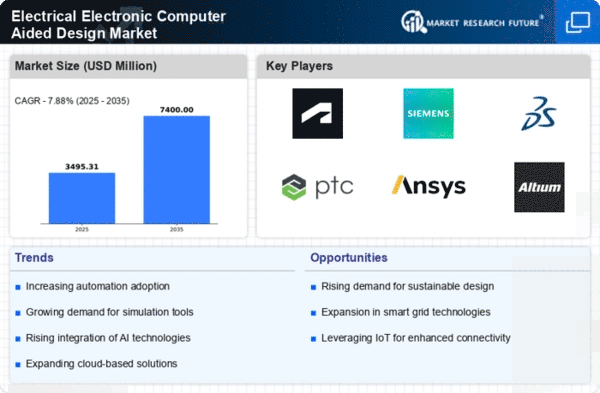
Electrical Electronic Computer Aided Design Market Infographic
Purchase Options

Market Share

Electrical Electronic Computer Aided Design Market Share Analysis

Electronic Design Automation (EDA) comprises various sets of software applications and algorithms crucial for the intricate design of semiconductor and electronic products. This technology relies on Electronic Computer-Aided Design (ECAD) software and incorporates the latest trends in computer and electronic technology. EDA, as an emerging technology, finds applications not only in electronic circuit design but also in diverse fields such as biomedical equipment, media & communications, and military applications.

One of the key advantages of EDA lies in its role in the design process, particularly in computer simulation. By utilizing EDA tools, designers can eliminate the stage of design verification, leading to an acceleration of the design process and a reduction in the design cycle. This not only expedites the overall process but also enhances design quality. In contrast to traditional mathematical methods, which are time-consuming and may yield less accurate results, EDA circuits leverage component models to enhance accuracy and minimize the time required for design.

The EDA system employs a database file to store model parameters and mature module designs. This approach enables users to seamlessly share data with other designers, fostering collaboration and knowledge exchange. Additionally, EDA tools play a crucial role in reducing the time required for designing complex Integrated Circuits (ICs), cutting manufacturing costs, optimizing IC design, and eliminating manufacturing errors. This comprehensive suite of capabilities makes EDA a valuable asset in the realm of electronic product design.

For designers working on Application-Specific Integrated Circuit (ASIC) logic, EDA tools offer a platform to translate logic design concepts into computer models. This functionality proves particularly beneficial when dealing with highly intricate integrated circuit applications. The tools provided by EDA enable designers to efficiently handle the complexities of ASIC logic, facilitating the implementation of advanced design ideas and contributing to the overall progress of electronic design processes.

In essence, EDA serves as a critical technology for the design and development of complex electronic products. Its applications extend across various industries, from electronics and biomedicine to media & communications and military applications. By leveraging EDA tools, designers can streamline the design process, enhance accuracy, and promote collaboration among design teams. The continued advancements in EDA contribute significantly to the evolution of electronic design, making it an indispensable element in the rapidly evolving landscape of technology and innovation.


Author
Aarti Dhapte
Team Lead - Research

She holds an experience of about 6+ years in Market Research and Business Consulting, working under the spectrum of Information Communication Technology, Telecommunications and Semiconductor domains. Aarti conceptualizes and implements a scalable business strategy and provides strategic leadership to the clients. Her expertise lies in market estimation, competitive intelligence, pipeline analysis, customer assessment, etc.

Leave a Comment

FAQs

What is the current valuation of the US electrical electronic computer aided design market?

As of 2024, the market valuation was 680.4 USD Million.

What is the projected market valuation for the US electrical electronic computer aided design market in 2035?

The market is projected to reach 1452.69 USD Million by 2035.

What is the expected CAGR for the US electrical electronic computer aided design market during the forecast period 2025 - 2035?

The expected CAGR for the market during 2025 - 2035 is 7.14%.

Which companies are considered key players in the US electrical electronic computer aided design market?

Key players include Cadence Design Systems, Synopsys, ANSYS, Altium, Mentor Graphics, Autodesk, Keysight Technologies, and Siemens EDA.

What are the main application segments of the US electrical electronic computer aided design market?

The main application segments include Electrical Design, Electronic Design, Mechanical Design, and System Design.

How did the Electronic Design segment perform in terms of valuation from 2024 to 2026?

The Electronic Design segment increased from 200.0 USD Million in 2024 to 420.0 USD Million in 2026.

Market Summary

As per analysis, the US electrical electronic computer aided design market is projected to grow from USD 680.4 Million in 2024 to USD 1452.69 Million by 2035, exhibiting a compound annual growth rate (CAGR) of 7.14% during the forecast period (2025 - 2035).

Key Market Trends & Highlights

The US electrical electronic computer aided design market is poised for substantial growth driven by technological advancements and evolving industry needs.

  • The integration of Artificial Intelligence is transforming design processes, enhancing efficiency and accuracy.
  • Sustainability in design practices is becoming increasingly prioritized, reflecting a shift towards environmentally conscious engineering.
  • Cloud-based collaboration tools are facilitating real-time teamwork, particularly in the rapidly growing automotive segment.
  • The growing demand for advanced electronics and the rise of the Internet of Things (IoT) are key drivers propelling the electrical design sector forward.

Market Size & Forecast

2024 Market Size 680.4 (USD Million)
2035 Market Size 1452.69 (USD Million)
CAGR (2025 - 2035) 7.14%

Major Players

<p>Cadence Design Systems (US), Synopsys (US), ANSYS (US), Altium (US), Mentor Graphics (US), Autodesk (US), Keysight Technologies (US), Siemens EDA (US)</p>

Market Trends

The US electrical electronic computer aided design market is currently experiencing a dynamic evolution, driven by advancements in technology and increasing demand for efficient design solutions. The integration of artificial intelligence and machine learning into design processes appears to enhance productivity and accuracy, allowing engineers and designers to create more complex systems with greater ease. Furthermore, the growing emphasis on sustainability and energy efficiency is influencing design practices, as companies seek to develop products that minimize environmental impact while maintaining performance standards. This shift towards eco-friendly design methodologies suggests a potential transformation in how products are conceptualized and brought to market. In addition, the rise of remote work and collaboration tools is reshaping the landscape of the US electrical electronic computer aided design market. As teams become more distributed, the need for robust software solutions that facilitate real-time collaboration and communication is paramount. This trend indicates a shift towards cloud-based platforms that offer flexibility and accessibility, enabling designers to work seamlessly across various locations. Overall, the market appears poised for continued growth, driven by technological advancements and changing work dynamics, which may redefine traditional design workflows and practices.

Integration of Artificial Intelligence

The incorporation of artificial intelligence into design processes is becoming increasingly prevalent. This trend suggests that AI can optimize workflows, enhance design accuracy, and reduce time spent on repetitive tasks, thereby allowing engineers to focus on more innovative aspects of their projects.

Sustainability in Design

A growing focus on sustainability is influencing the US electrical electronic computer aided design market. Companies are increasingly prioritizing eco-friendly practices, which may lead to the development of products that are not only efficient but also environmentally responsible, reflecting a broader societal shift towards sustainability.

Cloud-Based Collaboration Tools

The rise of remote work is driving demand for cloud-based collaboration tools within the design sector. These platforms facilitate real-time communication and project management, enabling teams to work together effectively regardless of their physical locations, thus transforming traditional design workflows.

Electrical Electronic Computer Aided Design Market Market Drivers

Increased Investment in R&D

Investment in research and development (R&D) within the electronics sector is a critical driver for the US electrical electronic computer aided design market. Companies are allocating significant resources to R&D to develop cutting-edge technologies and improve existing products. In 2025, the electronics industry in the US invested approximately 20 billion dollars in R&D, reflecting a commitment to innovation. This investment translates into a heightened demand for advanced CAD tools that facilitate rapid prototyping, simulation, and testing of new designs. As firms strive to maintain a competitive edge, the reliance on sophisticated CAD solutions is likely to intensify, thereby fostering growth in the US electrical electronic computer aided design market.

Rise of Internet of Things (IoT)

The proliferation of the Internet of Things (IoT) is reshaping the landscape of the US electrical electronic computer aided design market. As more devices become interconnected, the complexity of electronic designs increases, necessitating advanced CAD tools that can accommodate these intricate systems. The IoT market in the US is expected to reach over 1 trillion dollars by 2026, creating a substantial demand for innovative design solutions. CAD software that supports IoT applications enables engineers to design, simulate, and test interconnected devices efficiently. This trend not only enhances product development cycles but also fosters innovation in the design of smart devices, thereby propelling the growth of the US electrical electronic computer aided design market.

Regulatory Compliance and Standards

The US electrical electronic computer aided design market is significantly influenced by stringent regulatory requirements and industry standards. Compliance with safety, environmental, and performance regulations is essential for manufacturers of electronic products. The Federal Communications Commission (FCC) and the Environmental Protection Agency (EPA) impose regulations that necessitate the use of advanced CAD tools to ensure designs meet these standards. As a result, companies are increasingly investing in CAD software that incorporates compliance features, which not only streamlines the design process but also mitigates the risk of costly redesigns. This focus on regulatory adherence is likely to drive the growth of the US electrical electronic computer aided design market, as firms seek to enhance their design capabilities while ensuring compliance.

Growing Demand for Advanced Electronics

The US electrical electronic computer aided design market is experiencing a surge in demand for advanced electronic devices. This trend is driven by the increasing adoption of smart technologies across various sectors, including automotive, healthcare, and consumer electronics. According to recent data, the market for electronic devices is projected to grow at a compound annual growth rate of approximately 5.5% through 2026. This growth necessitates sophisticated design tools that can handle complex electronic systems, thereby propelling the demand for computer-aided design (CAD) software tailored for electronic applications. As companies strive to innovate and enhance product performance, the need for advanced CAD solutions becomes paramount, indicating a robust growth trajectory for the US electrical electronic computer aided design market.

Collaboration Across Geographical Boundaries

The trend of collaboration across geographical boundaries is reshaping the dynamics of the US electrical electronic computer aided design market. With the rise of remote work and global teams, there is an increasing need for collaborative design tools that enable engineers to work together seamlessly, regardless of location. Cloud-based CAD solutions are gaining traction, allowing teams to share designs and feedback in real-time. This shift not only enhances productivity but also accelerates the design process, as teams can iterate more quickly. The demand for such collaborative tools is expected to grow, indicating a positive outlook for the US electrical electronic computer aided design market as companies adapt to new ways of working.

Market Segment Insights

By Application: Electrical Design (Largest) vs. Electronic Design (Fastest-Growing)

<p>In the US electrical and electronic computer-aided design (CAD) market, the application segment is primarily dominated by Electrical Design, which holds the largest share due to its extensive use in various industries, including power generation and distribution. This segment benefits from significant investments in infrastructure and energy projects. Meanwhile, Electronic Design is rapidly gaining traction, being recognized for its critical role in the advancement of electronic components and smart devices, and is experiencing notable growth driven by market demand for innovative technologies.</p>

<p>Electrical Design (Dominant) vs. System Design (Emerging)</p>

<p>The Electrical Design segment stands out as the dominant force in the US CAD market, underpinned by its widespread application in sectors such as construction, manufacturing, and renewable energy. This segment is characterized by its emphasis on precision and compliance with regulations, often utilizing sophisticated software tools for circuit design and simulation. On the other hand, System Design is emerging as a significant player, focusing on integrating electrical and mechanical systems for complex solutions. With the rise of automation and smart technologies, System Design's importance is increasing as businesses seek to streamline operations and enhance efficiency.</p>

By End Use: Aerospace (Largest) vs. Automotive (Fastest-Growing)

<p>In the US electrical electronic computer aided design market, the end-use segment is characterized by significant diversification, with aerospace leading as the largest contributor. This segment has leveraged advanced technologies to streamline design processes, enhancing overall efficiency in product development. Automotive also plays a crucial role, rapidly gaining market share as electric and autonomous vehicle technologies emerge. Companies are increasingly adopting CAD tools tailored to meet industry-specific requirements, which is fostering growth across various sectors. The consumer electronics and telecommunications segments, while important, follow these two in terms of market share, showing a consistent but slower growth trajectory compared to aerospace and automotive.</p>

<p>Aerospace: Dominant vs. Automotive: Emerging</p>

<p>The aerospace segment is renowned for its stringent quality and safety standards, which makes it a dominant force in the US electrical electronic computer aided design market. It requires sophisticated CAD solutions that can accommodate complex simulations and integrations, thus driving innovation. On the other hand, the automotive segment is emerging rapidly due to the shift towards electrification and smart technology. This segment is characterized by a fast pace of change and a need for flexible and scalable design software that can handle new automotive technologies, such as advanced driver-assistance systems (ADAS) and electric powertrains. Both segments necessitate unique capabilities from CAD tools, reflecting their distinct demands in terms of functionality and innovation.</p>

By Deployment Type: Cloud-Based (Largest) vs. On-Premises (Fastest-Growing)

<p>In the US electrical electronic computer-aided design market, the deployment type segment is primarily characterized by three key values: On-Premises, Cloud-Based, and Hybrid. Among these, Cloud-Based solutions dominate the market due to their flexibility, scalability, and cost-effectiveness, appealing to a wide range of users. On-Premises systems maintain a significant share, favored by organizations that prioritize data security and control over their design processes. Hybrid models, while gaining traction, currently hold a smaller market presence but are increasingly being adopted to leverage both cloud advantages and on-premises capabilities.</p>

<p>Cloud-Based (Dominant) vs. On-Premises (Emerging)</p>

<p>Cloud-Based deployment in the US electrical electronic computer-aided design market is recognized as the dominant force, appealing to companies seeking efficiency and reduced IT overhead. Its scalable nature allows firms to adapt resources based on project demands, making it attractive for both small firms and large enterprises. On-Premises solutions, on the other hand, are seen as an emerging option for enterprises needing stringent data security and compliance with industry regulations. These organizations often prefer on-premises software to safeguard intellectual property and sensitive data. The demand for hybrid models is on the rise as they combine elements of both deployment types, enabling companies to enhance collaboration while still maintaining control over critical processes.</p>

By User Type: Large Enterprises (Largest) vs. Small and Medium Enterprises (Fastest-Growing)

<p>In the US electrical electronic computer aided design market, Large Enterprises dominate with a significant market share, leveraging their resources to integrate advanced software and technology seamlessly into their operations. Small and Medium Enterprises (SMEs) are gaining ground, capturing an increasing portion of the market as they innovate and adopt CAD solutions tailored to their specific needs. Educational Institutions also play a considerable role, emphasizing the importance of CAD technology in preparing future engineers and designers.</p>

<p>Large Enterprises (Dominant) vs. Small and Medium Enterprises (Emerging)</p>

<p>Large Enterprises in the US CAD market benefit from vast financial resources and established industry connections, allowing them to invest in cutting-edge technologies and comprehensive training programs. Conversely, Small and Medium Enterprises, driven by agile operations and niche market needs, are emerging as a significant force. They focus on customizable solutions and rapid deployment to cater to specific sectors, establishing a growing presence in the market. Educational Institutions, while less dominant, are crucial in fostering innovation and ensuring a skilled workforce, making their integration of CAD systems essential for future industry development.</p>

By Software Type: 3D CAD Software (Largest) vs. Simulation Software (Fastest-Growing)

<p>In the US electrical electronic computer-aided design market, the software type segment showcases a varied distribution of market share, with 3D CAD software leading the pack. Its extensive application across various industries solidifies its dominant position. Following this, simulation software has emerged as a significant contender, rapidly gaining traction due to its integral role in enhancing design verification processes. The remaining segment values, including 2D CAD and modeling software, while essential, hold a comparatively smaller share. These tools still contribute to a well-rounded software ecosystem, catering to specific design needs.</p>

<p>Software Type: 3D CAD (Dominant) vs. Simulation Software (Emerging)</p>

<p>3D CAD software is recognized as the dominant force in the US electrical electronic computer-aided design market, thanks to its comprehensive capabilities for creating detailed digital models. Its versatility allows for the visualization and manipulation of complex designs, making it an essential tool for engineers and designers alike. On the other hand, simulation software has become an emerging favorite, driven by the growing need for accurate design assessments and testing environments. This software enables professionals to evaluate how designs will perform in real-world conditions, thus fostering innovation and efficiency in the design process. Together, these software types reflect the evolving demands of modern design practices.</p>

Get more detailed insights about Electrical and Electronic Computer-Aided Design (ECAD) Market Research Report - Global Forecast till 2035

Regional Insights

North America : Leading Market Innovators

North America continues to lead the Electrical Electronic Computer Aided Design market, holding a significant share of 1620.0 million. The region's growth is driven by rapid technological advancements, increased demand for automation, and a strong focus on R&D. Regulatory support for innovation and sustainability further catalyzes market expansion, making it a hub for cutting-edge solutions. The competitive landscape is characterized by major players such as Autodesk, PTC, and ANSYS, which are headquartered in the U.S. This concentration of key companies fosters collaboration and innovation. The presence of a skilled workforce and robust infrastructure enhances the region's attractiveness for investment, ensuring continued leadership in the CAD market.

Europe : Emerging Technological Hub

Europe's Electrical Electronic Computer Aided Design market is projected at 900.0 million, reflecting a growing trend towards digital transformation across industries. The region benefits from stringent regulations promoting energy efficiency and sustainability, which drive demand for advanced CAD solutions. Countries like Germany and France are at the forefront, leveraging their engineering expertise to enhance product design and development. The competitive landscape features key players such as Siemens and Dassault Systemes, which are pivotal in shaping market dynamics. The European market is characterized by a strong emphasis on innovation and collaboration among companies and research institutions. This synergy fosters a vibrant ecosystem that supports the growth of CAD technologies, ensuring Europe remains a significant player in the global market.

Asia-Pacific : Rapidly Growing Market

The Asia-Pacific region, with a market size of 600.0 million, is witnessing a rapid increase in demand for Electrical Electronic Computer Aided Design solutions. This growth is fueled by the expansion of manufacturing sectors, particularly in countries like China and Japan, where technological advancements are reshaping traditional practices. Government initiatives aimed at promoting digitalization and smart manufacturing further bolster market prospects. Key players such as Zuken and Altium are making significant inroads in this region, capitalizing on the growing need for efficient design tools. The competitive landscape is evolving, with local companies emerging alongside established global firms. This dynamic environment is expected to drive innovation and enhance the overall market landscape in the coming years.

Middle East and Africa : Emerging Market Potential

The Middle East and Africa region, with a market size of 120.0 million, presents emerging opportunities in the Electrical Electronic Computer Aided Design market. The growth is primarily driven by increasing investments in infrastructure and technology, particularly in the Gulf Cooperation Council (GCC) countries. Regulatory frameworks are gradually evolving to support digital transformation, which is essential for attracting foreign investment and enhancing local capabilities. Countries like the UAE and South Africa are leading the charge, with a growing number of initiatives aimed at fostering innovation in design technologies. The competitive landscape is still developing, with both local and international players vying for market share. This region's potential for growth is significant, as it continues to embrace modern CAD solutions to meet the demands of various industries.

Key Players and Competitive Insights

The US electrical electronic computer aided design market is characterized by a dynamic competitive landscape, driven by rapid technological advancements and increasing demand for sophisticated design tools. Key players such as Cadence Design Systems (US), Synopsys (US), and ANSYS (US) are at the forefront, each adopting distinct strategies to enhance their market positioning. Cadence Design Systems (US) focuses on innovation through continuous investment in research and development, aiming to integrate AI capabilities into their design tools. Synopsys (US), on the other hand, emphasizes strategic partnerships and acquisitions to expand its product offerings and enhance its software capabilities. ANSYS (US) is leveraging its expertise in simulation technologies to provide comprehensive solutions that cater to the evolving needs of the market, particularly in sectors like automotive and aerospace.

The business tactics employed by these companies reflect a concerted effort to optimize operations and enhance customer engagement. Localizing manufacturing and supply chain optimization are prevalent strategies, allowing firms to respond swiftly to market demands. The competitive structure of the market appears moderately fragmented, with several players vying for market share, yet the influence of major companies remains substantial, shaping industry standards and practices.

In December 2025, Cadence Design Systems (US) announced a strategic partnership with a leading AI firm to develop next-generation design tools that incorporate machine learning algorithms. This collaboration is poised to enhance the efficiency of electronic design automation (EDA) processes, potentially revolutionizing how engineers approach complex design challenges. The integration of AI into their offerings may provide Cadence with a competitive edge, enabling faster design cycles and improved accuracy.

In November 2025, Synopsys (US) completed the acquisition of a prominent software company specializing in cloud-based design solutions. This acquisition is likely to bolster Synopsys's capabilities in providing scalable and flexible design tools, catering to the growing demand for cloud-based services in the EDA market. By enhancing its cloud offerings, Synopsys may attract a broader customer base, particularly among startups and smaller firms seeking cost-effective solutions.

In October 2025, ANSYS (US) launched a new simulation platform that integrates real-time data analytics with traditional simulation tools. This innovative platform aims to streamline the design process for engineers, allowing for more informed decision-making based on real-time insights. The strategic importance of this launch lies in ANSYS's ability to position itself as a leader in simulation technologies, addressing the increasing complexity of modern engineering challenges.

As of January 2026, the competitive trends in the market are increasingly defined by digitalization, sustainability, and the integration of AI technologies. Strategic alliances among key players are shaping the landscape, fostering innovation and enhancing product offerings. The shift from price-based competition to a focus on technological advancement and supply chain reliability is evident, suggesting that future competitive differentiation will hinge on the ability to innovate and adapt to changing market dynamics.

Key Companies in the Electrical Electronic Computer Aided Design Market include

Industry Developments

The product lifestyle management suite has been developed recently which comes along the help guidelines to assist the engineers and bring out the suitable designs for their equipment.

The cutting-edge technology and cloud-based technology have increased the value of the existing ECAD tools. Also, the 3D printers being used for the construction department helps the builders to construct the apartment blocks before investing. Such trends have been helping in building residential units in highly populated areas.

Future Outlook

Electrical Electronic Computer Aided Design Market Future Outlook

The US electrical electronic computer aided design market is projected to grow at a 7.14% CAGR from 2025 to 2035, driven by technological advancements and increased demand for automation.

New opportunities lie in:

  • Integration of AI-driven design tools for enhanced efficiency.
  • Development of cloud-based CAD solutions for remote collaboration.
  • Expansion into emerging markets with tailored CAD services.

By 2035, the market is expected to be robust, reflecting substantial growth and innovation.

Market Segmentation

Electrical Electronic Computer Aided Design Market End Use Outlook

  • Aerospace
  • Automotive
  • Consumer Electronics
  • Telecommunications

Electrical Electronic Computer Aided Design Market User Type Outlook

  • Small and Medium Enterprises
  • Large Enterprises
  • Educational Institutions

Electrical Electronic Computer Aided Design Market Application Outlook

  • Electrical Design
  • Electronic Design
  • Mechanical Design
  • System Design

Electrical Electronic Computer Aided Design Market Software Type Outlook

  • 2D CAD Software
  • 3D CAD Software
  • Simulation Software
  • Modeling Software

Electrical Electronic Computer Aided Design Market Deployment Type Outlook

  • On-Premises
  • Cloud-Based
  • Hybrid

Report Scope

MARKET SIZE 2024680.4(USD Million)
MARKET SIZE 2025726.6(USD Million)
MARKET SIZE 20351452.69(USD Million)
COMPOUND ANNUAL GROWTH RATE (CAGR)7.14% (2024 - 2035)
REPORT COVERAGERevenue Forecast, Competitive Landscape, Growth Factors, and Trends
BASE YEAR2024
Market Forecast Period2025 - 2035
Historical Data2019 - 2024
Market Forecast UnitsUSD Million
Key Companies ProfiledCadence Design Systems (US), Synopsys (US), ANSYS (US), Altium (US), Mentor Graphics (US), Autodesk (US), Keysight Technologies (US), Siemens EDA (US)
Segments CoveredApplication, End Use, Deployment Type, User Type, Software Type
Key Market OpportunitiesIntegration of artificial intelligence in design processes enhances efficiency in the us electrical electronic computer aided design market.
Key Market DynamicsTechnological advancements drive innovation in the US electrical electronic computer aided design market, enhancing design efficiency and collaboration.
Countries CoveredUS

FAQs

What is the current valuation of the US electrical electronic computer aided design market?

As of 2024, the market valuation was 680.4 USD Million.

What is the projected market valuation for the US electrical electronic computer aided design market in 2035?

The market is projected to reach 1452.69 USD Million by 2035.

What is the expected CAGR for the US electrical electronic computer aided design market during the forecast period 2025 - 2035?

The expected CAGR for the market during 2025 - 2035 is 7.14%.

Which companies are considered key players in the US electrical electronic computer aided design market?

Key players include Cadence Design Systems, Synopsys, ANSYS, Altium, Mentor Graphics, Autodesk, Keysight Technologies, and Siemens EDA.

What are the main application segments of the US electrical electronic computer aided design market?

The main application segments include Electrical Design, Electronic Design, Mechanical Design, and System Design.

How did the Electronic Design segment perform in terms of valuation from 2024 to 2026?

The Electronic Design segment increased from 200.0 USD Million in 2024 to 420.0 USD Million in 2026.

  1. SECTION I: EXECUTIVE SUMMARY AND KEY HIGHLIGHTS
    1. EXECUTIVE SUMMARY
      1. Market Overview
      2. Key Findings
      3. Market Segmentation
      4. Competitive Landscape
      5. Challenges and Opportunities
      6. Future Outlook
  2. SECTION II: SCOPING, METHODOLOGY AND MARKET STRUCTURE
    1. MARKET INTRODUCTION
      1. Definition
      2. Scope of the study
    2. RESEARCH METHODOLOGY
      1. Overview
      2. Data Mining
      3. Secondary Research
      4. Primary Research
      5. Forecasting Model
      6. Market Size Estimation
      7. Data Triangulation
      8. Validation
  3. SECTION III: QUALITATIVE ANALYSIS
    1. MARKET DYNAMICS
      1. Overview
      2. Drivers
      3. Restraints
      4. Opportunities
    2. MARKET FACTOR ANALYSIS
      1. Value chain Analysis
      2. Porter's Five Forces Analysis
      3. COVID-19 Impact Analysis
  4. SECTION IV: QUANTITATIVE ANALYSIS
    1. Information and Communications Technology, BY Application (USD Million)
      1. Product Design
      2. Simulation
      3. Testing
      4. Manufacturing
      5. Maintenance
    2. Information and Communications Technology, BY End Use (USD Million)
      1. Automotive
      2. Aerospace
      3. Consumer Electronics
      4. Telecommunications
      5. Industrial Equipment
    3. Information and Communications Technology, BY Deployment Type (USD Million)
      1. On-Premises
      2. Cloud-Based
      3. Hybrid
    4. Information and Communications Technology, BY Software Type (USD Million)
      1. 2D CAD Software
      2. 3D CAD Software
      3. Electrical CAD Software
      4. Mechanical CAD Software
    5. Information and Communications Technology, BY User Type (USD Million)
      1. Individual Users
      2. Small and Medium Enterprises
      3. Large Enterprises
    6. Information and Communications Technology, BY Region (USD Million)
      1. North America
      2. Europe
      3. APAC
      4. South America
      5. MEA
  5. SECTION V: COMPETITIVE ANALYSIS
    1. Competitive Landscape
      1. Overview
      2. Competitive Analysis
      3. Market share Analysis
      4. Major Growth Strategy in the Information and Communications Technology
      5. Competitive Benchmarking
      6. Leading Players in Terms of Number of Developments in the Information and Communications Technology
      7. Key developments and growth strategies
      8. Major Players Financial Matrix
    2. Company Profiles
      1. Autodesk (US)
      2. Siemens (DE)
      3. Dassault Systemes (FR)
      4. PTC (US)
      5. ANSYS (US)
      6. Altium (AU)
      7. Mentor Graphics (US)
      8. Cadence Design Systems (US)
      9. Zuken (JP)
    3. Appendix
      1. References
      2. Related Reports

Information and Communications Technology Market Segmentation

Information and Communications Technology By Application (USD Million, 2025-2035)

  • Product Design
  • Simulation
  • Testing
  • Manufacturing
  • Maintenance

Information and Communications Technology By End Use (USD Million, 2025-2035)

  • Automotive
  • Aerospace
  • Consumer Electronics
  • Telecommunications
  • Industrial Equipment

Information and Communications Technology By Deployment Type (USD Million, 2025-2035)

  • On-Premises
  • Cloud-Based
  • Hybrid

Information and Communications Technology By Software Type (USD Million, 2025-2035)

  • 2D CAD Software
  • 3D CAD Software
  • Electrical CAD Software
  • Mechanical CAD Software

Information and Communications Technology By User Type (USD Million, 2025-2035)

  • Individual Users
  • Small and Medium Enterprises
  • Large Enterprises
Infographic

Free Sample Request

Kindly complete the form below to receive a free sample of this Report

Get Free Sample

Customer Strories

Compare Licence

×
Features License Type
Single User Multiuser License Enterprise User
Price $4,950 $5,950 $7,250
Maximum User Access Limit 1 User Upto 10 Users Unrestricted Access Throughout the Organization
Free Customization
Direct Access to Analyst
Deliverable Format
Platform Access
Discount on Next Purchase 10% 15% 15%
Printable Versions