Request Free Sample ×

Kindly complete the form below to receive a free sample of this Report

* Please use a valid business email

Leading companies partner with us for data-driven Insights

clients tt-cursor
Hero Background
English
Chinese
French
Japanese
Korean
German
Spanish

Electric Wall Heater Market Analysis

ID: MRFR/Equip/6627-CR
128 Pages
Snehal Singh
Last Updated: February 25, 2026

Electric Wall Heater Market Research Report: Information By Application (Residential, Non-Residential), By Power (<1000 Watt, 1000 to 1600 Watt, 1600 to 2000 Watt, >2000 Watt) And By Region (North America, Europe, Asia-Pacific, And Rest Of The World) – Market Forecast Till 2035

Share:
Download PDF ×

We do not share your information with anyone. However, we may send you emails based on your report interest from time to time. You may contact us at any time to opt-out.

Electric Wall Heater Market Infographic
Purchase Options

Market Analysis

In-depth Analysis of Electric Wall Heater Market Industry Landscape

The electric wall heater market is set to reach US$ 5.8 BN by 2032, at a 5.80% CAGR between years 2023-2032. The market for electric wall heaters displays strong dynamics that are caused by several factors, which form its environment. The growing consciousness and the implementation of energy-efficient heating technologies is one of the major factors. With the growing awareness among consumers of their impact on climate and energy spending, electric wall heaters have become a very viable alternative due to its ability to convert electricity into heat. Technological developments in the electric heating systems also affect the market dynamics. Electric wall heaters are always evolving by the manufacturers to make them more effecient, safe and user friendly. Increasingly available smart features include programmable thermostats and remote controls, which meet the demands for heating solutions that are both simple to use yet also customizable. Energy-saving government programs and mandates are the essential components of the electric wall heater market. This phenomenon is very evident across the globe such that there is a lot of pressure towards lowering carbon emission and implementing green practices. This implies that consumers are motivated to purchase electric wall heaters which have high energy efficiencies; the manufacturers become competitive towards producing environment-friendly and also compliant products. The overall growth of the construction industry greatly affects the market dynamics. As more new residential and business buildings are being erected, the need for efficient heat supply solutions including electric wall heater increases at once. Besides the fact that renovations and enhancements in the existing buildings lead to market growth, as consumers seek contemporary and energy-efficient heating technologies. The changing trends of consumer preferences and also lifestyle influence the dynamic nature of electric wall heater market. The demand for minimal, space saving designs that can blend in well with different rooms including both the living room and also offices have made manufacturers come up with aesthetically appealing wall heaters. These heating solutions become even more advantageous with the ease of installation and also low maintenance costs. Market dynamics are greatly influenced by many factors such as competitive pricing and also cost affordability. Some high-end, feature rich electric wall heaters are targeted at a specific segment of the market and there is also an increasing demand for budget heating options with out compromising on the performance level. Manufacturers are responding to this shift by producing goods at various prices which creates more customers while also adding momentum into the larger market structure. The significance of global events and economic conditions cannot be dismissed at all when considering the market dynamics. The electrical wall heaters production, distribution, and also pricing are a product of the economic fluctuations supply chain disruptions and geopolitical factors.


Author
Author Profile
Snehal Singh
Manager - Research

High acumen in analyzing complex macro & micro markets with more than 6 years of work experience in the field of market research. By implementing her analytical skills in forecasting and estimation into market research reports, she has expertise in Packaging, Construction, and Equipment domains. She handles a team size of 20-25 resources and ensures smooth running of the projects, associated marketing activities, and client servicing.

Leave a Comment

FAQs

What is the current valuation of The Global Electric Wall Heater?

<p>The market valuation reached 3.91 USD Billion in 2024.</p>

What is the projected market size for The Global Electric Wall Heater by 2035?

<p>The market is expected to grow to 6.717 USD Billion by 2035.</p>

What is the expected CAGR for The Global Electric Wall Heater during the forecast period?

<p>The anticipated CAGR for the market from 2025 to 2035 is 5.04%.</p>

Which segments are included in The Global Electric Wall Heater?

<p>The market segments include Residential and Non-Residential applications.</p>

What were the valuations for the Residential and Non-Residential segments in 2024?

<p>In 2024, the Residential segment was valued at 2.34 USD Billion, while the Non-Residential segment was valued at 1.57 USD Billion.</p>

How do the power ratings of electric wall heaters affect market valuation?

Power ratings such as '&lt;1000 Watt' and '1000 to 1600 Watt' contributed to valuations of 0.78 USD Billion and 1.17 USD Billion, respectively, in 2024.

Who are the key players in The Global Electric Wall Heater?

Key players include Stiebel Eltron, Dimplex, Cadet, and Fahrenheat, among others.

What is the projected growth for the '<1000 Watt' power segment by 2035?

The '&lt;1000 Watt' segment is projected to grow to 1.25 USD Billion by 2035.

What is the expected valuation for the '1000 to 1600 Watt' segment in 2035?

The '1000 to 1600 Watt' segment is anticipated to reach 1.85 USD Billion by 2035.

How does the market performance of electric wall heaters compare across different power ratings?

In 2024, the '1600 to 2000 Watt' segment was valued at 1.12 USD Billion, indicating varied performance across power ratings.

Market Summary

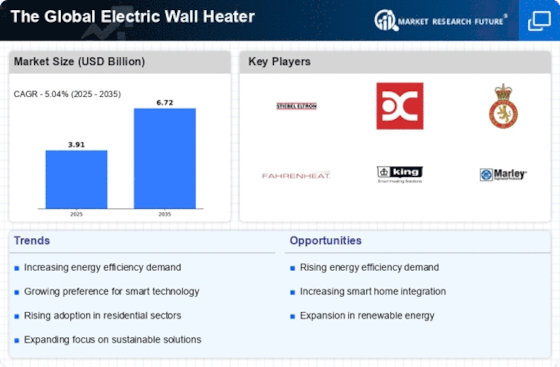
As per Market Research Future analysis, The Global Electric Wall Heater Market was estimated at 3.91 USD Billion in 2024. The electric wall heater industry is projected to grow from 4.107 USD Billion in 2025 to 6.717 USD Billion by 2035, exhibiting a compound annual growth rate (CAGR) of 5.04% during the forecast period 2025 - 2035

Key Market Trends & Highlights

The Global Electric Wall Heater Market is poised for growth driven by technological advancements and a focus on sustainability.

  • North America remains the largest market for electric wall heaters, driven by increasing demand for energy-efficient heating solutions. The Asia-Pacific region is emerging as the fastest-growing market, fueled by rapid urbanization and rising disposable incomes. The residential segment dominates the market, while the non-residential segment is experiencing the fastest growth due to expanding commercial spaces. Technological advancements and a heightened focus on sustainability are key drivers propelling market expansion.

Market Size & Forecast

2024 Market Size 3.91 (USD Billion)
2035 Market Size 6.717 (USD Billion)
CAGR (2025 - 2035) 5.04%
Largest Regional Market Share in 2024 North America

Major Players

Stiebel Eltron (DE), Dimplex (GB), <a href="https://www.cadet.glendimplexamericas.com/en-us/electric-heating-solutions/all-electric-heaters">Cadet </a>(US), Fahrenheat (US), King Electric (US), Marley Engineered Products (US), <a href="https://www.comfortzoneproducts.com/collections/heaters">Comfort Zone</a> (US), Econo-Heat (AU), TPI Corporation (US)

Market Trends

The Global Electric Wall Heater Market is currently experiencing a notable transformation, driven by a combination of technological advancements and evolving consumer preferences. As energy efficiency becomes increasingly paramount, manufacturers are focusing on developing innovative heating solutions that not only provide warmth but also minimize energy consumption. This shift is indicative of a broader trend towards sustainability, where consumers are more inclined to invest in products that align with their environmental values. Furthermore, the integration of smart technology into electric wall heaters is gaining traction, allowing users to control their induction heating systems remotely and optimize energy usage. In addition to technological innovations, the market is also influenced by changing lifestyles and urbanization. As more individuals move into urban areas, the demand for compact and efficient heating solutions rises. Electric wall heaters, with their space-saving designs, cater to this need effectively. Moreover, the growing trend of home renovations and improvements is propelling the market forward, as homeowners seek to enhance comfort and energy efficiency in their living spaces. Overall, The Electric Wall Heater Market appears poised for continued growth, driven by a confluence of technological, environmental, and lifestyle factors.

Technological Advancements

The integration of smart technology into electric wall heaters is becoming increasingly prevalent. This trend allows users to control their heating systems remotely, enhancing convenience and energy efficiency.

Sustainability Focus

There is a growing emphasis on energy-efficient heating solutions. Consumers are more inclined to choose products that reduce energy consumption, reflecting a broader commitment to environmental sustainability.

Urbanization and Compact Solutions

As urban living spaces become more common, the demand for compact and efficient heating solutions rises. Electric wall heaters are well-suited to meet the needs of smaller living environments.

Electric Wall Heater Market Market Drivers

Sustainability Focus

The Electric Wall Heater Industry is increasingly influenced by a growing focus on sustainability and energy efficiency. Consumers are becoming more environmentally conscious, leading to a demand for heating solutions that minimize carbon footprints. Electric wall heaters, particularly those utilizing renewable energy sources, are gaining traction as they offer cleaner alternatives to traditional heating methods. According to recent data, the market for energy-efficient electric heaters is expected to expand significantly, with a projected increase in sales of up to 20% in the next few years. This shift towards sustainable heating solutions is not only driven by consumer preferences but also by regulatory frameworks that encourage the adoption of energy-efficient appliances. As governments worldwide implement stricter energy efficiency standards, manufacturers are compelled to innovate, thereby enhancing the overall market landscape.

Rising Disposable Incomes

The Electric Wall Heater Industry is also benefiting from rising disposable incomes, particularly in emerging economies. As consumers gain more financial flexibility, they are increasingly willing to invest in home improvement and energy-efficient appliances. This trend is particularly evident in regions where economic growth is robust, leading to a surge in residential construction and renovation projects. Market data suggests that the demand for electric wall heaters is likely to increase by approximately 10% in these regions as homeowners seek to enhance comfort and energy efficiency. Additionally, the availability of financing options and incentives for energy-efficient upgrades further encourages consumers to opt for electric wall heaters. This growing purchasing power is expected to play a crucial role in shaping the market dynamics in the coming years.

Technological Advancements

The Electric Wall Heater Industry is experiencing a surge in technological advancements that enhance efficiency and user experience. Innovations such as smart thermostats and energy-efficient heating elements are becoming increasingly prevalent. These advancements not only improve energy consumption but also provide users with greater control over their heating systems. For instance, the integration of IoT technology allows for remote monitoring and management, which is appealing to tech-savvy consumers. As a result, the market is projected to grow at a compound annual growth rate (CAGR) of approximately 6% over the next five years, driven by these technological improvements. Furthermore, manufacturers are investing in research and development to create more compact and aesthetically pleasing designs, which could further stimulate demand in the residential sector.

Urbanization and Compact Solutions

The Global Electric Wall Heater Industry is witnessing a notable impact from urbanization trends, particularly in densely populated areas. As more individuals move to urban centers, the demand for compact and efficient heating solutions is on the rise. Electric wall heaters are particularly well-suited for small living spaces, such as apartments and condominiums, where traditional heating systems may be impractical. Market analysis indicates that urban areas are expected to account for a significant portion of the overall demand, with projections suggesting a 15% increase in sales in metropolitan regions over the next few years. This trend is further supported by the growing preference for minimalist living, where space-saving appliances are favored. Consequently, manufacturers are focusing on developing sleek, wall-mounted designs that cater to the needs of urban dwellers.

Increased Awareness of Health Benefits

The Global Electric Wall Heater Industry is experiencing a shift in consumer awareness regarding the health benefits associated with electric heating solutions. As individuals become more informed about indoor air quality and the potential health risks of traditional heating methods, there is a growing preference for electric wall heaters. These systems are known for providing consistent and clean heat, which can contribute to a healthier living environment. Market Research Future indicates that consumers are increasingly prioritizing products that promote well-being, leading to a projected increase in demand for electric wall heaters by approximately 12% over the next few years. Furthermore, the ability of electric industrial heaters to reduce allergens and improve air circulation is likely to resonate with health-conscious consumers, thereby driving market growth.

Market Segment Insights

By Application: Residential (Largest) vs. Non-Residential (Fastest-Growing)

<p>In The Global Electric Wall Heater, the Residential segment commands a substantial portion of the market share. This is primarily due to increasing consumer preference for energy-efficient heating solutions in homes. Many consumers are transitioning from traditional heating methods to electric wall heaters, drawn by their convenience, modern design, and space-saving capabilities. On the other hand, the Non-Residential segment is experiencing rapid growth, driven by the rising demand for electric wall heaters in commercial spaces such as offices, retail outlets, and industrial facilities.</p>

<p>Application: Residential (Dominant) vs. Non-Residential (Emerging)</p>

<p>The Residential segment of The Global Electric Wall Heater remains the dominant force, appealing to homeowners who seek efficiency, ease of installation, and aesthetic appeal. These heaters are ideal for various living spaces, offering customizable heating options for different rooms. In contrast, the Non-Residential segment is emerging as a key player, fueled by the need for reliable heating solutions in commercial properties. Businesses are increasingly adopting electric wall heaters for their energy-saving features, making them a preferred choice for enhancing comfort in office environments and public spaces.</p>

By Power: <1000 Watt (Largest) vs. >2000 Watt (Fastest-Growing)

<p>In The Global Electric Wall Heater, the power segment showcases a diverse range of options, with the <1000 Watt segment holding the largest market share. This category appeals to consumers seeking energy-efficient solutions for smaller spaces, providing adequate heating without excessive power consumption. In contrast, the >2000 Watt segment is emerging rapidly, catering to larger areas requiring significant heating power and gaining traction among consumers needing quick and effective heating solutions.</p>

<p>1000 to 1600 Watt: Dominant vs. 1600 to 2000 Watt: Emerging</p>

<p>The 1000 to 1600 Watt segment represents a dominant force in The Global Electric Wall Heater, striking an optimal balance between efficient heating and energy consumption. This range is particularly favored by consumers looking to heat medium-sized rooms effectively without incurring high energy costs. On the other hand, the 1600 to 2000 Watt segment is seen as an emerging category, attracting users who require more substantial heating capabilities for larger spaces or those wanting faster heating solutions. As energy efficiency gains importance, both segments are expected to capitalize on evolving consumer preferences, with the former remaining popular for regular use and the latter appealing for premium, quick-heating necessities.</p>

Electric Wall Heater Market Power Insights

The Electric Wall Heater Market segmentation, based on Power, includes &lt;1000 Watt, 1000 to 1600 Watt, 1600 to 2000 Watt, &gt;2000 Watt. The 1000 to 1600 Watt category has the biggest market share. This section is popular because it provides a good mix of heating power and energy efficiency, making it suited for a wide range of applications. Furthermore, electric wall heaters in this wattage range are frequently less expensive than higher wattage models, making them more accessible to consumers.

Get more detailed insights about Electric Wall Heater Market Research Report - Global Forecast till 2035

Regional Insights

North America : Market Leader in Innovation

North America is the largest market for electric wall heaters, holding approximately 45% of the global market share. The region's growth is driven by increasing energy efficiency regulations and a rising demand for smart home technologies. The U.S. and Canada are the primary contributors, with a strong focus on sustainable heating solutions and government incentives promoting energy-efficient appliances. The competitive landscape is robust, featuring key players like Stiebel Eltron, Cadet, and Fahrenheat. These companies are innovating to meet consumer demands for energy-efficient and smart heating solutions. The presence of established manufacturers and a growing trend towards home automation further bolster market growth in this region. The focus on reducing carbon footprints is also influencing product development and consumer preferences.

Europe : Emerging Market with Regulations

Europe is witnessing significant growth in the electric wall heater market, driven by stringent energy efficiency regulations and a shift towards renewable energy sources. The region holds approximately 30% of the global market share, with Germany and the UK being the largest markets. The European Union's commitment to reducing carbon emissions is a key catalyst for this growth, encouraging the adoption of energy-efficient heating solutions. Leading countries like Germany and the UK are home to major players such as Dimplex and Econo-Heat, which are focusing on innovative technologies to meet regulatory standards. The competitive landscape is characterized by a mix of established brands and emerging companies, all striving to enhance energy efficiency and sustainability in heating solutions. The market is also supported by government initiatives promoting eco-friendly products.

Asia-Pacific : Rapid Growth in Emerging Markets

Asia-Pacific is rapidly emerging as a significant player in the electric wall heater market, accounting for approximately 20% of the global share. The growth is fueled by urbanization, rising disposable incomes, and increasing awareness of energy-efficient heating solutions. Countries like China and India are leading the charge, with government initiatives promoting sustainable energy practices and modern heating technologies. The competitive landscape is evolving, with local manufacturers and international players like TPI Corporation and Marley Engineered Products vying for market share. The region's diverse climate conditions and varying consumer preferences are driving innovation in product offerings. As the demand for energy-efficient solutions continues to rise, companies are focusing on developing products that cater to both residential and commercial sectors, enhancing their market presence.

Middle East and Africa : Untapped Potential in Heating Solutions

The Middle East and Africa region is gradually emerging in the electric wall heater market, holding about 5% of the global share. The growth is primarily driven by increasing urbanization, rising temperatures, and a growing demand for efficient heating solutions in residential and commercial sectors. Countries like South Africa and the UAE are leading the market, with investments in infrastructure and energy-efficient technologies. The competitive landscape is still developing, with a mix of local and international players. Companies are focusing on adapting their products to meet the unique climate conditions and consumer preferences in the region. As awareness of energy efficiency grows, the market is expected to expand, with more players entering the field to capitalize on the untapped potential in heating solutions.

Key Players and Competitive Insights

Leading market players are investing heavily in research and development in order to expand their product lines, which will help the Electric Wall Heater Market, grow even more. Market participants are also undertaking a variety of strategic activities to expand their global footprint, with important market developments including new product launches, contractual agreements, mergers and acquisitions, higher investments, and collaboration with other organizations. To expand and survive in a more competitive and rising market climate, Electric Wall Heaterindustry must offer cost-effective items. Manufacturing locally to minimize operational costs is one of the key business tactics used by manufacturers in the global Electric Wall Heater industry to benefit clients and increase the market sector. In recent years, the Electric Wall Heater industry has offered some of the most significant advantages to medicine. Major players in the Electric Wall Heater Market, including Markel Products Company, Trane, Broan, Inc., WarmlyYours.com, Inc., King Electric, Indeeco, Glen Dimplex Group, and Radiant Systems and others, are attempting to increase market demand by investing in research and development operations. Stiebel Eltron is a German firm that makes central heating products such as heat pumps. In 2008, the UK office was established on the Wirral Peninsula. Stiebel Eltron began in Berlin in 1924, when Dr. Theodor Stiebel founded it. Today, it is a low-carbon green energy specialist that manufactures ground, air, and water source heat pumps. It also manufactures ventilation, air conditioning, and system technology. It has a global turnover of €700 million and employs 4000 people. In 2019, Stiebel Eltron has produced electric wall heaters that are both energy-efficient and environmentally beneficial. These heaters employ sophisticated heating technologies such as infrared and ceramic heating, which are more energy-efficient than classic heating elements. GlenDimplex is an Irish consumer Electronics Company headquartered in Dublin, Ireland. The corporation is privately held, having manufacturing and development facilities in the Republic of Ireland, the United Kingdom, China, and numerous other locations worldwide. The company was formed as Glen Electric on August 23, 1973, in Newry, Northern Ireland, as an electric heater producer with ten employees, and it was renamed Glen Dimplex after a merger with Dimplex, a prominent electric heating appliance manufacturer. Morphy Richards and Burco Dean Appliances, situated in Mexborough near Doncaster, England, were bought by the Glen Dimplex Group. In 2021, Dimplex has released WiFi-enabled electric wall heaters, which can be controlled remotely via a smartphone app. Users can alter temperature settings, establish schedules, and monitor energy consumption from anywhere, making these heaters more convenient and energy-efficient.

Key Companies in the Electric Wall Heater Market include

Industry Developments

March 2022: Rointe has released electric wall heaters that are elegant, fashionable, and unobtrusive. These heaters are frequently smaller and more compact than typical electric wall heaters, making them perfect for tight quarters or areas with limited wall space.

February 2021: Haverland has released electric wall heaters that can be linked to smart home systems like Amazon Alexa and Google Home. Users can utilize voice commands to control their electric wall heaters, making them more convenient and user-friendly. Furthermore, many electric wall heaters now have smartphone apps that enable users to change temperature settings, establish schedules, and monitor energy consumption from anywhere, making them more energy-efficient and cost-effective.

January 2020, Warmup and Tansun have created electric wall heaters that use infrared heating technology, which is more efficient and effective than standard convection heating at heating vast spaces.

Future Outlook

Electric Wall Heater Market Future Outlook

The Global Electric Wall Heater Market is projected to grow at a 5.04% CAGR from 2025 to 2035, driven by energy efficiency demands, technological advancements, and increasing residential construction.

New opportunities lie in:

  • <p>Expansion into smart home integration solutions Development of energy-efficient models targeting eco-conscious consumers Partnerships with construction firms for bulk supply agreements</p>

By 2035, the market is expected to solidify its position as a leader in energy-efficient heating solutions.

Market Segmentation

Electric Wall Heater Market Power Outlook

  • <1000 Watt
  • 1000 to 1600 Watt
  • 1600 to 2000 Watt
  • >2000 Watt

Electric Wall Heater Market Application Outlook

  • Residential
  • Non-Residential

Report Scope

MARKET SIZE 2024 3.91(USD Billion)
MARKET SIZE 2025 4.107(USD Billion)
MARKET SIZE 2035 6.717(USD Billion)
COMPOUND ANNUAL GROWTH RATE (CAGR) 5.04% (2025 - 2035)
REPORT COVERAGE Revenue Forecast, Competitive Landscape, Growth Factors, and Trends
BASE YEAR 2024
Market Forecast Period 2025 - 2035
Historical Data 2019 - 2024
Market Forecast Units USD Billion
Key Companies Profiled Stiebel Eltron (DE), Dimplex (GB), Cadet (US), Fahrenheat (US), King Electric (US), Marley Engineered Products (US), Comfort Zone (US), Econo-Heat (AU), TPI Corporation (US)
Segments Covered Application, Power, Region
Key Market Opportunities Integration of smart technology enhances energy efficiency in The Global Electric Wall Heater.
Key Market Dynamics Rising consumer preference for energy-efficient heating solutions drives innovation in electric wall heater technology.
Countries Covered North America, Europe, APAC, South America, MEA

FAQs

What is the current valuation of The Global Electric Wall Heater?

<p>The market valuation reached 3.91 USD Billion in 2024.</p>

What is the projected market size for The Global Electric Wall Heater by 2035?

<p>The market is expected to grow to 6.717 USD Billion by 2035.</p>

What is the expected CAGR for The Global Electric Wall Heater during the forecast period?

<p>The anticipated CAGR for the market from 2025 to 2035 is 5.04%.</p>

Which segments are included in The Global Electric Wall Heater?

<p>The market segments include Residential and Non-Residential applications.</p>

What were the valuations for the Residential and Non-Residential segments in 2024?

<p>In 2024, the Residential segment was valued at 2.34 USD Billion, while the Non-Residential segment was valued at 1.57 USD Billion.</p>

How do the power ratings of electric wall heaters affect market valuation?

Power ratings such as '&lt;1000 Watt' and '1000 to 1600 Watt' contributed to valuations of 0.78 USD Billion and 1.17 USD Billion, respectively, in 2024.

Who are the key players in The Global Electric Wall Heater?

Key players include Stiebel Eltron, Dimplex, Cadet, and Fahrenheat, among others.

What is the projected growth for the '<1000 Watt' power segment by 2035?

The '&lt;1000 Watt' segment is projected to grow to 1.25 USD Billion by 2035.

What is the expected valuation for the '1000 to 1600 Watt' segment in 2035?

The '1000 to 1600 Watt' segment is anticipated to reach 1.85 USD Billion by 2035.

How does the market performance of electric wall heaters compare across different power ratings?

In 2024, the '1600 to 2000 Watt' segment was valued at 1.12 USD Billion, indicating varied performance across power ratings.

  1. SECTION I: EXECUTIVE SUMMARY AND KEY HIGHLIGHTS
    1. | 1.1 EXECUTIVE SUMMARY
    2. | | 1.1.1 Market Overview
    3. | | 1.1.2 Key Findings
    4. | | 1.1.3 Market Segmentation
    5. | | 1.1.4 Competitive Landscape
    6. | | 1.1.5 Challenges and Opportunities
    7. | | 1.1.6 Future Outlook
  2. SECTION II: SCOPING, METHODOLOGY AND MARKET STRUCTURE
    1. | 2.1 MARKET INTRODUCTION
    2. | | 2.1.1 Definition
    3. | | 2.1.2 Scope of the study
    4. | | | 2.1.2.1 Research Objective
    5. | | | 2.1.2.2 Assumption
    6. | | | 2.1.2.3 Limitations
    7. | 2.2 RESEARCH METHODOLOGY
    8. | | 2.2.1 Overview
    9. | | 2.2.2 Data Mining
    10. | | 2.2.3 Secondary Research
    11. | | 2.2.4 Primary Research
    12. | | | 2.2.4.1 Primary Interviews and Information Gathering Process
    13. | | | 2.2.4.2 Breakdown of Primary Respondents
    14. | | 2.2.5 Forecasting Model
    15. | | 2.2.6 Market Size Estimation
    16. | | | 2.2.6.1 Bottom-Up Approach
    17. | | | 2.2.6.2 Top-Down Approach
    18. | | 2.2.7 Data Triangulation
    19. | | 2.2.8 Validation
  3. SECTION III: QUALITATIVE ANALYSIS
    1. | 3.1 MARKET DYNAMICS
    2. | | 3.1.1 Overview
    3. | | 3.1.2 Drivers
    4. | | 3.1.3 Restraints
    5. | | 3.1.4 Opportunities
    6. | 3.2 MARKET FACTOR ANALYSIS
    7. | | 3.2.1 Value chain Analysis
    8. | | 3.2.2 Porter's Five Forces Analysis
    9. | | | 3.2.2.1 Bargaining Power of Suppliers
    10. | | | 3.2.2.2 Bargaining Power of Buyers
    11. | | | 3.2.2.3 Threat of New Entrants
    12. | | | 3.2.2.4 Threat of Substitutes
    13. | | | 3.2.2.5 Intensity of Rivalry
    14. | | 3.2.3 COVID-19 Impact Analysis
    15. | | | 3.2.3.1 Market Impact Analysis
    16. | | | 3.2.3.2 Regional Impact
    17. | | | 3.2.3.3 Opportunity and Threat Analysis
  4. SECTION IV: QUANTITATIVE ANALYSIS
    1. | 4.1 Life Sciences, BY Application (USD Billion)
    2. | | 4.1.1 Residential
    3. | | 4.1.2 Non-Residential
    4. | 4.2 Life Sciences, BY Power (USD Billion)
    5. | | 4.2.1 2000 Watt
    6. | 4.3 Life Sciences, BY Region (USD Billion)
    7. | | 4.3.1 North America
    8. | | | 4.3.1.1 US
    9. | | | 4.3.1.2 Canada
    10. | | 4.3.2 Europe
    11. | | | 4.3.2.1 Germany
    12. | | | 4.3.2.2 UK
    13. | | | 4.3.2.3 France
    14. | | | 4.3.2.4 Russia
    15. | | | 4.3.2.5 Italy
    16. | | | 4.3.2.6 Spain
    17. | | | 4.3.2.7 Rest of Europe
    18. | | 4.3.3 APAC
    19. | | | 4.3.3.1 China
    20. | | | 4.3.3.2 India
    21. | | | 4.3.3.3 Japan
    22. | | | 4.3.3.4 South Korea
    23. | | | 4.3.3.5 Malaysia
    24. | | | 4.3.3.6 Thailand
    25. | | | 4.3.3.7 Indonesia
    26. | | | 4.3.3.8 Rest of APAC
    27. | | 4.3.4 South America
    28. | | | 4.3.4.1 Brazil
    29. | | | 4.3.4.2 Mexico
    30. | | | 4.3.4.3 Argentina
    31. | | | 4.3.4.4 Rest of South America
    32. | | 4.3.5 MEA
    33. | | | 4.3.5.1 GCC Countries
    34. | | | 4.3.5.2 South Africa
    35. | | | 4.3.5.3 Rest of MEA
  5. SECTION V: COMPETITIVE ANALYSIS
    1. | 5.1 Competitive Landscape
    2. | | 5.1.1 Overview
    3. | | 5.1.2 Competitive Analysis
    4. | | 5.1.3 Market share Analysis
    5. | | 5.1.4 Major Growth Strategy in the Life Sciences
    6. | | 5.1.5 Competitive Benchmarking
    7. | | 5.1.6 Leading Players in Terms of Number of Developments in the Life Sciences
    8. | | 5.1.7 Key developments and growth strategies
    9. | | | 5.1.7.1 New Product Launch/Service Deployment
    10. | | | 5.1.7.2 Merger & Acquisitions
    11. | | | 5.1.7.3 Joint Ventures
    12. | | 5.1.8 Major Players Financial Matrix
    13. | | | 5.1.8.1 Sales and Operating Income
    14. | | | 5.1.8.2 Major Players R&D Expenditure. 2023
    15. | 5.2 Company Profiles
    16. | | 5.2.1 Stiebel Eltron (DE)
    17. | | | 5.2.1.1 Financial Overview
    18. | | | 5.2.1.2 Products Offered
    19. | | | 5.2.1.3 Key Developments
    20. | | | 5.2.1.4 SWOT Analysis
    21. | | | 5.2.1.5 Key Strategies
    22. | | 5.2.2 Dimplex (GB)
    23. | | | 5.2.2.1 Financial Overview
    24. | | | 5.2.2.2 Products Offered
    25. | | | 5.2.2.3 Key Developments
    26. | | | 5.2.2.4 SWOT Analysis
    27. | | | 5.2.2.5 Key Strategies
    28. | | 5.2.3 Cadet (US)
    29. | | | 5.2.3.1 Financial Overview
    30. | | | 5.2.3.2 Products Offered
    31. | | | 5.2.3.3 Key Developments
    32. | | | 5.2.3.4 SWOT Analysis
    33. | | | 5.2.3.5 Key Strategies
    34. | | 5.2.4 Fahrenheat (US)
    35. | | | 5.2.4.1 Financial Overview
    36. | | | 5.2.4.2 Products Offered
    37. | | | 5.2.4.3 Key Developments
    38. | | | 5.2.4.4 SWOT Analysis
    39. | | | 5.2.4.5 Key Strategies
    40. | | 5.2.5 King Electric (US)
    41. | | | 5.2.5.1 Financial Overview
    42. | | | 5.2.5.2 Products Offered
    43. | | | 5.2.5.3 Key Developments
    44. | | | 5.2.5.4 SWOT Analysis
    45. | | | 5.2.5.5 Key Strategies
    46. | | 5.2.6 Marley Engineered Products (US)
    47. | | | 5.2.6.1 Financial Overview
    48. | | | 5.2.6.2 Products Offered
    49. | | | 5.2.6.3 Key Developments
    50. | | | 5.2.6.4 SWOT Analysis
    51. | | | 5.2.6.5 Key Strategies
    52. | | 5.2.7 Comfort Zone (US)
    53. | | | 5.2.7.1 Financial Overview
    54. | | | 5.2.7.2 Products Offered
    55. | | | 5.2.7.3 Key Developments
    56. | | | 5.2.7.4 SWOT Analysis
    57. | | | 5.2.7.5 Key Strategies
    58. | | 5.2.8 Econo-Heat (AU)
    59. | | | 5.2.8.1 Financial Overview
    60. | | | 5.2.8.2 Products Offered
    61. | | | 5.2.8.3 Key Developments
    62. | | | 5.2.8.4 SWOT Analysis
    63. | | | 5.2.8.5 Key Strategies
    64. | | 5.2.9 TPI Corporation (US)
    65. | | | 5.2.9.1 Financial Overview
    66. | | | 5.2.9.2 Products Offered
    67. | | | 5.2.9.3 Key Developments
    68. | | | 5.2.9.4 SWOT Analysis
    69. | | | 5.2.9.5 Key Strategies
    70. | 5.3 Appendix
    71. | | 5.3.1 References
    72. | | 5.3.2 Related Reports
  6. LIST OF FIGURES
    1. | 6.1 MARKET SYNOPSIS
    2. | 6.2 NORTH AMERICA MARKET ANALYSIS
    3. | 6.3 US MARKET ANALYSIS BY APPLICATION
    4. | 6.4 US MARKET ANALYSIS BY POWER
    5. | 6.5 CANADA MARKET ANALYSIS BY APPLICATION
    6. | 6.6 CANADA MARKET ANALYSIS BY POWER
    7. | 6.7 EUROPE MARKET ANALYSIS
    8. | 6.8 GERMANY MARKET ANALYSIS BY APPLICATION
    9. | 6.9 GERMANY MARKET ANALYSIS BY POWER
    10. | 6.10 UK MARKET ANALYSIS BY APPLICATION
    11. | 6.11 UK MARKET ANALYSIS BY POWER
    12. | 6.12 FRANCE MARKET ANALYSIS BY APPLICATION
    13. | 6.13 FRANCE MARKET ANALYSIS BY POWER
    14. | 6.14 RUSSIA MARKET ANALYSIS BY APPLICATION
    15. | 6.15 RUSSIA MARKET ANALYSIS BY POWER
    16. | 6.16 ITALY MARKET ANALYSIS BY APPLICATION
    17. | 6.17 ITALY MARKET ANALYSIS BY POWER
    18. | 6.18 SPAIN MARKET ANALYSIS BY APPLICATION
    19. | 6.19 SPAIN MARKET ANALYSIS BY POWER
    20. | 6.20 REST OF EUROPE MARKET ANALYSIS BY APPLICATION
    21. | 6.21 REST OF EUROPE MARKET ANALYSIS BY POWER
    22. | 6.22 APAC MARKET ANALYSIS
    23. | 6.23 CHINA MARKET ANALYSIS BY APPLICATION
    24. | 6.24 CHINA MARKET ANALYSIS BY POWER
    25. | 6.25 INDIA MARKET ANALYSIS BY APPLICATION
    26. | 6.26 INDIA MARKET ANALYSIS BY POWER
    27. | 6.27 JAPAN MARKET ANALYSIS BY APPLICATION
    28. | 6.28 JAPAN MARKET ANALYSIS BY POWER
    29. | 6.29 SOUTH KOREA MARKET ANALYSIS BY APPLICATION
    30. | 6.30 SOUTH KOREA MARKET ANALYSIS BY POWER
    31. | 6.31 MALAYSIA MARKET ANALYSIS BY APPLICATION
    32. | 6.32 MALAYSIA MARKET ANALYSIS BY POWER
    33. | 6.33 THAILAND MARKET ANALYSIS BY APPLICATION
    34. | 6.34 THAILAND MARKET ANALYSIS BY POWER
    35. | 6.35 INDONESIA MARKET ANALYSIS BY APPLICATION
    36. | 6.36 INDONESIA MARKET ANALYSIS BY POWER
    37. | 6.37 REST OF APAC MARKET ANALYSIS BY APPLICATION
    38. | 6.38 REST OF APAC MARKET ANALYSIS BY POWER
    39. | 6.39 SOUTH AMERICA MARKET ANALYSIS
    40. | 6.40 BRAZIL MARKET ANALYSIS BY APPLICATION
    41. | 6.41 BRAZIL MARKET ANALYSIS BY POWER
    42. | 6.42 MEXICO MARKET ANALYSIS BY APPLICATION
    43. | 6.43 MEXICO MARKET ANALYSIS BY POWER
    44. | 6.44 ARGENTINA MARKET ANALYSIS BY APPLICATION
    45. | 6.45 ARGENTINA MARKET ANALYSIS BY POWER
    46. | 6.46 REST OF SOUTH AMERICA MARKET ANALYSIS BY APPLICATION
    47. | 6.47 REST OF SOUTH AMERICA MARKET ANALYSIS BY POWER
    48. | 6.48 MEA MARKET ANALYSIS
    49. | 6.49 GCC COUNTRIES MARKET ANALYSIS BY APPLICATION
    50. | 6.50 GCC COUNTRIES MARKET ANALYSIS BY POWER
    51. | 6.51 SOUTH AFRICA MARKET ANALYSIS BY APPLICATION
    52. | 6.52 SOUTH AFRICA MARKET ANALYSIS BY POWER
    53. | 6.53 REST OF MEA MARKET ANALYSIS BY APPLICATION
    54. | 6.54 REST OF MEA MARKET ANALYSIS BY POWER
    55. | 6.55 KEY BUYING CRITERIA OF LIFE SCIENCES
    56. | 6.56 RESEARCH PROCESS OF MRFR
    57. | 6.57 DRO ANALYSIS OF LIFE SCIENCES
    58. | 6.58 DRIVERS IMPACT ANALYSIS: LIFE SCIENCES
    59. | 6.59 RESTRAINTS IMPACT ANALYSIS: LIFE SCIENCES
    60. | 6.60 SUPPLY / VALUE CHAIN: LIFE SCIENCES
    61. | 6.61 LIFE SCIENCES, BY APPLICATION, 2024 (% SHARE)
    62. | 6.62 LIFE SCIENCES, BY APPLICATION, 2024 TO 2035 (USD Billion)
    63. | 6.63 LIFE SCIENCES, BY POWER, 2024 (% SHARE)
    64. | 6.64 LIFE SCIENCES, BY POWER, 2024 TO 2035 (USD Billion)
    65. | 6.65 BENCHMARKING OF MAJOR COMPETITORS
  7. LIST OF TABLES
    1. | 7.1 LIST OF ASSUMPTIONS
    2. | | 7.1.1
    3. | 7.2 North America MARKET SIZE ESTIMATES; FORECAST
    4. | | 7.2.1 BY APPLICATION, 2025-2035 (USD Billion)
    5. | | 7.2.2 BY POWER, 2025-2035 (USD Billion)
    6. | 7.3 US MARKET SIZE ESTIMATES; FORECAST
    7. | | 7.3.1 BY APPLICATION, 2025-2035 (USD Billion)
    8. | | 7.3.2 BY POWER, 2025-2035 (USD Billion)
    9. | 7.4 Canada MARKET SIZE ESTIMATES; FORECAST
    10. | | 7.4.1 BY APPLICATION, 2025-2035 (USD Billion)
    11. | | 7.4.2 BY POWER, 2025-2035 (USD Billion)
    12. | 7.5 Europe MARKET SIZE ESTIMATES; FORECAST
    13. | | 7.5.1 BY APPLICATION, 2025-2035 (USD Billion)
    14. | | 7.5.2 BY POWER, 2025-2035 (USD Billion)
    15. | 7.6 Germany MARKET SIZE ESTIMATES; FORECAST
    16. | | 7.6.1 BY APPLICATION, 2025-2035 (USD Billion)
    17. | | 7.6.2 BY POWER, 2025-2035 (USD Billion)
    18. | 7.7 UK MARKET SIZE ESTIMATES; FORECAST
    19. | | 7.7.1 BY APPLICATION, 2025-2035 (USD Billion)
    20. | | 7.7.2 BY POWER, 2025-2035 (USD Billion)
    21. | 7.8 France MARKET SIZE ESTIMATES; FORECAST
    22. | | 7.8.1 BY APPLICATION, 2025-2035 (USD Billion)
    23. | | 7.8.2 BY POWER, 2025-2035 (USD Billion)
    24. | 7.9 Russia MARKET SIZE ESTIMATES; FORECAST
    25. | | 7.9.1 BY APPLICATION, 2025-2035 (USD Billion)
    26. | | 7.9.2 BY POWER, 2025-2035 (USD Billion)
    27. | 7.10 Italy MARKET SIZE ESTIMATES; FORECAST
    28. | | 7.10.1 BY APPLICATION, 2025-2035 (USD Billion)
    29. | | 7.10.2 BY POWER, 2025-2035 (USD Billion)
    30. | 7.11 Spain MARKET SIZE ESTIMATES; FORECAST
    31. | | 7.11.1 BY APPLICATION, 2025-2035 (USD Billion)
    32. | | 7.11.2 BY POWER, 2025-2035 (USD Billion)
    33. | 7.12 Rest of Europe MARKET SIZE ESTIMATES; FORECAST
    34. | | 7.12.1 BY APPLICATION, 2025-2035 (USD Billion)
    35. | | 7.12.2 BY POWER, 2025-2035 (USD Billion)
    36. | 7.13 APAC MARKET SIZE ESTIMATES; FORECAST
    37. | | 7.13.1 BY APPLICATION, 2025-2035 (USD Billion)
    38. | | 7.13.2 BY POWER, 2025-2035 (USD Billion)
    39. | 7.14 China MARKET SIZE ESTIMATES; FORECAST
    40. | | 7.14.1 BY APPLICATION, 2025-2035 (USD Billion)
    41. | | 7.14.2 BY POWER, 2025-2035 (USD Billion)
    42. | 7.15 India MARKET SIZE ESTIMATES; FORECAST
    43. | | 7.15.1 BY APPLICATION, 2025-2035 (USD Billion)
    44. | | 7.15.2 BY POWER, 2025-2035 (USD Billion)
    45. | 7.16 Japan MARKET SIZE ESTIMATES; FORECAST
    46. | | 7.16.1 BY APPLICATION, 2025-2035 (USD Billion)
    47. | | 7.16.2 BY POWER, 2025-2035 (USD Billion)
    48. | 7.17 South Korea MARKET SIZE ESTIMATES; FORECAST
    49. | | 7.17.1 BY APPLICATION, 2025-2035 (USD Billion)
    50. | | 7.17.2 BY POWER, 2025-2035 (USD Billion)
    51. | 7.18 Malaysia MARKET SIZE ESTIMATES; FORECAST
    52. | | 7.18.1 BY APPLICATION, 2025-2035 (USD Billion)
    53. | | 7.18.2 BY POWER, 2025-2035 (USD Billion)
    54. | 7.19 Thailand MARKET SIZE ESTIMATES; FORECAST
    55. | | 7.19.1 BY APPLICATION, 2025-2035 (USD Billion)
    56. | | 7.19.2 BY POWER, 2025-2035 (USD Billion)
    57. | 7.20 Indonesia MARKET SIZE ESTIMATES; FORECAST
    58. | | 7.20.1 BY APPLICATION, 2025-2035 (USD Billion)
    59. | | 7.20.2 BY POWER, 2025-2035 (USD Billion)
    60. | 7.21 Rest of APAC MARKET SIZE ESTIMATES; FORECAST
    61. | | 7.21.1 BY APPLICATION, 2025-2035 (USD Billion)
    62. | | 7.21.2 BY POWER, 2025-2035 (USD Billion)
    63. | 7.22 South America MARKET SIZE ESTIMATES; FORECAST
    64. | | 7.22.1 BY APPLICATION, 2025-2035 (USD Billion)
    65. | | 7.22.2 BY POWER, 2025-2035 (USD Billion)
    66. | 7.23 Brazil MARKET SIZE ESTIMATES; FORECAST
    67. | | 7.23.1 BY APPLICATION, 2025-2035 (USD Billion)
    68. | | 7.23.2 BY POWER, 2025-2035 (USD Billion)
    69. | 7.24 Mexico MARKET SIZE ESTIMATES; FORECAST
    70. | | 7.24.1 BY APPLICATION, 2025-2035 (USD Billion)
    71. | | 7.24.2 BY POWER, 2025-2035 (USD Billion)
    72. | 7.25 Argentina MARKET SIZE ESTIMATES; FORECAST
    73. | | 7.25.1 BY APPLICATION, 2025-2035 (USD Billion)
    74. | | 7.25.2 BY POWER, 2025-2035 (USD Billion)
    75. | 7.26 Rest of South America MARKET SIZE ESTIMATES; FORECAST
    76. | | 7.26.1 BY APPLICATION, 2025-2035 (USD Billion)
    77. | | 7.26.2 BY POWER, 2025-2035 (USD Billion)
    78. | 7.27 MEA MARKET SIZE ESTIMATES; FORECAST
    79. | | 7.27.1 BY APPLICATION, 2025-2035 (USD Billion)
    80. | | 7.27.2 BY POWER, 2025-2035 (USD Billion)
    81. | 7.28 GCC Countries MARKET SIZE ESTIMATES; FORECAST
    82. | | 7.28.1 BY APPLICATION, 2025-2035 (USD Billion)
    83. | | 7.28.2 BY POWER, 2025-2035 (USD Billion)
    84. | 7.29 South Africa MARKET SIZE ESTIMATES; FORECAST
    85. | | 7.29.1 BY APPLICATION, 2025-2035 (USD Billion)
    86. | | 7.29.2 BY POWER, 2025-2035 (USD Billion)
    87. | 7.30 Rest of MEA MARKET SIZE ESTIMATES; FORECAST
    88. | | 7.30.1 BY APPLICATION, 2025-2035 (USD Billion)
    89. | | 7.30.2 BY POWER, 2025-2035 (USD Billion)
    90. | 7.31 PRODUCT LAUNCH/PRODUCT DEVELOPMENT/APPROVAL
    91. | | 7.31.1
    92. | 7.32 ACQUISITION/PARTNERSHIP
    93. | | 7.32.1

Life Sciences Market Segmentation

Life Sciences By Application (USD Billion, 2025-2035)

  • Residential
  • Non-Residential

Life Sciences By Power (USD Billion, 2025-2035)

  • <1000 Watt
  • 1000 to 1600 Watt
  • 1600 to 2000 Watt
  • >2000 Watt
Infographic

Free Sample Request

Kindly complete the form below to receive a free sample of this Report

Get Free Sample

Customer Strories

Compare Licence

×
Features License Type
Single User Multiuser License Enterprise User
Price $4,950 $5,950 $7,250
Maximum User Access Limit 1 User Upto 10 Users Unrestricted Access Throughout the Organization
Free Customization
Direct Access to Analyst
Deliverable Format
Platform Access
Discount on Next Purchase 10% 15% 15%
Printable Versions