
×
Request Free Sample ×

Kindly complete the form below to receive a free sample of this Report

* Please use a valid business email

Leading companies partner with us for data-driven Insights

clients tt-cursor
Hero Background
English
Chinese
French
Japanese
Korean
German
Spanish

Electric Ships Market Size

ID: MRFR/AD/7202-CR
128 Pages
Swapnil Palwe
August 2023

Electric Ships Market Size, Share, Industry Trend & Analysis Research Report Information By Type (Fully Electric, and Hybrid), By System (Energy Storage Systems, Power Generation, Power Conversion, and Power Distribution Systems), By Ship Type (Commercial, and Defense), By Power (<75 kW, 75–150 kW, 151–745 kW, and 746–7,560 kW), By Range (<50 km, 50–100 km, 101–1,000 km, and >1,000 km), By Operation (Manned, Remotely Operated, and Autonomous), By End Use (Newbuild & Line Fit, and Retrofit) –Forecast Till 2035

Share:
Download PDF ×

We do not share your information with anyone. However, we may send you emails based on your report interest from time to time. You may contact us at any time to opt-out.

Electric Ships Market Infographic
Purchase Options

Electric Ships Size

Electric Ships Market Growth Projections and Opportunities

Two of the primary causes are the shift to energy from sustainable sources and the increasing focus on global sustainability. An increasing number of ships within the marine industry are using electric propulsion systems in an attempt to lower their carbon emissions. The aim to lessen negative environmental consequences, follow tight emission regulations, and improve the electrical effectiveness of maritime transport is what is driving this advancement.

The market for electric ships is largely shaped by economic factors as well. The instability associated with conventional fuel prices coupled with rising fuel costs has forced owners of ships and operators to look for more affordable options. Long-term, electric propulsion systems powered by batteries and fuel cells—two sustainable energy sources—offer a more dependable and potentially economical option. The increasing amount of government encouragement and rewards for the use of green methods, which draws investors throughout the marine sector, further supports the commercial feasibility of electrically propelled ships.

Technological advancements are a crucial factor driving the market for electric ships. The use of electric propulsion within maritime applications has become more practical and realistic due to developments in power management systems, electronic motor technology, and the creation of more energy-efficient batteries. It is anticipated that as these technologies develop and become more accessible, the number of electric ships is going to increase and the shipping sector will change.

Initiatives pertaining to regulations have a big impact on how the market for electric ships develops. Regulations aimed at lowering emissions of greenhouse gases and enhancing the sustainability of the environment in the maritime industry are being passed by governments and international bodies more frequently. Shipowners are being forced to investigate cleaner propulsion choices due to strict pollution standards and the identification of emission control areas. Electric propulsion is emerging as a crucial solution for meeting these regulatory requirements.

The electric ships market is being shaped by industry collaborations and market competition, which are encouraging innovation and hastening the deployment of electric propulsion technology. There is a competition underway among ship builders & maritime technology suppliers to create more economical and efficient electric vessels. Ship builders, technology companies, and energy providers are working together to make it easier to retrofit older boats using electrical power systems and include electrical propulsion systems in newly built ships.

Global factors that are impacting the market for electric ships include the growing emphasis on renewable energy sources and a movement toward decarbonization. Electric ships are primarily driving the shift to more environmentally friendly transportation, as the maritime industry's dedication to sustainability coincides with larger international initiatives to reduce climate change. Due to rising environmental awareness and the requirement for sustainable operations, the market is moving in favor of electrically operated ships as a more affordable and environmentally friendly replacement to traditional propulsion systems.

In conclusion, as the market for electric ships moves into a revolutionary phase, a number of factors including global industry trends, technological breakthroughs, economic factors, and governmental measures are pushing the market. As the marine industry strives to embrace more environmentally friendly and sustainable methods, electric ships may have a significant influence on future advances in maritime transportation.
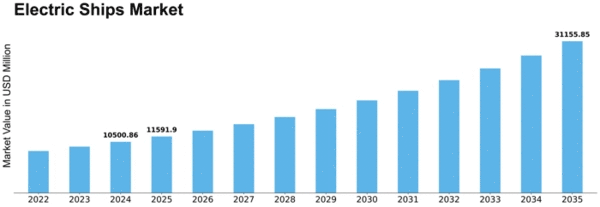

Electric Ships Market Size Graph
Author
Swapnil Palwe
Team Lead - Research

With a technical background as Bachelor's in Mechanical Engineering, with MBA in Operations Management , Swapnil has 6+ years of experience in market research, consulting and analytics with the tasks of data mining, analysis, and project execution. He is the POC for our clients, for their consulting projects running under the Automotive/A&D domain. Swapnil has worked on major projects in verticals such as Aerospace & Defense, Automotive and many other domain projects. He has worked on projects for fortune 500 companies' syndicate and consulting projects along with several government projects.

Leave a Comment

FAQs

How much is the electric ships market?

The Electric Ships Market size is expected to be valued at USD 9512.33747342469 Million in 2023.

What is the growth rate of the electric ships market?

The global market is projected to grow at a CAGR of 10.4% during the forecast period, 2025-2034.

Which region held the largest market share in the electric ships market?

Europe had the largest share of the Electric Ships Market.

Who are the key players in the electric ships market?

The key players in the market are AKASOL AG, Anglo Belgian Corporation NV, ABB, Echandia Marine AB, Siemens, BAE Systems, Corvus Energy, General Dynamics Electric Boat, General Electric, KONGSBERG MARITIME, Leclanche, MAN Energy Solutions, Norwegian Electric Systems, ECO Marine Power, EST-Floattech, Schottel, VARD, Wärtsilä, Visedo, and Saft (Total).

Which type led the electric ships market?

The hybrid type led the electric ships market in 2023.

Which ship type had the largest market share in the electric ships market?

Commercial ship type had the largest market share in the electric ships market.

Market Summary

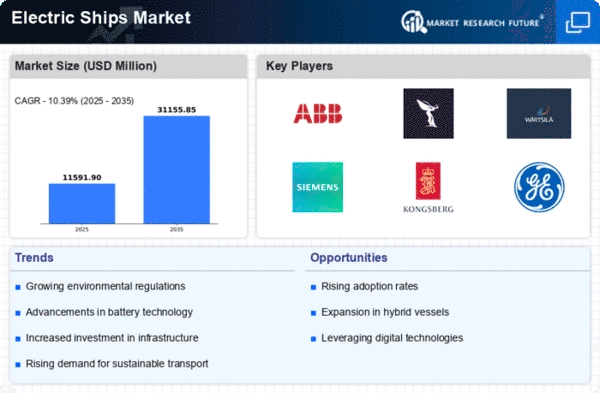
As per MRFR analysis, the Electric Ships Market Size was estimated at 10500.86 USD Million in 2024. The Electric Ships industry is projected to grow from 11592.11 in 2025 to 31155.85 by 2035, exhibiting a compound annual growth rate (CAGR) of 10.39 during the forecast period 2025 - 2035.

Key Market Trends & Highlights

The Electric Ships Market is poised for substantial growth driven by technological advancements and regulatory support.

  • Technological advancements in battery systems are enhancing the efficiency and range of electric ships.
  • North America remains the largest market for electric ships, while Asia-Pacific is emerging as the fastest-growing region.
  • Cargo ships dominate the market, yet passenger ships are witnessing the most rapid growth in adoption.
  • Investment in sustainable shipping infrastructure and increasing regulatory pressure for emission reductions are key drivers propelling market expansion.

Market Size & Forecast

2024 Market Size 10500.86 (USD Million)
2035 Market Size 31155.85 (USD Million)
CAGR (2025 - 2035) 10.39%
Largest Regional Market Share in 2024 North America

Major Players

ABB (CH), Rolls-Royce (GB), Wärtsilä (FI), Siemens (DE), Kongsberg Gruppen (NO), General Electric (US), DNV GL (NO), Hyundai Heavy Industries (KR), Mitsubishi Heavy Industries (JP)

Market Trends

The Electric Ships Market is currently experiencing a transformative phase, driven by advancements in technology and a growing emphasis on sustainability. As environmental concerns escalate, stakeholders are increasingly recognizing the potential of electric propulsion systems to reduce emissions and enhance energy efficiency. This shift is not merely a trend but appears to be a fundamental change in how maritime operations are conducted. The integration of electric ships into various sectors, including passenger transport and cargo shipping, suggests a broader acceptance of alternative energy sources in the industry. Furthermore, regulatory frameworks are evolving to support this transition, indicating a commitment to cleaner maritime practices. In addition to environmental benefits, the Electric Ships Market is likely to witness innovations in battery technology and energy management systems. These developments may enhance the operational capabilities of electric vessels, making them more competitive with traditional ships. The collaboration between manufacturers, technology providers, and regulatory bodies seems essential for fostering an ecosystem that supports the growth of electric shipping. As the market matures, it could lead to a paradigm shift in maritime logistics, potentially reshaping global trade dynamics and influencing supply chain strategies.

Technological Advancements in Battery Systems

Recent innovations in battery technology are poised to revolutionize the Electric Ships Market. Enhanced energy density and faster charging capabilities may significantly improve the operational range and efficiency of electric vessels. This trend indicates a shift towards more reliable and powerful energy storage solutions, which could facilitate broader adoption across various maritime sectors.

Regulatory Support for Sustainable Shipping

The Electric Ships Market is likely benefiting from increasing regulatory support aimed at promoting sustainable shipping practices. Governments and international bodies appear to be implementing stricter emissions standards and providing incentives for adopting electric propulsion systems. This regulatory landscape may encourage investment and innovation within the sector.

Growing Demand for Eco-Friendly Transportation

There is a noticeable rise in consumer preference for eco-friendly transportation options, which is influencing the Electric Ships Market. As public awareness of environmental issues grows, stakeholders in the maritime industry may feel compelled to adopt electric solutions to meet consumer expectations. This trend suggests a potential shift in market dynamics, favoring sustainable practices.

Electric Ships Market Market Drivers

Rising Fuel Prices

The Global Electric Ships Industry is also being propelled by the rising prices of traditional fuels. As fuel costs continue to escalate, shipping companies are seeking alternative solutions to mitigate operational expenses. Electric ships, which utilize electricity as a primary energy source, present a cost-effective alternative in the long term. This shift is particularly relevant in regions where fuel prices are volatile. The market is anticipated to expand significantly, with projections indicating a growth to 31.2 USD Billion by 2035, as more companies transition to electric vessels to enhance their economic sustainability.

Growing Environmental Regulations

The Global Electric Ships Industry is experiencing a surge in demand due to stringent environmental regulations aimed at reducing greenhouse gas emissions. Governments worldwide are implementing policies that encourage the adoption of cleaner technologies in maritime transport. For instance, the International Maritime Organization has set ambitious targets for reducing emissions, which has prompted shipbuilders to invest in electric propulsion systems. This regulatory landscape is likely to drive the market's growth, as the Global Electric Ships Market is projected to reach 10.5 USD Billion in 2024, reflecting a growing commitment to sustainable practices in the shipping industry.

Technological Advancements in Battery Systems

Technological innovations in battery systems are significantly influencing the Global Electric Ships Industry. Advances in lithium-ion and solid-state batteries have enhanced energy density and reduced charging times, making electric ships more viable. These improvements not only increase the operational range of electric vessels but also lower operational costs. As a result, shipbuilders are increasingly integrating these advanced battery technologies into their designs. The Global Electric Ships Market is expected to grow at a CAGR of 10.39% from 2025 to 2035, indicating a robust trend towards electrification in maritime transport.

Growing Consumer Demand for Sustainable Shipping

Consumer preferences are shifting towards sustainability, which is influencing the Global Electric Ships Industry. As awareness of environmental issues increases, consumers are demanding more sustainable shipping options. This trend is prompting shipping companies to adopt electric vessels to meet customer expectations and enhance their brand image. Companies that invest in electric ships are likely to gain a competitive edge in the market. The growing consumer demand for eco-friendly shipping solutions is expected to contribute to the overall growth of the Global Electric Ships Market, aligning with broader sustainability goals.

Increasing Investment in Electric Infrastructure

Investment in electric infrastructure is a critical driver for the Global Electric Ships Industry. Ports and shipping companies are increasingly investing in charging stations and related infrastructure to support the operation of electric vessels. This trend is evident in various regions, where governments are incentivizing the development of green ports. Enhanced infrastructure not only facilitates the adoption of electric ships but also improves the overall efficiency of maritime operations. As the Global Electric Ships Market continues to evolve, the establishment of robust charging networks will likely play a pivotal role in its expansion.

Market Segment Insights

By Application: Cargo Ship (Largest) vs. Passenger Ship (Fastest-Growing)

In the Electric Ships Market, the Cargo Ship segment holds the largest share, driven by the increasing demand for more efficient and sustainable shipping solutions. This segment capitalizes on advancements in electric propulsion technology, enabling shipping companies to minimize their carbon footprint while maximizing operational efficiency. Conversely, the Passenger Ship segment is recognized as the fastest-growing segment due to rising consumer awareness of environmental issues and regulations promoting cleaner transport methods. This shift is pushing cruise operators to adopt electric vessels to enhance passenger experience with quieter and more eco-friendly travel options.

Cargo Ship: Dominant vs. Passenger Ship: Emerging

The Cargo Ship segment stands as the dominant force in the Electric Ships Market, characterized by its bulk transport capabilities and long-established infrastructure. These vessels typically engage in international shipping routes and are increasingly integrating battery technologies and hybrid systems for efficiency. On the other hand, the Passenger Ship segment is emerging rapidly, fueled by a shift towards greener tourism and innovative designs accommodating electric systems. These vessels focus on enhancing guest experiences while reducing emissions, positioning them strongly for growth in a market that values sustainability.

By Power Source: Battery Electric (Largest) vs. Hybrid Electric (Fastest-Growing)

In the Electric Ships Market, the distribution of power sources showcases Battery Electric as the largest segment, commanding a significant share due to its efficiency and widespread adoption. Hybrid Electric is rapidly gaining traction, emerging as a fast-growing segment, thanks to advancements in technology and increasing interest from shipbuilders in sustainable solutions. Fuel Cell Electric and Solar Electric represent smaller shares, yet both are seeing interest as niche alternatives for specific applications in electrification.

Battery Electric (Dominant) vs. Hybrid Electric (Emerging)

Battery Electric ships are characterized by their reliance on advanced battery systems, enabling efficient energy use and reduced emissions. This technology is favored for its performance and reliability, with many leading manufacturers focusing on enhancing battery life and charging speeds. On the other hand, Hybrid Electric ships combine conventional engines with battery systems, offering enhanced flexibility and reduced reliance on traditional fuels. Hybrid technology is emerging as a solution for operators seeking to balance performance with environmental considerations, making it an appealing choice amid rising regulatory pressures for emissions reductions.

By Ship Type: Commercial Ship (Largest) vs. Leisure Ship (Fastest-Growing)

The Electric Ships Market exhibits a diverse range of segments, with 'Commercial Ships' commanding the largest market share. These vessels are preferred for their operational efficiency and environmental benefits, driving significant adoption across various commercial applications. On the other hand, 'Leisure Ships' are emerging as the fastest-growing segment, tapping into the growing demand for eco-friendly recreational boating options that cater to sustainability-conscious consumers. The growth in the Electric Ships Market is primarily propelled by advancements in battery technology and innovative propulsion systems. The rising need for reducing carbon emissions, coupled with stringent regulations, is further fuelling the transformation of the naval industry towards electric solutions. Both commercial and leisure segments are witnessing substantial investments and technological innovations aimed at enhancing operational capabilities and customer experiences.

Commercial Ship: Dominant vs. Leisure Ship: Emerging

Commercial Ships dominate the Electric Ships Market due to their wide application in freight transportation and fishing industries. With substantial investments in infrastructure and technology, these vessels are becoming more efficient and environmentally friendly, leading to increased operational adoption. Conversely, Leisure Ships represent an emerging segment, attracting attention for their potential to revolutionize recreational boating. As consumer preferences shift towards sustainable practices, leisure vessels are integrating electric propulsion to meet the demands for eco-friendly leisure activities. The growing popularity of yachting and private boating, combined with technological advancements, positions leisure ships as a promising area of growth within the electric maritime landscape.

By End Use: Transportation (Largest) vs. Research (Fastest-Growing)

The Electric Ships Market is distinctly segmented by end use, with transportation leading the way due to its vast application in commercial shipping and maritime logistics. This segment dominates the market, reflecting the increasing demand for environmentally friendly ships and the gradual adoption of electric propulsion systems. Following closely is the research segment, which is rapidly gaining traction as environmental concerns and innovation in marine technology drive investments in electric vessels for scientific exploration and data collection.

<a href="https://www.marketresearchfuture.com/reports/defense-market-34071" target="_blank">defense</a> (Dominant) vs. Tourism (Emerging)

In the Electric Ships Market, the <a href="https://www.marketresearchfuture.com/reports/defense-market-34071" target="_blank">defense</a> segment stands as a dominant player, utilizing electric ships for various strategic operations, including surveillance and logistics. Their need for stealth and efficient power management drives the development of advanced electric vessels, ensuring superior capabilities. Meanwhile, the tourism segment is emerging as a promising area, with electric ships being adopted for eco-friendly cruise operations, providing an attractive alternative for tourists. As sustainability becomes a priority for travelers, the adoption of electric vessels in tourism is expected to grow, showcasing the market's shift towards greener alternatives.

By Technology: Energy Storage System (Largest) vs. Propulsion System (Fastest-Growing)

In the Electric Ships Market, the Energy Storage System holds a significant market share, primarily due to its critical role in ensuring efficient energy management aboard electric vessels. This segment encompasses various battery technologies, particularly lithium-ion batteries, which are favored for their high energy density and relatively lower costs. On the other hand, the Propulsion System is rapidly gaining traction, driven by innovation in electric motors and power electronics that enhance the overall efficiency and performance of electric ships. Together, these segments are defining the operational capabilities of electric vessels.

Technology: Energy Storage System (Dominant) vs. Propulsion System (Emerging)

The Energy Storage System is a dominant force in the Electric Ships Market, representing a cornerstone technology that allows vessels to store and utilize renewable energy efficiently. This segment consists mainly of lithium-ion batteries, which are known for their longevity and performance stability in marine applications. In contrast, the Propulsion System is emerging with new advancements that promise improved thrust and reduced emissions. Innovative electric motors, coupled with advanced control mechanisms, are propelling this segment's growth. Together, these technologies are redefining maritime transport, emphasizing sustainability and operational efficiency.

Get more detailed insights about Electric Ships Market Research Report -Forecast till 2035

Regional Insights

North America : Leading Market Innovators

North America is poised to maintain its leadership in the electric ships market, holding a significant market share of 4200.0. The region's growth is driven by stringent environmental regulations, increasing investments in green technologies, and a shift towards sustainable maritime solutions. The demand for electric ships is further fueled by the rising costs of fossil fuels and the need for energy-efficient alternatives. The United States stands out as a key player, with major companies like General Electric and ABB leading the charge in innovation. The competitive landscape is characterized by collaborations between technology firms and shipbuilders, enhancing the development of electric propulsion systems. The presence of established players ensures a robust market environment, fostering advancements in electric ship technologies.

Europe : Sustainable Maritime Solutions

Europe is rapidly emerging as a hub for electric ships, with a market size of 3500.0. The region's growth is propelled by ambitious climate goals, including the European Green Deal, which aims to reduce greenhouse gas emissions by at least 55% by 2030. This regulatory framework encourages investments in electric shipping technologies, driving demand for cleaner alternatives in maritime transport. Leading countries such as Norway and Germany are at the forefront, with significant investments in electric ship projects. Companies like Wärtsilä and Siemens are pivotal in this transition, providing innovative solutions for electric propulsion. The competitive landscape is marked by a strong emphasis on sustainability, with numerous partnerships and initiatives aimed at enhancing the efficiency and performance of electric vessels.

Asia-Pacific : Emerging Market Potential

Asia-Pacific is witnessing a burgeoning interest in electric ships, with a market size of 2500.0. The region's growth is driven by increasing urbanization, rising environmental awareness, and government initiatives promoting sustainable shipping practices. Countries like China and Japan are investing heavily in electric vessel technologies, aiming to reduce their carbon footprints and enhance energy efficiency in maritime operations. China, in particular, is leading the charge with substantial investments in electric ship manufacturing. Key players such as Hyundai Heavy Industries and Mitsubishi Heavy Industries are actively developing innovative electric propulsion systems. The competitive landscape is evolving, with a focus on collaboration between governments and private sectors to accelerate the adoption of electric ships in the region.

Middle East and Africa : Emerging Market Dynamics

The Middle East and Africa region is gradually recognizing the potential of electric ships, with a market size of 300.86. The growth is driven by increasing investments in renewable energy and a shift towards sustainable maritime practices. Governments are beginning to implement regulations that encourage the adoption of electric vessels, aiming to reduce reliance on fossil fuels and enhance environmental sustainability. Countries like South Africa and the UAE are exploring electric shipping solutions, with local companies starting to invest in electric propulsion technologies. The competitive landscape is still developing, but there is a growing interest from international players looking to enter this emerging market. The presence of key players like Kongsberg Gruppen indicates a commitment to fostering innovation in the region.

Key Players and Competitive Insights

The Electric Ships Market is currently characterized by a dynamic competitive landscape, driven by the increasing demand for sustainable maritime solutions and advancements in battery technology. Key players such as ABB (CH), Rolls-Royce (GB), and Wärtsilä (FI) are at the forefront, each adopting distinct strategies to enhance their market positioning. ABB (CH) focuses on innovation in electric propulsion systems, while Rolls-Royce (GB) emphasizes digital transformation through its autonomous ship technology. Wärtsilä (FI) is actively pursuing partnerships to expand its portfolio of eco-friendly solutions, collectively shaping a competitive environment that prioritizes sustainability and technological advancement.In terms of business tactics, companies are increasingly localizing manufacturing to reduce costs and enhance supply chain efficiency. The market appears moderately fragmented, with several key players exerting influence over various segments. This structure allows for a diverse range of offerings, enabling companies to cater to specific customer needs while fostering healthy competition among them.

In November ABB (CH) announced a strategic partnership with a leading battery manufacturer to develop next-generation energy storage systems for electric ships. This collaboration is expected to enhance ABB's capabilities in providing integrated solutions, thereby solidifying its position as a leader in the electric propulsion sector. The strategic importance of this move lies in its potential to accelerate the adoption of electric vessels, aligning with global sustainability goals.

In October Rolls-Royce (GB) unveiled its latest autonomous vessel prototype, which incorporates advanced AI technologies for navigation and operational efficiency. This development not only showcases Rolls-Royce's commitment to innovation but also positions the company to capitalize on the growing trend of automation in maritime operations. The implications of this advancement suggest a shift towards more efficient and safer shipping practices, which could redefine operational standards in the industry.

In September Wärtsilä (FI) launched a new range of hybrid marine engines designed to reduce emissions by up to 30%. This initiative reflects Wärtsilä's proactive approach to addressing environmental regulations and customer demands for greener solutions. The strategic significance of this launch is underscored by its alignment with international maritime sustainability targets, potentially enhancing Wärtsilä's competitive edge in the market.

As of December current trends in the Electric Ships Market are heavily influenced by digitalization, sustainability, and the integration of AI technologies. Strategic alliances among key players are increasingly shaping the competitive landscape, fostering innovation and collaboration. Looking ahead, it is anticipated that competitive differentiation will evolve, with a pronounced shift from price-based competition to a focus on technological innovation and supply chain reliability. This transition underscores the importance of adaptability and forward-thinking strategies in navigating the complexities of the electric maritime sector.

Key Companies in the Electric Ships Market include

Industry Developments

  • In August 2022, Kongsberg Maritime has introduced EcoAdvisor, an intelligent and dynamic decision support system for optimizing a variety of vessel operations. It is used to monitor the vessel operation and its environment, including propulsion, environmental forces, power generation and control system dynamics.
  • In June 2022, Echandia Marine AB formed a strategic partnership with Toshiba to produce fuel cells for heavy-duty maritime applications. This alliance focuses on the production of fuel cell technology along with batteries to fast-track the electrification of the maritime sector.
  • November 2022: UECC launched a new electric vessel offering short-sea shipping services, demonstrating the technology's increasing viability for commercial use.
  • In April 2021, Siemens AG launched Sitrans SCM IQ, a new Industrial Internet of Things (IIoT) solution for Smart Condition Monitoring, at the Hannover Messe 2021. It enables potential incidents to be detected and prevented early, thus reducing maintenance costs and downtimes and increasing plant performance by up to ten percent.

Future Outlook

Electric Ships Market Future Outlook

The Electric Ships Market is projected to grow at a 10.39% CAGR from 2025 to 2035, driven by technological advancements, regulatory support, and increasing environmental concerns.

New opportunities lie in:

  • Development of advanced battery technologies for longer voyages.
  • Integration of renewable energy sources in electric ship operations.
  • Establishment of global charging infrastructure for electric vessels.

By 2035, the Electric Ships Market is poised for substantial growth, reflecting a robust transition towards sustainable maritime solutions.

Market Segmentation

Electric Ships Market End Use Outlook

  • Transportation
  • Research
  • Defense
  • Tourism

Electric Ships Market Ship Type Outlook

  • Commercial Ship
  • Military Ship
  • Leisure Ship
  • Workboat

Electric Ships Market Technology Outlook

  • Energy Storage System
  • Propulsion System
  • Charging Infrastructure
  • Control System

Electric Ships Market Application Outlook

  • Cargo Ship
  • Passenger Ship
  • Fishing Vessel
  • Naval Ship
  • Research Vessel

Electric Ships Market Power Source Outlook

  • Battery Electric
  • Hybrid Electric
  • Fuel Cell Electric
  • Solar Electric

Report Scope

MARKET SIZE 202410500.86(USD Million)
MARKET SIZE 202511592.11(USD Million)
MARKET SIZE 203531155.85(USD Million)
COMPOUND ANNUAL GROWTH RATE (CAGR)10.39% (2025 - 2035)
REPORT COVERAGERevenue Forecast, Competitive Landscape, Growth Factors, and Trends
BASE YEAR2024
Market Forecast Period2025 - 2035
Historical Data2019 - 2024
Market Forecast UnitsUSD Million
Key Companies ProfiledABB (CH), Rolls-Royce (GB), Wärtsilä (FI), Siemens (DE), Kongsberg Gruppen (NO), General Electric (US), DNV GL (NO), Hyundai Heavy Industries (KR), Mitsubishi Heavy Industries (JP)
Segments CoveredApplication, Power Source, Ship Type, End Use, Technology
Key Market OpportunitiesAdvancements in battery technology and sustainability regulations drive growth in the Electric Ships Market.
Key Market DynamicsRising regulatory pressures and technological advancements drive the adoption of electric ships in maritime transportation.

Countries CoveredNorth America, Europe, APAC, South America, MEA

FAQs

How much is the electric ships market?

The Electric Ships Market size is expected to be valued at USD 9512.33747342469 Million in 2023.

What is the growth rate of the electric ships market?

The global market is projected to grow at a CAGR of 10.4% during the forecast period, 2025-2034.

Which region held the largest market share in the electric ships market?

Europe had the largest share of the Electric Ships Market.

Who are the key players in the electric ships market?

The key players in the market are AKASOL AG, Anglo Belgian Corporation NV, ABB, Echandia Marine AB, Siemens, BAE Systems, Corvus Energy, General Dynamics Electric Boat, General Electric, KONGSBERG MARITIME, Leclanche, MAN Energy Solutions, Norwegian Electric Systems, ECO Marine Power, EST-Floattech, Schottel, VARD, Wärtsilä, Visedo, and Saft (Total).

Which type led the electric ships market?

The hybrid type led the electric ships market in 2023.

Which ship type had the largest market share in the electric ships market?

Commercial ship type had the largest market share in the electric ships market.

  1. SECTION I: EXECUTIVE SUMMARY AND KEY HIGHLIGHTS
    1. | 1.1 EXECUTIVE SUMMARY
    2. | 1.1.1 Market Overview
    3. | 1.1.2 Key Findings
    4. | 1.1.3 Market Segmentation
    5. | 1.1.4 Competitive Landscape
    6. | 1.1.5 Challenges and Opportunities
    7. | 1.1.6 Future Outlook
  2. SECTION II: SCOPING, METHODOLOGY AND MARKET STRUCTURE
    1. | 2.1 MARKET INTRODUCTION
    2. | 2.1.1 Definition
    3. | 2.1.2 Scope of the study
    4. |-- 2.1.2.1 Research Objective
    5. |-- 2.1.2.2 Assumption
    6. |-- 2.1.2.3 Limitations
    7. | 2.2 RESEARCH METHODOLOGY
    8. | 2.2.1 Overview
    9. | 2.2.2 Data Mining
    10. | 2.2.3 Secondary Research
    11. | 2.2.4 Primary Research
    12. |-- 2.2.4.1 Primary Interviews and Information Gathering Process
    13. |-- 2.2.4.2 Breakdown of Primary Respondents
    14. | 2.2.5 Forecasting Model
    15. | 2.2.6 Market Size Estimation
    16. |-- 2.2.6.1 Bottom-Up Approach
    17. |-- 2.2.6.2 Top-Down Approach
    18. | 2.2.7 Data Triangulation
    19. | 2.2.8 Validation
  3. SECTION III: QUALITATIVE ANALYSIS
    1. | 3.1 MARKET DYNAMICS
    2. | 3.1.1 Overview
    3. | 3.1.2 Drivers
    4. | 3.1.3 Restraints
    5. | 3.1.4 Opportunities
    6. | 3.2 MARKET FACTOR ANALYSIS
    7. | 3.2.1 Value chain Analysis
    8. | 3.2.2 Porter's Five Forces Analysis
    9. |-- 3.2.2.1 Bargaining Power of Suppliers
    10. |-- 3.2.2.2 Bargaining Power of Buyers
    11. |-- 3.2.2.3 Threat of New Entrants
    12. |-- 3.2.2.4 Threat of Substitutes
    13. |-- 3.2.2.5 Intensity of Rivalry
    14. | 3.2.3 COVID-19 Impact Analysis
    15. |-- 3.2.3.1 Market Impact Analysis
    16. |-- 3.2.3.2 Regional Impact
    17. |-- 3.2.3.3 Opportunity and Threat Analysis
  4. SECTION IV: QUANTITATIVE ANALYSIS
    1. | 4.1 Aerospace & Defense, BY Application (USD Million)
    2. | 4.1.1 Cargo Ship
    3. | 4.1.2 Passenger Ship
    4. | 4.1.3 Fishing Vessel
    5. | 4.1.4 Naval Ship
    6. | 4.1.5 Research Vessel
    7. | 4.2 Aerospace & Defense, BY Power Source (USD Million)
    8. | 4.2.1 Battery Electric
    9. | 4.2.2 Hybrid Electric
    10. | 4.2.3 Fuel Cell Electric
    11. | 4.2.4 Solar Electric
    12. | 4.3 Aerospace & Defense, BY Ship Type (USD Million)
    13. | 4.3.1 Commercial Ship
    14. | 4.3.2 Military Ship
    15. | 4.3.3 Leisure Ship
    16. | 4.3.4 Workboat
    17. | 4.4 Aerospace & Defense, BY End Use (USD Million)
    18. | 4.4.1 Transportation
    19. | 4.4.2 Research
    20. | 4.4.3 Defense
    21. | 4.4.4 Tourism
    22. | 4.5 Aerospace & Defense, BY Technology (USD Million)
    23. | 4.5.1 Energy Storage System
    24. | 4.5.2 Propulsion System
    25. | 4.5.3 Charging Infrastructure
    26. | 4.5.4 Control System
    27. | 4.6 Aerospace & Defense, BY Region (USD Million)
    28. | 4.6.1 North America
    29. |-- 4.6.1.1 US
    30. |-- 4.6.1.2 Canada
    31. | 4.6.2 Europe
    32. |-- 4.6.2.1 Germany
    33. |-- 4.6.2.2 UK
    34. |-- 4.6.2.3 France
    35. |-- 4.6.2.4 Russia
    36. |-- 4.6.2.5 Italy
    37. |-- 4.6.2.6 Spain
    38. |-- 4.6.2.7 Rest of Europe
    39. | 4.6.3 APAC
    40. |-- 4.6.3.1 China
    41. |-- 4.6.3.2 India
    42. |-- 4.6.3.3 Japan
    43. |-- 4.6.3.4 South Korea
    44. |-- 4.6.3.5 Malaysia
    45. |-- 4.6.3.6 Thailand
    46. |-- 4.6.3.7 Indonesia
    47. |-- 4.6.3.8 Rest of APAC
    48. | 4.6.4 South America
    49. |-- 4.6.4.1 Brazil
    50. |-- 4.6.4.2 Mexico
    51. |-- 4.6.4.3 Argentina
    52. |-- 4.6.4.4 Rest of South America
    53. | 4.6.5 MEA
    54. |-- 4.6.5.1 GCC Countries
    55. |-- 4.6.5.2 South Africa
    56. |-- 4.6.5.3 Rest of MEA
  5. SECTION V: COMPETITIVE ANALYSIS
    1. | 5.1 Competitive Landscape
    2. | 5.1.1 Overview
    3. | 5.1.2 Competitive Analysis
    4. | 5.1.3 Market share Analysis
    5. | 5.1.4 Major Growth Strategy in the Aerospace & Defense
    6. | 5.1.5 Competitive Benchmarking
    7. | 5.1.6 Leading Players in Terms of Number of Developments in the Aerospace & Defense
    8. | 5.1.7 Key developments and growth strategies
    9. |-- 5.1.7.1 New Product Launch/Service Deployment
    10. |-- 5.1.7.2 Merger & Acquisitions
    11. |-- 5.1.7.3 Joint Ventures
    12. | 5.1.8 Major Players Financial Matrix
    13. |-- 5.1.8.1 Sales and Operating Income
    14. |-- 5.1.8.2 Major Players R&D Expenditure. 2023
    15. | 5.2 Company Profiles
    16. | 5.2.1 ABB (CH)
    17. |-- 5.2.1.1 Financial Overview
    18. |-- 5.2.1.2 Products Offered
    19. |-- 5.2.1.3 Key Developments
    20. |-- 5.2.1.4 SWOT Analysis
    21. |-- 5.2.1.5 Key Strategies
    22. | 5.2.2 Rolls-Royce (GB)
    23. |-- 5.2.2.1 Financial Overview
    24. |-- 5.2.2.2 Products Offered
    25. |-- 5.2.2.3 Key Developments
    26. |-- 5.2.2.4 SWOT Analysis
    27. |-- 5.2.2.5 Key Strategies
    28. | 5.2.3 Wärtsilä (FI)
    29. |-- 5.2.3.1 Financial Overview
    30. |-- 5.2.3.2 Products Offered
    31. |-- 5.2.3.3 Key Developments
    32. |-- 5.2.3.4 SWOT Analysis
    33. |-- 5.2.3.5 Key Strategies
    34. | 5.2.4 Siemens (DE)
    35. |-- 5.2.4.1 Financial Overview
    36. |-- 5.2.4.2 Products Offered
    37. |-- 5.2.4.3 Key Developments
    38. |-- 5.2.4.4 SWOT Analysis
    39. |-- 5.2.4.5 Key Strategies
    40. | 5.2.5 Kongsberg Gruppen (NO)
    41. |-- 5.2.5.1 Financial Overview
    42. |-- 5.2.5.2 Products Offered
    43. |-- 5.2.5.3 Key Developments
    44. |-- 5.2.5.4 SWOT Analysis
    45. |-- 5.2.5.5 Key Strategies
    46. | 5.2.6 General Electric (US)
    47. |-- 5.2.6.1 Financial Overview
    48. |-- 5.2.6.2 Products Offered
    49. |-- 5.2.6.3 Key Developments
    50. |-- 5.2.6.4 SWOT Analysis
    51. |-- 5.2.6.5 Key Strategies
    52. | 5.2.7 DNV GL (NO)
    53. |-- 5.2.7.1 Financial Overview
    54. |-- 5.2.7.2 Products Offered
    55. |-- 5.2.7.3 Key Developments
    56. |-- 5.2.7.4 SWOT Analysis
    57. |-- 5.2.7.5 Key Strategies
    58. | 5.2.8 Hyundai Heavy Industries (KR)
    59. |-- 5.2.8.1 Financial Overview
    60. |-- 5.2.8.2 Products Offered
    61. |-- 5.2.8.3 Key Developments
    62. |-- 5.2.8.4 SWOT Analysis
    63. |-- 5.2.8.5 Key Strategies
    64. | 5.2.9 Mitsubishi Heavy Industries (JP)
    65. |-- 5.2.9.1 Financial Overview
    66. |-- 5.2.9.2 Products Offered
    67. |-- 5.2.9.3 Key Developments
    68. |-- 5.2.9.4 SWOT Analysis
    69. |-- 5.2.9.5 Key Strategies
    70. | 5.3 Appendix
    71. | 5.3.1 References
    72. | 5.3.2 Related Reports

Aerospace & Defense Market Segmentation

Aerospace & Defense By Application (USD Million, 2025-2035)

  • Cargo Ship
  • Passenger Ship
  • Fishing Vessel
  • Naval Ship
  • Research Vessel

Aerospace & Defense By Power Source (USD Million, 2025-2035)

  • Battery Electric
  • Hybrid Electric
  • Fuel Cell Electric
  • Solar Electric

Aerospace & Defense By Ship Type (USD Million, 2025-2035)

  • Commercial Ship
  • Military Ship
  • Leisure Ship
  • Workboat

Aerospace & Defense By End Use (USD Million, 2025-2035)

  • Transportation
  • Research
  • Defense
  • Tourism

Aerospace & Defense By Technology (USD Million, 2025-2035)

  • Energy Storage System
  • Propulsion System
  • Charging Infrastructure
  • Control System
Infographic

Free Sample Request

Kindly complete the form below to receive a free sample of this Report

Get Free Sample

Customer Strories

Compare Licence

×
Features License Type
Single User Multiuser License Enterprise User
Price $4,950 $5,950 $7,250
Maximum User Access Limit 1 User Upto 10 Users Unrestricted Access Throughout the Organization
Free Customization
Direct Access to Analyst
Deliverable Format
Platform Access
Discount on Next Purchase 10% 15% 15%
Printable Versions