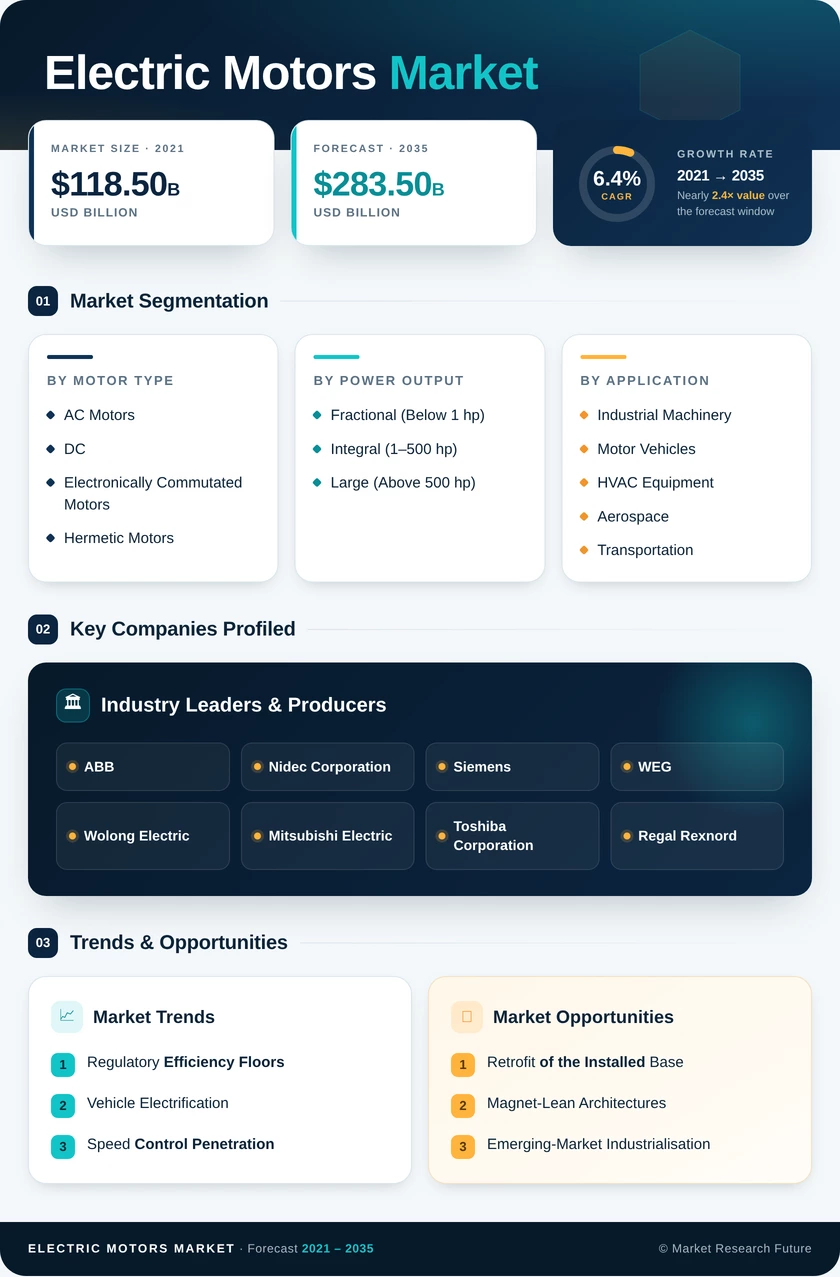
Segmentation Quick Reference
| Dimension | Sub-Segments | Dominant Segment | Fastest Growing Segment |
| By Motor Type | AC Motors; DC and Electronically Commutated Motors; Hermetic Motors | AC Motors | DC and Electronically Commutated Motors |
| By Power Output | Fractional (Below 1 hp); Integral (1–500 hp); Large (Above 500 hp) | Integral (1–500 hp) | Large (Above 500 hp) |
| By Application | Industrial Machinery; Motor Vehicles; HVAC Equipment; Aerospace and Transportation; Household Appliances; Others | Industrial Machinery | Motor Vehicles |
| By Voltage | Low Voltage (Below 1 kV); Medium Voltage (1–6.6 kV); High Voltage (Above 6.6 kV) | Low Voltage (Below 1 kV) | Medium Voltage (1–6.6 kV) |
| By Region | North America; Europe; Asia-Pacific; South America; Middle East & Africa | Asia-Pacific | Middle East & Africa |
Market Segmentation Overview
By Motor Type
| Sub-Segment | Key Trend |
| AC Motors | Efficiency-class upgrades drive replacement volume in constant-torque process duty |
| DC and Electronically Commutated Motors | Traction and appliance electrification lift share faster than any peer segment |
| Hermetic Motors | Refrigerant transition rules force compressor redesign and motor requalification |
Motor-type mix shifts slowly because industrial buyers replace like with like unless regulation or duty cycle forces reconsideration. Electronically commutated architectures win where variable load and compact packaging matter, which describes an expanding share of new installations.
By Power Output
| Sub-Segment | Key Trend |
| Fractional (Below 1 hp) | Appliance efficiency labelling accelerates obsolescence of legacy small-motor designs |
| Integral (1–500 hp) | Carries the bulk of regulatory attention and retrofit spending worldwide |
| Large (Above 500 hp) | Engineered-to-order economics with long lead times and service-led margins |
Power banding governs how suppliers organise manufacturing and channel strategy. Volume bands run through distribution on stocked catalogue terms, while large machines move through direct engineering sales with multi-year service attachment.
By Application
| Sub-Segment | Key Trend |
| Industrial Machinery | Retrofit of pre-2015 installed base underpins steady replacement demand |
| Motor Vehicles | Traction plus auxiliary content per vehicle rises with platform electrification |
| HVAC Equipment | Heat-pump mandates raise both unit volume and efficiency specification |
| Aerospace and Transportation | More-electric architectures push power density and thermal design limits |
| Household Appliances | Labelling schemes phase out lower-efficiency legacy designs |
| Others | Medical, marine and agricultural niches reward specialised certification |
Application mix determines margin quality more than revenue scale does. Regulated and safety-critical applications sustain pricing power, while commodity industrial duty faces continuous cost pressure from regional manufacturers.
By Voltage
| Sub-Segment | Key Trend |
| Low Voltage (Below 1 kV) | Highest unit volume; integrated drive packages gain attach rate |
| Medium Voltage (1–6.6 kV) | Process plant retrofit and utility pumping sustain steady expansion |
| High Voltage (Above 6.6 kV) | Mining, LNG and marine propulsion concentrate demand in a few large orders |
Voltage class correlates tightly with sales motion and service intensity. Higher-voltage installations demand engineering support, spare-parts commitments and site commissioning that smaller suppliers cannot economically provide.
By Region
| Sub-Segment | Key Trend |
| North America | Reshoring capex and data-centre auxiliaries lift high-specification demand |
| Europe | Ecodesign compliance schedules force accelerated installed-base turnover |
| Asia-Pacific | Manufacturing scale plus rising domestic efficiency standards |
| South America | Mining and agro-processing capital cycles govern order timing |
| Middle East & Africa | Industrial diversification and desalination programmes drive fastest growth |
Regional demand patterns diverge in character, not just in rate. Mature markets buy efficiency and compliance; developing markets buy capacity — and the balance between those two motives will determine pricing structure through 2035.


 Noah Malgeri
Co-Founder

 Peter Groot koerkamp
Account and Business Manager

 Younghwan Choi
Senior Retail Manager

 Mark Irwin
Management Consultant

 Akif Moroglu
Strategy & Business Development Director

 Guilherme Gomes Martins
Product Management Director

 Joseph Aguayo
Sales Operations & Pricing Manager

 La Terria Dodd
Program Support Specialist

 Rob Kooiker
Group Product Manager HVAC & Fire Protection GMA