×
Hero Background
English
Chinese
French
Japanese
Korean
German
Spanish

Edible Packaging Market Size

ID: MRFR/PCM/3989-HCR
185 Pages
Snehal Singh
October 2025

Edible Packaging Market Research Report Information By Material (Polysaccharides, Lipid, Protein Films and Others), By End User (Food & Beverage and Pharmaceutical) And By Region (North America, Europe, Asia-Pacific, And Rest Of The World) –Market Forecast Till 2035

Share:
Download PDF ×

We do not share your information with anyone. However, we may send you emails based on your report interest from time to time. You may contact us at any time to opt-out.

Edible Packaging Market Infographic
Purchase Options

Edible Packaging Size

Edible Packaging Market Growth Projections and Opportunities

The value of the Edible Packaging Market was USD 1.5 Billion in 2022, and it is projected to grow from USD 1.6 Billion in 2023 to USD 2.709 Billion by 2032 at a CAGR of 6.79%. The popularity of the Edible Packaging Market has been on the increase due to a number of key market forces that are influencing consumer preferences and changing industrial dynamics. One major factor contributing to this trend is the increasing global awareness of environmental sustainability. Also, the Edible Packaging Market is driven by rising demand for convenience and on-the-go food options. Since consumers have busy lifestyles and prefer hassle-free consumption, there has been an increasing preference for packaging that is eco-friendly and practically useful. This need is met by edible packaging, which provides a convenient outer layer that can be eaten along with various food products, thus eliminating separate disposal and giving rise to a more unified customer experience. Moreover, another important issue propelling growth in the Edible Packaging Market is its focus on food safety and preservation. Sometimes, edible packaging materials may possess natural antimicrobial properties that lengthen perishable items' shelf life. Furthermore, innovation within the food industry has also become one of the major influences behind the growth trends of the Edible Packaging Market. Companies are always looking to distinguish their products from others and stay ahead in a competitive market; hence, the adoption of this type of packaging helps them make unique, creative product offerings. This kind of creativity not only attracts customers but also enhances general market attractiveness, thereby creating an environment where continuous improvement takes place by adapting to varying customer tastes. Government regulations and initiatives promoting sustainable practices are playing a pivotal role in shaping the Edible Packaging Market. Numerous countries have put in place strict policies aimed at reducing single-use plastic bags while promoting other environmentally friendly packaging alternatives. To comply with such regulations, many businesses are opting for eatable wrappers. Furthermore, the industry is experiencing growth in collaborations and partnerships. With the realization of edible packaging's potential, there has been an increased number of collaborations between companies and other businesses as well as research institutions. These relationships aim to speed up invention, improve the quality of eatable packaging materials, and increase their range of use. Through such collaboration, the entire industry benefits from shared knowledge while sustainable packaging solutions are developed rapidly.

Edible Packaging Market Size Graph
Author
Snehal Singh
Assistant Manager - Research

High acumen in analyzing complex macro & micro markets with more than 6 years of work experience in the field of market research. By implementing her analytical skills in forecasting and estimation into market research reports, she has expertise in Packaging, Construction, and Equipment domains. She handles a team size of 20-25 resources and ensures smooth running of the projects, associated marketing activities, and client servicing.

Leave a Comment

FAQs

How much is the edible packaging market?

The edible packaging market size was valued at USD 1.90 Billion in 2024.

What is the growth rate of the edible packaging market?

Edible Packaging Market is projected to register a CAGR of 5.93% from 2025-2035

Which region held the largest market share in the edible packaging market?

North America had the largest share in the edible packaging market

Who are the key players in the edible packaging market?

The key players in the edible packaging market are WikiCell Designs Inc. (U.S.), Nagase & Co. Ltd. (Japan), JRF Technology LLC (U.S.), Tipa Corp (Israel), Interpack (U.S.), Pace International LLC (U.S.), Ingredion Inc (U.S.), Safetraces Inc. (U.S.), Dupont de Nemours and Company (U.S.), Tate & Lyle Plc. (U.K), Coveris Holdings (U.S.), MonoSol LLC (U.S.), Evoware (Indonesia), Watson Inc. (U.S.) and Devro plc (U.K).

Which material led the edible packaging market?

The protein film category dominated the edible packaging market in 2022.

Which end user had the largest market share in the edible packaging market?

The food & beverage category had the largest share in the edible packaging market.

Market Summary

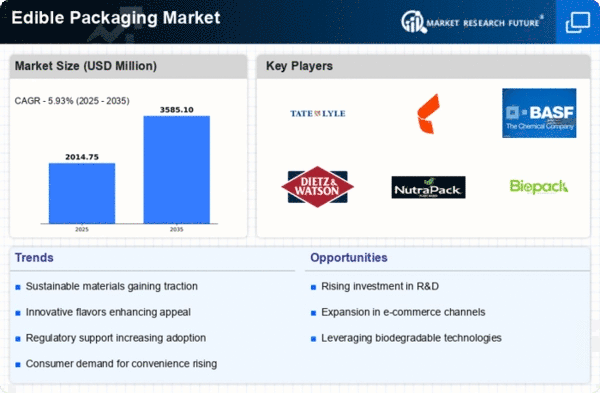
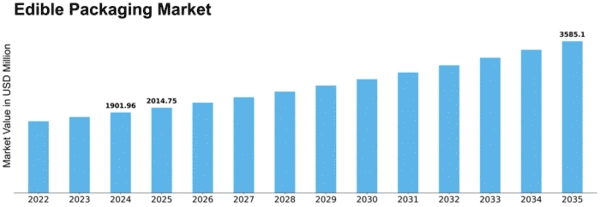
As per MRFR analysis, the Edible Packaging Market Size was estimated at 1901.96 USD Million in 2024. The Edible Packaging industry is projected to grow from 2014.79 in 2025 to 3585.1 by 2035, exhibiting a compound annual growth rate (CAGR) of 5.93 during the forecast period 2025 - 2035.

Key Market Trends & Highlights

The Edible Packaging Market is experiencing robust growth driven by sustainability and health trends.

  • North America remains the largest market for edible packaging, reflecting a strong consumer preference for sustainable solutions.
  • Asia-Pacific is identified as the fastest-growing region, driven by increasing health consciousness and demand for innovative packaging.
  • Food packaging continues to dominate the market, while beverage packaging is emerging as the fastest-growing segment.
  • Sustainability initiatives and consumer demand for convenience are key drivers propelling the growth of edible packaging.

Market Size & Forecast

2024 Market Size 1901.96 (USD Million)
2035 Market Size 3585.1 (USD Million)
CAGR (2025 - 2035) 5.93%
Largest Regional Market Share in 2024 North America

Major Players

<p>Tate & Lyle (GB), BASF (DE), Mondi Group (GB), Watson Foods (US), NutraPack (US), BioPack (AU), Kraft Heinz (US), Ecovative Design (US)</p>

Market Trends

The Edible Packaging Market is currently experiencing a notable transformation, driven by increasing consumer awareness regarding sustainability and environmental impact. As individuals become more conscious of their ecological footprint, the demand for alternatives to traditional packaging materials is rising. This shift appears to be influencing manufacturers to explore innovative solutions that not only reduce waste but also enhance the overall consumer experience. The integration of edible materials into packaging is gaining traction, as it aligns with the growing trend of health-conscious consumption and the desire for convenience. Moreover, advancements in technology and materials science are facilitating the development of diverse edible packaging options. These innovations may include the use of natural polymers, proteins, and carbohydrates, which can be tailored to meet specific product requirements. As the Edible Packaging Market evolves, it seems poised to attract investments and collaborations among stakeholders, including food manufacturers, packaging companies, and research institutions. This collaborative approach could potentially accelerate the adoption of edible packaging solutions across various sectors, including food and beverage, cosmetics, and pharmaceuticals.

Sustainability Focus

The Edible Packaging Market is increasingly characterized by a strong emphasis on sustainability. Consumers are actively seeking products that minimize environmental impact, prompting companies to adopt eco-friendly practices. This trend suggests a shift towards biodegradable and compostable materials, which aligns with the broader movement towards reducing plastic waste.

Health-Conscious Choices

There is a growing inclination among consumers towards health-conscious choices, which is influencing the Edible Packaging Market. Packaging made from natural ingredients is perceived as safer and more appealing. This trend indicates a potential for edible packaging to enhance the nutritional profile of products, thereby attracting health-oriented consumers.

Technological Advancements

Technological advancements are playing a crucial role in the evolution of the Edible Packaging Market. Innovations in material science are enabling the creation of diverse edible packaging solutions that cater to various food products. This trend highlights the potential for improved functionality and customization, which could enhance the overall consumer experience.

Edible Packaging Market Market Drivers

Regulatory Support

Regulatory support is a pivotal driver for the Global Edible Packaging Market Industry, as governments worldwide increasingly recognize the need for sustainable packaging solutions. Policies aimed at reducing plastic waste and promoting biodegradable materials are encouraging the adoption of edible packaging. For instance, various countries are implementing regulations that incentivize the use of eco-friendly packaging alternatives. This supportive regulatory environment is expected to facilitate market growth, with projections indicating a rise to 4.01 USD Billion by 2035. As regulations evolve, the industry is likely to benefit from increased investment and innovation.

Market Growth Projections

The Global Edible Packaging Market Industry is projected to experience substantial growth, with estimates suggesting a market size of 1.9 USD Billion in 2024 and a remarkable increase to 4.01 USD Billion by 2035. This growth trajectory indicates a compound annual growth rate of 7.04% from 2025 to 2035. Such projections reflect the increasing consumer acceptance of edible packaging as a viable alternative to traditional materials. Factors contributing to this growth include heightened environmental awareness, technological advancements, and evolving consumer preferences. As the market expands, it is likely to attract new entrants and foster innovation.

Health and Safety Concerns

Health and safety concerns significantly influence the Global Edible Packaging Market Industry, as consumers become more discerning about food safety. Edible packaging not only enhances the shelf life of products but also reduces the risk of contamination associated with traditional packaging materials. For example, edible films made from natural ingredients can provide a protective barrier against pathogens. This trend is expected to contribute to the market's growth, with projections suggesting a rise to 4.01 USD Billion by 2035. As health-conscious consumers seek safer food options, the industry is poised for expansion.

Sustainability Initiatives

The Global Edible Packaging Market Industry is increasingly driven by sustainability initiatives as consumers and businesses alike prioritize environmentally friendly solutions. With rising awareness of plastic pollution, edible packaging offers a viable alternative that reduces waste. For instance, companies are exploring materials derived from seaweed, rice, and other natural sources. This shift aligns with global efforts to minimize environmental impact, potentially leading to a market valuation of 1.9 USD Billion in 2024. As regulations tighten around plastic use, the demand for edible packaging is likely to grow, indicating a robust trajectory for the industry.

Technological Advancements

Technological advancements play a crucial role in shaping the Global Edible Packaging Market Industry. Innovations in material science and processing techniques have led to the development of more effective and versatile edible packaging solutions. For instance, the incorporation of nanotechnology can enhance the barrier properties of edible films, improving their functionality. These advancements not only cater to diverse food products but also align with consumer preferences for convenience and quality. As the industry evolves, it is likely to witness a compound annual growth rate of 7.04% from 2025 to 2035, reflecting the impact of technology on market dynamics.

Consumer Demand for Convenience

The Global Edible Packaging Market Industry is significantly influenced by consumer demand for convenience. As lifestyles become increasingly fast-paced, there is a growing preference for on-the-go food options that require minimal preparation. Edible packaging caters to this demand by providing a ready-to-eat solution that eliminates the need for additional waste disposal. For example, edible wrappers for snacks and meals are gaining traction among busy consumers. This trend is expected to bolster market growth, contributing to an anticipated valuation of 1.9 USD Billion in 2024. The convenience factor is likely to remain a key driver in the coming years.

Market Segment Insights

By Application: Food Packaging (Largest) vs. Beverage Packaging (Fastest-Growing)

<p>In the Edible Packaging Market, the application segment is predominantly led by food packaging, which holds the largest market share due to the increasing consumer demand for sustainable and biodegradable solutions. Following food packaging are beverage and pharmaceutical packaging, which are seeing gradual growth as their adoption rates rise among eco-conscious brands. Cosmetic packaging is also evolving, yet it represents a smaller fraction of the segment when compared to food and beverage applications. The growth trends in this segment indicate a shift towards innovative edible materials driven by consumer preferences for health and sustainability. Food packaging continues to dominate due to the rising need for food safety and preservation. Meanwhile, beverage packaging is emerging as the fastest-growing sub-segment, largely fueled by the trend towards healthier beverage options and the demand for convenience in packaging, showcasing the evolving landscape of consumer goods.</p>

<p>Packaging Type: Food Packaging (Dominant) vs. Beverage Packaging (Emerging)</p>

<p>In the Edible Packaging Market, food packaging is established as the dominant force, driven by its necessity in maintaining food safety and enhancing retail appeal. It typically involves materials derived from natural sources like starch and alginate, appealing to eco-conscious consumers. Conversely, beverage packaging is an emerging segment, characterized by innovative designs that cater to ready-to-drink lifestyles. This includes edible films and coatings that offer convenience without compromising on sustainability. Both segments are influenced by regulatory pressures and customer demand for eco-friendly alternatives, fostering a competitive landscape where food packaging leads, yet beverage packaging is poised for rapid expansion as manufacturers introduce new solutions.</p>

By Material Type: Plant-Based Polymers (Largest) vs. Seaweed Extracts (Fastest-Growing)

<p>The Edible Packaging Market is largely dominated by Plant-Based Polymers, which account for the highest market share among material types due to their versatility and consumer preference for sustainable options. Seaweed Extracts, while having a smaller share, are rapidly gaining traction as an innovative alternative, appealing particularly to health-conscious consumers and those seeking eco-friendly packaging solutions. They provide unique functionalities that cater to diverse applications, making them a noteworthy contender in this segment. Growth trends indicate a strong acceleration in demand for both material types, driven by increasing consumer awareness of environmental issues and the shift towards biodegradable materials. The pandemic further emphasized the importance of food safety and hygiene, thereby boosting the edible packaging sector. Rising investments in research and development for enhancing material properties and functionalities are also contributing to the fast growth of Seaweed Extracts in this energy-conscious market.</p>

<p>Plant-Based Polymers (Dominant) vs. Seaweed Extracts (Emerging)</p>

<p>Plant-Based Polymers represent the dominant force in the Edible Packaging Market, characterized by their biodegradability, accessibility, and compatibility with various food products. They encompass materials derived from natural sources, providing both sustainability and versatility, which appeal to both consumers and manufacturers. On the other hand, Seaweed Extracts are emerging materials that are increasingly recognized for their unique properties, such as their ability to create edible films and coatings. Their growth is propelled by innovations in food technology and increasing consumer preference for natural ingredients. As more companies explore these materials' applications, Seaweed Extracts are expected to carve a significant niche, appealing to environmentally conscious consumers and enhancing the overall market dynamics.</p>

By End Use: Food Industry (Largest) vs. Beverage Industry (Fastest-Growing)

<p>The Edible Packaging Market is notably segmented by end use, with the food industry holding the largest share due to its integral role in enhancing shelf life and reducing waste. This segment benefits from the rising consumer demand for sustainable and biodegradable options that meet health and safety standards. In contrast, the beverage industry is emerging as the fastest-growing segment, driven by innovations in packaging solutions that cater to the increasing preference for eco-friendly products, especially among younger consumers who place a premium on sustainability. Growth trends in the edible packaging market are significantly influenced by changing consumer preferences and regulatory pressures toward sustainability. The food industry is rapidly adopting edible packaging to meet the demands for convenience and freshness in products. Meanwhile, the beverage industry's growth is attributed to the evolving landscape of packaging materials, with a strong push towards plant-based solutions. The intersection of these trends highlights a market adapting to both environmental concerns and the evolving nature of consumer habits in food and drinks.</p>

<p>Food Industry (Dominant) vs. Beverage Industry (Emerging)</p>

<p>The food industry stands as the dominant force in the edible packaging market, characterized by its longstanding applications in various products ranging from snacks to frozen meals. This segment leverages the need for freshness, safety, and sustainability, which are increasingly being demanded by consumers and regulatory bodies alike. On the other hand, the beverage industry is recognized as an emerging player, driven by the rise of innovative packaging solutions that provide an eco-friendly alternative to conventional materials. The growth in this segment is propelled by a shift in consumer behaviors towards more sustainable practices, making way for the development of edible films and coatings that enhance product appeal while reducing environmental impact.</p>

Get more detailed insights about Edible Packaging Market Research Report - Global Forecast to 2035

Regional Insights

North America : Market Leader in Edible Packaging

North America is poised to maintain its leadership in the edible packaging market, holding a significant share of 950.98 million in 2024. The region's growth is driven by increasing consumer demand for sustainable packaging solutions and stringent regulations promoting eco-friendly practices. The rise in health-conscious consumers is also propelling the demand for edible packaging, as it aligns with the trend towards natural and organic products. The United States stands out as the leading country in this sector, with major players like Kraft Heinz, Watson Foods, and Ecovative Design driving innovation. The competitive landscape is characterized by a focus on research and development, with companies investing heavily in new technologies to enhance product offerings. This dynamic environment is expected to foster further growth and expansion in the North American edible packaging market.

Europe : Sustainable Packaging Initiatives

Europe is emerging as a significant player in the edible packaging market, with a market size of €600 million. The region's growth is fueled by increasing regulatory support for sustainable packaging and a strong consumer preference for environmentally friendly products. Initiatives by the European Union to reduce plastic waste are catalyzing the shift towards edible packaging, making it a viable alternative in various sectors, including food and beverage. Leading countries such as Germany, France, and the UK are at the forefront of this transition, with companies like BASF and Mondi Group actively participating in the market. The competitive landscape is marked by innovation and collaboration among key players, focusing on developing new materials and technologies. This collaborative approach is expected to enhance the market's growth trajectory in Europe.

Asia-Pacific : Emerging Market Potential

Asia-Pacific is witnessing rapid growth in the edible packaging market, with a market size of $300 million. The region's expansion is driven by increasing urbanization, rising disposable incomes, and a growing awareness of environmental issues. Consumers are increasingly seeking sustainable packaging options, which is propelling the demand for edible solutions across various industries, particularly in food and beverage sectors. Countries like China, India, and Japan are leading the charge in this market, with a mix of local and international players vying for market share. Companies such as NutraPack and BioPack are making significant strides in product development and innovation. The competitive landscape is evolving, with a focus on enhancing product quality and sustainability, positioning Asia-Pacific as a key player in The Edible Packaging.

Middle East and Africa : Niche Market Development

The Middle East and Africa region is gradually developing its edible packaging market, currently valued at $50.98 million. The growth is primarily driven by increasing consumer awareness regarding sustainability and the need for innovative packaging solutions. As the region faces challenges related to plastic waste, edible packaging presents a promising alternative that aligns with global sustainability trends. Countries like South Africa and the UAE are beginning to explore the potential of edible packaging, with local companies starting to invest in this niche market. The competitive landscape is still in its infancy, but there is a growing interest from both local and international players. This emerging market presents unique opportunities for growth as consumer preferences shift towards more sustainable options.

Key Players and Competitive Insights

The Edible Packaging Market is currently characterized by a dynamic competitive landscape, driven by increasing consumer demand for sustainable alternatives to traditional packaging. Key players are actively engaging in innovation and strategic partnerships to enhance their market positioning. For instance, Tate & Lyle (GB) has focused on developing new biodegradable materials that not only meet regulatory standards but also appeal to environmentally conscious consumers. Similarly, BASF (DE) is leveraging its extensive research capabilities to create advanced edible films that enhance product shelf life while reducing waste. These strategies collectively contribute to a competitive environment that emphasizes sustainability and innovation.

In terms of business tactics, companies are increasingly localizing manufacturing to reduce supply chain complexities and enhance responsiveness to market demands. The Edible Packaging Market appears moderately fragmented, with several players vying for market share. The collective influence of these key players is shaping a landscape where agility and sustainability are paramount, allowing them to respond effectively to evolving consumer preferences.

In November 2025, Kraft Heinz (US) announced a partnership with Ecovative Design (US) to develop a new line of edible packaging solutions aimed at reducing plastic waste in food products. This collaboration is strategically significant as it aligns with Kraft Heinz's commitment to sustainability and positions them as a leader in the edible packaging space. The partnership is expected to leverage Ecovative's innovative mycelium-based materials, potentially revolutionizing how food products are packaged.

In October 2025, Mondi Group (GB) launched a new range of edible packaging solutions designed specifically for the snack food sector. This initiative reflects Mondi's strategic focus on expanding its product offerings in response to growing consumer demand for sustainable packaging options. The introduction of these products is likely to enhance Mondi's competitive edge by catering to a niche market that prioritizes both convenience and environmental responsibility.

In September 2025, Watson Foods (US) unveiled a new edible film technology that allows for the incorporation of flavors and nutrients directly into the packaging. This innovation not only enhances the consumer experience but also aligns with current trends towards functional foods. The strategic importance of this development lies in its potential to differentiate Watson Foods in a crowded market, appealing to health-conscious consumers seeking added value in their food products.

As of December 2025, the Edible Packaging Market is witnessing trends that emphasize digitalization, sustainability, and the integration of AI technologies. Strategic alliances among key players are increasingly shaping the competitive landscape, fostering innovation and enhancing supply chain efficiencies. The shift from price-based competition to a focus on technological advancements and sustainable practices is becoming evident. Companies that prioritize innovation and reliability in their supply chains are likely to emerge as leaders in this evolving market.

Key Companies in the Edible Packaging Market market include

Industry Developments

  • Q2 2024: Notpla launches new seaweed-based edible packaging for foodservice sector Notpla, a UK-based sustainable packaging startup, announced the commercial launch of its new seaweed-based edible packaging solution targeting the foodservice industry. The product aims to reduce single-use plastic waste and is designed for takeaway and delivery applications.
  • Q1 2024: Evoware secures Series A funding to scale edible packaging production Indonesian startup Evoware announced it has raised Series A funding to expand its manufacturing capacity for seaweed-based edible packaging, aiming to meet growing demand from food and beverage companies seeking sustainable alternatives.
  • Q2 2024: Ingredion launches new plant-based edible film for confectionery applications Ingredion introduced a new plant-based edible film designed for use in confectionery packaging, offering improved barrier properties and sustainability benefits for candy manufacturers.
  • Q3 2024: MonoSol opens new edible packaging manufacturing facility in Indiana MonoSol, a Kuraray company, inaugurated a new manufacturing facility in Indiana dedicated to producing water-soluble and edible packaging films, increasing its production capacity to serve the food and beverage industry.
  • Q2 2025: Notpla partners with major UK supermarket to pilot edible packaging for fresh produce Notpla announced a partnership with a leading UK supermarket chain to pilot its seaweed-based edible packaging on select fresh produce items, aiming to reduce plastic waste in the retail sector.
  • Q1 2025: Devro launches new edible collagen film for pharmaceutical packaging Devro, a global leader in collagen-based products, launched a new edible collagen film designed for pharmaceutical packaging, targeting single-dose medication applications.
  • Q2 2024: WikiCell Designs announces partnership with global dairy brand for edible yogurt packaging WikiCell Designs entered into a partnership with a major global dairy company to develop and commercialize edible packaging for yogurt products, aiming to offer a plastic-free alternative to traditional containers.
  • Q3 2024: Tate & Lyle unveils new edible coating for fresh fruit to extend shelf life Tate & Lyle launched an edible coating solution for fresh fruit, designed to extend shelf life and reduce food waste while providing a sustainable packaging alternative.
  • Q1 2025: Evoware signs supply agreement with Asian fast-food chain for edible burger wrappers Evoware announced a supply agreement with a major Asian fast-food chain to provide seaweed-based edible burger wrappers, marking a significant commercial milestone for edible packaging adoption in quick-service restaurants.
  • Q2 2025: Amcor debuts prototype edible packaging at global food innovation expo Amcor showcased its first prototype of edible packaging at a leading global food innovation expo, signaling its entry into the sustainable packaging segment with a focus on food and beverage applications.
  • Q1 2024: JRF Technology receives regulatory approval for edible pharmaceutical blister packs in Europe JRF Technology announced it has received regulatory approval in Europe for its edible pharmaceutical blister packs, enabling the commercial launch of its innovative drug delivery packaging.
  • Q4 2024: Ingredion partners with North American snack brand to launch edible chip bags Ingredion entered into a partnership with a North American snack brand to develop and launch edible chip bags, aiming to provide a fully compostable and edible packaging solution for the snack food market.

Future Outlook

Edible Packaging Market Future Outlook

<p>The Edible Packaging Market is projected to grow at a 5.93% CAGR from 2024 to 2035, driven by sustainability trends, consumer demand for eco-friendly solutions, and regulatory support.</p>

New opportunities lie in:

  • <p>Development of biodegradable edible films for food preservation</p>
  • <p>Partnerships with food brands for customized edible packaging solutions</p>
  • <p>Expansion into emerging markets with tailored product offerings</p>

<p>By 2035, the Edible Packaging Market is expected to be a robust sector, driven by innovation and sustainability.</p>

Market Segmentation

Edible Packaging Market End Use Outlook

  • Food Industry
  • Beverage Industry
  • Pharmaceutical Industry
  • Cosmetic Industry

Edible Packaging Market Application Outlook

  • Food Packaging
  • Beverage Packaging
  • Pharmaceutical Packaging
  • Cosmetic Packaging

Edible Packaging Market Material Type Outlook

  • Plant-Based Polymers
  • Seaweed Extracts
  • Starch-Based Materials
  • Protein-Based Materials

Report Scope

MARKET SIZE 20241901.96(USD Million)
MARKET SIZE 20252014.79(USD Million)
MARKET SIZE 20353585.1(USD Million)
COMPOUND ANNUAL GROWTH RATE (CAGR)5.93% (2024 - 2035)
REPORT COVERAGERevenue Forecast, Competitive Landscape, Growth Factors, and Trends
BASE YEAR2024
Market Forecast Period2025 - 2035
Historical Data2019 - 2024
Market Forecast UnitsUSD Million
Key Companies ProfiledTate & Lyle (GB), BASF (DE), Mondi Group (GB), Watson Foods (US), NutraPack (US), BioPack (AU), Kraft Heinz (US), Ecovative Design (US)
Segments CoveredApplication, Material Type, End Use
Key Market OpportunitiesGrowing consumer demand for sustainable alternatives drives innovation in the Edible Packaging Market.
Key Market DynamicsRising consumer demand for sustainable solutions drives innovation and competition in the edible packaging sector.
Countries CoveredNorth America, Europe, APAC, South America, MEA

FAQs

How much is the edible packaging market?

The edible packaging market size was valued at USD 1.90 Billion in 2024.

What is the growth rate of the edible packaging market?

Edible Packaging Market is projected to register a CAGR of 5.93% from 2025-2035

Which region held the largest market share in the edible packaging market?

North America had the largest share in the edible packaging market

Who are the key players in the edible packaging market?

The key players in the edible packaging market are WikiCell Designs Inc. (U.S.), Nagase &amp; Co. Ltd. (Japan), JRF Technology LLC (U.S.), Tipa Corp (Israel), Interpack (U.S.), Pace International LLC (U.S.), Ingredion Inc (U.S.), Safetraces Inc. (U.S.), Dupont de Nemours and Company (U.S.), Tate &amp; Lyle Plc. (U.K), Coveris Holdings (U.S.), MonoSol LLC (U.S.), Evoware (Indonesia), Watson Inc. (U.S.) and Devro plc (U.K).

Which material led the edible packaging market?

The protein film category dominated the edible packaging market in 2022.

Which end user had the largest market share in the edible packaging market?

The food &amp; beverage category had the largest share in the edible packaging market.

  1. Executive Summary
  2. Scope of the Report
    1. Market Definition
    2. Scope of the Study
      1. Definition
      2. Research Objective
      3. Assumptions
      4. Limitations
    3. Research Process
      1. Primary Research
      2. Secondary
    4. Research
    5. Market size Estimation
    6. Forecast Model
  3. Market Landscape
    1. Porter’s Five Forces Analysis
    2. New Entrants
    3. Bargaining power of suppliers
    4. Chain Analysis
  4. Threat of
  5. Bargaining power of buyers
  6. Threat of substitutes
  7. Segment rivalry
    1. Value Chain/Supply
  8. Market Dynamics
    1. Introduction
    2. Market Drivers
    3. Market Restraints
    4. Market Opportunities
    5. Market Trends
  9. Global Edible Packaging
  10. Market, By Material
    1. Introduction
      1. Market Estimates & Forecast,
      2. Market Estimates & Forecast by Region,
    2. Polysaccharides
    3. Lipid
      1. Market Estimates
      2. Market Estimates & Forecast
    4. & Forecast, 2023-2032
    5. by Region, 2023-2032
    6. Protein Films
      1. Market
    7. Market Estimates & Forecast, 2023-2032
    8. Estimates & Forecast by Region, 2023-2032
    9. Others
      1. Market Estimates & Forecast, 2023-2032
    10. Market Estimates & Forecast by Region, 2023-2032
  11. Global Edible Packaging Market, By Application
    1. Introduction
    2. Food & Beverage
      1. Market
    3. Market Estimates & Forecast, 2023-2032
    4. Estimates & Forecast by Region, 2023-2032
    5. Pharmaceutical
      1. Market Estimates & Forecast, 2023-2032
    6. Market Estimates & Forecast by Region, 2023-2032
  12. Global Edible Packaging Market, By Region
    1. Introduction
    2. North America
      1. Market
      2. Market
      3. The
      4. Canada
    3. Market Estimates & Forecast, 2023-2032
    4. Estimates & Forecast by Material, 2023-2032
    5. Estimates & Forecast by Application, 2023-2032
    6. U.S
    7. & Forecast, 2023-2032
    8. Forecast by Material, 2023-2032
    9. & Forecast by Application, 2023-2032
    10. Europe
      1. Market
      2. Market
      3. U.K
      4. France
      5. Italy
      6. Rest
    11. Market Estimates & Forecast, 2023-2032
    12. Estimates & Forecast by Material, 2023-2032
    13. Estimates & Forecast by Application, 2023-2032
    14. Market Estimates & Forecast by Material, 2023-2032
    15. Market Estimates & Forecast by Application, 2023-2032
    16. Germany
    17. & Forecast, 2023-2032
    18. Forecast by Material, 2023-2032
    19. & Forecast by Application, 2023-2032
    20. Market Estimates & Forecast, 2023-2032
    21. Estimates & Forecast by Material, 2023-2032
    22. Estimates & Forecast by Application, 2023-2032
    23. of Europe
    24. Asia Pacific
      1. Market Estimates
      2. Market Estimates & Forecast
      3. Market Estimates & Forecast
      4. China
      5. Japan
      6. Rest of Asia Pacific
    25. & Forecast, 2023-2032
    26. by Material, 2023-2032
    27. by Application, 2023-2032
    28. Market Estimates & Forecast, 2023-2032
    29. Estimates & Forecast by Material, 2023-2032
    30. Estimates & Forecast by Application, 2023-2032
    31. Market Estimates & Forecast by Material, 2023-2032
    32. Market Estimates & Forecast by Application, 2023-2032
    33. India
    34. Estimates & Forecast, 2023-2032
    35. & Forecast by Material, 2023-2032
    36. & Forecast by Application, 2023-2032
    37. Rest of the
      1. Market Estimates & Forecast, 2023-2032
      2. Market Estimates & Forecast by Material, 2023-2032
      3. Market Estimates & Forecast by Application, 2023-2032
    38. World
  13. Competitive Landscape
    1. Company Profile
    2. Pace International LLC
      1. Company Overview
      2. Products/Services
      3. Financial Overview
      4. Strategy
    3. Offering
    4. Key Developments
    5. SWOT Analysis
    6. WikiCell Designs Inc.
      1. Products/Services Offering
      2. Financial Overview
      3. Key Developments
      4. Strategy
      5. SWOT Analysis
    7. Company Overview
    8. Tate & Lyle Plc.
      1. Company
      2. Products/Services Offering
      3. Key Developments
      4. SWOT Analysis
    9. Overview
    10. Financial Overview
    11. Strategy
    12. Safetraces,
      1. Company Overview
      2. Products/Services
      3. Financial Overview
      4. Strategy
    13. Inc.
    14. Offering
    15. Key Developments
    16. SWOT Analysis
    17. JRF Technology, LLC
      1. Products/Services Offering
      2. Financial Overview
      3. Key Developments
      4. Strategy
      5. SWOT Analysis
    18. Company Overview
    19. Tipa Corp
      1. Company Overview
      2. Products/Services Offering
      3. Financial
      4. Key Developments
      5. Strategy
      6. SWOT Analysis
    20. Overview
    21. MonoSol, LLC
      1. Company Overview
      2. Products/Services
      3. Financial Overview
      4. Strategy
    22. Offering
    23. Key Developments
    24. SWOT Analysis
    25. Watson, Inc.
      1. Products/Services Offering
      2. Financial Overview
      3. Key Developments
      4. Strategy
      5. SWOT Analysis
    26. Company Overview
    27. Devro plc
      1. Company Overview
      2. Products/Services Offering
      3. Financial
      4. Key Developments
      5. Strategy
      6. SWOT Analysis
    28. Overview
    29. Interpack
      1. Company Overview
      2. Products/Services
      3. Financial Overview
      4. Strategy
    30. Offering
    31. Key Developments
    32. SWOT Analysis
    33. Nagase & Co. Ltd
      1. Products/Services Offering
      2. Financial Overview
      3. Key
      4. Strategy
      5. SWOT
    34. Company Overview
    35. Developments
    36. Analysis
    37. Ingredion Inc
      1. Products/Services Offering
      2. Financial Overview
      3. Key
      4. Strategy
      5. SWOT
    38. Company Overview
    39. Developments
    40. Analysis
    41. Evoware
      1. Company
      2. Products/Services Offering
      3. Key Developments
      4. SWOT Analysis
      5. Company Overview
      6. Financial Overview
      7. Key Developments
      8. Strategy
      9. SWOT Analysis
    42. Overview
    43. Financial Overview
    44. Strategy
    45. Coveris Holdigs
    46. Products/Services Offering
    47. Dupont de Nemours
      1. Company Overview
      2. Financial Overview
      3. Key Developments
      4. Strategy
      5. SWOT Analysis
    48. and Company
    49. Products/Services Offering

Edible Packaging Material Outlook (USD Billion, 2025 - 2034)

  • Polysaccharides
  • Lipid
  • Protein Films
  • Others

Edible Packaging End User Outlook (USD Billion, 2025 - 2034)

  • Food & Beverage
  • Pharmaceutical

Edible Packaging Regional Outlook (USD Billion, 2025 - 2034)

  • North America Outlook (USD Billion, 2025 - 2034)
    • North America Edible Packaging by Material
      • Polysaccharides
      • Lipid
      • Protein Films
      • Others
    • North America Edible Packaging by End User
      • Food & Beverage
      • Pharmaceutical
    • US Outlook (USD Billion, 2025 - 2034)
    • US Edible Packaging by Material
      • Polysaccharides
      • Lipid
      • Protein Films
      • Others
    • US Edible Packaging by End User
      • Food & Beverage
      • Pharmaceutical
    • CANADA Outlook (USD Billion, 2025 - 2034)
    • CANADA Edible Packaging by Material
      • Polysaccharides
      • Lipid
      • Protein Films
      • Others
    • CANADA Edible Packaging by End User
      • Food & Beverage
      • Pharmaceutical
    • Europe Outlook (USD Billion, 2025 - 2034)
      • Europe Edible Packaging by Material
        • Polysaccharides
        • Lipid
        • Protein Films
        • Others
      • Europe Edible Packaging by End User
        • Food & Beverage
        • Pharmaceutical
      • Germany Outlook (USD Billion, 2025 - 2034)
      • Germany Edible Packaging by Material
        • Polysaccharides
        • Lipid
        • Protein Films
        • Others
      • Germany Edible Packaging by End User
        • Food & Beverage
        • Pharmaceutical
      • France Outlook (USD Billion, 2025 - 2034)
      • France Edible Packaging by Material
        • Polysaccharides
        • Lipid
        • Protein Films
        • Others
      • France Edible Packaging by End User
        • Food & Beverage
        • Pharmaceutical
      • UK Outlook (USD Billion, 2025 - 2034)
      • UK Edible Packaging by Material
        • Polysaccharides
        • Lipid
        • Protein Films
        • Others
      • UK Edible Packaging by End User
        • Food & Beverage
        • Pharmaceutical
      • ITALY Outlook (USD Billion, 2025 - 2034)
      • ITALY Edible Packaging by Material
        • Polysaccharides
        • Lipid
        • Protein Films
        • Others
      • ITALY Edible Packaging by End User
        • Food & Beverage
        • Pharmaceutical
      • SPAIN Outlook (USD Billion, 2025 - 2034)
      • Spain Edible Packaging by Material
        • Polysaccharides
        • Lipid
        • Protein Films
        • Others
      • Spain Edible Packaging by End User
        • Food & Beverage
        • Pharmaceutical
      • Rest Of Europe Outlook (USD Billion, 2025 - 2034)
      • Rest Of Europe Edible Packaging by Material
        • Polysaccharides
        • Lipid
        • Protein Films
        • Others
      • REST OF EUROPE Edible Packaging by End User
        • Food & Beverage
        • Pharmaceutical
      • Asia-Pacific Outlook (USD Billion, 2025 - 2034)
        • Asia-Pacific Edible Packaging by Material
          • Polysaccharides
          • Lipid
          • Protein Films
          • Others
        • Asia-Pacific Edible Packaging by End User
          • Food & Beverage
          • Pharmaceutical
        • China Outlook (USD Billion, 2025 - 2034)
        • China Edible Packaging by Material
          • Polysaccharides
          • Lipid
          • Protein Films
          • Others
        • China Edible Packaging by End User
          • Food & Beverage
          • Pharmaceutical
        • Japan Outlook (USD Billion, 2025 - 2034)
        • Japan Edible Packaging by Material
          • Polysaccharides
          • Lipid
          • Protein Films
          • Others
        • Japan Edible Packaging by End User
          • Food & Beverage
          • Pharmaceutical
        • India Outlook (USD Billion, 2025 - 2034)
        • India Edible Packaging by Material
          • Polysaccharides
          • Lipid
          • Protein Films
          • Others
        • India Edible Packaging by End User
          • Food & Beverage
          • Pharmaceutical
        • Australia Outlook (USD Billion, 2025 - 2034)
        • Australia Edible Packaging by Material
          • Polysaccharides
          • Lipid
          • Protein Films
          • Others
        • Australia Edible Packaging by End User
          • Food & Beverage
          • Pharmaceutical
        • Rest of Asia-Pacific Outlook (USD Billion, 2025 - 2034)
        • Rest of Asia-Pacific Edible Packaging by Material
          • Polysaccharides
          • Lipid
          • Protein Films
          • Others
        • Rest of Asia-Pacific Edible Packaging by End User
          • Food & Beverage
          • Pharmaceutical
        • Rest of the World Outlook (USD Billion, 2025 - 2034)
          • Rest of the World Edible Packaging by Material
            • Polysaccharides
            • Lipid
            • Protein Films
            • Others
          • Rest of the World Edible Packaging by End User
            • Food & Beverage
            • Pharmaceutical
          • Middle East Outlook (USD Billion, 2025 - 2034)
          • Middle East Edible Packaging by Material
            • Polysaccharides
            • Lipid
            • Protein Films
            • Others
          • Middle East Edible Packaging by End User
            • Food & Beverage
            • Pharmaceutical
          • Africa Outlook (USD Billion, 2025 - 2034)
          • Africa Edible Packaging by Material
            • Polysaccharides
            • Lipid
            • Protein Films
            • Others
          • Africa Edible Packaging by End User
            • Food & Beverage
            • Pharmaceutical
          • Latin America Outlook (USD Billion, 2025 - 2034)
          • Latin America Edible Packaging by Material
            • Polysaccharides
            • Lipid
            • Protein Films
            • Others
          • Latin America Edible Packaging by End User
            • Food & Beverage
            • Pharmaceutical


Infographic

Free Sample Request

Kindly complete the form below to receive a free sample of this Report

Get Free Sample

Customer Strories

Compare Licence

×
Features License Type
Single User Multiuser License Enterprise User
Price $4,950 $5,950 $7,250
Maximum User Access Limit 1 User Upto 10 Users Unrestricted Access Throughout the Organization
Free Customization
Direct Access to Analyst
Deliverable Format
Platform Access
Discount on Next Purchase 10% 15% 15%
Printable Versions