×
Hero Background
English
Chinese
French
Japanese
Korean
German
Spanish

Edge AI hardware Market Analysis

ID: MRFR/SEM/6365-CR
128 Pages
Aarti Dhapte
March 2024

Edge AI Hardware Market Research Report By Component (CPU, GPU, ASIC, and FPGA.), By Device (Smartphone, Camera, Robot, Automobile, Smart Speaker, Wearables, Smart Mirror, and Others), By Power Consumption (into 0-5 W, 6-10 W, and More Than 10 W), By Process (Training and Inference), By Vertical (Consumer Electronics, Smart Home, Automotive & Transportation, Healthcare, Aerospace & Defense, Government, Construction) and By Region (North America, Europe, Asia-Pacific, Middle East and Africa, South America) –Industry Forecast Till 2035

Share:
Download PDF ×

We do not share your information with anyone. However, we may send you emails based on your report interest from time to time. You may contact us at any time to opt-out.

Edge AI hardware Market Infographic
Purchase Options

Market Analysis

In-depth Analysis of Edge AI hardware Market Industry Landscape

In recent years, Edge AI hardware market dynamics have been drastically revamped by the surging requirements for energy-efficient and distributed artificial intelligence (AI) computing. Edge AI is the implementation of AI algorithms on devices located near data sources, lowering latency and increasing real-time decision capacities. This paradigm shift has boosted the drive to develop hardware designed especially for edge computing's unique needs.

The edge AI hardware market is being driven by the huge growth in the number of Internet of Things (IoT) devices. With the number of connected devices skyrocketing, a growing amount of is needed to process this large volume of data at the edge. These devices need edge AI hardware to make on-device artificial inference possible, and this can provide faster response times and less reliance on cloud-based processing.

The need for privacy and security in AI applications is also another factor influencing market dynamics. With edge AI hardware, data can be processed directly on the device. This decreases the risk of exposing sensitive data by transferring it to the cloud for processing. It is especially important in applications like healthcare, finance and smart homes, where data privacy is paramount. For this reason, more and more people want the AI hardware to provide strong performance at the edge but still guarantee data integrity and security.

The competitive landscape of the Edge AI hardware market is marked by a wave of innovation and a variety of solutions, all striving to win customers. Traditional semiconductor manufacturers and newcomers alike are trying to design processors and accelerators suited for each type of edge computing workload. These hardware solutions, designed to cope with the edge environments' unique power and space constraints, are equipped to meet these challenges. Furthermore, the market dynamics are also driven by the increasing adoption of Edge AI in various industry verticals. From manufacturing and retail to healthcare and transportation, organizations are adopting edge computing abilities to drive operational efficiency and improve decision-making procedures. This widespread adoption across industries is driving the demand for hardware solutions that can deliver high performance, energy efficiency, and scalability in diverse edge environments.


Author
Aarti Dhapte
Team Lead - Research

She holds an experience of about 6+ years in Market Research and Business Consulting, working under the spectrum of Information Communication Technology, Telecommunications and Semiconductor domains. Aarti conceptualizes and implements a scalable business strategy and provides strategic leadership to the clients. Her expertise lies in market estimation, competitive intelligence, pipeline analysis, customer assessment, etc.

Leave a Comment

FAQs

How much is the Edge AI Hardware market?

The Edge AI Hardware Market size is expected to be valued at USD 3275.01 billion in 2024.

What is the growth rate of the Edge AI Hardware market?

The global market is projected to grow at a CAGR of 21.92 % during the forecast period, 2025 to 2035.

Which region held the largest market share in the Edge AI Hardware market?

North America had the largest share of the global market.

Who are the key players in the Edge AI Hardware market?

The key players in the market are NVIDIA Corporation, Google (Alphabet Inc.), Intel Corporation, Huawei Technologies Co., Ltd., Apple Inc., Qualcomm Incorporated, Samsung Electronics Co., Ltd., IBM Corporation, Dell Technologies Inc., Microsoft Corporation, ARM, Hailo, MediaTek Inc., Xilinx Inc. and Micron Technology.

Which Component led the Edge AI Hardware market?

The CPU category dominated the market in 2022.

Market Summary

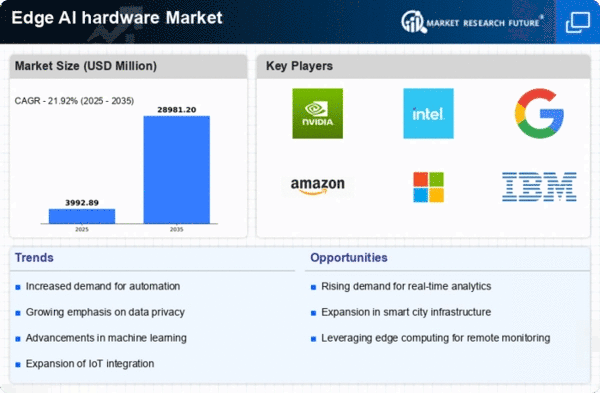
As per MRFR analysis, the Edge AI hardware Market Size was estimated at 3275.01 USD Million in 2024. The Edge AI hardware industry is projected to grow from 3992.96 in 2025 to 28981.2 by 2035, exhibiting a compound annual growth rate (CAGR) of 21.92 during the forecast period 2025 - 2035.

Key Market Trends & Highlights

The Edge AI hardware market is experiencing robust growth driven by technological advancements and increasing demand for real-time data processing.

  • The market witnesses increased adoption of AI-enabled edge devices, particularly in North America, which remains the largest market.
  • There is a growing focus on security and privacy, especially within the Smart Cities segment, which is currently the largest.
  • Integration with IoT ecosystems is becoming essential, with Asia-Pacific emerging as the fastest-growing region.
  • Rising demand for real-time data processing and advancements in machine learning algorithms are key drivers propelling market expansion.

Market Size & Forecast

2024 Market Size 3275.01 (USD Million)
2035 Market Size 28981.2 (USD Million)
CAGR (2025 - 2035) 21.92%
Largest Regional Market Share in 2024 North America

Major Players

<p>NVIDIA (US), Intel (US), Google (US), Amazon (US), Microsoft (US), IBM (US), Qualcomm (US), Hewlett Packard Enterprise (US), Xilinx (US)</p>

Market Trends

The Edge AI hardware Market is currently experiencing a transformative phase, driven by the increasing demand for real-time data processing and analytics at the source of data generation. This shift towards localized computing solutions is largely influenced by the proliferation of Internet of Things (IoT) devices and the need for enhanced privacy and security measures. As organizations seek to optimize their operations, the integration of artificial intelligence capabilities into edge devices appears to be a strategic priority. This trend not only reduces latency but also minimizes bandwidth usage, thereby improving overall efficiency. Furthermore, advancements in semiconductor technology and machine learning algorithms are likely to bolster the capabilities of edge devices, making them more powerful and versatile. In addition, the Edge AI hardware Market is witnessing a growing interest from various sectors, including healthcare, automotive, and manufacturing. These industries are increasingly adopting edge computing solutions to facilitate automation, predictive maintenance, and improved decision-making processes. The convergence of edge computing and AI technologies suggests a promising future, where devices can operate autonomously and intelligently. As the market evolves, collaboration among technology providers, software developers, and end-users will be crucial in shaping the landscape of Edge AI hardware, ensuring that solutions are tailored to meet specific industry needs and challenges.

Increased Adoption of AI-Enabled Edge Devices

The trend towards AI-enabled edge devices is gaining momentum as organizations recognize the benefits of processing data closer to its source. This shift enhances operational efficiency and reduces latency, allowing for quicker decision-making and improved user experiences.

Focus on Security and Privacy

As data breaches and privacy concerns continue to rise, the Edge AI hardware Market is seeing a heightened emphasis on security features. Companies are prioritizing solutions that ensure data protection while maintaining compliance with regulations.

Integration with IoT Ecosystems

The integration of Edge AI hardware with IoT ecosystems is becoming increasingly prevalent. This synergy enables seamless communication between devices, fostering smarter environments and enhancing the capabilities of both edge computing and IoT applications.

Edge AI hardware Market Market Drivers

Market Growth Projections

The Global Edge AI Hardware Market Industry is projected to experience substantial growth over the coming years. The market is expected to reach 3.28 USD Billion in 2024, with a remarkable increase to 29.0 USD Billion by 2035. This growth trajectory indicates a compound annual growth rate of 21.92% from 2025 to 2035. Such projections reflect the increasing integration of edge AI solutions across various sectors, driven by advancements in technology and the rising demand for efficient data processing. The market's expansion underscores the vital role of edge AI hardware in shaping the future of digital transformation.

Emergence of 5G Technology

The rollout of 5G technology is poised to revolutionize the Global Edge AI Hardware Market Industry. With its high-speed connectivity and low latency, 5G enables more efficient data transfer between edge devices and cloud services. This advancement facilitates the deployment of AI applications that require real-time processing, such as autonomous vehicles and smart manufacturing systems. The synergy between 5G and edge AI hardware is likely to drive market expansion, as organizations seek to harness the capabilities of both technologies. The anticipated growth trajectory suggests a promising future for edge AI solutions in a 5G-enabled landscape.

Increased Adoption of IoT Devices

The proliferation of Internet of Things (IoT) devices significantly influences the Global Edge AI Hardware Market Industry. As more devices become interconnected, the demand for edge AI solutions that can process data locally becomes paramount. This shift not only enhances data security but also reduces bandwidth costs associated with cloud computing. Industries such as smart cities and industrial automation are particularly benefiting from this trend. The market is anticipated to grow at a compound annual growth rate of 21.92% from 2025 to 2035, indicating a robust future driven by the integration of edge AI hardware with IoT ecosystems.

Growing Focus on Data Privacy and Security

Data privacy and security concerns are increasingly shaping the Global Edge AI Hardware Market Industry. With the rise in data breaches and regulatory scrutiny, organizations are prioritizing solutions that ensure data protection at the edge. Edge AI hardware Market allows for localized data processing, minimizing the risk of exposure during transmission to centralized servers. This trend is particularly relevant in sectors such as finance and healthcare, where sensitive information is handled. As businesses adopt edge AI solutions to enhance their security posture, the market is expected to witness substantial growth, further emphasizing the need for robust hardware solutions.

Rising Demand for Real-Time Data Processing

The Global Edge AI Hardware Market Industry experiences a notable surge in demand for real-time data processing. This trend is driven by the increasing need for instantaneous decision-making across various sectors, including healthcare, automotive, and manufacturing. For instance, edge AI devices facilitate rapid data analysis at the source, reducing latency and enhancing operational efficiency. As organizations seek to leverage data for competitive advantage, the market is projected to reach 3.28 USD Billion in 2024, reflecting a significant shift towards decentralized computing. This transformation underscores the importance of edge AI hardware in meeting the evolving needs of businesses globally.

Advancements in AI Algorithms and Machine Learning

Advancements in artificial intelligence algorithms and machine learning techniques are pivotal in propelling the Global Edge AI Hardware Market Industry forward. Enhanced algorithms enable more efficient processing and analysis of data at the edge, leading to improved performance and accuracy. For example, the integration of deep learning models in edge devices allows for sophisticated applications such as facial recognition and predictive maintenance. As these technologies evolve, they are expected to drive the market's growth, with projections indicating a rise to 29.0 USD Billion by 2035. This growth highlights the critical role of innovative AI methodologies in shaping the future of edge AI hardware.

Market Segment Insights

By Application: Smart Cities (Largest) vs. Industrial Automation (Fastest-Growing)

<p>The Edge AI hardware market is witnessing a diverse distribution across its application segments. Smart Cities, leveraging AI for urban management and infrastructure optimization, hold the largest share, reflecting the growing investments in smart infrastructure worldwide. Following closely, Industrial Automation is emerging as a significant contributor, driven by increased automation in manufacturing and enhanced operational efficiency through AI technologies.</p>

<p>Smart Cities (Dominant) vs. Industrial Automation (Emerging)</p>

<p>Smart Cities represent the dominant application in the Edge AI hardware market, as they utilize advanced analytics and AI-driven solutions to optimize urban services and improve citizens' quality of life. This segment benefits from consistent government support and public-private initiatives, aiming to create more sustainable environments. In contrast, Industrial Automation is an emerging segment experiencing rapid growth, fueled by the digitization of industry processes, the rise of Industry 4.0, and the integration of machine learning in predictive maintenance and production lines. As industries evolve, the demand for efficient and intelligent hardware solutions continues to climb, positioning Industrial Automation as a key area for future investment.</p>

By End Use: Manufacturing (Largest) vs. Automotive (Fastest-Growing)

<p>In the Edge AI hardware market, the manufacturing sector holds the largest share due to its extensive adoption of AI solutions for automation and efficiency enhancement. This segment leverages Edge AI to optimize production processes, supply chain management, and predictive maintenance, thereby significantly driving market share. On the other hand, telecommunications and consumer electronics also play vital roles, but their shares are comparatively smaller. The energy sector, while essential, is still emerging within this technological landscape as firms adopt AI-driven solutions for smarter resource management and grid efficiency.</p>

<p>Manufacturing: Industry Applications (Dominant) vs. Automotive: Autonomous Systems (Emerging)</p>

<p>The manufacturing segment in the Edge AI hardware market is characterized by its robust integration of AI technologies in production lines, leading to increases in operational efficiencies and reduced downtime. This segment, often regarded as dominant, utilizes AI-powered analytics to streamline processes, enhance quality control, and reduce costs. In contrast, the automotive segment is identified as emerging, primarily due to its rapid evolution towards autonomous systems. The integration of AI in vehicles for features such as autonomous driving, advanced driver-assistance systems (ADAS), and predictive maintenance is driving growth. The automotive industry's demand for innovative solutions to enhance safety and efficiency is rapidly transforming its landscape, marking a significant shift towards wider Edge AI adoption.</p>

By Technology: Machine Learning (Largest) vs. Robotics (Fastest-Growing)

<p>Within the Edge AI hardware market, Machine Learning is the dominant technology segment, capturing the largest market share driven by its extensive application across various sectors including healthcare, automotive, and manufacturing. Following closely, Computer Vision and Natural Language Processing provide significant contributions, while Sensor Fusion and Robotics are gaining traction as emerging technologies, catering to niche applications and developments. Growth trends in the Edge AI hardware market are on the rise, primarily fueled by the increasing demand for real-time data processing and decision-making at the edge. Robotics is witnessing rapid advancements and investments, marking it as the fastest-growing segment. The convergence of advanced algorithms, enhanced processing capabilities, and decreasing hardware costs further propels the adoption of these technologies, driving innovation across industries.</p>

<p>Technology: Machine Learning (Dominant) vs. Robotics (Emerging)</p>

<p>Machine Learning stands out as the dominant technology in the Edge AI hardware market, characterized by its capability to analyze vast datasets, predict outcomes, and provide insights that enhance operational efficiencies. It enjoys widespread application, from predictive maintenance in manufacturing to advanced driver-assistance systems in automotive. In contrast, Robotics is emerging swiftly, fueled by advancements in automation and AI integration. This segment is expanding rapidly due to innovations in autonomous machines, and collaborative robots (cobots) that enhance human capabilities. Robotics leverages Machine Learning to adapt and learn from their environments, thus complementing existing technologies and presenting a formidable combination that is shaping the future landscape of Edge AI hardware.</p>

By Form Factor: Embedded Systems (Largest) vs. Edge Servers (Fastest-Growing)

<p>In the Edge AI hardware market, the form factor segment showcases a diverse distribution of market value across various categories. Among these, Embedded Systems hold the largest share, primarily due to their wide applicability and integration in IoT devices and industrial automation systems. Meanwhile, Edge Servers, although smaller in share, are rapidly gaining traction as businesses increasingly seek localized data processing and AI capabilities at the edge, leading to a surge in demand for this segment.</p>

<p>Embedded Systems (Dominant) vs. Edge Servers (Emerging)</p>

<p>Embedded Systems stand out as the dominant form factor within the Edge AI hardware market, characterized by their compact design, energy efficiency, and ability to perform real-time data processing. They are widely used in consumer electronics, automotive applications, and smart home devices. On the other hand, Edge Servers represent an emerging segment, designed to handle complex AI workloads closer to the data source. They excel in processing large volumes of data with low latency, making them essential in sectors like healthcare and manufacturing, where immediate insights are critical.</p>

By Deployment Model: On-Premises (Largest) vs. Cloud-Based (Fastest-Growing)

<p>In the Edge AI hardware market, the deployment model segment reveals a diverse distribution among various choices. On-premises solutions lead the market, favored by enterprises looking for control over data security and low-latency processing. Cloud-based models are rising steadily, attracting businesses due to their flexibility and cost-effectiveness, particularly in scenarios necessitating scalable computing without extensive infrastructure investments. Hybrid and distributed models also have their share, but they cater to specific use cases that require both on-site and cloud capabilities.</p>

<p>On-Premises (Dominant) vs. Cloud-Based (Emerging)</p>

<p>The On-Premises deployment model remains dominant within the Edge AI hardware market, particularly among industries with stringent regulatory requirements on data privacy and access. Companies leveraging on-premises solutions benefit from reduced latency, enhanced security, and direct control over hardware resources. Conversely, Cloud-Based deployment is emerging rapidly, particularly in sectors that demand agility and scalability. This model enables organizations to dynamically adjust resources, share workloads, and minimize upfront investment costs. As businesses increasingly shift towards digital transformation, the demand for such flexible cloud solutions is expected to surge, driving innovation and competition in the market.</p>

Get more detailed insights about Edge AI hardware Market Research Report - Forecast to 2035

Regional Insights

North America : Innovation Hub for Edge AI

North America continues to dominate the Edge AI hardware market, holding a significant share of 1630.0M in 2025. The region's growth is driven by rapid advancements in AI technologies, increased demand for real-time data processing, and supportive government initiatives promoting AI innovation. Regulatory frameworks are evolving to facilitate the integration of AI in various sectors, enhancing market dynamics and attracting investments. The competitive landscape is robust, with the presence of major players like NVIDIA, Intel, and Google, which are spearheading innovation in Edge AI solutions. The U.S. leads the charge, supported by a strong ecosystem of tech companies and research institutions. This concentration of expertise and resources positions North America as a pivotal player in The Edge AI hardware, ensuring continued growth and technological advancement.

Europe : Emerging Powerhouse in AI

Europe is rapidly emerging as a significant player in the Edge AI hardware market, with a market size of 850.0M in 2025. The region benefits from strong regulatory support aimed at fostering AI development and deployment. Initiatives like the European AI Act are designed to create a conducive environment for innovation while ensuring ethical standards. This regulatory landscape is driving demand for Edge AI solutions across various industries, including automotive and healthcare. Leading countries such as Germany, France, and the UK are at the forefront of this transformation, hosting numerous tech firms and startups focused on AI advancements. The competitive landscape is characterized by collaborations between established companies and emerging players, enhancing innovation. Key players like IBM and Qualcomm are actively investing in Edge AI technologies, further solidifying Europe's position in the global market.

Asia-Pacific : Growing Market with Potential

Asia-Pacific is witnessing significant growth in the Edge AI hardware market, projected to reach 650.0M in 2025. The region's expansion is fueled by increasing investments in AI technologies, a growing demand for smart devices, and supportive government policies promoting digital transformation. Countries like China and Japan are leading the charge, with initiatives aimed at enhancing AI capabilities and infrastructure, thereby driving market growth. The competitive landscape is diverse, with a mix of established tech giants and innovative startups. Key players such as Google and Intel are actively involved in the region, contributing to the development of Edge AI solutions tailored to local needs. The presence of a large consumer base and rapid urbanization further enhances the market potential, making Asia-Pacific a critical region for Edge AI hardware development.

Middle East and Africa : Resource-Rich Frontier for AI

The Middle East and Africa (MEA) region is gradually emerging in the Edge AI hardware market, with a market size of 145.01M in 2025. The growth is driven by increasing investments in technology and infrastructure, alongside a rising demand for AI applications in sectors like healthcare and finance. Governments in the region are recognizing the potential of AI and are implementing strategies to foster innovation and attract foreign investments, creating a favorable environment for market growth. Countries such as the UAE and South Africa are leading the way, with initiatives aimed at enhancing digital capabilities and AI adoption. The competitive landscape is evolving, with both local and international players entering the market. Companies are focusing on developing Edge AI solutions that cater to the unique needs of the region, positioning MEA as a promising frontier for future growth in the Edge AI hardware market.

Key Players and Competitive Insights

The Edge AI hardware Market is currently characterized by intense competition and rapid technological advancements, driven by the increasing demand for real-time data processing and analytics at the edge. Major players such as NVIDIA (US), Intel (US), and Google (US) are strategically positioning themselves through innovation and partnerships, which collectively shape the competitive landscape. NVIDIA (US) focuses on enhancing its GPU capabilities for AI applications, while Intel (US) emphasizes its diverse portfolio, including CPUs and FPGAs, to cater to various edge computing needs. Google (US) leverages its cloud infrastructure to integrate AI solutions, thereby enhancing its competitive edge in the market.

Key business tactics employed by these companies include localizing manufacturing and optimizing supply chains to enhance efficiency and reduce costs. The market appears moderately fragmented, with a mix of established players and emerging startups. The collective influence of these key players is significant, as they drive technological advancements and set industry standards, thereby shaping the overall market dynamics.

In November 2025, NVIDIA (US) announced a partnership with a leading telecommunications provider to develop edge AI solutions tailored for smart cities. This strategic move is likely to enhance NVIDIA's market presence and expand its application scope in urban environments, where real-time data processing is crucial for infrastructure management and public safety.

In October 2025, Intel (US) unveiled its latest line of edge AI processors designed specifically for IoT applications. This launch is indicative of Intel's commitment to innovation and its strategy to capture a larger share of the growing IoT market, which is increasingly reliant on edge computing capabilities. By focusing on specialized processors, Intel aims to address the unique challenges posed by edge environments, thereby solidifying its competitive position.

In September 2025, Google (US) expanded its AI-driven edge computing services by integrating advanced machine learning capabilities into its existing cloud offerings. This integration is expected to enhance the performance of edge devices and facilitate more efficient data processing. By leveraging its cloud infrastructure, Google is likely to attract more enterprise customers seeking robust edge AI solutions, further intensifying competition in the market.

As of December 2025, current competitive trends in the Edge AI hardware Market are heavily influenced by digitalization, sustainability, and the integration of AI technologies. Strategic alliances among key players are shaping the landscape, fostering innovation and collaboration. The shift from price-based competition to a focus on technological advancement and supply chain reliability is evident, suggesting that future competitive differentiation will hinge on the ability to deliver innovative solutions that meet the evolving demands of the market.

Key Companies in the Edge AI hardware Market market include

Industry Developments

  • October 2024, A new AI hardware platform has now been introduced by NVIDIA, including GPUs and other resources directed to edge computing applications and real-time processing. This development is expected to enhance the capabilities of driverless automobiles, intelligent cities, and industrial automation systems. 
  • July 2024, Intel has launched a new range of AI processors for edge devices; these devices were tailored explicitly for low latency and high throughput scenarios. Edge-based AI applications like autonomous surveillance and robotic systems will likely benefit from these processors. 
  • April 2024, Qualcomm has introduced an Edge AI chipset that works with 5G networks. This chipset works specifically with mobile edge computing and allows Internet of Things devices, automobiles, and applications for real-time data analytics to be much more efficient. 
  • January 2024, Google Cloud launched its aggressively aimed AI accelerator, which is directed towards edge devices and applications. This accelerator aims to allow machine learning applications to function without much reliance on cloud servers, critical in industrial applications and healthcare. 
  • October 2023, As part of its aspirations to further diversify its business, Arm Holdings announced plans to enter the AI chip market. Such a move would allow them to use their strengths in the architectural design of chips to make processors intended for AI workloads. Broadly, the goal is to provide solutions for the shortage of efficient AI hardware.
  • July 2023, Regarding edge applications, Broadcom today showcased a new AI accelerator that provides low energy requirements and high performance. Further boosters for broader segments such as automotive, healthcare, and many other industries would come by bringing AI computation to the edge.
  • In May 2023, Arm introduced a new Cortex-X4 high-performance core, and a GPU called G720. the Cortex-A720 performance cores and Cortex-A520 power-efficiency CPUs, can be paired with GPUs in smartphones, tablets, and PCs. The chipset package, called TCS23, has a mix of hardware and software technologies operating on the sidelines that improve AI performance.
  • April 2023, Qualcomm partnered with a large automotive group to incorporate its Edge AI hardware Market in future vehicles. This collaboration is expected to improve the capabilities of self-driving cars and the user experience inside the vehicle with advanced AI processing.
  • In March 2023, Intel's Habana Labs has launched second-generation Al processors for training and inferencing. In March 2022, Amphenol Corporation expanded its SURLOK Plus Series to include 8 mm and 10.3 mm right-angle connectors, with a voltage range of 1500 VDC to meet energy storage and high-power connection and transfer requirements.

Future Outlook

Edge AI hardware Market Future Outlook

<p>The Edge AI hardware market is projected to grow at a 21.92% CAGR from 2024 to 2035, driven by advancements in IoT, increased data processing needs, and enhanced AI capabilities.</p>

New opportunities lie in:

  • <p>Development of AI-optimized edge computing devices for smart cities.</p>
  • <p>Integration of edge AI solutions in autonomous vehicle systems.</p>
  • <p>Creation of specialized hardware for real-time industrial automation applications.</p>

<p>By 2035, the Edge AI hardware market is expected to be robust, reflecting substantial growth and innovation.</p>

Market Segmentation

Edge AI hardware Market End Use Outlook

  • Manufacturing
  • Telecommunications
  • Energy
  • Automotive
  • Consumer Electronics

Edge AI hardware Market Technology Outlook

  • Machine Learning
  • Computer Vision
  • Natural Language Processing
  • Robotics
  • Sensor Fusion

Edge AI hardware Market Application Outlook

  • Smart Cities
  • Industrial Automation
  • Healthcare
  • Retail
  • Transportation

Edge AI hardware Market Form Factor Outlook

  • Embedded Systems
  • Edge Servers
  • Gateways
  • IoT Devices
  • Mobile Devices

Edge AI hardware Market Deployment Model Outlook

  • On-Premises
  • Cloud-Based
  • Hybrid
  • Distributed
  • Fog Computing

Report Scope

MARKET SIZE 20243275.01(USD Million)
MARKET SIZE 20253992.96(USD Million)
MARKET SIZE 203528981.2(USD Million)
COMPOUND ANNUAL GROWTH RATE (CAGR)21.92% (2024 - 2035)
REPORT COVERAGERevenue Forecast, Competitive Landscape, Growth Factors, and Trends
BASE YEAR2024
Market Forecast Period2025 - 2035
Historical Data2019 - 2024
Market Forecast UnitsUSD Million
Key Companies ProfiledNVIDIA (US), Intel (US), Google (US), Amazon (US), Microsoft (US), IBM (US), Qualcomm (US), Hewlett Packard Enterprise (US), Xilinx (US)
Segments CoveredApplication, End Use, Technology, Form Factor, Deployment Model
Key Market OpportunitiesIntegration of advanced machine learning algorithms in Edge AI hardware enhances real-time data processing capabilities.
Key Market DynamicsRising demand for real-time data processing drives innovation and competition in the Edge AI hardware sector.
Countries CoveredNorth America, Europe, APAC, South America, MEA

FAQs

How much is the Edge AI Hardware market?

The Edge AI Hardware Market size is expected to be valued at USD 3275.01 billion in 2024.

What is the growth rate of the Edge AI Hardware market?

The global market is projected to grow at a CAGR of 21.92 % during the forecast period, 2025 to 2035.

Which region held the largest market share in the Edge AI Hardware market?

North America had the largest share of the global market.

Who are the key players in the Edge AI Hardware market?

The key players in the market are NVIDIA Corporation, Google (Alphabet Inc.), Intel Corporation, Huawei Technologies Co., Ltd., Apple Inc., Qualcomm Incorporated, Samsung Electronics Co., Ltd., IBM Corporation, Dell Technologies Inc., Microsoft Corporation, ARM, Hailo, MediaTek Inc., Xilinx Inc. and Micron Technology.

Which Component led the Edge AI Hardware market?

The CPU category dominated the market in 2022.

  1. EXECUTIVE SUMMARY 12
    1. MARKET ATTRACTIVENESS ANALYSIS 15
  2. MARKET INTRODUCTION 16
    1. DEFINITION 16
    2. SCOPE OF THE STUDY 16
    3. RESEARCH OBJECTIVE 16
    4. MARKET STRUCTURE 17
  3. RESEARCH METHODOLOGY 18
  4. MARKET DYNAMICS 25
    1. OVERVIEW 25
    2. DRIVERS 26
      1. GROWTH IN THE UTILIZATION OF ARTIFICIAL INTELLIGENCE (AI) 26
      2. GROWING ADOPTION OF EDGE AI DUE TO VARIOUS ADVANTAGE OFFERED BY EDGE AI 27
    3. RESTRAINTS 29
      1. LIMITED COMPUTATIONAL POWER AND MEMORY IN EDGE DEVICES 29
      2. COMPLEXITY IN INTEGRATING DIVERSE EDGE AI HARDWARE COMPONENTS 29
    4. OPPORTUNITIES 30
      1. AVAILABILITY OF CHEAP AI HARDWARE AND COST-EFFECTIVE CONNECTIVITY 30
      2. 5G AND 6G NETWORKS INTEGRATION 31
    5. CHALLENGES: 31
    6. IMPACT ANALYSIS OF COVID-19 33
      1. IMPACT ON SEMICONDUCTOR MANUFACTURERS 33
      2. IMPACT ON COMPONENT MANUFACTURERS 34
      3. IMPACT ON DEVICE MANUFACTURERS 34
      4. IMPACT ON SUPPLY CHAIN DELAY 34
  5. MARKET FACTOR ANALYSIS 35
    1. SUPPLY CHAIN ANALYSIS 35
      1. RAW MATERIAL SUPPLIERS: 35
      2. COMPONENT MANUFACTURING: 36
      3. ORIGINAL EQUIPMENT MANUFACTURERS (OEMS): 36
      4. SOFTWARE PROVIDERS: 36
      5. END USERS: 36
    2. PORTER''S FIVE FORCES MODEL 37
      1. THREAT OF NEW ENTRANTS 37
      2. BARGAINING POWER OF SUPPLIERS 38
      3. THREAT OF SUBSTITUTES 38
      4. BARGAINING POWER OF BUYERS 38
      5. INTENSITY OF RIVALRY 38
    3. SWOT ANALYSIS OF E- HOUSE MARKET 39
    4. PESTAL ANALYSIS OF E- HOUSE MARKET 39
    5. CASE STUDIES DEMONSTRATING IMPLEMAENTATION OF EDGE AI IN VARIOUS FIELDS 41
  6. GLOBAL EDGE AI HARDWARE MARKET, BY COMPONENT 43
    1. OVERVIEW 43
    2. CPU 43
    3. GPU 43
    4. ASIC 43
    5. FGPA 44
  7. GLOBAL EDGE AI HARDWARE MARKET, BY DEVICE 45
    1. OVERVIEW 45
    2. SMARTPHONE 45
    3. CAMERA 45
    4. ROBOT 46
    5. AUTOMOBILE 46
    6. SMART SPEAKER 46
    7. WEARABLES 46
    8. SMART MIRROR 47
    9. OTHERS 47
  8. GLOBAL EDGE AI HARDWARE MARKET, BY POWER CONSUMPTION 48
    1. OVERVIEW 48
    2. 0-5W 48
    3. 6-10W 48
    4. MORE THAN 10W 48
  9. GLOBAL EDGE AI HARDWARE MARKET, BY PROCESS 49
    1. OVERVIEW 49
    2. TRAINING 49
    3. INFERENCE 49
  10. GLOBAL EDGE AI HARDWARE MARKET, BY VERTICAL 50
    1. OVERVIEW 50
    2. CONSUMER ELECTRONICS 50
    3. SMART HOME 50
    4. AUTOMOTIVE & TRANSPORTATION 50
    5. HEALTHCARE 51
    6. AEROSPACE & DEFENSE 51
    7. GOVERNMENT 51
    8. CONSTRUCTION 52
    9. OTHERS 52
  11. GLOBAL EDGE AI HARDWARE MARKET, BY REGION 53
    1. OVERVIEW 53
    2. NORTH AMERICA 53
    3. EUROPE 53
    4. ASIA-PACIFIC 54
    5. REST OF THE WORLD 54
  12. COMPETITVE LANDSCAPE 55
    1. COMPETITIVE BENCHMARKING 56
    2. VENDOR SHARE ANALYSIS 57
    3. RECENT DEVELOPMENTS 58
      1. PRODUCT DEVELOPMENT 58
  13. COMPANY PROFILE 61
    1. INTEL CORPORATION 61
      1. COMPANY OVERVIEW 61
      2. FINANCIAL OVERVIEW 62
      3. PRODUCTS/SOLUTIONS/SERVICES OFFERED 62
      4. KEY DEVELOPMENTS 63
      5. SWOT ANALYSIS 64
      6. KEY STRATEGIES 64
    2. ARM LIMITED 65
      1. COMPANY OVERVIEW 65
      2. FINANCIAL OVERVIEW 66
      3. PRODUCTS/SOLUTIONS/SERVICES OFFERED 66
      4. KEY DEVELOPMENTS 67
      5. SWOT ANALYSIS 68
      6. KEY STRATEGIES 68
    3. HUAWEI TECHNOLOGIES CO. LTD. 69
      1. COMPANY OVERVIEW 69
      2. FINANCIAL OVERVIEW 70
      3. PRODUCTS/SOLUTIONS/SERVICES OFFERED 70
      4. KEY DEVELOPMENTS 70
      5. SWOT ANALYSIS 71
      6. KEY STRATEGIES 71
    4. MICROSOFT 72
      1. COMPANY OVERVIEW 72
      2. FINANCIAL OVERVIEW 73
      3. PRODUCTS/SOLUTIONS/SERVICES OFFERED 73
      4. KEY DEVELOPMENTS 74
      5. SWOT ANALYSIS 74
      6. KEY STRATEGIES 75
    5. SAMSUNG ELECTRONICS CO., LTD. 76
      1. COMPANY OVERVIEW 76
      2. FINANCIAL OVERVIEW 77
      3. PRODUCTS OFFERED 77
      4. KEY DEVELOPMENTS 78
      5. SWOT ANALYSIS 78
      6. KEY STRATEGIES 78
    6. GOOGLE INC. (ALPHABET INC.) 79
      1. COMPANY OVERVIEW 79
      2. FINANCIAL OVERVIEW 80
      3. PRODUCTS OFFERED 80
      4. KEY DEVELOPMENTS 81
      5. SWOT ANALYSIS 81
      6. KEY STRATEGIES 81
    7. NVIDIA CORPORATION 82
      1. COMPANY OVERVIEW 82
      2. FINANCIAL OVERVIEW 83
      3. PRODUCTS OFFERED 83
      4. KEY DEVELOPMENTS 84
      5. SWOT ANALYSIS 84
      6. KEY STRATEGIES 84
    8. QUALCOMM 85
      1. COMPANY OVERVIEW 85
      2. FINANCIAL OVERVIEW 86
      3. PRODUCTS OFFERED 86
      4. KEY DEVELOPMENTS 87
      5. SWOT ANALYSIS 87
      6. KEY STRATEGIES 87
    9. MEDIATEK INC. 88
      1. COMPANY OVERVIEW 88
      2. FINANCIAL OVERVIEW 89
      3. PRODUCTS OFFERED 89
      4. KEY DEVELOPMENTS 90
      5. SWOT ANALYSIS 90
      6. KEY STRATEGIES 90
    10. XILINX INC. 91
      1. COMPANY OVERVIEW 91
      2. FINANCIAL OVERVIEW 92
      3. PRODUCTS OFFERED 93
      4. KEY DEVELOPMENTS 93
      5. SWOT ANALYSIS 94
      6. KEY STRATEGIES 94
    11. APPLE INC. 95
      1. COMPANY OVERVIEW 95
      2. FINANCIAL OVERVIEW 96
      3. PRODUCTS OFFERED 97
      4. KEY DEVELOPMENTS 97
      5. SWOT ANALYSIS 98
      6. KEY STRATEGIES 98
    12. DELL TECHNOLOGIES INC. 99
      1. COMPANY OVERVIEW 99
      2. FINANCIAL OVERVIEW 100
      3. PRODUCTS OFFERED 100
      4. KEY DEVELOPMENTS 101
      5. SWOT ANALYSIS 101
      6. KEY STRATEGIES 101
    13. MICRON TECHNOLOGY 102
      1. COMPANY OVERVIEW 102
      2. FINANCIAL OVERVIEW 103
      3. PRODUCTS OFFERED 103
      4. KEY DEVELOPMENTS 104
      5. SWOT ANALYSIS 104
      6. KEY STRATEGIES 104
    14. IMAGINATION TECHNOLOGIES LIMITED 105
      1. COMPANY OVERVIEW 105
      2. PRODUCTS OFFERED 105
      3. KEY DEVELOPMENTS 105
      4. SWOT ANALYSIS 106
      5. KEY STRATEGIES 106
    15. HAILO 107
      1. COMPANY OVERVIEW 107
      2. PRODUCTS OFFERED 107
      3. KEY DEVELOPMENTS 107
      4. SWOT ANALYSIS 108
      5. KEY STRATEGIES 108
  14. LIST OF TABLES
  15. PRODUCT DEVELOPMENT 58
  16. PARTNERSHIP 59
  17. INTEL CORPORATION: PRODUCTS/SOLUTIONS/SERVICES OFFERED 62
  18. INTEL CORPORATION: KEY DEVELOPMENTS 63
  19. ARM LIMITED: PRODUCTS/SOLUTIONS/SERVICES OFFERED 66
  20. ARM LIMITED: KEY DEVELOPMENTS 67
  21. HUAWEI TECHNOLOGIES CO. LTD.: PRODUCT/SOLUTION/SERVICE OFFERED 70
  22. MICROSOFT: PRODUCTS/SOLUTIONS/SERVICES OFFERED 73
  23. MICROSOFT: KEY DEVELOPMENTS 74
  24. SAMSUNG ELECTRONICS CO., LTD.: PRODUCTS OFFERED 77
  25. SAMSUNG ELECTRONICS CO., LTD.: KEY DEVELOPMENTS 78
  26. GOOGLE INC (ALPHABET INC.): PRODUCTS OFFERED 80
  27. GOOGLE INC (ALPHABET INC.): KEY DEVELOPMENTS 81
  28. NVIDIA CORPORATION: PRODUCTS OFFERED 83
  29. NVIDIA CORPORATION: KEY DEVELOPMENTS 84
  30. QUALCOMM: PRODUCTS OFFERED 86
  31. QUALCOMM: KEY DEVELOPMENTS 87
  32. MEDIATEK INC.: PRODUCTS OFFERED 89
  33. MEDIATEK INC.: KEY DEVELOPMENTS 90
  34. XILINX INC.: PRODUCTS OFFERED 93
  35. XILINX INC.: KEY DEVELOPMENTS 93
  36. APPLE INC.: PRODUCTS OFFERED 97
  37. APPLE INC.: KEY DEVELOPMENTS 97
  38. DELL TECHNOLOGIES INC.: PRODUCTS OFFERED 100
  39. MICRON TECHNOLOGY: PRODUCTS OFFERED 103
  40. MICRON TECHNOLOGY: KEY DEVELOPMENTS 104
  41. IMAGINATION TECHNOLOGIES LIMITED: PRODUCTS OFFERED 105
  42. IMAGINATION TECHNOLOGIES LIMITED: KEY DEVELOPMENTS 105
  43. HAILO: PRODUCTS OFFERED 107
  44. HAILO: KEY DEVELOPMENTS 107
  45. LIST OF FIGURES
  46. MARKET SYNOPSIS 14
  47. MARKET ATTRACTIVENESS ANALYSIS: GLOBAL EDGE AI HARDWARE MARKET 15
  48. GLOBAL EDGE AI HARDWARE MARKET: STRUCTURE 17
  49. BOTTOM-UP AND TOP-DOWN APPROACHES 22
  50. MARKET DYNAMICS: GLOBAL EDGE AI HARDWARE MARKET 25
  51. ADVANATAGES OF EDGE AI 27
  52. DRIVERS: IMPACT ANALYSIS 28
  53. RESTRAINT: IMPACT ANALYSIS 30
  54. GLOBAL E- HOUSE MARKET: VALUE CHAIN 35
  55. PORTER''S FIVE FORCES ANALYSIS OF GLOBAL EDGE AI HARDWARE MARKET 37
  56. GLOBAL EDGE AI HARDWARE MARKET – SWOT ANALYSIS 39
  57. GLOBAL EDGE AI HARDWARE MARKET: COMPETITIVE BENCHMARKING 56
  58. VENDOR SHARE ANALYSIS (2022, %) 57
  59. INTEL CORPORATION: FINANCIAL OVERVIEW SNAPSHOT 62
  60. INTEL CORPORATION: SWOT ANALYSIS 64
  61. ARM LIMITED (PART OF SOFTBANK GROUP): FINANCIAL OVERVIEW SNAPSHOT 66
  62. ARM LIMITED: SWOT ANALYSIS 68
  63. HUAWEI TECHNOLOGIES CO. LTD.: FINANCIAL OVERVIEW SNAPSHOT 70
  64. HUAWEI TECHNOLOGIES CO. LTD.: SWOT ANALYSIS 71
  65. MICROSOFT: FINANCIAL OVERVIEW SNAPSHOT 73
  66. MICROSOFT: SWOT ANALYSIS 74
  67. SAMSUNG ELECTRONICS CO., LTD.: FINANCIAL OVERVIEW SNAPSHOT 77
  68. SAMSUNG ELECTRONICS CO., LTD.: SWOT ANALYSIS 78
  69. GOOGLE INC (ALPHABET INC.): FINANCIAL OVERVIEW SNAPSHOT 80
  70. GOOGLE INC (ALPHABET INC.): SWOT ANALYSIS 81
  71. NVIDIA CORPORATION: FINANCIAL OVERVIEW SNAPSHOT 83
  72. NVIDIA CORPORATION: SWOT ANALYSIS 84
  73. QUALCOMM: FINANCIAL OVERVIEW SNAPSHOT 86
  74. QUALCOMM: SWOT ANALYSIS 87
  75. MEDIATEK INC.: FINANCIAL OVERVIEW SNAPSHOT 89
  76. MEDIATEK INC.: SWOT ANALYSIS 90
  77. XILINX INC.: FINANCIAL OVERVIEW SNAPSHOT 92
  78. XILINX INC.: SWOT ANALYSIS 94
  79. APPLE INC.: FINANCIAL OVERVIEW SNAPSHOT 96
  80. APPLE INC.: SWOT ANALYSIS 98
  81. DELL TECHNOLOGIES INC.: FINANCIAL OVERVIEW SNAPSHOT 100
  82. DELL TECHNOLOGIES INC.: SWOT ANALYSIS 101
  83. MICRON TECHNOLOGY: FINANCIAL OVERVIEW SNAPSHOT 103
  84. MICRON TECHNOLOGY: SWOT ANALYSIS 104
  85. IMAGINATION TECHNOLOGIES LIMITED: SWOT ANALYSIS 106
  86. HAILO: SWOT ANALYSIS 108'

Edge AI Hardware Market Segmentation

Global Edge AI Hardware Component Outlook (USD Million, 2019-2032)

  • CPU
  • GPU
  • ASIC
  • FPGA

Global Edge AI Hardware Device Outlook (USD Million, 2019-2032)

  • Smartphone
  • Camera
  • Robot
  • Automobile
  • Smart Speaker
  • Wearables
  • Smart Mirror
  • Others

Global Edge AI Hardware Power Consumption Outlook (USD Million, 2019-2032)

  • 0-5 W
  • 6-10 W
  • More Than 10 W

Global Edge AI Hardware Process Outlook (USD Million, 2019-2032)

  • Training
  • Inference

Global Edge AI Hardware Vertical Outlook (USD Million, 2019-2032)

  • Consumer Electronics
  • Smart Home
  • Automotive & Transportation
  • Healthcare
  • Aerospace & Defense
  • Government
  • Construction
  • Others

Global Edge AI Hardware Regional Outlook (USD Million, 2019-2032)

North America Edge AI Hardware Component Outlook (USD Million, 2019-2032)

  • CPU
  • GPU
  • ASIC
  • FPGA

North America Edge AI Hardware Device Outlook (USD Million, 2019-2032)

  • Smartphone
  • Camera
  • Robot
  • Automobile
  • Smart Speaker
  • Wearables
  • Smart Mirror
  • Others

North America Edge AI Hardware Power Consumption Outlook (USD Million, 2019-2032)

  • 0-5 W
  • 6-10 W
  • More Than 10 W

North America Edge AI Hardware Process Outlook (USD Million, 2019-2032)

  • Training
  • Inference

North America Edge AI Hardware Vertical Outlook (USD Million, 2019-2032)

  • Consumer Electronics
  • Smart Home
  • Automotive & Transportation
  • Healthcare
  • Aerospace & Defense
  • Government
  • Construction
  • Others


US Edge AI Hardware Component Outlook (USD Million, 2019-2032)

  • CPU
  • GPU
  • ASIC
  • FPGA

US Edge AI Hardware Device Outlook (USD Million, 2019-2032)

  • Smartphone
  • Camera
  • Robot
  • Automobile
  • Smart Speaker
  • Wearables
  • Smart Mirror
  • Others

US Edge AI Hardware Power Consumption Outlook (USD Million, 2019-2032)

  • 0-5 W
  • 6-10 W
  • More Than 10 W

US Edge AI Hardware Process Outlook (USD Million, 2019-2032)

  • Training
  • Inference

US Edge AI Hardware Vertical Outlook (USD Million, 2019-2032)

  • Consumer Electronics
  • Smart Home
  • Automotive & Transportation
  • Healthcare
  • Aerospace & Defense
  • Government
  • Construction
  • Others


Canada Edge AI Hardware Component Outlook (USD Million, 2019-2032)

  • CPU
  • GPU
  • ASIC
  • FPGA

Canada Edge AI Hardware Device Outlook (USD Million, 2019-2032)

  • Smartphone
  • Camera
  • Robot
  • Automobile
  • Smart Speaker
  • Wearables
  • Smart Mirror
  • Others

Canada Edge AI Hardware Power Consumption Outlook (USD Million, 2019-2032)

  • 0-5 W
  • 6-10 W
  • More Than 10 W

Canada Edge AI Hardware Process Outlook (USD Million, 2019-2032)

  • Training
  • Inference

Canada Edge AI Hardware Vertical Outlook (USD Million, 2019-2032)

  • Consumer Electronics
  • Smart Home
  • Automotive & Transportation
  • Healthcare
  • Aerospace & Defense
  • Government
  • Construction
  • Others

Mexico Edge AI Hardware Component Outlook (USD Million, 2019-2032)

  • CPU
  • GPU
  • ASIC
  • FPGA

Mexico Edge AI Hardware Device Outlook (USD Million, 2019-2032)

  • Smartphone
  • Camera
  • Robot
  • Automobile
  • Smart Speaker
  • Wearables
  • Smart Mirror
  • Others

Mexico Edge AI Hardware Power Consumption Outlook (USD Million, 2019-2032)

  • 0-5 W
  • 6-10 W
  • More Than 10 W

Mexico Edge AI Hardware Process Outlook (USD Million, 2019-2032)

  • Training
  • Inference

Mexico Edge AI Hardware Vertical Outlook (USD Million, 2019-2032)

  • Consumer Electronics
  • Smart Home
  • Automotive & Transportation
  • Healthcare
  • Aerospace & Defense
  • Government
  • Construction
  • Others

Europe Edge AI Hardware Component Outlook (USD Million, 2019-2032)

  • CPU
  • GPU
  • ASIC
  • FPGA

Europe Edge AI Hardware Device Outlook (USD Million, 2019-2032)

  • Smartphone
  • Camera
  • Robot
  • Automobile
  • Smart Speaker
  • Wearables
  • Smart Mirror
  • Others

Europe Edge AI Hardware Power Consumption Outlook (USD Million, 2019-2032)

  • 0-5 W
  • 6-10 W
  • More Than 10 W

Europe Edge AI Hardware Process Outlook (USD Million, 2019-2032)

  • Training
  • Inference

Europe Edge AI Hardware Vertical Outlook (USD Million, 2019-2032)

  • Consumer Electronics
  • Smart Home
  • Automotive & Transportation
  • Healthcare
  • Aerospace & Defense
  • Government
  • Construction
  • Others

Germany Edge AI Hardware Component Outlook (USD Million, 2019-2032)

  • CPU
  • GPU
  • ASIC
  • FPGA

Germany Edge AI Hardware Device Outlook (USD Million, 2019-2032)

  • Smartphone
  • Camera
  • Robot
  • Automobile
  • Smart Speaker
  • Wearables
  • Smart Mirror
  • Others

Germany Edge AI Hardware Power Consumption Outlook (USD Million, 2019-2032)

  • 0-5 W
  • 6-10 W
  • More Than 10 W

Germany Edge AI Hardware Process Outlook (USD Million, 2019-2032)

  • Training
  • Inference

Germany Edge AI Hardware Vertical Outlook (USD Million, 2019-2032)

  • Consumer Electronics
  • Smart Home
  • Automotive & Transportation
  • Healthcare
  • Aerospace & Defense
  • Government
  • Construction
  • Others


UK Edge AI Hardware Component Outlook (USD Million, 2019-2032)

  • CPU
  • GPU
  • ASIC
  • FPGA

UK Edge AI Hardware Device Outlook (USD Million, 2019-2032)

  • Smartphone
  • Camera
  • Robot
  • Automobile
  • Smart Speaker
  • Wearables
  • Smart Mirror
  • Others

UK Edge AI Hardware Power Consumption Outlook (USD Million, 2019-2032)

  • 0-5 W
  • 6-10 W
  • More Than 10 W

UK Edge AI Hardware Process Outlook (USD Million, 2019-2032)

  • Training
  • Inference

UK Edge AI Hardware Vertical Outlook (USD Million, 2019-2032)

  • Consumer Electronics
  • Smart Home
  • Automotive & Transportation
  • Healthcare
  • Aerospace & Defense
  • Government
  • Construction
  • Others


France Edge AI Hardware Component Outlook (USD Million, 2019-2032)

  • CPU
  • GPU
  • ASIC
  • FPGA

France Edge AI Hardware Device Outlook (USD Million, 2019-2032)

  • Smartphone
  • Camera
  • Robot
  • Automobile
  • Smart Speaker
  • Wearables
  • Smart Mirror
  • Others

France Edge AI Hardware Power Consumption Outlook (USD Million, 2019-2032)

  • 0-5 W
  • 6-10 W
  • More Than 10 W

France Edge AI Hardware Process Outlook (USD Million, 2019-2032)

  • Training
  • Inference

France Edge AI Hardware Vertical Outlook (USD Million, 2019-2032)

  • Consumer Electronics
  • Smart Home
  • Automotive & Transportation
  • Healthcare
  • Aerospace & Defense
  • Government
  • Construction
  • Others

Italy Edge AI Hardware Component Outlook (USD Million, 2019-2032)

  • CPU
  • GPU
  • ASIC
  • FPGA

Italy Edge AI Hardware Device Outlook (USD Million, 2019-2032)

  • Smartphone
  • Camera
  • Robot
  • Automobile
  • Smart Speaker
  • Wearables
  • Smart Mirror
  • Others

Italy Edge AI Hardware Power Consumption Outlook (USD Million, 2019-2032)

  • 0-5 W
  • 6-10 W
  • More Than 10 W

Italy Edge AI Hardware Process Outlook (USD Million, 2019-2032)

  • Training
  • Inference

Italy Edge AI Hardware Vertical Outlook (USD Million, 2019-2032)

  • Consumer Electronics
  • Smart Home
  • Automotive & Transportation
  • Healthcare
  • Aerospace & Defense
  • Government
  • Construction
  • Others


Spain Edge AI Hardware Component Outlook (USD Million, 2019-2032)

  • CPU
  • GPU
  • ASIC
  • FPGA

Spain Edge AI Hardware Device Outlook (USD Million, 2019-2032)

  • Smartphone
  • Camera
  • Robot
  • Automobile
  • Smart Speaker
  • Wearables
  • Smart Mirror
  • Others

Spain Edge AI Hardware Power Consumption Outlook (USD Million, 2019-2032)

  • 0-5 W
  • 6-10 W
  • More Than 10 W

Spain Edge AI Hardware Process Outlook (USD Million, 2019-2032)

  • Training
  • Inference

Spain Edge AI Hardware Vertical Outlook (USD Million, 2019-2032)

  • Consumer Electronics
  • Smart Home
  • Automotive & Transportation
  • Healthcare
  • Aerospace & Defense
  • Government
  • Construction
  • Others

Rest of Europe Edge AI Hardware Component Outlook (USD Million, 2019-2032)

  • CPU
  • GPU
  • ASIC
  • FPGA

Rest of Europe Edge AI Hardware Device Outlook (USD Million, 2019-2032)

  • Smartphone
  • Camera
  • Robot
  • Automobile
  • Smart Speaker
  • Wearables
  • Smart Mirror
  • Others

Rest of Europe Edge AI Hardware Power Consumption Outlook (USD Million, 2019-2032)

  • 0-5 W
  • 6-10 W
  • More Than 10 W

Rest of Europe Edge AI Hardware Process Outlook (USD Million, 2019-2032)

  • Training
  • Inference

Rest of Europe Edge AI Hardware Vertical Outlook (USD Million, 2019-2032)

  • Consumer Electronics
  • Smart Home
  • Automotive & Transportation
  • Healthcare
  • Aerospace & Defense
  • Government
  • Construction
  • Others


Asia Pacific Edge AI Hardware Component Outlook (USD Million, 2019-2032)

  • CPU
  • GPU
  • ASIC
  • FPGA

Asia Pacific Edge AI Hardware Device Outlook (USD Million, 2019-2032)

  • Smartphone
  • Camera
  • Robot
  • Automobile
  • Smart Speaker
  • Wearables
  • Smart Mirror
  • Others

Asia Pacific Edge AI Hardware Power Consumption Outlook (USD Million, 2019-2032)

  • 0-5 W
  • 6-10 W
  • More Than 10 W

Asia Pacific Edge AI Hardware Process Outlook (USD Million, 2019-2032)

  • Training
  • Inference

Asia Pacific Edge AI Hardware Vertical Outlook (USD Million, 2019-2032)

  • Consumer Electronics
  • Smart Home
  • Automotive & Transportation
  • Healthcare
  • Aerospace & Defense
  • Government
  • Construction
  • Others

China Edge AI Hardware Component Outlook (USD Million, 2019-2032)

  • CPU
  • GPU
  • ASIC
  • FPGA

China Edge AI Hardware Device Outlook (USD Million, 2019-2032)

  • Smartphone
  • Camera
  • Robot
  • Automobile
  • Smart Speaker
  • Wearables
  • Smart Mirror
  • Others

China Edge AI Hardware Power Consumption Outlook (USD Million, 2019-2032)

  • 0-5 W
  • 6-10 W
  • More Than 10 W

China Edge AI Hardware Process Outlook (USD Million, 2019-2032)

  • Training
  • Inference

China Edge AI Hardware Vertical Outlook (USD Million, 2019-2032)

  • Consumer Electronics
  • Smart Home
  • Automotive & Transportation
  • Healthcare
  • Aerospace & Defense
  • Government
  • Construction
  • Others

Japan Edge AI Hardware Component Outlook (USD Million, 2019-2032)

  • CPU
  • GPU
  • ASIC
  • FPGA

Japan Edge AI Hardware Device Outlook (USD Million, 2019-2032)

  • Smartphone
  • Camera
  • Robot
  • Automobile
  • Smart Speaker
  • Wearables
  • Smart Mirror
  • Others

Japan Edge AI Hardware Power Consumption Outlook (USD Million, 2019-2032)

  • 0-5 W
  • 6-10 W
  • More Than 10 W

Japan Edge AI Hardware Process Outlook (USD Million, 2019-2032)

  • Training
  • Inference

Japan Edge AI Hardware Vertical Outlook (USD Million, 2019-2032)

  • Consumer Electronics
  • Smart Home
  • Automotive & Transportation
  • Healthcare
  • Aerospace & Defense
  • Government
  • Construction
  • Others


India Edge AI Hardware Component Outlook (USD Million, 2019-2032)

  • CPU
  • GPU
  • ASIC
  • FPGA

India Edge AI Hardware Device Outlook (USD Million, 2019-2032)

  • Smartphone
  • Camera
  • Robot
  • Automobile
  • Smart Speaker
  • Wearables
  • Smart Mirror
  • Others

India Edge AI Hardware Power Consumption Outlook (USD Million, 2019-2032)

  • 0-5 W
  • 6-10 W
  • More Than 10 W

India Edge AI Hardware Process Outlook (USD Million, 2019-2032)

  • Training
  • Inference

India Edge AI Hardware Vertical Outlook (USD Million, 2019-2032)

  • Consumer Electronics
  • Smart Home
  • Automotive & Transportation
  • Healthcare
  • Aerospace & Defense
  • Government
  • Construction
  • Others

Rest of Asia Pacific Edge AI Hardware Component Outlook (USD Million, 2019-2032)

  • CPU
  • GPU
  • ASIC
  • FPGA

Rest of Asia Pacific Edge AI Hardware Device Outlook (USD Million, 2019-2032)

  • Smartphone
  • Camera
  • Robot
  • Automobile
  • Smart Speaker
  • Wearables
  • Smart Mirror
  • Others

Rest of Asia Pacific Edge AI Hardware Power Consumption Outlook (USD Million, 2019-2032)

  • 0-5 W
  • 6-10 W
  • More Than 10 W

Rest of Asia Pacific Edge AI Hardware Process Outlook (USD Million, 2019-2032)

  • Training
  • Inference

Rest of Asia Pacific Edge AI Hardware Vertical Outlook (USD Million, 2019-2032)

  • Consumer Electronics
  • Smart Home
  • Automotive & Transportation
  • Healthcare
  • Aerospace & Defense
  • Government
  • Construction
  • Others


Middle East & Africa Edge AI Hardware Component Outlook (USD Million, 2019-2032)

  • CPU
  • GPU
  • ASIC
  • FPGA

Middle East & Africa Edge AI Hardware Device Outlook (USD Million, 2019-2032)

  • Smartphone
  • Camera
  • Robot
  • Automobile
  • Smart Speaker
  • Wearables
  • Smart Mirror
  • Others

Middle East & Africa Edge AI Hardware Power Consumption Outlook (USD Million, 2019-2032)

  • 0-5 W
  • 6-10 W
  • More Than 10 W

Middle East & Africa Edge AI Hardware Process Outlook (USD Million, 2019-2032)

  • Training
  • Inference

Middle East & Africa Edge AI Hardware Vertical Outlook (USD Million, 2019-2032)

  • Consumer Electronics
  • Smart Home
  • Automotive & Transportation
  • Healthcare
  • Aerospace & Defense
  • Government
  • Construction
  • Others

South America Edge AI Hardware Component Outlook (USD Million, 2019-2032)

  • CPU
  • GPU
  • ASIC
  • FPGA

South America Edge AI Hardware Device Outlook (USD Million, 2019-2032)

  • Smartphone
  • Camera
  • Robot
  • Automobile
  • Smart Speaker
  • Wearables
  • Smart Mirror
  • Others

South America Edge AI Hardware Power Consumption Outlook (USD Million, 2019-2032)

  • 0-5 W
  • 6-10 W
  • More Than 10 W

South America Edge AI Hardware Process Outlook (USD Million, 2019-2032)

  • Training
  • Inference

South America Edge AI Hardware Vertical Outlook (USD Million, 2019-2032)

  • Consumer Electronics
  • Smart Home
  • Automotive & Transportation
  • Healthcare
  • Aerospace & Defense
  • Government
  • Construction
  • Others
Infographic

Free Sample Request

Kindly complete the form below to receive a free sample of this Report

Get Free Sample

Customer Strories

Compare Licence

×
Features License Type
Single User Multiuser License Enterprise User
Price $4,950 $5,950 $7,250
Maximum User Access Limit 1 User Upto 10 Users Unrestricted Access Throughout the Organization
Free Customization
Direct Access to Analyst
Deliverable Format
Platform Access
Discount on Next Purchase 10% 15% 15%
Printable Versions