
Request Free Sample ×

Kindly complete the form below to receive a free sample of this Report

* Please use a valid business email

Leading companies partner with us for data-driven Insights

clients tt-cursor
Hero Background
English
Chinese
French
Japanese
Korean
German
Spanish

E-passport E-visa Market Share

ID: MRFR/ICT/4652-HCR
100 Pages
Shubham Munde
December 2024

E-passport and E-visa Market Research Report: Information By Type (Biometrics, RFID), By Application (Leisure Travel, Business Travel, Identification/Proof, Immigration/Border Control), By Hardware Components (Antenna, Processor/Chip), And By Region (North America, Europe, Asia-Pacific, And Rest Of The World) –Market Forecast Till 2035.

Share:
Download PDF ×

We do not share your information with anyone. However, we may send you emails based on your report interest from time to time. You may contact us at any time to opt-out.

E-passport E-visa Market Infographic
Purchase Options

Market Share

E-passport E-visa Market Share Analysis

In the fiercely competitive landscape of the E-passport and E-visa market, companies deploy strategic market share positioning strategies to distinguish themselves, capture market share, and meet the evolving needs of governments and travelers. A pivotal strategy involves continuous technological innovation, where companies invest in research and development to enhance the security and features of their E-passports and E-visas. Staying at the forefront of technological advancements allows companies to position their products as cutting-edge, secure, and capable of addressing emerging challenges, thereby gaining a competitive advantage.

Strategic partnerships and collaborations are integral to market share positioning within the E-passport and E-visa sector. Companies often form alliances with technology providers, security experts, and government agencies to leverage collective expertise, share resources, and collectively advance the capabilities of electronic identification systems. These collaborations not only contribute to the development of more secure and interoperable solutions but also position the companies involved as leaders fostering innovation and industry-wide collaboration.

A customer-centric approach is essential for gaining and maintaining market share in the E-passport and E-visa sector. Companies that prioritize user experience, ease of use, and customization options create strong value propositions. Offering user-friendly interfaces, efficient visa application processes, and responsive customer support contribute to customer satisfaction and loyalty. A satisfied customer base not only leads to repeat business but also serves as a powerful asset in attracting new customers and expanding market share.

Strategic pricing is a critical component of market share positioning in the E-passport and E-visa market. Some companies focus on offering cost-effective solutions, targeting a broad customer base and governments with budget constraints. Others position themselves as premium providers, emphasizing advanced security features, additional services, and superior customer support. Strategic pricing allows companies to cater to specific market segments, optimizing market share based on the perceived value of their E-passports and E-visas.

Investment in marketing and brand positioning is a fundamental strategy for companies aiming to secure and enhance their market share. Effective marketing campaigns, participation in industry events, and thought leadership initiatives contribute to building brand recognition and trust. Companies that successfully position themselves as reputable and reliable providers of electronic identification solutions can influence customer preferences, gain market share, and establish a strong foothold in the competitive E-passport and E-visa market.

Geographical expansion is a market share positioning strategy often employed by companies seeking to tap into new markets and regions. Understanding the unique requirements and regulatory environments of different geographic areas allows companies to tailor their E-passports and E-visas to meet specific local needs. This strategy enables companies to diversify their customer base, reduce dependency on specific markets, and position themselves as global leaders in the E-passport and E-visa market.


Environmental sustainability considerations are becoming influential in market share positioning within the E-passport and E-visa sector. Companies that emphasize eco-friendly practices, such as the reduction of physical documents and the use of sustainable materials, align with the growing demand for environmentally conscious solutions. This strategy positions companies as socially responsible leaders in the E-passport and E-visa market, appealing to environmentally conscious customers and stakeholders and influencing market share positively.

The focus on continuous improvement and adaptability is a dynamic strategy in the E-passport and E-visa market. Companies that actively seek feedback, monitor industry trends, and respond quickly to emerging challenges position themselves as agile and innovative players. This strategy enables companies to proactively address market demands, stay ahead of the competition, and maintain a flexible market share positioning that aligns with the rapidly evolving landscape of electronic identification systems.


Author
Shubham Munde
Team Lead - Research

Shubham brings over 7 years of expertise in Market Intelligence and Strategic Consulting, with a strong focus on the Automotive, Aerospace, and Defense sectors. Backed by a solid foundation in semiconductors, electronics, and software, he has successfully delivered high-impact syndicated and custom research on a global scale. His core strengths include market sizing, forecasting, competitive intelligence, consumer insights, and supply chain mapping. Widely recognized for developing scalable growth strategies, Shubham empowers clients to navigate complex markets and achieve a lasting competitive edge. Trusted by start-ups and Fortune 500 companies alike, he consistently converts challenges into strategic opportunities that drive sustainable growth.

Leave a Comment

FAQs

What is the projected market valuation of the E-passport and E-visa market by 2035?

<p>The projected market valuation for the E-passport and E-visa market is 51.06 USD Billion by 2035.</p>

What was the market valuation of the E-passport and E-visa market in 2024?

<p>The overall market valuation of the E-passport and E-visa market was 28.36 USD Billion in 2024.</p>

What is the expected CAGR for the E-passport and E-visa market during the forecast period 2025 - 2035?

<p>The expected CAGR for the E-passport and E-visa market during the forecast period 2025 - 2035 is 5.49%.</p>

Which companies are considered key players in the E-passport and E-visa market?

<p>Key players in the E-passport and E-visa market include Thales, Gemalto, HID Global, Mühlbauer, Secunet, Zebra Technologies, Entrust, IDEMIA, and Veridos.</p>

What are the main application segments of the E-passport and E-visa market?

<p>The main application segments include Leisure Travel, Business Travel, Identification/Proof, and Immigration/Border Control.</p>

What was the market size for the Leisure Travel segment in 2024?

<p>The market size for the Leisure Travel segment was 5.68 USD Billion in 2024.</p>

What is the projected market size for the Immigration/Border Control segment by 2035?

The projected market size for the Immigration/Border Control segment is 16.16 USD Billion by 2035.

What hardware components are significant in the E-passport and E-visa market?

Significant hardware components in the market include Antenna and Processor/Chip.

What was the market size for Processor/Chip components in 2024?

The market size for Processor/Chip components was 19.86 USD Billion in 2024.

How does the market size for RFID compare to Biometrics in the E-passport and E-visa market?

Both RFID and Biometrics segments had a market size of 14.18 USD Billion in 2024, indicating equal initial valuation.

Market Summary

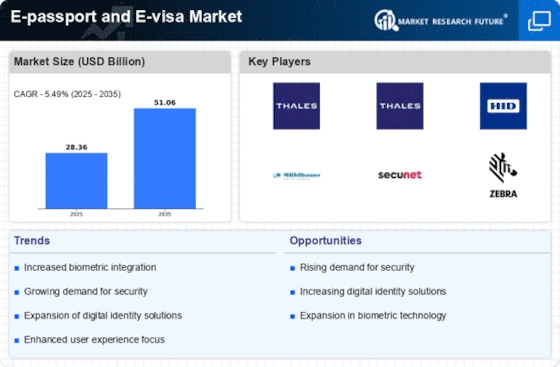
As per Market Research Future analysis, the E-passport and E-visa Market Size was estimated at 28.36 USD Billion in 2024. The E-passport and E-visa industry is projected to grow from 29.92 USD Billion in 2025 to 51.06 USD Billion by 2035, exhibiting a compound annual growth rate (CAGR) of 5.49% during the forecast period 2025 - 2035

Key Market Trends & Highlights

The E-passport and E-visa market is poised for substantial growth driven by technological advancements and increasing travel demands.

  • Technological advancements in security features are enhancing the integrity of E-passports and E-visas. The demand for seamless travel experiences is propelling the expansion of E-visa programs, particularly in North America. Biometric solutions dominate the market, while RFID technology is emerging as the fastest-growing segment in Asia-Pacific. Government initiatives for digital transformation and rising concerns over security and fraud prevention are key drivers of market growth.

Market Size & Forecast

2024 Market Size 28.36 (USD Billion)
2035 Market Size 51.06 (USD Billion)
CAGR (2025 - 2035) 5.49%
Largest Regional Market Share in 2024 Europe

Major Players

Thales (FR), Gemalto (NL), HID Global (US), Mühlbauer (DE), Secunet (DE), Zebra Technologies (US), Entrust (US), IDEMIA (FR), Veridos (DE)

Market Trends

The E-passport and E-visa Market is currently experiencing a transformative phase, driven by advancements in technology and increasing global travel demands. Governments worldwide are adopting electronic passports and visas to enhance security, streamline border control processes, and improve the overall travel experience for citizens. This shift towards digital solutions appears to be a response to the growing need for efficient identification methods and the desire to combat identity fraud. As nations invest in modernizing their travel documentation systems, the integration of biometric features and secure data storage is becoming more prevalent, indicating a significant evolution in how personal identification is managed. Moreover, the rise of digital platforms for visa applications is reshaping the landscape of international travel. E-visas are gaining traction as they offer convenience and speed, allowing travelers to apply online without the need for physical paperwork. This trend suggests a broader acceptance of digital solutions in governmental processes, potentially leading to a more interconnected global travel environment. As the E-passport and E-visa Market continues to evolve, it is likely that innovations in technology will further enhance security measures and user experience, paving the way for a more efficient and secure travel ecosystem.

Technological Advancements in Security Features

The E-passport and E-visa Market is witnessing a notable trend towards the incorporation of advanced security features. Innovations such as biometric identification, including facial recognition and fingerprint scanning, are becoming standard in electronic travel documents. These enhancements aim to bolster security and reduce the risk of identity theft, thereby fostering greater trust in digital travel solutions.

Growing Demand for Seamless Travel Experiences

There is an increasing demand for seamless travel experiences among global travelers. The E-passport and E-visa Market is responding to this need by streamlining application processes and reducing wait times at borders. This trend reflects a broader shift towards customer-centric services, where convenience and efficiency are prioritized to enhance the overall travel experience.

Expansion of E-visa Programs

The expansion of E-visa programs is a significant trend within the E-passport and E-visa Market. More countries are adopting electronic visa systems to facilitate easier access for international travelers. This trend not only simplifies the visa application process but also encourages tourism and business travel, contributing to economic growth in participating nations.

E-passport E-visa Market Market Drivers

Increasing International Travel and Tourism

The E-passport and E-visa Market is poised for growth due to the rising trend in international travel and tourism. As more individuals seek to explore different countries, the demand for efficient travel documentation is escalating. Recent statistics indicate that international tourist arrivals are expected to reach 1.8 billion by 2030, which could drive the need for streamlined visa processes. This surge in travel not only necessitates the adoption of e-passports and e-visas but also encourages governments to enhance their infrastructure to accommodate the influx of travelers. Consequently, the E-passport and E-visa Market is likely to expand in response to these evolving travel patterns.

Government Initiatives for Digital Transformation

Governments worldwide are increasingly prioritizing digital transformation, which significantly impacts the E-passport and E-visa Market. Initiatives aimed at modernizing border control and immigration processes are being implemented, with many countries transitioning to electronic systems. For instance, several nations have launched e-visa platforms to simplify the application process for travelers. This shift not only enhances efficiency but also reduces the administrative burden on government agencies. As more countries embrace digital solutions, the E-passport and E-visa Market is expected to grow, driven by the need for improved security and user-friendly travel experiences.

Rising Concerns Over Security and Fraud Prevention

The E-passport and E-visa Market is significantly influenced by the increasing concerns regarding security and fraud prevention. With the rise in identity theft and fraudulent activities, governments are compelled to adopt more secure travel documentation. E-passports, equipped with embedded chips and advanced encryption, offer enhanced protection against counterfeiting. Recent reports suggest that the global market for anti-fraud technologies in travel documents is projected to reach USD 1.2 billion by 2026. This heightened focus on security is likely to drive the adoption of e-passports and e-visas, as nations strive to protect their borders and ensure the integrity of their immigration systems.

Technological Innovations in Identity Verification

The E-passport and E-visa Market is experiencing a surge in technological innovations aimed at enhancing identity verification processes. Biometric technologies, such as facial recognition and fingerprint scanning, are becoming increasingly integrated into e-passports and e-visas. This integration not only improves security but also streamlines the verification process at borders. According to recent data, the biometric segment is projected to grow at a compound annual growth rate of over 15% in the coming years. As nations adopt these advanced technologies, the E-passport and E-visa Market is likely to witness a significant transformation, making travel more secure and efficient.

Integration of Artificial Intelligence in Processing

The integration of artificial intelligence (AI) in processing applications is emerging as a key driver for the E-passport and E-visa Market. AI technologies can streamline the application review process, reducing the time required for approvals and enhancing accuracy. By automating routine tasks, governments can allocate resources more effectively, improving overall efficiency. Recent studies indicate that AI can reduce processing times by up to 50%, which is particularly beneficial in high-traffic periods. As AI continues to evolve, its application in the E-passport and E-visa Market is likely to expand, leading to faster and more reliable travel documentation processes.

Market Segment Insights

By Type: Biometrics (Largest) vs. RFID (Fastest-Growing)

<p>In the E-passport and E-visa market, the biometric technology segment holds a dominant position, accounting for a significant share due to its widespread adoption. Biometrics are increasingly preferred for their ability to enhance security and streamline identity verification processes, making them essential in modern travel documentation. In contrast, RFID technology is emerging rapidly, gaining traction due to its efficiency in data management and tracking capabilities, which appeal greatly to both governments and travelers alike.</p>

<p>Technology: Biometrics (Dominant) vs. RFID (Emerging)</p>

<p>Biometrics is recognized as the cornerstone of identity verification in the E-passport and E-visa market. This technology utilizes unique physiological characteristics, such as fingerprints and facial recognition, to provide a high level of security and accuracy in travel documents. As governments invest heavily in infrastructure to support biometric systems, this segment is poised to maintain its dominance. On the other hand, RFID technology is making significant strides, characterized by its ability to facilitate quick scanning and data storage without physical contact. This feature makes RFID particularly appealing for enhancing user experience at border control and airports, thereby establishing it as a fast-growing component of the market.</p>

By Application: Leisure Travel (Largest) vs. Business Travel (Fastest-Growing)

<p>In the E-passport and E-visa market, the application segment showcases a diverse distribution of uses. Leisure travel serves as the largest application, primarily driven by the increasing popularity of tourism worldwide. It significantly influences the demand for e-passports and e-visas as travelers seek streamlined and efficient travel processes. Conversely, the business travel segment is rapidly gaining traction, driven by a resurgence in global trade, international conferences, and corporate mobility requirements.</p>

<p>Leisure Travel (Dominant) vs. Business Travel (Emerging)</p>

<p>Leisure travel stands out as the dominant application in the E-passport and E-visa market, characterized by its broad user base that prioritizes ease of travel. With growing tourism trends and the emergence of new travel destinations, leisure travelers prefer the convenience of e-passports and e-visas to facilitate their journeys. On the other hand, business travel is identified as an emerging application, propelled by the recovery of international business operations post-pandemic. Companies are increasingly advocating for the adoption of digital passport solutions to enhance their employees' travel experiences while maintaining security and compliance. Both segments are crucial to the overall growth of the E-passport and E-visa market.</p>

By Hardware Components: Antenna (Largest) vs. Processor/Chip (Fastest-Growing)

<p>In the 'E-passport and E-visa Market', the Antenna segment holds the largest market share, primarily due to its critical role in enabling communication between the passport and reading devices. This segment's stable demand is driven by the growing need for secure and rapid data transmission in identity verification processes. In contrast, the Processor/Chip segment has emerged as the fastest-growing sector, largely attributed to advancements in microprocessor technology, which enhance the processing capabilities and security features of e-passports and e-visas.</p>

<p>Processor/Chip (Dominant) vs. Antenna (Emerging)</p>

<p>The Processor/Chip segment is characterized by its pivotal role in driving the functionality of e-passports and e-visas, offering enhanced encryption and data management features that ensure user security. As biometric identification becomes more ubiquitous, the demand for high-performance chips that can handle complex algorithms is increasing. On the other hand, the Antenna segment, though currently dominant, is experiencing pressure from innovations in chip technology and integration. These advancements are leading to lighter and more efficient designs, making the Processor/Chip an emerging competitor in the overall hardware components landscape.</p>

Get more detailed insights about E-passport and E-visa Market Research Report – Forecast to 2035

Regional Insights

North America : Technological Innovation Leader

North America is witnessing significant growth in the E-passport and E-visa market, driven by technological advancements and increasing security concerns. The U.S. and Canada are the largest markets, holding approximately 60% of the total market share. Regulatory initiatives aimed at enhancing border security and streamlining travel processes are key growth catalysts. The demand for secure travel documents is further fueled by rising international travel and tourism, especially post-pandemic. The competitive landscape in North America is robust, with key players like HID Global and Zebra Technologies leading the charge. The presence of established companies such as Thales and Entrust enhances the region's market dynamics. Additionally, government initiatives to digitize travel documentation and improve border control systems are expected to bolster market growth. The focus on innovation and security will continue to shape the future of the E-passport and E-visa market in this region.

Europe : Regulatory Framework Strengthens Market

Europe is experiencing a surge in the E-passport and E-visa market, driven by stringent regulatory frameworks and increasing cross-border travel. The largest markets in this region are Germany and France, collectively accounting for about 55% of the market share. The European Union's initiatives to enhance border security and facilitate travel through digital solutions are significant growth drivers. The demand for E-passports and E-visas is expected to rise as countries adopt more secure and efficient travel documentation systems. Leading countries in Europe include Germany, France, and the Netherlands, with key players like Gemalto and IDEMIA playing pivotal roles. The competitive landscape is characterized by innovation and collaboration among technology providers and government agencies. The presence of regulatory bodies ensures compliance and fosters trust in digital travel solutions. As the region continues to prioritize security and efficiency, the E-passport and E-visa market is poised for substantial growth.

Asia-Pacific : Emerging Market Potential

The Asia-Pacific region is rapidly emerging as a significant player in the E-passport and E-visa market, driven by increasing travel demand and government initiatives to modernize border control systems. Countries like China and India are leading the market, holding approximately 50% of the regional share. The rise in international tourism and trade, coupled with the need for secure travel documentation, is propelling market growth. Regulatory support for digital transformation in travel is also a key factor in this region's expansion. In Asia-Pacific, the competitive landscape is evolving, with key players such as Thales and Mühlbauer establishing a strong presence. The region is witnessing collaborations between governments and technology providers to enhance the efficiency of travel processes. As countries invest in advanced identification technologies, the E-passport and E-visa market is expected to flourish, catering to the growing needs of travelers and businesses alike.

Middle East and Africa : Growing Demand for Secure Travel

The Middle East and Africa region is experiencing a notable expansion in the E-passport and E-visa market, driven by increasing travel and tourism activities. Countries like the UAE and South Africa are at the forefront, collectively holding around 45% of the market share. The region's focus on enhancing security measures and improving travel efficiency is a significant growth driver. Government initiatives aimed at digitizing travel documentation are also contributing to the rising demand for E-passports and E-visas. In this region, the competitive landscape is characterized by a mix of local and international players, with companies like Secunet and Veridos making significant strides. The presence of key players is bolstered by partnerships with government agencies to implement secure travel solutions. As the region continues to invest in technology and infrastructure, the E-passport and E-visa market is set to grow, catering to the evolving needs of travelers and enhancing border security.

Key Players and Competitive Insights

Leading market players are investing heavily in research and development to expand their product lines, which will help the E-passport and E-visa market grow even more. Market participants are also undertaking various strategic activities to expand their footprint, with important market developments including new product launches, contractual agreements, mergers and acquisitions, higher investments, and collaboration with other organizations. The E-passport and E-visa industry must offer cost-effective items to expand and survive in a more competitive and rising market climate. Manufacturing locally to minimize operational costs is one of the key business tactics manufacturers use in the E-passport and E-visa industry to benefit clients and increase the market sector. In recent years, the E-passport and E-visa industry has offered some of the most significant advantages to medicine. Major players in the E-passport and E-visa market, including Cardlogic Limited (Ireland), 4G identity solutions private limited (U.A.E), Iris Corporation (Malaysia), Safran Identity and Security (France), Muehlbauer Group (Malaysia) Eastcompeace (China), Oberthur Technologies (France), Datacard group (U.S), HID Corporation(U.S), Giesecke & Devrient Limited (Germany), Gemalto NV (the Netherlands)., and others, are attempting to increase market demand by investing in research and development operations. Gemalto, formerly known as Axalto and Gemplus International, was a prominent international digital security company that specialized in offering a range of software applications, secure personal devices like smart cards and tokens, e-wallets, and managed services. The company was established in June 2006 through the merger of Axalto and Gemplus International. In 2018, Gemalto N.V. recorded a revenue of €2.969 billion.In collaboration with Veridos, a provider of identity solutions, Gemalto joined forces to provide e-passport solutions worldwide. The objective of this partnership was to leverage their expertise in secure document technologies to enhance the security and efficiency of e-passports. IDEX Biometrics ASA (OSE: IDEX and Nasdaq: IDBA) is a renowned company at the forefront of fingerprint identification technologies, offering convenient, secure, and personalized authentication solutions. With IDEX Biometrics, individuals can make payments, verify their identity, access information, and easily unlock devices. The company specializes in inventing, engineering, and commercializing these user-friendly and highly secure solutions.In collaboration with IDEMIA, a leader in augmented identity solutions, IDEX Biometrics combines its expertise to deliver advanced fingerprint identification and authentication solutions. The collaboration aimed to develop biometric smart cards for secure identification and authentication, including e-passports and e-visas.

Key Companies in the E-passport E-visa Market include

Industry Developments

June 2014: Gemalto (Thales Group) and Veridos: Gemalto, a digital security company, and Veridos, a provider of identity solutions, collaborated to deliver e-passport solutions worldwide. The partnership aimed to combine their expertise in secure document technologies to enhance the security and efficiency of e-passports.

October 2019: IDEMIA, a prominent company specializing in augmented identity solutions, joined forces with IDEX Biometrics provides innovative solutions that enhance security and enable convenient and personalized authentication processes. This collaboration was established to create biometric smart cards that ensure secure identification and authentication, particularly for applications such as e-passports and e-visas by leveraging their respective expertise, IDEMIA and IDEX Biometrics aimed to develop innovative solutions that enhance the security and reliability of these important identification documents.

Future Outlook

E-passport E-visa Market Future Outlook

The E-passport and E-visa Market is projected to grow at a 5.49% CAGR from 2025 to 2035, driven by technological advancements, increasing travel demand, and enhanced security measures.

New opportunities lie in:

  • <p>Integration of biometric verification systems in e-passports Development of mobile e-visa applications for seamless processing Partnerships with travel agencies for bundled e-visa services</p>

By 2035, the market is expected to be robust, reflecting substantial growth and innovation.

Market Segmentation

E-passport E-visa Market Type Outlook

  • Biometrics
  • RFID

E-passport E-visa Market Application Outlook

  • Leisure Travel
  • Business Travel
  • Identification/Proof
  • Immigration/Border Control

E-passport E-visa Market Hardware Components Outlook

  • Antenna
  • Processor/Chip

Report Scope

MARKET SIZE 2024 28.36(USD Billion)
MARKET SIZE 2025 29.92(USD Billion)
MARKET SIZE 2035 51.06(USD Billion)
COMPOUND ANNUAL GROWTH RATE (CAGR) 5.49% (2025 - 2035)
REPORT COVERAGE Revenue Forecast, Competitive Landscape, Growth Factors, and Trends
BASE YEAR 2024
Market Forecast Period 2025 - 2035
Historical Data 2019 - 2024
Market Forecast Units USD Billion
Key Companies Profiled Thales (FR), Gemalto (NL), HID Global (US), Mühlbauer (DE), Secunet (DE), Zebra Technologies (US), Entrust (US), IDEMIA (FR), Veridos (DE)
Segments Covered Type, Application, Hardware Components, Region
Key Market Opportunities Integration of biometric technology enhances security and efficiency in the E-passport and E-visa Market.
Key Market Dynamics Rising demand for secure travel documents drives innovation in E-passport and E-visa technologies and regulatory frameworks.
Countries Covered North America, Europe, APAC, South America, MEA

FAQs

What is the projected market valuation of the E-passport and E-visa market by 2035?

<p>The projected market valuation for the E-passport and E-visa market is 51.06 USD Billion by 2035.</p>

What was the market valuation of the E-passport and E-visa market in 2024?

<p>The overall market valuation of the E-passport and E-visa market was 28.36 USD Billion in 2024.</p>

What is the expected CAGR for the E-passport and E-visa market during the forecast period 2025 - 2035?

<p>The expected CAGR for the E-passport and E-visa market during the forecast period 2025 - 2035 is 5.49%.</p>

Which companies are considered key players in the E-passport and E-visa market?

<p>Key players in the E-passport and E-visa market include Thales, Gemalto, HID Global, Mühlbauer, Secunet, Zebra Technologies, Entrust, IDEMIA, and Veridos.</p>

What are the main application segments of the E-passport and E-visa market?

<p>The main application segments include Leisure Travel, Business Travel, Identification/Proof, and Immigration/Border Control.</p>

What was the market size for the Leisure Travel segment in 2024?

<p>The market size for the Leisure Travel segment was 5.68 USD Billion in 2024.</p>

What is the projected market size for the Immigration/Border Control segment by 2035?

The projected market size for the Immigration/Border Control segment is 16.16 USD Billion by 2035.

What hardware components are significant in the E-passport and E-visa market?

Significant hardware components in the market include Antenna and Processor/Chip.

What was the market size for Processor/Chip components in 2024?

The market size for Processor/Chip components was 19.86 USD Billion in 2024.

How does the market size for RFID compare to Biometrics in the E-passport and E-visa market?

Both RFID and Biometrics segments had a market size of 14.18 USD Billion in 2024, indicating equal initial valuation.

  1. SECTION I: EXECUTIVE SUMMARY AND KEY HIGHLIGHTS
    1. | 1.1 EXECUTIVE SUMMARY
    2. | | 1.1.1 Market Overview
    3. | | 1.1.2 Key Findings
    4. | | 1.1.3 Market Segmentation
    5. | | 1.1.4 Competitive Landscape
    6. | | 1.1.5 Challenges and Opportunities
    7. | | 1.1.6 Future Outlook
  2. SECTION II: SCOPING, METHODOLOGY AND MARKET STRUCTURE
    1. | 2.1 MARKET INTRODUCTION
    2. | | 2.1.1 Definition
    3. | | 2.1.2 Scope of the study
    4. | | | 2.1.2.1 Research Objective
    5. | | | 2.1.2.2 Assumption
    6. | | | 2.1.2.3 Limitations
    7. | 2.2 RESEARCH METHODOLOGY
    8. | | 2.2.1 Overview
    9. | | 2.2.2 Data Mining
    10. | | 2.2.3 Secondary Research
    11. | | 2.2.4 Primary Research
    12. | | | 2.2.4.1 Primary Interviews and Information Gathering Process
    13. | | | 2.2.4.2 Breakdown of Primary Respondents
    14. | | 2.2.5 Forecasting Model
    15. | | 2.2.6 Market Size Estimation
    16. | | | 2.2.6.1 Bottom-Up Approach
    17. | | | 2.2.6.2 Top-Down Approach
    18. | | 2.2.7 Data Triangulation
    19. | | 2.2.8 Validation
  3. SECTION III: QUALITATIVE ANALYSIS
    1. | 3.1 MARKET DYNAMICS
    2. | | 3.1.1 Overview
    3. | | 3.1.2 Drivers
    4. | | 3.1.3 Restraints
    5. | | 3.1.4 Opportunities
    6. | 3.2 MARKET FACTOR ANALYSIS
    7. | | 3.2.1 Value chain Analysis
    8. | | 3.2.2 Porter's Five Forces Analysis
    9. | | | 3.2.2.1 Bargaining Power of Suppliers
    10. | | | 3.2.2.2 Bargaining Power of Buyers
    11. | | | 3.2.2.3 Threat of New Entrants
    12. | | | 3.2.2.4 Threat of Substitutes
    13. | | | 3.2.2.5 Intensity of Rivalry
    14. | | 3.2.3 COVID-19 Impact Analysis
    15. | | | 3.2.3.1 Market Impact Analysis
    16. | | | 3.2.3.2 Regional Impact
    17. | | | 3.2.3.3 Opportunity and Threat Analysis
  4. SECTION IV: QUANTITATIVE ANALYSIS
    1. | 4.1 Information and Communications Technology, BY Type (USD Billion)
    2. | | 4.1.1 Biometrics
    3. | | 4.1.2 RFID
    4. | 4.2 Information and Communications Technology, BY Application (USD Billion)
    5. | | 4.2.1 Leisure Travel
    6. | | 4.2.2 Business Travel
    7. | | 4.2.3 Identification/Proof
    8. | | 4.2.4 Immigration/Border Control
    9. | 4.3 Information and Communications Technology, BY Hardware Components (USD Billion)
    10. | | 4.3.1 Antenna
    11. | | 4.3.2 Processor/Chip
    12. | 4.4 Information and Communications Technology, BY Region (USD Billion)
    13. | | 4.4.1 North America
    14. | | | 4.4.1.1 US
    15. | | | 4.4.1.2 Canada
    16. | | 4.4.2 Europe
    17. | | | 4.4.2.1 Germany
    18. | | | 4.4.2.2 UK
    19. | | | 4.4.2.3 France
    20. | | | 4.4.2.4 Russia
    21. | | | 4.4.2.5 Italy
    22. | | | 4.4.2.6 Spain
    23. | | | 4.4.2.7 Rest of Europe
    24. | | 4.4.3 APAC
    25. | | | 4.4.3.1 China
    26. | | | 4.4.3.2 India
    27. | | | 4.4.3.3 Japan
    28. | | | 4.4.3.4 South Korea
    29. | | | 4.4.3.5 Malaysia
    30. | | | 4.4.3.6 Thailand
    31. | | | 4.4.3.7 Indonesia
    32. | | | 4.4.3.8 Rest of APAC
    33. | | 4.4.4 South America
    34. | | | 4.4.4.1 Brazil
    35. | | | 4.4.4.2 Mexico
    36. | | | 4.4.4.3 Argentina
    37. | | | 4.4.4.4 Rest of South America
    38. | | 4.4.5 MEA
    39. | | | 4.4.5.1 GCC Countries
    40. | | | 4.4.5.2 South Africa
    41. | | | 4.4.5.3 Rest of MEA
  5. SECTION V: COMPETITIVE ANALYSIS
    1. | 5.1 Competitive Landscape
    2. | | 5.1.1 Overview
    3. | | 5.1.2 Competitive Analysis
    4. | | 5.1.3 Market share Analysis
    5. | | 5.1.4 Major Growth Strategy in the Information and Communications Technology
    6. | | 5.1.5 Competitive Benchmarking
    7. | | 5.1.6 Leading Players in Terms of Number of Developments in the Information and Communications Technology
    8. | | 5.1.7 Key developments and growth strategies
    9. | | | 5.1.7.1 New Product Launch/Service Deployment
    10. | | | 5.1.7.2 Merger & Acquisitions
    11. | | | 5.1.7.3 Joint Ventures
    12. | | 5.1.8 Major Players Financial Matrix
    13. | | | 5.1.8.1 Sales and Operating Income
    14. | | | 5.1.8.2 Major Players R&D Expenditure. 2023
    15. | 5.2 Company Profiles
    16. | | 5.2.1 Thales (FR)
    17. | | | 5.2.1.1 Financial Overview
    18. | | | 5.2.1.2 Products Offered
    19. | | | 5.2.1.3 Key Developments
    20. | | | 5.2.1.4 SWOT Analysis
    21. | | | 5.2.1.5 Key Strategies
    22. | | 5.2.2 Gemalto (NL)
    23. | | | 5.2.2.1 Financial Overview
    24. | | | 5.2.2.2 Products Offered
    25. | | | 5.2.2.3 Key Developments
    26. | | | 5.2.2.4 SWOT Analysis
    27. | | | 5.2.2.5 Key Strategies
    28. | | 5.2.3 HID Global (US)
    29. | | | 5.2.3.1 Financial Overview
    30. | | | 5.2.3.2 Products Offered
    31. | | | 5.2.3.3 Key Developments
    32. | | | 5.2.3.4 SWOT Analysis
    33. | | | 5.2.3.5 Key Strategies
    34. | | 5.2.4 Mühlbauer (DE)
    35. | | | 5.2.4.1 Financial Overview
    36. | | | 5.2.4.2 Products Offered
    37. | | | 5.2.4.3 Key Developments
    38. | | | 5.2.4.4 SWOT Analysis
    39. | | | 5.2.4.5 Key Strategies
    40. | | 5.2.5 Secunet (DE)
    41. | | | 5.2.5.1 Financial Overview
    42. | | | 5.2.5.2 Products Offered
    43. | | | 5.2.5.3 Key Developments
    44. | | | 5.2.5.4 SWOT Analysis
    45. | | | 5.2.5.5 Key Strategies
    46. | | 5.2.6 Zebra Technologies (US)
    47. | | | 5.2.6.1 Financial Overview
    48. | | | 5.2.6.2 Products Offered
    49. | | | 5.2.6.3 Key Developments
    50. | | | 5.2.6.4 SWOT Analysis
    51. | | | 5.2.6.5 Key Strategies
    52. | | 5.2.7 Entrust (US)
    53. | | | 5.2.7.1 Financial Overview
    54. | | | 5.2.7.2 Products Offered
    55. | | | 5.2.7.3 Key Developments
    56. | | | 5.2.7.4 SWOT Analysis
    57. | | | 5.2.7.5 Key Strategies
    58. | | 5.2.8 IDEMIA (FR)
    59. | | | 5.2.8.1 Financial Overview
    60. | | | 5.2.8.2 Products Offered
    61. | | | 5.2.8.3 Key Developments
    62. | | | 5.2.8.4 SWOT Analysis
    63. | | | 5.2.8.5 Key Strategies
    64. | | 5.2.9 Veridos (DE)
    65. | | | 5.2.9.1 Financial Overview
    66. | | | 5.2.9.2 Products Offered
    67. | | | 5.2.9.3 Key Developments
    68. | | | 5.2.9.4 SWOT Analysis
    69. | | | 5.2.9.5 Key Strategies
    70. | 5.3 Appendix
    71. | | 5.3.1 References
    72. | | 5.3.2 Related Reports
  6. LIST OF FIGURES
    1. | 6.1 MARKET SYNOPSIS
    2. | 6.2 NORTH AMERICA MARKET ANALYSIS
    3. | 6.3 US MARKET ANALYSIS BY TYPE
    4. | 6.4 US MARKET ANALYSIS BY APPLICATION
    5. | 6.5 US MARKET ANALYSIS BY HARDWARE COMPONENTS
    6. | 6.6 CANADA MARKET ANALYSIS BY TYPE
    7. | 6.7 CANADA MARKET ANALYSIS BY APPLICATION
    8. | 6.8 CANADA MARKET ANALYSIS BY HARDWARE COMPONENTS
    9. | 6.9 EUROPE MARKET ANALYSIS
    10. | 6.10 GERMANY MARKET ANALYSIS BY TYPE
    11. | 6.11 GERMANY MARKET ANALYSIS BY APPLICATION
    12. | 6.12 GERMANY MARKET ANALYSIS BY HARDWARE COMPONENTS
    13. | 6.13 UK MARKET ANALYSIS BY TYPE
    14. | 6.14 UK MARKET ANALYSIS BY APPLICATION
    15. | 6.15 UK MARKET ANALYSIS BY HARDWARE COMPONENTS
    16. | 6.16 FRANCE MARKET ANALYSIS BY TYPE
    17. | 6.17 FRANCE MARKET ANALYSIS BY APPLICATION
    18. | 6.18 FRANCE MARKET ANALYSIS BY HARDWARE COMPONENTS
    19. | 6.19 RUSSIA MARKET ANALYSIS BY TYPE
    20. | 6.20 RUSSIA MARKET ANALYSIS BY APPLICATION
    21. | 6.21 RUSSIA MARKET ANALYSIS BY HARDWARE COMPONENTS
    22. | 6.22 ITALY MARKET ANALYSIS BY TYPE
    23. | 6.23 ITALY MARKET ANALYSIS BY APPLICATION
    24. | 6.24 ITALY MARKET ANALYSIS BY HARDWARE COMPONENTS
    25. | 6.25 SPAIN MARKET ANALYSIS BY TYPE
    26. | 6.26 SPAIN MARKET ANALYSIS BY APPLICATION
    27. | 6.27 SPAIN MARKET ANALYSIS BY HARDWARE COMPONENTS
    28. | 6.28 REST OF EUROPE MARKET ANALYSIS BY TYPE
    29. | 6.29 REST OF EUROPE MARKET ANALYSIS BY APPLICATION
    30. | 6.30 REST OF EUROPE MARKET ANALYSIS BY HARDWARE COMPONENTS
    31. | 6.31 APAC MARKET ANALYSIS
    32. | 6.32 CHINA MARKET ANALYSIS BY TYPE
    33. | 6.33 CHINA MARKET ANALYSIS BY APPLICATION
    34. | 6.34 CHINA MARKET ANALYSIS BY HARDWARE COMPONENTS
    35. | 6.35 INDIA MARKET ANALYSIS BY TYPE
    36. | 6.36 INDIA MARKET ANALYSIS BY APPLICATION
    37. | 6.37 INDIA MARKET ANALYSIS BY HARDWARE COMPONENTS
    38. | 6.38 JAPAN MARKET ANALYSIS BY TYPE
    39. | 6.39 JAPAN MARKET ANALYSIS BY APPLICATION
    40. | 6.40 JAPAN MARKET ANALYSIS BY HARDWARE COMPONENTS
    41. | 6.41 SOUTH KOREA MARKET ANALYSIS BY TYPE
    42. | 6.42 SOUTH KOREA MARKET ANALYSIS BY APPLICATION
    43. | 6.43 SOUTH KOREA MARKET ANALYSIS BY HARDWARE COMPONENTS
    44. | 6.44 MALAYSIA MARKET ANALYSIS BY TYPE
    45. | 6.45 MALAYSIA MARKET ANALYSIS BY APPLICATION
    46. | 6.46 MALAYSIA MARKET ANALYSIS BY HARDWARE COMPONENTS
    47. | 6.47 THAILAND MARKET ANALYSIS BY TYPE
    48. | 6.48 THAILAND MARKET ANALYSIS BY APPLICATION
    49. | 6.49 THAILAND MARKET ANALYSIS BY HARDWARE COMPONENTS
    50. | 6.50 INDONESIA MARKET ANALYSIS BY TYPE
    51. | 6.51 INDONESIA MARKET ANALYSIS BY APPLICATION
    52. | 6.52 INDONESIA MARKET ANALYSIS BY HARDWARE COMPONENTS
    53. | 6.53 REST OF APAC MARKET ANALYSIS BY TYPE
    54. | 6.54 REST OF APAC MARKET ANALYSIS BY APPLICATION
    55. | 6.55 REST OF APAC MARKET ANALYSIS BY HARDWARE COMPONENTS
    56. | 6.56 SOUTH AMERICA MARKET ANALYSIS
    57. | 6.57 BRAZIL MARKET ANALYSIS BY TYPE
    58. | 6.58 BRAZIL MARKET ANALYSIS BY APPLICATION
    59. | 6.59 BRAZIL MARKET ANALYSIS BY HARDWARE COMPONENTS
    60. | 6.60 MEXICO MARKET ANALYSIS BY TYPE
    61. | 6.61 MEXICO MARKET ANALYSIS BY APPLICATION
    62. | 6.62 MEXICO MARKET ANALYSIS BY HARDWARE COMPONENTS
    63. | 6.63 ARGENTINA MARKET ANALYSIS BY TYPE
    64. | 6.64 ARGENTINA MARKET ANALYSIS BY APPLICATION
    65. | 6.65 ARGENTINA MARKET ANALYSIS BY HARDWARE COMPONENTS
    66. | 6.66 REST OF SOUTH AMERICA MARKET ANALYSIS BY TYPE
    67. | 6.67 REST OF SOUTH AMERICA MARKET ANALYSIS BY APPLICATION
    68. | 6.68 REST OF SOUTH AMERICA MARKET ANALYSIS BY HARDWARE COMPONENTS
    69. | 6.69 MEA MARKET ANALYSIS
    70. | 6.70 GCC COUNTRIES MARKET ANALYSIS BY TYPE
    71. | 6.71 GCC COUNTRIES MARKET ANALYSIS BY APPLICATION
    72. | 6.72 GCC COUNTRIES MARKET ANALYSIS BY HARDWARE COMPONENTS
    73. | 6.73 SOUTH AFRICA MARKET ANALYSIS BY TYPE
    74. | 6.74 SOUTH AFRICA MARKET ANALYSIS BY APPLICATION
    75. | 6.75 SOUTH AFRICA MARKET ANALYSIS BY HARDWARE COMPONENTS
    76. | 6.76 REST OF MEA MARKET ANALYSIS BY TYPE
    77. | 6.77 REST OF MEA MARKET ANALYSIS BY APPLICATION
    78. | 6.78 REST OF MEA MARKET ANALYSIS BY HARDWARE COMPONENTS
    79. | 6.79 KEY BUYING CRITERIA OF INFORMATION AND COMMUNICATIONS TECHNOLOGY
    80. | 6.80 RESEARCH PROCESS OF MRFR
    81. | 6.81 DRO ANALYSIS OF INFORMATION AND COMMUNICATIONS TECHNOLOGY
    82. | 6.82 DRIVERS IMPACT ANALYSIS: INFORMATION AND COMMUNICATIONS TECHNOLOGY
    83. | 6.83 RESTRAINTS IMPACT ANALYSIS: INFORMATION AND COMMUNICATIONS TECHNOLOGY
    84. | 6.84 SUPPLY / VALUE CHAIN: INFORMATION AND COMMUNICATIONS TECHNOLOGY
    85. | 6.85 INFORMATION AND COMMUNICATIONS TECHNOLOGY, BY TYPE, 2024 (% SHARE)
    86. | 6.86 INFORMATION AND COMMUNICATIONS TECHNOLOGY, BY TYPE, 2024 TO 2035 (USD Billion)
    87. | 6.87 INFORMATION AND COMMUNICATIONS TECHNOLOGY, BY APPLICATION, 2024 (% SHARE)
    88. | 6.88 INFORMATION AND COMMUNICATIONS TECHNOLOGY, BY APPLICATION, 2024 TO 2035 (USD Billion)
    89. | 6.89 INFORMATION AND COMMUNICATIONS TECHNOLOGY, BY HARDWARE COMPONENTS, 2024 (% SHARE)
    90. | 6.90 INFORMATION AND COMMUNICATIONS TECHNOLOGY, BY HARDWARE COMPONENTS, 2024 TO 2035 (USD Billion)
    91. | 6.91 BENCHMARKING OF MAJOR COMPETITORS
  7. LIST OF TABLES
    1. | 7.1 LIST OF ASSUMPTIONS
    2. | | 7.1.1
    3. | 7.2 North America MARKET SIZE ESTIMATES; FORECAST
    4. | | 7.2.1 BY TYPE, 2025-2035 (USD Billion)
    5. | | 7.2.2 BY APPLICATION, 2025-2035 (USD Billion)
    6. | | 7.2.3 BY HARDWARE COMPONENTS, 2025-2035 (USD Billion)
    7. | 7.3 US MARKET SIZE ESTIMATES; FORECAST
    8. | | 7.3.1 BY TYPE, 2025-2035 (USD Billion)
    9. | | 7.3.2 BY APPLICATION, 2025-2035 (USD Billion)
    10. | | 7.3.3 BY HARDWARE COMPONENTS, 2025-2035 (USD Billion)
    11. | 7.4 Canada MARKET SIZE ESTIMATES; FORECAST
    12. | | 7.4.1 BY TYPE, 2025-2035 (USD Billion)
    13. | | 7.4.2 BY APPLICATION, 2025-2035 (USD Billion)
    14. | | 7.4.3 BY HARDWARE COMPONENTS, 2025-2035 (USD Billion)
    15. | 7.5 Europe MARKET SIZE ESTIMATES; FORECAST
    16. | | 7.5.1 BY TYPE, 2025-2035 (USD Billion)
    17. | | 7.5.2 BY APPLICATION, 2025-2035 (USD Billion)
    18. | | 7.5.3 BY HARDWARE COMPONENTS, 2025-2035 (USD Billion)
    19. | 7.6 Germany MARKET SIZE ESTIMATES; FORECAST
    20. | | 7.6.1 BY TYPE, 2025-2035 (USD Billion)
    21. | | 7.6.2 BY APPLICATION, 2025-2035 (USD Billion)
    22. | | 7.6.3 BY HARDWARE COMPONENTS, 2025-2035 (USD Billion)
    23. | 7.7 UK MARKET SIZE ESTIMATES; FORECAST
    24. | | 7.7.1 BY TYPE, 2025-2035 (USD Billion)
    25. | | 7.7.2 BY APPLICATION, 2025-2035 (USD Billion)
    26. | | 7.7.3 BY HARDWARE COMPONENTS, 2025-2035 (USD Billion)
    27. | 7.8 France MARKET SIZE ESTIMATES; FORECAST
    28. | | 7.8.1 BY TYPE, 2025-2035 (USD Billion)
    29. | | 7.8.2 BY APPLICATION, 2025-2035 (USD Billion)
    30. | | 7.8.3 BY HARDWARE COMPONENTS, 2025-2035 (USD Billion)
    31. | 7.9 Russia MARKET SIZE ESTIMATES; FORECAST
    32. | | 7.9.1 BY TYPE, 2025-2035 (USD Billion)
    33. | | 7.9.2 BY APPLICATION, 2025-2035 (USD Billion)
    34. | | 7.9.3 BY HARDWARE COMPONENTS, 2025-2035 (USD Billion)
    35. | 7.10 Italy MARKET SIZE ESTIMATES; FORECAST
    36. | | 7.10.1 BY TYPE, 2025-2035 (USD Billion)
    37. | | 7.10.2 BY APPLICATION, 2025-2035 (USD Billion)
    38. | | 7.10.3 BY HARDWARE COMPONENTS, 2025-2035 (USD Billion)
    39. | 7.11 Spain MARKET SIZE ESTIMATES; FORECAST
    40. | | 7.11.1 BY TYPE, 2025-2035 (USD Billion)
    41. | | 7.11.2 BY APPLICATION, 2025-2035 (USD Billion)
    42. | | 7.11.3 BY HARDWARE COMPONENTS, 2025-2035 (USD Billion)
    43. | 7.12 Rest of Europe MARKET SIZE ESTIMATES; FORECAST
    44. | | 7.12.1 BY TYPE, 2025-2035 (USD Billion)
    45. | | 7.12.2 BY APPLICATION, 2025-2035 (USD Billion)
    46. | | 7.12.3 BY HARDWARE COMPONENTS, 2025-2035 (USD Billion)
    47. | 7.13 APAC MARKET SIZE ESTIMATES; FORECAST
    48. | | 7.13.1 BY TYPE, 2025-2035 (USD Billion)
    49. | | 7.13.2 BY APPLICATION, 2025-2035 (USD Billion)
    50. | | 7.13.3 BY HARDWARE COMPONENTS, 2025-2035 (USD Billion)
    51. | 7.14 China MARKET SIZE ESTIMATES; FORECAST
    52. | | 7.14.1 BY TYPE, 2025-2035 (USD Billion)
    53. | | 7.14.2 BY APPLICATION, 2025-2035 (USD Billion)
    54. | | 7.14.3 BY HARDWARE COMPONENTS, 2025-2035 (USD Billion)
    55. | 7.15 India MARKET SIZE ESTIMATES; FORECAST
    56. | | 7.15.1 BY TYPE, 2025-2035 (USD Billion)
    57. | | 7.15.2 BY APPLICATION, 2025-2035 (USD Billion)
    58. | | 7.15.3 BY HARDWARE COMPONENTS, 2025-2035 (USD Billion)
    59. | 7.16 Japan MARKET SIZE ESTIMATES; FORECAST
    60. | | 7.16.1 BY TYPE, 2025-2035 (USD Billion)
    61. | | 7.16.2 BY APPLICATION, 2025-2035 (USD Billion)
    62. | | 7.16.3 BY HARDWARE COMPONENTS, 2025-2035 (USD Billion)
    63. | 7.17 South Korea MARKET SIZE ESTIMATES; FORECAST
    64. | | 7.17.1 BY TYPE, 2025-2035 (USD Billion)
    65. | | 7.17.2 BY APPLICATION, 2025-2035 (USD Billion)
    66. | | 7.17.3 BY HARDWARE COMPONENTS, 2025-2035 (USD Billion)
    67. | 7.18 Malaysia MARKET SIZE ESTIMATES; FORECAST
    68. | | 7.18.1 BY TYPE, 2025-2035 (USD Billion)
    69. | | 7.18.2 BY APPLICATION, 2025-2035 (USD Billion)
    70. | | 7.18.3 BY HARDWARE COMPONENTS, 2025-2035 (USD Billion)
    71. | 7.19 Thailand MARKET SIZE ESTIMATES; FORECAST
    72. | | 7.19.1 BY TYPE, 2025-2035 (USD Billion)
    73. | | 7.19.2 BY APPLICATION, 2025-2035 (USD Billion)
    74. | | 7.19.3 BY HARDWARE COMPONENTS, 2025-2035 (USD Billion)
    75. | 7.20 Indonesia MARKET SIZE ESTIMATES; FORECAST
    76. | | 7.20.1 BY TYPE, 2025-2035 (USD Billion)
    77. | | 7.20.2 BY APPLICATION, 2025-2035 (USD Billion)
    78. | | 7.20.3 BY HARDWARE COMPONENTS, 2025-2035 (USD Billion)
    79. | 7.21 Rest of APAC MARKET SIZE ESTIMATES; FORECAST
    80. | | 7.21.1 BY TYPE, 2025-2035 (USD Billion)
    81. | | 7.21.2 BY APPLICATION, 2025-2035 (USD Billion)
    82. | | 7.21.3 BY HARDWARE COMPONENTS, 2025-2035 (USD Billion)
    83. | 7.22 South America MARKET SIZE ESTIMATES; FORECAST
    84. | | 7.22.1 BY TYPE, 2025-2035 (USD Billion)
    85. | | 7.22.2 BY APPLICATION, 2025-2035 (USD Billion)
    86. | | 7.22.3 BY HARDWARE COMPONENTS, 2025-2035 (USD Billion)
    87. | 7.23 Brazil MARKET SIZE ESTIMATES; FORECAST
    88. | | 7.23.1 BY TYPE, 2025-2035 (USD Billion)
    89. | | 7.23.2 BY APPLICATION, 2025-2035 (USD Billion)
    90. | | 7.23.3 BY HARDWARE COMPONENTS, 2025-2035 (USD Billion)
    91. | 7.24 Mexico MARKET SIZE ESTIMATES; FORECAST
    92. | | 7.24.1 BY TYPE, 2025-2035 (USD Billion)
    93. | | 7.24.2 BY APPLICATION, 2025-2035 (USD Billion)
    94. | | 7.24.3 BY HARDWARE COMPONENTS, 2025-2035 (USD Billion)
    95. | 7.25 Argentina MARKET SIZE ESTIMATES; FORECAST
    96. | | 7.25.1 BY TYPE, 2025-2035 (USD Billion)
    97. | | 7.25.2 BY APPLICATION, 2025-2035 (USD Billion)
    98. | | 7.25.3 BY HARDWARE COMPONENTS, 2025-2035 (USD Billion)
    99. | 7.26 Rest of South America MARKET SIZE ESTIMATES; FORECAST
    100. | | 7.26.1 BY TYPE, 2025-2035 (USD Billion)
    101. | | 7.26.2 BY APPLICATION, 2025-2035 (USD Billion)
    102. | | 7.26.3 BY HARDWARE COMPONENTS, 2025-2035 (USD Billion)
    103. | 7.27 MEA MARKET SIZE ESTIMATES; FORECAST
    104. | | 7.27.1 BY TYPE, 2025-2035 (USD Billion)
    105. | | 7.27.2 BY APPLICATION, 2025-2035 (USD Billion)
    106. | | 7.27.3 BY HARDWARE COMPONENTS, 2025-2035 (USD Billion)
    107. | 7.28 GCC Countries MARKET SIZE ESTIMATES; FORECAST
    108. | | 7.28.1 BY TYPE, 2025-2035 (USD Billion)
    109. | | 7.28.2 BY APPLICATION, 2025-2035 (USD Billion)
    110. | | 7.28.3 BY HARDWARE COMPONENTS, 2025-2035 (USD Billion)
    111. | 7.29 South Africa MARKET SIZE ESTIMATES; FORECAST
    112. | | 7.29.1 BY TYPE, 2025-2035 (USD Billion)
    113. | | 7.29.2 BY APPLICATION, 2025-2035 (USD Billion)
    114. | | 7.29.3 BY HARDWARE COMPONENTS, 2025-2035 (USD Billion)
    115. | 7.30 Rest of MEA MARKET SIZE ESTIMATES; FORECAST
    116. | | 7.30.1 BY TYPE, 2025-2035 (USD Billion)
    117. | | 7.30.2 BY APPLICATION, 2025-2035 (USD Billion)
    118. | | 7.30.3 BY HARDWARE COMPONENTS, 2025-2035 (USD Billion)
    119. | 7.31 PRODUCT LAUNCH/PRODUCT DEVELOPMENT/APPROVAL
    120. | | 7.31.1
    121. | 7.32 ACQUISITION/PARTNERSHIP
    122. | | 7.32.1

Information and Communications Technology Market Segmentation

Information and Communications Technology By Type (USD Billion, 2025-2035)

  • Biometrics
  • RFID

Information and Communications Technology By Application (USD Billion, 2025-2035)

  • Leisure Travel
  • Business Travel
  • Identification/Proof
  • Immigration/Border Control

Information and Communications Technology By Hardware Components (USD Billion, 2025-2035)

  • Antenna
  • Processor/Chip
Infographic

Free Sample Request

Kindly complete the form below to receive a free sample of this Report

Get Free Sample

Customer Strories

Compare Licence

×
Features License Type
Single User Multiuser License Enterprise User
Price $4,950 $5,950 $7,250
Maximum User Access Limit 1 User Upto 10 Users Unrestricted Access Throughout the Organization
Free Customization
Direct Access to Analyst
Deliverable Format
Platform Access
Discount on Next Purchase 10% 15% 15%
Printable Versions