×
Hero Background
English
Chinese
French
Japanese
Korean
German
Spanish

E fluids Market Size

ID: MRFR/CnM/9574-HCR
110 Pages
Priya Nagrale
October 2025

E-fluids Market Research Report Information By Product Type (Coolants, Brake Fluid, Transmission Fluids, Greases) Vehicle Type (On-highway Vehicle, Off-highway Vehicle) Propulsion (Hybrid EV, Battery EV) Fill Type (First Fill, Service Fill) Forecast 2030

Share:
Download PDF ×

We do not share your information with anyone. However, we may send you emails based on your report interest from time to time. You may contact us at any time to opt-out.

E fluids Market Infographic
Purchase Options

E Fluids Size

E fluids Market Growth Projections and Opportunities

The E-fluids Market is influenced by various factors that contribute to its dynamics and growth. A primary driver is the increasing popularity of electronic cigarettes (e-cigarettes) and vaping devices. E-fluids, also known as e-liquids or vape juices, are crucial components of these devices, providing the flavors and nicotine solutions that users inhale. The growing acceptance of vaping as an alternative to traditional tobacco smoking propels the demand for diverse and innovative e-fluid products.

Raw material availability and pricing are critical factors affecting the e-fluids market. The primary ingredients in e-fluids include propylene glycol, vegetable glycerin, flavorings, and nicotine. Fluctuations in the prices of these raw materials, influenced by factors such as supply-chain disruptions and regulatory changes, impact the overall production cost of e-fluids, subsequently affecting market prices. The availability of high-quality and safe raw materials is essential to ensure the integrity and safety of e-fluid products.

Regulatory landscape and government policies play a significant role in shaping the e-fluids market. The industry faces continuous scrutiny and evolving regulations related to product safety, labeling, and marketing practices. Compliance with these regulations is essential for companies to ensure the quality and safety of their e-fluid products and maintain consumer trust. Changes in regulatory frameworks can impact the market dynamics and require companies to adapt their formulations and marketing strategies.

Technological advancements in e-fluid manufacturing processes contribute to market growth. Innovations in flavor extraction, nicotine delivery systems, and packaging technologies lead to the development of enhanced and differentiated e-fluid products. Continuous research and development in the industry drive advancements, expanding the range of flavors and formulations available in the market and influencing consumer preferences.

Consumer preferences for diverse and customized flavors influence the e-fluids market. The availability of a wide range of flavors, including fruit, dessert, menthol, and tobacco, caters to varying tastes and preferences among users. Companies in the e-fluids sector need to stay attuned to changing flavor trends and offer innovative and high-quality products to meet consumer demands.

Global economic conditions and trade policies also play a role in shaping the e-fluids market. Changes in international trade agreements, tariffs, and geopolitical factors can impact the supply chain, affecting both producers and consumers. Companies in the market must navigate these global economic dynamics to ensure stability in their operations and explore new opportunities in emerging markets.

Public health awareness and safety concerns influence the e-fluids market. As discussions around the potential health risks associated with vaping continue, consumer perceptions and attitudes toward e-fluids may shift. Companies that prioritize transparency, product safety, and responsible marketing practices can build trust and credibility in the market.

Weather conditions and climate considerations may impact the e-fluids market, especially in regions where temperature and humidity levels can affect the storage and quality of e-fluid products. Companies need to consider these environmental factors to ensure the stability and integrity of their products during production, transportation, and storage.
E fluids Market Size Graph
Author
Priya Nagrale
Senior Research Analyst

With an experience of over five years in market research industry (Chemicals & Materials domain), I gather and analyze market data from diverse sources to produce results, which are then presented back to a client. Also, provide recommendations based on the findings. As a Senior Research Analyst, I perform quality checks (QC) for market estimations, QC for reports, and handle queries and work extensively on client customizations. Also, handle the responsibilities of client proposals, report planning, report finalization, and execution

Leave a Comment

FAQs

What growth rate global e-fluids market would register in the future?

The global e-fluids market would register a growth of 27.08%.

Which industry will be crucial in taking the e-fluids market ahead??

Growing EV sales will play a prominent role in taking the market forward.

What is the key restraining factor for the global e-fluids market?

The prices at which EVs currently sell are still greater than those of conventionally-powered equivalents. The costly battery pack is a major factor, but the lack of economies of scale also plays a role in restraining the market growth

Which region would enjoy the upper hand in the e-fluids market?

Asia-Pacific would enjoy the upper hand in the e-fluids market, poised to grow rapidly.

Which Asia-Pacific country would set the trend in the e-fluids market?

China is poised to set the trend in the E-fluids market, with its ever-growing end-user industries present in the country.

Market Summary

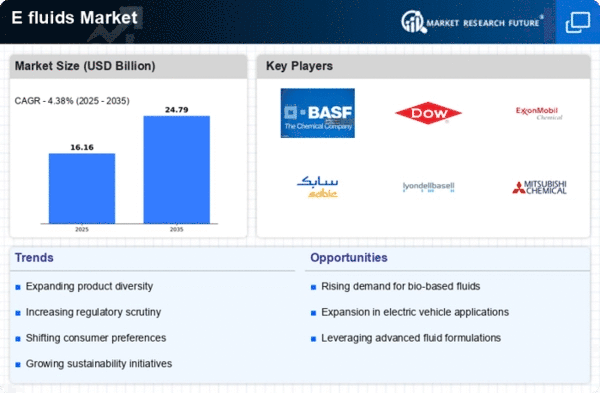
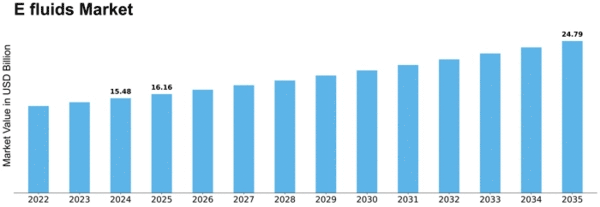
As per MRFR analysis, the E fluids Market Size was estimated at 15.48 USD Billion in 2024. The E fluids industry is projected to grow from 16.16 USD Billion in 2025 to 24.79 USD Billion by 2035, exhibiting a compound annual growth rate (CAGR) of 4.38 during the forecast period 2025 - 2035.

Key Market Trends & Highlights

The E fluids market is experiencing a robust growth trajectory driven by sustainability and technological advancements.

  • North America remains the largest market for E fluids, driven by increasing consumer awareness and demand.
  • The Asia-Pacific region is recognized as the fastest-growing market, reflecting a surge in industrial applications and innovations.
  • The automotive segment continues to dominate the market, while the aerospace segment is emerging as the fastest-growing area due to advancements in materials and technologies.
  • Sustainability initiatives and regulatory compliance are key drivers propelling the growth of E fluids across diverse end-user industries.

Market Size & Forecast

2024 Market Size 15.48 (USD Billion)
2035 Market Size 24.79 (USD Billion)
CAGR (2025 - 2035) 4.38%
Largest Regional Market Share in 2024 North America

Major Players

<p>BASF (DE), Dow (US), ExxonMobil (US), SABIC (SA), LyondellBasell (US), Mitsubishi Chemical (JP), Solvay (BE), Eastman Chemical (US), Clariant (CH)</p>

Market Trends

The E fluids Market is currently experiencing a transformative phase, driven by advancements in technology and increasing demand for efficient cooling solutions across various industries. This market encompasses a range of products, including heat transfer fluids, dielectric fluids, and other specialized liquids designed for electronic applications. As industries continue to evolve, the need for reliable and effective thermal management solutions becomes paramount. The growing emphasis on sustainability and energy efficiency further propels the development of innovative E fluids, which are designed to meet stringent environmental regulations while enhancing performance. In addition, the E fluids Market is witnessing a shift towards the adoption of bio-based and environmentally friendly alternatives. This trend reflects a broader commitment to reducing carbon footprints and promoting sustainable practices within the manufacturing sector. Companies are increasingly investing in research and development to create fluids that not only perform well but also align with global sustainability goals. As the market continues to expand, it appears poised for significant growth, driven by technological advancements and a heightened awareness of environmental impacts. The future of the E fluids Market seems promising, with potential for new applications and innovations that could redefine industry standards.

Sustainability Focus

The E fluids Market is increasingly oriented towards sustainable solutions, with manufacturers prioritizing the development of eco-friendly fluids. This trend is driven by regulatory pressures and consumer demand for greener products, leading to innovations in bio-based and recyclable materials.

Technological Advancements

Rapid technological progress is reshaping the E fluids Market, as new formulations and applications emerge. Enhanced thermal management capabilities and improved performance characteristics are becoming essential, enabling industries to optimize their operations and reduce energy consumption.

Diverse Applications

The E fluids Market is expanding into various sectors, including electronics, automotive, and renewable energy. This diversification indicates a growing recognition of the importance of effective thermal management across different industries, suggesting a robust future for E fluids.

E fluids Market Market Drivers

Growth in Renewable Energy Sector

The expansion of the renewable energy sector is a pivotal driver for the Global E-fluids Market Industry. As the world increasingly turns to renewable energy sources, the need for efficient cooling and lubrication fluids in wind turbines, solar panels, and energy storage systems becomes paramount. E-fluids are essential for maintaining the operational efficiency and longevity of these systems. The market's growth is closely tied to the increasing investments in renewable energy infrastructure, which are expected to rise significantly in the coming years. This trend aligns with the overall market growth trajectory, potentially reaching 30 USD Billion by 2035.

Rising Demand for Electric Vehicles

The increasing adoption of electric vehicles (EVs) is a primary driver for the Global E-fluids Market Industry. As consumers and manufacturers shift towards sustainable transportation, the demand for specialized fluids that enhance the performance and efficiency of EVs is growing. In 2024, the market is projected to reach 12.5 USD Billion, reflecting the industry's response to this trend. E-fluids play a crucial role in battery cooling, lubrication, and thermal management, which are essential for optimal EV operation. This trend is expected to continue, with the market potentially reaching 30 USD Billion by 2035, indicating a robust growth trajectory.

Increasing Focus on Energy Efficiency

The Global E-fluids Market Industry is experiencing a surge in demand due to the growing emphasis on energy efficiency across various sectors. Industries are increasingly recognizing the importance of optimizing fluid performance to reduce energy consumption and operational costs. E-fluids, designed for high efficiency and low friction, contribute to improved energy savings in electric vehicles and industrial applications. This trend is supported by the global push towards sustainability and cost-effectiveness. As organizations strive to meet energy efficiency targets, the demand for advanced e-fluids is likely to rise, further propelling market growth in the coming years.

Regulatory Support for Sustainable Solutions

Government regulations promoting sustainability are a significant catalyst for the Global E-fluids Market Industry. Many countries are implementing stringent emissions standards and incentivizing the use of eco-friendly technologies. This regulatory environment encourages manufacturers to develop and adopt e-fluids that minimize environmental impact while maintaining performance. For instance, initiatives aimed at reducing carbon footprints are likely to increase the demand for e-fluids in various applications, including automotive and industrial sectors. As a result, the market is expected to expand, with projections indicating a growth to 30 USD Billion by 2035, driven by these supportive policies.

Technological Advancements in Fluid Formulation

Innovations in fluid formulation are significantly influencing the Global E-fluids Market Industry. Advances in chemistry and materials science have led to the development of high-performance e-fluids that offer improved thermal stability, conductivity, and lubrication properties. These advancements not only enhance the efficiency of electric and hybrid vehicles but also cater to the growing needs of renewable energy systems. As manufacturers invest in research and development, the market is likely to see an influx of new products that meet stringent performance standards. This could further drive market growth, aligning with the projected CAGR of 8.28% from 2025 to 2035.

Market Segment Insights

By Application: Automotive (Largest) vs. Aerospace (Fastest-Growing)

<p>In the E fluids market, the application segment is diversified across various industries, with Automotive holding the largest market share. This sector benefits from increasing demand for electric vehicles and stricter emission regulations, prompting manufacturers to adopt environmentally friendly e-fluids. Other significant applications include Industrial and Marine, but their share is comparatively smaller. Aerospace, while traditionally a minor player, has been gaining traction as advancements in technology and a shift towards greener solutions are increasingly prioritized.</p>

<p>Aerospace (Emerging) vs. Marine (Dominant)</p>

<p>The Automotive application remains the dominant force in the E fluids market, driven by the widespread adoption of electric vehicles and ongoing innovations in e-fluid formulations that enhance performance and environmental compliance. Conversely, the Aerospace sector is emerging rapidly, fueled by a surge in demand for sustainable practices and improved operational efficiencies. As airlines and aircraft manufacturers focus on reducing their carbon footprint, e-fluids tailored for aviation are being developed. Meanwhile, the Marine sector, characterized by its robust regulatory environment, continues to leverage e-fluids to meet stringent environmental standards, ensuring compliance without compromising performance.</p>

By End Use: Lubricants (Largest) vs. Hydraulic Fluids (Fastest-Growing)

<p>In the E fluids Market, the distribution of end use segments shows that lubricants are the largest component, capturing substantial market share due to their widespread application in automotive and industrial sectors. Coolants and hydraulic fluids also play vital roles, catering to cooling systems and heavy machinery needs respectively. Fuel additives and heat transfer fluids round out the segment, providing essential functions in enhancing performance and efficiency in various applications.</p>

<p>Lubricants (Dominant) vs. Hydraulic Fluids (Emerging)</p>

<p>Lubricants remain a dominant force within the E fluids Market, essential for minimizing friction and wear in engines and machinery, thereby improving performance and longevity. Their extensive use across various industries solidifies their market leader status. In contrast, hydraulic fluids are emerging rapidly, driven by increasing automation and demand for more efficient machinery operation. The growing inclination towards eco-friendly hydraulic fluids further boosts their popularity. Together, these two segments are central to the dynamics of the E fluids market, influencing innovation and sustainability.</p>

By Type: Synthetic Fluids (Largest) vs. Biodegradable Fluids (Fastest-Growing)

<p>In the E fluids Market, the segment values reflect a diverse range of products with distinct properties. Synthetic fluids hold the largest market share, favored for their superior performance and long-term cost benefits. Conversely, biodegradable fluids are gaining traction as the fastest-growing segment due to rising environmental concerns and regulatory mandates favoring sustainable products. This shift indicates a growing interest among consumers for environmentally friendly options in industrial applications. Growth trends within this segment are driven by technological advancements and increased awareness regarding eco-friendly solutions. Synthetic fluids continue to dominate due to their efficiency in demanding applications, while biodegradable fluids have emerged as a response to the escalating demand for sustainable practices in industries such as manufacturing and automotive. This dynamic is reshaping the competitive landscape, driving innovations across the segment.</p>

<p>Synthetic Fluids (Dominant) vs. Water Based Fluids (Emerging)</p>

<p>Synthetic fluids are positioned as the dominant force in the E fluids Market, known for their exceptional performance, high thermal stability, and extended service life, making them the preferred choice in demanding applications. These fluids are engineered to provide superior lubrication, corrosion resistance, and optimal performance under extreme conditions, catering to a wide array of industries including automotive, aerospace, and manufacturing. On the other hand, water-based fluids are emerging rapidly, benefiting from their lower environmental impact and growing consumer preference for sustainable solutions. These fluids offer competitive performance in less critical applications, making them an attractive alternative for industries aiming to enhance their eco-friendliness while maintaining operational efficiency. As sustainability continues to drive market trends, the emphasis on water-based solutions is expected to grow significantly.</p>

Get more detailed insights about E-fluids Market Research Report—Global Forecast till 2035

Regional Insights

North America : Market Leader in E Fluids

North America is poised to maintain its leadership in the E fluids market, holding a significant market share of 6.0 in 2024. The region's growth is driven by increasing demand for advanced materials in automotive and electronics sectors, alongside stringent environmental regulations promoting sustainable practices. The push for innovation in energy-efficient solutions further catalyzes market expansion, making it a focal point for investments and technological advancements. The competitive landscape in North America is robust, featuring key players such as Dow, ExxonMobil, and BASF. These companies are leveraging their extensive R&D capabilities to develop cutting-edge E fluids that meet evolving consumer needs. The presence of established manufacturing facilities and a skilled workforce enhances the region's attractiveness for both domestic and international investments, solidifying its position as a market leader.

Europe : Innovation and Sustainability Focus

Europe's E fluids market is projected to grow significantly, with a market size of 4.5 in 2025. The region is characterized by a strong emphasis on sustainability and innovation, driven by regulatory frameworks such as the European Green Deal, which aims to make Europe climate-neutral by 2050. This regulatory environment fosters the development of eco-friendly E fluids, catering to the increasing demand for sustainable solutions across various industries. Leading countries in this market include Germany, France, and the UK, where major players like BASF and Solvay are actively investing in R&D to enhance product offerings. The competitive landscape is marked by collaborations between companies and research institutions, aimed at advancing technology and meeting stringent regulatory standards. This synergy is crucial for maintaining Europe's competitive edge in The E fluids.

Asia-Pacific : Emerging Market Potential

The Asia-Pacific region is witnessing a burgeoning E fluids market, with a projected size of 3.5 in 2025. This growth is fueled by rapid industrialization, urbanization, and increasing investments in renewable energy. Countries like China and India are at the forefront, driven by government initiatives aimed at enhancing energy efficiency and reducing carbon emissions. The rising demand for E fluids in automotive and electronics sectors further propels market expansion in this region. The competitive landscape is evolving, with key players such as Mitsubishi Chemical and Eastman Chemical establishing a strong presence. These companies are focusing on innovation and strategic partnerships to capture market share. The region's diverse manufacturing capabilities and growing consumer base present significant opportunities for both local and international players, making it a vital area for future growth in the E fluids market.

Middle East and Africa : Resource-Rich Market Dynamics

The Middle East and Africa (MEA) region is emerging as a significant player in the E fluids market, with a market size of 1.48 in 2025. The growth is primarily driven by the region's rich natural resources and increasing investments in petrochemical industries. Additionally, government initiatives aimed at diversifying economies and promoting sustainable practices are catalyzing the demand for E fluids across various sectors, including automotive and construction. Leading countries such as Saudi Arabia and South Africa are witnessing a surge in E fluids production, supported by key players like SABIC and Clariant. The competitive landscape is characterized by a mix of established companies and new entrants, all vying for market share. The region's strategic location and access to global markets further enhance its potential as a hub for E fluids production and distribution.

Key Players and Competitive Insights

The E fluids Market is currently characterized by a dynamic competitive landscape, driven by increasing demand for advanced materials and sustainable solutions. Key players such as BASF (DE), Dow (US), and ExxonMobil (US) are actively shaping the market through strategic initiatives focused on innovation and sustainability. BASF (DE) emphasizes its commitment to developing eco-friendly products, while Dow (US) is enhancing its portfolio through digital transformation and advanced manufacturing techniques. ExxonMobil (US) is also investing in research and development to create high-performance fluids that meet evolving industry standards. Collectively, these strategies foster a competitive environment that prioritizes technological advancement and environmental responsibility.

In terms of business tactics, companies are increasingly localizing manufacturing to reduce lead times and optimize supply chains. The market structure appears moderately fragmented, with several players vying for market share. However, the influence of major companies is substantial, as they leverage their resources and expertise to establish a competitive edge. This collective presence of key players not only enhances market stability but also drives innovation across the sector.

In November 2025, BASF (DE) announced the launch of a new line of biodegradable E fluids aimed at reducing environmental impact. This strategic move underscores the company's commitment to sustainability and positions it favorably in a market that increasingly values eco-friendly solutions. The introduction of these products is likely to attract environmentally conscious consumers and businesses, thereby enhancing BASF's market share.

In October 2025, Dow (US) unveiled a partnership with a leading technology firm to integrate AI into its manufacturing processes. This collaboration aims to optimize production efficiency and reduce waste, reflecting Dow's focus on digital transformation. The integration of AI is expected to streamline operations and improve product quality, potentially setting a new standard in the E fluids Market.

In September 2025, ExxonMobil (US) expanded its research initiatives by investing $100 million in a new facility dedicated to developing high-performance E fluids. This investment highlights the company's strategic focus on innovation and its intent to lead in the development of next-generation products. By enhancing its R&D capabilities, ExxonMobil is likely to strengthen its competitive position and respond effectively to market demands.

As of December 2025, current trends in the E fluids Market indicate a strong emphasis on digitalization, sustainability, and AI integration. Strategic alliances are increasingly shaping the competitive landscape, enabling companies to pool resources and expertise. Looking ahead, it appears that competitive differentiation will evolve, with a shift from price-based competition to a focus on innovation, technology, and supply chain reliability. This transition may redefine market dynamics, compelling companies to prioritize sustainable practices and advanced technologies to maintain their competitive edge.

Key Companies in the E fluids Market market include

Industry Developments

Future Outlook

E fluids Market Future Outlook

<p>The E fluids Market is projected to grow at a 4.38% CAGR from 2024 to 2035, driven by technological advancements, increasing demand for electric vehicles, and sustainability initiatives.</p>

New opportunities lie in:

  • <p>Development of advanced cooling fluids for electric vehicle batteries.</p>
  • <p>Expansion of e-fluid distribution networks in emerging markets.</p>
  • <p>Investment in R&D for biodegradable e-fluid formulations.</p>

<p>By 2035, the E fluids Market is expected to achieve substantial growth, reflecting evolving industry dynamics.</p>

Market Segmentation

E fluids Market Type Outlook

  • Synthetic Fluids
  • Biodegradable Fluids
  • Mineral Oil Based Fluids
  • Water Based Fluids
  • Emulsifiable Fluids

E fluids Market End Use Outlook

  • Lubricants
  • Coolants
  • Hydraulic Fluids
  • Fuel Additives
  • Heat Transfer Fluids

E fluids Market Application Outlook

  • Automotive
  • Industrial
  • Aerospace
  • Marine
  • Power Generation

Report Scope

MARKET SIZE 202415.48(USD Billion)
MARKET SIZE 202516.16(USD Billion)
MARKET SIZE 203524.79(USD Billion)
COMPOUND ANNUAL GROWTH RATE (CAGR)4.38% (2024 - 2035)
REPORT COVERAGERevenue Forecast, Competitive Landscape, Growth Factors, and Trends
BASE YEAR2024
Market Forecast Period2025 - 2035
Historical Data2019 - 2024
Market Forecast UnitsUSD Billion
Key Companies ProfiledBASF (DE), Dow (US), ExxonMobil (US), SABIC (SA), LyondellBasell (US), Mitsubishi Chemical (JP), Solvay (BE), Eastman Chemical (US), Clariant (CH)
Segments CoveredApplication, End Use, Type
Key Market OpportunitiesIntegration of advanced cooling technologies in electric vehicles enhances demand in the E fluids Market.
Key Market DynamicsRising demand for electric vehicles drives innovation in E fluids, enhancing performance and sustainability in automotive applications.
Countries CoveredNorth America, Europe, APAC, South America, MEA

FAQs

What growth rate global e-fluids market would register in the future?

The global e-fluids market would register a growth of 27.08%.

Which industry will be crucial in taking the e-fluids market ahead??

Growing EV sales will play a prominent role in taking the market forward.

What is the key restraining factor for the global e-fluids market?

The prices at which EVs currently sell are still greater than those of conventionally-powered equivalents. The costly battery pack is a major factor, but the lack of economies of scale also plays a role in restraining the market growth

Which region would enjoy the upper hand in the e-fluids market?

Asia-Pacific would enjoy the upper hand in the e-fluids market, poised to grow rapidly.

Which Asia-Pacific country would set the trend in the e-fluids market?

China is poised to set the trend in the E-fluids market, with its ever-growing end-user industries present in the country.

  1. Executive Summary
  2. Scope of
    1. the Report
    2. Market Definition
    3. Scope of the Study
    4. List of Assumptions
    5. Markets Structure
    6. Market Research Methodology
    7. Research Process
    8. Primary Research
    9. Secondary Research
    10. Market Size Estimation
    11. Forecast Model
  3. Market Dynamics of Global E-Fluids Market
    1. Introduction
    2. Drivers
    3. Restraints
    4. Opportunities
    5. Challenges
  4. Market Factor Analysis
    1. Supply
      1. Distributors/Retailers
      2. End-Use Industries
    2. Chain Analysis
    3. Raw Form Suppliers
    4. Manufacturers of E-Fluids
    5. Porter''s Five Forces Model
      1. Threat of New Entrants
      2. Intensity
      3. Bargaining Power of Buyers
    6. of Rivalry
    7. Threat of Substitutes
    8. Bargaining Power of Suppliers
    9. Pricing Analysis (USD/Ton), 2019-2021
    10. Impact of Covid-19
      1. Impact of Covid-19 on E-Fluids End users
    11. on E-Fluids Market
    12. Impact of Covid-19 on Supply Chain of E-Fluids
  5. Global E-Fluids Market,
    1. by Product Type
    2. Introduction
    3. Coolants
  6. Market Estimates & Forecast, by Region, 2019–2030
    1. Brake Fluid
      1. Market Estimates & Forecast, by Region,
    2. Transmission Fluids
  7. Market Estimates & Forecast, by Region, 2019–2030
    1. Greases
      1. Market Estimates & Forecast, by Region,
  8. Global E-Fluids Market, by Vehicle Type
    1. Introduction
    2. On-highway Vehicle
      1. Market Estimates & Forecast, by Region,
    3. Off-highway Vehicle
  9. Market Estimates & Forecast, by Region, 2019–2030
  10. Global E-Fluids Market, by Propulsion
    1. Introduction
    2. Hybrid EV
      1. Market Estimates
    3. & Forecast, by Region, 2019–2030
    4. Battery EV
      1. Market Estimates & Forecast, by Region,
  11. Global E-Fluids Market, by Fill Type
    1. Introduction
    2. First Fill
      1. Market Estimates & Forecast, by Region, 2019–2030
    3. Service Fill
      1. Market Estimates
    4. & Forecast, by Region, 2019–2030
  12. Global E-Fluids Market, by Region
    1. Introduction
    2. North America
    3. & Forecast by Country, 2019–2030
    4. Type, 2019–2030
  13. Market Estimates
  14. Market Estimates & Forecast, by Product
  15. Market Estimates & Forecast, by Vehicle Type, 2019–2030
    1. Forecast, by Propulsion, 2019–2030
    2. US
  16. Market Estimates &
  17. Market Estimates & Forecast, by Fill Type,
  18. Market Estimates & Forecast, by Product Type, 2019–2030
    1. Forecast, by Vehicle Type, 2019–2030
  19. Market Estimates &
  20. Market Estimates & Forecast, by Propulsion,
  21. Market Estimates & Forecast, by Fill Type, 2019–2030
    1. Forecast, by Product Type, 2019–2030
    2. Type, 2019–2030
  22. Canada
  23. Market Estimates &
  24. Market Estimates & Forecast, by Vehicle
  25. Market Estimates & Forecast, by Propulsion, 2019–2030
    1. Forecast, by Fill Type, 2019–2030
    2. & Forecast, by Product Type, 2019–2030
    3. Type, 2019–2030
  26. Market Estimates &
    1. Europe
  27. Market Estimates & Forecast by Country, 2019–2030
  28. Market Estimates
  29. Market Estimates & Forecast, by Vehicle
  30. Market Estimates & Forecast, by Propulsion, 2019–2030
    1. Forecast, by Fill Type, 2019–2030
  31. Market Estimates &
  32. Germany
  33. Market Estimates & Forecast, by Product Type,
  34. Market Estimates & Forecast, by Vehicle Type, 2019–2030
    1. Forecast, by Propulsion, 2019–2030
    2. France
  35. Market Estimates &
  36. Market Estimates & Forecast, by Fill Type,
  37. Market Estimates & Forecast, by Product Type, 2019–2030
    1. Forecast, by Vehicle Type, 2019–2030
  38. Market Estimates &
  39. Market Estimates & Forecast, by Propulsion,
  40. Market Estimates & Forecast, by Fill Type, 2019–2030
    1. Forecast, by Product Type, 2019–2030
    2. Type, 2019–2030
  41. Italy
  42. Market Estimates &
  43. Market Estimates & Forecast, by Vehicle
  44. Market Estimates & Forecast, by Propulsion, 2019–2030
    1. Forecast, by Fill Type, 2019–2030
  45. Market Estimates &
  46. Spain
  47. Market Estimates & Forecast, by Product Type,
  48. Market Estimates & Forecast, by Vehicle Type, 2019–2030
    1. Forecast, by Propulsion, 2019–2030
    2. UK
  49. Market Estimates &
  50. Market Estimates & Forecast, by Fill Type,
  51. Market Estimates & Forecast, by Product Type, 2019–2030
    1. Forecast, by Vehicle Type, 2019–2030
  52. Market Estimates &
  53. Market Estimates & Forecast, by Propulsion,
  54. Market Estimates & Forecast, by Fill Type, 2019–2030
    1. Forecast, by Product Type, 2019–2030
    2. Type, 2019–2030
  55. Russia
  56. Market Estimates &
  57. Market Estimates & Forecast, by Vehicle
  58. Market Estimates & Forecast, by Propulsion, 2019–2030
    1. Forecast, by Fill Type, 2019–2030
    2. Type, 2019–2030
  59. Market Estimates &
  60. Rest of Europe
  61. Market Estimates & Forecast, by Product
  62. Market Estimates & Forecast, by Vehicle Type, 2019–2030
    1. Forecast, by Propulsion, 2019–2030
    2. Asia-Pacific
    3. Market Estimates & Forecast by Country, 2019–2030
    4. Type, 2019–2030
  63. Market Estimates &
  64. Market Estimates & Forecast, by Fill Type,
  65. Market Estimates & Forecast, by Product
  66. Market Estimates & Forecast, by Vehicle Type, 2019–2030
    1. Forecast, by Propulsion, 2019–2030
    2. China
  67. Market Estimates &
  68. Market Estimates & Forecast, by Fill Type,
  69. Market Estimates & Forecast, by Product Type, 2019–2030
    1. Forecast, by Vehicle Type, 2019–2030
  70. Market Estimates &
  71. Market Estimates & Forecast, by Propulsion,
  72. Market Estimates & Forecast, by Fill Type, 2019–2030
    1. Forecast, by Product Type, 2019–2030
    2. Type, 2019–2030
  73. India
  74. Market Estimates &
  75. Market Estimates & Forecast, by Vehicle
  76. Market Estimates & Forecast, by Propulsion, 2019–2030
    1. Forecast, by Fill Type, 2019–2030
    2. Type, 2019–2030
  77. Market Estimates &
  78. South Korea
  79. Market Estimates & Forecast, by Product
  80. Market Estimates & Forecast, by Vehicle Type, 2019–2030
    1. Forecast, by Propulsion, 2019–2030
    2. Australia & New Zealand
    3. & Forecast, by Vehicle Type, 2019–2030
  81. Market Estimates &
  82. Market Estimates & Forecast, by Fill Type,
  83. Market Estimates & Forecast, by Product Type, 2019–2030
  84. Market Estimates
  85. Market Estimates & Forecast, by Propulsion,
  86. Market Estimates & Forecast, by Fill Type, 2019–2030
    1. & Forecast, by Product Type, 2019–2030
    2. Type, 2019–2030
  87. Australia & New Zealand
  88. Market Estimates
  89. Market Estimates & Forecast, by Vehicle
  90. Market Estimates & Forecast, by Propulsion, 2019–2030
    1. Forecast, by Fill Type, 2019–2030
    2. Type, 2019–2030
  91. Market Estimates &
  92. Rest of Asia-Pacific
  93. Market Estimates & Forecast, by Product
  94. Market Estimates & Forecast, by Vehicle Type, 2019–2030
    1. Forecast, by Propulsion, 2019–2030
    2. Middle East & Africa
    3. & Forecast, by Product Type, 2019–2030
    4. Type, 2019–2030
  95. Market Estimates &
  96. Market Estimates & Forecast, by Fill Type,
  97. Market Estimates & Forecast, by Country, 2019–2030
  98. Market Estimates
  99. Market Estimates & Forecast, by Vehicle
  100. Market Estimates & Forecast, by Propulsion, 2019–2030
    1. Forecast, by Fill Type, 2019–2030
    2. & Forecast, by Vehicle Type, 2019–2030
  101. Market Estimates &
  102. South Africa
  103. Market Estimates & Forecast, by Product Type, 2019–2030
  104. Market Estimates
  105. Market Estimates & Forecast, by Propulsion,
  106. Market Estimates & Forecast, by Fill Type, 2019–2030
    1. Forecast, by Product Type, 2019–2030
    2. Type, 2019–2030
  107. GCC
  108. Market Estimates &
  109. Market Estimates & Forecast, by Vehicle
  110. Market Estimates & Forecast, by Propulsion, 2019–2030
    1. Forecast, by Fill Type, 2019–2030
    2. Forecast, by Product Type, 2019–2030
    3. Type, 2019–2030
  111. Market Estimates &
  112. Rest of the Middle East & Africa
  113. Market Estimates &
  114. Market Estimates & Forecast, by Vehicle
  115. Market Estimates & Forecast, by Propulsion, 2019–2030
    1. Forecast, by Fill Type, 2019–2030
  116. Market Estimates &
    1. Latin America
  117. Market Estimates & Forecast, by Country,
  118. Market Estimates & Forecast, by Product Type, 2019–2030
    1. Forecast, by Vehicle Type, 2019–2030
  119. Market Estimates &
  120. Market Estimates & Forecast, by Propulsion,
  121. Market Estimates & Forecast, by Fill Type, 2019–2030
    1. Forecast, by Product Type, 2019–2030
    2. Type, 2019–2030
  122. Brazil
  123. Market Estimates &
  124. Market Estimates & Forecast, by Vehicle
  125. Market Estimates & Forecast, by Propulsion, 2019–2030
    1. Forecast, by Fill Type, 2019–2030
    2. Type, 2019–2030
  126. Market Estimates &
  127. Argentina
  128. Market Estimates & Forecast, by Product
  129. Market Estimates & Forecast, by Vehicle Type, 2019–2030
    1. Forecast, by Propulsion, 2019–2030
    2. Mexico
  130. Market Estimates &
  131. Market Estimates & Forecast, by Fill Type,
  132. Market Estimates & Forecast, by Product Type, 2019–2030
    1. Forecast, by Vehicle Type, 2019–2030
  133. Market Estimates &
  134. Market Estimates & Forecast, by Propulsion,
  135. Market Estimates & Forecast, by Fill Type, 2019–2030
    1. Estimates & Forecast, by Product Type, 2019–2030
    2. Type, 2019–2030
  136. Rest of Latin America
  137. Market
  138. Market Estimates & Forecast, by Vehicle
  139. Market Estimates & Forecast, by Propulsion, 2019–2030
    1. Forecast, by Fill Type, 2019–2030
  140. Market Estimates &
  141. Competitive Landscape
    1. Introduction
    2. Market Key Strategies
    3. Key Development Analysis (Expansions/Mergers
    4. & Acquisitions/Joint Ventures/New E-Fluids Developments/Agreements/Investments)
  142. Company
    1. Profiles
    2. Royal Dutch Shell Plc
    3. Company Overview
    4. Financial Overview
    5. E-Fluids Offered
    6. Key Developments
    7. SWOT Analysis
    8. Key Strategies
    9. ExxonMobil Corporation
    10. BP Plc.
    11. TotalEnergies SE
    12. FUCHS Petrolub AG
    13. Repsol S.A.
    14. ENEOS Corp.
    15. Valvoline Inc.
    16. PTT
    17. Petronas
  143. Appendix
  144. LIST OF TABLES
    1. Table 1.: Global E-Fluids
  145. Market, by Region, 2019–2030
  146. Table 2.: North America: E-Fluids Market, by Country, 2019–2030
    1. Table 3.: Europe: E-Fluids
  147. Market, by Country, 2019–2030
  148. Table 4.: Asia-Pacific: E-Fluids Market, by Country, 2019–2030
    1. Table 5.: Middle East
  149. & Africa: E-Fluids Market, by Country, 2019–2030
  150. Table 6.: Latin America: E-Fluids Market, by Country,
    1. Table
  151. 7.: Global E-Fluids Market, by Product Type, 2019–2030
  152. Table 8.: North America: E-Fluids Market, by Country,
    1. Table
  153. 9.: Europe: E-Fluids Market, by Country, 2019–2030
  154. Table 10.: Asia-Pacific: E-Fluids Market, by Country,
    1. Table
  155. 11.: Middle East & Africa: E-Fluids Market, by Country, 2019–2030
    1. Table 12.: Latin America:
  156. E-Fluids Market, by Country, 2019–2030
  157. Table 13.: Global E-Fluids Market, by Vehicle Type,
    1. Table
  158. 14.: North America: E-Fluids Market, by Country, 2019–2030
    1. Table 15.: Europe: E-Fluids Market,
    2. by Country, 2019–2030
  159. Table 16.: Asia-Pacific: E-Fluids Market, by Country, 2019–2030
    1. Table 17.: Middle East
  160. & Africa: E-Fluids Market, by Country, 2019–2030
  161. Table 18.: Latin America: E-Fluids Market, by Country,
    1. Table
  162. 19.: Global E-Fluids Market, by Propulsion, 2019–2030
  163. Table 20.: North America: E-Fluids Market, by Country,
    1. Table
  164. 21.: Europe: E-Fluids Market, by Country, 2019–2030
  165. Table 22.: Asia-Pacific: E-Fluids Market, by Country,
    1. Table
  166. 23.: Middle East & Africa: E-Fluids Market, by Country, 2019–2030
    1. Table 24.: Latin America:
  167. E-Fluids Market, by Country, 2019–2030
  168. Table 25.: Global E-Fluids Market, by Fill Type,
    1. Table
  169. 26.: North America: E-Fluids Market, by Country, 2019–2030
    1. Table 27.: Europe: E-Fluids Market,
    2. by Country, 2019–2030
  170. Table 28.: Asia-Pacific: E-Fluids Market, by Country, 2019–2030
    1. Table 29.: Middle East
  171. & Africa: E-Fluids Market, by Country, 2019–2030
  172. Table 30.: Latin America: E-Fluids Market, by Country,
    1. Table
  173. 31.: North America: E-Fluids Market, by Country, 2019–2030
    1. Table 32.: North America: E-Fluids
  174. Market, by Product Type 2019–2030
  175. Table 33.: North America: E-Fluids Market, by Vehicle Type,
    1. Table
  176. 34.: North America: E-Fluids Market, by Propulsion, 2019–2030
    1. Table 35.: North America: E-Fluids
  177. Market, by Fill Type, 2019–2030
  178. Table 36.: Euope: E-Fluids Market, by Country, 2019–2030
    1. Table 37.: Euope: E-Fluids
  179. Market, by Product Type 2019–2030
  180. Table 38.: Euope: E-Fluids Market, by Vehicle Type, 2019–2030
    1. Table 39.: Euope: E-Fluids
  181. Market, by Propulsion, 2019–2030
  182. Table 40.: Euope: E-Fluids Market, by Fill Type, 2019–2030
    1. Table 41.: Asia Pacific:
  183. E-Fluids Market, by Country, 2019–2030
  184. Table 42.: Asia Pacific: E-Fluids Market, by Product
    1. Type 2019–2030
    2. Table
  185. 43.: Asia Pacific: E-Fluids Market, by Vehicle Type, 2019–2030
    1. Table 44.: Asia Pacific: E-Fluids
  186. Market, by Propulsion, 2019–2030
  187. Table 45.: Asia Pacific: E-Fluids Market, by Fill Type,
    1. Table
  188. 46.: Latin America: E-Fluids Market, by Country, 2019–2030
    1. Table 47.: Latin America: E-Fluids
  189. Market, by Product Type 2019–2030
  190. Table 48.: Latin America: E-Fluids Market, by Vehicle Type,
    1. Table
  191. 49.: Latin America: E-Fluids Market, by Propulsion, 2019–2030
    1. Table 50.: Latin America: E-Fluids
  192. Market, by Fill Type, 2019–2030
  193. Table 51.: MEA: E-Fluids Market, by Country, 2019–2030
    1. Table 52.: MEA: E-Fluids
  194. Market, by Product Type 2019–2030
  195. Table 53.: MEA: E-Fluids Market, by Vehicle Type, 2019–2030
    1. Table 54.: MEA: E-Fluids
  196. Market, by Propulsion, 2019–2030
  197. Table 55.: MEA: E-Fluids Market, by Fill Type, 2019–2030
  198. LIST OF FIGURES
    1. Figure 1.: Global
    2. E-Fluids Market Segmentation
    3. Figure 2.: Forecast Research Methodology
    4. Figure 3.: Porter’s Five Forces Analysis of
    5. Global E-Fluids Market
    6. Figure
    7. 4.: Value Chain/Supply Chain of Global E-Fluids Market
  199. Figure 5.: Share of Global E-Fluids Market, by Country,
    1. Figure
    2. 6.: Global E-Fluids Market, 2019–2030
  200. Figure 7.: Global E-Fluids Market Size, by Product
    1. Type, 2019–2030
    2. Figure
  201. 8.: Share of Global E-Fluids Market, by Product Type, 2021 (%)
    1. Figure 9.: Global E-Fluids Market
    2. Size, by Vehicle Type, 2019–2030
  202. Figure 10.: Share of Global E-Fluids Market, by Vehicle
    1. Type, 2021 (%)
    2. Figure
  203. 11.: Global E-Fluids Market Size, by Propulsion, 2019–2030
    1. Figure 12.: Share of Global E-Fluids
  204. Market, by Propulsion, 2021 (%)
  205. Figure 13.: Global E-Fluids Market Size, by Fill Type, 2019–2030
    1. Figure 14.: Share of
  206. Global E-Fluids Market, by Fill Type, 2021 (%)

E-fluids Market Segmentation

Market Segmentation Overview

  • Detailed segmentation data will be available in the full report
  • Comprehensive analysis by multiple parameters
  • Regional and country-level breakdowns
  • Market size forecasts by segment
Infographic

Free Sample Request

Kindly complete the form below to receive a free sample of this Report

Get Free Sample

Customer Strories

Compare Licence

×
Features License Type
Single User Multiuser License Enterprise User
Price $4,950 $5,950 $7,250
Maximum User Access Limit 1 User Upto 10 Users Unrestricted Access Throughout the Organization
Free Customization
Direct Access to Analyst
Deliverable Format
Platform Access
Discount on Next Purchase 10% 15% 15%
Printable Versions