×
Hero Background
English
Chinese
French
Japanese
Korean
German
Spanish

Dyes Market Size

ID: MRFR/CnM/10586-CR
111 Pages
Chitranshi Jaiswal
September 2023

Dyes Market Research Report Information by Product Type (Reactive Dyes, Disperse Dyes, Vat Dyes Direct Dyes, Acid Dyes and Others), By Application (Textile, Leather, Paper, Printing Inks and Others) And By Region (North America, Europe, Asia-Pacific, Middle East & Africa and Latin America) - Forecast Till 2035

Share:
Download PDF ×

We do not share your information with anyone. However, we may send you emails based on your report interest from time to time. You may contact us at any time to opt-out.

Dyes Market Infographic
Purchase Options

Dyes Size

Dyes Market Growth Projections and Opportunities

The dyes market is a dynamic and competitive landscape, driven by various industries such as textiles, paints and coatings, plastics, and printing inks. Market share positioning strategies play a crucial role in determining the success and growth of companies operating in the dyes sector. Here are key strategies employed by players to enhance their market share: Product Portfolio Diversification: Companies aim to expand their market share by offering a diverse range of dyes catering to different applications and industries. This diversification helps capture a broader customer base and respond to changing market demands. Technological Innovation: Staying at the forefront of technological advancements in dye manufacturing is a key strategy. Companies invest in research and development to introduce innovative and high-performance dyes, gaining a competitive edge and increasing their market share. Focus on Sustainable and Eco-Friendly Dyes: With the growing emphasis on sustainability, companies strategically position themselves by developing and promoting eco-friendly and sustainable dye options. This aligns with market trends and regulatory preferences, appealing to environmentally conscious customers. Geographic Expansion: Expanding market presence geographically is a common strategy. Companies strategically enter new regions or strengthen their distribution networks to reach untapped markets, thereby increasing their market share on a global scale. Strategic Partnerships and Collaborations: Forming strategic partnerships with other industry players, suppliers, or research institutions is a collaborative strategy to enhance market share. This allows for shared resources, joint research efforts, and increased market reach. Customization and Tailored Solutions: Offering customized dye solutions to meet specific customer requirements is a strategy adopted by some companies. This approach helps in building long-term relationships with clients and gaining a competitive advantage in niche markets. Cost Leadership: Some companies focus on becoming cost leaders in the market by optimizing production processes, improving efficiency, and managing costs effectively. This strategy enables them to offer competitive pricing and capture a larger market share. Branding and Marketing Strategies: Building a strong brand presence through effective marketing strategies is vital. Companies invest in brand building, advertising, and promotional activities to create brand recognition and loyalty, influencing market share positively. Regulatory Compliance and Certification: Ensuring that dyes meet regulatory standards and obtaining relevant certifications is a strategic move. Compliance with international standards enhances credibility, builds trust among customers, and positively impacts market share. Mergers and Acquisitions: Mergers and acquisitions are strategic moves employed to consolidate market share. Companies strategically acquire or merge with other entities to gain access to new technologies, customer bases, and distribution channels, fostering growth and market dominance. Customer Relationship Management: Building strong customer relationships is a pivotal aspect of market share positioning. Companies invest in customer service, feedback mechanisms, and after-sales support to enhance customer satisfaction and loyalty, ultimately impacting market share positively. Continuous Improvement and Quality Assurance: Implementing continuous improvement initiatives and maintaining high-quality standards are strategic imperatives. This ensures customer satisfaction, builds a reputation for reliability, and contributes to the long-term positioning of a company in the market. 13. Monitoring Competitor Strategies: Keeping a vigilant eye on competitor activities is crucial for staying competitive. Understanding competitor strategies helps companies adjust their own approaches, identify market gaps, and capitalize on emerging opportunities to maintain or enhance market share.
Dyes Market Size Graph
Author
Chitranshi Jaiswal
Research Analyst Level I

In her 3 years of experience in the market research field, she has handled critical cross-domain projects. She has an in-depth knowledge of market estimation & analysis, problem-solving, primary as well as secondary research, and team management.She holds an engineering degree and is an MBA professional from a well-known university, capable of evaluating the market and competitive conditions. An exceptional strategist with excellent communication skills and a passion for delivering cutting-edge & practical insights for the market. Proficient in multi-tasking, and can successfully deal with competing demands, while maintaining complete confidentiality. Generated business through active client and project development, networking, and high-quality responses. Her knowledge and skills have helped in making solid business decisions, securing funding from investors, and avoiding business failures.

Leave a Comment

FAQs

How much is the dyes market?

As of 2022, Dyes is worth USD 28,547.38 million.

What is the growth rate of the Dyes market?

The Dyes Market is growing at a CAGR of 5.4%.

Which region held the largest market share in the Dyes market?

The Asia-Pacific region holds the largest market share in the Dyes market.

Who are the key players in the Dyes market?

BASF SE (Germany), Clariant AG (Switzerland), Archroma (Switzerland), Sudarshan Chemical Industries Limited (India), Atul Ltd. (India), Huntsman Corp. (US), JAY Chemical Industries Private Limited (India) are some of the prominent players in the market.

Which product type led the dyes market?

The thermosets segment in the Dyes Market is leading commercial market growth.

Which application has the largest market share in the dyes market?

The transportation segment has the largest market share.

Market Summary

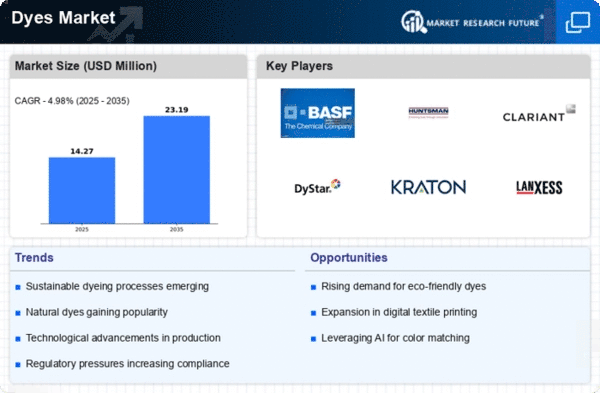
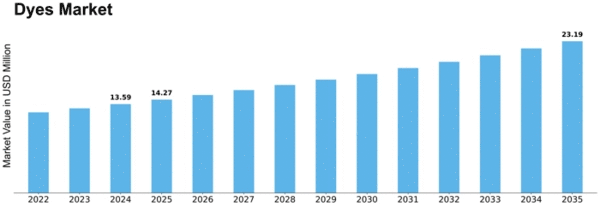
As per MRFR analysis, the Dyes Market was estimated at 13.59 USD Million in 2024. The Dyes industry is projected to grow from 14.26 USD Million in 2025 to 23.19 USD Million by 2035, exhibiting a compound annual growth rate (CAGR) of 4.98 during the forecast period 2025 - 2035.

Key Market Trends & Highlights

The Dyes Market is currently experiencing a transformative shift towards sustainability and technological innovation.

  • The market is witnessing a pronounced focus on sustainability, with an increasing demand for eco-friendly dyeing processes.
  • Natural dyes are gaining traction, particularly in North America, as consumers seek more environmentally responsible options.
  • Digital printing technologies are revolutionizing the dyeing process, enhancing customization capabilities across various sectors.
  • Key market drivers include sustainability initiatives and rising demand in the textile sector, particularly in the Asia-Pacific region.

Market Size & Forecast

2024 Market Size 13.59 (USD Million)
2035 Market Size 23.19 (USD Million)
CAGR (2025 - 2035) 4.98%
Largest Regional Market Share in 2024 Asia-Pacific

Major Players

<p>BASF SE (DE), Huntsman Corporation (US), Clariant AG (CH), Dystar GmbH (DE), Kraton Corporation (US), Lanxess AG (DE), Ferro Corporation (US), Troy Corporation (US), Atul Ltd (IN)</p>

Market Trends

The Dyes Market is currently experiencing a dynamic transformation, driven by various factors including technological advancements and evolving consumer preferences. The increasing demand for sustainable and eco-friendly dyeing processes is reshaping production methodologies. Manufacturers are increasingly adopting innovative techniques that minimize environmental impact while maintaining product quality. This shift towards sustainability is not merely a trend but appears to be a fundamental change in how the industry operates. Furthermore, the rise of digital printing technologies is influencing the Dyes Market, allowing for more precise and efficient application of dyes, which could lead to reduced waste and enhanced color vibrancy. In addition to sustainability, the Dyes Market is witnessing a growing interest in natural dyes, which are perceived as safer alternatives to synthetic options. This inclination towards natural products reflects a broader consumer trend favoring organic and environmentally friendly materials. As the market evolves, it seems likely that companies will continue to innovate, focusing on developing dyes that meet both aesthetic and ecological standards. The interplay between traditional dyeing methods and modern technological advancements suggests a complex landscape where adaptability and forward-thinking strategies will be crucial for success.

Sustainability Focus

The Dyes Market is increasingly prioritizing sustainable practices, with manufacturers exploring eco-friendly alternatives to traditional dyeing processes. This trend reflects a broader societal shift towards environmental responsibility, prompting companies to innovate in order to reduce their ecological footprint.

Rise of Natural Dyes

There is a notable surge in the popularity of natural dyes, as consumers seek safer and more organic options. This trend indicates a growing preference for products that align with health and environmental consciousness, potentially reshaping product offerings in the Dyes Market.

Digital Printing Technologies

The integration of digital printing technologies is transforming the Dyes Market by enabling more precise application and customization of colors. This advancement not only enhances efficiency but also reduces waste, suggesting a future where digital solutions play a pivotal role in dye application.

Dyes Market Market Drivers

Rising Demand from Textile Industry

The Global Dyes Market Industry experiences substantial growth driven by the increasing demand from the textile sector. As fashion trends evolve, the need for vibrant and diverse color palettes in clothing and home textiles intensifies. In 2024, the market is projected to reach 30.8 USD Billion, with textiles accounting for a significant share. This trend is expected to continue, as the global textile industry expands, particularly in developing regions. The integration of sustainable dyeing processes further enhances market appeal, as consumers increasingly favor eco-friendly products. Consequently, the textile industry's growth directly influences the dynamics of the Global Dyes Market.

Market Segment Insights

By Application: Textile (Largest) vs. Leather (Fastest-Growing)

<p>The Dyes Market is characterized by distinct application segments, with textiles leading as the largest sector. This sector's extensive use of synthetic and natural dyes for a variety of fabrics ensures its prominent position in the market. Other notable segments include leather, paper, plastics, and food, each holding a smaller yet significant share. While these segments are crucial, textiles remain the cornerstone of the dyeing industry, driven by continuous demand from fashion and home furnishings. In recent years, the leather segment has exhibited remarkable growth, emerging as the fastest-growing application for dyes. This growth is fueled by rising consumer preferences for leather goods and sustainable practices within the industry, fostering innovation in dyeing techniques and environmentally friendly options. As brands increasingly focus on eco-consciousness, the demand for high-quality, durable dyes in leather applications is projected to grow steadily in the coming years.</p>

<p>Textile (Dominant) vs. Leather (Emerging)</p>

<p>In the Dyes Market, the textile application stands out as the dominant segment, driven by its vast array of uses across various fabrics and ongoing innovations in dye technology. Textiles require diverse dye types, including reactive, disperse, and vat dyes, catering to demand from fashion, upholstery, and industrial applications. In contrast, the leather segment is considered emerging, gaining traction as sustainability becomes key in consumer choices. Brands are exploring innovative dyeing processes that minimize environmental impact while ensuring vibrant, long-lasting color. The shift towards more sustainable leather production methods, coupled with the rise in demand for ethically sourced leather goods, positions this segment for significant growth, making it a noteworthy consideration for industry stakeholders.</p>

By End Use: Automotive (Largest) vs. Healthcare (Fastest-Growing)

<p>The Dyes Market is segmented into various end-use industries, with Automotive leading the pack due to its extensive requirement for vibrant and durable colors used in vehicle coatings and interiors. Following closely are sectors like Construction and Consumer Goods that also consume a significant portion of dyes for aesthetic and protective purposes. Although Healthcare holds a smaller share, its relevance is rising, driven by increased demand for color-coded products in pharmaceuticals and medical devices.</p>

<p>Automotive: Dominant vs. Healthcare: Emerging</p>

<p>The Automotive sector is the dominant player in the Dyes Market, utilizing high-performance and visually appealing dyes for coatings, plastics, and textiles in vehicles. This sector benefits from continuous innovation in color trends and enhanced durability. Conversely, the Healthcare segment is rapidly emerging, fueled by the growth of personalized medicine and the need for sterile and color-coded medical supplies. The increasing emphasis on the application of dyes in biocompatible materials represents significant market potential, making this sector one of the fastest-growing in recent years.</p>

By Type: Synthetic Dyes (Largest) vs. Natural Dyes (Fastest-Growing)

<p>The Dyes Market is significantly influenced by the distribution of segment values, with synthetic dyes commanding a major portion of the market share due to their versatility, wide application range, and cost-effectiveness. In contrast, natural dyes are steadily gaining traction, appealing to environmentally conscious consumers and industries seeking sustainable alternatives. As awareness of eco-friendly practices increases, the demand for natural dyes is experiencing a notable rise. Growth trends in the dyes segment are indicative of a shift towards sustainability, with natural dyes on the fast track to prominence. Innovations in technology and advancements in sourcing natural materials are driving this segment's expansion. Meanwhile, synthetic dyes continue to thrive due to their established presence in various industries, though they face growing scrutiny regarding environmental impact, necessitating a balanced approach to product development and market strategies.</p>

<p>Synthetic Dyes (Dominant) vs. Natural Dyes (Emerging)</p>

<p>Synthetic dyes hold a dominant position in the Dyes Market, primarily due to their predictable performance, extensive color range, and compatibility with various materials, making them a go-to choice for many manufacturers. They are essential in industries such as textiles, coatings, and plastics, where high durability and quick drying times are crucial. However, the market is witnessing the emergence of natural dyes, which are increasingly favored for their minimal environmental footprint and biodegradability. This shift towards natural alternatives is partly fueled by consumer preferences for sustainable products, prompting manufacturers to invest in research and development of natural dye sources, thereby indicating a gradual but significant transformation in the dyes market landscape.</p>

By Formulation: Liquid Dyes (Largest) vs. Powder Dyes (Fastest-Growing)

<p>In the Dyes Market, the formulation segment is primarily dominated by liquid dyes, which hold a significant share due to their easy application and effective performance across a wide range of substrates. Powder dyes also represent a key part of the market, appreciated for their concentration and versatility in various industrial applications. While liquid dyes remain the preferred choice for manufacturers, powder dyes are gaining traction, particularly in specific applications where their benefits outweigh the convenience of liquid formulations. The growth in the dye formulation segment is being propelled by increasing applications in textiles and coatings, where both liquid and powder dyes meet different user needs. Emerging trends such as eco-friendly dye formulations and technological advancements are driving innovation and increasing demand in this sector. Furthermore, the resurgence of powder dyes as a sustainable option aligns with the growing emphasis on environmental safety in manufacturing processes, establishing them as a prominent player in the market.</p>

<p>Liquid Dyes (Dominant) vs. Powder Dyes (Emerging)</p>

<p>Liquid dyes are characterized by their superior solubility and ease of use in various applications, making them the dominant choice in the Dyes Market. They offer consistent quality and vibrant colors, spurring their demand in the textile and garment industries. On the other hand, powder dyes are emerging as a viable alternative, especially with manufacturers seeking more sustainable solutions. Their concentrated form allows for better color yield and less waste, appealing to environmentally conscious sectors. As the market evolves, both liquid and powder dyes are expected to co-exist, each serving distinct customer preferences and application requirements.</p>

By Color: Red (Largest) vs. Blue (Fastest-Growing)

<p>The dyes market exhibits a diverse distribution of market share among colors, with red leading as the most popular choice due to its broad application in textiles, coatings, and plastics. Other colors, particularly blue and green, are also significant but occupy smaller shares. Yellow and black round out the segment, but they are primarily niche products catering to specific industries such as food and cosmetics, where regulatory requirements influence selection trends.</p>

<p>Red (Dominant) vs. Blue (Emerging)</p>

<p>Red dye holds a commanding position in the market, favored for its vibrancy and versatility in various applications. It is extensively used in textiles, automotive, and food products, reflecting consumer preference and evolving fashion trends. In contrast, blue dye is emerging rapidly, driven by innovative formulations and a heightened awareness of sustainable practices. This segment is witnessing growth due to its association with eco-friendly choices, leading manufacturers to invest in new production methods that align with consumer demand for more sustainable products. As the market evolves, these two hues underscore a dynamic balance between traditional dominance and emerging trends.</p>

Get more detailed insights about Dyes Market Research Report—Global Forecast till 2035

Regional Insights

North America : Stable Market with Growth Potential

The North American dyes market, valued at $3.5 billion, is driven by increasing demand in textiles, automotive, and packaging industries. Regulatory support for sustainable practices is also a significant catalyst, as companies seek eco-friendly dye solutions. The market is expected to grow steadily, with a focus on innovation and compliance with environmental regulations. Leading countries like the US and Canada dominate the market, with key players such as Huntsman Corporation and Ferro Corporation driving competition. The presence of established manufacturers and a growing emphasis on sustainable products are shaping the competitive landscape. As the market evolves, companies are investing in R&D to meet changing consumer preferences and regulatory requirements.

Europe : Innovation and Sustainability Focus

Europe's dyes market, valued at $3.0 billion, is characterized by a strong emphasis on innovation and sustainability. The region is witnessing a shift towards eco-friendly dyes, driven by stringent regulations and consumer demand for sustainable products. This focus is expected to propel market growth, as companies adapt to new environmental standards and invest in green technologies. Germany, France, and the UK are leading countries in this market, with major players like BASF SE and Clariant AG at the forefront. The competitive landscape is marked by collaborations and partnerships aimed at enhancing product offerings. As the market evolves, regulatory frameworks will continue to shape industry practices, ensuring compliance and promoting sustainable growth.

Asia-Pacific : Emerging Powerhouse in Dyes

The Asia-Pacific region, with a market size of $6.5 billion, is the largest player in The Dyes. Rapid industrialization, urbanization, and a growing textile industry are key drivers of demand. Additionally, favorable government policies and investments in manufacturing are expected to further boost market growth. The region's focus on innovation and sustainability is also gaining traction, aligning with global trends. China and India are the leading countries in this market, hosting major players like Atul Ltd and Dystar GmbH. The competitive landscape is dynamic, with numerous local and international companies vying for market share. As the region continues to expand, the presence of established manufacturers and a focus on sustainable practices will shape the future of the dyes market.

Middle East and Africa : Growing Market with Unique Challenges

The Middle East and Africa dyes market, valued at $1.59 billion, is experiencing gradual growth driven by increasing demand in textiles and construction. However, the market faces challenges such as regulatory hurdles and limited access to advanced technologies. Despite these obstacles, the region's potential for growth remains significant, particularly as investments in infrastructure and manufacturing increase. Countries like South Africa and the UAE are leading the market, with a mix of local and international players. The competitive landscape is evolving, with companies focusing on innovation and sustainability to meet market demands. As the region develops, addressing regulatory challenges will be crucial for unlocking its full market potential.

Key Players and Competitive Insights

The Dyes Market is characterized by a dynamic competitive landscape, driven by innovation, sustainability, and regional expansion. Key players such as BASF SE (DE), Huntsman Corporation (US), and Clariant AG (CH) are actively shaping the market through strategic initiatives. BASF SE (DE) focuses on sustainable solutions, emphasizing eco-friendly dye products that align with global environmental standards. Huntsman Corporation (US) has adopted a strategy centered on digital transformation, enhancing operational efficiency and customer engagement through advanced technologies. Clariant AG (CH) is pursuing growth through strategic partnerships, particularly in emerging markets, which allows for localized product offerings and tailored solutions. Collectively, these strategies foster a competitive environment that prioritizes innovation and sustainability, essential for capturing market share in a rapidly evolving landscape.

The business tactics employed by these companies reflect a concerted effort to optimize supply chains and localize manufacturing. The Dyes Market appears moderately fragmented, with a mix of established players and emerging companies vying for market presence. The influence of key players is significant, as their operational strategies often set benchmarks for industry standards and practices, thereby shaping the overall market structure.

In November 2025, BASF SE (DE) announced the launch of a new line of biodegradable dyes aimed at reducing environmental impact. This strategic move not only reinforces BASF's commitment to sustainability but also positions the company as a leader in eco-friendly innovations within the dyes sector. The introduction of these products is likely to attract environmentally conscious consumers and businesses, enhancing BASF's competitive edge.

In October 2025, Huntsman Corporation (US) unveiled a digital platform designed to streamline customer interactions and improve supply chain transparency. This initiative is indicative of Huntsman's focus on leveraging technology to enhance customer experience and operational efficiency. By integrating digital solutions, the company aims to respond more swiftly to market demands, thereby solidifying its position in the competitive landscape.

In September 2025, Clariant AG (CH) entered into a strategic partnership with a leading textile manufacturer in Asia to co-develop innovative dye solutions tailored for the region's specific needs. This collaboration is expected to enhance Clariant's market penetration in Asia, allowing for customized products that cater to local preferences. Such partnerships are crucial for adapting to regional market dynamics and consumer trends, thereby fostering growth.

As of December 2025, the Dyes Market is witnessing trends that emphasize digitalization, sustainability, and the integration of AI technologies. Strategic alliances are increasingly shaping the competitive landscape, enabling companies to pool resources and expertise for enhanced innovation. The shift from price-based competition to a focus on technological advancement and supply chain reliability is evident. Moving forward, competitive differentiation will likely hinge on the ability to innovate and adapt to changing consumer preferences, with sustainability at the forefront of strategic initiatives.

Key Companies in the Dyes Market market include

Industry Developments

October 2022: Archroma and Panatronix, an Italian business specializing in ultrasonic cleaning for the textile denim sector, entered into a partnership to develop an alternative to the conventional yarn washing procedure and its associated excessive water consumption and contamination.

October 2020: Huntsman Textile Effects and Phong Phu International (PPJ) entered in a strategic partnership agreement that aims to promote PPJ's growth in Vietnam as a leading manufacturer of sustainable, high-performance textiles and garments for many of the world's leading brands and retailers.

May 2019:Lanxess AG completed the expansion of its Macrolex dyes production plant in Germany This expansion will help the company to address the demand for high-quality dyes in the plastics industry.

In February 2024, Birla Cellulose introduced its newest creation, Birla Viscose - Intellicolor, at the esteemed Bharat Tex event, marking a groundbreaking development. Birla Cellulose is positioned to revolutionize the textile industry by introducing its unique solution, which effectively tackles a persistent issue in traditional reactive dyeing. Intellicolor is an innovative breakthrough in the dyeing process, utilizing Cationic or Basic dyes. It has an impressive dye exhaustion rate of over 95%, which is higher than traditional procedures. It obviates the requirement for salt and soda ash in the dyeing procedure, simplifying operations and diminishing environmental consequences.

Reactive dyes provide enhanced color vibrancy by creating brighter tones with more tinctorial value and color depth, while using lower dye concentrations. As a consequence, there is a drop in the amount of chemicals used, a reduction in utility usage, shorter processing times, and a lower requirement for dye volumes. This ultimately promotes sustainability in dyeing operations. In classic or traditional reactive dyeing techniques, the utilization of reactive dyes frequently requires the inclusion of substantial amounts of salt into the dye bath.

Future Outlook

Dyes Market Future Outlook

<p>The Dyes Market is projected to grow at a 4.98% CAGR from 2024 to 2035, driven by increasing demand in textiles, automotive, and packaging industries.</p>

New opportunities lie in:

  • <p>Development of eco-friendly dye formulations for sustainable textiles.</p>
  • <p>Expansion into emerging markets with tailored product offerings.</p>
  • <p>Investment in digital dyeing technologies to enhance production efficiency.</p>

<p>By 2035, the Dyes Market is expected to achieve robust growth, reflecting evolving consumer preferences and technological advancements.</p>

Market Segmentation

Dyes Market Type Outlook

  • Natural Dyes
  • Synthetic Dyes
  • Reactive Dyes
  • Acid Dyes
  • Direct Dyes

Dyes Market Color Outlook

  • Red
  • Blue
  • Green
  • Yellow
  • Black

Dyes Market End Use Outlook

  • Automotive
  • Construction
  • Consumer Goods
  • Healthcare
  • Electronics

Dyes Market Application Outlook

  • Textile
  • Leather
  • Paper
  • Plastics
  • Food

Dyes Market Formulation Outlook

  • Liquid Dyes
  • Powder Dyes
  • Granular Dyes
  • Paste Dyes

Report Scope

MARKET SIZE 202413.59(USD Million)
MARKET SIZE 202514.26(USD Million)
MARKET SIZE 203523.19(USD Million)
COMPOUND ANNUAL GROWTH RATE (CAGR)4.98% (2024 - 2035)
REPORT COVERAGERevenue Forecast, Competitive Landscape, Growth Factors, and Trends
BASE YEAR2024
Market Forecast Period2025 - 2035
Historical Data2019 - 2024
Market Forecast UnitsUSD Million
Key Companies ProfiledBASF SE (DE), Huntsman Corporation (US), Clariant AG (CH), Dystar GmbH (DE), Kraton Corporation (US), Lanxess AG (DE), Ferro Corporation (US), Troy Corporation (US), Atul Ltd (IN)
Segments CoveredApplication, End Use, Type, Formulation, Color
Key Market OpportunitiesGrowing demand for eco-friendly dyes driven by consumer preference for sustainable products.
Key Market DynamicsRising demand for sustainable dyes drives innovation and regulatory compliance in the textile and manufacturing sectors.
Countries CoveredNorth America, Europe, APAC, South America, MEA

FAQs

How much is the dyes market?

As of 2022, Dyes is worth USD 28,547.38 million.

What is the growth rate of the Dyes market?

The Dyes Market is growing at a CAGR of 5.4%.

Which region held the largest market share in the Dyes market?

The Asia-Pacific region holds the largest market share in the Dyes market.

Who are the key players in the Dyes market?

BASF SE (Germany), Clariant AG (Switzerland), Archroma (Switzerland), Sudarshan Chemical Industries Limited (India), Atul Ltd. (India), Huntsman Corp. (US), JAY Chemical Industries Private Limited (India) are some of the prominent players in the market.

Which product type led the dyes market?

The thermosets segment in the Dyes Market is leading commercial market growth.

Which application has the largest market share in the dyes market?

The transportation segment has the largest market share.

  1. EXECUTIVE SUMMARY
    1. GLOBAL DYES MARKET,
    2. PRODUCT TYPE
  2. GLOBAL DYES MARKET, BY APPLICATION
  3. GLOBAL DYES MARKET, BY REGION
  4. MARKET INTRODUCTION
    1. DEFINITION
    2. SCOPE OF THE STUDY
    3. RESEARCH OBJECTIVE
    4. MARKET STRUCTURE
    5. KEY BUYING CRITERIA
  5. RESEARCH METHODOLOGY
    1. RESEARCH PROCESS
    2. PRIMARY RESEARCH
    3. SECONDARY RESEARCH
    4. MARKET SIZE ESTIMATION
    5. FORECAST MODEL
    6. LIST OF ASSUMPTIONS & LIMITATIONS
  6. MARKET DYNAMICS
    1. INTRODUCTION
    2. DRIVERS
      1. GROWTH IN END USE
      2. DRIVERS IMPACT
    3. INDUSTRIES
    4. GROWING DEMAND FOR COLORED PLASTICS AND INCREASE IN DEMAND FOR PRINTING INKS:
    5. ANALYSIS
    6. RESTRAINT
    7. STRINGENT REGULATIONS REGARDING WASTE GENERATION TO HINDER MARKET GROWTH AND PRICE
    8. VOLATILITY
  7. RESTRAINT IMPACT ANALYSIS
    1. OPPORTUNITIES
      1. INCREASING DEMAND FOR ENVIRONMENT FRIENDLY & SUSTAINABLE
    2. PRODUCTS
    3. CHALLENGES
    4. COMPETITION FROM ALTERNATIVE COLORANTS
    5. COVID 19 IMPACT ANALYSIS
      1. INDUSTRIES IMPACT OF COVID-19 PANDEMIC ON GLOBAL
  8. DYES MARKET
    1. IMPACT ON SUPPLY OF DYES
  9. IMPACT ON DEMAND FROM END-USE INDUSTRIES
  10. MARKET FACTOR ANALYSIS
    1. SUPPLY/ VALUE CHAIN ANALYSIS
      1. RAW MATERIALS
      2. MANUFACTURE
      3. DISTRIBUTION &
      4. THREAT OF NEW ENTRANTS
      5. BARGAINING POWER OF SUPPLIERS
      6. BARGAINING POWER OF BUYERS
      7. THREAT OF SUBSTITUTES
      8. RIVALRY
    2. SALES
    3. END-USE
    4. PORTER’S FIVE FORCES MODEL
  11. GLOBAL DYES MARKET,
    1. BY PRODUCT TYPE
    2. OVERVIEW
    3. GLOBAL DYES MARKET ESTIMATES & FORECAST, PRODUCT TYPE, 2019–2030
    4. ESTIMATES & FORECAST, PRODUCT TYPE, 2019–2030
  12. GLOBAL DYES MARKET
    1. REACTIVE DYES
    2. DISPERSE DYES
    3. VAT DYES
    4. DIRECT DYES
    5. ACID DYES
    6. OTHERS DYES
  13. GLOBAL DYES MARKET, BY APPLICATION OVERVIEW
    1. ESTIMATES & FORECAST, BY APPLICATION, 2019–2030
    2. BY APPLICATION, 2019–2030
    3. PRINTING INKS
    4. OTHERS
  14. GLOBAL DYES MARKET
  15. GLOBAL DYES MARKET ESTIMATES & FORECAST,
    1. TEXTILE
    2. LEATHER
    3. PAPER
  16. GLOBAL
  17. DYES MARKET, BY REGION
    1. OVERVIEW
  18. GLOBAL DYES MARKET ESTIMATES & FORECAST, BY REGION, 2019–2030
    1. ESTIMATES & FORECAST, BY REGION, 2019–2030
  19. GLOBAL DYES MARKET
    1. NORTH AMERICA
      1. US
      2. CANADA
    2. EUROPE
      1. GERMANY
      2. UK
      3. FRANCE
      4. SPAIN
      5. ITALY
      6. RUSSIA
      7. REST OF EUROPE
    3. ASIA PACIFIC
      1. CHINA
      2. JAPAN
      3. INDIA
      4. SOUTH KOREA
      5. REST OF ASIA PACIFIC
    4. LATIN AMERICA
      1. BRAZIL
      2. ARGENTINA
      3. REST OF LATIN AMERICA
    5. MIDDLE EAST & AFRICA
      1. GCC
      2. SOUTH AFRICA
      3. REST OF MIDDLE EAST & AFRICA
  20. COMPETITIVE LANDSCAPE
    1. INTRODUCTION
    2. STRATEGIC COLLABORATIONS
    3. ARE LIKELY TO WIDEN SCOPE OF MARKET GROWTH
    4. COMPETITIVE BENCHMARKING
  21. COMPANY PROFILES
    1. BASF SE.(DIC)
      1. COMPANY OVERVIEW
      2. FINANCIAL OVERVIEW
      3. PRODUCTS OFFERED
      4. KEY DEVELOPMENTS
      5. SWOT ANALYSIS
      6. KEY STRATEGIES
    2. CLARIANT AG.
      1. COMPANY OVERVIEW
      2. FINANCIAL OVERVIEW
      3. PRODUCTS OFFERED
      4. KEY DEVELOPMENTS
      5. SWOT ANALYSIS
      6. KEY STRATEGIES
    3. ARCHROMA
      1. COMPANY OVERVIEW
      2. FINANCIAL OVERVIEW
      3. PRODUCTS OFFERED
      4. KEY DEVELOPMENTS
      5. SWOT ANALYSIS
      6. KEY STRATEGIES
    4. SUDARSHAN CHEMICAL INDUSTRIES LTD.
      1. COMPANY OVERVIEW
      2. FINANCIAL OVERVIEW
      3. PRODUCTS OFFERED
      4. KEY DEVELOPMENTS
      5. SWOT ANALYSIS
      6. KEY STRATEGIES
    5. ATUL LTD.
      1. COMPANY OVERVIEW
      2. FINANCIAL OVERVIEW
      3. PRODUCTS OFFERED
      4. KEY DEVELOPMENTS
      5. SWOT ANALYSIS
      6. KEY STRATEGIES
    6. HUNTSMAN CORP
      1. COMPANY OVERVIEW
      2. FINANCIAL OVERVIEW
      3. PRODUCTS OFFERED
      4. KEY DEVELOPMENTS
      5. KEY STRATEGIES
    7. JAY CHEMICAL INDUSTRIES
    8. PRIVATE LIMITED.
    9. COMPANY OVERVIEW
    10. PRODUCTS OFFERED
    11. KEY DEVELOPMENTS
    12. KEY STRATEGIES
    13. LANXESS AG.
    14. COMPANY OVERVIEW
    15. FINANCIAL OVERVIEW
    16. PRODUCTS OFFERED
    17. KEY DEVELOPMENTS
    18. KEY STRATEGIES
    19. KIRI INDUSTRIES LTD.
    20. COMPANY OVERVIEW
    21. FINANCIAL OVERVIEW
    22. PRODUCTS OFFERED
    23. KEY DEVELOPMENTS
    24. KEY STRATEGIES
    25. MEGHMANI GROUP.
    26. COMPANY OVERVIEW
    27. FINANCIAL OVERVIEW
    28. PRODUCTS OFFERED
    29. KEY DEVELOPMENTS
    30. KEY STRATEGIES
  22. LIST OF TABLES
  23. PRIMARY INTERVIEWS
  24. LIST OF ASSUMPTIONS
    1. & LIMITATIONS
    2. TABLE
  25. GLOBAL DYES MARKET ESTIMATES & FORECAST, TYPE, 2019–2030(USD MILLION)
  26. GLOBAL DYES MARKET
    1. ESTIMATES & FORECAST, TYPE, 2019–2030(KT)
  27. GLOBAL DYES MARKET ESTIMATES & FORECAST,
    1. BY APPLICATION, 2019–2030(USD MILLION)
  28. GLOBAL DYES MARKET ESTIMATES & FORECAST,
    1. BY APPLICATION, 2019–2030(KT)
  29. GLOBAL DYES MARKET ESTIMATES & FORECAST, BY
    1. REGION, 2019–2030(USD MILLION)
  30. GLOBAL DYES MARKET ESTIMATES & FORECAST, BY
    1. REGION, 2019–2030(KT)
  31. NORTH AMERICA: MARKET ESTIMATES & FORECAST, BY COUNTRY,
  32. NORTH AMERICA: MARKET ESTIMATES & FORECAST, BY COUNTRY,
    1. TABLE
  33. NORTH AMERICA: DYES MARKET, PRODUCT TYPE, 2019–2030(USD MILLION)
  34. NORTH AMERICA:
    1. DYES MARKET, PRODUCT TYPE, 2019–2030(KT)
  35. NORTH AMERICA: DYES MARKET, BY APPLICATION,
  36. NORTH AMERICA: DYES MARKET, BY APPLICATION, 2019–2030(KT)
  37. US: DYES MARKET,
    1. PRODUCT TYPE, 2019–2030(USD MILLION)
  38. US: DYES MARKET, PRODUCT TYPE, 2019–2030(KT)
  39. US: DYES MARKET,
    1. BY APPLICATION, 2019–2030(USD MILLION)
  40. US: DYES MARKET, BY APPLICATION, 2019–2030(KT)
  41. CANADA: DYES
    1. MARKET, PRODUCT TYPE, 2019–2030(USD MILLION)
  42. CANADA: DYES MARKET, PRODUCT TYPE, 2019–2030(KT)
  43. CANADA: DYES
  44. MARKET, BY APPLICATION, 2019–2030(USD MILLION)
  45. CANADA: DYES MARKET, BY APPLICATION, 2019–2030(KT)
  46. EUROPE: MARKET
    1. ESTIMATES & FORECAST, BY COUNTRY, 2019–2030(USD MILLION)
  47. EUROPE: MARKET ESTIMATES
    1. & FORECAST, BY COUNTRY, 2019–2030(KT)
  48. EUROPE: DYES MARKET, PRODUCT TYPE, 2019–2030(USD
    1. MILLION)
    2. TABLE
  49. EUROPE: DYES MARKET, PRODUCT TYPE, 2019–2030(KT)
  50. EUROPE: DYES MARKET, BY APPLICATION, 2019–2030(USD
    1. MILLION)
    2. TABLE
  51. EUROPE: DYES MARKET, BY APPLICATION, 2019–2030(KT)
  52. GERMANY: DYES MARKET, PRODUCT TYPE, 2019–2030(USD
    1. MILLION)
    2. TABLE
  53. GERMANY: DYES MARKET, PRODUCT TYPE, 2019–2030(KT)
  54. GERMANY: DYES MARKET, BY APPLICATION, 2019–2030(USD
    1. MILLION)
    2. TABLE
  55. GERMANY: DYES MARKET, BY APPLICATION, 2019–2030(KT)
  56. UK: DYES MARKET, PRODUCT TYPE, 2019–2030(USD
    1. MILLION)
    2. TABLE
  57. UK: DYES MARKET, PRODUCT TYPE, 2019–2030(KT)
  58. UK: DYES MARKET, BY APPLICATION, 2019–2030(USD
    1. MILLION)
    2. TABLE
  59. UK: DYES MARKET, BY APPLICATION, 2019–2030(KT)
  60. FRANCE: DYES MARKET, PRODUCT TYPE, 2019–2030(USD
    1. MILLION)
    2. TABLE
  61. FRANCE: DYES MARKET, PRODUCT TYPE, 2019–2030(KT)
  62. FRANCE: DYES MARKET, BY APPLICATION, 2019–2030(USD
    1. MILLION)
    2. TABLE
  63. FRANCE: DYES MARKET, BY APPLICATION, 2019–2030(KT)
  64. SPAIN: DYES MARKET, PRODUCT TYPE, 2019–2030(USD
    1. MILLION)
    2. TABLE
  65. SPAIN: DYES MARKET, PRODUCT TYPE, 2019–2030(KT)
  66. SPAIN: DYES MARKET, BY APPLICATION, 2019–2030(USD
    1. MILLION)
    2. TABLE
  67. SPAIN: DYES MARKET, BY APPLICATION, 2019–2030(KT)
  68. ITALY: DYES MARKET, PRODUCT TYPE, 2019–2030(USD
    1. MILLION)
    2. TABLE
  69. ITALY: DYES MARKET, PRODUCT TYPE, 2019–2030(KT)
  70. ITALY: DYES MARKET, BY APPLICATION, 2019–2030(USD
    1. MILLION)
    2. TABLE
  71. ITALY: DYES MARKET, BY APPLICATION, 2019–2030(KT)
  72. RUSSIA: DYES MARKET, PRODUCT TYPE, 2019–2030(USD
    1. MILLION)
    2. TABLE
  73. RUSSIA: DYES MARKET, PRODUCT TYPE, 2019–2030(KT)
  74. RUSSIA: DYES MARKET, BY APPLICATION, 2019–2030(USD
    1. MILLION)
    2. TABLE
  75. RUSSIA: DYES MARKET, BY APPLICATION, 2019–2030(KT)
  76. REST OF EUROPE: DYES MARKET, PRODUCT TYPE,
  77. REST OF EUROPE: DYES MARKET, PRODUCT TYPE, 2019–2030(KT)
  78. REST OF EUROPE:
  79. DYES MARKET, BY APPLICATION, 2019–2030(USD MILLION)
  80. REST OF EUROPE: DYES MARKET, BY APPLICATION,
    1. TABLE
  81. ASIA PACIFIC: MARKET ESTIMATES & FORECAST, BY COUNTRY, 2019–2030 (USD
    1. MILLION)
    2. TABLE
  82. ASIA PACIFIC: MARKET ESTIMATES & FORECAST, BY COUNTRY, 2019–2030 (KT)
  83. ASIA PACIFIC:
    1. DYES MARKET, PRODUCT TYPE, 2019–2030(USD MILLION)
  84. ASIA PACIFIC: DYES MARKET, PRODUCT TYPE,
    1. TABLE
  85. ASIA PACIFIC: DYES MARKET, BY APPLICATION, 2019–2030(USD MILLION)
  86. ASIA PACIFIC:
  87. DYES MARKET, BY APPLICATION, 2019–2030(KT)
  88. CHINA: DYES MARKET, PRODUCT TYPE, 2019–2030(USD
    1. MILLION)
    2. TABLE
  89. CHINA: DYES MARKET, PRODUCT TYPE, 2019–2030(KT)
  90. CHINA: DYES MARKET, BY APPLICATION, 2019–2030(USD
    1. MILLION)
    2. TABLE
  91. CHINA: DYES MARKET, BY APPLICATION, 2019–2030(KT)
  92. CHINA: DYES MARKET, PRODUCT TYPE, 2019–2030(USD
    1. MILLION)
    2. TABLE
  93. CHINA: DYES MARKET, PRODUCT TYPE, 2019–2030(KT)
  94. CHINA: DYES MARKET, BY APPLICATION, 2019–2030(USD
    1. MILLION)
    2. TABLE
  95. CHINA: DYES MARKET, BY APPLICATION, 2019–2030(KT)
  96. INDIA: DYES MARKET, PRODUCT TYPE, 2019–2030(USD
    1. MILLION)
    2. TABLE
  97. INDIA: DYES MARKET, PRODUCT TYPE, 2019–2030(KT)
  98. INDIA: DYES MARKET, BY APPLICATION, 2019–2030(USD
    1. MILLION)
    2. TABLE
  99. INDIA: DYES MARKET, BY APPLICATION, 2019–2030(KT)
  100. SOUTH KOREA: DYES MARKET, PRODUCT TYPE,
  101. SOUTH KOREA: DYES MARKET, PRODUCT TYPE, 2019–2030(KT)
  102. SOUTH KOREA:
  103. DYES MARKET, BY APPLICATION, 2019–2030(USD MILLION)
  104. SOUTH KOREA: DYES MARKET, BY APPLICATION,
    1. TABLE
  105. REST OF ASIA PACIFIC: DYES MARKET, PRODUCT TYPE, 2019–2030(USD MILLION)
  106. REST OF ASIA
    1. PACIFIC: DYES MARKET, PRODUCT TYPE, 2019–2030(KT)
  107. REST OF ASIA PACIFIC: DYES MARKET, BY APPLICATION,
  108. REST OF ASIA PACIFIC: DYES MARKET, BY APPLICATION, 2019–2030(KT)
  109. LATIN AMERICA:
  110. MARKET ESTIMATES & FORECAST, BY COUNTRY, 2019–2030(USD MILLION)
  111. LATIN AMERICA:
  112. MARKET ESTIMATES & FORECAST, BY COUNTRY, 2019–2030(KT)
  113. LATIN AMERICA: DYES
    1. MARKET, PRODUCT TYPE, 2019–2030(USD MILLION)
  114. LATIN AMERICA: DYES MARKET, PRODUCT TYPE,
    1. TABLE
  115. LATIN AMERICA: DYES MARKET, BY APPLICATION, 2019–2030(USD MILLION)
  116. LATIN AMERICA:
  117. DYES MARKET, BY APPLICATION, 2019–2030(KT)
  118. BRAZIL: DYES MARKET, PRODUCT TYPE, 2019–2030(USD
    1. MILLION)
    2. TABLE
  119. BRAZIL: DYES MARKET, PRODUCT TYPE, 2019–2030(KT)
  120. BRAZIL: DYES MARKET, BY APPLICATION, 2019–2030(USD
    1. MILLION)
    2. TABLE
  121. BRAZIL: DYES MARKET, BY APPLICATION, 2019–2030(KT)
  122. ARGENTINA: DYES MARKET, PRODUCT TYPE, 2019–2030(USD
    1. MILLION)
    2. TABLE
  123. ARGENTINA: DYES MARKET, PRODUCT TYPE, 2019–2030(KT)
  124. ARGENTINA: DYES MARKET, BY APPLICATION,
  125. ARGENTINA: DYES MARKET, BY APPLICATION, 2019–2030(KT)
  126. REST OF LATIN
    1. AMERICA: DYES MARKET, PRODUCT TYPE, 2019–2030(USD MILLION)
  127. REST OF LATIN AMERICA:
    1. DYES MARKET, PRODUCT TYPE, 2019–2030(KT)
  128. REST OF LATIN AMERICA: DYES MARKET, BY APPLICATION,
  129. REST OF LATIN AMERICA: DYES MARKET, BY APPLICATION, 2019–2030(KT)
  130. MIDDLE EAST
  131. & AFRICA: MARKET ESTIMATES & FORECAST, BY COUNTRY, 2019–2030(USD MILLION)
  132. MIDDLE EAST
  133. & AFRICA: MARKET ESTIMATES & FORECAST, BY COUNTRY, 2019–2030(KT)
  134. MIDDLE EAST
    1. & AFRICA: DYES MARKET, PRODUCT TYPE, 2019–2030(USD MILLION)
  135. MIDDLE EAST
    1. & AFRICA: DYES MARKET, PRODUCT TYPE, 2019–2030(KT)
  136. MIDDLE EAST & AFRICA: DYES MARKET,
    1. BY APPLICATION, 2019–2030(USD MILLION)
  137. MIDDLE EAST & AFRICA: DYES MARKET,
    1. BY APPLICATION, 2019–2030(KT)
  138. GCC: DYES MARKET, PRODUCT TYPE, 2019–2030(USD
    1. MILLION)
    2. TABLE
  139. GCC: DYES MARKET, PRODUCT TYPE, 2019–2030(KT)
  140. GCC: DYES MARKET, BY APPLICATION, 2019–2030(USD
    1. MILLION)
    2. TABLE
  141. GCC: DYES MARKET, BY APPLICATION, 2019–2030(KT)
  142. SOUTH AFRICA: DYES MARKET, PRODUCT TYPE,
  143. SOUTH AFRICA: DYES MARKET, PRODUCT TYPE, 2019–2030(KT)
  144. SOUTH AFRICA:
  145. DYES MARKET, BY APPLICATION, 2019–2030(USD MILLION)
  146. SOUTH AFRICA: DYES MARKET, BY APPLICATION,
    1. TABLE
  147. REST OF MIDDLE EAST & AFRICA: DYES MARKET, PRODUCT TYPE, 2019–2030(USD
    1. MILLION)
    2. TABLE
  148. REST OF MIDDLE EAST & AFRICA: DYES MARKET, PRODUCT TYPE, 2019–2030(KT)
  149. REST OF MIDDLE
  150. EAST & AFRICA: DYES MARKET, BY APPLICATION, 2019–2030(USD MILLION)
  151. REST OF MIDDLE
  152. EAST & AFRICA: DYES MARKET, BY APPLICATION, 2019–

Dyes Market Segmentation

Dyes Market Product Type Outlook (USD Million, 2019-2030)

  • Reactive Dyes
  • Disperse Dyes
  • Vat Dyes
  • Direct Dyes
  • Acid Dyes
  • Other Dyes

Dyes Market Application Outlook (USD Million, 2019-2030)

  • Textile
  • Leather
  • Paper
  • Printing Inks
  • Others

Dyes Market Regional Outlook (USD Million, 2019-2030)

  • North America Outlook (USD Million, 2019-2030)
    • North America Dyes Market by Product Type
      • Reactive Dyes
      • Disperse Dyes
      • Vat Dyes
      • Direct Dyes
      • Acid Dyes
      • Others
    • North America Dyes Market by Application
      • Textile
      • Leather
      • Paper
      • Printing Inks
      • Others
    • US Outlook (USD Million, 2019-2030)
    • US Dyes Market by Product Type
      • Reactive Dyes
      • Disperse Dyes
      • Vat Dyes
      • Direct Dyes
      • Acid Dyes
      • Others
    • US Dyes Market by Application
      • Textile
      • Leather
      • Paper
      • Printing Inks
      • Others
    • CANADA Outlook (USD Million, 2019-2030)
    • Canada Dyes Market by Product Type
      • Reactive Dyes
      • Disperse Dyes
      • Vat Dyes
      • Direct Dyes
      • Acid Dyes
      • Others
    • Canada Dyes Market by Application
      • Textile
      • Leather
      • Paper
      • Printing Inks
      • Others
    • Europe Outlook (USD Million, 2019-2030)
      • Europe Dyes Market by Product Type
        • Reactive Dyes
        • Disperse Dyes
        • Vat Dyes
        • Direct Dyes
        • Acid Dyes
        • Others
      • Europe Dyes Market by Application
        • Textile
        • Leather
        • Paper
        • Printing Inks
        • Others
      • Germany Outlook (USD Million, 2019-2030)
      • Germany Dyes Market by Product Type
        • Reactive Dyes
        • Disperse Dyes
        • Vat Dyes
        • Direct Dyes
        • Acid Dyes
        • Others
      • Germany Dyes Market by Application
        • Textile
        • Leather
        • Paper
        • Printing Inks
        • Others
      • Russia Outlook (USD Million, 2019-2030)
      • Russia Dyes Market by Product Type
        • Reactive Dyes
        • Disperse Dyes
        • Vat Dyes
        • Direct Dyes
        • Acid Dyes
        • Others
      • Russia Dyes Market by Application
        • Textile
        • Leather
        • Paper
        • Printing Inks
        • Others
      • Italy Outlook (USD Million, 2019-2030)
      • Italy Dyes Market by Product Type
        • Reactive Dyes
        • Disperse Dyes
        • Vat Dyes
        • Direct Dyes
        • Acid Dyes
        • Others
      • Italy Dyes Market by Application
        • Textile
        • Leather
        • Paper
        • Printing Inks
        • Others
      • France Outlook (USD Million, 2019-2030)
      • France Dyes Market by Product Type
        • Reactive Dyes
        • Disperse Dyes
        • Vat Dyes
        • Direct Dyes
        • Acid Dyes
        • Others
      • France Dyes Market by Application
        • Textile
        • Leather
        • Paper
        • Printing Inks
        • Others
      • Spain Outlook (USD Million, 2019-2030)
      • Spain Dyes Market by Product Type
        • Reactive Dyes
        • Disperse Dyes
        • Vat Dyes
        • Direct Dyes
        • Acid Dyes
        • Others
      • Spain Dyes Market by Application
        • Textile
        • Leather
        • Paper
        • Printing Inks
        • Others
      • UK Outlook (USD Million, 2019-2030)
      • UK Dyes Market by Product Type
        • Reactive Dyes
        • Disperse Dyes
        • Vat Dyes
        • Direct Dyes
        • Acid Dyes
        • Others
      • UK Dyes Market by Application
        • Textile
        • Leather
        • Paper
        • Printing Inks
        • Others
      • Rest of Europe Outlook (USD Million, 2019-2030)
      • Rest of Europe Dyes Market by Product Type
        • Reactive Dyes
        • Disperse Dyes
        • Vat Dyes
        • Direct Dyes
        • Acid Dyes
        • Others
      • Rest of Europe Dyes Market by Application
        • Textile
        • Leather
        • Paper
        • Printing Inks
        • Others
      • Asia-Pacific Outlook (USD Million, 2019-2030)
        • Asia-Pacific Dyes Market by Product Type
          • Reactive Dyes
          • Disperse Dyes
          • Vat Dyes
          • Direct Dyes
          • Acid Dyes
          • Others
        • Asia-Pacific Dyes Market by Application
          • Textile
          • Leather
          • Paper
          • Printing Inks
          • Others
        • China Outlook (USD Million, 2019-2030)
        • China Dyes Market by Product Type
          • Reactive Dyes
          • Disperse Dyes
          • Vat Dyes
          • Direct Dyes
          • Acid Dyes
          • Others
        • China Dyes Market by Application
          • Textile
          • Leather
          • Paper
          • Printing Inks
          • Others
        • Japan Outlook (USD Million, 2019-2030)
        • Japan Dyes Market by Product Type
          • Reactive Dyes
          • Disperse Dyes
          • Vat Dyes
          • Direct Dyes
          • Acid Dyes
          • Others
        • Japan Dyes Market by Application
          • Textile
          • Leather
          • Paper
          • Printing Inks
          • Others
        • India Outlook (USD Million, 2019-2030)
        • India Dyes Market by Product Type
          • Reactive Dyes
          • Disperse Dyes
          • Vat Dyes
          • Direct Dyes
          • Acid Dyes
          • Others
        • India Dyes Market by Application
          • Textile
          • Leather
          • Paper
          • Printing Inks
          • Others
        • South Korea Outlook (USD Million, 2019-2030)
        • South Korea Dyes Market by Product Type
          • Reactive Dyes
          • Disperse Dyes
          • Vat Dyes
          • Direct Dyes
          • Acid Dyes
          • Others
        • South Korea Dyes Market by Application
          • Textile
          • Leather
          • Paper
          • Printing Inks
          • Others
        • Rest of Asia-Pacific Outlook (USD Million, 2019-2030)
        • Rest of Asia-Pacific Dyes Market by Product Type
          • Reactive Dyes
          • Disperse Dyes
          • Vat Dyes
          • Direct Dyes
          • Acid Dyes
          • Others
        • Rest of Asia-Pacific Dyes Market by Application
          • Textile
          • Leather
          • Paper
          • Printing Inks
          • Others
        • Middle East & Africa World Outlook (USD Million, 2019-2030)
          • Middle East & Africa Dyes Market by Product Type
            • Reactive Dyes
            • Disperse Dyes
            • Vat Dyes
            • Direct Dyes
            • Acid Dyes
            • Others
          • Middle East & Africa Dyes Market by Application
            • Textile
            • Leather
            • Paper
            • Printing Inks
            • Others
          • GCC Countries Outlook (USD Million, 2019-2030)
          • GCC Countries Dyes Market by Product Type
            • Reactive Dyes
            • Disperse Dyes
            • Vat Dyes
            • Direct Dyes
            • Acid Dyes
            • Others
          • GCC Countries Dyes Market by Application
            • Textile
            • Leather
            • Paper
            • Printing Inks
            • Others
          • South Africa Outlook (USD Million, 2019-2030)
          • South Africa Dyes Market by Product Type
            • Reactive Dyes
            • Disperse Dyes
            • Vat Dyes
            • Direct Dyes
            • Acid Dyes
            • Others
          • South Africa Dyes Market by Application
            • Textile
            • Leather
            • Paper
            • Printing Inks
            • Others
          • Rest of Middle East & Africa Outlook (USD Million, 2019-2030)
          • Rest of Middle East & Africa Dyes Market by Product Type
            • Reactive Dyes
            • Disperse Dyes
            • Vat Dyes
            • Direct Dyes
            • Acid Dyes
            • Others
          • Rest of Middle East & Africa Dyes Market by Application
            • Textile
            • Leather
            • Paper
            • Printing Inks
            • Others
          • Latin America Outlook (USD Million, 2019-2030)
          • Latin America Dyes Market by Product Type
            • Reactive Dyes
            • Disperse Dyes
            • Vat Dyes
            • Direct Dyes
            • Acid Dyes
            • Others
          • Latin America Dyes Market by Application
            • Textile
            • Leather
            • Paper
            • Printing Inks
            • Others
          • Brazil Outlook (USD Million, 2019-2030)
          • Brazil Dyes Market by Product Type
            • Reactive Dyes
            • Disperse Dyes
            • Vat Dyes
            • Direct Dyes
            • Acid Dyes
            • Others
          • Brazil Dyes Market by Application
            • Textile
            • Leather
            • Paper
            • Printing Inks
            • Others
          • Mexico Outlook (USD Million, 2019-2030)
          • Mexico Dyes Market by Product Type
            • Reactive Dyes
            • Disperse Dyes
            • Vat Dyes
            • Direct Dyes
            • Acid Dyes
            • Others
          • Mexico Dyes Market by Application
            • Textile
            • Leather
            • Paper
            • Printing Inks
            • Others
          • Argentina Outlook (USD Million, 2019-2030)
          • Argentina Dyes Market by Product Type
            • Reactive Dyes
            • Disperse Dyes
            • Vat Dyes
            • Direct Dyes
            • Acid Dyes
            • Others
          • Argentina Dyes Market by Application
            • Textile
            • Leather
            • Paper
            • Printing Inks
            • Others
          • Rest of Latin America Outlook (USD Million, 2019-2030)
          • Rest of Latin America Dyes Market by Product Type
            • Reactive Dyes
            • Disperse Dyes
            • Vat Dyes
            • Direct Dyes
            • Acid Dyes
            • Others
          • Rest of Latin America Dyes Market by Application
            • Textile
            • Leather
            • Paper
            • Printing Inks
            • Others
Infographic

Free Sample Request

Kindly complete the form below to receive a free sample of this Report

Get Free Sample

Customer Strories

Compare Licence

×
Features License Type
Single User Multiuser License Enterprise User
Price $4,950 $5,950 $7,250
Maximum User Access Limit 1 User Upto 10 Users Unrestricted Access Throughout the Organization
Free Customization
Direct Access to Analyst
Deliverable Format
Platform Access
Discount on Next Purchase 10% 15% 15%
Printable Versions