×
Request Free Sample ×

Kindly complete the form below to receive a free sample of this Report

* Please use a valid business email

Leading companies partner with us for data-driven Insights

clients tt-cursor
Hero Background
English
Chinese
French
Japanese
Korean
German
Spanish

Ductile Iron Pipes Market Size

ID: MRFR/PCM/6130-HCR
111 Pages
Snehal Singh
February 2026

Ductile Iron Pipes Market Research Report Information By Diameter (D.N. 80-300, DN 350-600, DN 700-1000, DN 1200-2000, and DN2000 & above), By Application (Water & Wastewater and Irrigation), And By Region (North America, Europe, Asia-Pacific, And Rest Of The World) – Market Forecast Till 2035

Share:
Download PDF ×

We do not share your information with anyone. However, we may send you emails based on your report interest from time to time. You may contact us at any time to opt-out.

Ductile Iron Pipes Market Infographic
Purchase Options

Ductile Iron Pipes Size

Ductile Iron Pipes Market Growth Projections and Opportunities

The Ductile Iron Pipes Market is influenced by various factors that contribute to its dynamics and growth. A key driver is the increasing demand for reliable and durable water and wastewater infrastructure, particularly in urban areas and industrial settings. Ductile iron pipes, known for their strength, durability, and corrosion resistance, have become a preferred choice for conveying water and sewage. The growing emphasis on infrastructure development, replacement of aging pipelines, and the need for resilient piping solutions propels the demand for ductile iron pipes globally.

The unparalleled growth of the end-use industries has resulted in the substantial growth of the ductile iron pipes market. Ductile iron, a type of cast iron and are used extensively for the construction of pipelines for physically transporting water and wastewater for irrigation, drinking, and other purposes. There are various benefits associated with these pipes, which makes them fit to be used in various end-use industries, owing to their durability, efficiency, and reliability.

Raw material availability and pricing play a crucial role in the ductile iron pipes market. The primary raw materials for manufacturing ductile iron pipes include iron ore, scrap metal, and alloys. Fluctuations in the prices of these raw materials, influenced by factors such as iron ore prices, market demand, and supply chain dynamics, can impact the overall production cost of ductile iron pipes. Ensuring a stable and cost-effective supply of high-quality raw materials is essential for manufacturers to maintain competitiveness in the market.

Technological advancements in ductile iron pipe production processes contribute to market growth. Innovations in casting techniques, coatings, and quality control lead to the development of pipes with improved corrosion resistance, longer service life, and enhanced structural integrity. Continuous research and development in the industry drive advancements, expanding the applications of ductile iron pipes in various water supply and wastewater systems and influencing the market's expansion.

End-user industries significantly influence the demand for ductile iron pipes. The water and wastewater sector is a major consumer, utilizing ductile iron pipes for applications such as water distribution, sewer systems, and stormwater management. Municipalities and utilities also contribute to the market as they recognize the reliability and longevity of ductile iron pipes for their critical infrastructure. Companies in the ductile iron pipes sector need to understand the specific requirements of these end-user industries to tailor their products accordingly and meet market demands.

Global economic conditions and infrastructure development play a role in shaping the ductile iron pipes market. Changes in construction spending, urbanization trends, and government investments in water infrastructure projects can impact the demand for ductile iron pipes. Companies in the market must monitor global economic dynamics to ensure stability in their operations and explore new opportunities in emerging markets.

Environmental considerations and sustainability are gaining importance in the ductile iron pipes market. As awareness of environmental issues grows, there is an increasing preference for materials that are recyclable and have a lower environmental impact. Ductile iron pipes, with their recyclability and long service life, align well with sustainability goals. Companies adopting green manufacturing practices and promoting the environmental benefits of their ductile iron pipes can gain a competitive edge.

Consumer preferences for reliability, longevity, and ease of installation influence the ductile iron pipes market. Engineers, contractors, and municipalities seek piping solutions that offer a robust and long-lasting infrastructure with minimal maintenance requirements. Ductile iron pipes, with their resilience to external pressures, resistance to corrosion, and ease of installation, meet these preferences. Companies that focus on delivering ductile iron pipes with consistent quality and performance can attract a broader customer base.

Quality standards and certifications are critical factors in the ductile iron pipes market. Meeting industry standards for manufacturing, testing, and product quality is essential for gaining customer trust and regulatory compliance. Companies need to adhere to international standards and obtain certifications to ensure that their ductile iron pipes meet the required specifications and performance criteria.
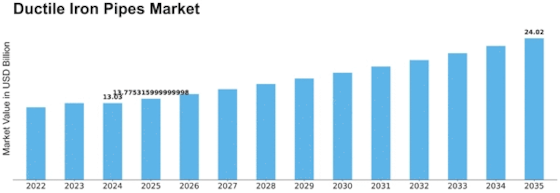

Ductile Iron Pipes Market Size Graph
Author
Snehal Singh
Assistant Manager - Research

High acumen in analyzing complex macro & micro markets with more than 6 years of work experience in the field of market research. By implementing her analytical skills in forecasting and estimation into market research reports, she has expertise in Packaging, Construction, and Equipment domains. She handles a team size of 20-25 resources and ensures smooth running of the projects, associated marketing activities, and client servicing.

Leave a Comment

FAQs

What is the projected market valuation of the Ductile Iron Pipes Market by 2035?

<p>The projected market valuation for the Ductile Iron Pipes Market is 24.02 USD Billion by 2035.</p>

What was the market valuation of the Ductile Iron Pipes Market in 2024?

<p>The market valuation of the Ductile Iron Pipes Market was 13.03 USD Billion in 2024.</p>

What is the expected CAGR for the Ductile Iron Pipes Market during the forecast period 2025 - 2035?

<p>The expected CAGR for the Ductile Iron Pipes Market during the forecast period 2025 - 2035 is 5.72%.</p>

Which segments are included in the Ductile Iron Pipes Market based on diameter?

<p>The segments based on diameter include D.N. 80-300, DN 350-600, DN 700-1000, DN 1200-2000, and DN 2000 & above.</p>

What are the projected valuations for the D.N. 80-300 segment by 2035?

<p>The projected valuation for the D.N. 80-300 segment is expected to reach 4.8 USD Billion by 2035.</p>

Which key players are leading the Ductile Iron Pipes Market?

Key players in the Ductile Iron Pipes Market include Saint-Gobain, McWane, Jindal Saw, and U.S. Pipe.

What is the projected valuation for the Water & Wastewater segment by 2035?

The projected valuation for the Water &amp; Wastewater segment is anticipated to be 15.0 USD Billion by 2035.

How does the projected valuation for the DN 350-600 segment compare to its 2024 valuation?

The DN 350-600 segment is projected to grow from 3.0 USD Billion in 2024 to 5.5 USD Billion by 2035.

What is the expected growth for the Irrigation segment in the Ductile Iron Pipes Market?

The Irrigation segment is projected to grow from 5.03 USD Billion in 2024 to 9.02 USD Billion by 2035.

What is the significance of the Ductile Iron Pipes Market in infrastructure development?

The Ductile Iron Pipes Market plays a crucial role in infrastructure development, particularly in water and wastewater management.

Market Summary

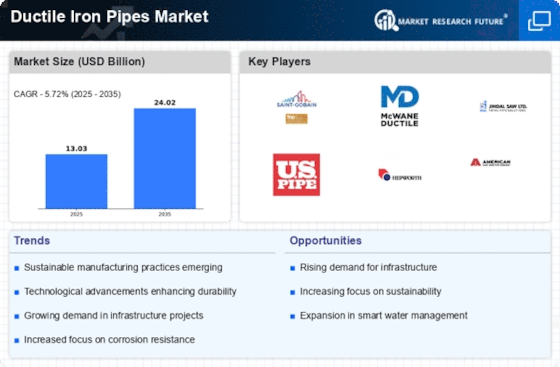
As per Market Research Future analysis, the Ductile Iron Pipes Market Size was estimated at 13.03 USD Billion in 2024. The Ductile Iron Pipes industry is projected to grow from 13.77 USD Billion in 2025 to 24.02 USD Billion by 2035, exhibiting a compound annual growth rate (CAGR) of 5.72% during the forecast period 2025 - 2035

Key Market Trends & Highlights

The Ductile Iron Pipes Market is poised for growth driven by sustainability and infrastructure needs.

  • North America remains the largest market for ductile iron pipes, driven by extensive water infrastructure projects. Asia-Pacific is emerging as the fastest-growing region, fueled by rapid urbanization and infrastructure development. The DN 700-1000 segment dominates the market, while the DN 350-600 segment is witnessing the fastest growth due to increasing demand. Rising demand for water infrastructure and regulatory support for wastewater management are key drivers propelling market expansion.

Market Size & Forecast

2024 Market Size 13.03 (USD Billion)
2035 Market Size 24.02 (USD Billion)
CAGR (2025 - 2035) 5.72%
Largest Regional Market Share in 2024 Asia Pacific

Major Players

Saint-Gobain (FR), McWane (US), Jindal Saw (IN), U.S. Pipe (US), Hepworth (GB), AMERICAN Cast Iron Pipe Company (US), Kubota (JP), Ductile Iron Pipe Company (US), Tata Metaliks (IN)

Market Trends

The Ductile Iron Pipes Market is currently experiencing a notable transformation, driven by various factors that influence its growth trajectory. The increasing demand for durable and reliable piping solutions in water supply and wastewater management applications appears to be a primary catalyst. Furthermore, the rising emphasis on infrastructure development, particularly in urban areas, suggests a growing need for robust materials that can withstand environmental stresses. This trend is likely to be complemented by advancements in manufacturing technologies, which may enhance the performance characteristics of ductile iron pipes, making them more appealing to end-users. In addition, sustainability considerations are becoming increasingly relevant within the Ductile Iron Pipes Market. Stakeholders are showing a heightened awareness of the environmental impact of their choices, leading to a preference for materials that offer longevity and recyclability. This shift could potentially reshape procurement strategies, as companies seek to align with eco-friendly practices. Overall, the Ductile Iron Pipes Market appears poised for growth, driven by a combination of infrastructural demands and evolving consumer preferences.

Sustainability Initiatives

The Ductile Iron Pipes Market is witnessing a shift towards sustainability, as manufacturers and consumers alike prioritize eco-friendly practices. This trend is characterized by an increased focus on the recyclability of materials and the reduction of carbon footprints in production processes. As environmental regulations become more stringent, companies are likely to adapt their strategies to meet these demands, potentially leading to innovations in product design and manufacturing.

Technological Advancements

Technological progress in the production of ductile iron pipes is significantly influencing the market landscape. Innovations in manufacturing techniques are enhancing the durability and performance of these pipes, making them more attractive for various applications. This trend may lead to improved efficiency in installation and maintenance, thereby appealing to a broader range of industries and applications.

Urbanization and Infrastructure Development

The ongoing trend of urbanization is driving the demand for ductile iron pipes, particularly in developing regions. As cities expand and infrastructure projects proliferate, the need for reliable water supply and sewage systems becomes increasingly critical. This trend suggests that the Ductile Iron Pipes Market will continue to grow, as stakeholders invest in robust solutions to support urban development.

Ductile Iron Pipes Market Market Drivers

Rising Demand for Water Infrastructure

The Ductile Iron Pipes Market is experiencing a notable increase in demand due to the urgent need for improved water infrastructure. As urban populations grow, the necessity for reliable water supply systems becomes paramount. According to recent data, investments in water infrastructure are projected to reach substantial figures, with many regions allocating significant budgets for upgrades and replacements. Ductile iron pipes, known for their durability and resistance to corrosion, are increasingly favored for these projects. This trend is likely to continue as municipalities prioritize the modernization of aging water systems, thereby driving growth in the ductile iron pipes sector.

Increased Focus on Wastewater Management

The Ductile Iron Pipes Market is also benefiting from heightened awareness regarding wastewater management. Governments and organizations are increasingly recognizing the importance of effective wastewater treatment systems to protect public health and the environment. As a result, there is a growing investment in infrastructure that utilizes ductile iron pipes, which are well-suited for handling wastewater due to their strength and longevity. Recent statistics indicate that The Ductile Iron Pipes Market is expected to expand significantly, further propelling the demand for ductile iron pipes. This focus on sustainable wastewater management practices is likely to enhance the market landscape for ductile iron pipes.

Technological Innovations in Pipe Manufacturing

Technological advancements in the manufacturing processes of ductile iron pipes are transforming the Ductile Iron Pipes Market. Innovations such as improved casting techniques and enhanced quality control measures are leading to the production of pipes that offer superior performance and reliability. These advancements not only reduce production costs but also enhance the overall quality of the pipes, making them more appealing to consumers. As manufacturers adopt these technologies, the market is expected to witness a surge in the availability of high-quality ductile iron pipes, which could potentially increase market share and attract new customers.

Growing Awareness of Environmental Sustainability

The Ductile Iron Pipes Market is increasingly influenced by the growing awareness of environmental sustainability. As stakeholders become more conscious of the environmental impact of construction materials, ductile iron pipes are gaining traction due to their recyclability and lower carbon footprint compared to alternatives. This shift in consumer preference is prompting manufacturers to emphasize the sustainable attributes of ductile iron pipes in their marketing strategies. Furthermore, as sustainability becomes a key criterion in procurement processes, the demand for ductile iron pipes is likely to rise, aligning with global efforts to promote eco-friendly construction practices.

Regulatory Support for Infrastructure Development

The Ductile Iron Pipes Market is likely to benefit from supportive regulatory frameworks aimed at enhancing infrastructure development. Governments across various regions are implementing policies that encourage investment in water and wastewater infrastructure, which often includes the use of ductile iron pipes. These regulations may provide financial incentives or streamline approval processes for projects that utilize durable materials. As a result, the market for ductile iron pipes is expected to grow, driven by the favorable regulatory environment that promotes the adoption of reliable and long-lasting piping solutions.

Market Segment Insights

By Diameter: DN 700-1000 (Largest) vs. DN 350-600 (Fastest-Growing)

<p>The Ductile Iron Pipes Market exhibits diverse demand distribution across various diameter segments. The DN 700-1000 category has emerged as the largest segment, commanding a significant portion of the market share. In contrast, the DN 350-600 segment exhibits robust growth potential, supported by increasing infrastructure developments and urbanization trends that drive demand for smaller diameter pipes in municipal applications.</p>

<p>DN 700-1000 (Dominant) vs. DN 350-600 (Emerging)</p>

<p>The DN 700-1000 segment represents the backbone of ductile iron pipes, commonly used in water and sewage systems due to their strength and durability. This diameter range benefits from large-scale projects, particularly in industrial and municipal sectors where high-capacity transport is essential. Conversely, the DN 350-600 segment is rapidly gaining traction, driven by increased demand in residential and commercial construction. This segment is characterized by its adaptability to a range of applications, including irrigation and smaller municipal services, making it a vital growth area in the market.</p>

By Type: Water & Wastewater (Largest) vs. Irrigation (Fastest-Growing)

<p>The Ductile Iron Pipes Market displays a significant distribution of market share between the Water & Wastewater and Irrigation segments. The Water & Wastewater sector occupies a substantial portion of the market due to its established applications and the essential need for reliable infrastructure in urban settings. This segment has consistently shown strength in demand driven by municipal needs for improved water distribution and waste management solutions. On the other hand, the Irrigation segment is gaining traction, driven by increasing agricultural practices and the pressing need for efficient water management in farming operations. Its transformation is fueled by technological advancements in irrigation systems that utilize ductile iron pipes for their durability and performance.</p>

<p>Water & Wastewater: Dominant vs. Irrigation: Emerging</p>

<p>In the Ductile Iron Pipes Market, the Water & Wastewater segment remains dominant, primarily due to its long-standing application in infrastructure projects. This segment is characterized by high demand for robust and corrosion-resistant piping solutions, ensuring the integrity of water systems. Meanwhile, the Irrigation segment, although emerging, is rapidly gaining importance, propelled by rising agricultural productivity and the push for sustainable practices. The increasing implementation of modern irrigation techniques that leverage ductile iron pipes is enhancing efficiency and promoting resource conservation. Both segments reflect unique characteristics, with Water & Wastewater focused on public health and safety, while Irrigation emphasizes agricultural innovation and water conservation.</p>

Get more detailed insights about Ductile Iron Pipes Market Research Report – Global Forecast till 2035

Regional Insights

North America : Market Leader in Ductile Iron

North America is the largest market for ductile iron pipes, holding approximately 40% of the global market share. The growth is driven by increasing infrastructure investments, particularly in water supply and wastewater management. Regulatory support, such as the Clean Water State Revolving Fund, further catalyzes demand for durable piping solutions. The region's focus on sustainable practices and modernization of aging infrastructure is expected to sustain this growth trajectory. The United States is the dominant player in this region, with key companies like McWane, U.S. Pipe, and AMERICAN Cast Iron Pipe Company leading the market. The competitive landscape is characterized by innovation and a strong emphasis on quality. Canada also contributes significantly, focusing on sustainable water management solutions. The presence of established manufacturers ensures a robust supply chain and competitive pricing, enhancing market dynamics.

Europe : Regulatory-Driven Market Growth

Europe is witnessing significant growth in the ductile iron pipes market, accounting for approximately 30% of the global share. The region's growth is primarily driven by stringent regulations aimed at improving water quality and infrastructure resilience. Initiatives like the European Water Framework Directive promote the use of durable materials, enhancing market demand. The focus on sustainability and environmental protection is also a key driver for the adoption of ductile iron pipes in various applications. Leading countries in this region include Germany, France, and the UK, with major players like Saint-Gobain and Hepworth dominating the market. The competitive landscape is marked by innovation and collaboration among manufacturers to meet regulatory standards. The presence of advanced manufacturing technologies and a strong distribution network further bolster the market. As Europe continues to invest in infrastructure, the ductile iron pipes market is poised for sustained growth.

Asia-Pacific : Emerging Market Potential

Asia-Pacific is emerging as a significant player in the ductile iron pipes market, holding around 25% of the global share. The region's growth is fueled by rapid urbanization, increasing industrial activities, and government initiatives aimed at improving water supply systems. Countries like India and China are investing heavily in infrastructure development, which is expected to drive demand for ductile iron pipes. Regulatory frameworks supporting sustainable practices further enhance market prospects. China and India are the leading countries in this region, with key players like Jindal Saw and Tata Metaliks making substantial contributions. The competitive landscape is evolving, with local manufacturers increasingly focusing on quality and innovation to meet growing demand. The presence of international companies also intensifies competition, ensuring a diverse product offering. As the region continues to develop, the ductile iron pipes market is set for robust growth.

Middle East and Africa : Resource-Rich Market Dynamics

The Middle East and Africa region is gradually emerging in the ductile iron pipes market, holding approximately 5% of the global share. The growth is primarily driven by increasing investments in water infrastructure and urban development projects. Governments are focusing on improving water supply systems, which is expected to boost demand for durable piping solutions. Regulatory initiatives aimed at enhancing water quality and sustainability are also contributing to market growth. Leading countries in this region include South Africa and the UAE, with a growing presence of key players like Kubota and local manufacturers. The competitive landscape is characterized by a mix of international and regional companies, focusing on quality and compliance with local regulations. As infrastructure projects expand, the ductile iron pipes market in the Middle East and Africa is poised for significant growth.

Key Players and Competitive Insights

The Ductile Iron Pipes Market is currently characterized by a competitive landscape that is both dynamic and multifaceted. Key growth drivers include increasing urbanization, infrastructure development, and a rising demand for durable piping solutions. Major players such as Saint-Gobain (France), McWane (US), and Jindal Saw (India) are strategically positioned to leverage these trends. Saint-Gobain (France) focuses on innovation and sustainability, emphasizing the development of eco-friendly products. Meanwhile, McWane (US) has been expanding its operational footprint through strategic acquisitions, enhancing its market share and product offerings. Jindal Saw (India) is concentrating on regional expansion, particularly in emerging markets, which collectively shapes a competitive environment that is increasingly focused on technological advancement and sustainability.In terms of business tactics, companies are localizing manufacturing to reduce costs and optimize supply chains. The market structure appears moderately fragmented, with several key players exerting influence over pricing and product availability. This fragmentation allows for a variety of competitive strategies, as companies seek to differentiate themselves through quality, service, and innovation.
In August Saint-Gobain (France) announced the launch of a new line of ductile iron pipes designed specifically for high-pressure applications. This strategic move not only enhances their product portfolio but also positions them as a leader in high-performance solutions, catering to the growing demand for robust infrastructure. The introduction of these pipes is likely to attract new customers and strengthen existing relationships in the construction and utilities sectors.
In September McWane (US) completed the acquisition of a regional competitor, which is expected to bolster its manufacturing capabilities and expand its distribution network. This acquisition is significant as it allows McWane to enhance its market presence and streamline operations, potentially leading to improved efficiency and cost savings. Such strategic actions indicate a trend towards consolidation in the market, as companies seek to fortify their positions against emerging competitors.
In July Jindal Saw (India) entered into a partnership with a leading technology firm to integrate AI-driven analytics into its production processes. This collaboration aims to optimize manufacturing efficiency and reduce waste, aligning with the growing emphasis on sustainability. The integration of advanced technologies is likely to provide Jindal Saw with a competitive edge, enabling them to respond more effectively to market demands and enhance product quality.
As of October current competitive trends in the Ductile Iron Pipes Market are increasingly defined by digitalization, sustainability, and technological integration. Strategic alliances are becoming more prevalent, as companies recognize the value of collaboration in enhancing innovation and market reach. Looking ahead, it appears that competitive differentiation will evolve from traditional price-based competition to a focus on innovation, technology adoption, and supply chain reliability, suggesting a transformative shift in how companies position themselves in the market.

Key Companies in the Ductile Iron Pipes Market include

Industry Developments

  • January 2021: The product portfolio of McWane Inc. will be enhanced by the purchase of Clear Water Manufacturing Corp., a leading producer and distributor of ductile iron pipes and steel pipe fabrication.
  • October 2020: The merging of the two businesses was accepted by Electrosteel Casting and Srikalahasti Pipes in 2020. Following the merger, the new organization would become India's top producer of ductile iron pipes, with a 30% market share.

Future Outlook

Ductile Iron Pipes Market Future Outlook

The Ductile Iron Pipes Market is projected to grow at a 5.72% CAGR from 2025 to 2035, driven by urbanization, infrastructure development, and increasing demand for durable piping solutions.

New opportunities lie in:

  • <p>Expansion into emerging markets with aging infrastructure needs. Development of eco-friendly ductile iron pipe manufacturing processes. Integration of smart technology for real-time monitoring in piping systems.</p>

By 2035, the Ductile Iron Pipes Market is expected to achieve robust growth and enhanced market positioning.

Market Segmentation

Ductile Iron Pipes Market Type Outlook

  • Water & Wastewater
  • Irrigation

Ductile Iron Pipes Market Diameter Outlook

  • D.N. 80-300
  • DN 350-600
  • DN 700-1000
  • DN 1200-2000
  • DN 2000 & above

Report Scope

MARKET SIZE 2024 13.03(USD Billion)
MARKET SIZE 2025 13.77(USD Billion)
MARKET SIZE 2035 24.02(USD Billion)
COMPOUND ANNUAL GROWTH RATE (CAGR) 5.72% (2025 - 2035)
REPORT COVERAGE Revenue Forecast, Competitive Landscape, Growth Factors, and Trends
BASE YEAR 2024
Market Forecast Period 2025 - 2035
Historical Data 2019 - 2024
Market Forecast Units USD Billion
Key Companies Profiled Saint-Gobain (FR), McWane (US), Jindal Saw (IN), U.S. Pipe (US), Hepworth (GB), AMERICAN Cast Iron Pipe Company (US), Kubota (JP), Ductile Iron Pipe Company (US), Tata Metaliks (IN)
Segments Covered Diameter, Application, Region
Key Market Opportunities Growing demand for sustainable infrastructure solutions drives innovation in the Ductile Iron Pipes Market.
Key Market Dynamics Rising demand for sustainable infrastructure drives innovation and competition in the ductile iron pipes market.
Countries Covered North America, Europe, APAC, South America, MEA

FAQs

What is the projected market valuation of the Ductile Iron Pipes Market by 2035?

<p>The projected market valuation for the Ductile Iron Pipes Market is 24.02 USD Billion by 2035.</p>

What was the market valuation of the Ductile Iron Pipes Market in 2024?

<p>The market valuation of the Ductile Iron Pipes Market was 13.03 USD Billion in 2024.</p>

What is the expected CAGR for the Ductile Iron Pipes Market during the forecast period 2025 - 2035?

<p>The expected CAGR for the Ductile Iron Pipes Market during the forecast period 2025 - 2035 is 5.72%.</p>

Which segments are included in the Ductile Iron Pipes Market based on diameter?

<p>The segments based on diameter include D.N. 80-300, DN 350-600, DN 700-1000, DN 1200-2000, and DN 2000 & above.</p>

What are the projected valuations for the D.N. 80-300 segment by 2035?

<p>The projected valuation for the D.N. 80-300 segment is expected to reach 4.8 USD Billion by 2035.</p>

Which key players are leading the Ductile Iron Pipes Market?

Key players in the Ductile Iron Pipes Market include Saint-Gobain, McWane, Jindal Saw, and U.S. Pipe.

What is the projected valuation for the Water & Wastewater segment by 2035?

The projected valuation for the Water &amp; Wastewater segment is anticipated to be 15.0 USD Billion by 2035.

How does the projected valuation for the DN 350-600 segment compare to its 2024 valuation?

The DN 350-600 segment is projected to grow from 3.0 USD Billion in 2024 to 5.5 USD Billion by 2035.

What is the expected growth for the Irrigation segment in the Ductile Iron Pipes Market?

The Irrigation segment is projected to grow from 5.03 USD Billion in 2024 to 9.02 USD Billion by 2035.

What is the significance of the Ductile Iron Pipes Market in infrastructure development?

The Ductile Iron Pipes Market plays a crucial role in infrastructure development, particularly in water and wastewater management.

  1. SECTION I: EXECUTIVE SUMMARY AND KEY HIGHLIGHTS
    1. | 1.1 EXECUTIVE SUMMARY
    2. | | 1.1.1 Market Overview
    3. | | 1.1.2 Key Findings
    4. | | 1.1.3 Market Segmentation
    5. | | 1.1.4 Competitive Landscape
    6. | | 1.1.5 Challenges and Opportunities
    7. | | 1.1.6 Future Outlook
  2. SECTION II: SCOPING, METHODOLOGY AND MARKET STRUCTURE
    1. | 2.1 MARKET INTRODUCTION
    2. | | 2.1.1 Definition
    3. | | 2.1.2 Scope of the study
    4. | | | 2.1.2.1 Research Objective
    5. | | | 2.1.2.2 Assumption
    6. | | | 2.1.2.3 Limitations
    7. | 2.2 RESEARCH METHODOLOGY
    8. | | 2.2.1 Overview
    9. | | 2.2.2 Data Mining
    10. | | 2.2.3 Secondary Research
    11. | | 2.2.4 Primary Research
    12. | | | 2.2.4.1 Primary Interviews and Information Gathering Process
    13. | | | 2.2.4.2 Breakdown of Primary Respondents
    14. | | 2.2.5 Forecasting Model
    15. | | 2.2.6 Market Size Estimation
    16. | | | 2.2.6.1 Bottom-Up Approach
    17. | | | 2.2.6.2 Top-Down Approach
    18. | | 2.2.7 Data Triangulation
    19. | | 2.2.8 Validation
  3. SECTION III: QUALITATIVE ANALYSIS
    1. | 3.1 MARKET DYNAMICS
    2. | | 3.1.1 Overview
    3. | | 3.1.2 Drivers
    4. | | 3.1.3 Restraints
    5. | | 3.1.4 Opportunities
    6. | 3.2 MARKET FACTOR ANALYSIS
    7. | | 3.2.1 Value chain Analysis
    8. | | 3.2.2 Porter's Five Forces Analysis
    9. | | | 3.2.2.1 Bargaining Power of Suppliers
    10. | | | 3.2.2.2 Bargaining Power of Buyers
    11. | | | 3.2.2.3 Threat of New Entrants
    12. | | | 3.2.2.4 Threat of Substitutes
    13. | | | 3.2.2.5 Intensity of Rivalry
    14. | | 3.2.3 COVID-19 Impact Analysis
    15. | | | 3.2.3.1 Market Impact Analysis
    16. | | | 3.2.3.2 Regional Impact
    17. | | | 3.2.3.3 Opportunity and Threat Analysis
  4. SECTION IV: QUANTITATIVE ANALYSIS
    1. | 4.1 Packaging & Transport, BY Diameter (USD Billion)
    2. | | 4.1.1 D.N. 80-300
    3. | | 4.1.2 DN 350-600
    4. | | 4.1.3 DN 700-1000
    5. | | 4.1.4 DN 1200-2000
    6. | | 4.1.5 DN 2000 & above
    7. | 4.2 Packaging & Transport, BY Type (USD Billion)
    8. | | 4.2.1 Water & Wastewater
    9. | | 4.2.2 Irrigation
    10. | 4.3 Packaging & Transport, BY Region (USD Billion)
    11. | | 4.3.1 North America
    12. | | | 4.3.1.1 US
    13. | | | 4.3.1.2 Canada
    14. | | 4.3.2 Europe
    15. | | | 4.3.2.1 Germany
    16. | | | 4.3.2.2 UK
    17. | | | 4.3.2.3 France
    18. | | | 4.3.2.4 Russia
    19. | | | 4.3.2.5 Italy
    20. | | | 4.3.2.6 Spain
    21. | | | 4.3.2.7 Rest of Europe
    22. | | 4.3.3 APAC
    23. | | | 4.3.3.1 China
    24. | | | 4.3.3.2 India
    25. | | | 4.3.3.3 Japan
    26. | | | 4.3.3.4 South Korea
    27. | | | 4.3.3.5 Malaysia
    28. | | | 4.3.3.6 Thailand
    29. | | | 4.3.3.7 Indonesia
    30. | | | 4.3.3.8 Rest of APAC
    31. | | 4.3.4 South America
    32. | | | 4.3.4.1 Brazil
    33. | | | 4.3.4.2 Mexico
    34. | | | 4.3.4.3 Argentina
    35. | | | 4.3.4.4 Rest of South America
    36. | | 4.3.5 MEA
    37. | | | 4.3.5.1 GCC Countries
    38. | | | 4.3.5.2 South Africa
    39. | | | 4.3.5.3 Rest of MEA
  5. SECTION V: COMPETITIVE ANALYSIS
    1. | 5.1 Competitive Landscape
    2. | | 5.1.1 Overview
    3. | | 5.1.2 Competitive Analysis
    4. | | 5.1.3 Market share Analysis
    5. | | 5.1.4 Major Growth Strategy in the Packaging & Transport
    6. | | 5.1.5 Competitive Benchmarking
    7. | | 5.1.6 Leading Players in Terms of Number of Developments in the Packaging & Transport
    8. | | 5.1.7 Key developments and growth strategies
    9. | | | 5.1.7.1 New Product Launch/Service Deployment
    10. | | | 5.1.7.2 Merger & Acquisitions
    11. | | | 5.1.7.3 Joint Ventures
    12. | | 5.1.8 Major Players Financial Matrix
    13. | | | 5.1.8.1 Sales and Operating Income
    14. | | | 5.1.8.2 Major Players R&D Expenditure. 2023
    15. | 5.2 Company Profiles
    16. | | 5.2.1 Saint-Gobain (FR)
    17. | | | 5.2.1.1 Financial Overview
    18. | | | 5.2.1.2 Products Offered
    19. | | | 5.2.1.3 Key Developments
    20. | | | 5.2.1.4 SWOT Analysis
    21. | | | 5.2.1.5 Key Strategies
    22. | | 5.2.2 McWane (US)
    23. | | | 5.2.2.1 Financial Overview
    24. | | | 5.2.2.2 Products Offered
    25. | | | 5.2.2.3 Key Developments
    26. | | | 5.2.2.4 SWOT Analysis
    27. | | | 5.2.2.5 Key Strategies
    28. | | 5.2.3 Jindal Saw (IN)
    29. | | | 5.2.3.1 Financial Overview
    30. | | | 5.2.3.2 Products Offered
    31. | | | 5.2.3.3 Key Developments
    32. | | | 5.2.3.4 SWOT Analysis
    33. | | | 5.2.3.5 Key Strategies
    34. | | 5.2.4 U.S. Pipe (US)
    35. | | | 5.2.4.1 Financial Overview
    36. | | | 5.2.4.2 Products Offered
    37. | | | 5.2.4.3 Key Developments
    38. | | | 5.2.4.4 SWOT Analysis
    39. | | | 5.2.4.5 Key Strategies
    40. | | 5.2.5 Hepworth (GB)
    41. | | | 5.2.5.1 Financial Overview
    42. | | | 5.2.5.2 Products Offered
    43. | | | 5.2.5.3 Key Developments
    44. | | | 5.2.5.4 SWOT Analysis
    45. | | | 5.2.5.5 Key Strategies
    46. | | 5.2.6 AMERICAN Cast Iron Pipe Company (US)
    47. | | | 5.2.6.1 Financial Overview
    48. | | | 5.2.6.2 Products Offered
    49. | | | 5.2.6.3 Key Developments
    50. | | | 5.2.6.4 SWOT Analysis
    51. | | | 5.2.6.5 Key Strategies
    52. | | 5.2.7 Kubota (JP)
    53. | | | 5.2.7.1 Financial Overview
    54. | | | 5.2.7.2 Products Offered
    55. | | | 5.2.7.3 Key Developments
    56. | | | 5.2.7.4 SWOT Analysis
    57. | | | 5.2.7.5 Key Strategies
    58. | | 5.2.8 Ductile Iron Pipe Company (US)
    59. | | | 5.2.8.1 Financial Overview
    60. | | | 5.2.8.2 Products Offered
    61. | | | 5.2.8.3 Key Developments
    62. | | | 5.2.8.4 SWOT Analysis
    63. | | | 5.2.8.5 Key Strategies
    64. | | 5.2.9 Tata Metaliks (IN)
    65. | | | 5.2.9.1 Financial Overview
    66. | | | 5.2.9.2 Products Offered
    67. | | | 5.2.9.3 Key Developments
    68. | | | 5.2.9.4 SWOT Analysis
    69. | | | 5.2.9.5 Key Strategies
    70. | 5.3 Appendix
    71. | | 5.3.1 References
    72. | | 5.3.2 Related Reports
  6. LIST OF FIGURES
    1. | 6.1 MARKET SYNOPSIS
    2. | 6.2 NORTH AMERICA MARKET ANALYSIS
    3. | 6.3 US MARKET ANALYSIS BY DIAMETER
    4. | 6.4 US MARKET ANALYSIS BY TYPE
    5. | 6.5 CANADA MARKET ANALYSIS BY DIAMETER
    6. | 6.6 CANADA MARKET ANALYSIS BY TYPE
    7. | 6.7 EUROPE MARKET ANALYSIS
    8. | 6.8 GERMANY MARKET ANALYSIS BY DIAMETER
    9. | 6.9 GERMANY MARKET ANALYSIS BY TYPE
    10. | 6.10 UK MARKET ANALYSIS BY DIAMETER
    11. | 6.11 UK MARKET ANALYSIS BY TYPE
    12. | 6.12 FRANCE MARKET ANALYSIS BY DIAMETER
    13. | 6.13 FRANCE MARKET ANALYSIS BY TYPE
    14. | 6.14 RUSSIA MARKET ANALYSIS BY DIAMETER
    15. | 6.15 RUSSIA MARKET ANALYSIS BY TYPE
    16. | 6.16 ITALY MARKET ANALYSIS BY DIAMETER
    17. | 6.17 ITALY MARKET ANALYSIS BY TYPE
    18. | 6.18 SPAIN MARKET ANALYSIS BY DIAMETER
    19. | 6.19 SPAIN MARKET ANALYSIS BY TYPE
    20. | 6.20 REST OF EUROPE MARKET ANALYSIS BY DIAMETER
    21. | 6.21 REST OF EUROPE MARKET ANALYSIS BY TYPE
    22. | 6.22 APAC MARKET ANALYSIS
    23. | 6.23 CHINA MARKET ANALYSIS BY DIAMETER
    24. | 6.24 CHINA MARKET ANALYSIS BY TYPE
    25. | 6.25 INDIA MARKET ANALYSIS BY DIAMETER
    26. | 6.26 INDIA MARKET ANALYSIS BY TYPE
    27. | 6.27 JAPAN MARKET ANALYSIS BY DIAMETER
    28. | 6.28 JAPAN MARKET ANALYSIS BY TYPE
    29. | 6.29 SOUTH KOREA MARKET ANALYSIS BY DIAMETER
    30. | 6.30 SOUTH KOREA MARKET ANALYSIS BY TYPE
    31. | 6.31 MALAYSIA MARKET ANALYSIS BY DIAMETER
    32. | 6.32 MALAYSIA MARKET ANALYSIS BY TYPE
    33. | 6.33 THAILAND MARKET ANALYSIS BY DIAMETER
    34. | 6.34 THAILAND MARKET ANALYSIS BY TYPE
    35. | 6.35 INDONESIA MARKET ANALYSIS BY DIAMETER
    36. | 6.36 INDONESIA MARKET ANALYSIS BY TYPE
    37. | 6.37 REST OF APAC MARKET ANALYSIS BY DIAMETER
    38. | 6.38 REST OF APAC MARKET ANALYSIS BY TYPE
    39. | 6.39 SOUTH AMERICA MARKET ANALYSIS
    40. | 6.40 BRAZIL MARKET ANALYSIS BY DIAMETER
    41. | 6.41 BRAZIL MARKET ANALYSIS BY TYPE
    42. | 6.42 MEXICO MARKET ANALYSIS BY DIAMETER
    43. | 6.43 MEXICO MARKET ANALYSIS BY TYPE
    44. | 6.44 ARGENTINA MARKET ANALYSIS BY DIAMETER
    45. | 6.45 ARGENTINA MARKET ANALYSIS BY TYPE
    46. | 6.46 REST OF SOUTH AMERICA MARKET ANALYSIS BY DIAMETER
    47. | 6.47 REST OF SOUTH AMERICA MARKET ANALYSIS BY TYPE
    48. | 6.48 MEA MARKET ANALYSIS
    49. | 6.49 GCC COUNTRIES MARKET ANALYSIS BY DIAMETER
    50. | 6.50 GCC COUNTRIES MARKET ANALYSIS BY TYPE
    51. | 6.51 SOUTH AFRICA MARKET ANALYSIS BY DIAMETER
    52. | 6.52 SOUTH AFRICA MARKET ANALYSIS BY TYPE
    53. | 6.53 REST OF MEA MARKET ANALYSIS BY DIAMETER
    54. | 6.54 REST OF MEA MARKET ANALYSIS BY TYPE
    55. | 6.55 KEY BUYING CRITERIA OF PACKAGING & TRANSPORT
    56. | 6.56 RESEARCH PROCESS OF MRFR
    57. | 6.57 DRO ANALYSIS OF PACKAGING & TRANSPORT
    58. | 6.58 DRIVERS IMPACT ANALYSIS: PACKAGING & TRANSPORT
    59. | 6.59 RESTRAINTS IMPACT ANALYSIS: PACKAGING & TRANSPORT
    60. | 6.60 SUPPLY / VALUE CHAIN: PACKAGING & TRANSPORT
    61. | 6.61 PACKAGING & TRANSPORT, BY DIAMETER, 2024 (% SHARE)
    62. | 6.62 PACKAGING & TRANSPORT, BY DIAMETER, 2024 TO 2035 (USD Billion)
    63. | 6.63 PACKAGING & TRANSPORT, BY TYPE, 2024 (% SHARE)
    64. | 6.64 PACKAGING & TRANSPORT, BY TYPE, 2024 TO 2035 (USD Billion)
    65. | 6.65 BENCHMARKING OF MAJOR COMPETITORS
  7. LIST OF TABLES
    1. | 7.1 LIST OF ASSUMPTIONS
    2. | | 7.1.1
    3. | 7.2 North America MARKET SIZE ESTIMATES; FORECAST
    4. | | 7.2.1 BY DIAMETER, 2025-2035 (USD Billion)
    5. | | 7.2.2 BY TYPE, 2025-2035 (USD Billion)
    6. | 7.3 US MARKET SIZE ESTIMATES; FORECAST
    7. | | 7.3.1 BY DIAMETER, 2025-2035 (USD Billion)
    8. | | 7.3.2 BY TYPE, 2025-2035 (USD Billion)
    9. | 7.4 Canada MARKET SIZE ESTIMATES; FORECAST
    10. | | 7.4.1 BY DIAMETER, 2025-2035 (USD Billion)
    11. | | 7.4.2 BY TYPE, 2025-2035 (USD Billion)
    12. | 7.5 Europe MARKET SIZE ESTIMATES; FORECAST
    13. | | 7.5.1 BY DIAMETER, 2025-2035 (USD Billion)
    14. | | 7.5.2 BY TYPE, 2025-2035 (USD Billion)
    15. | 7.6 Germany MARKET SIZE ESTIMATES; FORECAST
    16. | | 7.6.1 BY DIAMETER, 2025-2035 (USD Billion)
    17. | | 7.6.2 BY TYPE, 2025-2035 (USD Billion)
    18. | 7.7 UK MARKET SIZE ESTIMATES; FORECAST
    19. | | 7.7.1 BY DIAMETER, 2025-2035 (USD Billion)
    20. | | 7.7.2 BY TYPE, 2025-2035 (USD Billion)
    21. | 7.8 France MARKET SIZE ESTIMATES; FORECAST
    22. | | 7.8.1 BY DIAMETER, 2025-2035 (USD Billion)
    23. | | 7.8.2 BY TYPE, 2025-2035 (USD Billion)
    24. | 7.9 Russia MARKET SIZE ESTIMATES; FORECAST
    25. | | 7.9.1 BY DIAMETER, 2025-2035 (USD Billion)
    26. | | 7.9.2 BY TYPE, 2025-2035 (USD Billion)
    27. | 7.10 Italy MARKET SIZE ESTIMATES; FORECAST
    28. | | 7.10.1 BY DIAMETER, 2025-2035 (USD Billion)
    29. | | 7.10.2 BY TYPE, 2025-2035 (USD Billion)
    30. | 7.11 Spain MARKET SIZE ESTIMATES; FORECAST
    31. | | 7.11.1 BY DIAMETER, 2025-2035 (USD Billion)
    32. | | 7.11.2 BY TYPE, 2025-2035 (USD Billion)
    33. | 7.12 Rest of Europe MARKET SIZE ESTIMATES; FORECAST
    34. | | 7.12.1 BY DIAMETER, 2025-2035 (USD Billion)
    35. | | 7.12.2 BY TYPE, 2025-2035 (USD Billion)
    36. | 7.13 APAC MARKET SIZE ESTIMATES; FORECAST
    37. | | 7.13.1 BY DIAMETER, 2025-2035 (USD Billion)
    38. | | 7.13.2 BY TYPE, 2025-2035 (USD Billion)
    39. | 7.14 China MARKET SIZE ESTIMATES; FORECAST
    40. | | 7.14.1 BY DIAMETER, 2025-2035 (USD Billion)
    41. | | 7.14.2 BY TYPE, 2025-2035 (USD Billion)
    42. | 7.15 India MARKET SIZE ESTIMATES; FORECAST
    43. | | 7.15.1 BY DIAMETER, 2025-2035 (USD Billion)
    44. | | 7.15.2 BY TYPE, 2025-2035 (USD Billion)
    45. | 7.16 Japan MARKET SIZE ESTIMATES; FORECAST
    46. | | 7.16.1 BY DIAMETER, 2025-2035 (USD Billion)
    47. | | 7.16.2 BY TYPE, 2025-2035 (USD Billion)
    48. | 7.17 South Korea MARKET SIZE ESTIMATES; FORECAST
    49. | | 7.17.1 BY DIAMETER, 2025-2035 (USD Billion)
    50. | | 7.17.2 BY TYPE, 2025-2035 (USD Billion)
    51. | 7.18 Malaysia MARKET SIZE ESTIMATES; FORECAST
    52. | | 7.18.1 BY DIAMETER, 2025-2035 (USD Billion)
    53. | | 7.18.2 BY TYPE, 2025-2035 (USD Billion)
    54. | 7.19 Thailand MARKET SIZE ESTIMATES; FORECAST
    55. | | 7.19.1 BY DIAMETER, 2025-2035 (USD Billion)
    56. | | 7.19.2 BY TYPE, 2025-2035 (USD Billion)
    57. | 7.20 Indonesia MARKET SIZE ESTIMATES; FORECAST
    58. | | 7.20.1 BY DIAMETER, 2025-2035 (USD Billion)
    59. | | 7.20.2 BY TYPE, 2025-2035 (USD Billion)
    60. | 7.21 Rest of APAC MARKET SIZE ESTIMATES; FORECAST
    61. | | 7.21.1 BY DIAMETER, 2025-2035 (USD Billion)
    62. | | 7.21.2 BY TYPE, 2025-2035 (USD Billion)
    63. | 7.22 South America MARKET SIZE ESTIMATES; FORECAST
    64. | | 7.22.1 BY DIAMETER, 2025-2035 (USD Billion)
    65. | | 7.22.2 BY TYPE, 2025-2035 (USD Billion)
    66. | 7.23 Brazil MARKET SIZE ESTIMATES; FORECAST
    67. | | 7.23.1 BY DIAMETER, 2025-2035 (USD Billion)
    68. | | 7.23.2 BY TYPE, 2025-2035 (USD Billion)
    69. | 7.24 Mexico MARKET SIZE ESTIMATES; FORECAST
    70. | | 7.24.1 BY DIAMETER, 2025-2035 (USD Billion)
    71. | | 7.24.2 BY TYPE, 2025-2035 (USD Billion)
    72. | 7.25 Argentina MARKET SIZE ESTIMATES; FORECAST
    73. | | 7.25.1 BY DIAMETER, 2025-2035 (USD Billion)
    74. | | 7.25.2 BY TYPE, 2025-2035 (USD Billion)
    75. | 7.26 Rest of South America MARKET SIZE ESTIMATES; FORECAST
    76. | | 7.26.1 BY DIAMETER, 2025-2035 (USD Billion)
    77. | | 7.26.2 BY TYPE, 2025-2035 (USD Billion)
    78. | 7.27 MEA MARKET SIZE ESTIMATES; FORECAST
    79. | | 7.27.1 BY DIAMETER, 2025-2035 (USD Billion)
    80. | | 7.27.2 BY TYPE, 2025-2035 (USD Billion)
    81. | 7.28 GCC Countries MARKET SIZE ESTIMATES; FORECAST
    82. | | 7.28.1 BY DIAMETER, 2025-2035 (USD Billion)
    83. | | 7.28.2 BY TYPE, 2025-2035 (USD Billion)
    84. | 7.29 South Africa MARKET SIZE ESTIMATES; FORECAST
    85. | | 7.29.1 BY DIAMETER, 2025-2035 (USD Billion)
    86. | | 7.29.2 BY TYPE, 2025-2035 (USD Billion)
    87. | 7.30 Rest of MEA MARKET SIZE ESTIMATES; FORECAST
    88. | | 7.30.1 BY DIAMETER, 2025-2035 (USD Billion)
    89. | | 7.30.2 BY TYPE, 2025-2035 (USD Billion)
    90. | 7.31 PRODUCT LAUNCH/PRODUCT DEVELOPMENT/APPROVAL
    91. | | 7.31.1
    92. | 7.32 ACQUISITION/PARTNERSHIP
    93. | | 7.32.1

Packaging & Transport Market Segmentation

Packaging & Transport By Diameter (USD Billion, 2025-2035)

  • D.N. 80-300
  • DN 350-600
  • DN 700-1000
  • DN 1200-2000
  • DN 2000 & above

Packaging & Transport By Type (USD Billion, 2025-2035)

  • Water & Wastewater
  • Irrigation
Infographic

Free Sample Request

Kindly complete the form below to receive a free sample of this Report

Get Free Sample

Customer Strories

Compare Licence

×
Features License Type
Single User Multiuser License Enterprise User
Price $4,950 $5,950 $7,250
Maximum User Access Limit 1 User Upto 10 Users Unrestricted Access Throughout the Organization
Free Customization
Direct Access to Analyst
Deliverable Format
Platform Access
Discount on Next Purchase 10% 15% 15%
Printable Versions