Request Free Sample ×

Kindly complete the form below to receive a free sample of this Report

* Please use a valid business email

Leading companies partner with us for data-driven Insights

clients tt-cursor
Hero Background
English
Chinese
French
Japanese
Korean
German
Spanish

Dry Ice Market Share

ID: MRFR/FnB/7138-CR
178 Pages
Snehal Singh
October 2023

Dry Ice Market Size, Share, Industry Trend & Analysis Research Report Information By Type (Pellets and Blocks), Application (Food & Beverages, Storage & Transportation, Healthcare, Industrial Cleaning, and Others), and By Region (North America, Europe, Asia-Pacific, and Rest of the World) - Forecast Till 2035

Share:
Download PDF ×

We do not share your information with anyone. However, we may send you emails based on your report interest from time to time. You may contact us at any time to opt-out.

Dry Ice Market Infographic
Purchase Options

Market Share

Dry Ice Market Share Analysis

Companies implement several techniques to build and reinforce their market share standing in the constantly shifting Dry Ice industry. Companies are relying on distinctive immolations to differentiate themselves in a competitive market, and isolation is a key strategy. This might entail providing technical dry ice terminology appropriate for visually appealing processes, such as artificial cleaning, medical transportation, or entertainment. Businesses aim to draw in customers who are searching for high-quality and technically advanced dry ice outcomes by tailoring their goods to meet specific needs. Another important tactic in the Dry Ice business is cost leadership. Businesses work hard to become product leaders by offering competitive prices through scale economies and efficient production techniques. Dry ice is becoming more and more in demand throughout the globe, thus being an affordable alternative is crucial to drawing in companies looking for reliable and provident outcomes and taking a sizable chunk of the market. The Dry Ice industry is still driven by innovation, as businesses experiment with new business models and technological advancements. This might be establishing dry ice mixes with advanced properties, enforcing ecologically friendly product styles, or developing advanced packaging outcomes to improve transportation effectiveness. For businesses hoping to position themselves as leaders in a changing industry and satisfy the ever-changing expectations of diligence dependent on dry ice, staying on the cutting edge of innovation is essential. One of the most important components of market share positioning strategies for the Dry Ice industry is market segmentation. Businesses usually focus on certain market segments based on variables like climate, shipping needs, or specialized activities. For example, a business may focus on providing dry ice results that are adjusted to the stringent temperature control requirements of the pharmaceutical industry throughout transit. By using a focused strategy, businesses may efficiently capture market share by catering to the unique needs of visitors within particular industries. In the Dry Ice industry, strategic alliances and partnerships are essential. To expand their reach and reputation, businesses might partner with logistics companies, hospitals, or industrial facilities. In addition to increasing brand identification, these couplings create opportunities for frequent gambles, increase service immolations, and hasten the expansion of market share through cooperative sweating. In the ultramodern geographic context, the importance of digital marketing and e-commerce techniques for positioning market share has decreased. Businesses spend money developing a robust digital footprint and utilizing digital platforms to highlight their strengths, expand their fan base, and streamline order fulfillment. In this era of rapid technological advancement, digital marketing is essential for influencing opinion capture and gaining market share. In the Dry Ice market, carrying the necessary tools and adhering to nonsupervisory regulations are prerequisites. Due to the vital necessity of many dry ice businesses, visitors give preference to vendors that violate safety and quality standards. Businesses that show a dedication to safety procedures and nonsupervisory compliance establish themselves as trustworthy partners, which positively affects their market share. A smart tactic to educate visitors about the advantages and fashionable applications of dry ice is consumer education. Businesses spend money on instructional materials that emphasize the interesting processes, safe storage practices, and dry ice safety issues. Guests with higher levels of education are more likely to form well-informed opinions and build enduring relationships with businesses that value openness and communication, which increases market share. In summary, the competitive and dynamic dry ice industry encourages businesses to adopt a range of tactics for strategic positioning that maximizes market share. Each strategy, whether it be through innovation, cost leadership, market segmentation, hookups, digital marketing, nonsupervisory compliance, or consumer education, is essential to a company's ability to carve out a unique niche and hold onto valuable market share. Combining these strategies will help businesses succeed in this market by enabling them to adjust to changing consumer demands and market dynamics.


Author
Author Profile
Snehal Singh
Manager - Research

High acumen in analyzing complex macro & micro markets with more than 6 years of work experience in the field of market research. By implementing her analytical skills in forecasting and estimation into market research reports, she has expertise in Packaging, Construction, and Equipment domains. She handles a team size of 20-25 resources and ensures smooth running of the projects, associated marketing activities, and client servicing.

Leave a Comment

FAQs

What is the projected market valuation of The Global Dry Ice by 2035?

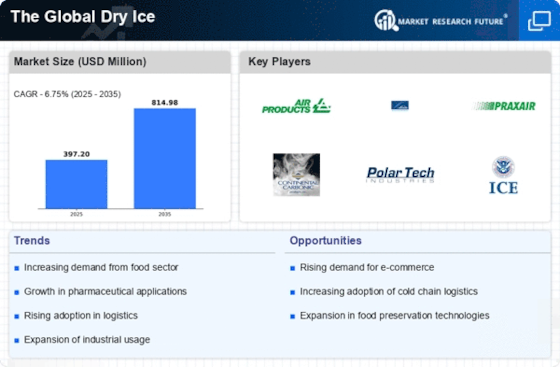
<p>The projected market valuation for The Global Dry Ice by 2035 is approximately 814.98 USD Million.</p>

What was the market valuation of The Global Dry Ice in 2024?

<p>The overall market valuation of The Global Dry Ice in 2024 was 397.2 USD Million.</p>

What is the expected CAGR for The Global Dry Ice during the forecast period 2025 - 2035?

<p>The expected CAGR for The Global Dry Ice during the forecast period 2025 - 2035 is 6.75%.</p>

Which companies are considered key players in The Global Dry Ice?

<p>Key players in The Global Dry Ice include Air Products and Chemicals Inc, Linde plc, and Praxair Technology Inc, among others.</p>

What are the main types of dry ice products in the market?

<p>The main types of dry ice products in the market include pellets, blocks, and other types, with blocks valued between 200.0 and 400.0 USD Million.</p>

How does the food and beverages sector contribute to The Global Dry Ice?

<p>The food and beverages sector contributes between 79.44 and 164.99 USD Million to The Global Dry Ice.</p>

What is the market valuation for the healthcare application of dry ice?

<p>The healthcare application of dry ice has a market valuation ranging from 39.72 to 84.99 USD Million.</p>

What is the significance of the storage and transportation segment in The Global Dry Ice?

<p>The storage and transportation segment holds a valuation between 79.44 and 164.99 USD Million, indicating its relevance in the market.</p>

What are the projected values for the industrial cleaning application of dry ice?

<p>The projected values for the industrial cleaning application of dry ice range from 39.72 to 84.99 USD Million.</p>

What is the valuation range for other types of dry ice products?

<p>The valuation range for other types of dry ice products is between 47.2 and 114.98 USD Million.</p>

Market Summary

As per Market Research Future analysis, The Global Dry Ice Market Size was estimated at 1.63 USD Million in 2024. The dry ice industry is projected to grow from 1.8 USD Million in 2025 to 4.0 USD Million by 2035, exhibiting a compound annual growth rate (CAGR) of 8.56% during the forecast period 2025 - 2035

Key Market Trends & Highlights

The Global Dry Ice Market is experiencing robust growth driven by diverse applications and technological advancements.

  • The food and beverage sector continues to drive the largest demand for dry ice, particularly in North America. Healthcare applications are emerging as the fastest-growing segment, especially in the Asia-Pacific region. Pellets remain the largest form of dry ice used, while blocks are witnessing rapid growth due to their efficiency in shipping. Key market drivers include the rising demand for food preservation and the expansion of the pharmaceutical sector.

Market Size & Forecast

2024 Market Size 1.63 (USD Million)
2035 Market Size 4.0 (USD Million)
CAGR (2025 - 2035) 8.56%
Largest Regional Market Share in 2024 North America

Major Players

Air Products and Chemicals Inc (US), Linde plc (IE), <a href="https://en.wikipedia.org/wiki/Dry_ice">Praxair Technology Inc</a> (US), Continental Carbonic Products Inc (US), Dry Ice Corp (US), Polar Tech Industries Inc (US), The Ice Company (CA), Cryo-Cell International Inc (US), Airgas Inc (US)

Market Trends

The Global Dry Ice is currently experiencing a notable transformation, driven by various factors that influence its demand and supply dynamics. The increasing utilization of dry ice in sectors such as food preservation, medical transportation, and industrial applications appears to be a primary catalyst for market growth. As businesses seek efficient solutions for temperature-sensitive products, the role of dry ice becomes increasingly critical. Furthermore, the rising awareness regarding the benefits of dry ice in maintaining product integrity during shipping and storage is likely to enhance its adoption across diverse industries. In addition to the growing demand, advancements in production technologies and distribution networks may also contribute to the evolving landscape of The Global Dry Ice. Companies are exploring innovative methods to enhance the efficiency of dry ice production, which could lead to reduced costs and improved availability. Moreover, the expansion of e-commerce and the need for reliable cold chain logistics are expected to further bolster the market. As these trends unfold, stakeholders in The Global Dry Ice must remain vigilant and adaptable to capitalize on emerging opportunities and navigate potential challenges ahead.

Rising Demand in Food and Beverage Sector

The food and beverage industry is increasingly relying on dry ice for preserving perishable goods during transportation. This trend indicates a shift towards more efficient cold chain solutions, as businesses prioritize product quality and safety.

Growth in Healthcare Applications

The healthcare sector is witnessing a surge in the use of dry ice for transporting vaccines and other temperature-sensitive medical supplies. This trend suggests a growing recognition of dry ice's role in ensuring the integrity of critical healthcare products.

Technological Advancements in Production

Innovations in dry ice production technology are emerging, potentially leading to more efficient manufacturing processes. This trend may enhance the overall supply chain, making dry ice more accessible to various industries.

Dry Ice Market Market Drivers

Rising Demand in Food Preservation

The increasing emphasis on food safety and preservation is a notable driver for The Global Dry Ice Industry. As consumers become more health-conscious, the demand for fresh and frozen food products rises. Dry ice plays a crucial role in maintaining the quality and safety of perishable goods during transportation and storage. The food and beverage sector is projected to account for a substantial share of the market, with estimates suggesting it could reach approximately 40% of the total dry ice consumption. This trend is likely to continue as more companies adopt dry ice for shipping and storage, ensuring that products remain at optimal temperatures and reducing spoilage rates.

Expansion of the Pharmaceutical Sector

The pharmaceutical industry is experiencing significant growth, which is positively impacting The Global Dry Ice Industry. Dry ice is essential for the transportation of temperature-sensitive medications and vaccines, ensuring their efficacy during transit. With the pharmaceutical market projected to grow at a compound annual growth rate of around 5% over the next few years, the demand for dry ice is expected to rise correspondingly. This growth is driven by the increasing need for advanced healthcare solutions and the expansion of biopharmaceuticals, which often require stringent temperature controls. Consequently, the reliance on dry ice for maintaining the integrity of these products is likely to bolster market growth.

Growth in E-commerce and Online Food Delivery

The rise of e-commerce and online food delivery services is significantly influencing The Global Dry Ice Industry. As more consumers turn to online platforms for grocery shopping and meal delivery, the need for effective temperature control during shipping becomes paramount. Dry ice is increasingly utilized to ensure that perishable items remain fresh during transit, thereby enhancing customer satisfaction. The e-commerce food sector is expected to grow at a rapid pace, with projections indicating a potential increase of over 20% in the coming years. This trend is likely to drive the demand for dry ice, as companies strive to meet consumer expectations for quality and safety in their delivered products.

Increasing Applications in Industrial Processes

The versatility of dry ice in various industrial applications is a key driver for The Global Dry Ice Industry. Industries such as manufacturing, automotive, and electronics utilize dry ice for cleaning, cooling, and as a refrigerant. The adoption of dry ice blasting technology for cleaning machinery and equipment is gaining traction due to its effectiveness and environmental benefits. As industries continue to seek sustainable and efficient solutions, the demand for dry ice is expected to grow. Market analysts suggest that the industrial segment could account for a significant portion of dry ice consumption, potentially reaching 30% of the overall market share in the near future.

Technological Innovations in Dry Ice Production

Technological advancements in the production of dry ice are shaping The Global Dry Ice Industry. Innovations such as improved manufacturing processes and enhanced efficiency in production techniques are making dry ice more accessible and cost-effective. These advancements may lead to a reduction in production costs, which could potentially lower prices for end-users. Furthermore, the introduction of automated systems in dry ice production facilities is likely to increase output and ensure consistent quality. As a result, the market may witness a surge in demand from various sectors, including food, pharmaceuticals, and logistics, as companies seek reliable and efficient solutions for their temperature control needs.

Market Segment Insights

By Type: Pellets (Largest) vs. Blocks (Fastest-Growing)

<p>In The Global Dry Ice, the segment distribution reflects a notable preference for pellets, which occupy the largest share due to their versatility and ease of use across various applications. Blocks, while not as dominant, are gaining traction as they offer extended cooling duration, making them increasingly popular in shipping and food preservation. Other types also contribute to the market; however, their presence is relatively minor compared to the primary two types. The growth trends in this segment indicate a rising demand for both pellets and blocks, driven by the expanding food and beverage industry that utilizes dry ice for preservation and shipping. Furthermore, the increase in demand for effective cold chain <a href="https://www.marketresearchfuture.com/reports/logistics-market-5076" target="_blank" title="logistics">logistics</a> is prompting manufacturers to innovate, leading to improved production techniques and an expanded application range for blocks, which is projected to drive further growth in this segment.</p>

<p>Pellets: Versatile (Dominant) vs. Blocks: Extended Cooling (Emerging)</p>

<p>Pellets are recognized as the dominant form of dry ice in The Global Dry Ice due to their versatility, enabling use in various sectors such as logistics, healthcare, and food distribution. Their compact nature allows for easy handling and storage, catering specifically to industries that require precise temperature control during transport. On the other hand, blocks, while currently emerging, are positioning themselves as a vital option for users needing longer-lasting cooling solutions. The extended cooling duration provided by blocks meets the growing demands of temperature-sensitive shipments, particularly in the wake of increasing online grocery deliveries and the healthcare sector's need for reliable transportation of pharmaceuticals and biological samples.</p>

By Application: Food & Beverages (Largest) vs. Healthcare (Fastest-Growing)

<p>The Global Dry Ice shows a diverse application distribution with the Food & Beverages sector holding the largest share. This segment thrives due to the essential role dry ice plays in maintaining temperature-sensitive food products during transport and storage. The necessity for high-quality frozen items and beverages drives demand, especially within the retail and foodservice sectors. On the other hand, the Healthcare segment is emerging as the fastest-growing application area for dry ice. The increase in pharmaceutical products, including vaccines, that necessitate strict temperature control during storage and transportation is a significant factor contributing to this growth. The rising demand for dry ice in laboratory and medical settings further propels this segment's expansion.</p>

<p>Food & Beverages (Dominant) vs. Healthcare (Emerging)</p>

<p>The Food & Beverages sector is the dominant application, leveraging dry ice for effective preservation of perishable items. This application is critical in ensuring the freshness and quality of various products, from <a href="https://www.marketresearchfuture.com/reports/frozen-foods-market-7585" target="_blank" title="frozen foods">frozen foods</a> to beverages, making it indispensable in logistics. On the other hand, the Healthcare segment is emerging rapidly, with dry ice being pivotal in the transportation of medical supplies and vaccines. Its ability to provide consistent low temperatures makes it essential for maintaining the integrity of sensitive biological materials. As the industry grows, particularly in light of increased vaccine distribution, the demand for dry ice in healthcare settings is projected to rise significantly, indicating a robust opportunity for market expansion in this sector.</p>

Get more detailed insights about Dry Ice Market Research Report - Forecast till 2035

Regional Insights

North America : Market Leader in Dry Ice

North America is the largest market for dry ice, accounting for approximately 45% of the global market share. The growth is driven by the increasing demand from the food and beverage sector, pharmaceuticals, and logistics industries. Regulatory support for food safety and transportation standards further catalyzes market expansion. The region's advanced infrastructure and technological innovations also play a crucial role in meeting the rising demand for dry ice in various applications. The United States is the primary contributor, with key players like Air Products and Chemicals Inc, Praxair Technology Inc, and Continental Carbonic Products Inc leading the market. Canada also plays a significant role, with The Ice Company contributing to the competitive landscape. The presence of these established companies ensures a robust supply chain and innovation in dry ice production and distribution.

Europe : Emerging Market Dynamics

Europe is witnessing significant growth in the dry ice market, holding approximately 30% of the global share. The demand is primarily driven by the food and beverage industry, healthcare, and logistics sectors. Regulatory frameworks focusing on environmental sustainability and food safety are pivotal in shaping market dynamics. Countries like Germany and the UK are at the forefront, with increasing investments in cold chain logistics and transportation, further boosting market growth. Germany leads the market, followed by the UK and France, with key players like Linde plc and Airgas Inc enhancing competition. The presence of innovative companies and a strong regulatory environment fosters a competitive landscape. The European market is characterized by a focus on sustainable practices, with companies increasingly adopting eco-friendly production methods to meet regulatory standards.

Asia-Pacific : Rapid Growth and Demand

Asia-Pacific is rapidly emerging as a significant player in the dry ice market, accounting for about 20% of the global share. The region's growth is fueled by the booming food and beverage sector, coupled with increasing demand from the pharmaceutical and logistics industries. Countries like China and India are witnessing a surge in demand due to urbanization and rising consumer awareness regarding food safety and preservation. Regulatory support for cold chain logistics is also a key driver of market growth. China is the largest market in the region, followed by India and Japan, with local players and international companies competing for market share. The competitive landscape is characterized by a mix of established firms and new entrants, focusing on innovation and efficiency in production. The presence of key players like Cryo-Cell International Inc and Polar Tech Industries Inc enhances the market's competitiveness and responsiveness to demand fluctuations.

Middle East and Africa : Untapped Market Potential

The Middle East and Africa region is gradually emerging in the dry ice market, holding approximately 5% of the global share. The growth is primarily driven by the increasing demand for dry ice in the food and beverage sector, as well as in healthcare applications. The region's expanding logistics and transportation infrastructure is also a significant factor contributing to market growth. Regulatory frameworks are evolving to support food safety and cold chain logistics, which are crucial for the dry ice market. Countries like South Africa and the UAE are leading the market, with a growing number of local and international players entering the space. The competitive landscape is characterized by a mix of established companies and new entrants, focusing on innovation and sustainability. The presence of key players is gradually increasing, contributing to the overall growth and development of the dry ice market in the region.

Key Players and Competitive Insights

The Global Dry Ice is currently characterized by a competitive landscape that is both dynamic and multifaceted. Key growth drivers include the increasing demand for dry ice in sectors such as food preservation, pharmaceuticals, and industrial applications. Major players like Air Products and Chemicals Inc (US), Linde plc (IE), and Praxair Technology Inc (US) are strategically positioned to leverage these trends. Air Products and Chemicals Inc (US) focuses on innovation and sustainability, investing in advanced production technologies to enhance efficiency. Linde plc (IE) emphasizes regional expansion, particularly in emerging markets, while Praxair Technology Inc (US) is enhancing its digital transformation initiatives to optimize supply chain management. Collectively, these strategies contribute to a competitive environment that is increasingly shaped by technological advancements and sustainability initiatives.

In terms of business tactics, companies are localizing manufacturing to reduce transportation costs and improve supply chain resilience. The market structure appears moderately fragmented, with several key players exerting influence over their respective regions. This fragmentation allows for niche players to thrive, while larger companies consolidate their market positions through strategic partnerships and acquisitions.

In August 2025, Airgas Inc (US) announced the opening of a new dry ice production facility in Texas, aimed at enhancing its supply capabilities in the southern United States. This strategic move is likely to bolster Airgas's market share by improving service delivery and reducing lead times for customers in the region. The facility is expected to utilize state-of-the-art technology, aligning with the company's commitment to sustainability and operational efficiency.

In September 2025, Linde plc (IE) entered into a partnership with a leading logistics company to develop a specialized dry ice distribution network across Europe. This collaboration is poised to enhance Linde's service offerings, particularly in the pharmaceutical sector, where timely delivery is critical. By optimizing its distribution channels, Linde aims to strengthen its competitive edge and respond more effectively to the growing demand for dry ice in temperature-sensitive applications.

In July 2025, Continental Carbonic Products Inc (US) launched a new line of eco-friendly dry ice products, which are produced using renewable energy sources. This initiative not only addresses the increasing consumer demand for sustainable solutions but also positions Continental Carbonic as a forward-thinking player in the market. The introduction of these products may attract environmentally conscious customers and enhance brand loyalty.

As of October 2025, current competitive trends in The Global Dry Ice are increasingly defined by digitalization, sustainability, and the integration of artificial intelligence in operations. Strategic alliances are becoming more prevalent, as companies seek to enhance their capabilities and market reach. Looking ahead, it is anticipated that competitive differentiation will evolve, shifting from traditional price-based competition to a focus on innovation, technological advancements, and supply chain reliability. This transition underscores the importance of adaptability and forward-thinking strategies in maintaining a competitive advantage.

Key Companies in the Dry Ice Market include

Industry Developments

Future Outlook

Dry Ice Market Future Outlook

The Global Dry Ice is projected to grow at a 6.75% CAGR from 2024 to 2035, driven by increasing demand in food preservation, healthcare, and logistics.

New opportunities lie in:

  • Expansion of dry ice production facilities in emerging markets.
  • Development of eco-friendly dry ice alternatives for sustainability.
  • Integration of automated dry ice dispensing solutions in logistics operations.

By 2035, the market is expected to achieve robust growth, positioning itself as a key player in various industries.

Market Segmentation

Dry Ice Market Type Outlook

  • Pellets
  • Blocks
  • Other Types

Dry Ice Market Application Outlook

  • Food & Beverages
  • Storage & Transportation
  • Healthcare
  • Industrial Cleaning
  • Others

Report Scope

MARKET SIZE 2024397.2(USD Million)
MARKET SIZE 2025424.02(USD Million)
MARKET SIZE 2035814.98(USD Million)
COMPOUND ANNUAL GROWTH RATE (CAGR)6.75% (2024 - 2035)
REPORT COVERAGERevenue Forecast, Competitive Landscape, Growth Factors, and Trends
BASE YEAR2024
Market Forecast Period2025 - 2035
Historical Data2019 - 2024
Market Forecast UnitsUSD Million
Key Companies ProfiledMarket analysis in progress
Segments CoveredMarket segmentation analysis in progress
Key Market OpportunitiesGrowing demand for sustainable packaging solutions enhances opportunities in The Global Dry Ice.
Key Market DynamicsRising demand for sustainable refrigeration solutions drives innovation and competition in the dry ice market.
Countries CoveredNorth America, Europe, APAC, South America, MEA

FAQs

What is the projected market valuation of The Global Dry Ice by 2035?

<p>The projected market valuation for The Global Dry Ice by 2035 is approximately 814.98 USD Million.</p>

What was the market valuation of The Global Dry Ice in 2024?

<p>The overall market valuation of The Global Dry Ice in 2024 was 397.2 USD Million.</p>

What is the expected CAGR for The Global Dry Ice during the forecast period 2025 - 2035?

<p>The expected CAGR for The Global Dry Ice during the forecast period 2025 - 2035 is 6.75%.</p>

Which companies are considered key players in The Global Dry Ice?

<p>Key players in The Global Dry Ice include Air Products and Chemicals Inc, Linde plc, and Praxair Technology Inc, among others.</p>

What are the main types of dry ice products in the market?

<p>The main types of dry ice products in the market include pellets, blocks, and other types, with blocks valued between 200.0 and 400.0 USD Million.</p>

How does the food and beverages sector contribute to The Global Dry Ice?

<p>The food and beverages sector contributes between 79.44 and 164.99 USD Million to The Global Dry Ice.</p>

What is the market valuation for the healthcare application of dry ice?

<p>The healthcare application of dry ice has a market valuation ranging from 39.72 to 84.99 USD Million.</p>

What is the significance of the storage and transportation segment in The Global Dry Ice?

<p>The storage and transportation segment holds a valuation between 79.44 and 164.99 USD Million, indicating its relevance in the market.</p>

What are the projected values for the industrial cleaning application of dry ice?

<p>The projected values for the industrial cleaning application of dry ice range from 39.72 to 84.99 USD Million.</p>

What is the valuation range for other types of dry ice products?

<p>The valuation range for other types of dry ice products is between 47.2 and 114.98 USD Million.</p>

  1. SECTION I: EXECUTIVE SUMMARY AND KEY HIGHLIGHTS
    1. | 1.1 EXECUTIVE SUMMARY
    2. | | 1.1.1 Market Overview
    3. | | 1.1.2 Key Findings
    4. | | 1.1.3 Market Segmentation
    5. | | 1.1.4 Competitive Landscape
    6. | | 1.1.5 Challenges and Opportunities
    7. | | 1.1.6 Future Outlook
  2. SECTION II: SCOPING, METHODOLOGY AND MARKET STRUCTURE
    1. | 2.1 MARKET INTRODUCTION
    2. | | 2.1.1 Definition
    3. | | 2.1.2 Scope of the study
    4. | | | 2.1.2.1 Research Objective
    5. | | | 2.1.2.2 Assumption
    6. | | | 2.1.2.3 Limitations
    7. | 2.2 RESEARCH METHODOLOGY
    8. | | 2.2.1 Overview
    9. | | 2.2.2 Data Mining
    10. | | 2.2.3 Secondary Research
    11. | | 2.2.4 Primary Research
    12. | | | 2.2.4.1 Primary Interviews and Information Gathering Process
    13. | | | 2.2.4.2 Breakdown of Primary Respondents
    14. | | 2.2.5 Forecasting Model
    15. | | 2.2.6 Market Size Estimation
    16. | | | 2.2.6.1 Bottom-Up Approach
    17. | | | 2.2.6.2 Top-Down Approach
    18. | | 2.2.7 Data Triangulation
    19. | | 2.2.8 Validation
  3. SECTION III: QUALITATIVE ANALYSIS
    1. | 3.1 MARKET DYNAMICS
    2. | | 3.1.1 Overview
    3. | | 3.1.2 Drivers
    4. | | 3.1.3 Restraints
    5. | | 3.1.4 Opportunities
    6. | 3.2 MARKET FACTOR ANALYSIS
    7. | | 3.2.1 Value chain Analysis
    8. | | 3.2.2 Porter's Five Forces Analysis
    9. | | | 3.2.2.1 Bargaining Power of Suppliers
    10. | | | 3.2.2.2 Bargaining Power of Buyers
    11. | | | 3.2.2.3 Threat of New Entrants
    12. | | | 3.2.2.4 Threat of Substitutes
    13. | | | 3.2.2.5 Intensity of Rivalry
    14. | | 3.2.3 COVID-19 Impact Analysis
    15. | | | 3.2.3.1 Market Impact Analysis
    16. | | | 3.2.3.2 Regional Impact
    17. | | | 3.2.3.3 Opportunity and Threat Analysis
  4. SECTION IV: QUANTITATIVE ANALYSIS
    1. | 4.1 Food, Beverages & Nutrition, BY Type (USD Million)
    2. | | 4.1.1 Pellets
    3. | | 4.1.2 Blocks
    4. | | 4.1.3 Other Types
    5. | 4.2 Food, Beverages & Nutrition, BY Application (USD Million)
    6. | | 4.2.1 Food & Beverages
    7. | | 4.2.2 Storage & Transportation
    8. | | 4.2.3 Healthcare
    9. | | 4.2.4 Industrial Cleaning
    10. | | 4.2.5 Others
    11. | 4.3 Food, Beverages & Nutrition, BY Region (USD Million)
    12. | | 4.3.1 North America
    13. | | | 4.3.1.1 US
    14. | | | 4.3.1.2 Canada
    15. | | 4.3.2 Europe
    16. | | | 4.3.2.1 Germany
    17. | | | 4.3.2.2 UK
    18. | | | 4.3.2.3 France
    19. | | | 4.3.2.4 Russia
    20. | | | 4.3.2.5 Italy
    21. | | | 4.3.2.6 Spain
    22. | | | 4.3.2.7 Rest of Europe
    23. | | 4.3.3 APAC
    24. | | | 4.3.3.1 China
    25. | | | 4.3.3.2 India
    26. | | | 4.3.3.3 Japan
    27. | | | 4.3.3.4 South Korea
    28. | | | 4.3.3.5 Malaysia
    29. | | | 4.3.3.6 Thailand
    30. | | | 4.3.3.7 Indonesia
    31. | | | 4.3.3.8 Rest of APAC
    32. | | 4.3.4 South America
    33. | | | 4.3.4.1 Brazil
    34. | | | 4.3.4.2 Mexico
    35. | | | 4.3.4.3 Argentina
    36. | | | 4.3.4.4 Rest of South America
    37. | | 4.3.5 MEA
    38. | | | 4.3.5.1 GCC Countries
    39. | | | 4.3.5.2 South Africa
    40. | | | 4.3.5.3 Rest of MEA
  5. SECTION V: COMPETITIVE ANALYSIS
    1. | 5.1 Competitive Landscape
    2. | | 5.1.1 Overview
    3. | | 5.1.2 Competitive Analysis
    4. | | 5.1.3 Market share Analysis
    5. | | 5.1.4 Major Growth Strategy in the Food, Beverages & Nutrition
    6. | | 5.1.5 Competitive Benchmarking
    7. | | 5.1.6 Leading Players in Terms of Number of Developments in the Food, Beverages & Nutrition
    8. | | 5.1.7 Key developments and growth strategies
    9. | | | 5.1.7.1 New Product Launch/Service Deployment
    10. | | | 5.1.7.2 Merger & Acquisitions
    11. | | | 5.1.7.3 Joint Ventures
    12. | | 5.1.8 Major Players Financial Matrix
    13. | | | 5.1.8.1 Sales and Operating Income
    14. | | | 5.1.8.2 Major Players R&D Expenditure. 2023
    15. | 5.2 Company Profiles
    16. | | 5.2.1 Air Products and Chemicals Inc (US)
    17. | | | 5.2.1.1 Financial Overview
    18. | | | 5.2.1.2 Products Offered
    19. | | | 5.2.1.3 Key Developments
    20. | | | 5.2.1.4 SWOT Analysis
    21. | | | 5.2.1.5 Key Strategies
    22. | | 5.2.2 Linde plc (IE)
    23. | | | 5.2.2.1 Financial Overview
    24. | | | 5.2.2.2 Products Offered
    25. | | | 5.2.2.3 Key Developments
    26. | | | 5.2.2.4 SWOT Analysis
    27. | | | 5.2.2.5 Key Strategies
    28. | | 5.2.3 Praxair Technology Inc (US)
    29. | | | 5.2.3.1 Financial Overview
    30. | | | 5.2.3.2 Products Offered
    31. | | | 5.2.3.3 Key Developments
    32. | | | 5.2.3.4 SWOT Analysis
    33. | | | 5.2.3.5 Key Strategies
    34. | | 5.2.4 Continental Carbonic Products Inc (US)
    35. | | | 5.2.4.1 Financial Overview
    36. | | | 5.2.4.2 Products Offered
    37. | | | 5.2.4.3 Key Developments
    38. | | | 5.2.4.4 SWOT Analysis
    39. | | | 5.2.4.5 Key Strategies
    40. | | 5.2.5 Dry Ice Corp (US)
    41. | | | 5.2.5.1 Financial Overview
    42. | | | 5.2.5.2 Products Offered
    43. | | | 5.2.5.3 Key Developments
    44. | | | 5.2.5.4 SWOT Analysis
    45. | | | 5.2.5.5 Key Strategies
    46. | | 5.2.6 Polar Tech Industries Inc (US)
    47. | | | 5.2.6.1 Financial Overview
    48. | | | 5.2.6.2 Products Offered
    49. | | | 5.2.6.3 Key Developments
    50. | | | 5.2.6.4 SWOT Analysis
    51. | | | 5.2.6.5 Key Strategies
    52. | | 5.2.7 The Ice Company (CA)
    53. | | | 5.2.7.1 Financial Overview
    54. | | | 5.2.7.2 Products Offered
    55. | | | 5.2.7.3 Key Developments
    56. | | | 5.2.7.4 SWOT Analysis
    57. | | | 5.2.7.5 Key Strategies
    58. | | 5.2.8 Cryo-Cell International Inc (US)
    59. | | | 5.2.8.1 Financial Overview
    60. | | | 5.2.8.2 Products Offered
    61. | | | 5.2.8.3 Key Developments
    62. | | | 5.2.8.4 SWOT Analysis
    63. | | | 5.2.8.5 Key Strategies
    64. | | 5.2.9 Airgas Inc (US)
    65. | | | 5.2.9.1 Financial Overview
    66. | | | 5.2.9.2 Products Offered
    67. | | | 5.2.9.3 Key Developments
    68. | | | 5.2.9.4 SWOT Analysis
    69. | | | 5.2.9.5 Key Strategies
    70. | 5.3 Appendix
    71. | | 5.3.1 References
    72. | | 5.3.2 Related Reports
  6. LIST OF FIGURES
    1. | 6.1 MARKET SYNOPSIS
    2. | 6.2 NORTH AMERICA MARKET ANALYSIS
    3. | 6.3 US MARKET ANALYSIS BY TYPE
    4. | 6.4 US MARKET ANALYSIS BY APPLICATION
    5. | 6.5 CANADA MARKET ANALYSIS BY TYPE
    6. | 6.6 CANADA MARKET ANALYSIS BY APPLICATION
    7. | 6.7 EUROPE MARKET ANALYSIS
    8. | 6.8 GERMANY MARKET ANALYSIS BY TYPE
    9. | 6.9 GERMANY MARKET ANALYSIS BY APPLICATION
    10. | 6.10 UK MARKET ANALYSIS BY TYPE
    11. | 6.11 UK MARKET ANALYSIS BY APPLICATION
    12. | 6.12 FRANCE MARKET ANALYSIS BY TYPE
    13. | 6.13 FRANCE MARKET ANALYSIS BY APPLICATION
    14. | 6.14 RUSSIA MARKET ANALYSIS BY TYPE
    15. | 6.15 RUSSIA MARKET ANALYSIS BY APPLICATION
    16. | 6.16 ITALY MARKET ANALYSIS BY TYPE
    17. | 6.17 ITALY MARKET ANALYSIS BY APPLICATION
    18. | 6.18 SPAIN MARKET ANALYSIS BY TYPE
    19. | 6.19 SPAIN MARKET ANALYSIS BY APPLICATION
    20. | 6.20 REST OF EUROPE MARKET ANALYSIS BY TYPE
    21. | 6.21 REST OF EUROPE MARKET ANALYSIS BY APPLICATION
    22. | 6.22 APAC MARKET ANALYSIS
    23. | 6.23 CHINA MARKET ANALYSIS BY TYPE
    24. | 6.24 CHINA MARKET ANALYSIS BY APPLICATION
    25. | 6.25 INDIA MARKET ANALYSIS BY TYPE
    26. | 6.26 INDIA MARKET ANALYSIS BY APPLICATION
    27. | 6.27 JAPAN MARKET ANALYSIS BY TYPE
    28. | 6.28 JAPAN MARKET ANALYSIS BY APPLICATION
    29. | 6.29 SOUTH KOREA MARKET ANALYSIS BY TYPE
    30. | 6.30 SOUTH KOREA MARKET ANALYSIS BY APPLICATION
    31. | 6.31 MALAYSIA MARKET ANALYSIS BY TYPE
    32. | 6.32 MALAYSIA MARKET ANALYSIS BY APPLICATION
    33. | 6.33 THAILAND MARKET ANALYSIS BY TYPE
    34. | 6.34 THAILAND MARKET ANALYSIS BY APPLICATION
    35. | 6.35 INDONESIA MARKET ANALYSIS BY TYPE
    36. | 6.36 INDONESIA MARKET ANALYSIS BY APPLICATION
    37. | 6.37 REST OF APAC MARKET ANALYSIS BY TYPE
    38. | 6.38 REST OF APAC MARKET ANALYSIS BY APPLICATION
    39. | 6.39 SOUTH AMERICA MARKET ANALYSIS
    40. | 6.40 BRAZIL MARKET ANALYSIS BY TYPE
    41. | 6.41 BRAZIL MARKET ANALYSIS BY APPLICATION
    42. | 6.42 MEXICO MARKET ANALYSIS BY TYPE
    43. | 6.43 MEXICO MARKET ANALYSIS BY APPLICATION
    44. | 6.44 ARGENTINA MARKET ANALYSIS BY TYPE
    45. | 6.45 ARGENTINA MARKET ANALYSIS BY APPLICATION
    46. | 6.46 REST OF SOUTH AMERICA MARKET ANALYSIS BY TYPE
    47. | 6.47 REST OF SOUTH AMERICA MARKET ANALYSIS BY APPLICATION
    48. | 6.48 MEA MARKET ANALYSIS
    49. | 6.49 GCC COUNTRIES MARKET ANALYSIS BY TYPE
    50. | 6.50 GCC COUNTRIES MARKET ANALYSIS BY APPLICATION
    51. | 6.51 SOUTH AFRICA MARKET ANALYSIS BY TYPE
    52. | 6.52 SOUTH AFRICA MARKET ANALYSIS BY APPLICATION
    53. | 6.53 REST OF MEA MARKET ANALYSIS BY TYPE
    54. | 6.54 REST OF MEA MARKET ANALYSIS BY APPLICATION
    55. | 6.55 KEY BUYING CRITERIA OF FOOD, BEVERAGES & NUTRITION
    56. | 6.56 RESEARCH PROCESS OF MRFR
    57. | 6.57 DRO ANALYSIS OF FOOD, BEVERAGES & NUTRITION
    58. | 6.58 DRIVERS IMPACT ANALYSIS: FOOD, BEVERAGES & NUTRITION
    59. | 6.59 RESTRAINTS IMPACT ANALYSIS: FOOD, BEVERAGES & NUTRITION
    60. | 6.60 SUPPLY / VALUE CHAIN: FOOD, BEVERAGES & NUTRITION
    61. | 6.61 FOOD, BEVERAGES & NUTRITION, BY TYPE, 2024 (% SHARE)
    62. | 6.62 FOOD, BEVERAGES & NUTRITION, BY TYPE, 2024 TO 2035 (USD Million)
    63. | 6.63 FOOD, BEVERAGES & NUTRITION, BY APPLICATION, 2024 (% SHARE)
    64. | 6.64 FOOD, BEVERAGES & NUTRITION, BY APPLICATION, 2024 TO 2035 (USD Million)
    65. | 6.65 BENCHMARKING OF MAJOR COMPETITORS
  7. LIST OF TABLES
    1. | 7.1 LIST OF ASSUMPTIONS
    2. | | 7.1.1
    3. | 7.2 North America MARKET SIZE ESTIMATES; FORECAST
    4. | | 7.2.1 BY TYPE, 2025-2035 (USD Million)
    5. | | 7.2.2 BY APPLICATION, 2025-2035 (USD Million)
    6. | 7.3 US MARKET SIZE ESTIMATES; FORECAST
    7. | | 7.3.1 BY TYPE, 2025-2035 (USD Million)
    8. | | 7.3.2 BY APPLICATION, 2025-2035 (USD Million)
    9. | 7.4 Canada MARKET SIZE ESTIMATES; FORECAST
    10. | | 7.4.1 BY TYPE, 2025-2035 (USD Million)
    11. | | 7.4.2 BY APPLICATION, 2025-2035 (USD Million)
    12. | 7.5 Europe MARKET SIZE ESTIMATES; FORECAST
    13. | | 7.5.1 BY TYPE, 2025-2035 (USD Million)
    14. | | 7.5.2 BY APPLICATION, 2025-2035 (USD Million)
    15. | 7.6 Germany MARKET SIZE ESTIMATES; FORECAST
    16. | | 7.6.1 BY TYPE, 2025-2035 (USD Million)
    17. | | 7.6.2 BY APPLICATION, 2025-2035 (USD Million)
    18. | 7.7 UK MARKET SIZE ESTIMATES; FORECAST
    19. | | 7.7.1 BY TYPE, 2025-2035 (USD Million)
    20. | | 7.7.2 BY APPLICATION, 2025-2035 (USD Million)
    21. | 7.8 France MARKET SIZE ESTIMATES; FORECAST
    22. | | 7.8.1 BY TYPE, 2025-2035 (USD Million)
    23. | | 7.8.2 BY APPLICATION, 2025-2035 (USD Million)
    24. | 7.9 Russia MARKET SIZE ESTIMATES; FORECAST
    25. | | 7.9.1 BY TYPE, 2025-2035 (USD Million)
    26. | | 7.9.2 BY APPLICATION, 2025-2035 (USD Million)
    27. | 7.10 Italy MARKET SIZE ESTIMATES; FORECAST
    28. | | 7.10.1 BY TYPE, 2025-2035 (USD Million)
    29. | | 7.10.2 BY APPLICATION, 2025-2035 (USD Million)
    30. | 7.11 Spain MARKET SIZE ESTIMATES; FORECAST
    31. | | 7.11.1 BY TYPE, 2025-2035 (USD Million)
    32. | | 7.11.2 BY APPLICATION, 2025-2035 (USD Million)
    33. | 7.12 Rest of Europe MARKET SIZE ESTIMATES; FORECAST
    34. | | 7.12.1 BY TYPE, 2025-2035 (USD Million)
    35. | | 7.12.2 BY APPLICATION, 2025-2035 (USD Million)
    36. | 7.13 APAC MARKET SIZE ESTIMATES; FORECAST
    37. | | 7.13.1 BY TYPE, 2025-2035 (USD Million)
    38. | | 7.13.2 BY APPLICATION, 2025-2035 (USD Million)
    39. | 7.14 China MARKET SIZE ESTIMATES; FORECAST
    40. | | 7.14.1 BY TYPE, 2025-2035 (USD Million)
    41. | | 7.14.2 BY APPLICATION, 2025-2035 (USD Million)
    42. | 7.15 India MARKET SIZE ESTIMATES; FORECAST
    43. | | 7.15.1 BY TYPE, 2025-2035 (USD Million)
    44. | | 7.15.2 BY APPLICATION, 2025-2035 (USD Million)
    45. | 7.16 Japan MARKET SIZE ESTIMATES; FORECAST
    46. | | 7.16.1 BY TYPE, 2025-2035 (USD Million)
    47. | | 7.16.2 BY APPLICATION, 2025-2035 (USD Million)
    48. | 7.17 South Korea MARKET SIZE ESTIMATES; FORECAST
    49. | | 7.17.1 BY TYPE, 2025-2035 (USD Million)
    50. | | 7.17.2 BY APPLICATION, 2025-2035 (USD Million)
    51. | 7.18 Malaysia MARKET SIZE ESTIMATES; FORECAST
    52. | | 7.18.1 BY TYPE, 2025-2035 (USD Million)
    53. | | 7.18.2 BY APPLICATION, 2025-2035 (USD Million)
    54. | 7.19 Thailand MARKET SIZE ESTIMATES; FORECAST
    55. | | 7.19.1 BY TYPE, 2025-2035 (USD Million)
    56. | | 7.19.2 BY APPLICATION, 2025-2035 (USD Million)
    57. | 7.20 Indonesia MARKET SIZE ESTIMATES; FORECAST
    58. | | 7.20.1 BY TYPE, 2025-2035 (USD Million)
    59. | | 7.20.2 BY APPLICATION, 2025-2035 (USD Million)
    60. | 7.21 Rest of APAC MARKET SIZE ESTIMATES; FORECAST
    61. | | 7.21.1 BY TYPE, 2025-2035 (USD Million)
    62. | | 7.21.2 BY APPLICATION, 2025-2035 (USD Million)
    63. | 7.22 South America MARKET SIZE ESTIMATES; FORECAST
    64. | | 7.22.1 BY TYPE, 2025-2035 (USD Million)
    65. | | 7.22.2 BY APPLICATION, 2025-2035 (USD Million)
    66. | 7.23 Brazil MARKET SIZE ESTIMATES; FORECAST
    67. | | 7.23.1 BY TYPE, 2025-2035 (USD Million)
    68. | | 7.23.2 BY APPLICATION, 2025-2035 (USD Million)
    69. | 7.24 Mexico MARKET SIZE ESTIMATES; FORECAST
    70. | | 7.24.1 BY TYPE, 2025-2035 (USD Million)
    71. | | 7.24.2 BY APPLICATION, 2025-2035 (USD Million)
    72. | 7.25 Argentina MARKET SIZE ESTIMATES; FORECAST
    73. | | 7.25.1 BY TYPE, 2025-2035 (USD Million)
    74. | | 7.25.2 BY APPLICATION, 2025-2035 (USD Million)
    75. | 7.26 Rest of South America MARKET SIZE ESTIMATES; FORECAST
    76. | | 7.26.1 BY TYPE, 2025-2035 (USD Million)
    77. | | 7.26.2 BY APPLICATION, 2025-2035 (USD Million)
    78. | 7.27 MEA MARKET SIZE ESTIMATES; FORECAST
    79. | | 7.27.1 BY TYPE, 2025-2035 (USD Million)
    80. | | 7.27.2 BY APPLICATION, 2025-2035 (USD Million)
    81. | 7.28 GCC Countries MARKET SIZE ESTIMATES; FORECAST
    82. | | 7.28.1 BY TYPE, 2025-2035 (USD Million)
    83. | | 7.28.2 BY APPLICATION, 2025-2035 (USD Million)
    84. | 7.29 South Africa MARKET SIZE ESTIMATES; FORECAST
    85. | | 7.29.1 BY TYPE, 2025-2035 (USD Million)
    86. | | 7.29.2 BY APPLICATION, 2025-2035 (USD Million)
    87. | 7.30 Rest of MEA MARKET SIZE ESTIMATES; FORECAST
    88. | | 7.30.1 BY TYPE, 2025-2035 (USD Million)
    89. | | 7.30.2 BY APPLICATION, 2025-2035 (USD Million)
    90. | 7.31 PRODUCT LAUNCH/PRODUCT DEVELOPMENT/APPROVAL
    91. | | 7.31.1
    92. | 7.32 ACQUISITION/PARTNERSHIP
    93. | | 7.32.1

Food, Beverages & Nutrition Market Segmentation

Food, Beverages & Nutrition By Type (USD Million, 2025-2035)

  • Pellets
  • Blocks
  • Other Types

Food, Beverages & Nutrition By Application (USD Million, 2025-2035)

  • Food & Beverages
  • Storage & Transportation
  • Healthcare
  • Industrial Cleaning
  • Others
Infographic

Free Sample Request

Kindly complete the form below to receive a free sample of this Report

Get Free Sample

Customer Strories

Compare Licence

×
Features License Type
Single User Multiuser License Enterprise User
Price $4,950 $5,950 $7,250
Maximum User Access Limit 1 User Upto 10 Users Unrestricted Access Throughout the Organization
Free Customization
Direct Access to Analyst
Deliverable Format
Platform Access
Discount on Next Purchase 10% 15% 15%
Printable Versions