Request Free Sample ×

Kindly complete the form below to receive a free sample of this Report

* Please use a valid business email

Leading companies partner with us for data-driven Insights

clients tt-cursor
Hero Background
English
Chinese
French
Japanese
Korean
German
Spanish

Drug Discovery Services Market Size

ID: MRFR/Pharma/4414-CR
110 Pages
Vikita Thakur
December 2022

Drug Discovery Services Market Research Report Information By Drug Type (Small Molecule Drug, Biologics), By Type (DMPK, Pharmaceutical Services, Others), By Therapeutic Area (Oncology, Others), And By Region (North America, Europe, Asia-Pacific, And Rest Of The World) - Growth & Industry Forecast 2025 To 2035

Share:
Download PDF ×

We do not share your information with anyone. However, we may send you emails based on your report interest from time to time. You may contact us at any time to opt-out.

Drug Discovery Services Market Infographic
Purchase Options

Drug Discovery Services Size

Drug Discovery Services Market Growth Projections and Opportunities

 The drug discovery services market is influenced by a multitude of market factors that shape its dynamics and growth trajectory. One key determinant is the increasing prevalence of chronic diseases worldwide. With conditions such as cancer, diabetes, and cardiovascular diseases on the rise, there is a growing demand for innovative drugs and therapies to address these health challenges. This heightened demand drives pharmaceutical companies and biotech firms to invest significantly in drug discovery services to develop novel treatments and medications.

Another significant market factor is the evolving regulatory landscape governing drug development and approval processes. Regulatory agencies such as the FDA (Food and Drug Administration) in the United States and the EMA (European Medicines Agency) in Europe continually update guidelines and requirements for the approval of new drugs. Compliance with these regulations is crucial for drug discovery service providers, as adherence ensures the safety, efficacy, and marketability of the drugs being developed.

Moreover, advancements in technology play a pivotal role in shaping the drug discovery services market. Innovations in areas such as genomics, proteomics, high-throughput screening, and artificial intelligence have revolutionized the drug discovery process. These technological advancements enable researchers to identify potential drug targets, optimize lead compounds, and predict drug efficacy with greater accuracy and efficiency. As a result, pharmaceutical companies and biotech firms increasingly rely on drug discovery service providers equipped with state-of-the-art technologies to accelerate their drug development pipelines.

Market competition also significantly influences the drug discovery services landscape. The market is characterized by numerous service providers ranging from contract research organizations (CROs) to academic research institutions and biopharmaceutical companies. Intense competition among these players drives continuous innovation, quality improvement, and cost optimization in drug discovery services. Service providers strive to differentiate themselves by offering specialized expertise, cutting-edge technologies, and flexible pricing models to attract pharmaceutical and biotech clients.

Furthermore, macroeconomic factors such as healthcare expenditure, government funding, and reimbursement policies exert considerable influence on the drug discovery services market. Rising healthcare spending, particularly in emerging markets, fuels investment in drug discovery research and development. Government funding initiatives and grants support academic and research institutions engaged in drug discovery activities, fostering innovation and collaboration within the industry. Additionally, favorable reimbursement policies incentivize pharmaceutical companies to invest in the development of breakthrough drugs and therapies.

The global socio-political landscape also impacts the drug discovery services market. Factors such as geopolitical tensions, trade policies, and healthcare reforms can create uncertainties and disruptions in the market. Shifts in government priorities, regulatory frameworks, and intellectual property laws may influence investment decisions and strategic partnerships within the pharmaceutical and biotech sectors. Consequently, drug discovery service providers must remain vigilant and adaptable to navigate geopolitical challenges and capitalize on emerging opportunities in the global marketplace.

Moreover, demographic trends, such as aging populations and changing disease profiles, shape the demand for drug discovery services. As the global population ages and lifestyles evolve, the prevalence of age-related and lifestyle-related diseases increases. This demographic shift drives the need for innovative therapeutics targeting conditions such as Alzheimer's disease, obesity, and autoimmune disorders. Drug discovery service providers play a crucial role in addressing these unmet medical needs by collaborating with pharmaceutical companies to develop effective treatments and interventions.
Drug Discovery Services Market Size Graph
Author
Author Profile
Vikita Thakur
Senior Research Analyst

She holds an experience of about 5+ years in market research and business consulting projects for sectors such as life sciences, medical devices, and healthcare IT. She possesses a robust background in data analysis, market estimation, competitive intelligence, pipeline analysis market trend identification, and consumer behavior insights. Her expertise lies in technical Sales support, client interaction and project management, designing and implementing market research studies, conducting competitive analysis, and synthesizing complex data into actionable recommendations that drive business growth.

Leave a Comment

FAQs

What is the current valuation of the Drug Discovery Services Market?

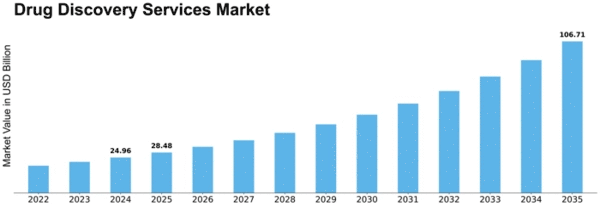
<p>As of 2024, the Drug Discovery Services Market was valued at 24.96 USD Billion.</p>

What is the projected market size for the Drug Discovery Services Market by 2035?

<p>The market is projected to reach 106.71 USD Billion by 2035.</p>

What is the expected CAGR for the Drug Discovery Services Market during the forecast period 2025 - 2035?

<p>The expected CAGR for the Drug Discovery Services Market during 2025 - 2035 is 14.12%.</p>

Which companies are considered key players in the Drug Discovery Services Market?

<p>Key players include Thermo Fisher Scientific, Charles River Laboratories, Covance, WuXi AppTec, and Evotec.</p>

What segment had the highest valuation in the Drug Discovery Services Market in 2024?

<p>In 2024, Clinical Trials had the highest valuation at 6.98 USD Billion.</p>

Which therapeutic area is projected to dominate the Drug Discovery Services Market by 2035?

<p>Oncology is projected to dominate the market with a valuation of 35.0 USD Billion by 2035.</p>

What are the primary service types in the Drug Discovery Services Market?

Primary service types include Contract Research Organization Services, Laboratory Services, and Consulting Services.

How does the valuation of Pharmaceutical Companies compare to Biotechnology Companies in the Drug Discovery Services Market?

In 2024, Pharmaceutical Companies were valued at 10.0 USD Billion, while Biotechnology Companies were valued at 6.0 USD Billion.

What technology segment is expected to show significant growth in the Drug Discovery Services Market?

The Chemical Libraries segment is expected to show significant growth, with a projected valuation of 34.96 USD Billion by 2035.

What is the valuation of the Biomarker Discovery segment in 2024?

The Biomarker Discovery segment was valued at 3.0 USD Billion in 2024.

Market Summary

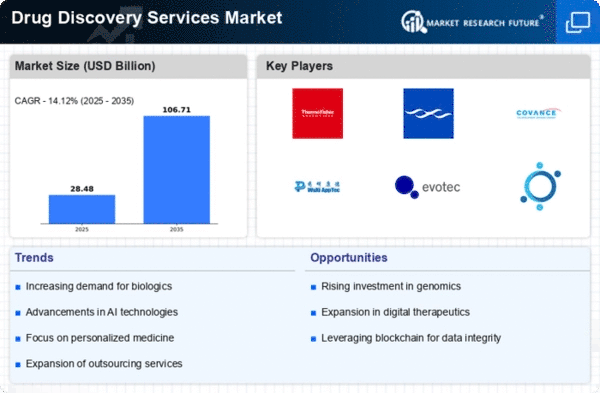
According to MRFR analysis, the Drug Discovery Services Market Size was valued at USD 24.96 Billion in 2024. The Drug Discovery Services industry is projected to grow from USD 28.48 Billion in 2025 to USD 106.71 Billion by 2035, registering a CAGR of 14.12% during the forecast period (2025–2035). North America led the market with over 50% share, generating around USD 12.48 billion in revenue.
 
The Drug Discovery Services Market is expanding due to increasing demand for innovative therapeutics and rising outsourcing by pharmaceutical companies. Key trends include adoption of AI-driven drug discovery, growing collaboration between biotech firms and CROs, and increasing focus on accelerating research timelines to enhance efficiency and reduce drug development costs globally. According to the World Health Organization, noncommunicable diseases account for 74% of global deaths, driving the need for continuous drug discovery and development.

Key Market Trends & Highlights

The Drug Discovery Services Market is poised for substantial growth driven by technological advancements and evolving healthcare needs.

  • The integration of Artificial Intelligence is transforming drug discovery processes, enhancing efficiency and accuracy. Personalized medicine is gaining traction, leading to tailored therapeutic approaches that cater to individual patient profiles. North America remains the largest market, while the Asia-Pacific region is emerging as the fastest-growing area for drug discovery services. Rising demand for biopharmaceuticals and advancements in genomics and proteomics are key drivers propelling the market forward.

Market Size & Forecast

2024 Market Size 24.96 (USD Billion)
2035 Market Size 106.71 (USD Billion)
CAGR (2025 - 2035) 14.12%
Largest Regional Market Share in 2024 North America

Major Players

Companies such as <a href="https://www.thermofisher.com/in/en/home/industrial/pharma-biopharma/drug-discovery-development/drug-discovery-development-services.html">Thermo Fisher Scientific</a> (US), Charles River Laboratories (US), Covance (US), WuXi AppTec (CN), Evotec (DE), Sygnature Discovery (GB), Medpace (US), PRA Health Sciences (US), BioDuro (US) are some of the major participants in the global market.

Market Trends

The Drug Discovery Services Market is currently experiencing a transformative phase, characterized by a convergence of advanced technologies and innovative methodologies. This evolution is largely driven by the increasing demand for efficient and cost-effective drug development processes. As pharmaceutical companies seek to streamline their research and development efforts, outsourcing drug discovery and development services has become a prevalent strategy.

This trend not only allows for access to specialized expertise but also facilitates the integration of cutting-edge technologies such as artificial intelligence and machine learning into the drug discovery pipeline. Furthermore, the growing emphasis on personalized medicine is reshaping the landscape, as companies strive to develop targeted therapies that cater to individual patient needs. In addition to technological advancements, regulatory changes and collaborations between academia and industry are playing pivotal roles in shaping the market.

Regulatory bodies are increasingly recognizing the importance of adaptive trial designs and real-world evidence, which may enhance the efficiency of drug development. Collaborative efforts between research institutions and pharmaceutical companies are fostering innovation and accelerating the discovery process. As the market continues to evolve, it appears poised for sustained growth, driven by the need for novel therapeutics and the ongoing quest for improved patient outcomes. The future landscape of drug discovery and development services is likely to be defined by a blend of scientific rigor and technological prowess, ultimately leading to more effective and safer medications for patients worldwide.

Integration of Artificial Intelligence

The incorporation of artificial intelligence in the Drug Discovery Services Market is becoming increasingly prevalent. AI technologies are being utilized to streamline various phases of drug development, from target identification to lead optimization. This integration enhances the efficiency of research processes, potentially reducing the time and resources required to bring new drugs to market.

The Institute for Health Metrics and Evaluation emphasizes the growing use of large-scale health data analytics across 200+ countries, supporting AI-driven advancements in biomedical research.

Focus on Personalized Medicine

There is a notable shift towards personalized medicine within the Drug Discovery Services Market. This trend emphasizes the development of tailored therapies that cater to individual patient characteristics. As a result, service providers are adapting their methodologies to include advanced genomic and proteomic analyses, which facilitate the creation of more effective and targeted treatment options.

According to the Centers for Disease Control and Prevention, precision medicine approaches are improving treatment outcomes by tailoring therapies to individual variability.

Expansion of Collaborative Partnerships

The market is witnessing an increase in collaborative partnerships among pharmaceutical companies, academic institutions, and service providers. These alliances are formed to leverage shared expertise and resources, fostering innovation in drug discovery. Such collaborations are likely to enhance the overall efficiency of the drug development process, leading to more rapid advancements in therapeutic solutions.

The Global Fund reports that public-private partnerships are critical for accelerating innovation and expanding access to advanced treatments.

Collaborative Research Initiatives

Collaborations between academic institutions and pharmaceutical companies are increasingly shaping the landscape of drug discovery and development services. These partnerships foster innovation and facilitate the sharing of knowledge and resources. Such initiatives may lead to accelerated discovery timelines and the development of novel therapeutics.

The National Institutes of Health supports extensive collaboration between academia and industry to advance drug discovery and translational research.

Drug Discovery Services Market Market Drivers

Rising Demand for Biologics

The Global Drug Discovery Services Market experiences a notable increase in demand for biologics, driven by advancements in biotechnology and a growing understanding of complex diseases. Biologics, including monoclonal antibodies and vaccines, represent a significant portion of new drug approvals. 
 
In 2024, the market is projected to reach 25.0 USD Billion, reflecting the industry's shift towards biologics. This trend is expected to continue as more companies invest in biologics research and development, potentially leading to a market value of 106.7 USD Billion by 2035. The emphasis on biologics is likely to propel the market forward, as companies seek innovative solutions to address unmet medical needs.

Growing Prevalence of Chronic Diseases

The Global Drug Discovery Services Market is propelled by the increasing prevalence of chronic diseases, such as cancer, diabetes, and cardiovascular disorders. As these diseases continue to rise globally, there is an urgent need for effective therapeutic solutions, driving demand for drug discovery services. Pharmaceutical companies are focusing on developing targeted therapies and personalized medicine approaches to address these health challenges. 
 
The market's growth is expected to align with the rising incidence of chronic diseases, contributing to a projected market value of 106.7 USD Billion by 2035. This growing health burden underscores the importance of the industry in developing innovative treatments.

Regulatory Support for Drug Development

Regulatory agencies worldwide are increasingly supporting drug development processes, which positively impacts the Global Drug Discovery Services Market. Initiatives aimed at expediting the approval of new drugs, such as the FDA's Breakthrough Therapy Designation, encourage innovation and reduce time to market for new therapies. 
 
This regulatory support fosters a conducive environment for drug discovery, enabling companies to bring novel treatments to patients more efficiently. As a result, the market is likely to experience substantial growth, with projections indicating a rise from 25.0 USD Billion in 2024 to 106.7 USD Billion by 2035. Such regulatory frameworks are essential for sustaining the momentum of the market.

Technological Advancements in Drug Discovery

Technological innovations play a crucial role in shaping the Drug Discovery Services Market. The integration of artificial intelligence, machine learning, and high-throughput screening technologies enhances the efficiency and accuracy of drug discovery processes. These advancements allow for faster identification of potential drug candidates, reducing time and costs associated with traditional methods. 
 
As a result, the market is poised for growth, with a projected compound annual growth rate of 14.12% from 2025 to 2035. The adoption of these technologies not only streamlines the drug discovery process but also improves the overall success rate of drug development, thereby driving the market.

Increase in Research and Development Expenditure

The Global Drug Discovery Services Market is significantly influenced by the rising expenditure on research and development (R&D) by pharmaceutical and biotechnology companies. As organizations prioritize innovation to stay competitive, R&D budgets are expanding, facilitating the exploration of novel therapeutic targets and drug modalities. 
 
This trend is particularly evident in emerging markets, where increased investment in healthcare infrastructure supports drug discovery initiatives. The anticipated growth in R&D spending is expected to contribute to the market's expansion, with projections indicating a rise from 25.0 USD Billion in 2024 to 106.7 USD Billion by 2035. Such investments are likely to enhance the capabilities of the industry.

Market Segment Insights

By Application: Preclinical Testing (Largest) vs. Clinical Trials (Fastest-Growing)

<p>In the Drug Discovery Services Market, the Application segment comprises various critical areas including Target Identification, Lead Optimization, Preclinical Testing, Clinical Trials, and Biomarker Discovery. Among these, Preclinical Testing holds the largest share, acting as a crucial phase in ensuring the safety and efficacy of drug candidates before they proceed to human trials. Clinical Trials, while smaller in market share, is recognized as the fastest-growing segment due to increasing investments and innovation in clinical research methodologies.</p>

<p>Preclinical Testing (Dominant) vs. Clinical Trials (Emerging)</p>

<p>Preclinical Testing serves as the backbone of the drug development process, ensuring that only the most promising compounds advance to the clinical trial stage. This segment extensively utilizes in vitro and in vivo models to gather essential biological data. On the other hand, Clinical Trials are rapidly evolving with advancements in technology such as decentralization and adaptive trial designs. This segment is witnessing unprecedented growth as pharmaceutical companies and research organizations seek to streamline the approval process while enhancing patient recruitment and retention strategies. Together, these segments represent the crucial phases of drug discovery that ensure potential therapies transition smoothly from laboratory bench to patients, ultimately impacting market dynamics.</p>

By Service Type: Contract Research Organization Services (Largest) vs. Laboratory Services (Fastest-Growing)

<p>In the Drug Discovery Services Market, the distribution of service types illustrates a clear hierarchy in terms of market share. Contract Research Organization (CRO) Services dominate this segment, capturing the largest share as pharmaceutical companies increasingly outsource research and development activities. Following closely are Laboratory Services, which exhibit robust growth due to their critical role in executing experiments and testing in drug development processes. Other segments, including Consulting Services and Data Analysis Services, also contribute to the market but on a smaller scale, reflecting their niche roles within the industry. Growth trends in the Drug Discovery Services Market indicate a shift towards more specialized and technology-driven services. The rise of Laboratory Services is propelled by advancements in technologies like high-throughput screening and biomarker identification. Additionally, the increasing complexity of drug development processes demands comprehensive regulatory affairs and data analysis services, further diversifying the service offerings within the market. Investments in digital technologies and an emphasis on personalized medicine are expected to bolster the growth of these service types over the coming years.</p>

<p>Contract Research Organization Services (Dominant) vs. Laboratory Services (Emerging)</p>

<p>Contract Research Organization (CRO) Services have established themselves as the dominant force in the Drug Discovery Services Market, serving as essential partners for pharmaceutical companies by providing a full spectrum of outsourced research services. These organizations facilitate the entire drug development process, from preclinical research to clinical trials, leveraging their expertise to improve efficiency and mitigate risks. Conversely, Laboratory Services are emerging as a critical player, characterized by rapid advancements and the ability to perform specialized assays and testing required for drug approval. The growing emphasis on precision medicine and the need for faster development cycles position Laboratory Services as a key growth area, indicating that they are poised to become indispensable in the ever-evolving landscape of drug discovery.</p>

By Technology: High Throughput Screening (Largest) vs. Bioinformatics (Fastest-Growing)

<p>The Drug Discovery Services Market is predominantly shaped by High Throughput Screening, which holds a significant market share due to its automation capabilities that enhance the efficiency and speed of drug development processes. Other methods, including Bioinformatics, In Silico Drug Design, Assay Development, and Chemical Libraries, also contribute to a diversified portfolio of services that cater to the evolving needs of pharmaceutical companies. Collectively, they provide essential tools for accelerating drug discovery workflows, optimizing candidate selection, and ensuring higher success rates. As drug development becomes increasingly complex, there is a notable trend towards integrating advanced technologies. Bioinformatics, in particular, is witnessing rapid growth driven by the need for data management and analysis in genomics and proteomics. The rise in personalized medicine and the push for precision therapies further fuel these growth trends. In addition, In Silico Drug Design offers crucial benefits by simulating drug interactions before physical trials, thereby reducing costs and timeframes associated with drug development, which enhances its appeal to drug discovery services.</p>

<p>High Throughput Screening: Dominant vs. Bioinformatics: Emerging</p>

<p>High Throughput Screening stands out as the dominant technology in the Drug Discovery Services Market due to its extensive application in screening vast libraries of compounds quickly and effectively. This technology is integral to the early stages of drug development, where it facilitates the identification of viable drug candidates at an unprecedented scale. Conversely, Bioinformatics represents an emerging technology that utilizes computational tools to manage and analyze biological data. With the explosion of data from genomic research, Bioinformatics plays a crucial role in deriving meaningful insights from complex datasets, thus shaping the future of drug discovery by enabling more targeted and efficient approaches to drug development. As these technologies evolve, integrating High Throughput Screening and Bioinformatics will drive innovation in the market.</p>

By Therapeutic Area: Oncology (Largest) vs. Neurology (Fastest-Growing)

<p>The Drug Discovery Services Market is notably segmented by therapeutic areas, with Oncology holding the largest market share. This expansive sector benefits from a continual influx of innovative therapies and substantial investment, reflecting the critical demand for advanced cancer treatments. Following Oncology, Neurology is gaining traction and emerging as a significant player, driven by increasing prevalence rates of neurological disorders and bolstered investments in research and development.</p>

<p>Oncology (Dominant) vs. Neurology (Emerging)</p>

<p>Oncology remains the dominant therapeutic area within the Drug Discovery Services Market, characterized by a robust pipeline of targeted therapies and immunotherapies addressing various cancer types. The increasing pressure on healthcare systems and demand for personalized medicine have fueled this growth, leading to extensive collaborations among pharmaceutical companies, biotech firms, and research institutions. In contrast, Neurology is regarded as an emerging segment, propelled by rising incidences of neurodegenerative diseases and mental health disorders. Advances in biomarkers and neurotherapeutics signal its potential, as the focus shifts towards developing novel treatment modalities to enhance patient outcomes.</p>

By End User: Pharmaceutical Companies (Largest) vs. Biotechnology Companies (Fastest-Growing)

<p>The Drug Discovery Services Market exhibits a diverse array of end users, with pharmaceutical companies holding the largest share. These companies heavily invest in drug development and rely on dedicated services to expedite the process. In contrast, biotechnology companies, while currently smaller in market share, are experiencing rapid growth as innovations and unique therapies come to market. Academic institutions, research organizations, and government agencies also contribute significantly, albeit at a lesser extent, reflecting a collaborative environment in drug discovery.</p>

<p>Biotechnology Companies (Emerging) vs. Academic Institutions (Dominant)</p>

<p>Biotechnology companies are emerging as pivotal players in the Drug Discovery Services Market, driven by their focus on cutting-edge therapies and genetic research. These organizations tend to collaborate with specialized service providers to gain access to advanced technologies, which helps them shorten their development timelines. On the other hand, academic institutions play a dominant role by providing foundational research and training the next generation of scientists. Their collaboration with both pharmaceutical and biotech companies fosters an environment of innovation, allowing for the translation of academic research into practical drug development, thus reinforcing their critical importance in the market.</p>

Get more detailed insights about Drug Discovery Services Market Research Report – Forecast to 2035

Regional Insights

North America : Leading Market Innovators

North America leads in the Drug Discovery Services Market Size, accounting for over 50% of the global revenue in 2024. The region's growth is driven by advanced research facilities, high R&D investments, and a robust regulatory framework that encourages innovation. The increasing prevalence of chronic diseases and the demand for personalized medicine further fuel market expansion. Regulatory bodies are actively promoting initiatives to streamline drug development processes, enhancing the overall market landscape.

The competitive landscape in North America is characterized by the presence of major players such as Thermo Fisher Scientific, Charles River Laboratories, and Covance. These companies leverage cutting-edge technologies and extensive expertise to offer comprehensive drug discovery solutions. The U.S. remains the leading country, supported by a strong network of biotech firms and academic institutions, fostering collaboration and innovation in drug development.

Europe : Emerging Research Hub

Europe's Drug Discovery Services market is projected to reach 6.99 by 2025, driven by increasing investments in biotechnology and pharmaceutical research. The region benefits from a strong regulatory framework that supports drug development, alongside initiatives aimed at enhancing collaboration between public and private sectors. The rising demand for innovative therapies and personalized medicine is also a key growth driver, as European countries focus on improving healthcare outcomes through advanced drug discovery techniques.

Leading countries in Europe include Germany, the UK, and France, which host numerous biotech firms and research institutions. The competitive landscape is marked by the presence of companies like Evotec and Sygnature Discovery, which are at the forefront of drug discovery innovation. The European market is characterized by strategic partnerships and collaborations, enhancing the capabilities of local firms to compete on a global scale.

Asia-Pacific : Rapidly Growing Market

The Asia-Pacific region is witnessing significant growth in the Drug Discovery Services market, projected to reach 4.98 by 2025. This growth is fueled by increasing investments in healthcare infrastructure, a rising number of clinical trials, and a growing emphasis on research and development. Countries in this region are also focusing on regulatory reforms to streamline drug approval processes, which is expected to enhance market dynamics and attract foreign investments in drug discovery services.

China and India are leading the charge in the Asia-Pacific market, with a growing number of biotech firms and research institutions. The competitive landscape features key players like WuXi AppTec, which is expanding its service offerings to meet the rising demand. The region's market is characterized by a blend of local and international firms, fostering a competitive environment that drives innovation and efficiency in drug discovery.

Middle East and Africa : Emerging Market Potential

The Middle East and Africa (MEA) region is gradually emerging in the Drug Discovery Services market, with a projected size of 0.51 by 2025. The growth is primarily driven by increasing healthcare investments and a rising focus on research and development initiatives. Governments in the region are implementing policies to enhance healthcare infrastructure and promote innovation in drug discovery, which is expected to attract global players and foster local capabilities.

Countries like South Africa and the UAE are leading the way in establishing research facilities and partnerships with international firms. The competitive landscape is still developing, with opportunities for local companies to collaborate with global leaders in drug discovery. As the region continues to invest in healthcare, the potential for growth in drug discovery services is significant, paving the way for future advancements in the sector.

Key Players and Competitive Insights

The Drug Discovery Services Market is currently characterized by a dynamic competitive landscape, driven by the increasing demand for innovative therapeutics and the need for efficient drug development processes. Key players such as Thermo Fisher Scientific (US), Charles River Laboratories (US), and WuXi AppTec (CN) are strategically positioned to leverage their extensive capabilities in research and development, thereby enhancing their market presence. These companies focus on innovation and technological advancements, which are critical in meeting the evolving needs of pharmaceutical and biotechnology firms. Their collective strategies, including partnerships and regional expansions, contribute to a robust competitive environment that fosters collaboration and accelerates drug discovery timelines.
 
In terms of business tactics, companies are increasingly localizing manufacturing and optimizing supply chains to enhance operational efficiency. The market structure appears moderately fragmented, with several players vying for market share. However, the influence of major companies like Covance (US) and Evotec (DE) is substantial, as they continue to set industry standards through their comprehensive service offerings and strategic initiatives. This competitive structure encourages smaller firms to innovate and differentiate themselves, thereby enriching the overall market dynamics.
 
In November Thermo Fisher Scientific (US) announced a strategic partnership with a leading biotechnology firm to co-develop next-generation gene therapies. This collaboration is expected to enhance their capabilities in gene editing and delivery systems, positioning Thermo Fisher as a frontrunner in the rapidly evolving field of genetic medicine. Such partnerships not only bolster their service portfolio but also signify a shift towards more integrated solutions in drug discovery.
 
In October Charles River Laboratories (US) expanded its global footprint by acquiring a prominent preclinical contract research organization in Europe. This acquisition is likely to enhance their service offerings and provide access to new markets, thereby strengthening their competitive edge. The move reflects a broader trend of consolidation within the industry, as companies seek to enhance their capabilities and streamline operations to better serve their clients.
 
In September WuXi AppTec (CN) launched a new platform aimed at integrating artificial intelligence (AI) into drug discovery processes. This initiative is indicative of the growing trend towards digitalization in the industry, as companies increasingly adopt AI to improve efficiency and reduce time-to-market for new drugs. The integration of AI technologies is expected to revolutionize traditional drug discovery methodologies, providing a competitive advantage to early adopters.
 
As of December the Drug Discovery Services Market is witnessing significant trends such as digitalization, sustainability, and the integration of AI technologies. Strategic alliances are becoming increasingly important, as they enable companies to pool resources and expertise, thereby enhancing their competitive positioning. Looking ahead, it appears that competitive differentiation will increasingly hinge on innovation and technological advancements rather than price-based competition. Companies that prioritize reliability in their supply chains and invest in cutting-edge technologies are likely to emerge as leaders in this evolving landscape.

Key Companies in the Drug Discovery Services Market include

Industry Developments

November 2023 Evotec and Bayer enter into a new strategic collaboration to accelerate the discovery and development of new drugs for multiple therapeutic areas. Under the terms of the agreement, Evotec will provide Bayer with access to its integrated drug discovery platform, which includes its expertise in target identification and validation, hit-to-lead and lead optimization, and preclinical development.Thermo Fisher Scientific announces the launch of its new Ion PGM™ Dx Sequencing System, which is a next-generation sequencing (NGS) system that is designed to help pharmaceutical and biotechnology companies accelerate drug discovery and development.

The Ion PGM Dx Sequencing System is designed to provide accurate and reliable results for a wide range of NGS applications, including target identification, validation, and drug screening.Qiagen announces the launch of its new QIAseq Targeted DNA Panels, which are a family of NGS panels that are designed to help pharmaceutical and biotechnology companies target specific genes or regions of the genome for sequencing. The QIAseq Targeted DNA Panels are designed to provide high-quality and reliable data for a wide range of drug discovery applications.

October 2023 Bio-Rad Laboratories announces the launch of its new QX200 Droplet Digital PCR (ddPCR) System, which is a ddPCR system that is designed to provide pharmaceutical and biotechnology companies with a more accurate and sensitive way to detect genetic mutations associated with disease. The QX200 ddPCR System is designed to help pharmaceutical and biotechnology companies accelerate drug discovery and development by enabling them to identify and validate new drug targets and to screen for drug candidates that are effective against those targets.Parexel announces the acquisition of Pharmapace, a leading provider of clinical trial services.

The acquisition is expected to strengthen Parexel's position in the market of drug discovery services and to enable the company to offer a more comprehensive range of services to its clients.

September 2023 Several CROs announce new partnerships with pharmaceutical and biotechnology companies to provide drug discovery services. For example, Syneos Health announced a new partnership with AstraZeneca to provide drug discovery services for a range of therapeutic areas.

Future Outlook

Drug Discovery Services Market Future Outlook

The Drug Discovery Services Market size is projected to reach USD 106.71 billion by 2035, growing at a CAGR of 14.12%, driven by advancements in technology, increasing R&amp;D investments, and a rising demand for personalized medicine.

New opportunities lie in:

  • <p>Integration of AI-driven drug design platforms Expansion of virtual screening services for lead optimization Development of strategic partnerships with biotech firms for co-development projects</p>

By 2035, the market is expected to be robust, reflecting substantial growth and innovation.

Market Segmentation

Drug Discovery Services Market End User Outlook

  • Pharmaceutical Companies
  • Biotechnology Firms
  • Academic Institutions
  • Contract Research Organizations
  • Government Research Institutes

Drug Discovery Services Market Technology Outlook

  • High Throughput Screening
  • Computational Drug Design
  • Biologics
  • Small Molecule Drug Discovery
  • Gene Therapy

Drug Discovery Services Market Service Type Outlook

  • Target Identification
  • Lead Optimization
  • Preclinical Services
  • Clinical Trials
  • Bioanalytical Services

Drug Discovery Services Market Therapeutic Area Outlook

  • Oncology
  • Neurology
  • Cardiology
  • Infectious Diseases
  • Metabolic Disorders

Report Scope

MARKET SIZE 2024 24.96(USD Billion)
MARKET SIZE 2025 28.48(USD Billion)
MARKET SIZE 2035 106.71(USD Billion)
COMPOUND ANNUAL GROWTH RATE (CAGR) 14.12% (2025 - 2035)
REPORT COVERAGE Revenue Forecast, Competitive Landscape, Growth Factors, and Trends
BASE YEAR 2024
Market Forecast Period 2025 - 2035
Historical Data 2019 - 2024
Market Forecast Units USD Billion
Key Companies Profiled Thermo Fisher Scientific (US), Charles River Laboratories (US), Covance (US), WuXi AppTec (CN), Evotec (DE), Sygnature Discovery (GB), Medpace (US), PRA Health Sciences (US), BioDuro (US)
Segments Covered Service Type, Therapeutic Area, Technology, End User
Key Market Opportunities Integration of artificial intelligence in the market enhances efficiency and accelerates drug development timelines.
Key Market Dynamics Rising demand for innovative therapies drives competition and technological advancements in the market.
Countries Covered North America, Europe, APAC, South America, MEA

FAQs

What is the current valuation of the Drug Discovery Services Market?

<p>As of 2024, the Drug Discovery Services Market was valued at 24.96 USD Billion.</p>

What is the projected market size for the Drug Discovery Services Market by 2035?

<p>The market is projected to reach 106.71 USD Billion by 2035.</p>

What is the expected CAGR for the Drug Discovery Services Market during the forecast period 2025 - 2035?

<p>The expected CAGR for the Drug Discovery Services Market during 2025 - 2035 is 14.12%.</p>

Which companies are considered key players in the Drug Discovery Services Market?

<p>Key players include Thermo Fisher Scientific, Charles River Laboratories, Covance, WuXi AppTec, and Evotec.</p>

What segment had the highest valuation in the Drug Discovery Services Market in 2024?

<p>In 2024, Clinical Trials had the highest valuation at 6.98 USD Billion.</p>

Which therapeutic area is projected to dominate the Drug Discovery Services Market by 2035?

<p>Oncology is projected to dominate the market with a valuation of 35.0 USD Billion by 2035.</p>

What are the primary service types in the Drug Discovery Services Market?

Primary service types include Contract Research Organization Services, Laboratory Services, and Consulting Services.

How does the valuation of Pharmaceutical Companies compare to Biotechnology Companies in the Drug Discovery Services Market?

In 2024, Pharmaceutical Companies were valued at 10.0 USD Billion, while Biotechnology Companies were valued at 6.0 USD Billion.

What technology segment is expected to show significant growth in the Drug Discovery Services Market?

The Chemical Libraries segment is expected to show significant growth, with a projected valuation of 34.96 USD Billion by 2035.

What is the valuation of the Biomarker Discovery segment in 2024?

The Biomarker Discovery segment was valued at 3.0 USD Billion in 2024.

  1. SECTION I: EXECUTIVE SUMMARY AND KEY HIGHLIGHTS
    1. | 1.1 EXECUTIVE SUMMARY
    2. | | 1.1.1 Market Overview
    3. | | 1.1.2 Key Findings
    4. | | 1.1.3 Market Segmentation
    5. | | 1.1.4 Competitive Landscape
    6. | | 1.1.5 Challenges and Opportunities
    7. | | 1.1.6 Future Outlook
  2. SECTION II: SCOPING, METHODOLOGY AND MARKET STRUCTURE
    1. | 2.1 MARKET INTRODUCTION
    2. | | 2.1.1 Definition
    3. | | 2.1.2 Scope of the study
    4. | | | 2.1.2.1 Research Objective
    5. | | | 2.1.2.2 Assumption
    6. | | | 2.1.2.3 Limitations
    7. | 2.2 RESEARCH METHODOLOGY
    8. | | 2.2.1 Overview
    9. | | 2.2.2 Data Mining
    10. | | 2.2.3 Secondary Research
    11. | | 2.2.4 Primary Research
    12. | | | 2.2.4.1 Primary Interviews and Information Gathering Process
    13. | | | 2.2.4.2 Breakdown of Primary Respondents
    14. | | 2.2.5 Forecasting Model
    15. | | 2.2.6 Market Size Estimation
    16. | | | 2.2.6.1 Bottom-Up Approach
    17. | | | 2.2.6.2 Top-Down Approach
    18. | | 2.2.7 Data Triangulation
    19. | | 2.2.8 Validation
  3. SECTION III: QUALITATIVE ANALYSIS
    1. | 3.1 MARKET DYNAMICS
    2. | | 3.1.1 Overview
    3. | | 3.1.2 Drivers
    4. | | 3.1.3 Restraints
    5. | | 3.1.4 Opportunities
    6. | 3.2 MARKET FACTOR ANALYSIS
    7. | | 3.2.1 Value chain Analysis
    8. | | 3.2.2 Porter's Five Forces Analysis
    9. | | | 3.2.2.1 Bargaining Power of Suppliers
    10. | | | 3.2.2.2 Bargaining Power of Buyers
    11. | | | 3.2.2.3 Threat of New Entrants
    12. | | | 3.2.2.4 Threat of Substitutes
    13. | | | 3.2.2.5 Intensity of Rivalry
    14. | | 3.2.3 COVID-19 Impact Analysis
    15. | | | 3.2.3.1 Market Impact Analysis
    16. | | | 3.2.3.2 Regional Impact
    17. | | | 3.2.3.3 Opportunity and Threat Analysis
  4. SECTION IV: QUANTITATIVE ANALYSIS
    1. | 4.1 Healthcare, BY Application (USD Billion)
    2. | | 4.1.1 Target Identification
    3. | | 4.1.2 Lead Optimization
    4. | | 4.1.3 Preclinical Testing
    5. | | 4.1.4 Clinical Trials
    6. | | 4.1.5 Biomarker Discovery
    7. | 4.2 Healthcare, BY Service Type (USD Billion)
    8. | | 4.2.1 Contract Research Organization Services
    9. | | 4.2.2 Laboratory Services
    10. | | 4.2.3 Consulting Services
    11. | | 4.2.4 Data Analysis Services
    12. | | 4.2.5 Regulatory Affairs Services
    13. | 4.3 Healthcare, BY Technology (USD Billion)
    14. | | 4.3.1 High Throughput Screening
    15. | | 4.3.2 Bioinformatics
    16. | | 4.3.3 In Silico Drug Design
    17. | | 4.3.4 Assay Development
    18. | | 4.3.5 Chemical Libraries
    19. | 4.4 Healthcare, BY Therapeutic Area (USD Billion)
    20. | | 4.4.1 Oncology
    21. | | 4.4.2 Neurology
    22. | | 4.4.3 Cardiology
    23. | | 4.4.4 Infectious Diseases
    24. | | 4.4.5 Metabolic Disorders
    25. | 4.5 Healthcare, BY End User (USD Billion)
    26. | | 4.5.1 Pharmaceutical Companies
    27. | | 4.5.2 Biotechnology Companies
    28. | | 4.5.3 Academic Institutions
    29. | | 4.5.4 Research Organizations
    30. | | 4.5.5 Government Agencies
    31. | 4.6 Healthcare, BY Region (USD Billion)
    32. | | 4.6.1 North America
    33. | | | 4.6.1.1 US
    34. | | | 4.6.1.2 Canada
    35. | | 4.6.2 Europe
    36. | | | 4.6.2.1 Germany
    37. | | | 4.6.2.2 UK
    38. | | | 4.6.2.3 France
    39. | | | 4.6.2.4 Russia
    40. | | | 4.6.2.5 Italy
    41. | | | 4.6.2.6 Spain
    42. | | | 4.6.2.7 Rest of Europe
    43. | | 4.6.3 APAC
    44. | | | 4.6.3.1 China
    45. | | | 4.6.3.2 India
    46. | | | 4.6.3.3 Japan
    47. | | | 4.6.3.4 South Korea
    48. | | | 4.6.3.5 Malaysia
    49. | | | 4.6.3.6 Thailand
    50. | | | 4.6.3.7 Indonesia
    51. | | | 4.6.3.8 Rest of APAC
    52. | | 4.6.4 South America
    53. | | | 4.6.4.1 Brazil
    54. | | | 4.6.4.2 Mexico
    55. | | | 4.6.4.3 Argentina
    56. | | | 4.6.4.4 Rest of South America
    57. | | 4.6.5 MEA
    58. | | | 4.6.5.1 GCC Countries
    59. | | | 4.6.5.2 South Africa
    60. | | | 4.6.5.3 Rest of MEA
  5. SECTION V: COMPETITIVE ANALYSIS
    1. | 5.1 Competitive Landscape
    2. | | 5.1.1 Overview
    3. | | 5.1.2 Competitive Analysis
    4. | | 5.1.3 Market share Analysis
    5. | | 5.1.4 Major Growth Strategy in the Healthcare
    6. | | 5.1.5 Competitive Benchmarking
    7. | | 5.1.6 Leading Players in Terms of Number of Developments in the Healthcare
    8. | | 5.1.7 Key developments and growth strategies
    9. | | | 5.1.7.1 New Product Launch/Service Deployment
    10. | | | 5.1.7.2 Merger & Acquisitions
    11. | | | 5.1.7.3 Joint Ventures
    12. | | 5.1.8 Major Players Financial Matrix
    13. | | | 5.1.8.1 Sales and Operating Income
    14. | | | 5.1.8.2 Major Players R&D Expenditure. 2023
    15. | 5.2 Company Profiles
    16. | | 5.2.1 Thermo Fisher Scientific (US)
    17. | | | 5.2.1.1 Financial Overview
    18. | | | 5.2.1.2 Products Offered
    19. | | | 5.2.1.3 Key Developments
    20. | | | 5.2.1.4 SWOT Analysis
    21. | | | 5.2.1.5 Key Strategies
    22. | | 5.2.2 Charles River Laboratories (US)
    23. | | | 5.2.2.1 Financial Overview
    24. | | | 5.2.2.2 Products Offered
    25. | | | 5.2.2.3 Key Developments
    26. | | | 5.2.2.4 SWOT Analysis
    27. | | | 5.2.2.5 Key Strategies
    28. | | 5.2.3 Covance (US)
    29. | | | 5.2.3.1 Financial Overview
    30. | | | 5.2.3.2 Products Offered
    31. | | | 5.2.3.3 Key Developments
    32. | | | 5.2.3.4 SWOT Analysis
    33. | | | 5.2.3.5 Key Strategies
    34. | | 5.2.4 WuXi AppTec (CN)
    35. | | | 5.2.4.1 Financial Overview
    36. | | | 5.2.4.2 Products Offered
    37. | | | 5.2.4.3 Key Developments
    38. | | | 5.2.4.4 SWOT Analysis
    39. | | | 5.2.4.5 Key Strategies
    40. | | 5.2.5 Evotec (DE)
    41. | | | 5.2.5.1 Financial Overview
    42. | | | 5.2.5.2 Products Offered
    43. | | | 5.2.5.3 Key Developments
    44. | | | 5.2.5.4 SWOT Analysis
    45. | | | 5.2.5.5 Key Strategies
    46. | | 5.2.6 Sygnature Discovery (GB)
    47. | | | 5.2.6.1 Financial Overview
    48. | | | 5.2.6.2 Products Offered
    49. | | | 5.2.6.3 Key Developments
    50. | | | 5.2.6.4 SWOT Analysis
    51. | | | 5.2.6.5 Key Strategies
    52. | | 5.2.7 Medpace (US)
    53. | | | 5.2.7.1 Financial Overview
    54. | | | 5.2.7.2 Products Offered
    55. | | | 5.2.7.3 Key Developments
    56. | | | 5.2.7.4 SWOT Analysis
    57. | | | 5.2.7.5 Key Strategies
    58. | | 5.2.8 PRA Health Sciences (US)
    59. | | | 5.2.8.1 Financial Overview
    60. | | | 5.2.8.2 Products Offered
    61. | | | 5.2.8.3 Key Developments
    62. | | | 5.2.8.4 SWOT Analysis
    63. | | | 5.2.8.5 Key Strategies
    64. | | 5.2.9 BioDuro (US)
    65. | | | 5.2.9.1 Financial Overview
    66. | | | 5.2.9.2 Products Offered
    67. | | | 5.2.9.3 Key Developments
    68. | | | 5.2.9.4 SWOT Analysis
    69. | | | 5.2.9.5 Key Strategies
    70. | 5.3 Appendix
    71. | | 5.3.1 References
    72. | | 5.3.2 Related Reports
  6. LIST OF FIGURES
    1. | 6.1 MARKET SYNOPSIS
    2. | 6.2 NORTH AMERICA MARKET ANALYSIS
    3. | 6.3 US MARKET ANALYSIS BY APPLICATION
    4. | 6.4 US MARKET ANALYSIS BY SERVICE TYPE
    5. | 6.5 US MARKET ANALYSIS BY TECHNOLOGY
    6. | 6.6 US MARKET ANALYSIS BY THERAPEUTIC AREA
    7. | 6.7 US MARKET ANALYSIS BY END USER
    8. | 6.8 CANADA MARKET ANALYSIS BY APPLICATION
    9. | 6.9 CANADA MARKET ANALYSIS BY SERVICE TYPE
    10. | 6.10 CANADA MARKET ANALYSIS BY TECHNOLOGY
    11. | 6.11 CANADA MARKET ANALYSIS BY THERAPEUTIC AREA
    12. | 6.12 CANADA MARKET ANALYSIS BY END USER
    13. | 6.13 EUROPE MARKET ANALYSIS
    14. | 6.14 GERMANY MARKET ANALYSIS BY APPLICATION
    15. | 6.15 GERMANY MARKET ANALYSIS BY SERVICE TYPE
    16. | 6.16 GERMANY MARKET ANALYSIS BY TECHNOLOGY
    17. | 6.17 GERMANY MARKET ANALYSIS BY THERAPEUTIC AREA
    18. | 6.18 GERMANY MARKET ANALYSIS BY END USER
    19. | 6.19 UK MARKET ANALYSIS BY APPLICATION
    20. | 6.20 UK MARKET ANALYSIS BY SERVICE TYPE
    21. | 6.21 UK MARKET ANALYSIS BY TECHNOLOGY
    22. | 6.22 UK MARKET ANALYSIS BY THERAPEUTIC AREA
    23. | 6.23 UK MARKET ANALYSIS BY END USER
    24. | 6.24 FRANCE MARKET ANALYSIS BY APPLICATION
    25. | 6.25 FRANCE MARKET ANALYSIS BY SERVICE TYPE
    26. | 6.26 FRANCE MARKET ANALYSIS BY TECHNOLOGY
    27. | 6.27 FRANCE MARKET ANALYSIS BY THERAPEUTIC AREA
    28. | 6.28 FRANCE MARKET ANALYSIS BY END USER
    29. | 6.29 RUSSIA MARKET ANALYSIS BY APPLICATION
    30. | 6.30 RUSSIA MARKET ANALYSIS BY SERVICE TYPE
    31. | 6.31 RUSSIA MARKET ANALYSIS BY TECHNOLOGY
    32. | 6.32 RUSSIA MARKET ANALYSIS BY THERAPEUTIC AREA
    33. | 6.33 RUSSIA MARKET ANALYSIS BY END USER
    34. | 6.34 ITALY MARKET ANALYSIS BY APPLICATION
    35. | 6.35 ITALY MARKET ANALYSIS BY SERVICE TYPE
    36. | 6.36 ITALY MARKET ANALYSIS BY TECHNOLOGY
    37. | 6.37 ITALY MARKET ANALYSIS BY THERAPEUTIC AREA
    38. | 6.38 ITALY MARKET ANALYSIS BY END USER
    39. | 6.39 SPAIN MARKET ANALYSIS BY APPLICATION
    40. | 6.40 SPAIN MARKET ANALYSIS BY SERVICE TYPE
    41. | 6.41 SPAIN MARKET ANALYSIS BY TECHNOLOGY
    42. | 6.42 SPAIN MARKET ANALYSIS BY THERAPEUTIC AREA
    43. | 6.43 SPAIN MARKET ANALYSIS BY END USER
    44. | 6.44 REST OF EUROPE MARKET ANALYSIS BY APPLICATION
    45. | 6.45 REST OF EUROPE MARKET ANALYSIS BY SERVICE TYPE
    46. | 6.46 REST OF EUROPE MARKET ANALYSIS BY TECHNOLOGY
    47. | 6.47 REST OF EUROPE MARKET ANALYSIS BY THERAPEUTIC AREA
    48. | 6.48 REST OF EUROPE MARKET ANALYSIS BY END USER
    49. | 6.49 APAC MARKET ANALYSIS
    50. | 6.50 CHINA MARKET ANALYSIS BY APPLICATION
    51. | 6.51 CHINA MARKET ANALYSIS BY SERVICE TYPE
    52. | 6.52 CHINA MARKET ANALYSIS BY TECHNOLOGY
    53. | 6.53 CHINA MARKET ANALYSIS BY THERAPEUTIC AREA
    54. | 6.54 CHINA MARKET ANALYSIS BY END USER
    55. | 6.55 INDIA MARKET ANALYSIS BY APPLICATION
    56. | 6.56 INDIA MARKET ANALYSIS BY SERVICE TYPE
    57. | 6.57 INDIA MARKET ANALYSIS BY TECHNOLOGY
    58. | 6.58 INDIA MARKET ANALYSIS BY THERAPEUTIC AREA
    59. | 6.59 INDIA MARKET ANALYSIS BY END USER
    60. | 6.60 JAPAN MARKET ANALYSIS BY APPLICATION
    61. | 6.61 JAPAN MARKET ANALYSIS BY SERVICE TYPE
    62. | 6.62 JAPAN MARKET ANALYSIS BY TECHNOLOGY
    63. | 6.63 JAPAN MARKET ANALYSIS BY THERAPEUTIC AREA
    64. | 6.64 JAPAN MARKET ANALYSIS BY END USER
    65. | 6.65 SOUTH KOREA MARKET ANALYSIS BY APPLICATION
    66. | 6.66 SOUTH KOREA MARKET ANALYSIS BY SERVICE TYPE
    67. | 6.67 SOUTH KOREA MARKET ANALYSIS BY TECHNOLOGY
    68. | 6.68 SOUTH KOREA MARKET ANALYSIS BY THERAPEUTIC AREA
    69. | 6.69 SOUTH KOREA MARKET ANALYSIS BY END USER
    70. | 6.70 MALAYSIA MARKET ANALYSIS BY APPLICATION
    71. | 6.71 MALAYSIA MARKET ANALYSIS BY SERVICE TYPE
    72. | 6.72 MALAYSIA MARKET ANALYSIS BY TECHNOLOGY
    73. | 6.73 MALAYSIA MARKET ANALYSIS BY THERAPEUTIC AREA
    74. | 6.74 MALAYSIA MARKET ANALYSIS BY END USER
    75. | 6.75 THAILAND MARKET ANALYSIS BY APPLICATION
    76. | 6.76 THAILAND MARKET ANALYSIS BY SERVICE TYPE
    77. | 6.77 THAILAND MARKET ANALYSIS BY TECHNOLOGY
    78. | 6.78 THAILAND MARKET ANALYSIS BY THERAPEUTIC AREA
    79. | 6.79 THAILAND MARKET ANALYSIS BY END USER
    80. | 6.80 INDONESIA MARKET ANALYSIS BY APPLICATION
    81. | 6.81 INDONESIA MARKET ANALYSIS BY SERVICE TYPE
    82. | 6.82 INDONESIA MARKET ANALYSIS BY TECHNOLOGY
    83. | 6.83 INDONESIA MARKET ANALYSIS BY THERAPEUTIC AREA
    84. | 6.84 INDONESIA MARKET ANALYSIS BY END USER
    85. | 6.85 REST OF APAC MARKET ANALYSIS BY APPLICATION
    86. | 6.86 REST OF APAC MARKET ANALYSIS BY SERVICE TYPE
    87. | 6.87 REST OF APAC MARKET ANALYSIS BY TECHNOLOGY
    88. | 6.88 REST OF APAC MARKET ANALYSIS BY THERAPEUTIC AREA
    89. | 6.89 REST OF APAC MARKET ANALYSIS BY END USER
    90. | 6.90 SOUTH AMERICA MARKET ANALYSIS
    91. | 6.91 BRAZIL MARKET ANALYSIS BY APPLICATION
    92. | 6.92 BRAZIL MARKET ANALYSIS BY SERVICE TYPE
    93. | 6.93 BRAZIL MARKET ANALYSIS BY TECHNOLOGY
    94. | 6.94 BRAZIL MARKET ANALYSIS BY THERAPEUTIC AREA
    95. | 6.95 BRAZIL MARKET ANALYSIS BY END USER
    96. | 6.96 MEXICO MARKET ANALYSIS BY APPLICATION
    97. | 6.97 MEXICO MARKET ANALYSIS BY SERVICE TYPE
    98. | 6.98 MEXICO MARKET ANALYSIS BY TECHNOLOGY
    99. | 6.99 MEXICO MARKET ANALYSIS BY THERAPEUTIC AREA
    100. | 6.100 MEXICO MARKET ANALYSIS BY END USER
    101. | 6.101 ARGENTINA MARKET ANALYSIS BY APPLICATION
    102. | 6.102 ARGENTINA MARKET ANALYSIS BY SERVICE TYPE
    103. | 6.103 ARGENTINA MARKET ANALYSIS BY TECHNOLOGY
    104. | 6.104 ARGENTINA MARKET ANALYSIS BY THERAPEUTIC AREA
    105. | 6.105 ARGENTINA MARKET ANALYSIS BY END USER
    106. | 6.106 REST OF SOUTH AMERICA MARKET ANALYSIS BY APPLICATION
    107. | 6.107 REST OF SOUTH AMERICA MARKET ANALYSIS BY SERVICE TYPE
    108. | 6.108 REST OF SOUTH AMERICA MARKET ANALYSIS BY TECHNOLOGY
    109. | 6.109 REST OF SOUTH AMERICA MARKET ANALYSIS BY THERAPEUTIC AREA
    110. | 6.110 REST OF SOUTH AMERICA MARKET ANALYSIS BY END USER
    111. | 6.111 MEA MARKET ANALYSIS
    112. | 6.112 GCC COUNTRIES MARKET ANALYSIS BY APPLICATION
    113. | 6.113 GCC COUNTRIES MARKET ANALYSIS BY SERVICE TYPE
    114. | 6.114 GCC COUNTRIES MARKET ANALYSIS BY TECHNOLOGY
    115. | 6.115 GCC COUNTRIES MARKET ANALYSIS BY THERAPEUTIC AREA
    116. | 6.116 GCC COUNTRIES MARKET ANALYSIS BY END USER
    117. | 6.117 SOUTH AFRICA MARKET ANALYSIS BY APPLICATION
    118. | 6.118 SOUTH AFRICA MARKET ANALYSIS BY SERVICE TYPE
    119. | 6.119 SOUTH AFRICA MARKET ANALYSIS BY TECHNOLOGY
    120. | 6.120 SOUTH AFRICA MARKET ANALYSIS BY THERAPEUTIC AREA
    121. | 6.121 SOUTH AFRICA MARKET ANALYSIS BY END USER
    122. | 6.122 REST OF MEA MARKET ANALYSIS BY APPLICATION
    123. | 6.123 REST OF MEA MARKET ANALYSIS BY SERVICE TYPE
    124. | 6.124 REST OF MEA MARKET ANALYSIS BY TECHNOLOGY
    125. | 6.125 REST OF MEA MARKET ANALYSIS BY THERAPEUTIC AREA
    126. | 6.126 REST OF MEA MARKET ANALYSIS BY END USER
    127. | 6.127 KEY BUYING CRITERIA OF HEALTHCARE
    128. | 6.128 RESEARCH PROCESS OF MRFR
    129. | 6.129 DRO ANALYSIS OF HEALTHCARE
    130. | 6.130 DRIVERS IMPACT ANALYSIS: HEALTHCARE
    131. | 6.131 RESTRAINTS IMPACT ANALYSIS: HEALTHCARE
    132. | 6.132 SUPPLY / VALUE CHAIN: HEALTHCARE
    133. | 6.133 HEALTHCARE, BY APPLICATION, 2024 (% SHARE)
    134. | 6.134 HEALTHCARE, BY APPLICATION, 2024 TO 2035 (USD Billion)
    135. | 6.135 HEALTHCARE, BY SERVICE TYPE, 2024 (% SHARE)
    136. | 6.136 HEALTHCARE, BY SERVICE TYPE, 2024 TO 2035 (USD Billion)
    137. | 6.137 HEALTHCARE, BY TECHNOLOGY, 2024 (% SHARE)
    138. | 6.138 HEALTHCARE, BY TECHNOLOGY, 2024 TO 2035 (USD Billion)
    139. | 6.139 HEALTHCARE, BY THERAPEUTIC AREA, 2024 (% SHARE)
    140. | 6.140 HEALTHCARE, BY THERAPEUTIC AREA, 2024 TO 2035 (USD Billion)
    141. | 6.141 HEALTHCARE, BY END USER, 2024 (% SHARE)
    142. | 6.142 HEALTHCARE, BY END USER, 2024 TO 2035 (USD Billion)
    143. | 6.143 BENCHMARKING OF MAJOR COMPETITORS
  7. LIST OF TABLES
    1. | 7.1 LIST OF ASSUMPTIONS
    2. | | 7.1.1
    3. | 7.2 North America MARKET SIZE ESTIMATES; FORECAST
    4. | | 7.2.1 BY APPLICATION, 2025-2035 (USD Billion)
    5. | | 7.2.2 BY SERVICE TYPE, 2025-2035 (USD Billion)
    6. | | 7.2.3 BY TECHNOLOGY, 2025-2035 (USD Billion)
    7. | | 7.2.4 BY THERAPEUTIC AREA, 2025-2035 (USD Billion)
    8. | | 7.2.5 BY END USER, 2025-2035 (USD Billion)
    9. | 7.3 US MARKET SIZE ESTIMATES; FORECAST
    10. | | 7.3.1 BY APPLICATION, 2025-2035 (USD Billion)
    11. | | 7.3.2 BY SERVICE TYPE, 2025-2035 (USD Billion)
    12. | | 7.3.3 BY TECHNOLOGY, 2025-2035 (USD Billion)
    13. | | 7.3.4 BY THERAPEUTIC AREA, 2025-2035 (USD Billion)
    14. | | 7.3.5 BY END USER, 2025-2035 (USD Billion)
    15. | 7.4 Canada MARKET SIZE ESTIMATES; FORECAST
    16. | | 7.4.1 BY APPLICATION, 2025-2035 (USD Billion)
    17. | | 7.4.2 BY SERVICE TYPE, 2025-2035 (USD Billion)
    18. | | 7.4.3 BY TECHNOLOGY, 2025-2035 (USD Billion)
    19. | | 7.4.4 BY THERAPEUTIC AREA, 2025-2035 (USD Billion)
    20. | | 7.4.5 BY END USER, 2025-2035 (USD Billion)
    21. | 7.5 Europe MARKET SIZE ESTIMATES; FORECAST
    22. | | 7.5.1 BY APPLICATION, 2025-2035 (USD Billion)
    23. | | 7.5.2 BY SERVICE TYPE, 2025-2035 (USD Billion)
    24. | | 7.5.3 BY TECHNOLOGY, 2025-2035 (USD Billion)
    25. | | 7.5.4 BY THERAPEUTIC AREA, 2025-2035 (USD Billion)
    26. | | 7.5.5 BY END USER, 2025-2035 (USD Billion)
    27. | 7.6 Germany MARKET SIZE ESTIMATES; FORECAST
    28. | | 7.6.1 BY APPLICATION, 2025-2035 (USD Billion)
    29. | | 7.6.2 BY SERVICE TYPE, 2025-2035 (USD Billion)
    30. | | 7.6.3 BY TECHNOLOGY, 2025-2035 (USD Billion)
    31. | | 7.6.4 BY THERAPEUTIC AREA, 2025-2035 (USD Billion)
    32. | | 7.6.5 BY END USER, 2025-2035 (USD Billion)
    33. | 7.7 UK MARKET SIZE ESTIMATES; FORECAST
    34. | | 7.7.1 BY APPLICATION, 2025-2035 (USD Billion)
    35. | | 7.7.2 BY SERVICE TYPE, 2025-2035 (USD Billion)
    36. | | 7.7.3 BY TECHNOLOGY, 2025-2035 (USD Billion)
    37. | | 7.7.4 BY THERAPEUTIC AREA, 2025-2035 (USD Billion)
    38. | | 7.7.5 BY END USER, 2025-2035 (USD Billion)
    39. | 7.8 France MARKET SIZE ESTIMATES; FORECAST
    40. | | 7.8.1 BY APPLICATION, 2025-2035 (USD Billion)
    41. | | 7.8.2 BY SERVICE TYPE, 2025-2035 (USD Billion)
    42. | | 7.8.3 BY TECHNOLOGY, 2025-2035 (USD Billion)
    43. | | 7.8.4 BY THERAPEUTIC AREA, 2025-2035 (USD Billion)
    44. | | 7.8.5 BY END USER, 2025-2035 (USD Billion)
    45. | 7.9 Russia MARKET SIZE ESTIMATES; FORECAST
    46. | | 7.9.1 BY APPLICATION, 2025-2035 (USD Billion)
    47. | | 7.9.2 BY SERVICE TYPE, 2025-2035 (USD Billion)
    48. | | 7.9.3 BY TECHNOLOGY, 2025-2035 (USD Billion)
    49. | | 7.9.4 BY THERAPEUTIC AREA, 2025-2035 (USD Billion)
    50. | | 7.9.5 BY END USER, 2025-2035 (USD Billion)
    51. | 7.10 Italy MARKET SIZE ESTIMATES; FORECAST
    52. | | 7.10.1 BY APPLICATION, 2025-2035 (USD Billion)
    53. | | 7.10.2 BY SERVICE TYPE, 2025-2035 (USD Billion)
    54. | | 7.10.3 BY TECHNOLOGY, 2025-2035 (USD Billion)
    55. | | 7.10.4 BY THERAPEUTIC AREA, 2025-2035 (USD Billion)
    56. | | 7.10.5 BY END USER, 2025-2035 (USD Billion)
    57. | 7.11 Spain MARKET SIZE ESTIMATES; FORECAST
    58. | | 7.11.1 BY APPLICATION, 2025-2035 (USD Billion)
    59. | | 7.11.2 BY SERVICE TYPE, 2025-2035 (USD Billion)
    60. | | 7.11.3 BY TECHNOLOGY, 2025-2035 (USD Billion)
    61. | | 7.11.4 BY THERAPEUTIC AREA, 2025-2035 (USD Billion)
    62. | | 7.11.5 BY END USER, 2025-2035 (USD Billion)
    63. | 7.12 Rest of Europe MARKET SIZE ESTIMATES; FORECAST
    64. | | 7.12.1 BY APPLICATION, 2025-2035 (USD Billion)
    65. | | 7.12.2 BY SERVICE TYPE, 2025-2035 (USD Billion)
    66. | | 7.12.3 BY TECHNOLOGY, 2025-2035 (USD Billion)
    67. | | 7.12.4 BY THERAPEUTIC AREA, 2025-2035 (USD Billion)
    68. | | 7.12.5 BY END USER, 2025-2035 (USD Billion)
    69. | 7.13 APAC MARKET SIZE ESTIMATES; FORECAST
    70. | | 7.13.1 BY APPLICATION, 2025-2035 (USD Billion)
    71. | | 7.13.2 BY SERVICE TYPE, 2025-2035 (USD Billion)
    72. | | 7.13.3 BY TECHNOLOGY, 2025-2035 (USD Billion)
    73. | | 7.13.4 BY THERAPEUTIC AREA, 2025-2035 (USD Billion)
    74. | | 7.13.5 BY END USER, 2025-2035 (USD Billion)
    75. | 7.14 China MARKET SIZE ESTIMATES; FORECAST
    76. | | 7.14.1 BY APPLICATION, 2025-2035 (USD Billion)
    77. | | 7.14.2 BY SERVICE TYPE, 2025-2035 (USD Billion)
    78. | | 7.14.3 BY TECHNOLOGY, 2025-2035 (USD Billion)
    79. | | 7.14.4 BY THERAPEUTIC AREA, 2025-2035 (USD Billion)
    80. | | 7.14.5 BY END USER, 2025-2035 (USD Billion)
    81. | 7.15 India MARKET SIZE ESTIMATES; FORECAST
    82. | | 7.15.1 BY APPLICATION, 2025-2035 (USD Billion)
    83. | | 7.15.2 BY SERVICE TYPE, 2025-2035 (USD Billion)
    84. | | 7.15.3 BY TECHNOLOGY, 2025-2035 (USD Billion)
    85. | | 7.15.4 BY THERAPEUTIC AREA, 2025-2035 (USD Billion)
    86. | | 7.15.5 BY END USER, 2025-2035 (USD Billion)
    87. | 7.16 Japan MARKET SIZE ESTIMATES; FORECAST
    88. | | 7.16.1 BY APPLICATION, 2025-2035 (USD Billion)
    89. | | 7.16.2 BY SERVICE TYPE, 2025-2035 (USD Billion)
    90. | | 7.16.3 BY TECHNOLOGY, 2025-2035 (USD Billion)
    91. | | 7.16.4 BY THERAPEUTIC AREA, 2025-2035 (USD Billion)
    92. | | 7.16.5 BY END USER, 2025-2035 (USD Billion)
    93. | 7.17 South Korea MARKET SIZE ESTIMATES; FORECAST
    94. | | 7.17.1 BY APPLICATION, 2025-2035 (USD Billion)
    95. | | 7.17.2 BY SERVICE TYPE, 2025-2035 (USD Billion)
    96. | | 7.17.3 BY TECHNOLOGY, 2025-2035 (USD Billion)
    97. | | 7.17.4 BY THERAPEUTIC AREA, 2025-2035 (USD Billion)
    98. | | 7.17.5 BY END USER, 2025-2035 (USD Billion)
    99. | 7.18 Malaysia MARKET SIZE ESTIMATES; FORECAST
    100. | | 7.18.1 BY APPLICATION, 2025-2035 (USD Billion)
    101. | | 7.18.2 BY SERVICE TYPE, 2025-2035 (USD Billion)
    102. | | 7.18.3 BY TECHNOLOGY, 2025-2035 (USD Billion)
    103. | | 7.18.4 BY THERAPEUTIC AREA, 2025-2035 (USD Billion)
    104. | | 7.18.5 BY END USER, 2025-2035 (USD Billion)
    105. | 7.19 Thailand MARKET SIZE ESTIMATES; FORECAST
    106. | | 7.19.1 BY APPLICATION, 2025-2035 (USD Billion)
    107. | | 7.19.2 BY SERVICE TYPE, 2025-2035 (USD Billion)
    108. | | 7.19.3 BY TECHNOLOGY, 2025-2035 (USD Billion)
    109. | | 7.19.4 BY THERAPEUTIC AREA, 2025-2035 (USD Billion)
    110. | | 7.19.5 BY END USER, 2025-2035 (USD Billion)
    111. | 7.20 Indonesia MARKET SIZE ESTIMATES; FORECAST
    112. | | 7.20.1 BY APPLICATION, 2025-2035 (USD Billion)
    113. | | 7.20.2 BY SERVICE TYPE, 2025-2035 (USD Billion)
    114. | | 7.20.3 BY TECHNOLOGY, 2025-2035 (USD Billion)
    115. | | 7.20.4 BY THERAPEUTIC AREA, 2025-2035 (USD Billion)
    116. | | 7.20.5 BY END USER, 2025-2035 (USD Billion)
    117. | 7.21 Rest of APAC MARKET SIZE ESTIMATES; FORECAST
    118. | | 7.21.1 BY APPLICATION, 2025-2035 (USD Billion)
    119. | | 7.21.2 BY SERVICE TYPE, 2025-2035 (USD Billion)
    120. | | 7.21.3 BY TECHNOLOGY, 2025-2035 (USD Billion)
    121. | | 7.21.4 BY THERAPEUTIC AREA, 2025-2035 (USD Billion)
    122. | | 7.21.5 BY END USER, 2025-2035 (USD Billion)
    123. | 7.22 South America MARKET SIZE ESTIMATES; FORECAST
    124. | | 7.22.1 BY APPLICATION, 2025-2035 (USD Billion)
    125. | | 7.22.2 BY SERVICE TYPE, 2025-2035 (USD Billion)
    126. | | 7.22.3 BY TECHNOLOGY, 2025-2035 (USD Billion)
    127. | | 7.22.4 BY THERAPEUTIC AREA, 2025-2035 (USD Billion)
    128. | | 7.22.5 BY END USER, 2025-2035 (USD Billion)
    129. | 7.23 Brazil MARKET SIZE ESTIMATES; FORECAST
    130. | | 7.23.1 BY APPLICATION, 2025-2035 (USD Billion)
    131. | | 7.23.2 BY SERVICE TYPE, 2025-2035 (USD Billion)
    132. | | 7.23.3 BY TECHNOLOGY, 2025-2035 (USD Billion)
    133. | | 7.23.4 BY THERAPEUTIC AREA, 2025-2035 (USD Billion)
    134. | | 7.23.5 BY END USER, 2025-2035 (USD Billion)
    135. | 7.24 Mexico MARKET SIZE ESTIMATES; FORECAST
    136. | | 7.24.1 BY APPLICATION, 2025-2035 (USD Billion)
    137. | | 7.24.2 BY SERVICE TYPE, 2025-2035 (USD Billion)
    138. | | 7.24.3 BY TECHNOLOGY, 2025-2035 (USD Billion)
    139. | | 7.24.4 BY THERAPEUTIC AREA, 2025-2035 (USD Billion)
    140. | | 7.24.5 BY END USER, 2025-2035 (USD Billion)
    141. | 7.25 Argentina MARKET SIZE ESTIMATES; FORECAST
    142. | | 7.25.1 BY APPLICATION, 2025-2035 (USD Billion)
    143. | | 7.25.2 BY SERVICE TYPE, 2025-2035 (USD Billion)
    144. | | 7.25.3 BY TECHNOLOGY, 2025-2035 (USD Billion)
    145. | | 7.25.4 BY THERAPEUTIC AREA, 2025-2035 (USD Billion)
    146. | | 7.25.5 BY END USER, 2025-2035 (USD Billion)
    147. | 7.26 Rest of South America MARKET SIZE ESTIMATES; FORECAST
    148. | | 7.26.1 BY APPLICATION, 2025-2035 (USD Billion)
    149. | | 7.26.2 BY SERVICE TYPE, 2025-2035 (USD Billion)
    150. | | 7.26.3 BY TECHNOLOGY, 2025-2035 (USD Billion)
    151. | | 7.26.4 BY THERAPEUTIC AREA, 2025-2035 (USD Billion)
    152. | | 7.26.5 BY END USER, 2025-2035 (USD Billion)
    153. | 7.27 MEA MARKET SIZE ESTIMATES; FORECAST
    154. | | 7.27.1 BY APPLICATION, 2025-2035 (USD Billion)
    155. | | 7.27.2 BY SERVICE TYPE, 2025-2035 (USD Billion)
    156. | | 7.27.3 BY TECHNOLOGY, 2025-2035 (USD Billion)
    157. | | 7.27.4 BY THERAPEUTIC AREA, 2025-2035 (USD Billion)
    158. | | 7.27.5 BY END USER, 2025-2035 (USD Billion)
    159. | 7.28 GCC Countries MARKET SIZE ESTIMATES; FORECAST
    160. | | 7.28.1 BY APPLICATION, 2025-2035 (USD Billion)
    161. | | 7.28.2 BY SERVICE TYPE, 2025-2035 (USD Billion)
    162. | | 7.28.3 BY TECHNOLOGY, 2025-2035 (USD Billion)
    163. | | 7.28.4 BY THERAPEUTIC AREA, 2025-2035 (USD Billion)
    164. | | 7.28.5 BY END USER, 2025-2035 (USD Billion)
    165. | 7.29 South Africa MARKET SIZE ESTIMATES; FORECAST
    166. | | 7.29.1 BY APPLICATION, 2025-2035 (USD Billion)
    167. | | 7.29.2 BY SERVICE TYPE, 2025-2035 (USD Billion)
    168. | | 7.29.3 BY TECHNOLOGY, 2025-2035 (USD Billion)
    169. | | 7.29.4 BY THERAPEUTIC AREA, 2025-2035 (USD Billion)
    170. | | 7.29.5 BY END USER, 2025-2035 (USD Billion)
    171. | 7.30 Rest of MEA MARKET SIZE ESTIMATES; FORECAST
    172. | | 7.30.1 BY APPLICATION, 2025-2035 (USD Billion)
    173. | | 7.30.2 BY SERVICE TYPE, 2025-2035 (USD Billion)
    174. | | 7.30.3 BY TECHNOLOGY, 2025-2035 (USD Billion)
    175. | | 7.30.4 BY THERAPEUTIC AREA, 2025-2035 (USD Billion)
    176. | | 7.30.5 BY END USER, 2025-2035 (USD Billion)
    177. | 7.31 PRODUCT LAUNCH/PRODUCT DEVELOPMENT/APPROVAL
    178. | | 7.31.1
    179. | 7.32 ACQUISITION/PARTNERSHIP
    180. | | 7.32.1

Healthcare Market Segmentation

Healthcare By Application (USD Billion, 2025-2035)

  • Target Identification
  • Lead Optimization
  • Preclinical Testing
  • Clinical Trials
  • Biomarker Discovery

Healthcare By Service Type (USD Billion, 2025-2035)

  • Contract Research Organization Services
  • Laboratory Services
  • Consulting Services
  • Data Analysis Services
  • Regulatory Affairs Services

Healthcare By Technology (USD Billion, 2025-2035)

  • High Throughput Screening
  • Bioinformatics
  • In Silico Drug Design
  • Assay Development
  • Chemical Libraries

Healthcare By Therapeutic Area (USD Billion, 2025-2035)

  • Oncology
  • Neurology
  • Cardiology
  • Infectious Diseases
  • Metabolic Disorders

Healthcare By End User (USD Billion, 2025-2035)

  • Pharmaceutical Companies
  • Biotechnology Companies
  • Academic Institutions
  • Research Organizations
  • Government Agencies
Infographic

Free Sample Request

Kindly complete the form below to receive a free sample of this Report

Get Free Sample

Customer Strories

Compare Licence

×
Features License Type
Single User Multiuser License Enterprise User
Price $4,950 $5,950 $7,250
Maximum User Access Limit 1 User Upto 10 Users Unrestricted Access Throughout the Organization
Free Customization
Direct Access to Analyst
Deliverable Format
Platform Access
Discount on Next Purchase 10% 15% 15%
Printable Versions
%>