Request Free Sample ×

Kindly complete the form below to receive a free sample of this Report

* Please use a valid business email

Leading companies partner with us for data-driven Insights

clients tt-cursor
Hero Background
English
Chinese
French
Japanese
Korean
German
Spanish

DNA Forensics Market Share

ID: MRFR/HC/9520-HCR
120 Pages
Rahul Gotadki
April 2026

DNA Forensics Market Research Report: Size, Share, Trend Analysis By Product Type (Analyzers & Sequencer, Software & Services, and Consumables) by Source (Hair, Blood, Bones, and Others), by Technique (Next-generation Sequencing, Capillary Electrophoresis, and PCR Amplification), By Applications (Criminal Casework, Missing Person Identification, and Others), by Region (North America, Europe, Asia-Pacific, and Rest of the World)) - Growth Outlook & Industry Forecast 2025 To 2035

Share:
Download PDF ×

We do not share your information with anyone. However, we may send you emails based on your report interest from time to time. You may contact us at any time to opt-out.

DNA Forensics Market Infographic
Purchase Options

Market Share

DNA Forensics Market Share Analysis

The DNA Forensics Market, which is crucial to criminal investigations and paternity testing, conducts a variety of strategic activities to secure market positioning and meet law enforcement and individual needs. DNA forensics companies emphasize unique characteristics and technology advances to differentiate. This may include DNA extraction, analysis, or proprietary database advances. Companies want to lead this highly specialized and vital market by delivering advantages like higher accuracy and shorter processing times to forensic laboratories and law enforcement authorities.

Another important DNA Forensics Market strategy is cost leadership. Some organizations lower DNA testing costs by streamlining laboratory operations, automating, and gaining economies of scale. The cost-effective approach allows them to deliver high-quality DNA forensics services at cheap pricing, making their solutions more accessible to more clients. This technique increases market penetration and positions organizations as credible providers of affordable, cutting-edge DNA testing services in budget-conscious environments.

Increasing DNA testing acceptance in existing markets is a popular DNA forensics market penetration strategy. To promote DNA forensics, companies work with law enforcement, forensic professionals, and legal organizations. Companies aim to increase market share and DNA forensics acceptance by promoting their services as essential tools for solving crimes, finding missing people, and establishing familial links.

Market development in the DNA Forensics Market explores new client categories or geographic areas. This may involve adding DNA testing services for cold cases, large disasters, or legal obligations. Researching DNA analysis techniques helps companies expand their services and find new business prospects.

Customer-centricity is key to DNA forensics service providers' market share. Companies try to gain law enforcement and DNA testing customers' trust by prioritizing accuracy, quality, and legal and ethical compliance. DNA forensics providers' market position is strengthened by positive experiences with reliable results and expert support, which encourage adoption and referrals.

In DNA forensics, strategic alliances and collaborations are crucial. Collaboration with law enforcement, forensic laboratories, and legal professionals advances DNA forensics technology and solves investigation problems. Technology and data analytic partnerships can improve DNA testing services. Collaborations promote market share and foster DNA forensics solution innovation and improvement."

Author
Author Profile
Rahul Gotadki
Research Manager

He holds an experience of about 9+ years in Market Research and Business Consulting, working under the spectrum of Life Sciences and Healthcare domains. Rahul conceptualizes and implements a scalable business strategy and provides strategic leadership to the clients. His expertise lies in market estimation, competitive intelligence, pipeline analysis, customer assessment, etc.

Leave a Comment

FAQs

What is the projected market valuation of the DNA Forensics Market by 2035?

<p>The DNA Forensics Market is projected to reach a valuation of 17.58 USD Billion by 2035.</p>

What was the market valuation of the DNA Forensics Market in 2024?

<p>In 2024, the DNA Forensics Market was valued at 8.0 USD Billion.</p>

What is the expected CAGR for the DNA Forensics Market during the forecast period 2025 - 2035?

<p>The expected CAGR for the DNA Forensics Market during the forecast period 2025 - 2035 is 7.42%.</p>

Which companies are considered key players in the DNA Forensics Market?

<p>Key players in the DNA Forensics Market include Thermo Fisher Scientific, Agilent Technologies, and Illumina, among others.</p>

What are the main segments of the DNA Forensics Market?

<p>The main segments of the DNA Forensics Market include Type, Source, Technique, and Application.</p>

How much is the 'Consumables' segment projected to grow by 2035?

The 'Consumables' segment is projected to grow from 2.8 USD Billion in 2024 to 5.58 USD Billion by 2035.

What is the projected growth for the 'Blood' source segment by 2035?

The 'Blood' source segment is expected to increase from 3.2 USD Billion in 2024 to 7.02 USD Billion by 2035.

Which technique is anticipated to dominate the DNA Forensics Market by 2035?

The 'Capillary Electrophoresis' technique is anticipated to grow from 3.2 USD Billion in 2024 to 7.0 USD Billion by 2035.

What applications are driving growth in the DNA Forensics Market?

Applications such as Criminal Casework and Missing Person Identification are driving growth in the DNA Forensics Market.

What is the projected valuation for the 'Software & Services' segment by 2035?

The 'Software &amp; Services' segment is projected to grow from 2.8 USD Billion in 2024 to 6.5 USD Billion by 2035.

Market Summary

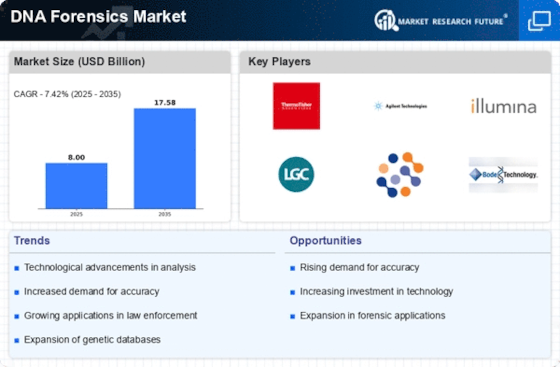
As per Market Research Future analysis, the DNA Forensics Market Size was estimated at 8.0 USD Billion in 2024. The DNA Forensics industry is projected to grow from 8.594 USD Billion in 2025 to 17.58 USD Billion by 2035, exhibiting a compound annual growth rate (CAGR) of 7.42% during the forecast period 2025 - 2035

Key Market Trends & Highlights

The DNA Forensics Market is experiencing robust growth driven by technological advancements and increasing public demand for justice.

  • North America remains the largest market for DNA forensics, driven by advanced technological infrastructure and regulatory support. The Asia-Pacific region is emerging as the fastest-growing market, fueled by rising crime rates and increased investment in forensic science. Analyzers and sequencers dominate the market, while software and services are witnessing the fastest growth due to evolving technological needs. Rising crime rates and public demand for justice are significant drivers propelling the expansion of the DNA forensics market.

Market Size & Forecast

2024 Market Size 8.0 (USD Billion)
2035 Market Size 17.58 (USD Billion)
CAGR (2025 - 2035) 7.42%
Largest Regional Market Share in 2024 North America

Major Players

Thermo Fisher Scientific (US), Agilent Technologies (US), Illumina (US), LGC Group (GB), Eurofins Scientific (LU), Bode Technology (US), Forensic DNA Services (US), Genetic Technologies Limited (AU), Promega Corporation (US)

Market Trends

The DNA Forensics Market is currently experiencing a transformative phase, driven by advancements in technology and an increasing emphasis on criminal justice. The integration of innovative techniques, such as next-generation sequencing and enhanced analytical methods, appears to be reshaping the landscape of forensic investigations. Law enforcement agencies are increasingly adopting these sophisticated tools to improve the accuracy and efficiency of DNA analysis, which may lead to more reliable outcomes in criminal cases. Furthermore, the growing awareness of the importance of genetic evidence in solving crimes is likely to bolster demand for DNA forensics services across various jurisdictions. In addition to technological advancements, the DNA Forensics Market is also influenced by regulatory changes and ethical considerations surrounding genetic data usage. As privacy concerns continue to rise, there is a pressing need for clear guidelines governing the collection and storage of DNA samples. This evolving regulatory environment may prompt companies to develop solutions that prioritize data security while maintaining the integrity of forensic analysis. Overall, the DNA Forensics Market is poised for growth, driven by innovation, regulatory adaptations, and an unwavering commitment to justice.

Technological Advancements

The DNA Forensics Market is witnessing rapid technological progress, particularly with the introduction of next-generation sequencing. This innovation enhances the precision of genetic analysis, enabling forensic experts to extract more information from smaller samples. As a result, law enforcement agencies are likely to adopt these advanced methodologies to improve case resolution rates.

Regulatory Developments

The evolving landscape of regulations surrounding DNA evidence is shaping the DNA Forensics Market. As governments implement stricter guidelines for the collection and use of genetic data, companies may need to adapt their practices to comply with these changes. This trend could lead to the emergence of new protocols that prioritize ethical considerations.

Increased Public Awareness

There is a growing public consciousness regarding the role of DNA evidence in criminal justice. This heightened awareness may drive demand for DNA forensics services, as individuals and communities recognize the potential of genetic analysis in solving crimes. Consequently, this trend could lead to increased funding and support for forensic initiatives.

DNA Forensics Market Market Drivers

Rising Crime Rates

The increasing incidence of crime, particularly violent crimes, has propelled the demand for advanced forensic technologies. As law enforcement agencies seek to solve cases more efficiently, the DNA Forensics Market is experiencing significant growth. In recent years, the number of homicides and sexual assaults has risen, leading to a greater reliance on DNA evidence for investigations. This trend is expected to continue, with the market projected to reach a valuation of approximately USD 3 billion by 2026. The need for accurate and reliable forensic analysis is paramount, as it not only aids in solving crimes but also in exonerating the innocent, thereby enhancing the credibility of the justice system.

Public Demand for Justice

The growing public demand for justice and accountability is a significant driver of the DNA Forensics Market. As society becomes more aware of wrongful convictions and the limitations of traditional investigative methods, there is an increasing expectation for law enforcement to utilize advanced forensic techniques. This demand is prompting agencies to adopt DNA analysis as a standard practice in criminal investigations. Public advocacy groups are also playing a role in pushing for reforms that prioritize the use of DNA evidence. Consequently, the market is likely to experience sustained growth, as the integration of DNA forensics into the justice system becomes more prevalent. This societal shift not only enhances the effectiveness of investigations but also fosters public trust in the criminal justice system.

Technological Innovations

Technological advancements in DNA analysis techniques are transforming the DNA Forensics Market. Innovations such as next-generation sequencing and rapid DNA testing are enhancing the speed and accuracy of forensic investigations. These technologies allow for the analysis of smaller DNA samples, which is particularly beneficial in cases where evidence is limited. The market is witnessing a shift towards automation and integration of artificial intelligence, which streamlines the analysis process and reduces human error. As these technologies become more accessible, the market is expected to expand, with a projected growth rate of over 10% annually. This evolution in technology not only improves forensic outcomes but also increases the efficiency of law enforcement agencies.

Legal and Regulatory Frameworks

The establishment of stringent legal and regulatory frameworks surrounding DNA evidence is a crucial driver for the DNA Forensics Market. Governments are increasingly recognizing the importance of DNA analysis in criminal justice, leading to the implementation of laws that mandate the use of DNA evidence in certain cases. This regulatory push is fostering a more standardized approach to forensic analysis, ensuring that laboratories adhere to best practices. As a result, the market is likely to see an influx of funding and resources directed towards enhancing forensic capabilities. The alignment of legal standards with technological advancements is expected to bolster the credibility of DNA evidence in court, further driving market growth.

Increased Investment in Forensic Science

There is a notable increase in investment in forensic science, which is significantly impacting the DNA Forensics Market. Governments and private entities are allocating more resources towards research and development in forensic technologies. This influx of funding is facilitating the development of innovative solutions that enhance the accuracy and efficiency of DNA analysis. Furthermore, partnerships between academic institutions and forensic laboratories are fostering knowledge exchange and technological advancements. As the demand for forensic services rises, this investment trend is likely to continue, with the market projected to grow at a compound annual growth rate of around 8% over the next five years. This financial commitment underscores the critical role of forensic science in modern law enforcement.

Market Segment Insights

By Type: Analyzers & Sequencer (Largest) vs. Software & Services (Fastest-Growing)

The DNA Forensics Market is diversified into several key segments, with Analyzers &amp; Sequencer emerging as the largest contributor, reflecting its essential role in forensic analysis. This segment encompasses advanced equipment crucial for DNA profiling, which significantly influences the overall efficiency of forensic investigations. On the other hand, Software &amp; Services are carving out a notable presence, gaining traction due to the increasing demand for integrated solutions that support data management and analysis in forensic applications.

Analyzers &amp; Sequencer (Dominant) vs. Software &amp; Services (Emerging)

In the DNA Forensics Market, Analyzers &amp; Sequencer hold a dominant position due to their critical function in DNA analysis. They are characterized by high precision and capability to process complex genetic data, making them indispensable in forensic labs. Conversely, Software &amp; Services represent an emerging segment, driven by the growing need for sophisticated data analytics and case management tools in forensic environments. These solutions enhance the capabilities of traditional analyzers by providing necessary support for interpretation and presentation of data, ultimately improving the turnaround time in investigations.

By Source: Blood (Largest) vs. Hair (Fastest-Growing)

Within the DNA Forensics Market, the source segment is predominantly characterized by <a href="https://www.marketresearchfuture.com/reports/blood-testing-market-5797">blood samples</a>, which command the largest market share due to their pivotal role in forensic investigations and legal proceedings. Blood provides rich genetic information that is crucial for various applications, including criminal identification and paternity testing. Hair samples, while representing a smaller portion of the market, are witnessing rapid growth as they are often more accessible for collection from crime scenes and personal belongings, contributing to their increasing adoption in forensic analyses. The growth trends in this segment are being influenced by several factors, particularly advancements in genetic testing technologies that improve the accuracy and efficiency of analysis. Furthermore, the rising awareness regarding DNA evidence in criminal justice and growing investments in forensic laboratories are driving demand for diverse sources in DNA sampling. Innovations in hair analysis techniques are set to propel its market share, making it an emerging contender in the forensics domain.

Blood (Dominant) vs. Hair (Emerging)

Blood stands as the dominant source in the DNA Forensics Market due to its comprehensive genetic data, which is crucial for substantiating evidence in legal cases. Its reliability and established methodologies for analysis solidify its position as the go-to source for forensic experts. However, hair is rapidly emerging as a notable alternative, gaining traction for its ease of collection and the ability to yield DNA when blood samples are unobtainable or compromised. The growing demand for non-invasive forensic techniques has led to innovations in hair analysis, enhancing its viability in investigations. These developments, combined with an increase in law enforcement agency training regarding hair forensic analysis, spotlight hair's growing importance alongside traditional blood sources.

By Technique: Next-generation Sequencing (Largest) vs. Capillary Electrophoresis (Fastest-Growing)

In the DNA forensics market, <a href="https://www.marketresearchfuture.com/reports/next-generation-sequencing-market-6354">Next-generation Sequencing (NGS)</a> currently holds the largest market share due to its ability to provide comprehensive genomic data with high accuracy and speed. Capillary Electrophoresis, while smaller in terms of market share, is gaining significant traction owing to its established techniques and reliable results in forensic analysis. The overall landscape is shaped by advancements in technology, increasing adoption of precision genomics, and a growing need for efficient forensic procedures. Growth trends in this segment are driven by the rising demand for more sophisticated forensic solutions that can handle complex biological samples. The expansion of NGS technology has revolutionized forensic science by enabling detailed individual analyses, while Capillary Electrophoresis is transitioning into innovative applications fueled by the integration of automation. These factors signal a robust growth trajectory for both techniques, with NGS leading the pack.

Technology: Next-generation Sequencing (Dominant) vs. Capillary Electrophoresis (Emerging)

Next-generation Sequencing (NGS) is leading the DNA forensics market as a dominant technology, known for its high throughput and precision in analyzing vast amounts of genetic data. NGS enables forensic analysts to identify genetic variations more rapidly, making it ideal for complex cases. On the other hand, Capillary Electrophoresis is increasingly recognized as an emerging technology that offers reliability and is widely accepted in forensic labs. It is particularly favored for analyzing short tandem repeats (STRs), critical for DNA profiling. As the demand for efficient forensic tools grows, both NGS and Capillary Electrophoresis are carving out important niches in the market, with NGS setting the standard for advanced analysis while Capillary Electrophoresis adapts to modern needs.

By Application: Criminal Casework (Largest) vs. Missing Person Identification (Fastest-Growing)

In the DNA Forensics Market, the application segment is predominantly led by Criminal Casework, which holds the largest share. This is primarily due to the increasing number of criminal investigations that rely heavily on DNA evidence for solving cases. Criminal Casework encompasses various forensic activities, such as analyzing biological samples collected from crime scenes, which further consolidates its position as the leading application area. Missing Person Identification follows as a significant but smaller segment in terms of market share, while also experiencing rapid growth due to heightened public and governmental interest in utilizing DNA technology to locate missing individuals and resolve unidentified body cases.

Criminal Casework (Dominant) vs. Missing Person Identification (Emerging)

Criminal Casework remains the dominant application in the DNA Forensics Market due to its essential role in law enforcement and criminal justice. The reliance on DNA analysis to provide compelling evidence in trials has reinforced its significant market position. In contrast, Missing Person Identification is carving out an emerging niche, driven by advancements in DNA technology that enhance accuracy and speed in identifying missing individuals. As public awareness increases and governments prioritize the use of scientific methods in these cases, the growth potential for Missing Person Identification is robust. The different dynamics between these segments underscore the necessity for ongoing innovation and adaptation in the DNA forensics landscape.

Get more detailed insights about DNA Forensics Market Research Report—Global Forecast till 2035

Regional Insights

North America : Innovation and Leadership Hub

North America is the largest market for DNA forensics, holding approximately 45% of the global share. The region's growth is driven by advancements in technology, increasing criminal investigations, and stringent regulations promoting forensic analysis. The demand for DNA testing in law enforcement and legal proceedings is on the rise, supported by government funding and initiatives aimed at improving forensic capabilities. The United States is the leading country in this sector, with key players like Thermo Fisher Scientific, Agilent Technologies, and Illumina dominating the market. The competitive landscape is characterized by continuous innovation and partnerships among companies to enhance product offerings. Canada also plays a significant role, contributing to the market with its growing forensic science initiatives and collaborations with U.S. firms.

Europe : Regulatory Framework and Growth

Europe is witnessing significant growth in the DNA forensics market, accounting for approximately 30% of the global share. The region benefits from robust regulatory frameworks that mandate DNA testing in criminal cases, driving demand for advanced forensic technologies. Countries are increasingly investing in forensic science to enhance public safety and streamline criminal investigations, further propelling market growth. Leading countries in Europe include the United Kingdom, Germany, and France, where companies like LGC Group and Eurofins Scientific are prominent. The competitive landscape is marked by collaborations between public institutions and private firms to develop innovative solutions. The European Union's commitment to improving forensic standards and practices is a key driver of market expansion.

Asia-Pacific : Rapidly Growing Forensic Sector

Asia-Pacific is rapidly emerging as a significant player in the DNA forensics market, holding about 20% of the global share. The region's growth is fueled by increasing criminal activities, government initiatives to enhance forensic capabilities, and rising public awareness about the importance of DNA testing. Countries are investing in advanced technologies to improve their forensic analysis processes, contributing to market expansion. China, India, and Australia are the leading countries in this region, with a growing number of forensic laboratories and research institutions. Key players like Genetic Technologies Limited and Bode Technology are expanding their presence in the market. The competitive landscape is evolving, with collaborations between governments and private sectors to enhance forensic science capabilities and address the rising demand for DNA testing.

Middle East and Africa : Emerging Forensic Landscape

The Middle East and Africa region is in the early stages of developing its DNA forensics market, currently holding about 5% of the global share. The growth is driven by increasing investments in law enforcement and forensic science, alongside rising awareness of the importance of DNA evidence in criminal justice. Governments are beginning to implement regulations that support the establishment of forensic laboratories and enhance investigative capabilities. Countries like South Africa and the United Arab Emirates are leading the way in adopting DNA forensics technologies. The competitive landscape is characterized by a mix of local and international players, with companies looking to establish partnerships to improve forensic services. As the region continues to develop its forensic infrastructure, the demand for DNA testing is expected to rise significantly.

Key Players and Competitive Insights

The DNA Forensics Market is currently characterized by a dynamic competitive landscape, driven by technological advancements and increasing demand for forensic analysis in criminal investigations and paternity testing. Key players such as Thermo Fisher Scientific (US), Agilent Technologies (US), and Illumina (US) are at the forefront, leveraging innovation and strategic partnerships to enhance their market positions. These companies are focusing on expanding their product portfolios and improving the efficiency of their forensic solutions, which collectively shapes a competitive environment that is both collaborative and competitive.

In terms of business tactics, companies are increasingly localizing manufacturing and optimizing their supply chains to respond swiftly to market demands. The market structure appears moderately fragmented, with several players vying for market share. However, the influence of major companies like Eurofins Scientific (LU) and Bode Technology (US) is significant, as they continue to set benchmarks in quality and service delivery, thereby impacting the overall competitive dynamics.

In August 2025, Thermo Fisher Scientific (US) announced the launch of a new line of rapid DNA analysis kits aimed at enhancing the speed and accuracy of forensic investigations. This strategic move is likely to bolster their market share by addressing the urgent need for timely forensic results, which is critical in law enforcement scenarios. The introduction of these kits not only reflects their commitment to innovation but also positions them as a leader in the fast-evolving DNA forensics sector.

In September 2025, Agilent Technologies (US) expanded its collaboration with law enforcement agencies to provide advanced genomic analysis tools. This partnership is expected to enhance the capabilities of forensic labs, allowing for more comprehensive investigations. By aligning with key stakeholders in the criminal justice system, Agilent is strategically positioning itself to capture a larger share of the market, while also contributing to the advancement of forensic science.

In July 2025, Illumina (US) unveiled a new software platform designed to streamline the analysis of DNA samples in forensic applications. This platform integrates artificial intelligence to improve data interpretation, which could significantly reduce the time required for forensic analysis. The strategic importance of this development lies in its potential to enhance the accuracy and efficiency of forensic investigations, thereby reinforcing Illumina's competitive edge in the market.

As of October 2025, the DNA Forensics Market is witnessing trends such as digitalization, sustainability, and the integration of artificial intelligence, which are redefining competitive strategies. Strategic alliances among key players are becoming increasingly prevalent, fostering innovation and enhancing service offerings. Looking ahead, it appears that competitive differentiation will likely evolve from traditional price-based competition to a focus on technological innovation, reliability in supply chains, and the ability to deliver rapid, accurate results.

Key Companies in the DNA Forensics Market include

Industry Developments

    • In June 2021, QIAGEN N.V. (Netherlands) partnered with Verogen (San Diego), a human identification specialist. The partnership brought exhaustive support and superior tools. It provides top-notch consequences with regard to human identification, which ultimately adds value to the market.
    • In September 2020, Oxygen Forensics, Inc. (Virginia) launched a new software product flagged by software company JetEngine Technology Corp. (US), namely Oxygen Forensic Detective v.13.0. This allows investigators to apply AI to the clear images for identification.
    • In January 2019, Inqaba Biotec (Nigeria) partnered with the University of the Western Cape (South Africa) and launched UniQ-Typer, a forensic detection kit.
    • In September 2018, Mawi DNA Technologies LLC (US) launched iSWAB-Cells, which are designed to collect and stabilise intact cells for up to four weeks at room temperature.
    • In February 2018, Hamilton Company (US) launched the ID NIMBUS assay in order to automate post-PCR sample processing with the help of the ForenSeq DNA Signature Prep Kit from Verogen (UK).

DNA Forensics Market

Future Outlook

DNA Forensics Market Future Outlook

The DNA Forensics Market is projected to grow at a 7.42% CAGR from 2025 to 2035, driven by technological advancements, increasing crime rates, and rising demand for genetic testing.

New opportunities lie in:

  • Development of portable DNA analysis devices for field use.
  • Expansion of partnerships with law enforcement agencies for integrated solutions.
  • Investment in AI-driven data analysis tools for enhanced forensic insights.

By 2035, the DNA Forensics Market is expected to be robust, driven by innovation and strategic collaborations.

Market Segmentation

DNA Forensics Market Type Outlook

  • Analyzers & Sequencer
  • Software & Services
  • Consumables

DNA Forensics Market Source Outlook

  • Hair
  • Blood
  • Bones
  • Others

DNA Forensics Market Technique Outlook

  • Next-generation Sequencing
  • Capillary Electrophoresis
  • PCR Amplification

DNA Forensics Market Application Outlook

  • Criminal Casework
  • Missing Person Identification
  • Others

Report Scope

MARKET SIZE 2024 8.0(USD Billion)
MARKET SIZE 2025 8.594(USD Billion)
MARKET SIZE 2035 17.58(USD Billion)
COMPOUND ANNUAL GROWTH RATE (CAGR) 7.42% (2025 - 2035)
REPORT COVERAGE Revenue Forecast, Competitive Landscape, Growth Factors, and Trends
BASE YEAR 2024
Market Forecast Period 2025 - 2035
Historical Data 2019 - 2024
Market Forecast Units USD Billion
Key Companies Profiled Thermo Fisher Scientific (US), Agilent Technologies (US), Illumina (US), LGC Group (GB), Eurofins Scientific (LU), Bode Technology (US), Forensic DNA Services (US), Genetic Technologies Limited (AU), Promega Corporation (US)
Segments Covered Product Type, Source, Technique, Applications, Region
Key Market Opportunities Advancements in rapid DNA analysis technologies enhance efficiency in criminal investigations within the DNA Forensics Market.
Key Market Dynamics Technological advancements and regulatory changes drive innovation and competition in the DNA forensics market.
Countries Covered North America, Europe, APAC, South America, MEA

FAQs

What is the projected market valuation of the DNA Forensics Market by 2035?

<p>The DNA Forensics Market is projected to reach a valuation of 17.58 USD Billion by 2035.</p>

What was the market valuation of the DNA Forensics Market in 2024?

<p>In 2024, the DNA Forensics Market was valued at 8.0 USD Billion.</p>

What is the expected CAGR for the DNA Forensics Market during the forecast period 2025 - 2035?

<p>The expected CAGR for the DNA Forensics Market during the forecast period 2025 - 2035 is 7.42%.</p>

Which companies are considered key players in the DNA Forensics Market?

<p>Key players in the DNA Forensics Market include Thermo Fisher Scientific, Agilent Technologies, and Illumina, among others.</p>

What are the main segments of the DNA Forensics Market?

<p>The main segments of the DNA Forensics Market include Type, Source, Technique, and Application.</p>

How much is the 'Consumables' segment projected to grow by 2035?

The 'Consumables' segment is projected to grow from 2.8 USD Billion in 2024 to 5.58 USD Billion by 2035.

What is the projected growth for the 'Blood' source segment by 2035?

The 'Blood' source segment is expected to increase from 3.2 USD Billion in 2024 to 7.02 USD Billion by 2035.

Which technique is anticipated to dominate the DNA Forensics Market by 2035?

The 'Capillary Electrophoresis' technique is anticipated to grow from 3.2 USD Billion in 2024 to 7.0 USD Billion by 2035.

What applications are driving growth in the DNA Forensics Market?

Applications such as Criminal Casework and Missing Person Identification are driving growth in the DNA Forensics Market.

What is the projected valuation for the 'Software & Services' segment by 2035?

The 'Software &amp; Services' segment is projected to grow from 2.8 USD Billion in 2024 to 6.5 USD Billion by 2035.

  1. SECTION I: EXECUTIVE SUMMARY AND KEY HIGHLIGHTS
    1. | 1.1 EXECUTIVE SUMMARY
    2. | | 1.1.1 Market Overview
    3. | | 1.1.2 Key Findings
    4. | | 1.1.3 Market Segmentation
    5. | | 1.1.4 Competitive Landscape
    6. | | 1.1.5 Challenges and Opportunities
    7. | | 1.1.6 Future Outlook
  2. SECTION II: SCOPING, METHODOLOGY AND MARKET STRUCTURE
    1. | 2.1 MARKET INTRODUCTION
    2. | | 2.1.1 Definition
    3. | | 2.1.2 Scope of the study
    4. | | | 2.1.2.1 Research Objective
    5. | | | 2.1.2.2 Assumption
    6. | | | 2.1.2.3 Limitations
    7. | 2.2 RESEARCH METHODOLOGY
    8. | | 2.2.1 Overview
    9. | | 2.2.2 Data Mining
    10. | | 2.2.3 Secondary Research
    11. | | 2.2.4 Primary Research
    12. | | | 2.2.4.1 Primary Interviews and Information Gathering Process
    13. | | | 2.2.4.2 Breakdown of Primary Respondents
    14. | | 2.2.5 Forecasting Model
    15. | | 2.2.6 Market Size Estimation
    16. | | | 2.2.6.1 Bottom-Up Approach
    17. | | | 2.2.6.2 Top-Down Approach
    18. | | 2.2.7 Data Triangulation
    19. | | 2.2.8 Validation
  3. SECTION III: QUALITATIVE ANALYSIS
    1. | 3.1 MARKET DYNAMICS
    2. | | 3.1.1 Overview
    3. | | 3.1.2 Drivers
    4. | | 3.1.3 Restraints
    5. | | 3.1.4 Opportunities
    6. | 3.2 MARKET FACTOR ANALYSIS
    7. | | 3.2.1 Value chain Analysis
    8. | | 3.2.2 Porter's Five Forces Analysis
    9. | | | 3.2.2.1 Bargaining Power of Suppliers
    10. | | | 3.2.2.2 Bargaining Power of Buyers
    11. | | | 3.2.2.3 Threat of New Entrants
    12. | | | 3.2.2.4 Threat of Substitutes
    13. | | | 3.2.2.5 Intensity of Rivalry
    14. | | 3.2.3 COVID-19 Impact Analysis
    15. | | | 3.2.3.1 Market Impact Analysis
    16. | | | 3.2.3.2 Regional Impact
    17. | | | 3.2.3.3 Opportunity and Threat Analysis
  4. SECTION IV: QUANTITATIVE ANALYSIS
    1. | 4.1 Healthcare, BY Type (USD Billion)
    2. | | 4.1.1 Analyzers & Sequencer
    3. | | 4.1.2 Software & Services
    4. | | 4.1.3 Consumables
    5. | 4.2 Healthcare, BY Source (USD Billion)
    6. | | 4.2.1 Hair
    7. | | 4.2.2 Blood
    8. | | 4.2.3 Bones
    9. | | 4.2.4 Others
    10. | 4.3 Healthcare, BY Technique (USD Billion)
    11. | | 4.3.1 Next-generation Sequencing
    12. | | 4.3.2 Capillary Electrophoresis
    13. | | 4.3.3 PCR Amplification
    14. | 4.4 Healthcare, BY Application (USD Billion)
    15. | | 4.4.1 Criminal Casework
    16. | | 4.4.2 Missing Person Identification
    17. | | 4.4.3 Others
    18. | 4.5 Healthcare, BY Region (USD Billion)
    19. | | 4.5.1 North America
    20. | | | 4.5.1.1 US
    21. | | | 4.5.1.2 Canada
    22. | | 4.5.2 Europe
    23. | | | 4.5.2.1 Germany
    24. | | | 4.5.2.2 UK
    25. | | | 4.5.2.3 France
    26. | | | 4.5.2.4 Russia
    27. | | | 4.5.2.5 Italy
    28. | | | 4.5.2.6 Spain
    29. | | | 4.5.2.7 Rest of Europe
    30. | | 4.5.3 APAC
    31. | | | 4.5.3.1 China
    32. | | | 4.5.3.2 India
    33. | | | 4.5.3.3 Japan
    34. | | | 4.5.3.4 South Korea
    35. | | | 4.5.3.5 Malaysia
    36. | | | 4.5.3.6 Thailand
    37. | | | 4.5.3.7 Indonesia
    38. | | | 4.5.3.8 Rest of APAC
    39. | | 4.5.4 South America
    40. | | | 4.5.4.1 Brazil
    41. | | | 4.5.4.2 Mexico
    42. | | | 4.5.4.3 Argentina
    43. | | | 4.5.4.4 Rest of South America
    44. | | 4.5.5 MEA
    45. | | | 4.5.5.1 GCC Countries
    46. | | | 4.5.5.2 South Africa
    47. | | | 4.5.5.3 Rest of MEA
  5. SECTION V: COMPETITIVE ANALYSIS
    1. | 5.1 Competitive Landscape
    2. | | 5.1.1 Overview
    3. | | 5.1.2 Competitive Analysis
    4. | | 5.1.3 Market share Analysis
    5. | | 5.1.4 Major Growth Strategy in the Healthcare
    6. | | 5.1.5 Competitive Benchmarking
    7. | | 5.1.6 Leading Players in Terms of Number of Developments in the Healthcare
    8. | | 5.1.7 Key developments and growth strategies
    9. | | | 5.1.7.1 New Product Launch/Service Deployment
    10. | | | 5.1.7.2 Merger & Acquisitions
    11. | | | 5.1.7.3 Joint Ventures
    12. | | 5.1.8 Major Players Financial Matrix
    13. | | | 5.1.8.1 Sales and Operating Income
    14. | | | 5.1.8.2 Major Players R&D Expenditure. 2023
    15. | 5.2 Company Profiles
    16. | | 5.2.1 Thermo Fisher Scientific (US)
    17. | | | 5.2.1.1 Financial Overview
    18. | | | 5.2.1.2 Products Offered
    19. | | | 5.2.1.3 Key Developments
    20. | | | 5.2.1.4 SWOT Analysis
    21. | | | 5.2.1.5 Key Strategies
    22. | | 5.2.2 Agilent Technologies (US)
    23. | | | 5.2.2.1 Financial Overview
    24. | | | 5.2.2.2 Products Offered
    25. | | | 5.2.2.3 Key Developments
    26. | | | 5.2.2.4 SWOT Analysis
    27. | | | 5.2.2.5 Key Strategies
    28. | | 5.2.3 Illumina (US)
    29. | | | 5.2.3.1 Financial Overview
    30. | | | 5.2.3.2 Products Offered
    31. | | | 5.2.3.3 Key Developments
    32. | | | 5.2.3.4 SWOT Analysis
    33. | | | 5.2.3.5 Key Strategies
    34. | | 5.2.4 LGC Group (GB)
    35. | | | 5.2.4.1 Financial Overview
    36. | | | 5.2.4.2 Products Offered
    37. | | | 5.2.4.3 Key Developments
    38. | | | 5.2.4.4 SWOT Analysis
    39. | | | 5.2.4.5 Key Strategies
    40. | | 5.2.5 Eurofins Scientific (LU)
    41. | | | 5.2.5.1 Financial Overview
    42. | | | 5.2.5.2 Products Offered
    43. | | | 5.2.5.3 Key Developments
    44. | | | 5.2.5.4 SWOT Analysis
    45. | | | 5.2.5.5 Key Strategies
    46. | | 5.2.6 Bode Technology (US)
    47. | | | 5.2.6.1 Financial Overview
    48. | | | 5.2.6.2 Products Offered
    49. | | | 5.2.6.3 Key Developments
    50. | | | 5.2.6.4 SWOT Analysis
    51. | | | 5.2.6.5 Key Strategies
    52. | | 5.2.7 Forensic DNA Services (US)
    53. | | | 5.2.7.1 Financial Overview
    54. | | | 5.2.7.2 Products Offered
    55. | | | 5.2.7.3 Key Developments
    56. | | | 5.2.7.4 SWOT Analysis
    57. | | | 5.2.7.5 Key Strategies
    58. | | 5.2.8 Genetic Technologies Limited (AU)
    59. | | | 5.2.8.1 Financial Overview
    60. | | | 5.2.8.2 Products Offered
    61. | | | 5.2.8.3 Key Developments
    62. | | | 5.2.8.4 SWOT Analysis
    63. | | | 5.2.8.5 Key Strategies
    64. | | 5.2.9 Promega Corporation (US)
    65. | | | 5.2.9.1 Financial Overview
    66. | | | 5.2.9.2 Products Offered
    67. | | | 5.2.9.3 Key Developments
    68. | | | 5.2.9.4 SWOT Analysis
    69. | | | 5.2.9.5 Key Strategies
    70. | 5.3 Appendix
    71. | | 5.3.1 References
    72. | | 5.3.2 Related Reports
  6. LIST OF FIGURES
    1. | 6.1 MARKET SYNOPSIS
    2. | 6.2 NORTH AMERICA MARKET ANALYSIS
    3. | 6.3 US MARKET ANALYSIS BY TYPE
    4. | 6.4 US MARKET ANALYSIS BY SOURCE
    5. | 6.5 US MARKET ANALYSIS BY TECHNIQUE
    6. | 6.6 US MARKET ANALYSIS BY APPLICATION
    7. | 6.7 CANADA MARKET ANALYSIS BY TYPE
    8. | 6.8 CANADA MARKET ANALYSIS BY SOURCE
    9. | 6.9 CANADA MARKET ANALYSIS BY TECHNIQUE
    10. | 6.10 CANADA MARKET ANALYSIS BY APPLICATION
    11. | 6.11 EUROPE MARKET ANALYSIS
    12. | 6.12 GERMANY MARKET ANALYSIS BY TYPE
    13. | 6.13 GERMANY MARKET ANALYSIS BY SOURCE
    14. | 6.14 GERMANY MARKET ANALYSIS BY TECHNIQUE
    15. | 6.15 GERMANY MARKET ANALYSIS BY APPLICATION
    16. | 6.16 UK MARKET ANALYSIS BY TYPE
    17. | 6.17 UK MARKET ANALYSIS BY SOURCE
    18. | 6.18 UK MARKET ANALYSIS BY TECHNIQUE
    19. | 6.19 UK MARKET ANALYSIS BY APPLICATION
    20. | 6.20 FRANCE MARKET ANALYSIS BY TYPE
    21. | 6.21 FRANCE MARKET ANALYSIS BY SOURCE
    22. | 6.22 FRANCE MARKET ANALYSIS BY TECHNIQUE
    23. | 6.23 FRANCE MARKET ANALYSIS BY APPLICATION
    24. | 6.24 RUSSIA MARKET ANALYSIS BY TYPE
    25. | 6.25 RUSSIA MARKET ANALYSIS BY SOURCE
    26. | 6.26 RUSSIA MARKET ANALYSIS BY TECHNIQUE
    27. | 6.27 RUSSIA MARKET ANALYSIS BY APPLICATION
    28. | 6.28 ITALY MARKET ANALYSIS BY TYPE
    29. | 6.29 ITALY MARKET ANALYSIS BY SOURCE
    30. | 6.30 ITALY MARKET ANALYSIS BY TECHNIQUE
    31. | 6.31 ITALY MARKET ANALYSIS BY APPLICATION
    32. | 6.32 SPAIN MARKET ANALYSIS BY TYPE
    33. | 6.33 SPAIN MARKET ANALYSIS BY SOURCE
    34. | 6.34 SPAIN MARKET ANALYSIS BY TECHNIQUE
    35. | 6.35 SPAIN MARKET ANALYSIS BY APPLICATION
    36. | 6.36 REST OF EUROPE MARKET ANALYSIS BY TYPE
    37. | 6.37 REST OF EUROPE MARKET ANALYSIS BY SOURCE
    38. | 6.38 REST OF EUROPE MARKET ANALYSIS BY TECHNIQUE
    39. | 6.39 REST OF EUROPE MARKET ANALYSIS BY APPLICATION
    40. | 6.40 APAC MARKET ANALYSIS
    41. | 6.41 CHINA MARKET ANALYSIS BY TYPE
    42. | 6.42 CHINA MARKET ANALYSIS BY SOURCE
    43. | 6.43 CHINA MARKET ANALYSIS BY TECHNIQUE
    44. | 6.44 CHINA MARKET ANALYSIS BY APPLICATION
    45. | 6.45 INDIA MARKET ANALYSIS BY TYPE
    46. | 6.46 INDIA MARKET ANALYSIS BY SOURCE
    47. | 6.47 INDIA MARKET ANALYSIS BY TECHNIQUE
    48. | 6.48 INDIA MARKET ANALYSIS BY APPLICATION
    49. | 6.49 JAPAN MARKET ANALYSIS BY TYPE
    50. | 6.50 JAPAN MARKET ANALYSIS BY SOURCE
    51. | 6.51 JAPAN MARKET ANALYSIS BY TECHNIQUE
    52. | 6.52 JAPAN MARKET ANALYSIS BY APPLICATION
    53. | 6.53 SOUTH KOREA MARKET ANALYSIS BY TYPE
    54. | 6.54 SOUTH KOREA MARKET ANALYSIS BY SOURCE
    55. | 6.55 SOUTH KOREA MARKET ANALYSIS BY TECHNIQUE
    56. | 6.56 SOUTH KOREA MARKET ANALYSIS BY APPLICATION
    57. | 6.57 MALAYSIA MARKET ANALYSIS BY TYPE
    58. | 6.58 MALAYSIA MARKET ANALYSIS BY SOURCE
    59. | 6.59 MALAYSIA MARKET ANALYSIS BY TECHNIQUE
    60. | 6.60 MALAYSIA MARKET ANALYSIS BY APPLICATION
    61. | 6.61 THAILAND MARKET ANALYSIS BY TYPE
    62. | 6.62 THAILAND MARKET ANALYSIS BY SOURCE
    63. | 6.63 THAILAND MARKET ANALYSIS BY TECHNIQUE
    64. | 6.64 THAILAND MARKET ANALYSIS BY APPLICATION
    65. | 6.65 INDONESIA MARKET ANALYSIS BY TYPE
    66. | 6.66 INDONESIA MARKET ANALYSIS BY SOURCE
    67. | 6.67 INDONESIA MARKET ANALYSIS BY TECHNIQUE
    68. | 6.68 INDONESIA MARKET ANALYSIS BY APPLICATION
    69. | 6.69 REST OF APAC MARKET ANALYSIS BY TYPE
    70. | 6.70 REST OF APAC MARKET ANALYSIS BY SOURCE
    71. | 6.71 REST OF APAC MARKET ANALYSIS BY TECHNIQUE
    72. | 6.72 REST OF APAC MARKET ANALYSIS BY APPLICATION
    73. | 6.73 SOUTH AMERICA MARKET ANALYSIS
    74. | 6.74 BRAZIL MARKET ANALYSIS BY TYPE
    75. | 6.75 BRAZIL MARKET ANALYSIS BY SOURCE
    76. | 6.76 BRAZIL MARKET ANALYSIS BY TECHNIQUE
    77. | 6.77 BRAZIL MARKET ANALYSIS BY APPLICATION
    78. | 6.78 MEXICO MARKET ANALYSIS BY TYPE
    79. | 6.79 MEXICO MARKET ANALYSIS BY SOURCE
    80. | 6.80 MEXICO MARKET ANALYSIS BY TECHNIQUE
    81. | 6.81 MEXICO MARKET ANALYSIS BY APPLICATION
    82. | 6.82 ARGENTINA MARKET ANALYSIS BY TYPE
    83. | 6.83 ARGENTINA MARKET ANALYSIS BY SOURCE
    84. | 6.84 ARGENTINA MARKET ANALYSIS BY TECHNIQUE
    85. | 6.85 ARGENTINA MARKET ANALYSIS BY APPLICATION
    86. | 6.86 REST OF SOUTH AMERICA MARKET ANALYSIS BY TYPE
    87. | 6.87 REST OF SOUTH AMERICA MARKET ANALYSIS BY SOURCE
    88. | 6.88 REST OF SOUTH AMERICA MARKET ANALYSIS BY TECHNIQUE
    89. | 6.89 REST OF SOUTH AMERICA MARKET ANALYSIS BY APPLICATION
    90. | 6.90 MEA MARKET ANALYSIS
    91. | 6.91 GCC COUNTRIES MARKET ANALYSIS BY TYPE
    92. | 6.92 GCC COUNTRIES MARKET ANALYSIS BY SOURCE
    93. | 6.93 GCC COUNTRIES MARKET ANALYSIS BY TECHNIQUE
    94. | 6.94 GCC COUNTRIES MARKET ANALYSIS BY APPLICATION
    95. | 6.95 SOUTH AFRICA MARKET ANALYSIS BY TYPE
    96. | 6.96 SOUTH AFRICA MARKET ANALYSIS BY SOURCE
    97. | 6.97 SOUTH AFRICA MARKET ANALYSIS BY TECHNIQUE
    98. | 6.98 SOUTH AFRICA MARKET ANALYSIS BY APPLICATION
    99. | 6.99 REST OF MEA MARKET ANALYSIS BY TYPE
    100. | 6.100 REST OF MEA MARKET ANALYSIS BY SOURCE
    101. | 6.101 REST OF MEA MARKET ANALYSIS BY TECHNIQUE
    102. | 6.102 REST OF MEA MARKET ANALYSIS BY APPLICATION
    103. | 6.103 KEY BUYING CRITERIA OF HEALTHCARE
    104. | 6.104 RESEARCH PROCESS OF MRFR
    105. | 6.105 DRO ANALYSIS OF HEALTHCARE
    106. | 6.106 DRIVERS IMPACT ANALYSIS: HEALTHCARE
    107. | 6.107 RESTRAINTS IMPACT ANALYSIS: HEALTHCARE
    108. | 6.108 SUPPLY / VALUE CHAIN: HEALTHCARE
    109. | 6.109 HEALTHCARE, BY TYPE, 2024 (% SHARE)
    110. | 6.110 HEALTHCARE, BY TYPE, 2024 TO 2035 (USD Billion)
    111. | 6.111 HEALTHCARE, BY SOURCE, 2024 (% SHARE)
    112. | 6.112 HEALTHCARE, BY SOURCE, 2024 TO 2035 (USD Billion)
    113. | 6.113 HEALTHCARE, BY TECHNIQUE, 2024 (% SHARE)
    114. | 6.114 HEALTHCARE, BY TECHNIQUE, 2024 TO 2035 (USD Billion)
    115. | 6.115 HEALTHCARE, BY APPLICATION, 2024 (% SHARE)
    116. | 6.116 HEALTHCARE, BY APPLICATION, 2024 TO 2035 (USD Billion)
    117. | 6.117 BENCHMARKING OF MAJOR COMPETITORS
  7. LIST OF TABLES
    1. | 7.1 LIST OF ASSUMPTIONS
    2. | | 7.1.1
    3. | 7.2 North America MARKET SIZE ESTIMATES; FORECAST
    4. | | 7.2.1 BY TYPE, 2025-2035 (USD Billion)
    5. | | 7.2.2 BY SOURCE, 2025-2035 (USD Billion)
    6. | | 7.2.3 BY TECHNIQUE, 2025-2035 (USD Billion)
    7. | | 7.2.4 BY APPLICATION, 2025-2035 (USD Billion)
    8. | 7.3 US MARKET SIZE ESTIMATES; FORECAST
    9. | | 7.3.1 BY TYPE, 2025-2035 (USD Billion)
    10. | | 7.3.2 BY SOURCE, 2025-2035 (USD Billion)
    11. | | 7.3.3 BY TECHNIQUE, 2025-2035 (USD Billion)
    12. | | 7.3.4 BY APPLICATION, 2025-2035 (USD Billion)
    13. | 7.4 Canada MARKET SIZE ESTIMATES; FORECAST
    14. | | 7.4.1 BY TYPE, 2025-2035 (USD Billion)
    15. | | 7.4.2 BY SOURCE, 2025-2035 (USD Billion)
    16. | | 7.4.3 BY TECHNIQUE, 2025-2035 (USD Billion)
    17. | | 7.4.4 BY APPLICATION, 2025-2035 (USD Billion)
    18. | 7.5 Europe MARKET SIZE ESTIMATES; FORECAST
    19. | | 7.5.1 BY TYPE, 2025-2035 (USD Billion)
    20. | | 7.5.2 BY SOURCE, 2025-2035 (USD Billion)
    21. | | 7.5.3 BY TECHNIQUE, 2025-2035 (USD Billion)
    22. | | 7.5.4 BY APPLICATION, 2025-2035 (USD Billion)
    23. | 7.6 Germany MARKET SIZE ESTIMATES; FORECAST
    24. | | 7.6.1 BY TYPE, 2025-2035 (USD Billion)
    25. | | 7.6.2 BY SOURCE, 2025-2035 (USD Billion)
    26. | | 7.6.3 BY TECHNIQUE, 2025-2035 (USD Billion)
    27. | | 7.6.4 BY APPLICATION, 2025-2035 (USD Billion)
    28. | 7.7 UK MARKET SIZE ESTIMATES; FORECAST
    29. | | 7.7.1 BY TYPE, 2025-2035 (USD Billion)
    30. | | 7.7.2 BY SOURCE, 2025-2035 (USD Billion)
    31. | | 7.7.3 BY TECHNIQUE, 2025-2035 (USD Billion)
    32. | | 7.7.4 BY APPLICATION, 2025-2035 (USD Billion)
    33. | 7.8 France MARKET SIZE ESTIMATES; FORECAST
    34. | | 7.8.1 BY TYPE, 2025-2035 (USD Billion)
    35. | | 7.8.2 BY SOURCE, 2025-2035 (USD Billion)
    36. | | 7.8.3 BY TECHNIQUE, 2025-2035 (USD Billion)
    37. | | 7.8.4 BY APPLICATION, 2025-2035 (USD Billion)
    38. | 7.9 Russia MARKET SIZE ESTIMATES; FORECAST
    39. | | 7.9.1 BY TYPE, 2025-2035 (USD Billion)
    40. | | 7.9.2 BY SOURCE, 2025-2035 (USD Billion)
    41. | | 7.9.3 BY TECHNIQUE, 2025-2035 (USD Billion)
    42. | | 7.9.4 BY APPLICATION, 2025-2035 (USD Billion)
    43. | 7.10 Italy MARKET SIZE ESTIMATES; FORECAST
    44. | | 7.10.1 BY TYPE, 2025-2035 (USD Billion)
    45. | | 7.10.2 BY SOURCE, 2025-2035 (USD Billion)
    46. | | 7.10.3 BY TECHNIQUE, 2025-2035 (USD Billion)
    47. | | 7.10.4 BY APPLICATION, 2025-2035 (USD Billion)
    48. | 7.11 Spain MARKET SIZE ESTIMATES; FORECAST
    49. | | 7.11.1 BY TYPE, 2025-2035 (USD Billion)
    50. | | 7.11.2 BY SOURCE, 2025-2035 (USD Billion)
    51. | | 7.11.3 BY TECHNIQUE, 2025-2035 (USD Billion)
    52. | | 7.11.4 BY APPLICATION, 2025-2035 (USD Billion)
    53. | 7.12 Rest of Europe MARKET SIZE ESTIMATES; FORECAST
    54. | | 7.12.1 BY TYPE, 2025-2035 (USD Billion)
    55. | | 7.12.2 BY SOURCE, 2025-2035 (USD Billion)
    56. | | 7.12.3 BY TECHNIQUE, 2025-2035 (USD Billion)
    57. | | 7.12.4 BY APPLICATION, 2025-2035 (USD Billion)
    58. | 7.13 APAC MARKET SIZE ESTIMATES; FORECAST
    59. | | 7.13.1 BY TYPE, 2025-2035 (USD Billion)
    60. | | 7.13.2 BY SOURCE, 2025-2035 (USD Billion)
    61. | | 7.13.3 BY TECHNIQUE, 2025-2035 (USD Billion)
    62. | | 7.13.4 BY APPLICATION, 2025-2035 (USD Billion)
    63. | 7.14 China MARKET SIZE ESTIMATES; FORECAST
    64. | | 7.14.1 BY TYPE, 2025-2035 (USD Billion)
    65. | | 7.14.2 BY SOURCE, 2025-2035 (USD Billion)
    66. | | 7.14.3 BY TECHNIQUE, 2025-2035 (USD Billion)
    67. | | 7.14.4 BY APPLICATION, 2025-2035 (USD Billion)
    68. | 7.15 India MARKET SIZE ESTIMATES; FORECAST
    69. | | 7.15.1 BY TYPE, 2025-2035 (USD Billion)
    70. | | 7.15.2 BY SOURCE, 2025-2035 (USD Billion)
    71. | | 7.15.3 BY TECHNIQUE, 2025-2035 (USD Billion)
    72. | | 7.15.4 BY APPLICATION, 2025-2035 (USD Billion)
    73. | 7.16 Japan MARKET SIZE ESTIMATES; FORECAST
    74. | | 7.16.1 BY TYPE, 2025-2035 (USD Billion)
    75. | | 7.16.2 BY SOURCE, 2025-2035 (USD Billion)
    76. | | 7.16.3 BY TECHNIQUE, 2025-2035 (USD Billion)
    77. | | 7.16.4 BY APPLICATION, 2025-2035 (USD Billion)
    78. | 7.17 South Korea MARKET SIZE ESTIMATES; FORECAST
    79. | | 7.17.1 BY TYPE, 2025-2035 (USD Billion)
    80. | | 7.17.2 BY SOURCE, 2025-2035 (USD Billion)
    81. | | 7.17.3 BY TECHNIQUE, 2025-2035 (USD Billion)
    82. | | 7.17.4 BY APPLICATION, 2025-2035 (USD Billion)
    83. | 7.18 Malaysia MARKET SIZE ESTIMATES; FORECAST
    84. | | 7.18.1 BY TYPE, 2025-2035 (USD Billion)
    85. | | 7.18.2 BY SOURCE, 2025-2035 (USD Billion)
    86. | | 7.18.3 BY TECHNIQUE, 2025-2035 (USD Billion)
    87. | | 7.18.4 BY APPLICATION, 2025-2035 (USD Billion)
    88. | 7.19 Thailand MARKET SIZE ESTIMATES; FORECAST
    89. | | 7.19.1 BY TYPE, 2025-2035 (USD Billion)
    90. | | 7.19.2 BY SOURCE, 2025-2035 (USD Billion)
    91. | | 7.19.3 BY TECHNIQUE, 2025-2035 (USD Billion)
    92. | | 7.19.4 BY APPLICATION, 2025-2035 (USD Billion)
    93. | 7.20 Indonesia MARKET SIZE ESTIMATES; FORECAST
    94. | | 7.20.1 BY TYPE, 2025-2035 (USD Billion)
    95. | | 7.20.2 BY SOURCE, 2025-2035 (USD Billion)
    96. | | 7.20.3 BY TECHNIQUE, 2025-2035 (USD Billion)
    97. | | 7.20.4 BY APPLICATION, 2025-2035 (USD Billion)
    98. | 7.21 Rest of APAC MARKET SIZE ESTIMATES; FORECAST
    99. | | 7.21.1 BY TYPE, 2025-2035 (USD Billion)
    100. | | 7.21.2 BY SOURCE, 2025-2035 (USD Billion)
    101. | | 7.21.3 BY TECHNIQUE, 2025-2035 (USD Billion)
    102. | | 7.21.4 BY APPLICATION, 2025-2035 (USD Billion)
    103. | 7.22 South America MARKET SIZE ESTIMATES; FORECAST
    104. | | 7.22.1 BY TYPE, 2025-2035 (USD Billion)
    105. | | 7.22.2 BY SOURCE, 2025-2035 (USD Billion)
    106. | | 7.22.3 BY TECHNIQUE, 2025-2035 (USD Billion)
    107. | | 7.22.4 BY APPLICATION, 2025-2035 (USD Billion)
    108. | 7.23 Brazil MARKET SIZE ESTIMATES; FORECAST
    109. | | 7.23.1 BY TYPE, 2025-2035 (USD Billion)
    110. | | 7.23.2 BY SOURCE, 2025-2035 (USD Billion)
    111. | | 7.23.3 BY TECHNIQUE, 2025-2035 (USD Billion)
    112. | | 7.23.4 BY APPLICATION, 2025-2035 (USD Billion)
    113. | 7.24 Mexico MARKET SIZE ESTIMATES; FORECAST
    114. | | 7.24.1 BY TYPE, 2025-2035 (USD Billion)
    115. | | 7.24.2 BY SOURCE, 2025-2035 (USD Billion)
    116. | | 7.24.3 BY TECHNIQUE, 2025-2035 (USD Billion)
    117. | | 7.24.4 BY APPLICATION, 2025-2035 (USD Billion)
    118. | 7.25 Argentina MARKET SIZE ESTIMATES; FORECAST
    119. | | 7.25.1 BY TYPE, 2025-2035 (USD Billion)
    120. | | 7.25.2 BY SOURCE, 2025-2035 (USD Billion)
    121. | | 7.25.3 BY TECHNIQUE, 2025-2035 (USD Billion)
    122. | | 7.25.4 BY APPLICATION, 2025-2035 (USD Billion)
    123. | 7.26 Rest of South America MARKET SIZE ESTIMATES; FORECAST
    124. | | 7.26.1 BY TYPE, 2025-2035 (USD Billion)
    125. | | 7.26.2 BY SOURCE, 2025-2035 (USD Billion)
    126. | | 7.26.3 BY TECHNIQUE, 2025-2035 (USD Billion)
    127. | | 7.26.4 BY APPLICATION, 2025-2035 (USD Billion)
    128. | 7.27 MEA MARKET SIZE ESTIMATES; FORECAST
    129. | | 7.27.1 BY TYPE, 2025-2035 (USD Billion)
    130. | | 7.27.2 BY SOURCE, 2025-2035 (USD Billion)
    131. | | 7.27.3 BY TECHNIQUE, 2025-2035 (USD Billion)
    132. | | 7.27.4 BY APPLICATION, 2025-2035 (USD Billion)
    133. | 7.28 GCC Countries MARKET SIZE ESTIMATES; FORECAST
    134. | | 7.28.1 BY TYPE, 2025-2035 (USD Billion)
    135. | | 7.28.2 BY SOURCE, 2025-2035 (USD Billion)
    136. | | 7.28.3 BY TECHNIQUE, 2025-2035 (USD Billion)
    137. | | 7.28.4 BY APPLICATION, 2025-2035 (USD Billion)
    138. | 7.29 South Africa MARKET SIZE ESTIMATES; FORECAST
    139. | | 7.29.1 BY TYPE, 2025-2035 (USD Billion)
    140. | | 7.29.2 BY SOURCE, 2025-2035 (USD Billion)
    141. | | 7.29.3 BY TECHNIQUE, 2025-2035 (USD Billion)
    142. | | 7.29.4 BY APPLICATION, 2025-2035 (USD Billion)
    143. | 7.30 Rest of MEA MARKET SIZE ESTIMATES; FORECAST
    144. | | 7.30.1 BY TYPE, 2025-2035 (USD Billion)
    145. | | 7.30.2 BY SOURCE, 2025-2035 (USD Billion)
    146. | | 7.30.3 BY TECHNIQUE, 2025-2035 (USD Billion)
    147. | | 7.30.4 BY APPLICATION, 2025-2035 (USD Billion)
    148. | 7.31 PRODUCT LAUNCH/PRODUCT DEVELOPMENT/APPROVAL
    149. | | 7.31.1
    150. | 7.32 ACQUISITION/PARTNERSHIP
    151. | | 7.32.1

Healthcare Market Segmentation

Healthcare By Type (USD Billion, 2025-2035)

  • Analyzers & Sequencer
  • Software & Services
  • Consumables

Healthcare By Source (USD Billion, 2025-2035)

  • Hair
  • Blood
  • Bones
  • Others

Healthcare By Technique (USD Billion, 2025-2035)

  • Next-generation Sequencing
  • Capillary Electrophoresis
  • PCR Amplification

Healthcare By Application (USD Billion, 2025-2035)

  • Criminal Casework
  • Missing Person Identification
  • Others
Infographic

Free Sample Request

Kindly complete the form below to receive a free sample of this Report

Get Free Sample

Customer Strories

Compare Licence

×
Features License Type
Single User Multiuser License Enterprise User
Price $4,950 $5,950 $7,250
Maximum User Access Limit 1 User Upto 10 Users Unrestricted Access Throughout the Organization
Free Customization
Direct Access to Analyst
Deliverable Format
Platform Access
Discount on Next Purchase 10% 15% 15%
Printable Versions
%>