Request Free Sample ×

Kindly complete the form below to receive a free sample of this Report

* Please use a valid business email

Leading companies partner with us for data-driven Insights

clients tt-cursor
Hero Background
English
Chinese
French
Japanese
Korean
German
Spanish

DIY Smart Home Market Analysis

ID: MRFR/SEM/2101-HCR
100 Pages
Nirmit Biswas
Last Updated: April 06, 2026

DIY Smart Home Market Size, Share and Research Report By Technology (Network Technology and Wireless Communication Technology), By Product (Entertainment Control, Security & Access Control and Smart Kitchen) And By Region (North America, Europe, Asia-Pacific, And Rest Of The World) –Industry Forecast Till 2035

Share:
Download PDF ×

We do not share your information with anyone. However, we may send you emails based on your report interest from time to time. You may contact us at any time to opt-out.

DIY Smart Home Market Infographic
Purchase Options

Market Analysis

In-depth Analysis of DIY Smart Home Market Industry Landscape

Recent years have seen a notable boom in the DIY smart home industry, driven by a combination of customer desire for convenience, technology breakthroughs, and the growing acceptance of linked gadgets. This emerging industry is defined by the dynamic interaction of several market factors that mold its course. The quick advancement of technology is one of the main forces behind the DIY smart home business. The widespread availability of reasonably priced and easily navigable smart gadgets, such as voice-activated assistants, security cameras, lighting, thermostats, and lights, has enabled homeowners to convert their conventional houses into sophisticated, networked environments. The ecosystem of DIY smart homes is growing as a result of ongoing advancements in sensors, AI, and networking protocols. The dynamics of the DIY smart home market are mostly shaped by consumer demand. The demand for increased security, energy efficiency, and convenience has driven the popularity of smart home solutions. Those who enjoy do-it-yourself projects are especially intrigued by the idea of building a personalized smart home experience that fits their requirements and tastes. The market is expanding as a result of increased customer interest, which is pushing manufacturers to create DIY smart home solutions that are more adaptable and affordable. Affordability and price sensitivity are important variables affecting the DIY smart home industry. Customers frequently look for affordable options that deliver value without sacrificing quality. Due to competition, more people may now join in the smart home movement thanks to the release of affordable DIY smart home kits. This cost-effectiveness broadens the market and encourages a more widespread use of smart home technologies. The DIY smart home industry has issues related to standards and interoperability. Because there are so many different types of devices on the market from various manufacturers, it can be not easy to ensure smooth integration and interoperability. Industry participants are attempting to create interoperability standards because they understand how important standardized communication methods are. Harmonious device operation is essential for maintaining user happiness and the DIY smart home market's steady growth.


Author
Author Profile
Nirmit Biswas
Senior Research Analyst

With 5+ years of expertise in Market Intelligence and Strategic Research, Nirmit Biswas specializes in ICT, Semiconductors, and BFSI. Backed by an MBA in Financial Services and a Computer Science foundation, Nirmit blends technical depth with business acumen. He has successfully led 100+ projects for global enterprises and startups, including Amazon, Cisco, L&T and Huawei, delivering market estimations, competitive benchmarking, and GTM strategies. His focus lies in transforming complex data into clear, actionable insights that drive growth, innovation, and investment decisions. Recognized for bridging engineering innovation with executive strategy, Nirmit helps businesses navigate dynamic markets with confidence.

Leave a Comment

FAQs

What is the current valuation of the DIY Smart Home Market?

<p>The DIY Smart Home Market was valued at 7.38 USD Billion in 2024.</p>

What is the projected market size for the DIY Smart Home Market by 2035?

<p>The market is projected to reach 93.72 USD Billion by 2035.</p>

What is the expected CAGR for the DIY Smart Home Market from 2025 to 2035?

<p>The expected CAGR for the DIY Smart Home Market during the forecast period 2025 - 2035 is 25.99%.</p>

Which technology segments are leading in the DIY Smart Home Market?

<p>The leading technology segments include Wireless Communication Technology, valued at 65.47 USD Billion, and Network Technology, valued at 28.25 USD Billion.</p>

What are the key product segments in the DIY Smart Home Market?

<p>Key product segments include Smart Kitchen, valued at 46.04 USD Billion, and Security & Access Control, valued at 28.56 USD Billion.</p>

Who are the major players in the DIY Smart Home Market?

<p>Major players include Amazon, Google, Apple, Samsung, Philips, Lutron, Ecobee, Ring, and August.</p>

How does the DIY Smart Home Market's growth compare to other markets?

The DIY Smart Home Market's growth appears robust, with a projected CAGR of 25.99% from 2025 to 2035.

What factors are driving the growth of the DIY Smart Home Market?

Factors driving growth may include advancements in technology, increased consumer interest in home automation, and the expansion of product offerings.

What role do key players like Amazon and Google play in the market?

Key players like Amazon and Google likely influence market trends through innovation and extensive product ecosystems.

How are consumer preferences shaping the DIY Smart Home Market?

Consumer preferences seem to be shifting towards integrated solutions, particularly in segments like Smart Kitchen and Security &amp; Access Control.

Market Summary

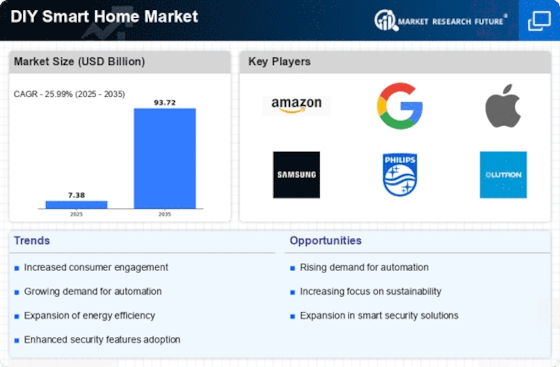
As per Market Research Future analysis, the DIY Smart Home Market Size was estimated at 7.38 USD Billion in 2024. The DIY Smart Home industry is projected to grow from 9.298 USD Billion in 2025 to 93.72 USD Billion by 2035, exhibiting a compound annual growth rate (CAGR) of 25.99% during the forecast period 2025 - 2035

Key Market Trends & Highlights

The DIY Smart Home Market is experiencing robust growth driven by technological advancements and consumer demand for automation.

  • North America remains the largest market for DIY smart home solutions, reflecting a strong consumer base and established infrastructure. The Asia-Pacific region is emerging as the fastest-growing market, fueled by increasing urbanization and rising disposable incomes. Wireless communication technology dominates the market, while network technology is rapidly gaining traction as consumers seek enhanced connectivity. Growing consumer interest in home automation and advancements in smart technology are key drivers propelling the market forward.

Market Size & Forecast

2024 Market Size 7.38 (USD Billion)
2035 Market Size 93.72 (USD Billion)
CAGR (2025 - 2035) 25.99%
Largest Regional Market Share in 2024 North America

Major Players

Amazon (US), Google (US), Apple (US), Samsung (KR), Philips (NL), Lutron (US), Ecobee (CA), Ring (US), August (US)

Market Trends

The DIY Smart Home Market is currently experiencing a notable transformation, driven by advancements in technology and a growing consumer interest in home automation. This market encompasses a wide range of products, including smart lighting, security systems, and energy management solutions, which empower homeowners to take control of their living environments. As individuals increasingly seek convenience, energy efficiency, and enhanced security, the demand for DIY smart home solutions continues to rise. Furthermore, the proliferation of mobile applications and user-friendly interfaces has made it easier for consumers to integrate these technologies into their homes without requiring professional installation. In addition to technological advancements, the DIY Smart Home Market is influenced by changing consumer preferences. Homeowners are becoming more inclined to personalize their living spaces, leading to a surge in customizable smart home products. This trend reflects a broader desire for individuality and self-expression within the home environment. As the market evolves, it appears that the focus will shift towards creating seamless ecosystems that allow various devices to communicate and work together harmoniously. Overall, the DIY Smart Home Market is poised for continued growth as it adapts to the needs and desires of modern consumers, fostering a more connected and efficient living experience.

Increased Focus on Energy Efficiency

The DIY Smart Home Market is witnessing a heightened emphasis on energy-efficient solutions. Homeowners are increasingly motivated to reduce their energy consumption and lower utility bills. Smart thermostats, energy monitoring systems, and automated lighting are becoming popular choices, as they allow users to optimize their energy usage. This trend not only benefits the environment but also aligns with the growing consumer awareness of sustainability.

Integration of Artificial Intelligence

Artificial intelligence is making significant inroads into the DIY Smart Home Market. Smart devices equipped with AI capabilities can learn user preferences and adapt their functions accordingly. This integration enhances user experience by providing personalized automation and predictive analytics. As AI technology continues to advance, it is likely to play a crucial role in shaping the future of smart home solutions.

Rise of Voice-Activated Systems

Voice-activated systems are gaining traction within the DIY Smart Home Market. Consumers are increasingly adopting smart speakers and voice assistants to control their home devices. This trend simplifies user interaction and enhances accessibility, making it easier for individuals to manage their smart home environments. As voice recognition technology improves, the reliance on voice commands is expected to grow, further embedding these systems into daily life.

DIY Smart Home Market Market Drivers

Advancements in Smart Technology

Technological advancements play a pivotal role in shaping the DIY Smart Home Market. Innovations in smart devices, such as improved connectivity and enhanced user interfaces, facilitate seamless integration into everyday life. The proliferation of Internet of Things (IoT) devices has led to a significant increase in the number of smart home products available to consumers. Data indicates that the market for smart home devices is projected to reach USD 174 billion by 2025, underscoring the rapid growth and adoption of these technologies. As manufacturers continue to invest in research and development, the DIY Smart Home Market is expected to benefit from a wider array of user-friendly products that empower consumers to create customized smart home ecosystems.

Growing Awareness of Home Security Concerns

Concerns regarding home security are increasingly influencing consumer behavior within the DIY Smart Home Market. As crime rates fluctuate and homeowners seek peace of mind, the demand for smart security solutions is on the rise. Products such as smart cameras, doorbell cameras, and motion sensors are becoming essential components of modern home security systems. Recent surveys indicate that nearly 60% of homeowners prioritize security features when considering smart home devices. This heightened awareness of security needs is likely to drive innovation and product development within the DIY Smart Home Market, as companies strive to offer comprehensive solutions that address the evolving concerns of consumers.

Growing Consumer Interest in Home Automation

The DIY Smart Home Market experiences a notable surge in consumer interest as individuals increasingly seek to enhance their living environments through automation. This trend is driven by the desire for convenience, security, and energy efficiency. According to recent data, approximately 70% of homeowners express a preference for smart home devices that can be easily installed without professional assistance. This growing inclination towards self-installation reflects a shift in consumer behavior, where individuals prioritize personalized solutions that align with their specific needs. As a result, the DIY Smart Home Market is likely to witness a continuous influx of innovative products designed for easy integration into existing home systems, catering to the evolving preferences of tech-savvy consumers.

Rising Demand for Energy Management Solutions

The emphasis on energy management is becoming increasingly pronounced within the DIY Smart Home Market. Consumers are more aware of their energy consumption patterns and are actively seeking solutions to reduce costs and environmental impact. Smart thermostats, energy-efficient lighting, and automated energy management systems are gaining traction as homeowners look for ways to optimize their energy usage. Recent statistics suggest that energy management solutions can lead to savings of up to 30% on energy bills. This growing demand for energy-efficient products is likely to drive innovation and competition within the DIY Smart Home Market, as companies strive to offer solutions that not only enhance convenience but also promote sustainability.

Increased Availability of Affordable Smart Devices

The DIY Smart Home Market is witnessing a significant increase in the availability of affordable smart devices, making home automation accessible to a broader audience. As technology advances and production costs decrease, manufacturers are introducing a range of budget-friendly options that do not compromise on quality or functionality. This democratization of smart home technology is likely to attract a diverse consumer base, including those who may have previously considered such devices to be prohibitively expensive. Market data indicates that the average price of smart home devices has decreased by approximately 20% over the past few years, further encouraging adoption. Consequently, the DIY Smart Home Market is poised for growth as more consumers embrace the benefits of smart technology.

Market Segment Insights

By Technology: Wireless Communication Technology (Largest) vs. Network Technology (Fastest-Growing)

<p>In the DIY Smart Home Market, Wireless Communication Technology holds a significant share, driven by its convenience and user-friendly implementation. It has become the favorite choice for consumers looking to enhance their home automation experience. This technology facilitates easy integration of various smart devices, allowing for seamless control from smartphones or tablets, thereby increasing its market penetration compared to traditional wired systems. On the other hand, Network Technology is experiencing rapid growth as homeowners increasingly recognize the need for secure and efficient connections between different smart devices. Factors such as the expansion of IoT and the need for reliable communication protocols contribute to the speed of this segment's growth. This reliance on strong networking infrastructure showcases how the DIY Smart Home Market is evolving to meet higher consumer demands for interconnected solutions.</p>

<p>Wireless Communication Technology: Dominant vs. Network Technology: Emerging</p>

<p>Wireless Communication Technology has established itself as the dominant force in the DIY Smart Home Market due to its ability to connect devices without the limitations of physical wires. This technology encompasses Wi-Fi and Bluetooth connectivity, which offer ease of installation and flexibility for homeowners. In contrast, Network Technology, though emerging, is gaining traction. It focuses on creating robust networks, ensuring that devices communicate effectively and securely. With the rise of smart home ecosystems, the interplay between these technologies is critical, as stronger network support will facilitate better functionality and integration of wireless devices. As market demands grow, both segment values will continue to develop, influencing the overall landscape of smart home solutions.</p>

By Product: Security & Access Control (Largest) vs. Smart Kitchen (Fastest-Growing)

<p>In the DIY Smart Home Market, the product segments show distinct variances in market share distribution. Security & Access Control is identified as the largest segment, as consumers increasingly prioritize safety and protection within their homes. The evolving technology in locks, cameras, and alarms has driven substantial adoption, with home automation enhancing traditional security measures. Meanwhile, the Smart Kitchen segment is experiencing rapid growth as modern households embrace technology for convenience and efficiency, integrating smart appliances that streamline cooking and food management.</p>

<p>Security & Access Control (Dominant) vs. Smart Kitchen (Emerging)</p>

<p>Security & Access Control has established itself as a dominant force within the DIY Smart Home Market, characterized by a broad range of products including smart locks, cameras, and alarm systems that enhance home security. This segment caters to safety-conscious consumers looking for convenience and accessibility through mobile integration. In contrast, the Smart Kitchen segment is emerging with innovations such as smart refrigerators, cooking assistants, and automated cooking appliances. With heightened consumer interest in culinary technologies and energy efficiency, Smart Kitchen products are rapidly penetrating the market, appealing to those seeking to modernize their cooking experience. As this trend grows, both segments continue to evolve and adapt to consumer needs.</p>

Get more detailed insights about Global DIY Smart Home Market Research Report- Forecast 2035

Regional Insights

North America : Innovation and Adoption Leader

North America is the largest market for DIY smart home products, accounting for approximately 45% of the global market share. The region's growth is driven by increasing consumer demand for home automation, energy efficiency, and security solutions. Regulatory support, such as incentives for energy-efficient devices, further catalyzes market expansion. The U.S. leads this market, followed closely by Canada, which holds about 10% of the share. The competitive landscape in North America is dominated by major players like Amazon, Google, and Apple, who are continuously innovating to enhance user experience. The presence of established brands and a tech-savvy consumer base fosters a robust environment for smart home technology. Additionally, partnerships between tech companies and home improvement retailers are enhancing product accessibility, further driving market growth.

Europe : Emerging Market with Regulations

Europe is witnessing significant growth in the DIY smart home market, holding approximately 30% of the global share. The region's expansion is fueled by increasing awareness of energy efficiency and sustainability, alongside supportive regulations promoting smart technology adoption. Countries like Germany and the UK are leading this market, with Germany accounting for about 12% of the share, driven by strong consumer interest and government initiatives. The competitive landscape in Europe features key players such as Philips and Samsung, who are investing in innovative solutions tailored to local preferences. The market is characterized by a mix of established brands and emerging startups, fostering a dynamic environment. Regulatory frameworks, such as the EU's Green Deal, are encouraging the integration of smart technologies in homes, further propelling market growth.

Asia-Pacific : Rapid Growth and Adoption

The Asia-Pacific region is rapidly emerging as a significant player in the DIY smart home market, holding around 20% of the global share. The growth is driven by rising disposable incomes, urbanization, and increasing consumer awareness of smart home technologies. China and Japan are the largest markets in this region, with China alone accounting for approximately 15% of the market share, supported by government initiatives promoting smart city developments. The competitive landscape is vibrant, with local and international players like Samsung and Ecobee vying for market share. The presence of a tech-savvy population and increasing smartphone penetration are key factors driving adoption. Additionally, collaborations between tech companies and local manufacturers are enhancing product offerings, making smart home solutions more accessible to consumers across the region.

Middle East and Africa : Emerging Market with Potential

The Middle East and Africa region is gradually emerging in the DIY smart home market, currently holding about 5% of the global share. The growth is primarily driven by increasing urbanization, rising disposable incomes, and a growing interest in home automation solutions. Countries like South Africa and the UAE are leading this market, with the UAE showing a strong inclination towards smart technologies, supported by government initiatives promoting innovation and sustainability. The competitive landscape is still developing, with a mix of local and international players entering the market. Key players are focusing on creating affordable and user-friendly smart home solutions to cater to the diverse consumer base. As awareness of smart home benefits increases, the market is expected to grow significantly in the coming years, driven by technological advancements and improved infrastructure.

Key Players and Competitive Insights

Leading market players are investing heavily in research and development in order to expand their product lines, which will help the DIY smart home market, grow even more. Market participants are also undertaking a variety of strategic activities to expand their global footprint, with important market developments including new product launches, contractual agreements, mergers and acquisitions, higher investments, and collaboration with other organizations. To expand and survive in a more competitive and rising market climate, DIY smart home industry must offer cost-effective items.Manufacturing locally to minimize operational costs is one of the key business tactics used by manufacturers in the global DIY smart home industry to benefit clients and increase the market sector. In recent years, the DIY smart home industry has offered some of the most significant advantages to market. Major players in the DIY smart home market attempting to increase market demand by investing in research and development operations include Nest Labs Inc. (U.S.), Honeywell International Inc. (U.S.), Assa Abloy Group (Sweden), Acuity Brands Inc. (U.S.), Johnson Controls Inc. (U.S.), Schneider Electric SE (France), United Technologies Corporation (U.S.), Samsung Electronics Co.Ltd. (South Korea), and Crestron Electronics Inc. (U.S.).Providing networking products is Nest Labs, Inc. The Company creates and produces a sensor-driven, Wi-Fi-enabled, programmable learning thermostat. In the US, Nest Labs is in business. In 2015, Google purchased Nest Labs. Google's home electronics devices are now sold under the Google Nest brand. Thermostats, smoke and carbon monoxide detectors, and security cameras were added in 2013, followed by the acquisition of Dropcam in June 2014.Schneider Electric SE, formerly known as Schneider Electric SA, develops associated technologies and solutions for power distribution. Its main products include essential power, cooling, and racks, low voltage goods and systems, solar power and energy storage, medium voltage distribution and grid automation, and automation and control solutions for automation and control. The business also provides cloud, consulting, training, field and automation, energy, and sustainability services.

Key Companies in the DIY Smart Home Market include

Industry Developments

December 2019: To advance the development of a new, sovereignty-free network standard and increase compatibility across smart home products, Apple, Amazon, Google, and the Zigbee Alliance joined together. Security was a key design principle.

May 2019: The Echo Show 5 is Amazon's newest addition to the line of Echo Show products, in addition to its compact design, 5.5-inch display, high-quality audio, HD camera, and built-in camera screen.

Future Outlook

DIY Smart Home Market Future Outlook

The DIY Smart Home Market is projected to grow at a 25.99% CAGR from 2025 to 2035, driven by technological advancements, consumer demand for automation, and energy efficiency.

New opportunities lie in:

  • Integration of AI-driven home automation systems</p><p>Expansion of subscription-based smart home services</p><p>Development of energy-efficient smart appliances

By 2035, the DIY Smart Home Market is poised for substantial growth and innovation.

Market Segmentation

DIY Smart Home Market Product Outlook

  • Entertainment Control
  • Security & Access Control
  • Smart Kitchen

DIY Smart Home Market Technology Outlook

  • Network Technology
  • Wireless Communication Technology

Report Scope

MARKET SIZE 2024 7.38(USD Billion)
MARKET SIZE 2025 9.298(USD Billion)
MARKET SIZE 2035 93.72(USD Billion)
COMPOUND ANNUAL GROWTH RATE (CAGR) 25.99% (2025 - 2035)
REPORT COVERAGE Revenue Forecast, Competitive Landscape, Growth Factors, and Trends
BASE YEAR 2024
Market Forecast Period 2025 - 2035
Historical Data 2019 - 2024
Market Forecast Units USD Billion
Key Companies Profiled Amazon (US), Google (US), Apple (US), Samsung (KR), Philips (NL), Lutron (US), Ecobee (CA), Ring (US), August (US)
Segments Covered Technology, Product, Region
Key Market Opportunities Integration of artificial intelligence in DIY Smart Home systems enhances user experience and automation capabilities.
Key Market Dynamics Rising consumer interest in automation drives innovation and competition in the DIY Smart Home Market.
Countries Covered North America, Europe, APAC, South America, MEA

FAQs

What is the current valuation of the DIY Smart Home Market?

<p>The DIY Smart Home Market was valued at 7.38 USD Billion in 2024.</p>

What is the projected market size for the DIY Smart Home Market by 2035?

<p>The market is projected to reach 93.72 USD Billion by 2035.</p>

What is the expected CAGR for the DIY Smart Home Market from 2025 to 2035?

<p>The expected CAGR for the DIY Smart Home Market during the forecast period 2025 - 2035 is 25.99%.</p>

Which technology segments are leading in the DIY Smart Home Market?

<p>The leading technology segments include Wireless Communication Technology, valued at 65.47 USD Billion, and Network Technology, valued at 28.25 USD Billion.</p>

What are the key product segments in the DIY Smart Home Market?

<p>Key product segments include Smart Kitchen, valued at 46.04 USD Billion, and Security & Access Control, valued at 28.56 USD Billion.</p>

Who are the major players in the DIY Smart Home Market?

<p>Major players include Amazon, Google, Apple, Samsung, Philips, Lutron, Ecobee, Ring, and August.</p>

How does the DIY Smart Home Market's growth compare to other markets?

The DIY Smart Home Market's growth appears robust, with a projected CAGR of 25.99% from 2025 to 2035.

What factors are driving the growth of the DIY Smart Home Market?

Factors driving growth may include advancements in technology, increased consumer interest in home automation, and the expansion of product offerings.

What role do key players like Amazon and Google play in the market?

Key players like Amazon and Google likely influence market trends through innovation and extensive product ecosystems.

How are consumer preferences shaping the DIY Smart Home Market?

Consumer preferences seem to be shifting towards integrated solutions, particularly in segments like Smart Kitchen and Security &amp; Access Control.

  1. SECTION I: EXECUTIVE SUMMARY AND KEY HIGHLIGHTS
    1. | 1.1 EXECUTIVE SUMMARY
    2. | | 1.1.1 Market Overview
    3. | | 1.1.2 Key Findings
    4. | | 1.1.3 Market Segmentation
    5. | | 1.1.4 Competitive Landscape
    6. | | 1.1.5 Challenges and Opportunities
    7. | | 1.1.6 Future Outlook
  2. SECTION II: SCOPING, METHODOLOGY AND MARKET STRUCTURE
    1. | 2.1 MARKET INTRODUCTION
    2. | | 2.1.1 Definition
    3. | | 2.1.2 Scope of the study
    4. | | | 2.1.2.1 Research Objective
    5. | | | 2.1.2.2 Assumption
    6. | | | 2.1.2.3 Limitations
    7. | 2.2 RESEARCH METHODOLOGY
    8. | | 2.2.1 Overview
    9. | | 2.2.2 Data Mining
    10. | | 2.2.3 Secondary Research
    11. | | 2.2.4 Primary Research
    12. | | | 2.2.4.1 Primary Interviews and Information Gathering Process
    13. | | | 2.2.4.2 Breakdown of Primary Respondents
    14. | | 2.2.5 Forecasting Model
    15. | | 2.2.6 Market Size Estimation
    16. | | | 2.2.6.1 Bottom-Up Approach
    17. | | | 2.2.6.2 Top-Down Approach
    18. | | 2.2.7 Data Triangulation
    19. | | 2.2.8 Validation
  3. SECTION III: QUALITATIVE ANALYSIS
    1. | 3.1 MARKET DYNAMICS
    2. | | 3.1.1 Overview
    3. | | 3.1.2 Drivers
    4. | | 3.1.3 Restraints
    5. | | 3.1.4 Opportunities
    6. | 3.2 MARKET FACTOR ANALYSIS
    7. | | 3.2.1 Value chain Analysis
    8. | | 3.2.2 Porter's Five Forces Analysis
    9. | | | 3.2.2.1 Bargaining Power of Suppliers
    10. | | | 3.2.2.2 Bargaining Power of Buyers
    11. | | | 3.2.2.3 Threat of New Entrants
    12. | | | 3.2.2.4 Threat of Substitutes
    13. | | | 3.2.2.5 Intensity of Rivalry
    14. | | 3.2.3 COVID-19 Impact Analysis
    15. | | | 3.2.3.1 Market Impact Analysis
    16. | | | 3.2.3.2 Regional Impact
    17. | | | 3.2.3.3 Opportunity and Threat Analysis
  4. SECTION IV: QUANTITATIVE ANALYSIS
    1. | 4.1 Semiconductor & Electronics, BY Technology (USD Billion)
    2. | | 4.1.1 Network Technology
    3. | | 4.1.2 Wireless Communication Technology
    4. | 4.2 Semiconductor & Electronics, BY Product (USD Billion)
    5. | | 4.2.1 Entertainment Control
    6. | | 4.2.2 Security & Access Control
    7. | | 4.2.3 Smart Kitchen
    8. | 4.3 Semiconductor & Electronics, BY Region (USD Billion)
    9. | | 4.3.1 North America
    10. | | | 4.3.1.1 US
    11. | | | 4.3.1.2 Canada
    12. | | 4.3.2 Europe
    13. | | | 4.3.2.1 Germany
    14. | | | 4.3.2.2 UK
    15. | | | 4.3.2.3 France
    16. | | | 4.3.2.4 Russia
    17. | | | 4.3.2.5 Italy
    18. | | | 4.3.2.6 Spain
    19. | | | 4.3.2.7 Rest of Europe
    20. | | 4.3.3 APAC
    21. | | | 4.3.3.1 China
    22. | | | 4.3.3.2 India
    23. | | | 4.3.3.3 Japan
    24. | | | 4.3.3.4 South Korea
    25. | | | 4.3.3.5 Malaysia
    26. | | | 4.3.3.6 Thailand
    27. | | | 4.3.3.7 Indonesia
    28. | | | 4.3.3.8 Rest of APAC
    29. | | 4.3.4 South America
    30. | | | 4.3.4.1 Brazil
    31. | | | 4.3.4.2 Mexico
    32. | | | 4.3.4.3 Argentina
    33. | | | 4.3.4.4 Rest of South America
    34. | | 4.3.5 MEA
    35. | | | 4.3.5.1 GCC Countries
    36. | | | 4.3.5.2 South Africa
    37. | | | 4.3.5.3 Rest of MEA
  5. SECTION V: COMPETITIVE ANALYSIS
    1. | 5.1 Competitive Landscape
    2. | | 5.1.1 Overview
    3. | | 5.1.2 Competitive Analysis
    4. | | 5.1.3 Market share Analysis
    5. | | 5.1.4 Major Growth Strategy in the Semiconductor & Electronics
    6. | | 5.1.5 Competitive Benchmarking
    7. | | 5.1.6 Leading Players in Terms of Number of Developments in the Semiconductor & Electronics
    8. | | 5.1.7 Key developments and growth strategies
    9. | | | 5.1.7.1 New Product Launch/Service Deployment
    10. | | | 5.1.7.2 Merger & Acquisitions
    11. | | | 5.1.7.3 Joint Ventures
    12. | | 5.1.8 Major Players Financial Matrix
    13. | | | 5.1.8.1 Sales and Operating Income
    14. | | | 5.1.8.2 Major Players R&D Expenditure. 2023
    15. | 5.2 Company Profiles
    16. | | 5.2.1 Amazon (US)
    17. | | | 5.2.1.1 Financial Overview
    18. | | | 5.2.1.2 Products Offered
    19. | | | 5.2.1.3 Key Developments
    20. | | | 5.2.1.4 SWOT Analysis
    21. | | | 5.2.1.5 Key Strategies
    22. | | 5.2.2 Google (US)
    23. | | | 5.2.2.1 Financial Overview
    24. | | | 5.2.2.2 Products Offered
    25. | | | 5.2.2.3 Key Developments
    26. | | | 5.2.2.4 SWOT Analysis
    27. | | | 5.2.2.5 Key Strategies
    28. | | 5.2.3 Apple (US)
    29. | | | 5.2.3.1 Financial Overview
    30. | | | 5.2.3.2 Products Offered
    31. | | | 5.2.3.3 Key Developments
    32. | | | 5.2.3.4 SWOT Analysis
    33. | | | 5.2.3.5 Key Strategies
    34. | | 5.2.4 Samsung (KR)
    35. | | | 5.2.4.1 Financial Overview
    36. | | | 5.2.4.2 Products Offered
    37. | | | 5.2.4.3 Key Developments
    38. | | | 5.2.4.4 SWOT Analysis
    39. | | | 5.2.4.5 Key Strategies
    40. | | 5.2.5 Philips (NL)
    41. | | | 5.2.5.1 Financial Overview
    42. | | | 5.2.5.2 Products Offered
    43. | | | 5.2.5.3 Key Developments
    44. | | | 5.2.5.4 SWOT Analysis
    45. | | | 5.2.5.5 Key Strategies
    46. | | 5.2.6 Lutron (US)
    47. | | | 5.2.6.1 Financial Overview
    48. | | | 5.2.6.2 Products Offered
    49. | | | 5.2.6.3 Key Developments
    50. | | | 5.2.6.4 SWOT Analysis
    51. | | | 5.2.6.5 Key Strategies
    52. | | 5.2.7 Ecobee (CA)
    53. | | | 5.2.7.1 Financial Overview
    54. | | | 5.2.7.2 Products Offered
    55. | | | 5.2.7.3 Key Developments
    56. | | | 5.2.7.4 SWOT Analysis
    57. | | | 5.2.7.5 Key Strategies
    58. | | 5.2.8 Ring (US)
    59. | | | 5.2.8.1 Financial Overview
    60. | | | 5.2.8.2 Products Offered
    61. | | | 5.2.8.3 Key Developments
    62. | | | 5.2.8.4 SWOT Analysis
    63. | | | 5.2.8.5 Key Strategies
    64. | | 5.2.9 August (US)
    65. | | | 5.2.9.1 Financial Overview
    66. | | | 5.2.9.2 Products Offered
    67. | | | 5.2.9.3 Key Developments
    68. | | | 5.2.9.4 SWOT Analysis
    69. | | | 5.2.9.5 Key Strategies
    70. | 5.3 Appendix
    71. | | 5.3.1 References
    72. | | 5.3.2 Related Reports
  6. LIST OF FIGURES
    1. | 6.1 MARKET SYNOPSIS
    2. | 6.2 NORTH AMERICA MARKET ANALYSIS
    3. | 6.3 US MARKET ANALYSIS BY TECHNOLOGY
    4. | 6.4 US MARKET ANALYSIS BY PRODUCT
    5. | 6.5 CANADA MARKET ANALYSIS BY TECHNOLOGY
    6. | 6.6 CANADA MARKET ANALYSIS BY PRODUCT
    7. | 6.7 EUROPE MARKET ANALYSIS
    8. | 6.8 GERMANY MARKET ANALYSIS BY TECHNOLOGY
    9. | 6.9 GERMANY MARKET ANALYSIS BY PRODUCT
    10. | 6.10 UK MARKET ANALYSIS BY TECHNOLOGY
    11. | 6.11 UK MARKET ANALYSIS BY PRODUCT
    12. | 6.12 FRANCE MARKET ANALYSIS BY TECHNOLOGY
    13. | 6.13 FRANCE MARKET ANALYSIS BY PRODUCT
    14. | 6.14 RUSSIA MARKET ANALYSIS BY TECHNOLOGY
    15. | 6.15 RUSSIA MARKET ANALYSIS BY PRODUCT
    16. | 6.16 ITALY MARKET ANALYSIS BY TECHNOLOGY
    17. | 6.17 ITALY MARKET ANALYSIS BY PRODUCT
    18. | 6.18 SPAIN MARKET ANALYSIS BY TECHNOLOGY
    19. | 6.19 SPAIN MARKET ANALYSIS BY PRODUCT
    20. | 6.20 REST OF EUROPE MARKET ANALYSIS BY TECHNOLOGY
    21. | 6.21 REST OF EUROPE MARKET ANALYSIS BY PRODUCT
    22. | 6.22 APAC MARKET ANALYSIS
    23. | 6.23 CHINA MARKET ANALYSIS BY TECHNOLOGY
    24. | 6.24 CHINA MARKET ANALYSIS BY PRODUCT
    25. | 6.25 INDIA MARKET ANALYSIS BY TECHNOLOGY
    26. | 6.26 INDIA MARKET ANALYSIS BY PRODUCT
    27. | 6.27 JAPAN MARKET ANALYSIS BY TECHNOLOGY
    28. | 6.28 JAPAN MARKET ANALYSIS BY PRODUCT
    29. | 6.29 SOUTH KOREA MARKET ANALYSIS BY TECHNOLOGY
    30. | 6.30 SOUTH KOREA MARKET ANALYSIS BY PRODUCT
    31. | 6.31 MALAYSIA MARKET ANALYSIS BY TECHNOLOGY
    32. | 6.32 MALAYSIA MARKET ANALYSIS BY PRODUCT
    33. | 6.33 THAILAND MARKET ANALYSIS BY TECHNOLOGY
    34. | 6.34 THAILAND MARKET ANALYSIS BY PRODUCT
    35. | 6.35 INDONESIA MARKET ANALYSIS BY TECHNOLOGY
    36. | 6.36 INDONESIA MARKET ANALYSIS BY PRODUCT
    37. | 6.37 REST OF APAC MARKET ANALYSIS BY TECHNOLOGY
    38. | 6.38 REST OF APAC MARKET ANALYSIS BY PRODUCT
    39. | 6.39 SOUTH AMERICA MARKET ANALYSIS
    40. | 6.40 BRAZIL MARKET ANALYSIS BY TECHNOLOGY
    41. | 6.41 BRAZIL MARKET ANALYSIS BY PRODUCT
    42. | 6.42 MEXICO MARKET ANALYSIS BY TECHNOLOGY
    43. | 6.43 MEXICO MARKET ANALYSIS BY PRODUCT
    44. | 6.44 ARGENTINA MARKET ANALYSIS BY TECHNOLOGY
    45. | 6.45 ARGENTINA MARKET ANALYSIS BY PRODUCT
    46. | 6.46 REST OF SOUTH AMERICA MARKET ANALYSIS BY TECHNOLOGY
    47. | 6.47 REST OF SOUTH AMERICA MARKET ANALYSIS BY PRODUCT
    48. | 6.48 MEA MARKET ANALYSIS
    49. | 6.49 GCC COUNTRIES MARKET ANALYSIS BY TECHNOLOGY
    50. | 6.50 GCC COUNTRIES MARKET ANALYSIS BY PRODUCT
    51. | 6.51 SOUTH AFRICA MARKET ANALYSIS BY TECHNOLOGY
    52. | 6.52 SOUTH AFRICA MARKET ANALYSIS BY PRODUCT
    53. | 6.53 REST OF MEA MARKET ANALYSIS BY TECHNOLOGY
    54. | 6.54 REST OF MEA MARKET ANALYSIS BY PRODUCT
    55. | 6.55 KEY BUYING CRITERIA OF SEMICONDUCTOR & ELECTRONICS
    56. | 6.56 RESEARCH PROCESS OF MRFR
    57. | 6.57 DRO ANALYSIS OF SEMICONDUCTOR & ELECTRONICS
    58. | 6.58 DRIVERS IMPACT ANALYSIS: SEMICONDUCTOR & ELECTRONICS
    59. | 6.59 RESTRAINTS IMPACT ANALYSIS: SEMICONDUCTOR & ELECTRONICS
    60. | 6.60 SUPPLY / VALUE CHAIN: SEMICONDUCTOR & ELECTRONICS
    61. | 6.61 SEMICONDUCTOR & ELECTRONICS, BY TECHNOLOGY, 2024 (% SHARE)
    62. | 6.62 SEMICONDUCTOR & ELECTRONICS, BY TECHNOLOGY, 2024 TO 2035 (USD Billion)
    63. | 6.63 SEMICONDUCTOR & ELECTRONICS, BY PRODUCT, 2024 (% SHARE)
    64. | 6.64 SEMICONDUCTOR & ELECTRONICS, BY PRODUCT, 2024 TO 2035 (USD Billion)
    65. | 6.65 BENCHMARKING OF MAJOR COMPETITORS
  7. LIST OF TABLES
    1. | 7.1 LIST OF ASSUMPTIONS
    2. | | 7.1.1
    3. | 7.2 North America MARKET SIZE ESTIMATES; FORECAST
    4. | | 7.2.1 BY TECHNOLOGY, 2025-2035 (USD Billion)
    5. | | 7.2.2 BY PRODUCT, 2025-2035 (USD Billion)
    6. | 7.3 US MARKET SIZE ESTIMATES; FORECAST
    7. | | 7.3.1 BY TECHNOLOGY, 2025-2035 (USD Billion)
    8. | | 7.3.2 BY PRODUCT, 2025-2035 (USD Billion)
    9. | 7.4 Canada MARKET SIZE ESTIMATES; FORECAST
    10. | | 7.4.1 BY TECHNOLOGY, 2025-2035 (USD Billion)
    11. | | 7.4.2 BY PRODUCT, 2025-2035 (USD Billion)
    12. | 7.5 Europe MARKET SIZE ESTIMATES; FORECAST
    13. | | 7.5.1 BY TECHNOLOGY, 2025-2035 (USD Billion)
    14. | | 7.5.2 BY PRODUCT, 2025-2035 (USD Billion)
    15. | 7.6 Germany MARKET SIZE ESTIMATES; FORECAST
    16. | | 7.6.1 BY TECHNOLOGY, 2025-2035 (USD Billion)
    17. | | 7.6.2 BY PRODUCT, 2025-2035 (USD Billion)
    18. | 7.7 UK MARKET SIZE ESTIMATES; FORECAST
    19. | | 7.7.1 BY TECHNOLOGY, 2025-2035 (USD Billion)
    20. | | 7.7.2 BY PRODUCT, 2025-2035 (USD Billion)
    21. | 7.8 France MARKET SIZE ESTIMATES; FORECAST
    22. | | 7.8.1 BY TECHNOLOGY, 2025-2035 (USD Billion)
    23. | | 7.8.2 BY PRODUCT, 2025-2035 (USD Billion)
    24. | 7.9 Russia MARKET SIZE ESTIMATES; FORECAST
    25. | | 7.9.1 BY TECHNOLOGY, 2025-2035 (USD Billion)
    26. | | 7.9.2 BY PRODUCT, 2025-2035 (USD Billion)
    27. | 7.10 Italy MARKET SIZE ESTIMATES; FORECAST
    28. | | 7.10.1 BY TECHNOLOGY, 2025-2035 (USD Billion)
    29. | | 7.10.2 BY PRODUCT, 2025-2035 (USD Billion)
    30. | 7.11 Spain MARKET SIZE ESTIMATES; FORECAST
    31. | | 7.11.1 BY TECHNOLOGY, 2025-2035 (USD Billion)
    32. | | 7.11.2 BY PRODUCT, 2025-2035 (USD Billion)
    33. | 7.12 Rest of Europe MARKET SIZE ESTIMATES; FORECAST
    34. | | 7.12.1 BY TECHNOLOGY, 2025-2035 (USD Billion)
    35. | | 7.12.2 BY PRODUCT, 2025-2035 (USD Billion)
    36. | 7.13 APAC MARKET SIZE ESTIMATES; FORECAST
    37. | | 7.13.1 BY TECHNOLOGY, 2025-2035 (USD Billion)
    38. | | 7.13.2 BY PRODUCT, 2025-2035 (USD Billion)
    39. | 7.14 China MARKET SIZE ESTIMATES; FORECAST
    40. | | 7.14.1 BY TECHNOLOGY, 2025-2035 (USD Billion)
    41. | | 7.14.2 BY PRODUCT, 2025-2035 (USD Billion)
    42. | 7.15 India MARKET SIZE ESTIMATES; FORECAST
    43. | | 7.15.1 BY TECHNOLOGY, 2025-2035 (USD Billion)
    44. | | 7.15.2 BY PRODUCT, 2025-2035 (USD Billion)
    45. | 7.16 Japan MARKET SIZE ESTIMATES; FORECAST
    46. | | 7.16.1 BY TECHNOLOGY, 2025-2035 (USD Billion)
    47. | | 7.16.2 BY PRODUCT, 2025-2035 (USD Billion)
    48. | 7.17 South Korea MARKET SIZE ESTIMATES; FORECAST
    49. | | 7.17.1 BY TECHNOLOGY, 2025-2035 (USD Billion)
    50. | | 7.17.2 BY PRODUCT, 2025-2035 (USD Billion)
    51. | 7.18 Malaysia MARKET SIZE ESTIMATES; FORECAST
    52. | | 7.18.1 BY TECHNOLOGY, 2025-2035 (USD Billion)
    53. | | 7.18.2 BY PRODUCT, 2025-2035 (USD Billion)
    54. | 7.19 Thailand MARKET SIZE ESTIMATES; FORECAST
    55. | | 7.19.1 BY TECHNOLOGY, 2025-2035 (USD Billion)
    56. | | 7.19.2 BY PRODUCT, 2025-2035 (USD Billion)
    57. | 7.20 Indonesia MARKET SIZE ESTIMATES; FORECAST
    58. | | 7.20.1 BY TECHNOLOGY, 2025-2035 (USD Billion)
    59. | | 7.20.2 BY PRODUCT, 2025-2035 (USD Billion)
    60. | 7.21 Rest of APAC MARKET SIZE ESTIMATES; FORECAST
    61. | | 7.21.1 BY TECHNOLOGY, 2025-2035 (USD Billion)
    62. | | 7.21.2 BY PRODUCT, 2025-2035 (USD Billion)
    63. | 7.22 South America MARKET SIZE ESTIMATES; FORECAST
    64. | | 7.22.1 BY TECHNOLOGY, 2025-2035 (USD Billion)
    65. | | 7.22.2 BY PRODUCT, 2025-2035 (USD Billion)
    66. | 7.23 Brazil MARKET SIZE ESTIMATES; FORECAST
    67. | | 7.23.1 BY TECHNOLOGY, 2025-2035 (USD Billion)
    68. | | 7.23.2 BY PRODUCT, 2025-2035 (USD Billion)
    69. | 7.24 Mexico MARKET SIZE ESTIMATES; FORECAST
    70. | | 7.24.1 BY TECHNOLOGY, 2025-2035 (USD Billion)
    71. | | 7.24.2 BY PRODUCT, 2025-2035 (USD Billion)
    72. | 7.25 Argentina MARKET SIZE ESTIMATES; FORECAST
    73. | | 7.25.1 BY TECHNOLOGY, 2025-2035 (USD Billion)
    74. | | 7.25.2 BY PRODUCT, 2025-2035 (USD Billion)
    75. | 7.26 Rest of South America MARKET SIZE ESTIMATES; FORECAST
    76. | | 7.26.1 BY TECHNOLOGY, 2025-2035 (USD Billion)
    77. | | 7.26.2 BY PRODUCT, 2025-2035 (USD Billion)
    78. | 7.27 MEA MARKET SIZE ESTIMATES; FORECAST
    79. | | 7.27.1 BY TECHNOLOGY, 2025-2035 (USD Billion)
    80. | | 7.27.2 BY PRODUCT, 2025-2035 (USD Billion)
    81. | 7.28 GCC Countries MARKET SIZE ESTIMATES; FORECAST
    82. | | 7.28.1 BY TECHNOLOGY, 2025-2035 (USD Billion)
    83. | | 7.28.2 BY PRODUCT, 2025-2035 (USD Billion)
    84. | 7.29 South Africa MARKET SIZE ESTIMATES; FORECAST
    85. | | 7.29.1 BY TECHNOLOGY, 2025-2035 (USD Billion)
    86. | | 7.29.2 BY PRODUCT, 2025-2035 (USD Billion)
    87. | 7.30 Rest of MEA MARKET SIZE ESTIMATES; FORECAST
    88. | | 7.30.1 BY TECHNOLOGY, 2025-2035 (USD Billion)
    89. | | 7.30.2 BY PRODUCT, 2025-2035 (USD Billion)
    90. | 7.31 PRODUCT LAUNCH/PRODUCT DEVELOPMENT/APPROVAL
    91. | | 7.31.1
    92. | 7.32 ACQUISITION/PARTNERSHIP
    93. | | 7.32.1

Semiconductor & Electronics Market Segmentation

Semiconductor & Electronics By Technology (USD Billion, 2025-2035)

  • Network Technology
  • Wireless Communication Technology

Semiconductor & Electronics By Product (USD Billion, 2025-2035)

  • Entertainment Control
  • Security & Access Control
  • Smart Kitchen
Infographic

Free Sample Request

Kindly complete the form below to receive a free sample of this Report

Get Free Sample

Customer Strories

Compare Licence

×
Features License Type
Single User Multiuser License Enterprise User
Price $4,950 $5,950 $7,250
Maximum User Access Limit 1 User Upto 10 Users Unrestricted Access Throughout the Organization
Free Customization
Direct Access to Analyst
Deliverable Format
Platform Access
Discount on Next Purchase 10% 15% 15%
Printable Versions