×
Hero Background
English
Chinese
French
Japanese
Korean
German
Spanish

Dimer Acid Market Share

ID: MRFR/CnM/4413-HCR
100 Pages
Chitranshi Jaiswal
October 2025

Dimer Acid Market Research Report Information: By Product Type (Standard, Distilled, Distilled & Hydrogenated), Application (Reactive & Non-Reactive Polyamide, Oilfield Chemical, Cosmetic Products), End-Use Industry (Construction, Oilfield, Cosmetics) and Region - Forecast till 2035

Share:
Download PDF ×

We do not share your information with anyone. However, we may send you emails based on your report interest from time to time. You may contact us at any time to opt-out.

Dimer Acid Market Infographic
Purchase Options

Market Share

Dimer Acid Market Share Analysis

The Dimer Acid market, a segment within the broader chemical industry, witnesses dynamic competition where companies employ various market share positioning strategies to gain a competitive edge. One prevalent approach is differentiation, where companies focus on creating unique product offerings to stand out in the market. This can involve developing dimer acids with distinct chemical properties or innovative applications. By doing so, companies aim to capture a niche market or offer solutions that cater to specific industry needs, thereby securing a dedicated customer base.

Another commonly adopted strategy is cost leadership. In this approach, companies strive to produce dimer acids at lower costs than competitors, enabling them to offer competitive pricing. Cost leadership can result from efficient production processes, economies of scale, or strategic partnerships with suppliers. By providing cost-effective solutions, companies aim to attract price-sensitive customers and increase their market share.

Furthermore, market penetration is a strategy employed by companies seeking to expand their market share within existing markets. This often involves aggressive marketing campaigns, promotional activities, and pricing strategies aimed at capturing a larger share of the customer base. By emphasizing the advantages of their dimer acid products, companies can convince existing customers to continue purchasing from them and attract new customers in the process.

Companies also explore diversification strategies to expand their presence in the Dimer Acid market. This could involve entering new geographical regions, introducing variations of existing products, or venturing into related product categories. Diversification helps companies mitigate risks associated with dependence on a specific market or product, fostering resilience in the face of changing market dynamics.

In addition to these strategies, collaboration and partnerships play a pivotal role in market share positioning within the Dimer Acid industry. By forming strategic alliances with other companies, businesses can leverage complementary strengths and resources to enhance their market presence. Collaborations may involve joint research and development efforts, shared distribution channels, or mutually beneficial marketing initiatives.

Environmental sustainability has become a key consideration for consumers and businesses alike, leading to the emergence of green or eco-friendly positioning strategies. Companies in the Dimer Acid market are increasingly focusing on developing environmentally friendly products, adopting sustainable production practices, and obtaining relevant certifications. This not only caters to the growing demand for sustainable solutions but also positions companies favorably in the eyes of environmentally conscious consumers.

Lastly, customer-centric strategies are vital for market share positioning in the Dimer Acid industry. Companies that prioritize customer satisfaction, provide excellent customer service, and respond promptly to market demands are more likely to build long-lasting relationships with clients. This not only helps in retaining existing customers but also attracts new ones through positive word-of-mouth and reputation building.

Author
Chitranshi Jaiswal
Research Analyst Level I

In her 3 years of experience in the market research field, she has handled critical cross-domain projects. She has an in-depth knowledge of market estimation & analysis, problem-solving, primary as well as secondary research, and team management.She holds an engineering degree and is an MBA professional from a well-known university, capable of evaluating the market and competitive conditions. An exceptional strategist with excellent communication skills and a passion for delivering cutting-edge & practical insights for the market. Proficient in multi-tasking, and can successfully deal with competing demands, while maintaining complete confidentiality. Generated business through active client and project development, networking, and high-quality responses. Her knowledge and skills have helped in making solid business decisions, securing funding from investors, and avoiding business failures.

Leave a Comment

FAQs

What is dimer acid?

Dimer acid is a yellow, viscous, and transparent liquid made by dimerizing unsaturated fatty acids on clay catalysts. Its molecular formula is C36H68O4.

What is dimer acid used for?

Dimer acid is mainly used to synthesize polyamide resins, among other applications.

What is the major driver for the market?

Growing demand from the construction and oil and gas industries is the major driver for the dimer acid market.

Which is the leading regional market?

Asia Pacific is the leading regional market due to the growing demand for adhesives, coatings, and other formulations from the construction industry.

What are the leading market players?

Leading players in the dimer acid market include Shandoing Huijin Chemical, Croda, and Oleon, among others.

Market Summary

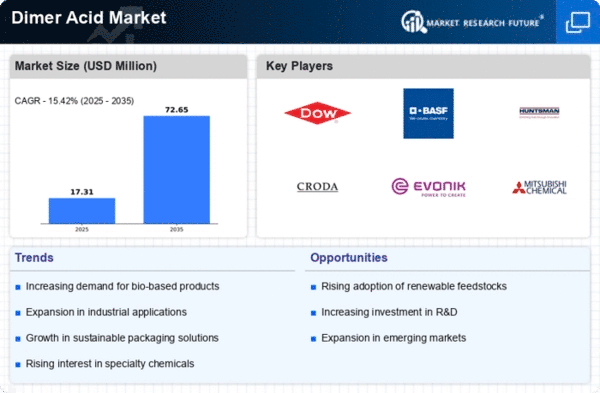
As per MRFR analysis, the Dimer Acid Market Size was estimated at 15.0 USD Million in 2024. The Dimer Acid industry is projected to grow from 17.31 in 2025 to 72.65 by 2035, exhibiting a compound annual growth rate (CAGR) of 15.42 during the forecast period 2025 - 2035.

Key Market Trends & Highlights

The Dimer Acid Market is experiencing a robust growth trajectory driven by sustainability and technological advancements.

  • North America remains the largest market for dimer acid, driven by its extensive use in adhesives and automotive applications.
  • Asia-Pacific is emerging as the fastest-growing region, with increasing demand in consumer goods and coatings segments.
  • The market is witnessing a notable shift towards sustainable practices, with a rising focus on bio-based products and performance characteristics.
  • Key drivers include the expansion in end-use industries and regulatory support for sustainable practices, which are propelling market growth.

Market Size & Forecast

2024 Market Size 15.0 (USD Million)
2035 Market Size 72.65 (USD Million)
CAGR (2025 - 2035) 15.42%
Largest Regional Market Share in 2024 North America

Major Players

<p>DOW (US), BASF (DE), Huntsman Corporation (US), Croda International (GB), Evonik Industries (DE), Mitsubishi Chemical Corporation (JP), Kraton Corporation (US), Oleon (BE), Nouryon (NL)</p>

Market Trends

The Dimer Acid Market is currently experiencing a notable evolution, driven by various factors that influence its dynamics. The increasing demand for bio-based products is reshaping the landscape, as manufacturers seek sustainable alternatives to traditional petrochemical sources. This shift appears to be fostering innovation in production processes, leading to the development of more environmentally friendly dimer acids. Furthermore, the growing awareness of the environmental impact of chemical products is prompting industries to adopt greener solutions, which may enhance the market's growth potential. In addition, the Dimer Acid Market is witnessing a surge in applications across diverse sectors, including coatings, adhesives, and lubricants. This diversification suggests a robust potential for expansion, as companies explore new uses for dimer acids. The ongoing advancements in technology are likely to improve the efficiency of production methods, thereby reducing costs and increasing accessibility. As the market continues to evolve, stakeholders must remain vigilant to emerging trends and shifts in consumer preferences, which could significantly influence future developments in the Dimer Acid Market.

Sustainability Focus

The emphasis on sustainable practices is becoming increasingly prominent within the Dimer Acid Market. Companies are actively seeking to reduce their carbon footprint by utilizing bio-based feedstocks, which may lead to a rise in demand for eco-friendly dimer acids. This trend indicates a shift towards greener alternatives, aligning with global sustainability goals.

Technological Advancements

Innovations in production technologies are likely to play a crucial role in shaping the Dimer Acid Market. Enhanced manufacturing processes may improve yield and reduce waste, making dimer acids more cost-effective. This technological evolution could facilitate broader adoption across various industries.

Diverse Application Growth

The expansion of applications for dimer acids across multiple sectors is noteworthy. Industries such as automotive, construction, and personal care are increasingly incorporating dimer acids into their products. This trend suggests a growing recognition of the versatility and performance benefits offered by dimer acids.

Dimer Acid Market Market Drivers

Expansion in Personal Care Products

The Global Dimer Acid Market Industry is witnessing an expansion in its application within personal care products. Dimer acid serves as an emulsifier and thickening agent in various formulations, including lotions, creams, and hair care products. The increasing consumer preference for natural and organic personal care items is likely to drive the demand for dimer acid, as it can be derived from renewable sources. This trend is expected to contribute to the market's growth trajectory, with projections suggesting a market value of 2500 USD Million by 2035. As personal care brands seek to enhance product performance, dimer acid's role may become increasingly pivotal.

Rising Demand in the Lubricants Sector

The Global Dimer Acid Market Industry is benefiting from the rising demand for high-performance lubricants. Dimer acid is utilized in the formulation of synthetic lubricants, which are favored for their superior thermal stability and lubricating properties. The automotive and industrial sectors are increasingly adopting these lubricants to improve efficiency and reduce wear. As global manufacturing activities ramp up, the demand for advanced lubricants is likely to grow, further propelling the dimer acid market. The projected compound annual growth rate of 6.5% from 2025 to 2035 indicates a promising outlook for the industry, driven by innovations in lubricant formulations.

Growing Demand in Coatings and Adhesives

The Global Dimer Acid Market Industry is experiencing a surge in demand from the coatings and adhesives sector. Dimer acid is increasingly utilized in the formulation of high-performance coatings due to its superior properties, such as enhanced adhesion and chemical resistance. As industries focus on sustainability, the shift towards eco-friendly coatings is likely to bolster the market further. In 2024, the market is projected to reach 1250 USD Million, with expectations of significant growth as manufacturers adopt dimer acid-based formulations. This trend indicates a robust future for the industry, particularly as the global push for sustainable materials continues.

Increased Focus on Sustainable Materials

The Global Dimer Acid Market Industry is increasingly influenced by the global focus on sustainability. As industries strive to reduce their carbon footprint, the demand for bio-based and renewable materials is rising. Dimer acid, often derived from natural sources, aligns with these sustainability goals, making it an attractive option for manufacturers across various sectors. This shift towards sustainable materials is expected to drive the market's growth, with projections indicating a market value of 2500 USD Million by 2035. The emphasis on eco-friendly products may lead to a broader acceptance of dimer acid in diverse applications, enhancing its market presence.

Technological Advancements in Production

The Global Dimer Acid Market Industry is poised for growth due to technological advancements in production processes. Innovations in manufacturing techniques are enhancing the efficiency and cost-effectiveness of dimer acid production. These advancements may lead to improved yield and reduced environmental impact, aligning with global sustainability goals. As manufacturers adopt these technologies, the market is expected to expand, with a projected value of 1250 USD Million in 2024. The continuous evolution of production methods could potentially reshape the competitive landscape, allowing for greater market penetration and diversification of applications.

Market Segment Insights

By Application: Adhesives (Largest) vs. Coatings (Fastest-Growing)

<p>In the Dimer Acid Market, the application segment showcases a diverse distribution of values, with adhesives holding the largest market share due to their essential role in manufacturing and construction industries. The strong demand for adhesive applications is driven by the construction boom and the rising trend of sustainable products, making adhesives a vital component in bonding and sealing solutions. On the other hand, coatings represent the fastest-growing segment within the application category, driven by innovations in environmental regulations and increasing demand for protective coatings in various industries. The surge in demand for coatings can also be attributed to the automotive and aerospace sectors, where durability and aesthetics are key considerations, further enhancing market growth prospects for coatings in the coming years.</p>

<p>Adhesives: Dominant vs. Coatings: Emerging</p>

<p>Adhesives have long been recognized as a dominant player in the Dimer Acid Market, primarily due to their versatility and applicability across various sectors, including construction, automotive, and consumer goods. Their ability to provide strong bonding solutions suitable for a wide range of materials makes them irreplaceable in many manufacturing processes. As industries lean towards more efficient and sustainable production methodologies, adhesives are being formulated with bio-based content, enhancing their appeal in environmentally conscious markets. Conversely, coatings represent an emerging and dynamic segment within the market, gaining traction thanks to advancements in technology and stringent regulations promoting safer and eco-friendly formulations. This segment is characterized by continual innovation, leading to the development of high-performance coatings that meet specific functionality requirements, such as resistance to corrosion and UV exposure. The increasing focus on aesthetics and longevity in products further drives the demand for advanced coatings, positioning them as a significant growth driver in the Dimer Acid Market.</p>

By End Use: Automotive (Largest) vs. Consumer Goods (Fastest-Growing)

<p>In the Dimer Acid Market, the end-use segment distribution reveals that the Automotive sector holds the largest share, significantly contributing to the demand for dimer acids due to their extensive use in automotive coatings and lubricants. Following closely, the Consumer Goods sector is experiencing rapid growth, driven by rising consumer demand for sustainable and bio-based products, which dimer acids are well-positioned to provide. The market is also supported by the Industrial and Electronics sectors, though they represent smaller portions of the overall market share compared to Automotive and Consumer Goods.</p>

<p>Automotive: Coatings (Dominant) vs. Electronics: Adhesives (Emerging)</p>

<p>In the automotive segment, coatings formulated with dimer acids are dominant due to their excellent properties such as weather resistance and durability, making them ideal for vehicle exteriors. This dominance is supported by the automotive industry's continuous push for high-performance materials that enhance longevity and reduce maintenance costs. On the other hand, in the Electronics sector, dimer acids are emerging in the adhesive market, providing excellent thermal stability and electrical insulation. As electronic devices become more compact and efficient, the demand for reliable adhesives that can endure high temperatures and diverse environmental conditions is increasing, offering significant growth potential for dimer acid applications.</p>

By Type: Dimer Acid 30 (Largest) vs. Dimer Acid 40 (Fastest-Growing)

<p>In the Dimer Acid Market, the distribution among the various types showcases a competitive landscape. Dimer Acid 30 stands as the largest segment, enjoying significant market share thanks to its wide applicability in various industries such as adhesives and coatings. In contrast, Dimer Acid 40 is rapidly gaining traction, driven by its unique properties and increasing demand for sustainable materials. This segment is appealing to manufacturers looking for innovative solutions in their products. The growth trends of these segments highlight an increasing preference for environmentally friendly products. Dimer Acid 40, recognized for its enhanced performance characteristics, is attracting attention and investment, particularly from sectors focused on sustainability. The demand for Dimer Acid 30 remains robust, but Dimer Acid 40 is expected to capture a larger market share as manufacturers adapt to changing consumer preferences and regulatory frameworks that favor greener alternatives.</p>

<p>Dimer Acid 30 (Dominant) vs. Dimer Acid 40 (Emerging)</p>

<p>Dimer Acid 30 is well-established in the market, leveraging its strong performance in various applications, including paints, coatings, and adhesives. Its chemical stability and efficiency make it a preferred choice among manufacturers while fulfilling numerous industry requirements. Dimer Acid 40, on the other hand, is emerging as a vital player due to its unique attributes, such as enhanced solubility and better compatibility with other materials, which cater to the recent trends towards eco-friendly products and formulations. As industries increasingly prioritize sustainable practices, Dimer Acid 40 is poised for growth, with a rising base of customers looking for innovative solutions that meet their product specifications.</p>

By Formulation: Waterborne (Largest) vs. Solventborne (Fastest-Growing)

<p>The formulation segment of the Dimer Acid Market showcases a diverse landscape, with waterborne coatings dominating due to their environmental advantages and efficacy. This segment holds a significant share, largely driven by the increasing demand for eco-friendly products in various industries. Solventborne formulations are also prominent but are witnessing rapid growth, fueled by their superior performance in specific applications, particularly in coatings and adhesives. The growth possibilities for both segments are influenced by shifting consumer preferences towards sustainable solutions and stringent environmental regulations. While waterborne formulations are expected to continue leading the market, solventborne options are quickly gaining momentum, driven by technological advancements and a diverse array of applications, including automotive and industrial sectors.</p>

<p>Waterborne Coatings (Dominant) vs. Powder Coatings (Emerging)</p>

<p>Waterborne coatings are at the forefront of the Dimer Acid Market formulation segment, characterized by their low volatile organic compound (VOC) emissions and excellent performance across various applications. Their dominance stems from increased regulatory pressures to adopt environmentally friendly solutions and growing awareness about sustainability. On the other hand, powder coatings are emerging as a viable alternative, particularly appealing for their durability, efficiency, and minimal waste generation during production and application. Both formulations cater to a diverse range of industries, including automotive, industrial, and architectural sectors, with waterborne coatings maintaining a strong lead while powder coatings show promising growth potential as manufacturers increasingly recognize their advantages.</p>

By Source: Vegetable Oil (Largest) vs. Petroleum (Fastest-Growing)

<p>The Dimer Acid Market showcases a diverse source composition, with Vegetable Oil leading in market share owing to its natural origin and sustainability credentials. This segment appeals to environmentally-conscious manufacturers and consumers, thus occupying a stable position within the industry. Conversely, the Petroleum-sourced dimer acids are gaining traction due to their cost-efficiency and versatile applications, capturing significant interest from various sectors, particularly in coatings and adhesives.</p>

<p>Vegetable Oil (Dominant) vs. Synthetic (Emerging)</p>

<p>Vegetable Oil-derived dimer acids dominate the segment due to their favorable characteristics such as biodegradability and compliance with eco-friendly standards. This segment is widely used in consumer goods and industrial applications, necessitating a steady supply of natural oils. In contrast, synthetic dimer acids are emerging as a compelling alternative, particularly in applications where performance is critical. Their ability to be tailored for specific functionalities makes them increasingly popular among manufacturers seeking customization and efficiency. As environmental regulations tighten, the demand for synthetic dimer acids is expected to rise, positioning them as a competitive player in the market.</p>

Get more detailed insights about Dimer Acid Market Research Report – Forecast to 2035

Regional Insights

North America : Market Leader in Dimer Acid

North America is poised to maintain its leadership in the Dimer Acid market, holding a significant share of 6.0 in 2025. The region's growth is driven by robust demand from the coatings, adhesives, and surfactants industries, alongside favorable regulatory frameworks that promote sustainable chemical production. The increasing focus on bio-based products further enhances market potential, as companies adapt to environmental regulations and consumer preferences for greener alternatives. The United States stands out as the primary market, with key players like DOW, Huntsman Corporation, and Kraton Corporation leading the charge. The competitive landscape is characterized by innovation and strategic partnerships, as companies invest in R&D to develop advanced dimer acid applications. The presence of established manufacturers and a strong distribution network solidify North America's position as a manufacturing hub for dimer acid products.

Europe : Emerging Market with Growth Potential

Europe is witnessing a growing demand for dimer acid, with a market size of 4.5 in 2025. The region's growth is fueled by increasing applications in the automotive and construction sectors, where dimer acid is utilized for its adhesive and coating properties. Regulatory support for sustainable practices and the shift towards eco-friendly materials are significant catalysts for market expansion, aligning with the EU's Green Deal initiatives aimed at reducing carbon footprints. Germany and France are leading the charge in Europe, with major players like BASF and Evonik Industries driving innovation and market penetration. The competitive landscape is marked by a focus on sustainability, as companies explore bio-based dimer acid alternatives. The presence of a well-established chemical industry and stringent regulations further enhance the region's attractiveness for investment in dimer acid production.

Asia-Pacific : Rapidly Growing Market Segment

Asia-Pacific is emerging as a significant player in the dimer acid market, with a projected size of 3.0 in 2025. The region's growth is driven by increasing industrialization and urbanization, leading to heightened demand in sectors such as automotive, construction, and personal care. Regulatory frameworks are evolving to support sustainable practices, which is expected to further boost market growth as manufacturers adapt to changing consumer preferences for eco-friendly products. China and Japan are at the forefront of this growth, with companies like Mitsubishi Chemical Corporation and Kraton Corporation expanding their operations. The competitive landscape is characterized by a mix of local and international players, fostering innovation and collaboration. As the region continues to develop, the demand for dimer acid is anticipated to rise, supported by investments in infrastructure and manufacturing capabilities.

Middle East and Africa : Emerging Market with Challenges

The Middle East and Africa region is gradually developing its dimer acid market, with a size of 1.5 in 2025. The growth is primarily driven by increasing industrial activities and the need for adhesives and coatings in various sectors. However, challenges such as limited production capacity and regulatory hurdles may hinder rapid expansion. The region's focus on diversifying its economy away from oil dependency is also influencing the demand for specialty chemicals like dimer acid. Countries like South Africa and the UAE are leading the market, with a growing number of local manufacturers entering the space. The competitive landscape is still in its nascent stages, with opportunities for international players to establish a foothold. As the region invests in infrastructure and chemical production capabilities, the dimer acid market is expected to gain traction, albeit at a slower pace compared to other regions.

Key Players and Competitive Insights

The Dimer Acid Market is characterized by a competitive landscape that is increasingly shaped by innovation, sustainability, and strategic partnerships. Key players such as DOW (US), BASF (DE), and Huntsman Corporation (US) are actively pursuing strategies that emphasize product development and market expansion. DOW (US) has focused on enhancing its product portfolio through sustainable practices, while BASF (DE) has been investing in digital transformation to optimize its operations. Huntsman Corporation (US) appears to be leveraging strategic acquisitions to bolster its market presence, thereby intensifying competition among these major players.

In terms of business tactics, companies are increasingly localizing manufacturing to reduce lead times and enhance supply chain efficiency. The Dimer Acid Market is moderately fragmented, with a mix of established players and emerging companies. This fragmentation allows for diverse competitive strategies, as key players seek to differentiate themselves through innovation and customer-centric approaches. The collective influence of these companies shapes a dynamic market environment where agility and responsiveness are paramount.

In November 2025, DOW (US) announced a partnership with a leading renewable energy firm to develop bio-based dimer acids. This strategic move is likely to enhance DOW's sustainability credentials and align with the growing demand for eco-friendly products. The collaboration may also provide DOW with a competitive edge in a market increasingly focused on reducing carbon footprints.

In October 2025, BASF (DE) launched a new line of dimer acids derived from sustainable sources, which reflects its commitment to innovation and environmental responsibility. This initiative not only positions BASF as a leader in sustainable chemical production but also caters to the rising consumer preference for green products. The introduction of this product line could potentially reshape market dynamics by setting new standards for sustainability in the industry.

In September 2025, Huntsman Corporation (US) completed the acquisition of a specialty chemical manufacturer, enhancing its capabilities in producing high-performance dimer acids. This acquisition is strategically significant as it allows Huntsman to expand its product offerings and strengthen its market position. The integration of new technologies and expertise from the acquired company may lead to improved product quality and customer satisfaction.

As of December 2025, the Dimer Acid Market is witnessing trends that emphasize digitalization, sustainability, and the integration of advanced technologies such as AI. Strategic alliances are becoming increasingly important, as companies seek to leverage each other's strengths to enhance their competitive positioning. The shift from price-based competition to a focus on innovation, technology, and supply chain reliability is evident. Moving forward, companies that prioritize these aspects are likely to achieve greater differentiation and success in the evolving market landscape.

Key Companies in the Dimer Acid Market market include

Industry Developments

Future Outlook

Dimer Acid Market Future Outlook

<p>The Dimer Acid Market is projected to grow at a 15.42% CAGR from 2024 to 2035, driven by increasing demand in coatings, adhesives, and surfactants.</p>

New opportunities lie in:

  • <p>Expansion into bio-based dimer acid production facilities.</p>
  • <p>Development of high-performance dimer acid derivatives for specialty applications.</p>
  • <p>Strategic partnerships with end-user industries for tailored solutions.</p>

<p>By 2035, the Dimer Acid Market is expected to achieve robust growth, solidifying its position in various industrial applications.</p>

Market Segmentation

Dimer Acid Market Type Outlook

  • Dimer Acid 10
  • Dimer Acid 20
  • Dimer Acid 30
  • Dimer Acid 40

Dimer Acid Market Source Outlook

  • Vegetable Oil
  • Petroleum
  • Synthetic

Dimer Acid Market End Use Outlook

  • Automotive
  • Construction
  • Consumer Goods
  • Industrial
  • Electronics

Dimer Acid Market Application Outlook

  • Adhesives
  • Coatings
  • Lubricants
  • Surfactants
  • Plastics

Dimer Acid Market Formulation Outlook

  • Waterborne
  • Solventborne
  • Powder Coatings
  • High Solid

Report Scope

MARKET SIZE 202415.0(USD Million)
MARKET SIZE 202517.31(USD Million)
MARKET SIZE 203572.65(USD Million)
COMPOUND ANNUAL GROWTH RATE (CAGR)15.42% (2024 - 2035)
REPORT COVERAGERevenue Forecast, Competitive Landscape, Growth Factors, and Trends
BASE YEAR2024
Market Forecast Period2025 - 2035
Historical Data2019 - 2024
Market Forecast UnitsUSD Million
Key Companies ProfiledDOW (US), BASF (DE), Huntsman Corporation (US), Croda International (GB), Evonik Industries (DE), Mitsubishi Chemical Corporation (JP), Kraton Corporation (US), Oleon (BE), Nouryon (NL)
Segments CoveredApplication, End Use, Type, Formulation, Source
Key Market OpportunitiesGrowing demand for bio-based dimer acids in sustainable product formulations presents a key opportunity.
Key Market DynamicsRising demand for bio-based dimer acids drives innovation and competition among manufacturers in the market.
Countries CoveredNorth America, Europe, APAC, South America, MEA

FAQs

What is dimer acid?

Dimer acid is a yellow, viscous, and transparent liquid made by dimerizing unsaturated fatty acids on clay catalysts. Its molecular formula is C36H68O4.

What is dimer acid used for?

Dimer acid is mainly used to synthesize polyamide resins, among other applications.

What is the major driver for the market?

Growing demand from the construction and oil and gas industries is the major driver for the dimer acid market.

Which is the leading regional market?

Asia Pacific is the leading regional market due to the growing demand for adhesives, coatings, and other formulations from the construction industry.

What are the leading market players?

Leading players in the dimer acid market include Shandoing Huijin Chemical, Croda, and Oleon, among others.

  1. Executive Summary
  2. Scope of the Report
    1. Market Definition
    2. Scope of the
      1. Research Objectives
      2. Assumptions & Limitations
    3. Study
    4. Markets Structure
    5. Market Research Methodology
    6. Research
    7. Process
    8. Secondary Research
    9. Primary Research
    10. Forecast Model
  3. Market Landscape
    1. Supply Chain Analysis
      1. Manufacturers/Producers
      2. Distributors/Retailers/Wholesalers/E-commerce
      3. End users
      4. Bargaining
      5. Bargaining power
      6. Threat of substitutes
      7. Intensity of competitive rivalry
    2. Raw material suppliers
    3. Porter’s Five Forces Analysis
    4. Threat of new entrants
    5. power of buyers
    6. of suppliers
    7. Market Dynamics of Global Dimer Acid Market
    8. Introduction
    9. Drivers
    10. Restraints
    11. Opportunities
    12. Challenges
    13. Trends/Technology
  4. Global Dimer
    1. Acid Market by Product Type
    2. Introduction
      1. Market
      2. Market Estimates & Forecast by
    3. Standard
    4. Estimates & Forecast, 2020-2027
    5. Region, 2020-2027
    6. Distilled
      1. Market Estimates & Forecast, 2020-2027
      2. Market Estimates
    7. & Forecast by Region, 2020-2027
    8. Distilled
      1. Market Estimates & Forecast,
      2. Market Estimates & Forecast by Region, 2020-2027
    9. and hydrogenated
  5. Global Dimer Acid Market, by Application
    1. Introduction
    2. Reactive Polyamide
      1. Market
      2. Market Estimates & Forecast by
    3. Estimates & Forecast, 2020-2027
    4. Region, 2020-2027
    5. Non-reactive Polyamide
      1. Market
      2. Market Estimates & Forecast by
    6. Estimates & Forecast, 2020-2027
    7. Region, 2020-2027
    8. Oilfield Chemicals
      1. Market
      2. Market Estimates & Forecast by
    9. Estimates & Forecast, 2020-2027
    10. Region, 2020-2027
    11. Cosmetics & personal care products
      1. Market Estimates & Forecast, 2020-2027
      2. Market Estimates &
    12. Forecast by Region, 2020-2027
    13. Others
      1. Market Estimates & Forecast, 2020-2027
      2. Market Estimates
    14. & Forecast by Region, 2020-2027
  6. Global Dimer Acid
  7. Market, by End-user industry
    1. Introduction
      1. Market Estimates & Forecast, 2020-2027
    2. Construction
    3. Market Estimates & Forecast by Region, 2020-2027
    4. Oilfield
      1. Market Estimates & Forecast, 2020-2027
      2. Market Estimates &
    5. Forecast by Region, 2020-2027
    6. Cosmetics
      1. Market
      2. Market Estimates & Forecast by
    7. Estimates & Forecast, 2020-2027
    8. Region, 2020-2027
    9. Others
      1. Market Estimates & Forecast
    10. Market Estimates & Forecast, 2020-2027
    11. by Region, 2020-2027
  8. Global Dimer Acid Market, by Region
    1. Introduction
    2. North America
      1. Market Estimates & Forecast, 2020-2027
      2. Market
      3. Market Estimates
      4. Market Estimates &
      5. U.S.
      6. Canada
    3. Estimates & Forecast by Product Type, 2020-2027
    4. & Forecast by Application, 2020-2027
    5. Forecast by End-use Industry, 2020-2027
    6. & Forecast, 2020-2027
    7. by Application, 2020-2027
    8. by Product Type, 2020-2027
    9. by End-use Industry, 2020-2027
    10. Europe
      1. Market
      2. Market
      3. Market
      4. France
      5. Italy
      6. U.K.
      7. Russia
    11. Market Estimates & Forecast, 2020-2027
    12. Estimates & Forecast by Product Type, 2020-2027
    13. Estimates & Forecast by Application, 2020-2027
    14. Estimates & Forecast by End-use Industry, 2020-2027
    15. Germany
    16. Market Estimates & Forecast, 2020-2027
    17. & Forecast by Application, 2020-2027
    18. by Product Type, 2020-2027
    19. by End-use Industry, 2020-2027
    20. Estimates & Forecast by Product Type, 2020-2027
    21. Estimates & Forecast by End-use Industry, 2020-2027
    22. Spain
    23. Estimates & Forecast, 2020-2027
    24. & Forecast by Application, 2020-2027
    25. by Product Type, 2020-2027
    26. by End-use Industry, 2020-2027
    27. Forecast, 2020-2027
    28. Market Estimates & Forecast by Product Type, 2020-2027
    29. Estimates & Forecast by End-use Industry, 2020-2027
    30. Poland
    31. Estimates & Forecast, 2020-2027
    32. & Forecast by Application, 2020-2027
    33. Asia Pacific
      1. Market
      2. Market Estimates
      3. Market
      4. Market
      5. India
      6. Japan
      7. Australia
      8. New Zealand
      9. Rest of Asia Pacific
    34. Estimates & Forecast, 2020-2027
    35. & Forecast by Product Type, 2020-2027
    36. Estimates & Forecast by Application, 2020-2027
    37. Estimates & Forecast by End-use Industry, 2020-2027
    38. China
    39. Market Estimates & Forecast, 2020-2027
    40. & Forecast by Application, 2020-2027
    41. & Forecast by Product Type, 2020-2027
    42. & Forecast by End-use Industry, 2020-2027
    43. & Forecast, 2020-2027
    44. by Application, 2020-2027
    45. by Product Type, 2020-2027
    46. by End-use Industry, 2020-2027
    47. & Forecast, 2020-2027
    48. by Application, 2020-2027
    49. & Forecast by Product Type, 2020-2027
    50. & Forecast by End-use Industry, 2020-2027
    51. Middle
      1. Market Estimates & Forecast,
      2. Market Estimates & Forecast by Product Type,
      3. Market Estimates & Forecast by Application,
      4. Market Estimates & Forecast by End-use Industry,
      5. Turkey
      6. Israel
      7. North Africa
      8. Rest of Middle East & Africa
    52. East & Africa
    53. Type, 2020-2027
    54. Estimates & Forecast by Application, 2020-2027
    55. by Product Type, 2020-2027
    56. Industry, 2020-2027
    57. Estimates & Forecast by Product Type, 2020-2027
    58. Estimates & Forecast by End-use Industry, 2020-2027
    59. GCC
    60. Estimates & Forecast, 2020-2027
    61. & Forecast by Application, 2020-2027
    62. & Forecast, 2020-2027
    63. by Application, 2020-2027
    64. Latin America
      1. Market Estimates &
      2. Market Estimates & Forecast by
      3. Market Estimates & Forecast by
      4. Market Estimates & Forecast
      5. Brazil
      6. Argentina
      7. Rest
    65. Forecast, 2020-2027
    66. Product Type, 2020-2027
    67. Application, 2020-2027
    68. by End-use Industry, 2020-2027
    69. Estimates & Forecast by Product Type, 2020-2027
    70. Estimates & Forecast by End-use Industry, 2020-2027
    71. Mexico
    72. Market Estimates & Forecast, 2020-2027
    73. & Forecast by Application, 2020-2027
    74. & Forecast by Product Type, 2020-2027
    75. & Forecast by End-use Industry, 2020-2027
    76. of Latin America
    77. Estimates & Forecast by Application, 2020-2027
  9. Company Landscape
    1. Introduction
    2. Market Strategy
    3. Key Development Analysis (Expansion/Merger & Acquisitions/Joint
    4. Venture/New Product Development/Agreement/Investment)
  10. Company
    1. Profiles
    2. Huijin Chemical Co. Ltd
    3. Product/Business Segment Overview
    4. Financial Updates
    5. Segment Overview
    6. Key Developments
    7. Financial Updates
    8. Segment Overview
    9. Key Developments
    10. Anqing Hongyu Chemical Co., Ltd
    11. Updates
    12. Overview
    13. Product/Business Segment Overview
    14. Product/Business Segment Overview
    15. Financial Updates
    16. Segment Overview
    17. Key Developments
    18. Krayton Corporations
    19. Company Overview
    20. Strategy
    21. SWOT Analysis
    22. Financial Updates
    23. Segment Overview
    24. Key Developments
    25. Fujian Liancheng Baixin Science and Technology Co.,Ltd.
    26. Financial Updates
    27. Product/Business Segment Overview
    28. SWOT Analysis
  11. Company Overview
  12. Financial Updates
  13. Strategy
  14. Key Developments
  15. SWOT Analysis
    1. Croda International Plc
      1. Company Overview
      2. Product/Business
      3. Strategy
      4. SWOT Analysis
    2. Oleon Corporate M&S
      1. Company Overview
      2. Product/Business
      3. Strategy
      4. SWOT Analysis
      5. Company Overview
      6. Financial
      7. Product/Business Segment Overview
      8. Strategy
      9. Key Developments
      10. SWOT Analysis
    3. Florachem Corporation.
      1. Company
      2. Financial Updates
      3. Strategy
      4. Key Developments
      5. SWOT Analysis
    4. Emery Oleochemicals
      1. Company Overview
      2. Financial Updates
      3. Strategy
      4. Key Developments
      5. SWOT Analysis
    5. Jinan tongfa resin Co. Ltd.
      1. Company Overview
      2. Product/Business
      3. Strategy
      4. SWOT Analysis
      5. Financial Updates
      6. Product/Business Segment Overview
      7. Key Developments
    6. Aturex Group
      1. Company Overview
      2. Product/Business
      3. Strategy
      4. SWOT Analysis
      5. Company Overview
      6. Strategy
      7. Key Developments
  16. Conclusion
  17. LIST OF TABLES
  18. Global Dimer Acid market:
    1. By Region, 2020-2027
  19. North America Dimer Acid
    1. market: By Country, 2020-2027
  20. Europe Dimer
    1. Acid market: By Country, 2020-2027
  21. Asia-Pacific
    1. Dimer Acid market: By Country, 2020-2027
  22. Middle
    1. East & Africa Dimer Acid market: By Country, 2020-2027
    2. Table 6
    3. Latin America Dimer Acid market: By Country, 2020-2027
    4. Table 7
    5. Global Dimer Acid Product Type Market: By Regions, 2020-2027
    6. Table
  23. North America Dimer Acid Product Type Market: By Country, 2020-2027
  24. Europe Dimer Acid Product Type Market: By
    1. Country, 2020-2027
    2. Table10 Asia-Pacific Dimer Acid
    3. Product Type Market: By Country, 2020-2027
    4. Table11 Middle
    5. East & Africa Dimer Acid Product Type Market: By Country, 2020-2027
    6. Table12 Latin America Dimer Acid Product Type Market: By Country,
    7. Table13 Global Dimer Acid Application Market:
    8. By Regions, 2020-2027
    9. Table14 North America Dimer
    10. Acid by Application Market: By Country, 2020-2027
    11. Table15
    12. Europe Dimer Acid Application Market: By Country, 2020-2027
    13. Table16
    14. Asia-Pacific Dimer Acid Application Market: By Country, 2020-2027
    15. Table17 Middle East & Africa Dimer Acid Application Market:
    16. By Country, 2020-2027
    17. Table18 Latin America Dimer
    18. Acid Application Market: By Country, 2020-2027
    19. Table19 Global
    20. Dimer Acid End-use Industry Market: By Regions, 2020-2027
    21. Table20
    22. North America Dimer Acid End-use Industry Market: By Country, 2020-2027
    23. Table21 Europe Dimer Acid End-use Industry Market: By Country,
    24. Table22 Asia-Pacific Dimer Acid End-use
    25. Industry Market: By Country, 2020-2027
    26. Table23 Middle
    27. East & Africa Dimer Acid End-use Industry Market: By Country, 2020-2027
    28. Table24 Latin America Dimer Acid End-use Industry Market: By
    29. Country, 2020-2027
    30. Table25 Global Product Type Market:
    31. By Region, 2020-2027
    32. Table26 Global Application Market:
    33. By Region, 2020-2027
    34. Table27 Global End-use Industry
    35. Market: By Region, 2020-2027
    36. Table28 North America
  25. Dimer Acid market, By Country
    1. Table29 North America
  26. Dimer Acid market, By Product Type
    1. Table30 North America
  27. Dimer Acid market, By Application
    1. Table31 North America
  28. Dimer Acid market, By End-use Industry
    1. Table32 Europe: Dimer
  29. Acid market, By Country
    1. Table33 Europe: Dimer Acid
  30. market, By Product Type
    1. Table34 Europe: Dimer Acid market,
    2. By Application
  31. Table35 Europe: Dimer Acid market, By End-use
    1. Industry
  32. Table36 Asia-Pacific: Dimer Acid market, By Country
  33. Table37 Asia-Pacific: Dimer Acid market, By Product
    1. Type
  34. Table38 Asia-Pacific: Dimer Acid market, By Application
    1. Table39 Asia-Pacific: Dimer Acid market, By
    2. End-use Industry
    3. Table40 Middle East & Africa: Dimer
  35. Acid market, By Country
    1. Table41 Middle East &
  36. Africa Dimer Acid market, By Product Type
    1. Table42 Middle
  37. East & Africa Dimer Acid market, By Application
    1. Table43
  38. Middle East & Africa: Dimer Acid market, By End-use Industry
  39. Table44 Latin America: Dimer Acid market, By Country
  40. Table45 Latin America Dimer Acid market, By Product Type
  41. Table46 Latin America Dimer Acid market, By Application
  42. Table47 Latin America: Dimer Acid market, By End-use Industry
  43. LIST OF FIGURES
  44. Global Dimer Acid
    1. market segmentation
  45. Forecast Printing methodology
  46. Five Forces Analysis of Global Dimer Acid market
    1. FIGURE
  47. Value Chain of Global Dimer Acid market
    1. FIGURE 5
  48. Share of Global Dimer Acid market in 2020, by country (in %)
    1. FIGURE 6
    2. Global Dimer Acid market, 2020-2027,
  49. Global Dimer
    1. Acid market size by Product Type, 2020
  50. Share of Global
    1. Dimer Acid market by Product Type, 2020-2027
  51. Global
    1. Dimer Acid market size by Application, 2020
  52. Share of Global
    1. Dimer Acid market by Application, 2020-2027
  53. Global Dimer Acid
    1. market size by End-use Industry, 2020
  54. Share of Global Dimer
    1. Acid market by End-use Industry, 2020-2027

Dimer Acid Market Segmentation

Market Segmentation Overview

  • Detailed segmentation data will be available in the full report
  • Comprehensive analysis by multiple parameters
  • Regional and country-level breakdowns
  • Market size forecasts by segment
Infographic

Free Sample Request

Kindly complete the form below to receive a free sample of this Report

Get Free Sample

Customer Strories

Compare Licence

×
Features License Type
Single User Multiuser License Enterprise User
Price $4,950 $5,950 $7,250
Maximum User Access Limit 1 User Upto 10 Users Unrestricted Access Throughout the Organization
Free Customization
Direct Access to Analyst
Deliverable Format
Platform Access
Discount on Next Purchase 10% 15% 15%
Printable Versions