×
Hero Background
English
Chinese
French
Japanese
Korean
German
Spanish

Diisopropylbenzene Market Trends

ID: MRFR/CnM/2405-HCR
135 Pages
Chitranshi Jaiswal
October 2025

Diisopropylbenzene Market Research Report Information by isomers (o-Diisopropylbenzene, m-Diisopropylbenzene, and p-Diisopropylbenzene), by Application (Stabilizers, Polymers, Synthetic Lubricants, Hydroperoxides, and Others), and by Region - Forecast till 2035

Share:
Download PDF ×

We do not share your information with anyone. However, we may send you emails based on your report interest from time to time. You may contact us at any time to opt-out.

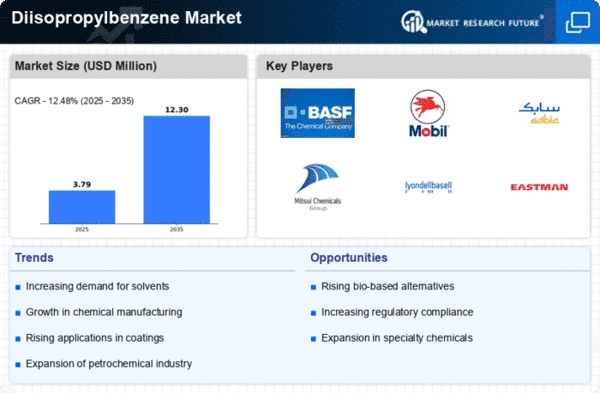
Diisopropylbenzene Market Infographic
Purchase Options

Market Trends

Key Emerging Trends in the Diisopropylbenzene Market

The dynamic nature of chemical industry is mirrored by recent developments in thje Diisopropylene benzene sector . The versatility of Diisopropylbenzene has made it popular across different industries thus increasing its demand significantly. One such trend involves increasing use of Diisopropylbenzene in producing flavors and fragrances. It finds application as a scent ingredient for personal care products, household items, food & beverages etc due to its unique aromas. The rise in number of scented products preferred by consumers increases the demand for Diisopropylbenzene hence it becomes a significant ingredient in fragrance production.

Another sector of interest in the market is the pharmaceutical industry that has seen a growing need for Diisopropylbenzene. As an intermediate, this chemical compound started gaining popularity in the synthesis of different drugs. Its role in creating active pharmaceutical ingredients (APIs) demonstrates its significance to the pharma sector. This can be attributed to growth within healthcare industry and expansion of diverse drug varieties.

Additionally, there have been shifts in demand patterns due to application of Diisopropylbenzene as precursors for polymers and resins. The chemical serves as a building block for certain types of polymer that are used to make coatings, adhesives and other industrial materials. It anticipates that with increasing property enhanced materials being sought after by industries; there will be increased demand of Diisopropylbenzene for polymer production.

Author
Chitranshi Jaiswal
Research Analyst Level I

In her 3 years of experience in the market research field, she has handled critical cross-domain projects. She has an in-depth knowledge of market estimation & analysis, problem-solving, primary as well as secondary research, and team management.She holds an engineering degree and is an MBA professional from a well-known university, capable of evaluating the market and competitive conditions. An exceptional strategist with excellent communication skills and a passion for delivering cutting-edge & practical insights for the market. Proficient in multi-tasking, and can successfully deal with competing demands, while maintaining complete confidentiality. Generated business through active client and project development, networking, and high-quality responses. Her knowledge and skills have helped in making solid business decisions, securing funding from investors, and avoiding business failures.

Leave a Comment

FAQs

What is the chemical formula of diisopropylbenzene?

C12H18.

What is diisopropylbenzene used as?

Diisopropylbenzene is majorly used as an intermediate in the production of synthetic lubricants, polymers, and stabilizers, apart from being used in gasoline and diesel as an additive.

What is the major driver for the market?

The growing demand for automotive fuel additives and lubricants is the major driver for the global diisopropylbenzene market.

Which is the leading regional market?

Asia Pacific is the largest regional market for diisopropylbenzene.

What are the key players in the market?

Leading players in the market include Eastman, TCI, and Arkema, among others.

Market Summary

As per Market Research Future Analysis, the Global Diisopropylbenzene Market was valued at USD 122.1 Million in 2022 and is projected to grow from USD 24.1 Million in 2023 to USD 178.1 Million by 2032, with a CAGR of 4.10% during the forecast period. Diisopropylbenzene Market, also known as 4-Isopropylcumene Benzene, is primarily used as an intermediate in the production of synthetic lubricants, stabilizers, and polymers. The largest market for diisopropylbenzene is in the Asia Pacific region, driven by demand in China and India, followed by North America and Europe. The market is segmented by isomers, applications, and regions, with key players including Eastman Chemical Company, Santa Cruz Biotechnology, and Arkema Group.

Key Market Trends & Highlights

The diisopropylbenzene market is witnessing significant growth driven by various applications.

  • Asia Pacific is the largest market, driven by demand for polymers and synthetic lubricants.
  • North America shows growth due to applications in stabilizers and polymers.
  • Europe ranks as the third largest market for diisopropylbenzene.
  • Latin America and the Middle East are also experiencing growth due to diverse applications.

Market Size & Forecast

2022 Market Size USD 122.1 Million
2023 Market Size USD 24.1 Million
2032 Market Size USD 178.1 Million
CAGR (2023-2032) 4.10%

Major Players

Eastman Chemical Company (US), Santa Cruz Biotechnology, Inc (US), TCI (Shanghai) Development Co., Ltd. (China), Arkema Group (Europe), Hangzhou Yuhao Chemical Technology Co., Ltd. (China), CHMA Chemical Technology (Shanghai) Co., Ltd (China), Mitsui Chemicals, Inc. (US), Rhein Chemie Corporation (US), Matrix Scientific, Inc, Sigma-Aldrich Co. LLC (US)

Market Trends

Diisopropylbenzene Market Market Drivers

Rising Demand from Chemical Industry

The Global Diisopropylbenzene Market Industry experiences robust growth driven by increasing demand from the chemical sector. Diisopropylbenzene Market serves as a vital intermediate in the production of various chemicals, including phenolic resins and surfactants. As industries expand, the need for high-quality chemical intermediates rises, leading to an estimated market value of 750 USD Million in 2024. The chemical industry's growth trajectory suggests that this demand will continue to escalate, potentially reaching 1250 USD Million by 2035, reflecting a compound annual growth rate of 4.75% from 2025 to 2035.

Market Segment Insights

Regional Insights

Key Companies in the Diisopropylbenzene Market market include

Industry Developments

Future Outlook

Diisopropylbenzene Market Future Outlook

The Global Diisopropylbenzene Market is projected to grow at a 4.75% CAGR from 2024 to 2035, driven by increasing demand in chemical synthesis and specialty applications.

New opportunities lie in:

  • Expand production capabilities to meet rising demand in emerging markets.
  • Invest in R&D for eco-friendly synthesis methods to attract sustainability-focused clients.
  • Develop strategic partnerships with key players in the petrochemical sector for enhanced market penetration.

By 2035, the Diisopropylbenzene Market is expected to achieve robust growth, solidifying its position in the global chemical landscape.

Market Segmentation

Report Scope

Attribute/Metric Details
  Market Size   2032: USD 178.1 Million
  CAGR   4.10%
  Base Year   2022
  Forecast Period   2023 to 2032
  Historical Data   2019 & 2020
  Forecast Units   Value (USD Million)
  Report Coverage   Revenue Forecast, Competitive Landscape, Growth Factors, and Trends
  Segments Covered   By Isomers, By Application and By Region
  Geographies Covered    North America, Europe, Asia-Pacific, and Rest of the World (RoW)
  Key Vendors   Eastman Chemical Company (US), Santa Cruz Biotechnology, Inc (US), TCI (Shanghai) Development Co., Ltd. (China), Arkema Group (Europe), Hangzhou Yuhao Chemical Technology Co., Ltd. (China), CHMA Chemical Technology (Shanghai) Co., Ltd (China), Mitsui Chemicals, Inc. (US), Rhein Chemie Corporation (US), Matrix Scientific. Inc, Sigma-Aldrich Co. LLC (US) and others.
  Key Market Opportunities   Diisopropylbenzene are soluble in ether, alcohol, acetone and benzene
  Key Market Drivers   The growing demand for automotive fuel additives and lubricants

FAQs

What is the chemical formula of diisopropylbenzene?

C12H18.

What is diisopropylbenzene used as?

Diisopropylbenzene is majorly used as an intermediate in the production of synthetic lubricants, polymers, and stabilizers, apart from being used in gasoline and diesel as an additive.

What is the major driver for the market?

The growing demand for automotive fuel additives and lubricants is the major driver for the global diisopropylbenzene market.

Which is the leading regional market?

Asia Pacific is the largest regional market for diisopropylbenzene.

What are the key players in the market?

Leading players in the market include Eastman, TCI, and Arkema, among others.

  1. Executive Summary
  2. Scope of The Report
    1. Market Definition
    2. Scope of The
      1. Research Objectives
      2. Assumptions & Limitations
    3. Study
    4. Markets Structure
    5. Market Research Methodology
    6. Research
    7. Process
    8. Secondary Research
    9. Primary Research
    10. Forecast Model
  3. Market Landscape
    1. Five Forces Analysis
      1. Bargaining
      2. Threat of substitutes
      3. Segment rivalry
    2. Threat of New Entrants
    3. power of buyers
    4. Value Chain/Supply Chain of Global Diisopropylbenzene Market
  4. Industry Overview of Global Diisopropylbenzene Market
    1. Introduction
    2. Growth Drivers
    3. Impact analysis
    4. Market Challenges
    5. Impact analysis
  5. Market Trends
    1. Introduction
    2. Growth Trends
    3. Impact analysis
  6. Global Diisopropylbenzene Market by Isomers
    1. Introduction
    2. o-Diisopropylbenzene
    3. m-Diisopropylbenzene
    4. p-Diisopropylbenzene
    5. Global Diisopropylbenzene Market by Applications
    6. Introduction
    7. Stabilizers
    8. Polymers
    9. Synthetic Lubricants
    10. Hydroperoxides
    11. Other
  7. Global
    1. Diisopropylbenzene Market by Region
    2. Introduction
    3. North America
      1. US
    4. Canada
    5. Europe
      1. Germany
      2. France
      3. Italy
      4. UK
    6. Spain
    7. Asia-Pacific
      1. China
      2. India
      3. Australia
      4. New
      5. Rest of Asia-Pacific
    8. Japan
    9. Zealand
    10. Middle
      1. Turkey
      2. Israel
      3. North
      4. GCC
      5. Rest of Middle East & Africa
    11. East & Africa
    12. Africa
    13. Latin America
      1. Brazil
      2. Argentina
      3. Rest of Latin America
  8. Company Landscape
    1. Company Profiles
    2. Eastman Chemical
      1. Company Overview
      2. Financial
      3. Key Developments
      4. Company Overview
      5. Product/Business Segment Overview
      6. Key Developments
    3. Company
    4. Product/Business Segment Overview
    5. Updates
    6. Santa Cruz Biotechnology, Inc
    7. Financial Updates
    8. TCI (Shanghai) Development Co., Ltd.
      1. Product/Business Segment Overview
      2. Financial Updates
      3. Key Developments
    9. Company Overview
    10. Arkema Group
      1. Company Overview
      2. Product/Business Segment Overview
      3. Key Developments
    11. Financial Updates
    12. Hangzhou Yuhao Chemical Technology Co., Ltd.
      1. Product/Business Segment Overview
      2. Financial Updates
      3. Key Developments
    13. Company Overview
    14. CHMA Chemical Technology (Shanghai) Co., Ltd.
      1. Company Overview
      2. Product/Business
      3. Financial Updates
    15. Segment Overview
    16. Key Developments
    17. Mitsui Chemicals, Inc.
      1. Company Overview
      2. Product/Business
      3. Financial Updates
    18. Segment Overview
    19. Key Developments
    20. Rhein Chemie Corporation
      1. Company Overview
      2. Product/Business
      3. Financial Updates
    21. Segment Overview
    22. Key Developments
    23. Matrix Scientific. Inc
      1. Company Overview
      2. Product/Business
      3. Financial Updates
    24. Segment Overview
    25. Key Developments
    26. Sigma-Aldrich Co. LLC
      1. Company Overview
      2. Product/Business
      3. Financial Updates
    27. Segment Overview
    28. Key Developments
  9. Conclusion
  10. LIST OF TABLES
  11. World Population by Major
    1. Regions (2020-2027)
  12. Global Diisopropylbenzene
    1. Market: By Region, 2020-2027
  13. North
    1. America Diisopropylbenzene Market: By Country, 2020-2027
    2. Table
  14. Europe Diisopropylbenzene Market: By Country, 2020-2027
  15. Asia-Pacific Diisopropylbenzene Market:
    1. By Country, 2020-2027
  16. Latin America Diisopropylbenzene
    1. Market: By Country, 2020-2027
  17. Global
    1. Diisopropylbenzene by Applications Market: By Regions, 2020-2027
  18. North America Diisopropylbenzene by Applications
    1. Market: By Country, 2020-2027
  19. Europe
    1. Diisopropylbenzene by Applications Market: By Country, 2020-2027
    2. Table9 Asia-Pacific Diisopropylbenzene by Applications
    3. Market: By Country, 2020-2027
    4. Table11 Latin
    5. America Diisopropylbenzene by Applications Market: By Country, 2020-2027
    6. Table12 North America Diisopropylbenzene for
    7. Isomers Market: By Country, 2020-2027
    8. Table13 Europe
    9. Diisopropylbenzene for Isomers Market: By Country, 2020-2027
    10. Table14
    11. Asia-Pacific Diisopropylbenzene for Isomers Market: By Country, 2020-2027
    12. Table15 Latin America Diisopropylbenzene for
    13. Isomers Market: By Country, 2020-2027
    14. Table16 Global
    15. Diisopropylbenzene for Isomers Market: By Region, 2020-2027
    16. Table17
    17. North America Diisopropylbenzene for Isomers Market: By Country, 2020-2027
    18. Table18 Europe Diisopropylbenzene for Isomers
    19. Market: By Country, 2020-2027
    20. Table19 Asia-Pacific
    21. Diisopropylbenzene for Isomers Market: By Country, 2020-2027
    22. Table20
    23. Latin America Diisopropylbenzene for Isomers Market: By Country, 2020-2027
    24. Table21 Latin America Diisopropylbenzene for
    25. Isomers Market: By Country, 2020-2027
    26. Table22 Global
    27. Applications Market: By Region, 2020-2027
    28. Table23
    29. Global Isomers Market: By Region, 2020-2027
    30. Table24
  20. North America Diisopropylbenzene Market, By Country
    1. Table25
  21. North America Diisopropylbenzene Market, By Applications
  22. Table26 North America Diisopropylbenzene Market, By Isomers
  23. Table27 Europe: Diisopropylbenzene Market, By Country
    1. Table28 Europe: Diisopropylbenzene Market,
    2. By Applications
    3. Table29 Europe: Diisopropylbenzene
  24. Market, By Isomers
    1. Table30 Asia-Pacific: Diisopropylbenzene
  25. Market, By Country
    1. Table31 Asia-Pacific: Diisopropylbenzene
  26. Market, By Applications
    1. Table32 Asia-Pacific:
  27. Diisopropylbenzene Market, By Isomers
    1. Table33 Latin
  28. America: Diisopropylbenzene Market, By Country
    1. Table34
  29. Latin America Diisopropylbenzene Market, By Applications
    1. Table35 Latin America: Diisopropylbenzene Market, By
    2. Isomers
  30. LIST OF FIGURES
  31. Global Diisopropylbenzene Market segmentation
  32. Forecast Methodology
  33. Five
    1. Forces Analysis of Global Diisopropylbenzene Market
    2. FIGURE 4
    3. Value Chain of Global Diisopropylbenzene Market
    4. FIGURE 5
  34. Share of Global Diisopropylbenzene Market in 2020, by country (in %)
  35. Global Diisopropylbenzene Market, 2020-2027,
  36. Sub-segments of Isomerss
    1. FIGURE 8
    2. Global Diisopropylbenzene Market size by Isomers, 2020
    3. FIGURE
  37. Share of Global Diisopropylbenzene Market by Isomers, 2020-2027
  38. Global Diisopropylbenzene
    1. Market size by Applications, 2020
  39. Share of Global
    1. Diisopropylbenzene Market by Applications, 2020-2027

Diisopropylbenzene Market Segmentation

Market Segmentation Overview

  • Detailed segmentation data will be available in the full report
  • Comprehensive analysis by multiple parameters
  • Regional and country-level breakdowns
  • Market size forecasts by segment
Infographic

Free Sample Request

Kindly complete the form below to receive a free sample of this Report

Get Free Sample

Customer Strories

Compare Licence

×
Features License Type
Single User Multiuser License Enterprise User
Price $4,950 $5,950 $7,250
Maximum User Access Limit 1 User Upto 10 Users Unrestricted Access Throughout the Organization
Free Customization
Direct Access to Analyst
Deliverable Format
Platform Access
Discount on Next Purchase 10% 15% 15%
Printable Versions