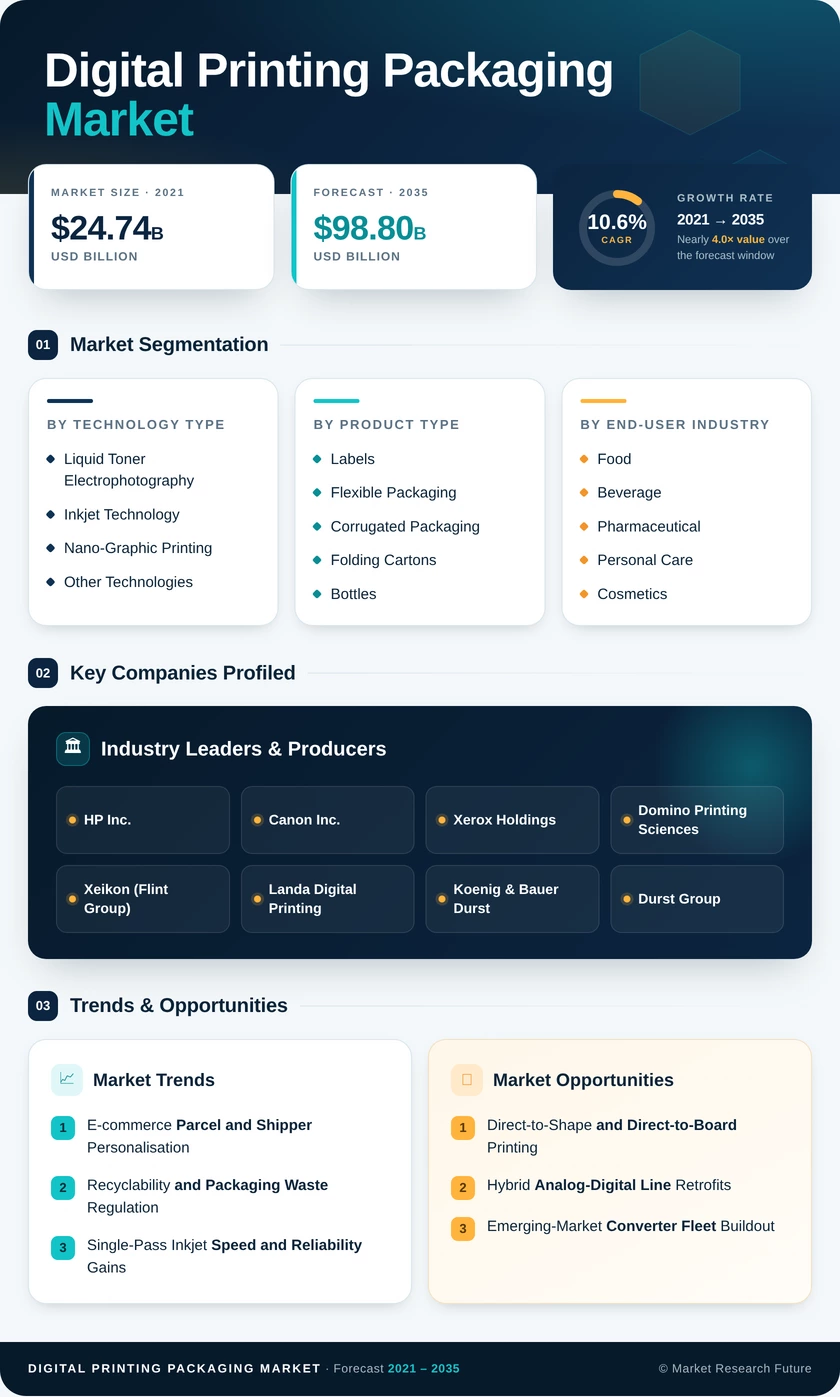
Segmentation Quick Reference
| Dimension | Sub-Segments | Dominant Segment | Fastest Growing Segment |
| By Technology Type | Liquid Toner Electrophotography; Inkjet Technology; Nano-Graphic Printing; Other Technologies | Liquid Toner Electrophotography (37.4% share, 2025) | Inkjet Technology (15.2% CAGR, 2026–2035) |
| By Product Type | Labels; Flexible Packaging; Corrugated Packaging; Folding Cartons; Bottles and Jars; Other Product Type | Labels (32.8% share, 2025) | Flexible Packaging (13.7% CAGR, 2026–2035) |
| By End-User Industry | Food; Beverage; Pharmaceutical; Personal Care and Cosmetics; Electrical and Electronics; Automotive; Other End-User Industry | Food (28.1% share, 2025) | Beverage (16.2% CAGR, 2026–2035) |
| By Ink Type | Solvent-based Inks; UV-cured Inks; Aqueous Inks; Latex and Resin-based Inks; Other Ink Types | UV-cured Inks (41.3% share, 2025) | Aqueous Inks (15.1% CAGR, 2026–2035) |
| By Substrate Material | Paper and Paperboard; Plastic Films; Metal; Glass; Other Substrate Material | Plastic Films (42.2% share, 2025) | Paper and Paperboard (15.9% CAGR, 2026–2035) |
| By Packaging Format | Primary Packaging; Secondary Packaging; Tertiary / Transit Packaging | Primary Packaging (35.8% share, 2025) | Tertiary / Transit Packaging (13.1% CAGR, 2026–2035) |
Market Segmentation Overview
By Technology Type
| Sub-Segment | Key Trend |
| Liquid Toner Electrophotography | Spot-colour accuracy retains premium label contracts specified by brand owners. |
| Inkjet Technology | Recirculating printheads and food-compliant chemistry remove prior adoption blockers. |
| Nano-Graphic Printing | Wide-format carton applications commercialise as capacity scales. |
| Other Technologies | Thermal transfer and specialty imaging hold defined niche workloads. |
Liquid Toner Electrophotography leads because its colour repeatability meets the contractual gamut tolerances premium label buyers write into supply agreements. Inkjet Technology grows fastest: printhead recirculation cut nozzle-out failures sharply, and aqueous formulations now clear food-contact review, opening film and board work that toner handles poorly. Nano-Graphic Printing remains confined to wide-format carton lines where its sheet-fed economics apply. The mix stays plural because job length, substrate, and colour tolerance select the process rather than the reverse.
By Product Type
| Sub-Segment | Key Trend |
| Labels | Serialisation rules make variable imaging the only compliant route |
| Flexible Packaging | Portion-control and reclosable formats shorten run lengths below analog crossover. |
| Corrugated Packaging | Direct-to-board lines absorb weekly shipper artwork churn. |
| Folding Cartons | Pharmaceutical and cosmetics unit cartons adopt inline coding. |
| Bottles and Jars | Direct-to-shape decoration removes the label layer entirely. |
| Other Product Type | Sleeves and tags follow beverage promotional cycles. |
Labels dominate revenue because roll-to-roll conversion pairs naturally with unit-level codes that pharmaceutical and nutraceutical regulation now requires. Flexible Packaging compounds fastest as snack, pet food, and personal-care brands split portfolios into smaller portion packs, dropping typical run lengths under the flexo economic threshold. Corrugated Packaging expands alongside parcel volumes, since fulfilment operators would rather image shippers on demand than warehouse pre-printed board. Folding Cartons trail both but benefit from inline serialisation.
By End-User Industry
| Sub-Segment | Key Trend |
| Food | Multi-market language changeover on pouch and flow-wrap lines |
| Beverage | Craft can sleeves and limited-edition campaign runs. |
| Pharmaceutical | Serialised cartons and tamper-evident construction |
| Personal Care and Cosmetics | Influencer collaborations and seasonal editions |
| Electrical and Electronics | Anti-counterfeit coding on retail presentation packs |
| Automotive | Aftermarket parts identification and traceability |
| Other End-User Industry | Household chemicals and pet care promotional cycles |
Food holds the largest revenue pool on throughput alone, with export processors valuing same-press language variants for multi-market SKUs. Beverage grows fastest because craft brewers and functional-drink brands treat the container as a rotating campaign asset ordered in thousands, not millions — a volume band analog plates cannot serve. Pharmaceutical demand is regulation-locked and therefore the most predictable of the three. Personal Care and Cosmetics adds volatility through short promotional cycles.
By Ink Type
| Sub-Segment | Key Trend |
| Solvent-based Inks | Persist where volatile-emission limits remain permissive |
| UV-cured Inks | Instant cure supports same-shift finishing and dispatch. |
| Aqueous Inks | Low-migration profiles clear food-contact review |
| Latex and Resin-based Inks | High elongation suits film conversion |
| Other Ink Types | Compostable formulations align with recyclability grading. |
UV-cured Inks lead because instant curing lets converters finish, slit, and ship within a single shift — decisive on moisture-sensitive beverage wraps where dwell time degrades product. Aqueous Inks grow fastest as food-contact migration rules tighten and water-based series reach durability parity on film substrates. Solvent-based Inks hold ground only in jurisdictions with looser emissions laws. Ink chemistry, not press hardware, is now the binding regulatory constraint on which jobs a converter can legally accept.
By Substrate Material
| Sub-Segment | Key Trend |
| Paper and Paperboard | Fibre-based redesign accelerates under recyclability grading |
| Plastic Films | Snack and personal-care pouch volume sustains the base. |
| Metal | Direct-to-shape can decoration reaches small-batch buyers. |
| Glass | Premium spirits and cosmetics decoration remains specialised. |
| Other Substrate Material | Foil laminates face substitution pressure from mono-materials |
Plastic Films carry the largest share because pouches remain the default construction for snacks and personal care, where barrier performance still outweighs recyclability scoring. Paper and Paperboard grows fastest as design-for-recycling criteria penalise multilayer laminates and brand owners move to coated fibre alternatives that de-ink cleanly. Metal gains from direct-to-shape systems letting small brewers order customised cans without a separate label layer. Every substrate switch forces fresh ink qualification, so migration itself sustains converter demand.
By Packaging Format
| Sub-Segment | Key Trend |
| Primary Packaging | Regulatory data and brand graphics converge on one panel |
| Secondary Packaging | Retailer-specific promotions avoid obsolete pre-printed stock. |
| Tertiary / Transit Packaging | Shipper personalisation follows e-commerce unboxing strategies. |
Primary Packaging leads because the consumer-facing panel must now carry serialisation codes, recycling instructions, and marketing artwork at once, and only variable imaging prices that combination economically at short run lengths. Tertiary / Transit Packaging grows fastest as fulfilment networks print shippers on demand rather than holding pre-printed board that right-sizing programmes render obsolete. Secondary Packaging sits between them, absorbing retailer promotional cycles. Format demand confirms the shift from decoration toward supply-chain function.


 Noah Malgeri
Co-Founder

 Peter Groot koerkamp
Account and Business Manager

 Younghwan Choi
Senior Retail Manager

 Mark Irwin
Management Consultant

 Akif Moroglu
Strategy & Business Development Director

 Guilherme Gomes Martins
Product Management Director

 Joseph Aguayo
Sales Operations & Pricing Manager

 La Terria Dodd
Program Support Specialist

 Rob Kooiker
Group Product Manager HVAC & Fire Protection GMA