Request Free Sample ×

Kindly complete the form below to receive a free sample of this Report

* Please use a valid business email

Leading companies partner with us for data-driven Insights

clients tt-cursor
Hero Background

Digital Payment Market

ID: MRFR/BS/6103-CR
200 Pages
Aarti Dhapte
June 2025

Digital Payment Market Size, Share & Industry Analysis By Payment Method (Credit Card, Debit Card, Mobile Wallet, Bank Transfer, Cryptocurrency), By Transaction Type (Online Transactions, In-Store Transactions, Peer-to-Peer Transactions, Recurring Payments), By End User (Retail Consumers, Businesses, Government Entities), By Industry Vertical (Retail, Banking, Travel, Healthcare, Entertainment) and By Regional (North America, Europe, South America, Asia Pacific, Middle East and Africa) - Industry Forecast Till 2035

Share:
Download PDF ×

We do not share your information with anyone. However, we may send you emails based on your report interest from time to time. You may contact us at any time to opt-out.

Digital Payment Market Infographic
Purchase Options

Digital Payment Market Summary

As per Market Research Future analysis, the Digital Payment Market Size was estimated at 111.81 USD Billion in 2024. The Digital Payment industry is projected to grow from 128.67 USD Billion in 2025 to 524.28 USD Billion by 2035, exhibiting a compound annual growth rate (CAGR) of 15.08% during the forecast period 2025 - 2035

Key Market Trends & Highlights

The Digital Payment Market is experiencing robust growth driven by technological advancements and changing consumer preferences.

  • The rise of mobile wallets is reshaping payment methods, particularly in the Asia-Pacific region.
  • Increased focus on security measures is becoming paramount as digital transactions proliferate across North America.
  • Integration of AI and machine learning is enhancing user experience and fraud detection in payment systems.
  • Expansion of e-commerce and adoption of contactless payments are key drivers propelling the market forward.

Market Size & Forecast

2024 Market Size 111.81 (USD Billion)
2035 Market Size 524.28 (USD Billion)
CAGR (2025 - 2035) 15.08%

Major Players

PayPal (US), Square (US), Adyen (NL), Stripe (US), Alipay (CN), WeChat Pay (CN), Visa (US), Mastercard (US), American Express (US), Revolut (GB)

Our Impact
Enabled $4.3B Revenue Impact for Fortune 500 and Leading Multinationals
Partnering with 2000+ Global Organizations Each Year
30K+ Citations by Top-Tier Firms in the Industry

Digital Payment Market Trends

The Digital Payment Market is currently experiencing a transformative phase, driven by advancements in technology and changing consumer preferences. The rapid expansion of the digital payment market reflects the broader transformation of the global payment industry. The proliferation of smartphones and internet connectivity has facilitated the adoption of various digital payment solutions, enabling consumers to transact seamlessly and securely. Growth is supported by advancements in payment technology and rising adoption across regions. As businesses increasingly recognize the importance of offering diverse payment options, the Digital Payment Market is witnessing a surge in innovative payment methods, including mobile wallets, contactless payments, and peer-to-peer transfer services. This evolution is not merely a response to consumer demand; it also reflects a broader shift towards a cashless society, where convenience and efficiency are paramount. Evolving digital payment trends indicate a strong shift toward mobile-first transactions. Moreover, regulatory frameworks are evolving to support the growth of the Digital Payment Market.  Fintech-led innovation continues to reshape the digital payment ecosystem. Governments are implementing policies that promote financial inclusion and enhance security measures, thereby fostering consumer trust in digital transactions. The rise of fintech companies is further intensifying competition, as these entities introduce agile solutions that challenge traditional banking systems. As the Digital Payment Market continues to expand, it appears poised for further innovation, with emerging technologies such as blockchain and artificial intelligence likely to play pivotal roles in shaping its future landscape. The interplay between consumer behavior, regulatory changes, and technological advancements suggests a dynamic environment that will require stakeholders to remain adaptable and forward-thinking.

Rise of Mobile Wallets

Mobile wallets are gaining traction as consumers increasingly prefer the convenience of making payments through their smartphones. This trend reflects a shift towards digital-first solutions, where users can store multiple payment methods in one application, streamlining the transaction process. Mobile wallets remain central to the expanding mobile payment market.

Increased Focus on Security

As digital transactions proliferate, there is a heightened emphasis on security measures. Companies are investing in advanced encryption technologies and biometric authentication to protect consumer data, thereby enhancing trust in digital payment systems. Security innovation strengthens trust across the digital payments industry.

Integration of AI and Machine Learning

The integration of artificial intelligence and machine learning into digital payment platforms is transforming the user experience. These technologies enable personalized services, fraud detection, and improved customer support, making transactions more efficient and secure. AI-driven analytics are transforming digital payment technologies.

Digital Payment Market Drivers

Expansion of E-commerce

The rapid expansion of e-commerce platforms has been a pivotal driver for the Digital Payment Market. As consumers increasingly prefer online shopping, the demand for seamless and secure payment solutions has surged. In 2025, e-commerce sales are projected to reach approximately 6 trillion USD, indicating a substantial growth trajectory. This trend compels businesses to adopt digital payment methods to enhance customer experience and streamline transactions. The integration of various payment options, including credit cards, digital wallets, and buy-now-pay-later services, further fuels this growth. Consequently, the Digital Payment Market is likely to witness a significant uptick in transaction volumes, as more consumers opt for online purchases over traditional retail. This shift not only transforms consumer behavior but also encourages merchants to innovate their payment processes to remain competitive.

Growing Smartphone Penetration

The growing penetration of smartphones is a significant driver of the Digital Payment Market. As of 2025, it is estimated that over 80% of the global population will own a smartphone, facilitating access to digital payment solutions. This widespread adoption enables consumers to conduct transactions anytime and anywhere, thereby increasing the frequency of digital payments. Mobile banking applications and digital wallets are becoming increasingly popular, allowing users to manage their finances with ease. The convenience offered by smartphones is likely to encourage more individuals to transition from cash to digital payment methods. Consequently, the Digital Payment Market is expected to experience substantial growth, as businesses adapt to the changing landscape by offering mobile-friendly payment options. This trend not only enhances consumer convenience but also drives innovation in payment technologies.

Adoption of Contactless Payments

The adoption of contactless payment methods is transforming the Digital Payment Market. With the proliferation of Near Field Communication (NFC) technology, consumers are increasingly utilizing contactless cards and mobile wallets for transactions. As of 2025, it is estimated that contactless payments will account for over 30% of all card transactions. This trend is driven by the convenience and speed of contactless payments, which enhance the overall shopping experience. Retailers are also incentivized to implement contactless payment systems to reduce checkout times and improve customer satisfaction. Furthermore, the Digital Payment Market benefits from the growing acceptance of these payment methods across various sectors, including retail, transportation, and hospitality. As more consumers embrace contactless technology, the industry is poised for continued growth, with an emphasis on innovation and user-friendly solutions.

Emergence of Fintech Innovations

The emergence of fintech innovations is reshaping the Digital Payment Market. Startups and established financial institutions are increasingly leveraging technology to develop new payment solutions that cater to evolving consumer needs. Innovations such as blockchain technology, peer-to-peer payment platforms, and instant payment systems are gaining traction. In 2025, the fintech sector is projected to reach a valuation of over 300 billion USD, highlighting the potential for growth within the Digital Payment Market. These advancements not only enhance transaction speed and security but also provide consumers with more choices in how they manage their finances. As fintech companies continue to disrupt traditional banking models, the Digital Payment Market is likely to witness increased competition and collaboration, ultimately leading to a more dynamic and diverse payment landscape.

Regulatory Support and Frameworks

Regulatory support and frameworks play a crucial role in shaping the Digital Payment Market. Governments worldwide are increasingly recognizing the importance of digital payments in promoting financial inclusion and economic growth. In 2025, several countries are expected to implement favorable regulations that facilitate the adoption of digital payment solutions. These regulations may include guidelines for security standards, consumer protection, and interoperability among payment systems. Such supportive measures encourage businesses to invest in digital payment technologies, thereby expanding the market. Moreover, the Digital Payment Market benefits from initiatives aimed at enhancing cybersecurity and combating fraud, which are essential for building consumer trust. As regulatory environments evolve, they are likely to foster innovation and competition, ultimately leading to a more robust digital payment ecosystem.

Market Segment Insights

By Payment Method: Credit Card (Largest) vs. Mobile Wallet (Fastest-Growing)

The digital payment market has showcased a diverse landscape with various payment methods competing for dominance. Currently, credit cards hold the largest market share, driven by consumer familiarity and extensive acceptance across global merchants. On the other hand, mobile wallets are gaining traction rapidly, appealing to tech-savvy consumers who prefer the convenience of mobile transactions and the integration of loyalty programs, making them a preferred choice among younger demographics. Growth trends indicate a shift towards more digital and contactless payment solutions, particularly in the wake of recent global events accelerating the digital transformation. Factors such as the increase in e-commerce, heightened security measures, and the ongoing adoption of smartphones are propelling mobile wallets to the forefront, showcasing their potential to capture a significant share of the market in the coming years.

Credit Card (Dominant) vs. Cryptocurrency (Emerging)

Credit cards are recognized as the dominant payment method within the digital payment market, characterized by their acceptance and reliability. They offer consumers a sense of security and rewards programs that enhance customer loyalty. In contrast, cryptocurrencies represent an emerging payment method, appealing to a niche market that values decentralization and transparency. While still in the early adoption phase, cryptocurrencies are increasingly being accepted by online retailers, driven by the growing interest in blockchain technology. The volatility and regulatory uncertainty surrounding cryptocurrencies remain barriers, but their potential for cross-border transactions and lower fees make them an attractive option, indicating a promising future in the evolving digital payment landscape.

By Transaction Type: Online Transactions (Largest) vs. Peer-to-Peer Transactions (Fastest-Growing)

The Digital Payment Market exhibits a diverse landscape shaped by various transaction types. Online Transactions lead the market, securing the largest share with an ongoing penetration into e-commerce, mobile commerce, and digital wallets. This segment benefits from the global shift towards online shopping and the increasing preference for contactless payment methods. In contrast, Peer-to-Peer Transactions are carving out their niche, rapidly growing thanks to the rise of social payment platforms and applications, facilitating instant transfers between users without intermediaries. The growth trends within this segment are influenced by technological advancements, changing consumer behaviors, and increased smartphone adoption. Factors such as the convenience and security offered by digital payment options drive users towards online transactions, while millennials and Gen Z users favor Peer-to-Peer Transactions for their simplicity and social integration. As financial literacy and digital ecosystems evolve, these transaction types will continue to reshape the market.

Online Transactions: Dominant vs. Recurring Payments: Emerging

The Online Transactions segment stands out as the dominant force in the Digital Payment Market, characterized by its alignment with consumer preferences for digital shopping and services. This segment enjoys strong support from various industries adopting e-commerce solutions, enabling smooth transactions through websites and mobile applications. On the other hand, Recurring Payments, while still emerging, play a crucial role in subscription-based services, providing a steady stream of revenue for businesses. This segment attracts consumers with its convenience, as it simplifies payment processes for subscriptions and utilities. Together, these segments reflect a transformation in the way consumers engage with digital payments, with Online Transactions leading the charge and Recurring Payments gradually establishing a vital presence.

By End User: Retail Consumers (Largest) vs. Businesses (Fastest-Growing)

In the Digital Payment Market, the distribution among end users reveals a significant presence of retail consumers, who represent the largest segment. This group is primarily driven by the increasing adoption of online shopping and mobile payments, reflecting a shift towards convenience and efficiency in transactions. Businesses, comprising a diverse range of industries, are also making substantial contributions to the market. They leverage digital payment solutions for enhanced operational efficiency and customer satisfaction.

Retail Consumers (Dominant) vs. Businesses (Emerging)

Retail consumers dominate the Digital Payment Market, characterized by their preference for quick and seamless transactions facilitated by mobile wallets and contactless payments. This segment is driven by factors such as increasing smartphone penetration and the growing trend of e-commerce. In contrast, the business segment is emerging rapidly, with companies of all sizes adopting digital payment technologies to streamline their billing processes and improve cash flow management. Businesses are increasingly recognizing the value of integrated payment solutions, which not only enhance transaction experiences but also provide valuable data analytics for strategic decision-making.

By Industry Vertical: Retail (Largest) vs. Travel (Fastest-Growing)

The digital payment market exhibits a diverse landscape across various industry verticals, with the retail segment holding the largest share. Retail payment solutions benefit from the high volume of transactions facilitated by e-commerce and brick-and-mortar stores embracing digital methods. Meanwhile, banking and healthcare segments also contribute significantly, but retail surpasses them in overall transactions, demonstrating a well-established infrastructure for digital payment adoption. In contrast, the travel segment is experiencing rapid growth, fueled by the increasing trend of online bookings and mobile payments among consumers. Factors such as the rising number of global travelers, along with the convenience of digital wallets and contactless payments, position travel as the fastest-growing vertical within the digital payment market, highlighting changing consumer behaviors and preferences.

Retail: Dominant vs. Travel: Emerging

The retail sector is characterized by its robust and established digital payment solutions, which cater to both online and offline customer experiences. Retailers leverage advanced payment technologies to ensure seamless transactions, enhancing customer satisfaction and loyalty. The sector encompasses various players, from large multinational chains to small local shops, all adopting digital payment systems to stay competitive. On the other hand, the travel segment is an emerging player, benefitting from a surge in mobile payment adoption as travelers increasingly prefer cashless transactions. This vertical is marked by innovation, with companies exploring new technologies such as blockchain and AI for traveler-centric digital payment solutions. The ongoing evolution in customer expectations drives both segments to adapt and refine their offerings, ensuring they meet the demands of a digital-first consumer base.

Get more detailed insights about Digital Payment Market

Regional Insights

North America : Digital Payment Market Leader

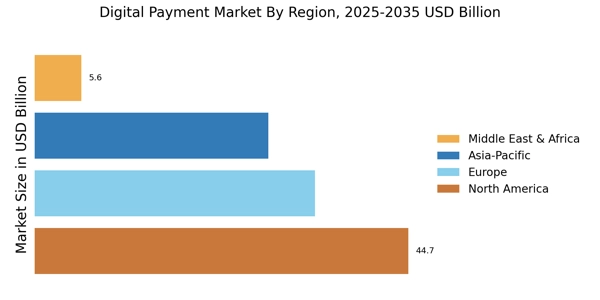
North America is the largest market for digital payments, holding approximately 40% of the global share. The region's growth is driven by high smartphone penetration, increasing e-commerce activities, and supportive regulatory frameworks. The U.S. leads this market, followed closely by Canada, as consumers increasingly prefer contactless and online payment methods. E-commerce growth strengthens the Mexico digital payment market. Regulatory initiatives aimed at enhancing cybersecurity and consumer protection further bolster market growth. The competitive landscape is characterized by major players such as PayPal, Square, and Stripe, which dominate the Digital Payment Market with innovative solutions. The presence of established financial institutions like Visa and Mastercard also enhances the ecosystem, providing consumers with a variety of payment options. The rapid adoption of digital wallets and peer-to-peer payment systems is reshaping consumer behavior, making North America a hotbed for digital payment innovations.

Europe : Regulatory Frameworks Drive Growth

Asia-Pacific is witnessing rapid growth in the digital payment market, holding approximately 25% of the global share. The region's expansion is driven by increasing smartphone penetration, a burgeoning middle class, and a shift towards cashless transactions. China leads the China digital payment market through large-scale mobile wallet adoption. Countries like China and India are at the forefront, with mobile payment platforms like Alipay and WeChat Pay leading the charge. Government initiatives promoting digitalization further catalyze this growth. China is the largest market in the region, followed by India, where digital payment adoption is accelerating due to favorable demographics and increasing internet access. Innovation in fintech supports the South Korea digital payment market. Government-backed initiatives accelerate growth in the India digital payment market. The competitive landscape is vibrant, with both local and international players vying for market share. Fintech investments support the gcc digital payment market. The presence of global giants like PayPal and emerging fintech companies is reshaping the payment ecosystem, making Asia-Pacific a key player in the global digital payment landscape.

Asia-Pacific : Emerging Market Potential

Asia-Pacific is witnessing rapid growth in the digital payment market, holding approximately 25% of the global share. The region's expansion is driven by increasing smartphone penetration, a burgeoning middle class, and a shift towards cashless transactions. China leads the China digital payment market through large-scale mobile wallet adoption. Countries like China and India are at the forefront, with mobile payment platforms like Alipay and WeChat Pay leading the charge. Government initiatives promoting digitalization further catalyze this growth. China is the largest market in the region, followed by India, where digital payment adoption is accelerating due to favorable demographics and increasing internet access. Innovation in fintech supports the South Korea digital payment market. Government-backed initiatives accelerate growth in the India digital payment market. The competitive landscape is vibrant, with both local and international players vying for market share. Fintech investments support the gcc digital payment market. The presence of global giants like PayPal and emerging fintech companies is reshaping the payment ecosystem, making Asia-Pacific a key player in the global digital payment landscape.

Middle East and Africa : Untapped Market Opportunities

The Middle East and Africa (MEA) region is emerging as a significant player in the digital payment market, holding approximately 5% of the global share. The growth is driven by increasing smartphone usage, a young population, and government initiatives aimed at promoting financial inclusion. Countries like South Africa and the UAE are leading the charge, with a growing number of consumers opting for digital payment solutions over traditional cash methods. The competitive landscape is characterized by a mix of local and international players, with companies like PayPal and local fintech startups gaining traction. The region's unique challenges, such as varying regulatory environments and infrastructure issues, present both opportunities and hurdles for market players. However, the increasing focus on digital transformation and financial technology is paving the way for a more robust digital payment ecosystem in MEA.

Digital Payment Market Regional Image

Key Players and Competitive Insights

The Digital Payment Market is currently characterized by a dynamic competitive landscape, driven by rapid technological advancements and evolving consumer preferences. Key players such as PayPal (US), Stripe (US), and Alipay (CN) are at the forefront, each adopting distinct strategies to enhance their market positioning. PayPal (US) continues to innovate its platform, focusing on expanding its services to include cryptocurrency transactions, thereby appealing to a broader demographic. Meanwhile, Stripe (US) emphasizes its developer-friendly approach, facilitating seamless integration for businesses, which positions it favorably among tech-savvy enterprises. Alipay (CN), on the other hand, leverages its extensive user base in China to expand internationally, particularly in Southeast Asia, indicating a strategic focus on regional growth and market penetration.The business tactics employed by these companies reflect a moderately fragmented market structure, where competition is intense yet diverse. Localizing services and optimizing supply chains are critical tactics that these players utilize to enhance customer experience and operational efficiency. The collective influence of these key players shapes a competitive environment that is not only about market share but also about technological leadership and customer loyalty. Competition among digital payment companies intensifies through platform innovation. Market leaders shape future digital payment trends.
In August PayPal (US) announced a partnership with a leading blockchain technology firm to enhance its cryptocurrency offerings. This strategic move is significant as it positions PayPal to capitalize on the growing interest in digital currencies, potentially attracting a new segment of users who are increasingly interested in decentralized finance. Such partnerships may also enhance PayPal's credibility in the crypto space, allowing it to differentiate itself from competitors.
In September Stripe (US) launched a new feature aimed at simplifying cross-border payments for small and medium-sized enterprises (SMEs). This initiative is crucial as it addresses a common pain point for SMEs, enabling them to expand their operations internationally with ease. By focusing on the needs of smaller businesses, Stripe not only strengthens its market position but also fosters loyalty among a vital customer segment that is often underserved by larger financial institutions.
In July Alipay (CN) expanded its services to include a digital wallet feature tailored for international travelers, allowing users to make payments seamlessly while abroad. This strategic expansion is indicative of Alipay's commitment to enhancing user experience and convenience, which is essential in retaining its competitive edge in the global market. By catering to the needs of travelers, Alipay positions itself as a versatile payment solution, further solidifying its brand presence outside of China.
As of October the Digital Payment Market is witnessing trends that emphasize digitalization, sustainability, and the integration of artificial intelligence. Strategic alliances among key players are increasingly shaping the competitive landscape, fostering innovation and enhancing service offerings. The shift from price-based competition to a focus on technological advancement and supply chain reliability is becoming evident. Companies that prioritize innovation and customer-centric solutions are likely to emerge as leaders in this evolving market.

Key Companies in the Digital Payment Market include

Industry Developments

The Digital Payment Market has seen significant recent developments, particularly with the rise of mobile payment solutions. Companies like Apple Pay and Google Pay are expanding their user bases as contactless transactions gain popularity. Retail and banking sectors drive innovation in payment technology.

In September 2023, Mastercard announced its strategic partnership with the Fintech, Stripe, to enhance payment processing capabilities and broaden reach, strengthening its position in the market. Recent launches reflect ongoing evolution across the digital payment ecosystem.

Furthermore, in October 2023, PayPal completed the acquisition of a digital invoicing company to further streamline payment functionalities for small businesses. The Digital Payment Market is experiencing robust growth, driven by the increasing adoption of digital wallets and electronic payment methods. Growth in market valuations for major players, such as Visa and American Express, reflects heightened consumer demand for secure online transactions.

The shift towards digital payments as a default transaction method has been accelerated by the COVID-19 pandemic, leading to a pronounced increase in e-commerce transactions in recent years, particularly noteworthy in 2021 and 2022. Overall, the trends indicate an ongoing transition toward a cashless society, with organizations adapting their services to meet evolving consumer preferences and regulatory standards.

Future Outlook

Digital Payment Market Future Outlook

The Digital Payment Market is projected to grow at a 15.08% CAGR from 2025 to 2035, driven by technological advancements, increased smartphone penetration, and evolving consumer preferences.

New opportunities lie in:

  • Integration of AI-driven fraud detection systems
  • Expansion of blockchain-based payment solutions
  • Development of mobile wallet partnerships with retailers

By 2035, the Digital Payment Market is expected to be a cornerstone of global commerce. The digital payment market is expected to remain a cornerstone of the global payment industry.

Market Segmentation

Digital Payment Market End User Outlook

  • Retail Consumers
  • Businesses
  • Government Entities

Digital Payment Market Payment Method Outlook

  • Credit Card
  • Debit Card
  • Mobile Wallet
  • Bank Transfer
  • Cryptocurrency

Digital Payment Market Transaction Type Outlook

  • Online Transactions
  • In-Store Transactions
  • Peer-to-Peer Transactions
  • Recurring Payments

Digital Payment Market Industry Vertical Outlook

  • Retail
  • Banking
  • Travel
  • Healthcare
  • Entertainment

Report Scope

MARKET SIZE 2024 111.81(USD Billion)
MARKET SIZE 2025 128.67(USD Billion)
MARKET SIZE 2035 524.28(USD Billion)
COMPOUND ANNUAL GROWTH RATE (CAGR) 15.08% (2025 - 2035)
REPORT COVERAGE Revenue Forecast, Competitive Landscape, Growth Factors, and Trends
BASE YEAR 2024
Market Forecast Period 2025 - 2035
Historical Data 2019 - 2024
Market Forecast Units USD Billion
Key Companies Profiled PayPal (US), Square (US), Adyen (NL), Stripe (US), Alipay (CN), WeChat Pay (CN), Visa (US), Mastercard (US), American Express (US), Revolut (GB)
Segments Covered Payment Method, Transaction Type, End User, Industry Vertical, Regional
Key Market Opportunities Integration of blockchain technology enhances security and transparency in the Digital Payment Market.
Key Market Dynamics Rapid technological advancements and evolving consumer preferences drive transformation in the Digital Payment Market.
Countries Covered North America, Europe, APAC, South America, MEA

Market Highlights

Author
Author Profile
Aarti Dhapte LinkedIn
AVP - Research

A consulting professional focused on helping businesses navigate complex markets through structured research and strategic insights. I partner with clients to solve high-impact business problems across market entry strategy, competitive intelligence, and opportunity assessment. Over the course of my experience, I have led and contributed to 100+ market research and consulting engagements, delivering insights across multiple industries and geographies, and supporting strategic decisions linked to $500M+ market opportunities. My core expertise lies in building robust market sizing, forecasting, and commercial models (top-down and bottom-up), alongside deep-dive competitive and industry analysis. I have played a key role in shaping go-to-market strategies, investment cases, and growth roadmaps, enabling clients to make confident, data-backed decisions in dynamic markets.

Leave a Comment

FAQs

What is the current valuation of the Digital Payment Market in 2024?

<p>The Digital Payment Market was valued at 111.81 USD Billion in 2024.</p>

What is the projected market size for the Digital Payment Market by 2035?

<p>The market is projected to reach 524.28 USD Billion by 2035.</p>

What is the expected CAGR for the Digital Payment Market during the forecast period 2025 - 2035?

<p>The expected CAGR for the Digital Payment Market during 2025 - 2035 is 15.08%.</p>

Which payment method segment is projected to have the highest valuation by 2035?

<p>The Mobile Wallet segment is projected to reach 200.0 USD Billion by 2035.</p>

How do online transactions compare to in-store transactions in terms of market size?

<p>Online transactions were valued at 44.72 USD Billion in 2024, while in-store transactions were valued at 33.0 USD Billion.</p>

What are the key players in the Digital Payment Market?

<p>Key players include PayPal, Square, Adyen, Stripe, Alipay, WeChat Pay, Visa, Mastercard, American Express, and Revolut.</p>

Which end user segment is expected to dominate the market by 2035?

<p>Retail Consumers are expected to dominate the market, reaching 210.0 USD Billion by 2035.</p>

What is the projected valuation for the banking industry vertical by 2035?

<p>The banking industry vertical is projected to reach 130.0 USD Billion by 2035.</p>

How do peer-to-peer transactions compare to recurring payments in terms of future growth?

<p>Peer-to-peer transactions were valued at 18.0 USD Billion in 2024, while recurring payments were valued at 16.09 USD Billion.</p>

What is the significance of cryptocurrency in the Digital Payment Market?

<p>Cryptocurrency had a valuation of 6.81 USD Billion in 2024, indicating its emerging role in the market.</p>

Download Free Sample

Kindly complete the form below to receive a free sample of this Report

Compare Licence

×
Features License Type
Single User Multiuser License Enterprise User
Price $4,950 $5,950 $7,250
Maximum User Access Limit 1 User Upto 10 Users Unrestricted Access Throughout the Organization
Free Customization
Direct Access to Analyst
Deliverable Format
Platform Access
Discount on Next Purchase 10% 15% 15%
Printable Versions