×
Request Free Sample ×

Kindly complete the form below to receive a free sample of this Report

* Please use a valid business email

Leading companies partner with us for data-driven Insights

clients tt-cursor
Hero Background
English
Chinese
French
Japanese
Korean
German
Spanish

Digital Badges Market Analysis

ID: MRFR/SEM/5243-HCR
100 Pages
Shubham Munde
October 2025

Digital Badges Market Size, Share and Research Report By Type (Participation, Recognition, Achievement, Contribution, Certification), By End-Users (Education (K-12, Higher Studies), Corporate (SMEs, Large Enterprises), Retail, Gaming, Transportation, Others), And By Region (North America, Europe, Asia-Pacific, And Rest Of The World) – Industry Forecast Till 2035

Share:
Download PDF ×

We do not share your information with anyone. However, we may send you emails based on your report interest from time to time. You may contact us at any time to opt-out.

Digital Badges Market Infographic
×
Digital Badges Market Infographic Full View
Purchase Options

Market Analysis

In-depth Analysis of Digital Badges Market Industry Landscape

The digital badges business has changed a lot in recent times. This shows how education, work skills and professional approval are changing too. Digital badges, sometimes called small certificates, have become a helpful way to prove abilities and success in many areas. One of the main reasons for this market's growth is rising demand for new ways to prove skills in school and work. Old-fashioned degrees and certificates are not the only things that show you're good at something. Now, companies and schools see how useful digital badges can be when they show very specific skills.

The market for digital badges is pushed by the move towards learning online and from home. As e-learning websites and big online class sessions become more common, there is also a bigger need for an agreed way to prove skills gained. Digital badges can be shared quickly online and show skills that learners have. They can put these on social media, job search sites or profile pages to prove their abilities. This ease and showing off help more people to use digital badges, making the market grow.

The way things work together and having standard rules are very important in how the market changes. As more people start to use digital badges, there is a growing focus on making sure that these badges from different places can be easily understood and known across different systems. Standardization attempts want to make a common way of talking about digital badges, so employers and schools can check out credentials better. This connection makes digital badges more believable, increasing trust between users and those who matter.

You can't overlook the part that artificial intelligence (AI) and data analysis play in the digital badges market. Machines that use AI can study big groups of digital badges. They give useful details about how learners do, if they're engaged and whether educational programs work well or not. Schools and groups can use this information to change what they offer, make learning better, and match classes with job requirements. Using AI in learning also allows the creation of flexible ways to learn. This makes sure that students get badges which show their real skills and abilities well.

The market has many different people involved, like schools and online learning sites. Employers and industry groups also play a role in it. Working together is very important for the digital badges market to keep growing.


Author
Shubham Munde
Research Analyst Level II

With a technical background in information technology & semiconductors, Shubham has 4.5+ years of experience in market research and analytics with the tasks of data mining, analysis, and project execution. He is the POC for our clients, for their consulting projects running under the ICT/Semiconductor domain. Shubham holds a Bachelor’s in Information and Technology and a Master of Business Administration (MBA). Shubham has executed over 150 research projects for our clients under the brand name Market Research Future in the last 2 years. His core skill is building the research respondent relation for gathering the primary information from industry and market estimation for niche markets. He is having expertise in conducting secondary & primary research, market estimations, market projections, competitive analysis, analysing current market trends and market dynamics, deep-dive analysis on market scenarios, consumer behaviour, technological impact analysis, consulting, analytics, etc. He has worked on fortune 500 companies' syndicate and consulting projects along with several government projects. He has worked on the projects of top tech brands such as IBM, Google, Microsoft, AWS, Meta, Oracle, Cisco Systems, Samsung, Accenture, VMware, Schneider Electric, Dell, HP, Ericsson, and so many others. He has worked on Metaverse, Web 3.0, Zero-Trust security, cyber-security, blockchain, quantum computing, robotics, 5G technology, High-Performance computing, data centers, AI, automation, IT equipment, sensors, semiconductors, consumer electronics and so many tech domain projects.

Leave a Comment

FAQs

How much is the Digital Badges market?

The global Digital Badges market size was valued at USD 279.13 billion in 2024.

What is the growth rate of the Digital Badges market?

The global market is projected to grow at a CAGR of 19.12% during the forecast period, 2025 to 2035.

Which region held the largest market share in the Digital Badges market?

North America had the largest share in the global Digital Badges market.

Who are the key players in the Digital Badges market?

The key players in the market are Credly Inc., Accredible, Nocti Business Solutions, RedCritter Corp., Accreditrust Technologies LLC, Concentric Sky Inc., Forall Systems Inc., Blackboard Inc., Badgecraft, and LearningTimes LLC.

Which type led the Digital Badges market?

The certification category dominated the market in 2023.

Which end-user had the largest market share in the market?

Education had the largest share in the global market for Digital Badges.

Market Summary

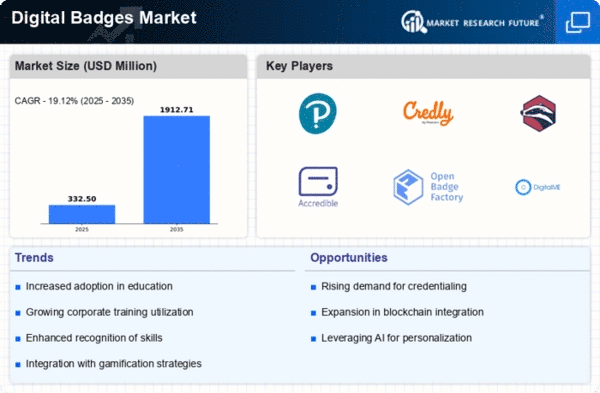
As per MRFR analysis, the Digital Badges Market Size was estimated at 279.13 USD Million in 2024. The Digital Badges industry is projected to grow from 332.5 in 2025 to 1912.71 by 2035, exhibiting a compound annual growth rate (CAGR) of 19.12 during the forecast period 2025 - 2035.

Key Market Trends & Highlights

The Digital Badges Market is experiencing robust growth driven by diverse applications across education and corporate sectors.

  • The market witnesses increased adoption in education, particularly among educational institutions in North America. Corporate utilization for employee development is rapidly expanding, especially in the Asia-Pacific region. Integration with blockchain technology is becoming a prominent trend, enhancing the credibility of digital badges. Key market drivers include the growing demand for skill recognition and the rise of lifelong learning initiatives.

Market Size & Forecast

2024 Market Size 279.13 (USD Million)
2035 Market Size 1912.71 (USD Million)
CAGR (2025 - 2035) 19.12%
Largest Regional Market Share in 2024 North America

Major Players

Pearson (GB), Credly (US), Badgr (US), Accredible (US), Open Badge Factory (FI), Digitalme (GB), Skillshare (US), Edmodo (US), Mozilla (US)

Market Trends

The Digital Badges Market is currently experiencing a notable evolution, driven by the increasing demand for recognition and validation of skills in various sectors. Organizations and educational institutions are increasingly adopting digital badges as a means to acknowledge achievements and competencies. This trend appears to be fueled by the growing emphasis on lifelong learning and the need for individuals to showcase their qualifications in a competitive job market. Furthermore, the integration of technology in education and professional development is likely to enhance the visibility and credibility of digital badges, making them a preferred choice for many. In addition, the Digital Badges Market seems to be expanding due to the rise of online learning platforms and the gamification of education. As more learners engage with digital content, the use of badges as motivational tools is becoming more prevalent. This shift indicates a broader acceptance of alternative credentialing methods, which may lead to a more diverse and inclusive approach to skill recognition. Overall, the Digital Badges Market is poised for growth, with various stakeholders recognizing the potential benefits of this innovative form of credentialing.

Increased Adoption in Education

Educational institutions are increasingly incorporating digital badges into their curricula to enhance student engagement and motivation. This trend suggests a shift towards recognizing informal learning and achievements, allowing students to showcase their skills beyond traditional grades.

Corporate Utilization for Employee Development

Companies are beginning to leverage digital badges as part of their employee development programs. This approach indicates a growing recognition of the importance of continuous learning and skill validation in the workplace, potentially leading to improved employee performance and satisfaction.

Integration with Blockchain Technology

The integration of digital badges with blockchain technology is emerging as a significant trend. This development may enhance the security and authenticity of credentials, providing a reliable method for verifying skills and achievements in various industries.

Digital Badges Market Market Drivers

Emergence of Blockchain Technology

The advent of blockchain technology presents a transformative opportunity for the Global Digital Badges Market Industry. By utilizing blockchain, digital badges can be securely issued, verified, and shared, enhancing their credibility and trustworthiness. This technological advancement addresses concerns related to fraud and misrepresentation in credentialing. As organizations and educational institutions increasingly recognize the value of blockchain in credentialing, the adoption of digital badges is expected to accelerate. The market's growth, projected to reach 1909.5 USD Million by 2035, indicates that the integration of blockchain technology will likely play a pivotal role in shaping the future of digital credentials.

Support from Government Initiatives

Government initiatives play a crucial role in propelling the Global Digital Badges Market Industry forward. Various countries are implementing policies that promote the use of digital credentials in education and workforce development. For instance, initiatives aimed at enhancing employability through recognized digital badges are gaining traction. These government-backed programs not only validate the efficacy of digital badges but also encourage institutions and organizations to adopt them. As a result, the market is poised for growth, with projections indicating a rise to 279.1 USD Million by 2024. This support from governmental bodies is likely to foster a conducive environment for the expansion of digital badge systems.

Increased Focus on Lifelong Learning

The Global Digital Badges Market Industry is significantly influenced by the increasing emphasis on lifelong learning. As individuals seek to upskill and reskill in an evolving job landscape, digital badges serve as a tangible representation of their learning journey. This trend is particularly relevant in industries undergoing rapid technological advancements, where continuous education is essential. Organizations are leveraging digital badges to motivate employees to engage in professional development. The market's growth trajectory, with a projected CAGR of 19.1% from 2025 to 2035, suggests that the demand for lifelong learning solutions will continue to drive the adoption of digital badges.

Growing Demand for Skills Recognition

The Global Digital Badges Market Industry experiences a notable surge in demand for skills recognition across various sectors. Organizations and educational institutions increasingly adopt digital badges as a means to validate and showcase individual competencies. This trend is particularly pronounced in the workforce development sector, where employers seek to identify candidates with specific skills. By 2024, the market is projected to reach 279.1 USD Million, reflecting the growing importance of credentialing in a competitive job market. Furthermore, the Global Digital Badges Market Industry is expected to expand significantly, with a projected CAGR of 19.1% from 2025 to 2035, indicating a robust future for skills recognition initiatives.

Integration with Learning Management Systems

The integration of digital badges with Learning Management Systems (LMS) is a pivotal driver within the Global Digital Badges Market Industry. Educational institutions are increasingly incorporating badge systems into their LMS platforms, facilitating seamless tracking of student achievements. This integration not only enhances the learning experience but also provides a structured framework for recognizing accomplishments. As institutions prioritize digital transformation, the Global Digital Badges Market Industry is likely to witness substantial growth. By 2035, the market is anticipated to reach 1909.5 USD Million, underscoring the significance of LMS integration in driving the adoption of digital badges.

Market Segment Insights

By Application: Education (Largest) vs. Corporate Training (Fastest-Growing)

The Digital Badges Market is significantly segmented by application, with 'Education' leading the charge in market share. Educational institutions leverage digital badges as a means to assess student learning and competencies, fostering a culture of achievement. Following closely is 'Corporate Training', which is rapidly gaining traction as organizations adopt digital credentials to recognize employee skills and training milestones, facilitating continuous learning and professional development.

Education: Digital Badges (Dominant) vs. Corporate Training: Digital Credentials (Emerging)

In the Digital Badges Market, 'Education' represents the dominant application area, utilizing badges to enhance student engagement and provide verifiable proof of learning accomplishments. Educational institutions benefit from incorporating digital badges as they not only promote learner motivation but also enable distinct recognition of skills across various subject areas. In contrast, 'Corporate Training' is emerging as a significant application, with businesses increasingly adopting digital badges to validate employee skillsets and foster a growth-oriented culture. As companies embrace lifelong learning paradigms, the effectiveness of digital badges in tracking and showcasing employee training journeys positions this sector for rapid growth.

By End Use: Educational Institutions (Largest) vs. Corporations (Fastest-Growing)

The Digital Badges Market is witnessing diverse engagement among various end-use segments. Educational Institutions hold the largest market share, leveraging badges to enhance credentialing and showcase student accomplishments. This segment has seen a steady growth, supported by a rising demand for validated skills and competencies in educational frameworks. Corporations are emerging rapidly in this sector, adapting digital badges to facilitate employee recognition and professional development, thus capturing a significant portion of the market.

Educational Institutions: Dominant vs. Corporations: Emerging

In the Digital Badges Market, Educational Institutions represent the dominant segment, increasingly utilizing badges as a means to enhance student motivation and showcase achievement in a competitive educational landscape. Contrasting this, Corporations are an emerging segment capitalizing on the need for continual professional growth and employee engagement. As workplaces adapt to a skills-based economy, corporations are adopting badges for training certification and career progression, thus creating a culture of recognition and accomplishment. This focus on workforce development is driving rapid adoption and growth in the corporate sector, aligning employee achievements with organizational goals.

By Technology: Blockchain (Largest) vs. Cloud-Based Solutions (Fastest-Growing)

In the Digital Badges Market, the technological segment displays a dynamic landscape with Blockchain emerging as the largest segment due to its secure and transparent nature, allowing for verifiable achievements. Following closely are Cloud-Based Solutions, which have gained traction for their flexibility and ease of access, catering to a broad user base. Mobile Applications, Web-Based Platforms, and Data Analytics also play significant roles, but their shares are relatively smaller compared to these leading technologies.

Technology: Blockchain (Dominant) vs. Data Analytics (Emerging)

Blockchain stands as the dominant technology in the Digital Badges Market, primarily attributed to its unparalleled security features and the growing demand for digital trust. It ensures that badges cannot be tampered with, significantly increasing their value for users and institutions. In contrast, Data Analytics represents an emerging technology, leveraging insights from badge usage to inform educational strategies and improve learning outcomes. While Blockchain focuses on secure issuance, Data Analytics aims to enhance user engagement and track skill development trends, positioning itself as a complementary force in shaping the future of digital credentials.

By User Type: Students (Largest) vs. Employees (Fastest-Growing)

The Digital Badges Market is increasingly being shaped by user types such as Students, Employees, Educators, Employers, and Community Members. Students hold the largest share, driving significant adoption of digital badges in education to showcase achievements and skills. Conversely, Employees are emerging as the fastest-growing segment, leveraging digital badges for skill recognition and professional development. Both segments play crucial roles in the market's evolution, impacted by educational institutions and the corporate sector respectively. As the demand for skill validation rises, growth trends indicate a notable shift towards digital badges among Employees, driven by an evolving job market emphasizing continuous learning and skill enhancement. Furthermore, Employers are increasingly supporting these initiatives, adopting them as part of their hiring and employee development strategies. This creates a dynamic interplay between the segments, where Students and Employees are likely to see increased integration of digital badges into their respective environments, shaping the future landscape of credentialing.

Students (Dominant) vs. Employees (Emerging)

In the Digital Badges Market, Students represent a dominant user type, utilizing badges to earn recognition for accomplishments in academic settings, thereby enhancing their resumes and portfolios. This segment often collaborates with educational institutions that adopt badges to motivate learners and foster skill development. On the other hand, Employees constitute an emerging segment, keenly embracing digital badges as their importance in the workforce increases. They leverage these credentials for professional development and career progression, appealing to Employers who seek to validate candidates' skills. As organizations prioritize continuous learning, the presence of digital badges in Employee skill sets becomes increasingly significant, highlighting a shift in the labor market where experiential learning meets traditional educational credentials.

By Issuing Authority: Educational Institutions (Largest) vs. Government Bodies (Fastest-Growing)

In the Digital Badges Market, Educational Institutions command the largest share, leveraging their established frameworks and extensive reach within academic ecosystems. They utilize digital badges to enhance credentialing and promote learner achievements, providing a robust platform for skill verification. Conversely, Government Bodies are emerging as the fastest-growing segment, increasingly adopting digital badges to recognize skills and training in various sectors. Their initiatives aim to facilitate workforce development and public service accountability, highlighting a shift toward competency-based recognition. Growth trends in this segment are influenced by technological advancements and evolving workforce demands. Educational Institutions are continuously innovating their badge systems, integrating them with learning management systems to boost student engagement. Meanwhile, Government Bodies are focusing on scalability and accessibility, utilizing digital badges to streamline skill recognition across diverse demographics. This gradual shift signals a broader acceptance of digital credentials across many sectors, propelling further adoption.

Educational Institutions (Dominant) vs. Non-Profit Organizations (Emerging)

Educational Institutions represent the dominant force in the Digital Badges Market, as they embed badges within academic programs to enhance student engagement and validate competencies. Their badges often align with educational standards, making them widely recognized in various fields. Non-Profit Organizations, while less prominent, are emerging as a vital force in the market. By collaborating with educational and professional entities, they provide alternative pathways for recognition that emphasize social impact and community engagement. Their focus on inclusivity and accessibility positions them to cater to underserved populations, driving innovative badge programs that address socio-economic barriers. The synergy between these two segments showcases a dynamic landscape where traditional education meets mission-driven initiatives.

Get more detailed insights about Digital Badges Market Research Report - Global Forecast till 2035

Regional Insights

North America : Market Leader in Digital Badges

North America leads the Digital Badges Market with a share of $139.65M in 2024, driven by increasing demand for credentialing in education and professional development. The region benefits from robust technological infrastructure and a growing emphasis on skills-based hiring, which fuels the adoption of digital badges as a means of validating competencies. Regulatory support for digital credentials further enhances market growth, making it a pivotal area for innovation and investment. The competitive landscape in North America is characterized by key players such as Credly, Badgr, and Accredible, which are at the forefront of digital credentialing solutions. The U.S. stands out as the largest market, with significant contributions from educational institutions and corporate training programs. The presence of established companies and startups alike fosters a dynamic environment, ensuring continuous advancements in digital badge technology.

Europe : Emerging Market for Digital Credentials

Europe's Digital Badges Market is valued at $83.74M, reflecting a growing trend towards digital credentialing in education and professional sectors. The region is witnessing increased demand for skills validation, driven by initiatives aimed at enhancing employability and lifelong learning. Regulatory frameworks supporting digital credentials, such as the European Qualifications Framework, are pivotal in promoting the adoption of digital badges across member states. Leading countries in Europe include the UK, Germany, and France, where educational institutions and organizations are increasingly integrating digital badges into their programs. Key players like Pearson and Open Badge Factory are instrumental in shaping the market landscape. The competitive environment is marked by collaborations between educational institutions and technology providers, fostering innovation and expanding the reach of digital badges.

Asia-Pacific : Growing Demand for Digital Badges

The Asia-Pacific Digital Badges Market, valued at $49.84M, is experiencing rapid growth driven by the increasing emphasis on skill development and employability. Countries like Australia, Japan, and India are leading the charge, with educational institutions adopting digital badges to enhance learning outcomes and provide verifiable credentials. The region's diverse educational landscape and technological advancements are key factors propelling market expansion. In this competitive landscape, companies such as Badgr and Skillshare are making significant inroads, offering innovative solutions tailored to local needs. The presence of government initiatives aimed at promoting digital education further supports the market's growth. As the demand for digital credentials rises, the Asia-Pacific region is poised to become a significant player in The Digital Badges.

Middle East and Africa : Emerging Market for Digital Badges

The Middle East and Africa Digital Badges Market, valued at $6.9M, is in its nascent stages but shows promising potential for growth. The increasing focus on education and skills development, particularly in countries like South Africa and the UAE, is driving interest in digital badges as a means of recognizing achievements. Government initiatives aimed at enhancing educational standards are also contributing to the market's development. The competitive landscape is still evolving, with a few key players beginning to establish their presence. Local educational institutions are exploring partnerships with technology providers to implement digital badge systems. As awareness of digital credentials grows, the region is likely to see a surge in adoption, positioning itself as a future hub for digital badge innovation.

Key Players and Competitive Insights

The Digital Badges Market is currently characterized by a dynamic competitive landscape, driven by the increasing demand for credentialing and skills recognition across various sectors. Key players such as Pearson (GB), Credly (US), and Badgr (US) are strategically positioned to leverage technological advancements and partnerships to enhance their offerings. Pearson (GB) focuses on integrating digital badges into its educational products, thereby enhancing learner engagement and recognition. Meanwhile, Credly (US) emphasizes partnerships with educational institutions and employers to expand its reach and credibility in the market. Badgr (US) appears to be concentrating on user experience and accessibility, which may facilitate broader adoption among diverse user groups. Collectively, these strategies indicate a trend towards innovation and collaboration, shaping a competitive environment that prioritizes user-centric solutions.
In terms of business tactics, companies are increasingly localizing their operations and optimizing supply chains to respond to regional demands effectively. The market structure is moderately fragmented, with several players vying for market share, yet the influence of major companies remains substantial. This competitive structure allows for a variety of offerings, catering to different segments of the market, while also fostering innovation as companies strive to differentiate themselves.
In November 2025, Pearson (GB) announced a partnership with a leading online learning platform to integrate its digital badge system, enhancing the visibility of learner achievements. This strategic move is likely to bolster Pearson's position in the market by providing learners with recognized credentials that can be shared across various platforms, thus increasing the value of their educational offerings. The partnership may also facilitate a more seamless user experience, aligning with current trends in digital education.
In October 2025, Credly (US) launched a new feature that allows users to create custom badges tailored to specific skills and achievements. This innovation is significant as it empowers organizations to recognize unique competencies, potentially increasing user engagement and satisfaction. By offering customizable solutions, Credly may enhance its competitive edge, appealing to a broader audience seeking personalized credentialing options.
In September 2025, Badgr (US) introduced an AI-driven analytics tool designed to help organizations track the impact of their digital badge programs. This tool is expected to provide valuable insights into learner engagement and outcomes, thereby enabling organizations to refine their strategies. The integration of AI into their offerings suggests a forward-thinking approach that could set Badgr apart in a crowded market, as data-driven decision-making becomes increasingly vital.
As of December 2025, the Digital Badges Market is witnessing trends such as digitalization, sustainability, and AI integration, which are reshaping competitive dynamics. Strategic alliances are becoming more prevalent, as companies recognize the value of collaboration in enhancing their service offerings. Looking ahead, competitive differentiation is likely to evolve, with a shift from price-based competition to a focus on innovation, technology, and supply chain reliability. This transition may foster a more sustainable and resilient market, where companies that prioritize technological advancements and user-centric solutions will thrive.

Key Companies in the Digital Badges Market include

Industry Developments

February 2022: Accredible announced a partnership with The Chartered Banker Institute to bring verifiable, secure, and shareable digital credentials to the Institute’s membership.

Future Outlook

Digital Badges Market Future Outlook

The Digital Badges Market is projected to grow at a 19.12% CAGR from 2025 to 2035, driven by increasing demand for credentialing and gamification in education and professional development.

New opportunities lie in:

  • Integration of digital badges in corporate training programs
  • Development of blockchain-based badge verification systems
  • Partnerships with educational institutions for badge issuance

By 2035, the Digital Badges Market is expected to be a robust sector, reflecting substantial growth and innovation.

Market Segmentation

Digital Badges Market End Use Outlook

  • Educational Institutions
  • Corporations
  • Non-Profit Organizations
  • Government Agencies
  • Online Learning Platforms

Digital Badges Market User Type Outlook

  • Students
  • Employees
  • Educators
  • Employers
  • Community Members

Digital Badges Market Technology Outlook

  • Blockchain
  • Cloud-Based Solutions
  • Mobile Applications
  • Web-Based Platforms
  • Data Analytics

Digital Badges Market Application Outlook

  • Education
  • Corporate Training
  • Gamification
  • Professional Development
  • Community Engagement

Digital Badges Market Issuing Authority Outlook

  • Educational Institutions
  • Professional Organizations
  • Employers
  • Government Bodies
  • Non-Profit Organizations

Report Scope

MARKET SIZE 2024 279.13(USD Million)
MARKET SIZE 2025 332.5(USD Million)
MARKET SIZE 2035 1912.71(USD Million)
COMPOUND ANNUAL GROWTH RATE (CAGR) 19.12% (2025 - 2035)
REPORT COVERAGE Revenue Forecast, Competitive Landscape, Growth Factors, and Trends
BASE YEAR 2024
Market Forecast Period 2025 - 2035
Historical Data 2019 - 2024
Market Forecast Units USD Million
Key Companies Profiled Pearson (GB), Credly (US), Badgr (US), Accredible (US), Open Badge Factory (FI), Digitalme (GB), Skillshare (US), Edmodo (US), Mozilla (US)
Segments Covered Application, End Use, Technology, User Type, Issuing Authority
Key Market Opportunities Integration of blockchain technology enhances security and trust in the Digital Badges Market.
Key Market Dynamics Rising demand for digital credentials drives innovation and competition in the digital badges market.
Countries Covered North America, Europe, APAC, South America, MEA

FAQs

How much is the Digital Badges market?

The global Digital Badges market size was valued at USD 279.13 billion in 2024.

What is the growth rate of the Digital Badges market?

The global market is projected to grow at a CAGR of 19.12% during the forecast period, 2025 to 2035.

Which region held the largest market share in the Digital Badges market?

North America had the largest share in the global Digital Badges market.

Who are the key players in the Digital Badges market?

The key players in the market are Credly Inc., Accredible, Nocti Business Solutions, RedCritter Corp., Accreditrust Technologies LLC, Concentric Sky Inc., Forall Systems Inc., Blackboard Inc., Badgecraft, and LearningTimes LLC.

Which type led the Digital Badges market?

The certification category dominated the market in 2023.

Which end-user had the largest market share in the market?

Education had the largest share in the global market for Digital Badges.

  1. SECTION I: EXECUTIVE SUMMARY AND KEY HIGHLIGHTS
    1. | 1.1 EXECUTIVE SUMMARY
    2. | 1.1.1 Market Overview
    3. | 1.1.2 Key Findings
    4. | 1.1.3 Market Segmentation
    5. | 1.1.4 Competitive Landscape
    6. | 1.1.5 Challenges and Opportunities
    7. | 1.1.6 Future Outlook
  2. SECTION II: SCOPING, METHODOLOGY AND MARKET STRUCTURE
    1. | 2.1 MARKET INTRODUCTION
    2. | 2.1.1 Definition
    3. | 2.1.2 Scope of the study
    4. |-- 2.1.2.1 Research Objective
    5. |-- 2.1.2.2 Assumption
    6. |-- 2.1.2.3 Limitations
    7. | 2.2 RESEARCH METHODOLOGY
    8. | 2.2.1 Overview
    9. | 2.2.2 Data Mining
    10. | 2.2.3 Secondary Research
    11. | 2.2.4 Primary Research
    12. |-- 2.2.4.1 Primary Interviews and Information Gathering Process
    13. |-- 2.2.4.2 Breakdown of Primary Respondents
    14. | 2.2.5 Forecasting Model
    15. | 2.2.6 Market Size Estimation
    16. |-- 2.2.6.1 Bottom-Up Approach
    17. |-- 2.2.6.2 Top-Down Approach
    18. | 2.2.7 Data Triangulation
    19. | 2.2.8 Validation
  3. SECTION III: QUALITATIVE ANALYSIS
    1. | 3.1 MARKET DYNAMICS
    2. | 3.1.1 Overview
    3. | 3.1.2 Drivers
    4. | 3.1.3 Restraints
    5. | 3.1.4 Opportunities
    6. | 3.2 MARKET FACTOR ANALYSIS
    7. | 3.2.1 Value chain Analysis
    8. | 3.2.2 Porter's Five Forces Analysis
    9. |-- 3.2.2.1 Bargaining Power of Suppliers
    10. |-- 3.2.2.2 Bargaining Power of Buyers
    11. |-- 3.2.2.3 Threat of New Entrants
    12. |-- 3.2.2.4 Threat of Substitutes
    13. |-- 3.2.2.5 Intensity of Rivalry
    14. | 3.2.3 COVID-19 Impact Analysis
    15. |-- 3.2.3.1 Market Impact Analysis
    16. |-- 3.2.3.2 Regional Impact
    17. |-- 3.2.3.3 Opportunity and Threat Analysis
  4. SECTION IV: QUANTITATIVE ANALYSIS
    1. | 4.1 Semiconductor & Electronics, BY Application (USD Million)
    2. | 4.1.1 Education
    3. | 4.1.2 Corporate Training
    4. | 4.1.3 Gamification
    5. | 4.1.4 Professional Development
    6. | 4.1.5 Community Engagement
    7. | 4.2 Semiconductor & Electronics, BY End Use (USD Million)
    8. | 4.2.1 Educational Institutions
    9. | 4.2.2 Corporations
    10. | 4.2.3 Non-Profit Organizations
    11. | 4.2.4 Government Agencies
    12. | 4.2.5 Online Learning Platforms
    13. | 4.3 Semiconductor & Electronics, BY Technology (USD Million)
    14. | 4.3.1 Blockchain
    15. | 4.3.2 Cloud-Based Solutions
    16. | 4.3.3 Mobile Applications
    17. | 4.3.4 Web-Based Platforms
    18. | 4.3.5 Data Analytics
    19. | 4.4 Semiconductor & Electronics, BY User Type (USD Million)
    20. | 4.4.1 Students
    21. | 4.4.2 Employees
    22. | 4.4.3 Educators
    23. | 4.4.4 Employers
    24. | 4.4.5 Community Members
    25. | 4.5 Semiconductor & Electronics, BY Issuing Authority (USD Million)
    26. | 4.5.1 Educational Institutions
    27. | 4.5.2 Professional Organizations
    28. | 4.5.3 Employers
    29. | 4.5.4 Government Bodies
    30. | 4.5.5 Non-Profit Organizations
    31. | 4.6 Semiconductor & Electronics, BY Region (USD Million)
    32. | 4.6.1 North America
    33. |-- 4.6.1.1 US
    34. |-- 4.6.1.2 Canada
    35. | 4.6.2 Europe
    36. |-- 4.6.2.1 Germany
    37. |-- 4.6.2.2 UK
    38. |-- 4.6.2.3 France
    39. |-- 4.6.2.4 Russia
    40. |-- 4.6.2.5 Italy
    41. |-- 4.6.2.6 Spain
    42. |-- 4.6.2.7 Rest of Europe
    43. | 4.6.3 APAC
    44. |-- 4.6.3.1 China
    45. |-- 4.6.3.2 India
    46. |-- 4.6.3.3 Japan
    47. |-- 4.6.3.4 South Korea
    48. |-- 4.6.3.5 Malaysia
    49. |-- 4.6.3.6 Thailand
    50. |-- 4.6.3.7 Indonesia
    51. |-- 4.6.3.8 Rest of APAC
    52. | 4.6.4 South America
    53. |-- 4.6.4.1 Brazil
    54. |-- 4.6.4.2 Mexico
    55. |-- 4.6.4.3 Argentina
    56. |-- 4.6.4.4 Rest of South America
    57. | 4.6.5 MEA
    58. |-- 4.6.5.1 GCC Countries
    59. |-- 4.6.5.2 South Africa
    60. |-- 4.6.5.3 Rest of MEA
  5. SECTION V: COMPETITIVE ANALYSIS
    1. | 5.1 Competitive Landscape
    2. | 5.1.1 Overview
    3. | 5.1.2 Competitive Analysis
    4. | 5.1.3 Market share Analysis
    5. | 5.1.4 Major Growth Strategy in the Semiconductor & Electronics
    6. | 5.1.5 Competitive Benchmarking
    7. | 5.1.6 Leading Players in Terms of Number of Developments in the Semiconductor & Electronics
    8. | 5.1.7 Key developments and growth strategies
    9. |-- 5.1.7.1 New Product Launch/Service Deployment
    10. |-- 5.1.7.2 Merger & Acquisitions
    11. |-- 5.1.7.3 Joint Ventures
    12. | 5.1.8 Major Players Financial Matrix
    13. |-- 5.1.8.1 Sales and Operating Income
    14. |-- 5.1.8.2 Major Players R&D Expenditure. 2023
    15. | 5.2 Company Profiles
    16. | 5.2.1 Pearson (GB)
    17. |-- 5.2.1.1 Financial Overview
    18. |-- 5.2.1.2 Products Offered
    19. |-- 5.2.1.3 Key Developments
    20. |-- 5.2.1.4 SWOT Analysis
    21. |-- 5.2.1.5 Key Strategies
    22. | 5.2.2 Credly (US)
    23. |-- 5.2.2.1 Financial Overview
    24. |-- 5.2.2.2 Products Offered
    25. |-- 5.2.2.3 Key Developments
    26. |-- 5.2.2.4 SWOT Analysis
    27. |-- 5.2.2.5 Key Strategies
    28. | 5.2.3 Badgr (US)
    29. |-- 5.2.3.1 Financial Overview
    30. |-- 5.2.3.2 Products Offered
    31. |-- 5.2.3.3 Key Developments
    32. |-- 5.2.3.4 SWOT Analysis
    33. |-- 5.2.3.5 Key Strategies
    34. | 5.2.4 Accredible (US)
    35. |-- 5.2.4.1 Financial Overview
    36. |-- 5.2.4.2 Products Offered
    37. |-- 5.2.4.3 Key Developments
    38. |-- 5.2.4.4 SWOT Analysis
    39. |-- 5.2.4.5 Key Strategies
    40. | 5.2.5 Open Badge Factory (FI)
    41. |-- 5.2.5.1 Financial Overview
    42. |-- 5.2.5.2 Products Offered
    43. |-- 5.2.5.3 Key Developments
    44. |-- 5.2.5.4 SWOT Analysis
    45. |-- 5.2.5.5 Key Strategies
    46. | 5.2.6 Digitalme (GB)
    47. |-- 5.2.6.1 Financial Overview
    48. |-- 5.2.6.2 Products Offered
    49. |-- 5.2.6.3 Key Developments
    50. |-- 5.2.6.4 SWOT Analysis
    51. |-- 5.2.6.5 Key Strategies
    52. | 5.2.7 Skillshare (US)
    53. |-- 5.2.7.1 Financial Overview
    54. |-- 5.2.7.2 Products Offered
    55. |-- 5.2.7.3 Key Developments
    56. |-- 5.2.7.4 SWOT Analysis
    57. |-- 5.2.7.5 Key Strategies
    58. | 5.2.8 Edmodo (US)
    59. |-- 5.2.8.1 Financial Overview
    60. |-- 5.2.8.2 Products Offered
    61. |-- 5.2.8.3 Key Developments
    62. |-- 5.2.8.4 SWOT Analysis
    63. |-- 5.2.8.5 Key Strategies
    64. | 5.2.9 Mozilla (US)
    65. |-- 5.2.9.1 Financial Overview
    66. |-- 5.2.9.2 Products Offered
    67. |-- 5.2.9.3 Key Developments
    68. |-- 5.2.9.4 SWOT Analysis
    69. |-- 5.2.9.5 Key Strategies
    70. | 5.3 Appendix
    71. | 5.3.1 References
    72. | 5.3.2 Related Reports

Semiconductor & Electronics Market Segmentation

Semiconductor & Electronics By Application (USD Million, 2025-2035)

  • Education
  • Corporate Training
  • Gamification
  • Professional Development
  • Community Engagement

Semiconductor & Electronics By End Use (USD Million, 2025-2035)

  • Educational Institutions
  • Corporations
  • Non-Profit Organizations
  • Government Agencies
  • Online Learning Platforms

Semiconductor & Electronics By Technology (USD Million, 2025-2035)

  • Blockchain
  • Cloud-Based Solutions
  • Mobile Applications
  • Web-Based Platforms
  • Data Analytics

Semiconductor & Electronics By User Type (USD Million, 2025-2035)

  • Students
  • Employees
  • Educators
  • Employers
  • Community Members

Semiconductor & Electronics By Issuing Authority (USD Million, 2025-2035)

  • Educational Institutions
  • Professional Organizations
  • Employers
  • Government Bodies
  • Non-Profit Organizations
Infographic

Free Sample Request

Kindly complete the form below to receive a free sample of this Report

Get Free Sample

Customer Strories

Compare Licence

×
Features License Type
Single User Multiuser License Enterprise User
Price $4,950 $5,950 $7,250
Maximum User Access Limit 1 User Upto 10 Users Unrestricted Access Throughout the Organization
Free Customization
Direct Access to Analyst
Deliverable Format
Platform Access
Discount on Next Purchase 10% 15% 15%
Printable Versions