×
Hero Background
English
Chinese
French
Japanese
Korean
German
Spanish

Dichroic Glass Market Size

ID: MRFR/CnM/11175-HCR
128 Pages
Chitranshi Jaiswal
October 2025

Dichroic Glass Market Research Report Information By Type (Thermochromic Glass, Electrochromic Glass, and Photochromatic Glass), By Application (Architecture, Jewellery and Art, Transportation, Aerospace, and Medical), By Manufacture (Small Scale, and Large Scale), By Sales Channel (Offline, and Online), And By Region (North America, Europe, Asia-Pacific, And Rest Of The World) –Market Forecast Till 2035

Share:
Download PDF ×

We do not share your information with anyone. However, we may send you emails based on your report interest from time to time. You may contact us at any time to opt-out.

Dichroic Glass Market Infographic
Purchase Options

Dichroic Glass Size

Dichroic Glass Market Growth Projections and Opportunities

The Dichroic Glass Market is driven by a combination of market factors which collectively shape its dynamics and growth path. One critical factor is the growing demand for aesthetic and innovative architectural designs. Architects and designers are now integrating dichroic glass in their projects because it can display different colors depending on the angle of view and light conditions. This has increased the use of dichroic glass in commercial and residential buildings leading to market expansion.

Technological advancements in glass manufacturing processes are key drivers in the dichroic glass market. Continuous innovations in coating technologies and production techniques improve the durability, clarity, as well as broaden the colour range of dichroic glasses. As these materials require long-lasting quality, architects, designers, as well as consumers looking for high-quality materials become attracted to them. It also gives manufacturers who invest in research and development an edge over competitors.

Moreover, changing consumer preferences and lifestyles impacts on the dichroic glass market greatly. This has elevated the demand for unique visually appealing materials such as dichroic glass due to increasing focus on interior design and home decor. This shift indicates that consumers are now more interested in products that do not just serve a purpose but also enhance beauty within their living spaces which all play a significant role in growth of this industry.

Also vital to remember is that government regulations and policies related to construction materials have an effect on the dichroic glass market too. The stringent regulations towards eco-friendly building practices make it logical for usages like using dichoric glasses since they satisfy such norms; otherwise any regulatory changes limiting utilization of certain stuffs or introducing more strict environmental standards may be obstacles for this industry.

Lastly, competition landscape plus market consolidation shapes dynamics within the Dichroic Glass Market domain. Reshaping structures of markets through mergers-acquisitions (M&A), partnerships or strategic collaborations among major players could be done. Consolidated markets often mean better distribution channels, improved production capabilities and wider range of product mix which gives a head start to industry leaders.
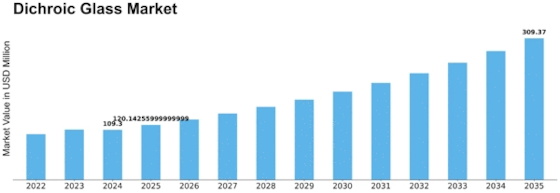
Dichroic Glass Market Size Graph
Author
Chitranshi Jaiswal
Research Analyst Level I

In her 3 years of experience in the market research field, she has handled critical cross-domain projects. She has an in-depth knowledge of market estimation & analysis, problem-solving, primary as well as secondary research, and team management.She holds an engineering degree and is an MBA professional from a well-known university, capable of evaluating the market and competitive conditions. An exceptional strategist with excellent communication skills and a passion for delivering cutting-edge & practical insights for the market. Proficient in multi-tasking, and can successfully deal with competing demands, while maintaining complete confidentiality. Generated business through active client and project development, networking, and high-quality responses. Her knowledge and skills have helped in making solid business decisions, securing funding from investors, and avoiding business failures.

Leave a Comment

FAQs

What is the current valuation of the Dichroic Glass Market as of 2024?

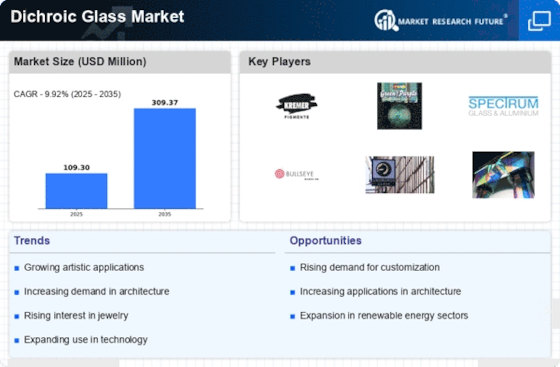
The Dichroic Glass Market was valued at 109.3 USD Million in 2024.

What is the projected market valuation for the Dichroic Glass Market in 2035?

The market is projected to reach 309.37 USD Million by 2035.

What is the expected CAGR for the Dichroic Glass Market during the forecast period 2025 - 2035?

The expected CAGR for the Dichroic Glass Market during 2025 - 2035 is 9.92%.

Which companies are considered key players in the Dichroic Glass Market?

Key players include Kremer Pigments, Dichroic Glass LLC, Spectrum Glass Company, and Bullseye Glass Company.

What are the main types of dichroic glass and their market valuations?

Thermochromic Glass, Electrochromic Glass, and Photochromatic Glass have valuations ranging from 30.0 to 120.0 USD Million.

How does the application of dichroic glass vary across different sectors?

Applications in Architecture, Jewellery and Art, and Medical sectors range from 10.0 to 104.37 USD Million.

Market Summary

As per MRFR analysis, the Dichroic Glass Market Size was estimated at 109.3 USD Million in 2024. The Dichroic Glass industry is projected to grow from 120.14 USD Million in 2025 to 309.37 USD Million by 2035, exhibiting a compound annual growth rate (CAGR) of 9.92 during the forecast period 2025 - 2035.

Key Market Trends & Highlights

The Dichroic Glass Market is experiencing robust growth driven by diverse applications and technological advancements.

  • The market is witnessing a rising demand in art and design, particularly in the jewellery and art segments.
  • Technological advancements in production are enhancing the quality and versatility of dichroic glass products.
  • Sustainable practices are becoming increasingly important, influencing consumer preferences and production methods.
  • Key market drivers include rising applications in architecture and innovations in lighting solutions, particularly in North America and the fast-growing Asia-Pacific region.

Market Size & Forecast

2024 Market Size 109.3 (USD Million)
2035 Market Size 309.37 (USD Million)
CAGR (2025 - 2035) 9.92%
Largest Regional Market Share in 2024 North America

Major Players

<p>Kremer Pigments (DE), Dichroic Glass LLC (US), Spectrum Glass Company (US), Bullseye Glass Company (US), Uroboros Glass Studio (US), Artistry in Glass (US), Dichroic Art (US), Dichroic Glassworks (US)</p>

Market Trends

The Dichroic Glass Market is currently experiencing a notable evolution, driven by a confluence of artistic innovation and technological advancements. This unique glass, characterized by its ability to display two distinct colors depending on the angle of light, finds applications across various sectors, including art, architecture, and jewelry. As consumer preferences shift towards personalized and aesthetically appealing products, the demand for dichroic glass is likely to rise. Furthermore, the integration of advanced manufacturing techniques appears to enhance the quality and versatility of this material, making it increasingly attractive to designers and artists alike. In addition to aesthetic considerations, sustainability is becoming a pivotal factor influencing the Dichroic Glass Market. Manufacturers are exploring eco-friendly production methods and materials, which may resonate with environmentally conscious consumers. This trend suggests a potential shift towards more sustainable practices within the industry, as stakeholders recognize the importance of aligning with global sustainability goals. Overall, the Dichroic Glass Market seems poised for growth, driven by innovation, artistic expression, and a commitment to sustainability.

Rising Demand in Art and Design

The Dichroic Glass Market is witnessing an increase in demand from artists and designers who seek unique materials for their creative projects. This trend indicates a growing appreciation for the aesthetic qualities of dichroic glass, which offers vibrant colors and dynamic visual effects.

Technological Advancements in Production

Innovations in manufacturing processes are enhancing the quality and efficiency of dichroic glass production. These advancements may lead to improved product offerings, allowing for greater customization and versatility in applications across various industries.

Focus on Sustainable Practices

There is a noticeable shift towards sustainability within the Dichroic Glass Market, as manufacturers explore eco-friendly materials and production methods. This trend reflects a broader commitment to environmental responsibility, appealing to consumers who prioritize sustainable choices.

Dichroic Glass Market Market Drivers

Growth in the Automotive Sector

The automotive industry is increasingly adopting dichroic glass for various applications, including vehicle windows and interior design elements. The Dichroic Glass Market is benefiting from this trend as manufacturers seek to enhance the aesthetic appeal and functionality of vehicles. The unique optical properties of dichroic glass allow for innovative designs that can improve visibility and reduce glare, which is particularly appealing to consumers. Market data indicates that the automotive segment is expected to witness significant growth, driven by the rising demand for luxury vehicles and custom designs. This shift towards incorporating advanced materials in automotive manufacturing is likely to further stimulate the Dichroic Glass Market.

Innovations in Lighting Solutions

Innovative lighting solutions are becoming a key driver for the Dichroic Glass Market. The unique properties of dichroic glass, which can filter and reflect light in various colors, are being utilized in modern lighting designs. This trend is particularly evident in the development of decorative lighting fixtures and architectural lighting systems that aim to create immersive environments. The market for lighting solutions is projected to grow substantially, with dichroic glass playing a pivotal role in enhancing visual experiences. As consumers increasingly seek unique and customizable lighting options, the demand for dichroic glass in this sector is likely to rise, further contributing to the expansion of the Dichroic Glass Market.

Rising Applications in Architecture

The Dichroic Glass Market is experiencing a notable increase in applications within architectural design. Architects and designers are increasingly incorporating dichroic glass into building facades, skylights, and interior partitions to create visually striking environments. This trend is driven by the material's ability to change color based on the angle of light, providing dynamic aesthetics that enhance the overall architectural appeal. According to recent data, the architectural segment is projected to account for a substantial share of the market, reflecting a growing preference for innovative materials that offer both functionality and artistic expression. As urbanization continues to rise, the demand for unique architectural solutions is likely to propel the growth of the Dichroic Glass Market.

Rising Demand in Consumer Electronics

The consumer electronics sector is emerging as a significant driver for the Dichroic Glass Market. Manufacturers are exploring the use of dichroic glass in various electronic devices, including smartphones, tablets, and televisions, to enhance visual appeal and functionality. The unique color-changing properties of dichroic glass can provide a distinctive aesthetic that differentiates products in a competitive market. Recent data indicates that the demand for visually appealing consumer electronics is on the rise, suggesting a potential increase in the adoption of dichroic glass in this industry. As technology continues to evolve, the integration of dichroic glass in consumer electronics is likely to contribute to the growth of the Dichroic Glass Market.

Increased Interest in Art Installations

The Dichroic Glass Market is witnessing a surge in interest from artists and designers who are incorporating dichroic glass into their installations. This material offers a unique way to manipulate light and color, making it an attractive choice for contemporary art projects. The growing trend of public art installations and interactive exhibits is driving demand for dichroic glass, as artists seek to create engaging and visually captivating experiences. Market analysis suggests that the art and design sector is poised for growth, with dichroic glass being a favored medium for innovative artistic expression. This increasing integration of dichroic glass in art is likely to bolster the overall market.

Market Segment Insights

By Type: Electrochromic Glass (Largest) vs. Thermochromic Glass (Fastest-Growing)

<p>The dichroic glass market is segmented into three types: thermochromic glass, electrochromic glass, and photochromatic glass. Currently, electrochromic glass holds the largest market share due to its versatile applications in smart windows and electronic displays. This type of glass can change its color in response to electrical stimuli, offering dynamic light control and energy efficiency, which makes it highly desired in commercial and residential sectors. In contrast, thermochromic glass and photochromatic glass capture a smaller portion of the market share but are gaining traction due to their unique properties, driving interest in energy-efficient solutions across various industries.</p>

<p>Electrochromic Glass (Dominant) vs. Thermochromic Glass (Emerging)</p>

<p>Electrochromic glass is the dominant force in the dichroic glass market, known for its ability to modulate light transmission effectively. This type responds to electrical stimuli, changing its transparency and hue, making it an ideal choice for energy-efficient smart windows in commercial buildings and automotive industries. On the other hand, thermochromic glass, which changes color based on temperature fluctuations, is an emerging player that offers potential in energy-saving applications, particularly in passive solar designs. As consumers become more eco-conscious, the demand for thermochromic glass is expected to rise, reflecting innovation in smart materials and sustainability efforts.</p>

By Application: Architecture (Largest) vs. Jewellery and Art (Fastest-Growing)

<p>In the Dichroic Glass Market, the application segment is divided into various key areas, including architecture, jewellery and art, transportation, aerospace, and medical. Among these, architecture holds the largest share, primarily due to its wide adoption in modern building designs, facades, and interior decorations. Following closely are jewellery and art, which leverage the unique visual attributes of dichroic glass to produce stunning pieces that appeal to consumers looking for unique aesthetic qualities.</p>

<p>Architecture (Dominant) vs. Jewellery and Art (Emerging)</p>

<p>The architecture segment is a dominant force in the dichroic glass market, capitalizing on aesthetic appeal and energy efficiency in contemporary design. This segment utilizes dichroic glass in facades, skylights, and interior accents, enhancing visual experiences. On the other hand, jewellery and art are emerging rapidly, as artisans increasingly incorporate dichroic glass into their designs, creating unique, eye-catching pieces. This trend is fueled by consumer demand for bespoke and artistic items. While architecture focuses on functionality and design innovation, jewellery and art emphasize creativity and personalization, creating a dynamic interplay between these two segments.</p>

By Manufacture: Small Scale (Largest) vs. Large Scale (Fastest-Growing)

<p>In the Dichroic Glass Market, the small scale manufacturing segment holds a significant market share, appealing primarily to niche markets and custom applications. This segment includes artisans and smaller companies that produce unique, specialized products, establishing a loyal customer base that values quality over quantity. Conversely, the large scale manufacturing segment, while gaining market share rapidly, caters to mass production and larger orders, primarily driven by industrial applications and bulk purchasing agreements. Growth trends within the Dichroic Glass Market indicate a strong upward trajectory for the large scale manufacturing segment, fueled by increasing demand from industries such as architecture, automotive, and consumer electronics. The expansion of manufacturing technologies and production capabilities enables these large-scale producers to introduce innovative products that can meet a wider range of applications. In contrast, the small scale segment continues to thrive by emphasizing customizability and artisanal craftsmanship, appealing to consumers seeking unique designs and high-quality finishes.</p>

<p>Manufacturing Scale: Small Scale (Dominant) vs. Large Scale (Emerging)</p>

<p>The small scale manufacturing segment in the Dichroic Glass Market is characterized by its focus on bespoke production and artisanal techniques that resonate with customers looking for unique, high-quality items. This segment often boasts a loyal clientele that appreciates the creativity and personal touch provided by smaller manufacturers. It thrives in sectors where customization and artistry are key, such as art installations and decorative glassware. On the other hand, the large scale manufacturing segment is rapidly emerging, responding to the growing demand for mass-produced dichroic glass for commercial and industrial use, such as in lighting and design applications. This segment leverages economies of scale and often invests in advanced technologies, allowing them to produce more innovative and varied products, ultimately expanding their market reach.</p>

By Sales Channel: Offline (Largest) vs. Online (Fastest-Growing)

<p>In the Dichroic Glass Market, the offline sales channel has established itself as the dominant force, commanding a significant share of the market distribution. Traditional brick-and-mortar retailers and specialized glass shops play a crucial role in the offline segment, allowing customers to physically experience and assess the product quality before purchase. These channels often benefit from established customer relationships and trust, which contribute to their prevalent status in the market. Conversely, the online sales channel is rapidly gaining traction, driven by increasing digitalization and consumer preference for online shopping. The convenience of browsing a wide range of products and making purchases from the comfort of home aligns well with modern consumer behavior. As e-commerce platforms continue to enhance their customer service and logistics, the online segment is poised for accelerated growth in the coming years.</p>

<p>Sales Channel: Offline (Dominant) vs. Online (Emerging)</p>

<p>The offline sales channel in the Dichroic Glass Market remains the dominant player, characterized by a strong presence of physical stores and direct customer interactions. This channel provides consumers with tactile experiences, allowing them to see and feel the dichroic glass products first-hand, which is invaluable for quality assessment. Retailers in this segment often build strong community ties and offer personalized service, fostering customer loyalty. In contrast, the emerging online sales channel leverages the power of e-commerce, appealing to a tech-savvy demographic that favors convenience and variety. This segment attracts customers with the ease of comparative shopping and the ability to access niche products that may not be available locally, thus reshaping the competitive landscape.</p>

Get more detailed insights about Dichroic Glass Market Research Report—Global Forecast till 2035

Regional Insights

North America : Market Leader in Innovation

North America is the largest market for dichroic glass, holding approximately 45% of the global market share. The region's growth is driven by increasing demand in the art glass sector, architectural applications, and advancements in manufacturing technologies. Regulatory support for sustainable materials and energy-efficient production processes further catalyzes market expansion. The presence of key players like Bullseye Glass Company and Spectrum Glass Company enhances competitive dynamics, fostering innovation and quality improvements. The United States is the leading country in this region, with a robust market for dichroic glass products. The competitive landscape is characterized by several established companies, including Kremer Pigments and Dichroic Glass Market LLC, which contribute to a diverse product range. The focus on artistic applications and custom solutions drives demand, while collaborations among manufacturers and artists promote market growth. The region's emphasis on quality and design continues to attract both domestic and international customers.

Europe : Emerging Market with Potential

Europe is witnessing a significant rise in the dichroic glass market, currently holding about 30% of the global share. The growth is fueled by increasing applications in decorative arts, architecture, and automotive industries. Regulatory frameworks promoting sustainable materials and energy efficiency are pivotal in shaping market trends. Countries like Germany and the UK are at the forefront, driving innovation and adoption of dichroic glass products in various sectors. Germany leads the European market, supported by a strong manufacturing base and a focus on high-quality glass products. The competitive landscape features key players such as Kremer Pigments and Uroboros Glass Studio, which are known for their innovative designs and sustainable practices. The presence of art institutions and a growing interest in custom glass solutions further enhance market dynamics. Collaborative efforts among artists and manufacturers are expected to propel growth in the coming years.

Asia-Pacific : Rapid Growth and Adoption

Asia-Pacific is emerging as a significant player in the dichroic glass market, currently accounting for approximately 20% of the global share. The region's growth is driven by increasing urbanization, rising disposable incomes, and a growing interest in decorative glass applications. Countries like China and Japan are leading the charge, with supportive government policies promoting the use of advanced materials in construction and design. The market is also influenced by the rising trend of customization in glass products. China is the largest market in the region, with a rapidly expanding manufacturing sector that supports the production of dichroic glass. The competitive landscape is characterized by both local and international players, with companies focusing on innovation and quality. The presence of key players and a growing number of startups in the decorative glass segment are expected to drive market growth. As consumer preferences shift towards unique and artistic designs, the demand for dichroic glass is anticipated to rise significantly.

Middle East and Africa : Untapped Market Opportunities

The Middle East and Africa region is currently the smallest market for dichroic glass, holding about 5% of the global share. However, there is significant potential for growth driven by increasing investments in construction and infrastructure projects. The demand for decorative glass in architectural applications is on the rise, supported by government initiatives aimed at enhancing urban aesthetics. Countries like the UAE and South Africa are leading the way in adopting innovative glass solutions. The UAE is at the forefront of this market, with a booming construction sector that embraces modern design trends. The competitive landscape is still developing, with a mix of local artisans and international companies entering the market. Key players are beginning to explore opportunities in this region, focusing on high-quality and customized products. As awareness of dichroic glass benefits grows, the market is expected to expand, driven by both residential and commercial applications.

Key Players and Competitive Insights

Leading market players are putting a lot of money on R&D to expand their product lines, which will help the Dichroic Glass Market, keep growing. Additionally, market players are engaging in a range of calculated initiatives to increase their worldwide presence, with important market developments involving the introduction of new products, contracts, M&A transactions, increased investment, and cooperation with other enterprises. To grow and endure in an increasingly cutthroat and dynamic market, Dichroic Glass industry must provide reasonably priced goods.

One of the main business strategies employed by manufacturers is to manufacture locally in order to reduce operating expenses in the global Dichroic Glass industry to help customers and expand the market segment. In recent years, the Dichroic Glass industry has provided some of the biggest benefits to medicine. Major players in the Dichroic Glass Market, including Saint-Gobain, China National Building Materials Group, CRH, Guardian, PPG, NSG, Cardinal, AGC, PGW, Pittsburgh Corning, and others, are engaging in research and development activities in an effort to boost market demand.

CRH plc is a global conglomerate of diverse construction products companies. For the construction business, it produces and supplies a broad range of goods. In 1970, Cement Limited (founded in 1936) and Roadstone Limited (1949), two prominent Irish public enterprises, merged to form the group. CRH is primarily listed on the London Stock Exchange and Euronext Dublin, where it is included in the ISEQ 20. However, as of September 25, 2023, it will also be listed on the New York Stock Exchange. In July 2019, A US investment group called Blackstone acquired CRH's underperforming European distribution division for €1.64 billion.

PPG Industries, Inc. is a Fortune 500 American corporation that supplies paints, coatings, and specialty materials all over the world. With its global headquarters located in Pittsburgh, Pennsylvania, PPG has operations in over 70 countries. It is the world's largest coatings company by revenue, trailed only by AkzoNobel. Its headquarters are located in Pittsburgh's downtown PPG Place, an office and retail complex that is well-known for the glass exterior that postmodern architect Philip Johnson created. In 2020, PPG's "High Strength, Highly Ductile Structural Adhesive PR 2930" took home the Adhesives and Sealants Council (ASC) Innovation Award.

Key Companies in the Dichroic Glass Market market include

Industry Developments

September 2019: Apple said that it will invest $250 million in Corning to support the company's efforts to develop and manufacture the glass needed for a number of key products, including the iPad, iPhone, and Apple Watch.

August 2021: AGC Biologics, a well-known international biopharmaceutical Contract Development and production Organization (CDMO), has completed the acquisition of a state-of-the-art commercial production facility situated in Longmont, Colorado, USA.

January 2023: Therma-Tru introduced its new line of fiberglass and steel products for 2023, which includes more sizes for popular forms, a combined storm and entrance door system, artistic glass patterns, paint and stain color possibilities, and other amenities. February 2024: CBS Dichroic Glass Market announced its plans for funding research into improved scratch-resistant and hardy films for a new generation of dichroics targeting the automobile and aerospace industries.

Future Outlook

Dichroic Glass Market Future Outlook

<p>The Dichroic Glass Market is projected to grow at a 9.92% CAGR from 2024 to 2035, driven by increasing demand in architectural and artistic applications.</p>

New opportunities lie in:

  • <p>Expansion into renewable energy applications for solar panels.</p>
  • <p>Development of customizable dichroic glass for luxury interior design.</p>
  • <p>Partnerships with art institutions for exclusive installations and exhibitions.</p>

<p>By 2035, the market is expected to solidify its position as a leader in innovative glass solutions.</p>

Market Segmentation

Dichroic Glass Market Type Outlook

  • Thermochromic Glass
  • Electrochromic Glass
  • Photochromatic Glass

Dichroic Glass Market Application Outlook

  • Architecture
  • Jewellery and Art
  • Transportation
  • Aerospace
  • Medical

Dichroic Glass Market Manufacture Outlook

  • Small Scale
  • Large Scale

Dichroic Glass Market Sales Channel Outlook

  • Offline
  • Online

Report Scope

MARKET SIZE 2024109.3(USD Million)
MARKET SIZE 2025120.14(USD Million)
MARKET SIZE 2035309.37(USD Million)
COMPOUND ANNUAL GROWTH RATE (CAGR)9.92% (2024 - 2035)
REPORT COVERAGERevenue Forecast, Competitive Landscape, Growth Factors, and Trends
BASE YEAR2024
Market Forecast Period2025 - 2035
Historical Data2019 - 2024
Market Forecast UnitsUSD Million
Key Companies ProfiledMarket analysis in progress
Segments CoveredMarket segmentation analysis in progress
Key Market OpportunitiesGrowing demand for sustainable materials enhances opportunities in the Dichroic Glass Market.
Key Market DynamicsRising demand for innovative applications drives competition and technological advancements in the dichroic glass market.
Countries CoveredNorth America, Europe, APAC, South America, MEA

FAQs

What is the current valuation of the Dichroic Glass Market as of 2024?

The Dichroic Glass Market was valued at 109.3 USD Million in 2024.

What is the projected market valuation for the Dichroic Glass Market in 2035?

The market is projected to reach 309.37 USD Million by 2035.

What is the expected CAGR for the Dichroic Glass Market during the forecast period 2025 - 2035?

The expected CAGR for the Dichroic Glass Market during 2025 - 2035 is 9.92%.

Which companies are considered key players in the Dichroic Glass Market?

Key players include Kremer Pigments, Dichroic Glass LLC, Spectrum Glass Company, and Bullseye Glass Company.

What are the main types of dichroic glass and their market valuations?

Thermochromic Glass, Electrochromic Glass, and Photochromatic Glass have valuations ranging from 30.0 to 120.0 USD Million.

How does the application of dichroic glass vary across different sectors?

Applications in Architecture, Jewellery and Art, and Medical sectors range from 10.0 to 104.37 USD Million.

  1. SECTION I: EXECUTIVE SUMMARY AND KEY HIGHLIGHTS
    1. EXECUTIVE SUMMARY
      1. Market Overview
      2. Key Findings
      3. Market Segmentation
      4. Competitive Landscape
      5. Challenges and Opportunities
      6. Future Outlook
  2. SECTION II: SCOPING, METHODOLOGY AND MARKET STRUCTURE
    1. MARKET INTRODUCTION
      1. Definition
      2. Scope of the study
    2. RESEARCH METHODOLOGY
      1. Overview
      2. Data Mining
      3. Secondary Research
      4. Primary Research
      5. Forecasting Model
      6. Market Size Estimation
      7. Data Triangulation
      8. Validation
  3. SECTION III: QUALITATIVE ANALYSIS
    1. MARKET DYNAMICS
      1. Overview
      2. Drivers
      3. Restraints
      4. Opportunities
    2. MARKET FACTOR ANALYSIS
      1. Value chain Analysis
      2. Porter's Five Forces Analysis
      3. COVID-19 Impact Analysis
  4. SECTION IV: QUANTITATIVE ANALYSIS
    1. Chemicals and Materials, BY Type (USD Million)
      1. Thermochromic Glass
      2. Electrochromic Glass
      3. Photochromatic Glass
    2. Chemicals and Materials, BY Application (USD Million)
      1. Architecture
      2. Jewellery and Art
      3. Transportation
      4. Aerospace
      5. Medical
    3. Chemicals and Materials, BY Manufacture (USD Million)
      1. Small Scale
      2. Large Scale
    4. Chemicals and Materials, BY Sales Channel (USD Million)
      1. Offline
      2. Online
    5. Chemicals and Materials, BY Region (USD Million)
      1. North America
      2. Europe
      3. APAC
      4. South America
      5. MEA
  5. SECTION V: COMPETITIVE ANALYSIS
    1. Competitive Landscape
      1. Overview
      2. Competitive Analysis
      3. Market share Analysis
      4. Major Growth Strategy in the Chemicals and Materials
      5. Competitive Benchmarking
      6. Leading Players in Terms of Number of Developments in the Chemicals and Materials
      7. Key developments and growth strategies
      8. Major Players Financial Matrix
    2. Company Profiles
      1. Kremer Pigments (DE)
      2. Dichroic Glass LLC (US)
      3. Spectrum Glass Company (US)
      4. Bullseye Glass Company (US)
      5. Uroboros Glass Studio (US)
      6. Artistry in Glass (US)
      7. Dichroic Art (US)
      8. Dichroic Glassworks (US)
    3. Appendix
      1. References
      2. Related Reports
  6. LIST OF FIGURES
    1. MARKET SYNOPSIS
    2. NORTH AMERICA MARKET ANALYSIS
    3. US MARKET ANALYSIS BY TYPE
    4. US MARKET ANALYSIS BY APPLICATION
    5. US MARKET ANALYSIS BY MANUFACTURE
    6. US MARKET ANALYSIS BY SALES CHANNEL
    7. CANADA MARKET ANALYSIS BY TYPE
    8. CANADA MARKET ANALYSIS BY APPLICATION
    9. CANADA MARKET ANALYSIS BY MANUFACTURE
    10. CANADA MARKET ANALYSIS BY SALES CHANNEL
    11. EUROPE MARKET ANALYSIS
    12. GERMANY MARKET ANALYSIS BY TYPE
    13. GERMANY MARKET ANALYSIS BY APPLICATION
    14. GERMANY MARKET ANALYSIS BY MANUFACTURE
    15. GERMANY MARKET ANALYSIS BY SALES CHANNEL
    16. UK MARKET ANALYSIS BY TYPE
    17. UK MARKET ANALYSIS BY APPLICATION
    18. UK MARKET ANALYSIS BY MANUFACTURE
    19. UK MARKET ANALYSIS BY SALES CHANNEL
    20. FRANCE MARKET ANALYSIS BY TYPE
    21. FRANCE MARKET ANALYSIS BY APPLICATION
    22. FRANCE MARKET ANALYSIS BY MANUFACTURE
    23. FRANCE MARKET ANALYSIS BY SALES CHANNEL
    24. RUSSIA MARKET ANALYSIS BY TYPE
    25. RUSSIA MARKET ANALYSIS BY APPLICATION
    26. RUSSIA MARKET ANALYSIS BY MANUFACTURE
    27. RUSSIA MARKET ANALYSIS BY SALES CHANNEL
    28. ITALY MARKET ANALYSIS BY TYPE
    29. ITALY MARKET ANALYSIS BY APPLICATION
    30. ITALY MARKET ANALYSIS BY MANUFACTURE
    31. ITALY MARKET ANALYSIS BY SALES CHANNEL
    32. SPAIN MARKET ANALYSIS BY TYPE
    33. SPAIN MARKET ANALYSIS BY APPLICATION
    34. SPAIN MARKET ANALYSIS BY MANUFACTURE
    35. SPAIN MARKET ANALYSIS BY SALES CHANNEL
    36. REST OF EUROPE MARKET ANALYSIS BY TYPE
    37. REST OF EUROPE MARKET ANALYSIS BY APPLICATION
    38. REST OF EUROPE MARKET ANALYSIS BY MANUFACTURE
    39. REST OF EUROPE MARKET ANALYSIS BY SALES CHANNEL
    40. APAC MARKET ANALYSIS
    41. CHINA MARKET ANALYSIS BY TYPE
    42. CHINA MARKET ANALYSIS BY APPLICATION
    43. CHINA MARKET ANALYSIS BY MANUFACTURE
    44. CHINA MARKET ANALYSIS BY SALES CHANNEL
    45. INDIA MARKET ANALYSIS BY TYPE
    46. INDIA MARKET ANALYSIS BY APPLICATION
    47. INDIA MARKET ANALYSIS BY MANUFACTURE
    48. INDIA MARKET ANALYSIS BY SALES CHANNEL
    49. JAPAN MARKET ANALYSIS BY TYPE
    50. JAPAN MARKET ANALYSIS BY APPLICATION
    51. JAPAN MARKET ANALYSIS BY MANUFACTURE
    52. JAPAN MARKET ANALYSIS BY SALES CHANNEL
    53. SOUTH KOREA MARKET ANALYSIS BY TYPE
    54. SOUTH KOREA MARKET ANALYSIS BY APPLICATION
    55. SOUTH KOREA MARKET ANALYSIS BY MANUFACTURE
    56. SOUTH KOREA MARKET ANALYSIS BY SALES CHANNEL
    57. MALAYSIA MARKET ANALYSIS BY TYPE
    58. MALAYSIA MARKET ANALYSIS BY APPLICATION
    59. MALAYSIA MARKET ANALYSIS BY MANUFACTURE
    60. MALAYSIA MARKET ANALYSIS BY SALES CHANNEL
    61. THAILAND MARKET ANALYSIS BY TYPE
    62. THAILAND MARKET ANALYSIS BY APPLICATION
    63. THAILAND MARKET ANALYSIS BY MANUFACTURE
    64. THAILAND MARKET ANALYSIS BY SALES CHANNEL
    65. INDONESIA MARKET ANALYSIS BY TYPE
    66. INDONESIA MARKET ANALYSIS BY APPLICATION
    67. INDONESIA MARKET ANALYSIS BY MANUFACTURE
    68. INDONESIA MARKET ANALYSIS BY SALES CHANNEL
    69. REST OF APAC MARKET ANALYSIS BY TYPE
    70. REST OF APAC MARKET ANALYSIS BY APPLICATION
    71. REST OF APAC MARKET ANALYSIS BY MANUFACTURE
    72. REST OF APAC MARKET ANALYSIS BY SALES CHANNEL
    73. SOUTH AMERICA MARKET ANALYSIS
    74. BRAZIL MARKET ANALYSIS BY TYPE
    75. BRAZIL MARKET ANALYSIS BY APPLICATION
    76. BRAZIL MARKET ANALYSIS BY MANUFACTURE
    77. BRAZIL MARKET ANALYSIS BY SALES CHANNEL
    78. MEXICO MARKET ANALYSIS BY TYPE
    79. MEXICO MARKET ANALYSIS BY APPLICATION
    80. MEXICO MARKET ANALYSIS BY MANUFACTURE
    81. MEXICO MARKET ANALYSIS BY SALES CHANNEL
    82. ARGENTINA MARKET ANALYSIS BY TYPE
    83. ARGENTINA MARKET ANALYSIS BY APPLICATION
    84. ARGENTINA MARKET ANALYSIS BY MANUFACTURE
    85. ARGENTINA MARKET ANALYSIS BY SALES CHANNEL
    86. REST OF SOUTH AMERICA MARKET ANALYSIS BY TYPE
    87. REST OF SOUTH AMERICA MARKET ANALYSIS BY APPLICATION
    88. REST OF SOUTH AMERICA MARKET ANALYSIS BY MANUFACTURE
    89. REST OF SOUTH AMERICA MARKET ANALYSIS BY SALES CHANNEL
    90. MEA MARKET ANALYSIS
    91. GCC COUNTRIES MARKET ANALYSIS BY TYPE
    92. GCC COUNTRIES MARKET ANALYSIS BY APPLICATION
    93. GCC COUNTRIES MARKET ANALYSIS BY MANUFACTURE
    94. GCC COUNTRIES MARKET ANALYSIS BY SALES CHANNEL
    95. SOUTH AFRICA MARKET ANALYSIS BY TYPE
    96. SOUTH AFRICA MARKET ANALYSIS BY APPLICATION
    97. SOUTH AFRICA MARKET ANALYSIS BY MANUFACTURE
    98. SOUTH AFRICA MARKET ANALYSIS BY SALES CHANNEL
    99. REST OF MEA MARKET ANALYSIS BY TYPE
    100. REST OF MEA MARKET ANALYSIS BY APPLICATION
    101. REST OF MEA MARKET ANALYSIS BY MANUFACTURE
    102. REST OF MEA MARKET ANALYSIS BY SALES CHANNEL
    103. KEY BUYING CRITERIA OF CHEMICALS AND MATERIALS
    104. RESEARCH PROCESS OF MRFR
    105. DRO ANALYSIS OF CHEMICALS AND MATERIALS
    106. DRIVERS IMPACT ANALYSIS: CHEMICALS AND MATERIALS
    107. RESTRAINTS IMPACT ANALYSIS: CHEMICALS AND MATERIALS
    108. SUPPLY / VALUE CHAIN: CHEMICALS AND MATERIALS
    109. CHEMICALS AND MATERIALS, BY TYPE, 2024 (% SHARE)
    110. CHEMICALS AND MATERIALS, BY TYPE, 2024 TO 2035 (USD Million)
    111. CHEMICALS AND MATERIALS, BY APPLICATION, 2024 (% SHARE)
    112. CHEMICALS AND MATERIALS, BY APPLICATION, 2024 TO 2035 (USD Million)
    113. CHEMICALS AND MATERIALS, BY MANUFACTURE, 2024 (% SHARE)
    114. CHEMICALS AND MATERIALS, BY MANUFACTURE, 2024 TO 2035 (USD Million)
    115. CHEMICALS AND MATERIALS, BY SALES CHANNEL, 2024 (% SHARE)
    116. CHEMICALS AND MATERIALS, BY SALES CHANNEL, 2024 TO 2035 (USD Million)
    117. BENCHMARKING OF MAJOR COMPETITORS
  7. LIST OF TABLES
    1. LIST OF ASSUMPTIONS
    2. North America MARKET SIZE ESTIMATES; FORECAST
      1. BY TYPE, 2025-2035 (USD Million)
      2. BY APPLICATION, 2025-2035 (USD Million)
      3. BY MANUFACTURE, 2025-2035 (USD Million)
      4. BY SALES CHANNEL, 2025-2035 (USD Million)
    3. US MARKET SIZE ESTIMATES; FORECAST
      1. BY TYPE, 2025-2035 (USD Million)
      2. BY APPLICATION, 2025-2035 (USD Million)
      3. BY MANUFACTURE, 2025-2035 (USD Million)
      4. BY SALES CHANNEL, 2025-2035 (USD Million)
    4. Canada MARKET SIZE ESTIMATES; FORECAST
      1. BY TYPE, 2025-2035 (USD Million)
      2. BY APPLICATION, 2025-2035 (USD Million)
      3. BY MANUFACTURE, 2025-2035 (USD Million)
      4. BY SALES CHANNEL, 2025-2035 (USD Million)
    5. Europe MARKET SIZE ESTIMATES; FORECAST
      1. BY TYPE, 2025-2035 (USD Million)
      2. BY APPLICATION, 2025-2035 (USD Million)
      3. BY MANUFACTURE, 2025-2035 (USD Million)
      4. BY SALES CHANNEL, 2025-2035 (USD Million)
    6. Germany MARKET SIZE ESTIMATES; FORECAST
      1. BY TYPE, 2025-2035 (USD Million)
      2. BY APPLICATION, 2025-2035 (USD Million)
      3. BY MANUFACTURE, 2025-2035 (USD Million)
      4. BY SALES CHANNEL, 2025-2035 (USD Million)
    7. UK MARKET SIZE ESTIMATES; FORECAST
      1. BY TYPE, 2025-2035 (USD Million)
      2. BY APPLICATION, 2025-2035 (USD Million)
      3. BY MANUFACTURE, 2025-2035 (USD Million)
      4. BY SALES CHANNEL, 2025-2035 (USD Million)
    8. France MARKET SIZE ESTIMATES; FORECAST
      1. BY TYPE, 2025-2035 (USD Million)
      2. BY APPLICATION, 2025-2035 (USD Million)
      3. BY MANUFACTURE, 2025-2035 (USD Million)
      4. BY SALES CHANNEL, 2025-2035 (USD Million)
    9. Russia MARKET SIZE ESTIMATES; FORECAST
      1. BY TYPE, 2025-2035 (USD Million)
      2. BY APPLICATION, 2025-2035 (USD Million)
      3. BY MANUFACTURE, 2025-2035 (USD Million)
      4. BY SALES CHANNEL, 2025-2035 (USD Million)
    10. Italy MARKET SIZE ESTIMATES; FORECAST
      1. BY TYPE, 2025-2035 (USD Million)
      2. BY APPLICATION, 2025-2035 (USD Million)
      3. BY MANUFACTURE, 2025-2035 (USD Million)
      4. BY SALES CHANNEL, 2025-2035 (USD Million)
    11. Spain MARKET SIZE ESTIMATES; FORECAST
      1. BY TYPE, 2025-2035 (USD Million)
      2. BY APPLICATION, 2025-2035 (USD Million)
      3. BY MANUFACTURE, 2025-2035 (USD Million)
      4. BY SALES CHANNEL, 2025-2035 (USD Million)
    12. Rest of Europe MARKET SIZE ESTIMATES; FORECAST
      1. BY TYPE, 2025-2035 (USD Million)
      2. BY APPLICATION, 2025-2035 (USD Million)
      3. BY MANUFACTURE, 2025-2035 (USD Million)
      4. BY SALES CHANNEL, 2025-2035 (USD Million)
    13. APAC MARKET SIZE ESTIMATES; FORECAST
      1. BY TYPE, 2025-2035 (USD Million)
      2. BY APPLICATION, 2025-2035 (USD Million)
      3. BY MANUFACTURE, 2025-2035 (USD Million)
      4. BY SALES CHANNEL, 2025-2035 (USD Million)
    14. China MARKET SIZE ESTIMATES; FORECAST
      1. BY TYPE, 2025-2035 (USD Million)
      2. BY APPLICATION, 2025-2035 (USD Million)
      3. BY MANUFACTURE, 2025-2035 (USD Million)
      4. BY SALES CHANNEL, 2025-2035 (USD Million)
    15. India MARKET SIZE ESTIMATES; FORECAST
      1. BY TYPE, 2025-2035 (USD Million)
      2. BY APPLICATION, 2025-2035 (USD Million)
      3. BY MANUFACTURE, 2025-2035 (USD Million)
      4. BY SALES CHANNEL, 2025-2035 (USD Million)
    16. Japan MARKET SIZE ESTIMATES; FORECAST
      1. BY TYPE, 2025-2035 (USD Million)
      2. BY APPLICATION, 2025-2035 (USD Million)
      3. BY MANUFACTURE, 2025-2035 (USD Million)
      4. BY SALES CHANNEL, 2025-2035 (USD Million)
    17. South Korea MARKET SIZE ESTIMATES; FORECAST
      1. BY TYPE, 2025-2035 (USD Million)
      2. BY APPLICATION, 2025-2035 (USD Million)
      3. BY MANUFACTURE, 2025-2035 (USD Million)
      4. BY SALES CHANNEL, 2025-2035 (USD Million)
    18. Malaysia MARKET SIZE ESTIMATES; FORECAST
      1. BY TYPE, 2025-2035 (USD Million)
      2. BY APPLICATION, 2025-2035 (USD Million)
      3. BY MANUFACTURE, 2025-2035 (USD Million)
      4. BY SALES CHANNEL, 2025-2035 (USD Million)
    19. Thailand MARKET SIZE ESTIMATES; FORECAST
      1. BY TYPE, 2025-2035 (USD Million)
      2. BY APPLICATION, 2025-2035 (USD Million)
      3. BY MANUFACTURE, 2025-2035 (USD Million)
      4. BY SALES CHANNEL, 2025-2035 (USD Million)
    20. Indonesia MARKET SIZE ESTIMATES; FORECAST
      1. BY TYPE, 2025-2035 (USD Million)
      2. BY APPLICATION, 2025-2035 (USD Million)
      3. BY MANUFACTURE, 2025-2035 (USD Million)
      4. BY SALES CHANNEL, 2025-2035 (USD Million)
    21. Rest of APAC MARKET SIZE ESTIMATES; FORECAST
      1. BY TYPE, 2025-2035 (USD Million)
      2. BY APPLICATION, 2025-2035 (USD Million)
      3. BY MANUFACTURE, 2025-2035 (USD Million)
      4. BY SALES CHANNEL, 2025-2035 (USD Million)
    22. South America MARKET SIZE ESTIMATES; FORECAST
      1. BY TYPE, 2025-2035 (USD Million)
      2. BY APPLICATION, 2025-2035 (USD Million)
      3. BY MANUFACTURE, 2025-2035 (USD Million)
      4. BY SALES CHANNEL, 2025-2035 (USD Million)
    23. Brazil MARKET SIZE ESTIMATES; FORECAST
      1. BY TYPE, 2025-2035 (USD Million)
      2. BY APPLICATION, 2025-2035 (USD Million)
      3. BY MANUFACTURE, 2025-2035 (USD Million)
      4. BY SALES CHANNEL, 2025-2035 (USD Million)
    24. Mexico MARKET SIZE ESTIMATES; FORECAST
      1. BY TYPE, 2025-2035 (USD Million)
      2. BY APPLICATION, 2025-2035 (USD Million)
      3. BY MANUFACTURE, 2025-2035 (USD Million)
      4. BY SALES CHANNEL, 2025-2035 (USD Million)
    25. Argentina MARKET SIZE ESTIMATES; FORECAST
      1. BY TYPE, 2025-2035 (USD Million)
      2. BY APPLICATION, 2025-2035 (USD Million)
      3. BY MANUFACTURE, 2025-2035 (USD Million)
      4. BY SALES CHANNEL, 2025-2035 (USD Million)
    26. Rest of South America MARKET SIZE ESTIMATES; FORECAST
      1. BY TYPE, 2025-2035 (USD Million)
      2. BY APPLICATION, 2025-2035 (USD Million)
      3. BY MANUFACTURE, 2025-2035 (USD Million)
      4. BY SALES CHANNEL, 2025-2035 (USD Million)
    27. MEA MARKET SIZE ESTIMATES; FORECAST
      1. BY TYPE, 2025-2035 (USD Million)
      2. BY APPLICATION, 2025-2035 (USD Million)
      3. BY MANUFACTURE, 2025-2035 (USD Million)
      4. BY SALES CHANNEL, 2025-2035 (USD Million)
    28. GCC Countries MARKET SIZE ESTIMATES; FORECAST
      1. BY TYPE, 2025-2035 (USD Million)
      2. BY APPLICATION, 2025-2035 (USD Million)
      3. BY MANUFACTURE, 2025-2035 (USD Million)
      4. BY SALES CHANNEL, 2025-2035 (USD Million)
    29. South Africa MARKET SIZE ESTIMATES; FORECAST
      1. BY TYPE, 2025-2035 (USD Million)
      2. BY APPLICATION, 2025-2035 (USD Million)
      3. BY MANUFACTURE, 2025-2035 (USD Million)
      4. BY SALES CHANNEL, 2025-2035 (USD Million)
    30. Rest of MEA MARKET SIZE ESTIMATES; FORECAST
      1. BY TYPE, 2025-2035 (USD Million)
      2. BY APPLICATION, 2025-2035 (USD Million)
      3. BY MANUFACTURE, 2025-2035 (USD Million)
      4. BY SALES CHANNEL, 2025-2035 (USD Million)
    31. PRODUCT LAUNCH/PRODUCT DEVELOPMENT/APPROVAL
    32. ACQUISITION/PARTNERSHIP

Dichroic Glass Market Segmentation

Dichroic Glass Type Outlook (USD Billion, 2018-2032)

  • Thermochromic Glass
  • Electrochromic Glass
  • Photochromatic Glass

Dichroic Glass Application Outlook (USD Billion, 2018-2032)

  • Architecture
  • Jewellery and Art
  • Transportation
  • Aerospace
  • Medical

Dichroic Glass Manufacture Outlook (USD Billion, 2018-2032)

  • Small Scale
  • Large Scale

Dichroic Glass Sales Channel Outlook (USD Billion, 2018-2032)

  • Offline
  • Online

Dichroic Glass Regional Outlook (USD Billion, 2018-2032)

  • North AmericaOutlook (USD Billion, 2018-2032)
    • North America Dichroic Glass by Type
      • Thermochromic Glass
      • Electrochromic Glass
      • Photochromatic Glass
    • North America Dichroic Glass by Application
      • Architecture
      • Jewellery and Art
      • Transportation
      • Aerospace
      • Medical
    • North America Dichroic Glass by Manufacture
      • Small Scale
      • Large Scale
    • North America Dichroic Glass by Sales Channel
      • Offline
      • Online
    • US Outlook (USD Billion, 2018-2032)
    • US Dichroic Glass by Type
      • Thermochromic Glass
      • Electrochromic Glass
      • Photochromatic Glass
    • US Dichroic Glass by Application
      • Architecture
      • Jewellery and Art
      • Transportation
      • Aerospace
      • Medical
    • US Dichroic Glass by Manufacture
      • Small Scale
      • Large Scale
    • US Dichroic Glass by Sales Channel
      • Offline
      • Online
    • CANADA Outlook (USD Billion, 2018-2032)
    • CANADA Dichroic Glass by Type
      • Thermochromic Glass
      • Electrochromic Glass
      • Photochromatic Glass
    • CANADA Dichroic Glass by Application
      • Architecture
      • Jewellery and Art
      • Transportation
      • Aerospace
      • Medical
    • CANADA Dichroic Glass by Manufacture
      • Small Scale
      • Large Scale
    • CANADA Dichroic Glass by Sales Channel
      • Offline
      • Online
    • Europe Outlook (USD Billion, 2018-2032)
      • Europe Dichroic Glass by Type
        • Thermochromic Glass
        • Electrochromic Glass
        • Photochromatic Glass
      • Europe Dichroic Glass by Application
        • Architecture
        • Jewellery and Art
        • Transportation
        • Aerospace
        • Medical
      • Europe Dichroic Glass by Manufacture
        • Small Scale
        • Large Scale
      • Europe Dichroic Glass by Sales Channel
        • Offline
        • Online
      • Germany Outlook (USD Billion, 2018-2032)
      • Germany Dichroic Glass by Type
        • Thermochromic Glass
        • Electrochromic Glass
        • Photochromatic Glass
      • Germany Dichroic Glass by Application
        • Architecture
        • Jewellery and Art
        • Transportation
        • Aerospace
        • Medical
      • Germany Dichroic Glass by Manufacture
        • Small Scale
        • Large Scale
      • Germany Dichroic Glass by Sales Channel
        • Offline
        • Online
      • France Outlook (USD Billion, 2018-2032)
      • France Dichroic Glass by Type
        • Thermochromic Glass
        • Electrochromic Glass
        • Photochromatic Glass
      • France Dichroic Glass by Application
        • Architecture
        • Jewellery and Art
        • Transportation
        • Aerospace
        • Medical
      • France Dichroic Glass by Manufacture
        • Small Scale
        • Large Scale
      • France Dichroic Glass by Sales Channel
        • Offline
        • Online
      • UK Outlook (USD Billion, 2018-2032)
      • UK Dichroic Glass by Type
        • Thermochromic Glass
        • Electrochromic Glass
        • Photochromatic Glass
      • UK Dichroic Glass by Application
        • Architecture
        • Jewellery and Art
        • Transportation
        • Aerospace
        • Medical
      • UK Dichroic Glass by Manufacture
        • Small Scale
        • Large Scale
      • UK Dichroic Glass by Sales Channel
        • Offline
        • Online
      • ITALY Outlook (USD Billion, 2018-2032)
      • ITALY Dichroic Glass by Type
        • Thermochromic Glass
        • Electrochromic Glass
        • Photochromatic Glass
      • ITALY Dichroic Glass by Application
        • Architecture
        • Jewellery and Art
        • Transportation
        • Aerospace
        • Medical
      • ITALY Dichroic Glass by Manufacture
        • Small Scale
        • Large Scale
      • ITALY Dichroic Glass by Sales Channel
        • Offline
        • Online
      • SPAIN Outlook (USD Billion, 2018-2032)
      • Spain Dichroic Glass by Type
        • Thermochromic Glass
        • Electrochromic Glass
        • Photochromatic Glass
      • Spain Dichroic Glass by Application
        • Architecture
        • Jewellery and Art
        • Transportation
        • Aerospace
        • Medical
      • Spain Dichroic Glass by Manufacture
        • Small Scale
        • Large Scale
      • Spain Dichroic Glass by Sales Channel
        • Offline
        • Online
      • Rest Of Europe Outlook (USD Billion, 2018-2032)
      • Rest Of Europe Dichroic Glass by Type
        • Thermochromic Glass
        • Electrochromic Glass
        • Photochromatic Glass
      • REST OF EUROPE Dichroic Glass by Application
        • Architecture
        • Jewellery and Art
        • Transportation
        • Aerospace
        • Medical
      • REST OF EUROPE Dichroic Glass by Manufacture
        • Small Scale
        • Large Scale
      • REST OF EUROPE Dichroic Glass by Sales Channel
        • Offline
        • Online
      • Asia-Pacific Outlook (USD Billion, 2018-2032)
        • Asia-Pacific Dichroic Glass by Type
          • Thermochromic Glass
          • Electrochromic Glass
          • Photochromatic Glass
        • Asia-Pacific Dichroic Glass by Application
          • Architecture
          • Jewellery and Art
          • Transportation
          • Aerospace
          • Medical
        • Asia-Pacific Dichroic Glass by Manufacture
          • Small Scale
          • Large Scale
        • Asia-Pacific Dichroic Glass by Sales Channel
          • Offline
          • Online
        • China Outlook (USD Billion, 2018-2032)
        • China Dichroic Glass by Type
          • Thermochromic Glass
          • Electrochromic Glass
          • Photochromatic Glass
        • China Dichroic Glass by Application
          • Architecture
          • Jewellery and Art
          • Transportation
          • Aerospace
          • Medical
        • China Dichroic Glass by Manufacture
          • Small Scale
          • Large Scale
        • China Dichroic Glass by Sales Channel
          • Offline
          • Online
        • Japan Outlook (USD Billion, 2018-2032)
        • Japan Dichroic Glass by Type
          • Thermochromic Glass
          • Electrochromic Glass
          • Photochromatic Glass
        • Japan Dichroic Glass by Application
          • Architecture
          • Jewellery and Art
          • Transportation
          • Aerospace
          • Medical
        • Japan Dichroic Glass by Manufacture
          • Small Scale
          • Large Scale
        • Japan Dichroic Glass by Sales Channel
          • Offline
          • Online
        • India Outlook (USD Billion, 2018-2032)
        • India Dichroic Glass by Type
          • Thermochromic Glass
          • Electrochromic Glass
          • Photochromatic Glass
        • India Dichroic Glass by Application
          • Architecture
          • Jewellery and Art
          • Transportation
          • Aerospace
          • Medical
        • India Dichroic Glass by Manufacture
          • Small Scale
          • Large Scale
        • India Dichroic Glass by Sales Channel
          • Offline
          • Online
        • Australia Outlook (USD Billion, 2018-2032)
        • Australia Dichroic Glass by Type
          • Thermochromic Glass
          • Electrochromic Glass
          • Photochromatic Glass
        • Australia Dichroic Glass by Application
          • Architecture
          • Jewellery and Art
          • Transportation
          • Aerospace
          • Medical
        • Australia Dichroic Glass by Manufacture
          • Small Scale
          • Large Scale
        • Australia Dichroic Glass by Sales Channel
          • Offline
          • Online
        • Rest of Asia-Pacific Outlook (USD Billion, 2018-2032)
        • Rest of Asia-Pacific Dichroic Glass by Type
          • Thermochromic Glass
          • Electrochromic Glass
          • Photochromatic Glass
        • Rest of Asia-Pacific Dichroic Glass by Application
          • Architecture
          • Jewellery and Art
          • Transportation
          • Aerospace
          • Medical
        • Rest of Asia-Pacific Dichroic Glass by Manufacture
          • Small Scale
          • Large Scale
        • Rest of Asia-Pacific Dichroic Glass by Sales Channel
          • Offline
          • Online
        • Rest of the World Outlook (USD Billion, 2018-2032)
          • Rest of the World Dichroic Glass by Type
            • Thermochromic Glass
            • Electrochromic Glass
            • Photochromatic Glass
          • Rest of the World Dichroic Glass by Application
            • Architecture
            • Jewellery and Art
            • Transportation
            • Aerospace
            • Medical
          • Rest of the World Dichroic Glass by Manufacture
            • Small Scale
            • Large Scale
          • Rest of the World Dichroic Glass by Sales Channel
            • Offline
            • Online
          • Middle East Outlook (USD Billion, 2018-2032)
          • Middle East Dichroic Glass by Type
            • Thermochromic Glass
            • Electrochromic Glass
            • Photochromatic Glass
          • Middle East Dichroic Glass by Application
            • Architecture
            • Jewellery and Art
            • Transportation
            • Aerospace
            • Medical
          • Middle East Dichroic Glass by Manufacture
            • Small Scale
            • Large Scale
          • Middle East Dichroic Glass by Sales Channel
            • Offline
            • Online
          • Africa Outlook (USD Billion, 2018-2032)
          • Africa Dichroic Glass by Type
            • Thermochromic Glass
            • Electrochromic Glass
            • Photochromatic Glass
          • Africa Dichroic Glass by Application
            • Architecture
            • Jewellery and Art
            • Transportation
            • Aerospace
            • Medical
          • Africa Dichroic Glass by Manufacture
            • Small Scale
            • Large Scale
          • Africa Dichroic Glass by Sales Channel
            • Offline
            • Online
          • Latin America Outlook (USD Billion, 2018-2032)
          • Latin America Dichroic Glass by Type
            • Thermochromic Glass
            • Electrochromic Glass
            • Photochromatic Glass
          • Latin America Dichroic Glass by Application
            • Architecture
            • Jewellery and Art
            • Transportation
            • Aerospace
            • Medical
          • Latin America Dichroic Glass by Manufacture
            • Small Scale
            • Large Scale
          • Latin America Dichroic Glass by Sales Channel
            • Offline
            • Online
Infographic

Free Sample Request

Kindly complete the form below to receive a free sample of this Report

Get Free Sample

Customer Strories

Compare Licence

×
Features License Type
Single User Multiuser License Enterprise User
Price $4,950 $5,950 $7,250
Maximum User Access Limit 1 User Upto 10 Users Unrestricted Access Throughout the Organization
Free Customization
Direct Access to Analyst
Deliverable Format
Platform Access
Discount on Next Purchase 10% 15% 15%
Printable Versions