×
Request Free Sample ×

Kindly complete the form below to receive a free sample of this Report

* Please use a valid business email

Leading companies partner with us for data-driven Insights

clients tt-cursor
Hero Background
English
Chinese
French
Japanese
Korean
German
Spanish

Detox Tea Market Trends

ID: MRFR/FnB/12492-CR
125 Pages
Pradeep Nandi
September 2025

Detox Tea Market Size, Share, Industry Trend & Analysis Research Report Information By Origin (Organic and Conventional), By Form (Ready-to-brew, Sachets/Bags and Premixes), By Wellness Claim (Liver Detox, Intestinal Detox, Cardiac Detox and Others), and By Region (North America, Europe, Asia-Pacific, Rest of the World ) –Market Size, Share, Industry Trend & Analysis Forecast Till 2035

Share:
Download PDF ×

We do not share your information with anyone. However, we may send you emails based on your report interest from time to time. You may contact us at any time to opt-out.

Detox Tea Market Infographic
×
Detox Tea Market Infographic Full View
Purchase Options

Market Trends

Key Emerging Trends in the Detox Tea Market

The Detox Tea Market has experienced notable shifts in recent years, reflecting a growing consumer interest in health and wellness. One prominent trend in this market is the increasing demand for natural and herbal ingredients. Consumers are actively seeking products that harness the power of herbs and botanicals known for their detoxifying properties. Ingredients such as dandelion, ginger, turmeric, and green tea have gained popularity, as they are perceived to support the body's natural cleansing processes without relying on artificial additives.

Another significant trend is the emphasis on functional benefits beyond traditional tea consumption. Detox teas are now positioned as more than just a beverage; they are marketed for their potential health benefits. Manufacturers are incorporating ingredients with antioxidant properties, anti-inflammatory effects, and metabolism-boosting qualities to appeal to consumers looking for holistic wellness solutions. This trend aligns with the broader movement toward preventive healthcare, where individuals seek products that support overall well-being.

The Detox Tea Market is witnessing a surge in demand for personalized and specialty blends. As consumers become more discerning about their health needs, there is a growing interest in teas tailored to address specific concerns, such as digestion, stress reduction, and immune support. Customized blends that combine various herbs and botanicals are gaining popularity, allowing consumers to choose teas that align with their individual health goals and preferences.

The rise of e-commerce has had a profound impact on the Detox Tea Market. Online platforms have provided consumers with easy access to a wide variety of detox teas, allowing for convenient comparison, research, and purchase. This digital shift has not only expanded the market reach for established brands but has also paved the way for smaller, niche players to enter the industry. The accessibility of detox teas through e-commerce has transformed consumer buying behavior, emphasizing the importance of online presence and marketing strategies for brands in this market.

A growing awareness of the importance of mental well-being has influenced the Detox Tea Market. Products that promote relaxation, stress reduction, and better sleep are gaining traction. Ingredients like chamomile, lavender, and adaptogens are being incorporated into detox tea formulations to address not only physical health but also the mental and emotional aspects of well-being. This trend reflects a holistic approach to health, recognizing the interconnectedness of mind and body.

The Detox Tea Market is also witnessing a shift toward sustainable and eco-friendly practices. Consumers are increasingly mindful of the environmental impact of their purchasing decisions, prompting tea manufacturers to adopt responsible sourcing, eco-friendly packaging, and ethical production methods. Sustainability has become a key differentiator in the market, influencing consumer loyalty and brand perception.

Social media and influencer marketing play a crucial role in shaping trends within the Detox Tea Market. Platforms like Instagram and YouTube have become influential channels for promoting detox teas, with influencers and wellness advocates sharing their experiences and recommendations. The visual appeal of aesthetically pleasing tea blends and packaging, coupled with endorsements from trusted influencers, contributes to the market's growth and popularity.

Author
Pradeep Nandi
Senior Research Analyst

I have a bachelor's degree in mechanical engineering and an MBA. I have more than two years of expertise in the retail, food, and beverage, chemical, and material industries, and hence have developed a sound cross-domain expertise. A firm believer in lifelong learning and sharing of knowledge. Having a proclivity for hatching ideas and trying to absorb as much information as possible in a short amount of time. Introducing corporates to the data and insight, which enables them to move from probability to possibility, has been my key areas of interest. 

Leave a Comment

FAQs

How much is the Detox Tea Market?

The Detox Tea Market is expected to be valued at USD 5.78 Billion in 2035.

What is the growth rate of the Detox Tea Market?

The global market is projected to grow at a CAGR of 9.84% during the forecast period, 2025-2035.

Which region holds the largest market share in the Detox Tea Market?

Asia Pacific had the largest share of the global market.

Who are the key players in the Detox Tea Market?

The key players in the market are Astec Industries, including Yogi Life, Teatulia Organic Teas, Celestial Seasonings. Inc, Choice Organic Teas, Traditional Medicinals, Twinings, Pukka Herbs, Lipton, Kusmi Tea, Adagio Teas, And Others.

Which By Origin led the Detox Tea Market?

Conventional dominated the market in 2024.

Which By Wellness Claim had the largest market share in the Detox Tea Market?

The Liver Detox Segment had the largest revenue share of the global market.

Market Summary

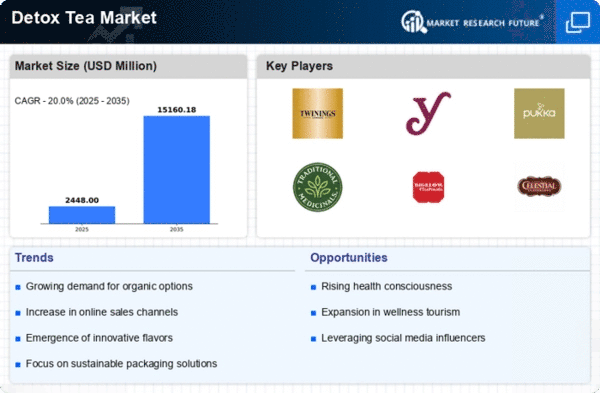
As per MRFR analysis, the Detox Tea Market Size was estimated at 2040.0 USD Million in 2024. The Detox Tea industry is projected to grow from 2448.04 USD Million in 2025 to 15160.18 USD Million by 2035, exhibiting a compound annual growth rate (CAGR) of 20.0 during the forecast period 2025 - 2035.

Key Market Trends & Highlights

The Detox Tea Market is experiencing a dynamic shift towards health-oriented and sustainable products.

  • The market is witnessing a rise in herbal ingredients, reflecting consumer preferences for natural and holistic wellness solutions.
  • Sustainability is becoming a focal point, with brands increasingly adopting eco-friendly practices in sourcing and packaging.
  • Personalization of detox tea products is on the rise, catering to individual health needs and preferences.
  • Health consciousness and the influence of social media are major drivers, propelling demand particularly in North America and the herbal tea segment.

Market Size & Forecast

2024 Market Size 2040.0 (USD Million)
2035 Market Size 15160.18 (USD Million)
CAGR (2025 - 2035) 20.0%
Largest Regional Market Share in 2024 North America

Major Players

Twinings (GB), Yogi Tea (DE), Pukka Herbs (GB), Traditional Medicinals (US), Bigelow Tea (US), Celestial Seasonings (US), Teavana (US), Numi Organic Tea (US), Rooibos Ltd (ZA)

Market Trends

detox tea

Detox Tea Market Market Drivers

Rising Health Consciousness

The increasing awareness of health and wellness among consumers appears to be a primary driver of the Global detox tea Market Industry. As individuals become more informed about the benefits of natural ingredients, the demand for detox teas, which are often perceived as healthier alternatives to sugary beverages, is likely to rise. This trend is particularly evident in urban areas where lifestyle diseases are prevalent. The market is projected to reach 2500 USD Million in 2024, reflecting a growing inclination towards products that promote detoxification and overall well-being.

Innovative Product Offerings

The introduction of innovative product offerings is a driving force in the Global Detox Tea Market Industry. Brands are increasingly experimenting with unique flavors, blends, and functional ingredients to attract consumers seeking novel experiences. This innovation not only caters to diverse taste preferences but also aligns with the growing trend of personalized nutrition. As companies invest in research and development to create differentiated products, they may enhance their competitive edge. Such innovations are likely to contribute to the market's growth, supporting the projected increase in market value over the next decade.

Expansion of E-commerce Platforms

The rise of e-commerce platforms has transformed the way consumers access products, significantly impacting the Global Detox Tea Market Industry. Online retail provides convenience and a wider selection of detox tea brands, catering to diverse consumer preferences. This shift is particularly relevant in regions where traditional retail channels are less accessible. The ease of purchasing through digital platforms is likely to enhance market penetration, allowing brands to reach a broader audience. As e-commerce continues to grow, it may contribute to the projected CAGR of 6.5% from 2025 to 2035, further bolstering market expansion.

Growing Demand for Natural Ingredients

There is a notable shift towards natural and organic products within the Global Detox Tea Market Industry. Consumers increasingly prefer beverages made from herbal and plant-based ingredients, which are perceived as safer and more beneficial for health. This trend is supported by regulatory bodies advocating for clean labeling and transparency in food and beverage products. As a result, brands that emphasize natural ingredients are likely to capture a larger market share. The anticipated growth trajectory suggests that by 2035, the market could expand to 5000 USD Million, driven by this consumer preference.

Influence of Social Media and Celebrity Endorsements

Social media platforms play a crucial role in shaping consumer perceptions and preferences in the Global Detox Tea Market Industry. Influencers and celebrities often promote detox teas, which can significantly enhance brand visibility and credibility. This phenomenon is particularly pronounced among younger demographics who are more likely to engage with online content. The impact of social media marketing strategies may lead to increased sales and brand loyalty, as consumers are drawn to products endorsed by figures they admire. This trend could potentially accelerate market growth, aligning with the overall expansion of the industry.

Market Segment Insights

By Product Type: Herbal Tea (Largest) vs. Green Tea (Fastest-Growing)

In the Detox Tea Market, the product type segment showcases a diverse range of offerings, with Herbal Tea capturing the largest market share. Green Tea follows closely behind, appealing to health-conscious consumers seeking detoxification benefits. Black Tea and <a href="https://www.marketresearchfuture.com/reports/fruit-tea-market-8611" target="_blank">fruit tea</a> also contribute to the market but occupy smaller portions in terms of consumer preference. The varied flavors and health benefits of these teas cater to different tastes and wellness goals, influencing their adoption rates.

Herbal Tea (Dominant) vs. Green Tea (Emerging)

Herbal Tea leads the Detox Tea Market due to its extensive variety and established reputation for promoting wellness. With ingredients like chamomile, mint, and hibiscus, Herbal Tea appeals to consumers looking for natural remedies and relaxation. Conversely, Green Tea is emerging rapidly, driven by a surge in awareness regarding its detoxifying properties and antioxidant content. New product innovations, including flavored green blends, are attracting a younger demographic. Both segments are seeing increased marketing efforts highlighting their health benefits, fostering competitive growth.

By Distribution Channel: Online Retail (Largest) vs. Supermarkets (Fastest-Growing)

The Detox Tea Market is experiencing a noteworthy distribution channel shift, with online retail emerging as the largest channel. This format capitalizes on the growing trend of e-commerce, providing consumers with convenient access to a variety of detox tea brands and products. Supermarkets, while still a significant player, are seeing increased competition from digital platforms. They continue to maintain a substantial portion of the market share, appealing to consumers seeking in-person shopping experiences. In contrast, health food stores and specialty stores, although important, hold a smaller share of the market. However, these channels are witnessing a surge in growth as health-conscious consumers increasingly seek out specialized and organic options. The rise of wellness trends is driving overall demand for detox tea, leading to new product offerings in these segments.

Online Retail (Dominant) vs. Specialty Stores (Emerging)

Online retail stands as the dominant distribution channel in the Detox Tea Market due to its extensive range and convenience, allowing consumers to browse and order from home. This channel caters to the tech-savvy demographic and often features promotions and discounts that attract a larger customer base. In contrast, specialty stores are emerging as valuable players, offering personalized customer experiences and curated selections that appeal to niche markets. These stores capitalize on trends focusing on organic, loose-leaf, and premium detox teas, targeting consumers willing to pay a premium for quality products. The unique offerings and expert knowledge in specialty stores create a differentiated shopping experience, although they currently attract a smaller segment of the market compared to online retail.

By Consumer Demographics: Age Group (Largest) vs. Lifestyle (Fastest-Growing)

In the Detox Tea Market, the distribution of consumer demographics reveals that the largest share is attributed to the age group of 25 to 34 years. This segment not only embraces detox tea for its health benefits but also integrates it into their daily routines, setting trends for younger demographics. Additionally, a significant portion of consumers falls within the 35 to 44 age range, showing a robust interest in wellness products as part of a broader lifestyle choice. On the other hand, the lifestyle segment is witnessing rapid growth, particularly among millennials and health-conscious individuals. Factors influencing this trend include increasing awareness of wellness, a rise in fitness activities, and shifting consumer preferences towards organic and natural products. As more consumers incorporate detox tea into their diets, lifestyle changes such as veganism and health-oriented living are propelling this segment's expansion in the market.

Age Group: 25-34 (Dominant) vs. Lifestyle: Health-Conscious (Emerging)

The age group of 25 to 34 years stands out as the dominant force in the Detox Tea Market. This demographic is characterized by a keen interest in health and wellness, actively seeking products that align with their lifestyle choices. Their purchasing behavior is influenced by social media trends and peer recommendations, making them valuable consumers for brands. In contrast, the emerging lifestyle segment of health-conscious individuals is significantly reshaping market dynamics. This group prioritizes natural and organic ingredients, often turning to detox tea as a means of detoxification and overall wellness. Their emphasis on sustainability and ethical sourcing further impacts purchasing decisions, presenting both challenges and opportunities for brands targeting this conscious consumer base.

By Formulation Type: Loose Leaf (Largest) vs. Tea Bags (Fastest-Growing)

In the Detox Tea Market, loose leaf formulations currently hold the largest share, appealing to consumers seeking high-quality, natural ingredients. The popularity of loose leaf tea is driven by its perceived health benefits and the ability to customize brews. Conversely, tea bags, while historically favored, are experiencing a remarkable shift as consumers lean towards convenience and on-the-go solutions, making them the fastest-growing segment. This shift indicates a diversification in consumer preferences and drinking habits, as quick consumption becomes a priority. Looking ahead, the market for detox teas is poised for robust growth, influenced by rising health consciousness among consumers. The demand for ready-to-drink options is creating new opportunities, particularly among younger demographics who prefer convenience. This trend is further fueled by increased awareness of detoxification benefits, leading to a burgeoning market for powdered formulations as well. As brands innovate their offerings in line with evolving consumer preferences, the segment is likely to witness dynamic shifts over the next few years.

Loose Leaf (Dominant) vs. Powdered (Emerging)

The loose leaf segment maintains a dominant position within the detox tea market, appealing to those who prefer a traditional brewing experience and perceive loose leaf as a superior option for flavor and quality. Consumers who choose loose leaf teas often value artisanal blends and the freshness of their brews, leading to a loyal customer base. On the other hand, the powdered detox teas are emerging as a modern alternative, catering to the increasing demand for convenience and ease of preparation. Powdered detox teas promise a quick and efficient way to enjoy the benefits of detoxification without the brewing process. This formulation appeals particularly to younger consumers and active lifestyles, solidifying its position as a notable challenger to loose leaf offerings.

By Purpose: Weight Loss (Largest) vs. Detoxification (Fastest-Growing)

The Detox Tea Market reveals a diverse segment analysis centered around key purposes: Weight Loss, Detoxification, Digestive Health, and Skin Health. Currently, Weight Loss holds the largest market share as consumers increasingly seek natural remedies to assist their weight management goals. This segment has been significantly bolstered by marketing campaigns that emphasize the effectiveness of detox teas in weight reduction, thus capturing substantial consumer interest alongside health and wellness trends. In contrast, the Detoxification segment is noted as the fastest-growing in the market. This surge is driven by heightened awareness of the importance of detoxifying the body in the face of modern environmental stressors and dietary habits. As consumers become more proactive about their health and well-being, the demand for detox teas designed to cleanse and refresh the body continues to rise, signalling a shift towards more integrative health approaches in the tea market.

Weight Loss (Dominant) vs. Digestive Health (Emerging)

The Weight Loss purpose stands as a dominant force in the Detox Tea Market due to its wide-ranging appeal among health-conscious consumers. Many individuals are turning to detox teas as a natural aid to help them shed excess weight while promoting overall wellness. This segment benefits from extensive marketing strategies that leverage success stories and endorsements from fitness influencers. Meanwhile, the Digestive Health segment has emerged as a growing category, appealing particularly to consumers interested in holistic health solutions. These detox teas often contain ingredients that promote gut health, reduce bloating, and enhance digestion. As awareness of gut health's importance continues to expand, this segment is poised for significant growth, appealing particularly to those seeking relief from digestive discomfort in conjunction with detoxification.

Get more detailed insights about Detox Tea Market Research Report – Forecast till 2035

Regional Insights

North America : Market Leader in Detox Tea

North America is poised to maintain its leadership in the detox tea market, holding a significant share of $850.0 million in 2025. The region's growth is driven by increasing health consciousness among consumers, a rising trend towards organic products, and supportive regulations promoting herbal teas. The demand for detox teas is further fueled by the growing popularity of wellness and detoxification practices, making it a lucrative market for key players. The competitive landscape in North America is robust, featuring major players like Traditional Medicinals, Bigelow Tea, and Celestial Seasonings. These companies leverage innovative marketing strategies and product diversification to capture consumer interest. The U.S. remains the largest market, supported by a strong distribution network and a growing preference for natural health solutions. The presence of established brands enhances market dynamics, ensuring a competitive edge in product offerings.

Europe : Emerging Detox Tea Hub

Europe is witnessing a burgeoning interest in detox teas, with a market size of $600.0 million projected for 2025. This growth is primarily driven by an increasing number of health-conscious consumers seeking natural remedies and wellness solutions. Regulatory support for herbal products and a shift towards organic consumption are significant catalysts for market expansion. The region's diverse tea culture also plays a vital role in promoting detox tea consumption across various demographics. Leading countries in this market include Germany, the UK, and France, where brands like Yogi Tea and Pukka Herbs are making substantial inroads. The competitive landscape is characterized by a mix of established brands and emerging players, all vying for market share. The presence of key players enhances product availability and innovation, catering to the evolving preferences of European consumers. "The European market for herbal teas is expected to grow significantly, driven by consumer demand for health-oriented products," European Tea Committee.

Asia-Pacific : Rising Health Trends

Asia-Pacific is emerging as a promising market for detox teas, with a projected size of $480.0 million by 2025. The region's growth is fueled by increasing awareness of health benefits associated with herbal teas and a cultural inclination towards natural remedies. Regulatory frameworks supporting herbal products are also contributing to market expansion. The rising trend of wellness and detoxification among consumers is expected to further drive demand for detox teas in this region. Countries like Australia, Japan, and China are leading the charge in the detox tea market, with local brands and international players like Teavana and Numi Organic Tea gaining traction. The competitive landscape is evolving, with a focus on product innovation and marketing strategies tailored to local preferences. As consumers become more health-conscious, the demand for detox teas is likely to rise, presenting opportunities for both established and new entrants in the market.

Middle East and Africa : Niche Market Development

The Middle East and Africa region is gradually developing a niche market for detox teas, with a market size of $110.0 million anticipated by 2025. The growth is driven by increasing health awareness and a shift towards natural and organic products among consumers. Regulatory support for herbal and organic products is fostering a conducive environment for market growth. The rising trend of wellness and detoxification is also contributing to the demand for detox teas in this region. Leading countries in this market include South Africa and the UAE, where local brands and international players are beginning to establish a presence. The competitive landscape is characterized by a mix of traditional herbal tea producers and new entrants focusing on detox products. As consumer preferences evolve, the detox tea market in the Middle East and Africa is expected to expand, offering opportunities for innovation and growth.

Key Players and Competitive Insights

The Detox Tea Market is currently characterized by a dynamic competitive landscape, driven by increasing consumer awareness regarding health and wellness. Key players are actively engaging in innovative product development, strategic partnerships, and regional expansions to capture market share. Companies such as Twinings (GB), Yogi Tea (DE), and Pukka Herbs (GB) are at the forefront, leveraging their brand heritage and product diversity to appeal to health-conscious consumers. Their operational focus on sustainability and organic ingredients appears to resonate well with the growing demand for natural products, thereby shaping a competitive environment that prioritizes quality and ethical sourcing.In terms of business tactics, companies are increasingly localizing manufacturing to enhance supply chain efficiency and reduce costs. This approach not only mitigates risks associated with The Detox Tea demands. The market structure is moderately fragmented, with several players vying for consumer attention. However, the collective influence of major companies like Traditional Medicinals (US) and Bigelow Tea (US) suggests a trend towards consolidation, as these firms seek to strengthen their market positions through strategic acquisitions and collaborations.

In November Yogi Tea (DE) announced a partnership with a leading health and wellness influencer to promote its new line of detox teas. This collaboration is strategically significant as it aims to tap into the influencer's extensive follower base, thereby enhancing brand visibility and consumer engagement. Such partnerships are indicative of a broader trend where brands leverage social media to connect with younger demographics, potentially driving sales growth in a competitive market.

In October Pukka Herbs (GB) launched a new range of herbal detox teas, emphasizing sustainability and organic sourcing. This initiative not only aligns with consumer preferences for eco-friendly products but also positions Pukka as a leader in the organic segment of the market. The strategic importance of this launch lies in its potential to attract environmentally conscious consumers, thereby expanding Pukka's market share and reinforcing its brand identity.

In September Traditional Medicinals (US) expanded its distribution network by entering into a partnership with a major online retailer. This move is likely to enhance accessibility for consumers, particularly in regions where traditional retail presence is limited. By increasing its online footprint, Traditional Medicinals aims to capture the growing trend of e-commerce, which has become a critical channel for health and wellness products.

As of December the Detox Tea Market is witnessing trends such as digitalization, sustainability, and the integration of AI in product development and marketing strategies. Strategic alliances are increasingly shaping the competitive landscape, allowing companies to pool resources and expertise. Looking ahead, competitive differentiation is expected to evolve, with a shift from price-based competition to a focus on innovation, technology, and supply chain reliability. This transition underscores the importance of adaptability in a rapidly changing market environment.

Key Companies in the Detox Tea Market include

Industry Developments

Future Outlook

Detox Tea Market Future Outlook

The Detox Tea Market is projected to grow at a 20.0% CAGR from 2025 to 2035, driven by increasing health consciousness, innovative product offerings, and expanding distribution channels.

New opportunities lie in:

  • Development of subscription-based detox tea delivery services
  • Expansion into emerging markets with localized flavors
  • Partnerships with wellness influencers for targeted marketing campaigns

By 2035, the Detox Tea Market is expected to achieve substantial growth and diversification.

Market Segmentation

Detox Tea Market Purpose Outlook

  • Weight Loss
  • Detoxification
  • Digestive Health
  • Skin Health

Detox Tea Market Product Type Outlook

  • Herbal Tea
  • Green Tea
  • Black Tea
  • Fruit Tea

Detox Tea Market Formulation Type Outlook

  • Loose Leaf
  • Tea Bags
  • Ready-to-Drink
  • Powdered

Detox Tea Market Distribution Channel Outlook

  • Online Retail
  • Supermarkets
  • Health Food Stores
  • Specialty Stores

Detox Tea Market Consumer Demographics Outlook

  • Age Group
  • Gender
  • Income Level
  • Lifestyle

Report Scope

MARKET SIZE 20242040.0(USD Million)
MARKET SIZE 20252448.04(USD Million)
MARKET SIZE 203515160.18(USD Million)
COMPOUND ANNUAL GROWTH RATE (CAGR)20.0% (2025 - 2035)
REPORT COVERAGERevenue Forecast, Competitive Landscape, Growth Factors, and Trends
BASE YEAR2024
Market Forecast Period2025 - 2035
Historical Data2019 - 2024
Market Forecast UnitsUSD Million
Key Companies ProfiledTwinings (GB), Yogi Tea (DE), Pukka Herbs (GB), Traditional Medicinals (US), Bigelow Tea (US), Celestial Seasonings (US), Teavana (US), Numi Organic Tea (US), Rooibos Ltd (ZA)
Segments CoveredProduct Type, Distribution Channel, Consumer Demographics, Formulation Type, Purpose
Key Market OpportunitiesGrowing consumer interest in health and wellness drives innovation in the Detox Tea Market.
Key Market DynamicsRising consumer preference for health-oriented beverages drives innovation and competition in the Detox Tea Market.
Countries CoveredNorth America, Europe, APAC, South America, MEA

FAQs

How much is the Detox Tea Market?

The Detox Tea Market is expected to be valued at USD 5.78 Billion in 2035.

What is the growth rate of the Detox Tea Market?

The global market is projected to grow at a CAGR of 9.84% during the forecast period, 2025-2035.

Which region holds the largest market share in the Detox Tea Market?

Asia Pacific had the largest share of the global market.

Who are the key players in the Detox Tea Market?

The key players in the market are Astec Industries, including Yogi Life, Teatulia Organic Teas, Celestial Seasonings. Inc, Choice Organic Teas, Traditional Medicinals, Twinings, Pukka Herbs, Lipton, Kusmi Tea, Adagio Teas, And Others.

Which By Origin led the Detox Tea Market?

Conventional dominated the market in 2024.

Which By Wellness Claim had the largest market share in the Detox Tea Market?

The Liver Detox Segment had the largest revenue share of the global market.

  1. SECTION I: EXECUTIVE SUMMARY AND KEY HIGHLIGHTS
    1. | 1.1 EXECUTIVE SUMMARY
    2. | 1.1.1 Market Overview
    3. | 1.1.2 Key Findings
    4. | 1.1.3 Market Segmentation
    5. | 1.1.4 Competitive Landscape
    6. | 1.1.5 Challenges and Opportunities
    7. | 1.1.6 Future Outlook
  2. SECTION II: SCOPING, METHODOLOGY AND MARKET STRUCTURE
    1. | 2.1 MARKET INTRODUCTION
    2. | 2.1.1 Definition
    3. | 2.1.2 Scope of the study
    4. |-- 2.1.2.1 Research Objective
    5. |-- 2.1.2.2 Assumption
    6. |-- 2.1.2.3 Limitations
    7. | 2.2 RESEARCH METHODOLOGY
    8. | 2.2.1 Overview
    9. | 2.2.2 Data Mining
    10. | 2.2.3 Secondary Research
    11. | 2.2.4 Primary Research
    12. |-- 2.2.4.1 Primary Interviews and Information Gathering Process
    13. |-- 2.2.4.2 Breakdown of Primary Respondents
    14. | 2.2.5 Forecasting Model
    15. | 2.2.6 Market Size Estimation
    16. |-- 2.2.6.1 Bottom-Up Approach
    17. |-- 2.2.6.2 Top-Down Approach
    18. | 2.2.7 Data Triangulation
    19. | 2.2.8 Validation
  3. SECTION III: QUALITATIVE ANALYSIS
    1. | 3.1 MARKET DYNAMICS
    2. | 3.1.1 Overview
    3. | 3.1.2 Drivers
    4. | 3.1.3 Restraints
    5. | 3.1.4 Opportunities
    6. | 3.2 MARKET FACTOR ANALYSIS
    7. | 3.2.1 Value chain Analysis
    8. | 3.2.2 Porter's Five Forces Analysis
    9. |-- 3.2.2.1 Bargaining Power of Suppliers
    10. |-- 3.2.2.2 Bargaining Power of Buyers
    11. |-- 3.2.2.3 Threat of New Entrants
    12. |-- 3.2.2.4 Threat of Substitutes
    13. |-- 3.2.2.5 Intensity of Rivalry
    14. | 3.2.3 COVID-19 Impact Analysis
    15. |-- 3.2.3.1 Market Impact Analysis
    16. |-- 3.2.3.2 Regional Impact
    17. |-- 3.2.3.3 Opportunity and Threat Analysis
  4. SECTION IV: QUANTITATIVE ANALYSIS
    1. | 4.1 Food, Beverages & Nutrition, BY Product Type (USD Million)
    2. | 4.1.1 Herbal Tea
    3. | 4.1.2 Green Tea
    4. | 4.1.3 Black Tea
    5. | 4.1.4 Fruit Tea
    6. | 4.2 Food, Beverages & Nutrition, BY Distribution Channel (USD Million)
    7. | 4.2.1 Online Retail
    8. | 4.2.2 Supermarkets
    9. | 4.2.3 Health Food Stores
    10. | 4.2.4 Specialty Stores
    11. | 4.3 Food, Beverages & Nutrition, BY Consumer Demographics (USD Million)
    12. | 4.3.1 Age Group
    13. | 4.3.2 Gender
    14. | 4.3.3 Income Level
    15. | 4.3.4 Lifestyle
    16. | 4.4 Food, Beverages & Nutrition, BY Formulation Type (USD Million)
    17. | 4.4.1 Loose Leaf
    18. | 4.4.2 Tea Bags
    19. | 4.4.3 Ready-to-Drink
    20. | 4.4.4 Powdered
    21. | 4.5 Food, Beverages & Nutrition, BY Purpose (USD Million)
    22. | 4.5.1 Weight Loss
    23. | 4.5.2 Detoxification
    24. | 4.5.3 Digestive Health
    25. | 4.5.4 Skin Health
    26. | 4.6 Food, Beverages & Nutrition, BY Region (USD Million)
    27. | 4.6.1 North America
    28. |-- 4.6.1.1 US
    29. |-- 4.6.1.2 Canada
    30. | 4.6.2 Europe
    31. |-- 4.6.2.1 Germany
    32. |-- 4.6.2.2 UK
    33. |-- 4.6.2.3 France
    34. |-- 4.6.2.4 Russia
    35. |-- 4.6.2.5 Italy
    36. |-- 4.6.2.6 Spain
    37. |-- 4.6.2.7 Rest of Europe
    38. | 4.6.3 APAC
    39. |-- 4.6.3.1 China
    40. |-- 4.6.3.2 India
    41. |-- 4.6.3.3 Japan
    42. |-- 4.6.3.4 South Korea
    43. |-- 4.6.3.5 Malaysia
    44. |-- 4.6.3.6 Thailand
    45. |-- 4.6.3.7 Indonesia
    46. |-- 4.6.3.8 Rest of APAC
    47. | 4.6.4 South America
    48. |-- 4.6.4.1 Brazil
    49. |-- 4.6.4.2 Mexico
    50. |-- 4.6.4.3 Argentina
    51. |-- 4.6.4.4 Rest of South America
    52. | 4.6.5 MEA
    53. |-- 4.6.5.1 GCC Countries
    54. |-- 4.6.5.2 South Africa
    55. |-- 4.6.5.3 Rest of MEA
  5. SECTION V: COMPETITIVE ANALYSIS
    1. | 5.1 Competitive Landscape
    2. | 5.1.1 Overview
    3. | 5.1.2 Competitive Analysis
    4. | 5.1.3 Market share Analysis
    5. | 5.1.4 Major Growth Strategy in the Food, Beverages & Nutrition
    6. | 5.1.5 Competitive Benchmarking
    7. | 5.1.6 Leading Players in Terms of Number of Developments in the Food, Beverages & Nutrition
    8. | 5.1.7 Key developments and growth strategies
    9. |-- 5.1.7.1 New Product Launch/Service Deployment
    10. |-- 5.1.7.2 Merger & Acquisitions
    11. |-- 5.1.7.3 Joint Ventures
    12. | 5.1.8 Major Players Financial Matrix
    13. |-- 5.1.8.1 Sales and Operating Income
    14. |-- 5.1.8.2 Major Players R&D Expenditure. 2023
    15. | 5.2 Company Profiles
    16. | 5.2.1 Twinings (GB)
    17. |-- 5.2.1.1 Financial Overview
    18. |-- 5.2.1.2 Products Offered
    19. |-- 5.2.1.3 Key Developments
    20. |-- 5.2.1.4 SWOT Analysis
    21. |-- 5.2.1.5 Key Strategies
    22. | 5.2.2 Yogi Tea (DE)
    23. |-- 5.2.2.1 Financial Overview
    24. |-- 5.2.2.2 Products Offered
    25. |-- 5.2.2.3 Key Developments
    26. |-- 5.2.2.4 SWOT Analysis
    27. |-- 5.2.2.5 Key Strategies
    28. | 5.2.3 Pukka Herbs (GB)
    29. |-- 5.2.3.1 Financial Overview
    30. |-- 5.2.3.2 Products Offered
    31. |-- 5.2.3.3 Key Developments
    32. |-- 5.2.3.4 SWOT Analysis
    33. |-- 5.2.3.5 Key Strategies
    34. | 5.2.4 Traditional Medicinals (US)
    35. |-- 5.2.4.1 Financial Overview
    36. |-- 5.2.4.2 Products Offered
    37. |-- 5.2.4.3 Key Developments
    38. |-- 5.2.4.4 SWOT Analysis
    39. |-- 5.2.4.5 Key Strategies
    40. | 5.2.5 Bigelow Tea (US)
    41. |-- 5.2.5.1 Financial Overview
    42. |-- 5.2.5.2 Products Offered
    43. |-- 5.2.5.3 Key Developments
    44. |-- 5.2.5.4 SWOT Analysis
    45. |-- 5.2.5.5 Key Strategies
    46. | 5.2.6 Celestial Seasonings (US)
    47. |-- 5.2.6.1 Financial Overview
    48. |-- 5.2.6.2 Products Offered
    49. |-- 5.2.6.3 Key Developments
    50. |-- 5.2.6.4 SWOT Analysis
    51. |-- 5.2.6.5 Key Strategies
    52. | 5.2.7 Teavana (US)
    53. |-- 5.2.7.1 Financial Overview
    54. |-- 5.2.7.2 Products Offered
    55. |-- 5.2.7.3 Key Developments
    56. |-- 5.2.7.4 SWOT Analysis
    57. |-- 5.2.7.5 Key Strategies
    58. | 5.2.8 Numi Organic Tea (US)
    59. |-- 5.2.8.1 Financial Overview
    60. |-- 5.2.8.2 Products Offered
    61. |-- 5.2.8.3 Key Developments
    62. |-- 5.2.8.4 SWOT Analysis
    63. |-- 5.2.8.5 Key Strategies
    64. | 5.2.9 Rooibos Ltd (ZA)
    65. |-- 5.2.9.1 Financial Overview
    66. |-- 5.2.9.2 Products Offered
    67. |-- 5.2.9.3 Key Developments
    68. |-- 5.2.9.4 SWOT Analysis
    69. |-- 5.2.9.5 Key Strategies
    70. | 5.3 Appendix
    71. | 5.3.1 References
    72. | 5.3.2 Related Reports

Food, Beverages & Nutrition Market Segmentation

Food, Beverages & Nutrition By Product Type (USD Million, 2025-2035)

  • Herbal Tea
  • Green Tea
  • Black Tea
  • Fruit Tea

Food, Beverages & Nutrition By Distribution Channel (USD Million, 2025-2035)

  • Online Retail
  • Supermarkets
  • Health Food Stores
  • Specialty Stores

Food, Beverages & Nutrition By Consumer Demographics (USD Million, 2025-2035)

  • Age Group
  • Gender
  • Income Level
  • Lifestyle

Food, Beverages & Nutrition By Formulation Type (USD Million, 2025-2035)

  • Loose Leaf
  • Tea Bags
  • Ready-to-Drink
  • Powdered

Food, Beverages & Nutrition By Purpose (USD Million, 2025-2035)

  • Weight Loss
  • Detoxification
  • Digestive Health
  • Skin Health
Infographic

Free Sample Request

Kindly complete the form below to receive a free sample of this Report

Get Free Sample

Customer Strories

Compare Licence

×
Features License Type
Single User Multiuser License Enterprise User
Price $4,950 $5,950 $7,250
Maximum User Access Limit 1 User Upto 10 Users Unrestricted Access Throughout the Organization
Free Customization
Direct Access to Analyst
Deliverable Format
Platform Access
Discount on Next Purchase 10% 15% 15%
Printable Versions