Request Free Sample ×

Kindly complete the form below to receive a free sample of this Report

* Please use a valid business email

Leading companies partner with us for data-driven Insights

clients tt-cursor
Hero Background
English
Chinese
French
Japanese
Korean
German
Spanish

Dermabrasion Market Size

ID: MRFR/MED/3281-HCR
110 Pages
Vikita Thakur
April 2026

Dermabrasion Market Information Research Report by devices (manual, motorized), by indications (surgical scars, benign tumors, actinic keratosis, rhinophyma, perioral rhytides), by end users (hospitals, dermatology clinics) - Forecast till 2035

Share:
Download PDF ×

We do not share your information with anyone. However, we may send you emails based on your report interest from time to time. You may contact us at any time to opt-out.

Dermabrasion Market Infographic
Purchase Options

Dermabrasion Size

Dermabrasion Market Growth Projections and Opportunities

The Dermabrasion market is influenced by a myriad of factors that collectively shape its dynamics and growth trajectory. One of the primary market factors is the increasing prevalence of skin disorders and the growing demand for cosmetic procedures. As awareness about skincare and aesthetics rises, individuals seek effective solutions to address concerns such as scars, wrinkles, and uneven skin texture. Dermabrasion, with its ability to rejuvenate the skin's surface, emerges as a popular choice, driving the market forward.

Technological advancements play a pivotal role in shaping the Dermabrasion market. The development of innovative tools and techniques enhances the precision and safety of the procedure, attracting both patients and practitioners. Advancements in dermabrasion devices, such as the introduction of microdermabrasion and diamond-tip devices, have expanded treatment options, further boosting market growth.

Moreover, the influence of demographic factors cannot be overlooked. The aging population, particularly in developed regions, contributes significantly to the expansion of the Dermabrasion market. As individuals age, the desire to maintain youthful skin and address aging-related skin concerns fuels the demand for dermatological procedures, including dermabrasion.

Economic factors also come into play, impacting the accessibility of dermabrasion procedures. The availability of disposable income influences individuals' willingness to invest in cosmetic treatments. In economically stable regions, the Dermabrasion market tends to witness robust growth as consumers are more likely to allocate funds for aesthetic procedures.

Regulatory factors are crucial in shaping the landscape of the Dermabrasion market. Stringent regulations and compliance requirements ensure the safety and efficacy of dermabrasion procedures, instilling confidence among patients. Regulatory approval of new devices and techniques is a significant milestone for market players, paving the way for product commercialization and market expansion.

The competitive landscape is another market factor that influences the growth and dynamics of the Dermabrasion market. With numerous players vying for market share, innovation becomes a key differentiator. Companies invest in research and development to introduce novel dermabrasion technologies, stay ahead of competitors, and cater to evolving consumer preferences.

Consumer preferences and cultural factors also play a role in shaping the Dermabrasion market. The societal emphasis on appearance and beauty standards varies across different regions and cultures. Understanding these nuances is essential for market players to tailor their offerings and marketing strategies accordingly.

Lastly, the impact of global events and health crises cannot be ignored. The COVID-19 pandemic, for instance, brought about significant disruptions in the healthcare and cosmetic industries, affecting the Dermabrasion market. Changes in consumer behavior, restrictions on elective procedures, and supply chain challenges all influenced the market dynamics during such times.
Dermabrasion Market Size Graph
Author
Author Profile
Vikita Thakur
Senior Research Analyst

She holds an experience of about 5+ years in market research and business consulting projects for sectors such as life sciences, medical devices, and healthcare IT. She possesses a robust background in data analysis, market estimation, competitive intelligence, pipeline analysis market trend identification, and consumer behavior insights. Her expertise lies in technical Sales support, client interaction and project management, designing and implementing market research studies, conducting competitive analysis, and synthesizing complex data into actionable recommendations that drive business growth.

Leave a Comment

FAQs

What is the current valuation of the Dermabrasion Market as of 2024?

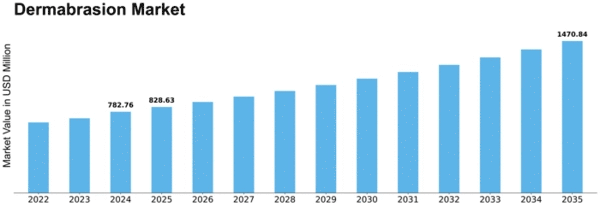
<p>The Dermabrasion Market was valued at 782.76 USD Million in 2024.</p>

What is the projected market valuation for the Dermabrasion Market in 2035?

<p>The projected valuation for the Dermabrasion Market in 2035 is 1470.84 USD Million.</p>

What is the expected CAGR for the Dermabrasion Market during the forecast period 2025 - 2035?

<p>The expected CAGR for the Dermabrasion Market during the forecast period 2025 - 2035 is 5.86%.</p>

Which companies are considered key players in the Dermabrasion Market?

<p>Key players in the Dermabrasion Market include Allergan, Merz Pharmaceuticals, Galderma, and Revance Therapeutics.</p>

What are the main application segments of the Dermabrasion Market?

<p>The main application segments include Surgical Dermabrasion, Mechanical Dermabrasion, Chemical Dermabrasion, and Microdermabrasion.</p>

How does the valuation of Chemical Dermabrasion compare to other segments?

Chemical Dermabrasion has a valuation range of 250.0 to 500.0 USD Million, indicating strong market performance.

What is the valuation range for Cosmetic Surgery Centers in the Dermabrasion Market?

The valuation range for Cosmetic Surgery Centers is between 234.83 and 450.0 USD Million.

What types of dermabrasion techniques are currently utilized in the market?

The types of dermabrasion techniques include Manual Dermabrasion, Automated Dermabrasion, and Laser Dermabrasion.

What is the projected growth for the Home Care segment in the Dermabrasion Market?

The Home Care segment is projected to have a valuation range of 234.83 to 420.84 USD Million.

How does the market for Diamond Dermabrasion compare to Crystal Dermabrasion?

Diamond Dermabrasion has a valuation range of 200.0 to 400.0 USD Million, while Crystal Dermabrasion ranges from 300.0 to 600.0 USD Million.

Market Summary

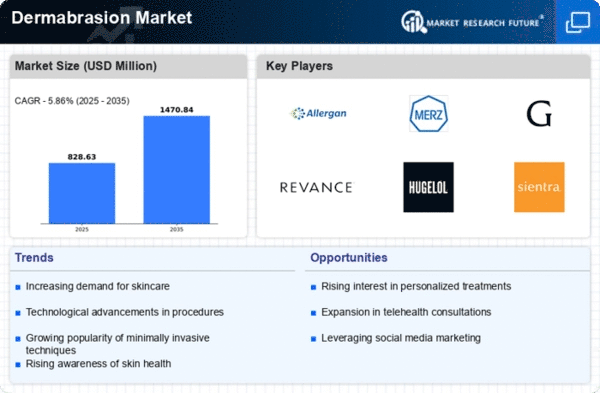
As per MRFR analysis, the Dermabrasion Market Size was estimated at 782.76 USD Million in 2024. The Dermabrasion industry is projected to grow from 837.6 in 2025 to 1470.84 by 2035, exhibiting a compound annual growth rate (CAGR) of 5.86% during the forecast period 2025 - 2035.

Key Market Trends & Highlights

The Dermabrasion Market is experiencing a dynamic shift towards advanced and personalized treatment options.

  • Technological advancements are driving innovation in dermabrasion techniques, enhancing efficacy and safety.
  • The influence of social media is significantly shaping consumer perceptions and increasing demand for aesthetic procedures.
  • Surgical dermabrasion remains the largest segment, while microdermabrasion is emerging as the fastest-growing segment in the market.
  • Rising demand for aesthetic procedures and growing awareness of skin health are key drivers propelling market growth in North America and Asia-Pacific.

Market Size & Forecast

2024 Market Size 782.76 (USD Million)
2035 Market Size 1470.84 (USD Million)
CAGR (2025 - 2035) 5.86%
Largest Regional Market Share in 2024 North America

Major Players

Allergan (US), Merz Pharmaceuticals (DE), Galderma (CH), Revance Therapeutics (US), Hugel (KR), Sientra (US), Prollenium Medical Technologies (CA), Croma-Pharma (AT), Medytox (KR)

Market Trends

The Dermabrasion Market is currently experiencing a notable evolution, driven by advancements in technology and increasing consumer awareness regarding skin health. As individuals become more conscious of their appearance, the demand for effective skin resurfacing procedures has surged. This market encompasses various techniques, including mechanical and chemical methods, which aim to improve skin texture and reduce imperfections. The growing popularity of minimally invasive procedures is reshaping the landscape, as patients seek options that offer quicker recovery times and less discomfort. Furthermore, the rise of social media and beauty influencers has amplified interest in aesthetic treatments, leading to a broader acceptance of dermabrasion as a viable solution for skin rejuvenation. In addition to technological advancements, the Dermabrasion Market is influenced by a shift towards personalized skincare solutions. Consumers are increasingly seeking treatments tailored to their specific skin types and concerns, prompting providers to offer customized options. This trend is further supported by the integration of artificial intelligence and machine learning in dermatology, which enhances treatment precision and outcomes. As the market continues to evolve, it appears poised for growth, with an emphasis on safety, efficacy, and patient satisfaction. The future of the Dermabrasion Market seems promising, as innovations and consumer preferences converge to create a dynamic environment for both practitioners and patients.

Technological Advancements

The Dermabrasion Market is witnessing a surge in technological innovations that enhance treatment efficacy and patient comfort. New devices and techniques are being developed, allowing for more precise and controlled procedures. This trend not only improves outcomes but also reduces recovery times, making dermabrasion more appealing to a broader audience.

Personalized Treatments

There is a growing emphasis on personalized skincare solutions within the Dermabrasion Market. Consumers are increasingly seeking treatments that cater to their unique skin types and concerns. This shift encourages providers to adopt customized approaches, ensuring that each patient receives tailored care that addresses their specific needs.

Influence of Social Media

The impact of social media on the Dermabrasion Market cannot be overlooked. Platforms showcasing beauty trends and personal experiences have heightened awareness and acceptance of dermabrasion treatments. As influencers share their journeys, potential patients are more inclined to explore these options, driving demand for skin resurfacing procedures.

Dermabrasion Market Market Drivers

Market Growth Projections

The Global Dermabrasion Market Industry is projected to experience substantial growth, with estimates indicating a rise from 0.24 USD Billion in 2024 to 0.88 USD Billion by 2035. This trajectory reflects a compound annual growth rate of 12.3% from 2025 to 2035, suggesting a robust market response to evolving consumer preferences and technological advancements. The anticipated growth is indicative of a broader trend within the cosmetic industry, where dermabrasion is increasingly recognized for its effectiveness in addressing various skin concerns. This upward trend underscores the potential for sustained investment and innovation within the Global Dermabrasion Market Industry.

Rising Demand for Cosmetic Procedures

The Global Dermabrasion Market Industry experiences a notable increase in demand for cosmetic procedures as individuals seek to enhance their appearance. This trend is driven by a growing awareness of skin health and aesthetics, particularly among younger demographics. The market is projected to reach 0.24 USD Billion in 2024, reflecting the increasing willingness of consumers to invest in skin treatments. As societal norms shift towards valuing personal appearance, the industry is likely to expand further, with dermabrasion being a preferred choice for skin rejuvenation. This demand is anticipated to contribute significantly to the overall growth of the Global Dermabrasion Market Industry.

Increasing Prevalence of Skin Disorders

The Global Dermabrasion Market Industry is significantly influenced by the rising prevalence of skin disorders, including acne scars, hyperpigmentation, and aging skin. As awareness of these conditions grows, more individuals are seeking effective treatment options, with dermabrasion emerging as a viable solution. The market's expansion is further supported by healthcare professionals advocating for dermabrasion as a safe and effective method for skin rejuvenation. This trend is expected to drive the market towards an estimated value of 0.88 USD Billion by 2035, highlighting the increasing reliance on dermabrasion to address various skin concerns.

Expansion of Dermatology Clinics and Spas

The Global Dermabrasion Market Industry benefits from the expansion of dermatology clinics and wellness spas, which increasingly offer dermabrasion services. This proliferation of facilities provides greater access to skin treatments, catering to a diverse clientele. As more clinics adopt dermabrasion as part of their service offerings, the market is poised for growth. The convenience of localized services enhances consumer engagement and encourages individuals to seek treatment. This trend is expected to contribute to the overall market growth, as the availability of dermabrasion services becomes more widespread, aligning with the increasing demand for cosmetic procedures.

Growing Aesthetic Consciousness Among Consumers

A shift in consumer attitudes towards aesthetics is a significant driver of the Global Dermabrasion Market Industry. As individuals become more conscious of their appearance, there is a marked increase in the pursuit of cosmetic treatments. This growing aesthetic consciousness is particularly evident in urban populations, where access to cosmetic services is more prevalent. The demand for dermabrasion procedures is likely to rise as consumers seek effective solutions for skin imperfections. This trend not only reflects changing societal values but also indicates a potential for sustained growth in the industry, as more individuals prioritize skin health and appearance.

Technological Advancements in Dermabrasion Techniques

Technological innovations play a crucial role in shaping the Global Dermabrasion Market Industry. The introduction of advanced dermabrasion devices, such as microdermabrasion machines and laser-assisted techniques, enhances the efficacy and safety of treatments. These advancements not only improve patient outcomes but also reduce recovery times, making procedures more appealing. As a result, practitioners are increasingly adopting these technologies, leading to a projected compound annual growth rate of 12.3% from 2025 to 2035. This growth indicates a robust market response to the integration of technology in dermabrasion, thereby attracting a wider clientele seeking effective skin treatments.

Market Segment Insights

By Application: Surgical Dermabrasion (Largest) vs. Microdermabrasion (Fastest-Growing)

In the dermatological procedures market, the application segment has seen a diverse range of techniques gaining prominence. Surgical Dermabrasion holds a significant market share, favored for its deep skin resurfacing capabilities, thereby appealing to a demographic seeking significant results. Conversely, Microdermabrasion is witnessing a rapid increase in adoption due to its non-invasive nature and minimal recovery time, making it increasingly popular among younger consumers and those looking for subtle improvements. The balance of market shares in these applications illustrates varied consumer needs and preferences based on desired outcomes.

Surgical Dermabrasion (Dominant) vs. Microdermabrasion (Emerging)

Surgical Dermabrasion is a well-established procedure known for its ability to treat severe skin imperfections by removing damaged outer skin layers. It is associated with longer recovery times but offers dramatic improvements, making it a top choice for deep scarring and extensive skin damage. In contrast, Microdermabrasion is gaining traction as an emerging trend. This technique provides a gentler approach suitable for a broader audience, including those with sensitive skin. As both treatments evolve, they cater to distinct patient profiles: Surgical Dermabrasion targets individuals requiring significant correction, while Microdermabrasion appeals to cosmetic maintenance seekers looking for convenience and less invasive options.

By End Use: Dermatology Clinics (Largest) vs. Home Care (Fastest-Growing)

In the Dermabrasion Market, dermatology clinics hold the largest market share due to their specialized services and patient trust. These facilities provide comprehensive skin care treatments, including advanced dermabrasion techniques led by experienced dermatologists. Following closely are cosmetic surgery centers, which also contribute significantly to the market with their specialized offerings. Home care solutions, although currently a smaller segment, are rapidly gaining traction as consumers seek effective at-home treatments, leading to a shift in market dynamics.

Dermatology Clinics (Dominant) vs. Home Care (Emerging)

Dermatology clinics have established themselves as the dominant force in the dermabrasion market due to their expertise and the trust they have built with patients. These clinics offer a range of professional treatments and are equipped with advanced equipment, ensuring high-quality results. In contrast, the home care segment presents itself as an emerging market, driven by consumer preferences for convenient, cost-effective, and user-friendly dermabrasion solutions. <a href="https://www.marketresearchfuture.com/reports/home-care-product-market-27057" target="_blank" title="home care product">Home care products</a> are increasingly being formulated with effective ingredients, thereby expanding their market presence as consumers opt for at-home treatments that deliver results akin to professional procedures.

By Type: Diamond Dermabrasion (Largest) vs. Surgical Dermabrasion (Fastest-Growing)

<p>The dermabrasion market is primarily segmented into Diamond Dermabrasion, Crystal Dermabrasion, and Surgical Dermabrasion, with Diamond Dermabrasion commanding the largest share. Its superior performance and effectiveness in skin resurfacing have established it as a preferred choice amongst both professionals and patients. Crystal Dermabrasion, although still popular, is gradually losing market share to the more advanced diamond variant due to the latter's reduced risk of complications and enhanced patient satisfaction. On the other hand, Surgical Dermabrasion continues to gain traction, predominantly due to its ability to address deeper skin issues efficiently, impacting the overall market dynamics significantly.</p>

<p>Dermabrasion: Diamond (Dominant) vs. Surgical (Emerging)</p>

<p>Diamond Dermabrasion stands out in the dermabrasion market due to its precision and effectiveness, utilizing diamond-tipped instruments for a superior resurfacing experience. This method minimizes skin trauma and promotes faster recovery, leading to higher patient satisfaction rates. In contrast, Surgical Dermabrasion represents an emerging trend that is witnessing a surge in popularity. It is particularly beneficial for treating deeper skin irregularities, delivering significant results, albeit with longer recovery times. The growing acceptance of minimally invasive surgical techniques is propelling Surgical Dermabrasion's growth, as practitioners and patients alike seek treatments that enhance skin quality with improved outcomes.</p>

By Technique: Laser Dermabrasion (Largest) vs. Automated Dermabrasion (Fastest-Growing)

<p>In the Dermabrasion Market, the landscape is primarily dominated by Laser Dermabrasion, which holds the largest market share due to its advanced technology and effectiveness in skin treatment. Manual Dermabrasion, while still present, is gradually losing ground to more tech-driven methods, with Laser and Automated techniques leading the way. Automated Dermabrasion, on the other hand, is witnessing a surge in popularity, particularly among younger demographics seeking quick and non-invasive solutions.</p>

<p>Technique: Laser Dermabrasion (Dominant) vs. Automated Dermabrasion (Emerging)</p>

<p>Laser Dermabrasion stands out as the dominant technique in the market, known for its precision and effectiveness in treating a variety of skin concerns, including acne scars and uneven skin texture. This method involves the use of high-intensity light to remove dead skin layers, promoting faster healing and a smoother complexion. In contrast, Automated Dermabrasion is emerging rapidly as a popular choice for those who prefer a more automated and less hands-on procedure. Its ease of use and efficiency are attracting a growing number of clients seeking quick results without the downtime associated with traditional methods.</p>

Get more detailed insights about Dermabrasion Market Research Report - Forecast till 2035

Regional Insights

North America : Market Leader in Dermabrasion

North America continues to lead the dermabrasion market, holding a significant share of 400.0 million in 2024. The region's growth is driven by increasing consumer awareness of skin care, advancements in technology, and a rise in minimally invasive procedures. Regulatory support and favorable reimbursement policies further catalyze market expansion, making it a hub for innovation in dermatological treatments. The competitive landscape in North America is robust, featuring key players such as Allergan, Revance Therapeutics, and Sientra. The U.S. remains the largest market, supported by a high demand for aesthetic procedures. The presence of established companies and ongoing research and development initiatives contribute to a dynamic market environment, ensuring continued growth and innovation.

Europe : Emerging Market Dynamics

Europe's dermabrasion market is valued at 200.0 million, reflecting a growing trend towards aesthetic procedures and skin rejuvenation. Factors such as an aging population, increased disposable income, and rising awareness of skin health are driving demand. Regulatory frameworks in countries like Germany and France support the use of advanced dermabrasion technologies, enhancing market growth prospects. Leading countries in Europe include Germany, France, and the UK, where key players like Merz Pharmaceuticals and Galderma are prominent. The competitive landscape is characterized by innovation and strategic partnerships, with companies focusing on expanding their product offerings. The region's commitment to quality and safety in dermatological treatments positions it as a significant player in the global market.

Asia-Pacific : Rapidly Expanding Market

The Asia-Pacific dermabrasion market, valued at 150.0 million, is witnessing rapid growth driven by rising disposable incomes and a growing middle class. Increased awareness of skin care and aesthetic treatments, coupled with technological advancements, are key factors propelling market demand. Regulatory bodies in countries like South Korea and Japan are also promoting safe practices in cosmetic procedures, further enhancing market potential. Countries such as South Korea, Japan, and Australia are leading the charge in this region, with key players like Hugel and Medytox making significant strides. The competitive landscape is evolving, with a focus on innovative products and services tailored to local preferences. As the market matures, the presence of established companies and new entrants is expected to intensify competition, driving further growth.

Middle East and Africa : Emerging Market Opportunities

The Middle East and Africa (MEA) dermabrasion market, valued at 32.76 million, is emerging as a significant player in the global landscape. Factors such as increasing urbanization, rising disposable incomes, and a growing interest in cosmetic procedures are driving market growth. Regulatory bodies are beginning to establish guidelines that support the safe use of dermabrasion technologies, which is crucial for market expansion. Leading countries in the MEA region include the UAE and South Africa, where there is a growing demand for aesthetic treatments. The competitive landscape is characterized by a mix of local and international players, with companies focusing on expanding their reach and product offerings. As awareness of skin care continues to rise, the MEA region is poised for substantial growth in the dermabrasion market.

Key Players and Competitive Insights

The Dermabrasion Market is currently characterized by a dynamic competitive landscape, driven by a confluence of technological advancements and increasing consumer demand for aesthetic procedures. Key players such as Allergan (US), Merz Pharmaceuticals (DE), and Galderma (CH) are at the forefront, each adopting distinct strategies to enhance their market presence. Allergan (US) focuses on innovation through the development of advanced dermabrasion technologies, while Merz Pharmaceuticals (DE) emphasizes strategic partnerships to expand its product offerings. Galderma (CH), on the other hand, is leveraging its strong brand reputation to penetrate emerging markets, thereby shaping a competitive environment that is both collaborative and competitive.In terms of business tactics, companies are increasingly localizing manufacturing to reduce costs and optimize supply chains. The Dermabrasion Market appears moderately fragmented, with a mix of established players and emerging companies vying for market share. This competitive structure allows for a diverse range of products and services, fostering innovation and responsiveness to consumer needs. The collective influence of these key players is significant, as they drive trends and set benchmarks for quality and efficacy in dermabrasion technologies.

In November Revance Therapeutics (US) announced the launch of a new dermabrasion device designed to enhance patient comfort and treatment outcomes. This strategic move is likely to position Revance as a leader in patient-centric solutions, potentially attracting a broader customer base and increasing market share. The introduction of this device underscores the importance of innovation in maintaining competitive advantage within the market.

In October Sientra (US) expanded its product line by acquiring a smaller company specializing in advanced dermabrasion techniques. This acquisition not only diversifies Sientra's offerings but also strengthens its technological capabilities, allowing for a more comprehensive approach to skin rejuvenation. Such strategic actions indicate a trend towards consolidation in the market, where larger players seek to enhance their portfolios through targeted acquisitions.

In September Prollenium Medical Technologies (CA) launched a sustainability initiative aimed at reducing the environmental impact of its manufacturing processes. This move reflects a growing trend towards sustainability in the Dermabrasion Market, as consumers increasingly favor brands that demonstrate environmental responsibility. Prollenium's initiative may enhance its brand image and appeal to eco-conscious consumers, thereby influencing purchasing decisions.

As of December the Dermabrasion Market is witnessing trends such as digitalization and AI integration, which are reshaping competitive dynamics. Strategic alliances among key players are becoming more prevalent, facilitating knowledge sharing and resource optimization. The shift from price-based competition to a focus on innovation, technology, and supply chain reliability is evident, suggesting that future competitive differentiation will hinge on these factors. Companies that can effectively leverage these trends are likely to secure a more robust position in the evolving market landscape.

Key Companies in the Dermabrasion Market include

Industry Developments

Future Outlook

Dermabrasion Market Future Outlook

The Dermabrasion Market is projected to grow at a 5.86% CAGR from 2025 to 2035, driven by technological advancements, increasing aesthetic procedures, and rising consumer awareness.

New opportunities lie in:

  • Expansion of telemedicine platforms for remote consultations
  • Development of advanced dermabrasion devices with AI integration
  • Strategic partnerships with skincare brands for bundled offerings

By 2035, the Dermabrasion Market is expected to achieve substantial growth and innovation.

Market Segmentation

Dermabrasion Market Type Outlook

  • Crystal Dermabrasion
  • Diamond Dermabrasion
  • Hydradermabrasion

Dermabrasion Market End Use Outlook

  • Dermatology Clinics
  • Cosmetic Surgery Centers
  • Hospitals
  • Home Care

Dermabrasion Market Application Outlook

  • Surgical Dermabrasion
  • Mechanical Dermabrasion
  • Chemical Dermabrasion
  • Microdermabrasion

Dermabrasion Market Patient Demographics Outlook

  • Age Group
  • Gender
  • Skin Type

Report Scope

MARKET SIZE 2024 782.76(USD Million)
MARKET SIZE 2025 837.6(USD Million)
MARKET SIZE 2035 1470.84(USD Million)
COMPOUND ANNUAL GROWTH RATE (CAGR) 5.86% (2025 - 2035)
REPORT COVERAGE Revenue Forecast, Competitive Landscape, Growth Factors, and Trends
BASE YEAR 2024
Market Forecast Period 2025 - 2035
Historical Data 2019 - 2024
Market Forecast Units USD Million
Key Companies Profiled Allergan (US), Merz Pharmaceuticals (DE), Galderma (CH), Revance Therapeutics (US), Hugel (KR), Sientra (US), Prollenium Medical Technologies (CA), Croma-Pharma (AT), Medytox (KR)
Segments Covered Application, End Use, Type, Patient Demographics
Key Market Opportunities Integration of advanced technologies enhances efficacy and safety in the Dermabrasion Market.
Key Market Dynamics Rising consumer demand for non-invasive skin treatments drives innovation and competition in the dermabrasion market.
Countries Covered North America, Europe, APAC, South America, MEA

FAQs

What is the current valuation of the Dermabrasion Market as of 2024?

<p>The Dermabrasion Market was valued at 782.76 USD Million in 2024.</p>

What is the projected market valuation for the Dermabrasion Market in 2035?

<p>The projected valuation for the Dermabrasion Market in 2035 is 1470.84 USD Million.</p>

What is the expected CAGR for the Dermabrasion Market during the forecast period 2025 - 2035?

<p>The expected CAGR for the Dermabrasion Market during the forecast period 2025 - 2035 is 5.86%.</p>

Which companies are considered key players in the Dermabrasion Market?

<p>Key players in the Dermabrasion Market include Allergan, Merz Pharmaceuticals, Galderma, and Revance Therapeutics.</p>

What are the main application segments of the Dermabrasion Market?

<p>The main application segments include Surgical Dermabrasion, Mechanical Dermabrasion, Chemical Dermabrasion, and Microdermabrasion.</p>

How does the valuation of Chemical Dermabrasion compare to other segments?

Chemical Dermabrasion has a valuation range of 250.0 to 500.0 USD Million, indicating strong market performance.

What is the valuation range for Cosmetic Surgery Centers in the Dermabrasion Market?

The valuation range for Cosmetic Surgery Centers is between 234.83 and 450.0 USD Million.

What types of dermabrasion techniques are currently utilized in the market?

The types of dermabrasion techniques include Manual Dermabrasion, Automated Dermabrasion, and Laser Dermabrasion.

What is the projected growth for the Home Care segment in the Dermabrasion Market?

The Home Care segment is projected to have a valuation range of 234.83 to 420.84 USD Million.

How does the market for Diamond Dermabrasion compare to Crystal Dermabrasion?

Diamond Dermabrasion has a valuation range of 200.0 to 400.0 USD Million, while Crystal Dermabrasion ranges from 300.0 to 600.0 USD Million.

  1. SECTION I: EXECUTIVE SUMMARY AND KEY HIGHLIGHTS
    1. | 1.1 EXECUTIVE SUMMARY
    2. | | 1.1.1 Market Overview
    3. | | 1.1.2 Key Findings
    4. | | 1.1.3 Market Segmentation
    5. | | 1.1.4 Competitive Landscape
    6. | | 1.1.5 Challenges and Opportunities
    7. | | 1.1.6 Future Outlook
  2. SECTION II: SCOPING, METHODOLOGY AND MARKET STRUCTURE
    1. | 2.1 MARKET INTRODUCTION
    2. | | 2.1.1 Definition
    3. | | 2.1.2 Scope of the study
    4. | | | 2.1.2.1 Research Objective
    5. | | | 2.1.2.2 Assumption
    6. | | | 2.1.2.3 Limitations
    7. | 2.2 RESEARCH METHODOLOGY
    8. | | 2.2.1 Overview
    9. | | 2.2.2 Data Mining
    10. | | 2.2.3 Secondary Research
    11. | | 2.2.4 Primary Research
    12. | | | 2.2.4.1 Primary Interviews and Information Gathering Process
    13. | | | 2.2.4.2 Breakdown of Primary Respondents
    14. | | 2.2.5 Forecasting Model
    15. | | 2.2.6 Market Size Estimation
    16. | | | 2.2.6.1 Bottom-Up Approach
    17. | | | 2.2.6.2 Top-Down Approach
    18. | | 2.2.7 Data Triangulation
    19. | | 2.2.8 Validation
  3. SECTION III: QUALITATIVE ANALYSIS
    1. | 3.1 MARKET DYNAMICS
    2. | | 3.1.1 Overview
    3. | | 3.1.2 Drivers
    4. | | 3.1.3 Restraints
    5. | | 3.1.4 Opportunities
    6. | 3.2 MARKET FACTOR ANALYSIS
    7. | | 3.2.1 Value chain Analysis
    8. | | 3.2.2 Porter's Five Forces Analysis
    9. | | | 3.2.2.1 Bargaining Power of Suppliers
    10. | | | 3.2.2.2 Bargaining Power of Buyers
    11. | | | 3.2.2.3 Threat of New Entrants
    12. | | | 3.2.2.4 Threat of Substitutes
    13. | | | 3.2.2.5 Intensity of Rivalry
    14. | | 3.2.3 COVID-19 Impact Analysis
    15. | | | 3.2.3.1 Market Impact Analysis
    16. | | | 3.2.3.2 Regional Impact
    17. | | | 3.2.3.3 Opportunity and Threat Analysis
  4. SECTION IV: QUANTITATIVE ANALYSIS
    1. | 4.1 Healthcare, BY Application (USD Million)
    2. | | 4.1.1 Surgical Dermabrasion
    3. | | 4.1.2 Mechanical Dermabrasion
    4. | | 4.1.3 Chemical Dermabrasion
    5. | | 4.1.4 Microdermabrasion
    6. | 4.2 Healthcare, BY End Use (USD Million)
    7. | | 4.2.1 Dermatology Clinics
    8. | | 4.2.2 Cosmetic Surgery Centers
    9. | | 4.2.3 Hospitals
    10. | | 4.2.4 Home Care
    11. | 4.3 Healthcare, BY Type (USD Million)
    12. | | 4.3.1 Diamond Dermabrasion
    13. | | 4.3.2 Crystal Dermabrasion
    14. | | 4.3.3 Surgical Dermabrasion
    15. | 4.4 Healthcare, BY Technique (USD Million)
    16. | | 4.4.1 Manual Dermabrasion
    17. | | 4.4.2 Automated Dermabrasion
    18. | | 4.4.3 Laser Dermabrasion
    19. | 4.5 Healthcare, BY Region (USD Million)
    20. | | 4.5.1 North America
    21. | | | 4.5.1.1 US
    22. | | | 4.5.1.2 Canada
    23. | | 4.5.2 Europe
    24. | | | 4.5.2.1 Germany
    25. | | | 4.5.2.2 UK
    26. | | | 4.5.2.3 France
    27. | | | 4.5.2.4 Russia
    28. | | | 4.5.2.5 Italy
    29. | | | 4.5.2.6 Spain
    30. | | | 4.5.2.7 Rest of Europe
    31. | | 4.5.3 APAC
    32. | | | 4.5.3.1 China
    33. | | | 4.5.3.2 India
    34. | | | 4.5.3.3 Japan
    35. | | | 4.5.3.4 South Korea
    36. | | | 4.5.3.5 Malaysia
    37. | | | 4.5.3.6 Thailand
    38. | | | 4.5.3.7 Indonesia
    39. | | | 4.5.3.8 Rest of APAC
    40. | | 4.5.4 South America
    41. | | | 4.5.4.1 Brazil
    42. | | | 4.5.4.2 Mexico
    43. | | | 4.5.4.3 Argentina
    44. | | | 4.5.4.4 Rest of South America
    45. | | 4.5.5 MEA
    46. | | | 4.5.5.1 GCC Countries
    47. | | | 4.5.5.2 South Africa
    48. | | | 4.5.5.3 Rest of MEA
  5. SECTION V: COMPETITIVE ANALYSIS
    1. | 5.1 Competitive Landscape
    2. | | 5.1.1 Overview
    3. | | 5.1.2 Competitive Analysis
    4. | | 5.1.3 Market share Analysis
    5. | | 5.1.4 Major Growth Strategy in the Healthcare
    6. | | 5.1.5 Competitive Benchmarking
    7. | | 5.1.6 Leading Players in Terms of Number of Developments in the Healthcare
    8. | | 5.1.7 Key developments and growth strategies
    9. | | | 5.1.7.1 New Product Launch/Service Deployment
    10. | | | 5.1.7.2 Merger & Acquisitions
    11. | | | 5.1.7.3 Joint Ventures
    12. | | 5.1.8 Major Players Financial Matrix
    13. | | | 5.1.8.1 Sales and Operating Income
    14. | | | 5.1.8.2 Major Players R&D Expenditure. 2023
    15. | 5.2 Company Profiles
    16. | | 5.2.1 Allergan (US)
    17. | | | 5.2.1.1 Financial Overview
    18. | | | 5.2.1.2 Products Offered
    19. | | | 5.2.1.3 Key Developments
    20. | | | 5.2.1.4 SWOT Analysis
    21. | | | 5.2.1.5 Key Strategies
    22. | | 5.2.2 Merz Pharmaceuticals (DE)
    23. | | | 5.2.2.1 Financial Overview
    24. | | | 5.2.2.2 Products Offered
    25. | | | 5.2.2.3 Key Developments
    26. | | | 5.2.2.4 SWOT Analysis
    27. | | | 5.2.2.5 Key Strategies
    28. | | 5.2.3 Galderma (CH)
    29. | | | 5.2.3.1 Financial Overview
    30. | | | 5.2.3.2 Products Offered
    31. | | | 5.2.3.3 Key Developments
    32. | | | 5.2.3.4 SWOT Analysis
    33. | | | 5.2.3.5 Key Strategies
    34. | | 5.2.4 Revance Therapeutics (US)
    35. | | | 5.2.4.1 Financial Overview
    36. | | | 5.2.4.2 Products Offered
    37. | | | 5.2.4.3 Key Developments
    38. | | | 5.2.4.4 SWOT Analysis
    39. | | | 5.2.4.5 Key Strategies
    40. | | 5.2.5 Hugel (KR)
    41. | | | 5.2.5.1 Financial Overview
    42. | | | 5.2.5.2 Products Offered
    43. | | | 5.2.5.3 Key Developments
    44. | | | 5.2.5.4 SWOT Analysis
    45. | | | 5.2.5.5 Key Strategies
    46. | | 5.2.6 Sientra (US)
    47. | | | 5.2.6.1 Financial Overview
    48. | | | 5.2.6.2 Products Offered
    49. | | | 5.2.6.3 Key Developments
    50. | | | 5.2.6.4 SWOT Analysis
    51. | | | 5.2.6.5 Key Strategies
    52. | | 5.2.7 Prollenium Medical Technologies (CA)
    53. | | | 5.2.7.1 Financial Overview
    54. | | | 5.2.7.2 Products Offered
    55. | | | 5.2.7.3 Key Developments
    56. | | | 5.2.7.4 SWOT Analysis
    57. | | | 5.2.7.5 Key Strategies
    58. | | 5.2.8 Croma-Pharma (AT)
    59. | | | 5.2.8.1 Financial Overview
    60. | | | 5.2.8.2 Products Offered
    61. | | | 5.2.8.3 Key Developments
    62. | | | 5.2.8.4 SWOT Analysis
    63. | | | 5.2.8.5 Key Strategies
    64. | | 5.2.9 Medytox (KR)
    65. | | | 5.2.9.1 Financial Overview
    66. | | | 5.2.9.2 Products Offered
    67. | | | 5.2.9.3 Key Developments
    68. | | | 5.2.9.4 SWOT Analysis
    69. | | | 5.2.9.5 Key Strategies
    70. | 5.3 Appendix
    71. | | 5.3.1 References
    72. | | 5.3.2 Related Reports
  6. LIST OF FIGURES
    1. | 6.1 MARKET SYNOPSIS
    2. | 6.2 NORTH AMERICA MARKET ANALYSIS
    3. | 6.3 US MARKET ANALYSIS BY APPLICATION
    4. | 6.4 US MARKET ANALYSIS BY END USE
    5. | 6.5 US MARKET ANALYSIS BY TYPE
    6. | 6.6 US MARKET ANALYSIS BY TECHNIQUE
    7. | 6.7 CANADA MARKET ANALYSIS BY APPLICATION
    8. | 6.8 CANADA MARKET ANALYSIS BY END USE
    9. | 6.9 CANADA MARKET ANALYSIS BY TYPE
    10. | 6.10 CANADA MARKET ANALYSIS BY TECHNIQUE
    11. | 6.11 EUROPE MARKET ANALYSIS
    12. | 6.12 GERMANY MARKET ANALYSIS BY APPLICATION
    13. | 6.13 GERMANY MARKET ANALYSIS BY END USE
    14. | 6.14 GERMANY MARKET ANALYSIS BY TYPE
    15. | 6.15 GERMANY MARKET ANALYSIS BY TECHNIQUE
    16. | 6.16 UK MARKET ANALYSIS BY APPLICATION
    17. | 6.17 UK MARKET ANALYSIS BY END USE
    18. | 6.18 UK MARKET ANALYSIS BY TYPE
    19. | 6.19 UK MARKET ANALYSIS BY TECHNIQUE
    20. | 6.20 FRANCE MARKET ANALYSIS BY APPLICATION
    21. | 6.21 FRANCE MARKET ANALYSIS BY END USE
    22. | 6.22 FRANCE MARKET ANALYSIS BY TYPE
    23. | 6.23 FRANCE MARKET ANALYSIS BY TECHNIQUE
    24. | 6.24 RUSSIA MARKET ANALYSIS BY APPLICATION
    25. | 6.25 RUSSIA MARKET ANALYSIS BY END USE
    26. | 6.26 RUSSIA MARKET ANALYSIS BY TYPE
    27. | 6.27 RUSSIA MARKET ANALYSIS BY TECHNIQUE
    28. | 6.28 ITALY MARKET ANALYSIS BY APPLICATION
    29. | 6.29 ITALY MARKET ANALYSIS BY END USE
    30. | 6.30 ITALY MARKET ANALYSIS BY TYPE
    31. | 6.31 ITALY MARKET ANALYSIS BY TECHNIQUE
    32. | 6.32 SPAIN MARKET ANALYSIS BY APPLICATION
    33. | 6.33 SPAIN MARKET ANALYSIS BY END USE
    34. | 6.34 SPAIN MARKET ANALYSIS BY TYPE
    35. | 6.35 SPAIN MARKET ANALYSIS BY TECHNIQUE
    36. | 6.36 REST OF EUROPE MARKET ANALYSIS BY APPLICATION
    37. | 6.37 REST OF EUROPE MARKET ANALYSIS BY END USE
    38. | 6.38 REST OF EUROPE MARKET ANALYSIS BY TYPE
    39. | 6.39 REST OF EUROPE MARKET ANALYSIS BY TECHNIQUE
    40. | 6.40 APAC MARKET ANALYSIS
    41. | 6.41 CHINA MARKET ANALYSIS BY APPLICATION
    42. | 6.42 CHINA MARKET ANALYSIS BY END USE
    43. | 6.43 CHINA MARKET ANALYSIS BY TYPE
    44. | 6.44 CHINA MARKET ANALYSIS BY TECHNIQUE
    45. | 6.45 INDIA MARKET ANALYSIS BY APPLICATION
    46. | 6.46 INDIA MARKET ANALYSIS BY END USE
    47. | 6.47 INDIA MARKET ANALYSIS BY TYPE
    48. | 6.48 INDIA MARKET ANALYSIS BY TECHNIQUE
    49. | 6.49 JAPAN MARKET ANALYSIS BY APPLICATION
    50. | 6.50 JAPAN MARKET ANALYSIS BY END USE
    51. | 6.51 JAPAN MARKET ANALYSIS BY TYPE
    52. | 6.52 JAPAN MARKET ANALYSIS BY TECHNIQUE
    53. | 6.53 SOUTH KOREA MARKET ANALYSIS BY APPLICATION
    54. | 6.54 SOUTH KOREA MARKET ANALYSIS BY END USE
    55. | 6.55 SOUTH KOREA MARKET ANALYSIS BY TYPE
    56. | 6.56 SOUTH KOREA MARKET ANALYSIS BY TECHNIQUE
    57. | 6.57 MALAYSIA MARKET ANALYSIS BY APPLICATION
    58. | 6.58 MALAYSIA MARKET ANALYSIS BY END USE
    59. | 6.59 MALAYSIA MARKET ANALYSIS BY TYPE
    60. | 6.60 MALAYSIA MARKET ANALYSIS BY TECHNIQUE
    61. | 6.61 THAILAND MARKET ANALYSIS BY APPLICATION
    62. | 6.62 THAILAND MARKET ANALYSIS BY END USE
    63. | 6.63 THAILAND MARKET ANALYSIS BY TYPE
    64. | 6.64 THAILAND MARKET ANALYSIS BY TECHNIQUE
    65. | 6.65 INDONESIA MARKET ANALYSIS BY APPLICATION
    66. | 6.66 INDONESIA MARKET ANALYSIS BY END USE
    67. | 6.67 INDONESIA MARKET ANALYSIS BY TYPE
    68. | 6.68 INDONESIA MARKET ANALYSIS BY TECHNIQUE
    69. | 6.69 REST OF APAC MARKET ANALYSIS BY APPLICATION
    70. | 6.70 REST OF APAC MARKET ANALYSIS BY END USE
    71. | 6.71 REST OF APAC MARKET ANALYSIS BY TYPE
    72. | 6.72 REST OF APAC MARKET ANALYSIS BY TECHNIQUE
    73. | 6.73 SOUTH AMERICA MARKET ANALYSIS
    74. | 6.74 BRAZIL MARKET ANALYSIS BY APPLICATION
    75. | 6.75 BRAZIL MARKET ANALYSIS BY END USE
    76. | 6.76 BRAZIL MARKET ANALYSIS BY TYPE
    77. | 6.77 BRAZIL MARKET ANALYSIS BY TECHNIQUE
    78. | 6.78 MEXICO MARKET ANALYSIS BY APPLICATION
    79. | 6.79 MEXICO MARKET ANALYSIS BY END USE
    80. | 6.80 MEXICO MARKET ANALYSIS BY TYPE
    81. | 6.81 MEXICO MARKET ANALYSIS BY TECHNIQUE
    82. | 6.82 ARGENTINA MARKET ANALYSIS BY APPLICATION
    83. | 6.83 ARGENTINA MARKET ANALYSIS BY END USE
    84. | 6.84 ARGENTINA MARKET ANALYSIS BY TYPE
    85. | 6.85 ARGENTINA MARKET ANALYSIS BY TECHNIQUE
    86. | 6.86 REST OF SOUTH AMERICA MARKET ANALYSIS BY APPLICATION
    87. | 6.87 REST OF SOUTH AMERICA MARKET ANALYSIS BY END USE
    88. | 6.88 REST OF SOUTH AMERICA MARKET ANALYSIS BY TYPE
    89. | 6.89 REST OF SOUTH AMERICA MARKET ANALYSIS BY TECHNIQUE
    90. | 6.90 MEA MARKET ANALYSIS
    91. | 6.91 GCC COUNTRIES MARKET ANALYSIS BY APPLICATION
    92. | 6.92 GCC COUNTRIES MARKET ANALYSIS BY END USE
    93. | 6.93 GCC COUNTRIES MARKET ANALYSIS BY TYPE
    94. | 6.94 GCC COUNTRIES MARKET ANALYSIS BY TECHNIQUE
    95. | 6.95 SOUTH AFRICA MARKET ANALYSIS BY APPLICATION
    96. | 6.96 SOUTH AFRICA MARKET ANALYSIS BY END USE
    97. | 6.97 SOUTH AFRICA MARKET ANALYSIS BY TYPE
    98. | 6.98 SOUTH AFRICA MARKET ANALYSIS BY TECHNIQUE
    99. | 6.99 REST OF MEA MARKET ANALYSIS BY APPLICATION
    100. | 6.100 REST OF MEA MARKET ANALYSIS BY END USE
    101. | 6.101 REST OF MEA MARKET ANALYSIS BY TYPE
    102. | 6.102 REST OF MEA MARKET ANALYSIS BY TECHNIQUE
    103. | 6.103 KEY BUYING CRITERIA OF HEALTHCARE
    104. | 6.104 RESEARCH PROCESS OF MRFR
    105. | 6.105 DRO ANALYSIS OF HEALTHCARE
    106. | 6.106 DRIVERS IMPACT ANALYSIS: HEALTHCARE
    107. | 6.107 RESTRAINTS IMPACT ANALYSIS: HEALTHCARE
    108. | 6.108 SUPPLY / VALUE CHAIN: HEALTHCARE
    109. | 6.109 HEALTHCARE, BY APPLICATION, 2024 (% SHARE)
    110. | 6.110 HEALTHCARE, BY APPLICATION, 2024 TO 2035 (USD Million)
    111. | 6.111 HEALTHCARE, BY END USE, 2024 (% SHARE)
    112. | 6.112 HEALTHCARE, BY END USE, 2024 TO 2035 (USD Million)
    113. | 6.113 HEALTHCARE, BY TYPE, 2024 (% SHARE)
    114. | 6.114 HEALTHCARE, BY TYPE, 2024 TO 2035 (USD Million)
    115. | 6.115 HEALTHCARE, BY TECHNIQUE, 2024 (% SHARE)
    116. | 6.116 HEALTHCARE, BY TECHNIQUE, 2024 TO 2035 (USD Million)
    117. | 6.117 BENCHMARKING OF MAJOR COMPETITORS
  7. LIST OF TABLES
    1. | 7.1 LIST OF ASSUMPTIONS
    2. | | 7.1.1
    3. | 7.2 North America MARKET SIZE ESTIMATES; FORECAST
    4. | | 7.2.1 BY APPLICATION, 2025-2035 (USD Million)
    5. | | 7.2.2 BY END USE, 2025-2035 (USD Million)
    6. | | 7.2.3 BY TYPE, 2025-2035 (USD Million)
    7. | | 7.2.4 BY TECHNIQUE, 2025-2035 (USD Million)
    8. | 7.3 US MARKET SIZE ESTIMATES; FORECAST
    9. | | 7.3.1 BY APPLICATION, 2025-2035 (USD Million)
    10. | | 7.3.2 BY END USE, 2025-2035 (USD Million)
    11. | | 7.3.3 BY TYPE, 2025-2035 (USD Million)
    12. | | 7.3.4 BY TECHNIQUE, 2025-2035 (USD Million)
    13. | 7.4 Canada MARKET SIZE ESTIMATES; FORECAST
    14. | | 7.4.1 BY APPLICATION, 2025-2035 (USD Million)
    15. | | 7.4.2 BY END USE, 2025-2035 (USD Million)
    16. | | 7.4.3 BY TYPE, 2025-2035 (USD Million)
    17. | | 7.4.4 BY TECHNIQUE, 2025-2035 (USD Million)
    18. | 7.5 Europe MARKET SIZE ESTIMATES; FORECAST
    19. | | 7.5.1 BY APPLICATION, 2025-2035 (USD Million)
    20. | | 7.5.2 BY END USE, 2025-2035 (USD Million)
    21. | | 7.5.3 BY TYPE, 2025-2035 (USD Million)
    22. | | 7.5.4 BY TECHNIQUE, 2025-2035 (USD Million)
    23. | 7.6 Germany MARKET SIZE ESTIMATES; FORECAST
    24. | | 7.6.1 BY APPLICATION, 2025-2035 (USD Million)
    25. | | 7.6.2 BY END USE, 2025-2035 (USD Million)
    26. | | 7.6.3 BY TYPE, 2025-2035 (USD Million)
    27. | | 7.6.4 BY TECHNIQUE, 2025-2035 (USD Million)
    28. | 7.7 UK MARKET SIZE ESTIMATES; FORECAST
    29. | | 7.7.1 BY APPLICATION, 2025-2035 (USD Million)
    30. | | 7.7.2 BY END USE, 2025-2035 (USD Million)
    31. | | 7.7.3 BY TYPE, 2025-2035 (USD Million)
    32. | | 7.7.4 BY TECHNIQUE, 2025-2035 (USD Million)
    33. | 7.8 France MARKET SIZE ESTIMATES; FORECAST
    34. | | 7.8.1 BY APPLICATION, 2025-2035 (USD Million)
    35. | | 7.8.2 BY END USE, 2025-2035 (USD Million)
    36. | | 7.8.3 BY TYPE, 2025-2035 (USD Million)
    37. | | 7.8.4 BY TECHNIQUE, 2025-2035 (USD Million)
    38. | 7.9 Russia MARKET SIZE ESTIMATES; FORECAST
    39. | | 7.9.1 BY APPLICATION, 2025-2035 (USD Million)
    40. | | 7.9.2 BY END USE, 2025-2035 (USD Million)
    41. | | 7.9.3 BY TYPE, 2025-2035 (USD Million)
    42. | | 7.9.4 BY TECHNIQUE, 2025-2035 (USD Million)
    43. | 7.10 Italy MARKET SIZE ESTIMATES; FORECAST
    44. | | 7.10.1 BY APPLICATION, 2025-2035 (USD Million)
    45. | | 7.10.2 BY END USE, 2025-2035 (USD Million)
    46. | | 7.10.3 BY TYPE, 2025-2035 (USD Million)
    47. | | 7.10.4 BY TECHNIQUE, 2025-2035 (USD Million)
    48. | 7.11 Spain MARKET SIZE ESTIMATES; FORECAST
    49. | | 7.11.1 BY APPLICATION, 2025-2035 (USD Million)
    50. | | 7.11.2 BY END USE, 2025-2035 (USD Million)
    51. | | 7.11.3 BY TYPE, 2025-2035 (USD Million)
    52. | | 7.11.4 BY TECHNIQUE, 2025-2035 (USD Million)
    53. | 7.12 Rest of Europe MARKET SIZE ESTIMATES; FORECAST
    54. | | 7.12.1 BY APPLICATION, 2025-2035 (USD Million)
    55. | | 7.12.2 BY END USE, 2025-2035 (USD Million)
    56. | | 7.12.3 BY TYPE, 2025-2035 (USD Million)
    57. | | 7.12.4 BY TECHNIQUE, 2025-2035 (USD Million)
    58. | 7.13 APAC MARKET SIZE ESTIMATES; FORECAST
    59. | | 7.13.1 BY APPLICATION, 2025-2035 (USD Million)
    60. | | 7.13.2 BY END USE, 2025-2035 (USD Million)
    61. | | 7.13.3 BY TYPE, 2025-2035 (USD Million)
    62. | | 7.13.4 BY TECHNIQUE, 2025-2035 (USD Million)
    63. | 7.14 China MARKET SIZE ESTIMATES; FORECAST
    64. | | 7.14.1 BY APPLICATION, 2025-2035 (USD Million)
    65. | | 7.14.2 BY END USE, 2025-2035 (USD Million)
    66. | | 7.14.3 BY TYPE, 2025-2035 (USD Million)
    67. | | 7.14.4 BY TECHNIQUE, 2025-2035 (USD Million)
    68. | 7.15 India MARKET SIZE ESTIMATES; FORECAST
    69. | | 7.15.1 BY APPLICATION, 2025-2035 (USD Million)
    70. | | 7.15.2 BY END USE, 2025-2035 (USD Million)
    71. | | 7.15.3 BY TYPE, 2025-2035 (USD Million)
    72. | | 7.15.4 BY TECHNIQUE, 2025-2035 (USD Million)
    73. | 7.16 Japan MARKET SIZE ESTIMATES; FORECAST
    74. | | 7.16.1 BY APPLICATION, 2025-2035 (USD Million)
    75. | | 7.16.2 BY END USE, 2025-2035 (USD Million)
    76. | | 7.16.3 BY TYPE, 2025-2035 (USD Million)
    77. | | 7.16.4 BY TECHNIQUE, 2025-2035 (USD Million)
    78. | 7.17 South Korea MARKET SIZE ESTIMATES; FORECAST
    79. | | 7.17.1 BY APPLICATION, 2025-2035 (USD Million)
    80. | | 7.17.2 BY END USE, 2025-2035 (USD Million)
    81. | | 7.17.3 BY TYPE, 2025-2035 (USD Million)
    82. | | 7.17.4 BY TECHNIQUE, 2025-2035 (USD Million)
    83. | 7.18 Malaysia MARKET SIZE ESTIMATES; FORECAST
    84. | | 7.18.1 BY APPLICATION, 2025-2035 (USD Million)
    85. | | 7.18.2 BY END USE, 2025-2035 (USD Million)
    86. | | 7.18.3 BY TYPE, 2025-2035 (USD Million)
    87. | | 7.18.4 BY TECHNIQUE, 2025-2035 (USD Million)
    88. | 7.19 Thailand MARKET SIZE ESTIMATES; FORECAST
    89. | | 7.19.1 BY APPLICATION, 2025-2035 (USD Million)
    90. | | 7.19.2 BY END USE, 2025-2035 (USD Million)
    91. | | 7.19.3 BY TYPE, 2025-2035 (USD Million)
    92. | | 7.19.4 BY TECHNIQUE, 2025-2035 (USD Million)
    93. | 7.20 Indonesia MARKET SIZE ESTIMATES; FORECAST
    94. | | 7.20.1 BY APPLICATION, 2025-2035 (USD Million)
    95. | | 7.20.2 BY END USE, 2025-2035 (USD Million)
    96. | | 7.20.3 BY TYPE, 2025-2035 (USD Million)
    97. | | 7.20.4 BY TECHNIQUE, 2025-2035 (USD Million)
    98. | 7.21 Rest of APAC MARKET SIZE ESTIMATES; FORECAST
    99. | | 7.21.1 BY APPLICATION, 2025-2035 (USD Million)
    100. | | 7.21.2 BY END USE, 2025-2035 (USD Million)
    101. | | 7.21.3 BY TYPE, 2025-2035 (USD Million)
    102. | | 7.21.4 BY TECHNIQUE, 2025-2035 (USD Million)
    103. | 7.22 South America MARKET SIZE ESTIMATES; FORECAST
    104. | | 7.22.1 BY APPLICATION, 2025-2035 (USD Million)
    105. | | 7.22.2 BY END USE, 2025-2035 (USD Million)
    106. | | 7.22.3 BY TYPE, 2025-2035 (USD Million)
    107. | | 7.22.4 BY TECHNIQUE, 2025-2035 (USD Million)
    108. | 7.23 Brazil MARKET SIZE ESTIMATES; FORECAST
    109. | | 7.23.1 BY APPLICATION, 2025-2035 (USD Million)
    110. | | 7.23.2 BY END USE, 2025-2035 (USD Million)
    111. | | 7.23.3 BY TYPE, 2025-2035 (USD Million)
    112. | | 7.23.4 BY TECHNIQUE, 2025-2035 (USD Million)
    113. | 7.24 Mexico MARKET SIZE ESTIMATES; FORECAST
    114. | | 7.24.1 BY APPLICATION, 2025-2035 (USD Million)
    115. | | 7.24.2 BY END USE, 2025-2035 (USD Million)
    116. | | 7.24.3 BY TYPE, 2025-2035 (USD Million)
    117. | | 7.24.4 BY TECHNIQUE, 2025-2035 (USD Million)
    118. | 7.25 Argentina MARKET SIZE ESTIMATES; FORECAST
    119. | | 7.25.1 BY APPLICATION, 2025-2035 (USD Million)
    120. | | 7.25.2 BY END USE, 2025-2035 (USD Million)
    121. | | 7.25.3 BY TYPE, 2025-2035 (USD Million)
    122. | | 7.25.4 BY TECHNIQUE, 2025-2035 (USD Million)
    123. | 7.26 Rest of South America MARKET SIZE ESTIMATES; FORECAST
    124. | | 7.26.1 BY APPLICATION, 2025-2035 (USD Million)
    125. | | 7.26.2 BY END USE, 2025-2035 (USD Million)
    126. | | 7.26.3 BY TYPE, 2025-2035 (USD Million)
    127. | | 7.26.4 BY TECHNIQUE, 2025-2035 (USD Million)
    128. | 7.27 MEA MARKET SIZE ESTIMATES; FORECAST
    129. | | 7.27.1 BY APPLICATION, 2025-2035 (USD Million)
    130. | | 7.27.2 BY END USE, 2025-2035 (USD Million)
    131. | | 7.27.3 BY TYPE, 2025-2035 (USD Million)
    132. | | 7.27.4 BY TECHNIQUE, 2025-2035 (USD Million)
    133. | 7.28 GCC Countries MARKET SIZE ESTIMATES; FORECAST
    134. | | 7.28.1 BY APPLICATION, 2025-2035 (USD Million)
    135. | | 7.28.2 BY END USE, 2025-2035 (USD Million)
    136. | | 7.28.3 BY TYPE, 2025-2035 (USD Million)
    137. | | 7.28.4 BY TECHNIQUE, 2025-2035 (USD Million)
    138. | 7.29 South Africa MARKET SIZE ESTIMATES; FORECAST
    139. | | 7.29.1 BY APPLICATION, 2025-2035 (USD Million)
    140. | | 7.29.2 BY END USE, 2025-2035 (USD Million)
    141. | | 7.29.3 BY TYPE, 2025-2035 (USD Million)
    142. | | 7.29.4 BY TECHNIQUE, 2025-2035 (USD Million)
    143. | 7.30 Rest of MEA MARKET SIZE ESTIMATES; FORECAST
    144. | | 7.30.1 BY APPLICATION, 2025-2035 (USD Million)
    145. | | 7.30.2 BY END USE, 2025-2035 (USD Million)
    146. | | 7.30.3 BY TYPE, 2025-2035 (USD Million)
    147. | | 7.30.4 BY TECHNIQUE, 2025-2035 (USD Million)
    148. | 7.31 PRODUCT LAUNCH/PRODUCT DEVELOPMENT/APPROVAL
    149. | | 7.31.1
    150. | 7.32 ACQUISITION/PARTNERSHIP
    151. | | 7.32.1

Healthcare Market Segmentation

Healthcare By Application (USD Million, 2025-2035)

  • Surgical Dermabrasion
  • Mechanical Dermabrasion
  • Chemical Dermabrasion
  • Microdermabrasion

Healthcare By End Use (USD Million, 2025-2035)

  • Dermatology Clinics
  • Cosmetic Surgery Centers
  • Hospitals
  • Home Care

Healthcare By Type (USD Million, 2025-2035)

  • Diamond Dermabrasion
  • Crystal Dermabrasion
  • Surgical Dermabrasion

Healthcare By Technique (USD Million, 2025-2035)

  • Manual Dermabrasion
  • Automated Dermabrasion
  • Laser Dermabrasion
Infographic

Free Sample Request

Kindly complete the form below to receive a free sample of this Report

Get Free Sample

Customer Strories

Compare Licence

×
Features License Type
Single User Multiuser License Enterprise User
Price $4,950 $5,950 $7,250
Maximum User Access Limit 1 User Upto 10 Users Unrestricted Access Throughout the Organization
Free Customization
Direct Access to Analyst
Deliverable Format
Platform Access
Discount on Next Purchase 10% 15% 15%
Printable Versions
%>