Request Free Sample ×

Kindly complete the form below to receive a free sample of this Report

* Please use a valid business email

Leading companies partner with us for data-driven Insights

clients tt-cursor
Hero Background
English
Chinese
French
Japanese
Korean
German
Spanish

Dental Surgical Instruments Market Size

ID: MRFR/MED/5468-HCR
150 Pages
Rahul Gotadki
Last Updated: April 06, 2026

Dental Surgical Instruments Market Research Report By Product Type (Hand Instruments, Rotary Instruments, Surgical Lasers, Implant Instruments), By End User (Dental Clinics, Hospitals, Academic Institutions, Research Laboratories), By Material (Stainless Steel, Plastic, Alloy, Ceramic), By Application (Oral Surgery, Periodontics, Orthodontics, Endodontics) and By Regional (North America, Europe, South America, Asia Pacific, Middle East and Africa) - Growth & Industry Forecast 2025 To 2035

Share:
Download PDF ×

We do not share your information with anyone. However, we may send you emails based on your report interest from time to time. You may contact us at any time to opt-out.

Dental Surgical Instruments Market Infographic
Purchase Options

Dental Surgical Instruments Size

Dental Surgical Instruments Market Growth Projections and Opportunities

The diagnostic imaging services market is profoundly stimulated through continuous technological improvements in imaging modalities. Innovations in MRI (Magnetic Resonance Imaging), CT (Computed Tomography), X-ray, ultrasound, and nuclear medicine contribute to stepped forward diagnostic abilities, enhancing the overall market landscape. Increased consciousness of preventive healthcare practices encourages individuals to undergo habitual diagnostic imaging for early detection of potential health troubles. This fashion undoubtedly influences the diagnostic imaging services market as more people prioritize proactive health screenings. The surge in minimally invasive approaches, guided via diagnostic imaging techniques, boosts the call for imaging services. Procedures such as interventional radiology and image-guided surgical procedures depend upon correct diagnostic imaging for specific interventions, influencing market increase. The integration of synthetic intelligence in diagnostic imaging enhances photograph analysis, interpretation, and analysis. AI-pushed technology, which includes machine studying algorithms, contributes to faster and more accurate diagnostic procedures, influencing the market's technological panorama. The globalization of healthcare services and clinical tourism contribute to the call for diagnostic imaging. Government initiatives and healthcare regulations play a pivotal function in shaping the diagnostic imaging services market. Policies selling preventive healthcare, reimbursement schemes, and investments in healthcare infrastructure affect the accessibility and utilization of diagnostic imaging services. The emphasis on early disease detection as a key method for stepped-forward patient effects influences the market. Diagnostic imaging services play an essential function in detecting sicknesses at early ranges, permitting timely interventions, and contributing to higher diagnosis and treatment outcomes. Ongoing efforts to reduce radiation doses in diagnostic imaging processes address protection worries and influence market dynamics. Manufacturers focus on developing imaging technologies that maintain diagnostic accuracy even by minimizing radiation exposure, enhancing market acceptance. The COVID-19 pandemic has considerably encouraged the diagnostic imaging services marketplace. The want for imaging services within the analysis and tracking of COVID-19 cases, as well as the backlog of non-COVID scientific imaging processes, has formed the market's response and edition to evolving healthcare needs. The enlargement of teleradiology offerings, facilitated via improved connectivity and generation, influences the market. Remote photo interpretation and reporting contribute to green healthcare delivery, mainly in underserved or far-off areas, impacting the accessibility of diagnostic imaging services.
Dental Surgical Instruments Market Size Graph
Author
Author Profile
Rahul Gotadki
Research Manager

He holds an experience of about 9+ years in Market Research and Business Consulting, working under the spectrum of Life Sciences and Healthcare domains. Rahul conceptualizes and implements a scalable business strategy and provides strategic leadership to the clients. His expertise lies in market estimation, competitive intelligence, pipeline analysis, customer assessment, etc.

Leave a Comment

FAQs

What is the current valuation of the Dental Surgical Instruments Market?

<p>As of 2024, the market valuation stands at 3254.26 USD Million.</p>

What is the projected market size for the Dental Surgical Instruments Market by 2035?

<p>The market is expected to reach a valuation of 6178.86 USD Million by 2035.</p>

What is the expected CAGR for the Dental Surgical Instruments Market during the forecast period 2025 - 2035?

<p>The market is anticipated to grow at a CAGR of 6.0% from 2025 to 2035.</p>

Which application segment holds the highest market value in 2024?

<p>In 2024, the Implantology segment had the highest market value at 913.26 USD Million.</p>

What are the projected values for the Oral Surgery segment by 2035?

<p>The Oral Surgery segment is projected to reach 1230.0 USD Million by 2035.</p>

Which product type is expected to show significant growth in the Dental Surgical Instruments Market?

<p>Scalpels are expected to show significant growth, with a projected value of 1200.0 USD Million by 2035.</p>

What is the market value for Dental Clinics in 2024?

<p>In 2024, the market value for Dental Clinics was 1300.0 USD Million.</p>

How does the market value for Research Laboratories compare to that of Academic Institutions in 2024?

<p>In 2024, Research Laboratories had a market value of 600.0 USD Million, while Academic Institutions had a value of 704.26 USD Million.</p>

Which key players are leading the Dental Surgical Instruments Market?

<p>Key players include Straumann, Dentsply Sirona, Henry Schein, and Danaher, among others.</p>

What is the projected market value for Forceps by 2035?

<p>The market value for Forceps is projected to reach 1100.0 USD Million by 2035.</p>

Market Summary

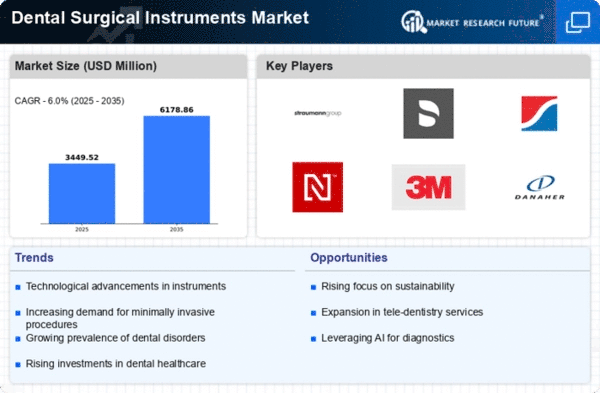
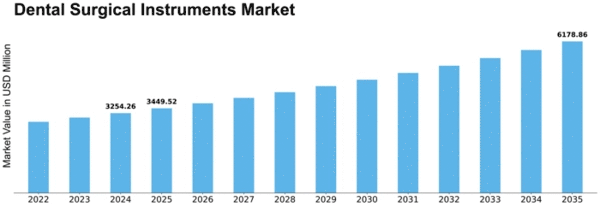
As per MRFR analysis, the Dental Surgical Instruments Market was estimated at 3254.26 USD Million in 2024. The Dental Surgical Instruments industry is projected to grow from 3449.58 USD Million in 2025 to 6178.86 USD Million by 2035, exhibiting a compound annual growth rate (CAGR) of 6.0% during the forecast period 2025 - 2035.

Key Market Trends & Highlights

The Dental Surgical Instruments Market is experiencing robust growth driven by technological advancements and increasing demand for oral health solutions.

  • North America remains the largest market for dental surgical instruments, driven by advanced healthcare infrastructure and high dental expenditure.
  • The Asia-Pacific region is emerging as the fastest-growing market, fueled by rising disposable incomes and increasing awareness of oral health.
  • Oral surgery continues to dominate the market, while implantology is rapidly gaining traction as a key growth segment.
  • Technological advancements and the rising focus on minimally invasive techniques are major drivers propelling market expansion.

Market Size & Forecast

2024 Market Size 3254.26 (USD Million)
2035 Market Size 6178.86 (USD Million)
CAGR (2025 - 2035) 6.0%
Largest Regional Market Share in 2024 North America

Major Players

Straumann (CH), Dentsply Sirona (US), Henry Schein (US), Nobel Biocare (CH), 3M (US), Danaher (US), Kavo Kerr (DE), Mizzy (JP), A-dec (US)

Market Trends

The Dental Surgical Instruments Market is currently experiencing a dynamic evolution, driven by advancements in technology and increasing demand for minimally invasive procedures. Innovations in materials and design are enhancing the functionality and precision of surgical instruments, which, in turn, is likely to improve patient outcomes. Furthermore, the growing emphasis on oral health awareness among The Dental Surgical Instruments forward. As dental professionals seek to adopt the latest tools and techniques, the market is poised for substantial growth. In addition, the rising prevalence of dental disorders and the expanding geriatric population are contributing to the heightened demand for surgical instruments. The integration of digital technologies, such as computer-aided design and manufacturing, is also transforming the landscape of the Dental Surgical Instruments Market. This shift not only streamlines production processes but also allows for customization, catering to the specific needs of dental practitioners. Overall, the market seems to be on a trajectory of continuous improvement and innovation, reflecting the evolving nature of dental care practices.

Technological Advancements

The integration of cutting-edge technologies in the Dental Surgical Instruments Market is reshaping the landscape. Innovations such as laser-assisted tools and robotic systems are enhancing precision and efficiency during procedures. These advancements not only improve surgical outcomes but also reduce recovery times for patients.

Minimally Invasive Techniques

There is a noticeable shift towards minimally invasive surgical techniques within the Dental Surgical Instruments Market. This trend is driven by patient preferences for less traumatic procedures, which often result in quicker recovery and reduced discomfort. As a result, instruments designed for such techniques are gaining prominence.

Increased Focus on Oral Health

The growing awareness of oral health and its impact on overall well-being is influencing the Dental Surgical Instruments Market. As more individuals prioritize dental care, the demand for advanced surgical instruments is likely to rise. This trend reflects a broader societal shift towards preventive healthcare and regular dental check-ups.

Dental Surgical Instruments Market Market Drivers

Growing Dental Tourism

The Global Dental Surgical Instruments Market Industry benefits from the burgeoning dental tourism sector, where patients seek affordable and high-quality dental care abroad. Countries such as Mexico, Costa Rica, and Thailand have emerged as popular destinations for dental procedures, attracting international patients. This trend is fueled by the cost-effectiveness of treatments compared to developed nations, alongside the availability of advanced surgical instruments. As dental tourism continues to expand, it creates a demand for a diverse range of dental surgical instruments, thereby driving market growth. The influx of patients seeking dental care abroad is likely to bolster the industry further.

Market Growth Projections

The Global Dental Surgical Instruments Market Industry is projected to experience a compound annual growth rate (CAGR) of 4.01% from 2025 to 2035, indicating a steady upward trend. This growth is driven by various factors, including technological advancements, increasing dental procedures, and a rising geriatric population. The market is expected to evolve with innovations in surgical instruments, enhancing their functionality and efficiency. As the industry adapts to changing consumer needs and preferences, the anticipated market size of 9 USD Billion by 2035 reflects the potential for sustained growth and development in the dental surgical instruments sector.

Rising Geriatric Population

The Global Dental Surgical Instruments Market Industry is significantly influenced by the increasing geriatric population, which is more susceptible to dental issues. As individuals age, they often experience a higher incidence of dental diseases, necessitating surgical interventions. The World Health Organization projects that by 2035, the global population aged 60 years and older will reach 1.4 billion, further amplifying the demand for dental surgeries. This demographic shift compels dental practitioners to invest in advanced surgical instruments to cater to the specific needs of older patients. Consequently, the market is poised for growth, with an expected value of 9 USD Billion by 2035.

Government Initiatives and Regulations

Government initiatives and regulations significantly impact the Global Dental Surgical Instruments Market Industry, as they promote oral health awareness and accessibility to dental care. Various health organizations and governments are implementing programs aimed at improving dental health standards and encouraging preventive care. These initiatives often include funding for dental education and subsidizing dental procedures, which can lead to increased demand for surgical instruments. Furthermore, stringent regulations regarding the quality and safety of dental instruments ensure that manufacturers maintain high standards, fostering consumer trust. Such supportive measures are likely to enhance market growth and stability.

Increasing Demand for Dental Procedures

The Global Dental Surgical Instruments Market Industry experiences a notable surge in demand for dental procedures, driven by rising awareness of oral health and aesthetics. As populations become more health-conscious, the need for surgical interventions, including implants and orthodontics, increases. This trend is reflected in the projected market size, which is anticipated to reach 5.84 USD Billion in 2024. The growing prevalence of dental diseases, coupled with advancements in surgical techniques, propels the market forward, indicating a robust growth trajectory. As a result, manufacturers are likely to innovate and expand their product offerings to meet this rising demand.

Technological Advancements in Dental Instruments

Technological innovations play a pivotal role in shaping the Global Dental Surgical Instruments Market Industry. The introduction of advanced materials, digital imaging, and minimally invasive surgical techniques enhances the efficiency and effectiveness of dental procedures. For instance, the integration of computer-aided design and manufacturing (CAD/CAM) systems has revolutionized the production of dental prosthetics, improving precision and patient outcomes. These advancements not only streamline surgical processes but also contribute to patient satisfaction, thereby driving market growth. As technology continues to evolve, the market is expected to witness further enhancements, fostering a competitive landscape among manufacturers..webp

Market Segment Insights

By Application: Oral Surgery (Largest) vs. Implantology (Fastest-Growing)

In the Dental Surgical Instruments Market, the application segment showcases a diverse landscape with Oral Surgery holding a considerable market share, driven by the prevalence of various dental infections and the aging population. Periodontics, Orthodontics, and Endodontics also represent significant portions of the market, reflecting the growing demand for comprehensive dental care. While Oral Surgery remains predominant, the Implantology segment is emerging rapidly, catering to a rising consumer inclination towards dental implants and restoration procedures.

Oral Surgery (Dominant) vs. Implantology (Emerging)

Oral Surgery stands as the dominant player in the application segment, emphasizing procedures for extraction, jaw surgeries, and tissue management. This segment benefits from advanced surgical instruments enhancing precision and efficacy, catering to complex dental treatments. Conversely, Implantology surfaces as an emerging market, driven by advancements in implant technologies and the increasing acceptance of dental implants as a viable solution for tooth loss. The growing awareness and capabilities in surgical techniques further invigorate this sub-segment, positioning it for notable growth as patients increasingly opt for permanent dental solutions.

By Product Type: Scalpels (Largest) vs. Forceps (Fastest-Growing)

The Dental Surgical Instruments Market shows a diverse product type segmentation, with scalpels commanding the largest market share due to their fundamental role in dental procedures. The reliable performance and precision offered by scalpels contribute significantly to their widespread usage across various surgical applications. In contrast, forceps are rapidly gaining momentum in the market, driven by the increasing demand for minimally invasive procedures and advancements in ergonomic designs catered to improve handling and control during surgery.

Scalpels (Dominant) vs. Needles (Emerging)

Scalpels remain the dominant force in the Dental Surgical Instruments Market, renowned for their precision and effectiveness in various surgical procedures. This category encompasses a variety of blade types and designs tailored for specific dental applications, ensuring optimal outcomes for both practitioners and patients. On the other hand, needles are emerging as key players, particularly in anesthesia delivery and suturing tasks. The evolution of needle technology, including safety features and design enhancements, has positioned needles as essential instruments, reflecting the industry's efforts to improve patient safety and procedural efficiency.

By End Use: Dental Clinics (Largest) vs. Hospitals (Fastest-Growing)

<p>The Dental Surgical Instruments Market demonstrates a diverse distribution among its end-use segments. Dental clinics hold the largest share, as they are the primary settings for routine dental procedures and surgeries, driving high demand for surgical instruments. Hospitals follow closely, serving as critical points for complex dental surgeries, but their market share is growing rapidly as advancements in dental care become integrated into general healthcare practices. The growth trends within this segment are influenced by increasing awareness around oral health and advancements in dental technologies. Dental clinics are consistently upgrading their instruments to provide better care, while hospitals are expanding their dental departments. Research laboratories and academic institutions also play a role, primarily in innovation and training, but their impact on market growth remains relatively modest compared to clinics and hospitals.</p>

<p>Dental Clinics (Dominant) vs. Hospitals (Emerging)</p>

<p>Dental clinics dominate the Dental Surgical Instruments Market due to their essential role in providing routine care and specialized dental surgeries. These clinics are equipped with a wide array of surgical instruments tailored for various dental conditions, leading to higher patient turnover and consistent demand for new products. Their focus on enhancing patient experiences and outcomes drives continuous investment in advanced surgical tools. In contrast, hospitals, while currently an emerging segment, are rapidly expanding their dental services, especially with increasing integration of dental care into overall medical treatment paradigms. This shift reflects a broader trend of recognizing oral health as integral to general health, which is likely to bolster hospitals' market positioning in the coming years.</p>

Get more detailed insights about Dental Surgical Instruments Market Research Report - Forecast till 2035

Regional Insights

North America : Market Leader in Innovation

North America is poised to maintain its leadership in the Dental Surgical Instruments Market, holding a significant market share of $1625.0M in 2024. The region's growth is driven by increasing dental procedures, technological advancements, and a robust healthcare infrastructure. Regulatory support and rising awareness about oral health further catalyze demand, making it a prime market for dental innovations. The competitive landscape is characterized by key players such as Dentsply Sirona, Henry Schein, and 3M, which are at the forefront of product development and distribution. The U.S. remains the largest contributor, supported by a high prevalence of dental issues and a strong emphasis on preventive care. This environment fosters continuous investment in research and development, ensuring that North America remains a hub for cutting-edge dental solutions.

Europe : Emerging Market with Growth Potential

Europe's Dental Surgical Instruments Market is valued at $975.0M, reflecting a growing demand driven by an aging population and increasing dental health awareness. Regulatory frameworks in countries like Germany and France support innovation and quality standards, enhancing market growth. The rise in dental tourism and cosmetic dentistry also contributes to the region's expanding market share. Leading countries such as Germany, France, and the UK dominate the landscape, with key players like Kavo Kerr and Nobel Biocare driving competition. The presence of established manufacturers and a focus on advanced technologies position Europe as a significant player in the global market. The region's commitment to improving dental care standards ensures sustained growth and innovation in dental surgical instruments.

Asia-Pacific : Rapidly Growing Market Segment

The Asia-Pacific region, with a market size of $550.0M, is witnessing rapid growth in the Dental Surgical Instruments Market. Factors such as rising disposable incomes, urbanization, and increased awareness of dental health are driving demand. Government initiatives aimed at improving healthcare access and quality further bolster market expansion, making it a key area for investment and development. Countries like Japan, China, and India are leading the charge, with a growing number of dental clinics and a surge in dental procedures. Key players such as Mizzy are capitalizing on this trend, enhancing their market presence through innovative product offerings. The competitive landscape is evolving, with both local and international companies vying for market share, indicating a dynamic and promising future for dental surgical instruments in this region.

Middle East and Africa : Emerging Market with Challenges

The Middle East and Africa region, valued at $104.26M, is gradually emerging in the Dental Surgical Instruments Market. Growth is driven by increasing healthcare investments, rising dental awareness, and a growing population. However, challenges such as economic disparities and varying healthcare standards across countries can impact market growth. Regulatory bodies are working to improve standards, which is expected to enhance market conditions in the future. Countries like South Africa and the UAE are leading the market, with a growing number of dental professionals and clinics. The presence of international players is increasing, as companies seek to tap into the region's potential. The competitive landscape is becoming more dynamic, with local manufacturers also entering the market, indicating a shift towards a more robust dental care environment.

Key Players and Competitive Insights

The Dental Surgical Instruments Market is characterized by a dynamic competitive landscape, driven by technological advancements, increasing demand for minimally invasive procedures, and a growing emphasis on patient-centric care. Key players such as Dentsply Sirona (US), Straumann (CH), and Danaher (US) are strategically positioned to leverage these trends. Dentsply Sirona (US) focuses on innovation through its extensive R&D investments, aiming to enhance product offerings and improve surgical outcomes. Meanwhile, Straumann (CH) emphasizes partnerships and acquisitions to expand its portfolio and market reach, particularly in emerging markets. Danaher (US) adopts a strategy centered on digital transformation, integrating advanced technologies into its product lines to streamline operations and enhance customer engagement. Collectively, these strategies contribute to a competitive environment that prioritizes innovation and responsiveness to market needs.In terms of business tactics, companies are increasingly localizing manufacturing to reduce lead times and optimize supply chains. This approach not only enhances operational efficiency but also allows for better alignment with regional market demands. The market structure appears moderately fragmented, with several key players exerting influence while also facing competition from smaller, specialized firms. The collective actions of these major companies shape a landscape where agility and adaptability are paramount.

In November Dentsply Sirona (US) announced the launch of a new line of digital surgical instruments designed to enhance precision in dental procedures. This strategic move underscores the company's commitment to innovation and positions it to capture a larger share of the growing market for digital solutions in dentistry. The introduction of these instruments is likely to improve surgical outcomes and streamline workflows, thereby reinforcing Dentsply Sirona's competitive edge.

In October Straumann (CH) completed the acquisition of a leading dental technology firm, which is expected to bolster its capabilities in digital dentistry. This acquisition not only expands Straumann's product offerings but also enhances its technological expertise, allowing the company to better serve its global customer base. The strategic importance of this move lies in its potential to accelerate growth in a rapidly evolving market, where digital solutions are becoming increasingly critical.

In September Danaher (US) unveiled a new AI-driven analytics platform aimed at optimizing dental practice management. This initiative reflects Danaher's focus on integrating advanced technologies into its offerings, thereby enhancing operational efficiency for dental practitioners. The strategic significance of this development is profound, as it positions Danaher at the forefront of the digital transformation trend within the dental sector, potentially reshaping how practices operate.

As of December current competitive trends in the Dental Surgical Instruments Market are heavily influenced by digitalization, sustainability, and AI integration. Strategic alliances among key players are fostering innovation and enhancing product development capabilities. Looking ahead, competitive differentiation is likely to evolve from traditional price-based competition to a focus on technological innovation, supply chain reliability, and sustainable practices. This shift indicates a broader transformation in the market, where companies that prioritize these elements may gain a substantial advantage.

Key Companies in the Dental Surgical Instruments Market include

Industry Developments

In recent developments within the Dental Surgical Instruments Market, companies like Dentsply Sirona has been making significant strides in enhancing their product offerings and expanding their market presence. As of September 2023, NSK announced an increased focus on digital dentistry, introducing advanced imaging technologies that align with current dental practices. Similarly, Ivoclar Vivadent has strengthened its portfolio by innovating materials suitable for tooth restoration, responding to the growing demand for aesthetic dentistry solutions.

In the past few years, the market has seen a general trend toward consolidation, with major players like Henry Schein and KaVo Kerr actively seeking partnerships to remain competitive. Reports indicate a consistent growth trajectory for the market, driven by technological advancements and an increasing emphasis on preventive dental care. Additionally, certain regions have observed an uptick in dental procedures due to a rise in awareness regarding oral health, impacting demand for surgical instruments globally.

Future Outlook

Dental Surgical Instruments Market Future Outlook

The Dental Surgical Instruments Market is projected to grow at a 6.0% CAGR from 2025 to 2035, driven by technological advancements, increasing dental procedures, and rising awareness of oral health.

New opportunities lie in:

  • Expansion into emerging markets through localized manufacturing facilities.
  • Development of smart dental instruments integrated with AI for enhanced precision.
  • Partnerships with dental schools for training programs using advanced surgical tools.

By 2035, the market is expected to achieve robust growth, solidifying its position as a key sector in healthcare.

Market Segmentation

Dental Surgical Instruments Market End Use Outlook

  • Hospitals
  • Dental Clinics
  • Research Laboratories
  • Academic Institutions

Dental Surgical Instruments Market Application Outlook

  • Oral Surgery
  • Periodontics
  • Orthodontics
  • Endodontics
  • Implantology

Dental Surgical Instruments Market Product Type Outlook

  • Scalpels
  • Forceps
  • Scissors
  • Needles
  • Elevators

Report Scope

MARKET SIZE 2024 3254.26(USD Million)
MARKET SIZE 2025 3449.58(USD Million)
MARKET SIZE 2035 6178.86(USD Million)
COMPOUND ANNUAL GROWTH RATE (CAGR) 6.0% (2025 - 2035)
REPORT COVERAGE Revenue Forecast, Competitive Landscape, Growth Factors, and Trends
BASE YEAR 2024
Market Forecast Period 2025 - 2035
Historical Data 2019 - 2024
Market Forecast Units USD Million
Key Companies Profiled Straumann (CH), Dentsply Sirona (US), Henry Schein (US), Nobel Biocare (CH), 3M (US), Danaher (US), Kavo Kerr (DE), Mizzy (JP), A-dec (US)
Segments Covered Application, Product Type, End Use
Key Market Opportunities Integration of advanced digital technologies enhances precision and efficiency in the Dental Surgical Instruments Market.
Key Market Dynamics Technological advancements and regulatory changes drive innovation and competition in the Dental Surgical Instruments Market.
Countries Covered North America, Europe, APAC, South America, MEA

FAQs

What is the current valuation of the Dental Surgical Instruments Market?

<p>As of 2024, the market valuation stands at 3254.26 USD Million.</p>

What is the projected market size for the Dental Surgical Instruments Market by 2035?

<p>The market is expected to reach a valuation of 6178.86 USD Million by 2035.</p>

What is the expected CAGR for the Dental Surgical Instruments Market during the forecast period 2025 - 2035?

<p>The market is anticipated to grow at a CAGR of 6.0% from 2025 to 2035.</p>

Which application segment holds the highest market value in 2024?

<p>In 2024, the Implantology segment had the highest market value at 913.26 USD Million.</p>

What are the projected values for the Oral Surgery segment by 2035?

<p>The Oral Surgery segment is projected to reach 1230.0 USD Million by 2035.</p>

Which product type is expected to show significant growth in the Dental Surgical Instruments Market?

<p>Scalpels are expected to show significant growth, with a projected value of 1200.0 USD Million by 2035.</p>

What is the market value for Dental Clinics in 2024?

<p>In 2024, the market value for Dental Clinics was 1300.0 USD Million.</p>

How does the market value for Research Laboratories compare to that of Academic Institutions in 2024?

<p>In 2024, Research Laboratories had a market value of 600.0 USD Million, while Academic Institutions had a value of 704.26 USD Million.</p>

Which key players are leading the Dental Surgical Instruments Market?

<p>Key players include Straumann, Dentsply Sirona, Henry Schein, and Danaher, among others.</p>

What is the projected market value for Forceps by 2035?

<p>The market value for Forceps is projected to reach 1100.0 USD Million by 2035.</p>

  1. SECTION I: EXECUTIVE SUMMARY AND KEY HIGHLIGHTS
    1. | 1.1 EXECUTIVE SUMMARY
    2. | | 1.1.1 Market Overview
    3. | | 1.1.2 Key Findings
    4. | | 1.1.3 Market Segmentation
    5. | | 1.1.4 Competitive Landscape
    6. | | 1.1.5 Challenges and Opportunities
    7. | | 1.1.6 Future Outlook
  2. SECTION II: SCOPING, METHODOLOGY AND MARKET STRUCTURE
    1. | 2.1 MARKET INTRODUCTION
    2. | | 2.1.1 Definition
    3. | | 2.1.2 Scope of the study
    4. | | | 2.1.2.1 Research Objective
    5. | | | 2.1.2.2 Assumption
    6. | | | 2.1.2.3 Limitations
    7. | 2.2 RESEARCH METHODOLOGY
    8. | | 2.2.1 Overview
    9. | | 2.2.2 Data Mining
    10. | | 2.2.3 Secondary Research
    11. | | 2.2.4 Primary Research
    12. | | | 2.2.4.1 Primary Interviews and Information Gathering Process
    13. | | | 2.2.4.2 Breakdown of Primary Respondents
    14. | | 2.2.5 Forecasting Model
    15. | | 2.2.6 Market Size Estimation
    16. | | | 2.2.6.1 Bottom-Up Approach
    17. | | | 2.2.6.2 Top-Down Approach
    18. | | 2.2.7 Data Triangulation
    19. | | 2.2.8 Validation
  3. SECTION III: QUALITATIVE ANALYSIS
    1. | 3.1 MARKET DYNAMICS
    2. | | 3.1.1 Overview
    3. | | 3.1.2 Drivers
    4. | | 3.1.3 Restraints
    5. | | 3.1.4 Opportunities
    6. | 3.2 MARKET FACTOR ANALYSIS
    7. | | 3.2.1 Value chain Analysis
    8. | | 3.2.2 Porter's Five Forces Analysis
    9. | | | 3.2.2.1 Bargaining Power of Suppliers
    10. | | | 3.2.2.2 Bargaining Power of Buyers
    11. | | | 3.2.2.3 Threat of New Entrants
    12. | | | 3.2.2.4 Threat of Substitutes
    13. | | | 3.2.2.5 Intensity of Rivalry
    14. | | 3.2.3 COVID-19 Impact Analysis
    15. | | | 3.2.3.1 Market Impact Analysis
    16. | | | 3.2.3.2 Regional Impact
    17. | | | 3.2.3.3 Opportunity and Threat Analysis
  4. SECTION IV: QUANTITATIVE ANALYSIS
    1. | 4.1 Healthcare, BY Application (USD Million)
    2. | | 4.1.1 Oral Surgery
    3. | | 4.1.2 Periodontics
    4. | | 4.1.3 Orthodontics
    5. | | 4.1.4 Endodontics
    6. | | 4.1.5 Implantology
    7. | 4.2 Healthcare, BY Product Type (USD Million)
    8. | | 4.2.1 Scalpels
    9. | | 4.2.2 Forceps
    10. | | 4.2.3 Scissors
    11. | | 4.2.4 Needles
    12. | | 4.2.5 Suction Devices
    13. | 4.3 Healthcare, BY End Use (USD Million)
    14. | | 4.3.1 Hospitals
    15. | | 4.3.2 Dental Clinics
    16. | | 4.3.3 Research Laboratories
    17. | | 4.3.4 Academic Institutions
    18. | 4.4 Healthcare, BY Region (USD Million)
    19. | | 4.4.1 North America
    20. | | | 4.4.1.1 US
    21. | | | 4.4.1.2 Canada
    22. | | 4.4.2 Europe
    23. | | | 4.4.2.1 Germany
    24. | | | 4.4.2.2 UK
    25. | | | 4.4.2.3 France
    26. | | | 4.4.2.4 Russia
    27. | | | 4.4.2.5 Italy
    28. | | | 4.4.2.6 Spain
    29. | | | 4.4.2.7 Rest of Europe
    30. | | 4.4.3 APAC
    31. | | | 4.4.3.1 China
    32. | | | 4.4.3.2 India
    33. | | | 4.4.3.3 Japan
    34. | | | 4.4.3.4 South Korea
    35. | | | 4.4.3.5 Malaysia
    36. | | | 4.4.3.6 Thailand
    37. | | | 4.4.3.7 Indonesia
    38. | | | 4.4.3.8 Rest of APAC
    39. | | 4.4.4 South America
    40. | | | 4.4.4.1 Brazil
    41. | | | 4.4.4.2 Mexico
    42. | | | 4.4.4.3 Argentina
    43. | | | 4.4.4.4 Rest of South America
    44. | | 4.4.5 MEA
    45. | | | 4.4.5.1 GCC Countries
    46. | | | 4.4.5.2 South Africa
    47. | | | 4.4.5.3 Rest of MEA
  5. SECTION V: COMPETITIVE ANALYSIS
    1. | 5.1 Competitive Landscape
    2. | | 5.1.1 Overview
    3. | | 5.1.2 Competitive Analysis
    4. | | 5.1.3 Market share Analysis
    5. | | 5.1.4 Major Growth Strategy in the Healthcare
    6. | | 5.1.5 Competitive Benchmarking
    7. | | 5.1.6 Leading Players in Terms of Number of Developments in the Healthcare
    8. | | 5.1.7 Key developments and growth strategies
    9. | | | 5.1.7.1 New Product Launch/Service Deployment
    10. | | | 5.1.7.2 Merger & Acquisitions
    11. | | | 5.1.7.3 Joint Ventures
    12. | | 5.1.8 Major Players Financial Matrix
    13. | | | 5.1.8.1 Sales and Operating Income
    14. | | | 5.1.8.2 Major Players R&D Expenditure. 2023
    15. | 5.2 Company Profiles
    16. | | 5.2.1 Straumann (CH)
    17. | | | 5.2.1.1 Financial Overview
    18. | | | 5.2.1.2 Products Offered
    19. | | | 5.2.1.3 Key Developments
    20. | | | 5.2.1.4 SWOT Analysis
    21. | | | 5.2.1.5 Key Strategies
    22. | | 5.2.2 Dentsply Sirona (US)
    23. | | | 5.2.2.1 Financial Overview
    24. | | | 5.2.2.2 Products Offered
    25. | | | 5.2.2.3 Key Developments
    26. | | | 5.2.2.4 SWOT Analysis
    27. | | | 5.2.2.5 Key Strategies
    28. | | 5.2.3 Henry Schein (US)
    29. | | | 5.2.3.1 Financial Overview
    30. | | | 5.2.3.2 Products Offered
    31. | | | 5.2.3.3 Key Developments
    32. | | | 5.2.3.4 SWOT Analysis
    33. | | | 5.2.3.5 Key Strategies
    34. | | 5.2.4 Danaher (US)
    35. | | | 5.2.4.1 Financial Overview
    36. | | | 5.2.4.2 Products Offered
    37. | | | 5.2.4.3 Key Developments
    38. | | | 5.2.4.4 SWOT Analysis
    39. | | | 5.2.4.5 Key Strategies
    40. | | 5.2.5 3M (US)
    41. | | | 5.2.5.1 Financial Overview
    42. | | | 5.2.5.2 Products Offered
    43. | | | 5.2.5.3 Key Developments
    44. | | | 5.2.5.4 SWOT Analysis
    45. | | | 5.2.5.5 Key Strategies
    46. | | 5.2.6 Kavo Kerr (DE)
    47. | | | 5.2.6.1 Financial Overview
    48. | | | 5.2.6.2 Products Offered
    49. | | | 5.2.6.3 Key Developments
    50. | | | 5.2.6.4 SWOT Analysis
    51. | | | 5.2.6.5 Key Strategies
    52. | | 5.2.7 Nobel Biocare (CH)
    53. | | | 5.2.7.1 Financial Overview
    54. | | | 5.2.7.2 Products Offered
    55. | | | 5.2.7.3 Key Developments
    56. | | | 5.2.7.4 SWOT Analysis
    57. | | | 5.2.7.5 Key Strategies
    58. | | 5.2.8 Zimmer Biomet (US)
    59. | | | 5.2.8.1 Financial Overview
    60. | | | 5.2.8.2 Products Offered
    61. | | | 5.2.8.3 Key Developments
    62. | | | 5.2.8.4 SWOT Analysis
    63. | | | 5.2.8.5 Key Strategies
    64. | | 5.2.9 Mizzy (JP)
    65. | | | 5.2.9.1 Financial Overview
    66. | | | 5.2.9.2 Products Offered
    67. | | | 5.2.9.3 Key Developments
    68. | | | 5.2.9.4 SWOT Analysis
    69. | | | 5.2.9.5 Key Strategies
    70. | 5.3 Appendix
    71. | | 5.3.1 References
    72. | | 5.3.2 Related Reports
  6. LIST OF FIGURES
    1. | 6.1 MARKET SYNOPSIS
    2. | 6.2 NORTH AMERICA MARKET ANALYSIS
    3. | 6.3 US MARKET ANALYSIS BY APPLICATION
    4. | 6.4 US MARKET ANALYSIS BY PRODUCT TYPE
    5. | 6.5 US MARKET ANALYSIS BY END USE
    6. | 6.6 CANADA MARKET ANALYSIS BY APPLICATION
    7. | 6.7 CANADA MARKET ANALYSIS BY PRODUCT TYPE
    8. | 6.8 CANADA MARKET ANALYSIS BY END USE
    9. | 6.9 EUROPE MARKET ANALYSIS
    10. | 6.10 GERMANY MARKET ANALYSIS BY APPLICATION
    11. | 6.11 GERMANY MARKET ANALYSIS BY PRODUCT TYPE
    12. | 6.12 GERMANY MARKET ANALYSIS BY END USE
    13. | 6.13 UK MARKET ANALYSIS BY APPLICATION
    14. | 6.14 UK MARKET ANALYSIS BY PRODUCT TYPE
    15. | 6.15 UK MARKET ANALYSIS BY END USE
    16. | 6.16 FRANCE MARKET ANALYSIS BY APPLICATION
    17. | 6.17 FRANCE MARKET ANALYSIS BY PRODUCT TYPE
    18. | 6.18 FRANCE MARKET ANALYSIS BY END USE
    19. | 6.19 RUSSIA MARKET ANALYSIS BY APPLICATION
    20. | 6.20 RUSSIA MARKET ANALYSIS BY PRODUCT TYPE
    21. | 6.21 RUSSIA MARKET ANALYSIS BY END USE
    22. | 6.22 ITALY MARKET ANALYSIS BY APPLICATION
    23. | 6.23 ITALY MARKET ANALYSIS BY PRODUCT TYPE
    24. | 6.24 ITALY MARKET ANALYSIS BY END USE
    25. | 6.25 SPAIN MARKET ANALYSIS BY APPLICATION
    26. | 6.26 SPAIN MARKET ANALYSIS BY PRODUCT TYPE
    27. | 6.27 SPAIN MARKET ANALYSIS BY END USE
    28. | 6.28 REST OF EUROPE MARKET ANALYSIS BY APPLICATION
    29. | 6.29 REST OF EUROPE MARKET ANALYSIS BY PRODUCT TYPE
    30. | 6.30 REST OF EUROPE MARKET ANALYSIS BY END USE
    31. | 6.31 APAC MARKET ANALYSIS
    32. | 6.32 CHINA MARKET ANALYSIS BY APPLICATION
    33. | 6.33 CHINA MARKET ANALYSIS BY PRODUCT TYPE
    34. | 6.34 CHINA MARKET ANALYSIS BY END USE
    35. | 6.35 INDIA MARKET ANALYSIS BY APPLICATION
    36. | 6.36 INDIA MARKET ANALYSIS BY PRODUCT TYPE
    37. | 6.37 INDIA MARKET ANALYSIS BY END USE
    38. | 6.38 JAPAN MARKET ANALYSIS BY APPLICATION
    39. | 6.39 JAPAN MARKET ANALYSIS BY PRODUCT TYPE
    40. | 6.40 JAPAN MARKET ANALYSIS BY END USE
    41. | 6.41 SOUTH KOREA MARKET ANALYSIS BY APPLICATION
    42. | 6.42 SOUTH KOREA MARKET ANALYSIS BY PRODUCT TYPE
    43. | 6.43 SOUTH KOREA MARKET ANALYSIS BY END USE
    44. | 6.44 MALAYSIA MARKET ANALYSIS BY APPLICATION
    45. | 6.45 MALAYSIA MARKET ANALYSIS BY PRODUCT TYPE
    46. | 6.46 MALAYSIA MARKET ANALYSIS BY END USE
    47. | 6.47 THAILAND MARKET ANALYSIS BY APPLICATION
    48. | 6.48 THAILAND MARKET ANALYSIS BY PRODUCT TYPE
    49. | 6.49 THAILAND MARKET ANALYSIS BY END USE
    50. | 6.50 INDONESIA MARKET ANALYSIS BY APPLICATION
    51. | 6.51 INDONESIA MARKET ANALYSIS BY PRODUCT TYPE
    52. | 6.52 INDONESIA MARKET ANALYSIS BY END USE
    53. | 6.53 REST OF APAC MARKET ANALYSIS BY APPLICATION
    54. | 6.54 REST OF APAC MARKET ANALYSIS BY PRODUCT TYPE
    55. | 6.55 REST OF APAC MARKET ANALYSIS BY END USE
    56. | 6.56 SOUTH AMERICA MARKET ANALYSIS
    57. | 6.57 BRAZIL MARKET ANALYSIS BY APPLICATION
    58. | 6.58 BRAZIL MARKET ANALYSIS BY PRODUCT TYPE
    59. | 6.59 BRAZIL MARKET ANALYSIS BY END USE
    60. | 6.60 MEXICO MARKET ANALYSIS BY APPLICATION
    61. | 6.61 MEXICO MARKET ANALYSIS BY PRODUCT TYPE
    62. | 6.62 MEXICO MARKET ANALYSIS BY END USE
    63. | 6.63 ARGENTINA MARKET ANALYSIS BY APPLICATION
    64. | 6.64 ARGENTINA MARKET ANALYSIS BY PRODUCT TYPE
    65. | 6.65 ARGENTINA MARKET ANALYSIS BY END USE
    66. | 6.66 REST OF SOUTH AMERICA MARKET ANALYSIS BY APPLICATION
    67. | 6.67 REST OF SOUTH AMERICA MARKET ANALYSIS BY PRODUCT TYPE
    68. | 6.68 REST OF SOUTH AMERICA MARKET ANALYSIS BY END USE
    69. | 6.69 MEA MARKET ANALYSIS
    70. | 6.70 GCC COUNTRIES MARKET ANALYSIS BY APPLICATION
    71. | 6.71 GCC COUNTRIES MARKET ANALYSIS BY PRODUCT TYPE
    72. | 6.72 GCC COUNTRIES MARKET ANALYSIS BY END USE
    73. | 6.73 SOUTH AFRICA MARKET ANALYSIS BY APPLICATION
    74. | 6.74 SOUTH AFRICA MARKET ANALYSIS BY PRODUCT TYPE
    75. | 6.75 SOUTH AFRICA MARKET ANALYSIS BY END USE
    76. | 6.76 REST OF MEA MARKET ANALYSIS BY APPLICATION
    77. | 6.77 REST OF MEA MARKET ANALYSIS BY PRODUCT TYPE
    78. | 6.78 REST OF MEA MARKET ANALYSIS BY END USE
    79. | 6.79 KEY BUYING CRITERIA OF HEALTHCARE
    80. | 6.80 RESEARCH PROCESS OF MRFR
    81. | 6.81 DRO ANALYSIS OF HEALTHCARE
    82. | 6.82 DRIVERS IMPACT ANALYSIS: HEALTHCARE
    83. | 6.83 RESTRAINTS IMPACT ANALYSIS: HEALTHCARE
    84. | 6.84 SUPPLY / VALUE CHAIN: HEALTHCARE
    85. | 6.85 HEALTHCARE, BY APPLICATION, 2024 (% SHARE)
    86. | 6.86 HEALTHCARE, BY APPLICATION, 2024 TO 2035 (USD Million)
    87. | 6.87 HEALTHCARE, BY PRODUCT TYPE, 2024 (% SHARE)
    88. | 6.88 HEALTHCARE, BY PRODUCT TYPE, 2024 TO 2035 (USD Million)
    89. | 6.89 HEALTHCARE, BY END USE, 2024 (% SHARE)
    90. | 6.90 HEALTHCARE, BY END USE, 2024 TO 2035 (USD Million)
    91. | 6.91 BENCHMARKING OF MAJOR COMPETITORS
  7. LIST OF TABLES
    1. | 7.1 LIST OF ASSUMPTIONS
    2. | | 7.1.1
    3. | 7.2 North America MARKET SIZE ESTIMATES; FORECAST
    4. | | 7.2.1 BY APPLICATION, 2025-2035 (USD Million)
    5. | | 7.2.2 BY PRODUCT TYPE, 2025-2035 (USD Million)
    6. | | 7.2.3 BY END USE, 2025-2035 (USD Million)
    7. | 7.3 US MARKET SIZE ESTIMATES; FORECAST
    8. | | 7.3.1 BY APPLICATION, 2025-2035 (USD Million)
    9. | | 7.3.2 BY PRODUCT TYPE, 2025-2035 (USD Million)
    10. | | 7.3.3 BY END USE, 2025-2035 (USD Million)
    11. | 7.4 Canada MARKET SIZE ESTIMATES; FORECAST
    12. | | 7.4.1 BY APPLICATION, 2025-2035 (USD Million)
    13. | | 7.4.2 BY PRODUCT TYPE, 2025-2035 (USD Million)
    14. | | 7.4.3 BY END USE, 2025-2035 (USD Million)
    15. | 7.5 Europe MARKET SIZE ESTIMATES; FORECAST
    16. | | 7.5.1 BY APPLICATION, 2025-2035 (USD Million)
    17. | | 7.5.2 BY PRODUCT TYPE, 2025-2035 (USD Million)
    18. | | 7.5.3 BY END USE, 2025-2035 (USD Million)
    19. | 7.6 Germany MARKET SIZE ESTIMATES; FORECAST
    20. | | 7.6.1 BY APPLICATION, 2025-2035 (USD Million)
    21. | | 7.6.2 BY PRODUCT TYPE, 2025-2035 (USD Million)
    22. | | 7.6.3 BY END USE, 2025-2035 (USD Million)
    23. | 7.7 UK MARKET SIZE ESTIMATES; FORECAST
    24. | | 7.7.1 BY APPLICATION, 2025-2035 (USD Million)
    25. | | 7.7.2 BY PRODUCT TYPE, 2025-2035 (USD Million)
    26. | | 7.7.3 BY END USE, 2025-2035 (USD Million)
    27. | 7.8 France MARKET SIZE ESTIMATES; FORECAST
    28. | | 7.8.1 BY APPLICATION, 2025-2035 (USD Million)
    29. | | 7.8.2 BY PRODUCT TYPE, 2025-2035 (USD Million)
    30. | | 7.8.3 BY END USE, 2025-2035 (USD Million)
    31. | 7.9 Russia MARKET SIZE ESTIMATES; FORECAST
    32. | | 7.9.1 BY APPLICATION, 2025-2035 (USD Million)
    33. | | 7.9.2 BY PRODUCT TYPE, 2025-2035 (USD Million)
    34. | | 7.9.3 BY END USE, 2025-2035 (USD Million)
    35. | 7.10 Italy MARKET SIZE ESTIMATES; FORECAST
    36. | | 7.10.1 BY APPLICATION, 2025-2035 (USD Million)
    37. | | 7.10.2 BY PRODUCT TYPE, 2025-2035 (USD Million)
    38. | | 7.10.3 BY END USE, 2025-2035 (USD Million)
    39. | 7.11 Spain MARKET SIZE ESTIMATES; FORECAST
    40. | | 7.11.1 BY APPLICATION, 2025-2035 (USD Million)
    41. | | 7.11.2 BY PRODUCT TYPE, 2025-2035 (USD Million)
    42. | | 7.11.3 BY END USE, 2025-2035 (USD Million)
    43. | 7.12 Rest of Europe MARKET SIZE ESTIMATES; FORECAST
    44. | | 7.12.1 BY APPLICATION, 2025-2035 (USD Million)
    45. | | 7.12.2 BY PRODUCT TYPE, 2025-2035 (USD Million)
    46. | | 7.12.3 BY END USE, 2025-2035 (USD Million)
    47. | 7.13 APAC MARKET SIZE ESTIMATES; FORECAST
    48. | | 7.13.1 BY APPLICATION, 2025-2035 (USD Million)
    49. | | 7.13.2 BY PRODUCT TYPE, 2025-2035 (USD Million)
    50. | | 7.13.3 BY END USE, 2025-2035 (USD Million)
    51. | 7.14 China MARKET SIZE ESTIMATES; FORECAST
    52. | | 7.14.1 BY APPLICATION, 2025-2035 (USD Million)
    53. | | 7.14.2 BY PRODUCT TYPE, 2025-2035 (USD Million)
    54. | | 7.14.3 BY END USE, 2025-2035 (USD Million)
    55. | 7.15 India MARKET SIZE ESTIMATES; FORECAST
    56. | | 7.15.1 BY APPLICATION, 2025-2035 (USD Million)
    57. | | 7.15.2 BY PRODUCT TYPE, 2025-2035 (USD Million)
    58. | | 7.15.3 BY END USE, 2025-2035 (USD Million)
    59. | 7.16 Japan MARKET SIZE ESTIMATES; FORECAST
    60. | | 7.16.1 BY APPLICATION, 2025-2035 (USD Million)
    61. | | 7.16.2 BY PRODUCT TYPE, 2025-2035 (USD Million)
    62. | | 7.16.3 BY END USE, 2025-2035 (USD Million)
    63. | 7.17 South Korea MARKET SIZE ESTIMATES; FORECAST
    64. | | 7.17.1 BY APPLICATION, 2025-2035 (USD Million)
    65. | | 7.17.2 BY PRODUCT TYPE, 2025-2035 (USD Million)
    66. | | 7.17.3 BY END USE, 2025-2035 (USD Million)
    67. | 7.18 Malaysia MARKET SIZE ESTIMATES; FORECAST
    68. | | 7.18.1 BY APPLICATION, 2025-2035 (USD Million)
    69. | | 7.18.2 BY PRODUCT TYPE, 2025-2035 (USD Million)
    70. | | 7.18.3 BY END USE, 2025-2035 (USD Million)
    71. | 7.19 Thailand MARKET SIZE ESTIMATES; FORECAST
    72. | | 7.19.1 BY APPLICATION, 2025-2035 (USD Million)
    73. | | 7.19.2 BY PRODUCT TYPE, 2025-2035 (USD Million)
    74. | | 7.19.3 BY END USE, 2025-2035 (USD Million)
    75. | 7.20 Indonesia MARKET SIZE ESTIMATES; FORECAST
    76. | | 7.20.1 BY APPLICATION, 2025-2035 (USD Million)
    77. | | 7.20.2 BY PRODUCT TYPE, 2025-2035 (USD Million)
    78. | | 7.20.3 BY END USE, 2025-2035 (USD Million)
    79. | 7.21 Rest of APAC MARKET SIZE ESTIMATES; FORECAST
    80. | | 7.21.1 BY APPLICATION, 2025-2035 (USD Million)
    81. | | 7.21.2 BY PRODUCT TYPE, 2025-2035 (USD Million)
    82. | | 7.21.3 BY END USE, 2025-2035 (USD Million)
    83. | 7.22 South America MARKET SIZE ESTIMATES; FORECAST
    84. | | 7.22.1 BY APPLICATION, 2025-2035 (USD Million)
    85. | | 7.22.2 BY PRODUCT TYPE, 2025-2035 (USD Million)
    86. | | 7.22.3 BY END USE, 2025-2035 (USD Million)
    87. | 7.23 Brazil MARKET SIZE ESTIMATES; FORECAST
    88. | | 7.23.1 BY APPLICATION, 2025-2035 (USD Million)
    89. | | 7.23.2 BY PRODUCT TYPE, 2025-2035 (USD Million)
    90. | | 7.23.3 BY END USE, 2025-2035 (USD Million)
    91. | 7.24 Mexico MARKET SIZE ESTIMATES; FORECAST
    92. | | 7.24.1 BY APPLICATION, 2025-2035 (USD Million)
    93. | | 7.24.2 BY PRODUCT TYPE, 2025-2035 (USD Million)
    94. | | 7.24.3 BY END USE, 2025-2035 (USD Million)
    95. | 7.25 Argentina MARKET SIZE ESTIMATES; FORECAST
    96. | | 7.25.1 BY APPLICATION, 2025-2035 (USD Million)
    97. | | 7.25.2 BY PRODUCT TYPE, 2025-2035 (USD Million)
    98. | | 7.25.3 BY END USE, 2025-2035 (USD Million)
    99. | 7.26 Rest of South America MARKET SIZE ESTIMATES; FORECAST
    100. | | 7.26.1 BY APPLICATION, 2025-2035 (USD Million)
    101. | | 7.26.2 BY PRODUCT TYPE, 2025-2035 (USD Million)
    102. | | 7.26.3 BY END USE, 2025-2035 (USD Million)
    103. | 7.27 MEA MARKET SIZE ESTIMATES; FORECAST
    104. | | 7.27.1 BY APPLICATION, 2025-2035 (USD Million)
    105. | | 7.27.2 BY PRODUCT TYPE, 2025-2035 (USD Million)
    106. | | 7.27.3 BY END USE, 2025-2035 (USD Million)
    107. | 7.28 GCC Countries MARKET SIZE ESTIMATES; FORECAST
    108. | | 7.28.1 BY APPLICATION, 2025-2035 (USD Million)
    109. | | 7.28.2 BY PRODUCT TYPE, 2025-2035 (USD Million)
    110. | | 7.28.3 BY END USE, 2025-2035 (USD Million)
    111. | 7.29 South Africa MARKET SIZE ESTIMATES; FORECAST
    112. | | 7.29.1 BY APPLICATION, 2025-2035 (USD Million)
    113. | | 7.29.2 BY PRODUCT TYPE, 2025-2035 (USD Million)
    114. | | 7.29.3 BY END USE, 2025-2035 (USD Million)
    115. | 7.30 Rest of MEA MARKET SIZE ESTIMATES; FORECAST
    116. | | 7.30.1 BY APPLICATION, 2025-2035 (USD Million)
    117. | | 7.30.2 BY PRODUCT TYPE, 2025-2035 (USD Million)
    118. | | 7.30.3 BY END USE, 2025-2035 (USD Million)
    119. | 7.31 PRODUCT LAUNCH/PRODUCT DEVELOPMENT/APPROVAL
    120. | | 7.31.1
    121. | 7.32 ACQUISITION/PARTNERSHIP
    122. | | 7.32.1

Healthcare Market Segmentation

Healthcare By Application (USD Million, 2025-2035)

  • Oral Surgery
  • Periodontics
  • Orthodontics
  • Endodontics
  • Implantology

Healthcare By Product Type (USD Million, 2025-2035)

  • Scalpels
  • Forceps
  • Scissors
  • Needles
  • Suction Devices

Healthcare By End Use (USD Million, 2025-2035)

  • Hospitals
  • Dental Clinics
  • Research Laboratories
  • Academic Institutions
Infographic

Free Sample Request

Kindly complete the form below to receive a free sample of this Report

Get Free Sample

Customer Strories

Compare Licence

×
Features License Type
Single User Multiuser License Enterprise User
Price $4,950 $5,950 $7,250
Maximum User Access Limit 1 User Upto 10 Users Unrestricted Access Throughout the Organization
Free Customization
Direct Access to Analyst
Deliverable Format
Platform Access
Discount on Next Purchase 10% 15% 15%
Printable Versions