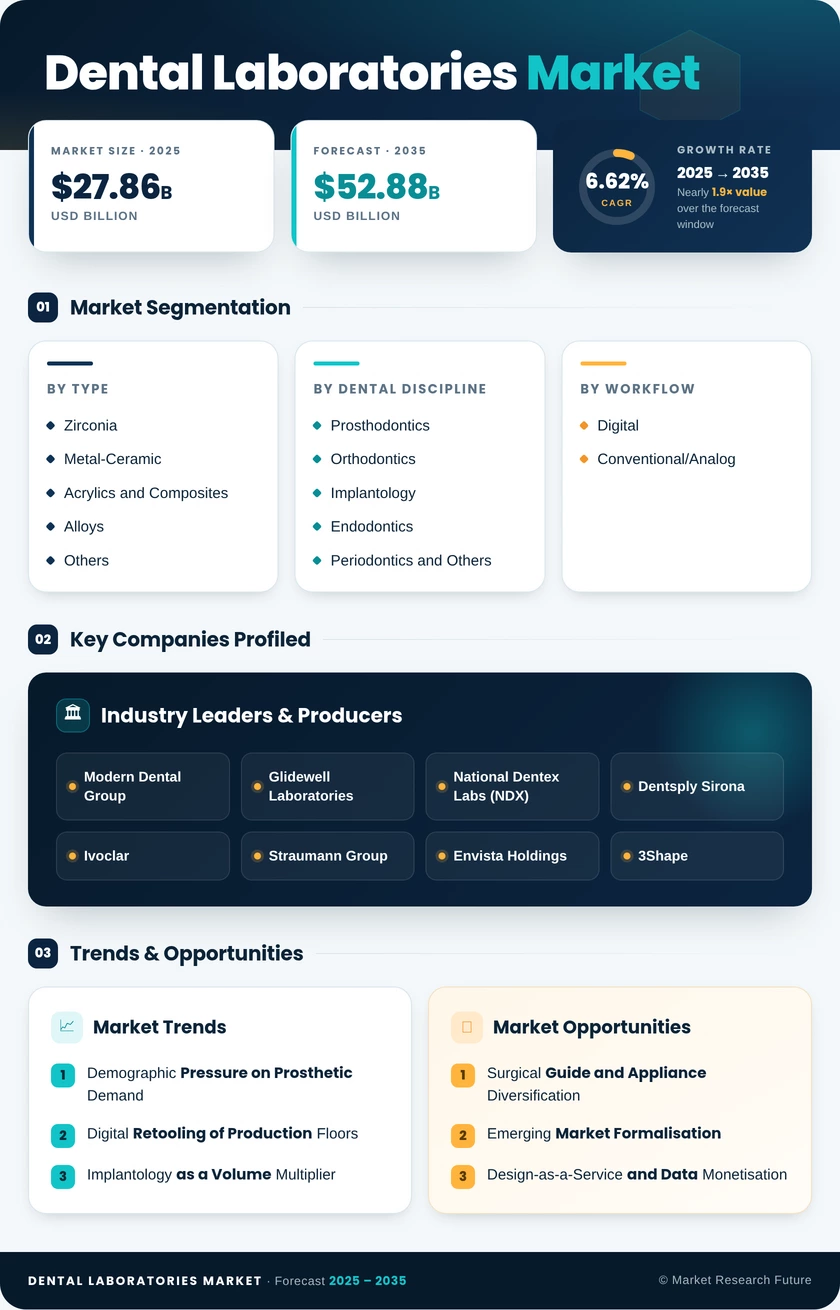
Segmentation Quick Reference
| Dimension | Sub-Segments | Dominant Segment | Fastest Growing Segment |
| Product and Services | Equipment Type (Milling Equipment and More); Consumables and Accessories; Software and Services | Consumables and Accessories | Software and Services |
| Dental Discipline | Prosthodontics; Orthodontics; Implantology; Endodontics; Periodontics and Others | Prosthodontics | Implantology |
| Material Type | Zirconia; Metal-Ceramic; Acrylics and Composites; Alloys; Others | Zirconia | Zirconia |
| Workflow | Digital; Conventional/Analog | Digital | Digital |
| End User | Independent Dental Labs; DSO-Owned and Group Labs; Hospital-Affiliated Labs; Chairside/In-Clinic Labs | Independent Dental Labs | DSO-Owned and Group Labs |
| Geography | North America; Europe; Asia-Pacific; South America; Middle East & Africa | North America | Asia-Pacific |
Market Segmentation Overview
By Product and Services
| Sub-Segment | Key Trend |
| Equipment Type (Milling Equipment and More) | Five-axis units and resin printers replacing casting infrastructure |
| Consumables and Accessories | Shift from precious alloys toward zirconia discs and hybrid ceramics. |
| Software and Services | Move from perpetual licences to per-unit design subscriptions. |
Product mix is drifting steadily from capital equipment toward recurring revenue. Laboratories that completed hardware investment cycles between 2020 and 2024 now spend disproportionately on materials and design software, changing supplier relationships from transactional to contractual.
By Dental Discipline
| Sub-Segment | Key Trend |
| Prosthodontics | Steady volume growth driven by ageing demographics |
| Orthodontics | Partial disintermediation by aligner manufacturers |
| Implantology | Highest revenue per case; expanding on price-reform tailwinds |
| Endodontics | Post-and-core work tied to root canal volumes |
| Periodontics and Others | Splints, guides, and surgical accessories gaining share |
Discipline mix determines margin profile more than scale does. Operations weighted toward implant and full-arch work consistently report gross margins six to ten points above single-unit-dominant peers.
By Material Type
| Sub-Segment | Key Trend |
| Zirconia | Multilayer translucency closing the anterior aesthetic gap |
| Metal-Ceramic | Gradual decline as monolithic alternatives mature |
| Acrylics and Composites | Stable base tied to removable and provisional work |
| Alloys | Retained for frameworks and partial denture casting |
| Others | Lithium disilicate holding a premium aesthetic niche |
Material substitution is the quietest but most durable margin lever in this sector. Falling precious metal content has structurally reduced cost per unit while insulating laboratories from commodity price volatility.
By Workflow
| Sub-Segment | Key Trend |
| Digital | Scan-to-sinter pipelines compressing turnaround below 48 hours |
| Conventional/Analog | Retained for complex removables, repairs, and layered anterior cases |
Workflow migration is nearing an inflection where analog capability becomes a specialty rather than a default. Laboratories preserving selective hand skill alongside digital scale are positioned best for the 2030s.
By End User
| Sub-Segment | Key Trend |
| Independent Dental Labs | Slow share erosion under consolidation pressure |
| DSO-Owned and Group Labs | Vertical integration capturing internal case volume |
| Hospital-Affiliated Labs | Defensible niche in maxillofacial and reconstructive work |
| Chairside/In-Clinic Labs | Growth constrained by unit-volume break-even thresholds |
End-user structure is the clearest signal of where value migrates next. As group ownership deepens, independent operators must compete on speed, complexity, or specialisation rather than on price.
Opus 5 High

 Noah Malgeri
Co-Founder
Noah Malgeri
Co-Founder

 Peter Groot koerkamp
Account and Business Manager
Peter Groot koerkamp
Account and Business Manager

 Younghwan Choi
Senior Retail Manager
Younghwan Choi
Senior Retail Manager

 Mark Irwin
Management Consultant
Mark Irwin
Management Consultant

 Akif Moroglu
Strategy & Business Development Director
Akif Moroglu
Strategy & Business Development Director

 Guilherme Gomes Martins
Product Management Director
Guilherme Gomes Martins
Product Management Director

 Joseph Aguayo
Sales Operations & Pricing Manager
Joseph Aguayo
Sales Operations & Pricing Manager

 La Terria Dodd
Program Support Specialist
La Terria Dodd
Program Support Specialist

 Rob Kooiker
Group Product Manager HVAC & Fire Protection GMA
Rob Kooiker
Group Product Manager HVAC & Fire Protection GMA