Request Free Sample ×

Kindly complete the form below to receive a free sample of this Report

* Please use a valid business email

Leading companies partner with us for data-driven Insights

clients tt-cursor
Hero Background
English
Chinese
French
Japanese
Korean
German
Spanish

Dental Elevator Luxator Market Trends

ID: MRFR/MED/0227-HCR
110 Pages
Rahul Gotadki
March 2026

Dental Elevator & Luxator Market Research Report Information By Type (Dental Elevators and Dental Luxators), Size (2.5mm, 3mm, 3.2mm, 4mm, 5mm, and 10mm), End-User (Hospitals and Clinics, Dental Clinics, Research and Academic Institutes) - Global Forecast Till 2035

Share:
Download PDF ×

We do not share your information with anyone. However, we may send you emails based on your report interest from time to time. You may contact us at any time to opt-out.

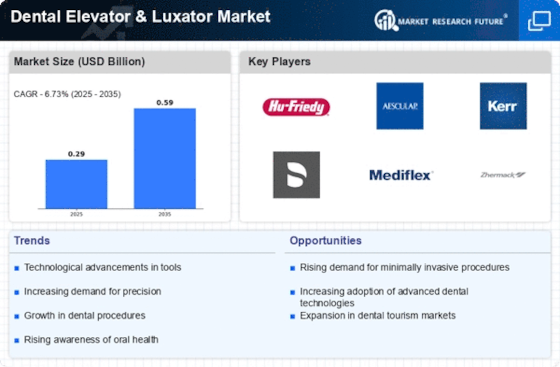
Dental Elevator Luxator Market Infographic
Purchase Options

Market Trends

Key Emerging Trends in the Dental Elevator Luxator Market

Dental elevator and luxator market trends are affected by global dental treatment growth. Elevators and luxators for removing teeth and other dental procedures are needed as individuals learn more about oral health and dentistry technology improves.

Rapid advances in dental technology drive market trends. Manufacturers are adding new features to dental elevators and luxators to increase accuracy, reduce stress, and speed up tooth extraction. As digital technology become more common, dentistry becomes more accurate and less intrusive. As consumers prioritize comfort and quick recuperation, mildly invasive dental procedures are growing. Dental elevators and luxators preserve tissue during extractions, following this trend. A rising number of dentists are using gentle yet successful tooth removal equipment. Dental implant procedures are driving dental elevator and luxator sales. These instruments are crucial for removing teeth to create way for dental implants in the early stages. Dental implants are replacing lost teeth more often, increasing the requirement for associated instruments. Dental professionals are focusing on instrument design to make treatments simpler and less stressful. Manufacturers are designing dental elevators and luxators with dentist-friendly features to counter this tendency. This makes treatments accurate and comfortable. Dental tourism—when individuals travel abroad for cheaper and better dental work—is affecting the dental elevator and luxator business. As dental offices worldwide handle more patients, they require reliable and cutting-edge instruments. Rising personal income and global dental care spending effect market dynamics. Elevators and luxators are needed more because individuals have more dental treatment. This tendency is seen in developed and emerging nations. The dental industry is regulated to protect patients and ensure quality. Following these guidelines requires manufacturers to get licenses and achieve quality requirements, which affects the market. Dentistry elevators and luxators are more reliable and popular because to this feature. Dental lift and luxator industry leaders merge and purchase each other to boost their positions. As organizations provide increasingly innovative and distinctive solutions to keep ahead of the competition, the struggle toughens, spurring innovation and product development. Technology has altered dental product sales. Manufacturers are increasingly adopting digital channels to sell and target dentists. Online training and product demonstrations assist dentists understand the advantages of contemporary dental products like elevators and luxators, growing the industry.


Author
Author Profile
Rahul Gotadki
Research Manager

He holds an experience of about 9+ years in Market Research and Business Consulting, working under the spectrum of Life Sciences and Healthcare domains. Rahul conceptualizes and implements a scalable business strategy and provides strategic leadership to the clients. His expertise lies in market estimation, competitive intelligence, pipeline analysis, customer assessment, etc.

Leave a Comment

FAQs

What is the current market valuation of the Dental Elevator & Luxator Market?

<p>As of 2024, the market valuation stands at 0.2882 USD Billion.</p>

What is the projected market size for the Dental Elevator & Luxator Market by 2035?

<p>The market is expected to reach a valuation of 0.5899 USD Billion by 2035.</p>

What is the expected CAGR for the Dental Elevator & Luxator Market during the forecast period?

<p>The market is projected to grow at a CAGR of 6.73% from 2025 to 2035.</p>

Which segments are included in the Dental Elevator & Luxator Market?

<p>The market segments include Dental Elevators, Dental Luxators, and various size categories.</p>

What are the key players in the Dental Elevator & Luxator Market?

<p>Key players include Hu-Friedy, Aesculap, Kerr Dental, and Dentsply Sirona, among others.</p>

How did the Dental Elevators segment perform in 2024?

In 2024, the Dental Elevators segment was valued at approximately 0.0865 USD Billion.

What is the expected performance of the Dental Luxators segment by 2035?

The Dental Luxators segment is anticipated to grow to around 0.1743 USD Billion by 2035.

What is the market size for Dental Clinics as an end-user segment?

In 2024, the Dental Clinics segment was valued at 0.115 USD Billion.

How do the size categories of dental instruments impact market valuation?

Size categories such as 2 mm and 4 mm are projected to contribute significantly to market growth, with valuations expected to reach 0.1 USD Billion and 0.2 USD Billion respectively by 2035.

What role do research and academic institutes play in the Dental Elevator & Luxator Market?

Research and academic institutes accounted for a market valuation of 0.045 USD Billion in 2024, indicating their importance in the sector.

Market Summary

As per Market Research Future analysis, the Dental Elevator & Luxator Market Size was estimated at 0.2882 USD Billion in 2024. The Dental Elevator & Luxator industry is projected to grow from USD 0.3076 Billion in 2025 to USD 0.5899 Billion by 2035, exhibiting a compound annual growth rate (CAGR) of 6.73% during the forecast period 2025 - 2035

Key Market Trends & Highlights

The Dental Elevator and Luxator Market is experiencing notable growth driven by technological advancements and increasing oral health awareness.

  • Technological advancements are enhancing the efficiency and effectiveness of dental elevators, particularly in North America, which remains the largest market.
  • Minimally invasive techniques are gaining traction, especially in the Asia-Pacific region, which is recognized as the fastest-growing market.
  • The dental elevator segment holds the largest market share, while the 2 mm luxator segment is emerging as the fastest-growing category.
  • Rising demand for dental procedures and an increased focus on preventive dental care are key drivers propelling market expansion.

Market Size & Forecast

2024 Market Size 0.2882 (USD Billion)
2035 Market Size 0.5899 (USD Billion)
CAGR (2025 - 2035) 6.73%
Largest Regional Market Share in 2024 North America

Major Players

Hu-Friedy (US), Aesculap (DE), Kerr Dental (US), Dentsply Sirona (US), Medi-Flex (US), Zhermack (IT), B. Braun (DE), Nobel Biocare (CH), Patterson Dental (US)

Market Trends

The Dental Elevator & Luxator Market is currently experiencing a notable evolution, driven by advancements in dental technology and an increasing emphasis on minimally invasive procedures. As dental professionals seek to enhance patient comfort and improve surgical outcomes, the demand for specialized instruments such as elevators and luxators is on the rise. These tools are essential for tooth extraction and periodontal procedures, allowing for greater precision and reduced trauma to surrounding tissues. Furthermore, the growing awareness of oral health and the importance of dental care among the general population is likely to contribute to the expansion of this market. As dental practices evolve, the integration of innovative materials and ergonomic designs in the manufacturing of these instruments appears to be a focal point for many companies operating within this sector. In addition, the Dental Elevator & Luxator Market is influenced by the increasing prevalence of dental disorders and the aging population, which necessitates more dental interventions. The trend towards digital dentistry, including the use of computer-aided design and manufacturing, may also play a role in shaping the future landscape of this market. As practitioners adopt new technologies, the efficiency and effectiveness of dental procedures are expected to improve, potentially leading to a higher demand for advanced dental tools. Overall, the market seems poised for growth, with various factors converging to create a dynamic environment for dental professionals and manufacturers alike.

Technological Advancements

The ongoing integration of cutting-edge technology in dental practices is reshaping the Dental Elevator & Luxator Market. Innovations such as digital imaging and computer-aided design are enhancing the precision of dental procedures, thereby increasing the demand for specialized instruments that complement these advancements.

Minimally Invasive Techniques

There is a growing trend towards minimally invasive dental procedures, which prioritize patient comfort and quicker recovery times. This shift is driving the need for dental elevators and luxators that facilitate less traumatic extractions and periodontal treatments, aligning with contemporary patient care philosophies.

Aging Population and Oral Health Awareness

The rising awareness of oral health, coupled with an aging demographic, is contributing to an increased demand for dental services. As older adults require more dental interventions, the Dental Elevator & Luxator Market is likely to expand, reflecting the need for effective tools that cater to this population.

Dental Elevator Luxator Market Market Drivers

Growth of Dental Tourism

The rise of dental tourism is emerging as a notable driver for the Dental Elevator & Luxator Market. Patients are increasingly traveling to different regions for affordable dental care, which often includes extractions. This trend not only boosts the demand for dental services but also necessitates the availability of high-quality dental tools, including elevators and luxators. Countries known for their dental tourism are witnessing a surge in dental practices, which in turn increases the consumption of specialized extraction instruments. As dental tourism continues to grow, it is likely to create new opportunities for manufacturers and suppliers within the dental elevator and luxator market.

Rising Demand for Dental Procedures

The increasing prevalence of dental issues, such as tooth decay and periodontal diseases, drives the demand for dental procedures, thereby impacting the Dental Elevator & Luxator Market. As more individuals seek dental care, the need for effective extraction tools becomes paramount. According to recent statistics, dental procedures have seen a steady rise, with millions of extractions performed annually. This trend suggests that dental professionals are increasingly relying on specialized instruments like elevators and luxators to enhance their efficiency and patient outcomes. The growing awareness of oral health and the importance of timely dental interventions further contribute to this demand, indicating a robust market potential for dental elevators and luxators.

Increased Focus on Preventive Dental Care

The heightened emphasis on preventive dental care is reshaping the Dental Elevator & Luxator Market. As more individuals prioritize regular dental check-ups and preventive measures, the likelihood of requiring extractions may also rise. Dental professionals are increasingly equipped with advanced tools to manage such procedures effectively. This shift towards preventive care not only enhances patient outcomes but also drives the demand for reliable extraction instruments. The market is likely to benefit from this trend, as dental practitioners seek to invest in high-quality elevators and luxators to ensure optimal care for their patients. The focus on preventive measures may lead to a more proactive approach in dental practices, further stimulating market growth.

Technological Innovations in Dental Tools

Technological advancements in dental tools significantly influence the Dental Elevator & Luxator Market. Innovations such as improved materials, ergonomic designs, and enhanced functionality are transforming the way dental professionals approach extractions. For instance, the introduction of lightweight, durable materials has led to the development of more efficient elevators and luxators, which can reduce the time and effort required during procedures. Furthermore, the integration of digital technologies in dental practices is likely to enhance the precision and effectiveness of these tools. As dental practitioners increasingly adopt these innovations, the market for dental elevators and luxators is expected to expand, reflecting a shift towards more sophisticated dental care solutions.

Regulatory Standards and Quality Assurance

The establishment of stringent regulatory standards and quality assurance protocols is a critical driver for the Dental Elevator & Luxator Market. Regulatory bodies are increasingly emphasizing the need for high-quality dental instruments to ensure patient safety and effective treatment outcomes. Compliance with these standards often necessitates the use of advanced materials and manufacturing processes, which can enhance the performance of dental elevators and luxators. As dental practices strive to meet these regulations, the demand for reliable and compliant extraction tools is likely to increase. This focus on quality assurance not only benefits patients but also encourages manufacturers to innovate and improve their product offerings, thereby fostering growth within the market.

Market Segment Insights

By Type: Dental Elevators (Largest) vs. Dental Luxators (Fastest-Growing)

In the Dental Elevator & Luxator Market, the segment is characterized by a diverse range of products, prominently featuring Dental Elevators, which hold the largest market share. Among these, Non-winged elevators and Molt periosteal elevators are particularly popular due to their effectiveness in various dental procedures. On the other hand, dental luxators, with their innovative designs, have emerged as a significant driving force in the market, indicating a dynamic shift toward these specialized instruments. The growth trends in this segment reflect a surge in demand for minimally invasive dental solutions, contributing to the rising popularity of dental luxators. Advances in material technology and design, particularly for luxators such as Luxator forte and titanium variants, are key drivers fostering market expansion. Dental professionals increasingly prefer tools that enhance precision and patient comfort, bolstering both the elevator and luxator categories in their respective niches.

Dental Elevators: Non-winged Elevators (Dominant) vs. Dental Luxators: Curved Luxators (Emerging)

In the ever-evolving landscape of the Dental Elevator & Luxator Market, Non-winged Elevators stand out as the dominant type, favored for their versatility and reliability in a range of dental extractions. These instruments provide dentists with the ability to achieve optimal leverage, fostering a smoother extraction process. Conversely, curved luxators are gaining traction as a newly emerging category, recognized for their unique design that facilitates access to hard-to-reach molars and compact spaces within the dental arch. They cater to the increasing demand for precision tools that minimize trauma to surrounding tissues, thus enhancing patient experiences during dental procedures. The momentum behind these curved luxators reflects an industry-wide trend towards innovative instruments that marry efficiency with patient-centric approaches.

By Size: 5 mm (Largest) vs. 2 mm (Fastest-Growing)

In the Dental Elevator & Luxator Market, the size distribution plays a critical role in determining product preferences among dental professionals. The 5 mm size segment currently holds the largest market share, favored for its versatility and effectiveness in various dental procedures. Following closely are the 4 mm and 3 mm segments, which collectively capture a significant portion of the market. The 2 mm segment, despite being smaller, is gaining traction due to its specialized applications in precise dental extractions and minimally invasive procedures. Growth trends in the size segment are driven by the increasing demand for precision in dental surgeries and a shift towards instruments that minimize patient discomfort. The 2 mm dental elevators and luxators are experiencing rapid growth as they cater to the trend of less invasive techniques. Additionally, advancements in materials and manufacturing technologies are enhancing the performance of these instruments, further boosting their adoption in clinics and dental practices around the globe.

5 mm (Dominant) vs. 2 mm (Emerging)

The 5 mm dental elevator and luxator stand out as the dominant choice in the market due to their larger size, which provides dentists with a robust tool for a wide array of extraction procedures. Their sturdy design allows for effective leverage, making them suitable for various dental needs while maintaining user comfort. In contrast, the 2 mm segment is emerging rapidly as a preferred option for specific applications, especially in minimally invasive dentistry where precision is crucial. The smaller size of the 2 mm instrument allows for detailed work in tight spaces, appealing to dental practitioners focused on performing delicate extractions with minimal tissue trauma. This contrast highlights the evolving dynamics of the Dental Elevator & Luxator Market as it adapts to new consumer preferences.

By End-user: Dental Clinics (Largest) vs. Hospitals And Clinics (Fastest-Growing)

In the Dental Elevator & Luxator Market, the distribution of market share among end-users reveals that dental clinics hold the largest share, primarily due to their prevalence and specialized nature in providing dental care. Hospitals and clinics follow closely but are rapidly gaining traction, emphasizing the importance of dental treatments within broader healthcare services. Research and academic institutes, while vital, occupy a smaller segment, focusing on advancements and training in dental technologies.

Dental Clinics (Dominant) vs. Hospitals And Clinics (Emerging)

Dental clinics represent the dominant end-user segment in the Dental Elevator & Luxator Market, attributed to their tailored services and accessibility for routine dental procedures. These clinics are equipped with specialized tools and trained professionals, ensuring optimal patient care and satisfaction. Conversely, hospitals and clinics are emerging players in this market, as the integration of dental services into clinical practices becomes more common. This trend is driven by a growing recognition of oral health's significance in overall health. With advancements in dental technology and treatment methods, these settings are increasingly adopting dental elevators and luxators, showcasing their adaptability to meet patient needs.

Get more detailed insights about Dental Elevator and Luxator Market Research Report – Forecast to 2035

Regional Insights

North America : Market Leader in Innovation

North America is the largest market for dental elevators and luxators, holding approximately 45% of the global market share. The growth is driven by increasing dental procedures, technological advancements, and a rising aging population requiring dental care. Regulatory support from bodies like the FDA ensures high standards for dental tools, further boosting market confidence. The United States dominates this region, with key players such as Hu-Friedy, Dentsply Sirona, and Kerr Dental leading the competitive landscape. The presence of advanced healthcare infrastructure and a focus on dental education contribute to the region's robust market dynamics. Canada also plays a significant role, with a growing demand for innovative dental solutions, enhancing the overall market potential.

Europe : Emerging Market with Regulations

Europe is the second-largest market for dental elevators and luxators, accounting for approximately 30% of the global market share. The growth is fueled by increasing awareness of oral health, advancements in dental technology, and supportive regulations from the European Union. The region's stringent quality standards ensure that dental tools meet high safety and efficacy benchmarks, fostering consumer trust. Germany and the United Kingdom are the leading countries in this market, with significant contributions from companies like Aesculap and B. Braun. The competitive landscape is characterized by a mix of established players and innovative startups, enhancing product offerings. The presence of dental associations and regulatory bodies further supports market growth by promoting best practices and continuous education in dental care.

Asia-Pacific : Rapidly Growing Market Potential

Asia-Pacific is witnessing rapid growth in the dental elevators and luxators market, holding about 20% of the global market share. The increasing population, rising disposable incomes, and growing awareness of dental hygiene are key drivers of this growth. Additionally, government initiatives to improve healthcare infrastructure and access to dental services are catalyzing market expansion in the region. Countries like China and India are at the forefront of this growth, with a rising number of dental clinics and practitioners. The competitive landscape includes both local and international players, such as Zhermack and Nobel Biocare, who are expanding their presence. The region's diverse market dynamics and increasing investment in dental technology are expected to further enhance growth prospects in the coming years.

Middle East and Africa : Untapped Market with Opportunities

The Middle East and Africa region is an emerging market for dental elevators and luxators, holding approximately 5% of the global market share. The growth is driven by increasing urbanization, rising healthcare expenditure, and a growing awareness of dental health. Governments are investing in healthcare infrastructure, which is expected to enhance access to dental services and tools in the region. Countries like South Africa and the UAE are leading the market, with a growing number of dental professionals and clinics. The competitive landscape is evolving, with both local and international companies seeking to establish a foothold. The presence of key players and increasing dental tourism in the region are expected to drive further growth in the dental tools market.

Key Players and Competitive Insights

The Dental Elevator & Luxator Market is characterized by a competitive landscape that is increasingly shaped by innovation, strategic partnerships, and regional expansions. Key players such as Dentsply Sirona (US), Hu-Friedy (US), and Aesculap (DE) are at the forefront, each adopting distinct strategies to enhance their market presence. Dentsply Sirona (US) focuses on technological advancements in dental instruments, emphasizing the integration of digital solutions to streamline dental procedures. Meanwhile, Hu-Friedy (US) has positioned itself as a leader in high-quality dental instruments, leveraging its long-standing reputation to foster customer loyalty and expand its product offerings. Aesculap (DE), on the other hand, is actively pursuing mergers and acquisitions to bolster its portfolio, indicating a strategy aimed at consolidating its market position and enhancing its competitive edge.

The business tactics employed by these companies reflect a nuanced understanding of the market's structure, which is moderately fragmented. Localizing manufacturing and optimizing supply chains are prevalent strategies that allow these firms to respond swiftly to regional demands while maintaining cost efficiency. The collective influence of these key players not only shapes market dynamics but also sets a benchmark for emerging companies seeking to establish themselves in this sector.

In August 2025, Dentsply Sirona (US) announced a strategic partnership with a leading dental technology firm to co-develop a new line of digital dental instruments. This collaboration is poised to enhance Dentsply Sirona's product offerings, aligning with the growing trend towards digitalization in dentistry. The partnership underscores the company's commitment to innovation and positions it favorably against competitors who may not be as agile in adopting new technologies.

In July 2025, Hu-Friedy (US) launched a new range of eco-friendly dental elevators, reflecting a strategic pivot towards sustainability. This initiative not only caters to the increasing consumer demand for environmentally responsible products but also enhances Hu-Friedy's brand image as a forward-thinking company. By prioritizing sustainability, Hu-Friedy is likely to attract a broader customer base, particularly among environmentally conscious dental practitioners.

In September 2025, Aesculap (DE) completed the acquisition of a smaller dental instrument manufacturer, which is expected to expand its product line and market reach. This acquisition is strategically significant as it allows Aesculap to integrate innovative technologies and diversify its offerings, thereby strengthening its competitive position in the market. Such moves indicate a trend towards consolidation among key players, which may reshape the competitive landscape in the coming years.

As of October 2025, the competitive trends in the Dental Elevator & Luxator Market are increasingly defined by digitalization, sustainability, and the integration of artificial intelligence. Strategic alliances are becoming more prevalent, as companies recognize the value of collaboration in enhancing their technological capabilities. Looking ahead, competitive differentiation is likely to evolve from traditional price-based competition to a focus on innovation, technological advancements, and supply chain reliability. This shift suggests that companies that prioritize these aspects will be better positioned to thrive in an increasingly competitive environment.

Key Companies in the Dental Elevator Luxator Market include

Industry Developments

  • On March 8, 2018, North American Dental Group and Dentsply Sirona Inc. (US) have launched a partnership. Dentsply Sirona has been chosen as NADG's official manufacturing partner for its affiliated offices.
  • On March 26, 2018, Dentsply Sirona Inc. (US), a prominent dental equipment manufacturer, announced its acquisitionprocurement of OraMetrix, Inc. (US), a developer of dental technology solutions, including 3-D technology solutions for orthodontic care and others. The OraMetrix purchase is also expected to assist Dentsply Sirona in providing a complete orthodontic solution for its customers, including complete arch clear aligners.

Future Outlook

Dental Elevator Luxator Market Future Outlook

The Dental Elevator & Luxator Market is projected to grow at a 6.73% CAGR from 2025 to 2035, driven by technological advancements, increasing dental procedures, and rising consumer awareness.

New opportunities lie in:

  • Development of advanced ergonomic designs for enhanced user comfort.
  • Expansion into emerging markets with tailored product offerings.
  • Integration of digital technologies for improved surgical precision.

By 2035, the market is expected to achieve robust growth, positioning itself as a leader in dental surgical tools.

Market Segmentation

Dental Elevator Luxator Market Size Outlook

  • 2 mm
  • 3 mm
  • 4 mm
  • 5 mm
  • 10 mm

Dental Elevator Luxator Market Type Outlook

  • Dental Elevators
  • Non-winged elevators
  • Molt periosteal elevators
  • Woodson periosteal elevators
  • Winged elevators
  • Periosteal elevators
  • Dental Luxators
  • Luxator periotome
  • Luxator short periotome
  • Curved luxators
  • Luxator forte elevator
  • Luxator LX
  • Bent luxators
  • Luxator dual-edge periotome
  • Luxator titanium

Dental Elevator Luxator Market End-user Outlook

  • Hospitals And Clinics
  • Dental Clinics
  • Research And Academic Institutes
  • Others

Report Scope

MARKET SIZE 2024 0.2882(USD Billion)
MARKET SIZE 2025 0.3076(USD Billion)
MARKET SIZE 2035 0.5899(USD Billion)
COMPOUND ANNUAL GROWTH RATE (CAGR) 6.73% (2025 - 2035)
REPORT COVERAGE Revenue Forecast, Competitive Landscape, Growth Factors, and Trends
BASE YEAR 2024
Market Forecast Period 2025 - 2035
Historical Data 2019 - 2024
Market Forecast Units USD Billion
Key Companies Profiled Hu-Friedy (US), Aesculap (DE), Kerr Dental (US), Dentsply Sirona (US), Medi-Flex (US), Zhermack (IT), B. Braun (DE), Nobel Biocare (CH), Patterson Dental (US)
Segments Covered Type
Key Market Opportunities Integration of advanced materials and technologies enhances efficiency in the Dental Elevator and Luxator Market.
Key Market Dynamics Rising demand for minimally invasive dental procedures drives innovation in dental elevators and luxators.
Countries Covered North America, Europe, APAC, South America, MEA

FAQs

What is the current market valuation of the Dental Elevator & Luxator Market?

<p>As of 2024, the market valuation stands at 0.2882 USD Billion.</p>

What is the projected market size for the Dental Elevator & Luxator Market by 2035?

<p>The market is expected to reach a valuation of 0.5899 USD Billion by 2035.</p>

What is the expected CAGR for the Dental Elevator & Luxator Market during the forecast period?

<p>The market is projected to grow at a CAGR of 6.73% from 2025 to 2035.</p>

Which segments are included in the Dental Elevator & Luxator Market?

<p>The market segments include Dental Elevators, Dental Luxators, and various size categories.</p>

What are the key players in the Dental Elevator & Luxator Market?

<p>Key players include Hu-Friedy, Aesculap, Kerr Dental, and Dentsply Sirona, among others.</p>

How did the Dental Elevators segment perform in 2024?

In 2024, the Dental Elevators segment was valued at approximately 0.0865 USD Billion.

What is the expected performance of the Dental Luxators segment by 2035?

The Dental Luxators segment is anticipated to grow to around 0.1743 USD Billion by 2035.

What is the market size for Dental Clinics as an end-user segment?

In 2024, the Dental Clinics segment was valued at 0.115 USD Billion.

How do the size categories of dental instruments impact market valuation?

Size categories such as 2 mm and 4 mm are projected to contribute significantly to market growth, with valuations expected to reach 0.1 USD Billion and 0.2 USD Billion respectively by 2035.

What role do research and academic institutes play in the Dental Elevator & Luxator Market?

Research and academic institutes accounted for a market valuation of 0.045 USD Billion in 2024, indicating their importance in the sector.

  1. SECTION I: EXECUTIVE SUMMARY AND KEY HIGHLIGHTS
    1. | 1.1 EXECUTIVE SUMMARY
    2. | | 1.1.1 Market Overview
    3. | | 1.1.2 Key Findings
    4. | | 1.1.3 Market Segmentation
    5. | | 1.1.4 Competitive Landscape
    6. | | 1.1.5 Challenges and Opportunities
    7. | | 1.1.6 Future Outlook
  2. SECTION II: SCOPING, METHODOLOGY AND MARKET STRUCTURE
    1. | 2.1 MARKET INTRODUCTION
    2. | | 2.1.1 Definition
    3. | | 2.1.2 Scope of the study
    4. | | | 2.1.2.1 Research Objective
    5. | | | 2.1.2.2 Assumption
    6. | | | 2.1.2.3 Limitations
    7. | 2.2 RESEARCH METHODOLOGY
    8. | | 2.2.1 Overview
    9. | | 2.2.2 Data Mining
    10. | | 2.2.3 Secondary Research
    11. | | 2.2.4 Primary Research
    12. | | | 2.2.4.1 Primary Interviews and Information Gathering Process
    13. | | | 2.2.4.2 Breakdown of Primary Respondents
    14. | | 2.2.5 Forecasting Model
    15. | | 2.2.6 Market Size Estimation
    16. | | | 2.2.6.1 Bottom-Up Approach
    17. | | | 2.2.6.2 Top-Down Approach
    18. | | 2.2.7 Data Triangulation
    19. | | 2.2.8 Validation
  3. SECTION III: QUALITATIVE ANALYSIS
    1. | 3.1 MARKET DYNAMICS
    2. | | 3.1.1 Overview
    3. | | 3.1.2 Drivers
    4. | | 3.1.3 Restraints
    5. | | 3.1.4 Opportunities
    6. | 3.2 MARKET FACTOR ANALYSIS
    7. | | 3.2.1 Value chain Analysis
    8. | | 3.2.2 Porter's Five Forces Analysis
    9. | | | 3.2.2.1 Bargaining Power of Suppliers
    10. | | | 3.2.2.2 Bargaining Power of Buyers
    11. | | | 3.2.2.3 Threat of New Entrants
    12. | | | 3.2.2.4 Threat of Substitutes
    13. | | | 3.2.2.5 Intensity of Rivalry
    14. | | 3.2.3 COVID-19 Impact Analysis
    15. | | | 3.2.3.1 Market Impact Analysis
    16. | | | 3.2.3.2 Regional Impact
    17. | | | 3.2.3.3 Opportunity and Threat Analysis
  4. SECTION IV: QUANTITATIVE ANALYSIS
    1. | 4.1 Healthcare, BY Type (USD Billion)
    2. | | 4.1.1 Dental Elevators
    3. | | 4.1.2 Non-winged elevators
    4. | | 4.1.3 Molt periosteal elevators
    5. | | 4.1.4 Woodson periosteal elevators
    6. | | 4.1.5 Winged elevators
    7. | | 4.1.6 Periosteal elevators
    8. | | 4.1.7 Dental Luxators
    9. | | 4.1.8 Luxator periotome
    10. | | 4.1.9 Luxator short periotome
    11. | | 4.1.10 Curved luxators
    12. | | 4.1.11 Luxator forte elevator
    13. | | 4.1.12 Luxator LX
    14. | | 4.1.13 Bent luxators
    15. | | 4.1.14 Luxator dual-edge periotome
    16. | | 4.1.15 Luxator titanium
    17. | 4.2 Healthcare, BY Size (USD Billion)
    18. | | 4.2.1 2 mm
    19. | | 4.2.2 3 mm
    20. | | 4.2.3 4 mm
    21. | | 4.2.4 5 mm
    22. | | 4.2.5 10 mm
    23. | 4.3 Healthcare, BY End-user (USD Billion)
    24. | | 4.3.1 Hospitals And Clinics
    25. | | 4.3.2 Dental Clinics
    26. | | 4.3.3 Research And Academic Institutes
    27. | | 4.3.4 Others
    28. | 4.4 Healthcare, BY Region (USD Billion)
    29. | | 4.4.1 North America
    30. | | | 4.4.1.1 US
    31. | | | 4.4.1.2 Canada
    32. | | 4.4.2 Europe
    33. | | | 4.4.2.1 Germany
    34. | | | 4.4.2.2 UK
    35. | | | 4.4.2.3 France
    36. | | | 4.4.2.4 Russia
    37. | | | 4.4.2.5 Italy
    38. | | | 4.4.2.6 Spain
    39. | | | 4.4.2.7 Rest of Europe
    40. | | 4.4.3 APAC
    41. | | | 4.4.3.1 China
    42. | | | 4.4.3.2 India
    43. | | | 4.4.3.3 Japan
    44. | | | 4.4.3.4 South Korea
    45. | | | 4.4.3.5 Malaysia
    46. | | | 4.4.3.6 Thailand
    47. | | | 4.4.3.7 Indonesia
    48. | | | 4.4.3.8 Rest of APAC
    49. | | 4.4.4 South America
    50. | | | 4.4.4.1 Brazil
    51. | | | 4.4.4.2 Mexico
    52. | | | 4.4.4.3 Argentina
    53. | | | 4.4.4.4 Rest of South America
    54. | | 4.4.5 MEA
    55. | | | 4.4.5.1 GCC Countries
    56. | | | 4.4.5.2 South Africa
    57. | | | 4.4.5.3 Rest of MEA
  5. SECTION V: COMPETITIVE ANALYSIS
    1. | 5.1 Competitive Landscape
    2. | | 5.1.1 Overview
    3. | | 5.1.2 Competitive Analysis
    4. | | 5.1.3 Market share Analysis
    5. | | 5.1.4 Major Growth Strategy in the Healthcare
    6. | | 5.1.5 Competitive Benchmarking
    7. | | 5.1.6 Leading Players in Terms of Number of Developments in the Healthcare
    8. | | 5.1.7 Key developments and growth strategies
    9. | | | 5.1.7.1 New Product Launch/Service Deployment
    10. | | | 5.1.7.2 Merger & Acquisitions
    11. | | | 5.1.7.3 Joint Ventures
    12. | | 5.1.8 Major Players Financial Matrix
    13. | | | 5.1.8.1 Sales and Operating Income
    14. | | | 5.1.8.2 Major Players R&D Expenditure. 2023
    15. | 5.2 Company Profiles
    16. | | 5.2.1 Hu-Friedy (US)
    17. | | | 5.2.1.1 Financial Overview
    18. | | | 5.2.1.2 Products Offered
    19. | | | 5.2.1.3 Key Developments
    20. | | | 5.2.1.4 SWOT Analysis
    21. | | | 5.2.1.5 Key Strategies
    22. | | 5.2.2 Aesculap (DE)
    23. | | | 5.2.2.1 Financial Overview
    24. | | | 5.2.2.2 Products Offered
    25. | | | 5.2.2.3 Key Developments
    26. | | | 5.2.2.4 SWOT Analysis
    27. | | | 5.2.2.5 Key Strategies
    28. | | 5.2.3 Kerr Dental (US)
    29. | | | 5.2.3.1 Financial Overview
    30. | | | 5.2.3.2 Products Offered
    31. | | | 5.2.3.3 Key Developments
    32. | | | 5.2.3.4 SWOT Analysis
    33. | | | 5.2.3.5 Key Strategies
    34. | | 5.2.4 Dentsply Sirona (US)
    35. | | | 5.2.4.1 Financial Overview
    36. | | | 5.2.4.2 Products Offered
    37. | | | 5.2.4.3 Key Developments
    38. | | | 5.2.4.4 SWOT Analysis
    39. | | | 5.2.4.5 Key Strategies
    40. | | 5.2.5 Medi-Flex (US)
    41. | | | 5.2.5.1 Financial Overview
    42. | | | 5.2.5.2 Products Offered
    43. | | | 5.2.5.3 Key Developments
    44. | | | 5.2.5.4 SWOT Analysis
    45. | | | 5.2.5.5 Key Strategies
    46. | | 5.2.6 Zhermack (IT)
    47. | | | 5.2.6.1 Financial Overview
    48. | | | 5.2.6.2 Products Offered
    49. | | | 5.2.6.3 Key Developments
    50. | | | 5.2.6.4 SWOT Analysis
    51. | | | 5.2.6.5 Key Strategies
    52. | | 5.2.7 B. Braun (DE)
    53. | | | 5.2.7.1 Financial Overview
    54. | | | 5.2.7.2 Products Offered
    55. | | | 5.2.7.3 Key Developments
    56. | | | 5.2.7.4 SWOT Analysis
    57. | | | 5.2.7.5 Key Strategies
    58. | | 5.2.8 Nobel Biocare (CH)
    59. | | | 5.2.8.1 Financial Overview
    60. | | | 5.2.8.2 Products Offered
    61. | | | 5.2.8.3 Key Developments
    62. | | | 5.2.8.4 SWOT Analysis
    63. | | | 5.2.8.5 Key Strategies
    64. | | 5.2.9 Patterson Dental (US)
    65. | | | 5.2.9.1 Financial Overview
    66. | | | 5.2.9.2 Products Offered
    67. | | | 5.2.9.3 Key Developments
    68. | | | 5.2.9.4 SWOT Analysis
    69. | | | 5.2.9.5 Key Strategies
    70. | 5.3 Appendix
    71. | | 5.3.1 References
    72. | | 5.3.2 Related Reports
  6. LIST OF FIGURES
    1. | 6.1 MARKET SYNOPSIS
    2. | 6.2 NORTH AMERICA MARKET ANALYSIS
    3. | 6.3 US MARKET ANALYSIS BY TYPE
    4. | 6.4 US MARKET ANALYSIS BY SIZE
    5. | 6.5 US MARKET ANALYSIS BY END-USER
    6. | 6.6 CANADA MARKET ANALYSIS BY TYPE
    7. | 6.7 CANADA MARKET ANALYSIS BY SIZE
    8. | 6.8 CANADA MARKET ANALYSIS BY END-USER
    9. | 6.9 EUROPE MARKET ANALYSIS
    10. | 6.10 GERMANY MARKET ANALYSIS BY TYPE
    11. | 6.11 GERMANY MARKET ANALYSIS BY SIZE
    12. | 6.12 GERMANY MARKET ANALYSIS BY END-USER
    13. | 6.13 UK MARKET ANALYSIS BY TYPE
    14. | 6.14 UK MARKET ANALYSIS BY SIZE
    15. | 6.15 UK MARKET ANALYSIS BY END-USER
    16. | 6.16 FRANCE MARKET ANALYSIS BY TYPE
    17. | 6.17 FRANCE MARKET ANALYSIS BY SIZE
    18. | 6.18 FRANCE MARKET ANALYSIS BY END-USER
    19. | 6.19 RUSSIA MARKET ANALYSIS BY TYPE
    20. | 6.20 RUSSIA MARKET ANALYSIS BY SIZE
    21. | 6.21 RUSSIA MARKET ANALYSIS BY END-USER
    22. | 6.22 ITALY MARKET ANALYSIS BY TYPE
    23. | 6.23 ITALY MARKET ANALYSIS BY SIZE
    24. | 6.24 ITALY MARKET ANALYSIS BY END-USER
    25. | 6.25 SPAIN MARKET ANALYSIS BY TYPE
    26. | 6.26 SPAIN MARKET ANALYSIS BY SIZE
    27. | 6.27 SPAIN MARKET ANALYSIS BY END-USER
    28. | 6.28 REST OF EUROPE MARKET ANALYSIS BY TYPE
    29. | 6.29 REST OF EUROPE MARKET ANALYSIS BY SIZE
    30. | 6.30 REST OF EUROPE MARKET ANALYSIS BY END-USER
    31. | 6.31 APAC MARKET ANALYSIS
    32. | 6.32 CHINA MARKET ANALYSIS BY TYPE
    33. | 6.33 CHINA MARKET ANALYSIS BY SIZE
    34. | 6.34 CHINA MARKET ANALYSIS BY END-USER
    35. | 6.35 INDIA MARKET ANALYSIS BY TYPE
    36. | 6.36 INDIA MARKET ANALYSIS BY SIZE
    37. | 6.37 INDIA MARKET ANALYSIS BY END-USER
    38. | 6.38 JAPAN MARKET ANALYSIS BY TYPE
    39. | 6.39 JAPAN MARKET ANALYSIS BY SIZE
    40. | 6.40 JAPAN MARKET ANALYSIS BY END-USER
    41. | 6.41 SOUTH KOREA MARKET ANALYSIS BY TYPE
    42. | 6.42 SOUTH KOREA MARKET ANALYSIS BY SIZE
    43. | 6.43 SOUTH KOREA MARKET ANALYSIS BY END-USER
    44. | 6.44 MALAYSIA MARKET ANALYSIS BY TYPE
    45. | 6.45 MALAYSIA MARKET ANALYSIS BY SIZE
    46. | 6.46 MALAYSIA MARKET ANALYSIS BY END-USER
    47. | 6.47 THAILAND MARKET ANALYSIS BY TYPE
    48. | 6.48 THAILAND MARKET ANALYSIS BY SIZE
    49. | 6.49 THAILAND MARKET ANALYSIS BY END-USER
    50. | 6.50 INDONESIA MARKET ANALYSIS BY TYPE
    51. | 6.51 INDONESIA MARKET ANALYSIS BY SIZE
    52. | 6.52 INDONESIA MARKET ANALYSIS BY END-USER
    53. | 6.53 REST OF APAC MARKET ANALYSIS BY TYPE
    54. | 6.54 REST OF APAC MARKET ANALYSIS BY SIZE
    55. | 6.55 REST OF APAC MARKET ANALYSIS BY END-USER
    56. | 6.56 SOUTH AMERICA MARKET ANALYSIS
    57. | 6.57 BRAZIL MARKET ANALYSIS BY TYPE
    58. | 6.58 BRAZIL MARKET ANALYSIS BY SIZE
    59. | 6.59 BRAZIL MARKET ANALYSIS BY END-USER
    60. | 6.60 MEXICO MARKET ANALYSIS BY TYPE
    61. | 6.61 MEXICO MARKET ANALYSIS BY SIZE
    62. | 6.62 MEXICO MARKET ANALYSIS BY END-USER
    63. | 6.63 ARGENTINA MARKET ANALYSIS BY TYPE
    64. | 6.64 ARGENTINA MARKET ANALYSIS BY SIZE
    65. | 6.65 ARGENTINA MARKET ANALYSIS BY END-USER
    66. | 6.66 REST OF SOUTH AMERICA MARKET ANALYSIS BY TYPE
    67. | 6.67 REST OF SOUTH AMERICA MARKET ANALYSIS BY SIZE
    68. | 6.68 REST OF SOUTH AMERICA MARKET ANALYSIS BY END-USER
    69. | 6.69 MEA MARKET ANALYSIS
    70. | 6.70 GCC COUNTRIES MARKET ANALYSIS BY TYPE
    71. | 6.71 GCC COUNTRIES MARKET ANALYSIS BY SIZE
    72. | 6.72 GCC COUNTRIES MARKET ANALYSIS BY END-USER
    73. | 6.73 SOUTH AFRICA MARKET ANALYSIS BY TYPE
    74. | 6.74 SOUTH AFRICA MARKET ANALYSIS BY SIZE
    75. | 6.75 SOUTH AFRICA MARKET ANALYSIS BY END-USER
    76. | 6.76 REST OF MEA MARKET ANALYSIS BY TYPE
    77. | 6.77 REST OF MEA MARKET ANALYSIS BY SIZE
    78. | 6.78 REST OF MEA MARKET ANALYSIS BY END-USER
    79. | 6.79 KEY BUYING CRITERIA OF HEALTHCARE
    80. | 6.80 RESEARCH PROCESS OF MRFR
    81. | 6.81 DRO ANALYSIS OF HEALTHCARE
    82. | 6.82 DRIVERS IMPACT ANALYSIS: HEALTHCARE
    83. | 6.83 RESTRAINTS IMPACT ANALYSIS: HEALTHCARE
    84. | 6.84 SUPPLY / VALUE CHAIN: HEALTHCARE
    85. | 6.85 HEALTHCARE, BY TYPE, 2024 (% SHARE)
    86. | 6.86 HEALTHCARE, BY TYPE, 2024 TO 2035 (USD Billion)
    87. | 6.87 HEALTHCARE, BY SIZE, 2024 (% SHARE)
    88. | 6.88 HEALTHCARE, BY SIZE, 2024 TO 2035 (USD Billion)
    89. | 6.89 HEALTHCARE, BY END-USER, 2024 (% SHARE)
    90. | 6.90 HEALTHCARE, BY END-USER, 2024 TO 2035 (USD Billion)
    91. | 6.91 BENCHMARKING OF MAJOR COMPETITORS
  7. LIST OF TABLES
    1. | 7.1 LIST OF ASSUMPTIONS
    2. | | 7.1.1
    3. | 7.2 North America MARKET SIZE ESTIMATES; FORECAST
    4. | | 7.2.1 BY TYPE, 2025-2035 (USD Billion)
    5. | | 7.2.2 BY SIZE, 2025-2035 (USD Billion)
    6. | | 7.2.3 BY END-USER, 2025-2035 (USD Billion)
    7. | 7.3 US MARKET SIZE ESTIMATES; FORECAST
    8. | | 7.3.1 BY TYPE, 2025-2035 (USD Billion)
    9. | | 7.3.2 BY SIZE, 2025-2035 (USD Billion)
    10. | | 7.3.3 BY END-USER, 2025-2035 (USD Billion)
    11. | 7.4 Canada MARKET SIZE ESTIMATES; FORECAST
    12. | | 7.4.1 BY TYPE, 2025-2035 (USD Billion)
    13. | | 7.4.2 BY SIZE, 2025-2035 (USD Billion)
    14. | | 7.4.3 BY END-USER, 2025-2035 (USD Billion)
    15. | 7.5 Europe MARKET SIZE ESTIMATES; FORECAST
    16. | | 7.5.1 BY TYPE, 2025-2035 (USD Billion)
    17. | | 7.5.2 BY SIZE, 2025-2035 (USD Billion)
    18. | | 7.5.3 BY END-USER, 2025-2035 (USD Billion)
    19. | 7.6 Germany MARKET SIZE ESTIMATES; FORECAST
    20. | | 7.6.1 BY TYPE, 2025-2035 (USD Billion)
    21. | | 7.6.2 BY SIZE, 2025-2035 (USD Billion)
    22. | | 7.6.3 BY END-USER, 2025-2035 (USD Billion)
    23. | 7.7 UK MARKET SIZE ESTIMATES; FORECAST
    24. | | 7.7.1 BY TYPE, 2025-2035 (USD Billion)
    25. | | 7.7.2 BY SIZE, 2025-2035 (USD Billion)
    26. | | 7.7.3 BY END-USER, 2025-2035 (USD Billion)
    27. | 7.8 France MARKET SIZE ESTIMATES; FORECAST
    28. | | 7.8.1 BY TYPE, 2025-2035 (USD Billion)
    29. | | 7.8.2 BY SIZE, 2025-2035 (USD Billion)
    30. | | 7.8.3 BY END-USER, 2025-2035 (USD Billion)
    31. | 7.9 Russia MARKET SIZE ESTIMATES; FORECAST
    32. | | 7.9.1 BY TYPE, 2025-2035 (USD Billion)
    33. | | 7.9.2 BY SIZE, 2025-2035 (USD Billion)
    34. | | 7.9.3 BY END-USER, 2025-2035 (USD Billion)
    35. | 7.10 Italy MARKET SIZE ESTIMATES; FORECAST
    36. | | 7.10.1 BY TYPE, 2025-2035 (USD Billion)
    37. | | 7.10.2 BY SIZE, 2025-2035 (USD Billion)
    38. | | 7.10.3 BY END-USER, 2025-2035 (USD Billion)
    39. | 7.11 Spain MARKET SIZE ESTIMATES; FORECAST
    40. | | 7.11.1 BY TYPE, 2025-2035 (USD Billion)
    41. | | 7.11.2 BY SIZE, 2025-2035 (USD Billion)
    42. | | 7.11.3 BY END-USER, 2025-2035 (USD Billion)
    43. | 7.12 Rest of Europe MARKET SIZE ESTIMATES; FORECAST
    44. | | 7.12.1 BY TYPE, 2025-2035 (USD Billion)
    45. | | 7.12.2 BY SIZE, 2025-2035 (USD Billion)
    46. | | 7.12.3 BY END-USER, 2025-2035 (USD Billion)
    47. | 7.13 APAC MARKET SIZE ESTIMATES; FORECAST
    48. | | 7.13.1 BY TYPE, 2025-2035 (USD Billion)
    49. | | 7.13.2 BY SIZE, 2025-2035 (USD Billion)
    50. | | 7.13.3 BY END-USER, 2025-2035 (USD Billion)
    51. | 7.14 China MARKET SIZE ESTIMATES; FORECAST
    52. | | 7.14.1 BY TYPE, 2025-2035 (USD Billion)
    53. | | 7.14.2 BY SIZE, 2025-2035 (USD Billion)
    54. | | 7.14.3 BY END-USER, 2025-2035 (USD Billion)
    55. | 7.15 India MARKET SIZE ESTIMATES; FORECAST
    56. | | 7.15.1 BY TYPE, 2025-2035 (USD Billion)
    57. | | 7.15.2 BY SIZE, 2025-2035 (USD Billion)
    58. | | 7.15.3 BY END-USER, 2025-2035 (USD Billion)
    59. | 7.16 Japan MARKET SIZE ESTIMATES; FORECAST
    60. | | 7.16.1 BY TYPE, 2025-2035 (USD Billion)
    61. | | 7.16.2 BY SIZE, 2025-2035 (USD Billion)
    62. | | 7.16.3 BY END-USER, 2025-2035 (USD Billion)
    63. | 7.17 South Korea MARKET SIZE ESTIMATES; FORECAST
    64. | | 7.17.1 BY TYPE, 2025-2035 (USD Billion)
    65. | | 7.17.2 BY SIZE, 2025-2035 (USD Billion)
    66. | | 7.17.3 BY END-USER, 2025-2035 (USD Billion)
    67. | 7.18 Malaysia MARKET SIZE ESTIMATES; FORECAST
    68. | | 7.18.1 BY TYPE, 2025-2035 (USD Billion)
    69. | | 7.18.2 BY SIZE, 2025-2035 (USD Billion)
    70. | | 7.18.3 BY END-USER, 2025-2035 (USD Billion)
    71. | 7.19 Thailand MARKET SIZE ESTIMATES; FORECAST
    72. | | 7.19.1 BY TYPE, 2025-2035 (USD Billion)
    73. | | 7.19.2 BY SIZE, 2025-2035 (USD Billion)
    74. | | 7.19.3 BY END-USER, 2025-2035 (USD Billion)
    75. | 7.20 Indonesia MARKET SIZE ESTIMATES; FORECAST
    76. | | 7.20.1 BY TYPE, 2025-2035 (USD Billion)
    77. | | 7.20.2 BY SIZE, 2025-2035 (USD Billion)
    78. | | 7.20.3 BY END-USER, 2025-2035 (USD Billion)
    79. | 7.21 Rest of APAC MARKET SIZE ESTIMATES; FORECAST
    80. | | 7.21.1 BY TYPE, 2025-2035 (USD Billion)
    81. | | 7.21.2 BY SIZE, 2025-2035 (USD Billion)
    82. | | 7.21.3 BY END-USER, 2025-2035 (USD Billion)
    83. | 7.22 South America MARKET SIZE ESTIMATES; FORECAST
    84. | | 7.22.1 BY TYPE, 2025-2035 (USD Billion)
    85. | | 7.22.2 BY SIZE, 2025-2035 (USD Billion)
    86. | | 7.22.3 BY END-USER, 2025-2035 (USD Billion)
    87. | 7.23 Brazil MARKET SIZE ESTIMATES; FORECAST
    88. | | 7.23.1 BY TYPE, 2025-2035 (USD Billion)
    89. | | 7.23.2 BY SIZE, 2025-2035 (USD Billion)
    90. | | 7.23.3 BY END-USER, 2025-2035 (USD Billion)
    91. | 7.24 Mexico MARKET SIZE ESTIMATES; FORECAST
    92. | | 7.24.1 BY TYPE, 2025-2035 (USD Billion)
    93. | | 7.24.2 BY SIZE, 2025-2035 (USD Billion)
    94. | | 7.24.3 BY END-USER, 2025-2035 (USD Billion)
    95. | 7.25 Argentina MARKET SIZE ESTIMATES; FORECAST
    96. | | 7.25.1 BY TYPE, 2025-2035 (USD Billion)
    97. | | 7.25.2 BY SIZE, 2025-2035 (USD Billion)
    98. | | 7.25.3 BY END-USER, 2025-2035 (USD Billion)
    99. | 7.26 Rest of South America MARKET SIZE ESTIMATES; FORECAST
    100. | | 7.26.1 BY TYPE, 2025-2035 (USD Billion)
    101. | | 7.26.2 BY SIZE, 2025-2035 (USD Billion)
    102. | | 7.26.3 BY END-USER, 2025-2035 (USD Billion)
    103. | 7.27 MEA MARKET SIZE ESTIMATES; FORECAST
    104. | | 7.27.1 BY TYPE, 2025-2035 (USD Billion)
    105. | | 7.27.2 BY SIZE, 2025-2035 (USD Billion)
    106. | | 7.27.3 BY END-USER, 2025-2035 (USD Billion)
    107. | 7.28 GCC Countries MARKET SIZE ESTIMATES; FORECAST
    108. | | 7.28.1 BY TYPE, 2025-2035 (USD Billion)
    109. | | 7.28.2 BY SIZE, 2025-2035 (USD Billion)
    110. | | 7.28.3 BY END-USER, 2025-2035 (USD Billion)
    111. | 7.29 South Africa MARKET SIZE ESTIMATES; FORECAST
    112. | | 7.29.1 BY TYPE, 2025-2035 (USD Billion)
    113. | | 7.29.2 BY SIZE, 2025-2035 (USD Billion)
    114. | | 7.29.3 BY END-USER, 2025-2035 (USD Billion)
    115. | 7.30 Rest of MEA MARKET SIZE ESTIMATES; FORECAST
    116. | | 7.30.1 BY TYPE, 2025-2035 (USD Billion)
    117. | | 7.30.2 BY SIZE, 2025-2035 (USD Billion)
    118. | | 7.30.3 BY END-USER, 2025-2035 (USD Billion)
    119. | 7.31 PRODUCT LAUNCH/PRODUCT DEVELOPMENT/APPROVAL
    120. | | 7.31.1
    121. | 7.32 ACQUISITION/PARTNERSHIP
    122. | | 7.32.1

Healthcare Market Segmentation

Healthcare By Type (USD Billion, 2025-2035)

  • Dental Elevators
  • Non-winged elevators
  • Molt periosteal elevators
  • Woodson periosteal elevators
  • Winged elevators
  • Periosteal elevators
  • Dental Luxators
  • Luxator periotome
  • Luxator short periotome
  • Curved luxators
  • Luxator forte elevator
  • Luxator LX
  • Bent luxators
  • Luxator dual-edge periotome
  • Luxator titanium

Healthcare By Size (USD Billion, 2025-2035)

  • 2 mm
  • 3 mm
  • 4 mm
  • 5 mm
  • 10 mm

Healthcare By End-user (USD Billion, 2025-2035)

  • Hospitals And Clinics
  • Dental Clinics
  • Research And Academic Institutes
  • Others
Infographic

Free Sample Request

Kindly complete the form below to receive a free sample of this Report

Get Free Sample

Customer Strories

Compare Licence

×
Features License Type
Single User Multiuser License Enterprise User
Price $4,950 $5,950 $7,250
Maximum User Access Limit 1 User Upto 10 Users Unrestricted Access Throughout the Organization
Free Customization
Direct Access to Analyst
Deliverable Format
Platform Access
Discount on Next Purchase 10% 15% 15%
Printable Versions