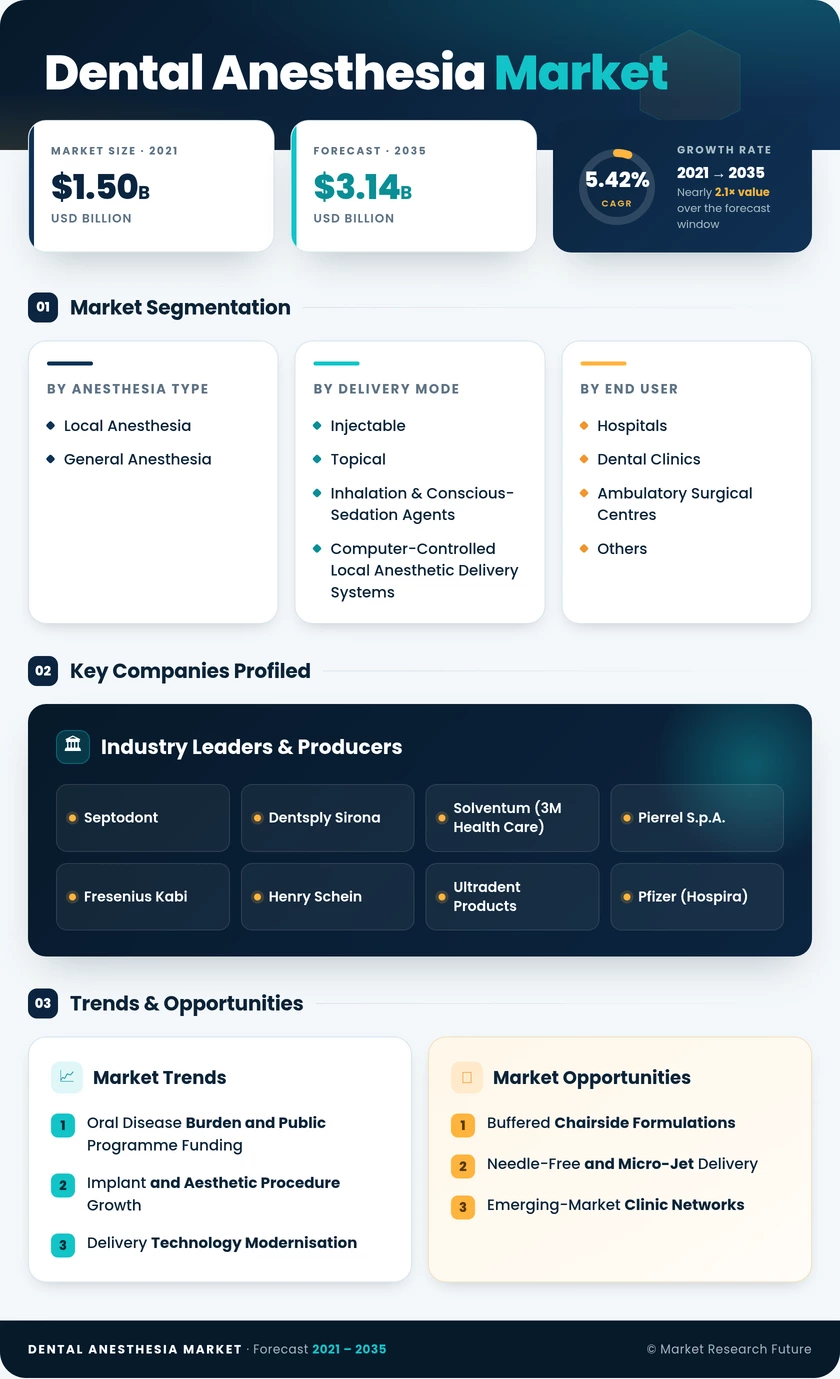
Segmentation Quick Reference
| Dimension | Sub-Segments | Dominant Segment | Fastest Growing Segment |
| By Anesthesia Type | Local Anesthesia; General Anesthesia | Local Anesthesia | General Anesthesia |
| By Delivery Mode | Injectable; Topical; Inhalation & Conscious-Sedation Agents; Computer-Controlled Local Anesthetic Delivery Systems | Injectable | Computer-Controlled Local Anesthetic Delivery Systems |
| By End User | Hospitals; Dental Clinics; Ambulatory Surgical Centres; Others | Dental Clinics | Ambulatory Surgical Centres |
| By Region | North America; Europe; Asia-Pacific; South America; Middle East & Africa | North America | Asia-Pacific |
Market Segmentation Overview
By Anesthesia Type
| Sub-Segment | Key Trend |
| Local Anesthesia | Articaine continues displacing older amides in infiltration technique; buffering accessories gain formulary status |
| General Anesthesia | Growth concentrated in special-needs and complex pediatric programmes delivered through hospital affiliations |
Anesthesia type remains the most stable segmentation axis. Local formulations will hold a clear majority share through 2035, but general anesthesia grows roughly forty percent faster as health systems formalise pathways for patients who cannot tolerate conscious treatment.
By Delivery Mode
| Sub-Segment | Key Trend |
| Injectable | Volume-stable core; competition shifting from molecule to cartridge and needle ergonomics |
| Topical | Steady hygiene-driven demand with formulation innovation around onset speed |
| Inhalation & Conscious-Sedation Agents | Constrained by emissions policy in Europe; substitution toward oral and intravenous routes |
| Computer-Controlled Local Anesthetic Delivery Systems | Fastest adoption curve; increasingly bundled with dosing telemetry and analytics subscriptions |
Delivery mode is where the category's economics are being rewritten. Value is migrating from the anesthetic molecule toward the apparatus that administers it, and vendors without a device or accessory anchor face structural margin compression.
By End User
| Sub-Segment | Key Trend |
| Hospitals | Concentrated in maxillofacial surgery and medically complex caseloads |
| Dental Clinics | Group-practice consolidation centralises formulary decisions and compresses unit pricing |
| Ambulatory Surgical Centres | Case migration from inpatient theatres drives the strongest growth of any channel |
| Others | Academic, military, and community dental services provide stable baseline demand |
End-user dynamics increasingly determine pricing power. Clinics deliver volume but negotiate hardest through consolidated buying groups, while ambulatory surgical centres offer smaller volumes at healthier realised margins.
By Region
| Sub-Segment | Key Trend |
| North America | Formulary consolidation through dental service organisations; Canadian coverage expansion |
| Europe | Green procurement criteria reshaping sedation product mix |
| Asia-Pacific | Clinic-chain scaling and domestic cartridge manufacturing build-out |
| South America | Public restorative programmes sustaining volume despite currency volatility |
| Middle East & Africa | Privatisation of outpatient care and tightening registration requirements |
Geographic strategy now hinges on registration timing rather than distribution reach. Suppliers that complete dossier work ahead of tender cycles in Gulf and Southeast Asian markets consistently outperform those entering after price benchmarks are set.


 Noah Malgeri
Co-Founder

 Peter Groot koerkamp
Account and Business Manager

 Younghwan Choi
Senior Retail Manager

 Mark Irwin
Management Consultant

 Akif Moroglu
Strategy & Business Development Director

 Guilherme Gomes Martins
Product Management Director

 Joseph Aguayo
Sales Operations & Pricing Manager

 La Terria Dodd
Program Support Specialist

 Rob Kooiker
Group Product Manager HVAC & Fire Protection GMA