
×
Hero Background
English
Chinese
French
Japanese
Korean
German
Spanish

Decoy Flares Market Share

ID: MRFR/AD/10278-HCR
128 Pages
Sejal Akre
October 2025

Decoy Flares Market Research Report Information By Type (Pyrotechnic Flares, Pyrophoric Flares, and Others), By Application (Fixed Wing and Rotary Wing), and By Region (North America, Europe, Asia-Pacific, and Rest Of The World) – Market Forecast Till 2035

Share:
Download PDF ×

We do not share your information with anyone. However, we may send you emails based on your report interest from time to time. You may contact us at any time to opt-out.

Decoy Flares Market Infographic
Purchase Options

Market Share

Decoy Flares Market Share Analysis

In the competitive landscape of the Decoy Flares market, companies are strategically positioning themselves to cater to the growing demand for effective countermeasure solutions against infrared-guided missiles and threats. Decoy flares serve as crucial defensive tools deployed by military aircraft, helicopters, and other platforms to divert incoming heat-seeking missiles away from the host vehicle, ensuring the safety of personnel and mission success.

One key strategy within this market is differentiation. Companies aim to differentiate their decoy flares by offering unique features, performance characteristics, and specialized formulations tailored to specific mission requirements and threat scenarios. This could involve developing flares with varying burn durations, spectral signatures, and deployment mechanisms optimized for different types of aircraft and operating environments. By providing decoy flares with distinct advantages over competitors, such as longer burn times or enhanced spectral properties, companies can attract customers seeking reliable and effective countermeasures, thereby gaining a competitive edge and increasing their market share.

Pricing strategies also play a significant role in market share positioning within the Decoy Flares market. Some companies may adopt a cost leadership approach, aiming to capture market share by offering their flares at competitive prices compared to rival products. This strategy can be particularly effective in segments where cost-conscious military agencies prioritize affordability without compromising on flare performance or reliability. Conversely, other companies may pursue premium pricing, positioning themselves as providers of high-quality decoy flares with advanced features, such as multi-spectral capabilities or longer shelf life. While this approach may limit market share in terms of volume, it can lead to higher profit margins and revenue from customers valuing top-tier decoy flare technology for critical missions.

Additionally, distribution strategies are crucial for expanding market reach and capturing a larger share of the Decoy Flares market. Companies may establish strategic partnerships with defense contractors, aerospace manufacturers, and military procurement agencies to ensure widespread availability and adoption of their flare solutions. Moreover, investing in efficient distribution networks, logistics infrastructure, and supply chain management can enhance accessibility and timely delivery of decoy flares to military customers worldwide. By optimizing distribution channels and providing seamless access to their products, companies can increase their market share and establish a strong presence in the decoy flare market.

Marketing and branding efforts also play a vital role in market share positioning within the Decoy Flares market. Companies invest in targeted marketing campaigns to raise awareness of their brand and flare offerings among military decision-makers, defense contractors, and aerospace industry stakeholders. This may involve showcasing the effectiveness, reliability, and versatility of decoy flares through demonstrations, case studies, and testimonials. Additionally, participating in defense trade shows, aerospace exhibitions, and industry conferences can provide opportunities to showcase new products, network with key stakeholders, and build partnerships. By effectively communicating the value proposition of their flare solutions and building a reputable brand image, companies can enhance their market share and competitiveness in the decoy flare market.

Furthermore, continuous innovation is essential for maintaining market share positioning and driving growth in the Decoy Flares market. Companies must invest in research and development to develop next-generation flare technologies, improve spectral performance, increase resistance to countermeasures, and address evolving missile threats and tactics. By staying at the forefront of technological advancements and offering innovative flare solutions, companies can attract new customers, retain existing ones, and solidify their market share in this dynamic and competitive sector.

Author
Sejal Akre
Senior Research Analyst

She has over 5 years of rich experience, in market research and consulting providing valuable market insights to client. Hands on expertise in management consulting, and extensive knowledge in domain including ICT, Automotive & Transportation and Aerospace & Defense. She is skilled in Go-to market strategy, industry analysis, market sizing, in depth company profiling, competitive intelligence & benchmarking and value chain amongst others.

Leave a Comment

FAQs

What is the current valuation of the Decoy Flares Market as of 2024?

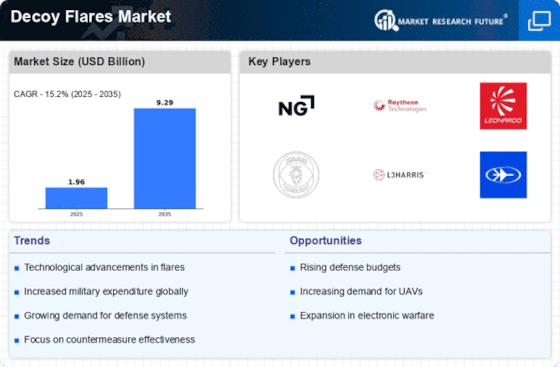
The Decoy Flares Market was valued at 1.958 USD Billion in 2024.

What is the projected market valuation for the Decoy Flares Market in 2035?

The market is projected to reach a valuation of 9.289 USD Billion by 2035.

What is the expected CAGR for the Decoy Flares Market during the forecast period 2025 - 2035?

The expected CAGR for the Decoy Flares Market during 2025 - 2035 is 15.2%.

Which companies are considered key players in the Decoy Flares Market?

Key players in the market include Northrop Grumman, Raytheon Technologies, Leonardo S.p.A., Saab AB, L3Harris Technologies, Rafael Advanced Defense Systems, Boeing, Thales Group, and General Dynamics.

What are the main types of decoy flares in the market?

The main types of decoy flares in the market are Pyrotechnic Flares, Pyrophoric Flares, and Others.

What was the market size for Pyrotechnic Flares in 2024?

The market size for Pyrotechnic Flares was 0.879 USD Billion in 2024.

Market Summary

As per MRFR analysis, the Decoy Flares Market Size was estimated at 1.958 USD Billion in 2024. The Decoy Flares industry is projected to grow from 2.256 USD Billion in 2025 to 9.289 USD Billion by 2035, exhibiting a compound annual growth rate (CAGR) of 15.2 during the forecast period 2025 - 2035.

Key Market Trends & Highlights

The Decoy Flares Market is poised for growth driven by technological advancements and increasing military expenditure.

  • North America remains the largest market for decoy flares, driven by substantial military investments.
  • Asia-Pacific is emerging as the fastest-growing region, reflecting heightened defense spending and geopolitical tensions.
  • Pyrotechnic flares dominate the market, while pyrophoric flares are witnessing rapid growth due to technological innovations.
  • Rising military expenditure and emerging threats are key drivers propelling demand across both fixed wing and rotary wing segments.

Market Size & Forecast

2024 Market Size 1.958 (USD Billion)
2035 Market Size 9.289 (USD Billion)
CAGR (2025 - 2035) 15.2%
Largest Regional Market Share in 2024 North America

Major Players

<p>Northrop Grumman (US), Raytheon Technologies (US), Leonardo S.p.A. (IT), Saab AB (SE), L3Harris Technologies (US), Rafael Advanced Defense Systems (IL), Boeing (US), Thales Group (FR), General Dynamics (US)</p>

Market Trends

The Decoy Flares Market is currently experiencing a dynamic evolution, driven by advancements in military technology and increasing defense budgets across various nations. The demand for effective countermeasures against heat-seeking missiles has prompted manufacturers to innovate and enhance the performance of decoy flares. This market appears to be influenced by geopolitical tensions, which often lead to heightened military preparedness and investment in defense systems. As nations prioritize their security, the integration of advanced decoy systems into military operations is likely to expand, reflecting a broader trend towards modernization in defense strategies. Moreover, the Decoy Flares Market seems to be benefiting from collaborations between defense contractors and government agencies. These partnerships facilitate the development of tailored solutions that meet specific operational requirements. Additionally, the growing emphasis on unmanned aerial vehicles (UAVs) and their associated defense mechanisms may further stimulate market growth. As the landscape of warfare evolves, the role of decoy flares in protecting assets and personnel becomes increasingly critical, suggesting a robust future for this sector.

Technological Advancements

The Decoy Flares Market is witnessing a surge in technological innovations aimed at enhancing the effectiveness of countermeasures. Manufacturers are focusing on developing flares that offer improved thermal signatures and longer burn times, which could potentially increase their efficacy against modern missile systems.

Geopolitical Influences

Ongoing geopolitical tensions appear to be a driving force behind the demand for decoy flares. Nations are likely to invest more in defense capabilities, leading to an increased focus on acquiring advanced decoy systems to protect military assets from emerging threats.

Integration with UAVs

The growing utilization of unmanned aerial vehicles in military operations may lead to a heightened demand for decoy flares. As UAVs become more prevalent, the need for effective defensive measures, including decoy systems, is expected to rise, indicating a potential shift in market dynamics.

Decoy Flares Market Market Drivers

Rising Military Expenditure

The Decoy Flares Market is experiencing growth due to increasing military budgets across various nations. Countries are investing heavily in defense capabilities, which includes advanced countermeasure systems. According to recent data, military spending has seen a consistent rise, with an estimated increase of 3.5% annually. This trend indicates a heightened focus on enhancing aerial defense mechanisms, where decoy flares play a crucial role in protecting aircraft from heat-seeking missiles. As nations prioritize modernization of their armed forces, the demand for decoy flares is likely to surge, thereby driving the market forward.

Emerging Threats and Conflicts

The Decoy Flares Market is significantly influenced by the emergence of new threats and ongoing conflicts. As geopolitical tensions escalate, military forces are compelled to enhance their defensive strategies. The proliferation of advanced missile technology poses a substantial risk to aerial operations, necessitating the use of decoy flares as a countermeasure. Recent assessments indicate that regions experiencing conflict are increasingly adopting sophisticated defense systems, which include decoy flares. This trend suggests that the market will continue to expand as military organizations seek effective solutions to counteract evolving threats.

Increased Demand from Civil Aviation

The Decoy Flares Market is also benefiting from a rising demand in the civil aviation sector. As commercial airlines seek to enhance safety measures against potential missile threats, the adoption of decoy flares is becoming more common. Regulatory bodies are increasingly advocating for the implementation of such countermeasures, particularly in regions with heightened risks. Recent statistics suggest that the civil aviation sector is projected to grow at a rate of 4% annually, which may lead to a corresponding increase in the demand for decoy flares. This trend indicates a diversification of the market beyond traditional military applications.

Strategic Partnerships and Collaborations

Strategic partnerships within the Decoy Flares Market are emerging as a key driver of growth. Collaborations between defense contractors and technology firms are fostering innovation and enhancing product offerings. These alliances enable companies to leverage each other's strengths, resulting in the development of advanced decoy systems that meet the evolving needs of military clients. Recent trends indicate that such partnerships are becoming more common, as firms aim to combine expertise in materials science and defense technology. This collaborative approach is likely to accelerate market growth and improve the competitive landscape.

Technological Innovations in Countermeasures

Technological advancements are a pivotal driver in the Decoy Flares Market. Innovations in materials and design have led to the development of more effective and reliable decoy flares. These advancements not only enhance performance but also improve the cost-effectiveness of production. The integration of smart technologies into decoy systems is becoming more prevalent, allowing for better targeting and deployment strategies. As a result, the market is witnessing a shift towards high-tech solutions that can adapt to various combat scenarios. This evolution in technology is likely to attract investment and stimulate growth within the industry.

Market Segment Insights

By Type: Pyrotechnic Flares (Largest) vs. Pyrophoric Flares (Fastest-Growing)

<p>In the Decoy Flares Market, the distribution of share among 'Pyrotechnic Flares' and 'Pyrophoric Flares' reflects their respective positions in the defense and military applications. Pyrotechnic flares hold the largest share due to their longstanding application and reliability in various scenarios, especially in aerial operations. In contrast, while 'Others' signify niche products, they do not significantly impact the overall market share compared to pyrotechnic and pyrophoric alternatives. The growth trends indicate that 'Pyrophoric Flares' are rapidly gaining traction, primarily driven by advancements in materials and technology which enhance their effectiveness and ease of use. The increasing demand for innovative decoy systems in both military and civilian applications fuels this segment's growth. As nations upgrade their defense capabilities, the shift towards more efficient and stealthy flare technologies signals a promising future for pyrophoric flares.</p>

<p>Decoy Flares Market: Pyrotechnic (Dominant) vs. Pyrophoric (Emerging)</p>

<p>The market characteristics of the 'Pyrotechnic Flares' segment demonstrate its dominance in the Decoy Flares Market, attributed to its reliability and proven performance across various military applications. Often used to mislead heat-seeking and infrared-guided missiles, these flares provide a robust defense mechanism, ensuring safety in aerial operations. On the other hand, the 'Pyrophoric Flares' segment is rapidly emerging due to advancements in pyrophoric technology that enhance the flare's efficiency and effectiveness. These flares burn longer and can be deployed silently, which is particularly attractive in modern warfare scenarios. As a result, both segments hold significant importance, with pyrotechnic flares being a trusted choice and pyrophoric flares on the rise as an innovative alternative.</p>

By Application: Fixed Wing (Largest) vs. Rotary Wing (Fastest-Growing)

<p>In the Decoy Flares Market, the 'Application' segment is divided into fixed wing and rotary wing applications. Fixed wing platforms hold the largest market share, primarily because of their extensive deployment in military and defense operations. These aircraft are preferred for their range and capacity to carry multiple decoys, resulting in a significant portion of the market being allocated to fixed wing applications. Conversely, rotary wing applications are gaining traction, representing the fastest-growing segment as they become more integral in various tactical operations, including reconnaissance and close air support. The growth trends within the application segment reflect an increasing demand for advanced decoy flare systems tailored for both fixed and rotary wing aircraft. Factors contributing to this growth include heightened defense budgets across several nations, driven by geopolitical tensions and military modernization programs. Additionally, the evolving battlefield environment necessitates a shift towards versatile and agile air support solutions, propelling rotary wing applications to the forefront as they adapt to meet contemporary operational requirements.</p>

<p>Application: Fixed Wing (Dominant) vs. Rotary Wing (Emerging)</p>

<p>The Fixed Wing application segment is characterized by its longstanding dominance in the Decoy Flares Market, leveraging established technologies and extensive operational platforms. These aircraft, such as fighter jets and bombers, can carry a wide array of decoy flares, enhancing their survivability against sophisticated missile threats. The segment benefits from robust supply chain networks and widespread military adoption. In contrast, the Rotary Wing application segment is emerging rapidly, showcasing versatility in combat operations involving helicopters and UAVs. This segment's growth is fueled by innovations in decoy technology that enhance effectiveness in diverse scenarios, including low-altitude engagements. As military strategies evolve, rotary wing platforms are increasingly recognized for their strategic advantages, leading to a noteworthy rise in market interest and investment.</p>

Get more detailed insights about Decoy Flares Market Research Report—Global Forecast till 2035

Regional Insights

North America : Defense Innovation Leader

North America is the largest market for decoy flares, accounting for approximately 45% of the global share. The region's growth is driven by increasing defense budgets, technological advancements, and a focus on enhancing military capabilities. Regulatory support from government agencies, including the Department of Defense, further catalyzes market expansion. The rising geopolitical tensions also contribute to the heightened demand for advanced defense systems. The United States is the leading country in this market, with major players like Northrop Grumman, Raytheon Technologies, and Boeing dominating the landscape. The competitive environment is characterized by continuous innovation and strategic partnerships among key players. Canada also plays a significant role, contributing to the regional market with its defense initiatives and collaborations with U.S. firms.

Europe : Emerging Defense Market

Europe is witnessing a significant increase in the demand for decoy flares, holding approximately 30% of the global market share. The growth is fueled by rising defense budgets across NATO countries and a focus on enhancing air defense capabilities. Regulatory frameworks, such as the European Defense Fund, are encouraging collaboration among member states to develop advanced military technologies, including decoy systems. Leading countries in this region include the United Kingdom, France, and Germany, where key players like Thales Group and Leonardo S.p.A. are actively involved in the market. The competitive landscape is marked by partnerships and joint ventures aimed at innovation and efficiency. The presence of established defense contractors and a growing emphasis on indigenous production capabilities further strengthen the market position in Europe.

Asia-Pacific : Rapidly Growing Defense Sector

Asia-Pacific is emerging as a significant player in the decoy flares market, accounting for around 20% of the global share. The region's growth is driven by escalating military expenditures, particularly in countries like India and Japan, as they enhance their defense capabilities amid regional tensions. Government initiatives aimed at modernizing armed forces and acquiring advanced technologies are key regulatory catalysts for market growth. China and India are the leading countries in this market, with a growing presence of local manufacturers and international collaborations. The competitive landscape is evolving, with companies like Saab AB and Rafael Advanced Defense Systems looking to expand their footprint in the region. The increasing focus on indigenous production and technology transfer agreements is shaping the market dynamics in Asia-Pacific.

Middle East and Africa : Strategic Defense Investments

The Middle East and Africa region is witnessing a gradual increase in the demand for decoy flares, holding approximately 5% of the global market share. The growth is primarily driven by ongoing regional conflicts and the need for enhanced defense capabilities. Countries are investing in advanced military technologies to ensure national security, supported by various government initiatives and international collaborations. Key players in this region include local defense contractors and international firms looking to establish a presence. Countries like Saudi Arabia and the UAE are leading the market, focusing on modernizing their armed forces. The competitive landscape is characterized by partnerships with global defense companies, aiming to enhance local production capabilities and reduce dependency on foreign suppliers.

Key Players and Competitive Insights

Leading market players are investing heavily in research and development in order to expand their product lines, which will help the Decoy Flares Market, grow even more. Market participants are also undertaking a variety of strategic activities to expand their global footprint, with important market developments including new product launches, contractual agreements, mergers and acquisitions, higher investments, and collaboration with other organizations. To expand and survive in a more competitive and rising market climate, Decoy Flares industry must offer cost-effective items.

Manufacturing locally to minimize operational costs is one of the key business tactics used by manufacturers in the global Decoy Flares industry to benefit clients and increase the market sector. In recent years, the Decoy Flares industry has offered some of the most significant advantages to medicine. Major players in the Decoy Flares Market, including Armtec Defense Technologies, Mil-Spec Industries Corporation, LACROIX, Ordtech, Owen International, Premier Explosives Limited, Rheinmetall AG, Rosoboronexport, Elbit Systems Ltd., and TARA Aerospace AD, are attempting to increase market demand by investing in research and development operations.

Manufacturer of aerospace and defense goods is Northrop Grumman Corp (Northrop Grumman). Unmanned systems, aircraft, autonomous systems, cybersecurity, command, control, communications, computers, intelligence, surveillance, and reconnaissance (C4ISR), logistics, and modernization services are all included in the company's product range. The aerospace, defense, electronics, and information systems industries can all benefit from Northrop Grumman's solutions. It produces wireless communication infrastructure, mission-critical computer systems, spacecraft systems, and acoustic sensors for aircraft carriers and submarines. The business provides goods and services to commercial clients in North America, Europe, and Asia-Pacific as well as to international, state, and local governments.

Falls Church, Virginia, in the United States, serves as the company's headquarters. The U.S. Air Force awarded Northrop Grumman Corporation (U.S.) a contract of US$ 355 million in October 2018 to create new flares for the F-35 Lightning II aircraft.

Defense contractor and systems integrator BAE Systems Plc (BAE). The business offers solutions for air, land, and maritime security, aerospace, and defense. Advanced electronics, cybersecurity, and intelligence products are among BAE's offerings, along with information technology solutions and support services. Military aircraft, space systems, surface ships, submarines, avionics, radars, command, control, communications, computers, intelligence, surveillance, and reconnaissance (C4ISR) systems, electronic systems, torpedoes, and guided missile systems are all products that the firm develops, produces, and sells. Both the government and business clients are served.

The corporation has operations throughout Central and South America, Africa, the Middle East, North America, and Asia-Pacific. London, England serves as the home base for BAE. The U.S. Navy granted BAE Systems a contract worth US$36.7 million in 2019 to create and test a dual band, next-generation Fiber-Optic Towed Decoy (FOTD) that will shield pilots and aircraft from cutting-edge threats.

Key Companies in the Decoy Flares Market market include

Industry Developments

March 2019 Esterline Technologies Corporation was purchased by TransDigm Group Incorporated for USD 3.9 billion.

September 2019 US Navy and US Air Force have awarded Chemring Group PLC a contract worth USD 8.1 million to supply MJU-66 flares under a three-year Indefinite Delivery/Indefinite Quantity (IDIQ) agreement.

September 2018 Orbital ATK, Inc. was fully acquired by Northrop Grumman Corporation. The product portfolio of Northrop Grumman in the decoy flares industry is anticipated to grow as a result of this acquisition.

Future Outlook

Decoy Flares Market Future Outlook

<p>The Decoy Flares Market is projected to grow at a 15.2% CAGR from 2024 to 2035, driven by advancements in military technology and increasing defense budgets.</p>

New opportunities lie in:

  • <p>Development of multi-spectral decoy flares for enhanced effectiveness.</p>
  • <p>Expansion into emerging markets with tailored product offerings.</p>
  • <p>Partnerships with defense contractors for integrated defense solutions.</p>

<p>By 2035, the Decoy Flares Market is expected to achieve substantial growth and innovation.</p>

Market Segmentation

Decoy Flares Market Type Outlook

  • Pyrotechnic Flares
  • Pyrophoric Flares
  • Others

Decoy Flares Market Application Outlook

  • Fixed Wing
  • Rotary Wing

Report Scope

MARKET SIZE 20241.958(USD Billion)
MARKET SIZE 20252.256(USD Billion)
MARKET SIZE 20359.289(USD Billion)
COMPOUND ANNUAL GROWTH RATE (CAGR)15.2% (2024 - 2035)
REPORT COVERAGERevenue Forecast, Competitive Landscape, Growth Factors, and Trends
BASE YEAR2024
Market Forecast Period2025 - 2035
Historical Data2019 - 2024
Market Forecast UnitsUSD Billion
Key Companies ProfiledMarket analysis in progress
Segments CoveredMarket segmentation analysis in progress
Key Market OpportunitiesAdvancements in countermeasure technologies drive growth in the Decoy Flares Market.
Key Market DynamicsRising demand for advanced decoy flares driven by evolving military tactics and technological advancements in defense systems.
Countries CoveredNorth America, Europe, APAC, South America, MEA

FAQs

What is the current valuation of the Decoy Flares Market as of 2024?

The Decoy Flares Market was valued at 1.958 USD Billion in 2024.

What is the projected market valuation for the Decoy Flares Market in 2035?

The market is projected to reach a valuation of 9.289 USD Billion by 2035.

What is the expected CAGR for the Decoy Flares Market during the forecast period 2025 - 2035?

The expected CAGR for the Decoy Flares Market during 2025 - 2035 is 15.2%.

Which companies are considered key players in the Decoy Flares Market?

Key players in the market include Northrop Grumman, Raytheon Technologies, Leonardo S.p.A., Saab AB, L3Harris Technologies, Rafael Advanced Defense Systems, Boeing, Thales Group, and General Dynamics.

What are the main types of decoy flares in the market?

The main types of decoy flares in the market are Pyrotechnic Flares, Pyrophoric Flares, and Others.

What was the market size for Pyrotechnic Flares in 2024?

The market size for Pyrotechnic Flares was 0.879 USD Billion in 2024.

  1. SECTION I: EXECUTIVE SUMMARY AND KEY HIGHLIGHTS
    1. EXECUTIVE SUMMARY
      1. Market Overview
      2. Key Findings
      3. Market Segmentation
      4. Competitive Landscape
      5. Challenges and Opportunities
      6. Future Outlook
  2. SECTION II: SCOPING, METHODOLOGY AND MARKET STRUCTURE
    1. MARKET INTRODUCTION
      1. Definition
      2. Scope of the study
    2. RESEARCH METHODOLOGY
      1. Overview
      2. Data Mining
      3. Secondary Research
      4. Primary Research
      5. Forecasting Model
      6. Market Size Estimation
      7. Data Triangulation
      8. Validation
  3. SECTION III: QUALITATIVE ANALYSIS
    1. MARKET DYNAMICS
      1. Overview
      2. Drivers
      3. Restraints
      4. Opportunities
    2. MARKET FACTOR ANALYSIS
      1. Value chain Analysis
      2. Porter's Five Forces Analysis
      3. COVID-19 Impact Analysis
  4. SECTION IV: QUANTITATIVE ANALYSIS
    1. Aerospace & Defense, BY Type (USD Billion)
      1. Pyrotechnic Flares
      2. Pyrophoric Flares
      3. Others
    2. Aerospace & Defense, BY Application (USD Billion)
      1. Fixed Wing
      2. Rotary Wing
    3. Aerospace & Defense, BY Region (USD Billion)
      1. North America
      2. Europe
      3. APAC
      4. South America
      5. MEA
  5. SECTION V: COMPETITIVE ANALYSIS
    1. Competitive Landscape
      1. Overview
      2. Competitive Analysis
      3. Market share Analysis
      4. Major Growth Strategy in the Aerospace & Defense
      5. Competitive Benchmarking
      6. Leading Players in Terms of Number of Developments in the Aerospace & Defense
      7. Key developments and growth strategies
      8. Major Players Financial Matrix
    2. Company Profiles
      1. Northrop Grumman (US)
      2. Raytheon Technologies (US)
      3. Leonardo S.p.A. (IT)
      4. Saab AB (SE)
      5. L3Harris Technologies (US)
      6. Rafael Advanced Defense Systems (IL)
      7. Boeing (US)
      8. Thales Group (FR)
      9. General Dynamics (US)
    3. Appendix
      1. References
      2. Related Reports
  6. LIST OF FIGURES
    1. MARKET SYNOPSIS
    2. NORTH AMERICA MARKET ANALYSIS
    3. US MARKET ANALYSIS BY TYPE
    4. US MARKET ANALYSIS BY APPLICATION
    5. CANADA MARKET ANALYSIS BY TYPE
    6. CANADA MARKET ANALYSIS BY APPLICATION
    7. EUROPE MARKET ANALYSIS
    8. GERMANY MARKET ANALYSIS BY TYPE
    9. GERMANY MARKET ANALYSIS BY APPLICATION
    10. UK MARKET ANALYSIS BY TYPE
    11. UK MARKET ANALYSIS BY APPLICATION
    12. FRANCE MARKET ANALYSIS BY TYPE
    13. FRANCE MARKET ANALYSIS BY APPLICATION
    14. RUSSIA MARKET ANALYSIS BY TYPE
    15. RUSSIA MARKET ANALYSIS BY APPLICATION
    16. ITALY MARKET ANALYSIS BY TYPE
    17. ITALY MARKET ANALYSIS BY APPLICATION
    18. SPAIN MARKET ANALYSIS BY TYPE
    19. SPAIN MARKET ANALYSIS BY APPLICATION
    20. REST OF EUROPE MARKET ANALYSIS BY TYPE
    21. REST OF EUROPE MARKET ANALYSIS BY APPLICATION
    22. APAC MARKET ANALYSIS
    23. CHINA MARKET ANALYSIS BY TYPE
    24. CHINA MARKET ANALYSIS BY APPLICATION
    25. INDIA MARKET ANALYSIS BY TYPE
    26. INDIA MARKET ANALYSIS BY APPLICATION
    27. JAPAN MARKET ANALYSIS BY TYPE
    28. JAPAN MARKET ANALYSIS BY APPLICATION
    29. SOUTH KOREA MARKET ANALYSIS BY TYPE
    30. SOUTH KOREA MARKET ANALYSIS BY APPLICATION
    31. MALAYSIA MARKET ANALYSIS BY TYPE
    32. MALAYSIA MARKET ANALYSIS BY APPLICATION
    33. THAILAND MARKET ANALYSIS BY TYPE
    34. THAILAND MARKET ANALYSIS BY APPLICATION
    35. INDONESIA MARKET ANALYSIS BY TYPE
    36. INDONESIA MARKET ANALYSIS BY APPLICATION
    37. REST OF APAC MARKET ANALYSIS BY TYPE
    38. REST OF APAC MARKET ANALYSIS BY APPLICATION
    39. SOUTH AMERICA MARKET ANALYSIS
    40. BRAZIL MARKET ANALYSIS BY TYPE
    41. BRAZIL MARKET ANALYSIS BY APPLICATION
    42. MEXICO MARKET ANALYSIS BY TYPE
    43. MEXICO MARKET ANALYSIS BY APPLICATION
    44. ARGENTINA MARKET ANALYSIS BY TYPE
    45. ARGENTINA MARKET ANALYSIS BY APPLICATION
    46. REST OF SOUTH AMERICA MARKET ANALYSIS BY TYPE
    47. REST OF SOUTH AMERICA MARKET ANALYSIS BY APPLICATION
    48. MEA MARKET ANALYSIS
    49. GCC COUNTRIES MARKET ANALYSIS BY TYPE
    50. GCC COUNTRIES MARKET ANALYSIS BY APPLICATION
    51. SOUTH AFRICA MARKET ANALYSIS BY TYPE
    52. SOUTH AFRICA MARKET ANALYSIS BY APPLICATION
    53. REST OF MEA MARKET ANALYSIS BY TYPE
    54. REST OF MEA MARKET ANALYSIS BY APPLICATION
    55. KEY BUYING CRITERIA OF AEROSPACE & DEFENSE
    56. RESEARCH PROCESS OF MRFR
    57. DRO ANALYSIS OF AEROSPACE & DEFENSE
    58. DRIVERS IMPACT ANALYSIS: AEROSPACE & DEFENSE
    59. RESTRAINTS IMPACT ANALYSIS: AEROSPACE & DEFENSE
    60. SUPPLY / VALUE CHAIN: AEROSPACE & DEFENSE
    61. AEROSPACE & DEFENSE, BY TYPE, 2024 (% SHARE)
    62. AEROSPACE & DEFENSE, BY TYPE, 2024 TO 2035 (USD Billion)
    63. AEROSPACE & DEFENSE, BY APPLICATION, 2024 (% SHARE)
    64. AEROSPACE & DEFENSE, BY APPLICATION, 2024 TO 2035 (USD Billion)
    65. BENCHMARKING OF MAJOR COMPETITORS
  7. LIST OF TABLES
    1. LIST OF ASSUMPTIONS
    2. North America MARKET SIZE ESTIMATES; FORECAST
      1. BY TYPE, 2025-2035 (USD Billion)
      2. BY APPLICATION, 2025-2035 (USD Billion)
    3. US MARKET SIZE ESTIMATES; FORECAST
      1. BY TYPE, 2025-2035 (USD Billion)
      2. BY APPLICATION, 2025-2035 (USD Billion)
    4. Canada MARKET SIZE ESTIMATES; FORECAST
      1. BY TYPE, 2025-2035 (USD Billion)
      2. BY APPLICATION, 2025-2035 (USD Billion)
    5. Europe MARKET SIZE ESTIMATES; FORECAST
      1. BY TYPE, 2025-2035 (USD Billion)
      2. BY APPLICATION, 2025-2035 (USD Billion)
    6. Germany MARKET SIZE ESTIMATES; FORECAST
      1. BY TYPE, 2025-2035 (USD Billion)
      2. BY APPLICATION, 2025-2035 (USD Billion)
    7. UK MARKET SIZE ESTIMATES; FORECAST
      1. BY TYPE, 2025-2035 (USD Billion)
      2. BY APPLICATION, 2025-2035 (USD Billion)
    8. France MARKET SIZE ESTIMATES; FORECAST
      1. BY TYPE, 2025-2035 (USD Billion)
      2. BY APPLICATION, 2025-2035 (USD Billion)
    9. Russia MARKET SIZE ESTIMATES; FORECAST
      1. BY TYPE, 2025-2035 (USD Billion)
      2. BY APPLICATION, 2025-2035 (USD Billion)
    10. Italy MARKET SIZE ESTIMATES; FORECAST
      1. BY TYPE, 2025-2035 (USD Billion)
      2. BY APPLICATION, 2025-2035 (USD Billion)
    11. Spain MARKET SIZE ESTIMATES; FORECAST
      1. BY TYPE, 2025-2035 (USD Billion)
      2. BY APPLICATION, 2025-2035 (USD Billion)
    12. Rest of Europe MARKET SIZE ESTIMATES; FORECAST
      1. BY TYPE, 2025-2035 (USD Billion)
      2. BY APPLICATION, 2025-2035 (USD Billion)
    13. APAC MARKET SIZE ESTIMATES; FORECAST
      1. BY TYPE, 2025-2035 (USD Billion)
      2. BY APPLICATION, 2025-2035 (USD Billion)
    14. China MARKET SIZE ESTIMATES; FORECAST
      1. BY TYPE, 2025-2035 (USD Billion)
      2. BY APPLICATION, 2025-2035 (USD Billion)
    15. India MARKET SIZE ESTIMATES; FORECAST
      1. BY TYPE, 2025-2035 (USD Billion)
      2. BY APPLICATION, 2025-2035 (USD Billion)
    16. Japan MARKET SIZE ESTIMATES; FORECAST
      1. BY TYPE, 2025-2035 (USD Billion)
      2. BY APPLICATION, 2025-2035 (USD Billion)
    17. South Korea MARKET SIZE ESTIMATES; FORECAST
      1. BY TYPE, 2025-2035 (USD Billion)
      2. BY APPLICATION, 2025-2035 (USD Billion)
    18. Malaysia MARKET SIZE ESTIMATES; FORECAST
      1. BY TYPE, 2025-2035 (USD Billion)
      2. BY APPLICATION, 2025-2035 (USD Billion)
    19. Thailand MARKET SIZE ESTIMATES; FORECAST
      1. BY TYPE, 2025-2035 (USD Billion)
      2. BY APPLICATION, 2025-2035 (USD Billion)
    20. Indonesia MARKET SIZE ESTIMATES; FORECAST
      1. BY TYPE, 2025-2035 (USD Billion)
      2. BY APPLICATION, 2025-2035 (USD Billion)
    21. Rest of APAC MARKET SIZE ESTIMATES; FORECAST
      1. BY TYPE, 2025-2035 (USD Billion)
      2. BY APPLICATION, 2025-2035 (USD Billion)
    22. South America MARKET SIZE ESTIMATES; FORECAST
      1. BY TYPE, 2025-2035 (USD Billion)
      2. BY APPLICATION, 2025-2035 (USD Billion)
    23. Brazil MARKET SIZE ESTIMATES; FORECAST
      1. BY TYPE, 2025-2035 (USD Billion)
      2. BY APPLICATION, 2025-2035 (USD Billion)
    24. Mexico MARKET SIZE ESTIMATES; FORECAST
      1. BY TYPE, 2025-2035 (USD Billion)
      2. BY APPLICATION, 2025-2035 (USD Billion)
    25. Argentina MARKET SIZE ESTIMATES; FORECAST
      1. BY TYPE, 2025-2035 (USD Billion)
      2. BY APPLICATION, 2025-2035 (USD Billion)
    26. Rest of South America MARKET SIZE ESTIMATES; FORECAST
      1. BY TYPE, 2025-2035 (USD Billion)
      2. BY APPLICATION, 2025-2035 (USD Billion)
    27. MEA MARKET SIZE ESTIMATES; FORECAST
      1. BY TYPE, 2025-2035 (USD Billion)
      2. BY APPLICATION, 2025-2035 (USD Billion)
    28. GCC Countries MARKET SIZE ESTIMATES; FORECAST
      1. BY TYPE, 2025-2035 (USD Billion)
      2. BY APPLICATION, 2025-2035 (USD Billion)
    29. South Africa MARKET SIZE ESTIMATES; FORECAST
      1. BY TYPE, 2025-2035 (USD Billion)
      2. BY APPLICATION, 2025-2035 (USD Billion)
    30. Rest of MEA MARKET SIZE ESTIMATES; FORECAST
      1. BY TYPE, 2025-2035 (USD Billion)
      2. BY APPLICATION, 2025-2035 (USD Billion)
    31. PRODUCT LAUNCH/PRODUCT DEVELOPMENT/APPROVAL
    32. ACQUISITION/PARTNERSHIP

Decoy Flares Market Segmentation

Decoy Flares Type Outlook (USD Billion, 2018-2032)

  • Pyrotechnic Flares
  • Pyrophoric Flares
  • Others

Decoy Flares Application Outlook (USD Billion, 2018-2032)

  • Fixed Wing
  • Rotary Wing

Decoy Flares Regional Outlook (USD Billion, 2018-2032)

  • North America Outlook (USD Billion, 2018-2032)

    • Decoy Flares by Type
      • Pyrotechnic Flares
      • Pyrophoric Flares
      • Others
    • Decoy Flares Application Outlook (USD Billion, 2018-2032)

      • Fixed Wing
      • Rotary Wing
    • US Outlook (USD Billion, 2018-2032)

    • Decoy Flares by Type
      • Pyrotechnic Flares
      • Pyrophoric Flares
      • Others
    • Decoy Flares Application Outlook (USD Billion, 2018-2032)

      • Fixed Wing
      • Rotary Wing
    • Canada Outlook (USD Billion, 2018-2032)

    • Decoy Flares by Type
      • Pyrotechnic Flares
      • Pyrophoric Flares
      • Others
    • Decoy Flares Application Outlook (USD Billion, 2018-2032)

      • Fixed Wing
      • Rotary Wing
  • Europe Outlook (USD Billion, 2018-2032)

    • Decoy Flares by Type
      • Pyrotechnic Flares
      • Pyrophoric Flares
      • Others
    • Decoy Flares Application Outlook (USD Billion, 2018-2032)

      • Fixed Wing
      • Rotary Wing
    • Germany Outlook (USD Billion, 2018-2032)

    • Decoy Flares by Type
      • Pyrotechnic Flares
      • Pyrophoric Flares
      • Others
    • Decoy Flares Application Outlook (USD Billion, 2018-2032)

      • Fixed Wing
      • Rotary Wing
    • France Outlook (USD Billion, 2018-2032)

    • Decoy Flares by Type
      • Pyrotechnic Flares
      • Pyrophoric Flares
      • Others
    • Decoy Flares Application Outlook (USD Billion, 2018-2032)

      • Fixed Wing
      • Rotary Wing
    • UK Outlook (USD Billion, 2018-2032)

    • Decoy Flares by Type
      • Pyrotechnic Flares
      • Pyrophoric Flares
      • Others
    • Decoy Flares Application Outlook (USD Billion, 2018-2032)

      • Fixed Wing
      • Rotary Wing
    • Italy Outlook (USD Billion, 2018-2032)

    • Decoy Flares by Type
      • Pyrotechnic Flares
      • Pyrophoric Flares
      • Others
    • Decoy Flares Application Outlook (USD Billion, 2018-2032)

      • Fixed Wing
      • Rotary Wing
    • Spain Outlook (USD Billion, 2018-2032)

    • Decoy Flares by Type
      • Pyrotechnic Flares
      • Pyrophoric Flares
      • Others
    • Decoy Flares Application Outlook (USD Billion, 2018-2032)

      • Fixed Wing
      • Rotary Wing
    • Rest Of Europe Outlook (USD Billion, 2018-2032)

    • Decoy Flares by Type
      • Pyrotechnic Flares
      • Pyrophoric Flares
      • Others
    • Decoy Flares Application Outlook (USD Billion, 2018-2032)

      • Fixed Wing
      • Rotary Wing
  • Asia-Pacific Outlook (USD Billion, 2018-2032)

    • Decoy Flares by Type
      • Pyrotechnic Flares
      • Pyrophoric Flares
      • Others
    • Decoy Flares Application Outlook (USD Billion, 2018-2032)

      • Fixed Wing
      • Rotary Wing
    • China Outlook (USD Billion, 2018-2032)

    • Decoy Flares by Type
      • Pyrotechnic Flares
      • Pyrophoric Flares
      • Others
    • Decoy Flares Application Outlook (USD Billion, 2018-2032)

      • Fixed Wing
      • Rotary Wing
    • Japan Outlook (USD Billion, 2018-2032)

    • Decoy Flares by Type
      • Pyrotechnic Flares
      • Pyrophoric Flares
      • Others
    • Decoy Flares Application Outlook (USD Billion, 2018-2032)

      • Fixed Wing
      • Rotary Wing
    • India Outlook (USD Billion, 2018-2032)

    • Decoy Flares by Type
      • Pyrotechnic Flares
      • Pyrophoric Flares
      • Others
    • Decoy Flares Application Outlook (USD Billion, 2018-2032)

      • Fixed Wing
      • Rotary Wing
    • Australia Outlook (USD Billion, 2018-2032)

    • Decoy Flares by Type
      • Pyrotechnic Flares
      • Pyrophoric Flares
      • Others
    • Decoy Flares Application Outlook (USD Billion, 2018-2032)

      • Fixed Wing
      • Rotary Wing
    • Rest of Asia-Pacific Outlook (USD Billion, 2018-2032)

    • Decoy Flares by Type
      • Pyrotechnic Flares
      • Pyrophoric Flares
      • Others
    • Decoy Flares Application Outlook (USD Billion, 2018-2032)

      • Fixed Wing
      • Rotary Wing
  • Rest of the World Outlook (USD Billion, 2018-2032)

    • Decoy Flares by Type
      • Pyrotechnic Flares
      • Pyrophoric Flares
      • Others
    • Decoy Flares Application Outlook (USD Billion, 2018-2032)

      • Fixed Wing
      • Rotary Wing
    • Middle East Outlook (USD Billion, 2018-2032)

    • Decoy Flares by Type
      • Pyrotechnic Flares
      • Pyrophoric Flares
      • Others
    • Decoy Flares Application Outlook (USD Billion, 2018-2032)

      • Fixed Wing
      • Rotary Wing
    • Africa Outlook (USD Billion, 2018-2032)

    • Decoy Flares by Type
      • Pyrotechnic Flares
      • Pyrophoric Flares
      • Others
    • Decoy Flares Application Outlook (USD Billion, 2018-2032)

      • Fixed Wing
      • Rotary Wing
    • Latin America Outlook (USD Billion, 2018-2032)

    • Decoy Flares by Type
      • Pyrotechnic Flares
      • Pyrophoric Flares
      • Others
    • Decoy Flares Application Outlook (USD Billion, 2018-2032)

      • Fixed Wing
      • Rotary Wing


Infographic

Free Sample Request

Kindly complete the form below to receive a free sample of this Report

Get Free Sample

Customer Strories

Compare Licence

×
Features License Type
Single User Multiuser License Enterprise User
Price $4,950 $5,950 $7,250
Maximum User Access Limit 1 User Upto 10 Users Unrestricted Access Throughout the Organization
Free Customization
Direct Access to Analyst
Deliverable Format
Platform Access
Discount on Next Purchase 10% 15% 15%
Printable Versions