
Request Free Sample ×

Kindly complete the form below to receive a free sample of this Report

* Please use a valid business email

Leading companies partner with us for data-driven Insights

clients tt-cursor
Hero Background
English
Chinese
French
Japanese
Korean
German
Spanish

Data Recovery Software Market Analysis

ID: MRFR/ICT/4284-HCR
100 Pages
Aarti Dhapte
December 2024

Data Recovery Software Market Research Report – By Component (Software, Service), Deployment (On-Premise, On-Cloud), Application (Commercial, Personal), Platform (Windows, Linux, Mac), Industry (Bfsi, Healthcare) – Forecast Till 2035

Share:
Download PDF ×

We do not share your information with anyone. However, we may send you emails based on your report interest from time to time. You may contact us at any time to opt-out.

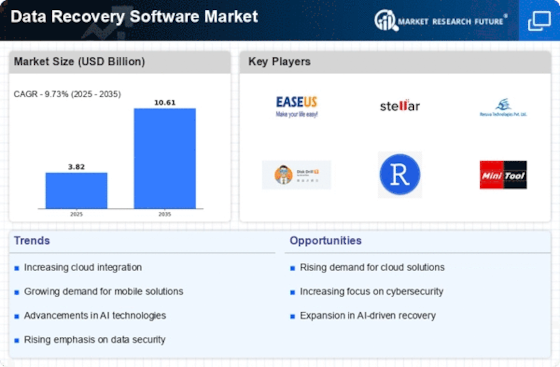
Data Recovery Software Market Infographic
Purchase Options

Market Analysis

In-depth Analysis of Data Recovery Software Market Industry Landscape

In today's market, companies are required to provide better and smarter solutions for recovering lost or deleted data for both individuals and businesses. The goal is to offer advanced versions of data recovery software that can effectively recover data even in cases of truncated, corrupted, or broken videos. These advanced software solutions stand out from traditional ones because they are more functional and efficient.

The increasing number of computers falling prey to viruses has become a significant concern. As a result, various effective and beneficial technologies are emerging to shield these devices from virus attacks. The focus is on developing solutions that not only recover lost data but also prevent potential threats, ensuring the security and integrity of individuals' and enterprises' information.

The market demands companies to innovate and provide data recovery solutions that go beyond the basic functionalities. Advanced versions of data recovery software are designed to address more complex issues, such as recovering data from videos that may have been truncated or corrupted. This capability is crucial for individuals and businesses who rely on multimedia content and need to ensure the integrity of their files.

When we talk about advanced data recovery software, it's essential to understand how it differs from traditional software. The key distinction lies in functionality and effectiveness. Advanced software is equipped with more sophisticated features and capabilities, offering a higher level of performance compared to traditional counterparts. This is particularly important in the ever-evolving landscape of technology where the challenges faced by users are becoming more intricate.

In the current scenario, a large number of PCs are falling victim to viruses, posing a threat to the data stored on these devices. To combat this issue, innovative technologies are taking the forefront, aiming to provide robust protection against virus attacks. These technologies are not only about recovering data after an attack but also about preventing such attacks in the first place.

The need for more advanced data recovery solutions arises from the evolving nature of threats and challenges faced by users. Traditional recovery software may fall short in addressing the complexities of modern data loss scenarios. Therefore, companies are compelled to develop and offer solutions that are not only more efficient but also more versatile in handling a variety of data recovery situations.

The emphasis on truncated, corrupted, and broken video repair highlights the changing landscape of data recovery needs. Multimedia content has become an integral part of our digital lives, and its loss or corruption can have significant implications. Advanced data recovery software recognizes this need and incorporates features that specifically target the recovery of multimedia files, ensuring that users can regain access to their important videos without loss of quality.

The market demands companies to step up their game in providing advanced and efficient data recovery solutions. The evolving challenges, especially in the face of virus attacks, require innovative approaches to not only recover lost data but also prevent potential threats. Advanced data recovery software, with its enhanced functionality and effectiveness, stands as a crucial tool in addressing the complexities of modern data loss scenarios. As technology continues to progress, companies will need to stay ahead of the curve to meet the ever-growing demands of individuals and enterprises for robust data recovery solutions.


Author
Author Profile
Aarti Dhapte
AVP - Research

A consulting professional focused on helping businesses navigate complex markets through structured research and strategic insights. I partner with clients to solve high-impact business problems across market entry strategy, competitive intelligence, and opportunity assessment. Over the course of my experience, I have led and contributed to 100+ market research and consulting engagements, delivering insights across multiple industries and geographies, and supporting strategic decisions linked to $500M+ market opportunities. My core expertise lies in building robust market sizing, forecasting, and commercial models (top-down and bottom-up), alongside deep-dive competitive and industry analysis. I have played a key role in shaping go-to-market strategies, investment cases, and growth roadmaps, enabling clients to make confident, data-backed decisions in dynamic markets.

Leave a Comment

FAQs

What is the current valuation of the Data Recovery Software Market in 2024?

<p>The Data Recovery Software Market was valued at 3.82 USD Billion in 2024.</p>

What is the projected market size for the Data Recovery Software Market by 2035?

<p>The market is projected to reach 10.61 USD Billion by 2035.</p>

What is the expected CAGR for the Data Recovery Software Market during the forecast period 2025 - 2035?

<p>The expected CAGR for the Data Recovery Software Market during 2025 - 2035 is 9.73%.</p>

Which segment of the Data Recovery Software Market had the highest valuation in 2024?

<p>In 2024, the Software segment had the highest valuation at 2.29 USD Billion.</p>

How does the On-Cloud deployment segment compare to On-Premise in terms of valuation?

<p>The On-Cloud deployment segment was valued at 2.3 USD Billion, surpassing the On-Premise segment, which was valued at 1.52 USD Billion in 2024.</p>

What are the key applications driving the Data Recovery Software Market?

<p>The key applications include Commercial, valued at 2.29 USD Billion, and Personal, valued at 1.53 USD Billion in 2024.</p>

Which platforms are most utilized in the Data Recovery Software Market?

In 2024, Windows led the platform segment with a valuation of 1.5 USD Billion, followed by Mac at 1.32 USD Billion.

What industries are primarily utilizing Data Recovery Software?

The BFSI and Healthcare industries are significant users, with valuations of 1.52 USD Billion and 1.3 USD Billion, respectively, in 2024.

Who are the leading players in the Data Recovery Software Market?

Key players include EaseUS, Stellar Data Recovery, Recuva, Disk Drill, and R-Studio, among others.

What is the anticipated growth trend for the Data Recovery Software Market in the coming years?

The Data Recovery Software Market appears poised for substantial growth, with projections indicating a rise to 10.61 USD Billion by 2035.

Market Summary

As per Market Research Future analysis, the Data Recovery Software Market Size was estimated at 3.82 USD Billion in 2024. The Data Recovery Software industry is projected to grow from 4.192 USD Billion in 2025 to 10.61 USD Billion by 2035, exhibiting a compound annual growth rate (CAGR) of 9.73% during the forecast period 2025 - 2035

Key Market Trends & Highlights

The Data Recovery Software Market is experiencing robust growth driven by technological advancements and increasing data security concerns.

  • North America remains the largest market for data recovery software, reflecting a strong demand for reliable solutions. The Asia-Pacific region is emerging as the fastest-growing market, fueled by rapid digital transformation and increasing data generation. The software segment continues to dominate the market, while the service segment is witnessing the fastest growth due to rising customer support needs. Rising data loss incidents and growing awareness of data security are key drivers propelling the market forward.

Market Size & Forecast

2024 Market Size 3.82 (USD Billion)
2035 Market Size 10.61 (USD Billion)
CAGR (2025 - 2035) 9.73%
Largest Regional Market Share in 2024 North America

Major Players

<a href="https://www.nationthailand.com/blogs/news/world/40060032">EaseUS</a> (CN), Stellar Data Recovery (IN), Recuva (GB), Disk Drill (US), R-Studio (RU), MiniTool (CA), Ontrack (US), <a href="https://www.uber.com/en-GB/blog/robust-database-backup-recovery-at-uber/">Data Rescue</a> (US), GetDataBack (US)

Market Trends

The Data Recovery Software Market is currently experiencing a dynamic evolution, driven by the increasing reliance on digital data across various sectors. As organizations and individuals generate vast amounts of information, the necessity for effective recovery solutions becomes paramount. This market appears to be influenced by several factors, including the rising incidence of data loss due to hardware failures, accidental deletions, and cyber threats. Consequently, the demand for robust recovery tools is likely to grow, as users seek reliable methods to restore lost or corrupted data. Furthermore, advancements in technology may enhance the capabilities of these software solutions, making them more efficient and user-friendly. In addition to technological improvements, the Data Recovery Software Market seems to be shaped by changing consumer preferences. Users are increasingly favoring solutions that offer cloud integration and mobile compatibility, reflecting a shift towards more flexible and accessible recovery options. Moreover, the growing awareness of data privacy and security issues may drive the development of software that not only recovers data but also ensures its protection. As the market continues to evolve, it is essential for stakeholders to remain attuned to these trends, as they could significantly impact future growth and innovation in the sector.

Increased Demand for Cloud-Based Solutions

The Data Recovery Software Market is witnessing a notable shift towards cloud-based recovery solutions. This trend indicates a growing preference among users for services that offer remote access and storage capabilities. Cloud integration allows for seamless data recovery processes, enhancing convenience and efficiency.

Focus on User-Friendly Interfaces

There is a discernible emphasis on developing user-friendly interfaces within the Data Recovery Software Market. This trend suggests that software providers are prioritizing ease of use, enabling individuals with varying technical expertise to navigate recovery processes without extensive training.

Integration of AI and Machine Learning

The incorporation of artificial intelligence and machine learning technologies is emerging as a significant trend in the Data Recovery Software Market. These advancements may enhance the accuracy and speed of data recovery, allowing for more effective solutions that adapt to user needs.

Data Recovery Software Market Market Drivers

Rising Data Loss Incidents

The increasing frequency of data loss incidents, driven by hardware failures, accidental deletions, and cyberattacks, propels the Data Recovery Software Market. As organizations and individuals become more reliant on digital data, the potential for loss escalates. Reports indicate that nearly 60% of small businesses experience data loss, underscoring the urgent need for effective recovery solutions. This trend is likely to continue, as the volume of data generated grows exponentially. Consequently, the demand for robust data recovery software is expected to rise, as users seek reliable solutions to mitigate the risks associated with data loss. The Data Recovery Software Market is thus positioned for growth, as both consumers and enterprises prioritize data protection and recovery capabilities.

Adoption of Remote Work Practices

The shift towards remote work practices has significantly influenced the Data Recovery Software Market. As employees access company data from various locations and devices, the risk of data loss increases. Organizations are compelled to implement comprehensive data recovery solutions to safeguard their information assets. A survey indicates that over 70% of companies have adopted remote work policies, highlighting the necessity for effective data management strategies. This trend is expected to persist, as remote work becomes a standard practice. Consequently, the Data Recovery Software Market is likely to experience heightened demand, as businesses seek to ensure data integrity and availability in a decentralized work environment.

Growing Awareness of Data Security

The rising awareness of data security among consumers and businesses is a pivotal driver for the Data Recovery Software Market. As data breaches and cyber threats become more prevalent, organizations are increasingly investing in data protection measures, including recovery software. Research suggests that The Data Recovery Software Market is projected to reach over 300 billion dollars by 2024, reflecting the heightened focus on safeguarding sensitive information. This awareness translates into a greater demand for data recovery solutions, as users recognize the importance of having reliable recovery options in place. The Data Recovery Software Market stands to benefit from this trend, as more entities prioritize comprehensive data security strategies.

Regulatory Compliance Requirements

Regulatory compliance requirements are increasingly influencing the Data Recovery Software Market. Organizations across various sectors are mandated to adhere to data protection regulations, such as GDPR and HIPAA, which necessitate robust data management practices. Failure to comply with these regulations can result in substantial fines and reputational damage, prompting businesses to invest in data recovery solutions. A report indicates that compliance-related spending is projected to exceed 100 billion dollars by 2025, highlighting the financial implications of regulatory adherence. As companies strive to meet these requirements, the Data Recovery Software Market is likely to experience growth, as effective recovery solutions become integral to compliance strategies.

Technological Advancements in Software Solutions

Technological advancements in software solutions are significantly shaping the Data Recovery Software Market. Innovations such as cloud-based recovery options, enhanced algorithms, and user-friendly interfaces are making data recovery more accessible and efficient. The integration of artificial intelligence and machine learning into recovery software is particularly noteworthy, as these technologies can improve recovery success rates and streamline processes. As organizations seek to leverage these advancements, the demand for sophisticated data recovery solutions is expected to rise. The Data Recovery Software Market is thus likely to witness growth, driven by the continuous evolution of technology and the need for effective data management.

Market Segment Insights

By Component: Software (Largest) vs. Service (Fastest-Growing)

<p>In the Data Recovery Software Market, the component segment is primarily divided into software and service offerings. The software category holds the largest share, dominating the market due to its essential role in facilitating data recovery processes efficiently and effectively. Service offerings, while smaller in market share, are rapidly gaining traction as they provide essential support, ensuring optimal performance and installation of recovery solutions, thus appealing to a wider audience seeking expert assistance in critical data loss scenarios.</p>

<p>Component: Software (Dominant) vs. Service (Emerging)</p>

<p>Software offerings in the Data Recovery Software Market are characterized by their robust functionalities, user-friendly interfaces, and versatility across various data loss situations. Dominating the market, these solutions cater to individual consumers and enterprises alike, enabling efficient recovery processes for deleted files, system failures, and virus attacks. On the other hand, service offerings are emerging as essential complements, providing professional assistance, customization, and maintenance. As businesses increasingly recognize the importance of expert intervention in data recovery, the service segment is witnessing rapid growth, enhancing overall market dynamics by offering tailored solutions that foster customer loyalty and trust.</p>

By Deployment: On-Premise (Largest) vs. On-Cloud (Fastest-Growing)

<p>In the Data Recovery Software Market, the deployment segment showcases a clear market share distribution favoring On-Premise solutions as the largest segment. Organizations often prefer the On-Premise deployment model due to its perceived control over data security and compliance, particularly in industries where data sensitivity is paramount. On-Cloud solutions, although smaller in terms of market share, are rapidly gaining traction as businesses increasingly adopt cloud strategies for their flexibility, scalability, and cost-saving features, making them a compelling choice for many newer enterprises. Growth trends in the deployment segment are increasing as digital transformation accelerates. The demand for On-Cloud solutions is driven by the rise of remote work and the necessity for data accessibility across multiple locations. Additionally, advancements in cloud technology and cost-effective pricing models are encouraging organizations to transition from traditional On-Premise systems, leading to the emergence of On-Cloud as the fastest-growing segment in this space. Organizations are navigating these options carefully to balance control, security, and modern operational needs.</p>

<p>Deployment: On-Premise (Dominant) vs. On-Cloud (Emerging)</p>

<p>On-Premise deployment remains the dominant method for delivering data recovery software, as many enterprises favor the control it offers. With On-Premise solutions, organizations can customize their systems to specific needs while ensuring regulatory compliance. This model is particularly advantageous for industries with stringent data management regulations. Conversely, On-Cloud is emerging as a viable alternative, attracting businesses looking for cost efficiency and ease of access. The flexibility of On-Cloud deployment allows for rapid scaling and deployment of software, positioning it as a suitable choice for startups and smaller businesses. As technology progresses and more firms embrace remote operations, the balance between these deployment options is likely to shift further.</p>

By Application: Commercial (Largest) vs. Personal (Fastest-Growing)

<p>In the Data Recovery Software Market, the application segment is primarily divided into commercial and personal uses. Commercial applications account for the largest share of the market, primarily due to the extensive use of data recovery solutions by businesses that rely on digital data for their operations. Industries ranging from finance to healthcare have adopted these solutions to safeguard their critical information, thereby pushing the commercial segment to dominate market share. On the other hand, the personal application segment, while smaller, is gaining traction as more individuals become aware of the need for data protection and recovery, further expanding this market.</p>

<p>Application: Commercial (Dominant) vs. Personal (Emerging)</p>

<p>The commercial segment of the Data Recovery Software Market serves businesses of all sizes, providing robust solutions to recover lost data due to various issues like hardware failure and human error. Companies favor these solutions for their ability to recover large volumes of data efficiently and reliably, making data recovery a critical component of their IT strategies. Conversely, the personal segment, although emerging, is witnessing increased adoption driven by the rising dependence on personal devices and the escalating awareness about data loss issues among consumers. Personal users seek user-friendly software that offers effective recovery solutions, indicating an evolving market dynamic that emphasizes ease of use alongside performance.</p>

By Platform: Windows (Largest) vs. Linux (Fastest-Growing)

<p>In the Data Recovery Software Market, the segment distribution illustrates Windows as the dominant platform, holding the largest market share. This dominance is attributed to the extensive user base and the frequency of data loss incidents on Windows operating systems. Linux, on the other hand, is emerging as a significant player due to its increasing adoption in enterprise environments and open-source communities, which demands robust recovery solutions.</p>

<p>Platform: Windows (Dominant) vs. Linux (Emerging)</p>

<p>Windows remains the dominant platform in the Data Recovery Software Market, favored for its extensive compatibility and user familiarity. Its established presence among personal and business users makes it the preferred choice for recovery solutions, driven by high incidences of accidental data deletion and system failures. Conversely, Linux is carving out its niche as an emerging player, primarily appealing to tech-savvy users and organizations that prioritize open-source solutions. The growth of Linux in cloud computing and server environments contributes to its rising demand for reliable recovery software, highlighting a shift towards more customizable and cost-effective data solutions.</p>

By Industry: BFSI (Largest) vs. Healthcare (Fastest-Growing)

<p>The Data Recovery Software Market is notably characterized by its strong segment presence in the Banking, Financial Services, and Insurance (BFSI) sector, which holds the largest market share. This sector's reliance on secure and efficient data management systems underscores its prominence, given the critical nature of data integrity in financial transactions and regulatory compliance. Conversely, the Healthcare sector is emerging rapidly, distinguished by its significant data processing requirements and the increasing digitization of health records, which drives the adoption of data recovery solutions to protect sensitive patient information. In terms of growth trends, the BFSI sector continues to dominate due to heightened cyber threats and strict regulatory frameworks that necessitate robust data recovery mechanisms. Meanwhile, the Healthcare segment is witnessing an impressive growth trajectory, fueled by the rising incidences of data breaches and the need for compliance with health data regulations. Both sectors are expected to drive innovation in data recovery software as they seek advanced solutions to safeguard their critical assets against evolving threats.</p>

<p>BFSI (Dominant) vs. Healthcare (Emerging)</p>

<p>The BFSI sector is characterized by a rigorous demand for data recovery software due to the sensitive nature of financial data and the essential need for business continuity. Banks and financial institutions prioritize robust data recovery solutions to minimize downtime and avoid financial loss from potential data breaches. This segment's robust infrastructure and regulatory compliance needs solidify its position as a dominant player in the Data Recovery Software Market. On the other hand, the Healthcare sector is emerging as a vital segment driven by its accelerated digital transformation and the mandate for electronic health records. Healthcare organizations are increasingly aware of the compliance implications of data loss, creating a strong demand for reliable data recovery solutions. This sector's growth is further propelled by technological advancements in healthcare data management, making it a pivotal area for innovation in data recovery software.</p>

Get more detailed insights about Data Recovery Software Market Research Report - Forecast to 2035

Regional Insights

North America : Leading Market Innovators

North America is the largest market for data recovery software, holding approximately 40% of the global share. The region's growth is driven by increasing data loss incidents, rising cyber threats, and a growing reliance on digital data across sectors. Regulatory frameworks, such as the GDPR and CCPA, are also pushing organizations to adopt robust data recovery solutions to ensure compliance and protect sensitive information. The competitive landscape in North America is characterized by the presence of key players like EaseUS, Disk Drill, and Ontrack. The U.S. leads the market, followed by Canada, which is witnessing a surge in demand for data recovery solutions. The region's focus on innovation and technology advancements further enhances its market position, making it a hub for data recovery software development.

Europe : Regulatory-Driven Growth

Europe is witnessing significant growth in the data recovery software market, accounting for approximately 30% of the global share. The region's demand is fueled by stringent data protection regulations, such as the GDPR, which mandate organizations to have effective data recovery solutions in place. Additionally, the increasing frequency of data breaches and cyberattacks is driving the need for reliable recovery software across various industries. Leading countries in Europe include Germany, the UK, and France, where the presence of established companies like Stellar Data Recovery and Recuva is notable. The competitive landscape is evolving, with a mix of local and international players striving to capture market share. The emphasis on compliance and data security is shaping the market dynamics, making Europe a critical region for data recovery solutions.

Asia-Pacific : Rapidly Growing Demand

Asia-Pacific is rapidly emerging as a significant player in the data recovery software market, holding around 25% of the global share. The region's growth is driven by increasing digitalization, a surge in data generation, and rising awareness about data loss prevention. Countries like India and China are witnessing a boom in IT infrastructure, which is further propelling the demand for effective data recovery solutions to mitigate data loss risks. The competitive landscape in Asia-Pacific is diverse, with key players like MiniTool and Stellar Data Recovery expanding their presence. The region is characterized by a mix of established companies and startups, all vying for market share. The growing focus on cybersecurity and data management solutions is expected to drive further growth in the data recovery software market across Asia-Pacific.

Middle East and Africa : Emerging Market Potential

The Middle East and Africa region is gradually emerging in the data recovery software market, accounting for approximately 5% of the global share. The growth is primarily driven by increasing internet penetration, rising smartphone usage, and a growing awareness of data protection among businesses. Regulatory initiatives aimed at enhancing data security are also contributing to the demand for data recovery solutions in this region. Leading countries in this region include South Africa and the UAE, where the market is witnessing a rise in demand for data recovery services. The competitive landscape is still developing, with both local and international players entering the market. As businesses increasingly recognize the importance of data recovery, the region is poised for significant growth in the coming years.

Key Players and Competitive Insights

Leading market players are investing heavily in research and development in order to expand their product lines, which will help the data recovery software market, grow even more. Market participants are also undertaking a variety of strategic activities to expand their global footprint, with important market developments including new product launches, contractual agreements, mergers and acquisitions, higher investments, and collaboration with other organizations. To expand and survive in a more competitive and rising market climate, data recovery software industry must offer cost-effective items.
Manufacturing locally to minimize operational costs is one of the key business tactics used by manufacturers in the global data recovery software industry to benefit clients and increase the market sector. In recent years, the data recovery software industry has offered some of the most significant advantages to market.
Major players in the data recovery software market attempting to increase market demand by investing in research and development operations include Dell Inc. (U.S.), NetApp Inc.(U.S.), CA Technologies (U.S.), Hewlett Packard Enterprise Development LP (U.S.), Microsoft Corporation (U.S.), Acronis International GmbH (Switzerland), Veritas Technologies LLC (U.S.), Commvault (U.S.), Oracle Corporation (U.S.) and IBM Corporation (U.S.).
Acronis International GmbH is an information technology firm that offers solutions for data protection and catastrophe recovery. The business provides secure file-sharing solutions, system setup, and backup software for physical, virtual, and cloud servers. Its offerings also include backup advanced for vCloud, cyber protect, files cloud, cyber infrastructure, cyber appliance, cloud manager, notary cloud, cloud security, cloud storage, cloud migration, and cyber fit score.
Storage devices and data management solutions are offered by NetApp Inc. The business provides services for archiving, managing, preserving, and keeping corporate data. Data ONTAP, data management, application integration, storage management, FAS family products, E-Series, data protection software products, and data retention solutions are all part of its product line. These goods offer investment protection and increased asset utilization, all of which contribute to increased enterprise productivity, performance, and profitability.

Key Companies in the Data Recovery Software Market include

Industry Developments

September 2021: Zerto was purchased by US-based information technology giant HPE for $374 million. With this acquisition, HE continues to transition its storage business into a cloud-native, software-defined data services business and puts the HE GreenLake edge-to-cloud platform with a tried-and-true solution in the rapidly expanding data protection market. Zero is a US-based firm that specialises in software for backup, data transfer, and disaster recovery between on-premises and cloud environments.

June 2019: With the intention of becoming an expert in cloud computing, IBM Corporation first purchased REDHAT, a producer of Open Source software, for about USD 33 billion.

Future Outlook

Data Recovery Software Market Future Outlook

The Data Recovery Software Market is projected to grow at a 9.73% CAGR from 2025 to 2035, driven by increasing data loss incidents and rising digitalization.

New opportunities lie in:

  • Development of AI-driven recovery solutions for enhanced efficiency.
  • Expansion into mobile data recovery services targeting smartphone users.
  • Partnerships with cloud service providers for integrated recovery solutions.

By 2035, the market is expected to be robust, reflecting substantial growth and innovation.

Market Segmentation

Data Recovery Software Market Industry Outlook

  • BFSI
  • Healthcare

Data Recovery Software Market Platform Outlook

  • Windows
  • Linux
  • Mac

Data Recovery Software Market Component Outlook

  • Software
  • Service

Data Recovery Software Market Deployment Outlook

  • On-Premise
  • On-Cloud

Data Recovery Software Market Application Outlook

  • Commercial
  • Personal

Report Scope

MARKET SIZE 2024 3.82(USD Billion)
MARKET SIZE 2025 4.192(USD Billion)
MARKET SIZE 2035 10.61(USD Billion)
COMPOUND ANNUAL GROWTH RATE (CAGR) 9.73% (2025 - 2035)
REPORT COVERAGE Revenue Forecast, Competitive Landscape, Growth Factors, and Trends
BASE YEAR 2024
Market Forecast Period 2025 - 2035
Historical Data 2019 - 2024
Market Forecast Units USD Billion
Key Companies Profiled EaseUS (CN), Stellar Data Recovery (IN), Recuva (GB), Disk Drill (US), R-Studio (RU), MiniTool (CA), Ontrack (US), Data Rescue (US), GetDataBack (US)
Segments Covered Component
Key Market Opportunities Integration of artificial intelligence enhances efficiency in the Data Recovery Software Market.
Key Market Dynamics Rising demand for data security drives innovation and competition in the data recovery software sector.
Countries Covered North America, Europe, APAC, South America, MEA

FAQs

What is the current valuation of the Data Recovery Software Market in 2024?

<p>The Data Recovery Software Market was valued at 3.82 USD Billion in 2024.</p>

What is the projected market size for the Data Recovery Software Market by 2035?

<p>The market is projected to reach 10.61 USD Billion by 2035.</p>

What is the expected CAGR for the Data Recovery Software Market during the forecast period 2025 - 2035?

<p>The expected CAGR for the Data Recovery Software Market during 2025 - 2035 is 9.73%.</p>

Which segment of the Data Recovery Software Market had the highest valuation in 2024?

<p>In 2024, the Software segment had the highest valuation at 2.29 USD Billion.</p>

How does the On-Cloud deployment segment compare to On-Premise in terms of valuation?

<p>The On-Cloud deployment segment was valued at 2.3 USD Billion, surpassing the On-Premise segment, which was valued at 1.52 USD Billion in 2024.</p>

What are the key applications driving the Data Recovery Software Market?

<p>The key applications include Commercial, valued at 2.29 USD Billion, and Personal, valued at 1.53 USD Billion in 2024.</p>

Which platforms are most utilized in the Data Recovery Software Market?

In 2024, Windows led the platform segment with a valuation of 1.5 USD Billion, followed by Mac at 1.32 USD Billion.

What industries are primarily utilizing Data Recovery Software?

The BFSI and Healthcare industries are significant users, with valuations of 1.52 USD Billion and 1.3 USD Billion, respectively, in 2024.

Who are the leading players in the Data Recovery Software Market?

Key players include EaseUS, Stellar Data Recovery, Recuva, Disk Drill, and R-Studio, among others.

What is the anticipated growth trend for the Data Recovery Software Market in the coming years?

The Data Recovery Software Market appears poised for substantial growth, with projections indicating a rise to 10.61 USD Billion by 2035.

  1. SECTION I: EXECUTIVE SUMMARY AND KEY HIGHLIGHTS
    1. | 1.1 EXECUTIVE SUMMARY
    2. | | 1.1.1 Market Overview
    3. | | 1.1.2 Key Findings
    4. | | 1.1.3 Market Segmentation
    5. | | 1.1.4 Competitive Landscape
    6. | | 1.1.5 Challenges and Opportunities
    7. | | 1.1.6 Future Outlook
  2. SECTION II: SCOPING, METHODOLOGY AND MARKET STRUCTURE
    1. | 2.1 MARKET INTRODUCTION
    2. | | 2.1.1 Definition
    3. | | 2.1.2 Scope of the study
    4. | | | 2.1.2.1 Research Objective
    5. | | | 2.1.2.2 Assumption
    6. | | | 2.1.2.3 Limitations
    7. | 2.2 RESEARCH METHODOLOGY
    8. | | 2.2.1 Overview
    9. | | 2.2.2 Data Mining
    10. | | 2.2.3 Secondary Research
    11. | | 2.2.4 Primary Research
    12. | | | 2.2.4.1 Primary Interviews and Information Gathering Process
    13. | | | 2.2.4.2 Breakdown of Primary Respondents
    14. | | 2.2.5 Forecasting Model
    15. | | 2.2.6 Market Size Estimation
    16. | | | 2.2.6.1 Bottom-Up Approach
    17. | | | 2.2.6.2 Top-Down Approach
    18. | | 2.2.7 Data Triangulation
    19. | | 2.2.8 Validation
  3. SECTION III: QUALITATIVE ANALYSIS
    1. | 3.1 MARKET DYNAMICS
    2. | | 3.1.1 Overview
    3. | | 3.1.2 Drivers
    4. | | 3.1.3 Restraints
    5. | | 3.1.4 Opportunities
    6. | 3.2 MARKET FACTOR ANALYSIS
    7. | | 3.2.1 Value chain Analysis
    8. | | 3.2.2 Porter's Five Forces Analysis
    9. | | | 3.2.2.1 Bargaining Power of Suppliers
    10. | | | 3.2.2.2 Bargaining Power of Buyers
    11. | | | 3.2.2.3 Threat of New Entrants
    12. | | | 3.2.2.4 Threat of Substitutes
    13. | | | 3.2.2.5 Intensity of Rivalry
    14. | | 3.2.3 COVID-19 Impact Analysis
    15. | | | 3.2.3.1 Market Impact Analysis
    16. | | | 3.2.3.2 Regional Impact
    17. | | | 3.2.3.3 Opportunity and Threat Analysis
  4. SECTION IV: QUANTITATIVE ANALYSIS
    1. | 4.1 Information and Communications Technology, BY Component (USD Billion)
    2. | | 4.1.1 Software
    3. | | 4.1.2 Service
    4. | 4.2 Information and Communications Technology, BY Deployment (USD Billion)
    5. | | 4.2.1 On-Premise
    6. | | 4.2.2 On-Cloud
    7. | 4.3 Information and Communications Technology, BY Application (USD Billion)
    8. | | 4.3.1 Commercial
    9. | | 4.3.2 Personal
    10. | 4.4 Information and Communications Technology, BY Platform (USD Billion)
    11. | | 4.4.1 Windows
    12. | | 4.4.2 Linux
    13. | | 4.4.3 Mac
    14. | 4.5 Information and Communications Technology, BY Industry (USD Billion)
    15. | | 4.5.1 BFSI
    16. | | 4.5.2 Healthcare
    17. | 4.6 Information and Communications Technology, BY Region (USD Billion)
    18. | | 4.6.1 North America
    19. | | | 4.6.1.1 US
    20. | | | 4.6.1.2 Canada
    21. | | 4.6.2 Europe
    22. | | | 4.6.2.1 Germany
    23. | | | 4.6.2.2 UK
    24. | | | 4.6.2.3 France
    25. | | | 4.6.2.4 Russia
    26. | | | 4.6.2.5 Italy
    27. | | | 4.6.2.6 Spain
    28. | | | 4.6.2.7 Rest of Europe
    29. | | 4.6.3 APAC
    30. | | | 4.6.3.1 China
    31. | | | 4.6.3.2 India
    32. | | | 4.6.3.3 Japan
    33. | | | 4.6.3.4 South Korea
    34. | | | 4.6.3.5 Malaysia
    35. | | | 4.6.3.6 Thailand
    36. | | | 4.6.3.7 Indonesia
    37. | | | 4.6.3.8 Rest of APAC
    38. | | 4.6.4 South America
    39. | | | 4.6.4.1 Brazil
    40. | | | 4.6.4.2 Mexico
    41. | | | 4.6.4.3 Argentina
    42. | | | 4.6.4.4 Rest of South America
    43. | | 4.6.5 MEA
    44. | | | 4.6.5.1 GCC Countries
    45. | | | 4.6.5.2 South Africa
    46. | | | 4.6.5.3 Rest of MEA
  5. SECTION V: COMPETITIVE ANALYSIS
    1. | 5.1 Competitive Landscape
    2. | | 5.1.1 Overview
    3. | | 5.1.2 Competitive Analysis
    4. | | 5.1.3 Market share Analysis
    5. | | 5.1.4 Major Growth Strategy in the Information and Communications Technology
    6. | | 5.1.5 Competitive Benchmarking
    7. | | 5.1.6 Leading Players in Terms of Number of Developments in the Information and Communications Technology
    8. | | 5.1.7 Key developments and growth strategies
    9. | | | 5.1.7.1 New Product Launch/Service Deployment
    10. | | | 5.1.7.2 Merger & Acquisitions
    11. | | | 5.1.7.3 Joint Ventures
    12. | | 5.1.8 Major Players Financial Matrix
    13. | | | 5.1.8.1 Sales and Operating Income
    14. | | | 5.1.8.2 Major Players R&D Expenditure. 2023
    15. | 5.2 Company Profiles
    16. | | 5.2.1 EaseUS (CN)
    17. | | | 5.2.1.1 Financial Overview
    18. | | | 5.2.1.2 Products Offered
    19. | | | 5.2.1.3 Key Developments
    20. | | | 5.2.1.4 SWOT Analysis
    21. | | | 5.2.1.5 Key Strategies
    22. | | 5.2.2 Stellar Data Recovery (IN)
    23. | | | 5.2.2.1 Financial Overview
    24. | | | 5.2.2.2 Products Offered
    25. | | | 5.2.2.3 Key Developments
    26. | | | 5.2.2.4 SWOT Analysis
    27. | | | 5.2.2.5 Key Strategies
    28. | | 5.2.3 Recuva (GB)
    29. | | | 5.2.3.1 Financial Overview
    30. | | | 5.2.3.2 Products Offered
    31. | | | 5.2.3.3 Key Developments
    32. | | | 5.2.3.4 SWOT Analysis
    33. | | | 5.2.3.5 Key Strategies
    34. | | 5.2.4 Disk Drill (US)
    35. | | | 5.2.4.1 Financial Overview
    36. | | | 5.2.4.2 Products Offered
    37. | | | 5.2.4.3 Key Developments
    38. | | | 5.2.4.4 SWOT Analysis
    39. | | | 5.2.4.5 Key Strategies
    40. | | 5.2.5 R-Studio (RU)
    41. | | | 5.2.5.1 Financial Overview
    42. | | | 5.2.5.2 Products Offered
    43. | | | 5.2.5.3 Key Developments
    44. | | | 5.2.5.4 SWOT Analysis
    45. | | | 5.2.5.5 Key Strategies
    46. | | 5.2.6 MiniTool (CA)
    47. | | | 5.2.6.1 Financial Overview
    48. | | | 5.2.6.2 Products Offered
    49. | | | 5.2.6.3 Key Developments
    50. | | | 5.2.6.4 SWOT Analysis
    51. | | | 5.2.6.5 Key Strategies
    52. | | 5.2.7 Ontrack (US)
    53. | | | 5.2.7.1 Financial Overview
    54. | | | 5.2.7.2 Products Offered
    55. | | | 5.2.7.3 Key Developments
    56. | | | 5.2.7.4 SWOT Analysis
    57. | | | 5.2.7.5 Key Strategies
    58. | | 5.2.8 Data Rescue (US)
    59. | | | 5.2.8.1 Financial Overview
    60. | | | 5.2.8.2 Products Offered
    61. | | | 5.2.8.3 Key Developments
    62. | | | 5.2.8.4 SWOT Analysis
    63. | | | 5.2.8.5 Key Strategies
    64. | | 5.2.9 GetDataBack (US)
    65. | | | 5.2.9.1 Financial Overview
    66. | | | 5.2.9.2 Products Offered
    67. | | | 5.2.9.3 Key Developments
    68. | | | 5.2.9.4 SWOT Analysis
    69. | | | 5.2.9.5 Key Strategies
    70. | 5.3 Appendix
    71. | | 5.3.1 References
    72. | | 5.3.2 Related Reports
  6. LIST OF FIGURES
    1. | 6.1 MARKET SYNOPSIS
    2. | 6.2 NORTH AMERICA MARKET ANALYSIS
    3. | 6.3 US MARKET ANALYSIS BY COMPONENT
    4. | 6.4 US MARKET ANALYSIS BY DEPLOYMENT
    5. | 6.5 US MARKET ANALYSIS BY APPLICATION
    6. | 6.6 US MARKET ANALYSIS BY PLATFORM
    7. | 6.7 US MARKET ANALYSIS BY INDUSTRY
    8. | 6.8 CANADA MARKET ANALYSIS BY COMPONENT
    9. | 6.9 CANADA MARKET ANALYSIS BY DEPLOYMENT
    10. | 6.10 CANADA MARKET ANALYSIS BY APPLICATION
    11. | 6.11 CANADA MARKET ANALYSIS BY PLATFORM
    12. | 6.12 CANADA MARKET ANALYSIS BY INDUSTRY
    13. | 6.13 EUROPE MARKET ANALYSIS
    14. | 6.14 GERMANY MARKET ANALYSIS BY COMPONENT
    15. | 6.15 GERMANY MARKET ANALYSIS BY DEPLOYMENT
    16. | 6.16 GERMANY MARKET ANALYSIS BY APPLICATION
    17. | 6.17 GERMANY MARKET ANALYSIS BY PLATFORM
    18. | 6.18 GERMANY MARKET ANALYSIS BY INDUSTRY
    19. | 6.19 UK MARKET ANALYSIS BY COMPONENT
    20. | 6.20 UK MARKET ANALYSIS BY DEPLOYMENT
    21. | 6.21 UK MARKET ANALYSIS BY APPLICATION
    22. | 6.22 UK MARKET ANALYSIS BY PLATFORM
    23. | 6.23 UK MARKET ANALYSIS BY INDUSTRY
    24. | 6.24 FRANCE MARKET ANALYSIS BY COMPONENT
    25. | 6.25 FRANCE MARKET ANALYSIS BY DEPLOYMENT
    26. | 6.26 FRANCE MARKET ANALYSIS BY APPLICATION
    27. | 6.27 FRANCE MARKET ANALYSIS BY PLATFORM
    28. | 6.28 FRANCE MARKET ANALYSIS BY INDUSTRY
    29. | 6.29 RUSSIA MARKET ANALYSIS BY COMPONENT
    30. | 6.30 RUSSIA MARKET ANALYSIS BY DEPLOYMENT
    31. | 6.31 RUSSIA MARKET ANALYSIS BY APPLICATION
    32. | 6.32 RUSSIA MARKET ANALYSIS BY PLATFORM
    33. | 6.33 RUSSIA MARKET ANALYSIS BY INDUSTRY
    34. | 6.34 ITALY MARKET ANALYSIS BY COMPONENT
    35. | 6.35 ITALY MARKET ANALYSIS BY DEPLOYMENT
    36. | 6.36 ITALY MARKET ANALYSIS BY APPLICATION
    37. | 6.37 ITALY MARKET ANALYSIS BY PLATFORM
    38. | 6.38 ITALY MARKET ANALYSIS BY INDUSTRY
    39. | 6.39 SPAIN MARKET ANALYSIS BY COMPONENT
    40. | 6.40 SPAIN MARKET ANALYSIS BY DEPLOYMENT
    41. | 6.41 SPAIN MARKET ANALYSIS BY APPLICATION
    42. | 6.42 SPAIN MARKET ANALYSIS BY PLATFORM
    43. | 6.43 SPAIN MARKET ANALYSIS BY INDUSTRY
    44. | 6.44 REST OF EUROPE MARKET ANALYSIS BY COMPONENT
    45. | 6.45 REST OF EUROPE MARKET ANALYSIS BY DEPLOYMENT
    46. | 6.46 REST OF EUROPE MARKET ANALYSIS BY APPLICATION
    47. | 6.47 REST OF EUROPE MARKET ANALYSIS BY PLATFORM
    48. | 6.48 REST OF EUROPE MARKET ANALYSIS BY INDUSTRY
    49. | 6.49 APAC MARKET ANALYSIS
    50. | 6.50 CHINA MARKET ANALYSIS BY COMPONENT
    51. | 6.51 CHINA MARKET ANALYSIS BY DEPLOYMENT
    52. | 6.52 CHINA MARKET ANALYSIS BY APPLICATION
    53. | 6.53 CHINA MARKET ANALYSIS BY PLATFORM
    54. | 6.54 CHINA MARKET ANALYSIS BY INDUSTRY
    55. | 6.55 INDIA MARKET ANALYSIS BY COMPONENT
    56. | 6.56 INDIA MARKET ANALYSIS BY DEPLOYMENT
    57. | 6.57 INDIA MARKET ANALYSIS BY APPLICATION
    58. | 6.58 INDIA MARKET ANALYSIS BY PLATFORM
    59. | 6.59 INDIA MARKET ANALYSIS BY INDUSTRY
    60. | 6.60 JAPAN MARKET ANALYSIS BY COMPONENT
    61. | 6.61 JAPAN MARKET ANALYSIS BY DEPLOYMENT
    62. | 6.62 JAPAN MARKET ANALYSIS BY APPLICATION
    63. | 6.63 JAPAN MARKET ANALYSIS BY PLATFORM
    64. | 6.64 JAPAN MARKET ANALYSIS BY INDUSTRY
    65. | 6.65 SOUTH KOREA MARKET ANALYSIS BY COMPONENT
    66. | 6.66 SOUTH KOREA MARKET ANALYSIS BY DEPLOYMENT
    67. | 6.67 SOUTH KOREA MARKET ANALYSIS BY APPLICATION
    68. | 6.68 SOUTH KOREA MARKET ANALYSIS BY PLATFORM
    69. | 6.69 SOUTH KOREA MARKET ANALYSIS BY INDUSTRY
    70. | 6.70 MALAYSIA MARKET ANALYSIS BY COMPONENT
    71. | 6.71 MALAYSIA MARKET ANALYSIS BY DEPLOYMENT
    72. | 6.72 MALAYSIA MARKET ANALYSIS BY APPLICATION
    73. | 6.73 MALAYSIA MARKET ANALYSIS BY PLATFORM
    74. | 6.74 MALAYSIA MARKET ANALYSIS BY INDUSTRY
    75. | 6.75 THAILAND MARKET ANALYSIS BY COMPONENT
    76. | 6.76 THAILAND MARKET ANALYSIS BY DEPLOYMENT
    77. | 6.77 THAILAND MARKET ANALYSIS BY APPLICATION
    78. | 6.78 THAILAND MARKET ANALYSIS BY PLATFORM
    79. | 6.79 THAILAND MARKET ANALYSIS BY INDUSTRY
    80. | 6.80 INDONESIA MARKET ANALYSIS BY COMPONENT
    81. | 6.81 INDONESIA MARKET ANALYSIS BY DEPLOYMENT
    82. | 6.82 INDONESIA MARKET ANALYSIS BY APPLICATION
    83. | 6.83 INDONESIA MARKET ANALYSIS BY PLATFORM
    84. | 6.84 INDONESIA MARKET ANALYSIS BY INDUSTRY
    85. | 6.85 REST OF APAC MARKET ANALYSIS BY COMPONENT
    86. | 6.86 REST OF APAC MARKET ANALYSIS BY DEPLOYMENT
    87. | 6.87 REST OF APAC MARKET ANALYSIS BY APPLICATION
    88. | 6.88 REST OF APAC MARKET ANALYSIS BY PLATFORM
    89. | 6.89 REST OF APAC MARKET ANALYSIS BY INDUSTRY
    90. | 6.90 SOUTH AMERICA MARKET ANALYSIS
    91. | 6.91 BRAZIL MARKET ANALYSIS BY COMPONENT
    92. | 6.92 BRAZIL MARKET ANALYSIS BY DEPLOYMENT
    93. | 6.93 BRAZIL MARKET ANALYSIS BY APPLICATION
    94. | 6.94 BRAZIL MARKET ANALYSIS BY PLATFORM
    95. | 6.95 BRAZIL MARKET ANALYSIS BY INDUSTRY
    96. | 6.96 MEXICO MARKET ANALYSIS BY COMPONENT
    97. | 6.97 MEXICO MARKET ANALYSIS BY DEPLOYMENT
    98. | 6.98 MEXICO MARKET ANALYSIS BY APPLICATION
    99. | 6.99 MEXICO MARKET ANALYSIS BY PLATFORM
    100. | 6.100 MEXICO MARKET ANALYSIS BY INDUSTRY
    101. | 6.101 ARGENTINA MARKET ANALYSIS BY COMPONENT
    102. | 6.102 ARGENTINA MARKET ANALYSIS BY DEPLOYMENT
    103. | 6.103 ARGENTINA MARKET ANALYSIS BY APPLICATION
    104. | 6.104 ARGENTINA MARKET ANALYSIS BY PLATFORM
    105. | 6.105 ARGENTINA MARKET ANALYSIS BY INDUSTRY
    106. | 6.106 REST OF SOUTH AMERICA MARKET ANALYSIS BY COMPONENT
    107. | 6.107 REST OF SOUTH AMERICA MARKET ANALYSIS BY DEPLOYMENT
    108. | 6.108 REST OF SOUTH AMERICA MARKET ANALYSIS BY APPLICATION
    109. | 6.109 REST OF SOUTH AMERICA MARKET ANALYSIS BY PLATFORM
    110. | 6.110 REST OF SOUTH AMERICA MARKET ANALYSIS BY INDUSTRY
    111. | 6.111 MEA MARKET ANALYSIS
    112. | 6.112 GCC COUNTRIES MARKET ANALYSIS BY COMPONENT
    113. | 6.113 GCC COUNTRIES MARKET ANALYSIS BY DEPLOYMENT
    114. | 6.114 GCC COUNTRIES MARKET ANALYSIS BY APPLICATION
    115. | 6.115 GCC COUNTRIES MARKET ANALYSIS BY PLATFORM
    116. | 6.116 GCC COUNTRIES MARKET ANALYSIS BY INDUSTRY
    117. | 6.117 SOUTH AFRICA MARKET ANALYSIS BY COMPONENT
    118. | 6.118 SOUTH AFRICA MARKET ANALYSIS BY DEPLOYMENT
    119. | 6.119 SOUTH AFRICA MARKET ANALYSIS BY APPLICATION
    120. | 6.120 SOUTH AFRICA MARKET ANALYSIS BY PLATFORM
    121. | 6.121 SOUTH AFRICA MARKET ANALYSIS BY INDUSTRY
    122. | 6.122 REST OF MEA MARKET ANALYSIS BY COMPONENT
    123. | 6.123 REST OF MEA MARKET ANALYSIS BY DEPLOYMENT
    124. | 6.124 REST OF MEA MARKET ANALYSIS BY APPLICATION
    125. | 6.125 REST OF MEA MARKET ANALYSIS BY PLATFORM
    126. | 6.126 REST OF MEA MARKET ANALYSIS BY INDUSTRY
    127. | 6.127 KEY BUYING CRITERIA OF INFORMATION AND COMMUNICATIONS TECHNOLOGY
    128. | 6.128 RESEARCH PROCESS OF MRFR
    129. | 6.129 DRO ANALYSIS OF INFORMATION AND COMMUNICATIONS TECHNOLOGY
    130. | 6.130 DRIVERS IMPACT ANALYSIS: INFORMATION AND COMMUNICATIONS TECHNOLOGY
    131. | 6.131 RESTRAINTS IMPACT ANALYSIS: INFORMATION AND COMMUNICATIONS TECHNOLOGY
    132. | 6.132 SUPPLY / VALUE CHAIN: INFORMATION AND COMMUNICATIONS TECHNOLOGY
    133. | 6.133 INFORMATION AND COMMUNICATIONS TECHNOLOGY, BY COMPONENT, 2024 (% SHARE)
    134. | 6.134 INFORMATION AND COMMUNICATIONS TECHNOLOGY, BY COMPONENT, 2024 TO 2035 (USD Billion)
    135. | 6.135 INFORMATION AND COMMUNICATIONS TECHNOLOGY, BY DEPLOYMENT, 2024 (% SHARE)
    136. | 6.136 INFORMATION AND COMMUNICATIONS TECHNOLOGY, BY DEPLOYMENT, 2024 TO 2035 (USD Billion)
    137. | 6.137 INFORMATION AND COMMUNICATIONS TECHNOLOGY, BY APPLICATION, 2024 (% SHARE)
    138. | 6.138 INFORMATION AND COMMUNICATIONS TECHNOLOGY, BY APPLICATION, 2024 TO 2035 (USD Billion)
    139. | 6.139 INFORMATION AND COMMUNICATIONS TECHNOLOGY, BY PLATFORM, 2024 (% SHARE)
    140. | 6.140 INFORMATION AND COMMUNICATIONS TECHNOLOGY, BY PLATFORM, 2024 TO 2035 (USD Billion)
    141. | 6.141 INFORMATION AND COMMUNICATIONS TECHNOLOGY, BY INDUSTRY, 2024 (% SHARE)
    142. | 6.142 INFORMATION AND COMMUNICATIONS TECHNOLOGY, BY INDUSTRY, 2024 TO 2035 (USD Billion)
    143. | 6.143 BENCHMARKING OF MAJOR COMPETITORS
  7. LIST OF TABLES
    1. | 7.1 LIST OF ASSUMPTIONS
    2. | | 7.1.1
    3. | 7.2 North America MARKET SIZE ESTIMATES; FORECAST
    4. | | 7.2.1 BY COMPONENT, 2025-2035 (USD Billion)
    5. | | 7.2.2 BY DEPLOYMENT, 2025-2035 (USD Billion)
    6. | | 7.2.3 BY APPLICATION, 2025-2035 (USD Billion)
    7. | | 7.2.4 BY PLATFORM, 2025-2035 (USD Billion)
    8. | | 7.2.5 BY INDUSTRY, 2025-2035 (USD Billion)
    9. | 7.3 US MARKET SIZE ESTIMATES; FORECAST
    10. | | 7.3.1 BY COMPONENT, 2025-2035 (USD Billion)
    11. | | 7.3.2 BY DEPLOYMENT, 2025-2035 (USD Billion)
    12. | | 7.3.3 BY APPLICATION, 2025-2035 (USD Billion)
    13. | | 7.3.4 BY PLATFORM, 2025-2035 (USD Billion)
    14. | | 7.3.5 BY INDUSTRY, 2025-2035 (USD Billion)
    15. | 7.4 Canada MARKET SIZE ESTIMATES; FORECAST
    16. | | 7.4.1 BY COMPONENT, 2025-2035 (USD Billion)
    17. | | 7.4.2 BY DEPLOYMENT, 2025-2035 (USD Billion)
    18. | | 7.4.3 BY APPLICATION, 2025-2035 (USD Billion)
    19. | | 7.4.4 BY PLATFORM, 2025-2035 (USD Billion)
    20. | | 7.4.5 BY INDUSTRY, 2025-2035 (USD Billion)
    21. | 7.5 Europe MARKET SIZE ESTIMATES; FORECAST
    22. | | 7.5.1 BY COMPONENT, 2025-2035 (USD Billion)
    23. | | 7.5.2 BY DEPLOYMENT, 2025-2035 (USD Billion)
    24. | | 7.5.3 BY APPLICATION, 2025-2035 (USD Billion)
    25. | | 7.5.4 BY PLATFORM, 2025-2035 (USD Billion)
    26. | | 7.5.5 BY INDUSTRY, 2025-2035 (USD Billion)
    27. | 7.6 Germany MARKET SIZE ESTIMATES; FORECAST
    28. | | 7.6.1 BY COMPONENT, 2025-2035 (USD Billion)
    29. | | 7.6.2 BY DEPLOYMENT, 2025-2035 (USD Billion)
    30. | | 7.6.3 BY APPLICATION, 2025-2035 (USD Billion)
    31. | | 7.6.4 BY PLATFORM, 2025-2035 (USD Billion)
    32. | | 7.6.5 BY INDUSTRY, 2025-2035 (USD Billion)
    33. | 7.7 UK MARKET SIZE ESTIMATES; FORECAST
    34. | | 7.7.1 BY COMPONENT, 2025-2035 (USD Billion)
    35. | | 7.7.2 BY DEPLOYMENT, 2025-2035 (USD Billion)
    36. | | 7.7.3 BY APPLICATION, 2025-2035 (USD Billion)
    37. | | 7.7.4 BY PLATFORM, 2025-2035 (USD Billion)
    38. | | 7.7.5 BY INDUSTRY, 2025-2035 (USD Billion)
    39. | 7.8 France MARKET SIZE ESTIMATES; FORECAST
    40. | | 7.8.1 BY COMPONENT, 2025-2035 (USD Billion)
    41. | | 7.8.2 BY DEPLOYMENT, 2025-2035 (USD Billion)
    42. | | 7.8.3 BY APPLICATION, 2025-2035 (USD Billion)
    43. | | 7.8.4 BY PLATFORM, 2025-2035 (USD Billion)
    44. | | 7.8.5 BY INDUSTRY, 2025-2035 (USD Billion)
    45. | 7.9 Russia MARKET SIZE ESTIMATES; FORECAST
    46. | | 7.9.1 BY COMPONENT, 2025-2035 (USD Billion)
    47. | | 7.9.2 BY DEPLOYMENT, 2025-2035 (USD Billion)
    48. | | 7.9.3 BY APPLICATION, 2025-2035 (USD Billion)
    49. | | 7.9.4 BY PLATFORM, 2025-2035 (USD Billion)
    50. | | 7.9.5 BY INDUSTRY, 2025-2035 (USD Billion)
    51. | 7.10 Italy MARKET SIZE ESTIMATES; FORECAST
    52. | | 7.10.1 BY COMPONENT, 2025-2035 (USD Billion)
    53. | | 7.10.2 BY DEPLOYMENT, 2025-2035 (USD Billion)
    54. | | 7.10.3 BY APPLICATION, 2025-2035 (USD Billion)
    55. | | 7.10.4 BY PLATFORM, 2025-2035 (USD Billion)
    56. | | 7.10.5 BY INDUSTRY, 2025-2035 (USD Billion)
    57. | 7.11 Spain MARKET SIZE ESTIMATES; FORECAST
    58. | | 7.11.1 BY COMPONENT, 2025-2035 (USD Billion)
    59. | | 7.11.2 BY DEPLOYMENT, 2025-2035 (USD Billion)
    60. | | 7.11.3 BY APPLICATION, 2025-2035 (USD Billion)
    61. | | 7.11.4 BY PLATFORM, 2025-2035 (USD Billion)
    62. | | 7.11.5 BY INDUSTRY, 2025-2035 (USD Billion)
    63. | 7.12 Rest of Europe MARKET SIZE ESTIMATES; FORECAST
    64. | | 7.12.1 BY COMPONENT, 2025-2035 (USD Billion)
    65. | | 7.12.2 BY DEPLOYMENT, 2025-2035 (USD Billion)
    66. | | 7.12.3 BY APPLICATION, 2025-2035 (USD Billion)
    67. | | 7.12.4 BY PLATFORM, 2025-2035 (USD Billion)
    68. | | 7.12.5 BY INDUSTRY, 2025-2035 (USD Billion)
    69. | 7.13 APAC MARKET SIZE ESTIMATES; FORECAST
    70. | | 7.13.1 BY COMPONENT, 2025-2035 (USD Billion)
    71. | | 7.13.2 BY DEPLOYMENT, 2025-2035 (USD Billion)
    72. | | 7.13.3 BY APPLICATION, 2025-2035 (USD Billion)
    73. | | 7.13.4 BY PLATFORM, 2025-2035 (USD Billion)
    74. | | 7.13.5 BY INDUSTRY, 2025-2035 (USD Billion)
    75. | 7.14 China MARKET SIZE ESTIMATES; FORECAST
    76. | | 7.14.1 BY COMPONENT, 2025-2035 (USD Billion)
    77. | | 7.14.2 BY DEPLOYMENT, 2025-2035 (USD Billion)
    78. | | 7.14.3 BY APPLICATION, 2025-2035 (USD Billion)
    79. | | 7.14.4 BY PLATFORM, 2025-2035 (USD Billion)
    80. | | 7.14.5 BY INDUSTRY, 2025-2035 (USD Billion)
    81. | 7.15 India MARKET SIZE ESTIMATES; FORECAST
    82. | | 7.15.1 BY COMPONENT, 2025-2035 (USD Billion)
    83. | | 7.15.2 BY DEPLOYMENT, 2025-2035 (USD Billion)
    84. | | 7.15.3 BY APPLICATION, 2025-2035 (USD Billion)
    85. | | 7.15.4 BY PLATFORM, 2025-2035 (USD Billion)
    86. | | 7.15.5 BY INDUSTRY, 2025-2035 (USD Billion)
    87. | 7.16 Japan MARKET SIZE ESTIMATES; FORECAST
    88. | | 7.16.1 BY COMPONENT, 2025-2035 (USD Billion)
    89. | | 7.16.2 BY DEPLOYMENT, 2025-2035 (USD Billion)
    90. | | 7.16.3 BY APPLICATION, 2025-2035 (USD Billion)
    91. | | 7.16.4 BY PLATFORM, 2025-2035 (USD Billion)
    92. | | 7.16.5 BY INDUSTRY, 2025-2035 (USD Billion)
    93. | 7.17 South Korea MARKET SIZE ESTIMATES; FORECAST
    94. | | 7.17.1 BY COMPONENT, 2025-2035 (USD Billion)
    95. | | 7.17.2 BY DEPLOYMENT, 2025-2035 (USD Billion)
    96. | | 7.17.3 BY APPLICATION, 2025-2035 (USD Billion)
    97. | | 7.17.4 BY PLATFORM, 2025-2035 (USD Billion)
    98. | | 7.17.5 BY INDUSTRY, 2025-2035 (USD Billion)
    99. | 7.18 Malaysia MARKET SIZE ESTIMATES; FORECAST
    100. | | 7.18.1 BY COMPONENT, 2025-2035 (USD Billion)
    101. | | 7.18.2 BY DEPLOYMENT, 2025-2035 (USD Billion)
    102. | | 7.18.3 BY APPLICATION, 2025-2035 (USD Billion)
    103. | | 7.18.4 BY PLATFORM, 2025-2035 (USD Billion)
    104. | | 7.18.5 BY INDUSTRY, 2025-2035 (USD Billion)
    105. | 7.19 Thailand MARKET SIZE ESTIMATES; FORECAST
    106. | | 7.19.1 BY COMPONENT, 2025-2035 (USD Billion)
    107. | | 7.19.2 BY DEPLOYMENT, 2025-2035 (USD Billion)
    108. | | 7.19.3 BY APPLICATION, 2025-2035 (USD Billion)
    109. | | 7.19.4 BY PLATFORM, 2025-2035 (USD Billion)
    110. | | 7.19.5 BY INDUSTRY, 2025-2035 (USD Billion)
    111. | 7.20 Indonesia MARKET SIZE ESTIMATES; FORECAST
    112. | | 7.20.1 BY COMPONENT, 2025-2035 (USD Billion)
    113. | | 7.20.2 BY DEPLOYMENT, 2025-2035 (USD Billion)
    114. | | 7.20.3 BY APPLICATION, 2025-2035 (USD Billion)
    115. | | 7.20.4 BY PLATFORM, 2025-2035 (USD Billion)
    116. | | 7.20.5 BY INDUSTRY, 2025-2035 (USD Billion)
    117. | 7.21 Rest of APAC MARKET SIZE ESTIMATES; FORECAST
    118. | | 7.21.1 BY COMPONENT, 2025-2035 (USD Billion)
    119. | | 7.21.2 BY DEPLOYMENT, 2025-2035 (USD Billion)
    120. | | 7.21.3 BY APPLICATION, 2025-2035 (USD Billion)
    121. | | 7.21.4 BY PLATFORM, 2025-2035 (USD Billion)
    122. | | 7.21.5 BY INDUSTRY, 2025-2035 (USD Billion)
    123. | 7.22 South America MARKET SIZE ESTIMATES; FORECAST
    124. | | 7.22.1 BY COMPONENT, 2025-2035 (USD Billion)
    125. | | 7.22.2 BY DEPLOYMENT, 2025-2035 (USD Billion)
    126. | | 7.22.3 BY APPLICATION, 2025-2035 (USD Billion)
    127. | | 7.22.4 BY PLATFORM, 2025-2035 (USD Billion)
    128. | | 7.22.5 BY INDUSTRY, 2025-2035 (USD Billion)
    129. | 7.23 Brazil MARKET SIZE ESTIMATES; FORECAST
    130. | | 7.23.1 BY COMPONENT, 2025-2035 (USD Billion)
    131. | | 7.23.2 BY DEPLOYMENT, 2025-2035 (USD Billion)
    132. | | 7.23.3 BY APPLICATION, 2025-2035 (USD Billion)
    133. | | 7.23.4 BY PLATFORM, 2025-2035 (USD Billion)
    134. | | 7.23.5 BY INDUSTRY, 2025-2035 (USD Billion)
    135. | 7.24 Mexico MARKET SIZE ESTIMATES; FORECAST
    136. | | 7.24.1 BY COMPONENT, 2025-2035 (USD Billion)
    137. | | 7.24.2 BY DEPLOYMENT, 2025-2035 (USD Billion)
    138. | | 7.24.3 BY APPLICATION, 2025-2035 (USD Billion)
    139. | | 7.24.4 BY PLATFORM, 2025-2035 (USD Billion)
    140. | | 7.24.5 BY INDUSTRY, 2025-2035 (USD Billion)
    141. | 7.25 Argentina MARKET SIZE ESTIMATES; FORECAST
    142. | | 7.25.1 BY COMPONENT, 2025-2035 (USD Billion)
    143. | | 7.25.2 BY DEPLOYMENT, 2025-2035 (USD Billion)
    144. | | 7.25.3 BY APPLICATION, 2025-2035 (USD Billion)
    145. | | 7.25.4 BY PLATFORM, 2025-2035 (USD Billion)
    146. | | 7.25.5 BY INDUSTRY, 2025-2035 (USD Billion)
    147. | 7.26 Rest of South America MARKET SIZE ESTIMATES; FORECAST
    148. | | 7.26.1 BY COMPONENT, 2025-2035 (USD Billion)
    149. | | 7.26.2 BY DEPLOYMENT, 2025-2035 (USD Billion)
    150. | | 7.26.3 BY APPLICATION, 2025-2035 (USD Billion)
    151. | | 7.26.4 BY PLATFORM, 2025-2035 (USD Billion)
    152. | | 7.26.5 BY INDUSTRY, 2025-2035 (USD Billion)
    153. | 7.27 MEA MARKET SIZE ESTIMATES; FORECAST
    154. | | 7.27.1 BY COMPONENT, 2025-2035 (USD Billion)
    155. | | 7.27.2 BY DEPLOYMENT, 2025-2035 (USD Billion)
    156. | | 7.27.3 BY APPLICATION, 2025-2035 (USD Billion)
    157. | | 7.27.4 BY PLATFORM, 2025-2035 (USD Billion)
    158. | | 7.27.5 BY INDUSTRY, 2025-2035 (USD Billion)
    159. | 7.28 GCC Countries MARKET SIZE ESTIMATES; FORECAST
    160. | | 7.28.1 BY COMPONENT, 2025-2035 (USD Billion)
    161. | | 7.28.2 BY DEPLOYMENT, 2025-2035 (USD Billion)
    162. | | 7.28.3 BY APPLICATION, 2025-2035 (USD Billion)
    163. | | 7.28.4 BY PLATFORM, 2025-2035 (USD Billion)
    164. | | 7.28.5 BY INDUSTRY, 2025-2035 (USD Billion)
    165. | 7.29 South Africa MARKET SIZE ESTIMATES; FORECAST
    166. | | 7.29.1 BY COMPONENT, 2025-2035 (USD Billion)
    167. | | 7.29.2 BY DEPLOYMENT, 2025-2035 (USD Billion)
    168. | | 7.29.3 BY APPLICATION, 2025-2035 (USD Billion)
    169. | | 7.29.4 BY PLATFORM, 2025-2035 (USD Billion)
    170. | | 7.29.5 BY INDUSTRY, 2025-2035 (USD Billion)
    171. | 7.30 Rest of MEA MARKET SIZE ESTIMATES; FORECAST
    172. | | 7.30.1 BY COMPONENT, 2025-2035 (USD Billion)
    173. | | 7.30.2 BY DEPLOYMENT, 2025-2035 (USD Billion)
    174. | | 7.30.3 BY APPLICATION, 2025-2035 (USD Billion)
    175. | | 7.30.4 BY PLATFORM, 2025-2035 (USD Billion)
    176. | | 7.30.5 BY INDUSTRY, 2025-2035 (USD Billion)
    177. | 7.31 PRODUCT LAUNCH/PRODUCT DEVELOPMENT/APPROVAL
    178. | | 7.31.1
    179. | 7.32 ACQUISITION/PARTNERSHIP
    180. | | 7.32.1

Information and Communications Technology Market Segmentation

Information and Communications Technology By Component (USD Billion, 2025-2035)

  • Software
  • Service

Information and Communications Technology By Deployment (USD Billion, 2025-2035)

  • On-Premise
  • On-Cloud

Information and Communications Technology By Application (USD Billion, 2025-2035)

  • Commercial
  • Personal

Information and Communications Technology By Platform (USD Billion, 2025-2035)

  • Windows
  • Linux
  • Mac

Information and Communications Technology By Industry (USD Billion, 2025-2035)

  • BFSI
  • Healthcare
Infographic

Free Sample Request

Kindly complete the form below to receive a free sample of this Report

Get Free Sample

Customer Strories

Compare Licence

×
Features License Type
Single User Multiuser License Enterprise User
Price $4,950 $5,950 $7,250
Maximum User Access Limit 1 User Upto 10 Users Unrestricted Access Throughout the Organization
Free Customization
Direct Access to Analyst
Deliverable Format
Platform Access
Discount on Next Purchase 10% 15% 15%
Printable Versions