
Request Free Sample ×

Kindly complete the form below to receive a free sample of this Report

* Please use a valid business email

Leading companies partner with us for data-driven Insights

clients tt-cursor
Hero Background
English
Chinese
French
Japanese
Korean
German
Spanish

Data Centre Market Trends

ID: MRFR/ICT/3299-HCR
100 Pages
Ankit Gupta
March 2026

Data Center Market Size, Share & Trends Analysis Research Report: By Type (Enterprise Data Center, Colocation Data Center, Hyperscale Data Center, Managed Data Center), By End Use (IT and Telecom, BFSI, Government, Healthcare, Retail), By Deployment (On-Premise, Cloud, Hybrid), By Service (Infrastructure as a Service, Platform as a Service, Software as a Service) and By Regional (North America, Europe, South America, Asia Pacific, Middle East and Africa) - Forecast to 2035

Share:
Download PDF ×

We do not share your information with anyone. However, we may send you emails based on your report interest from time to time. You may contact us at any time to opt-out.

Data Centre Market Infographic
Purchase Options

Market Trends

Key Emerging Trends in the Data Centre Market

Previously a clamouring group of servers hid in the cellars of innovation behemoths, the server farm is presently the thumping heart of the computerized universe. Each activity performed, for example, swiping a Mastercard or streaming your favoured program, produces and contributes information to these huge storehouses of data. The server farm market, like the data it stores, is constantly developing because of a strong juncture of patterns. Spike in Development: Undoubtedly, the market is going through a time of colossal extension. It is anticipated that the global market will reach $400 billion by 2030 thanks to compound annual growth rates (CAGRs) ranging from 9% to 10.9%.

The unending development of the computerized universe, which is moved by distributed computing, large information examination, and the persistent headway of artificial intelligence, is the wellspring of this unquenchable interest. Concerning the cloud, the market's ongoing prevailing fashion is driven by cloud-based administrations, which isn't startling. Cloud solutions that are scalable and adaptable are gaining popularity among both large and small businesses alike. As an outcome, there is an elevated requirement for colocation offices, wherein associations rent region inside additional sweeping server farms to house their servers and hardware. The Green Goliath Sustainability is not just a trendy term in the data center industry; it is an absolute necessity. A green unrest has been prompted by the huge energy utilization of these offices, which has prompted an expanded accentuation on energy-effective cooling frameworks, sustainable power sources, and, surprisingly, submerged server farms for maximal cooling potential. The edge Impact in spite of the strength of the cloud, the fringe network is step by step turning into an essential partner. By performing information handling in nearer vicinity to the source, at the outskirts of the organization, idleness is decreased, and execution is improved, explicitly for use cases like independent vehicles and brilliant urban areas.

As a result, more modest, circulated server farms are being laid out in nearer closeness to end customers. Robotization Flourishes: The human hand is giving way to the robotic hand in data centers. Computerization is acquiring unmistakable quality, as arrangements moved by man-made intelligence supervise server provisioning, security, and prescient support, among different errands. As well as diminishing functional costs, this expands efficiency and trustworthiness. Secret Sentinel: Security concerns rise to the top, especially as data becomes a treasure. To prevent malignant entertainers, server farms are executing zero-trust structures and modern danger discovery frameworks as a feature of their expanded network protection endeavours. Topographical Composition: The server farm development is not a monoculture on a worldwide scale. Different districts are going through particular examples of development.

A request is detonating in developing business sectors like China and India, though deeply grounded rivals in North America and Europe are focusing on modernization and enhancement. Future Perspectives: The server farm industry is stacked with an open door. With the quick development of information utilization and mechanical headways, it is sensible to expect extra advancements in areas like quantum calculation, particular models, and hyper-scale offices. The future data center will significantly alter the fundamental structure of our digital existence, going beyond merely data storage.


Author
Author Profile
Ankit Gupta
Team Lead - Research

Ankit Gupta is a seasoned market intelligence and strategic research professional with over six plus years of experience in the ICT and Semiconductor industries. With academic roots in Telecom, Marketing, and Electronics, he blends technical insight with business strategy. Ankit has led 200+ projects, including work for Fortune 500 clients like Microsoft and Rio Tinto, covering market sizing, tech forecasting, and go-to-market strategies. Known for bridging engineering and enterprise decision-making, his insights support growth, innovation, and investment planning across diverse technology markets.

Leave a Comment

FAQs

What is the current valuation of the Data Center Market as of 2024?

<p>The overall market valuation was 65.57 USD Billion in 2024.</p>

What is the projected market valuation for the Data Center Market in 2035?

<p>The projected valuation for 2035 is 150.11 USD Billion.</p>

What is the expected CAGR for the Data Center Market during the forecast period 2025 - 2035?

<p>The expected CAGR for the Data Center Market during the forecast period 2025 - 2035 is 7.82%.</p>

Which segment of the Data Center Market is expected to grow the most by 2035?

<p>The Cloud deployment segment, valued at 30.0 to 80.0 USD Billion, is likely to experience substantial growth.</p>

What are the key players in the Data Center Market?

<p>Key players include Amazon Web Services, Microsoft Azure, Google Cloud, and Alibaba Cloud, among others.</p>

How does the Enterprise Data Center segment perform compared to others?

<p>The Enterprise Data Center segment had a valuation range of 20.0 to 45.0 USD Billion, indicating robust performance.</p>

What is the valuation range for the Hyperscale Data Center segment?

<p>The Hyperscale Data Center segment is valued between 20.0 and 50.0 USD Billion.</p>

Which end-use sector shows the highest potential in the Data Center Market?

<p>The IT and Telecom sector, with a valuation range of 20.0 to 45.0 USD Billion, appears to show the highest potential.</p>

What is the projected growth for the Software as a Service segment by 2035?

<p>The Software as a Service segment is projected to grow significantly, with a valuation range of 30.57 to 70.11 USD Billion.</p>

How does the Managed Data Center segment compare to others in terms of valuation?

<p>The Managed Data Center segment had a valuation range of 10.57 to 20.11 USD Billion, indicating a smaller market share compared to others.</p>

Market Summary

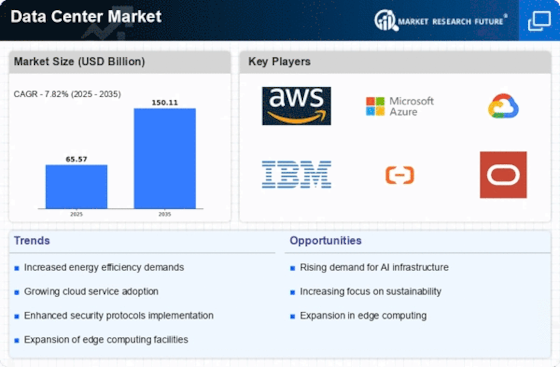
As per Market Research Future analysis, the Data Center Market Size was estimated at 65.57 USD Billion in 2024. The Data Center industry is projected to grow from 70.7 USD Billion in 2025 to 150.11 USD Billion by 2035, exhibiting a compound annual growth rate (CAGR) of 7.82% during the forecast period 2025 - 2035

Key Market Trends & Highlights

The Data Center Market is experiencing robust growth driven by technological advancements and evolving consumer demands.

  • Sustainability initiatives are increasingly shaping data center operations, particularly in North America. The growth of edge computing is facilitating faster data processing and reduced latency, especially in the Asia-Pacific region. Hybrid cloud adoption is becoming prevalent as enterprises seek flexible and scalable solutions to meet their needs. Increased demand for data storage and the rise of artificial intelligence are key drivers propelling the expansion of hyperscale data centers.

Market Size & Forecast

2024 Market Size 65.57 (USD Billion)
2035 Market Size 150.11 (USD Billion)
CAGR (2025 - 2035) 7.82%
Largest Regional Market Share in 2024 North America

Major Players

Amazon Web Services (US), Microsoft Azure (US), Google Cloud (US), IBM (US), Alibaba Cloud (CN), Oracle (US), DigitalOcean (US), Equinix (US), NTT Communications (JP), Rackspace (US)

Market Trends

The Data Center Market is currently experiencing a transformative phase, driven by the increasing demand for cloud computing and data storage solutions. Organizations across various sectors are recognizing the necessity of robust infrastructure to support their digital operations. This shift is prompting investments in advanced technologies, such as artificial intelligence and machine learning, which enhance operational efficiency and data management capabilities. The data center industry is undergoing rapid transformation, driven by rising cloud adoption, AI workloads, and increasing global data consumption. The global market data center landscape is shaped by strong enterprise demand, hyperscale expansion, and sustained infrastructure upgrades. Growing data center investment across developed and emerging economies continues to fuel long-term market growth. 

Furthermore, sustainability has emerged as a focal point, with companies striving to reduce their carbon footprints through energy-efficient practices and renewable energy sources. In addition to technological advancements, the Data Center Market is witnessing a geographical expansion, as businesses seek to establish data centers in regions with favorable regulations and lower operational costs. This trend indicates a strategic approach to optimizing performance while ensuring compliance with local laws. The cost and complexity of building data center facilities are increasing due to rising energy demands, land constraints, and sustainability requirements. As the data center market evolves, it appears that adaptability and innovation will be crucial for stakeholders aiming to maintain a competitive edge in this dynamic environment.

Recent data center industry news highlights large-scale expansions by hyperscalers and increasing focus on sustainable infrastructure. Rising data center investment in energy-efficient technologies is reshaping operational strategies across regions. Major industry events such as Data Center World 2026 are expected to showcase innovations in cooling, power management, and modular deployments.

Sustainability Initiatives

The emphasis on sustainability within the Data Center Market is becoming increasingly pronounced. Companies are adopting eco-friendly practices, such as utilizing renewable energy sources and implementing energy-efficient technologies. This trend not only addresses environmental concerns but also aligns with corporate social responsibility goals.

Edge Computing Growth

The rise of edge computing is reshaping the Data Center Market landscape. By processing data closer to the source, organizations can reduce latency and enhance performance. This trend is particularly relevant for applications requiring real-time data processing, such as IoT and autonomous systems.

Hybrid Cloud Adoption

The shift towards hybrid cloud solutions is gaining momentum in the Data Center Market. Organizations are increasingly combining on-premises infrastructure with cloud services to achieve greater flexibility and scalability. This approach allows businesses to optimize their resources while maintaining control over sensitive data.

Data Centre Market Market Drivers

Growing Cybersecurity Concerns

As cyber threats become increasingly sophisticated, the Data Center Market faces mounting pressure to enhance security measures. Organizations are prioritizing data protection, leading to a surge in demand for data centers that offer robust cybersecurity solutions. The Data Center is projected to exceed 300 billion USD by 2025, reflecting the critical need for secure data storage and processing environments. Data centers are responding by implementing advanced security protocols, including encryption, intrusion detection systems, and multi-factor authentication. This focus on cybersecurity not only safeguards sensitive information but also builds trust with clients and stakeholders. Consequently, the Data Center Market is likely to see a shift towards facilities that prioritize security as a core component of their service offerings.

Increased Demand for Data Storage

The Data Center Market experiences heightened demand for data storage solutions, driven by the exponential growth of data generation across various sectors. As organizations increasingly rely on data analytics, the need for robust storage capabilities becomes paramount. According to recent estimates, the volume of data created globally is projected to reach 175 zettabytes by 2025. This surge necessitates the expansion of data center facilities to accommodate the influx of information. Consequently, data centers are evolving to offer scalable storage solutions that can adapt to fluctuating demands. This trend not only enhances operational efficiency but also positions data centers as critical infrastructure in the digital economy. The ongoing investment in advanced storage technologies further underscores the importance of this driver in shaping the future of the Data Center Market.

Expansion of Internet of Things (IoT)

The proliferation of Internet of Things (IoT) devices is reshaping the Data Center Market, as the number of connected devices continues to grow exponentially. With billions of IoT devices expected to be in use by 2025, data centers must adapt to handle the vast amounts of data generated by these devices. This trend necessitates the development of edge computing solutions, which allow for data processing closer to the source, thereby reducing latency and bandwidth usage. As a result, data centers are increasingly investing in infrastructure that supports IoT applications, ensuring they can meet the demands of this rapidly evolving landscape. The integration of IoT technologies into data center operations not only enhances efficiency but also opens new avenues for innovation within the Data Center Market.

Regulatory Compliance and Data Sovereignty

The Data Center Market is significantly influenced by regulatory compliance and data sovereignty requirements. As governments implement stricter data protection laws, organizations are compelled to ensure that their data storage practices align with these regulations. This has led to an increased demand for data centers that can provide compliant solutions, particularly in regions with stringent data residency laws. The global regulatory landscape is evolving, with various jurisdictions enforcing regulations that dictate how and where data can be stored. Consequently, data centers must invest in infrastructure that meets these compliance standards, thereby enhancing their appeal to businesses seeking to mitigate legal risks. This focus on regulatory compliance is likely to shape the strategic direction of the Data Center Market in the coming years.

Rise of Artificial Intelligence and Machine Learning

The integration of artificial intelligence (AI) and machine learning (ML) technologies is significantly influencing the Data Center Market. As businesses seek to leverage AI and ML for improved decision-making and operational efficiency, the demand for data centers equipped with high-performance computing capabilities is on the rise. These technologies require substantial computational power and storage resources, prompting data centers to upgrade their infrastructure. It is estimated that the AI market will reach a valuation of over 190 billion USD by 2025, further driving the need for data centers that can support these advanced applications. The Data Center Market must adapt to these evolving requirements, ensuring that facilities are optimized for AI workloads, thereby enhancing their competitive edge in the technology landscape.

Market Segment Insights

By Type: Enterprise Data Center (Largest) vs. Hyperscale Data Center (Fastest-Growing)

<p>In the Data Center Market, the Enterprise Data Center segment holds the largest share, as organizations leverage these facilities for their substantial computing needs. Typically owned and operated by individual companies, Enterprise Data Centers offer customized solutions tailored to their operations, supporting mission-critical applications. The segment's stability and robust infrastructure make it the preferred choice for many large enterprises that prioritize security and control over their data. On the other hand, Hyperscale Data Centers are rapidly gaining traction due to their ability to scale operations effectively. Increasing demand for cloud services drives the growth of Hyperscale Data Centers, as they support massive data processing and storage needs through their highly efficient systems.</p>

<p>Cloud Services: Enterprise Data Center (Dominant) vs. Managed Data Center (Emerging)</p>

<p>The Enterprise Data Center segment is characterized by dedicated facilities owned by large organizations, providing a controlled environment for data processing and storage. Its dominant position stems from businesses' need for privacy, compliance, and reliability, along with customized IT infrastructure. Conversely, the Managed Data Center segment is emerging rapidly, appealing to organizations seeking outsourced solutions for their data requirements. Managed Data Centers enable businesses to focus on their core competencies, offering flexibility and scalability, which are critical in today’s fast-paced digital landscape. These two segments represent different strategies in meeting data demands—one emphasizing ownership and control, while the other focuses on leveraging third-party expertise.</p>

By End-Use: IT and Telecom (Largest) vs. Healthcare (Fastest-Growing)

<p>In the Data Center Market, the largest share of end-use segments is attributed to IT and Telecom, which boasts a substantial portion of the market due to the high demand for data processing, storage, and networking capabilities. This segment is primarily driven by the rapid expansion of cloud computing and the adoption of digital services across various sectors. Following closely behind, the Healthcare segment is emerging as a significant player, driven by the increasing need for data management, privacy, and digital health solutions, fostering innovation and investment in this area.</p>

<p>Healthcare: IT and Telecom (Dominant) vs. Retail (Emerging)</p>

<p>The IT and Telecom segment remains dominant in the Data Center Market, characterized by substantial investment in infrastructure and services to support vast networks of data and connectivity. Companies in this sector are prioritizing efficiency and scalability, leading to advanced data center solutions that cater to the ever-growing demand for internet bandwidth and digital services. Conversely, the Retail sector has emerged as a new force in the market, driven by the rise of e-commerce and the need for robust data handling capabilities. Retailers are increasingly leveraging data centers to enhance consumer engagement, manage inventory, and implement omnichannel strategies, indicating a shift in how data is utilized for competitive advantage.</p>

By Deployment: Cloud (Largest) vs. Hybrid (Fastest-Growing)

<p>In the Data Center Market, the deployment segment shows a distinctive distribution of shares among three key areas: On-Premise, Cloud, and Hybrid. Presently, Cloud services hold the largest share due to their scalability and cost-effectiveness, making them a preferred choice for businesses looking to enhance operational efficiency. On-Premise solutions continue to attract organizations seeking greater control and security over their data, while Hybrid models are rapidly gaining traction due to their flexibility and ability to integrate both private and public cloud solutions.</p>

<p>Deployment Strategy: Cloud (Dominant) vs. Hybrid (Emerging)</p>

<p>The Cloud deployment strategy stands out as the dominant approach in the Data Center Market, thanks to its substantial benefits, including reduced operational costs, enhanced collaboration, and minimal infrastructure management. This model appeals to various industries seeking agility and rapid deployment of resources. Conversely, Hybrid deployment is emerging as a key player, combining the best of both worlds by leveraging the strengths of On-Premise and Cloud environments. Companies favor Hybrid solutions for their adaptability and capacity to mitigate risks associated with solely relying on one deployment method, enabling them to respond effectively to changing business demands.</p>

By Service: Infrastructure as a Service (Largest) vs. Software as a Service (Fastest-Growing)

<p>The Data Center Market's service segment showcases a diverse landscape where Infrastructure as a Service (IaaS) holds the largest market share owing to its robust demand among enterprises seeking scalable infrastructure solutions. On the other hand, Software as a Service (SaaS) is rapidly gaining traction with its growing adoption driven by the increasing need for accessible and flexible software solutions in various industries. This dynamic distribution highlights a notable shift towards cloud-based services, reflecting the evolving needs of businesses in the digital age.</p>

<p>IaaS (Dominant) vs. SaaS (Emerging)</p>

<p>Infrastructure as a Service (IaaS) dominates the Data Center Market due to its pivotal role in providing on-demand computing resources, allowing businesses to scale their IT infrastructure efficiently. Its comprehensive offerings include servers, storage, and networking solutions which have become essential for enterprises aiming to minimize capital expenditures. Conversely, Software as a Service (SaaS) emerges as a fast-growing contender, offering cloud-based applications that facilitate user accessibility and collaboration. With its subscription-based model, SaaS is particularly appealing to small and medium-sized enterprises, leading to increased adoption rates. Together, these segments illustrate a transformative shift in how businesses leverage technology to enhance operational efficiency.</p>

By Service Model: Software as a Service (Largest) vs. Disaster Recovery as a Service (Fastest-Growing)

<p>In the data center market, the service model segment showcases a diverse portfolio with Software as a Service (SaaS) leading in market share, showing its prominence as businesses increasingly adopt cloud-based solutions for flexibility and scalability. Infrastructure as a Service (IaaS) and Platform as a Service (PaaS) follow closely, each providing essential building blocks for enterprises looking to enhance operational efficiencies. Disaster Recovery as a Service (DRaaS) and Backup as a Service (BaaS) also play critical roles, catering to organizations that prioritize data security and resilience.</p>

<p>Software as a Service (Dominant) vs. Disaster Recovery as a Service (Emerging)</p>

<p>Software as a Service (SaaS) dominates the data center market by offering scalable and flexible solutions that enable enterprises to streamline operations without heavy upfront investments in infrastructure. Its massive adoption stems from the ease of access and continuous updates provided by vendors. On the other hand, Disaster Recovery as a Service (DRaaS) is emerging as a vital segment due to increasing awareness around the importance of business continuity planning. Organizations increasingly seek reliable recovery solutions that protect critical data and applications, making DRaaS an appealing option that addresses the growing concerns around data loss and system failures.</p>

Get more detailed insights about Data Center Market Research Report - Global Forecast to 2035

Regional Insights

North America : Innovation and Leadership Hub

North America remains the largest market for data centers, holding approximately 45% of the global share. The region's growth is driven by increasing demand for cloud services, data storage, and advanced technologies like AI and IoT. Regulatory support, including data protection laws, further catalyzes market expansion. The U.S. is the largest contributor, followed by Canada, which together account for a significant portion of the data center market share. The competitive landscape is dominated by major players such as Amazon Web Services, Microsoft Azure, and Google Cloud, all of which have established extensive infrastructures. The presence of these tech giants fosters innovation and attracts investments, enhancing the region's appeal. Additionally, the focus on sustainability and energy efficiency is shaping new data center designs, ensuring that North America remains at the forefront of the industry.

The growth of data centers in the US is driven by cloud adoption, AI workloads, and strong digital infrastructure. Data centers in Northern Virginia represent the largest concentration globally, benefiting from connectivity, power availability, and proximity to enterprises. Data centers in Virginia continue to attract investments due to favorable regulations and a mature ecosystem. Each Virginia data center benefits from access to high-capacity fiber networks and reliable power supply. The expansion of Virginia data centers reinforces the state’s position as a global data center hub.

Europe : Emerging Data Center Powerhouse

Europe is rapidly becoming a significant player in the data center market, holding around 30% of the global share. The region's growth is propelled by increasing digitalization, cloud adoption, and stringent data protection regulations like GDPR. Countries such as Germany and the UK are leading the charge, with robust infrastructure and favorable policies that encourage investment in data centers. The European market is characterized by a strong emphasis on sustainability and energy efficiency. Leading countries in Europe include Germany, the UK, and France, which host numerous data centers and attract major players like IBM and Oracle. The competitive landscape is evolving, with local providers also gaining traction. The European market is increasingly focused on green technologies, with many data centers aiming for carbon neutrality. This commitment to sustainability is reshaping the industry and positioning Europe as a leader in responsible data management.

Asia-Pacific : Rapidly Growing Digital Frontier

Asia-Pacific is witnessing a rapid expansion in the data center market, accounting for approximately 20% of the global share. The growth is primarily driven by the increasing demand for cloud services, digital transformation, and the rise of e-commerce. Countries like China and India are at the forefront, with significant investments in data center infrastructure. The region's regulatory environment is evolving, with governments promoting digital economies and data localization policies. China leads the market, followed by India and Japan, with major players like Alibaba Cloud and NTT Communications establishing a strong presence. The competitive landscape is marked by a mix of global and local providers, fostering innovation and competition. The focus on enhancing connectivity and reducing latency is driving the development of new data centers, making Asia-Pacific a key player in the global data center landscape.

Middle East and Africa : Emerging Market with Potential

The Middle East and Africa region is emerging as a potential growth market for data centers, holding about 5% of the global share. The growth is driven by increasing internet penetration, mobile connectivity, and investments in digital infrastructure. Countries like the UAE and South Africa are leading the way, with government initiatives aimed at boosting the digital economy and attracting foreign investment. The region's regulatory landscape is gradually improving, supporting data center development. The competitive landscape features a mix of local and international players, with companies like Equinix and Rackspace expanding their operations. The focus on enhancing data security and compliance with local regulations is shaping the market. As the region continues to invest in technology and infrastructure, it is poised for significant growth in the data center sector, making it an attractive destination for investment.

Key Players and Competitive Insights

The Data Center Market is currently characterized by intense competition and rapid evolution, driven by the increasing demand for cloud services, data storage, and processing capabilities. The market is dominated by some of the biggest data center companies, including Amazon Web Services, Microsoft Azure, and Google Cloud. These largest data center companies continue to expand their global footprints through acquisitions and new facility launches. Major players such as Amazon Web Services (US), Microsoft Azure (US), and Google Cloud (US) dominate the landscape, each employing distinct strategies to maintain their competitive edge. Amazon Web Services (US) focuses on continuous innovation and expansion of its service offerings, while Microsoft Azure (US) emphasizes partnerships and integrations with enterprise solutions. Google Cloud (US) appears to be concentrating on enhancing its AI capabilities and sustainability initiatives, which collectively shape a competitive environment that is both dynamic and multifaceted.
The data center market structure is moderately fragmented, with a mix of established giants and emerging players. Key tactics employed by these companies include localizing data center operations to meet regional compliance and optimizing supply chains to enhance service delivery. This competitive structure allows for a diverse range of services and pricing models, fostering an environment where innovation and customer-centric solutions are paramount.
In August 2025, Amazon Web Services (US) announced the launch of its new data center in Brazil, aimed at expanding its footprint in Latin America. This strategic move not only enhances AWS's ability to serve local customers with lower latency but also aligns with its broader goal of increasing global accessibility to cloud services. The establishment of this facility is likely to bolster AWS's competitive position in a region that is experiencing rapid digital transformation.
In September 2025, Microsoft Azure (US) unveiled a partnership with a leading telecommunications provider to enhance its edge computing capabilities. This collaboration is expected to facilitate the deployment of Azure services closer to end-users, thereby improving performance and reliability. Such strategic alliances are indicative of Azure's commitment to integrating advanced technologies and expanding its service reach, which may prove crucial in retaining its competitive advantage.
In July 2025, Google Cloud (US) launched a new initiative focused on carbon-neutral data centers, reinforcing its commitment to sustainability. This initiative not only addresses growing environmental concerns but also positions Google Cloud as a leader in eco-friendly technology solutions. The emphasis on sustainability is likely to resonate with environmentally conscious consumers and businesses, potentially influencing their choice of cloud service providers.
As of October 2025, the Data Center Market is witnessing trends that emphasize digitalization, sustainability, and the integration of artificial intelligence. Strategic alliances are increasingly shaping the competitive landscape, allowing companies to leverage complementary strengths and enhance service offerings. Moving forward, competitive differentiation is expected to evolve from traditional price-based competition to a focus on innovation, technological advancements, and supply chain reliability, as companies strive to meet the complex demands of a rapidly changing digital environment.

Key Companies in the Data Centre Market include

Industry Developments

Recent developments in the Global Data Center Market have been significant, showcasing the continuous evolution and expansion of key players. In September 2023, Digital Realty announced its acquisition of a data center facility in Dallas, Texas, enhancing its service capabilities in a significant market. Additionally, Amazon Web Services launched new regions in Asia-Pacific, reflecting the growing demand for cloud services across the region. In August 2023, Equinix completed its acquisition of an interconnection platform, bolstering its global reach and service offerings. Market growth is further evidenced by IBM's investment in AI-driven data center solutions aimed at improving operational efficiencies.

Meanwhile, Alibaba Cloud reported increased revenue from data center services, attributing success to a surge in digital transformation initiatives worldwide. Over the past couple of years, the Global Data Center Market has seen unprecedented growth, driven by increased data consumption and the rise of cloud services, with major companies like Google and Microsoft continuously expanding their infrastructures to meet client needs and enhance performance. The data center market's trajectory signifies a robust demand for innovation and infrastructure development in response to a rapidly digitalizing economy.

The data center cooling is evolving due to increasing power densities and environmental concerns, pushing adoption of advanced cooling solutions. Innovations such as liquid cooling, free‑cooling systems, and thermal management technologies are critical for maintaining uptime and improving energy efficiency across data centers.

Future Outlook

Data Centre Market Future Outlook

The Data Center Market is projected to grow at a 7.82% CAGR from 2025 to 2035, driven by increasing cloud adoption, data storage needs, and energy efficiency demands.

New opportunities lie in:

  • <p>Expansion of edge computing facilities in urban areas Development of AI-driven data management solutions Investment in renewable energy sources for sustainable operations</p>

By 2035, the Data Center Market is expected to be robust, driven by innovation and sustainability.

Market Segmentation

Data Centre Market Type Outlook

  • Enterprise Data Center
  • Colocation Data Center
  • Hyperscale Data Center
  • Managed Data Center

Data Centre Market End-Use Outlook

  • IT and Telecom
  • BFSI
  • Government
  • Healthcare
  • Retail

Data Centre Market Service Outlook

  • Infrastructure as a Service
  • Platform as a Service
  • Software as a Service

Data Centre Market Deployment Outlook

  • On-Premise
  • Cloud
  • Hybrid

Report Scope

MARKET SIZE 2024 65.57(USD Billion)
MARKET SIZE 2025 70.7(USD Billion)
MARKET SIZE 2035 150.11(USD Billion)
COMPOUND ANNUAL GROWTH RATE (CAGR) 7.82% (2025 - 2035)
REPORT COVERAGE Revenue Forecast, Competitive Landscape, Growth Factors, and Trends
BASE YEAR 2024
Market Forecast Period 2025 - 2035
Historical Data 2019 - 2024
Market Forecast Units USD Billion
Key Companies Profiled Amazon Web Services (US), Microsoft Azure (US), Google Cloud (US), IBM (US), Alibaba Cloud (CN), Oracle (US), DigitalOcean (US), Equinix (US), NTT Communications (JP), Rackspace (US)
Segments Covered Type, End Use, Deployment, Service, Regional
Key Market Opportunities Integration of artificial intelligence for enhanced data management and operational efficiency in the Data Center Market.
Key Market Dynamics Rising demand for energy-efficient solutions drives innovation and competition in the Data Center Market.
Countries Covered North America, Europe, APAC, South America, MEA

FAQs

What is the current valuation of the Data Center Market as of 2024?

<p>The overall market valuation was 65.57 USD Billion in 2024.</p>

What is the projected market valuation for the Data Center Market in 2035?

<p>The projected valuation for 2035 is 150.11 USD Billion.</p>

What is the expected CAGR for the Data Center Market during the forecast period 2025 - 2035?

<p>The expected CAGR for the Data Center Market during the forecast period 2025 - 2035 is 7.82%.</p>

Which segment of the Data Center Market is expected to grow the most by 2035?

<p>The Cloud deployment segment, valued at 30.0 to 80.0 USD Billion, is likely to experience substantial growth.</p>

What are the key players in the Data Center Market?

<p>Key players include Amazon Web Services, Microsoft Azure, Google Cloud, and Alibaba Cloud, among others.</p>

How does the Enterprise Data Center segment perform compared to others?

<p>The Enterprise Data Center segment had a valuation range of 20.0 to 45.0 USD Billion, indicating robust performance.</p>

What is the valuation range for the Hyperscale Data Center segment?

<p>The Hyperscale Data Center segment is valued between 20.0 and 50.0 USD Billion.</p>

Which end-use sector shows the highest potential in the Data Center Market?

<p>The IT and Telecom sector, with a valuation range of 20.0 to 45.0 USD Billion, appears to show the highest potential.</p>

What is the projected growth for the Software as a Service segment by 2035?

<p>The Software as a Service segment is projected to grow significantly, with a valuation range of 30.57 to 70.11 USD Billion.</p>

How does the Managed Data Center segment compare to others in terms of valuation?

<p>The Managed Data Center segment had a valuation range of 10.57 to 20.11 USD Billion, indicating a smaller market share compared to others.</p>

  1. SECTION I: EXECUTIVE SUMMARY AND KEY HIGHLIGHTS
    1. | 1.1 EXECUTIVE SUMMARY
    2. | | 1.1.1 Market Overview
    3. | | 1.1.2 Key Findings
    4. | | 1.1.3 Market Segmentation
    5. | | 1.1.4 Competitive Landscape
    6. | | 1.1.5 Challenges and Opportunities
    7. | | 1.1.6 Future Outlook
  2. SECTION II: SCOPING, METHODOLOGY AND MARKET STRUCTURE
    1. | 2.1 MARKET INTRODUCTION
    2. | | 2.1.1 Definition
    3. | | 2.1.2 Scope of the study
    4. | | | 2.1.2.1 Research Objective
    5. | | | 2.1.2.2 Assumption
    6. | | | 2.1.2.3 Limitations
    7. | 2.2 RESEARCH METHODOLOGY
    8. | | 2.2.1 Overview
    9. | | 2.2.2 Data Mining
    10. | | 2.2.3 Secondary Research
    11. | | 2.2.4 Primary Research
    12. | | | 2.2.4.1 Primary Interviews and Information Gathering Process
    13. | | | 2.2.4.2 Breakdown of Primary Respondents
    14. | | 2.2.5 Forecasting Model
    15. | | 2.2.6 Market Size Estimation
    16. | | | 2.2.6.1 Bottom-Up Approach
    17. | | | 2.2.6.2 Top-Down Approach
    18. | | 2.2.7 Data Triangulation
    19. | | 2.2.8 Validation
  3. SECTION III: QUALITATIVE ANALYSIS
    1. | 3.1 MARKET DYNAMICS
    2. | | 3.1.1 Overview
    3. | | 3.1.2 Drivers
    4. | | 3.1.3 Restraints
    5. | | 3.1.4 Opportunities
    6. | 3.2 MARKET FACTOR ANALYSIS
    7. | | 3.2.1 Value chain Analysis
    8. | | 3.2.2 Porter's Five Forces Analysis
    9. | | | 3.2.2.1 Bargaining Power of Suppliers
    10. | | | 3.2.2.2 Bargaining Power of Buyers
    11. | | | 3.2.2.3 Threat of New Entrants
    12. | | | 3.2.2.4 Threat of Substitutes
    13. | | | 3.2.2.5 Intensity of Rivalry
    14. | | 3.2.3 COVID-19 Impact Analysis
    15. | | | 3.2.3.1 Market Impact Analysis
    16. | | | 3.2.3.2 Regional Impact
    17. | | | 3.2.3.3 Opportunity and Threat Analysis
  4. SECTION IV: QUANTITATIVE ANALYSIS
    1. | 4.1 Information and Communications Technology, BY Type (USD Billion)
    2. | | 4.1.1 Enterprise Data Center
    3. | | 4.1.2 Colocation Data Center
    4. | | 4.1.3 Hyperscale Data Center
    5. | | 4.1.4 Managed Data Center
    6. | 4.2 Information and Communications Technology, BY End-Use (USD Billion)
    7. | | 4.2.1 IT and Telecom
    8. | | 4.2.2 BFSI
    9. | | 4.2.3 Government
    10. | | 4.2.4 Healthcare
    11. | | 4.2.5 Retail
    12. | 4.3 Information and Communications Technology, BY Deployment (USD Billion)
    13. | | 4.3.1 On-Premise
    14. | | 4.3.2 Cloud
    15. | | 4.3.3 Hybrid
    16. | 4.4 Information and Communications Technology, BY Service (USD Billion)
    17. | | 4.4.1 Infrastructure as a Service
    18. | | 4.4.2 Platform as a Service
    19. | | 4.4.3 Software as a Service
    20. | 4.5 Information and Communications Technology, BY Region (USD Billion)
    21. | | 4.5.1 North America
    22. | | | 4.5.1.1 US
    23. | | | 4.5.1.2 Canada
    24. | | 4.5.2 Europe
    25. | | | 4.5.2.1 Germany
    26. | | | 4.5.2.2 UK
    27. | | | 4.5.2.3 France
    28. | | | 4.5.2.4 Russia
    29. | | | 4.5.2.5 Italy
    30. | | | 4.5.2.6 Spain
    31. | | | 4.5.2.7 Rest of Europe
    32. | | 4.5.3 APAC
    33. | | | 4.5.3.1 China
    34. | | | 4.5.3.2 India
    35. | | | 4.5.3.3 Japan
    36. | | | 4.5.3.4 South Korea
    37. | | | 4.5.3.5 Malaysia
    38. | | | 4.5.3.6 Thailand
    39. | | | 4.5.3.7 Indonesia
    40. | | | 4.5.3.8 Rest of APAC
    41. | | 4.5.4 South America
    42. | | | 4.5.4.1 Brazil
    43. | | | 4.5.4.2 Mexico
    44. | | | 4.5.4.3 Argentina
    45. | | | 4.5.4.4 Rest of South America
    46. | | 4.5.5 MEA
    47. | | | 4.5.5.1 GCC Countries
    48. | | | 4.5.5.2 South Africa
    49. | | | 4.5.5.3 Rest of MEA
  5. SECTION V: COMPETITIVE ANALYSIS
    1. | 5.1 Competitive Landscape
    2. | | 5.1.1 Overview
    3. | | 5.1.2 Competitive Analysis
    4. | | 5.1.3 Market share Analysis
    5. | | 5.1.4 Major Growth Strategy in the Information and Communications Technology
    6. | | 5.1.5 Competitive Benchmarking
    7. | | 5.1.6 Leading Players in Terms of Number of Developments in the Information and Communications Technology
    8. | | 5.1.7 Key developments and growth strategies
    9. | | | 5.1.7.1 New Product Launch/Service Deployment
    10. | | | 5.1.7.2 Merger & Acquisitions
    11. | | | 5.1.7.3 Joint Ventures
    12. | | 5.1.8 Major Players Financial Matrix
    13. | | | 5.1.8.1 Sales and Operating Income
    14. | | | 5.1.8.2 Major Players R&D Expenditure. 2023
    15. | 5.2 Company Profiles
    16. | | 5.2.1 Amazon Web Services (US)
    17. | | | 5.2.1.1 Financial Overview
    18. | | | 5.2.1.2 Products Offered
    19. | | | 5.2.1.3 Key Developments
    20. | | | 5.2.1.4 SWOT Analysis
    21. | | | 5.2.1.5 Key Strategies
    22. | | 5.2.2 Microsoft Azure (US)
    23. | | | 5.2.2.1 Financial Overview
    24. | | | 5.2.2.2 Products Offered
    25. | | | 5.2.2.3 Key Developments
    26. | | | 5.2.2.4 SWOT Analysis
    27. | | | 5.2.2.5 Key Strategies
    28. | | 5.2.3 Google Cloud (US)
    29. | | | 5.2.3.1 Financial Overview
    30. | | | 5.2.3.2 Products Offered
    31. | | | 5.2.3.3 Key Developments
    32. | | | 5.2.3.4 SWOT Analysis
    33. | | | 5.2.3.5 Key Strategies
    34. | | 5.2.4 IBM (US)
    35. | | | 5.2.4.1 Financial Overview
    36. | | | 5.2.4.2 Products Offered
    37. | | | 5.2.4.3 Key Developments
    38. | | | 5.2.4.4 SWOT Analysis
    39. | | | 5.2.4.5 Key Strategies
    40. | | 5.2.5 Alibaba Cloud (CN)
    41. | | | 5.2.5.1 Financial Overview
    42. | | | 5.2.5.2 Products Offered
    43. | | | 5.2.5.3 Key Developments
    44. | | | 5.2.5.4 SWOT Analysis
    45. | | | 5.2.5.5 Key Strategies
    46. | | 5.2.6 Oracle (US)
    47. | | | 5.2.6.1 Financial Overview
    48. | | | 5.2.6.2 Products Offered
    49. | | | 5.2.6.3 Key Developments
    50. | | | 5.2.6.4 SWOT Analysis
    51. | | | 5.2.6.5 Key Strategies
    52. | | 5.2.7 DigitalOcean (US)
    53. | | | 5.2.7.1 Financial Overview
    54. | | | 5.2.7.2 Products Offered
    55. | | | 5.2.7.3 Key Developments
    56. | | | 5.2.7.4 SWOT Analysis
    57. | | | 5.2.7.5 Key Strategies
    58. | | 5.2.8 Equinix (US)
    59. | | | 5.2.8.1 Financial Overview
    60. | | | 5.2.8.2 Products Offered
    61. | | | 5.2.8.3 Key Developments
    62. | | | 5.2.8.4 SWOT Analysis
    63. | | | 5.2.8.5 Key Strategies
    64. | | 5.2.9 NTT Communications (JP)
    65. | | | 5.2.9.1 Financial Overview
    66. | | | 5.2.9.2 Products Offered
    67. | | | 5.2.9.3 Key Developments
    68. | | | 5.2.9.4 SWOT Analysis
    69. | | | 5.2.9.5 Key Strategies
    70. | | 5.2.10 Rackspace (US)
    71. | | | 5.2.10.1 Financial Overview
    72. | | | 5.2.10.2 Products Offered
    73. | | | 5.2.10.3 Key Developments
    74. | | | 5.2.10.4 SWOT Analysis
    75. | | | 5.2.10.5 Key Strategies
    76. | 5.3 Appendix
    77. | | 5.3.1 References
    78. | | 5.3.2 Related Reports
  6. LIST OF FIGURES
    1. | 6.1 MARKET SYNOPSIS
    2. | 6.2 NORTH AMERICA MARKET ANALYSIS
    3. | 6.3 US MARKET ANALYSIS BY TYPE
    4. | 6.4 US MARKET ANALYSIS BY END-USE
    5. | 6.5 US MARKET ANALYSIS BY DEPLOYMENT
    6. | 6.6 US MARKET ANALYSIS BY SERVICE
    7. | 6.7 CANADA MARKET ANALYSIS BY TYPE
    8. | 6.8 CANADA MARKET ANALYSIS BY END-USE
    9. | 6.9 CANADA MARKET ANALYSIS BY DEPLOYMENT
    10. | 6.10 CANADA MARKET ANALYSIS BY SERVICE
    11. | 6.11 EUROPE MARKET ANALYSIS
    12. | 6.12 GERMANY MARKET ANALYSIS BY TYPE
    13. | 6.13 GERMANY MARKET ANALYSIS BY END-USE
    14. | 6.14 GERMANY MARKET ANALYSIS BY DEPLOYMENT
    15. | 6.15 GERMANY MARKET ANALYSIS BY SERVICE
    16. | 6.16 UK MARKET ANALYSIS BY TYPE
    17. | 6.17 UK MARKET ANALYSIS BY END-USE
    18. | 6.18 UK MARKET ANALYSIS BY DEPLOYMENT
    19. | 6.19 UK MARKET ANALYSIS BY SERVICE
    20. | 6.20 FRANCE MARKET ANALYSIS BY TYPE
    21. | 6.21 FRANCE MARKET ANALYSIS BY END-USE
    22. | 6.22 FRANCE MARKET ANALYSIS BY DEPLOYMENT
    23. | 6.23 FRANCE MARKET ANALYSIS BY SERVICE
    24. | 6.24 RUSSIA MARKET ANALYSIS BY TYPE
    25. | 6.25 RUSSIA MARKET ANALYSIS BY END-USE
    26. | 6.26 RUSSIA MARKET ANALYSIS BY DEPLOYMENT
    27. | 6.27 RUSSIA MARKET ANALYSIS BY SERVICE
    28. | 6.28 ITALY MARKET ANALYSIS BY TYPE
    29. | 6.29 ITALY MARKET ANALYSIS BY END-USE
    30. | 6.30 ITALY MARKET ANALYSIS BY DEPLOYMENT
    31. | 6.31 ITALY MARKET ANALYSIS BY SERVICE
    32. | 6.32 SPAIN MARKET ANALYSIS BY TYPE
    33. | 6.33 SPAIN MARKET ANALYSIS BY END-USE
    34. | 6.34 SPAIN MARKET ANALYSIS BY DEPLOYMENT
    35. | 6.35 SPAIN MARKET ANALYSIS BY SERVICE
    36. | 6.36 REST OF EUROPE MARKET ANALYSIS BY TYPE
    37. | 6.37 REST OF EUROPE MARKET ANALYSIS BY END-USE
    38. | 6.38 REST OF EUROPE MARKET ANALYSIS BY DEPLOYMENT
    39. | 6.39 REST OF EUROPE MARKET ANALYSIS BY SERVICE
    40. | 6.40 APAC MARKET ANALYSIS
    41. | 6.41 CHINA MARKET ANALYSIS BY TYPE
    42. | 6.42 CHINA MARKET ANALYSIS BY END-USE
    43. | 6.43 CHINA MARKET ANALYSIS BY DEPLOYMENT
    44. | 6.44 CHINA MARKET ANALYSIS BY SERVICE
    45. | 6.45 INDIA MARKET ANALYSIS BY TYPE
    46. | 6.46 INDIA MARKET ANALYSIS BY END-USE
    47. | 6.47 INDIA MARKET ANALYSIS BY DEPLOYMENT
    48. | 6.48 INDIA MARKET ANALYSIS BY SERVICE
    49. | 6.49 JAPAN MARKET ANALYSIS BY TYPE
    50. | 6.50 JAPAN MARKET ANALYSIS BY END-USE
    51. | 6.51 JAPAN MARKET ANALYSIS BY DEPLOYMENT
    52. | 6.52 JAPAN MARKET ANALYSIS BY SERVICE
    53. | 6.53 SOUTH KOREA MARKET ANALYSIS BY TYPE
    54. | 6.54 SOUTH KOREA MARKET ANALYSIS BY END-USE
    55. | 6.55 SOUTH KOREA MARKET ANALYSIS BY DEPLOYMENT
    56. | 6.56 SOUTH KOREA MARKET ANALYSIS BY SERVICE
    57. | 6.57 MALAYSIA MARKET ANALYSIS BY TYPE
    58. | 6.58 MALAYSIA MARKET ANALYSIS BY END-USE
    59. | 6.59 MALAYSIA MARKET ANALYSIS BY DEPLOYMENT
    60. | 6.60 MALAYSIA MARKET ANALYSIS BY SERVICE
    61. | 6.61 THAILAND MARKET ANALYSIS BY TYPE
    62. | 6.62 THAILAND MARKET ANALYSIS BY END-USE
    63. | 6.63 THAILAND MARKET ANALYSIS BY DEPLOYMENT
    64. | 6.64 THAILAND MARKET ANALYSIS BY SERVICE
    65. | 6.65 INDONESIA MARKET ANALYSIS BY TYPE
    66. | 6.66 INDONESIA MARKET ANALYSIS BY END-USE
    67. | 6.67 INDONESIA MARKET ANALYSIS BY DEPLOYMENT
    68. | 6.68 INDONESIA MARKET ANALYSIS BY SERVICE
    69. | 6.69 REST OF APAC MARKET ANALYSIS BY TYPE
    70. | 6.70 REST OF APAC MARKET ANALYSIS BY END-USE
    71. | 6.71 REST OF APAC MARKET ANALYSIS BY DEPLOYMENT
    72. | 6.72 REST OF APAC MARKET ANALYSIS BY SERVICE
    73. | 6.73 SOUTH AMERICA MARKET ANALYSIS
    74. | 6.74 BRAZIL MARKET ANALYSIS BY TYPE
    75. | 6.75 BRAZIL MARKET ANALYSIS BY END-USE
    76. | 6.76 BRAZIL MARKET ANALYSIS BY DEPLOYMENT
    77. | 6.77 BRAZIL MARKET ANALYSIS BY SERVICE
    78. | 6.78 MEXICO MARKET ANALYSIS BY TYPE
    79. | 6.79 MEXICO MARKET ANALYSIS BY END-USE
    80. | 6.80 MEXICO MARKET ANALYSIS BY DEPLOYMENT
    81. | 6.81 MEXICO MARKET ANALYSIS BY SERVICE
    82. | 6.82 ARGENTINA MARKET ANALYSIS BY TYPE
    83. | 6.83 ARGENTINA MARKET ANALYSIS BY END-USE
    84. | 6.84 ARGENTINA MARKET ANALYSIS BY DEPLOYMENT
    85. | 6.85 ARGENTINA MARKET ANALYSIS BY SERVICE
    86. | 6.86 REST OF SOUTH AMERICA MARKET ANALYSIS BY TYPE
    87. | 6.87 REST OF SOUTH AMERICA MARKET ANALYSIS BY END-USE
    88. | 6.88 REST OF SOUTH AMERICA MARKET ANALYSIS BY DEPLOYMENT
    89. | 6.89 REST OF SOUTH AMERICA MARKET ANALYSIS BY SERVICE
    90. | 6.90 MEA MARKET ANALYSIS
    91. | 6.91 GCC COUNTRIES MARKET ANALYSIS BY TYPE
    92. | 6.92 GCC COUNTRIES MARKET ANALYSIS BY END-USE
    93. | 6.93 GCC COUNTRIES MARKET ANALYSIS BY DEPLOYMENT
    94. | 6.94 GCC COUNTRIES MARKET ANALYSIS BY SERVICE
    95. | 6.95 SOUTH AFRICA MARKET ANALYSIS BY TYPE
    96. | 6.96 SOUTH AFRICA MARKET ANALYSIS BY END-USE
    97. | 6.97 SOUTH AFRICA MARKET ANALYSIS BY DEPLOYMENT
    98. | 6.98 SOUTH AFRICA MARKET ANALYSIS BY SERVICE
    99. | 6.99 REST OF MEA MARKET ANALYSIS BY TYPE
    100. | 6.100 REST OF MEA MARKET ANALYSIS BY END-USE
    101. | 6.101 REST OF MEA MARKET ANALYSIS BY DEPLOYMENT
    102. | 6.102 REST OF MEA MARKET ANALYSIS BY SERVICE
    103. | 6.103 KEY BUYING CRITERIA OF INFORMATION AND COMMUNICATIONS TECHNOLOGY
    104. | 6.104 RESEARCH PROCESS OF MRFR
    105. | 6.105 DRO ANALYSIS OF INFORMATION AND COMMUNICATIONS TECHNOLOGY
    106. | 6.106 DRIVERS IMPACT ANALYSIS: INFORMATION AND COMMUNICATIONS TECHNOLOGY
    107. | 6.107 RESTRAINTS IMPACT ANALYSIS: INFORMATION AND COMMUNICATIONS TECHNOLOGY
    108. | 6.108 SUPPLY / VALUE CHAIN: INFORMATION AND COMMUNICATIONS TECHNOLOGY
    109. | 6.109 INFORMATION AND COMMUNICATIONS TECHNOLOGY, BY TYPE, 2024 (% SHARE)
    110. | 6.110 INFORMATION AND COMMUNICATIONS TECHNOLOGY, BY TYPE, 2024 TO 2035 (USD Billion)
    111. | 6.111 INFORMATION AND COMMUNICATIONS TECHNOLOGY, BY END-USE, 2024 (% SHARE)
    112. | 6.112 INFORMATION AND COMMUNICATIONS TECHNOLOGY, BY END-USE, 2024 TO 2035 (USD Billion)
    113. | 6.113 INFORMATION AND COMMUNICATIONS TECHNOLOGY, BY DEPLOYMENT, 2024 (% SHARE)
    114. | 6.114 INFORMATION AND COMMUNICATIONS TECHNOLOGY, BY DEPLOYMENT, 2024 TO 2035 (USD Billion)
    115. | 6.115 INFORMATION AND COMMUNICATIONS TECHNOLOGY, BY SERVICE, 2024 (% SHARE)
    116. | 6.116 INFORMATION AND COMMUNICATIONS TECHNOLOGY, BY SERVICE, 2024 TO 2035 (USD Billion)
    117. | 6.117 BENCHMARKING OF MAJOR COMPETITORS
  7. LIST OF TABLES
    1. | 7.1 LIST OF ASSUMPTIONS
    2. | | 7.1.1
    3. | 7.2 North America MARKET SIZE ESTIMATES; FORECAST
    4. | | 7.2.1 BY TYPE, 2025-2035 (USD Billion)
    5. | | 7.2.2 BY END-USE, 2025-2035 (USD Billion)
    6. | | 7.2.3 BY DEPLOYMENT, 2025-2035 (USD Billion)
    7. | | 7.2.4 BY SERVICE, 2025-2035 (USD Billion)
    8. | 7.3 US MARKET SIZE ESTIMATES; FORECAST
    9. | | 7.3.1 BY TYPE, 2025-2035 (USD Billion)
    10. | | 7.3.2 BY END-USE, 2025-2035 (USD Billion)
    11. | | 7.3.3 BY DEPLOYMENT, 2025-2035 (USD Billion)
    12. | | 7.3.4 BY SERVICE, 2025-2035 (USD Billion)
    13. | 7.4 Canada MARKET SIZE ESTIMATES; FORECAST
    14. | | 7.4.1 BY TYPE, 2025-2035 (USD Billion)
    15. | | 7.4.2 BY END-USE, 2025-2035 (USD Billion)
    16. | | 7.4.3 BY DEPLOYMENT, 2025-2035 (USD Billion)
    17. | | 7.4.4 BY SERVICE, 2025-2035 (USD Billion)
    18. | 7.5 Europe MARKET SIZE ESTIMATES; FORECAST
    19. | | 7.5.1 BY TYPE, 2025-2035 (USD Billion)
    20. | | 7.5.2 BY END-USE, 2025-2035 (USD Billion)
    21. | | 7.5.3 BY DEPLOYMENT, 2025-2035 (USD Billion)
    22. | | 7.5.4 BY SERVICE, 2025-2035 (USD Billion)
    23. | 7.6 Germany MARKET SIZE ESTIMATES; FORECAST
    24. | | 7.6.1 BY TYPE, 2025-2035 (USD Billion)
    25. | | 7.6.2 BY END-USE, 2025-2035 (USD Billion)
    26. | | 7.6.3 BY DEPLOYMENT, 2025-2035 (USD Billion)
    27. | | 7.6.4 BY SERVICE, 2025-2035 (USD Billion)
    28. | 7.7 UK MARKET SIZE ESTIMATES; FORECAST
    29. | | 7.7.1 BY TYPE, 2025-2035 (USD Billion)
    30. | | 7.7.2 BY END-USE, 2025-2035 (USD Billion)
    31. | | 7.7.3 BY DEPLOYMENT, 2025-2035 (USD Billion)
    32. | | 7.7.4 BY SERVICE, 2025-2035 (USD Billion)
    33. | 7.8 France MARKET SIZE ESTIMATES; FORECAST
    34. | | 7.8.1 BY TYPE, 2025-2035 (USD Billion)
    35. | | 7.8.2 BY END-USE, 2025-2035 (USD Billion)
    36. | | 7.8.3 BY DEPLOYMENT, 2025-2035 (USD Billion)
    37. | | 7.8.4 BY SERVICE, 2025-2035 (USD Billion)
    38. | 7.9 Russia MARKET SIZE ESTIMATES; FORECAST
    39. | | 7.9.1 BY TYPE, 2025-2035 (USD Billion)
    40. | | 7.9.2 BY END-USE, 2025-2035 (USD Billion)
    41. | | 7.9.3 BY DEPLOYMENT, 2025-2035 (USD Billion)
    42. | | 7.9.4 BY SERVICE, 2025-2035 (USD Billion)
    43. | 7.10 Italy MARKET SIZE ESTIMATES; FORECAST
    44. | | 7.10.1 BY TYPE, 2025-2035 (USD Billion)
    45. | | 7.10.2 BY END-USE, 2025-2035 (USD Billion)
    46. | | 7.10.3 BY DEPLOYMENT, 2025-2035 (USD Billion)
    47. | | 7.10.4 BY SERVICE, 2025-2035 (USD Billion)
    48. | 7.11 Spain MARKET SIZE ESTIMATES; FORECAST
    49. | | 7.11.1 BY TYPE, 2025-2035 (USD Billion)
    50. | | 7.11.2 BY END-USE, 2025-2035 (USD Billion)
    51. | | 7.11.3 BY DEPLOYMENT, 2025-2035 (USD Billion)
    52. | | 7.11.4 BY SERVICE, 2025-2035 (USD Billion)
    53. | 7.12 Rest of Europe MARKET SIZE ESTIMATES; FORECAST
    54. | | 7.12.1 BY TYPE, 2025-2035 (USD Billion)
    55. | | 7.12.2 BY END-USE, 2025-2035 (USD Billion)
    56. | | 7.12.3 BY DEPLOYMENT, 2025-2035 (USD Billion)
    57. | | 7.12.4 BY SERVICE, 2025-2035 (USD Billion)
    58. | 7.13 APAC MARKET SIZE ESTIMATES; FORECAST
    59. | | 7.13.1 BY TYPE, 2025-2035 (USD Billion)
    60. | | 7.13.2 BY END-USE, 2025-2035 (USD Billion)
    61. | | 7.13.3 BY DEPLOYMENT, 2025-2035 (USD Billion)
    62. | | 7.13.4 BY SERVICE, 2025-2035 (USD Billion)
    63. | 7.14 China MARKET SIZE ESTIMATES; FORECAST
    64. | | 7.14.1 BY TYPE, 2025-2035 (USD Billion)
    65. | | 7.14.2 BY END-USE, 2025-2035 (USD Billion)
    66. | | 7.14.3 BY DEPLOYMENT, 2025-2035 (USD Billion)
    67. | | 7.14.4 BY SERVICE, 2025-2035 (USD Billion)
    68. | 7.15 India MARKET SIZE ESTIMATES; FORECAST
    69. | | 7.15.1 BY TYPE, 2025-2035 (USD Billion)
    70. | | 7.15.2 BY END-USE, 2025-2035 (USD Billion)
    71. | | 7.15.3 BY DEPLOYMENT, 2025-2035 (USD Billion)
    72. | | 7.15.4 BY SERVICE, 2025-2035 (USD Billion)
    73. | 7.16 Japan MARKET SIZE ESTIMATES; FORECAST
    74. | | 7.16.1 BY TYPE, 2025-2035 (USD Billion)
    75. | | 7.16.2 BY END-USE, 2025-2035 (USD Billion)
    76. | | 7.16.3 BY DEPLOYMENT, 2025-2035 (USD Billion)
    77. | | 7.16.4 BY SERVICE, 2025-2035 (USD Billion)
    78. | 7.17 South Korea MARKET SIZE ESTIMATES; FORECAST
    79. | | 7.17.1 BY TYPE, 2025-2035 (USD Billion)
    80. | | 7.17.2 BY END-USE, 2025-2035 (USD Billion)
    81. | | 7.17.3 BY DEPLOYMENT, 2025-2035 (USD Billion)
    82. | | 7.17.4 BY SERVICE, 2025-2035 (USD Billion)
    83. | 7.18 Malaysia MARKET SIZE ESTIMATES; FORECAST
    84. | | 7.18.1 BY TYPE, 2025-2035 (USD Billion)
    85. | | 7.18.2 BY END-USE, 2025-2035 (USD Billion)
    86. | | 7.18.3 BY DEPLOYMENT, 2025-2035 (USD Billion)
    87. | | 7.18.4 BY SERVICE, 2025-2035 (USD Billion)
    88. | 7.19 Thailand MARKET SIZE ESTIMATES; FORECAST
    89. | | 7.19.1 BY TYPE, 2025-2035 (USD Billion)
    90. | | 7.19.2 BY END-USE, 2025-2035 (USD Billion)
    91. | | 7.19.3 BY DEPLOYMENT, 2025-2035 (USD Billion)
    92. | | 7.19.4 BY SERVICE, 2025-2035 (USD Billion)
    93. | 7.20 Indonesia MARKET SIZE ESTIMATES; FORECAST
    94. | | 7.20.1 BY TYPE, 2025-2035 (USD Billion)
    95. | | 7.20.2 BY END-USE, 2025-2035 (USD Billion)
    96. | | 7.20.3 BY DEPLOYMENT, 2025-2035 (USD Billion)
    97. | | 7.20.4 BY SERVICE, 2025-2035 (USD Billion)
    98. | 7.21 Rest of APAC MARKET SIZE ESTIMATES; FORECAST
    99. | | 7.21.1 BY TYPE, 2025-2035 (USD Billion)
    100. | | 7.21.2 BY END-USE, 2025-2035 (USD Billion)
    101. | | 7.21.3 BY DEPLOYMENT, 2025-2035 (USD Billion)
    102. | | 7.21.4 BY SERVICE, 2025-2035 (USD Billion)
    103. | 7.22 South America MARKET SIZE ESTIMATES; FORECAST
    104. | | 7.22.1 BY TYPE, 2025-2035 (USD Billion)
    105. | | 7.22.2 BY END-USE, 2025-2035 (USD Billion)
    106. | | 7.22.3 BY DEPLOYMENT, 2025-2035 (USD Billion)
    107. | | 7.22.4 BY SERVICE, 2025-2035 (USD Billion)
    108. | 7.23 Brazil MARKET SIZE ESTIMATES; FORECAST
    109. | | 7.23.1 BY TYPE, 2025-2035 (USD Billion)
    110. | | 7.23.2 BY END-USE, 2025-2035 (USD Billion)
    111. | | 7.23.3 BY DEPLOYMENT, 2025-2035 (USD Billion)
    112. | | 7.23.4 BY SERVICE, 2025-2035 (USD Billion)
    113. | 7.24 Mexico MARKET SIZE ESTIMATES; FORECAST
    114. | | 7.24.1 BY TYPE, 2025-2035 (USD Billion)
    115. | | 7.24.2 BY END-USE, 2025-2035 (USD Billion)
    116. | | 7.24.3 BY DEPLOYMENT, 2025-2035 (USD Billion)
    117. | | 7.24.4 BY SERVICE, 2025-2035 (USD Billion)
    118. | 7.25 Argentina MARKET SIZE ESTIMATES; FORECAST
    119. | | 7.25.1 BY TYPE, 2025-2035 (USD Billion)
    120. | | 7.25.2 BY END-USE, 2025-2035 (USD Billion)
    121. | | 7.25.3 BY DEPLOYMENT, 2025-2035 (USD Billion)
    122. | | 7.25.4 BY SERVICE, 2025-2035 (USD Billion)
    123. | 7.26 Rest of South America MARKET SIZE ESTIMATES; FORECAST
    124. | | 7.26.1 BY TYPE, 2025-2035 (USD Billion)
    125. | | 7.26.2 BY END-USE, 2025-2035 (USD Billion)
    126. | | 7.26.3 BY DEPLOYMENT, 2025-2035 (USD Billion)
    127. | | 7.26.4 BY SERVICE, 2025-2035 (USD Billion)
    128. | 7.27 MEA MARKET SIZE ESTIMATES; FORECAST
    129. | | 7.27.1 BY TYPE, 2025-2035 (USD Billion)
    130. | | 7.27.2 BY END-USE, 2025-2035 (USD Billion)
    131. | | 7.27.3 BY DEPLOYMENT, 2025-2035 (USD Billion)
    132. | | 7.27.4 BY SERVICE, 2025-2035 (USD Billion)
    133. | 7.28 GCC Countries MARKET SIZE ESTIMATES; FORECAST
    134. | | 7.28.1 BY TYPE, 2025-2035 (USD Billion)
    135. | | 7.28.2 BY END-USE, 2025-2035 (USD Billion)
    136. | | 7.28.3 BY DEPLOYMENT, 2025-2035 (USD Billion)
    137. | | 7.28.4 BY SERVICE, 2025-2035 (USD Billion)
    138. | 7.29 South Africa MARKET SIZE ESTIMATES; FORECAST
    139. | | 7.29.1 BY TYPE, 2025-2035 (USD Billion)
    140. | | 7.29.2 BY END-USE, 2025-2035 (USD Billion)
    141. | | 7.29.3 BY DEPLOYMENT, 2025-2035 (USD Billion)
    142. | | 7.29.4 BY SERVICE, 2025-2035 (USD Billion)
    143. | 7.30 Rest of MEA MARKET SIZE ESTIMATES; FORECAST
    144. | | 7.30.1 BY TYPE, 2025-2035 (USD Billion)
    145. | | 7.30.2 BY END-USE, 2025-2035 (USD Billion)
    146. | | 7.30.3 BY DEPLOYMENT, 2025-2035 (USD Billion)
    147. | | 7.30.4 BY SERVICE, 2025-2035 (USD Billion)
    148. | 7.31 PRODUCT LAUNCH/PRODUCT DEVELOPMENT/APPROVAL
    149. | | 7.31.1
    150. | 7.32 ACQUISITION/PARTNERSHIP
    151. | | 7.32.1

Information and Communications Technology Market Segmentation

Information and Communications Technology By Type (USD Billion, 2025-2035)

  • Enterprise Data Center
  • Colocation Data Center
  • Hyperscale Data Center
  • Managed Data Center

Information and Communications Technology By End-Use (USD Billion, 2025-2035)

  • IT and Telecom
  • BFSI
  • Government
  • Healthcare
  • Retail

Information and Communications Technology By Deployment (USD Billion, 2025-2035)

  • On-Premise
  • Cloud
  • Hybrid

Information and Communications Technology By Service (USD Billion, 2025-2035)

  • Infrastructure as a Service
  • Platform as a Service
  • Software as a Service
Infographic

Free Sample Request

Kindly complete the form below to receive a free sample of this Report

Get Free Sample

Customer Strories

Compare Licence

×
Features License Type
Single User Multiuser License Enterprise User
Price $4,950 $5,950 $7,250
Maximum User Access Limit 1 User Upto 10 Users Unrestricted Access Throughout the Organization
Free Customization
Direct Access to Analyst
Deliverable Format
Platform Access
Discount on Next Purchase 10% 15% 15%
Printable Versions