Request Free Sample ×

Kindly complete the form below to receive a free sample of this Report

* Please use a valid business email

Leading companies partner with us for data-driven Insights

clients tt-cursor
Hero Background
English
Chinese
French
Japanese
Korean
German
Spanish

Data Analysis Storage Management Market Analysis

ID: MRFR/HC/8839-CR
121 Pages
Rahul Gotadki
Last Updated: January 13, 2026

Global Data Analysis, Storage & Management Market in Life Sciences Information by Product & Service (Data Analysis Software & Workbenches, Storage, Management, & Cloud Computing Solution; Data Analysis Services), Application (Next-Generation Sequencing, Microscopy, Chromatography, Flow Cytometry, Spectroscopy), End User (Pharmaceutical & Biotechnology Companies, Research Centers, Academic & Government Institutions, Hospitals & Clinics), and by Region (Americas, Europe, Asia-Pacific, and Middle East & Africa)—Forecast till 2035

Share:
Download PDF ×

We do not share your information with anyone. However, we may send you emails based on your report interest from time to time. You may contact us at any time to opt-out.

Data Analysis Storage Management Market Infographic
Purchase Options

Market Analysis

In-depth Analysis of Data Analysis Storage Management Market Industry Landscape

The dynamics of the Data Analysis, Storage, and Management Market in Life Sciences are shaped by the exponential growth of organic records, technological advancements, regulatory requirements, and the increasing importance of records-driven insights in Life Sciences research. Stakeholders in prescription drugs, biotechnology, and research institutions have to understand these dynamics to harness the whole potential of statistics in advancing clinical discoveries and enhancing healthcare consequences. Dynamics are influenced by the challenges and opportunities related to huge amounts of information in Life Sciences. The enormous quantity of genomic, proteomic, and clinical records generated provides demanding situations in garage and evaluation, but it additionally presents exceptional opportunities for deriving meaningful insights and accelerating research. The dynamics encompass a focal point on facts, security, and compliance. With the sensitive nature of genomic and scientific information, stringent safety features and adherence to regulatory requirements, which include the General Data Protection Regulation (GDPR) and Health Insurance Portability and Accountability Act (HIPAA), are important considerations. Market dynamics are motivated through the speedy increase of customized medication. The increasing emphasis on tailoring treatments to character genetic profiles calls for sophisticated facts evaluation and storage answers to manipulate the diverse datasets associated with precision medication tasks. Dynamics involve collaborations among Life Sciences and generation companies. Partnerships between pharmaceutical corporations, biotech corporations, and tech giants contribute to the improvement of integrated solutions that deal with the precise information management and analysis wishes of the Life Sciences enterprise. The market dynamics encompass the emergence of AI and ML packages. These technologies play a vital role in data analysis, offering predictive insights, figuring out patterns, and accelerating the invention of potential therapeutic goals, contributing to the performance of Life Sciences studies. Dynamics involve strategic investments in bioinformatics. Recognizing the pivotal function of bioinformatics in records analysis, businesses and research establishments make good-sized investments to boost computational methods, algorithms, and software program equipment for extracting significant facts from complicated datasets. The dynamics include information standardization initiatives. Standardizing statistics codecs and structures enhances interoperability and helps the combination of various datasets, making sure seamless collaboration and information exchange in the Life Sciences surroundings. Dynamics are trended with the aid of the adoption of blockchain generation. Blockchain ensures statistics integrity, transparency, and traceability, addressing issues associated with information reproducibility and keeping the integrity of Life Sciences information during its lifecycle. The dynamics contain facts-sharing projects and the promotion of open technological know-how. Market dynamics encompass efforts in the bioinformatics team of workers' development. Training programs and academic initiatives are crucial to equip researchers and information scientists with the capabilities needed to efficiently control and examine the massive datasets generated in Life Sciences research.


Author
Author Profile
Rahul Gotadki
Research Manager

He holds an experience of about 9+ years in Market Research and Business Consulting, working under the spectrum of Life Sciences and Healthcare domains. Rahul conceptualizes and implements a scalable business strategy and provides strategic leadership to the clients. His expertise lies in market estimation, competitive intelligence, pipeline analysis, customer assessment, etc.

Leave a Comment

FAQs

What is the projected market valuation for the Data Analysis, Storage & Management Market in 2035?

<p>The projected market valuation for the Data Analysis, Storage & Management Market in 2035 is 54.26 USD Billion.</p>

What was the market valuation for the Data Analysis, Storage & Management Market in 2024?

<p>The market valuation for the Data Analysis, Storage & Management Market in 2024 was 16.29 USD Billion.</p>

What is the expected CAGR for the Data Analysis, Storage & Management Market from 2025 to 2035?

<p>The expected CAGR for the Data Analysis, Storage & Management Market during the forecast period 2025 - 2035 is 11.56%.</p>

Which companies are considered key players in the Data Analysis, Storage & Management Market?

<p>Key players in the market include Microsoft, Amazon, IBM, Oracle, Google, SAP, Salesforce, Snowflake, and Alibaba.</p>

What are the main segments of the Data Analysis, Storage & Management Market?

<p>The main segments include Product & Service, Application, and End User.</p>

What was the valuation for Data Analysis Software and Workbenches in 2024?

The valuation for Data Analysis Software and Workbenches in 2024 was 4.88 USD Billion.

How much is the Storage, Management and Cloud Computing Solution segment projected to be worth in 2035?

The Storage, Management and Cloud Computing Solution segment is projected to be worth 26.0 USD Billion in 2035.

What is the projected valuation for the Data Analysis Services segment in 2035?

The projected valuation for the Data Analysis Services segment in 2035 is 12.26 USD Billion.

Which end user segment is expected to have the highest valuation in 2035?

The Hospitals and Clinics end user segment is expected to have the highest valuation at 21.31 USD Billion in 2035.

What is the projected growth for the Chromatography application segment by 2035?

The Chromatography application segment is projected to grow to 13.5 USD Billion by 2035.

Market Summary

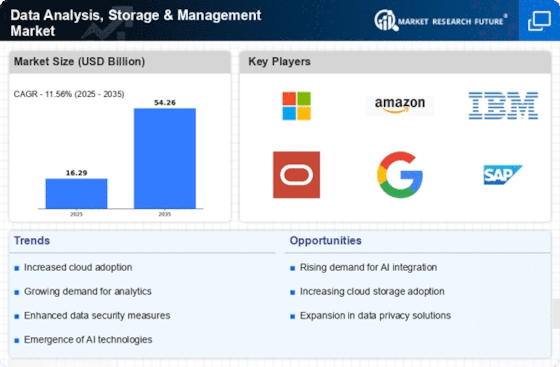
As per Market Research Future analysis, the Data Analysis, Storage & Management Market was estimated at 16.29 USD Billion in 2024. The Data Analysis, Storage & Management industry is projected to grow from 18.17 USD Billion in 2025 to 54.26 USD Billion by 2035, exhibiting a compound annual growth rate (CAGR) of 11.56% during the forecast period 2025 - 2035

Key Market Trends & Highlights

The Data Analysis, Storage and Management Market is experiencing robust growth driven by technological advancements and increasing data demands.

  • The rise of cloud-based solutions is transforming how organizations manage and analyze data, particularly in North America. Integration of artificial intelligence is enhancing data analysis capabilities, making processes more efficient and insightful across various sectors. A growing focus on data security and compliance is evident, especially in the context of stringent regulations in both North America and Asia-Pacific. Increased data generation and the adoption of advanced analytics are key drivers propelling the growth of data analysis services, which is the fastest-growing segment.

Market Size & Forecast

2024 Market Size 16.29 (USD Billion)
2035 Market Size 54.26 (USD Billion)
CAGR (2025 - 2035) 11.56%
Largest Regional Market Share in 2024 North America

Major Players

Microsoft (US), Amazon (US), IBM (US), Oracle (US), Google (US), SAP (DE), Salesforce (US), Snowflake (US), Alibaba (CN)

Market Trends

The Data Analysis, Storage & Management Market is currently experiencing a transformative phase, driven by the increasing demand for efficient data handling and insightful analytics. Organizations across various sectors are recognizing the necessity of robust data management solutions to enhance decision-making processes and operational efficiency. This market is characterized by rapid technological advancements, with cloud computing and artificial intelligence emerging as pivotal components.

As businesses strive to harness the power of big data, the integration of advanced analytics tools is becoming essential for extracting meaningful insights from vast datasets. Moreover, the growing emphasis on data security and compliance is shaping the landscape of the Data Analysis, Storage & Management Market. Companies are compelled to adopt solutions that not only facilitate data storage but also ensure the protection of sensitive information.

This trend is further fueled by regulatory requirements that mandate stringent data governance practices. As a result, organizations are increasingly investing in comprehensive data management frameworks that encompass storage, analysis, and security, thereby fostering a more resilient and agile data ecosystem. The future of this market appears promising, with continuous innovations likely to redefine how data is analyzed, stored, and managed across industries.

Rise of Cloud-Based Solutions

The shift towards cloud-based data management solutions is becoming increasingly prevalent. Organizations are opting for cloud services due to their scalability, flexibility, and cost-effectiveness. This trend allows businesses to store and analyze data without the constraints of traditional on-premises infrastructure.

Integration of Artificial Intelligence

The incorporation of artificial intelligence into data analysis processes is gaining traction. AI technologies enhance the ability to process large volumes of data, enabling organizations to derive insights more efficiently. This integration is likely to improve predictive analytics and decision-making capabilities.

Focus on Data Security and Compliance

As data breaches and privacy concerns rise, there is a heightened focus on data security and compliance within the market. Organizations are prioritizing solutions that not only manage data effectively but also adhere to regulatory standards, ensuring the protection of sensitive information.

Data Analysis Storage Management Market Market Drivers

Increased Data Generation

The exponential growth of data generation across various sectors appears to be a primary driver for the Data Analysis, Storage & Management Market. With the proliferation of IoT devices, social media, and digital transactions, organizations are inundated with vast amounts of data. According to recent estimates, the total data created worldwide is projected to reach 175 zettabytes by 2025. This surge necessitates advanced data storage and management solutions, compelling businesses to invest in robust systems that can efficiently handle, analyze, and store this data. Consequently, the demand for innovative data analysis tools and storage solutions is likely to escalate, propelling the market forward.

Adoption of Advanced Analytics

The increasing adoption of advanced analytics tools is driving the Data Analysis, Storage & Management Market. Organizations are recognizing the value of data-driven decision-making, leading to a surge in the use of predictive and prescriptive analytics. This trend is supported by a report indicating that the analytics market is expected to grow at a compound annual growth rate of over 25% through 2025. As businesses seek to derive actionable insights from their data, the need for sophisticated data management solutions becomes paramount. This shift not only enhances operational efficiency but also fosters a culture of innovation, further stimulating market growth.

Growing Focus on Data Monetization

The growing focus on data monetization is emerging as a key driver for the Data Analysis, Storage & Management Market. Organizations are increasingly recognizing the potential of their data as a valuable asset that can be leveraged for revenue generation. This trend is supported by findings that suggest companies that effectively monetize their data can achieve substantial competitive advantages. As businesses seek to unlock the value of their data, the demand for advanced data analysis and management solutions is likely to rise. This focus on data monetization not only enhances operational efficiency but also encourages innovation in data management practices.

Regulatory Compliance Requirements

The evolving landscape of regulatory compliance is a significant driver for the Data Analysis, Storage & Management Market. Organizations are increasingly required to adhere to stringent data protection regulations, such as GDPR and CCPA, which mandate the secure storage and management of personal data. Compliance with these regulations necessitates the implementation of advanced data management solutions that ensure data integrity and security. As non-compliance can result in hefty fines and reputational damage, businesses are compelled to invest in technologies that facilitate compliance. This trend is likely to bolster the demand for data management solutions, thereby enhancing market growth.

Emergence of Hybrid Cloud Solutions

The emergence of hybrid cloud solutions is reshaping the Data Analysis, Storage & Management Market. Organizations are increasingly adopting hybrid cloud architectures to balance the benefits of public and private clouds, allowing for greater flexibility and scalability. This trend is evidenced by a report indicating that the hybrid cloud market is expected to grow significantly, with many enterprises opting for this model to optimize their data storage and management strategies. By leveraging hybrid cloud solutions, businesses can enhance their data analysis capabilities while ensuring that sensitive data remains secure. This shift is likely to drive further investments in data management technologies.

Market Segment Insights

By Product & Service: Data Analysis Software and Workbenches (Largest) vs. Data Analysis Services (Fastest-Growing)

In the Data Analysis, Storage &amp; Management Market, Data Analysis Software and Workbenches hold the largest share, representing a critical component of businesses seeking to leverage data insights effectively. This segment includes a range of tools and platforms that facilitate data analysis, enabling organizations to extract, process, and interpret vast datasets. Meanwhile, Data Analysis Services have emerged as the fastest-growing segment, reflecting a trend where businesses increasingly seek external expertise to enhance their data capabilities without significant investment in internal resources.

Data Analysis Software and Workbenches: Dominant vs. Data Analysis Services: Emerging

Data Analysis Software and Workbenches are characterized by their robust features tailored for deep analytical functions, making them indispensable for organizations aiming to derive meaningful insights from large data sets. This segment often encompasses powerful visualization tools and automated reporting features, supporting various industries in decision-making processes. On the other hand, Data Analysis Services represent an emerging trend as companies prioritize flexibility and scalability in their analytics approach. These services offer specialized expertise, allowing businesses to access advanced analytical capabilities without the need for substantial upfront investments, thus driving rapid growth in this area.

By Application: Next-Generation Sequencing (Largest) vs. Spectroscopy (Fastest-Growing)

The application segment within the Data Analysis, Storage &amp; Management Market showcases a diverse distribution of market share. Next-Generation Sequencing (NGS) leads the market, as it offers unparalleled accuracy and high throughput for genomic data analysis. Following closely are Microscopy and Chromatography, which are widely utilized in clinical and research laboratories. Flow Cytometry and Spectroscopy similarly hold significant shares, catering to essential analytical functions in various scientific fields. Each of these applications has its unique advantages, driving demand among various end-users.

Chromatography (Dominant) vs. Flow Cytometry (Emerging)

Chromatography is widely regarded as a dominant force in the Data Analysis, Storage &amp; Management Market due to its critical role in separation and analysis processes in chemistry and biochemistry. It serves various sectors, including pharmaceuticals and environmental testing, thus solidifying its market position. On the other hand, Flow Cytometry is emerging as a powerful technique, particularly in cell analysis and immunology. Its capacity for fast, quantitative analysis of cellular properties positions it well for growth opportunities, driven by advances in technology and increasing application across research and clinical labs.

By End User: Pharmaceutical and Biotechnology Companies (Largest) vs. Research Centers (Fastest-Growing)

In the Data Analysis, Storage &amp; Management Market, Pharmaceutical and Biotechnology Companies represent the largest end user segment, benefiting from expansive data management needs due to extensive research and regulatory demands. This segment's considerable market share is driven by an increased focus on drug development and clinical trials, resulting in heightened data analysis and storage requirements. Meanwhile, Research Centers are emerging as a rapidly growing segment, fueled by government funding and increasing collaborations with academic institutions, which enhances their data management capabilities and demands.

Pharmaceutical and Biotechnology Companies (Dominant) vs. Academic &amp; Government Institutions (Emerging)

Pharmaceutical and Biotechnology Companies stand out as a dominant force in the Data Analysis, Storage &amp; Management Market, largely due to their extensive data requirements stemming from stringent regulatory compliance and innovative research initiatives. These organizations are investing heavily in advanced data management solutions to streamline operations and enhance research outcomes. In contrast, Academic &amp; Government Institutions are regarded as an emerging segment, gaining significant traction due to the increasing emphasis on research-driven funding and collaborative projects that necessitate robust data analysis and management solutions. Their unique challenges, such as budget constraints and the need for shared access to data, further shape their market positioning.

Get more detailed insights about Data Analysis, Storage & Management Market Research Report—Global Forecast till 2035

Regional Insights

North America : Innovation and Leadership Hub

North America remains the largest market for Data Analysis, Storage & Management, holding approximately 45% of the global market share. The region's growth is driven by rapid technological advancements, increasing data generation, and a strong emphasis on data security regulations. The demand for cloud-based solutions and AI-driven analytics is also on the rise, further propelling market expansion. The United States is the leading country in this sector, with major players like Microsoft, Amazon, and IBM driving innovation. The competitive landscape is characterized by continuous investment in R&D and strategic partnerships. Canada also plays a significant role, contributing to the market with its growing tech ecosystem and supportive government policies.

Europe : Regulatory Framework and Growth

Europe is the second-largest market for Data Analysis, Storage & Management, accounting for around 30% of the global market share. The region's growth is fueled by stringent data protection regulations such as GDPR, which have heightened the demand for secure data management solutions. Additionally, the increasing adoption of cloud services and big data analytics is driving market expansion across various sectors. Germany and the United Kingdom are the leading countries in this market, with a strong presence of key players like SAP and Oracle. The competitive landscape is marked by a focus on compliance and innovation, as companies strive to meet regulatory requirements while enhancing their service offerings. The European market is also witnessing a rise in startups focusing on niche data solutions, further enriching the ecosystem.

Asia-Pacific : Rapid Growth and Adoption

Asia-Pacific is witnessing rapid growth in the Data Analysis, Storage & Management market, holding approximately 20% of the global market share. The region's expansion is driven by increasing digital transformation initiatives, a surge in data generation, and the growing adoption of cloud technologies. Countries like China and India are at the forefront, with significant investments in data infrastructure and analytics capabilities. China is the largest market in the region, supported by major players like Alibaba and a robust tech ecosystem. India follows closely, with a burgeoning startup culture and increasing demand for data-driven solutions across various industries. The competitive landscape is evolving, with both established companies and new entrants vying for market share, fostering innovation and growth.

Middle East and Africa : Emerging Data Landscape

The Middle East and Africa region is gradually emerging in the Data Analysis, Storage & Management market, holding about 5% of the global market share. The growth is primarily driven by increasing internet penetration, mobile device usage, and a growing emphasis on data-driven decision-making across various sectors. Governments in the region are also investing in digital transformation initiatives, which are expected to further boost market growth. Countries like South Africa and the UAE are leading the charge, with a focus on enhancing their data infrastructure and analytics capabilities. The competitive landscape is characterized by a mix of local and international players, with increasing collaborations and partnerships aimed at leveraging data for economic growth. The region is poised for significant advancements in data management solutions in the coming years.

Key Players and Competitive Insights

The Data Analysis, Storage & Management Market is currently characterized by a dynamic competitive landscape, driven by rapid technological advancements and an increasing demand for data-driven decision-making. Major players such as Microsoft (US), Amazon (US), and IBM (US) are at the forefront, each adopting distinct strategies to enhance their market positioning. Microsoft (US) emphasizes innovation through its Azure cloud platform, focusing on integrating advanced analytics and AI capabilities. Amazon (US), with its AWS division, continues to expand its service offerings, particularly in machine learning and data warehousing. Meanwhile, IBM (US) is pivoting towards hybrid cloud solutions, aiming to leverage its legacy systems while integrating modern data management technologies. Collectively, these strategies not only enhance their competitive edge but also shape the overall market dynamics, fostering an environment where agility and technological prowess are paramount.

In terms of business tactics, companies are increasingly localizing their operations and optimizing supply chains to better serve diverse markets. The competitive structure of the Data Analysis, Storage & Management Market appears moderately fragmented, with a mix of established giants and emerging players. This fragmentation allows for a variety of innovative solutions, although the influence of key players remains substantial, as they set benchmarks for service quality and technological advancement.

In September 2025, Google (US) announced a strategic partnership with a leading AI firm to enhance its data analytics capabilities. This collaboration is expected to bolster Google Cloud's offerings, particularly in predictive analytics, thereby positioning it as a formidable competitor in the market. The strategic importance of this partnership lies in its potential to attract more enterprise clients seeking advanced analytics solutions, thus expanding Google's market share.

In August 2025, Oracle (US) unveiled a new suite of cloud-based data management tools designed to streamline data integration and analytics for businesses. This launch reflects Oracle's commitment to innovation and its strategy to cater to the growing demand for seamless data solutions. By enhancing its product offerings, Oracle aims to solidify its position in the market and respond to the evolving needs of its customers.

In July 2025, Snowflake (US) expanded its global footprint by opening new data centers in Europe and Asia. This expansion is indicative of Snowflake's strategy to enhance its service delivery and meet the increasing demand for data storage and management solutions in these regions. The strategic significance of this move lies in its potential to improve latency and compliance with local data regulations, thereby attracting a broader client base.

As of October 2025, the competitive trends in the Data Analysis, Storage & Management Market are increasingly defined by digitalization, sustainability, and the integration of artificial intelligence. Strategic alliances are becoming more prevalent, as companies recognize the value of collaboration in enhancing their technological capabilities. Looking ahead, it is likely that competitive differentiation will evolve, shifting from traditional price-based competition to a focus on innovation, technological advancement, and supply chain reliability. This transition underscores the necessity for companies to not only invest in cutting-edge technologies but also to foster partnerships that enhance their service offerings.

Key Companies in the Data Analysis Storage Management Market include

Industry Developments

    • In December2020, IBM Corporation (US) announced the addition of newer capabilities into its AI platform- IBM Watson. These capabilities include improving AI automation, expansion in precision level in natural language processing (NLP), and promoting the insights fetched from AI-based projections.
    • In October 2020,Advanced Micro Devices (US) announced that it has agreed to buy Xilinx (US) in a USD 35 billion all-stock deal.Xilinx develops highly flexible and adaptive processing platforms that enable rapid innovation across various technologies - from the cloud to the edge and the endpoint.
    • In October 2020, Intel Corporation (US), in collaboration with the Government of Telangana, International Institute of Information Technology, Hyderabad, and Public Health Foundation of India (PHFI), announced the launch of INAI, an applied artificial intelligence (AI) research center in Hyderabad.INAI is an initiative to apply AI to population-scale problems in the Indian context, with a focus on identifying and solving challenges in healthcare and smart mobility.


Future Outlook

Data Analysis Storage Management Market Future Outlook

The Data Analysis, Storage &amp; Management Market is projected to grow at 11.56% CAGR from 2025 to 2035, driven by increasing data volumes, cloud adoption, and advanced analytics.

New opportunities lie in:

  • Development of AI-driven data analytics platforms for real-time insights.
  • Expansion of hybrid cloud storage solutions to enhance data accessibility.
  • Implementation of robust data governance frameworks to ensure compliance and security.

By 2035, the market is expected to be robust, driven by innovation and strategic investments.

Market Segmentation

Data Analysis Storage Management Market End User Outlook

  • Pharmaceutical and Biotechnology Companies
  • Research Centers
  • Academic & Government Institutions
  • Hospitals and Clinics

Data Analysis Storage Management Market Application Outlook

  • Next-Generation Sequencing
  • Microscopy
  • Chromatography
  • Flow Cytometry
  • Spectroscopy

Data Analysis Storage Management Market Product & Service Outlook

  • Data Analysis Software and Workbenches
  • Storage
  • Management and Cloud Computing Solution
  • Data Analysis Services

Report Scope

MARKET SIZE 2024 16.29(USD Billion)
MARKET SIZE 2025 18.17(USD Billion)
MARKET SIZE 2035 54.26(USD Billion)
COMPOUND ANNUAL GROWTH RATE (CAGR) 11.56% (2025 - 2035)
REPORT COVERAGE Revenue Forecast, Competitive Landscape, Growth Factors, and Trends
BASE YEAR 2024
Market Forecast Period 2025 - 2035
Historical Data 2019 - 2024
Market Forecast Units USD Billion
Key Companies Profiled Microsoft (US), Amazon (US), IBM (US), Oracle (US), Google (US), SAP (DE), Salesforce (US), Snowflake (US), Alibaba (CN)
Segments Covered Product & Service, Region
Key Market Opportunities Integration of artificial intelligence in data management enhances efficiency and decision-making capabilities.
Key Market Dynamics Rising demand for advanced analytics drives innovation and competition in the Data Analysis, Storage and Management Market.
Countries Covered North America, Europe, APAC, South America, MEA

FAQs

What is the projected market valuation for the Data Analysis, Storage & Management Market in 2035?

<p>The projected market valuation for the Data Analysis, Storage & Management Market in 2035 is 54.26 USD Billion.</p>

What was the market valuation for the Data Analysis, Storage & Management Market in 2024?

<p>The market valuation for the Data Analysis, Storage & Management Market in 2024 was 16.29 USD Billion.</p>

What is the expected CAGR for the Data Analysis, Storage & Management Market from 2025 to 2035?

<p>The expected CAGR for the Data Analysis, Storage & Management Market during the forecast period 2025 - 2035 is 11.56%.</p>

Which companies are considered key players in the Data Analysis, Storage & Management Market?

<p>Key players in the market include Microsoft, Amazon, IBM, Oracle, Google, SAP, Salesforce, Snowflake, and Alibaba.</p>

What are the main segments of the Data Analysis, Storage & Management Market?

<p>The main segments include Product & Service, Application, and End User.</p>

What was the valuation for Data Analysis Software and Workbenches in 2024?

The valuation for Data Analysis Software and Workbenches in 2024 was 4.88 USD Billion.

How much is the Storage, Management and Cloud Computing Solution segment projected to be worth in 2035?

The Storage, Management and Cloud Computing Solution segment is projected to be worth 26.0 USD Billion in 2035.

What is the projected valuation for the Data Analysis Services segment in 2035?

The projected valuation for the Data Analysis Services segment in 2035 is 12.26 USD Billion.

Which end user segment is expected to have the highest valuation in 2035?

The Hospitals and Clinics end user segment is expected to have the highest valuation at 21.31 USD Billion in 2035.

What is the projected growth for the Chromatography application segment by 2035?

The Chromatography application segment is projected to grow to 13.5 USD Billion by 2035.

  1. SECTION I: EXECUTIVE SUMMARY AND KEY HIGHLIGHTS
    1. | 1.1 EXECUTIVE SUMMARY
    2. | | 1.1.1 Market Overview
    3. | | 1.1.2 Key Findings
    4. | | 1.1.3 Market Segmentation
    5. | | 1.1.4 Competitive Landscape
    6. | | 1.1.5 Challenges and Opportunities
    7. | | 1.1.6 Future Outlook
  2. SECTION II: SCOPING, METHODOLOGY AND MARKET STRUCTURE
    1. | 2.1 MARKET INTRODUCTION
    2. | | 2.1.1 Definition
    3. | | 2.1.2 Scope of the study
    4. | | | 2.1.2.1 Research Objective
    5. | | | 2.1.2.2 Assumption
    6. | | | 2.1.2.3 Limitations
    7. | 2.2 RESEARCH METHODOLOGY
    8. | | 2.2.1 Overview
    9. | | 2.2.2 Data Mining
    10. | | 2.2.3 Secondary Research
    11. | | 2.2.4 Primary Research
    12. | | | 2.2.4.1 Primary Interviews and Information Gathering Process
    13. | | | 2.2.4.2 Breakdown of Primary Respondents
    14. | | 2.2.5 Forecasting Model
    15. | | 2.2.6 Market Size Estimation
    16. | | | 2.2.6.1 Bottom-Up Approach
    17. | | | 2.2.6.2 Top-Down Approach
    18. | | 2.2.7 Data Triangulation
    19. | | 2.2.8 Validation
  3. SECTION III: QUALITATIVE ANALYSIS
    1. | 3.1 MARKET DYNAMICS
    2. | | 3.1.1 Overview
    3. | | 3.1.2 Drivers
    4. | | 3.1.3 Restraints
    5. | | 3.1.4 Opportunities
    6. | 3.2 MARKET FACTOR ANALYSIS
    7. | | 3.2.1 Value chain Analysis
    8. | | 3.2.2 Porter's Five Forces Analysis
    9. | | | 3.2.2.1 Bargaining Power of Suppliers
    10. | | | 3.2.2.2 Bargaining Power of Buyers
    11. | | | 3.2.2.3 Threat of New Entrants
    12. | | | 3.2.2.4 Threat of Substitutes
    13. | | | 3.2.2.5 Intensity of Rivalry
    14. | | 3.2.3 COVID-19 Impact Analysis
    15. | | | 3.2.3.1 Market Impact Analysis
    16. | | | 3.2.3.2 Regional Impact
    17. | | | 3.2.3.3 Opportunity and Threat Analysis
  4. SECTION IV: QUANTITATIVE ANALYSIS
    1. | 4.1 Healthcare, BY Product & Service (USD Billion)
    2. | | 4.1.1 Data Analysis Software and Workbenches
    3. | | 4.1.2 Storage, Management and Cloud Computing Solution
    4. | | 4.1.3 Data Analysis Services
    5. | 4.2 Healthcare, BY Application (USD Billion)
    6. | | 4.2.1 Next-Generation Sequencing
    7. | | 4.2.2 Microscopy
    8. | | 4.2.3 Chromatography
    9. | | 4.2.4 Flow Cytometry
    10. | | 4.2.5 Spectroscopy
    11. | 4.3 Healthcare, BY End User (USD Billion)
    12. | | 4.3.1 Pharmaceutical and Biotechnology Companies
    13. | | 4.3.2 Research Centers
    14. | | 4.3.3 Academic & Government Institutions
    15. | | 4.3.4 Hospitals and Clinics
    16. | 4.4 Healthcare, BY Region (USD Billion)
    17. | | 4.4.1 North America
    18. | | | 4.4.1.1 US
    19. | | | 4.4.1.2 Canada
    20. | | 4.4.2 Europe
    21. | | | 4.4.2.1 Germany
    22. | | | 4.4.2.2 UK
    23. | | | 4.4.2.3 France
    24. | | | 4.4.2.4 Russia
    25. | | | 4.4.2.5 Italy
    26. | | | 4.4.2.6 Spain
    27. | | | 4.4.2.7 Rest of Europe
    28. | | 4.4.3 APAC
    29. | | | 4.4.3.1 China
    30. | | | 4.4.3.2 India
    31. | | | 4.4.3.3 Japan
    32. | | | 4.4.3.4 South Korea
    33. | | | 4.4.3.5 Malaysia
    34. | | | 4.4.3.6 Thailand
    35. | | | 4.4.3.7 Indonesia
    36. | | | 4.4.3.8 Rest of APAC
    37. | | 4.4.4 South America
    38. | | | 4.4.4.1 Brazil
    39. | | | 4.4.4.2 Mexico
    40. | | | 4.4.4.3 Argentina
    41. | | | 4.4.4.4 Rest of South America
    42. | | 4.4.5 MEA
    43. | | | 4.4.5.1 GCC Countries
    44. | | | 4.4.5.2 South Africa
    45. | | | 4.4.5.3 Rest of MEA
  5. SECTION V: COMPETITIVE ANALYSIS
    1. | 5.1 Competitive Landscape
    2. | | 5.1.1 Overview
    3. | | 5.1.2 Competitive Analysis
    4. | | 5.1.3 Market share Analysis
    5. | | 5.1.4 Major Growth Strategy in the Healthcare
    6. | | 5.1.5 Competitive Benchmarking
    7. | | 5.1.6 Leading Players in Terms of Number of Developments in the Healthcare
    8. | | 5.1.7 Key developments and growth strategies
    9. | | | 5.1.7.1 New Product Launch/Service Deployment
    10. | | | 5.1.7.2 Merger & Acquisitions
    11. | | | 5.1.7.3 Joint Ventures
    12. | | 5.1.8 Major Players Financial Matrix
    13. | | | 5.1.8.1 Sales and Operating Income
    14. | | | 5.1.8.2 Major Players R&D Expenditure. 2023
    15. | 5.2 Company Profiles
    16. | | 5.2.1 Microsoft (US)
    17. | | | 5.2.1.1 Financial Overview
    18. | | | 5.2.1.2 Products Offered
    19. | | | 5.2.1.3 Key Developments
    20. | | | 5.2.1.4 SWOT Analysis
    21. | | | 5.2.1.5 Key Strategies
    22. | | 5.2.2 Amazon (US)
    23. | | | 5.2.2.1 Financial Overview
    24. | | | 5.2.2.2 Products Offered
    25. | | | 5.2.2.3 Key Developments
    26. | | | 5.2.2.4 SWOT Analysis
    27. | | | 5.2.2.5 Key Strategies
    28. | | 5.2.3 IBM (US)
    29. | | | 5.2.3.1 Financial Overview
    30. | | | 5.2.3.2 Products Offered
    31. | | | 5.2.3.3 Key Developments
    32. | | | 5.2.3.4 SWOT Analysis
    33. | | | 5.2.3.5 Key Strategies
    34. | | 5.2.4 Oracle (US)
    35. | | | 5.2.4.1 Financial Overview
    36. | | | 5.2.4.2 Products Offered
    37. | | | 5.2.4.3 Key Developments
    38. | | | 5.2.4.4 SWOT Analysis
    39. | | | 5.2.4.5 Key Strategies
    40. | | 5.2.5 Google (US)
    41. | | | 5.2.5.1 Financial Overview
    42. | | | 5.2.5.2 Products Offered
    43. | | | 5.2.5.3 Key Developments
    44. | | | 5.2.5.4 SWOT Analysis
    45. | | | 5.2.5.5 Key Strategies
    46. | | 5.2.6 SAP (DE)
    47. | | | 5.2.6.1 Financial Overview
    48. | | | 5.2.6.2 Products Offered
    49. | | | 5.2.6.3 Key Developments
    50. | | | 5.2.6.4 SWOT Analysis
    51. | | | 5.2.6.5 Key Strategies
    52. | | 5.2.7 Salesforce (US)
    53. | | | 5.2.7.1 Financial Overview
    54. | | | 5.2.7.2 Products Offered
    55. | | | 5.2.7.3 Key Developments
    56. | | | 5.2.7.4 SWOT Analysis
    57. | | | 5.2.7.5 Key Strategies
    58. | | 5.2.8 Snowflake (US)
    59. | | | 5.2.8.1 Financial Overview
    60. | | | 5.2.8.2 Products Offered
    61. | | | 5.2.8.3 Key Developments
    62. | | | 5.2.8.4 SWOT Analysis
    63. | | | 5.2.8.5 Key Strategies
    64. | | 5.2.9 Alibaba (CN)
    65. | | | 5.2.9.1 Financial Overview
    66. | | | 5.2.9.2 Products Offered
    67. | | | 5.2.9.3 Key Developments
    68. | | | 5.2.9.4 SWOT Analysis
    69. | | | 5.2.9.5 Key Strategies
    70. | 5.3 Appendix
    71. | | 5.3.1 References
    72. | | 5.3.2 Related Reports
  6. LIST OF FIGURES
    1. | 6.1 MARKET SYNOPSIS
    2. | 6.2 NORTH AMERICA MARKET ANALYSIS
    3. | 6.3 US MARKET ANALYSIS BY PRODUCT & SERVICE
    4. | 6.4 US MARKET ANALYSIS BY APPLICATION
    5. | 6.5 US MARKET ANALYSIS BY END USER
    6. | 6.6 CANADA MARKET ANALYSIS BY PRODUCT & SERVICE
    7. | 6.7 CANADA MARKET ANALYSIS BY APPLICATION
    8. | 6.8 CANADA MARKET ANALYSIS BY END USER
    9. | 6.9 EUROPE MARKET ANALYSIS
    10. | 6.10 GERMANY MARKET ANALYSIS BY PRODUCT & SERVICE
    11. | 6.11 GERMANY MARKET ANALYSIS BY APPLICATION
    12. | 6.12 GERMANY MARKET ANALYSIS BY END USER
    13. | 6.13 UK MARKET ANALYSIS BY PRODUCT & SERVICE
    14. | 6.14 UK MARKET ANALYSIS BY APPLICATION
    15. | 6.15 UK MARKET ANALYSIS BY END USER
    16. | 6.16 FRANCE MARKET ANALYSIS BY PRODUCT & SERVICE
    17. | 6.17 FRANCE MARKET ANALYSIS BY APPLICATION
    18. | 6.18 FRANCE MARKET ANALYSIS BY END USER
    19. | 6.19 RUSSIA MARKET ANALYSIS BY PRODUCT & SERVICE
    20. | 6.20 RUSSIA MARKET ANALYSIS BY APPLICATION
    21. | 6.21 RUSSIA MARKET ANALYSIS BY END USER
    22. | 6.22 ITALY MARKET ANALYSIS BY PRODUCT & SERVICE
    23. | 6.23 ITALY MARKET ANALYSIS BY APPLICATION
    24. | 6.24 ITALY MARKET ANALYSIS BY END USER
    25. | 6.25 SPAIN MARKET ANALYSIS BY PRODUCT & SERVICE
    26. | 6.26 SPAIN MARKET ANALYSIS BY APPLICATION
    27. | 6.27 SPAIN MARKET ANALYSIS BY END USER
    28. | 6.28 REST OF EUROPE MARKET ANALYSIS BY PRODUCT & SERVICE
    29. | 6.29 REST OF EUROPE MARKET ANALYSIS BY APPLICATION
    30. | 6.30 REST OF EUROPE MARKET ANALYSIS BY END USER
    31. | 6.31 APAC MARKET ANALYSIS
    32. | 6.32 CHINA MARKET ANALYSIS BY PRODUCT & SERVICE
    33. | 6.33 CHINA MARKET ANALYSIS BY APPLICATION
    34. | 6.34 CHINA MARKET ANALYSIS BY END USER
    35. | 6.35 INDIA MARKET ANALYSIS BY PRODUCT & SERVICE
    36. | 6.36 INDIA MARKET ANALYSIS BY APPLICATION
    37. | 6.37 INDIA MARKET ANALYSIS BY END USER
    38. | 6.38 JAPAN MARKET ANALYSIS BY PRODUCT & SERVICE
    39. | 6.39 JAPAN MARKET ANALYSIS BY APPLICATION
    40. | 6.40 JAPAN MARKET ANALYSIS BY END USER
    41. | 6.41 SOUTH KOREA MARKET ANALYSIS BY PRODUCT & SERVICE
    42. | 6.42 SOUTH KOREA MARKET ANALYSIS BY APPLICATION
    43. | 6.43 SOUTH KOREA MARKET ANALYSIS BY END USER
    44. | 6.44 MALAYSIA MARKET ANALYSIS BY PRODUCT & SERVICE
    45. | 6.45 MALAYSIA MARKET ANALYSIS BY APPLICATION
    46. | 6.46 MALAYSIA MARKET ANALYSIS BY END USER
    47. | 6.47 THAILAND MARKET ANALYSIS BY PRODUCT & SERVICE
    48. | 6.48 THAILAND MARKET ANALYSIS BY APPLICATION
    49. | 6.49 THAILAND MARKET ANALYSIS BY END USER
    50. | 6.50 INDONESIA MARKET ANALYSIS BY PRODUCT & SERVICE
    51. | 6.51 INDONESIA MARKET ANALYSIS BY APPLICATION
    52. | 6.52 INDONESIA MARKET ANALYSIS BY END USER
    53. | 6.53 REST OF APAC MARKET ANALYSIS BY PRODUCT & SERVICE
    54. | 6.54 REST OF APAC MARKET ANALYSIS BY APPLICATION
    55. | 6.55 REST OF APAC MARKET ANALYSIS BY END USER
    56. | 6.56 SOUTH AMERICA MARKET ANALYSIS
    57. | 6.57 BRAZIL MARKET ANALYSIS BY PRODUCT & SERVICE
    58. | 6.58 BRAZIL MARKET ANALYSIS BY APPLICATION
    59. | 6.59 BRAZIL MARKET ANALYSIS BY END USER
    60. | 6.60 MEXICO MARKET ANALYSIS BY PRODUCT & SERVICE
    61. | 6.61 MEXICO MARKET ANALYSIS BY APPLICATION
    62. | 6.62 MEXICO MARKET ANALYSIS BY END USER
    63. | 6.63 ARGENTINA MARKET ANALYSIS BY PRODUCT & SERVICE
    64. | 6.64 ARGENTINA MARKET ANALYSIS BY APPLICATION
    65. | 6.65 ARGENTINA MARKET ANALYSIS BY END USER
    66. | 6.66 REST OF SOUTH AMERICA MARKET ANALYSIS BY PRODUCT & SERVICE
    67. | 6.67 REST OF SOUTH AMERICA MARKET ANALYSIS BY APPLICATION
    68. | 6.68 REST OF SOUTH AMERICA MARKET ANALYSIS BY END USER
    69. | 6.69 MEA MARKET ANALYSIS
    70. | 6.70 GCC COUNTRIES MARKET ANALYSIS BY PRODUCT & SERVICE
    71. | 6.71 GCC COUNTRIES MARKET ANALYSIS BY APPLICATION
    72. | 6.72 GCC COUNTRIES MARKET ANALYSIS BY END USER
    73. | 6.73 SOUTH AFRICA MARKET ANALYSIS BY PRODUCT & SERVICE
    74. | 6.74 SOUTH AFRICA MARKET ANALYSIS BY APPLICATION
    75. | 6.75 SOUTH AFRICA MARKET ANALYSIS BY END USER
    76. | 6.76 REST OF MEA MARKET ANALYSIS BY PRODUCT & SERVICE
    77. | 6.77 REST OF MEA MARKET ANALYSIS BY APPLICATION
    78. | 6.78 REST OF MEA MARKET ANALYSIS BY END USER
    79. | 6.79 KEY BUYING CRITERIA OF HEALTHCARE
    80. | 6.80 RESEARCH PROCESS OF MRFR
    81. | 6.81 DRO ANALYSIS OF HEALTHCARE
    82. | 6.82 DRIVERS IMPACT ANALYSIS: HEALTHCARE
    83. | 6.83 RESTRAINTS IMPACT ANALYSIS: HEALTHCARE
    84. | 6.84 SUPPLY / VALUE CHAIN: HEALTHCARE
    85. | 6.85 HEALTHCARE, BY PRODUCT & SERVICE, 2024 (% SHARE)
    86. | 6.86 HEALTHCARE, BY PRODUCT & SERVICE, 2024 TO 2035 (USD Billion)
    87. | 6.87 HEALTHCARE, BY APPLICATION, 2024 (% SHARE)
    88. | 6.88 HEALTHCARE, BY APPLICATION, 2024 TO 2035 (USD Billion)
    89. | 6.89 HEALTHCARE, BY END USER, 2024 (% SHARE)
    90. | 6.90 HEALTHCARE, BY END USER, 2024 TO 2035 (USD Billion)
    91. | 6.91 BENCHMARKING OF MAJOR COMPETITORS
  7. LIST OF TABLES
    1. | 7.1 LIST OF ASSUMPTIONS
    2. | | 7.1.1
    3. | 7.2 North America MARKET SIZE ESTIMATES; FORECAST
    4. | | 7.2.1 BY PRODUCT & SERVICE, 2025-2035 (USD Billion)
    5. | | 7.2.2 BY APPLICATION, 2025-2035 (USD Billion)
    6. | | 7.2.3 BY END USER, 2025-2035 (USD Billion)
    7. | 7.3 US MARKET SIZE ESTIMATES; FORECAST
    8. | | 7.3.1 BY PRODUCT & SERVICE, 2025-2035 (USD Billion)
    9. | | 7.3.2 BY APPLICATION, 2025-2035 (USD Billion)
    10. | | 7.3.3 BY END USER, 2025-2035 (USD Billion)
    11. | 7.4 Canada MARKET SIZE ESTIMATES; FORECAST
    12. | | 7.4.1 BY PRODUCT & SERVICE, 2025-2035 (USD Billion)
    13. | | 7.4.2 BY APPLICATION, 2025-2035 (USD Billion)
    14. | | 7.4.3 BY END USER, 2025-2035 (USD Billion)
    15. | 7.5 Europe MARKET SIZE ESTIMATES; FORECAST
    16. | | 7.5.1 BY PRODUCT & SERVICE, 2025-2035 (USD Billion)
    17. | | 7.5.2 BY APPLICATION, 2025-2035 (USD Billion)
    18. | | 7.5.3 BY END USER, 2025-2035 (USD Billion)
    19. | 7.6 Germany MARKET SIZE ESTIMATES; FORECAST
    20. | | 7.6.1 BY PRODUCT & SERVICE, 2025-2035 (USD Billion)
    21. | | 7.6.2 BY APPLICATION, 2025-2035 (USD Billion)
    22. | | 7.6.3 BY END USER, 2025-2035 (USD Billion)
    23. | 7.7 UK MARKET SIZE ESTIMATES; FORECAST
    24. | | 7.7.1 BY PRODUCT & SERVICE, 2025-2035 (USD Billion)
    25. | | 7.7.2 BY APPLICATION, 2025-2035 (USD Billion)
    26. | | 7.7.3 BY END USER, 2025-2035 (USD Billion)
    27. | 7.8 France MARKET SIZE ESTIMATES; FORECAST
    28. | | 7.8.1 BY PRODUCT & SERVICE, 2025-2035 (USD Billion)
    29. | | 7.8.2 BY APPLICATION, 2025-2035 (USD Billion)
    30. | | 7.8.3 BY END USER, 2025-2035 (USD Billion)
    31. | 7.9 Russia MARKET SIZE ESTIMATES; FORECAST
    32. | | 7.9.1 BY PRODUCT & SERVICE, 2025-2035 (USD Billion)
    33. | | 7.9.2 BY APPLICATION, 2025-2035 (USD Billion)
    34. | | 7.9.3 BY END USER, 2025-2035 (USD Billion)
    35. | 7.10 Italy MARKET SIZE ESTIMATES; FORECAST
    36. | | 7.10.1 BY PRODUCT & SERVICE, 2025-2035 (USD Billion)
    37. | | 7.10.2 BY APPLICATION, 2025-2035 (USD Billion)
    38. | | 7.10.3 BY END USER, 2025-2035 (USD Billion)
    39. | 7.11 Spain MARKET SIZE ESTIMATES; FORECAST
    40. | | 7.11.1 BY PRODUCT & SERVICE, 2025-2035 (USD Billion)
    41. | | 7.11.2 BY APPLICATION, 2025-2035 (USD Billion)
    42. | | 7.11.3 BY END USER, 2025-2035 (USD Billion)
    43. | 7.12 Rest of Europe MARKET SIZE ESTIMATES; FORECAST
    44. | | 7.12.1 BY PRODUCT & SERVICE, 2025-2035 (USD Billion)
    45. | | 7.12.2 BY APPLICATION, 2025-2035 (USD Billion)
    46. | | 7.12.3 BY END USER, 2025-2035 (USD Billion)
    47. | 7.13 APAC MARKET SIZE ESTIMATES; FORECAST
    48. | | 7.13.1 BY PRODUCT & SERVICE, 2025-2035 (USD Billion)
    49. | | 7.13.2 BY APPLICATION, 2025-2035 (USD Billion)
    50. | | 7.13.3 BY END USER, 2025-2035 (USD Billion)
    51. | 7.14 China MARKET SIZE ESTIMATES; FORECAST
    52. | | 7.14.1 BY PRODUCT & SERVICE, 2025-2035 (USD Billion)
    53. | | 7.14.2 BY APPLICATION, 2025-2035 (USD Billion)
    54. | | 7.14.3 BY END USER, 2025-2035 (USD Billion)
    55. | 7.15 India MARKET SIZE ESTIMATES; FORECAST
    56. | | 7.15.1 BY PRODUCT & SERVICE, 2025-2035 (USD Billion)
    57. | | 7.15.2 BY APPLICATION, 2025-2035 (USD Billion)
    58. | | 7.15.3 BY END USER, 2025-2035 (USD Billion)
    59. | 7.16 Japan MARKET SIZE ESTIMATES; FORECAST
    60. | | 7.16.1 BY PRODUCT & SERVICE, 2025-2035 (USD Billion)
    61. | | 7.16.2 BY APPLICATION, 2025-2035 (USD Billion)
    62. | | 7.16.3 BY END USER, 2025-2035 (USD Billion)
    63. | 7.17 South Korea MARKET SIZE ESTIMATES; FORECAST
    64. | | 7.17.1 BY PRODUCT & SERVICE, 2025-2035 (USD Billion)
    65. | | 7.17.2 BY APPLICATION, 2025-2035 (USD Billion)
    66. | | 7.17.3 BY END USER, 2025-2035 (USD Billion)
    67. | 7.18 Malaysia MARKET SIZE ESTIMATES; FORECAST
    68. | | 7.18.1 BY PRODUCT & SERVICE, 2025-2035 (USD Billion)
    69. | | 7.18.2 BY APPLICATION, 2025-2035 (USD Billion)
    70. | | 7.18.3 BY END USER, 2025-2035 (USD Billion)
    71. | 7.19 Thailand MARKET SIZE ESTIMATES; FORECAST
    72. | | 7.19.1 BY PRODUCT & SERVICE, 2025-2035 (USD Billion)
    73. | | 7.19.2 BY APPLICATION, 2025-2035 (USD Billion)
    74. | | 7.19.3 BY END USER, 2025-2035 (USD Billion)
    75. | 7.20 Indonesia MARKET SIZE ESTIMATES; FORECAST
    76. | | 7.20.1 BY PRODUCT & SERVICE, 2025-2035 (USD Billion)
    77. | | 7.20.2 BY APPLICATION, 2025-2035 (USD Billion)
    78. | | 7.20.3 BY END USER, 2025-2035 (USD Billion)
    79. | 7.21 Rest of APAC MARKET SIZE ESTIMATES; FORECAST
    80. | | 7.21.1 BY PRODUCT & SERVICE, 2025-2035 (USD Billion)
    81. | | 7.21.2 BY APPLICATION, 2025-2035 (USD Billion)
    82. | | 7.21.3 BY END USER, 2025-2035 (USD Billion)
    83. | 7.22 South America MARKET SIZE ESTIMATES; FORECAST
    84. | | 7.22.1 BY PRODUCT & SERVICE, 2025-2035 (USD Billion)
    85. | | 7.22.2 BY APPLICATION, 2025-2035 (USD Billion)
    86. | | 7.22.3 BY END USER, 2025-2035 (USD Billion)
    87. | 7.23 Brazil MARKET SIZE ESTIMATES; FORECAST
    88. | | 7.23.1 BY PRODUCT & SERVICE, 2025-2035 (USD Billion)
    89. | | 7.23.2 BY APPLICATION, 2025-2035 (USD Billion)
    90. | | 7.23.3 BY END USER, 2025-2035 (USD Billion)
    91. | 7.24 Mexico MARKET SIZE ESTIMATES; FORECAST
    92. | | 7.24.1 BY PRODUCT & SERVICE, 2025-2035 (USD Billion)
    93. | | 7.24.2 BY APPLICATION, 2025-2035 (USD Billion)
    94. | | 7.24.3 BY END USER, 2025-2035 (USD Billion)
    95. | 7.25 Argentina MARKET SIZE ESTIMATES; FORECAST
    96. | | 7.25.1 BY PRODUCT & SERVICE, 2025-2035 (USD Billion)
    97. | | 7.25.2 BY APPLICATION, 2025-2035 (USD Billion)
    98. | | 7.25.3 BY END USER, 2025-2035 (USD Billion)
    99. | 7.26 Rest of South America MARKET SIZE ESTIMATES; FORECAST
    100. | | 7.26.1 BY PRODUCT & SERVICE, 2025-2035 (USD Billion)
    101. | | 7.26.2 BY APPLICATION, 2025-2035 (USD Billion)
    102. | | 7.26.3 BY END USER, 2025-2035 (USD Billion)
    103. | 7.27 MEA MARKET SIZE ESTIMATES; FORECAST
    104. | | 7.27.1 BY PRODUCT & SERVICE, 2025-2035 (USD Billion)
    105. | | 7.27.2 BY APPLICATION, 2025-2035 (USD Billion)
    106. | | 7.27.3 BY END USER, 2025-2035 (USD Billion)
    107. | 7.28 GCC Countries MARKET SIZE ESTIMATES; FORECAST
    108. | | 7.28.1 BY PRODUCT & SERVICE, 2025-2035 (USD Billion)
    109. | | 7.28.2 BY APPLICATION, 2025-2035 (USD Billion)
    110. | | 7.28.3 BY END USER, 2025-2035 (USD Billion)
    111. | 7.29 South Africa MARKET SIZE ESTIMATES; FORECAST
    112. | | 7.29.1 BY PRODUCT & SERVICE, 2025-2035 (USD Billion)
    113. | | 7.29.2 BY APPLICATION, 2025-2035 (USD Billion)
    114. | | 7.29.3 BY END USER, 2025-2035 (USD Billion)
    115. | 7.30 Rest of MEA MARKET SIZE ESTIMATES; FORECAST
    116. | | 7.30.1 BY PRODUCT & SERVICE, 2025-2035 (USD Billion)
    117. | | 7.30.2 BY APPLICATION, 2025-2035 (USD Billion)
    118. | | 7.30.3 BY END USER, 2025-2035 (USD Billion)
    119. | 7.31 PRODUCT LAUNCH/PRODUCT DEVELOPMENT/APPROVAL
    120. | | 7.31.1
    121. | 7.32 ACQUISITION/PARTNERSHIP
    122. | | 7.32.1

Healthcare Market Segmentation

Healthcare By Product & Service (USD Billion, 2025-2035)

  • Data Analysis Software and Workbenches
  • Storage, Management and Cloud Computing Solution
  • Data Analysis Services

Healthcare By Application (USD Billion, 2025-2035)

  • Next-Generation Sequencing
  • Microscopy
  • Chromatography
  • Flow Cytometry
  • Spectroscopy

Healthcare By End User (USD Billion, 2025-2035)

  • Pharmaceutical and Biotechnology Companies
  • Research Centers
  • Academic & Government Institutions
  • Hospitals and Clinics
Infographic

Free Sample Request

Kindly complete the form below to receive a free sample of this Report

Get Free Sample

Customer Strories

Compare Licence

×
Features License Type
Single User Multiuser License Enterprise User
Price $4,950 $5,950 $7,250
Maximum User Access Limit 1 User Upto 10 Users Unrestricted Access Throughout the Organization
Free Customization
Direct Access to Analyst
Deliverable Format
Platform Access
Discount on Next Purchase 10% 15% 15%
Printable Versions