
Request Free Sample ×

Kindly complete the form below to receive a free sample of this Report

* Please use a valid business email

Leading companies partner with us for data-driven Insights

clients tt-cursor
Hero Background
English
Chinese
French
Japanese
Korean
German
Spanish

Data Acquisition DAQ System Market Analysis

ID: MRFR/ICT/9291-HCR
100 Pages
Aarti Dhapte
Last Updated: April 06, 2026

Data Acquisition System Market Size, Share and Research Report: By Type (Hardware, and Software), By Speed (High-speed (>100 KS/S), and Low-speed (<100 KS/S)), By Application (R&D, Field, and Manufacturing), By Vertical (Automotive & Transportation, Aerospace & Defense, Wireless Communications & Infrastructure, Power & Energy, Environmental Monitoring, Healthcare, Food & beverage, and Other) And By Region (North America, Europe, Asia-Pacific, And Rest Of The World) –Market Forecast Till 2035.

Share:
Download PDF ×

We do not share your information with anyone. However, we may send you emails based on your report interest from time to time. You may contact us at any time to opt-out.

Data Acquisition DAQ System Market Infographic
Purchase Options

Market Analysis

In-depth Analysis of Data Acquisition DAQ System Market Industry Landscape

The market elements of the data acquisition system (DAS) market are impacted by a few key factors that shape its development and advancement. Primarily, the increasing demand for real-time data analytics and monitoring in various industries such as manufacturing, automotive application shows will aid DAS market growth. Data collection systems that would be able to collect, process and interpret sensor information for data-driven decisions are in high demand by organizations

Moreover, the combination of disruptive innovation such as IoT (Internet of Things), big data analytics and cloud computing with market intelligence systems is additionally propelling growth. These innovations allow steady networking, data storage and analytics resulting in improved performance of DAS on the overall. In addition, the changing focus on automation and digitalization in modern processes is driving DAS adoption to enable remote monitoring, predictive maintenance and process optimization.

In addition, the extreme administrative frameworks in regions such as healthcare, drugs and food and beverage are causing demand for strong yet comfortable data acquisition systems. Consistency with directives such as FDA guidelines, ISO certificates and Good Manufacturing Practices (GMPs), is vital leading to increased investments in advanced DAS systems which provide integrity, security of data trails.

An opposite side of the coin, data acquisition system market is also facing challenges associated with security and privacy issues. As the amount of information collected and transmitted continues. Therefore, organizations are investing in secure DAS solutions with encryption features access controls and threat detection capabilities to mitigate these risks.

Moreover, the industry is moving towards remote data acquisition systems due to increasing demands for flexibility and portability with ease of installation. Flexible remote DAS frameworks give better comfort and adaptability, particularly in applications where wired associations may be unfeasible or outrageously expensive. This pattern is reshaping the cutthroat scene of the DAS market, with organizations zeroing in on creating imaginative remote innovations to acquire an upper hand


Author
Author Profile
Aarti Dhapte
AVP - Research

A consulting professional focused on helping businesses navigate complex markets through structured research and strategic insights. I partner with clients to solve high-impact business problems across market entry strategy, competitive intelligence, and opportunity assessment. Over the course of my experience, I have led and contributed to 100+ market research and consulting engagements, delivering insights across multiple industries and geographies, and supporting strategic decisions linked to $500M+ market opportunities. My core expertise lies in building robust market sizing, forecasting, and commercial models (top-down and bottom-up), alongside deep-dive competitive and industry analysis. I have played a key role in shaping go-to-market strategies, investment cases, and growth roadmaps, enabling clients to make confident, data-backed decisions in dynamic markets.

Leave a Comment

FAQs

What is the projected market valuation for the Data Acquisition System Market in 2035?

<p>The projected market valuation for the Data Acquisition System Market in 2035 is 3.672 USD Billion.</p>

What was the overall market valuation for the Data Acquisition System Market in 2024?

<p>The overall market valuation for the Data Acquisition System Market in 2024 was 2.114 USD Billion.</p>

What is the expected CAGR for the Data Acquisition System Market during the forecast period 2025 - 2035?

<p>The expected CAGR for the Data Acquisition System Market during the forecast period 2025 - 2035 is 5.15%.</p>

Which companies are considered key players in the Data Acquisition System Market?

<p>Key players in the Data Acquisition System Market include National Instruments, Honeywell, Keysight Technologies, Siemens, and Rockwell Automation.</p>

What are the main segments of the Data Acquisition System Market by type?

<p>The main segments by type in the Data Acquisition System Market are Hardware and Software, with valuations of 1.845 USD Billion and 1.827 USD Billion, respectively.</p>

How does the Data Acquisition System Market perform in the automotive and transportation sector?

<p>In the automotive and transportation sector, the Data Acquisition System Market was valued at 0.735 USD Billion in 2024.</p>

What is the valuation of the Data Acquisition System Market for high-speed data acquisition systems?

The valuation for high-speed data acquisition systems, defined as those operating at over 100 KS/S, was 1.883 USD Billion in 2024.

What applications are driving growth in the Data Acquisition System Market?

Key applications driving growth in the Data Acquisition System Market include R&amp;D, Field, and Manufacturing, with valuations of 1.475 USD Billion, 1.175 USD Billion, and 1.022 USD Billion, respectively.

What is the market valuation for the healthcare vertical in the Data Acquisition System Market?

The market valuation for the healthcare vertical in the Data Acquisition System Market was 0.56 USD Billion in 2024.

How does the Data Acquisition System Market perform in the aerospace and defense sector?

In the aerospace and defense sector, the Data Acquisition System Market was valued at 0.61 USD Billion in 2024.

Market Summary

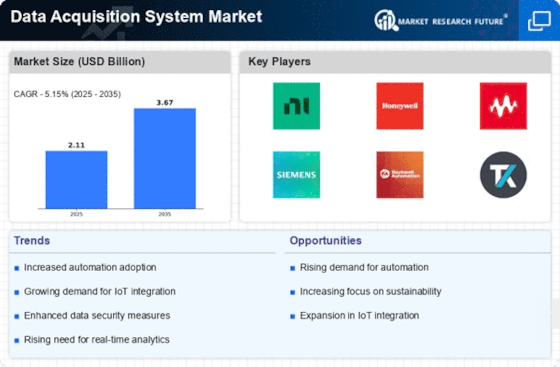
As per Market Research Future analysis, the Data Acquisition System Market Size was estimated at 2.114 USD Billion in 2024. The Data Acquisition System industry is projected to grow from 2.222 USD Billion in 2025 to 3.672 USD Billion by 2035, exhibiting a compound annual growth rate (CAGR) of 5.15% during the forecast period 2025 - 2035

Key Market Trends & Highlights

The Data Acquisition System Market is poised for substantial growth driven by technological advancements and increasing demand for real-time data processing.

  • North America remains the largest market for data acquisition systems, driven by robust industrial applications. The Asia-Pacific region is emerging as the fastest-growing market, fueled by rapid technological adoption and infrastructure development. Hardware continues to dominate the market, while software solutions are experiencing the fastest growth due to increasing automation needs. Rising demand for real-time data processing and advancements in sensor technologies are key drivers propelling market expansion.

Market Size & Forecast

2024 Market Size 2.114 (USD Billion)
2035 Market Size 3.672 (USD Billion)
CAGR (2025 - 2035) 5.15%
Largest Regional Market Share in 2024 North America

Major Players

National Instruments (US), Honeywell (US), Keysight Technologies (US), Siemens (DE), Rockwell Automation (US), Tektronix (US), Data Translation (US), Yokogawa Electric (JP), Fluke Corporation (US)

Market Trends

The Data Acquisition System Market is currently experiencing a transformative phase, driven by advancements in technology and increasing demand for real-time data collection across various sectors. Industries such as manufacturing, healthcare, and environmental monitoring are increasingly adopting sophisticated data acquisition systems to enhance operational efficiency and decision-making processes. The integration of Internet of Things (IoT) devices and cloud computing is reshaping the landscape, allowing for seamless data integration and analysis. As organizations strive for greater accuracy and speed in data handling, the market is likely to witness a surge in innovative solutions that cater to these evolving needs.

Moreover, the growing emphasis on automation and smart technologies is propelling the Data Acquisition System Market forward. Companies are investing in systems that not only collect data but also provide actionable insights, thereby facilitating predictive maintenance and optimizing resource allocation. This trend indicates a shift towards more intelligent systems that can adapt to changing environments and user requirements. As the market continues to evolve, stakeholders must remain vigilant to emerging technologies and changing consumer preferences to maintain a competitive edge in this dynamic landscape.

Integration of IoT Technologies

Organizations are upgrading their legacy data acquisition systems to support high-speed signal processing and seamless communication with modern industrial IoT networks .This trend allows for enhanced connectivity and real-time data monitoring, enabling organizations to make informed decisions swiftly. As IoT devices proliferate, the demand for systems that can effectively manage and analyze vast amounts of data is likely to grow.

Focus on Automation and Smart Solutions

High-performance data acquisition systems are increasingly integrated with artificial intelligence to optimize performance and efficiency in sectors like aerospace, automotive, and renewable energy.

Emphasis on Data Security and Compliance

As data privacy concerns rise, there is an increasing emphasis on security and compliance within the Data Acquisition System Market. Companies are prioritizing systems that ensure data integrity and adhere to regulatory standards. This focus on security may drive innovation in the development of more robust and secure data acquisition solutions.

Rise of Advanced data Aquisition Software

Advanced data aquisition software provides the necessary tools for signal conditioning, real-time visualization, and complex data modeling, enabling deeper insights into industrial processes. The adoption of intuitive data aquisition software is critical for streamlining test-and-measurement workflows, reducing setup times, and improving the overall accuracy of experimental data.

Data Acquisition DAQ System Market Market Drivers

Advancements in Sensor Technologies

Technological advancements in sensor technologies are significantly influencing the Data Acquisition System Market. The proliferation of high-precision sensors, capable of capturing a wide array of data types, enhances the accuracy and reliability of data acquisition systems. For instance, the integration of smart sensors in industrial applications allows for more efficient monitoring and control processes. The market for sensor technologies is expected to witness substantial growth, with projections indicating an increase in demand for advanced sensors by over 15% in the coming years. This evolution in sensor technology not only improves data quality but also expands the potential applications of data acquisition systems across diverse industries, thereby driving the Data Acquisition System Market forward.

Growing Focus on Predictive Maintenance

The Data Acquisition System Market is witnessing a growing focus on predictive maintenance strategies across various sectors. Organizations are increasingly utilizing data acquisition systems to monitor equipment performance and predict potential failures before they occur. This proactive approach not only minimizes downtime but also reduces maintenance costs significantly. Recent studies indicate that predictive maintenance can lead to cost savings of up to 30% for manufacturing companies. As industries strive to enhance operational efficiency and reduce unexpected equipment failures, the demand for data acquisition systems that support predictive maintenance is likely to increase. This trend underscores the importance of data-driven insights in optimizing maintenance practices within the Data Acquisition System Market.

Regulatory Compliance and Data Governance

The Data Acquisition System Market is significantly influenced by the increasing emphasis on regulatory compliance and data governance. Organizations are required to adhere to stringent regulations regarding data collection, storage, and processing, particularly in sectors such as finance, healthcare, and telecommunications. Compliance with these regulations necessitates robust data acquisition systems that ensure data integrity and security. As a result, the market for data acquisition systems that incorporate advanced compliance features is expected to expand. Recent reports indicate that companies investing in compliance-focused data acquisition solutions can enhance their operational resilience and mitigate risks associated with data breaches. This growing regulatory landscape is a critical driver of innovation and growth within the Data Acquisition System Market.

Increased Adoption of Cloud-Based Solutions

The shift towards cloud-based solutions is reshaping the Data Acquisition System Market. Organizations are increasingly adopting cloud technologies to facilitate data storage, processing, and analysis. This transition allows for enhanced scalability, flexibility, and cost-effectiveness in managing data acquisition systems. Recent data suggests that the cloud segment within the data acquisition market is expected to grow at a rate of 18% annually, reflecting a strong preference for cloud-based architectures. By leveraging cloud solutions, businesses can streamline their data workflows and improve collaboration across teams, which is essential for optimizing data-driven decision-making processes. Consequently, the rise of cloud-based data acquisition systems is a key driver of growth in the Data Acquisition System Market.

Rising Demand for Real-Time Data Processing

The Data Acquisition System Market experiences a notable surge in demand for real-time data processing capabilities. Industries such as manufacturing, healthcare, and energy are increasingly reliant on timely data to enhance operational efficiency and decision-making. According to recent estimates, the market for real-time data processing solutions is projected to grow at a compound annual growth rate of approximately 12% over the next five years. This trend is driven by the need for immediate insights, enabling organizations to respond swiftly to changing conditions. As a result, data acquisition systems that facilitate real-time data collection and analysis are becoming indispensable across various sectors, thereby propelling the growth of the Data Acquisition System Market.

Market Segment Insights

By Type: Hardware (Largest) vs. Software (Fastest-Growing)

<p>In the Data Acquisition System Market, the Hardware segment holds a significant share, dominating the landscape with its essential physical components that facilitate data collection and system functionality. Hardware solutions are crucial for organizations looking to invest in reliable data infrastructure, contributing to their leading market position. Conversely, the Software segment is emerging rapidly. As organizations focus more on data analytics and processing capabilities, software solutions are gaining traction, reflecting a significant shift in market preferences towards more automated and sophisticated data acquisition tools.</p>

<p>Data Acquisition Solutions: Hardware (Dominant) vs. Software (Emerging)</p>

<p>The Hardware segment remains dominant in the Data Acquisition System Market domain, characterized by its foundational role in data collection systems. It includes physical devices and instruments essential for accurate measurements and data integration. Companies are investing heavily in advanced hardware technologies to ensure seamless data acquisition, making this segment robust. On the other hand, the Software segment is labeled as emerging, driven by the increasing demand for sophisticated analytics and data processing capabilities. Organizations prefer software solutions that offer flexibility, scalability, and real-time data insights, enabling them to adapt to rapidly changing data environments. This trend highlights a shift towards integration of software enhancements with traditional hardware, underlining a synergistic evolution in this market.</p>

By Speed: High-speed (>100 KS/S) (Largest) vs. Low-speed (<100 KS/S)

<p>In the Data Acquisition System Market, the majority share of speed segment is held by high-speed systems which cater to demanding applications that require precise data capture at rapid rates. These systems are essential in sectors such as automotive testing and telecommunications, where high-frequency data is crucial for operational efficiency. Low-speed systems, while they occupy a smaller share of the market, serve important functions in less demanding applications like environmental monitoring and basic telemetry in industrial processes.</p>

<p>Speed Type: High-speed (>100 KS/S) (Dominant) vs. Low-speed (<100 KS/S) (Emerging)</p>

<p>High-speed data acquisition systems are characterized by their ability to process data at rates exceeding 100 kilo-samples per second, making them the choice for advanced technological applications that require quick response times and high accuracy. These systems have become dominant due to their critical role in industries that are pushing for faster and more reliable data analysis. Conversely, low-speed data acquisition systems, which operate below this threshold, are deemed as emerging options for applications that do not demand high-speed data processing. These systems are gaining traction in niche markets and are valued for their cost-effectiveness and simplicity, appealing particularly to smaller organizations and projects with less intensive data requirements.</p>

By Application: R&D (Largest) vs. Field (Fastest-Growing)

<p>The application segment in the Data Acquisition System Market showcases a well-diversified distribution among R&D, Field, and Manufacturing sectors. R&D remains the largest contributor, driven by heightened demand for innovation and testing in various industries. The Field application, often associated with real-time data capture in dynamic environments, is gaining prominence as businesses embrace automation and remote monitoring solutions. Manufacturing applications follow closely, leveraging data acquisition to enhance production efficiency and quality control.</p>

<p>R&D (Dominant) vs. Field (Emerging)</p>

<p>The R&D sector stands as the dominant player in the Data Acquisition System Market, characterized by its significant investment in advanced technologies to foster innovation. Companies are prioritizing data-driven decision-making, leading to enhanced product development and faster time-to-market. In contrast, the Field application represents an emerging segment that is rapidly evolving. This area is marked by its focus on real-time data collection, primarily through mobile and IoT devices, facilitating predictive maintenance and operational optimization. The rise of smart cities is further propelling the need for efficient field data acquisition systems.</p>

By Vertical: Healthcare (Largest) vs. Aerospace & Defense (Fastest-Growing)

<p>In the Data Acquisition System Market, the Healthcare segment holds the largest share, driven by the increasing adoption of advanced data solutions in medical devices and patient monitoring systems. Conversely, the Aerospace & Defense segment is currently the fastest-growing, fueled by the rising demand for high-precision data acquisition systems for aircraft and defense applications. This underscores a significant shift towards technology enhancement across sectors, utilizing data acquisition for operational efficiency. The growth trends in the market reveal a continuous integration of IoT and AI technologies, significantly boosting the performance and capabilities of data acquisition systems. Sectors like Power & Energy are also witnessing an upward trajectory as they adopt smart grids and renewable energy solutions. The Environmental Monitoring segment, although smaller, is evolving rapidly due to regulatory pressures and public awareness, indicating broader acceptance of data-driven solutions in all sectors.</p>

<p>Healthcare (Dominant) vs. Aerospace & Defense (Emerging)</p>

<p>The Healthcare segment in the Data Acquisition System Market is characterized by its extensive applications in patient care and medical research. Its dominance stems from the increasing reliance on real-time data collection for decision-making in clinical environments. Moreover, the growing prevalence of telemedicine and wearable health technologies empowers healthcare providers to leverage data acquisition for improved patient outcomes. On the other hand, the Aerospace & Defense segment is emerging as a vital player, driven by advancements in sensor technology and data analysis for mission-critical operations. This sector seeks to enhance data integrity and accuracy to ensure safety and compliance, making it a rapidly growing market segment with increasing investments in modern data solutions.</p>

By Technology: Wired Technology (Largest) vs. Wireless Technology (Fastest-Growing)

<p>In the data acquisition system market, Wired Technology currently holds the largest share, driven by its reliability and established infrastructure. While Wireless Technology trails in terms of market share, it is rapidly gaining traction, propelled by advancements in connectivity and the growing need for flexibility in data collection methods. Optical Technology and Embedded Technology also play significant roles, albeit with smaller shares, catering to niche applications.</p>

<p>Technology: Wired (Dominant) vs. Wireless (Emerging)</p>

<p>Wired Technology has established itself as a dominant force in the data acquisition system market, offering robust solutions with high data transfer rates and outstanding reliability for industrial applications. Its mature infrastructure continues to offer advantages in stability and security. On the other hand, Wireless Technology is emerging as a game-changer, leveraging advancements in IoT and wireless communication to enable real-time data acquisition in dynamic environments. This versatility makes it appealing for industries requiring remote monitoring and rapid deployment, thus positioning it as a crucial player in the future of data acquisition.</p>

Get more detailed insights about Data Acquisition System Market Research Report - Global Forecast till 2035

Regional Insights

By region, the study provides market insights into North America, Europe, Asia-Pacific and the Rest of the World. The North American Data Acquisition System market area will dominate this market, The growing demand for DAQ systems in verticals such as automotive and transportation, as well as the growing use of smart solutions in the power, automotive, oil & gas, industrial, and pharmaceutical industries, will drive the market in North America.

Further, the major countries studied in the market report are The US, Canada, German, Japan, India, France, the UK, Italy, Spain, China, Australia, South Korea, and Brazil.

Figure3 : GLOBAL DATA ACQUISITION SYSTEM MARKET SHARE BY REGION 2022 (USD Billion)

Europe has the second-largest market share for Data Acquisition Systems. Positive legislative changes, widespread industrial automation, and new clever manufacturing ventures would increase the European Union's market share. Furthermore, the German Data Acquisition System market dominated, while the UK Data Acquisition System market was the fastest expanding in the European area.

The Asia-Pacific Data Acquisition System Market is estimated to expand at the quickest CAGR between 2023 and 2032. The utilization of emerging technology, such as artificial intelligence (AI) and the Internet of Things, increased production capacity, stricter laws governing product testing and measurement, and major government backing for manufacturing. Furthermore, China's Data Acquisition System market had the greatest market share, while India's Data Acquisition System market was the fastest expanding in the Asia-Pacific region.

Key Players and Competitive Insights

Leading market companies are making significant R&D investments to diversify their product offerings, which will drive the Data Acquisition System market's expansion. Important market developments include new product releases, contractual agreements, mergers and acquisitions, greater investments, and collaboration with other organizations. Market participants also engage in several strategic actions to increase their worldwide presence. The market for Data Acquisition System industry is becoming more competitive. Therefore, it needs to offer reasonably priced products to grow and thrive.
Manufacturing locally to reduce operating costs is one of the primary business strategies manufacturers employ in the worldwide Data Acquisition System industry to assist customers and expand the market sector. The market for Data Acquisition System industry has recently provided some of the most important benefits. Major players in the Data Acquisition System market, including Major players in the Data Acquisition System market, including ABB,Explorium' and others, are attempting to increase market demand by investing in research and development operations.
ABB is a technology leader in electrification and automation, paving the path for a more resource-efficient and sustainable future. The company's solutions combine Engineering know-how and software to optimise how objects are created, transported, powered, and operated. ABB's 105,000 workers are dedicated to creating innovations that drive industrial change, building on more than 130 years of excellence.
In December ABB India collaborated with Indore smart city evelopment to implement digital technology that ensures uninterrupted power supply to households and businesses.
Through digitally enabled SCAD solutions, ABB's Compact Secondary Substations (CSS) employed in the project save downtime by ensuring a consistent and stable power supply.
Explorium's External Data Cloud links you to the greatest data sources in the world, all on one platform. It automatically identifies important, impacting data signals and utilises them to provide strong analytical solutions and revolutionary go-to-market activities.
In April Explorium, has released Signal Studio, a data acquisition product for developed analytics and machine learning that allows data and analyst teams quickly recognise and transform the most relevant external information signals into their data analysis pipeline.

Key Companies in the Data Acquisition DAQ System Market include

Industry Developments

In January 2023, Axiometrix Solutions’ brand, imc Test & Measurement, introduced its modular data collection system, IMC ARGUSfit. Therefore, there is an imc ARGUSfit base unit and extra amplifier and fieldbus interface modules like FD that can be easily docked together quickly to offer high flexibility in automotive and machine testing and monitoring.

In June 2022, Advantech launched the iDAQ line of data collection modules. The company made this announcement about the iDAQ series, which is a new family of modular data acquisition modules and chassis consisting of the iDAQ-900 chassis and a group of DAQ modules that includes the iDAQ-700 and 800.

June 2022 - Advantech announced the launch of a new series of data acquisition modules - the iDAQ series. It contains a range of modular DAQ modules and chassis known as the iDAQ series, including the iDAQ-900 series chassis as well as iDAQ-700 and 800 series DAQ modules.

December 2021 saw a partnership between Indore Smart City Development (which had partnered with ABB India) to provide an uninterrupted supply of electricity for residential areas and businesses through digital technologies. Connected to supervisory control & data acquisition (SCADA) systems powered by Compact Secondary Substations (CSS), it ensures that electricity is constantly supplied without interruption.

In June 2023, imc Test & Measurement finally presented its latest line-up called imc ARGUSfit as a powerful solution for flexible measurement tasks. It is completed by introducing MAY FD options or any other complementary amplifier or fieldbus interface module to these ones. Hence, this modularity allows for easy assembly without having to deal with specific design requirements that are common in both automotive testing scenarios and machinery applications.

FMK INC, a South Korea-based start-up, launched the TSI-T001 tunnel safety inspection system on April 20th, 2024. In addition to this feature, autonomous data acquisition is also provided in the package.

In June 2023, IMC Test & Measurement announced the launch of its new data acquisition system. It is a modular data acquisition system designed to be simple, easily installed, and integrated.

Future Outlook

Data Acquisition DAQ System Market Future Outlook

The Data Acquisition System Market is projected to grow at a 5.15% CAGR from 2025 to 2035, driven by advancements in IoT, automation, and <a href="https://www.marketresearchfuture.com/reports/data-analytics-market-1689">data analytics</a>.

New opportunities lie in:

  • <p>Integration of AI-driven analytics for real-time data processing. Development of portable data acquisition devices for field applications. Expansion into emerging markets with tailored solutions for local industries.</p>

By 2035, the market is expected to be robust, reflecting substantial growth and innovation.

Market Segmentation

Data Acquisition DAQ System Market Type Outlook

  • Hardware
  • Software

Data Acquisition DAQ System Market Speed Outlook

  • High-speed (>100 KS/S)
  • Low-speed (<100 KS/S)

Data Acquisition DAQ System Market Vertical Outlook

  • Automotive & Transportation
  • Aerospace & Defense
  • Wireless Communications & Infrastructure
  • Power & Energy
  • Environmental Monitoring
  • Healthcare
  • Food & Beverage
  • Others

Data Acquisition DAQ System Market Application Outlook

  • R&D
  • Field
  • Manufacturing

Report Scope

MARKET SIZE 2024 2.114(USD Billion)
MARKET SIZE 2025 2.222(USD Billion)
MARKET SIZE 2035 3.672(USD Billion)
COMPOUND ANNUAL GROWTH RATE (CAGR) 5.15% (2025 - 2035)
REPORT COVERAGE Revenue Forecast, Competitive Landscape, Growth Factors, and Trends
BASE YEAR 2024
Market Forecast Period 2025 - 2035
Historical Data 2019 - 2024
Market Forecast Units USD Billion
Key Companies Profiled National Instruments (US), Honeywell (US), Keysight Technologies (US), Siemens (DE), Rockwell Automation (US), Tektronix (US), Data Translation (US), Yokogawa Electric (JP), Fluke Corporation (US)
Segments Covered Type, Speed, Application, Vertical, Region
Key Market Opportunities Integration of artificial intelligence in Data Acquisition System Market enhances data processing and decision-making capabilities.
Key Market Dynamics Rising demand for real-time data analytics drives innovation in Data Acquisition Systems across various industries.
Countries Covered North America, Europe, APAC, South America, MEA

FAQs

What is the projected market valuation for the Data Acquisition System Market in 2035?

<p>The projected market valuation for the Data Acquisition System Market in 2035 is 3.672 USD Billion.</p>

What was the overall market valuation for the Data Acquisition System Market in 2024?

<p>The overall market valuation for the Data Acquisition System Market in 2024 was 2.114 USD Billion.</p>

What is the expected CAGR for the Data Acquisition System Market during the forecast period 2025 - 2035?

<p>The expected CAGR for the Data Acquisition System Market during the forecast period 2025 - 2035 is 5.15%.</p>

Which companies are considered key players in the Data Acquisition System Market?

<p>Key players in the Data Acquisition System Market include National Instruments, Honeywell, Keysight Technologies, Siemens, and Rockwell Automation.</p>

What are the main segments of the Data Acquisition System Market by type?

<p>The main segments by type in the Data Acquisition System Market are Hardware and Software, with valuations of 1.845 USD Billion and 1.827 USD Billion, respectively.</p>

How does the Data Acquisition System Market perform in the automotive and transportation sector?

<p>In the automotive and transportation sector, the Data Acquisition System Market was valued at 0.735 USD Billion in 2024.</p>

What is the valuation of the Data Acquisition System Market for high-speed data acquisition systems?

The valuation for high-speed data acquisition systems, defined as those operating at over 100 KS/S, was 1.883 USD Billion in 2024.

What applications are driving growth in the Data Acquisition System Market?

Key applications driving growth in the Data Acquisition System Market include R&amp;D, Field, and Manufacturing, with valuations of 1.475 USD Billion, 1.175 USD Billion, and 1.022 USD Billion, respectively.

What is the market valuation for the healthcare vertical in the Data Acquisition System Market?

The market valuation for the healthcare vertical in the Data Acquisition System Market was 0.56 USD Billion in 2024.

How does the Data Acquisition System Market perform in the aerospace and defense sector?

In the aerospace and defense sector, the Data Acquisition System Market was valued at 0.61 USD Billion in 2024.

  1. SECTION I: EXECUTIVE SUMMARY AND KEY HIGHLIGHTS
    1. | 1.1 EXECUTIVE SUMMARY
    2. | | 1.1.1 Market Overview
    3. | | 1.1.2 Key Findings
    4. | | 1.1.3 Market Segmentation
    5. | | 1.1.4 Competitive Landscape
    6. | | 1.1.5 Challenges and Opportunities
    7. | | 1.1.6 Future Outlook
  2. SECTION II: SCOPING, METHODOLOGY AND MARKET STRUCTURE
    1. | 2.1 MARKET INTRODUCTION
    2. | | 2.1.1 Definition
    3. | | 2.1.2 Scope of the study
    4. | | | 2.1.2.1 Research Objective
    5. | | | 2.1.2.2 Assumption
    6. | | | 2.1.2.3 Limitations
    7. | 2.2 RESEARCH METHODOLOGY
    8. | | 2.2.1 Overview
    9. | | 2.2.2 Data Mining
    10. | | 2.2.3 Secondary Research
    11. | | 2.2.4 Primary Research
    12. | | | 2.2.4.1 Primary Interviews and Information Gathering Process
    13. | | | 2.2.4.2 Breakdown of Primary Respondents
    14. | | 2.2.5 Forecasting Model
    15. | | 2.2.6 Market Size Estimation
    16. | | | 2.2.6.1 Bottom-Up Approach
    17. | | | 2.2.6.2 Top-Down Approach
    18. | | 2.2.7 Data Triangulation
    19. | | 2.2.8 Validation
  3. SECTION III: QUALITATIVE ANALYSIS
    1. | 3.1 MARKET DYNAMICS
    2. | | 3.1.1 Overview
    3. | | 3.1.2 Drivers
    4. | | 3.1.3 Restraints
    5. | | 3.1.4 Opportunities
    6. | 3.2 MARKET FACTOR ANALYSIS
    7. | | 3.2.1 Value chain Analysis
    8. | | 3.2.2 Porter's Five Forces Analysis
    9. | | | 3.2.2.1 Bargaining Power of Suppliers
    10. | | | 3.2.2.2 Bargaining Power of Buyers
    11. | | | 3.2.2.3 Threat of New Entrants
    12. | | | 3.2.2.4 Threat of Substitutes
    13. | | | 3.2.2.5 Intensity of Rivalry
    14. | | 3.2.3 COVID-19 Impact Analysis
    15. | | | 3.2.3.1 Market Impact Analysis
    16. | | | 3.2.3.2 Regional Impact
    17. | | | 3.2.3.3 Opportunity and Threat Analysis
  4. SECTION IV: QUANTITATIVE ANALYSIS
    1. | 4.1 Information and Communications Technology, BY Type (USD Billion)
    2. | | 4.1.1 Hardware
    3. | | 4.1.2 Software
    4. | 4.2 Information and Communications Technology, BY Speed (USD Billion)
    5. | | 4.2.1 High-speed (>100 KS/S)
    6. | | 4.2.2 Low-speed (<100 KS/S)
    7. | 4.3 Information and Communications Technology, BY Application (USD Billion)
    8. | | 4.3.1 R&D
    9. | | 4.3.2 Field
    10. | | 4.3.3 Manufacturing
    11. | 4.4 Information and Communications Technology, BY Vertical (USD Billion)
    12. | | 4.4.1 Automotive & Transportation
    13. | | 4.4.2 Aerospace & Defense
    14. | | 4.4.3 Wireless Communications & Infrastructure
    15. | | 4.4.4 Power & Energy
    16. | | 4.4.5 Environmental Monitoring
    17. | | 4.4.6 Healthcare
    18. | | 4.4.7 Food & Beverage
    19. | | 4.4.8 Others
    20. | 4.5 Information and Communications Technology, BY Region (USD Billion)
    21. | | 4.5.1 North America
    22. | | | 4.5.1.1 US
    23. | | | 4.5.1.2 Canada
    24. | | 4.5.2 Europe
    25. | | | 4.5.2.1 Germany
    26. | | | 4.5.2.2 UK
    27. | | | 4.5.2.3 France
    28. | | | 4.5.2.4 Russia
    29. | | | 4.5.2.5 Italy
    30. | | | 4.5.2.6 Spain
    31. | | | 4.5.2.7 Rest of Europe
    32. | | 4.5.3 APAC
    33. | | | 4.5.3.1 China
    34. | | | 4.5.3.2 India
    35. | | | 4.5.3.3 Japan
    36. | | | 4.5.3.4 South Korea
    37. | | | 4.5.3.5 Malaysia
    38. | | | 4.5.3.6 Thailand
    39. | | | 4.5.3.7 Indonesia
    40. | | | 4.5.3.8 Rest of APAC
    41. | | 4.5.4 South America
    42. | | | 4.5.4.1 Brazil
    43. | | | 4.5.4.2 Mexico
    44. | | | 4.5.4.3 Argentina
    45. | | | 4.5.4.4 Rest of South America
    46. | | 4.5.5 MEA
    47. | | | 4.5.5.1 GCC Countries
    48. | | | 4.5.5.2 South Africa
    49. | | | 4.5.5.3 Rest of MEA
  5. SECTION V: COMPETITIVE ANALYSIS
    1. | 5.1 Competitive Landscape
    2. | | 5.1.1 Overview
    3. | | 5.1.2 Competitive Analysis
    4. | | 5.1.3 Market share Analysis
    5. | | 5.1.4 Major Growth Strategy in the Information and Communications Technology
    6. | | 5.1.5 Competitive Benchmarking
    7. | | 5.1.6 Leading Players in Terms of Number of Developments in the Information and Communications Technology
    8. | | 5.1.7 Key developments and growth strategies
    9. | | | 5.1.7.1 New Product Launch/Service Deployment
    10. | | | 5.1.7.2 Merger & Acquisitions
    11. | | | 5.1.7.3 Joint Ventures
    12. | | 5.1.8 Major Players Financial Matrix
    13. | | | 5.1.8.1 Sales and Operating Income
    14. | | | 5.1.8.2 Major Players R&D Expenditure. 2023
    15. | 5.2 Company Profiles
    16. | | 5.2.1 National Instruments (US)
    17. | | | 5.2.1.1 Financial Overview
    18. | | | 5.2.1.2 Products Offered
    19. | | | 5.2.1.3 Key Developments
    20. | | | 5.2.1.4 SWOT Analysis
    21. | | | 5.2.1.5 Key Strategies
    22. | | 5.2.2 Honeywell (US)
    23. | | | 5.2.2.1 Financial Overview
    24. | | | 5.2.2.2 Products Offered
    25. | | | 5.2.2.3 Key Developments
    26. | | | 5.2.2.4 SWOT Analysis
    27. | | | 5.2.2.5 Key Strategies
    28. | | 5.2.3 Keysight Technologies (US)
    29. | | | 5.2.3.1 Financial Overview
    30. | | | 5.2.3.2 Products Offered
    31. | | | 5.2.3.3 Key Developments
    32. | | | 5.2.3.4 SWOT Analysis
    33. | | | 5.2.3.5 Key Strategies
    34. | | 5.2.4 Siemens (DE)
    35. | | | 5.2.4.1 Financial Overview
    36. | | | 5.2.4.2 Products Offered
    37. | | | 5.2.4.3 Key Developments
    38. | | | 5.2.4.4 SWOT Analysis
    39. | | | 5.2.4.5 Key Strategies
    40. | | 5.2.5 Rockwell Automation (US)
    41. | | | 5.2.5.1 Financial Overview
    42. | | | 5.2.5.2 Products Offered
    43. | | | 5.2.5.3 Key Developments
    44. | | | 5.2.5.4 SWOT Analysis
    45. | | | 5.2.5.5 Key Strategies
    46. | | 5.2.6 Tektronix (US)
    47. | | | 5.2.6.1 Financial Overview
    48. | | | 5.2.6.2 Products Offered
    49. | | | 5.2.6.3 Key Developments
    50. | | | 5.2.6.4 SWOT Analysis
    51. | | | 5.2.6.5 Key Strategies
    52. | | 5.2.7 Data Translation (US)
    53. | | | 5.2.7.1 Financial Overview
    54. | | | 5.2.7.2 Products Offered
    55. | | | 5.2.7.3 Key Developments
    56. | | | 5.2.7.4 SWOT Analysis
    57. | | | 5.2.7.5 Key Strategies
    58. | | 5.2.8 Yokogawa Electric (JP)
    59. | | | 5.2.8.1 Financial Overview
    60. | | | 5.2.8.2 Products Offered
    61. | | | 5.2.8.3 Key Developments
    62. | | | 5.2.8.4 SWOT Analysis
    63. | | | 5.2.8.5 Key Strategies
    64. | | 5.2.9 Fluke Corporation (US)
    65. | | | 5.2.9.1 Financial Overview
    66. | | | 5.2.9.2 Products Offered
    67. | | | 5.2.9.3 Key Developments
    68. | | | 5.2.9.4 SWOT Analysis
    69. | | | 5.2.9.5 Key Strategies
    70. | 5.3 Appendix
    71. | | 5.3.1 References
    72. | | 5.3.2 Related Reports
  6. LIST OF FIGURES
    1. | 6.1 MARKET SYNOPSIS
    2. | 6.2 NORTH AMERICA MARKET ANALYSIS
    3. | 6.3 US MARKET ANALYSIS BY TYPE
    4. | 6.4 US MARKET ANALYSIS BY SPEED
    5. | 6.5 US MARKET ANALYSIS BY APPLICATION
    6. | 6.6 US MARKET ANALYSIS BY VERTICAL
    7. | 6.7 CANADA MARKET ANALYSIS BY TYPE
    8. | 6.8 CANADA MARKET ANALYSIS BY SPEED
    9. | 6.9 CANADA MARKET ANALYSIS BY APPLICATION
    10. | 6.10 CANADA MARKET ANALYSIS BY VERTICAL
    11. | 6.11 EUROPE MARKET ANALYSIS
    12. | 6.12 GERMANY MARKET ANALYSIS BY TYPE
    13. | 6.13 GERMANY MARKET ANALYSIS BY SPEED
    14. | 6.14 GERMANY MARKET ANALYSIS BY APPLICATION
    15. | 6.15 GERMANY MARKET ANALYSIS BY VERTICAL
    16. | 6.16 UK MARKET ANALYSIS BY TYPE
    17. | 6.17 UK MARKET ANALYSIS BY SPEED
    18. | 6.18 UK MARKET ANALYSIS BY APPLICATION
    19. | 6.19 UK MARKET ANALYSIS BY VERTICAL
    20. | 6.20 FRANCE MARKET ANALYSIS BY TYPE
    21. | 6.21 FRANCE MARKET ANALYSIS BY SPEED
    22. | 6.22 FRANCE MARKET ANALYSIS BY APPLICATION
    23. | 6.23 FRANCE MARKET ANALYSIS BY VERTICAL
    24. | 6.24 RUSSIA MARKET ANALYSIS BY TYPE
    25. | 6.25 RUSSIA MARKET ANALYSIS BY SPEED
    26. | 6.26 RUSSIA MARKET ANALYSIS BY APPLICATION
    27. | 6.27 RUSSIA MARKET ANALYSIS BY VERTICAL
    28. | 6.28 ITALY MARKET ANALYSIS BY TYPE
    29. | 6.29 ITALY MARKET ANALYSIS BY SPEED
    30. | 6.30 ITALY MARKET ANALYSIS BY APPLICATION
    31. | 6.31 ITALY MARKET ANALYSIS BY VERTICAL
    32. | 6.32 SPAIN MARKET ANALYSIS BY TYPE
    33. | 6.33 SPAIN MARKET ANALYSIS BY SPEED
    34. | 6.34 SPAIN MARKET ANALYSIS BY APPLICATION
    35. | 6.35 SPAIN MARKET ANALYSIS BY VERTICAL
    36. | 6.36 REST OF EUROPE MARKET ANALYSIS BY TYPE
    37. | 6.37 REST OF EUROPE MARKET ANALYSIS BY SPEED
    38. | 6.38 REST OF EUROPE MARKET ANALYSIS BY APPLICATION
    39. | 6.39 REST OF EUROPE MARKET ANALYSIS BY VERTICAL
    40. | 6.40 APAC MARKET ANALYSIS
    41. | 6.41 CHINA MARKET ANALYSIS BY TYPE
    42. | 6.42 CHINA MARKET ANALYSIS BY SPEED
    43. | 6.43 CHINA MARKET ANALYSIS BY APPLICATION
    44. | 6.44 CHINA MARKET ANALYSIS BY VERTICAL
    45. | 6.45 INDIA MARKET ANALYSIS BY TYPE
    46. | 6.46 INDIA MARKET ANALYSIS BY SPEED
    47. | 6.47 INDIA MARKET ANALYSIS BY APPLICATION
    48. | 6.48 INDIA MARKET ANALYSIS BY VERTICAL
    49. | 6.49 JAPAN MARKET ANALYSIS BY TYPE
    50. | 6.50 JAPAN MARKET ANALYSIS BY SPEED
    51. | 6.51 JAPAN MARKET ANALYSIS BY APPLICATION
    52. | 6.52 JAPAN MARKET ANALYSIS BY VERTICAL
    53. | 6.53 SOUTH KOREA MARKET ANALYSIS BY TYPE
    54. | 6.54 SOUTH KOREA MARKET ANALYSIS BY SPEED
    55. | 6.55 SOUTH KOREA MARKET ANALYSIS BY APPLICATION
    56. | 6.56 SOUTH KOREA MARKET ANALYSIS BY VERTICAL
    57. | 6.57 MALAYSIA MARKET ANALYSIS BY TYPE
    58. | 6.58 MALAYSIA MARKET ANALYSIS BY SPEED
    59. | 6.59 MALAYSIA MARKET ANALYSIS BY APPLICATION
    60. | 6.60 MALAYSIA MARKET ANALYSIS BY VERTICAL
    61. | 6.61 THAILAND MARKET ANALYSIS BY TYPE
    62. | 6.62 THAILAND MARKET ANALYSIS BY SPEED
    63. | 6.63 THAILAND MARKET ANALYSIS BY APPLICATION
    64. | 6.64 THAILAND MARKET ANALYSIS BY VERTICAL
    65. | 6.65 INDONESIA MARKET ANALYSIS BY TYPE
    66. | 6.66 INDONESIA MARKET ANALYSIS BY SPEED
    67. | 6.67 INDONESIA MARKET ANALYSIS BY APPLICATION
    68. | 6.68 INDONESIA MARKET ANALYSIS BY VERTICAL
    69. | 6.69 REST OF APAC MARKET ANALYSIS BY TYPE
    70. | 6.70 REST OF APAC MARKET ANALYSIS BY SPEED
    71. | 6.71 REST OF APAC MARKET ANALYSIS BY APPLICATION
    72. | 6.72 REST OF APAC MARKET ANALYSIS BY VERTICAL
    73. | 6.73 SOUTH AMERICA MARKET ANALYSIS
    74. | 6.74 BRAZIL MARKET ANALYSIS BY TYPE
    75. | 6.75 BRAZIL MARKET ANALYSIS BY SPEED
    76. | 6.76 BRAZIL MARKET ANALYSIS BY APPLICATION
    77. | 6.77 BRAZIL MARKET ANALYSIS BY VERTICAL
    78. | 6.78 MEXICO MARKET ANALYSIS BY TYPE
    79. | 6.79 MEXICO MARKET ANALYSIS BY SPEED
    80. | 6.80 MEXICO MARKET ANALYSIS BY APPLICATION
    81. | 6.81 MEXICO MARKET ANALYSIS BY VERTICAL
    82. | 6.82 ARGENTINA MARKET ANALYSIS BY TYPE
    83. | 6.83 ARGENTINA MARKET ANALYSIS BY SPEED
    84. | 6.84 ARGENTINA MARKET ANALYSIS BY APPLICATION
    85. | 6.85 ARGENTINA MARKET ANALYSIS BY VERTICAL
    86. | 6.86 REST OF SOUTH AMERICA MARKET ANALYSIS BY TYPE
    87. | 6.87 REST OF SOUTH AMERICA MARKET ANALYSIS BY SPEED
    88. | 6.88 REST OF SOUTH AMERICA MARKET ANALYSIS BY APPLICATION
    89. | 6.89 REST OF SOUTH AMERICA MARKET ANALYSIS BY VERTICAL
    90. | 6.90 MEA MARKET ANALYSIS
    91. | 6.91 GCC COUNTRIES MARKET ANALYSIS BY TYPE
    92. | 6.92 GCC COUNTRIES MARKET ANALYSIS BY SPEED
    93. | 6.93 GCC COUNTRIES MARKET ANALYSIS BY APPLICATION
    94. | 6.94 GCC COUNTRIES MARKET ANALYSIS BY VERTICAL
    95. | 6.95 SOUTH AFRICA MARKET ANALYSIS BY TYPE
    96. | 6.96 SOUTH AFRICA MARKET ANALYSIS BY SPEED
    97. | 6.97 SOUTH AFRICA MARKET ANALYSIS BY APPLICATION
    98. | 6.98 SOUTH AFRICA MARKET ANALYSIS BY VERTICAL
    99. | 6.99 REST OF MEA MARKET ANALYSIS BY TYPE
    100. | 6.100 REST OF MEA MARKET ANALYSIS BY SPEED
    101. | 6.101 REST OF MEA MARKET ANALYSIS BY APPLICATION
    102. | 6.102 REST OF MEA MARKET ANALYSIS BY VERTICAL
    103. | 6.103 KEY BUYING CRITERIA OF INFORMATION AND COMMUNICATIONS TECHNOLOGY
    104. | 6.104 RESEARCH PROCESS OF MRFR
    105. | 6.105 DRO ANALYSIS OF INFORMATION AND COMMUNICATIONS TECHNOLOGY
    106. | 6.106 DRIVERS IMPACT ANALYSIS: INFORMATION AND COMMUNICATIONS TECHNOLOGY
    107. | 6.107 RESTRAINTS IMPACT ANALYSIS: INFORMATION AND COMMUNICATIONS TECHNOLOGY
    108. | 6.108 SUPPLY / VALUE CHAIN: INFORMATION AND COMMUNICATIONS TECHNOLOGY
    109. | 6.109 INFORMATION AND COMMUNICATIONS TECHNOLOGY, BY TYPE, 2024 (% SHARE)
    110. | 6.110 INFORMATION AND COMMUNICATIONS TECHNOLOGY, BY TYPE, 2024 TO 2035 (USD Billion)
    111. | 6.111 INFORMATION AND COMMUNICATIONS TECHNOLOGY, BY SPEED, 2024 (% SHARE)
    112. | 6.112 INFORMATION AND COMMUNICATIONS TECHNOLOGY, BY SPEED, 2024 TO 2035 (USD Billion)
    113. | 6.113 INFORMATION AND COMMUNICATIONS TECHNOLOGY, BY APPLICATION, 2024 (% SHARE)
    114. | 6.114 INFORMATION AND COMMUNICATIONS TECHNOLOGY, BY APPLICATION, 2024 TO 2035 (USD Billion)
    115. | 6.115 INFORMATION AND COMMUNICATIONS TECHNOLOGY, BY VERTICAL, 2024 (% SHARE)
    116. | 6.116 INFORMATION AND COMMUNICATIONS TECHNOLOGY, BY VERTICAL, 2024 TO 2035 (USD Billion)
    117. | 6.117 BENCHMARKING OF MAJOR COMPETITORS
  7. LIST OF TABLES
    1. | 7.1 LIST OF ASSUMPTIONS
    2. | | 7.1.1
    3. | 7.2 North America MARKET SIZE ESTIMATES; FORECAST
    4. | | 7.2.1 BY TYPE, 2025-2035 (USD Billion)
    5. | | 7.2.2 BY SPEED, 2025-2035 (USD Billion)
    6. | | 7.2.3 BY APPLICATION, 2025-2035 (USD Billion)
    7. | | 7.2.4 BY VERTICAL, 2025-2035 (USD Billion)
    8. | 7.3 US MARKET SIZE ESTIMATES; FORECAST
    9. | | 7.3.1 BY TYPE, 2025-2035 (USD Billion)
    10. | | 7.3.2 BY SPEED, 2025-2035 (USD Billion)
    11. | | 7.3.3 BY APPLICATION, 2025-2035 (USD Billion)
    12. | | 7.3.4 BY VERTICAL, 2025-2035 (USD Billion)
    13. | 7.4 Canada MARKET SIZE ESTIMATES; FORECAST
    14. | | 7.4.1 BY TYPE, 2025-2035 (USD Billion)
    15. | | 7.4.2 BY SPEED, 2025-2035 (USD Billion)
    16. | | 7.4.3 BY APPLICATION, 2025-2035 (USD Billion)
    17. | | 7.4.4 BY VERTICAL, 2025-2035 (USD Billion)
    18. | 7.5 Europe MARKET SIZE ESTIMATES; FORECAST
    19. | | 7.5.1 BY TYPE, 2025-2035 (USD Billion)
    20. | | 7.5.2 BY SPEED, 2025-2035 (USD Billion)
    21. | | 7.5.3 BY APPLICATION, 2025-2035 (USD Billion)
    22. | | 7.5.4 BY VERTICAL, 2025-2035 (USD Billion)
    23. | 7.6 Germany MARKET SIZE ESTIMATES; FORECAST
    24. | | 7.6.1 BY TYPE, 2025-2035 (USD Billion)
    25. | | 7.6.2 BY SPEED, 2025-2035 (USD Billion)
    26. | | 7.6.3 BY APPLICATION, 2025-2035 (USD Billion)
    27. | | 7.6.4 BY VERTICAL, 2025-2035 (USD Billion)
    28. | 7.7 UK MARKET SIZE ESTIMATES; FORECAST
    29. | | 7.7.1 BY TYPE, 2025-2035 (USD Billion)
    30. | | 7.7.2 BY SPEED, 2025-2035 (USD Billion)
    31. | | 7.7.3 BY APPLICATION, 2025-2035 (USD Billion)
    32. | | 7.7.4 BY VERTICAL, 2025-2035 (USD Billion)
    33. | 7.8 France MARKET SIZE ESTIMATES; FORECAST
    34. | | 7.8.1 BY TYPE, 2025-2035 (USD Billion)
    35. | | 7.8.2 BY SPEED, 2025-2035 (USD Billion)
    36. | | 7.8.3 BY APPLICATION, 2025-2035 (USD Billion)
    37. | | 7.8.4 BY VERTICAL, 2025-2035 (USD Billion)
    38. | 7.9 Russia MARKET SIZE ESTIMATES; FORECAST
    39. | | 7.9.1 BY TYPE, 2025-2035 (USD Billion)
    40. | | 7.9.2 BY SPEED, 2025-2035 (USD Billion)
    41. | | 7.9.3 BY APPLICATION, 2025-2035 (USD Billion)
    42. | | 7.9.4 BY VERTICAL, 2025-2035 (USD Billion)
    43. | 7.10 Italy MARKET SIZE ESTIMATES; FORECAST
    44. | | 7.10.1 BY TYPE, 2025-2035 (USD Billion)
    45. | | 7.10.2 BY SPEED, 2025-2035 (USD Billion)
    46. | | 7.10.3 BY APPLICATION, 2025-2035 (USD Billion)
    47. | | 7.10.4 BY VERTICAL, 2025-2035 (USD Billion)
    48. | 7.11 Spain MARKET SIZE ESTIMATES; FORECAST
    49. | | 7.11.1 BY TYPE, 2025-2035 (USD Billion)
    50. | | 7.11.2 BY SPEED, 2025-2035 (USD Billion)
    51. | | 7.11.3 BY APPLICATION, 2025-2035 (USD Billion)
    52. | | 7.11.4 BY VERTICAL, 2025-2035 (USD Billion)
    53. | 7.12 Rest of Europe MARKET SIZE ESTIMATES; FORECAST
    54. | | 7.12.1 BY TYPE, 2025-2035 (USD Billion)
    55. | | 7.12.2 BY SPEED, 2025-2035 (USD Billion)
    56. | | 7.12.3 BY APPLICATION, 2025-2035 (USD Billion)
    57. | | 7.12.4 BY VERTICAL, 2025-2035 (USD Billion)
    58. | 7.13 APAC MARKET SIZE ESTIMATES; FORECAST
    59. | | 7.13.1 BY TYPE, 2025-2035 (USD Billion)
    60. | | 7.13.2 BY SPEED, 2025-2035 (USD Billion)
    61. | | 7.13.3 BY APPLICATION, 2025-2035 (USD Billion)
    62. | | 7.13.4 BY VERTICAL, 2025-2035 (USD Billion)
    63. | 7.14 China MARKET SIZE ESTIMATES; FORECAST
    64. | | 7.14.1 BY TYPE, 2025-2035 (USD Billion)
    65. | | 7.14.2 BY SPEED, 2025-2035 (USD Billion)
    66. | | 7.14.3 BY APPLICATION, 2025-2035 (USD Billion)
    67. | | 7.14.4 BY VERTICAL, 2025-2035 (USD Billion)
    68. | 7.15 India MARKET SIZE ESTIMATES; FORECAST
    69. | | 7.15.1 BY TYPE, 2025-2035 (USD Billion)
    70. | | 7.15.2 BY SPEED, 2025-2035 (USD Billion)
    71. | | 7.15.3 BY APPLICATION, 2025-2035 (USD Billion)
    72. | | 7.15.4 BY VERTICAL, 2025-2035 (USD Billion)
    73. | 7.16 Japan MARKET SIZE ESTIMATES; FORECAST
    74. | | 7.16.1 BY TYPE, 2025-2035 (USD Billion)
    75. | | 7.16.2 BY SPEED, 2025-2035 (USD Billion)
    76. | | 7.16.3 BY APPLICATION, 2025-2035 (USD Billion)
    77. | | 7.16.4 BY VERTICAL, 2025-2035 (USD Billion)
    78. | 7.17 South Korea MARKET SIZE ESTIMATES; FORECAST
    79. | | 7.17.1 BY TYPE, 2025-2035 (USD Billion)
    80. | | 7.17.2 BY SPEED, 2025-2035 (USD Billion)
    81. | | 7.17.3 BY APPLICATION, 2025-2035 (USD Billion)
    82. | | 7.17.4 BY VERTICAL, 2025-2035 (USD Billion)
    83. | 7.18 Malaysia MARKET SIZE ESTIMATES; FORECAST
    84. | | 7.18.1 BY TYPE, 2025-2035 (USD Billion)
    85. | | 7.18.2 BY SPEED, 2025-2035 (USD Billion)
    86. | | 7.18.3 BY APPLICATION, 2025-2035 (USD Billion)
    87. | | 7.18.4 BY VERTICAL, 2025-2035 (USD Billion)
    88. | 7.19 Thailand MARKET SIZE ESTIMATES; FORECAST
    89. | | 7.19.1 BY TYPE, 2025-2035 (USD Billion)
    90. | | 7.19.2 BY SPEED, 2025-2035 (USD Billion)
    91. | | 7.19.3 BY APPLICATION, 2025-2035 (USD Billion)
    92. | | 7.19.4 BY VERTICAL, 2025-2035 (USD Billion)
    93. | 7.20 Indonesia MARKET SIZE ESTIMATES; FORECAST
    94. | | 7.20.1 BY TYPE, 2025-2035 (USD Billion)
    95. | | 7.20.2 BY SPEED, 2025-2035 (USD Billion)
    96. | | 7.20.3 BY APPLICATION, 2025-2035 (USD Billion)
    97. | | 7.20.4 BY VERTICAL, 2025-2035 (USD Billion)
    98. | 7.21 Rest of APAC MARKET SIZE ESTIMATES; FORECAST
    99. | | 7.21.1 BY TYPE, 2025-2035 (USD Billion)
    100. | | 7.21.2 BY SPEED, 2025-2035 (USD Billion)
    101. | | 7.21.3 BY APPLICATION, 2025-2035 (USD Billion)
    102. | | 7.21.4 BY VERTICAL, 2025-2035 (USD Billion)
    103. | 7.22 South America MARKET SIZE ESTIMATES; FORECAST
    104. | | 7.22.1 BY TYPE, 2025-2035 (USD Billion)
    105. | | 7.22.2 BY SPEED, 2025-2035 (USD Billion)
    106. | | 7.22.3 BY APPLICATION, 2025-2035 (USD Billion)
    107. | | 7.22.4 BY VERTICAL, 2025-2035 (USD Billion)
    108. | 7.23 Brazil MARKET SIZE ESTIMATES; FORECAST
    109. | | 7.23.1 BY TYPE, 2025-2035 (USD Billion)
    110. | | 7.23.2 BY SPEED, 2025-2035 (USD Billion)
    111. | | 7.23.3 BY APPLICATION, 2025-2035 (USD Billion)
    112. | | 7.23.4 BY VERTICAL, 2025-2035 (USD Billion)
    113. | 7.24 Mexico MARKET SIZE ESTIMATES; FORECAST
    114. | | 7.24.1 BY TYPE, 2025-2035 (USD Billion)
    115. | | 7.24.2 BY SPEED, 2025-2035 (USD Billion)
    116. | | 7.24.3 BY APPLICATION, 2025-2035 (USD Billion)
    117. | | 7.24.4 BY VERTICAL, 2025-2035 (USD Billion)
    118. | 7.25 Argentina MARKET SIZE ESTIMATES; FORECAST
    119. | | 7.25.1 BY TYPE, 2025-2035 (USD Billion)
    120. | | 7.25.2 BY SPEED, 2025-2035 (USD Billion)
    121. | | 7.25.3 BY APPLICATION, 2025-2035 (USD Billion)
    122. | | 7.25.4 BY VERTICAL, 2025-2035 (USD Billion)
    123. | 7.26 Rest of South America MARKET SIZE ESTIMATES; FORECAST
    124. | | 7.26.1 BY TYPE, 2025-2035 (USD Billion)
    125. | | 7.26.2 BY SPEED, 2025-2035 (USD Billion)
    126. | | 7.26.3 BY APPLICATION, 2025-2035 (USD Billion)
    127. | | 7.26.4 BY VERTICAL, 2025-2035 (USD Billion)
    128. | 7.27 MEA MARKET SIZE ESTIMATES; FORECAST
    129. | | 7.27.1 BY TYPE, 2025-2035 (USD Billion)
    130. | | 7.27.2 BY SPEED, 2025-2035 (USD Billion)
    131. | | 7.27.3 BY APPLICATION, 2025-2035 (USD Billion)
    132. | | 7.27.4 BY VERTICAL, 2025-2035 (USD Billion)
    133. | 7.28 GCC Countries MARKET SIZE ESTIMATES; FORECAST
    134. | | 7.28.1 BY TYPE, 2025-2035 (USD Billion)
    135. | | 7.28.2 BY SPEED, 2025-2035 (USD Billion)
    136. | | 7.28.3 BY APPLICATION, 2025-2035 (USD Billion)
    137. | | 7.28.4 BY VERTICAL, 2025-2035 (USD Billion)
    138. | 7.29 South Africa MARKET SIZE ESTIMATES; FORECAST
    139. | | 7.29.1 BY TYPE, 2025-2035 (USD Billion)
    140. | | 7.29.2 BY SPEED, 2025-2035 (USD Billion)
    141. | | 7.29.3 BY APPLICATION, 2025-2035 (USD Billion)
    142. | | 7.29.4 BY VERTICAL, 2025-2035 (USD Billion)
    143. | 7.30 Rest of MEA MARKET SIZE ESTIMATES; FORECAST
    144. | | 7.30.1 BY TYPE, 2025-2035 (USD Billion)
    145. | | 7.30.2 BY SPEED, 2025-2035 (USD Billion)
    146. | | 7.30.3 BY APPLICATION, 2025-2035 (USD Billion)
    147. | | 7.30.4 BY VERTICAL, 2025-2035 (USD Billion)
    148. | 7.31 PRODUCT LAUNCH/PRODUCT DEVELOPMENT/APPROVAL
    149. | | 7.31.1
    150. | 7.32 ACQUISITION/PARTNERSHIP
    151. | | 7.32.1

Information and Communications Technology Market Segmentation

Information and Communications Technology By Type (USD Billion, 2025-2035)

  • Hardware
  • Software

Information and Communications Technology By Speed (USD Billion, 2025-2035)

  • High-speed (>100 KS/S)
  • Low-speed (<100 KS/S)

Information and Communications Technology By Application (USD Billion, 2025-2035)

  • R&D
  • Field
  • Manufacturing

Information and Communications Technology By Vertical (USD Billion, 2025-2035)

  • Automotive & Transportation
  • Aerospace & Defense
  • Wireless Communications & Infrastructure
  • Power & Energy
  • Environmental Monitoring
  • Healthcare
  • Food & Beverage
  • Others
Infographic

Free Sample Request

Kindly complete the form below to receive a free sample of this Report

Get Free Sample

Customer Strories

Compare Licence

×
Features License Type
Single User Multiuser License Enterprise User
Price $4,950 $5,950 $7,250
Maximum User Access Limit 1 User Upto 10 Users Unrestricted Access Throughout the Organization
Free Customization
Direct Access to Analyst
Deliverable Format
Platform Access
Discount on Next Purchase 10% 15% 15%
Printable Versions