Request Free Sample ×

Kindly complete the form below to receive a free sample of this Report

* Please use a valid business email

Leading companies partner with us for data-driven Insights

clients tt-cursor
Hero Background
English
Chinese
French
Japanese
Korean
German
Spanish

Dark Fiber Market Analysis

ID: MRFR/ICT/9034-HCR
100 Pages
Ankit Gupta
April 2026

Dark Fiber Market Size, Share and Research Report: By Fiber Type (Single Mode, Multi-mode), By Network Type (Metro, Long-haul), By Application (Telecom, Oil & Gas, BFSI, Medical, Railway), By Region (Asia-Pacific, North America, Europe, and Rest of the World) - Forecast till 2035.

Share:
Download PDF ×

We do not share your information with anyone. However, we may send you emails based on your report interest from time to time. You may contact us at any time to opt-out.

Dark Fiber Market Infographic
Purchase Options

Market Analysis

In-depth Analysis of Dark Fiber Market Industry Landscape

The Dark Fiber marketplace is characterized by a complicated interplay of elements that shape its conditions. Dark Fiber, additionally called unlit or unused optical Fiber, has emerged as a critical element in contemporary telecommunications infrastructure. As a result, the demand for Dark Fiber has surged, especially in areas witnessing an increase in information center construction. Another element contributing to the marketplace conditions is the evolution of the 5G era. The deployment of 5G networks requires a dense and high-ability fiber-optic infrastructure to guide the multiplied information site visitors and coffee-latency requirements. Dark Fiber gives a value-effective and scalable answer for telecom operators to build the vital community spine for 5G. The ongoing global rollout of 5G networks has, consequently, been a massive catalyst for the improvement of the Dark Fiber marketplace.

Competitive forces inside the telecommunications industry also play a pivotal role in shaping the Dark Fiber market. As traditional telecom operators strive to enhance their network skills and compete with emerging players, the adoption of Dark Fiber turns into a strategic vital. Dark Fiber allows these operators to make their network footprint quickly without the requirement for large physical infrastructure investments. Consequently, partnerships, mergers, and acquisitions inside the telecom sector contribute to the ebb and flow of the Dark Fiber market conditions. Regulatory guidelines and government tasks, in addition, mold the contours of the Dark Fiber marketplace. Governments understand the importance of robust virtual infrastructure for financial development and competitiveness. Various regulatory measures and monetary incentives are often implemented to inspire the deployment of fiber-optic networks, which include Dark Fiber.

These policy decisions influence the investment landscape and at once impact marketplace conditions by shaping the aggressive surroundings and figuring out the tempo of infrastructure development. Despite the favorable market situations, challenges additionally punctuate the Dark Fiber landscape. The initial capital funding required for laying and preserving fiber-optic infrastructure poses a barrier for a few marketplace gamers. Additionally, the sheer scale and complexity of deploying Dark Fiber networks necessitate careful planning and coordination, often leading to prolonged undertaking timelines.


Author
Author Profile
Ankit Gupta
Team Lead - Research

Ankit Gupta is a seasoned market intelligence and strategic research professional with over six plus years of experience in the ICT and Semiconductor industries. With academic roots in Telecom, Marketing, and Electronics, he blends technical insight with business strategy. Ankit has led 200+ projects, including work for Fortune 500 clients like Microsoft and Rio Tinto, covering market sizing, tech forecasting, and go-to-market strategies. Known for bridging engineering and enterprise decision-making, his insights support growth, innovation, and investment planning across diverse technology markets.

Leave a Comment

FAQs

What is the current valuation of the Dark Fiber Market as of 2024?

<p>The Dark Fiber Market was valued at 6.9 USD Billion in 2024.</p>

What is the projected market size for the Dark Fiber Market by 2035?

<p>The market is projected to reach 16.76 USD Billion by 2035.</p>

What is the expected CAGR for the Dark Fiber Market during the forecast period 2025 - 2035?

<p>The expected CAGR for the Dark Fiber Market during 2025 - 2035 is 8.4%.</p>

Which companies are considered key players in the Dark Fiber Market?

<p>Key players include Zayo Group, Lumen Technologies, AT&T, Crown Castle, and others.</p>

What are the primary applications of dark fiber in various industries?

<p>Applications include Telecom, Oil & Gas, BFSI, Military & Defense, and Medical sectors.</p>

How does the market segmentation by type affect the Dark Fiber Market?

<p>The market segments by type include Single-Mode and Multi-Mode, with valuations of 8.25 and 8.51 USD Billion respectively.</p>

What is the valuation of the Metro and Long-Haul network segments in the Dark Fiber Market?

The Metro segment is valued at 5.04 USD Billion, while the Long-Haul segment is valued at 11.72 USD Billion.

How does the Dark Fiber Market's growth compare across different applications?

The Telecom application leads with a valuation of 6.5 USD Billion, followed by Oil &amp; Gas at 2.5 USD Billion.

What trends are influencing the growth of the Dark Fiber Market?

Trends include increasing demand for high-speed connectivity and expansion in various sectors such as BFSI and Military.

What role do international players like Telstra and NTT Communications play in the Dark Fiber Market?

International players like Telstra and NTT Communications contribute to market growth through global service offerings and infrastructure development.

Market Summary

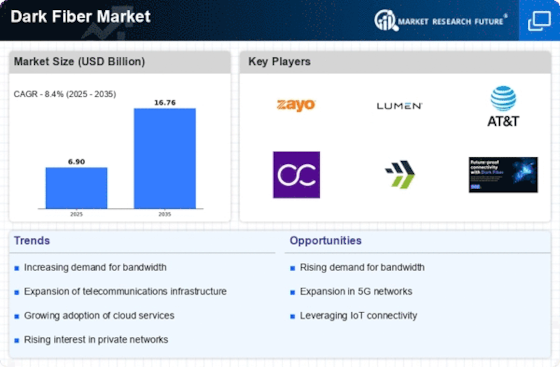
As per Market Research Future analysis, the Dark Fiber Market Size was estimated at 6.9 USD Billion in 2024. The Dark Fiber industry is projected to grow from 7.48 USD Billion in 2025 to 16.76 USD Billion by 2035, exhibiting a compound annual growth rate (CAGR) of 8.4% during the forecast period 2025 - 2035

Key Market Trends & Highlights

The Dark Fiber Market is experiencing robust growth driven by increasing bandwidth demands and technological advancements.

  • The demand for bandwidth continues to rise, propelling the expansion of dark fiber networks across various sectors. North America remains the largest market for dark fiber, while Asia-Pacific is emerging as the fastest-growing region. Single-Mode fiber dominates the market, whereas Multi-Mode fiber is witnessing the fastest growth due to evolving applications. Key drivers such as the rising adoption of cloud services and the growth of 5G infrastructure are significantly influencing market dynamics.

Market Size & Forecast

2024 Market Size 6.9 (USD Billion)
2035 Market Size 16.76 (USD Billion)
CAGR (2025 - 2035) 8.4%
Largest Regional Market Share in 2024 Asia Pacific

Major Players

<a href="https://www.zayo.com/">Zayo Group</a> (US), Lumen Technologies (US), AT&amp;T (US), Crown Castle (US), FiberLight (US), Dark Fiber Solutions (US), Telstra (AU), NTT Communications (JP), <a href="https://www.colt.net/">Colt Technology Services</a> (GB)

Market Trends

The Dark Fiber Market is currently experiencing a notable transformation, driven by the increasing demand for high-speed internet and the expansion of data centers. As organizations seek to enhance their network capabilities, the utilization of dark fiber infrastructure appears to be a viable solution. This trend is further supported by the growing reliance on cloud computing and the Internet of Things (IoT), which necessitate robust and scalable connectivity options. Moreover, the rise of smart cities and advanced telecommunications technologies indicates a shift towards more sophisticated networking solutions, thereby propelling the dark fiber sector forward. In addition, the competitive landscape of the Dark Fiber Market is evolving, with various stakeholders, including telecommunications companies and private investors, actively seeking opportunities to expand their fiber optic networks. This dynamic environment suggests that partnerships and collaborations may become increasingly common as entities strive to meet the surging demand for bandwidth.

Furthermore, regulatory frameworks and government initiatives aimed at promoting broadband access could potentially enhance market growth, creating a favorable atmosphere for investment and innovation in dark fiber infrastructure. Overall, the Dark Fiber Market is poised for continued expansion, driven by technological advancements and changing consumer needs. Dark optical fiber refers to unused fiber optic cables that can be leased by enterprises to build private high-capacity networks. The choice between multimode fiber vs single mode fiber depends on transmission distance, bandwidth requirements, and deployment cost. Optical fiber multimode vs single mode analysis highlights the performance advantages of single-mode fiber in long-haul dark fiber networks.

Increased Demand for Bandwidth

The Dark Fiber Market is witnessing a surge in demand for bandwidth, primarily due to the proliferation of data-intensive applications. As businesses and consumers increasingly rely on high-speed internet, the need for enhanced connectivity solutions becomes apparent. This trend is likely to drive investments in dark fiber infrastructure, as organizations seek to accommodate growing data traffic. Major dark fiber companies are focusing on network expansion and strategic partnerships to strengthen market presence. Dark fiber service providers are increasingly offering customized connectivity solutions for data centers and enterprises. Dark fiber pricing varies based on route length, fiber type, and regional infrastructure availability. Investments in dark fibre infrastructure are accelerating to support 5G, cloud computing, and data center expansion. The expansion of metro dark fiber networks is supporting cloud and 5G deployments in major cities.

Expansion of Data Centers

The ongoing expansion of data centers plays a crucial role in shaping the Dark Fiber Market. With the rise of cloud services and digital storage solutions, data centers require robust connectivity options to support their operations. This expansion may lead to increased utilization of dark fiber networks, as they offer the necessary bandwidth and flexibility.

Government Initiatives and Regulations

Government initiatives aimed at improving broadband access are likely to influence the Dark Fiber Market positively. Regulatory frameworks that promote investment in fiber optic infrastructure could enhance market growth. Such initiatives may encourage partnerships between public and private sectors, fostering innovation and expanding the reach of dark fiber networks.

Dark Fiber Market Market Drivers

Emergence of Smart Cities

The development of smart cities is driving the demand for advanced telecommunications infrastructure, which includes the Dark Fiber Market. Smart city initiatives rely on interconnected systems that require high-speed data transmission for efficient operation. Dark fiber networks provide the necessary bandwidth to support various applications, such as traffic management, public safety, and environmental monitoring. As urban areas increasingly adopt smart technologies, the need for reliable and scalable fiber optic solutions becomes evident. It is estimated that investments in smart city projects could exceed 2 trillion dollars by 2025, indicating a substantial opportunity for the Dark Fiber Market to play a crucial role in urban development.

Growth of 5G Infrastructure

The rollout of 5G technology is poised to revolutionize telecommunications, thereby acting as a catalyst for the Dark Fiber Market. 5G networks require extensive fiber optic infrastructure to deliver high-speed connectivity and low latency. Dark fiber is essential for backhauling data from cell towers to central networks, ensuring that the full potential of 5G can be realized. As telecommunications companies invest heavily in 5G infrastructure, the demand for dark fiber is expected to surge. Reports indicate that global 5G investments could reach 1 trillion dollars by 2025, highlighting the critical role of the Dark Fiber Market in supporting this technological advancement.

Rising Adoption of Cloud Services

The increasing adoption of cloud services is a pivotal driver for the Dark Fiber Market. As businesses migrate their operations to the cloud, the demand for high-speed, reliable connectivity intensifies. Dark fiber provides the necessary bandwidth and flexibility to support cloud-based applications, which are becoming integral to modern enterprises. According to recent data, the cloud computing market is projected to reach a valuation of over 800 billion dollars by 2025, further propelling the need for dark fiber infrastructure. This trend indicates that organizations are seeking scalable solutions to accommodate their growing data needs, thereby enhancing the relevance of the Dark Fiber Market.

Increased Focus on Network Security

As cyber threats become more sophisticated, organizations are placing a heightened emphasis on network security, which serves as a key driver for the Dark Fiber Market. Dark fiber networks offer enhanced security features, as they are private and dedicated, reducing the risk of data breaches compared to shared networks. This aspect is particularly appealing to sectors such as finance and healthcare, where data integrity is paramount. The Dark Fiber Market is anticipated to grow to over 300 billion dollars by 2024, indicating a strong correlation between security needs and the demand for dark fiber solutions. Consequently, the Dark Fiber Market is likely to benefit from this increasing focus on secure networking.

Surge in Internet of Things (IoT) Devices

The proliferation of Internet of Things (IoT) devices is significantly influencing the Dark Fiber Market. With billions of devices expected to be connected in the coming years, the demand for robust and high-capacity networks is paramount. Dark fiber offers the bandwidth necessary to handle the vast amounts of data generated by IoT applications, which range from smart homes to industrial automation. Industry estimates suggest that the number of connected IoT devices could exceed 30 billion by 2030, creating a substantial opportunity for dark fiber providers. This surge in connectivity requirements underscores the critical role of the Dark Fiber Market in supporting the infrastructure needed for IoT growth.

Market Segment Insights

By Type: Single-Mode (Largest) vs. Multi-Mode (Fastest-Growing)

The Dark Fiber Market is predominantly characterized by the Single-Mode fiber, which commands the largest share due to its superior performance over long distances and higher bandwidth capacity. Single-Mode fiber is chiefly utilized by telecommunications companies and large enterprises, leading to its widespread adoption and dominance in the market. Meanwhile, Multi-Mode fiber, while smaller in share, is gaining traction particularly in local area networks and data centers, largely driven by advancements in technology and affordability.

Fiber Type: Single-Mode (Dominant) vs. Multi-Mode (Emerging)

Single-Mode fiber is known for its capability to transmit data over longer distances with minimal signal loss, making it the dominant choice for high-capacity links and backbone networks. This type of fiber utilizes a single light path, resulting in higher efficiencies and performance levels. In contrast, Multi-Mode fiber, while emerging, is increasingly popular for shorter distances and lower-speed networks. Its lower cost and easier installation make it appealing for businesses looking to expand network capabilities without significant investment. As technology advances, the Multi-Mode segment is expected to grow rapidly, especially in environments focused on <a href="https://www.marketresearchfuture.com/reports/data-centre-market-4721">data center</a> applications.

By Network: Metro (Largest) vs. Long-Haul (Fastest-Growing)

In the Dark Fiber Market, the Metro segment dominates the market landscape, characterized by a significant share primarily driven by urban connectivity demands. Increasing data traffic and the proliferation of high-speed internet services have made Metro dark fiber a preferred choice. In contrast, the Long-Haul segment, although smaller in share, is witnessing remarkable growth as enterprises expand their networks across longer distances through fiber-optic technology, addressing broader geographic demands.

Metro (Dominant) vs. Long-Haul (Emerging)

Metro dark fiber networks are characterized by their ability to deliver high-capacity connectivity within urban centers, catering to businesses and service providers seeking rapid and reliable data transmission. This segment's strength lies in its well-established infrastructure, which supports various applications like <a href="https://www.marketresearchfuture.com/reports/cloud-computing-market-1013">cloud computing</a> and data centers. Conversely, the Long-Haul segment is emerging as a critical player, focusing on connecting distant locations and supporting bandwidth-intensive applications. As organizations increasingly require intercity and transcontinental data transport solutions, Long-Haul networks are rapidly gaining traction, driven by the demand for high-speed connectivity across greater distances.

By Application: Telecom (Largest) vs. Oil & Gas (Fastest-Growing)

In the Dark Fiber Market, the application segments demonstrate varied market share distributions, with Telecom being the dominant sector. This sector thrives due to the thriving demand for high-speed internet and increased connectivity needs globally. Following closely, sectors such as Oil &amp; Gas, BFSI, and Military &amp; Defense are also noteworthy, although they contribute less relative to Telecom. The presence of a growing number of service providers is set to enhance fiber utilization, particularly in remote and rural areas. As the market progresses, the Oil &amp; Gas segment is emerging rapidly, driven by the need for advanced communication systems and secure data transmission. The increased exploration and production activities are pushing the demand for dark fiber networks to facilitate real-time data sharing and connectivity. Moreover, the BFSI sector is leveraging dark fiber for enhanced security measures to protect sensitive financial data, while Military &amp; Defense applications focus on robust communication systems. Overall, growth is underpinned by technological advancements and the rising need for reliable high-speed connections across various sectors.

Telecom: Dominant vs. Oil &amp; Gas: Emerging

The Telecom sector stands as the dominant player in the Dark Fiber Market, characterized by its widespread infrastructure and robust demand driven by global connectivity needs. Telecom companies leverage dark fiber to provide high-speed internet services, enhancing bandwidth capacity and ensuring reliable communication among users. Emerging in parallel, the Oil &amp; Gas sector showcases significant potential, focusing on secure communication channels for the operation of remote sites and real-time data sharing. This sector utilizes dark fiber networks to facilitate the communication between offshore platforms and onshore facilities, optimizing operations and enhancing data safety. As exploration activities ramp up and the industry leans towards digital transformation, the Oil &amp; Gas sector is poised for rapid expansion within the dark fiber landscape.

Get more detailed insights about Dark Fiber Market Research Report - Global Forecast till 2035

Regional Insights

North America : Leading Market Innovators

North America is the largest market for dark fiber, accounting for approximately 60% of the global share. The region's growth is driven by increasing demand for high-speed internet, cloud computing, and data centers. Regulatory support for infrastructure development and investment in telecommunications further catalyze market expansion. The U.S. government has been actively promoting broadband access, which enhances the dark fiber market landscape. The competitive landscape is characterized by major players such as Zayo Group, Lumen Technologies, and AT&T, which dominate the market. These companies are investing heavily in expanding their fiber networks to meet the growing demand. Additionally, the presence of numerous regional providers enhances competition, ensuring a diverse range of services and pricing options for consumers.

Europe : Emerging Fiber Connectivity Hub

Europe is witnessing significant growth in the dark fiber market, holding approximately 25% of the global share. The demand is driven by the increasing need for high-capacity networks and the expansion of data centers. Regulatory frameworks, such as the European Electronic Communications Code, promote investment in fiber infrastructure, facilitating market growth. Countries like Germany and the UK are leading this expansion, supported by government initiatives to enhance digital connectivity. Leading countries in the region include Germany, the UK, and France, with a competitive landscape featuring key players like Colt Technology Services and local providers. The market is characterized by strategic partnerships and investments aimed at expanding fiber networks. The presence of established telecommunications companies and new entrants fosters innovation and competition, ensuring a robust market environment.

Asia-Pacific : Rapidly Expanding Fiber Networks

Asia-Pacific is emerging as a significant player in the dark fiber market, accounting for around 10% of the global share. The region's growth is fueled by rapid urbanization, increasing internet penetration, and the rise of cloud services. Governments are investing in digital infrastructure, with initiatives aimed at enhancing connectivity and supporting economic growth. Countries like Australia and Japan are at the forefront, driving demand for dark fiber solutions. The competitive landscape is marked by key players such as Telstra and NTT Communications, which are expanding their fiber networks to meet the growing demand. The presence of various local providers also contributes to a dynamic market environment. As businesses increasingly rely on high-speed connectivity, the dark fiber market in Asia-Pacific is poised for substantial growth, driven by both demand and regulatory support.

Middle East and Africa : Emerging Market Potential

The Middle East and Africa (MEA) region is gradually developing its dark fiber market, currently holding about 5% of the global share. The growth is driven by increasing investments in telecommunications infrastructure and the rising demand for high-speed internet services. Governments are recognizing the importance of digital connectivity, leading to regulatory initiatives aimed at enhancing fiber infrastructure. Countries like South Africa and the UAE are leading the charge in this transformation. The competitive landscape features a mix of local and international players, with companies investing in expanding their fiber networks. The presence of key players is growing, and partnerships are being formed to enhance service offerings. As the region continues to develop its digital infrastructure, the dark fiber market is expected to experience significant growth, driven by both demand and regulatory support.

Key Players and Competitive Insights

The Dark Fiber Market is currently characterized by a dynamic competitive landscape, driven by increasing demand for high-capacity bandwidth and the proliferation of data-intensive applications. Optical fiber multimode vs single mode analysis highlights the performance advantages of single-mode fiber in long-haul dark fiber networks Key players such as Zayo Group (US), Lumen Technologies (US), and AT&T (US) are strategically positioning themselves through a combination of innovation, regional expansion, and partnerships. Zayo Group (US) focuses on enhancing its fiber network infrastructure, while Lumen Technologies (US) emphasizes digital transformation initiatives to cater to enterprise customers. AT&T (US) is leveraging its extensive network to provide integrated solutions, thereby shaping a competitive environment that is increasingly reliant on technological advancements and customer-centric services.
The business tactics employed by these companies reflect a moderately fragmented market structure, where localizing operations and optimizing supply chains are pivotal. The collective influence of these key players fosters a competitive atmosphere that encourages innovation and responsiveness to market demands. As companies strive to differentiate themselves, the emphasis on localized service delivery and operational efficiency becomes paramount, allowing them to better meet the needs of diverse customer segments.
In August 2025, Zayo Group (US) announced a significant expansion of its dark fiber network in the Midwest, aiming to enhance connectivity for regional data centers. This strategic move is likely to bolster Zayo's market position by providing customers with increased bandwidth options and improved service reliability. The expansion aligns with the growing trend of data center consolidation, where proximity to fiber infrastructure is crucial for operational efficiency.
In September 2025, Lumen Technologies (US) unveiled a new suite of managed services designed to optimize dark fiber utilization for enterprise clients. This initiative appears to reflect Lumen's commitment to digital transformation, enabling businesses to leverage their fiber assets more effectively. By offering tailored solutions, Lumen may enhance customer loyalty and drive revenue growth in a competitive landscape where service differentiation is key.
In July 2025, AT&T (US) entered into a strategic partnership with a leading cloud service provider to enhance its dark fiber offerings. This collaboration is expected to facilitate seamless integration of cloud services with AT&T's fiber network, thereby providing customers with enhanced performance and scalability. Such partnerships indicate a trend towards integrated solutions that combine fiber infrastructure with advanced digital services, positioning AT&T favorably in the evolving market.
As of October 2025, the Dark Fiber Market is witnessing trends that emphasize digitalization, sustainability, and the integration of artificial intelligence. Strategic alliances among key players are increasingly shaping the competitive landscape, fostering innovation and collaborative solutions. Looking ahead, it is anticipated that competitive differentiation will evolve, shifting from traditional price-based competition to a focus on technological innovation, reliability of supply chains, and the ability to deliver customized solutions that meet the specific needs of customers.

Key Companies in the Dark Fiber Market include

Industry Developments

  • Q2 2024: Zayo Group to Expand Dark Fiber Market Network in Texas with New Route Zayo Group announced the launch of a new dark fiber route in Texas, expanding its network to support growing demand from data centers and enterprise customers in the region.
  • Q2 2024: Crown Castle Announces Completion of Major Dark Fiber Market Expansion in Phoenix Crown Castle completed a significant dark fiber network expansion in Phoenix, Arizona, aimed at supporting 5G deployments and enterprise connectivity.
  • Q3 2024: Lumen Technologies Secures Multi-Year Dark Fiber Market Contract with U.S. Federal Agency Lumen Technologies announced it has been awarded a multi-year contract to provide dark fiber infrastructure to a major U.S. federal agency, enhancing secure government communications.
  • Q3 2024: euNetworks Acquires Onstage Online to Expand Dark Fiber Market Footprint in Austria euNetworks completed the acquisition of Onstage Online GmbH, strengthening its dark fiber network presence in Austria and Central Europe.
  • Q4 2024: Aqua Comms Launches New Transatlantic Dark Fiber Market Route Connecting New York and Dublin Aqua Comms announced the launch of a new transatlantic dark fiber route, providing high-capacity, low-latency connectivity between New York and Dublin for hyperscale and enterprise customers.
  • Q4 2024: Colt Technology Services Partners with Equinix to Deliver Dark Fiber Market Solutions Across Europe Colt Technology Services entered a partnership with Equinix to provide dark fiber connectivity between key data centers in major European cities.
  • Q1 2025: Consolidated Communications Expands Dark Fiber Market Network in Chicago Metro Area Consolidated Communications announced the expansion of its dark fiber network in the Chicago metropolitan area, targeting enterprise and carrier customers.
  • Q1 2025: Zayo Group Announces New Dark Fiber Market Route Connecting Atlanta and Miami Zayo Group launched a new long-haul dark fiber route connecting Atlanta and Miami, enhancing connectivity options for cloud and content providers.
  • Q2 2025: EXA Infrastructure Acquires Dark Fiber Market Assets from FiberLight in Strategic U.S. Expansion EXA Infrastructure acquired dark fiber assets from FiberLight, expanding its U.S. network footprint and strengthening its position in the North American market.
  • Q2 2025: Verizon Business Wins Major Dark Fiber Market Contract with Fortune 100 Retailer Verizon Business secured a multi-year contract to provide dark fiber connectivity to a leading Fortune 100 retailer, supporting its digital transformation initiatives.
  • Q2 2025: PacketFabric Raises $150M to Accelerate Dark Fiber Market Network Expansion PacketFabric closed a $150 million funding round to accelerate the expansion of its dark fiber network infrastructure across North America and Europe.
  • Q2 2025: FirstLight Opens New Dark Fiber Market Route Connecting Boston and Montreal FirstLight announced the opening of a new dark fiber route between Boston and Montreal, enhancing cross-border connectivity for enterprise and carrier customers.

Future Outlook

Dark Fiber Market Future Outlook

The Dark Fiber Market is projected to grow at an 8.4% CAGR from 2025 to 2035, driven by increasing demand for high-speed connectivity and data transmission.

New opportunities lie in:

  • <p>Expansion into underserved rural areas with dedicated dark fiber networks. Partnerships with cloud service providers for enhanced data center connectivity. Development of innovative pricing models for flexible leasing options.</p>

By 2035, the Dark Fiber Market is expected to be robust, driven by strategic investments and technological advancements.

Market Segmentation

Dark Fiber Market Type Outlook

  • Single-Mode
  • Multi-Mode

Dark Fiber Market Network Outlook

  • Metro
  • Long-Haul

Dark Fiber Market Application Outlook

  • Telecom
  • Oil & Gas
  • BFSI
  • Military & Defense
  • Medical
  • Railway
  • Others

Report Scope

MARKET SIZE 2024 6.9(USD Billion)
MARKET SIZE 2025 7.48(USD Billion)
MARKET SIZE 2035 16.76(USD Billion)
COMPOUND ANNUAL GROWTH RATE (CAGR) 8.4% (2025 - 2035)
REPORT COVERAGE Revenue Forecast, Competitive Landscape, Growth Factors, and Trends
BASE YEAR 2024
Market Forecast Period 2025 - 2035
Historical Data 2019 - 2024
Market Forecast Units USD Billion
Key Companies Profiled Zayo Group (US), Lumen Technologies (US), AT&T (US), Crown Castle (US), FiberLight (US), Dark Fiber Solutions (US), Telstra (AU), NTT Communications (JP), Colt Technology Services (GB)
Segments Covered Fiber Type, Network Type, Application, Region
Key Market Opportunities Expansion of 5G networks driving demand for Dark Fiber Market infrastructure and connectivity solutions.
Key Market Dynamics Rising demand for high-speed connectivity drives competition and investment in dark fiber infrastructure and services.
Countries Covered North America, Europe, APAC, South America, MEA

FAQs

What is the current valuation of the Dark Fiber Market as of 2024?

<p>The Dark Fiber Market was valued at 6.9 USD Billion in 2024.</p>

What is the projected market size for the Dark Fiber Market by 2035?

<p>The market is projected to reach 16.76 USD Billion by 2035.</p>

What is the expected CAGR for the Dark Fiber Market during the forecast period 2025 - 2035?

<p>The expected CAGR for the Dark Fiber Market during 2025 - 2035 is 8.4%.</p>

Which companies are considered key players in the Dark Fiber Market?

<p>Key players include Zayo Group, Lumen Technologies, AT&T, Crown Castle, and others.</p>

What are the primary applications of dark fiber in various industries?

<p>Applications include Telecom, Oil & Gas, BFSI, Military & Defense, and Medical sectors.</p>

How does the market segmentation by type affect the Dark Fiber Market?

<p>The market segments by type include Single-Mode and Multi-Mode, with valuations of 8.25 and 8.51 USD Billion respectively.</p>

What is the valuation of the Metro and Long-Haul network segments in the Dark Fiber Market?

The Metro segment is valued at 5.04 USD Billion, while the Long-Haul segment is valued at 11.72 USD Billion.

How does the Dark Fiber Market's growth compare across different applications?

The Telecom application leads with a valuation of 6.5 USD Billion, followed by Oil &amp; Gas at 2.5 USD Billion.

What trends are influencing the growth of the Dark Fiber Market?

Trends include increasing demand for high-speed connectivity and expansion in various sectors such as BFSI and Military.

What role do international players like Telstra and NTT Communications play in the Dark Fiber Market?

International players like Telstra and NTT Communications contribute to market growth through global service offerings and infrastructure development.

  1. SECTION I: EXECUTIVE SUMMARY AND KEY HIGHLIGHTS
    1. | 1.1 EXECUTIVE SUMMARY
    2. | | 1.1.1 Market Overview
    3. | | 1.1.2 Key Findings
    4. | | 1.1.3 Market Segmentation
    5. | | 1.1.4 Competitive Landscape
    6. | | 1.1.5 Challenges and Opportunities
    7. | | 1.1.6 Future Outlook
  2. SECTION II: SCOPING, METHODOLOGY AND MARKET STRUCTURE
    1. | 2.1 MARKET INTRODUCTION
    2. | | 2.1.1 Definition
    3. | | 2.1.2 Scope of the study
    4. | | | 2.1.2.1 Research Objective
    5. | | | 2.1.2.2 Assumption
    6. | | | 2.1.2.3 Limitations
    7. | 2.2 RESEARCH METHODOLOGY
    8. | | 2.2.1 Overview
    9. | | 2.2.2 Data Mining
    10. | | 2.2.3 Secondary Research
    11. | | 2.2.4 Primary Research
    12. | | | 2.2.4.1 Primary Interviews and Information Gathering Process
    13. | | | 2.2.4.2 Breakdown of Primary Respondents
    14. | | 2.2.5 Forecasting Model
    15. | | 2.2.6 Market Size Estimation
    16. | | | 2.2.6.1 Bottom-Up Approach
    17. | | | 2.2.6.2 Top-Down Approach
    18. | | 2.2.7 Data Triangulation
    19. | | 2.2.8 Validation
  3. SECTION III: QUALITATIVE ANALYSIS
    1. | 3.1 MARKET DYNAMICS
    2. | | 3.1.1 Overview
    3. | | 3.1.2 Drivers
    4. | | 3.1.3 Restraints
    5. | | 3.1.4 Opportunities
    6. | 3.2 MARKET FACTOR ANALYSIS
    7. | | 3.2.1 Value chain Analysis
    8. | | 3.2.2 Porter's Five Forces Analysis
    9. | | | 3.2.2.1 Bargaining Power of Suppliers
    10. | | | 3.2.2.2 Bargaining Power of Buyers
    11. | | | 3.2.2.3 Threat of New Entrants
    12. | | | 3.2.2.4 Threat of Substitutes
    13. | | | 3.2.2.5 Intensity of Rivalry
    14. | | 3.2.3 COVID-19 Impact Analysis
    15. | | | 3.2.3.1 Market Impact Analysis
    16. | | | 3.2.3.2 Regional Impact
    17. | | | 3.2.3.3 Opportunity and Threat Analysis
  4. SECTION IV: QUANTITATIVE ANALYSIS
    1. | 4.1 Information and Communications Technology, BY Type (USD Billion)
    2. | | 4.1.1 Single-Mode
    3. | | 4.1.2 Multi-Mode
    4. | 4.2 Information and Communications Technology, BY Network (USD Billion)
    5. | | 4.2.1 Metro
    6. | | 4.2.2 Long-Haul
    7. | 4.3 Information and Communications Technology, BY Application (USD Billion)
    8. | | 4.3.1 Telecom
    9. | | 4.3.2 Oil & Gas
    10. | | 4.3.3 BFSI
    11. | | 4.3.4 Military & Defense
    12. | | 4.3.5 Medical
    13. | | 4.3.6 Railway
    14. | | 4.3.7 Others
    15. | 4.4 Information and Communications Technology, BY Region (USD Billion)
    16. | | 4.4.1 North America
    17. | | | 4.4.1.1 US
    18. | | | 4.4.1.2 Canada
    19. | | 4.4.2 Europe
    20. | | | 4.4.2.1 Germany
    21. | | | 4.4.2.2 UK
    22. | | | 4.4.2.3 France
    23. | | | 4.4.2.4 Russia
    24. | | | 4.4.2.5 Italy
    25. | | | 4.4.2.6 Spain
    26. | | | 4.4.2.7 Rest of Europe
    27. | | 4.4.3 APAC
    28. | | | 4.4.3.1 China
    29. | | | 4.4.3.2 India
    30. | | | 4.4.3.3 Japan
    31. | | | 4.4.3.4 South Korea
    32. | | | 4.4.3.5 Malaysia
    33. | | | 4.4.3.6 Thailand
    34. | | | 4.4.3.7 Indonesia
    35. | | | 4.4.3.8 Rest of APAC
    36. | | 4.4.4 South America
    37. | | | 4.4.4.1 Brazil
    38. | | | 4.4.4.2 Mexico
    39. | | | 4.4.4.3 Argentina
    40. | | | 4.4.4.4 Rest of South America
    41. | | 4.4.5 MEA
    42. | | | 4.4.5.1 GCC Countries
    43. | | | 4.4.5.2 South Africa
    44. | | | 4.4.5.3 Rest of MEA
  5. SECTION V: COMPETITIVE ANALYSIS
    1. | 5.1 Competitive Landscape
    2. | | 5.1.1 Overview
    3. | | 5.1.2 Competitive Analysis
    4. | | 5.1.3 Market share Analysis
    5. | | 5.1.4 Major Growth Strategy in the Information and Communications Technology
    6. | | 5.1.5 Competitive Benchmarking
    7. | | 5.1.6 Leading Players in Terms of Number of Developments in the Information and Communications Technology
    8. | | 5.1.7 Key developments and growth strategies
    9. | | | 5.1.7.1 New Product Launch/Service Deployment
    10. | | | 5.1.7.2 Merger & Acquisitions
    11. | | | 5.1.7.3 Joint Ventures
    12. | | 5.1.8 Major Players Financial Matrix
    13. | | | 5.1.8.1 Sales and Operating Income
    14. | | | 5.1.8.2 Major Players R&D Expenditure. 2023
    15. | 5.2 Company Profiles
    16. | | 5.2.1 Zayo Group (US)
    17. | | | 5.2.1.1 Financial Overview
    18. | | | 5.2.1.2 Products Offered
    19. | | | 5.2.1.3 Key Developments
    20. | | | 5.2.1.4 SWOT Analysis
    21. | | | 5.2.1.5 Key Strategies
    22. | | 5.2.2 Lumen Technologies (US)
    23. | | | 5.2.2.1 Financial Overview
    24. | | | 5.2.2.2 Products Offered
    25. | | | 5.2.2.3 Key Developments
    26. | | | 5.2.2.4 SWOT Analysis
    27. | | | 5.2.2.5 Key Strategies
    28. | | 5.2.3 AT&T (US)
    29. | | | 5.2.3.1 Financial Overview
    30. | | | 5.2.3.2 Products Offered
    31. | | | 5.2.3.3 Key Developments
    32. | | | 5.2.3.4 SWOT Analysis
    33. | | | 5.2.3.5 Key Strategies
    34. | | 5.2.4 Crown Castle (US)
    35. | | | 5.2.4.1 Financial Overview
    36. | | | 5.2.4.2 Products Offered
    37. | | | 5.2.4.3 Key Developments
    38. | | | 5.2.4.4 SWOT Analysis
    39. | | | 5.2.4.5 Key Strategies
    40. | | 5.2.5 FiberLight (US)
    41. | | | 5.2.5.1 Financial Overview
    42. | | | 5.2.5.2 Products Offered
    43. | | | 5.2.5.3 Key Developments
    44. | | | 5.2.5.4 SWOT Analysis
    45. | | | 5.2.5.5 Key Strategies
    46. | | 5.2.6 Dark Fiber Solutions (US)
    47. | | | 5.2.6.1 Financial Overview
    48. | | | 5.2.6.2 Products Offered
    49. | | | 5.2.6.3 Key Developments
    50. | | | 5.2.6.4 SWOT Analysis
    51. | | | 5.2.6.5 Key Strategies
    52. | | 5.2.7 Telstra (AU)
    53. | | | 5.2.7.1 Financial Overview
    54. | | | 5.2.7.2 Products Offered
    55. | | | 5.2.7.3 Key Developments
    56. | | | 5.2.7.4 SWOT Analysis
    57. | | | 5.2.7.5 Key Strategies
    58. | | 5.2.8 NTT Communications (JP)
    59. | | | 5.2.8.1 Financial Overview
    60. | | | 5.2.8.2 Products Offered
    61. | | | 5.2.8.3 Key Developments
    62. | | | 5.2.8.4 SWOT Analysis
    63. | | | 5.2.8.5 Key Strategies
    64. | | 5.2.9 Colt Technology Services (GB)
    65. | | | 5.2.9.1 Financial Overview
    66. | | | 5.2.9.2 Products Offered
    67. | | | 5.2.9.3 Key Developments
    68. | | | 5.2.9.4 SWOT Analysis
    69. | | | 5.2.9.5 Key Strategies
    70. | 5.3 Appendix
    71. | | 5.3.1 References
    72. | | 5.3.2 Related Reports
  6. LIST OF FIGURES
    1. | 6.1 MARKET SYNOPSIS
    2. | 6.2 NORTH AMERICA MARKET ANALYSIS
    3. | 6.3 US MARKET ANALYSIS BY TYPE
    4. | 6.4 US MARKET ANALYSIS BY NETWORK
    5. | 6.5 US MARKET ANALYSIS BY APPLICATION
    6. | 6.6 CANADA MARKET ANALYSIS BY TYPE
    7. | 6.7 CANADA MARKET ANALYSIS BY NETWORK
    8. | 6.8 CANADA MARKET ANALYSIS BY APPLICATION
    9. | 6.9 EUROPE MARKET ANALYSIS
    10. | 6.10 GERMANY MARKET ANALYSIS BY TYPE
    11. | 6.11 GERMANY MARKET ANALYSIS BY NETWORK
    12. | 6.12 GERMANY MARKET ANALYSIS BY APPLICATION
    13. | 6.13 UK MARKET ANALYSIS BY TYPE
    14. | 6.14 UK MARKET ANALYSIS BY NETWORK
    15. | 6.15 UK MARKET ANALYSIS BY APPLICATION
    16. | 6.16 FRANCE MARKET ANALYSIS BY TYPE
    17. | 6.17 FRANCE MARKET ANALYSIS BY NETWORK
    18. | 6.18 FRANCE MARKET ANALYSIS BY APPLICATION
    19. | 6.19 RUSSIA MARKET ANALYSIS BY TYPE
    20. | 6.20 RUSSIA MARKET ANALYSIS BY NETWORK
    21. | 6.21 RUSSIA MARKET ANALYSIS BY APPLICATION
    22. | 6.22 ITALY MARKET ANALYSIS BY TYPE
    23. | 6.23 ITALY MARKET ANALYSIS BY NETWORK
    24. | 6.24 ITALY MARKET ANALYSIS BY APPLICATION
    25. | 6.25 SPAIN MARKET ANALYSIS BY TYPE
    26. | 6.26 SPAIN MARKET ANALYSIS BY NETWORK
    27. | 6.27 SPAIN MARKET ANALYSIS BY APPLICATION
    28. | 6.28 REST OF EUROPE MARKET ANALYSIS BY TYPE
    29. | 6.29 REST OF EUROPE MARKET ANALYSIS BY NETWORK
    30. | 6.30 REST OF EUROPE MARKET ANALYSIS BY APPLICATION
    31. | 6.31 APAC MARKET ANALYSIS
    32. | 6.32 CHINA MARKET ANALYSIS BY TYPE
    33. | 6.33 CHINA MARKET ANALYSIS BY NETWORK
    34. | 6.34 CHINA MARKET ANALYSIS BY APPLICATION
    35. | 6.35 INDIA MARKET ANALYSIS BY TYPE
    36. | 6.36 INDIA MARKET ANALYSIS BY NETWORK
    37. | 6.37 INDIA MARKET ANALYSIS BY APPLICATION
    38. | 6.38 JAPAN MARKET ANALYSIS BY TYPE
    39. | 6.39 JAPAN MARKET ANALYSIS BY NETWORK
    40. | 6.40 JAPAN MARKET ANALYSIS BY APPLICATION
    41. | 6.41 SOUTH KOREA MARKET ANALYSIS BY TYPE
    42. | 6.42 SOUTH KOREA MARKET ANALYSIS BY NETWORK
    43. | 6.43 SOUTH KOREA MARKET ANALYSIS BY APPLICATION
    44. | 6.44 MALAYSIA MARKET ANALYSIS BY TYPE
    45. | 6.45 MALAYSIA MARKET ANALYSIS BY NETWORK
    46. | 6.46 MALAYSIA MARKET ANALYSIS BY APPLICATION
    47. | 6.47 THAILAND MARKET ANALYSIS BY TYPE
    48. | 6.48 THAILAND MARKET ANALYSIS BY NETWORK
    49. | 6.49 THAILAND MARKET ANALYSIS BY APPLICATION
    50. | 6.50 INDONESIA MARKET ANALYSIS BY TYPE
    51. | 6.51 INDONESIA MARKET ANALYSIS BY NETWORK
    52. | 6.52 INDONESIA MARKET ANALYSIS BY APPLICATION
    53. | 6.53 REST OF APAC MARKET ANALYSIS BY TYPE
    54. | 6.54 REST OF APAC MARKET ANALYSIS BY NETWORK
    55. | 6.55 REST OF APAC MARKET ANALYSIS BY APPLICATION
    56. | 6.56 SOUTH AMERICA MARKET ANALYSIS
    57. | 6.57 BRAZIL MARKET ANALYSIS BY TYPE
    58. | 6.58 BRAZIL MARKET ANALYSIS BY NETWORK
    59. | 6.59 BRAZIL MARKET ANALYSIS BY APPLICATION
    60. | 6.60 MEXICO MARKET ANALYSIS BY TYPE
    61. | 6.61 MEXICO MARKET ANALYSIS BY NETWORK
    62. | 6.62 MEXICO MARKET ANALYSIS BY APPLICATION
    63. | 6.63 ARGENTINA MARKET ANALYSIS BY TYPE
    64. | 6.64 ARGENTINA MARKET ANALYSIS BY NETWORK
    65. | 6.65 ARGENTINA MARKET ANALYSIS BY APPLICATION
    66. | 6.66 REST OF SOUTH AMERICA MARKET ANALYSIS BY TYPE
    67. | 6.67 REST OF SOUTH AMERICA MARKET ANALYSIS BY NETWORK
    68. | 6.68 REST OF SOUTH AMERICA MARKET ANALYSIS BY APPLICATION
    69. | 6.69 MEA MARKET ANALYSIS
    70. | 6.70 GCC COUNTRIES MARKET ANALYSIS BY TYPE
    71. | 6.71 GCC COUNTRIES MARKET ANALYSIS BY NETWORK
    72. | 6.72 GCC COUNTRIES MARKET ANALYSIS BY APPLICATION
    73. | 6.73 SOUTH AFRICA MARKET ANALYSIS BY TYPE
    74. | 6.74 SOUTH AFRICA MARKET ANALYSIS BY NETWORK
    75. | 6.75 SOUTH AFRICA MARKET ANALYSIS BY APPLICATION
    76. | 6.76 REST OF MEA MARKET ANALYSIS BY TYPE
    77. | 6.77 REST OF MEA MARKET ANALYSIS BY NETWORK
    78. | 6.78 REST OF MEA MARKET ANALYSIS BY APPLICATION
    79. | 6.79 KEY BUYING CRITERIA OF INFORMATION AND COMMUNICATIONS TECHNOLOGY
    80. | 6.80 RESEARCH PROCESS OF MRFR
    81. | 6.81 DRO ANALYSIS OF INFORMATION AND COMMUNICATIONS TECHNOLOGY
    82. | 6.82 DRIVERS IMPACT ANALYSIS: INFORMATION AND COMMUNICATIONS TECHNOLOGY
    83. | 6.83 RESTRAINTS IMPACT ANALYSIS: INFORMATION AND COMMUNICATIONS TECHNOLOGY
    84. | 6.84 SUPPLY / VALUE CHAIN: INFORMATION AND COMMUNICATIONS TECHNOLOGY
    85. | 6.85 INFORMATION AND COMMUNICATIONS TECHNOLOGY, BY TYPE, 2024 (% SHARE)
    86. | 6.86 INFORMATION AND COMMUNICATIONS TECHNOLOGY, BY TYPE, 2024 TO 2035 (USD Billion)
    87. | 6.87 INFORMATION AND COMMUNICATIONS TECHNOLOGY, BY NETWORK, 2024 (% SHARE)
    88. | 6.88 INFORMATION AND COMMUNICATIONS TECHNOLOGY, BY NETWORK, 2024 TO 2035 (USD Billion)
    89. | 6.89 INFORMATION AND COMMUNICATIONS TECHNOLOGY, BY APPLICATION, 2024 (% SHARE)
    90. | 6.90 INFORMATION AND COMMUNICATIONS TECHNOLOGY, BY APPLICATION, 2024 TO 2035 (USD Billion)
    91. | 6.91 BENCHMARKING OF MAJOR COMPETITORS
  7. LIST OF TABLES
    1. | 7.1 LIST OF ASSUMPTIONS
    2. | | 7.1.1
    3. | 7.2 North America MARKET SIZE ESTIMATES; FORECAST
    4. | | 7.2.1 BY TYPE, 2025-2035 (USD Billion)
    5. | | 7.2.2 BY NETWORK, 2025-2035 (USD Billion)
    6. | | 7.2.3 BY APPLICATION, 2025-2035 (USD Billion)
    7. | 7.3 US MARKET SIZE ESTIMATES; FORECAST
    8. | | 7.3.1 BY TYPE, 2025-2035 (USD Billion)
    9. | | 7.3.2 BY NETWORK, 2025-2035 (USD Billion)
    10. | | 7.3.3 BY APPLICATION, 2025-2035 (USD Billion)
    11. | 7.4 Canada MARKET SIZE ESTIMATES; FORECAST
    12. | | 7.4.1 BY TYPE, 2025-2035 (USD Billion)
    13. | | 7.4.2 BY NETWORK, 2025-2035 (USD Billion)
    14. | | 7.4.3 BY APPLICATION, 2025-2035 (USD Billion)
    15. | 7.5 Europe MARKET SIZE ESTIMATES; FORECAST
    16. | | 7.5.1 BY TYPE, 2025-2035 (USD Billion)
    17. | | 7.5.2 BY NETWORK, 2025-2035 (USD Billion)
    18. | | 7.5.3 BY APPLICATION, 2025-2035 (USD Billion)
    19. | 7.6 Germany MARKET SIZE ESTIMATES; FORECAST
    20. | | 7.6.1 BY TYPE, 2025-2035 (USD Billion)
    21. | | 7.6.2 BY NETWORK, 2025-2035 (USD Billion)
    22. | | 7.6.3 BY APPLICATION, 2025-2035 (USD Billion)
    23. | 7.7 UK MARKET SIZE ESTIMATES; FORECAST
    24. | | 7.7.1 BY TYPE, 2025-2035 (USD Billion)
    25. | | 7.7.2 BY NETWORK, 2025-2035 (USD Billion)
    26. | | 7.7.3 BY APPLICATION, 2025-2035 (USD Billion)
    27. | 7.8 France MARKET SIZE ESTIMATES; FORECAST
    28. | | 7.8.1 BY TYPE, 2025-2035 (USD Billion)
    29. | | 7.8.2 BY NETWORK, 2025-2035 (USD Billion)
    30. | | 7.8.3 BY APPLICATION, 2025-2035 (USD Billion)
    31. | 7.9 Russia MARKET SIZE ESTIMATES; FORECAST
    32. | | 7.9.1 BY TYPE, 2025-2035 (USD Billion)
    33. | | 7.9.2 BY NETWORK, 2025-2035 (USD Billion)
    34. | | 7.9.3 BY APPLICATION, 2025-2035 (USD Billion)
    35. | 7.10 Italy MARKET SIZE ESTIMATES; FORECAST
    36. | | 7.10.1 BY TYPE, 2025-2035 (USD Billion)
    37. | | 7.10.2 BY NETWORK, 2025-2035 (USD Billion)
    38. | | 7.10.3 BY APPLICATION, 2025-2035 (USD Billion)
    39. | 7.11 Spain MARKET SIZE ESTIMATES; FORECAST
    40. | | 7.11.1 BY TYPE, 2025-2035 (USD Billion)
    41. | | 7.11.2 BY NETWORK, 2025-2035 (USD Billion)
    42. | | 7.11.3 BY APPLICATION, 2025-2035 (USD Billion)
    43. | 7.12 Rest of Europe MARKET SIZE ESTIMATES; FORECAST
    44. | | 7.12.1 BY TYPE, 2025-2035 (USD Billion)
    45. | | 7.12.2 BY NETWORK, 2025-2035 (USD Billion)
    46. | | 7.12.3 BY APPLICATION, 2025-2035 (USD Billion)
    47. | 7.13 APAC MARKET SIZE ESTIMATES; FORECAST
    48. | | 7.13.1 BY TYPE, 2025-2035 (USD Billion)
    49. | | 7.13.2 BY NETWORK, 2025-2035 (USD Billion)
    50. | | 7.13.3 BY APPLICATION, 2025-2035 (USD Billion)
    51. | 7.14 China MARKET SIZE ESTIMATES; FORECAST
    52. | | 7.14.1 BY TYPE, 2025-2035 (USD Billion)
    53. | | 7.14.2 BY NETWORK, 2025-2035 (USD Billion)
    54. | | 7.14.3 BY APPLICATION, 2025-2035 (USD Billion)
    55. | 7.15 India MARKET SIZE ESTIMATES; FORECAST
    56. | | 7.15.1 BY TYPE, 2025-2035 (USD Billion)
    57. | | 7.15.2 BY NETWORK, 2025-2035 (USD Billion)
    58. | | 7.15.3 BY APPLICATION, 2025-2035 (USD Billion)
    59. | 7.16 Japan MARKET SIZE ESTIMATES; FORECAST
    60. | | 7.16.1 BY TYPE, 2025-2035 (USD Billion)
    61. | | 7.16.2 BY NETWORK, 2025-2035 (USD Billion)
    62. | | 7.16.3 BY APPLICATION, 2025-2035 (USD Billion)
    63. | 7.17 South Korea MARKET SIZE ESTIMATES; FORECAST
    64. | | 7.17.1 BY TYPE, 2025-2035 (USD Billion)
    65. | | 7.17.2 BY NETWORK, 2025-2035 (USD Billion)
    66. | | 7.17.3 BY APPLICATION, 2025-2035 (USD Billion)
    67. | 7.18 Malaysia MARKET SIZE ESTIMATES; FORECAST
    68. | | 7.18.1 BY TYPE, 2025-2035 (USD Billion)
    69. | | 7.18.2 BY NETWORK, 2025-2035 (USD Billion)
    70. | | 7.18.3 BY APPLICATION, 2025-2035 (USD Billion)
    71. | 7.19 Thailand MARKET SIZE ESTIMATES; FORECAST
    72. | | 7.19.1 BY TYPE, 2025-2035 (USD Billion)
    73. | | 7.19.2 BY NETWORK, 2025-2035 (USD Billion)
    74. | | 7.19.3 BY APPLICATION, 2025-2035 (USD Billion)
    75. | 7.20 Indonesia MARKET SIZE ESTIMATES; FORECAST
    76. | | 7.20.1 BY TYPE, 2025-2035 (USD Billion)
    77. | | 7.20.2 BY NETWORK, 2025-2035 (USD Billion)
    78. | | 7.20.3 BY APPLICATION, 2025-2035 (USD Billion)
    79. | 7.21 Rest of APAC MARKET SIZE ESTIMATES; FORECAST
    80. | | 7.21.1 BY TYPE, 2025-2035 (USD Billion)
    81. | | 7.21.2 BY NETWORK, 2025-2035 (USD Billion)
    82. | | 7.21.3 BY APPLICATION, 2025-2035 (USD Billion)
    83. | 7.22 South America MARKET SIZE ESTIMATES; FORECAST
    84. | | 7.22.1 BY TYPE, 2025-2035 (USD Billion)
    85. | | 7.22.2 BY NETWORK, 2025-2035 (USD Billion)
    86. | | 7.22.3 BY APPLICATION, 2025-2035 (USD Billion)
    87. | 7.23 Brazil MARKET SIZE ESTIMATES; FORECAST
    88. | | 7.23.1 BY TYPE, 2025-2035 (USD Billion)
    89. | | 7.23.2 BY NETWORK, 2025-2035 (USD Billion)
    90. | | 7.23.3 BY APPLICATION, 2025-2035 (USD Billion)
    91. | 7.24 Mexico MARKET SIZE ESTIMATES; FORECAST
    92. | | 7.24.1 BY TYPE, 2025-2035 (USD Billion)
    93. | | 7.24.2 BY NETWORK, 2025-2035 (USD Billion)
    94. | | 7.24.3 BY APPLICATION, 2025-2035 (USD Billion)
    95. | 7.25 Argentina MARKET SIZE ESTIMATES; FORECAST
    96. | | 7.25.1 BY TYPE, 2025-2035 (USD Billion)
    97. | | 7.25.2 BY NETWORK, 2025-2035 (USD Billion)
    98. | | 7.25.3 BY APPLICATION, 2025-2035 (USD Billion)
    99. | 7.26 Rest of South America MARKET SIZE ESTIMATES; FORECAST
    100. | | 7.26.1 BY TYPE, 2025-2035 (USD Billion)
    101. | | 7.26.2 BY NETWORK, 2025-2035 (USD Billion)
    102. | | 7.26.3 BY APPLICATION, 2025-2035 (USD Billion)
    103. | 7.27 MEA MARKET SIZE ESTIMATES; FORECAST
    104. | | 7.27.1 BY TYPE, 2025-2035 (USD Billion)
    105. | | 7.27.2 BY NETWORK, 2025-2035 (USD Billion)
    106. | | 7.27.3 BY APPLICATION, 2025-2035 (USD Billion)
    107. | 7.28 GCC Countries MARKET SIZE ESTIMATES; FORECAST
    108. | | 7.28.1 BY TYPE, 2025-2035 (USD Billion)
    109. | | 7.28.2 BY NETWORK, 2025-2035 (USD Billion)
    110. | | 7.28.3 BY APPLICATION, 2025-2035 (USD Billion)
    111. | 7.29 South Africa MARKET SIZE ESTIMATES; FORECAST
    112. | | 7.29.1 BY TYPE, 2025-2035 (USD Billion)
    113. | | 7.29.2 BY NETWORK, 2025-2035 (USD Billion)
    114. | | 7.29.3 BY APPLICATION, 2025-2035 (USD Billion)
    115. | 7.30 Rest of MEA MARKET SIZE ESTIMATES; FORECAST
    116. | | 7.30.1 BY TYPE, 2025-2035 (USD Billion)
    117. | | 7.30.2 BY NETWORK, 2025-2035 (USD Billion)
    118. | | 7.30.3 BY APPLICATION, 2025-2035 (USD Billion)
    119. | 7.31 PRODUCT LAUNCH/PRODUCT DEVELOPMENT/APPROVAL
    120. | | 7.31.1
    121. | 7.32 ACQUISITION/PARTNERSHIP
    122. | | 7.32.1

Information and Communications Technology Market Segmentation

Information and Communications Technology By Type (USD Billion, 2025-2035)

  • Single-Mode
  • Multi-Mode

Information and Communications Technology By Network (USD Billion, 2025-2035)

  • Metro
  • Long-Haul

Information and Communications Technology By Application (USD Billion, 2025-2035)

  • Telecom
  • Oil & Gas
  • BFSI
  • Military & Defense
  • Medical
  • Railway
  • Others
Infographic

Free Sample Request

Kindly complete the form below to receive a free sample of this Report

Get Free Sample

Customer Strories

Compare Licence

×
Features License Type
Single User Multiuser License Enterprise User
Price $4,950 $5,950 $7,250
Maximum User Access Limit 1 User Upto 10 Users Unrestricted Access Throughout the Organization
Free Customization
Direct Access to Analyst
Deliverable Format
Platform Access
Discount on Next Purchase 10% 15% 15%
Printable Versions
%>