×
Hero Background
English
Chinese
French
Japanese
Korean
German
Spanish

Cutting Equipment Market Size

ID: MRFR/Equip/10208-HCR
128 Pages
Snehal Singh
October 2025

Cutting Equipment Market Research Report Information By Cutting Technology (Plasma, Laser, Waterjet, and Carbon- arc), By End User (Automotive, Metal Fabrication, Construction, Aerospace and Defense, Shipbuilding, and Others), and By Region (North America, Europe, Asia-Pacific, and Rest of The World) – Market Forecast Till 2035

Share:
Download PDF ×

We do not share your information with anyone. However, we may send you emails based on your report interest from time to time. You may contact us at any time to opt-out.

Cutting Equipment Market Infographic
Purchase Options

Cutting Equipment Size

Cutting Equipment Market Growth Projections and Opportunities

There are a number of factors that affect the cutting equipment market, and these among other elements determine its dynamics. A critical element is technological development. The introduction of new advanced technologies has given rise to the need for better and more efficient cutting tools. Manufacturers always seek to include novelties such as laser cutting and CNC systems aiming at improving efficiency while keeping up with the ongoing needs in different industries. The global economy also serves a key role in determining the cutting equipment market. In periods of economic boom, industries generally invest more in capacity expansion and modernization which creates an enhanced demand for cutting tools and machinery. On the other hand, recessions could lead to lack of investments and a decline in market activities. Another key driving force of the cutting equipment market is regulatory policies and standards. Manufacturers are prompted to manufacture specific cutting tools due to stringent regulations regarding the safety in workplaces and environment concerns. This has resulted in incorporation of technologies that reduce emissions, noise and other environmental effects as the industry moves towards environment friendly solutions. Precision cutting technologies used in the automotive and aerospace industries largely influence the development of that market, as they are major consumers. The changing demand for vehicles and airplanes, directly impacts the market to make manufacturers adjust their production according to industries. Likewise, the modern building industry is a significant user of cutting tools for its different uses due to urbanization and infrastructure development hence affecting market trends. There is a high level of competition in the market, with many players competing for market share. This battle often breeds continuous innovation along with price competitiveness to distinguish themselves from one another. The market has a combination of major players and new entrants who contribute in their way to the dynamism and growth that is witnessed currently on this platform. The dynamics of the global supply chain also affect cutting equipment market. Product pricing and profitability are directly influenced by the supply of raw materials, especially metal alloys used in cutting tool manufacturing. Moreover, interruptions to the supply chain including those caused by geopolitical issues or natural disasters would cause further effects on the market leading towards shortages and a rise in prices. Customer preference and industry trends are two crucial elements that influence the cutting equipment market. With users seeking efficiency, accuracy and adaptability in their activities, the manufacturers make cutting tools that are geared for these needs.

Cutting Equipment Market Size Graph
Author
Snehal Singh
Assistant Manager - Research

High acumen in analyzing complex macro & micro markets with more than 6 years of work experience in the field of market research. By implementing her analytical skills in forecasting and estimation into market research reports, she has expertise in Packaging, Construction, and Equipment domains. She handles a team size of 20-25 resources and ensures smooth running of the projects, associated marketing activities, and client servicing.

Leave a Comment

FAQs

What is the projected market valuation of the Cutting Equipment Market by 2035?

The Cutting Equipment Market is projected to reach a valuation of 16.04 USD Billion by 2035.

What was the market valuation of the Cutting Equipment Market in 2024?

In 2024, the market valuation of the Cutting Equipment Market was 5.909 USD Billion.

What is the expected CAGR for the Cutting Equipment Market during the forecast period 2025 - 2035?

The expected CAGR for the Cutting Equipment Market during the forecast period 2025 - 2035 is 9.5%.

Which cutting technologies are expected to show significant growth in the market?

Plasma, Laser, Waterjet, and Carbon-arc cutting technologies are expected to show significant growth, with valuations projected to reach 4.0, 5.5, 4.0, and 2.5 USD Billion respectively by 2035.

What are the key end-user segments driving the Cutting Equipment Market?

Key end-user segments include Automotive, Metal Fabrication, Construction, Aerospace and Defense, and Shipbuilding, with projected valuations of 4.0, 4.5, 3.0, 2.5, and 1.5 USD Billion respectively by 2035.

Who are the leading players in the Cutting Equipment Market?

Leading players in the Cutting Equipment Market include Bosch, Makita, DeWalt, Hilti, Milwaukee, Festool, Hitachi, Stihl, and Ryobi.

Market Summary

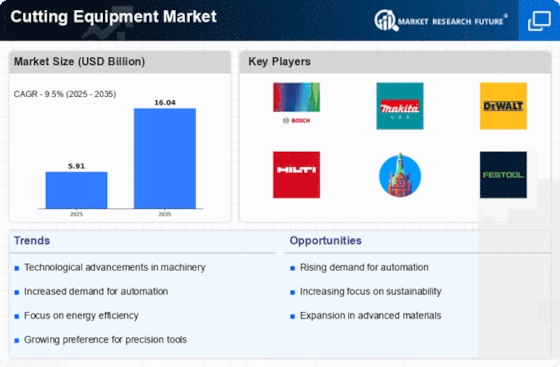
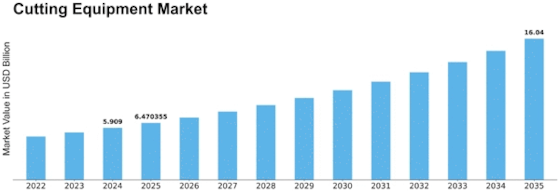
As per Market Research Future analysis, the Cutting Equipment Market was estimated at 5.909 USD Billion in 2024. The Cutting Equipment industry is projected to grow from 6.47 USD Billion in 2025 to 16.04 USD Billion by 2035, exhibiting a compound annual growth rate (CAGR) of 9.5% during the forecast period 2025 - 2035.

Key Market Trends & Highlights

The Cutting Equipment Market is experiencing robust growth driven by technological advancements and increasing demand across various sectors.

  • Technological advancements are reshaping the cutting equipment landscape, particularly in North America, which remains the largest market. The Asia-Pacific region is witnessing rapid growth, fueled by rising industrialization and infrastructure development. Plasma cutting equipment continues to dominate the market, while laser cutting technology is emerging as the fastest-growing segment. Key market drivers include the rising demand in the construction sector and increased automation in manufacturing, which are propelling market expansion.

Market Size & Forecast

2024 Market Size 5.909 (USD Billion)
2035 Market Size 16.04 (USD Billion)
CAGR (2025 - 2035) 9.5%
Largest Regional Market Share in 2024 North America

Major Players

<p>Bosch (DE), <a href="https://makita.in/product-category/tools/corded/cutting/">Makita</a> (JP), DeWalt (US), Hilti (LI), Milwaukee (US), <a href="https://www.festool.com/accessory/accessories-for-angle-grinders/guards-and-extraction-hoods/diamond-cutting-systems?appgw_azwaf_jsc=L7ZZMbXbJBhpHQSN2IEMbYOaGZaFiPU_gBiBlUS3hsWRkHKuUYa6Vmy8Uwbx-5vzg7ZMcOeA21arZThAKb_ga9n1VWrHAlHkW-I3vtXNFwubsL3S5ImY4MlWvn4u8uG3qcFfxTVW2r0ozxVmNjn-R6NXtFP9xvY33LoFqeoyjkQD42Li_sB8M3BHYtHDlVTC05sBgmwGVtUl6P43sCPPlj69-AAR44sZaY95rqYjvksxwLeThw2yJ4T65pKmVewMGOT865gg8DVexsuRvgPpeTGCUs67UOvZ0t8mlHZSFny7EqebMMjxn13kr9FKNcRFV8skrqxPt5LOGWAPAatT-w">Festool</a> (DE), Hitachi (JP), Stihl (DE), Ryobi (JP)</p>

Market Trends

The Cutting Equipment Market is currently experiencing a dynamic evolution, driven by advancements in technology and increasing demand across various industries. The integration of automation and smart technologies appears to enhance efficiency and precision in cutting processes, which is likely to attract a broader range of applications. Furthermore, the growing emphasis on sustainability and eco-friendly practices may influence manufacturers to develop innovative solutions that minimize waste and energy consumption. As industries strive for higher productivity and lower operational costs, the Cutting Equipment Market seems poised for substantial growth in the coming years. In addition, the competitive landscape of the Cutting Equipment Market is becoming increasingly diverse, with numerous players vying for market share. This competition encourages continuous innovation, leading to the introduction of cutting-edge products that cater to specific industry needs. Moreover, the expansion of e-commerce platforms facilitates easier access to cutting equipment, allowing customers to compare options and make informed purchasing decisions. Overall, the Cutting Equipment Market is likely to witness significant transformations as it adapts to the evolving demands of various sectors.

Technological Advancements

The Cutting Equipment Market is witnessing a surge in technological innovations, particularly in automation and smart technologies. These advancements enhance operational efficiency and precision, making cutting processes more effective across various applications.

Sustainability Focus

There is a growing emphasis on sustainability within the Cutting Equipment Market, as manufacturers strive to develop eco-friendly solutions. This trend reflects a broader industry shift towards minimizing waste and energy consumption, aligning with global environmental goals.

E-commerce Growth

The rise of e-commerce platforms is transforming the Cutting Equipment Market by providing customers with easier access to a wide range of products. This trend enables consumers to compare options and make informed decisions, fostering a more competitive marketplace.

Cutting Equipment Market Market Drivers

Growing Focus on Safety Standards

The Cutting Equipment Market is increasingly shaped by the growing emphasis on safety standards across various sectors. As industries recognize the importance of worker safety, there is a heightened demand for cutting equipment that adheres to stringent safety regulations. In 2025, it is projected that the safety equipment market will exceed 50 billion dollars, reflecting the industry's commitment to protecting workers. This trend compels manufacturers in the Cutting Equipment Market to innovate and design equipment that not only enhances performance but also prioritizes safety features. The integration of safety mechanisms, such as automatic shut-off systems and protective guards, is likely to become a standard expectation among consumers. As a result, companies that prioritize safety in their cutting equipment offerings may gain a competitive edge in the market.

Emerging Markets and Economic Growth

The Cutting Equipment Market is poised for growth due to the emergence of new markets and overall economic development. Countries experiencing rapid industrialization are increasingly investing in cutting equipment to support their manufacturing and construction sectors. In 2025, it is anticipated that emerging markets will contribute significantly to the global demand for cutting tools, with a projected growth rate of around 6%. This trend is likely to be driven by increased foreign investments and government initiatives aimed at boosting local industries. As these markets expand, the Cutting Equipment Market will need to adapt to diverse consumer needs and preferences, potentially leading to the development of region-specific cutting solutions. Companies that can effectively navigate these emerging markets may find lucrative opportunities for growth.

Rising Demand in Construction Sector

The Cutting Equipment Market experiences a notable surge in demand driven by the expanding construction sector. As urbanization accelerates, the need for efficient cutting tools becomes paramount. In 2025, the construction industry is projected to grow at a rate of approximately 5.5% annually, necessitating advanced cutting equipment for various applications. This growth is likely to be fueled by infrastructure development and residential projects, which require precision cutting tools for materials such as metal, wood, and concrete. Consequently, manufacturers in the Cutting Equipment Market are innovating to meet these demands, enhancing product offerings to include more efficient and durable cutting solutions. The integration of smart technologies into cutting equipment is also anticipated to play a crucial role in meeting the evolving needs of the construction sector.

Increased Automation in Manufacturing

The Cutting Equipment Market is significantly influenced by the trend towards automation in manufacturing processes. As industries strive for higher efficiency and reduced operational costs, the adoption of automated cutting solutions is becoming more prevalent. In 2025, it is estimated that the automation market will reach a valuation of over 200 billion dollars, with cutting equipment being a critical component. Automated cutting machines not only enhance precision but also minimize waste, aligning with the industry's push for sustainability. This shift towards automation is likely to drive innovation within the Cutting Equipment Market, as manufacturers develop advanced technologies that integrate seamlessly with existing production lines. The demand for automated solutions is expected to continue rising, prompting companies to invest in research and development to stay competitive.

Technological Innovations and Smart Tools

The Cutting Equipment Market is currently witnessing a wave of technological innovations that are transforming traditional cutting methods. The integration of smart technologies, such as IoT and AI, into cutting equipment is enhancing operational efficiency and precision. In 2025, the smart cutting tools market is expected to grow at a compound annual growth rate of over 10%, indicating a strong shift towards intelligent solutions. These innovations not only improve the performance of cutting equipment but also provide valuable data analytics for users, enabling better decision-making. As manufacturers in the Cutting Equipment Market continue to invest in research and development, the introduction of advanced features such as predictive maintenance and real-time monitoring is likely to become commonplace. This trend suggests a future where cutting equipment is not only a tool but also a smart partner in production processes.

Market Segment Insights

By Cutting Technology: Plasma (Largest) vs. Laser (Fastest-Growing)

<p>The cutting equipment market has seen significant distribution among various cutting technologies, primarily dominated by plasma technology. Plasma cutting represents the largest market share due to its widespread usage across industries like manufacturing and automotive for efficient cutting of thick materials. Laser cutting, while not the largest, is rapidly gaining traction, particularly in precision applications thanks to its accuracy and speed. Trends indicate that while plasma remains a staple for heavy-duty applications, laser technology is becoming increasingly popular in modern fabrication processes. The growth trajectory of cutting technologies is influenced by advancements in machinery, rising demand for automation, and the need for precision cutting solutions. As industries evolve, laser cutting technology is being adopted more frequently due to its versatility and minimal thermal distortion, making it ideal for intricate designs. Meanwhile, plasma cutting continues to hold its ground in heavy industries. The combined development of these technologies highlights the dynamic nature of the cutting equipment market and underscores the importance of innovation in meeting diverse manufacturing needs.</p>

<p>Technology: Plasma (Dominant) vs. Waterjet (Emerging)</p>

<p>Plasma cutting technology is recognized as the dominant force in the cutting equipment market, mainly due to its robust performance in handling a variety of materials and thicknesses. Its capacity for high-speed cutting of metals, particularly steel and aluminum, makes it a preferred choice in the heavy manufacturing sector. Conversely, waterjet technology is emerging as a strong alternative, particularly for applications where heat-sensitive materials are involved. Its ability to cut without altering the material properties through heat makes waterjet an attractive option for industries focused on maintaining integrity during the cutting process. Thus, while plasma cutting establishes itself firmly in legacy applications, waterjet cutting is carving out a niche catering to modern material demands.</p>

By End User: Automotive (Largest) vs. Aerospace and Defense (Fastest-Growing)

<p>The Cutting Equipment Market is significantly influenced by various end-user segments. The automotive sector commands a substantial portion of the market share, driven by the ongoing need for precision cutting solutions in vehicle manufacturing and maintenance. The metal fabrication and construction industries also hold considerable shares, as they utilize cutting tools for various structural and manufacturing processes. The aerospace and defense segment, while currently smaller, shows remarkable potential due to increasing investments in technology and safety measures. Growth trends in the Cutting Equipment Market are largely propelled by the <a href="https://www.marketresearchfuture.com/reports/automotive-industry-7683">automobile industry</a>'s rapid evolution and the increasing demand for lightweight materials. The aerospace and defense sectors are witnessing the fastest growth as these industries prioritize advanced technologies and high-performance cutting solutions. Moreover, the push for automation and efficiency in manufacturing processes is encouraging innovation in cutting equipment, leading to higher adoption rates across all segments.</p>

<p>Automotive: Dominant vs. Aerospace and Defense: Emerging</p>

<p>The automotive segment remains the dominant force in the Cutting Equipment Market, distinguished by its high demand for precision cutting during vehicle production, where efficiency and accuracy are paramount. This segment embraces advanced cutting technologies to enhance productivity and meet regulatory standards. Meanwhile, the aerospace and defense segment is recognized as an emerging force, characterized by an emphasis on advanced materials and lightweight components. The growth in this segment is fueled by rising government defense budgets and increasing focus on sustainable aviation solutions. Both segments emphasize the importance of innovation, yet operate under different pressures and requirements, shaping their unique positions in the cutting equipment landscape.</p>

Get more detailed insights about Cutting Equipment Market Research Report—Global Forecast till 2035

Regional Insights

North America : Market Leader in Innovation

North America is the largest market for cutting equipment, holding approximately 40% of the global share. The region's growth is driven by advancements in technology, increasing demand for precision tools, and a robust construction sector. Regulatory support for safety standards and environmental compliance further catalyzes market expansion. The U.S. and Canada are the primary contributors, with a strong focus on innovation and sustainability in manufacturing practices. The competitive landscape in North America is characterized by the presence of major players such as DeWalt, Milwaukee, and Bosch. These companies are investing heavily in R&D to enhance product offerings and meet evolving consumer demands. The market is also witnessing a trend towards cordless and battery-operated tools, which are gaining popularity due to their convenience and efficiency. The emphasis on quality and performance continues to shape the competitive dynamics in this region.

Europe : Emerging Market with Regulations

Europe is a significant player in the cutting equipment market, accounting for around 30% of the global share. The region's growth is fueled by stringent regulations aimed at enhancing workplace safety and environmental sustainability. Countries like Germany and the UK are leading the market, driven by their strong manufacturing sectors and innovation in tool technology. The European Union's directives on machinery safety and emissions are pivotal in shaping market trends and driving demand for advanced cutting solutions. Germany stands out as the largest market in Europe, with key players like Bosch and Festool leading the charge. The competitive landscape is marked by a focus on high-quality products and technological advancements. Additionally, the presence of numerous small and medium enterprises contributes to a dynamic market environment. The emphasis on energy-efficient and eco-friendly tools is becoming increasingly important, aligning with broader sustainability goals across the region.

Asia-Pacific : Rapid Growth and Urbanization

Asia-Pacific is rapidly emerging as a powerhouse in the cutting equipment market, holding approximately 25% of the global share. The region's growth is driven by urbanization, increasing construction activities, and rising disposable incomes. Countries like China and India are at the forefront, with significant investments in infrastructure and manufacturing sectors. Government initiatives aimed at boosting industrial growth and foreign investments are also key drivers of market expansion. China is the largest market in the region, with a strong presence of local manufacturers and international players like Makita and Hitachi. The competitive landscape is evolving, with a growing emphasis on innovation and technology. The demand for advanced cutting tools is increasing, particularly in the construction and automotive sectors. As the region continues to develop, the focus on quality and efficiency in cutting equipment is expected to shape future market trends.

Middle East and Africa : Resource-Rich Frontier for Growth

The Middle East and Africa represent a resource-rich frontier for the cutting equipment market, holding about 5% of the global share. The region's growth is primarily driven by increasing investments in infrastructure and construction projects, particularly in countries like the UAE and South Africa. Regulatory frameworks are gradually evolving to support industrial growth, with a focus on safety and quality standards that align with international practices. The competitive landscape in this region is characterized by a mix of local and international players. Companies are increasingly focusing on establishing a presence in emerging markets, driven by the demand for advanced cutting solutions. The presence of key players like Hilti and Stihl is notable, as they adapt their strategies to meet the unique needs of the region. As the market matures, the emphasis on innovation and quality will be crucial for capturing growth opportunities.

Key Players and Competitive Insights

Leading market players are investing heavily in research and development in order to expand their product lines, which will help the Cutting Equipment Market, grow even more. Market participants are also undertaking a variety of strategic activities to expand their global footprint, with important market developments including new product launches, contractual agreements, mergers and acquisitions, higher investments, and collaboration with other organizations. To expand and survive in a more competitive and rising market climate, Cutting Equipment industry must offer cost-effective items.

Manufacturing locally to minimize operational costs is one of the key business tactics used by manufacturers in the global Cutting Equipment industry to benefit clients and increase the market sector. In recent years, the Cutting Equipment industry has offered some of the most significant advantages to medicine.

Major players in the Cutting Equipment Market, including Illinois Tool Works, AMADA WELD TECH, The Lincoln Electric Company, Colfax Corporation, Koike Aronson, Inc., GCE Group, Ador Welding Ltd., OMAX Corporation, Hypertherm, Inc., Jet Edge, Inc., DAIHEN Corporation, V.V Mineral, OTTO BAIER GmbH, ICS Cutting Tools, Inc., Snap-on Incorporated, CERATIZIT S.A., Opta Group LLC., WB Alloys Welding Products Ltd, Kennametal Inc., Samtectools, HOLLFELDER-GÜHRING GmbH and others, are attempting to increase market demand by investing in research and development operations.

Products for welding, cutting, and brazing are designed, developed, and produced by Lincoln Electric Holdings Inc (Lincoln Electric). Arc welding power sources, wire feeding systems, plasma cutters, robotic welding packages, fume extraction equipment, integrated automation systems, fluxes, consumable electrodes, and welding accessories are all offered by the company. Additionally, the business sells regulators and torches used for oxy-fuel welding, cutting, and brazing, as well as CNC plasma and oxy-fuel cutting systems. The automotive, oil and gas, construction and infrastructure, and shipbuilding industries are among the sectors served by Lincoln Electric.

It operates across the Middle East, Africa, Asia-Pacific, Europe, and the Americas. Cleveland, Ohio, in the United States, is home to Lincoln Electric's headquarters. The Lincoln Electric Company unveiled "Torchmate 4510," a CNC plasma cutting machine, in December 2020 to boost clients' production capacities across metal cutting processes. When equipped with the "Optional FlexCut 125 power supply," the aforementioned machine increases its ability to support metal sheets up to 1" thick that are 5x10 in size.

A supplier of cutting-edge technologies on a global scale is Messer Cutting Systems. The business offers services to the global standard-setting metalworking industry. As the industry's founder, it provides comprehensive solutions and places a strategic emphasis on its clients and client-driven innovation. With over 900 people spread over 5 main locations with production sites, the company operates in more than 50 countries. The company offers oxyfuel, plasma, and laser cutting systems, as well as oxyfuel welding, cutting, brazing, and heating plant and equipment, ranging from hand-guided machines up to specialized machines for shipbuilding.

The program is completed with environmental equipment for the systems as well as spare parts, maintenance, and modernization services. Its software solutions enhance operational and production procedures. Flame Technologies, Inc. (Flame Tech), a US-based producer of goods for the oxyfuel market, was bought by Messer Cutting Systems through an affiliated business in February 2022. With Flame Tech, Messer Cutting Systems improves its standing as a leading provider of pre-heating, steel mill, and oxygen fuel solutions on a global scale.

Key Companies in the Cutting Equipment Market market include

Industry Developments

July 2022 The lightweight, dual-input voltage POWER MIG 215 MPi multi-process welder from Lincoln Electric features a new ergonomic design and is available now.

June 2020 'McLaren Racing' is receiving cutting tools from CERATIZIT S.A. for the manufacture of artificial ventilators. To make the ventilators, the company is supplying drilling equipment, AluLine end mills, CCR-AL Circular Line end mills, and WTX-Ti drills.

Future Outlook

Cutting Equipment Market Future Outlook

<p>The Cutting Equipment Market is projected to grow at a 9.5% CAGR from 2024 to 2035, driven by technological advancements, increasing automation, and rising demand across various industries.</p>

New opportunities lie in:

  • <p>Development of smart cutting tools with IoT integration</p>
  • <p>Expansion into emerging markets with tailored solutions</p>
  • <p>Investment in sustainable cutting technologies to reduce waste</p>

<p>By 2035, the Cutting Equipment Market is expected to achieve substantial growth and innovation.</p>

Market Segmentation

Cutting Equipment Market End User Outlook

  • Automotive
  • Metal Fabrication
  • Construction
  • Aerospace and Defense
  • Shipbuilding
  • Others

Cutting Equipment Market Cutting Technology Outlook

  • Plasma
  • Laser
  • Waterjet
  • Carbon-arc

Report Scope

MARKET SIZE 2024 5.909(USD Billion)
MARKET SIZE 2025 6.47(USD Billion)
MARKET SIZE 2035 16.04(USD Billion)
COMPOUND ANNUAL GROWTH RATE (CAGR) 9.5% (2024 - 2035)
REPORT COVERAGE Revenue Forecast, Competitive Landscape, Growth Factors, and Trends
BASE YEAR 2024
Market Forecast Period 2025 - 2035
Historical Data 2019 - 2024
Market Forecast Units USD Billion
Key Companies Profiled Market analysis in progress
Segments Covered Market segmentation analysis in progress
Key Market Opportunities Integration of advanced automation technologies enhances efficiency in the Cutting Equipment Market.
Key Market Dynamics Technological advancements and regulatory changes drive innovation and competition in the cutting equipment market.
Countries Covered North America, Europe, APAC, South America, MEA

FAQs

What is the projected market valuation of the Cutting Equipment Market by 2035?

The Cutting Equipment Market is projected to reach a valuation of 16.04 USD Billion by 2035.

What was the market valuation of the Cutting Equipment Market in 2024?

In 2024, the market valuation of the Cutting Equipment Market was 5.909 USD Billion.

What is the expected CAGR for the Cutting Equipment Market during the forecast period 2025 - 2035?

The expected CAGR for the Cutting Equipment Market during the forecast period 2025 - 2035 is 9.5%.

Which cutting technologies are expected to show significant growth in the market?

Plasma, Laser, Waterjet, and Carbon-arc cutting technologies are expected to show significant growth, with valuations projected to reach 4.0, 5.5, 4.0, and 2.5 USD Billion respectively by 2035.

What are the key end-user segments driving the Cutting Equipment Market?

Key end-user segments include Automotive, Metal Fabrication, Construction, Aerospace and Defense, and Shipbuilding, with projected valuations of 4.0, 4.5, 3.0, 2.5, and 1.5 USD Billion respectively by 2035.

Who are the leading players in the Cutting Equipment Market?

Leading players in the Cutting Equipment Market include Bosch, Makita, DeWalt, Hilti, Milwaukee, Festool, Hitachi, Stihl, and Ryobi.

  1. SECTION I: EXECUTIVE SUMMARY AND KEY HIGHLIGHTS
    1. EXECUTIVE SUMMARY
      1. Market Overview
      2. Key Findings
      3. Market Segmentation
      4. Competitive Landscape
      5. Challenges and Opportunities
      6. Future Outlook 2
  2. SECTION II: SCOPING, METHODOLOGY AND MARKET STRUCTURE
    1. MARKET INTRODUCTION
      1. Definition
      2. Scope of the study
    2. RESEARCH METHODOLOGY
      1. Overview
      2. Data Mining
      3. Secondary Research
      4. Primary Research
      5. Forecasting Model
      6. Market Size Estimation
      7. Data Triangulation
      8. Validation 3
  3. SECTION III: QUALITATIVE ANALYSIS
    1. MARKET DYNAMICS
      1. Overview
      2. Drivers
      3. Restraints
      4. Opportunities
    2. MARKET FACTOR ANALYSIS
      1. Value chain Analysis
      2. Porter's Five Forces Analysis
      3. COVID-19 Impact Analysis
  4. SECTION IV: QUANTITATIVE ANALYSIS
    1. Chemicals and Materials, BY Cutting Technology (USD Billion)
      1. Plasma
      2. Laser
      3. Waterjet
      4. Carbon-arc
    2. Chemicals and Materials, BY End User (USD Billion)
      1. Automotive
      2. Metal Fabrication
      3. Construction
      4. Aerospace and Defense
      5. Shipbuilding
      6. Others
    3. Chemicals and Materials, BY Region (USD Billion)
      1. North America
      2. Europe
      3. APAC
      4. South America
      5. MEA
  5. SECTION V: COMPETITIVE ANALYSIS
    1. Competitive Landscape
      1. Overview
      2. Competitive Analysis
      3. Market share Analysis
      4. Major Growth Strategy in the Chemicals and Materials
      5. Competitive Benchmarking
      6. Leading Players in Terms of Number of Developments in the Chemicals and Materials
      7. Key developments and growth strategies
      8. Major Players Financial Matrix
    2. Company Profiles
      1. Bosch (DE)
      2. Makita (JP)
      3. DeWalt (US)
      4. Hilti (LI)
      5. Milwaukee (US)
      6. Festool (DE)
      7. Hitachi (JP)
      8. Stihl (DE)
      9. Ryobi (JP)
    3. Appendix
      1. References
      2. Related Reports 6 LIST OF FIGURES
    4. MARKET SYNOPSIS
    5. NORTH AMERICA MARKET ANALYSIS
    6. US MARKET ANALYSIS BY CUTTING TECHNOLOGY
    7. US MARKET ANALYSIS BY END USER
    8. CANADA MARKET ANALYSIS BY CUTTING TECHNOLOGY
    9. CANADA MARKET ANALYSIS BY END USER
    10. EUROPE MARKET ANALYSIS
    11. GERMANY MARKET ANALYSIS BY CUTTING TECHNOLOGY
    12. GERMANY MARKET ANALYSIS BY END USER
    13. UK MARKET ANALYSIS BY CUTTING TECHNOLOGY
    14. UK MARKET ANALYSIS BY END USER
    15. FRANCE MARKET ANALYSIS BY CUTTING TECHNOLOGY
    16. FRANCE MARKET ANALYSIS BY END USER
    17. RUSSIA MARKET ANALYSIS BY CUTTING TECHNOLOGY
    18. RUSSIA MARKET ANALYSIS BY END USER
    19. ITALY MARKET ANALYSIS BY CUTTING TECHNOLOGY
    20. ITALY MARKET ANALYSIS BY END USER
    21. SPAIN MARKET ANALYSIS BY CUTTING TECHNOLOGY
    22. SPAIN MARKET ANALYSIS BY END USER
    23. REST OF EUROPE MARKET ANALYSIS BY CUTTING TECHNOLOGY
    24. REST OF EUROPE MARKET ANALYSIS BY END USER
    25. APAC MARKET ANALYSIS
    26. CHINA MARKET ANALYSIS BY CUTTING TECHNOLOGY
    27. CHINA MARKET ANALYSIS BY END USER
    28. INDIA MARKET ANALYSIS BY CUTTING TECHNOLOGY
    29. INDIA MARKET ANALYSIS BY END USER
    30. JAPAN MARKET ANALYSIS BY CUTTING TECHNOLOGY
    31. JAPAN MARKET ANALYSIS BY END USER
    32. SOUTH KOREA MARKET ANALYSIS BY CUTTING TECHNOLOGY
    33. SOUTH KOREA MARKET ANALYSIS BY END USER
    34. MALAYSIA MARKET ANALYSIS BY CUTTING TECHNOLOGY
    35. MALAYSIA MARKET ANALYSIS BY END USER
    36. THAILAND MARKET ANALYSIS BY CUTTING TECHNOLOGY
    37. THAILAND MARKET ANALYSIS BY END USER
    38. INDONESIA MARKET ANALYSIS BY CUTTING TECHNOLOGY
    39. INDONESIA MARKET ANALYSIS BY END USER
    40. REST OF APAC MARKET ANALYSIS BY CUTTING TECHNOLOGY
    41. REST OF APAC MARKET ANALYSIS BY END USER
    42. SOUTH AMERICA MARKET ANALYSIS
    43. BRAZIL MARKET ANALYSIS BY CUTTING TECHNOLOGY
    44. BRAZIL MARKET ANALYSIS BY END USER
    45. MEXICO MARKET ANALYSIS BY CUTTING TECHNOLOGY
    46. MEXICO MARKET ANALYSIS BY END USER
    47. ARGENTINA MARKET ANALYSIS BY CUTTING TECHNOLOGY
    48. ARGENTINA MARKET ANALYSIS BY END USER
    49. REST OF SOUTH AMERICA MARKET ANALYSIS BY CUTTING TECHNOLOGY
    50. REST OF SOUTH AMERICA MARKET ANALYSIS BY END USER
    51. MEA MARKET ANALYSIS
    52. GCC COUNTRIES MARKET ANALYSIS BY CUTTING TECHNOLOGY
    53. GCC COUNTRIES MARKET ANALYSIS BY END USER
    54. SOUTH AFRICA MARKET ANALYSIS BY CUTTING TECHNOLOGY
    55. SOUTH AFRICA MARKET ANALYSIS BY END USER
    56. REST OF MEA MARKET ANALYSIS BY CUTTING TECHNOLOGY
    57. REST OF MEA MARKET ANALYSIS BY END USER
    58. KEY BUYING CRITERIA OF CHEMICALS AND MATERIALS
    59. RESEARCH PROCESS OF MRFR
    60. DRO ANALYSIS OF CHEMICALS AND MATERIALS
    61. DRIVERS IMPACT ANALYSIS: CHEMICALS AND MATERIALS
    62. RESTRAINTS IMPACT ANALYSIS: CHEMICALS AND MATERIALS
    63. SUPPLY / VALUE CHAIN: CHEMICALS AND MATERIALS
    64. CHEMICALS AND MATERIALS, BY CUTTING TECHNOLOGY, 2024 (% SHARE)
    65. CHEMICALS AND MATERIALS, BY CUTTING TECHNOLOGY, 2024 TO 2035 (USD Billion)
    66. CHEMICALS AND MATERIALS, BY END USER, 2024 (% SHARE)
    67. CHEMICALS AND MATERIALS, BY END USER, 2024 TO 2035 (USD Billion)
    68. BENCHMARKING OF MAJOR COMPETITORS 7 LIST OF TABLES
    69. LIST OF ASSUMPTIONS
    70. North America MARKET SIZE ESTIMATES; FORECAST
      1. BY CUTTING TECHNOLOGY, 2025-2035 (USD Billion)
      2. BY END USER, 2025-2035 (USD Billion)
    71. US MARKET SIZE ESTIMATES; FORECAST
      1. BY CUTTING TECHNOLOGY, 2025-2035 (USD Billion)
      2. BY END USER, 2025-2035 (USD Billion)
    72. Canada MARKET SIZE ESTIMATES; FORECAST
      1. BY CUTTING TECHNOLOGY, 2025-2035 (USD Billion)
      2. BY END USER, 2025-2035 (USD Billion)
    73. Europe MARKET SIZE ESTIMATES; FORECAST
      1. BY CUTTING TECHNOLOGY, 2025-2035 (USD Billion)
      2. BY END USER, 2025-2035 (USD Billion)
    74. Germany MARKET SIZE ESTIMATES; FORECAST
      1. BY CUTTING TECHNOLOGY, 2025-2035 (USD Billion)
      2. BY END USER, 2025-2035 (USD Billion)
    75. UK MARKET SIZE ESTIMATES; FORECAST
      1. BY CUTTING TECHNOLOGY, 2025-2035 (USD Billion)
      2. BY END USER, 2025-2035 (USD Billion)
    76. France MARKET SIZE ESTIMATES; FORECAST
      1. BY CUTTING TECHNOLOGY, 2025-2035 (USD Billion)
      2. BY END USER, 2025-2035 (USD Billion)
    77. Russia MARKET SIZE ESTIMATES; FORECAST
      1. BY CUTTING TECHNOLOGY, 2025-2035 (USD Billion)
      2. BY END USER, 2025-2035 (USD Billion)
    78. Italy MARKET SIZE ESTIMATES; FORECAST
      1. BY CUTTING TECHNOLOGY, 2025-2035 (USD Billion)
      2. BY END USER, 2025-2035 (USD Billion)
    79. Spain MARKET SIZE ESTIMATES; FORECAST
      1. BY CUTTING TECHNOLOGY, 2025-2035 (USD Billion)
      2. BY END USER, 2025-2035 (USD Billion)
    80. Rest of Europe MARKET SIZE ESTIMATES; FORECAST
      1. BY CUTTING TECHNOLOGY, 2025-2035 (USD Billion)
      2. BY END USER, 2025-2035 (USD Billion)
    81. APAC MARKET SIZE ESTIMATES; FORECAST
      1. BY CUTTING TECHNOLOGY, 2025-2035 (USD Billion)
      2. BY END USER, 2025-2035 (USD Billion)
    82. China MARKET SIZE ESTIMATES; FORECAST
      1. BY CUTTING TECHNOLOGY, 2025-2035 (USD Billion)
      2. BY END USER, 2025-2035 (USD Billion)
    83. India MARKET SIZE ESTIMATES; FORECAST
      1. BY CUTTING TECHNOLOGY, 2025-2035 (USD Billion)
      2. BY END USER, 2025-2035 (USD Billion)
    84. Japan MARKET SIZE ESTIMATES; FORECAST
      1. BY CUTTING TECHNOLOGY, 2025-2035 (USD Billion)
      2. BY END USER, 2025-2035 (USD Billion)
    85. South Korea MARKET SIZE ESTIMATES; FORECAST
      1. BY CUTTING TECHNOLOGY, 2025-2035 (USD Billion)
      2. BY END USER, 2025-2035 (USD Billion)
    86. Malaysia MARKET SIZE ESTIMATES; FORECAST
      1. BY CUTTING TECHNOLOGY, 2025-2035 (USD Billion)
      2. BY END USER, 2025-2035 (USD Billion)
    87. Thailand MARKET SIZE ESTIMATES; FORECAST
      1. BY CUTTING TECHNOLOGY, 2025-2035 (USD Billion)
      2. BY END USER, 2025-2035 (USD Billion)
    88. Indonesia MARKET SIZE ESTIMATES; FORECAST
      1. BY CUTTING TECHNOLOGY, 2025-2035 (USD Billion)
      2. BY END USER, 2025-2035 (USD Billion)
    89. Rest of APAC MARKET SIZE ESTIMATES; FORECAST
      1. BY CUTTING TECHNOLOGY, 2025-2035 (USD Billion)
      2. BY END USER, 2025-2035 (USD Billion)
    90. South America MARKET SIZE ESTIMATES; FORECAST
      1. BY CUTTING TECHNOLOGY, 2025-2035 (USD Billion)
      2. BY END USER, 2025-2035 (USD Billion)
    91. Brazil MARKET SIZE ESTIMATES; FORECAST
      1. BY CUTTING TECHNOLOGY, 2025-2035 (USD Billion)
      2. BY END USER, 2025-2035 (USD Billion)
    92. Mexico MARKET SIZE ESTIMATES; FORECAST
      1. BY CUTTING TECHNOLOGY, 2025-2035 (USD Billion)
      2. BY END USER, 2025-2035 (USD Billion)
    93. Argentina MARKET SIZE ESTIMATES; FORECAST
      1. BY CUTTING TECHNOLOGY, 2025-2035 (USD Billion)
      2. BY END USER, 2025-2035 (USD Billion)
    94. Rest of South America MARKET SIZE ESTIMATES; FORECAST
      1. BY CUTTING TECHNOLOGY, 2025-2035 (USD Billion)
      2. BY END USER, 2025-2035 (USD Billion)
    95. MEA MARKET SIZE ESTIMATES; FORECAST
      1. BY CUTTING TECHNOLOGY, 2025-2035 (USD Billion)
      2. BY END USER, 2025-2035 (USD Billion)
    96. GCC Countries MARKET SIZE ESTIMATES; FORECAST
      1. BY CUTTING TECHNOLOGY, 2025-2035 (USD Billion)
      2. BY END USER, 2025-2035 (USD Billion)
    97. South Africa MARKET SIZE ESTIMATES; FORECAST
      1. BY CUTTING TECHNOLOGY, 2025-2035 (USD Billion)
      2. BY END USER, 2025-2035 (USD Billion)
    98. Rest of MEA MARKET SIZE ESTIMATES; FORECAST
      1. BY CUTTING TECHNOLOGY, 2025-2035 (USD Billion)
      2. BY END USER, 2025-2035 (USD Billion)
    99. PRODUCT LAUNCH/PRODUCT DEVELOPMENT/APPROVAL
    100. ACQUISITION/PARTNERSHIP

Cutting Equipment Market Segmentation

Cutting Equipment Cutting Technology Outlook (USD Billion, 2024-2030)

Plasma

Laser

Waterjet

Carbon-arc

Cutting Equipment End-User Outlook (USD Billion, 2024-2030)

Automotive

Metal Fabrication

Construction

Aerospace and Defense

Shipbuilding

Others

Cutting Equipment Regional Outlook (USD Billion, 2024-2030)

North America Outlook (USD Billion, 2024-2030)

Cutting Equipment by Cutting Technology

Plasma

Laser

Waterjet

Carbon-arc

Cutting Equipment by End-User

Automotive

Metal Fabrication

Construction

Aerospace and Defense

Shipbuilding

Others

US Outlook (USD Billion, 2024-2030)

Cutting Equipment by Cutting Technology

Plasma

Laser

Waterjet

Carbon-arc

Cutting Equipment by End-User

Automotive

Metal Fabrication

Construction

Aerospace and Defense

Shipbuilding

Others

Canada Outlook (USD Billion, 2024-2030)

Cutting Equipment by Cutting Technology

Plasma

Laser

Waterjet

Carbon-arc

Cutting Equipment by End-User

Automotive

Metal Fabrication

Construction

Aerospace and Defense

Shipbuilding

Others

Europe Outlook (USD Billion, 2024-2030)

Cutting Equipment by Cutting Technology

Plasma

Laser

Waterjet

Carbon-arc

Cutting Equipment by End-User

Automotive

Metal Fabrication

Construction

Aerospace and Defense

Shipbuilding

Others

Germany Outlook (USD Billion, 2024-2030)

Cutting Equipment by Cutting Technology

Plasma

Laser

Waterjet

Carbon-arc

Cutting Equipment by End-User

Automotive

Metal Fabrication

Construction

Aerospace and Defense

Shipbuilding

Others

France Outlook (USD Billion, 2024-2030)

Cutting Equipment by Cutting Technology

Plasma

Laser

Waterjet

Carbon-arc

Cutting Equipment by End-User

Automotive

Metal Fabrication

Construction

Aerospace and Defense

Shipbuilding

Others

UK Outlook (USD Billion, 2024-2030)

Cutting Equipment by Cutting Technology

Plasma

Laser

Waterjet

Carbon-arc

Cutting Equipment by End-User

Automotive

Metal Fabrication

Construction

Aerospace and Defense

Shipbuilding

Others

Italy Outlook (USD Billion, 2024-2030)

Cutting Equipment by Cutting Technology

Plasma

Laser

Waterjet

Carbon-arc

Cutting Equipment by End-User

Automotive

Metal Fabrication

Construction

Aerospace and Defense

Shipbuilding

Others

Spain Outlook (USD Billion, 2024-2030)

Cutting Equipment by Cutting Technology

Plasma

Laser

Waterjet

Carbon-arc

Cutting Equipment by End-User

Automotive

Metal Fabrication

Construction

Aerospace and Defense

Shipbuilding

Others

Rest Of Europe Outlook (USD Billion, 2024-2030)

Cutting Equipment by Cutting Technology

Plasma

Laser

Waterjet

Carbon-arc

Cutting Equipment by End-User

Automotive

Metal Fabrication

Construction

Aerospace and Defense

Shipbuilding

Others

Asia-Pacific Outlook (USD Billion, 2024-2030)

Cutting Equipment by Cutting Technology

Plasma

Laser

Waterjet

Carbon-arc

Cutting Equipment by End-User

Automotive

Metal Fabrication

Construction

Aerospace and Defense

Shipbuilding

Others

China Outlook (USD Billion, 2024-2030)

Cutting Equipment by Cutting Technology

Plasma

Laser

Waterjet

Carbon-arc

Cutting Equipment by End-User

Automotive

Metal Fabrication

Construction

Aerospace and Defense

Shipbuilding

Others

Japan Outlook (USD Billion, 2024-2030)

Cutting Equipment by Cutting Technology

Plasma

Laser

Waterjet

Carbon-arc

Cutting Equipment by End-User

Automotive

Metal Fabrication

Construction

Aerospace and Defense

Shipbuilding

Others

India Outlook (USD Billion, 2024-2030)

Cutting Equipment by Cutting Technology

Plasma

Laser

Waterjet

Carbon-arc

Cutting Equipment by End-User

Automotive

Metal Fabrication

Construction

Aerospace and Defense

Shipbuilding

Others

Australia Outlook (USD Billion, 2024-2030)

Cutting Equipment by Cutting Technology

Plasma

Laser

Waterjet

Carbon-arc

Cutting Equipment by End-User

Automotive

Metal Fabrication

Construction

Aerospace and Defense

Shipbuilding

Others

Rest of Asia-Pacific Outlook (USD Billion, 2024-2030)

Cutting Equipment by Cutting Technology

Plasma

Laser

Waterjet

Carbon-arc

Cutting Equipment by End-User

Automotive

Metal Fabrication

Construction

Aerospace and Defense

Shipbuilding

Others

Rest of the World Outlook (USD Billion, 2024-2030)

Cutting Equipment by Cutting Technology

Plasma

Laser

Waterjet

Carbon-arc

Cutting Equipment by End-User

Automotive

Metal Fabrication

Construction

Aerospace and Defense

Shipbuilding

Others

Middle East Outlook (USD Billion, 2024-2030)

Cutting Equipment by Cutting Technology

Plasma

Laser

Waterjet

Carbon-arc

Cutting Equipment by End-User

Automotive

Metal Fabrication

Construction

Aerospace and Defense

Shipbuilding

Others

Africa Outlook (USD Billion, 2024-2030)

Cutting Equipment by Cutting Technology

Plasma

Laser

Waterjet

Carbon-arc

Cutting Equipment by End-User

Automotive

Metal Fabrication

Construction

Aerospace and Defense

Shipbuilding

Others

Latin America Outlook (USD Billion, 2024-2030)

Cutting Equipment by Cutting Technology

Plasma

Laser

Waterjet

Carbon-arc

Cutting Equipment by End-User

Automotive

Metal Fabrication

Construction

Aerospace and Defense

Shipbuilding

Others

Infographic

Free Sample Request

Kindly complete the form below to receive a free sample of this Report

Get Free Sample

Customer Strories

Compare Licence

×
Features License Type
Single User Multiuser License Enterprise User
Price $4,950 $5,950 $7,250
Maximum User Access Limit 1 User Upto 10 Users Unrestricted Access Throughout the Organization
Free Customization
Direct Access to Analyst
Deliverable Format
Platform Access
Discount on Next Purchase 10% 15% 15%
Printable Versions