
Request Free Sample ×

Kindly complete the form below to receive a free sample of this Report

* Please use a valid business email

Leading companies partner with us for data-driven Insights

clients tt-cursor
Hero Background

Airport Robots Market

ID: MRFR/AD/9082-HCR
175 Pages
Abbas Raut, Sejal Akre
Last Updated: May 27, 2026
Airport Robots Market Size, Share, Industry Trend & Analysis Research Report By Application (Terminal, Landside), By Robot Type (Non-Humanoid, Humanoid), By End Use (Airport Security, Valet Parking, Baggage Handling, Cleaning & Disinfection, Passenger Service/Guidance, Others), By Geography (North America, Europe, Asia-Pacific, South America, Middle East & Africa) - Forecast to 2035
Download PDF ×

We do not share your information with anyone. However, we may send you emails based on your report interest from time to time. You may contact us at any time to opt-out.


Market Summary

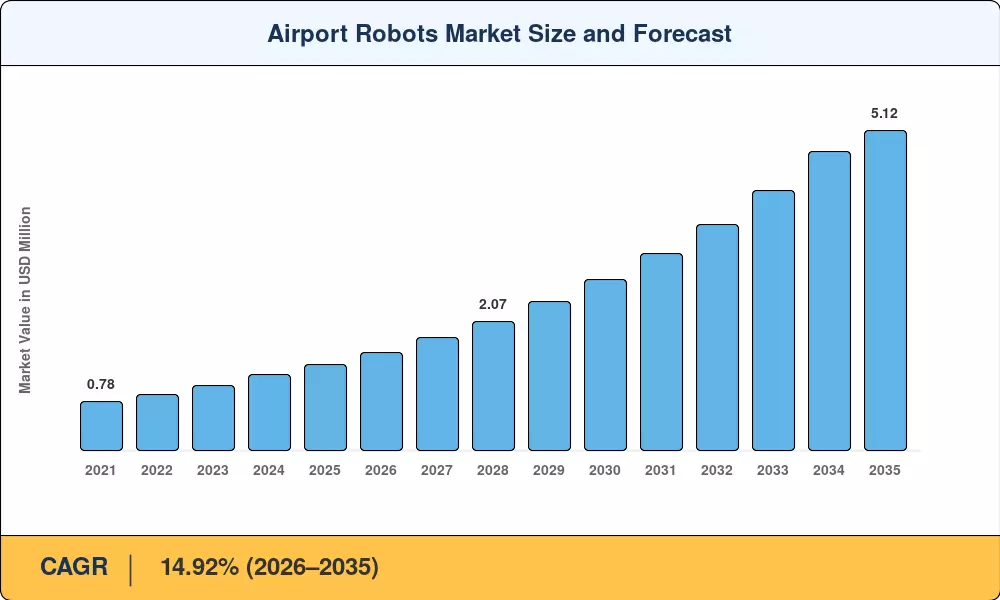
The Airport Robots Market reached an estimated USD 1.38 billion in 2025 and is projected to grow from USD 1.57 billion in 2026 to USD 5.12 billion by 2035, registering a CAGR of 14.92% during the forecast period. Post-pandemic passenger volume recovery — global air traffic exceeded 4.4 billion passengers in 2024 according to IATA [2] — has collided with persistent labor shortages across ground handling and terminal operations, creating a structural pull toward robotic automation. Airport operators worldwide are channeling capital expenditure toward autonomous airport service robots as a way to absorb capacity growth without expanding physical footprints.

There is a technology inflection happening. AI-driven robotic platforms using LiDAR, computer vision, and natural language processing are replacing legacy manual tasks such as luggage handling, terminal cleaning and perimeter security. In 2024, Singapore’s Changi Airport Group invested more than USD 65 million for a phased implementation of baggage handling robot systems and autonomous cleaning units in Terminals 1-4 [3]. These deployments prove that airport cleaning automation robot systems and passenger assistance airport robot kiosks may reduce turnaround times by 20-30% while decreasing operational personnel needs.

North America is the leader in the Airport Robots Market with around 34.5% of the global market share due to TSA security measures and federal innovation grants [4]. The Asia-Pacific area is the fastest expanding with a predicted CAGR of 18.2% due to active smart-airport plans in China, Japan and South Korea Europe follows in second place, with EU-funded digitization efforts under Horizon Europe anchoring the position. In the coming decade, AI robot security patrol solutions and autonomous logistics platforms will redefine airport operations from curb to gate.


Key Report Takeaways

• By Application

  • Terminal operations captured approximately 73% of the Airport Robots Market revenue in 2025, reflecting strong demand for information kiosks, autonomous airport service robots, and cleaning units deployed in passenger-facing zones
  • Landside solutions — including autonomous valet parking and curbside logistics — are forecast to expand at a 15.6% CAGR through 2035 as sensor technology matures and regulatory pilots scale

• By Robot Type

  • Non-humanoid platforms held a dominant share of the Airport Robots Market in 2025, valued at approximately USD 1.04 billion, owing to their lower unit cost and faster deployment timelines
  • Humanoid units are projected to grow at a 16.8% CAGR through 2035, driven by multilingual passenger assistance airport robot use cases in high-traffic terminals

• By End Use

  • Security systems led the Airport Robots Market with roughly 34.2% share in 2025, powered by AI robot security patrol adoption at major hub airports
  • Cleaning and disinfection robots are advancing at a 17.4% CAGR, the fastest among all end-use segments, reflecting sustained post-COVID hygiene investment

• By Geography

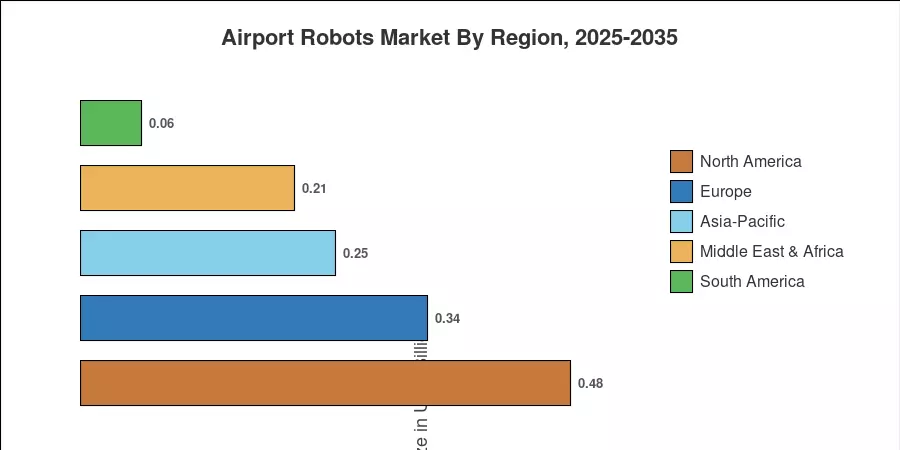
  • North America accounted for approximately USD 0.48 billion of Airport Robots Market revenue in 2025, led by the United States
  • Asia-Pacific is set to post the fastest expansion at an 18.2% CAGR through 2035, with China and Japan as primary growth engines


Airport Robots Market Size and Forecast (2021–2035)

MRFR's proprietary estimation framework combines primary interviews with airport operators, robotics OEMs, and system integrators alongside secondary data from IATA, ACI, national aviation authorities, and company financials. Historical figures (2021–2024) reflect actual deployments and procurement records; 2025 is the base year, and 2026–2035 values are modeled using a constant CAGR of 14.92%.
Market Size Chart
Our Impact
Enabled $4.3B Revenue Impact for Fortune 500 and Leading Multinationals
Partnering with 2000+ Global Organizations Each Year
30K+ Citations by Top-Tier Firms in the Industry
 

Driver Impact Analysis

Driver ~% Impact on CAGR Geographic Relevance Impact Timeline
Post-pandemic passenger volume recovery ~18% Global Short-term (≤2 yr)
Chronic ground-handling labor shortages ~20% North America, Europe Medium-term (2–4 yr)
Smart-airport digitization mandates ~15% Asia-Pacific, Middle East Long-term (≥4 yr)
Federal aviation security standards (TSA, ECAC) ~14% North America, Europe Medium-term (2–4 yr)
AI and computer vision cost reductions ~13% Global Long-term (≥4 yr)
Autonomous vehicle regulatory pilots ~10% North America, Asia-Pacific Medium-term (2–4 yr)
ESG and sustainability reporting pressure ~10% Europe, North America Long-term (≥4 yr)


Post-Pandemic Passenger Volume Recovery

IATA reported that global passenger traffic reached 4.4 billion in 2024, surpassing 2019 levels for the first time [2]. This surge is forcing airports to process more travelers through fixed infrastructure, creating acute demand for autonomous airport service robots that deliver wayfinding, check-in assistance, and queue management without adding headcount. Airports Council International projects 5.7 billion annual passengers by 2030, locking in sustained demand for the Airport Robots Market through the forecast period.

Chronic Ground-Handling Labor Shortages

The aviation ground-handling sector lost an estimated 2.3 million workers during the pandemic, and recovery has stalled at roughly 85% of pre-COVID staffing levels in North America and Europe [7]. Baggage handling robot systems directly address this gap — Dallas/Fort Worth International Airport's 2024 pilot program cut baggage mishandling incidents by 37% while operating with 25% fewer ramp workers [3]. This structural labor deficit transforms robotics from a discretionary upgrade into an operational necessity for the Airport Robots Market.

Smart-Airport Digitization Mandates

China's Civil Aviation Administration earmarked USD 4.2 billion for airport modernization under its 2025 Smart Civil Aviation plan, with autonomous robotics designated a priority spending category [6]. Japan's MLIT allocated ¥38 billion for terminal automation across 28 national airports. These government programs accelerate procurement cycles for airport cleaning automation robot platforms and passenger assistance airport robot units, anchoring long-term growth in Asia-Pacific's Airport Robots Market.

Federal Aviation Security Standards

The U.S. Transportation Security Administration's 2024 Technology Modernization Roadmap includes autonomous perimeter surveillance as a qualifying technology for airport security grants [4]. European Civil Aviation Conference screening standards increasingly recognize AI robot security patrol capabilities as compliant alternatives to manned patrols, opening a regulatory pathway that reduces adoption friction across both regions.


Restraints Impact Analysis

Restraint ~% Impact on CAGR Geographic Relevance Impact Timeline
High upfront capital and integration costs ~−15% Global Short-term (≤2 yr)
Fragmented regulatory frameworks for autonomous systems ~−12% Europe, South America Medium-term (2–4 yr)
Cybersecurity vulnerabilities in connected robot fleets ~−10% Global Long-term (≥4 yr)
Workforce displacement and union resistance ~−8% North America, Europe Medium-term (2–4 yr)
Limited interoperability between OEM platforms ~−7% Global Long-term (≥4 yr)


High Upfront Capital and Integration Costs

A single autonomous airport service robot unit can cost USD 150,000–350,000, depending on sensor payload and AI stack. In contrast, integration into legacy airport IT systems often doubles the total cost of ownership. Small and mid-size airports — representing over 70% of global airport count — frequently lack the capital reserves to justify these investments without multi-year ROI assurances, constraining near-term addressable demand for the Airport Robots Market.

Fragmented Regulatory Frameworks

No unified international standard governs autonomous robot operations in airport environments. European regulators are split between EASA guidance on airside automation and national-level standards for terminal robots, creating compliance complexity that slows cross-border deployment [12]. South American airports face similar fragmentation, where inconsistent national aviation codes impede the scaling of baggage handling robot systems and AI robot security patrol solutions.

Cybersecurity Vulnerabilities

Connected robot fleets operating across airport networks present attractive targets for cyberattack. A 2024 Eurocontrol study identified autonomous ground systems as a top-three cybersecurity risk category for European airports [13]. Operators must invest in encrypted mesh networks, zero-trust architectures, and dedicated SOC monitoring — costs that add 15–20% to annual operating budgets and may delay procurement decisions in the Airport Robots Market.


Opportunities

Robotics-as-a-Service (RaaS) Subscription Models

RaaS models convert prohibitive capital expenditure into manageable operating expenses, opening the Airport Robots Market to smaller regional airports that cannot afford outright purchases. Subscription pricing — typically USD 3,000–8,000 per robot per month — bundles hardware, software updates, and maintenance, accelerating adoption across the long tail of airports

Autonomous Landside Logistics and Valet Parking

Autonomous valet parking and curbside baggage collecting is a revenue stream that is under-exploited. The development of sensor suites and the proliferation of regulatory pilots in the U.S. and Singapore are laying the groundwork for commercial landside deployments, a segment predicted to outpace terminal applications in growth through 2035

Emerging-Market Airport Construction Boom

More than 240 new airports are under construction or planned in India, Southeast Asia and the Middle East through 2032, many with robotics-ready infrastructure, according to groundbreaking [6]. These greenfield initiatives avoid retrofit expenses and develop a built-in pipeline for autonomous airport service robots, airport cleaning automation robot units and passenger help airport robot kiosks.

Data Monetization from Robot-Collected Analytics

Robots explore terminals and constantly collect geographical, temperature, and behavioral data. Airport operators will be able to monetize anonymized passenger-flow information by selling insights to stores, airlines and advertising networks, generating a supplementary layer of revenue that adds to overall ROI and supports the business case for the Airport Robots Market

AI-Powered Multilingual Passenger Engagement

Large language model integration enables passenger assistance airport robot systems to converse fluently in 30+ languages, a capability that manual information desks cannot scale. Airports with high international-transfer ratios — Dubai, Singapore, Frankfurt — represent premium deployment targets where multilingual AI delivers measurable passenger-satisfaction improvements


Future Outlook

AI-Driven Autonomy and Edge Computing

The Airport Robots Market will get a boost via on-device AI processing at the edge. It is projected that by 2030, 65% of deployed robots at airports would perform local inference rather than relying on cloud connectivity, thereby enabling real-time decision-making in security-sensitive airside zones. This transition will allow for new use cases for AI robot security patrols – ranging from autonomous perimeter surveillance to anomaly behavioral detection – that existing cloud-dependent architectures cannot safely handle.

Platform Economics and Middleware Standardization

Airport operators are moving away from single-vendor fleets toward open middleware platforms that orchestrate multi-OEM robot deployments from a unified command center. Standardization efforts led by ISO/TC 299 and the Airport Robot Interoperability Consortium aim to publish common APIs by 2028, reducing integration costs by up to 40% [14]. Suppliers that invest in interoperable middleware will capture disproportionate value in the Airport Robots Market through longer-term service contracts and recurring software revenue.

Sustainability and Energy-Efficient Operations

Airport operators are facing growing need to disclose ESG under frameworks such as the EU CSRD and SEC climate-risk rules [10]. A clear emissions savings is made possible by autonomous airport service robots using high-density lithium iron phosphate batteries and solar-charging stations, with early adopters experiencing 30–45% less energy use per work than their staffed equivalents. Airport cleaning automation robots patrolling optimal routes cut down on electricity waste, bringing operational automation in line with environmental goals.

Human-Robot Collaboration Frameworks

The Airport Robots Market will not evolve as a full-replacement story. Rather, the most successful deployments by 2035 will pair autonomous units with human supervisors in structured collaboration frameworks. IATA's 2025 Airport Operations Automation Guidelines recommend a 1:8 human-to-robot supervision ratio for terminal environments, creating a hybrid operating model that balances efficiency with accountability and traveler trust [2].


Airport Robots Market Segmentation Analysis

By Application

Segment Key Metric Primary Demand Driver
Terminal 73% share (2025) Passenger-facing information, cleaning, and security tasks
Landside 15.6% CAGR (2026–2035) Autonomous valet parking and curbside logistics


Terminal operations dominate the Airport Robots Market because information kiosks, airport cleaning automation robot units, and AI robot security patrol platforms deliver immediate, visible efficiency improvements to travelers and operators alike. Cleaning robots alone reduced terminal sanitation labor hours by 42% at Incheon International during a 2024 trial [3]. Landside applications are catching up rapidly, however, as maturing sensor suites enable autonomous valet parking systems that recover 15–20% more parking capacity through precision vehicle stacking.

By Robot Type

Segment Key Metric Primary Demand Driver
Non-Humanoid USD 1.04 Billion (2025) Lower cost, modular design, baggage handling robot systems
Humanoid 16.8% CAGR (2026–2035) Multilingual passenger assistance airport robot interactions


Non-humanoid platforms — wheeled, tracked, and aerial — currently anchor the Airport Robots Market thanks to lower unit costs and simpler deployment logistics. Baggage handling robot systems and floor-scrubbing machines fall squarely in this category. Humanoid robots, while a smaller share today, are gaining traction for front-of-house passenger engagement: SoftBank's Pepper and LG's CLOi Guide have been deployed at Tokyo Haneda, Munich, and Incheon for multilingual wayfinding. The humanoid segment's superior CAGR reflects growing airline and airport interest in differentiated passenger experiences.

By End Use

Segment Key Metric Primary Demand Driver
Airport Security 34.2% share (2025) TSA/ECAC standards, AI robot security patrol mandates
Valet Parking USD 0.13 Billion (2025) Space optimization, autonomous driving tech transfer
Baggage Handling 14.8% CAGR (2026–2035) Labor shortages, baggage handling robot systems efficiency
Cleaning & Disinfection 17.4% CAGR (2026–2035) Post-COVID hygiene standards, airport cleaning automation robot
Passenger Service/Guidance USD 0.18 Billion (2025) Multilingual AI, passenger assistance and airport robot demand
Others 11.5% CAGR (2026–2035) Retail delivery, maintenance inspection


Security remains the largest end-use segment in the Airport Robots Market, propelled by government funding for AI robot security patrol systems that perform autonomous perimeter surveillance, behavioral screening, and threat detection. Cleaning and disinfection robots are the fastest-growing end-use category: the lasting behavioral shift in passenger hygiene expectations, combined with airport cleaning automation robot solutions that operate 24/7 without shift breaks, creates compelling ROI even for cost-sensitive operators.


Regional Market Share Analysis

Region Key Metric Primary Investment Themes
North America 34.5% share (2025) TSA security modernization, AI robot security patrol and labor substitution
Europe 24.8% share (2025) EU Horizon Europe funding, airport cleaning automation robot rollouts
Asia-Pacific 18.2% CAGR (2026–2035) Smart-airport mandates, baggage handling robot systems
South America USD 0.06 Billion (2025) New airport construction, basic automation adoption
Middle East & Africa 15.4% CAGR (2026–2035) Mega-hub expansions, premium passenger experience
Total USD 1.38 Billion (2025)

The Airport Robots Market exhibits pronounced regional variation, shaped by differing regulatory environments, labor dynamics, and infrastructure investment cycles. North America and Asia-Pacific together account for roughly two-thirds of global revenue.


North America

Country Key Metric Key Driver
United States 78% of regional share TSA grants, autonomous airport service robots at hub airports
Canada 12.8% CAGR (2026–2035) CATSA modernization, bilingual passenger assistance and airport robot demand
Mexico USD 0.02 Billion (2025) New Felipe Ángeles airport, greenfield automation


The United States drives the vast majority of North America's Airport Robots Market spend, with TSA's Technology Modernization Roadmap and FAA innovation sandbox programs channeling federal funding toward AI robot security patrol and baggage handling robot systems at Tier-1 hubs [4]. Canada's CATSA is piloting autonomous screening-lane robots at Toronto Pearson and Vancouver International, while Mexico's new airport projects offer greenfield deployment opportunities for autonomous airport service robots.

Europe

Country Key Metric Key Driver
Germany 22% of the regional share Fraport digitization strategy, Industrie 4.0 robotics supply chain
United Kingdom 14.6% CAGR (2026–2035) Heathrow T5 automation, post-Brexit labor gaps
France USD 0.05 Billion (2025) ADP Group smart-terminal roadmap
Italy 13.2% CAGR (2026–2035) ADR Fiumicino expansion, EU co-funding
Spain USD 0.03 Billion (2025) Aena digitization program
Nordic Countries 14.0% CAGR (2026–2035) High labor costs are accelerating airport cleaning automation robot adoption.
Russia USD 0.01 Billion (2025) Limited growth due to sanctions and import restrictions
Rest of Europe 11.5% CAGR (2026–2035) Eastern European airport modernization


Europe's Airport Robots Market benefits from Horizon Europe's digital transport corridor funding and national smart-airport strategies. Germany's Fraport AG has deployed over 45 autonomous airport service robots across Frankfurt Airport terminals, and the UK's acute post-Brexit labor shortages are accelerating the adoption of airport cleaning automation robot fleets at Heathrow and Gatwick [15].

Asia-Pacific

Country Key Metric Key Driver
China 36% of the regional share CAAC smart-aviation plan, domestic OEM cost advantage
India 19.5% CAGR (2026–2035) 80+ new airports planned, DigiYatra integration
Japan USD 0.05 Billion (2025) MLIT terminal automation program
South Korea 17.8% CAGR (2026–2035) Incheon T2 robotics rollout, K-robotics subsidies
ASEAN USD 0.04 Billion (2025) Changi, Suvarnabhumi, KLIA expansions
Rest of Asia-Pacific 16.2% CAGR (2026–2035) Australia and New Zealand smart-airport pilots


Asia-Pacific represents the fastest-growing region in the Airport Robots Market, propelled by China's USD 4.2 billion smart-aviation modernization plan and India's ambitious airport-construction pipeline [6]. Domestic manufacturers in Shenzhen and Seoul are driving down hardware unit costs by 15–20% annually, making baggage handling robot systems and passenger assistance airport robot deployments economically viable for mid-size airports across the region.

South America

Country Key Metric Key Driver
Brazil 62% of regional share GRU Airport modernization, ANAC pilot programs
Argentina 12.5% CAGR (2026–2035) Ezeiza expansion, tourism recovery
Rest of South America USD 0.01 Billion (2025) Early-stage adoption, limited funding


South America's Airport Robots Market remains nascent but is accelerating. Brazil's GRU Airport launched a passenger assistance airport robot pilot in 2024 in partnership with a domestic integrator, while Argentina's Ezeiza international terminal is evaluating airport cleaning automation robot solutions as part of a broader concession upgrade [16].

Middle East & Africa

Country Key Metric Key Driver
Saudi Arabia 35% of regional share NEOM and Vision 2030 airport projects
UAE 15.9% CAGR (2026–2035) Dubai DXB/Al Maktoum mega-hub, premium passenger experience
South Africa USD 0.01 Billion (2025) ACSA terminal upgrades, cost-driven automation
Egypt 14.1% CAGR (2026–2035) New Administrative Capital Airport, tourism growth
Rest of MEA USD 0.01 Billion (2025) Early-stage adoption


The Middle East & Africa region's Airport Robots Market is driven by mega-hub investment. Saudi Arabia's NEOM and Riyadh's King Salman International Airport are being designed with autonomous airport service robots embedded in terminal operations from inception. At the same time, Dubai's expansion of Al Maktoum International will feature AI robot security patrol and passenger-guidance robots as standard infrastructure [17].


Regional Market Share
 

Competitive Benchmarking

The Airport Robots Market has a medium level of concentration, with the top five companies accounting for an estimated 35-42% revenue share. The competitive landscape runs the gamut from robotics-pure-play OEMs to diversified industrial conglomerates to specialist airport-tech integrators. This is a dynamic landscape, and partnership between hardware providers and AI software vendors increasingly determines deal results.


Company Est. Revenue Share Range Key Offerings for Airport Robots Market Strategic Positioning
SoftBank Robotics ~7–10% Pepper, Whiz cleaning robot Passenger engagement + cleaning portfolio
LG Electronics ~5–8% CLOi GuideBot, CLOi ServeBot Consumer electronics brand trust, Asia-Pacific scale
ABB Ltd. ~4–7% Autonomous mobile robots, baggage handling automation Industrial automation expertise
Stanley Robotics ~4–6% Stan autonomous valet parking robot Niche landside leader, European airport contracts
Knightscope Inc. ~3–5% K5/K7 AI robot security patrol platforms Security-focused, U.S. federal contracts
SITA ~3–5% Smart Path, Kate chatbot, robotic integration middleware Airport IT ecosystem integration
Vanderlande (Toyota Industries) ~4–7% FLEET baggage handling robot systems Global baggage logistics dominance
ICM Airport Technics ~2–4% Auto Bag Drop, autonomous check-in kiosks Self-service passenger touchpoints
Avidbots ~2–4% Neo autonomous floor scrubber Airport cleaning automation robot specialty
ECA Group (Groupe Gorgé) ~2–3% IT180 inspection drone, ground patrol robots Defense-grade AI robot security patrol


Recent News & Developments


Report Scope

Parameter Details
Market Scope Airport Robots Market — global coverage across terminal and landside applications
Study Period 2021–2035
CAGR (Forecast) 14.92% (2026–2035)
Market Size (2025 Base Year) USD 1.38 Billion
Market Size (2035 Endpoint) USD 5.12 Billion
Fastest Growing Segments Cleaning & Disinfection (by end use); Humanoid (by type); Asia-Pacific (by region)
Companies Profiled 10 (SoftBank Robotics, LG Electronics, ABB, Stanley Robotics, Knightscope, SITA, Vanderlande, ICM Airport Technics, Avidbots, ECA Group)
Valuation Currency USD Billion


FAQs

What ROI timeline should airport operators expect from deploying autonomous airport service robots?

Most Tier-1 hub airports recover their autonomous airport service robots investment within 18–30 months through labor-cost offsets and throughput gains. Smaller regional airports using RaaS subscription models break even faster because they avoid upfront capital outlays.

How does the Airport Robots Market address passenger data privacy concerns during robot-collected analytics?

Deployed robots typically anonymize spatial and behavioral data at the edge before any transmission, complying with GDPR and equivalent frameworks [13]. Airport operators that implement federated analytics architectures can monetize insights without exposing personally identifiable information.

Which procurement model — outright purchase or RaaS — suits mid-size airports entering the Airport Robots Market?

RaaS is generally preferable because it converts capital expenditure to operating expense, bundles maintenance, and allows fleet scaling without large upfront commitments. Purchase makes sense only when airports have dedicated robotics engineering teams.

How do baggage handling robot systems integrate with legacy baggage sortation infrastructure?

Modern baggage handling robot systems use standardized tote interfaces and middleware APIs that bridge legacy conveyor BHS with autonomous mobile robots [20]. Retrofit integration typically takes 8–14 weeks per terminal without disrupting live operations.

What cybersecurity certifications should buyers require for AI robot security patrol platforms in the Airport Robots Market?

Buyers should require ISO 27001 compliance, SOC 2 Type II attestation, and validation against NIST SP 800-82 for industrial control systems [13]. These certifications ensure encrypted communications and secure firmware update pipelines.

Can airport cleaning automation robot solutions operate effectively in high-traffic terminal environments during peak hours?

Yes — current-generation airport cleaning automation robot units use dynamic path planning and pedestrian-avoidance algorithms rated for environments exceeding 5,000 people per hour [3]. Most operators schedule intensive cleaning during off-peak windows and run lighter maintenance passes during rush periods.

How will humanoid passenger assistance airport robot platforms evolve by 2030 in the Airport Robots Market?

Humanoid platforms will integrate generative AI for natural conversation, emotion recognition for distressed-traveler detection, and biometric handoff to airline agents [19]. Unit costs are expected to decline 35–45% by 2030 as manufacturing scales in Asia-Pacific.


Author
Author
Author Profile
Abbas Raut LinkedIn
Research Analyst
Abbas Raut is a Senior Research Analyst with 5+ years of experience delivering data-driven insights and strategic recommendations across the Automotive and Aerospace & Defense sectors. He specializes in emerging technologies, industry value chains, and global market dynamics shaping the future of mobility and defense. In automotive, Abbas has led studies on EVs, charging stations, BMS, superchargers, and more, guiding stakeholders through electrification and regulatory shifts. In Aerospace & Defense, he has analyzed markets for military electronics, drones, radars, and electronic warfare solutions, supporting procurement and investment strategies. With expertise in market sizing, forecasting, benchmarking, and technology adoption, Abbas is known for transforming complex datasets into actionable insights that drive strategy, innovation, and growth.
Co-Author
Co-Author Profile
Sejal Akre LinkedIn
Senior Research Analyst
She has over 5 years of rich experience, in market research and consulting providing valuable market insights to client. Hands on expertise in management consulting, and extensive knowledge in domain including ICT, Automotive & Transportation and Aerospace & Defense. She is skilled in Go-to market strategy, industry analysis, market sizing, in depth company profiling, competitive intelligence & benchmarking and value chain amongst others.

Research Approach

Secondary Research

The secondary research process involved comprehensive analysis of regulatory frameworks, aviation safety databases, robotics standardization repositories, and authoritative industry publications. Key sources included the US Federal Aviation Administration (FAA) UAS Integration Office and Airport Technology Research (ATR) Division, European Union Aviation Safety Agency (EASA) AI Roadmap and NPA regulatory proposals, International Civil Aviation Organization (ICAO) Remotely Piloted Aircraft Systems (RPAS) standards, Transportation Security Administration (TSA) screening technology guidelines, Airports Council International (ACI) Autonomous Vehicles and Systems reports, International Air Transport Association (IATA) Ground Operations Manual and automation guidelines, EUROCONTROL Network Manager aviation statistics, US Bureau of Transportation Statistics (BTS) airport operational data, International Federation of Robotics (IFR) World Robotics statistics, ISO/TC 299 Robotics Technical Committee standards (ISO 10218, ISO/TS 15066), and ANSI/A3 R15.06 robotics safety standards. National civil aviation authorities including the UK Civil Aviation Authority (CAA), Transport Canada, and Japan Civil Aviation Bureau provided supplemental regulatory data. These sources were utilized to gather unmanned aircraft system (UAS) integration frameworks, autonomous ground support equipment regulations, AI/ML aviation safety guidelines, airport automation adoption metrics, procurement trends for robotic systems, and airfield operational efficiency benchmarks across baggage handling, security screening, and passenger assistance applications.

Primary Research

Airport robotics adoption, integration hurdles, and technology roadmaps were the topics of qualitative and quantitative insights gathered through interviews with supply-side and demand-side stakeholders as part of the primary research process. CEOs, chief technology officers (CTOs) of robotics and automation departments, airport solution heads, and regulatory compliance officers from companies that make AGVs, robotic kiosks, and UAS/drone systems for use on airfields were among the supply-side sources. Airport operations directors, VPs of ground handling services, chief innovation officers of airlines, officials from the TSA and screening authority, airport facilities management leads from Category I and Category X international airports, and ground handling service providers made up the demand-side sources. The primary research provided evidence of application segmentation in the realms of security screening and baggage handling technologies, verified the certification timelines for autonomous systems, and uncovered information regarding protocols for human-robot collaboration, models for total cost of ownership, and the necessary infrastructure retrofits for robotic deployment.

Primary Respondent Breakdown:

By Designation: C-level Primaries (32%), Director Level (30%), Others (38%)

By Region: North America (34%), Europe (29%), Asia-Pacific (28%), Rest of World (9%)

Market Size Estimation

Global market valuation was derived through revenue mapping, unit shipment analysis, and airport automation spend evaluation. The methodology included:

Identification of 35+ key manufacturers and solution providers across North America, Europe, Asia-Pacific, and Latin America specializing in autonomous mobile robots (AMRs), automated guided vehicles (AGVs), cleaning robots, kiosks, and airfield drones

Product mapping across artificial intelligence-enabled navigation systems, computer vision-based security screening, sensor fusion technologies, and machine learning-based passenger assistance platforms

Analysis of reported and modeled annual revenues specific to airport robotics portfolios and ground support equipment automation

Coverage of manufacturers and system integrators representing 65-70% of global market share in 2024

Extrapolation using bottom-up (robot deployment count × ASP by airport category and application) and top-down (manufacturer revenue validation) approaches to derive segment-specific valuations for baggage handling automation, security screening robotics, and passenger assistance systems

Download Free Sample

Kindly complete the form below to receive a free sample of this Report