Request Free Sample ×

Kindly complete the form below to receive a free sample of this Report

* Please use a valid business email

Leading companies partner with us for data-driven Insights

clients tt-cursor
Hero Background

Airport Robots Market

ID: MRFR/AD/9082-HCR
175 Pages
Abbas Raut
Last Updated: May 27, 2026
Airport Robots Market Size, Share, Industry Trend & Analysis Research Report By Application (Terminal, Landside), By Robot Type (Non-Humanoid, Humanoid), By End Use (Airport Security, Valet Parking, Baggage Handling, Cleaning & Disinfection, Passenger Service/Guidance, Others), By Geography (North America, Europe, Asia-Pacific, South America, Middle East & Africa) - Forecast to 2035
Download PDF ×

We do not share your information with anyone. However, we may send you emails based on your report interest from time to time. You may contact us at any time to opt-out.

  1. 1 Market Summary |
    1. 1.1 Study Assumptions & Market Definition |
    2. 1.2 Scope of the Study |
    3. 1.3 Research Methodology
  2. 2 Key Report Takeaways
  3. 3 Market Size and Forecast (2021–2035) |
    1. 3.1 Historical Market Size (2021–2025) |
    2. 3.2 Current & Forecast Market Size (2026–2035) |
    3. 3.3 Market Size by Revenue (USD Billion) |
    4. 3.4 Year-over-Year Growth Analysis
  4. 4 Driver Impact Analysis |
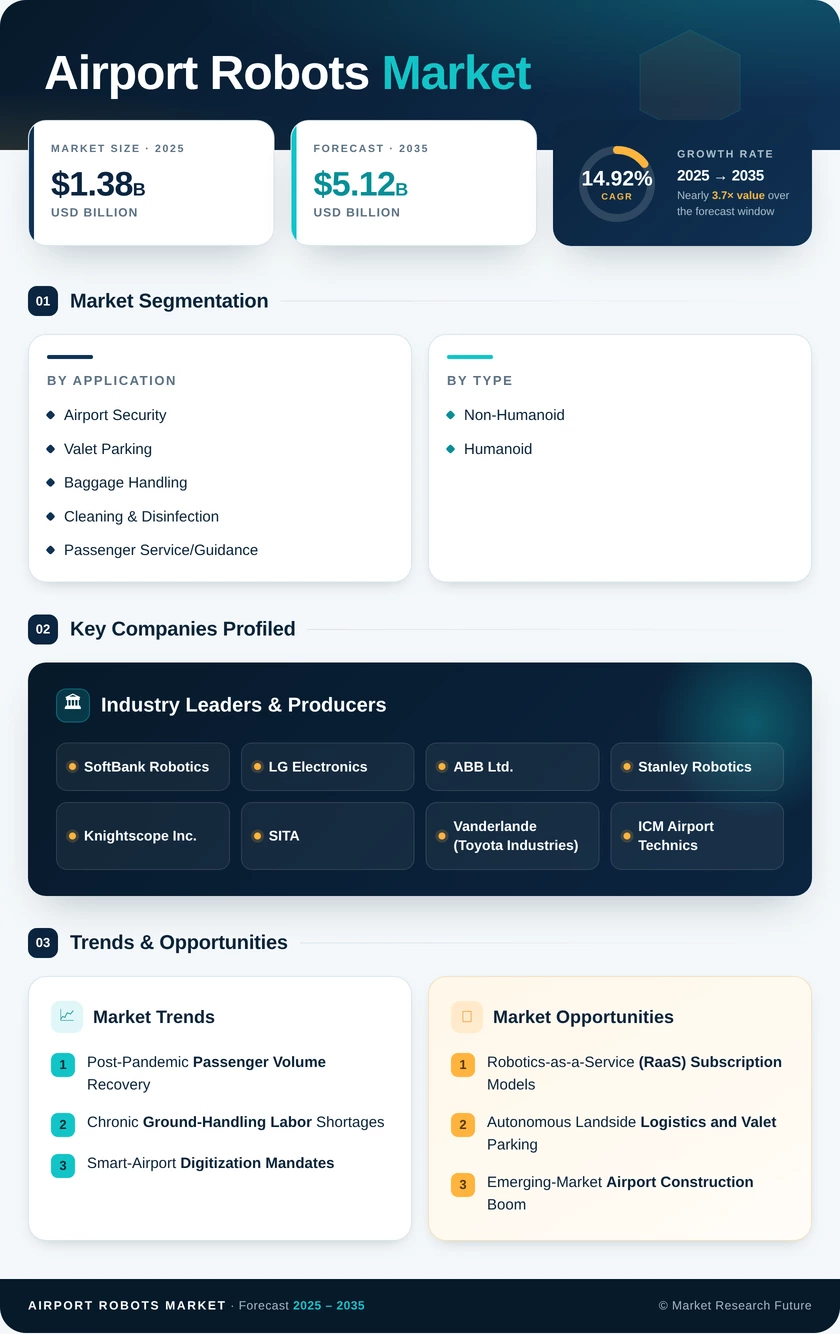
    1. 4.1 Post-Pandemic Passenger Volume Recovery |
    2. 4.2 Chronic Ground-Handling Labor Shortages |
    3. 4.3 Smart-Airport Digitization Mandates |
    4. 4.4 Federal Aviation Security Standards
  5. 5 Restraints Impact Analysis |
    1. 5.1 High Upfront Capital and Integration Costs |
    2. 5.2 Fragmented Regulatory Frameworks |
    3. 5.3 Cybersecurity Vulnerabilities
  6. 6 Opportunities |
    1. 6.1 Robotics-as-a-Service (RaaS) Subscription Models |
    2. 6.2 Autonomous Landside Logistics and Valet Parking |
    3. 6.3 Emerging-Market Airport Construction Boom |
    4. 6.4 Data Monetization from Robot-Collected Analytics |
    5. 6.5 AI-Powered Multilingual Passenger Engagement
  7. 7 Regional Market Share and Country-Level Analysis |
    1. 7.1 North America | |
      1. 7.1.1 United States | |
      2. 7.1.2 Canada | |
      3. 7.1.3 Mexico |
    2. 7.2 Europe | |
      1. 7.2.1 Germany | |
      2. 7.2.2 United Kingdom | |
      3. 7.2.3 France | |
      4. 7.2.4 Italy | |
      5. 7.2.5 Spain | |
      6. 7.2.6 Nordic Countries | |
      7. 7.2.7 Russia | |
      8. 7.2.8 Rest of Europe |
    3. 7.3 Asia-Pacific | |
      1. 7.3.1 China | |
      2. 7.3.2 India | |
      3. 7.3.3 Japan | |
      4. 7.3.4 South Korea | |
      5. 7.3.5 ASEAN | |
      6. 7.3.6 Rest of Asia-Pacific |
    4. 7.4 South America | |
      1. 7.4.1 Brazil | |
      2. 7.4.2 Argentina | |
      3. 7.4.3 Rest of South America |
    5. 7.5 Middle East & Africa | |
      1. 7.5.1 Saudi Arabia | |
      2. 7.5.2 UAE | |
      3. 7.5.3 South Africa | |
      4. 7.5.4 Egypt | |
      5. 7.5.5 Rest of MEA
  8. 8 Future Outlook (2026–2035) |
    1. 8.1 AI-Driven Autonomy and Edge Computing |
    2. 8.2 Platform Economics and Middleware Standardization |
    3. 8.3 Sustainability and Energy-Efficient Operations |
    4. 8.4 Human-Robot Collaboration Frameworks
  9. 9 Market Segmentation Analysis |
    1. 9.1 By Application | |
      1. 9.1.1 Terminal | |
      2. 9.1.2 Landside |
    2. 9.2 By Robot Type | |
      1. 9.2.1 Non-Humanoid | |
      2. 9.2.2 Humanoid |
    3. 9.3 By End Use | |
      1. 9.3.1 Airport Security | |
      2. 9.3.2 Valet Parking | |
      3. 9.3.3 Baggage Handling | |
      4. 9.3.4 Cleaning & Disinfection | |
      5. 9.3.5 Passenger Service/Guidance | |
      6. 9.3.6 Others
  10. 10 Competitive Landscape |
    1. 10.1 Market Share Analysis (2025) |
    2. 10.2 Competitive Benchmarking Matrix |
    3. 10.3 Company Profiles | |
      1. 10.3.1 SoftBank Robotics | |
      2. 10.3.2 LG Electronics | |
      3. 10.3.3 ABB Ltd. | |
      4. 10.3.4 Stanley Robotics | |
      5. 10.3.5 Knightscope Inc. | |
      6. 10.3.6 SITA | |
      7. 10.3.7 Vanderlande (Toyota Industries) | |
      8. 10.3.8 ICM Airport Technics | |
      9. 10.3.9 Avidbots | |
      10. 10.3.10 ECA Group (Groupe Gorgé)
  11. 11 Recent News & Developments
  12. 12 Report Scope & Methodology |
    1. 12.1 Study Period & Base Year |
    2. 12.2 Data Sources & Citations |
    3. 12.3 Abbreviations
  13. 13 Detailed Sources and Citations
  14. 14 Frequently Asked Questions (FAQs)
  15. 15 LIST OF TABLES |
  16. TABLE 1 Airport Robots Market Size & Forecast, by Revenue (USD Billion), 2021–2035 |
  17. TABLE 2 Airport Robots Market — Year-over-Year Growth Analysis, 2021–2035 |
  18. TABLE 3 Driver Impact Analysis — Airport Robots Market, 2026–2035 |
  19. TABLE 4 Restraint Impact Analysis — Airport Robots Market, 2026–2035 |
  20. TABLE 5 Regional Market Summary — Airport Robots Market, 2025 |
  21. TABLE 6 North America Airport Robots Market Size, by Country, 2021–2035 (USD Billion) |
  22. TABLE 7 Europe Airport Robots Market Size, by Country, 2021–2035 (USD Billion) |
  23. TABLE 8 Asia-Pacific Airport Robots Market Size, by Country, 2021–2035 (USD Billion) |
  24. TABLE 9 South America Airport Robots Market Size, by Country, 2021–2035 (USD Billion) |
  25. TABLE 10 Middle East & Africa Airport Robots Market Size, by Country, 2021–2035 (USD Billion) |
  26. TABLE 11 Airport Robots Market Size, by Application, 2021–2035 (USD Billion) |
  27. TABLE 12 Airport Robots Market Size, by Robot Type, 2021–2035 (USD Billion) |
  28. TABLE 13 Airport Robots Market Size, by End Use, 2021–2035 (USD Billion) |
  29. TABLE 14 Competitive Benchmarking Matrix — Airport Robots Market, 2025 |
  30. TABLE 15 Company Profiles — Key Players, Airport Robots Market |
  31. TABLE 16 Recent Developments & Strategic Announcements, 2023–2025 |
  32. TABLE 17 Report Scope & Methodology Parameters |
  33. TABLE 18 Detailed Sources and Citations
  34. 16 LIST OF FIGURES |
  35. FIGURE 1 Airport Robots Market Dynamics — Drivers, Restraints, and Opportunities |
  36. FIGURE 2 Airport Robots Market Value Chain Analysis |
  37. FIGURE 3 Porter's Five Forces Analysis — Airport Robots Market |
  38. FIGURE 4 Airport Robots Market Size Trend (USD Billion), 2021–2035 |
  39. FIGURE 5 Airport Robots Market Share, by Application, 2025 |
  40. FIGURE 6 Airport Robots Market Share, by Robot Type, 2025 |
  41. FIGURE 7 Airport Robots Market Share, by End Use, 2025 |
  42. FIGURE 8 Airport Robots Market Share, by Region, 2025 |
  43. FIGURE 9 Airport Robots Market Regional Growth Rate Comparison, 2026–2035 |
  44. FIGURE 10 Competitive Landscape — Airport Robots Market Revenue Share, 2025

Segmentation Quick Reference

Dimension Sub-Segments Dominant Segment Fastest Growing Segment
By Application Terminal, Landside Terminal Landside
By Robot Type Non-Humanoid, Humanoid Non-Humanoid Humanoid
By End Use Airport Security, Valet Parking, Baggage Handling, Cleaning & Disinfection, Passenger Service/Guidance, Others Airport Security Cleaning & Disinfection
By Geography North America, Europe, Asia-Pacific, South America, Middle East & Africa North America Asia-Pacific


Market Segmentation Overview

By Application

Sub-Segment Key Trend
Terminal Dominant share driven by passenger-facing automation in security, cleaning, and information services
Landside Fastest growth fueled by autonomous valet parking, curbside logistics, and maturing sensor technology


Terminal operations remain the primary revenue source as airports prioritize automation in high-visibility passenger zones. Landside applications are emerging as the higher-growth opportunity, with autonomous parking and curbside baggage robots entering commercial deployment.

By Robot Type

Sub-Segment Key Trend
Non-Humanoid Wheeled, tracked, and aerial robots dominate through lower cost and modular deployment for baggage and cleaning tasks
Humanoid Rapidly growing segment driven by multilingual passenger engagement and brand-differentiation strategies


Non-humanoid platforms anchor current fleet deployments, but humanoid robots are gaining traction as airports seek differentiated traveler experiences powered by conversational AI and emotion-recognition technology.

By End Use

Sub-Segment Key Trend
Airport Security Largest segment, driven by government security mandates and AI-powered perimeter surveillance
Valet Parking Autonomous parking robots optimize space utilization and improve passenger convenience.
Baggage Handling Labor-shortage mitigation and throughput efficiency drive adoption of autonomous baggage transport
Cleaning & Disinfection Fastest-growing end use, sustained by post-pandemic hygiene expectations and 24/7 robot operations
Passenger Service/Guidance Multilingual AI-powered kiosks enhance traveler satisfaction at international hub airports.
Others Emerging use cases include in-terminal retail delivery and airside maintenance inspection robots.


Security and cleaning represent the two most dynamic end-use categories in the Airport Robots Market, reflecting both regulatory push and operational pull factors that are unlikely to abate through the forecast period.

By Geography

Sub-Segment Key Trend
North America Largest region, led by U.S. federal security grants and labor-substitution demand
Europe Second-largest region, driven by EU digital-transport funding and post-Brexit labor gaps
Asia-Pacific Fastest-growing region, propelled by smart-airport mandates and domestic OEM cost advantages
South America Nascent adoption concentrated in Brazil's hub airports.
Middle East & Africa High-growth pocket driven by mega-hub construction in Saudi Arabia and the UAE


Regional dynamics in the Airport Robots Market reflect a clear pattern: mature Western markets focus on labor-replacement ROI, while Asia-Pacific and the Middle East invest in robotics as part of greenfield smart-airport construction programs.