Request Free Sample ×

Kindly complete the form below to receive a free sample of this Report

* Please use a valid business email

Leading companies partner with us for data-driven Insights

clients tt-cursor
Hero Background

Sodium Benzoate Market

ID: MRFR/FnB/9062-HCR
90 Pages
Snehal Singh
April 2026

Sodium Benzoate Market Size, Share, Industry Trend & Analysis Research Report Information by Form (Dry & Liquid), by Application [Beverage, Food (Baked Products, Condiments, Dressings, Frozen Dairy Products, Others), Pharmaceuticals, Personal Care & Others], by Region - Forecast till 2035

Share:
Download PDF ×

We do not share your information with anyone. However, we may send you emails based on your report interest from time to time. You may contact us at any time to opt-out.

Sodium Benzoate Market Infographic
Purchase Options

Sodium Benzoate Market Summary

As per MRFR analysis, the Sodium Benzoate Market Size was estimated at 1.75 USD Million in 2024. The Sodium Benzoate industry is projected to grow from 1.86 in 2025 to 3.14 by 2035, exhibiting a compound annual growth rate (CAGR) of 5.44% during the forecast period 2025 - 2035.

Key Market Trends & Highlights

The Sodium Benzoate Market is experiencing a dynamic shift driven by evolving consumer preferences and regulatory frameworks.

  • The demand for clean label products is rising, influencing formulation choices across various sectors.
  • North America remains the largest market for sodium benzoate, while Asia-Pacific is emerging as the fastest-growing region.
  • In the food industry, sodium benzoate is predominantly utilized for food preservation, whereas its application in personal care is rapidly expanding.
  • Key market drivers include the increasing use of sodium benzoate in food preservation and the growth in personal care and cosmetic applications.

Market Size & Forecast

2024 Market Size 1.75 (USD Million)
2035 Market Size 3.14 (USD Million)
CAGR (2025 - 2035) 5.44%

Major Players

BASF SE (DE), Eastman Chemical Company (US), Hawkins, Inc. (US), Shandong Jinling Chemical (CN), FBC Industries, Inc. (US), Spectrum Chemical Manufacturing Corp. (US), Kao Corporation (JP), Nantong Acetic Acid Chemical Co., Ltd. (CN), Nippon Shokubai Co., Ltd. (JP)

Our Impact
Enabled $4.3B Revenue Impact for Fortune 500 and Leading Multinationals
Partnering with 2000+ Global Organizations Each Year
30K+ Citations by Top-Tier Firms in the Industry

Sodium Benzoate Market Trends

The Sodium Benzoate Market is currently experiencing notable developments driven by various factors. This compound, primarily utilized as a preservative in food and beverages, is gaining traction due to increasing consumer awareness regarding food safety and quality. As regulatory bodies continue to emphasize the importance of safe food additives, the demand for sodium benzoate is likely to rise. Additionally, the growing trend of clean label products is influencing manufacturers to seek effective preservatives that align with consumer preferences for natural ingredients. This shift may lead to innovations in sodium benzoate formulations, enhancing its appeal in the market. Moreover, the Sodium Benzoate Market is also influenced by its applications beyond the food industry. The compound is utilized in pharmaceuticals, cosmetics, and personal care products, which broadens its market potential. As industries seek to improve product stability and shelf life, sodium benzoate's versatility positions it favorably. Furthermore, the increasing focus on sustainability and eco-friendly practices may drive research into alternative preservation methods, potentially impacting the sodium benzoate landscape. Overall, the Sodium Benzoate Market appears poised for growth, with evolving consumer preferences and regulatory landscapes shaping its future trajectory.

Rising Demand for Clean Label Products

The trend towards clean label products is gaining momentum, as consumers increasingly prefer transparency in ingredient sourcing. This shift is prompting manufacturers to explore sodium benzoate as a viable preservative option that meets consumer expectations for natural and safe additives.

Expansion in Non-Food Applications

Sodium benzoate is finding new applications beyond the food sector, particularly in pharmaceuticals and cosmetics. This diversification is likely to enhance market growth, as industries recognize the benefits of sodium benzoate in improving product stability and extending shelf life.

Regulatory Influence on Market Dynamics

Regulatory frameworks surrounding food safety and additive usage are evolving, which may impact the sodium benzoate market. Stricter regulations could lead to increased scrutiny of preservatives, prompting manufacturers to adapt their formulations and practices to comply with new standards.

Sodium Benzoate Market Drivers

Growth in Beverage Industry

The beverage sector significantly influences the Global Sodium Benzoate Industry, as sodium benzoate is commonly used as a preservative in soft drinks and fruit juices. The rising consumption of non-alcoholic beverages globally has led to an increased need for effective preservatives to maintain product quality and safety. As the market evolves, the demand for sodium benzoate is anticipated to grow, with projections indicating a market value of 1250 USD Million by 2035. This growth is further fueled by the trend towards healthier beverage options, where sodium benzoate serves as a reliable preservative without compromising flavor.

Rising Demand in Food Preservation

The Global Sodium Benzoate Industry experiences a notable increase in demand due to its widespread application as a food preservative. Sodium benzoate effectively inhibits the growth of bacteria, yeast, and fungi, thereby extending the shelf life of various food products. In 2024, the market is projected to reach 750 USD Million, driven by consumer preferences for longer-lasting food items. As food safety regulations become more stringent, manufacturers are increasingly adopting sodium benzoate to comply with these standards. This trend is expected to continue, contributing to a compound annual growth rate of 4.75% from 2025 to 2035.

Consumer Awareness and Health Trends

Consumer awareness regarding food additives and health trends significantly influences the Global Sodium Benzoate Industry. As consumers become more informed about the ingredients in their food, there is a growing demand for transparency and safety in food products. Sodium benzoate, being a widely recognized preservative, is often scrutinized, leading manufacturers to emphasize its safety and efficacy. This trend towards health-conscious consumption is likely to shape product formulations, with sodium benzoate remaining a key ingredient in many formulations. The market is expected to adapt to these changing consumer preferences, ensuring that sodium benzoate remains relevant in the evolving landscape.

Regulatory Support for Safe Additives

Regulatory frameworks play a crucial role in shaping the Global Sodium Benzoate Industry. Governments worldwide are increasingly recognizing the importance of food safety and the role of preservatives in maintaining product integrity. Sodium benzoate is approved for use in many countries, which enhances its marketability. The support from regulatory bodies encourages manufacturers to incorporate sodium benzoate into their products, ensuring compliance with safety standards. This regulatory backing is likely to bolster market growth, as it reassures consumers about the safety of food products containing sodium benzoate.

Versatility in Industrial Applications

The versatility of sodium benzoate extends beyond food preservation, significantly impacting the Global Sodium Benzoate Industry. It is utilized in various industrial applications, including cosmetics, pharmaceuticals, and personal care products. This broad applicability enhances its market potential, as industries seek effective preservatives to enhance product stability and shelf life. The increasing focus on product quality across sectors is likely to drive demand for sodium benzoate, contributing to its market growth. As industries continue to innovate, the role of sodium benzoate as a multifunctional additive is expected to expand, further solidifying its position in the market.

Market Segment Insights

By Application: Food Preservation (Largest) vs. Beverages (Fastest-Growing)

The Sodium Benzoate Market is segmented by application, with food preservation taking the lead as the largest segment. This segment holds a significant portion of the market, driven by the increasing demand for longer shelf life in food products. In addition to food preservation, other notable segments include cosmetics, pharmaceuticals, and agricultural chemicals, each contributing to the growing interest in sodium benzoate as a versatile preservative. Beverages, on the other hand, are emerging as the fastest-growing segment, fueled by rising consumption of soft drinks and flavored water products.

Food Preservation (Dominant) vs. Beverages (Emerging)

In the Sodium Benzoate Market, food preservation is regarded as the dominant application segment. It is characterized by a vast range of uses across various food products to prevent microbial growth and extend shelf life, which is a critical factor in consumer satisfaction and safety. The demand for clean-label products is pushing manufacturers to seek effective natural preservatives, thereby opening new opportunities for sodium benzoate. Meanwhile, beverages represent an emerging category where sodium benzoate is gaining traction due to its effectiveness in maintaining quality. As consumer preferences shift towards convenient and ready-to-drink solutions, the beverage sector's growth is anticipated to accelerate, highlighting the need for effective preservation methods to ensure product freshness.

By End Use: Food Industry (Largest) vs. Personal Care Industry (Fastest-Growing)

The Sodium Benzoate Market is heavily influenced by its end-use segments, with the food industry holding a significant share. This sector utilizes sodium benzoate primarily as a preservative, capitalizing on its effectiveness in inhibiting the growth of bacteria, yeast, and fungi in various food products. The substantial demand from processed food manufacturers fuels this segment's prominence, accounting for a majority of market consumption. Other segments, like personal care and pharmaceutical, although smaller, contribute to the market growth trajectory by catering to specific consumer needs requiring the unique properties of sodium benzoate. In terms of growth trends, the food industry is projected to maintain its lead due to the continuing rise in global food production and processing. However, the personal care industry is emerging rapidly, driven by increased consumer demand for cosmetic products that incorporate natural and effective preservatives. This shift towards personal care reflects broader trends in consumer behavior, focusing on health and wellness, thereby propelling sodium benzoate's adoption in formulations. Concurrently, the pharmaceutical and beverage industries also showcase steady demand, enhancing the overall growth landscape for sodium benzoate in various application avenues.

Food Industry: Dominant vs. Personal Care Industry: Emerging

In the Sodium Benzoate Market, the food industry stands out as the dominant segment, primarily driven by its role as a preservative that enhances food shelf life and safety. This established sector leverages sodium benzoate in a variety of processed foods to meet safety regulations and consumer expectations for product quality. On the other hand, the personal care industry represents an emerging segment, capturing attention for its rapid growth as it increasingly incorporates sodium benzoate in beauty and skincare products. This rise is propelled by the growing consumer awareness of product ingredients, where sodium benzoate is appreciated for its antimicrobial properties and effectiveness in extending the shelf life of personal care items. As consumer preferences shift towards clean and effective formulations, both segments are showing dynamic characteristics that reflect the evolving landscape of the Sodium Benzoate Market.

By Formulation Type: Liquid Formulation (Largest) vs. Powder Formulation (Fastest-Growing)

In the Sodium Benzoate Market, the formulation types play a crucial role in determining application suitability and market segmentation. Liquid formulation dominates the market due to its versatility and ease of use in various food and beverage applications. It is preferred by manufacturers for its ability to mix seamlessly with other ingredients. Meanwhile, powder formulation, while currently smaller in market share, is experiencing significant growth owing to its advantages in dry products and convenience in packaging.

Liquid Formulation (Dominant) vs. Powder Formulation (Emerging)

Liquid formulation stands out in the Sodium Benzoate Market as the dominant choice among manufacturers and consumers alike. Its liquid state provides ease of incorporation into various formulations, making it highly preferred in industries such as food and beverage preservations. Conversely, the powdered formulation is emerging as a key player, gaining traction due to its non-liquid form which fits well in dry food applications and reduces transportation costs. The convenience and longer shelf life of powdered sodium benzoate further drive its potential in this growing market, catering to a niche segment that seeks versatility in product usage.

By Distribution Channel: Direct Sales (Largest) vs. Online Sales (Fastest-Growing)

In the Sodium Benzoate Market, the distribution channel plays a crucial role in determining product reach and accessibility. Direct Sales currently dominate, as manufacturers leverage direct relationships with businesses that require sodium benzoate, ensuring a consistent supply chain. Conversely, Online Sales, while smaller in share, are rapidly catching up as more buyers turn to digital platforms for procurement, necessitating manufacturers to establish a robust online presence to meet growing demand.

Distribution Channel: Direct Sales (Dominant) vs. Online Sales (Emerging)

Direct Sales in the Sodium Benzoate Market exhibit a dominant presence, characterized by strong relationships between manufacturers and large-scale buyers, such as food and beverage companies. This channel provides consistency in supply and quality control, making it favored for bulk purchasing. Meanwhile, Online Sales are emerging as a significant trend, driven by the convenience of digital purchasing platforms and an increase in end-user awareness. The accelerating growth of e-commerce is transforming the way sodium benzoate is marketed and purchased, appealing to smaller buyers and new markets that require easier access to this chemical additive.

Get more detailed insights about Sodium Benzoate Market

Regional Insights

North America : Market Leader in Sodium Benzoate

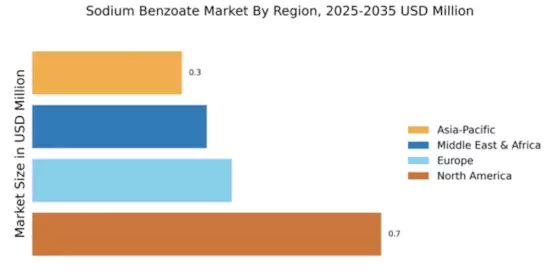
North America is poised to maintain its leadership in the Sodium Benzoate market, holding a significant market share of 70% in 2024. The region's growth is driven by increasing demand in food preservation and pharmaceuticals, alongside stringent regulations promoting food safety. The presence of major players like Eastman Chemical Company and BASF SE further fuels market expansion, supported by innovative product developments and sustainable practices. The United States stands as the largest market, with a robust competitive landscape featuring key players such as Hawkins, Inc. and FBC Industries, Inc. The region benefits from advanced manufacturing capabilities and a strong distribution network, ensuring efficient supply chains. As consumer awareness regarding food additives grows, the demand for Sodium Benzoate is expected to rise, solidifying North America's market position.

Europe : Regulatory Framework Driving Growth

Europe is witnessing a steady growth in the Sodium Benzoate market, with a market share of 40% in 2024. The region's growth is primarily driven by stringent food safety regulations and increasing consumer demand for natural preservatives. The European Food Safety Authority (EFSA) has established guidelines that support the safe use of Sodium Benzoate, enhancing its market appeal in food and beverage applications. Leading countries such as Germany, France, and the UK are at the forefront of this market, with a competitive landscape featuring key players like Kao Corporation and Nippon Shokubai Co., Ltd. The presence of established chemical manufacturers and a focus on sustainable practices are pivotal in shaping the market dynamics. As the demand for clean-label products rises, Sodium Benzoate's role in food preservation is expected to grow significantly.

Asia-Pacific : Emerging Market with High Potential

The Asia-Pacific region is emerging as a significant player in the Sodium Benzoate market, holding a market share of 30% in 2024. The growth is driven by increasing industrialization, urbanization, and rising disposable incomes, leading to higher demand for processed foods. Additionally, favorable government policies promoting food safety and quality standards are acting as catalysts for market expansion in this region. China and India are the leading countries in this market, with a competitive landscape featuring key players like Shandong Jinling Chemical and Nantong Acetic Acid Chemical Co., Ltd. The region's market is characterized by a mix of local and international players, fostering innovation and competitive pricing. As consumer preferences shift towards convenience foods, the demand for Sodium Benzoate is expected to rise, presenting lucrative opportunities for market participants.

Middle East and Africa : Growing Demand in Diverse Sectors

The Middle East and Africa region is witnessing a growing demand for Sodium Benzoate, with a market share of 35% in 2024. The growth is attributed to the expanding food and beverage industry, coupled with increasing awareness regarding food safety and preservation. Regulatory bodies are beginning to implement guidelines that support the safe use of Sodium Benzoate, which is expected to further boost market growth in the coming years. Countries like South Africa and the UAE are leading the market, with a competitive landscape that includes both local and international players. The presence of key manufacturers and distributors is enhancing market accessibility. As the region continues to develop economically, the demand for Sodium Benzoate in various applications, including cosmetics and pharmaceuticals, is anticipated to rise significantly.

Sodium Benzoate Market Regional Image

Key Players and Competitive Insights

The Sodium Benzoate Market is characterized by a competitive landscape that is increasingly shaped by innovation, sustainability, and strategic partnerships. Key players such as BASF SE (DE), Eastman Chemical Company (US), and Hawkins, Inc. (US) are actively pursuing strategies that enhance their market positioning. BASF SE (DE) focuses on expanding its product portfolio through research and development, while Eastman Chemical Company (US) emphasizes sustainability in its operations, aiming to reduce environmental impact. Hawkins, Inc. (US) appears to be leveraging its regional presence to optimize supply chains and enhance customer service, collectively contributing to a dynamic competitive environment.The market structure is moderately fragmented, with several players vying for market share. Key business tactics include localizing manufacturing to reduce costs and improve responsiveness to market demands. Supply chain optimization is also a critical focus, as companies seek to enhance efficiency and reliability. The collective influence of these strategies by major players shapes the competitive dynamics, fostering an environment where innovation and operational excellence are paramount.

In November BASF SE (DE) announced a new initiative aimed at increasing the production capacity of sodium benzoate at its facility in Ludwigshafen. This strategic move is significant as it aligns with the growing demand for food preservatives and indicates BASF's commitment to meeting market needs while enhancing its operational capabilities. The expansion is expected to bolster its competitive edge in the global market.

In October Eastman Chemical Company (US) launched a new line of sustainable sodium benzoate products designed to cater to the growing consumer preference for environmentally friendly options. This initiative not only reflects Eastman's commitment to sustainability but also positions the company favorably against competitors who may not prioritize eco-friendly solutions. The introduction of these products could potentially attract a new customer base, enhancing market share.

In September Hawkins, Inc. (US) entered into a strategic partnership with a leading food manufacturer to supply sodium benzoate for their preservative needs. This collaboration is indicative of Hawkins' strategy to strengthen its market presence through alliances that enhance distribution capabilities. Such partnerships are likely to provide Hawkins with a competitive advantage by ensuring a steady demand for its products.

As of December the Sodium Benzoate Market is witnessing trends that emphasize digitalization, sustainability, and the integration of advanced technologies. Strategic alliances are increasingly shaping the competitive landscape, allowing companies to pool resources and expertise. The shift from price-based competition to a focus on innovation and supply chain reliability is evident, suggesting that future competitive differentiation will hinge on technological advancements and sustainable practices.

Key Companies in the Sodium Benzoate Market include

Industry Developments

There are no recent developments. 

Report Outlook

The sodium benzoate market report covers the current scenario of the market and the growth factors of the market for sodium benzoate. The growth factors that are discussed in the report include drivers, opportunities, restraints, and challenges. The various segments of the market is also been discussed in this report along with the various regions into which the market has been divided. COVID-19 pandemic impact on the market is also highlighted in the report. The report also outlines the competitiveness of the key players of the market in the competitive analysis section.  

Report Detail 

  • Historic Period: 2018 - 2020
  • Base Year: 2021
  • Forecast Period: 2022 – 2030 

By Geographically, 

  • North America
  • Asia Pacific
  • Latin America
  • Europe
  • The Middle East and Africa

Future Outlook

Sodium Benzoate Market Future Outlook

The Sodium Benzoate Market is projected to grow at a 5.44% CAGR from 2025 to 2035, driven by increasing demand in food preservation and pharmaceuticals.

New opportunities lie in:

  • Expansion into emerging markets with tailored formulations.
  • Development of eco-friendly sodium benzoate alternatives.
  • Strategic partnerships with food manufacturers for bulk supply agreements.

By 2035, the Sodium Benzoate Market is expected to achieve robust growth, solidifying its position in various industries.

Market Segmentation

Sodium Benzoate Market End Use Outlook

  • Food Industry
  • Personal Care
  • Healthcare
  • Agriculture
  • Chemical Manufacturing

Sodium Benzoate Market Application Outlook

  • Food Preservation
  • Cosmetic Products
  • Pharmaceuticals
  • Beverages
  • Agricultural Chemicals

Sodium Benzoate Market Formulation Type Outlook

  • Liquid Formulation
  • Powder Formulation
  • Granular Formulation
  • Emulsified Formulation

Sodium Benzoate Market Distribution Channel Outlook

  • Direct Sales
  • Online Sales
  • Retail Sales
  • Wholesale

Report Scope

MARKET SIZE 2024 1.75(USD Million)
MARKET SIZE 2025 1.86(USD Million)
MARKET SIZE 2035 3.14(USD Million)
COMPOUND ANNUAL GROWTH RATE (CAGR) 5.44% (2025 - 2035)
REPORT COVERAGE Revenue Forecast, Competitive Landscape, Growth Factors, and Trends
BASE YEAR 2024
Market Forecast Period 2025 - 2035
Historical Data 2019 - 2024
Market Forecast Units USD Million
Key Companies Profiled BASF SE (DE), Eastman Chemical Company (US), Hawkins, Inc. (US), Shandong Jinling Chemical (CN), FBC Industries, Inc. (US), Spectrum Chemical Manufacturing Corp. (US), Kao Corporation (JP), Nantong Acetic Acid Chemical Co., Ltd. (CN), Nippon Shokubai Co., Ltd. (JP)
Segments Covered Application, End Use, Formulation Type, Distribution Channel
Key Market Opportunities Growing demand for natural preservatives in food products enhances opportunities in the Sodium Benzoate Market.
Key Market Dynamics Rising demand for natural preservatives drives innovation and competition in the Sodium Benzoate market.
Countries Covered North America, Europe, APAC, South America, MEA

Market Highlights

Author
Author
Author Profile
Snehal Singh LinkedIn
Manager - Research
High acumen in analyzing complex macro & micro markets with more than 6 years of work experience in the field of market research. By implementing her analytical skills in forecasting and estimation into market research reports, she has expertise in Packaging, Construction, and Equipment domains. She handles a team size of 20-25 resources and ensures smooth running of the projects, associated marketing activities, and client servicing.
Leave a Comment

FAQs

What is the projected market valuation of the Sodium Benzoate Market by 2035?

The Sodium Benzoate Market is projected to reach a valuation of 3.14 USD Million by 2035.

What was the market valuation of Sodium Benzoate in 2024?

The overall market valuation of Sodium Benzoate was 1.75 USD Million in 2024.

What is the expected CAGR for the Sodium Benzoate Market during the forecast period 2025 - 2035?

The expected CAGR for the Sodium Benzoate Market during the forecast period 2025 - 2035 is 5.44%.

Which application segment had the highest valuation in 2024?

In 2024, the Food Preservation application segment had the highest valuation at 1.25 USD Million.

What are the key players in the Sodium Benzoate Market?

Key players in the Sodium Benzoate Market include BASF SE, Eastman Chemical Company, and Hawkins, Inc.

How does the valuation of the Personal Care Industry segment compare to the Pharmaceutical Industry segment in 2024?

In 2024, the Personal Care Industry segment was valued at 0.55 USD Million, while the Pharmaceutical Industry segment was valued at 0.45 USD Million.

What is the projected growth for the Beverage Industry segment by 2035?

The Beverage Industry segment is expected to grow from 0.35 USD Million in 2024 to 0.59 USD Million by 2035.

Which distribution channel is anticipated to have the highest valuation in 2035?

The Wholesale distribution channel is anticipated to have the highest valuation by 2035, following its growth trajectory.

What formulation type is expected to dominate the Sodium Benzoate Market by 2035?

The Liquid Formulation type is expected to dominate the Sodium Benzoate Market, with a projected valuation increase.

How does the market performance of Sodium Benzoate in 2024 compare across different end-use segments?

In 2024, the Food Industry segment led with a valuation of 1.25 USD Million, while the Agriculture segment was at 0.15 USD Million.

Research Approach

Secondary Research

The secondary research process involved comprehensive analysis of regulatory databases, food chemical safety publications, peer-reviewed journals, and authoritative industry organizations. Key sources included the US Food & Drug Administration (FDA), European Food Safety Authority (EFSA), FAO/WHO Codex Alimentarius Commission, US Environmental Protection Agency (EPA), Food Chemicals Codex (FCC) by USP, International Food Additives Council (IFAC), European Chemicals Agency (ECHA), Japan Ministry of Health, Labour and Welfare (MHLW) Food Additives Database, China National Food Safety Standard (GB standards), India Food Safety and Standards Authority (FSSAI), American Chemical Society (ACS) publications, National Center for Biotechnology Information (NCBI/PubMed) for toxicological studies, Food and Agriculture Organization (FAO) FAOSTAT, OECD Chemical Safety Database, and national chemical regulatory agencies from key production markets. These sources were used to collect regulatory approval data, acceptable daily intake (ADI) studies, production volume statistics, application-specific consumption trends, and food safety compliance frameworks for sodium benzoate across food preservation, beverage stabilization, pharmaceutical formulations, and personal care applications.

Primary Research

Qualitative and quantitative insights were obtained by interviewing supply-side and demand-side stakeholders during the primary research process. Sources from the supply side included CEOs, VPs of Manufacturing, regulatory compliance chiefs, and commercial directors from sodium benzoate manufacturers, chemical distributors, and OEMs (including key producers such as BASF SE, Eastman Chemical Company, and regional chemical manufacturers). Procurement directors from food and beverage manufacturers (including soft drink producers, baked goods companies, and condiment manufacturers), pharmaceutical formulation scientists, cosmetics R&D heads, and supply chain managers from personal care product companies constituted demand-side sources. The primary research validated application segmentation in liquid and dry formulations, confirmed production capacity expansion timelines, and garnered insights on clean-label formulation challenges, pricing volatility associated with benzoic acid raw materials, and regional regulatory compliance costs.

Primary Respondent Breakdown:

By Designation: C-level Primaries (28%), Director Level (32%), Others (40%)

By Region: North America (32%), Europe (30%), Asia-Pacific (28%), Rest of World (10%)

Market Size Estimation

Global market valuation was derived through production capacity analysis and application volume assessment. The methodology included:

Identification of over 60 significant chemical distributors and manufacturers in North America, Europe, Asia-Pacific, Latin America, and the Middle East and Africa

Product mapping across dry/powder and liquid sodium benzoate formulations, with purity grades (food grade, pharmaceutical grade, technical grade)

Analysis of reported and modeled annual revenues specific to sodium benzoate product portfolios, including benzoic acid derivative segment allocations

Coverage of manufacturers representing 75-80% of global market share in 2024

Extrapolation using bottom-up (application volume × ASP by formulation type and end-use industry) and top-down (manufacturer revenue validation against chemical industry directories) approaches to derive segment-specific valuations for food preservation, beverage additives, pharmaceutical excipients, and personal care applications

Download Free Sample

Kindly complete the form below to receive a free sample of this Report

Compare Licence

×
Features License Type
Single User Multiuser License Enterprise User
Price $4,950 $5,950 $7,250
Maximum User Access Limit 1 User Upto 10 Users Unrestricted Access Throughout the Organization
Free Customization
Direct Access to Analyst
Deliverable Format
Platform Access
Discount on Next Purchase 10% 15% 15%
Printable Versions
%>