
Request Free Sample ×

Kindly complete the form below to receive a free sample of this Report

* Please use a valid business email

Leading companies partner with us for data-driven Insights

clients tt-cursor
Hero Background
English
Chinese
French
Japanese
Korean
German
Spanish

Customer Experience Management Market Trends

ID: MRFR/ICT/2117-HCR
200 Pages
Aarti Dhapte
March 2026

Customer Experience Management Market Size, Share and Research Report: By Technology (Artificial Intelligence, Cloud Computing, Big Data Analytics, Internet of Things, Omnichannel Communication), By Application (Customer Feedback Management, Customer Journey Mapping, Predictive Analytics, Social Media Management, Personalization), By End Use (Retail, Healthcare, BFSI, Telecommunications, Travel and Hospitality), By Deployment Mode (On-Premises, Cloud-Based, Hybrid) and By Regional (North America, Europe, South America, Asia Pacific, Middle East and Africa)- Industry Forecast to 2035

Share:
Download PDF ×

We do not share your information with anyone. However, we may send you emails based on your report interest from time to time. You may contact us at any time to opt-out.

Customer Experience Management Market Infographic
Purchase Options

Market Trends

Key Emerging Trends in the Customer Experience Management Market

The CEM market is seeing unique patterns that are reshaping the scene of client associations and connections. As organizations progressively perceive the crucial job that client experience plays in their prosperity, the interest for autonomous CEM arrangements is on the ascent.

One conspicuous pattern in the Autonomous CEM market is the developing reception of Computerized reasoning (artificial intelligence) and AI advances. Organizations are utilizing these cutting-edge innovations to break down immense measures of client information continuously, acquiring significant experiences into client conduct and inclinations. Artificial intelligence controlled CEM arrangements empower organizations to convey customized and proactive encounters, subsequently improving consumer loyalty and dedication.

Another prominent pattern is the accentuation on omnichannel client encounters. With shoppers drawing in with brands across different stages, for example, sites, versatile applications, virtual entertainment, and actual stores, organizations are focusing on the reconciliation of these channels to make a consistent and reliable client venture. Free CEM arrangements are assuming a significant part in working with this reconciliation, guaranteeing that clients get a brought together and firm insight across all touchpoints.

The ascent of client opinion examination is likewise a huge pattern in the Free CEM market. Organizations are progressively perceiving the significance of understanding what clients are talking about as well as how they feel. Opinion examination devices empower organizations to check client feelings and feelings communicated in surveys, web-based entertainment, and other correspondence channels. This important data permits organizations to resolve issues expeditiously, recognize regions for development, and exploit positive input to reinforce their image notoriety.

In light of the rising spotlight on information protection and security, one more pattern in the Free CEM market is the execution of hearty safety efforts. As organizations gather and dissect delicate client information, guaranteeing the insurance of this data is fundamental. Autonomous CEM arrangements are consolidating progressed security highlights, encryption conventions, and consistence with information insurance guidelines to ingrain certainty among clients and satisfy rigid protection guidelines.

In addition, there is a growing trend toward cloud based CEM solutions. Cloud innovation offers versatility, adaptability, and openness, permitting organizations to oversee and dissect huge measures of client information without the requirement for broad on-premises foundation effectively. Cloud-based Autonomous CEM arrangements empower associations to adjust to changing client needs quickly and convey refreshes flawlessly, upgrading generally readiness in answering business sector elements.

The CEM market is likewise seeing a pattern towards a more all-encompassing way to deal with client experience. Organizations are moving past value-based communications and zeroing in on building long haul associations with clients. By providing tools for customer journey mapping, feedback collection, and predictive analytics, independent CEM solutions enable businesses to comprehend and address the entire customer lifecycle.

All in all, the market is developing to meet the changing necessities of organizations in the computerized age. With the combination of simulated intelligence, omnichannel encounters, opinion examination, upgraded safety efforts, cloud innovation, and a comprehensive client driven approach, organizations are strategically situated to hoist their client encounters. As the market keeps on developing, organizations that focus on CEM arrangements are probably going to acquire an upper hand by encouraging persevering through client connections and remaining in front of industry patterns.


Author
Author Profile
Aarti Dhapte
AVP - Research

A consulting professional focused on helping businesses navigate complex markets through structured research and strategic insights. I partner with clients to solve high-impact business problems across market entry strategy, competitive intelligence, and opportunity assessment. Over the course of my experience, I have led and contributed to 100+ market research and consulting engagements, delivering insights across multiple industries and geographies, and supporting strategic decisions linked to $500M+ market opportunities. My core expertise lies in building robust market sizing, forecasting, and commercial models (top-down and bottom-up), alongside deep-dive competitive and industry analysis. I have played a key role in shaping go-to-market strategies, investment cases, and growth roadmaps, enabling clients to make confident, data-backed decisions in dynamic markets.

Leave a Comment

FAQs

What is the projected market valuation of the Customer Experience Management Market by 2035?

<p>The projected market valuation for the Customer Experience Management Market by 2035 is 24.09 USD Billion.</p>

What was the market valuation of the Customer Experience Management Market in 2024?

<p>The overall market valuation of the Customer Experience Management Market was 10.5 USD Billion in 2024.</p>

What is the expected CAGR for the Customer Experience Management Market from 2025 to 2035?

<p>The expected CAGR for the Customer Experience Management Market during the forecast period 2025 - 2035 is 7.84%.</p>

Which technology segment is anticipated to grow the most in the Customer Experience Management Market?

<p>The Artificial Intelligence segment is anticipated to grow from 2.1 USD Billion in 2024 to 5.5 USD Billion by 2035.</p>

How does the Cloud-Based deployment mode compare to On-Premises in terms of market size?

<p>The Cloud-Based deployment mode is expected to grow from 5.25 USD Billion in 2024 to 12.09 USD Billion by 2035, surpassing On-Premises.</p>

What are the key applications driving growth in the Customer Experience Management Market?

<p>Key applications include Predictive Analytics, which is projected to grow from 2.4 USD Billion in 2024 to 5.5 USD Billion by 2035.</p>

Which industry is expected to have the highest market size in the Customer Experience Management Market?

<p>The BFSI sector is expected to grow from 2.8 USD Billion in 2024 to 6.5 USD Billion by 2035, indicating strong demand.</p>

Who are the leading players in the Customer Experience Management Market?

<p>Key players in the market include Salesforce, Adobe, SAP, Oracle, and Zendesk, among others.</p>

What is the growth outlook for the Omnichannel Communication segment?

<p>The Omnichannel Communication segment is projected to grow from 2.4 USD Billion in 2024 to 4.5 USD Billion by 2035.</p>

How does the market size for Customer Journey Mapping compare to Customer Feedback Management?

<p>Customer Journey Mapping is expected to grow from 2.0 USD Billion in 2024 to 4.5 USD Billion by 2035, while Customer Feedback Management is projected to grow from 2.1 USD Billion to 5.0 USD Billion.</p>

Market Summary

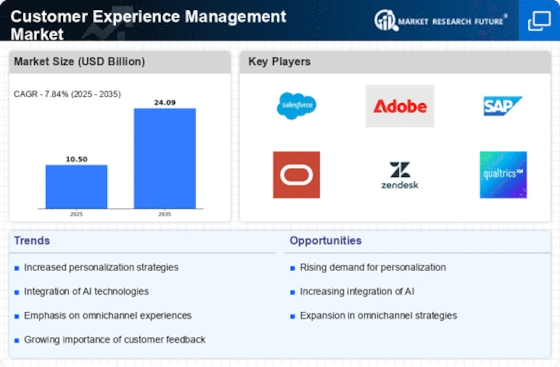
As per Market Research Future analysis, the Customer Experience Management Market was estimated at 10.5 USD Billion in 2024. The Customer Experience Management industry is projected to grow from 11.32 USD Billion in 2025 to 24.09 USD Billion by 2035, exhibiting a compound annual growth rate (CAGR) of 7.84% during the forecast period 2025 - 2035

Key Market Trends & Highlights

The Customer Experience Management Market is evolving towards greater personalization and technological integration.

  • Personalization of customer interactions is becoming increasingly vital in enhancing customer satisfaction. North America remains the largest market, while Asia-Pacific is recognized as the fastest-growing region in customer experience management. Artificial Intelligence leads the market as the largest segment, whereas Cloud Computing is emerging as the fastest-growing segment. Rising consumer expectations and the growing importance of customer feedback are driving the market forward.

Market Size & Forecast

2024 Market Size 10.5 (USD Billion)
2035 Market Size 24.09 (USD Billion)
CAGR (2025 - 2035) 7.84%
Largest Regional Market Share in 2024 North America

Major Players

Salesforce (US), Adobe (US), SAP (DE), Oracle (US), Zendesk (US), Qualtrics (US), Freshworks (IN), HubSpot (US), Medallia (US)

Market Trends

The Customer Experience Management Market is currently undergoing a transformative phase, driven by the increasing emphasis on personalized interactions and the integration of advanced technologies. Organizations are recognizing the necessity of understanding customer journeys in a more nuanced manner, which appears to enhance customer satisfaction and loyalty. The broader customer service market is evolving into a value-driven engine where support agents are re-skilled as empathy experts to handle complex, emotionally charged inquiries.

A comprehensive customer experience management market analysis in 2026 highlights the convergence of employee experience (EX) and customer experience (CX) as a single operational goal. This unified approach ensures that satisfied, well-supported employees naturally deliver better service to customers.


Moreover, the rise of digital channels and the proliferation of data analytics tools are reshaping the Customer Experience Management Market. Companies are leveraging these technologies to gain insights into customer behavior, preferences, and feedback. This data-driven approach enables organizations to tailor their offerings and interactions, potentially leading to improved customer retention and advocacy. As the market evolves, it is likely that the integration of artificial intelligence and machine learning will further enhance the ability to predict customer needs and streamline service delivery, thereby solidifying the importance of customer experience in overall business strategy.

Personalization of Customer Interactions

There is a growing trend towards the personalization of customer interactions within the Customer Experience Management Market. Organizations are increasingly utilizing data analytics to tailor experiences to individual preferences, which may lead to enhanced customer satisfaction and loyalty. This focus on personalization suggests that businesses are recognizing the value of understanding their customers on a deeper level.

Integration of Advanced Technologies

The integration of advanced technologies, such as artificial intelligence and machine learning, is becoming more prevalent in the Customer Experience Management Market. These technologies enable organizations to analyze vast amounts of data, providing insights that can inform customer engagement strategies. This trend indicates a shift towards more efficient and effective customer service solutions.

Emphasis on Customer Feedback

An increasing emphasis on customer feedback is evident in the Customer Experience Management Market. Modern customer experience market research has moved beyond traditional long-form surveys to focus on "silent" feedback captured through behavioral analytics and heatmaps. Companies are actively seeking input from their customers to refine their offerings and improve service delivery. This trend highlights the importance of listening to customer voices and adapting business practices accordingly.

Technology Trends in Customer Experience Management Software Market

Interoperability is a major trend in the customer experience management software market, as enterprises demand modular systems that can easily plug into existing CRM and ERP stacks. The customer experience management iot market is expanding as smart home and wearable devices provide real-time telemetry that allows brands to offer proactive maintenance.

Customer Experience Management Market Market Drivers

Increased Competition

In the Customer Experience Management Market, the competitive landscape is intensifying. Companies across various sectors are recognizing that superior customer experience can serve as a differentiator in a crowded marketplace. This realization has led to a significant increase in investments in customer experience initiatives. Data suggests that organizations prioritizing customer experience outperform their competitors by 80% in revenue growth. Consequently, businesses are adopting advanced customer experience management tools to gain a competitive edge, streamline operations, and foster customer loyalty.

Technological Advancements

The Customer Experience Management Market is being transformed by rapid technological advancements. Innovations such as artificial intelligence, machine learning, and big data analytics are enabling organizations to gather and analyze customer data more effectively. These technologies facilitate the creation of personalized experiences, allowing businesses to anticipate customer needs and preferences. As per industry reports, the integration of AI in customer experience management can lead to a 30% increase in customer satisfaction. This trend underscores the importance of leveraging technology to enhance customer interactions and drive business growth.

Rising Consumer Expectations

The Customer Experience Management Market is currently witnessing a surge in consumer expectations. Customers increasingly demand personalized and seamless interactions across various touchpoints. This shift is driven by the proliferation of digital technologies, which have empowered consumers to expect immediate responses and tailored experiences. According to recent data, 80% of consumers indicate that the experience a company provides is as important as its products or services. As a result, businesses are compelled to invest in customer experience management solutions to meet these heightened expectations, thereby enhancing customer satisfaction and loyalty.

Shift Towards Omnichannel Strategies

The Customer Experience Management Market is experiencing a notable shift towards omnichannel strategies. Businesses are increasingly adopting a holistic approach to customer interactions, ensuring a consistent experience across all channels, whether online or offline. This trend is driven by the need to meet customers where they are and provide seamless transitions between different platforms. Data reveals that companies with strong omnichannel strategies retain 89% of their customers, compared to 33% for those with weak strategies. This underscores the critical role of omnichannel customer experience management in fostering customer loyalty and satisfaction.

Growing Importance of Customer Feedback

In the Customer Experience Management Market, the emphasis on customer feedback is becoming increasingly pronounced. Organizations are recognizing that understanding customer sentiments is crucial for improving service delivery and product offerings. The ability to collect, analyze, and act on customer feedback can significantly influence customer retention rates. Recent studies indicate that companies that actively seek and respond to customer feedback can see a 25% increase in customer loyalty. This trend highlights the necessity for businesses to implement robust feedback mechanisms as part of their customer experience management strategies.

Market Segment Insights

By Technology: Artificial Intelligence (Largest) vs. Cloud Computing (Fastest-Growing)

In the Customer Experience Management Market, Artificial Intelligence currently holds the largest share, significantly impacting how businesses engage with customers. Its application in personalizing customer interactions and automating responses has made it an essential tool for organizations aiming to enhance their customer service capabilities. Meanwhile, Cloud Computing, while slightly behind, is the fastest-growing segment, driven by the increasing demand for scalable solutions and the ability to integrate various customer touchpoints seamlessly.

CEM Technology: AI (Dominant) vs. Cloud (Emerging)

Artificial Intelligence stands as the dominant force in the Customer Experience Management Market landscape, primarily responsible for innovations such as chatbots and predictive analytics that transform customer interactions into personalized experiences. On the other hand, Cloud Computing is emerging rapidly, enabling businesses to deploy CEM strategies with unparalleled agility and efficiency. This shift to cloud-based solutions facilitates the integration of different service channels, thereby enhancing overall customer engagement frameworks. The rise of remote working and the necessity for real-time data access further bolster Cloud Computing's position, making it a vital contributor to future advancements in customer experience.

By Application: Customer Feedback Management (Largest) vs. Predictive Analytics (Fastest-Growing)

In the Customer Experience Management Market, the application segment is diverse, with Customer Feedback Management commanding the largest share. It plays a crucial role in understanding customer sentiments and driving improvements in products and services. Predictive Analytics, while currently a smaller segment, is rapidly gaining traction as businesses seek to leverage data for future trends and customer expectations.

Customer Feedback Management (Dominant) vs. Predictive Analytics (Emerging)

Customer Feedback Management is recognized as the dominant value within the Customer Experience Management Market, focusing on gathering insights through surveys and customer interactions. It is essential for companies aiming to enhance their offerings based on direct feedback. On the other hand, Predictive Analytics is an emerging segment, driven by advancements in artificial intelligence and <a title="machine learning" href="https://www.marketresearchfuture.com/reports/machine-learning-market-2494" target="_blank" rel="noopener">machine learning</a>. This segment utilizes historical data to forecast future customer behaviors, helping organizations make proactive decisions. As companies increasingly prioritize data-driven strategies, Predictive Analytics is positioned for significant growth.

By Use: Retail (Largest) vs. Healthcare (Fastest-Growing)

In the Customer Experience Management Market, the 'Use' segment showcases a varied distribution of market share among key sectors. Retail leads this segment, dominating consumer interactions with a strong emphasis on personalized shopping experiences and customer satisfaction. Following closely, the healthcare sector is rapidly gaining ground, driven by innovations in patient engagement and the necessity for improved service delivery. Telecommunications and BFSI also play significant roles but trail behind these leading sectors in terms of market share.

Retail (Dominant) vs. Healthcare (Emerging)

The retail sector stands out as the dominant player in the Customer Experience Management Market due to its reliance on customer feedback and engagement strategies that enhance the purchasing journey. Organizations in this space leverage advanced technologies like AI and data analytics to fine-tune customer interactions and boost loyalty. On the other hand, healthcare is emerging as a vital segment, focusing on patient experience and the integration of digital tools. This sector is increasingly prioritizing seamless communication and personalized care, making it an attractive area for investment and innovation in managing customer experiences.

By Deployment Mode: Cloud-Based (Largest) vs. Hybrid (Fastest-Growing)

In the Customer Experience Management Market, the distribution among deployment modes shows a clear preference for Cloud-Based solutions, which dominate the market due to their flexibility and scalability. On-Premises solutions, once widely favored, have seen a decline as businesses shift towards more accessible and cost-effective Cloud solutions. Hybrid models, combining both On-Premises and Cloud capabilities, also carve out a significant share as organizations find a balance between control and flexibility.

Cloud-Based (Dominant) vs. Hybrid (Emerging)

Cloud-Based deployment in the Customer Experience Management Market remains the dominant mode, offering businesses greater scalability and ease of access to technologies. Its flexibility enables rapid updates and integration of advanced features that enhance customer interactions. Conversely, the Hybrid deployment emerges as a compelling alternative, appealing to organizations that require a tailored solution combining On-Premises control with Cloud efficiency. The Hybrid model allows businesses to adhere to data regulations while leveraging Cloud's innovative capabilities, thus attracting enterprises looking for a balanced approach.

Get more detailed insights about Customer Experience Management Market Research Report - Global Forecast 2035

Regional Insights

The Global Customer Experience Management Market is projected to showcase substantial growth across various regions by 2035, with North America holding a majority share, valued at 10.5 USD Billion, reflecting its significant investment in customer engagement strategies and technology advancements. In the Canada customer experience management market, there is a strong emphasis on bilingual AI support tools that can seamlessly transition between English and French without losing context.


Europe follows closely, projected to reach 6.8 USD Billion, driven by regulatory compliance and a strong focus on enhancing customer relations. Sustainable brand practices have become a core differentiator in the Europe customer experience management market, with consumers favoring companies that provide transparent environmental impact data.


The APAC region, valued at 5.0 USD Billion, demonstrates a growing adoption of digital solutions propelled by rapid urbanization and increased smartphone penetration. China, India and Japan are the critical players in this region. Regulatory shifts regarding data sovereignty are pushing the China customer experience management market toward localized cloud solutions that prioritize domestic security standards.


In South America, the market is expected to reach 2.1 USD Billion, reflecting an increasing demand for innovative customer experience solutions amid evolving consumer behaviors.


Meanwhile, the Middle East and Africa (MEA) are anticipated to expand steadily, valued at 1.7 USD Billion, as businesses recognize the importance of customer satisfaction in diverse markets. These regional dynamics emphasize the varying focuses on customer experience strategies in different markets, influenced by technological advancements and local consumer demands, thereby shaping the Global Customer Experience Management Market landscape effectively.

Key Players and Competitive Insights

The Global Customer Experience Management Market has rapidly evolved, driven by an increased emphasis on enhancing customer interactions and satisfaction across various industries. As more small-to-medium enterprises adopt subscription-based CEM tools, the overall customer experience management market size continues to broaden across diverse economic sectors. Businesses are increasingly recognizing the importance of understanding customer journeys and preferences, leading to significant investments in technology and strategies aimed at optimizing the customer experience. Companies in this market are employing advanced methodologies that integrate data analytics, artificial intelligence, and personalized engagement strategies to create seamless, impactful customer interactions.
 
As competition intensifies, organizations are compelled to differentiate themselves through innovative solutions that cater specifically to the nuanced needs of their customers, which can significantly affect customer loyalty and brand reputation in the long run.
 
Pendo has established a notable presence in the Global Customer Experience Management Market by providing solutions that focus on product experience and user engagement. The company's strengths lie in its robust analytics capabilities, which allow organizations to capture user behavior insights and optimize their product offerings accordingly. Pendo’s platform empowers businesses to enhance customer engagement through product usage data, enabling them to make informed decisions that improve customer experiences. With its emphasis on user onboarding and feature adoption, Pendo has successfully positioned itself as a valuable partner for organizations seeking to enrich their customer experience strategies.
 
The company's commitment to innovation and user-centric product development has helped it capture a significant market share while building strong relationships with its clients.
 
SAP has a substantial footprint in the Global Customer Experience Management Market, largely driven by its comprehensive suite of solutions designed for end-to-end customer engagement. The core offerings of SAP include Customer Experience solutions that integrate seamlessly with its other enterprise software products. SAP’s strengths lie in its ability to provide unified data management and cloud-based solutions, thus facilitating personalized customer interactions across multiple channels.
 
The company has pursued strategic mergers and acquisitions to expand its market presence and enhance its capabilities in the customer experience domain. These initiatives have solidified SAP’s position as a market leader by enriching its portfolio with advanced analytics, customer data platforms, and automation tools that cater to the evolving demands of businesses worldwide, ensuring SAP remains responsive to customer needs in a rapidly changing marketplace.

Key Companies in the Customer Experience Management Market include

Industry Developments

Recent developments in the Global Customer Experience Management Market showcase significant growth and strategic maneuvers among key players. In September 2023, Salesforce announced the expansion of its Customer 360 platform, incorporating new features aimed at enhancing personalized customer interactions. Similarly, in August 2023, Adobe rolled out updates to its Experience Cloud, focusing on integrating artificial intelligence to streamline customer engagement processes. 

Notably, in July 2023, Qualtrics acquired a niche analytics firm to bolster its customer experience capabilities, a move indicative of increasing consolidation within the sector. Volatility in the market is underscored by the rise in stock valuations for companies like HubSpot and Zendesk after embracing innovative customer service solutions. In the past two to three years, significant events include Medallia's acquisition of a leading AI insights provider in April 2021, signaling the market's shift towards technology-driven experiences. 

The increasing emphasis on digital transformation and customer-centric strategies is reshaping the market landscape, fostering a competitive environment for organizations like Microsoft, Oracle, and Verint to excel in delivering exceptional customer experiences globally.


Future Outlook

Customer Experience Management Market Future Outlook

The Customer Experience Management Market is projected to grow at a 7.84% CAGR from 2025 to 2035, driven by technological advancements, increasing customer expectations, and the need for personalized experiences.

New opportunities lie in:

  • <p>Integration of AI-driven analytics for real-time customer insights. Development of omnichannel engagement platforms to enhance customer interactions. Implementation of automated feedback systems to streamline customer satisfaction processes.</p>

By 2035, the market is expected to be robust, reflecting substantial growth and innovation.

Market Segmentation

Customer Experience Management Market Use Outlook

  • Retail
  • Healthcare
  • BFSI
  • Telecommunications
  • Travel and Hospitality

Customer Experience Management Market Technology Outlook

  • Artificial Intelligence
  • Cloud Computing
  • Big Data Analytics
  • Internet of Things
  • Omnichannel Communication

Customer Experience Management Market Application Outlook

  • Customer Feedback Management
  • Customer Journey Mapping
  • Predictive Analytics
  • Social Media Management
  • Personalization

Customer Experience Management Market Deployment Mode Outlook

  • On-Premises
  • Cloud-Based
  • Hybrid

Report Scope

MARKET SIZE 2024 10.5(USD Billion)
MARKET SIZE 2025 11.32(USD Billion)
MARKET SIZE 2035 24.09(USD Billion)
COMPOUND ANNUAL GROWTH RATE (CAGR) 7.84% (2025 - 2035)
REPORT COVERAGE Revenue Forecast, Competitive Landscape, Growth Factors, and Trends
BASE YEAR 2024
Market Forecast Period 2025 - 2035
Historical Data 2019 - 2024
Market Forecast Units USD Billion
Key Companies Profiled Salesforce (US), Adobe (US), SAP (DE), Oracle (US), Zendesk (US), Qualtrics (US), Freshworks (IN), HubSpot (US), Medallia (US)
Segments Covered Technology, Application, End Use, Deployment Mode, Regional
Key Market Opportunities Integration of artificial intelligence to enhance personalized customer interactions in the Customer Experience Management Market.
Key Market Dynamics Rising consumer expectations drive technological advancements and competitive strategies in the Customer Experience Management Market.
Countries Covered North America, Europe, APAC, South America, MEA

FAQs

What is the projected market valuation of the Customer Experience Management Market by 2035?

<p>The projected market valuation for the Customer Experience Management Market by 2035 is 24.09 USD Billion.</p>

What was the market valuation of the Customer Experience Management Market in 2024?

<p>The overall market valuation of the Customer Experience Management Market was 10.5 USD Billion in 2024.</p>

What is the expected CAGR for the Customer Experience Management Market from 2025 to 2035?

<p>The expected CAGR for the Customer Experience Management Market during the forecast period 2025 - 2035 is 7.84%.</p>

Which technology segment is anticipated to grow the most in the Customer Experience Management Market?

<p>The Artificial Intelligence segment is anticipated to grow from 2.1 USD Billion in 2024 to 5.5 USD Billion by 2035.</p>

How does the Cloud-Based deployment mode compare to On-Premises in terms of market size?

<p>The Cloud-Based deployment mode is expected to grow from 5.25 USD Billion in 2024 to 12.09 USD Billion by 2035, surpassing On-Premises.</p>

What are the key applications driving growth in the Customer Experience Management Market?

<p>Key applications include Predictive Analytics, which is projected to grow from 2.4 USD Billion in 2024 to 5.5 USD Billion by 2035.</p>

Which industry is expected to have the highest market size in the Customer Experience Management Market?

<p>The BFSI sector is expected to grow from 2.8 USD Billion in 2024 to 6.5 USD Billion by 2035, indicating strong demand.</p>

Who are the leading players in the Customer Experience Management Market?

<p>Key players in the market include Salesforce, Adobe, SAP, Oracle, and Zendesk, among others.</p>

What is the growth outlook for the Omnichannel Communication segment?

<p>The Omnichannel Communication segment is projected to grow from 2.4 USD Billion in 2024 to 4.5 USD Billion by 2035.</p>

How does the market size for Customer Journey Mapping compare to Customer Feedback Management?

<p>Customer Journey Mapping is expected to grow from 2.0 USD Billion in 2024 to 4.5 USD Billion by 2035, while Customer Feedback Management is projected to grow from 2.1 USD Billion to 5.0 USD Billion.</p>

  1. SECTION I: EXECUTIVE SUMMARY AND KEY HIGHLIGHTS
    1. | 1.1 EXECUTIVE SUMMARY
    2. | | 1.1.1 Market Overview
    3. | | 1.1.2 Key Findings
    4. | | 1.1.3 Market Segmentation
    5. | | 1.1.4 Competitive Landscape
    6. | | 1.1.5 Challenges and Opportunities
    7. | | 1.1.6 Future Outlook
  2. SECTION II: SCOPING, METHODOLOGY AND MARKET STRUCTURE
    1. | 2.1 MARKET INTRODUCTION
    2. | | 2.1.1 Definition
    3. | | 2.1.2 Scope of the study
    4. | | | 2.1.2.1 Research Objective
    5. | | | 2.1.2.2 Assumption
    6. | | | 2.1.2.3 Limitations
    7. | 2.2 RESEARCH METHODOLOGY
    8. | | 2.2.1 Overview
    9. | | 2.2.2 Data Mining
    10. | | 2.2.3 Secondary Research
    11. | | 2.2.4 Primary Research
    12. | | | 2.2.4.1 Primary Interviews and Information Gathering Process
    13. | | | 2.2.4.2 Breakdown of Primary Respondents
    14. | | 2.2.5 Forecasting Model
    15. | | 2.2.6 Market Size Estimation
    16. | | | 2.2.6.1 Bottom-Up Approach
    17. | | | 2.2.6.2 Top-Down Approach
    18. | | 2.2.7 Data Triangulation
    19. | | 2.2.8 Validation
  3. SECTION III: QUALITATIVE ANALYSIS
    1. | 3.1 MARKET DYNAMICS
    2. | | 3.1.1 Overview
    3. | | 3.1.2 Drivers
    4. | | 3.1.3 Restraints
    5. | | 3.1.4 Opportunities
    6. | 3.2 MARKET FACTOR ANALYSIS
    7. | | 3.2.1 Value chain Analysis
    8. | | 3.2.2 Porter's Five Forces Analysis
    9. | | | 3.2.2.1 Bargaining Power of Suppliers
    10. | | | 3.2.2.2 Bargaining Power of Buyers
    11. | | | 3.2.2.3 Threat of New Entrants
    12. | | | 3.2.2.4 Threat of Substitutes
    13. | | | 3.2.2.5 Intensity of Rivalry
    14. | | 3.2.3 COVID-19 Impact Analysis
    15. | | | 3.2.3.1 Market Impact Analysis
    16. | | | 3.2.3.2 Regional Impact
    17. | | | 3.2.3.3 Opportunity and Threat Analysis
  4. SECTION IV: QUANTITATIVE ANALYSIS
    1. | 4.1 Information and Communications Technology, BY Technology (USD Billion)
    2. | | 4.1.1 Artificial Intelligence
    3. | | 4.1.2 Cloud Computing
    4. | | 4.1.3 Big Data Analytics
    5. | | 4.1.4 Internet of Things
    6. | | 4.1.5 Omnichannel Communication
    7. | 4.2 Information and Communications Technology, BY Application (USD Billion)
    8. | | 4.2.1 Customer Feedback Management
    9. | | 4.2.2 Customer Journey Mapping
    10. | | 4.2.3 Predictive Analytics
    11. | | 4.2.4 Social Media Management
    12. | | 4.2.5 Personalization
    13. | 4.3 Information and Communications Technology, BY Use (USD Billion)
    14. | | 4.3.1 Retail
    15. | | 4.3.2 Healthcare
    16. | | 4.3.3 BFSI
    17. | | 4.3.4 Telecommunications
    18. | | 4.3.5 Travel and Hospitality
    19. | 4.4 Information and Communications Technology, BY Deployment Mode (USD Billion)
    20. | | 4.4.1 On-Premises
    21. | | 4.4.2 Cloud-Based
    22. | | 4.4.3 Hybrid
    23. | 4.5 Information and Communications Technology, BY Region (USD Billion)
    24. | | 4.5.1 North America
    25. | | | 4.5.1.1 US
    26. | | | 4.5.1.2 Canada
    27. | | 4.5.2 Europe
    28. | | | 4.5.2.1 Germany
    29. | | | 4.5.2.2 UK
    30. | | | 4.5.2.3 France
    31. | | | 4.5.2.4 Russia
    32. | | | 4.5.2.5 Italy
    33. | | | 4.5.2.6 Spain
    34. | | | 4.5.2.7 Rest of Europe
    35. | | 4.5.3 APAC
    36. | | | 4.5.3.1 China
    37. | | | 4.5.3.2 India
    38. | | | 4.5.3.3 Japan
    39. | | | 4.5.3.4 South Korea
    40. | | | 4.5.3.5 Malaysia
    41. | | | 4.5.3.6 Thailand
    42. | | | 4.5.3.7 Indonesia
    43. | | | 4.5.3.8 Rest of APAC
    44. | | 4.5.4 South America
    45. | | | 4.5.4.1 Brazil
    46. | | | 4.5.4.2 Mexico
    47. | | | 4.5.4.3 Argentina
    48. | | | 4.5.4.4 Rest of South America
    49. | | 4.5.5 MEA
    50. | | | 4.5.5.1 GCC Countries
    51. | | | 4.5.5.2 South Africa
    52. | | | 4.5.5.3 Rest of MEA
  5. SECTION V: COMPETITIVE ANALYSIS
    1. | 5.1 Competitive Landscape
    2. | | 5.1.1 Overview
    3. | | 5.1.2 Competitive Analysis
    4. | | 5.1.3 Market share Analysis
    5. | | 5.1.4 Major Growth Strategy in the Information and Communications Technology
    6. | | 5.1.5 Competitive Benchmarking
    7. | | 5.1.6 Leading Players in Terms of Number of Developments in the Information and Communications Technology
    8. | | 5.1.7 Key developments and growth strategies
    9. | | | 5.1.7.1 New Product Launch/Service Deployment
    10. | | | 5.1.7.2 Merger & Acquisitions
    11. | | | 5.1.7.3 Joint Ventures
    12. | | 5.1.8 Major Players Financial Matrix
    13. | | | 5.1.8.1 Sales and Operating Income
    14. | | | 5.1.8.2 Major Players R&D Expenditure. 2023
    15. | 5.2 Company Profiles
    16. | | 5.2.1 Salesforce (US)
    17. | | | 5.2.1.1 Financial Overview
    18. | | | 5.2.1.2 Products Offered
    19. | | | 5.2.1.3 Key Developments
    20. | | | 5.2.1.4 SWOT Analysis
    21. | | | 5.2.1.5 Key Strategies
    22. | | 5.2.2 Adobe (US)
    23. | | | 5.2.2.1 Financial Overview
    24. | | | 5.2.2.2 Products Offered
    25. | | | 5.2.2.3 Key Developments
    26. | | | 5.2.2.4 SWOT Analysis
    27. | | | 5.2.2.5 Key Strategies
    28. | | 5.2.3 SAP (DE)
    29. | | | 5.2.3.1 Financial Overview
    30. | | | 5.2.3.2 Products Offered
    31. | | | 5.2.3.3 Key Developments
    32. | | | 5.2.3.4 SWOT Analysis
    33. | | | 5.2.3.5 Key Strategies
    34. | | 5.2.4 Oracle (US)
    35. | | | 5.2.4.1 Financial Overview
    36. | | | 5.2.4.2 Products Offered
    37. | | | 5.2.4.3 Key Developments
    38. | | | 5.2.4.4 SWOT Analysis
    39. | | | 5.2.4.5 Key Strategies
    40. | | 5.2.5 Zendesk (US)
    41. | | | 5.2.5.1 Financial Overview
    42. | | | 5.2.5.2 Products Offered
    43. | | | 5.2.5.3 Key Developments
    44. | | | 5.2.5.4 SWOT Analysis
    45. | | | 5.2.5.5 Key Strategies
    46. | | 5.2.6 Qualtrics (US)
    47. | | | 5.2.6.1 Financial Overview
    48. | | | 5.2.6.2 Products Offered
    49. | | | 5.2.6.3 Key Developments
    50. | | | 5.2.6.4 SWOT Analysis
    51. | | | 5.2.6.5 Key Strategies
    52. | | 5.2.7 Freshworks (IN)
    53. | | | 5.2.7.1 Financial Overview
    54. | | | 5.2.7.2 Products Offered
    55. | | | 5.2.7.3 Key Developments
    56. | | | 5.2.7.4 SWOT Analysis
    57. | | | 5.2.7.5 Key Strategies
    58. | | 5.2.8 HubSpot (US)
    59. | | | 5.2.8.1 Financial Overview
    60. | | | 5.2.8.2 Products Offered
    61. | | | 5.2.8.3 Key Developments
    62. | | | 5.2.8.4 SWOT Analysis
    63. | | | 5.2.8.5 Key Strategies
    64. | | 5.2.9 Medallia (US)
    65. | | | 5.2.9.1 Financial Overview
    66. | | | 5.2.9.2 Products Offered
    67. | | | 5.2.9.3 Key Developments
    68. | | | 5.2.9.4 SWOT Analysis
    69. | | | 5.2.9.5 Key Strategies
    70. | 5.3 Appendix
    71. | | 5.3.1 References
    72. | | 5.3.2 Related Reports
  6. LIST OF FIGURES
    1. | 6.1 MARKET SYNOPSIS
    2. | 6.2 NORTH AMERICA MARKET ANALYSIS
    3. | 6.3 US MARKET ANALYSIS BY TECHNOLOGY
    4. | 6.4 US MARKET ANALYSIS BY APPLICATION
    5. | 6.5 US MARKET ANALYSIS BY USE
    6. | 6.6 US MARKET ANALYSIS BY DEPLOYMENT MODE
    7. | 6.7 CANADA MARKET ANALYSIS BY TECHNOLOGY
    8. | 6.8 CANADA MARKET ANALYSIS BY APPLICATION
    9. | 6.9 CANADA MARKET ANALYSIS BY USE
    10. | 6.10 CANADA MARKET ANALYSIS BY DEPLOYMENT MODE
    11. | 6.11 EUROPE MARKET ANALYSIS
    12. | 6.12 GERMANY MARKET ANALYSIS BY TECHNOLOGY
    13. | 6.13 GERMANY MARKET ANALYSIS BY APPLICATION
    14. | 6.14 GERMANY MARKET ANALYSIS BY USE
    15. | 6.15 GERMANY MARKET ANALYSIS BY DEPLOYMENT MODE
    16. | 6.16 UK MARKET ANALYSIS BY TECHNOLOGY
    17. | 6.17 UK MARKET ANALYSIS BY APPLICATION
    18. | 6.18 UK MARKET ANALYSIS BY USE
    19. | 6.19 UK MARKET ANALYSIS BY DEPLOYMENT MODE
    20. | 6.20 FRANCE MARKET ANALYSIS BY TECHNOLOGY
    21. | 6.21 FRANCE MARKET ANALYSIS BY APPLICATION
    22. | 6.22 FRANCE MARKET ANALYSIS BY USE
    23. | 6.23 FRANCE MARKET ANALYSIS BY DEPLOYMENT MODE
    24. | 6.24 RUSSIA MARKET ANALYSIS BY TECHNOLOGY
    25. | 6.25 RUSSIA MARKET ANALYSIS BY APPLICATION
    26. | 6.26 RUSSIA MARKET ANALYSIS BY USE
    27. | 6.27 RUSSIA MARKET ANALYSIS BY DEPLOYMENT MODE
    28. | 6.28 ITALY MARKET ANALYSIS BY TECHNOLOGY
    29. | 6.29 ITALY MARKET ANALYSIS BY APPLICATION
    30. | 6.30 ITALY MARKET ANALYSIS BY USE
    31. | 6.31 ITALY MARKET ANALYSIS BY DEPLOYMENT MODE
    32. | 6.32 SPAIN MARKET ANALYSIS BY TECHNOLOGY
    33. | 6.33 SPAIN MARKET ANALYSIS BY APPLICATION
    34. | 6.34 SPAIN MARKET ANALYSIS BY USE
    35. | 6.35 SPAIN MARKET ANALYSIS BY DEPLOYMENT MODE
    36. | 6.36 REST OF EUROPE MARKET ANALYSIS BY TECHNOLOGY
    37. | 6.37 REST OF EUROPE MARKET ANALYSIS BY APPLICATION
    38. | 6.38 REST OF EUROPE MARKET ANALYSIS BY USE
    39. | 6.39 REST OF EUROPE MARKET ANALYSIS BY DEPLOYMENT MODE
    40. | 6.40 APAC MARKET ANALYSIS
    41. | 6.41 CHINA MARKET ANALYSIS BY TECHNOLOGY
    42. | 6.42 CHINA MARKET ANALYSIS BY APPLICATION
    43. | 6.43 CHINA MARKET ANALYSIS BY USE
    44. | 6.44 CHINA MARKET ANALYSIS BY DEPLOYMENT MODE
    45. | 6.45 INDIA MARKET ANALYSIS BY TECHNOLOGY
    46. | 6.46 INDIA MARKET ANALYSIS BY APPLICATION
    47. | 6.47 INDIA MARKET ANALYSIS BY USE
    48. | 6.48 INDIA MARKET ANALYSIS BY DEPLOYMENT MODE
    49. | 6.49 JAPAN MARKET ANALYSIS BY TECHNOLOGY
    50. | 6.50 JAPAN MARKET ANALYSIS BY APPLICATION
    51. | 6.51 JAPAN MARKET ANALYSIS BY USE
    52. | 6.52 JAPAN MARKET ANALYSIS BY DEPLOYMENT MODE
    53. | 6.53 SOUTH KOREA MARKET ANALYSIS BY TECHNOLOGY
    54. | 6.54 SOUTH KOREA MARKET ANALYSIS BY APPLICATION
    55. | 6.55 SOUTH KOREA MARKET ANALYSIS BY USE
    56. | 6.56 SOUTH KOREA MARKET ANALYSIS BY DEPLOYMENT MODE
    57. | 6.57 MALAYSIA MARKET ANALYSIS BY TECHNOLOGY
    58. | 6.58 MALAYSIA MARKET ANALYSIS BY APPLICATION
    59. | 6.59 MALAYSIA MARKET ANALYSIS BY USE
    60. | 6.60 MALAYSIA MARKET ANALYSIS BY DEPLOYMENT MODE
    61. | 6.61 THAILAND MARKET ANALYSIS BY TECHNOLOGY
    62. | 6.62 THAILAND MARKET ANALYSIS BY APPLICATION
    63. | 6.63 THAILAND MARKET ANALYSIS BY USE
    64. | 6.64 THAILAND MARKET ANALYSIS BY DEPLOYMENT MODE
    65. | 6.65 INDONESIA MARKET ANALYSIS BY TECHNOLOGY
    66. | 6.66 INDONESIA MARKET ANALYSIS BY APPLICATION
    67. | 6.67 INDONESIA MARKET ANALYSIS BY USE
    68. | 6.68 INDONESIA MARKET ANALYSIS BY DEPLOYMENT MODE
    69. | 6.69 REST OF APAC MARKET ANALYSIS BY TECHNOLOGY
    70. | 6.70 REST OF APAC MARKET ANALYSIS BY APPLICATION
    71. | 6.71 REST OF APAC MARKET ANALYSIS BY USE
    72. | 6.72 REST OF APAC MARKET ANALYSIS BY DEPLOYMENT MODE
    73. | 6.73 SOUTH AMERICA MARKET ANALYSIS
    74. | 6.74 BRAZIL MARKET ANALYSIS BY TECHNOLOGY
    75. | 6.75 BRAZIL MARKET ANALYSIS BY APPLICATION
    76. | 6.76 BRAZIL MARKET ANALYSIS BY USE
    77. | 6.77 BRAZIL MARKET ANALYSIS BY DEPLOYMENT MODE
    78. | 6.78 MEXICO MARKET ANALYSIS BY TECHNOLOGY
    79. | 6.79 MEXICO MARKET ANALYSIS BY APPLICATION
    80. | 6.80 MEXICO MARKET ANALYSIS BY USE
    81. | 6.81 MEXICO MARKET ANALYSIS BY DEPLOYMENT MODE
    82. | 6.82 ARGENTINA MARKET ANALYSIS BY TECHNOLOGY
    83. | 6.83 ARGENTINA MARKET ANALYSIS BY APPLICATION
    84. | 6.84 ARGENTINA MARKET ANALYSIS BY USE
    85. | 6.85 ARGENTINA MARKET ANALYSIS BY DEPLOYMENT MODE
    86. | 6.86 REST OF SOUTH AMERICA MARKET ANALYSIS BY TECHNOLOGY
    87. | 6.87 REST OF SOUTH AMERICA MARKET ANALYSIS BY APPLICATION
    88. | 6.88 REST OF SOUTH AMERICA MARKET ANALYSIS BY USE
    89. | 6.89 REST OF SOUTH AMERICA MARKET ANALYSIS BY DEPLOYMENT MODE
    90. | 6.90 MEA MARKET ANALYSIS
    91. | 6.91 GCC COUNTRIES MARKET ANALYSIS BY TECHNOLOGY
    92. | 6.92 GCC COUNTRIES MARKET ANALYSIS BY APPLICATION
    93. | 6.93 GCC COUNTRIES MARKET ANALYSIS BY USE
    94. | 6.94 GCC COUNTRIES MARKET ANALYSIS BY DEPLOYMENT MODE
    95. | 6.95 SOUTH AFRICA MARKET ANALYSIS BY TECHNOLOGY
    96. | 6.96 SOUTH AFRICA MARKET ANALYSIS BY APPLICATION
    97. | 6.97 SOUTH AFRICA MARKET ANALYSIS BY USE
    98. | 6.98 SOUTH AFRICA MARKET ANALYSIS BY DEPLOYMENT MODE
    99. | 6.99 REST OF MEA MARKET ANALYSIS BY TECHNOLOGY
    100. | 6.100 REST OF MEA MARKET ANALYSIS BY APPLICATION
    101. | 6.101 REST OF MEA MARKET ANALYSIS BY USE
    102. | 6.102 REST OF MEA MARKET ANALYSIS BY DEPLOYMENT MODE
    103. | 6.103 KEY BUYING CRITERIA OF INFORMATION AND COMMUNICATIONS TECHNOLOGY
    104. | 6.104 RESEARCH PROCESS OF MRFR
    105. | 6.105 DRO ANALYSIS OF INFORMATION AND COMMUNICATIONS TECHNOLOGY
    106. | 6.106 DRIVERS IMPACT ANALYSIS: INFORMATION AND COMMUNICATIONS TECHNOLOGY
    107. | 6.107 RESTRAINTS IMPACT ANALYSIS: INFORMATION AND COMMUNICATIONS TECHNOLOGY
    108. | 6.108 SUPPLY / VALUE CHAIN: INFORMATION AND COMMUNICATIONS TECHNOLOGY
    109. | 6.109 INFORMATION AND COMMUNICATIONS TECHNOLOGY, BY TECHNOLOGY, 2024 (% SHARE)
    110. | 6.110 INFORMATION AND COMMUNICATIONS TECHNOLOGY, BY TECHNOLOGY, 2024 TO 2035 (USD Billion)
    111. | 6.111 INFORMATION AND COMMUNICATIONS TECHNOLOGY, BY APPLICATION, 2024 (% SHARE)
    112. | 6.112 INFORMATION AND COMMUNICATIONS TECHNOLOGY, BY APPLICATION, 2024 TO 2035 (USD Billion)
    113. | 6.113 INFORMATION AND COMMUNICATIONS TECHNOLOGY, BY USE, 2024 (% SHARE)
    114. | 6.114 INFORMATION AND COMMUNICATIONS TECHNOLOGY, BY USE, 2024 TO 2035 (USD Billion)
    115. | 6.115 INFORMATION AND COMMUNICATIONS TECHNOLOGY, BY DEPLOYMENT MODE, 2024 (% SHARE)
    116. | 6.116 INFORMATION AND COMMUNICATIONS TECHNOLOGY, BY DEPLOYMENT MODE, 2024 TO 2035 (USD Billion)
    117. | 6.117 BENCHMARKING OF MAJOR COMPETITORS
  7. LIST OF TABLES
    1. | 7.1 LIST OF ASSUMPTIONS
    2. | | 7.1.1
    3. | 7.2 North America MARKET SIZE ESTIMATES; FORECAST
    4. | | 7.2.1 BY TECHNOLOGY, 2025-2035 (USD Billion)
    5. | | 7.2.2 BY APPLICATION, 2025-2035 (USD Billion)
    6. | | 7.2.3 BY USE, 2025-2035 (USD Billion)
    7. | | 7.2.4 BY DEPLOYMENT MODE, 2025-2035 (USD Billion)
    8. | 7.3 US MARKET SIZE ESTIMATES; FORECAST
    9. | | 7.3.1 BY TECHNOLOGY, 2025-2035 (USD Billion)
    10. | | 7.3.2 BY APPLICATION, 2025-2035 (USD Billion)
    11. | | 7.3.3 BY USE, 2025-2035 (USD Billion)
    12. | | 7.3.4 BY DEPLOYMENT MODE, 2025-2035 (USD Billion)
    13. | 7.4 Canada MARKET SIZE ESTIMATES; FORECAST
    14. | | 7.4.1 BY TECHNOLOGY, 2025-2035 (USD Billion)
    15. | | 7.4.2 BY APPLICATION, 2025-2035 (USD Billion)
    16. | | 7.4.3 BY USE, 2025-2035 (USD Billion)
    17. | | 7.4.4 BY DEPLOYMENT MODE, 2025-2035 (USD Billion)
    18. | 7.5 Europe MARKET SIZE ESTIMATES; FORECAST
    19. | | 7.5.1 BY TECHNOLOGY, 2025-2035 (USD Billion)
    20. | | 7.5.2 BY APPLICATION, 2025-2035 (USD Billion)
    21. | | 7.5.3 BY USE, 2025-2035 (USD Billion)
    22. | | 7.5.4 BY DEPLOYMENT MODE, 2025-2035 (USD Billion)
    23. | 7.6 Germany MARKET SIZE ESTIMATES; FORECAST
    24. | | 7.6.1 BY TECHNOLOGY, 2025-2035 (USD Billion)
    25. | | 7.6.2 BY APPLICATION, 2025-2035 (USD Billion)
    26. | | 7.6.3 BY USE, 2025-2035 (USD Billion)
    27. | | 7.6.4 BY DEPLOYMENT MODE, 2025-2035 (USD Billion)
    28. | 7.7 UK MARKET SIZE ESTIMATES; FORECAST
    29. | | 7.7.1 BY TECHNOLOGY, 2025-2035 (USD Billion)
    30. | | 7.7.2 BY APPLICATION, 2025-2035 (USD Billion)
    31. | | 7.7.3 BY USE, 2025-2035 (USD Billion)
    32. | | 7.7.4 BY DEPLOYMENT MODE, 2025-2035 (USD Billion)
    33. | 7.8 France MARKET SIZE ESTIMATES; FORECAST
    34. | | 7.8.1 BY TECHNOLOGY, 2025-2035 (USD Billion)
    35. | | 7.8.2 BY APPLICATION, 2025-2035 (USD Billion)
    36. | | 7.8.3 BY USE, 2025-2035 (USD Billion)
    37. | | 7.8.4 BY DEPLOYMENT MODE, 2025-2035 (USD Billion)
    38. | 7.9 Russia MARKET SIZE ESTIMATES; FORECAST
    39. | | 7.9.1 BY TECHNOLOGY, 2025-2035 (USD Billion)
    40. | | 7.9.2 BY APPLICATION, 2025-2035 (USD Billion)
    41. | | 7.9.3 BY USE, 2025-2035 (USD Billion)
    42. | | 7.9.4 BY DEPLOYMENT MODE, 2025-2035 (USD Billion)
    43. | 7.10 Italy MARKET SIZE ESTIMATES; FORECAST
    44. | | 7.10.1 BY TECHNOLOGY, 2025-2035 (USD Billion)
    45. | | 7.10.2 BY APPLICATION, 2025-2035 (USD Billion)
    46. | | 7.10.3 BY USE, 2025-2035 (USD Billion)
    47. | | 7.10.4 BY DEPLOYMENT MODE, 2025-2035 (USD Billion)
    48. | 7.11 Spain MARKET SIZE ESTIMATES; FORECAST
    49. | | 7.11.1 BY TECHNOLOGY, 2025-2035 (USD Billion)
    50. | | 7.11.2 BY APPLICATION, 2025-2035 (USD Billion)
    51. | | 7.11.3 BY USE, 2025-2035 (USD Billion)
    52. | | 7.11.4 BY DEPLOYMENT MODE, 2025-2035 (USD Billion)
    53. | 7.12 Rest of Europe MARKET SIZE ESTIMATES; FORECAST
    54. | | 7.12.1 BY TECHNOLOGY, 2025-2035 (USD Billion)
    55. | | 7.12.2 BY APPLICATION, 2025-2035 (USD Billion)
    56. | | 7.12.3 BY USE, 2025-2035 (USD Billion)
    57. | | 7.12.4 BY DEPLOYMENT MODE, 2025-2035 (USD Billion)
    58. | 7.13 APAC MARKET SIZE ESTIMATES; FORECAST
    59. | | 7.13.1 BY TECHNOLOGY, 2025-2035 (USD Billion)
    60. | | 7.13.2 BY APPLICATION, 2025-2035 (USD Billion)
    61. | | 7.13.3 BY USE, 2025-2035 (USD Billion)
    62. | | 7.13.4 BY DEPLOYMENT MODE, 2025-2035 (USD Billion)
    63. | 7.14 China MARKET SIZE ESTIMATES; FORECAST
    64. | | 7.14.1 BY TECHNOLOGY, 2025-2035 (USD Billion)
    65. | | 7.14.2 BY APPLICATION, 2025-2035 (USD Billion)
    66. | | 7.14.3 BY USE, 2025-2035 (USD Billion)
    67. | | 7.14.4 BY DEPLOYMENT MODE, 2025-2035 (USD Billion)
    68. | 7.15 India MARKET SIZE ESTIMATES; FORECAST
    69. | | 7.15.1 BY TECHNOLOGY, 2025-2035 (USD Billion)
    70. | | 7.15.2 BY APPLICATION, 2025-2035 (USD Billion)
    71. | | 7.15.3 BY USE, 2025-2035 (USD Billion)
    72. | | 7.15.4 BY DEPLOYMENT MODE, 2025-2035 (USD Billion)
    73. | 7.16 Japan MARKET SIZE ESTIMATES; FORECAST
    74. | | 7.16.1 BY TECHNOLOGY, 2025-2035 (USD Billion)
    75. | | 7.16.2 BY APPLICATION, 2025-2035 (USD Billion)
    76. | | 7.16.3 BY USE, 2025-2035 (USD Billion)
    77. | | 7.16.4 BY DEPLOYMENT MODE, 2025-2035 (USD Billion)
    78. | 7.17 South Korea MARKET SIZE ESTIMATES; FORECAST
    79. | | 7.17.1 BY TECHNOLOGY, 2025-2035 (USD Billion)
    80. | | 7.17.2 BY APPLICATION, 2025-2035 (USD Billion)
    81. | | 7.17.3 BY USE, 2025-2035 (USD Billion)
    82. | | 7.17.4 BY DEPLOYMENT MODE, 2025-2035 (USD Billion)
    83. | 7.18 Malaysia MARKET SIZE ESTIMATES; FORECAST
    84. | | 7.18.1 BY TECHNOLOGY, 2025-2035 (USD Billion)
    85. | | 7.18.2 BY APPLICATION, 2025-2035 (USD Billion)
    86. | | 7.18.3 BY USE, 2025-2035 (USD Billion)
    87. | | 7.18.4 BY DEPLOYMENT MODE, 2025-2035 (USD Billion)
    88. | 7.19 Thailand MARKET SIZE ESTIMATES; FORECAST
    89. | | 7.19.1 BY TECHNOLOGY, 2025-2035 (USD Billion)
    90. | | 7.19.2 BY APPLICATION, 2025-2035 (USD Billion)
    91. | | 7.19.3 BY USE, 2025-2035 (USD Billion)
    92. | | 7.19.4 BY DEPLOYMENT MODE, 2025-2035 (USD Billion)
    93. | 7.20 Indonesia MARKET SIZE ESTIMATES; FORECAST
    94. | | 7.20.1 BY TECHNOLOGY, 2025-2035 (USD Billion)
    95. | | 7.20.2 BY APPLICATION, 2025-2035 (USD Billion)
    96. | | 7.20.3 BY USE, 2025-2035 (USD Billion)
    97. | | 7.20.4 BY DEPLOYMENT MODE, 2025-2035 (USD Billion)
    98. | 7.21 Rest of APAC MARKET SIZE ESTIMATES; FORECAST
    99. | | 7.21.1 BY TECHNOLOGY, 2025-2035 (USD Billion)
    100. | | 7.21.2 BY APPLICATION, 2025-2035 (USD Billion)
    101. | | 7.21.3 BY USE, 2025-2035 (USD Billion)
    102. | | 7.21.4 BY DEPLOYMENT MODE, 2025-2035 (USD Billion)
    103. | 7.22 South America MARKET SIZE ESTIMATES; FORECAST
    104. | | 7.22.1 BY TECHNOLOGY, 2025-2035 (USD Billion)
    105. | | 7.22.2 BY APPLICATION, 2025-2035 (USD Billion)
    106. | | 7.22.3 BY USE, 2025-2035 (USD Billion)
    107. | | 7.22.4 BY DEPLOYMENT MODE, 2025-2035 (USD Billion)
    108. | 7.23 Brazil MARKET SIZE ESTIMATES; FORECAST
    109. | | 7.23.1 BY TECHNOLOGY, 2025-2035 (USD Billion)
    110. | | 7.23.2 BY APPLICATION, 2025-2035 (USD Billion)
    111. | | 7.23.3 BY USE, 2025-2035 (USD Billion)
    112. | | 7.23.4 BY DEPLOYMENT MODE, 2025-2035 (USD Billion)
    113. | 7.24 Mexico MARKET SIZE ESTIMATES; FORECAST
    114. | | 7.24.1 BY TECHNOLOGY, 2025-2035 (USD Billion)
    115. | | 7.24.2 BY APPLICATION, 2025-2035 (USD Billion)
    116. | | 7.24.3 BY USE, 2025-2035 (USD Billion)
    117. | | 7.24.4 BY DEPLOYMENT MODE, 2025-2035 (USD Billion)
    118. | 7.25 Argentina MARKET SIZE ESTIMATES; FORECAST
    119. | | 7.25.1 BY TECHNOLOGY, 2025-2035 (USD Billion)
    120. | | 7.25.2 BY APPLICATION, 2025-2035 (USD Billion)
    121. | | 7.25.3 BY USE, 2025-2035 (USD Billion)
    122. | | 7.25.4 BY DEPLOYMENT MODE, 2025-2035 (USD Billion)
    123. | 7.26 Rest of South America MARKET SIZE ESTIMATES; FORECAST
    124. | | 7.26.1 BY TECHNOLOGY, 2025-2035 (USD Billion)
    125. | | 7.26.2 BY APPLICATION, 2025-2035 (USD Billion)
    126. | | 7.26.3 BY USE, 2025-2035 (USD Billion)
    127. | | 7.26.4 BY DEPLOYMENT MODE, 2025-2035 (USD Billion)
    128. | 7.27 MEA MARKET SIZE ESTIMATES; FORECAST
    129. | | 7.27.1 BY TECHNOLOGY, 2025-2035 (USD Billion)
    130. | | 7.27.2 BY APPLICATION, 2025-2035 (USD Billion)
    131. | | 7.27.3 BY USE, 2025-2035 (USD Billion)
    132. | | 7.27.4 BY DEPLOYMENT MODE, 2025-2035 (USD Billion)
    133. | 7.28 GCC Countries MARKET SIZE ESTIMATES; FORECAST
    134. | | 7.28.1 BY TECHNOLOGY, 2025-2035 (USD Billion)
    135. | | 7.28.2 BY APPLICATION, 2025-2035 (USD Billion)
    136. | | 7.28.3 BY USE, 2025-2035 (USD Billion)
    137. | | 7.28.4 BY DEPLOYMENT MODE, 2025-2035 (USD Billion)
    138. | 7.29 South Africa MARKET SIZE ESTIMATES; FORECAST
    139. | | 7.29.1 BY TECHNOLOGY, 2025-2035 (USD Billion)
    140. | | 7.29.2 BY APPLICATION, 2025-2035 (USD Billion)
    141. | | 7.29.3 BY USE, 2025-2035 (USD Billion)
    142. | | 7.29.4 BY DEPLOYMENT MODE, 2025-2035 (USD Billion)
    143. | 7.30 Rest of MEA MARKET SIZE ESTIMATES; FORECAST
    144. | | 7.30.1 BY TECHNOLOGY, 2025-2035 (USD Billion)
    145. | | 7.30.2 BY APPLICATION, 2025-2035 (USD Billion)
    146. | | 7.30.3 BY USE, 2025-2035 (USD Billion)
    147. | | 7.30.4 BY DEPLOYMENT MODE, 2025-2035 (USD Billion)
    148. | 7.31 PRODUCT LAUNCH/PRODUCT DEVELOPMENT/APPROVAL
    149. | | 7.31.1
    150. | 7.32 ACQUISITION/PARTNERSHIP
    151. | | 7.32.1

Information and Communications Technology Market Segmentation

Information and Communications Technology By Technology (USD Billion, 2025-2035)

  • Artificial Intelligence
  • Cloud Computing
  • Big Data Analytics
  • Internet of Things
  • Omnichannel Communication

Information and Communications Technology By Application (USD Billion, 2025-2035)

  • Customer Feedback Management
  • Customer Journey Mapping
  • Predictive Analytics
  • Social Media Management
  • Personalization

Information and Communications Technology By Use (USD Billion, 2025-2035)

  • Retail
  • Healthcare
  • BFSI
  • Telecommunications
  • Travel and Hospitality

Information and Communications Technology By Deployment Mode (USD Billion, 2025-2035)

  • On-Premises
  • Cloud-Based
  • Hybrid
Infographic

Free Sample Request

Kindly complete the form below to receive a free sample of this Report

Get Free Sample

Customer Strories

Compare Licence

×
Features License Type
Single User Multiuser License Enterprise User
Price $4,950 $5,950 $7,250
Maximum User Access Limit 1 User Upto 10 Users Unrestricted Access Throughout the Organization
Free Customization
Direct Access to Analyst
Deliverable Format
Platform Access
Discount on Next Purchase 10% 15% 15%
Printable Versions