×
Hero Background
English
Chinese
French
Japanese
Korean
German
Spanish

Cryogenic Capsules Market Analysis

ID: MRFR/Equip/10341-HCR
128 Pages
Swapnil Palwe
October 2025

Cryogenic Capsules Market Research Report Information By Material (Polypropylene and Polyethylene), By Capacity (0.5ml to 1ml, 1ml to 2ml, and 2ml to 5ml), By Cap Closure Type (Inner Cap (Internal Thread) and Outer Cap (External Thread)), and By Region (North America, Europe, Asia-Pacific, and Rest Of The World) – Market Forecast Till 2035

Share:
Download PDF ×

We do not share your information with anyone. However, we may send you emails based on your report interest from time to time. You may contact us at any time to opt-out.

Cryogenic Capsules Market Infographic
Purchase Options

Market Analysis

In-depth Analysis of Cryogenic Capsules Market Industry Landscape

The Cryogenic Capsule Market is witnessing dynamic shifts pushed by means of a confluence of factors that span technological advancements, increasing programs, and evolving up-consumer necessities. Cryogenic capsules, designed to keep and transport substances at extraordinarily low temperatures, have turned out to be crucial components in industries ranging from healthcare and biotechnology to energy and aerospace. One of the important marketplace dynamics is the developing demand for cryogenic capsules within the healthcare area for the garage and transportation of organic samples and prescribed drugs. Advancements in cryogenic generation have played a pivotal function in shaping the market panorama. The improvement of superior insulation substances, coupled with innovative designs, has improved the performance and reliability of Cryogenic Capsules. These upgrades have addressed longstanding demanding situations related to maintaining extremely low temperatures over prolonged intervals, making sure the integrity of touchy materials for the duration of transit and garage. Market dynamics are also formed through the regulatory panorama and safety issues. As industries employing Cryogenic Capsules turn out to be more regulated, adherence to stringent protection standards will become paramount. The competitive panorama of the Cryogenic Capsules marketplace is marked by the presence of key players continuously innovating to take advantage of a competitive side. Strategic collaborations and partnerships are at the upward thrust as agencies are seeking to leverage each other's strengths and competencies to deal with evolving market demands. Additionally, studies and improvement projects are targeted at creating next-technology Cryogenic Capsules with more suitable functions, which include progressed thermal insulation and multiplied capacity. Market dynamics are, in addition, motivated by the geographical distribution of demand. Regions with a sturdy presence in industries including healthcare, electricity, and aerospace are witnessing better demand for Cryogenic Capsules. Emerging economies are getting key gamers inside the marketplace as they spend money on infrastructure development and technological improvements across various sectors. In conclusion, the marketplace dynamics of the Cryogenic Capsules market are characterized by an aggregate of technological improvements, expanding packages, and evolving regulatory landscapes. The interplay of these elements is using the increase of the market, making Cryogenic Capsules imperative in diverse industries. As the demand for dependable and green cryogenic solutions continues to grow, the market is poised for further evolution, with innovation and collaboration at the vanguard of industry strategies.

Author
Swapnil Palwe
Team Lead - Research

With a technical background as Bachelor's in Mechanical Engineering, with MBA in Operations Management , Swapnil has 6+ years of experience in market research, consulting and analytics with the tasks of data mining, analysis, and project execution. He is the POC for our clients, for their consulting projects running under the Automotive/A&D domain. Swapnil has worked on major projects in verticals such as Aerospace & Defense, Automotive and many other domain projects. He has worked on projects for fortune 500 companies' syndicate and consulting projects along with several government projects.

Leave a Comment

FAQs

What is the current valuation of the Cryogenic Capsules Market?

As of 2024, the Cryogenic Capsules Market was valued at 8.076 USD Billion.

What is the projected market valuation for the Cryogenic Capsules Market in 2035?

The market is projected to reach a valuation of 15.18 USD Billion by 2035.

What is the expected CAGR for the Cryogenic Capsules Market during the forecast period 2025 - 2035?

The expected CAGR for the Cryogenic Capsules Market during the forecast period 2025 - 2035 is 5.9%.

Which companies are considered key players in the Cryogenic Capsules Market?

Key players in the market include Linde plc, Air Products and Chemicals, Inc., Cryoport, Inc., and Chart Industries, Inc.

What are the primary materials used in the Cryogenic Capsules Market?

The primary materials include polypropylene and polyethylene, with valuations of 3.5 to 6.5 USD Billion and 4.576 to 8.68 USD Billion, respectively.

How is the Cryogenic Capsules Market segmented by capacity?

The market is segmented by capacity, with values ranging from 1.5 to 3.0 USD Billion for 0.5ml to 1ml, and 4.076 to 7.18 USD Billion for 2ml to 5ml.

Market Summary

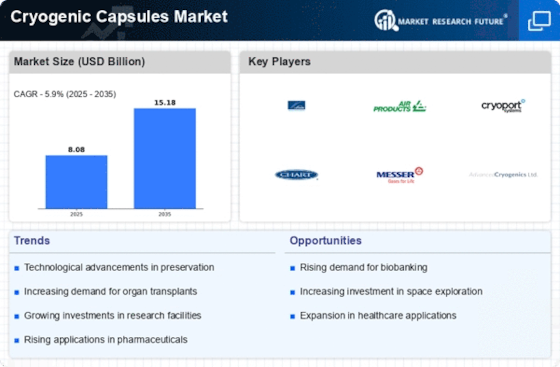
As per MRFR analysis, the Cryogenic Capsules Market Size was estimated at 8.076 USD Billion in 2024. The Cryogenic Capsules industry is projected to grow from 8.553 USD Billion in 2025 to 15.18 USD Billion by 2035, exhibiting a compound annual growth rate (CAGR) of 5.9 during the forecast period 2025 - 2035.

Key Market Trends & Highlights

The Cryogenic Capsules Market is poised for substantial growth driven by technological advancements and increasing demand across various applications.

  • Technological advancements in cryogenic systems are enhancing the efficiency and reliability of cryogenic capsules.
  • North America remains the largest market, while the Asia-Pacific region is emerging as the fastest-growing market for cryogenic solutions.
  • The polypropylene segment dominates the market, whereas the polyethylene segment is witnessing rapid growth due to its versatility.
  • Rising demand for medical applications and increasing investment in research and development are key drivers propelling market expansion.

Market Size & Forecast

2024 Market Size 8.076 (USD Billion)
2035 Market Size 15.18 (USD Billion)
CAGR (2025 - 2035) 5.9%
Largest Regional Market Share in 2024 North America

Major Players

<p>Linde plc (GB), Air Products and Chemicals, Inc. (US), Cryoport, Inc. (US), Chart Industries, Inc. (US), Messer Group GmbH (DE), Nikkiso Co., Ltd. (JP), Advanced Cryogenics, LLC (US), Cryogenmash (RU), Herose GmbH (DE)</p>

Market Trends

The Cryogenic Capsules Market is currently experiencing a notable evolution, driven by advancements in technology and increasing applications across various sectors. These capsules, designed to maintain extremely low temperatures, are essential for preserving biological samples, pharmaceuticals, and other sensitive materials. As industries recognize the importance of cryogenic preservation, the demand for innovative solutions continues to rise. This trend is further supported by the growing emphasis on research and development, particularly in the fields of biotechnology and medicine, where the need for effective storage solutions is paramount. Moreover, the market landscape is characterized by a shift towards sustainable practices. Companies are increasingly focusing on eco-friendly materials and energy-efficient technologies in the production of cryogenic capsules. This shift not only aligns with global sustainability goals but also appeals to environmentally conscious consumers. As the Cryogenic Capsules Market evolves, it appears poised for growth, with potential expansions into emerging markets and new applications that could redefine its future trajectory. The interplay of technological advancements and sustainability initiatives suggests a dynamic and promising outlook for this sector.

Technological Advancements

Recent innovations in cryogenic technology are enhancing the efficiency and effectiveness of cryogenic capsules. These advancements may lead to improved insulation materials and more reliable temperature control systems, which could significantly benefit various industries.

Sustainability Initiatives

There is a growing trend towards the adoption of sustainable practices within the Cryogenic Capsules Market. Manufacturers are increasingly focusing on eco-friendly materials and energy-efficient production processes, which may attract environmentally conscious consumers.

Expansion into Emerging Markets

The Cryogenic Capsules Market is likely to see expansion into emerging markets, driven by increasing demand for advanced storage solutions in sectors such as healthcare and biotechnology. This trend suggests a potential for growth in regions that are currently underrepresented in the market.

Cryogenic Capsules Market Market Drivers

Expansion of Biobanking Facilities

The expansion of biobanking facilities serves as a significant driver for the Cryogenic Capsules Market. Biobanks play a crucial role in the collection, storage, and distribution of biological samples for research and clinical applications. As the demand for biobanking services increases, the need for reliable cryogenic storage solutions becomes evident. The biobanking market is anticipated to grow at a compound annual growth rate of approximately 10% over the next few years, driven by the rising prevalence of chronic diseases and the need for personalized medicine. This growth is likely to propel the demand for cryogenic capsules, as biobanks require advanced storage technologies to ensure the integrity of their samples. Consequently, the Cryogenic Capsules Market is poised for substantial growth.

Rising Demand for Medical Applications

The Cryogenic Capsules Market experiences a notable surge in demand driven by advancements in medical applications. Cryogenic capsules are increasingly utilized for the preservation of biological samples, including stem cells and reproductive cells. The market for cryopreservation in healthcare is projected to reach approximately 5 billion USD by 2026, indicating a robust growth trajectory. This demand is fueled by the growing emphasis on personalized medicine and regenerative therapies, which require reliable storage solutions. As healthcare providers seek to enhance patient outcomes, the adoption of cryogenic technology becomes essential. Consequently, the Cryogenic Capsules Market is likely to witness significant expansion as medical institutions invest in advanced cryogenic storage solutions.

Technological Innovations in Cryogenic Systems

Technological innovations play a pivotal role in shaping the Cryogenic Capsules Market. Recent advancements in cryogenic technology, such as improved insulation materials and automated monitoring systems, enhance the efficiency and reliability of cryogenic storage. These innovations not only reduce energy consumption but also ensure optimal preservation conditions for sensitive biological materials. The integration of IoT and AI in cryogenic systems is expected to streamline operations and improve data management. As a result, the market is projected to grow at a compound annual growth rate of around 8% over the next five years. This trend indicates a strong inclination towards adopting cutting-edge technologies within the Cryogenic Capsules Market.

Growing Awareness of Environmental Sustainability

The Cryogenic Capsules Market is influenced by the growing awareness of environmental sustainability. As organizations strive to minimize their carbon footprint, the demand for energy-efficient cryogenic systems is on the rise. Manufacturers are increasingly focusing on developing eco-friendly cryogenic capsules that utilize sustainable materials and processes. This shift aligns with global sustainability goals and regulatory frameworks aimed at reducing environmental impact. The market for sustainable cryogenic solutions is projected to grow significantly, as companies seek to comply with environmental regulations while maintaining operational efficiency. Thus, the Cryogenic Capsules Market is likely to evolve in response to these sustainability initiatives.

Increasing Investment in Research and Development

Investment in research and development is a critical driver for the Cryogenic Capsules Market. As various sectors, including pharmaceuticals and biotechnology, prioritize innovation, the need for effective cryogenic storage solutions becomes paramount. Research institutions are increasingly focusing on cryopreservation techniques to enhance the viability of biological samples. This trend is reflected in the rising number of research projects and collaborations aimed at developing advanced cryogenic technologies. The global investment in biotechnology research is expected to exceed 300 billion USD by 2025, which will likely bolster the demand for cryogenic capsules. Consequently, the Cryogenic Capsules Market stands to benefit from this influx of funding and innovation.

Market Segment Insights

By Material: Polypropylene (Largest) vs. Polyethylene (Fastest-Growing)

<p>In the Cryogenic Capsules Market, the material segment is prominently featured by Polypropylene and Polyethylene. Polypropylene currently holds the largest share, thanks to its excellent thermal insulation properties and chemical resistance, making it suitable for cryogenic applications. Polyethylene, on the other hand, is gaining traction rapidly as industries seek flexible and lightweight materials, responding to market demand for more versatile packaging solutions in cryogenics.</p>

<p>Material: Polypropylene (Dominant) vs. Polyethylene (Emerging)</p>

<p>Polypropylene stands out as the dominant player in the Cryogenic Capsules Market due to its superior durability, resistance to thermal shock, and capacity to maintain structural integrity in extreme temperatures. Its manufacturing process is well-established, allowing for consistent quality and performance, making it a preferred choice among manufacturers. Conversely, Polyethylene is emerging as a significant force in the market, favored for its lightweight nature and adaptability to various applications. As innovations in material sciences enhance its performance, Polyethylene is becoming increasingly popular, particularly in lightweight capsule designs that require less energy for transport and handling, attracting interest from eco-conscious industries.</p>

By Capacity: 2ml to 5ml (Largest) vs. 1ml to 2ml (Fastest-Growing)

<p>In the Cryogenic Capsules Market, the capacity segment is characterized by three key ranges: 0.5ml to 1ml, 1ml to 2ml, and 2ml to 5ml. The largest market share is held by the 2ml to 5ml segment, which has gained significant traction due to its application in broader biopreservation needs. In contrast, the 1ml to 2ml segment is emerging rapidly, appealing to sectors requiring precise sample handling and storage, thereby showcasing a dynamic distribution of capacities.</p>

<p>Capacity: 2ml to 5ml (Dominant) vs. 1ml to 2ml (Emerging)</p>

<p>The 2ml to 5ml capacity range represents the dominant portion of the market, frequently sought after for its versatility in biobanking, pharmaceuticals, and clinical applications. Its ability to accommodate varying sample sizes enhances its adoption across multiple sectors. On the other hand, the 1ml to 2ml segment is recognized as the emerging choice, particularly favored in research and diagnostic labs for its efficiency in storing smaller samples. This capacity range is becoming increasingly relevant as precise applications in laboratory environments grow, making it a critical area for innovation in cryogenic technologies.</p>

By Cap Closure Type: Inner Cap (Largest) vs. Outer Cap (Fastest-Growing)

<p>In the Cryogenic Capsules Market, the Inner Cap (Internal Thread) segment holds the largest market share due to its robust sealing capabilities and superior insulation properties. This segment is preferred for applications requiring tight seals and minimized risk of leakage during transport and storage. On the other hand, the Outer Cap (External Thread) is witnessing rapid growth due to the increasing trend of lightweight and easily operable designs. As end-users seek more user-friendly products, the Outer Cap segment is rapidly gaining traction.</p>

<p>Cap Closure Type: Inner Cap (Dominant) vs. Outer Cap (Emerging)</p>

<p>The Inner Cap (Internal Thread) is characterized by its reliability and effectiveness in maintaining cryogenic conditions. This closure type excels in preventing contamination and product degradation, making it the choice for high-value substances that require stringent handling. Conversely, the Outer Cap (External Thread) is becoming popular for its innovative design that facilitates easier access and operation. Its growth is propelled by shifts towards user-centric designs, making it favorable for a broader range of applications. As the market evolves, both segments present unique benefits that cater to diverse consumer needs.</p>

Get more detailed insights about Cryogenic Capsules Market Research Report—Global Forecast till 2035

Regional Insights

North America : Innovation and Demand Surge

North America is the largest market for cryogenic capsules, holding approximately 45% of the global market share. The region's growth is driven by increasing demand in healthcare, aerospace, and energy sectors, alongside stringent regulations promoting safety and efficiency. The presence of major players like Linde plc and Air Products and Chemicals, Inc. further fuels market expansion, supported by technological advancements and rising investments in cryogenic technologies. The United States dominates the North American market, accounting for a significant portion of the demand due to its robust healthcare infrastructure and aerospace industry. Canada follows as the second-largest market, driven by its growing energy sector and investments in research and development. The competitive landscape is characterized by key players such as Cryoport, Inc. and Chart Industries, Inc., which are continuously innovating to meet the evolving needs of various industries.

Europe : Regulatory Framework and Growth

Europe is witnessing significant growth in the cryogenic capsules market, holding around 30% of the global share. The region's expansion is propelled by stringent regulations aimed at ensuring safety and efficiency in the transportation of cryogenic materials. Countries like Germany and the UK are at the forefront, with increasing investments in healthcare and energy sectors driving demand for cryogenic solutions. The European Union's focus on sustainability and innovation further catalyzes market growth. Germany is the leading country in Europe, supported by a strong industrial base and key players like Messer Group GmbH and Herose GmbH. The UK follows closely, with a growing emphasis on research and development in cryogenic technologies. The competitive landscape is marked by collaborations and partnerships among companies to enhance product offerings and meet regulatory standards. This dynamic environment fosters innovation and positions Europe as a key player in the global market.

Asia-Pacific : Rapid Growth and Investment

Asia-Pacific is rapidly emerging as a significant player in the cryogenic capsules market, holding approximately 20% of the global market share. The region's growth is driven by increasing industrialization, rising healthcare demands, and investments in energy infrastructure. Countries like China and Japan are leading the charge, with government initiatives promoting the adoption of advanced cryogenic technologies to enhance efficiency and safety in various applications. China is the largest market in the region, supported by its booming healthcare and energy sectors. Japan follows as a key player, with companies like Nikkiso Co., Ltd. leading innovations in cryogenic solutions. The competitive landscape is characterized by a mix of local and international players, fostering a dynamic environment for growth. As investments in research and development continue to rise, Asia-Pacific is poised for substantial advancements in cryogenic technologies.

Middle East and Africa : Emerging Market with Potential

The Middle East and Africa region is gradually emerging in the cryogenic capsules market, holding about 5% of the global share. The growth is primarily driven by increasing investments in healthcare and energy sectors, alongside a growing awareness of the benefits of cryogenic technologies. Countries like South Africa and the UAE are leading the way, with government initiatives aimed at enhancing infrastructure and promoting technological advancements in cryogenics. South Africa is the largest market in the region, supported by its expanding healthcare sector and energy initiatives. The UAE follows closely, with significant investments in research and development. The competitive landscape is evolving, with both local and international players entering the market to capitalize on growth opportunities. As the region continues to develop, the cryogenic capsules market is expected to witness substantial growth in the coming years.

Key Players and Competitive Insights

The Cryogenic Capsules Market is currently characterized by a dynamic competitive landscape, driven by increasing demand for advanced storage solutions in various sectors, including healthcare, aerospace, and energy. Key players such as Linde plc (GB), Air Products and Chemicals, Inc. (US), and Cryoport, Inc. (US) are strategically positioning themselves through innovation and regional expansion. Linde plc (GB) focuses on enhancing its product offerings through technological advancements, while Air Products and Chemicals, Inc. (US) emphasizes partnerships to bolster its market presence. Collectively, these strategies contribute to a competitive environment that is increasingly focused on technological differentiation and customer-centric solutions.

In terms of business tactics, companies are localizing manufacturing and optimizing supply chains to enhance operational efficiency. The market appears moderately fragmented, with several players vying for market share. However, the influence of major companies is significant, as they set industry standards and drive innovation. This competitive structure suggests that while there is room for smaller players, the dominance of established firms shapes market dynamics.

In August 2025, Cryoport, Inc. (US) announced a strategic partnership with a leading biopharmaceutical company to enhance its cryogenic logistics capabilities. This collaboration is expected to streamline the supply chain for temperature-sensitive products, thereby improving service delivery and customer satisfaction. The strategic importance of this partnership lies in its potential to position Cryoport as a leader in the biopharmaceutical logistics sector, leveraging its expertise in cryogenic technology.

In September 2025, Chart Industries, Inc. (US) unveiled a new line of cryogenic storage solutions designed for the renewable energy sector. This launch reflects the company's commitment to sustainability and innovation, as it aims to support the growing demand for clean energy technologies. The introduction of these products is likely to enhance Chart's competitive edge, aligning with global trends towards environmentally friendly solutions.

In July 2025, Messer Group GmbH (DE) expanded its operations in Asia by establishing a new manufacturing facility in China. This move is indicative of the company's strategy to tap into the rapidly growing Asian market, which is witnessing increased demand for cryogenic solutions. The establishment of local manufacturing capabilities is expected to reduce lead times and enhance service delivery, thereby strengthening Messer's market position in the region.

As of October 2025, the Cryogenic Capsules Market is witnessing trends such as digitalization, sustainability, and the integration of artificial intelligence in operations. Strategic alliances are increasingly shaping the competitive landscape, enabling companies to leverage complementary strengths. Looking ahead, competitive differentiation is likely to evolve from traditional price-based competition to a focus on innovation, technological advancements, and supply chain reliability, as companies strive to meet the demands of a rapidly changing market.

Key Companies in the Cryogenic Capsules Market market include

Industry Developments

October 2021 For the Cryogenic Double Wall Storage Tanks (DWST) and related facilities - Package 7 (Part-A) at HPCL Rajasthan Refinery Ltd in Rajasthan, India, Chemie-Tech was given an engineering, procurement, construction, and commissioning contract. 

The contract's scope includes project management, residual process design, detailed design and engineering, procurement, construction, pre-commissioning, and commissioning of an above-ground, vertical, flat-bottom double-wall storage tank (outer tank with RCC post-tension wall and inner tank 9% Ni Steel) with Packages like BOG Compressor, Ethylene Vaporisor, Propylene Heating, Glycol Makeup, and Cold-Blowdown system.

Future Outlook

Cryogenic Capsules Market Future Outlook

<p>The Cryogenic Capsules Market is projected to grow at a 5.9% CAGR from 2024 to 2035, driven by advancements in medical technology, increasing demand for preservation solutions, and expanding applications in various industries.</p>

New opportunities lie in:

  • <p>Development of advanced cryogenic storage solutions for biopharmaceuticals.</p>
  • <p>Expansion into emerging markets with tailored cryogenic services.</p>
  • <p>Integration of IoT technology for real-time monitoring of cryogenic systems.</p>

<p>By 2035, the Cryogenic Capsules Market is expected to achieve substantial growth, reflecting evolving industry needs.</p>

Market Segmentation

Cryogenic Capsules Market Capacity Outlook

  • 0.5ml to 1ml
  • 1ml to 2ml
  • 2ml to 5ml

Cryogenic Capsules Market Material Outlook

  • Polypropylene
  • Polyethylene

Cryogenic Capsules Market Cap Closure Type Outlook

  • Inner Cap (Internal Thread)
  • Outer Cap (External Thread)

Report Scope

MARKET SIZE 20248.076(USD Billion)
MARKET SIZE 20258.553(USD Billion)
MARKET SIZE 203515.18(USD Billion)
COMPOUND ANNUAL GROWTH RATE (CAGR)5.9% (2024 - 2035)
REPORT COVERAGERevenue Forecast, Competitive Landscape, Growth Factors, and Trends
BASE YEAR2024
Market Forecast Period2025 - 2035
Historical Data2019 - 2024
Market Forecast UnitsUSD Billion
Key Companies ProfiledMarket analysis in progress
Segments CoveredMarket segmentation analysis in progress
Key Market OpportunitiesAdvancements in cryogenic technology enhance storage efficiency in the Cryogenic Capsules Market.
Key Market DynamicsRising demand for advanced cryogenic capsules driven by technological innovations and increasing applications in various industries.
Countries CoveredNorth America, Europe, APAC, South America, MEA

FAQs

What is the current valuation of the Cryogenic Capsules Market?

As of 2024, the Cryogenic Capsules Market was valued at 8.076 USD Billion.

What is the projected market valuation for the Cryogenic Capsules Market in 2035?

The market is projected to reach a valuation of 15.18 USD Billion by 2035.

What is the expected CAGR for the Cryogenic Capsules Market during the forecast period 2025 - 2035?

The expected CAGR for the Cryogenic Capsules Market during the forecast period 2025 - 2035 is 5.9%.

Which companies are considered key players in the Cryogenic Capsules Market?

Key players in the market include Linde plc, Air Products and Chemicals, Inc., Cryoport, Inc., and Chart Industries, Inc.

What are the primary materials used in the Cryogenic Capsules Market?

The primary materials include polypropylene and polyethylene, with valuations of 3.5 to 6.5 USD Billion and 4.576 to 8.68 USD Billion, respectively.

How is the Cryogenic Capsules Market segmented by capacity?

The market is segmented by capacity, with values ranging from 1.5 to 3.0 USD Billion for 0.5ml to 1ml, and 4.076 to 7.18 USD Billion for 2ml to 5ml.

  1. SECTION I: EXECUTIVE SUMMARY AND KEY HIGHLIGHTS
    1. EXECUTIVE SUMMARY
      1. Market Overview
      2. Key Findings
      3. Market Segmentation
      4. Competitive Landscape
      5. Challenges and Opportunities
      6. Future Outlook
  2. SECTION II: SCOPING, METHODOLOGY AND MARKET STRUCTURE
    1. MARKET INTRODUCTION
      1. Definition
      2. Scope of the study
    2. RESEARCH METHODOLOGY
      1. Overview
      2. Data Mining
      3. Secondary Research
      4. Primary Research
      5. Forecasting Model
      6. Market Size Estimation
      7. Data Triangulation
      8. Validation
  3. SECTION III: QUALITATIVE ANALYSIS
    1. MARKET DYNAMICS
      1. Overview
      2. Drivers
      3. Restraints
      4. Opportunities
    2. MARKET FACTOR ANALYSIS
      1. Value chain Analysis
      2. Porter's Five Forces Analysis
      3. COVID-19 Impact Analysis
  4. SECTION IV: QUANTITATIVE ANALYSIS
    1. Life Sciences, BY Material (USD Billion)
      1. Polypropylene
      2. Polyethylene
    2. Life Sciences, BY Capacity (USD Billion)
      1. 0.5ml to 1ml
      2. 1ml to 2ml
      3. 2ml to 5ml
    3. Life Sciences, BY Cap Closure Type (USD Billion)
      1. Inner Cap (Internal Thread)
      2. Outer Cap (External Thread)
    4. Life Sciences, BY Region (USD Billion)
      1. North America
      2. Europe
      3. APAC
      4. South America
      5. MEA
  5. SECTION V: COMPETITIVE ANALYSIS
    1. Competitive Landscape
      1. Overview
      2. Competitive Analysis
      3. Market share Analysis
      4. Major Growth Strategy in the Life Sciences
      5. Competitive Benchmarking
      6. Leading Players in Terms of Number of Developments in the Life Sciences
      7. Key developments and growth strategies
      8. Major Players Financial Matrix
    2. Company Profiles
      1. Linde plc (GB)
      2. Air Products and Chemicals, Inc. (US)
      3. Cryoport, Inc. (US)
      4. Chart Industries, Inc. (US)
      5. Messer Group GmbH (DE)
      6. Nikkiso Co., Ltd. (JP)
      7. Advanced Cryogenics, LLC (US)
      8. Cryogenmash (RU)
      9. Herose GmbH (DE)
    3. Appendix
      1. References
      2. Related Reports
  6. LIST OF FIGURES
    1. MARKET SYNOPSIS
    2. NORTH AMERICA MARKET ANALYSIS
    3. US MARKET ANALYSIS BY MATERIAL
    4. US MARKET ANALYSIS BY CAPACITY
    5. US MARKET ANALYSIS BY CAP CLOSURE TYPE
    6. CANADA MARKET ANALYSIS BY MATERIAL
    7. CANADA MARKET ANALYSIS BY CAPACITY
    8. CANADA MARKET ANALYSIS BY CAP CLOSURE TYPE
    9. EUROPE MARKET ANALYSIS
    10. GERMANY MARKET ANALYSIS BY MATERIAL
    11. GERMANY MARKET ANALYSIS BY CAPACITY
    12. GERMANY MARKET ANALYSIS BY CAP CLOSURE TYPE
    13. UK MARKET ANALYSIS BY MATERIAL
    14. UK MARKET ANALYSIS BY CAPACITY
    15. UK MARKET ANALYSIS BY CAP CLOSURE TYPE
    16. FRANCE MARKET ANALYSIS BY MATERIAL
    17. FRANCE MARKET ANALYSIS BY CAPACITY
    18. FRANCE MARKET ANALYSIS BY CAP CLOSURE TYPE
    19. RUSSIA MARKET ANALYSIS BY MATERIAL
    20. RUSSIA MARKET ANALYSIS BY CAPACITY
    21. RUSSIA MARKET ANALYSIS BY CAP CLOSURE TYPE
    22. ITALY MARKET ANALYSIS BY MATERIAL
    23. ITALY MARKET ANALYSIS BY CAPACITY
    24. ITALY MARKET ANALYSIS BY CAP CLOSURE TYPE
    25. SPAIN MARKET ANALYSIS BY MATERIAL
    26. SPAIN MARKET ANALYSIS BY CAPACITY
    27. SPAIN MARKET ANALYSIS BY CAP CLOSURE TYPE
    28. REST OF EUROPE MARKET ANALYSIS BY MATERIAL
    29. REST OF EUROPE MARKET ANALYSIS BY CAPACITY
    30. REST OF EUROPE MARKET ANALYSIS BY CAP CLOSURE TYPE
    31. APAC MARKET ANALYSIS
    32. CHINA MARKET ANALYSIS BY MATERIAL
    33. CHINA MARKET ANALYSIS BY CAPACITY
    34. CHINA MARKET ANALYSIS BY CAP CLOSURE TYPE
    35. INDIA MARKET ANALYSIS BY MATERIAL
    36. INDIA MARKET ANALYSIS BY CAPACITY
    37. INDIA MARKET ANALYSIS BY CAP CLOSURE TYPE
    38. JAPAN MARKET ANALYSIS BY MATERIAL
    39. JAPAN MARKET ANALYSIS BY CAPACITY
    40. JAPAN MARKET ANALYSIS BY CAP CLOSURE TYPE
    41. SOUTH KOREA MARKET ANALYSIS BY MATERIAL
    42. SOUTH KOREA MARKET ANALYSIS BY CAPACITY
    43. SOUTH KOREA MARKET ANALYSIS BY CAP CLOSURE TYPE
    44. MALAYSIA MARKET ANALYSIS BY MATERIAL
    45. MALAYSIA MARKET ANALYSIS BY CAPACITY
    46. MALAYSIA MARKET ANALYSIS BY CAP CLOSURE TYPE
    47. THAILAND MARKET ANALYSIS BY MATERIAL
    48. THAILAND MARKET ANALYSIS BY CAPACITY
    49. THAILAND MARKET ANALYSIS BY CAP CLOSURE TYPE
    50. INDONESIA MARKET ANALYSIS BY MATERIAL
    51. INDONESIA MARKET ANALYSIS BY CAPACITY
    52. INDONESIA MARKET ANALYSIS BY CAP CLOSURE TYPE
    53. REST OF APAC MARKET ANALYSIS BY MATERIAL
    54. REST OF APAC MARKET ANALYSIS BY CAPACITY
    55. REST OF APAC MARKET ANALYSIS BY CAP CLOSURE TYPE
    56. SOUTH AMERICA MARKET ANALYSIS
    57. BRAZIL MARKET ANALYSIS BY MATERIAL
    58. BRAZIL MARKET ANALYSIS BY CAPACITY
    59. BRAZIL MARKET ANALYSIS BY CAP CLOSURE TYPE
    60. MEXICO MARKET ANALYSIS BY MATERIAL
    61. MEXICO MARKET ANALYSIS BY CAPACITY
    62. MEXICO MARKET ANALYSIS BY CAP CLOSURE TYPE
    63. ARGENTINA MARKET ANALYSIS BY MATERIAL
    64. ARGENTINA MARKET ANALYSIS BY CAPACITY
    65. ARGENTINA MARKET ANALYSIS BY CAP CLOSURE TYPE
    66. REST OF SOUTH AMERICA MARKET ANALYSIS BY MATERIAL
    67. REST OF SOUTH AMERICA MARKET ANALYSIS BY CAPACITY
    68. REST OF SOUTH AMERICA MARKET ANALYSIS BY CAP CLOSURE TYPE
    69. MEA MARKET ANALYSIS
    70. GCC COUNTRIES MARKET ANALYSIS BY MATERIAL
    71. GCC COUNTRIES MARKET ANALYSIS BY CAPACITY
    72. GCC COUNTRIES MARKET ANALYSIS BY CAP CLOSURE TYPE
    73. SOUTH AFRICA MARKET ANALYSIS BY MATERIAL
    74. SOUTH AFRICA MARKET ANALYSIS BY CAPACITY
    75. SOUTH AFRICA MARKET ANALYSIS BY CAP CLOSURE TYPE
    76. REST OF MEA MARKET ANALYSIS BY MATERIAL
    77. REST OF MEA MARKET ANALYSIS BY CAPACITY
    78. REST OF MEA MARKET ANALYSIS BY CAP CLOSURE TYPE
    79. KEY BUYING CRITERIA OF LIFE SCIENCES
    80. RESEARCH PROCESS OF MRFR
    81. DRO ANALYSIS OF LIFE SCIENCES
    82. DRIVERS IMPACT ANALYSIS: LIFE SCIENCES
    83. RESTRAINTS IMPACT ANALYSIS: LIFE SCIENCES
    84. SUPPLY / VALUE CHAIN: LIFE SCIENCES
    85. LIFE SCIENCES, BY MATERIAL, 2024 (% SHARE)
    86. LIFE SCIENCES, BY MATERIAL, 2024 TO 2035 (USD Billion)
    87. LIFE SCIENCES, BY CAPACITY, 2024 (% SHARE)
    88. LIFE SCIENCES, BY CAPACITY, 2024 TO 2035 (USD Billion)
    89. LIFE SCIENCES, BY CAP CLOSURE TYPE, 2024 (% SHARE)
    90. LIFE SCIENCES, BY CAP CLOSURE TYPE, 2024 TO 2035 (USD Billion)
    91. BENCHMARKING OF MAJOR COMPETITORS
  7. LIST OF TABLES
    1. LIST OF ASSUMPTIONS
    2. North America MARKET SIZE ESTIMATES; FORECAST
      1. BY MATERIAL, 2025-2035 (USD Billion)
      2. BY CAPACITY, 2025-2035 (USD Billion)
      3. BY CAP CLOSURE TYPE, 2025-2035 (USD Billion)
    3. US MARKET SIZE ESTIMATES; FORECAST
      1. BY MATERIAL, 2025-2035 (USD Billion)
      2. BY CAPACITY, 2025-2035 (USD Billion)
      3. BY CAP CLOSURE TYPE, 2025-2035 (USD Billion)
    4. Canada MARKET SIZE ESTIMATES; FORECAST
      1. BY MATERIAL, 2025-2035 (USD Billion)
      2. BY CAPACITY, 2025-2035 (USD Billion)
      3. BY CAP CLOSURE TYPE, 2025-2035 (USD Billion)
    5. Europe MARKET SIZE ESTIMATES; FORECAST
      1. BY MATERIAL, 2025-2035 (USD Billion)
      2. BY CAPACITY, 2025-2035 (USD Billion)
      3. BY CAP CLOSURE TYPE, 2025-2035 (USD Billion)
    6. Germany MARKET SIZE ESTIMATES; FORECAST
      1. BY MATERIAL, 2025-2035 (USD Billion)
      2. BY CAPACITY, 2025-2035 (USD Billion)
      3. BY CAP CLOSURE TYPE, 2025-2035 (USD Billion)
    7. UK MARKET SIZE ESTIMATES; FORECAST
      1. BY MATERIAL, 2025-2035 (USD Billion)
      2. BY CAPACITY, 2025-2035 (USD Billion)
      3. BY CAP CLOSURE TYPE, 2025-2035 (USD Billion)
    8. France MARKET SIZE ESTIMATES; FORECAST
      1. BY MATERIAL, 2025-2035 (USD Billion)
      2. BY CAPACITY, 2025-2035 (USD Billion)
      3. BY CAP CLOSURE TYPE, 2025-2035 (USD Billion)
    9. Russia MARKET SIZE ESTIMATES; FORECAST
      1. BY MATERIAL, 2025-2035 (USD Billion)
      2. BY CAPACITY, 2025-2035 (USD Billion)
      3. BY CAP CLOSURE TYPE, 2025-2035 (USD Billion)
    10. Italy MARKET SIZE ESTIMATES; FORECAST
      1. BY MATERIAL, 2025-2035 (USD Billion)
      2. BY CAPACITY, 2025-2035 (USD Billion)
      3. BY CAP CLOSURE TYPE, 2025-2035 (USD Billion)
    11. Spain MARKET SIZE ESTIMATES; FORECAST
      1. BY MATERIAL, 2025-2035 (USD Billion)
      2. BY CAPACITY, 2025-2035 (USD Billion)
      3. BY CAP CLOSURE TYPE, 2025-2035 (USD Billion)
    12. Rest of Europe MARKET SIZE ESTIMATES; FORECAST
      1. BY MATERIAL, 2025-2035 (USD Billion)
      2. BY CAPACITY, 2025-2035 (USD Billion)
      3. BY CAP CLOSURE TYPE, 2025-2035 (USD Billion)
    13. APAC MARKET SIZE ESTIMATES; FORECAST
      1. BY MATERIAL, 2025-2035 (USD Billion)
      2. BY CAPACITY, 2025-2035 (USD Billion)
      3. BY CAP CLOSURE TYPE, 2025-2035 (USD Billion)
    14. China MARKET SIZE ESTIMATES; FORECAST
      1. BY MATERIAL, 2025-2035 (USD Billion)
      2. BY CAPACITY, 2025-2035 (USD Billion)
      3. BY CAP CLOSURE TYPE, 2025-2035 (USD Billion)
    15. India MARKET SIZE ESTIMATES; FORECAST
      1. BY MATERIAL, 2025-2035 (USD Billion)
      2. BY CAPACITY, 2025-2035 (USD Billion)
      3. BY CAP CLOSURE TYPE, 2025-2035 (USD Billion)
    16. Japan MARKET SIZE ESTIMATES; FORECAST
      1. BY MATERIAL, 2025-2035 (USD Billion)
      2. BY CAPACITY, 2025-2035 (USD Billion)
      3. BY CAP CLOSURE TYPE, 2025-2035 (USD Billion)
    17. South Korea MARKET SIZE ESTIMATES; FORECAST
      1. BY MATERIAL, 2025-2035 (USD Billion)
      2. BY CAPACITY, 2025-2035 (USD Billion)
      3. BY CAP CLOSURE TYPE, 2025-2035 (USD Billion)
    18. Malaysia MARKET SIZE ESTIMATES; FORECAST
      1. BY MATERIAL, 2025-2035 (USD Billion)
      2. BY CAPACITY, 2025-2035 (USD Billion)
      3. BY CAP CLOSURE TYPE, 2025-2035 (USD Billion)
    19. Thailand MARKET SIZE ESTIMATES; FORECAST
      1. BY MATERIAL, 2025-2035 (USD Billion)
      2. BY CAPACITY, 2025-2035 (USD Billion)
      3. BY CAP CLOSURE TYPE, 2025-2035 (USD Billion)
    20. Indonesia MARKET SIZE ESTIMATES; FORECAST
      1. BY MATERIAL, 2025-2035 (USD Billion)
      2. BY CAPACITY, 2025-2035 (USD Billion)
      3. BY CAP CLOSURE TYPE, 2025-2035 (USD Billion)
    21. Rest of APAC MARKET SIZE ESTIMATES; FORECAST
      1. BY MATERIAL, 2025-2035 (USD Billion)
      2. BY CAPACITY, 2025-2035 (USD Billion)
      3. BY CAP CLOSURE TYPE, 2025-2035 (USD Billion)
    22. South America MARKET SIZE ESTIMATES; FORECAST
      1. BY MATERIAL, 2025-2035 (USD Billion)
      2. BY CAPACITY, 2025-2035 (USD Billion)
      3. BY CAP CLOSURE TYPE, 2025-2035 (USD Billion)
    23. Brazil MARKET SIZE ESTIMATES; FORECAST
      1. BY MATERIAL, 2025-2035 (USD Billion)
      2. BY CAPACITY, 2025-2035 (USD Billion)
      3. BY CAP CLOSURE TYPE, 2025-2035 (USD Billion)
    24. Mexico MARKET SIZE ESTIMATES; FORECAST
      1. BY MATERIAL, 2025-2035 (USD Billion)
      2. BY CAPACITY, 2025-2035 (USD Billion)
      3. BY CAP CLOSURE TYPE, 2025-2035 (USD Billion)
    25. Argentina MARKET SIZE ESTIMATES; FORECAST
      1. BY MATERIAL, 2025-2035 (USD Billion)
      2. BY CAPACITY, 2025-2035 (USD Billion)
      3. BY CAP CLOSURE TYPE, 2025-2035 (USD Billion)
    26. Rest of South America MARKET SIZE ESTIMATES; FORECAST
      1. BY MATERIAL, 2025-2035 (USD Billion)
      2. BY CAPACITY, 2025-2035 (USD Billion)
      3. BY CAP CLOSURE TYPE, 2025-2035 (USD Billion)
    27. MEA MARKET SIZE ESTIMATES; FORECAST
      1. BY MATERIAL, 2025-2035 (USD Billion)
      2. BY CAPACITY, 2025-2035 (USD Billion)
      3. BY CAP CLOSURE TYPE, 2025-2035 (USD Billion)
    28. GCC Countries MARKET SIZE ESTIMATES; FORECAST
      1. BY MATERIAL, 2025-2035 (USD Billion)
      2. BY CAPACITY, 2025-2035 (USD Billion)
      3. BY CAP CLOSURE TYPE, 2025-2035 (USD Billion)
    29. South Africa MARKET SIZE ESTIMATES; FORECAST
      1. BY MATERIAL, 2025-2035 (USD Billion)
      2. BY CAPACITY, 2025-2035 (USD Billion)
      3. BY CAP CLOSURE TYPE, 2025-2035 (USD Billion)
    30. Rest of MEA MARKET SIZE ESTIMATES; FORECAST
      1. BY MATERIAL, 2025-2035 (USD Billion)
      2. BY CAPACITY, 2025-2035 (USD Billion)
      3. BY CAP CLOSURE TYPE, 2025-2035 (USD Billion)
    31. PRODUCT LAUNCH/PRODUCT DEVELOPMENT/APPROVAL
    32. ACQUISITION/PARTNERSHIP

Cryogenic Capsules Market Segmentation

Cryogenic Capsules Material Outlook (USD Billion, 2024-2032)

Polypropylene

Polyethylene

Cryogenic Capsules Capacity Outlook (USD Billion, 2024-2032)

0.5ml to 1ml

1ml to 2ml

2ml to 5ml

Cryogenic Capsules Cap Closure Type Outlook (USD Billion, 2024-2032)

Inner cap (Internal thread)

Outer cap (External thread)

Cryogenic Capsules Regional Outlook (USD Billion, 2024-2032)

North America Outlook (USD Billion, 2024-2032)

Cryogenic Capsules by Material

Platform

Services

Cryogenic Capsules by Capacity

0.5ml to 1ml

1ml to 2ml

2ml to 5ml

Cryogenic Capsules by Cap Closure Type

Inner cap (Internal thread)

Outer cap (External thread)

US Outlook (USD Billion, 2024-2032)

Cryogenic Capsules by Material

Platform

Services

Cryogenic Capsules by Capacity

0.5ml to 1ml

1ml to 2ml

2ml to 5ml

Cryogenic Capsules by Cap Closure Type

Inner cap (Internal thread)

Outer cap (External thread)

Canada Outlook (USD Billion, 2024-2032)

Cryogenic Capsules by Material

Platform

Services

Cryogenic Capsules by Capacity

0.5ml to 1ml

1ml to 2ml

2ml to 5ml

Cryogenic Capsules by Cap Closure Type

Inner cap (Internal thread)

Outer cap (External thread)

Europe Outlook (USD Billion, 2024-2032)

Cryogenic Capsules by Material

Platform

Services

Cryogenic Capsules by Capacity

0.5ml to 1ml

1ml to 2ml

2ml to 5ml

Cryogenic Capsules by Cap Closure Type

Inner cap (Internal thread)

Outer cap (External thread)

Germany Outlook (USD Billion, 2024-2032)

Cryogenic Capsules by Material

Platform

Services

Cryogenic Capsules by Capacity

0.5ml to 1ml

1ml to 2ml

2ml to 5ml

Cryogenic Capsules by Cap Closure Type

Inner cap (Internal thread)

Outer cap (External thread)

France Outlook (USD Billion, 2024-2032)

Cryogenic Capsules by Material

Platform

Services

Cryogenic Capsules by Capacity

0.5ml to 1ml

1ml to 2ml

2ml to 5ml

Cryogenic Capsules by Cap Closure Type

Inner cap (Internal thread)

Outer cap (External thread)

UK Outlook (USD Billion, 2024-2032)

Cryogenic Capsules by Material

Platform

Services

Cryogenic Capsules by Capacity

0.5ml to 1ml

1ml to 2ml

2ml to 5ml

Cryogenic Capsules by Cap Closure Type

Inner cap (Internal thread)

Outer cap (External thread)

Italy Outlook (USD Billion, 2024-2032)

Cryogenic Capsules by Material

Platform

Services

Cryogenic Capsules by Capacity

0.5ml to 1ml

1ml to 2ml

2ml to 5ml

Cryogenic Capsules by Cap Closure Type

Inner cap (Internal thread)

Outer cap (External thread)

Spain Outlook (USD Billion, 2024-2032)

Cryogenic Capsules by Material

Platform

Services

Cryogenic Capsules by Capacity

0.5ml to 1ml

1ml to 2ml

2ml to 5ml

Cryogenic Capsules by Cap Closure Type

Inner cap (Internal thread)

Outer cap (External thread)

Rest Of Europe Outlook (USD Billion, 2024-2032)

Cryogenic Capsules by Material

Platform

Services

Cryogenic Capsules by Capacity

0.5ml to 1ml

1ml to 2ml

2ml to 5ml

Cryogenic Capsules by Cap Closure Type

Inner cap (Internal thread)

Outer cap (External thread)

Asia-Pacific Outlook (USD Billion, 2024-2032)

Cryogenic Capsules by Material

Platform

Services

Cryogenic Capsules by Capacity

0.5ml to 1ml

1ml to 2ml

2ml to 5ml

Cryogenic Capsules by Cap Closure Type

Inner cap (Internal thread)

Outer cap (External thread)

China Outlook (USD Billion, 2024-2032)

Cryogenic Capsules by Material

Platform

Services

Cryogenic Capsules by Capacity

0.5ml to 1ml

1ml to 2ml

2ml to 5ml

Cryogenic Capsules by Cap Closure Type

Inner cap (Internal thread)

Outer cap (External thread)

Japan Outlook (USD Billion, 2024-2032)

Cryogenic Capsules by Material

Platform

Services

Cryogenic Capsules by Capacity

0.5ml to 1ml

1ml to 2ml

2ml to 5ml

Cryogenic Capsules by Cap Closure Type

Inner cap (Internal thread)

Outer cap (External thread)

India Outlook (USD Billion, 2024-2032)

Cryogenic Capsules by Material

Platform

Services

Cryogenic Capsules by Capacity

0.5ml to 1ml

1ml to 2ml

2ml to 5ml

Cryogenic Capsules by Cap Closure Type

Inner cap (Internal thread)

Outer cap (External thread)

Australia Outlook (USD Billion, 2024-2032)

Cryogenic Capsules by Material

Platform

Services

Cryogenic Capsules by Capacity

0.5ml to 1ml

1ml to 2ml

2ml to 5ml

Cryogenic Capsules by Cap Closure Type

Inner cap (Internal thread)

Outer cap (External thread)

Rest of Asia-Pacific Outlook (USD Billion, 2024-2032)

Cryogenic Capsules by Material

Platform

Services

Cryogenic Capsules by Capacity

0.5ml to 1ml

1ml to 2ml

2ml to 5ml

Cryogenic Capsules by Cap Closure Type

Inner cap (Internal thread)

Outer cap (External thread)

Rest of the World Outlook (USD Billion, 2024-2032)

Cryogenic Capsules by Material

Platform

Services

Cryogenic Capsules by Capacity

0.5ml to 1ml

1ml to 2ml

2ml to 5ml

Cryogenic Capsules by Cap Closure Type

Inner cap (Internal thread)

Outer cap (External thread)

Middle East Outlook (USD Billion, 2024-2032)

Cryogenic Capsules by Material

Platform

Services

Cryogenic Capsules by Capacity

0.5ml to 1ml

1ml to 2ml

2ml to 5ml

Cryogenic Capsules by Cap Closure Type

Inner cap (Internal thread)

Outer cap (External thread)

Africa Outlook (USD Billion, 2024-2032)

Cryogenic Capsules by Material

Platform

Services

Cryogenic Capsules by Capacity

0.5ml to 1ml

1ml to 2ml

2ml to 5ml

Cryogenic Capsules by Cap Closure Type

Inner cap (Internal thread)

Outer cap (External thread)

Latin America Outlook (USD Billion, 2024-2032)

Cryogenic Capsules by Material

Platform

Services

Cryogenic Capsules by Capacity

0.5ml to 1ml

1ml to 2ml

2ml to 5ml

Cryogenic Capsules by Cap Closure Type

Inner cap (Internal thread)

Outer cap (External thread)


Infographic

Free Sample Request

Kindly complete the form below to receive a free sample of this Report

Get Free Sample

Customer Strories

Compare Licence

×
Features License Type
Single User Multiuser License Enterprise User
Price $4,950 $5,950 $7,250
Maximum User Access Limit 1 User Upto 10 Users Unrestricted Access Throughout the Organization
Free Customization
Direct Access to Analyst
Deliverable Format
Platform Access
Discount on Next Purchase 10% 15% 15%
Printable Versions