×
Request Free Sample ×

Kindly complete the form below to receive a free sample of this Report

* Please use a valid business email

Leading companies partner with us for data-driven Insights

clients tt-cursor
Hero Background
English
Chinese
French
Japanese
Korean
German
Spanish

Corneal Cross Linking Devices Market Trends

ID: MRFR/HC/9436-CR
166 Pages
Kinjoll Dey
September 2022

Corneal Cross linking Devices Market Research Report Information by Type (Standard Corneal Cross-Linking, Corneal Cross-Linking Plus, and Accelerated Cross-Linking), Method (Epithelium-off Method and Epithelium-on Method), Application (Keratoconus, Pellucid Marginal Degeneration, Refractive Surgery Ectasia, and Others), End User (Hospitals, Eye Clinics, and Ambulatory Surgical Centers) and Region (North America, Europe, Asia-Pacific, and Rest of the World)—Forecast till 2035

Share:
Download PDF ×

We do not share your information with anyone. However, we may send you emails based on your report interest from time to time. You may contact us at any time to opt-out.

Corneal Cross Linking Devices Market Infographic
×
Corneal Cross Linking Devices Market Infographic Full View
Purchase Options

Market Trends

Key Emerging Trends in the Corneal Cross Linking Devices Market

The global market for Corneal Cross-linking (CXL) devices is poised for growth, primarily fueled by the rising incidence and prevalence of keratoconus disorders on a global scale and advancements in healthcare infrastructure. However, this growth may face hindrances due to challenges such as a lack of awareness and potential side effects associated with the treatment. Conversely, opportunities for substantial growth exist in the market through ongoing product development and launches.

The escalating prevalence of keratoconus disorders worldwide stands out as a significant driver for the growth of the Corneal Cross-linking (CXL) devices market. A meta-analysis study conducted by Hashemi et al, funded by the Noor Research Center for Ophthalmic Epidemiology, revealed that the prevalence of keratoconus in the entire population was 1.38 per 1000 population. This suggests a noteworthy occurrence of keratoconus, and recent years have witnessed a surge in reported cases of this disorder. Notably, variations in prevalence are observed among populations due to environmental factors and ethnic differences.

Geographical locations characterized by abundant sunshine and hot weather, such as India and the Middle East, are expected to exhibit higher prevalence rates compared to regions with cooler climates and less sunshine, like Finland, Denmark, Japan, and other colder countries. This geographical distinction is linked to the environmental conditions that may contribute to the development of keratoconus. Additionally, numerous studies indicate a higher prevalence among Asian subjects compared to white Caucasians. As these trends persist, the increasing prevalence of keratoconus disorders is projected to be a sustained driver for the growth of the Corneal Cross-linking (CXL) devices market.

However, despite the positive momentum, challenges exist that may impede the global Corneal Cross-linking (CXL) devices market. One such challenge is the lack of awareness about keratoconus disorders and the treatment options available. Addressing this issue requires concerted efforts in education and awareness campaigns to ensure timely diagnosis and treatment. Moreover, potential side effects associated with corneal crosslinking procedures are a concern that needs to be effectively communicated to both healthcare providers and patients.

On a positive note, the global market presents growth opportunities through continuous product development and launches. As technology and medical science progress, the introduction of innovative devices and procedures enhances the effectiveness of corneal crosslinking, making it a more appealing option for healthcare professionals and patients alike. This innovation-driven approach is expected to create a conducive environment for the Corneal Cross-linking (CXL) devices market, allowing for sustained growth and the provision of advanced treatment options.
Author
Kinjoll Dey
Research Analyst Level I

He is an extremely curious individual currently working in Healthcare and Medical Devices Domain. Kinjoll is comfortably versed in data centric research backed by healthcare educational background. He leverages extensive data mining and analytics tools such as Primary and Secondary Research, Statistical Analysis, Machine Learning, Data Modelling. His key role also involves Technical Sales Support, Client Interaction and Project management within the Healthcare team. Lastly, he showcases extensive affinity towards learning new skills and remain fascinated in implementing them.

Leave a Comment

FAQs

How Big is the Corneal Cross linking Devices market?

The global corneal cross linking devices market is anticipated to reach USD 0.45 Billion at a CAGR of 13.25% by 2032

Who are the key players in the market of Corneal Cross linking Devices?

Glaukos Corporation (US), EMAGine AG (Switzerland), Peschke GmbH (Switzerland), IROMED GROUP Srl (Italy), iVIS Technologies (Italy), and AJL Ophthalmic S.A. (Spain) are the key players in the market of Corneal Cross linking Devices.

Which region is predicted to lead the market of Corneal Cross linking Devices?

North America is predicted to lead the market of Corneal Cross linking Devices.

What is the major market driver of Corneal Cross linking Devices?

Increasing prevalence of keratoconus disorders and Improving healthcare infrastructure are the major market driver of Corneal Cross linking Devices.

Which factors may limit the market growth of Corneal Cross linking Devices?

Lack of awareness regarding keratoconus disorders and Side effects associated with treatment are the factors may limit the market growth.

Market Summary

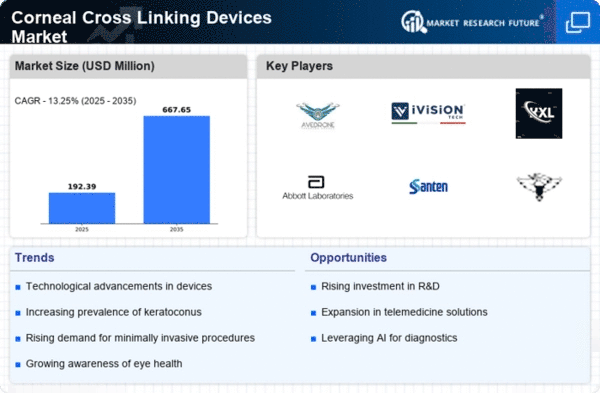
As per MRFR analysis, the Corneal Cross Linking Devices Market Summary was estimated at 169.88 USD Million in 2024. The Corneal Cross Linking Devices industry is projected to grow from 192.38 in 2025 to 667.65 by 2035, exhibiting a compound annual growth rate (CAGR) of 13.25 during the forecast period 2025 - 2035.

Key Market Trends & Highlights

The Corneal Cross Linking Devices Market is poised for substantial growth driven by technological advancements and increasing awareness.

  • Technological advancements are enhancing the efficacy and safety of corneal cross linking procedures.
  • North America remains the largest market, while Asia-Pacific is emerging as the fastest-growing region in this sector.
  • Keratoconus is the largest segment, whereas corneal ectasia is witnessing the fastest growth in demand.
  • Rising prevalence of keratoconus and technological innovations in device design are key drivers propelling market expansion.

Market Size & Forecast

2024 Market Size 169.88 (USD Million)
2035 Market Size 667.65 (USD Million)
CAGR (2025 - 2035) 13.25%
Largest Regional Market Share in 2024 North America

Major Players

Avedro (US), iVision Technologies (US), KXL (DE), Bausch + Lomb (US), Abbott (US), Santen Pharmaceutical (JP), Eagle Vision (US), OptoVue (US)

Market Trends

The Corneal Cross Linking Devices Market is currently experiencing a notable evolution, driven by advancements in technology and an increasing prevalence of corneal diseases. This market appears to be characterized by a growing demand for effective treatment options for conditions such as keratoconus and corneal ectasia. As healthcare providers seek to enhance patient outcomes, the integration of innovative devices and techniques is becoming more prevalent. Furthermore, the rising awareness of eye health and the importance of early intervention may contribute to the expansion of this market. The ongoing research and development efforts in this field suggest a promising future for corneal cross linking technologies. In addition, the Corneal Cross Linking Devices Market seems to be influenced by a shift towards minimally invasive procedures. Surgeons and patients alike appear to favor techniques that reduce recovery time and improve overall comfort. This trend may lead to the introduction of new devices that offer enhanced precision and efficacy. Moreover, collaborations between manufacturers and healthcare institutions could foster the development of advanced solutions tailored to meet the specific needs of patients. Overall, the market is poised for growth, with various factors indicating a robust trajectory in the coming years.

Technological Advancements

The Corneal Cross Linking Devices Market is witnessing a surge in technological innovations. New devices are being developed that enhance the precision and effectiveness of cross linking procedures. These advancements may lead to improved patient outcomes and increased adoption rates among healthcare providers.

Minimally Invasive Techniques

There is a noticeable trend towards minimally invasive procedures within the Corneal Cross Linking Devices Market. Patients and surgeons are increasingly favoring techniques that promise quicker recovery times and reduced discomfort, potentially driving demand for new device offerings.

Collaborative Research Initiatives

Collaborations between device manufacturers and healthcare institutions are becoming more common in the Corneal Cross Linking Devices Market. Such partnerships may facilitate the development of tailored solutions that address specific patient needs, thereby enhancing treatment efficacy and market growth.

Corneal Cross Linking Devices Market Market Drivers

Market Growth Projections

The Global Corneal Cross Linking Devices Market Industry is projected to experience substantial growth in the coming years. With a current valuation of 0.17 USD Billion in 2024, the market is anticipated to expand significantly, reaching an estimated 0.65 USD Billion by 2035. This growth trajectory indicates a compound annual growth rate of 13.02% from 2025 to 2035. Factors contributing to this growth include increasing prevalence of keratoconus, technological advancements, and rising awareness among patients and healthcare providers. The market's expansion reflects a broader trend towards improved eye care and treatment options.

Rising Geriatric Population

The global increase in the geriatric population correlates with a higher prevalence of eye disorders, thereby influencing the Global Corneal Cross Linking Devices Market Industry. Older adults are more susceptible to conditions like keratoconus, necessitating effective treatment options. As the population aged 65 and above continues to grow, the demand for corneal cross linking devices is expected to rise. This demographic shift is likely to drive market growth, with projections indicating a market size of 0.65 USD Billion by 2035. The aging population underscores the need for innovative solutions to address age-related eye conditions.

Growing Awareness and Education

Increased awareness and educational initiatives regarding corneal diseases and their treatments significantly impact the Global Corneal Cross Linking Devices Market Industry. Healthcare organizations and advocacy groups are actively promoting knowledge about keratoconus and the benefits of corneal cross linking. This heightened awareness leads to early diagnosis and treatment, which is crucial for effective management of the condition. As a result, more patients are likely to seek out these procedures, contributing to market growth. The industry is expected to see a valuation of 0.17 USD Billion in 2024, with a potential increase as educational efforts continue to expand.

Regulatory Support and Approvals

Supportive regulatory frameworks and timely approvals for corneal cross linking devices play a crucial role in the Global Corneal Cross Linking Devices Market Industry. Regulatory bodies are increasingly recognizing the importance of these devices in treating keratoconus and other corneal disorders. Streamlined approval processes facilitate quicker market entry for new technologies, encouraging manufacturers to innovate. This regulatory environment fosters competition and enhances patient access to advanced treatment options. As a result, the market is poised for growth, with expectations of reaching 0.65 USD Billion by 2035.

Increasing Prevalence of Keratoconus

The rising incidence of keratoconus globally drives demand for corneal cross linking devices. Keratoconus, a progressive eye disease, affects approximately 1 in 2,000 individuals, leading to significant visual impairment. As awareness of this condition grows, more patients seek treatment options, thereby propelling the Global Corneal Cross Linking Devices Market Industry. In 2024, the market is valued at 0.17 USD Billion, reflecting the urgent need for effective interventions. The increasing prevalence of keratoconus is expected to contribute to a compound annual growth rate of 13.02% from 2025 to 2035, potentially reaching 0.65 USD Billion by 2035.

Technological Advancements in Treatment

Innovations in corneal cross linking technology enhance treatment efficacy and safety, thereby boosting the Global Corneal Cross Linking Devices Market Industry. Newer devices utilize advanced techniques such as accelerated cross linking, which reduces treatment time and improves patient comfort. These advancements not only attract more healthcare providers but also encourage patients to opt for these procedures. As technology continues to evolve, the market is likely to expand, with a projected valuation of 0.65 USD Billion by 2035. The integration of artificial intelligence in treatment planning further indicates a promising future for the industry.

Market Segment Insights

By Application: Keratoconus (Largest) vs. Corneal Ectasia (Fastest-Growing)

In the corneal cross linking devices market, the application segment is primarily dominated by keratoconus, which holds a significant share due to the rising prevalence of this condition. Corneal ectasia follows, gaining traction as awareness and diagnosis of this ailment improve among practitioners and patients alike, although it accounts for a smaller portion of the total market. Post-refractive surgery applications are also noteworthy, yet they do not command the same attention as the leading applications. Other applications represent a diverse category with various niche uses, though they collectively possess a minimal market share.

Condition: Keratoconus (Dominant) vs. Corneal Ectasia (Emerging)

Keratoconus is identified as the dominant application segment, driven by a significant number of diagnosed cases and established treatment protocols. This condition often leads to progressive vision impairment, necessitating effective management and intervention strategies, making keratoconus an essential focus for corneal cross linking technologies. On the other hand, corneal ectasia is an emerging application, witnessing rapid growth as awareness increases and more patients seek corrective procedures post-refractive surgeries. The growing demand for effective treatments and the introduction of innovative cross-linking techniques are propelling the adoption of devices in this market, spurring future growth prospects.

By Device Type: UV Light Devices (Largest) vs. Combined Devices (Fastest-Growing)

The 'Device Type' segment of the Corneal Cross Linking Devices Market showcases a diversified array of offerings, prominently featuring UV Light Devices and Riboflavin Solutions. UV Light Devices represent the largest share, driven by their efficacy in treating keratoconus and other corneal conditions. Meanwhile, Combined Devices are rapidly gaining traction, presenting an innovative approach by integrating both UV light and riboflavin solutions, thereby appealing to a broader audience seeking enhanced treatment options.

UV Light Devices (Dominant) vs. Combined Devices (Emerging)

UV Light Devices are recognized as the cornerstone of the Corneal Cross Linking Devices Market, boasting a robust presence due to their established clinical efficacy. These devices primarily utilize ultraviolet light in conjunction with riboflavin to achieve optimal corneal strengthening results. On the other hand, Combined Devices have emerged as a compelling trend, marrying the functionality of UV Light Devices with riboflavin solutions, thus streamlining procedures and reducing treatment times. The growing preference for minimally invasive, dual-action treatments is propelling Combined Devices into the spotlight, catering to an evolving market that increasingly favors comprehensive solutions.

By End User: Hospitals (Largest) vs. Ophthalmology Clinics (Fastest-Growing)

In the Corneal Cross Linking Devices Market, hospitals hold the largest share among end users, primarily due to their extensive resources and capabilities in providing comprehensive eye care. They have the infrastructure to invest in advanced technologies, which translates into higher patient volumes and a robust demand for corneal cross-linking procedures. Meanwhile, ophthalmology clinics, while smaller in share compared to hospitals, are the fastest-growing segment. This growth is driven by the increasing prevalence of corneal diseases and a rising awareness of eye health among patients seeking specialized care in these clinics.

Hospitals (Dominant) vs. Ambulatory Surgical Centers (Emerging)

Hospitals are the dominant players in the Corneal Cross Linking Devices Market, leveraging significant resources, advanced technologies, and a wide range of services to attract and treat patients. Their ability to integrate corneal cross-linking treatments into broader ophthalmic care, combined with a large patient base, enhances their position in the market. In contrast, ambulatory surgical centers are emerging as a competitive segment, focusing on outpatient procedures to provide efficient and cost-effective eye care. These centers offer convenience and shorter wait times, appealing to patients who prefer swift and less invasive treatment options. As more patients shift to outpatient care, ambulatory surgical centers are likely to witness accelerated growth and an increasing share in the market.

By Technology: Standard Cross Linking (Largest) vs. Accelerated Cross Linking (Fastest-Growing)

The Corneal Cross Linking Devices Market is prominently characterized by four main technologies: Standard Cross Linking, Accelerated Cross Linking, Trans-epithelial Cross Linking, and Other Technologies. Among these segments, Standard Cross Linking holds the majority market share, due to its established efficacy and widespread adoption in clinical practices. However, Accelerated Cross Linking is quickly gaining traction as an innovative alternative, resulting in heightened competitive dynamics within the market.

Technology: Standard Cross Linking (Dominant) vs. Accelerated Cross Linking (Emerging)

Standard Cross Linking is a well-established and dominant technology within the Corneal Cross Linking Devices Market, known for its reliable outcomes in treating keratoconus and other corneal disorders. Its long-standing presence ensures that many healthcare providers prefer it for its proven safety and effectiveness. In contrast, Accelerated Cross Linking is an emerging technology that promises to reduce treatment time and enhance patient comfort, making it an attractive option for both practitioners and patients. This technology utilizes higher UV light exposure, which could lead to quicker recovery times, captivating the interest of a growing market segment looking for innovative solutions.

Get more detailed insights about Corneal Cross Linking Devices Market Research Report—Global Forecast till 2035

Regional Insights

North America : Market Leader in Innovation

North America is poised to maintain its leadership in the Corneal Cross Linking Devices Market, holding a significant market share of 85.0% as of 2024. The region's growth is driven by increasing prevalence of keratoconus, advancements in technology, and supportive regulatory frameworks. The demand for minimally invasive procedures is also on the rise, further propelling market expansion. Regulatory bodies are actively promoting innovations that enhance patient outcomes, contributing to a robust market environment. The competitive landscape in North America is characterized by the presence of key players such as Avedro, Bausch + Lomb, and Abbott. These companies are at the forefront of technological advancements, offering a range of innovative products that cater to diverse patient needs. The U.S. remains the largest market, supported by a well-established healthcare infrastructure and high healthcare expenditure. This competitive edge is expected to drive further growth in the coming years.

Europe : Emerging Market with Growth Potential

Europe is witnessing a growing demand for Corneal Cross Linking Devices, with a market size of €50.0 million. The region's growth is fueled by increasing awareness of eye health, rising incidences of corneal diseases, and favorable regulatory conditions. The European Medicines Agency (EMA) has been instrumental in streamlining the approval processes for innovative medical devices, thereby enhancing market accessibility. This regulatory support is expected to drive further investments in research and development, fostering innovation in the sector. Leading countries in Europe include Germany, France, and the UK, which are home to several prominent manufacturers and distributors. The competitive landscape is marked by the presence of companies like KXL and Santen Pharmaceutical, which are actively expanding their product offerings. The collaboration between healthcare providers and manufacturers is also strengthening the market, ensuring that patients have access to the latest technologies and treatments. This synergy is crucial for sustaining growth in the European market.

Asia-Pacific : Rapidly Growing Market Segment

The Asia-Pacific region is emerging as a significant player in the Corneal Cross Linking Devices Market, with a market size of $30.0 million. The growth is driven by increasing healthcare expenditure, rising awareness of eye health, and a growing aging population. Countries like Japan and Australia are leading the charge, supported by advancements in medical technology and a focus on improving patient outcomes. The demand for effective treatments for corneal diseases is on the rise, further propelling market growth. In this region, key players such as Santen Pharmaceutical and Eagle Vision are making substantial investments to expand their market presence. The competitive landscape is evolving, with local manufacturers also entering the market, enhancing competition. The collaboration between government bodies and private sectors is crucial for fostering innovation and ensuring that patients have access to the latest treatment options. This dynamic environment is expected to drive sustained growth in the Asia-Pacific market.

Middle East and Africa : Emerging Market with Challenges

The Middle East and Africa region is gradually developing its Corneal Cross Linking Devices Market, currently valued at $4.88 million. The growth is primarily driven by increasing awareness of eye health and the rising prevalence of corneal diseases. However, the market faces challenges such as limited access to advanced medical technologies and varying regulatory frameworks across countries. Efforts are being made to improve healthcare infrastructure, which is essential for market growth in this region. Countries like South Africa and the UAE are leading the market, with a growing number of healthcare facilities adopting advanced treatment options. The competitive landscape is characterized by a mix of local and international players, striving to enhance their market presence. Collaboration between governments and healthcare providers is crucial for overcoming existing challenges and ensuring that patients have access to effective treatments. This collaborative approach is expected to foster growth in the Middle East and Africa market.

Key Players and Competitive Insights

The Corneal Cross Linking Devices Market is currently characterized by a dynamic competitive landscape, driven by technological advancements and increasing prevalence of corneal diseases. Key players such as Avedro (US), Bausch + Lomb (US), and Santen Pharmaceutical (JP) are strategically positioned to leverage innovation and expand their market presence. Avedro (US) has focused on enhancing its product portfolio through continuous research and development, while Bausch + Lomb (US) emphasizes strategic partnerships to bolster its distribution channels. Santen Pharmaceutical (JP) appears to be concentrating on regional expansion, particularly in Asia, to tap into emerging markets. Collectively, these strategies contribute to a competitive environment that is increasingly shaped by innovation and collaboration.In terms of business tactics, companies are localizing manufacturing and optimizing supply chains to enhance operational efficiency. The market structure is moderately fragmented, with several players vying for market share. This fragmentation allows for a diverse range of products and services, although the influence of key players remains significant in shaping market trends and consumer preferences.In November 2025, Avedro (US) announced the launch of a new advanced corneal cross-linking device that integrates AI technology to improve treatment outcomes. This strategic move not only positions Avedro (US) as a leader in innovation but also reflects a broader trend towards the integration of technology in medical devices, potentially enhancing patient care and operational efficiency.In October 2025, Bausch + Lomb (US) entered into a strategic partnership with a leading telemedicine provider to facilitate remote consultations for patients requiring corneal cross-linking procedures. This collaboration is indicative of a growing trend towards digital health solutions, which may enhance patient access to care and streamline the treatment process, thereby improving overall patient satisfaction.In September 2025, Santen Pharmaceutical (JP) expanded its manufacturing capabilities in Southeast Asia, aiming to meet the rising demand for corneal cross-linking devices in the region. This expansion not only signifies Santen's commitment to regional growth but also highlights the increasing importance of localized production in ensuring supply chain reliability and responsiveness to market needs.As of December 2025, current competitive trends in the Corneal Cross Linking Devices Market are increasingly defined by digitalization, sustainability, and the integration of AI technologies. Strategic alliances are becoming more prevalent, as companies recognize the value of collaboration in enhancing their competitive edge. Looking ahead, it is likely that competitive differentiation will evolve from traditional price-based competition to a focus on innovation, technological advancements, and supply chain reliability, thereby reshaping the market landscape.

Key Companies in the Corneal Cross Linking Devices Market include

Industry Developments

    • In November 2019, Glaukos Corporation acquired Avedro, Inc. (US) to support its new corneal health franchise. This acquisition brought together two highly complementary hybrid pharmaceutical and device organizations. In addition, Avedro's innovative bio-activated pharmaceutical solutions and R&D capabilities combined with Glaukos' global commercial scale for corneal cross-linking products.
    • In October 2019, A partnership between SERVImed Industrial S.p.A. (Italy), distributor of IROMED GROUP Srl and TECHLens (Poland) aimed to develop a combination product to treat keratoconus. The final product will combine IROMED GROUP Srl transepithelial Ribocross riboflavin formulation with the CXLens cross-linking system for corneal remodelling from TECLens. The market for CXL devices is benefiting as a result.

Future Outlook

Corneal Cross Linking Devices Market Future Outlook

The Corneal Cross Linking Devices Market is projected to grow at a 13.25% CAGR from 2024 to 2035, driven by technological advancements, increasing prevalence of keratoconus, and rising awareness of eye health.

New opportunities lie in:

  • Development of portable cross-linking devices for outpatient settings.
  • Expansion into emerging markets with tailored pricing strategies.
  • Partnerships with ophthalmology clinics for integrated service offerings.

By 2035, the market is expected to achieve substantial growth, solidifying its position as a leader in ophthalmic technologies.

Market Segmentation

Corneal Cross Linking Devices Market End User Outlook

  • Hospitals
  • Ophthalmology Clinics
  • Ambulatory Surgical Centers
  • Other End Users

Corneal Cross Linking Devices Market Technology Outlook

  • Standard Cross Linking
  • Accelerated Cross Linking
  • Trans-epithelial Cross Linking
  • Other Technologies

Corneal Cross Linking Devices Market Application Outlook

  • Keratoconus
  • Corneal Ectasia
  • Post-Refractive Surgery
  • Other Applications

Corneal Cross Linking Devices Market Device Type Outlook

  • UV Light Devices
  • Riboflavin Solutions
  • Combined Devices
  • Other Device Types

Report Scope

MARKET SIZE 2024169.88(USD Million)
MARKET SIZE 2025192.38(USD Million)
MARKET SIZE 2035667.65(USD Million)
COMPOUND ANNUAL GROWTH RATE (CAGR)13.25% (2025 - 2035)
REPORT COVERAGERevenue Forecast, Competitive Landscape, Growth Factors, and Trends
BASE YEAR2024
Market Forecast Period2025 - 2035
Historical Data2019 - 2024
Market Forecast UnitsUSD Million
Key Companies ProfiledAvedro (US), iVision Technologies (US), KXL (DE), Bausch + Lomb (US), Abbott (US), Santen Pharmaceutical (JP), Eagle Vision (US), OptoVue (US)
Segments CoveredApplication, Device Type, End User, Technology
Key Market OpportunitiesAdvancements in minimally invasive techniques enhance growth potential in the Corneal Cross Linking Devices Market.
Key Market DynamicsTechnological advancements and regulatory changes drive innovation and competition in the corneal cross linking devices market.
Countries CoveredNorth America, Europe, APAC, South America, MEA

FAQs

How Big is the Corneal Cross linking Devices market?

The global corneal cross linking devices market is anticipated to reach USD 0.45 Billion at a CAGR of 13.25% by 2032

Who are the key players in the market of Corneal Cross linking Devices?

Glaukos Corporation (US), EMAGine AG (Switzerland), Peschke GmbH (Switzerland), IROMED GROUP Srl (Italy), iVIS Technologies (Italy), and AJL Ophthalmic S.A. (Spain) are the key players in the market of Corneal Cross linking Devices.

Which region is predicted to lead the market of Corneal Cross linking Devices?

North America is predicted to lead the market of Corneal Cross linking Devices.

What is the major market driver of Corneal Cross linking Devices?

Increasing prevalence of keratoconus disorders and Improving healthcare infrastructure are the major market driver of Corneal Cross linking Devices.

Which factors may limit the market growth of Corneal Cross linking Devices?

Lack of awareness regarding keratoconus disorders and Side effects associated with treatment are the factors may limit the market growth.

  1. SECTION I: EXECUTIVE SUMMARY AND KEY HIGHLIGHTS
    1. | 1.1 EXECUTIVE SUMMARY
  2. SECTION II: SCOPING, METHODOLOGY AND MARKET STRUCTURE
    1. | 2.1 MARKET INTRODUCTION
    2. | 2.2 RESEARCH METHODOLOGY
  3. SECTION III: QUALITATIVE ANALYSIS
    1. | 3.1 MARKET DYNAMICS
    2. | 3.2 MARKET FACTOR ANALYSIS
  4. SECTION IV: QUANTITATIVE ANALYSIS
    1. | 4.1 Healthcare, BY Application (USD Million)
    2. | 4.2 Healthcare, BY Device Type (USD Million)
    3. | 4.3 Healthcare, BY End User (USD Million)
    4. | 4.4 Healthcare, BY Technology (USD Million)
    5. | 4.5 Healthcare, BY Region (USD Million)
  5. SECTION V: COMPETITIVE ANALYSIS
    1. | 5.1 Competitive Landscape
    2. | 5.2 Company Profiles
    3. | 5.3 Appendix

Corneal Cross Linking Devices Market Segmentation

Market Segmentation Overview

  • Detailed segmentation data will be available in the full report
  • Comprehensive analysis by multiple parameters
  • Regional and country-level breakdowns
  • Market size forecasts by segment
Infographic

Free Sample Request

Kindly complete the form below to receive a free sample of this Report

Get Free Sample

Customer Strories

Compare Licence

×
Features License Type
Single User Multiuser License Enterprise User
Price $4,950 $5,950 $7,250
Maximum User Access Limit 1 User Upto 10 Users Unrestricted Access Throughout the Organization
Free Customization
Direct Access to Analyst
Deliverable Format
Platform Access
Discount on Next Purchase 10% 15% 15%
Printable Versions