Cooling Towers Market Share
Cooling Tower Market Research Report Information by Type (Evaporative Cooling Tower, Dry Cooling Tower, Hybrid Cooling Tower), by Design (Mechanical Draft, Natural Draft), by Material (Concrete, Steel, FRP, Wood, HDPE), by Application (Power Generation, HVACR, Food & Beverage, Chemical, Petrochemical and Oil & Gas, and Others), by Flow Type (Crossflow, Counterflow), By Technology (Open Circuits, Close Circuits, Hybrid circuits) and by Region –Market Forecast Till 2035
FAQs
What is the current valuation of the Cooling Tower Market as of 2024?
<p>The Cooling Tower Market was valued at 4009.54 USD Million in 2024.</p>
What is the projected market valuation for the Cooling Tower Market in 2035?
<p>The market is projected to reach a valuation of 6729.63 USD Million by 2035.</p>
What is the expected CAGR for the Cooling Tower Market during the forecast period 2025 - 2035?
<p>The expected CAGR for the Cooling Tower Market during the forecast period 2025 - 2035 is 4.82%.</p>
Which companies are considered key players in the Cooling Tower Market?
<p>Key players in the Cooling Tower Market include SPX Cooling Technologies, Baltimore Air Coil, Evapco, and Trane, among others.</p>
What are the main types of cooling towers and their market valuations?
<p>The main types include Evaporative Cooling Towers valued between 2000.0 and 3500.0 USD Million, Dry Cooling Towers between 1200.0 and 2200.0 USD Million, and Hybrid Cooling Towers between 809.54 and 1029.63 USD Million.</p>
How does the design segment of the Cooling Tower Market perform?
<p>The Mechanical Draft design segment is valued between 2000.0 and 3500.0 USD Million, while the Natural Draft segment ranges from 2009.54 to 3229.63 USD Million.</p>
What materials are predominantly used in the construction of cooling towers?
The materials include Concrete valued between 1000.0 and 1700.0 USD Million, Steel between 1200.0 and 2000.0 USD Million, and FRP between 800.0 and 1300.0 USD Million.
Which applications are driving demand in the Cooling Tower Market?
Key applications include Power Generation valued between 1000.0 and 1700.0 USD Million and HVACR between 800.0 and 1300.0 USD Million.
What flow types are prevalent in the Cooling Tower Market?
The prevalent flow types are Crossflow, valued between 2004.77 and 3350.0 USD Million, and Counterflow, ranging from 2004.77 to 3379.63 USD Million.
What technologies are utilized in the Cooling Tower Market?
The market features Open Circuits valued between 1603.81 and 2720.0 USD Million and Close Circuits between 1202.86 and 2040.0 USD Million.
Market Summary
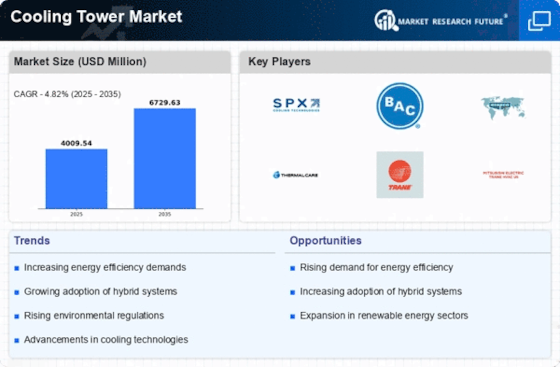
As per Market Research Future analysis, the Cooling Tower Market Size was estimated at 4009.54 USD Million in 2024. The Cooling Tower industry is projected to grow from 4202.81 USD Million in 2025 to 6729.63 USD Million by 2035, exhibiting a compound annual growth rate (CAGR) of 4.82% during the forecast period 2025 - 2035
Key Market Trends & Highlights
The Cooling Tower Market is experiencing a transformative shift towards sustainability and technological integration.
- North America remains the largest market for cooling towers, driven by industrial growth and energy efficiency demands. Asia-Pacific is identified as the fastest-growing region, reflecting rapid urbanization and increasing energy needs. Evaporative cooling towers dominate the market, while hybrid cooling towers are emerging as the fastest-growing segment. Rising demand for energy efficiency and regulatory compliance are key drivers propelling market growth.
Market Size & Forecast
| 2024 Market Size | 4009.54 (USD Million) |
| 2035 Market Size | 6729.63 (USD Million) |
| CAGR (2025 - 2035) | 4.82% |
| Largest Regional Market Share in 2024 | Asia Pacific |
Major Players
SPX Cooling Technologies (US), Baltimore Air Coil (US), <a href="https://www.evapco.com/products/cooling-towers-factory-assembled/cooling-tower">Evapco </a>(US), Thermal Care (US), <a href="https://www.trane.com/commercial/latin-america/bz/en/services/rentals/rental-equipment/cooling-towers.html">Trane</a> (US), Mitsubishi Electric (JP), Alfa Laval (SE), Babcock & Wilcox (US), Koch Industries (US)
Market Trends
The Cooling Tower Market is currently experiencing a dynamic evolution, driven by various factors that influence its growth trajectory. Increasing industrialization and urbanization are propelling demand for efficient cooling solutions across sectors such as power generation, HVAC system, and manufacturing. Furthermore, the growing emphasis on energy efficiency and sustainability is prompting industries to adopt advanced cooling technologies. This shift not only enhances operational efficiency but also aligns with global environmental goals, suggesting a potential for innovation in cooling tower designs and materials. In addition, regulatory frameworks aimed at reducing carbon emissions are likely to shape the Cooling Tower Market landscape. As industries strive to comply with stringent environmental standards, there is a noticeable trend towards the integration of eco-friendly materials and practices in cooling tower construction and operation. This evolving market environment indicates a promising future for manufacturers who can adapt to these changing demands and invest in research and development. Overall, the Cooling Tower Market appears poised for growth, with opportunities for advancements that cater to both efficiency and sustainability needs.
Sustainability Initiatives
The Cooling Tower Market is witnessing a notable shift towards sustainability initiatives. Companies are increasingly focusing on eco-friendly materials and energy-efficient designs to meet regulatory requirements and consumer expectations. This trend reflects a broader commitment to reducing environmental impact and promoting sustainable practices within the industry.

Technological Advancements
Technological advancements are playing a crucial role in shaping the Cooling Tower Market. Innovations in materials, design, and operational efficiency are enabling manufacturers to create more effective cooling solutions. These advancements not only enhance performance but also contribute to reduced energy consumption, aligning with the growing demand for sustainable technologies.
Integration of Smart Technologies
The integration of smart technologies into cooling tower systems is emerging as a significant trend. Automation and IoT applications are enhancing monitoring and control capabilities, leading to improved efficiency and reduced operational costs. This trend indicates a shift towards more intelligent and responsive cooling solutions that can adapt to varying operational demands.
Cooling Towers Market Market Drivers
Increased Focus on Sustainability
The heightened focus on sustainability is a driving force in the Cooling Tower Market. As organizations prioritize sustainable practices, the demand for eco-friendly cooling solutions is on the rise. Cooling towers that utilize renewable energy sources or have lower environmental footprints are becoming increasingly popular. This trend is supported by consumer preferences shifting towards sustainable products and practices. Additionally, industries are recognizing the long-term benefits of investing in sustainable cooling technologies, which can lead to cost savings and improved corporate image. The emphasis on sustainability is likely to continue influencing purchasing decisions, thereby propelling the growth of the Cooling Tower Market.
Industrial Growth and Urbanization
The rapid pace of industrial growth and urbanization significantly influences the Cooling Tower Market. As urban areas expand and industries proliferate, the need for effective cooling solutions becomes increasingly critical. Data suggests that the industrial sector, particularly in manufacturing and power generation, is a major consumer of cooling towers, accounting for a substantial share of the market. The construction of new facilities and the expansion of existing ones necessitate the installation of cooling systems to manage heat loads effectively. This trend is expected to continue, with projections indicating a steady increase in demand for cooling towers in urbanized regions. The Cooling Tower Market is thus poised for growth, driven by the ongoing industrialization and urban development.
Rising Demand for Energy Efficiency
The increasing emphasis on energy efficiency is a primary driver for the Cooling Tower Market. As industries strive to reduce operational costs and minimize environmental impact, energy-efficient cooling solutions are becoming essential. According to recent data, energy-efficient cooling towers can reduce energy consumption by up to 30% compared to traditional models. This shift not only aligns with sustainability goals but also meets regulatory requirements in various regions. Consequently, manufacturers are innovating to produce cooling towers that utilize advanced materials and designs, enhancing their efficiency. The growing awareness of energy conservation among consumers and businesses alike further propels the demand for these systems, indicating a robust growth trajectory for the Cooling Tower Market.
Technological Innovations in Cooling Solutions
Technological innovations play a crucial role in shaping the Cooling Tower Market. The advent of new materials, designs, and control systems has led to the development of more efficient and reliable cooling towers. Innovations such as variable speed drives, advanced heat exchangers, and smart monitoring systems enhance the performance and efficiency of cooling towers. These technologies not only improve energy efficiency but also extend the lifespan of cooling systems. Furthermore, the integration of IoT and automation in cooling tower operations allows for real-time monitoring and optimization, reducing maintenance costs and downtime. As industries increasingly adopt these advanced technologies, the Cooling Tower Market is expected to witness significant advancements and growth.
Regulatory Compliance and Environmental Standards
The stringent regulatory compliance and environmental standards are pivotal drivers for the Cooling Tower Market. Governments worldwide are implementing regulations aimed at reducing water and energy consumption, as well as minimizing emissions from industrial processes. These regulations compel industries to adopt advanced cooling technologies that comply with environmental standards. For instance, cooling towers that utilize closed-loop systems are gaining traction due to their reduced water usage and lower environmental impact. The need for compliance not only drives the demand for innovative cooling solutions but also encourages manufacturers to invest in research and development. As industries seek to meet these regulatory requirements, the Cooling Tower Market is likely to experience sustained growth.
Market Segment Insights
By Type: Evaporative Cooling Tower (Largest) vs. Hybrid Cooling Tower (Fastest-Growing)
The cooling tower market is characterized by a diverse range of technologies, with evaporative cooling towers leading the segment due to their ubiquitous application across industries. This segment holds a substantial share owing to their efficiency in heat transfer through evaporation, making them essential for large-scale cooling operations in sectors such as power generation and <a href="https://www.marketresearchfuture.com/reports/smart-hvac-controls-market-22293">smart HVAC controls</a>. In contrast, dry cooling towers have catered to niche markets where water scarcity is a concern, allowing them to maintain a marginal share. Hybrid cooling towers are carving a notable space for themselves with their ability to transition between evaporative and dry cooling methods.
Cooling Technology: Evaporative (Dominant) vs. Hybrid (Emerging)
Evaporative cooling towers dominate the market as they leverage the cooling effect of water evaporation, providing superior heat reduction efficiency while being cost-effective for large industrial applications. Their widespread adoption stems from their effectiveness in optimizing thermal performance in power plants, chemical processing, and HVAC systems. Conversely, hybrid cooling towers are emerging as a versatile solution, offering the benefits of both evaporative and dry cooling. This adaptability is crucial in regions facing strict water regulations while still aiming for efficient cooling solutions. Hybrid systems, thus, represent a significant opportunity for growth, driven by increasing environmental concerns and the need for energy-efficient technologies.
By Design: Mechanical Draft (Largest) vs. Natural Draft (Fastest-Growing)
The Cooling Tower Market exhibits a distinct segmentation by design, with the mechanical draft towers holding a significant share due to their widespread application across various industries. Mechanical draft cooling towers, known for their efficient operation and ability to handle larger cooling loads, dominate the market landscape. On the other hand, natural draft cooling towers, while currently smaller in market share, are gaining traction due to their energy-efficient designs and reduced operational costs, making them a viable alternative in specific applications.
Cooling Tower Design: Mechanical Draft (Dominant) vs. Natural Draft (Emerging)
Mechanical draft cooling towers are recognized for their robust performance, especially in industrial applications where high heat loads are common. Their design incorporates fans to enhance airflow, allowing for better heat exchange, which is crucial in cooling processes. In contrast, natural draft cooling towers rely on buoyancy for airflow, leading to lower energy consumption and operational expenses. Despite being less prevalent, the natural draft segment is projected to grow rapidly as industries seek sustainable solutions. Its low environmental impact and installation flexibility make it attractive for new projects, positioning it well for future expansion in alignment with global sustainability goals.
By Material: Concrete (Largest) vs. Steel (Fastest-Growing)
In the Cooling Tower Market, the material segment is diverse, encompassing Concrete, Steel, Fiber Reinforced Plastic (FRP), Wood, and High-Density Polyethylene (HDPE). Concrete cooling towers hold the largest share, favored for their durability and thermal efficiency. Steel cooling towers, meanwhile, are emerging rapidly, driven by the need for lightweight solutions that offer quicker installation and flexibility in design. Other materials like FRP and Wood hold smaller market shares, catering to specific applications and preferences in various industrial settings.
Cooling Towers Market: Concrete (Dominant) vs. Steel (Emerging)
Concrete cooling towers are recognized as the dominant material choice due to their robustness and longevity, making them suitable for high-capacity operations. Their ability to withstand extreme weather conditions and require minimal maintenance positions them favorably in large industrial and power generation applications. In contrast, Steel cooling towers are gaining traction as an emerging option, appreciated for their lightweight properties and customizable designs. This flexibility allows for quicker assembly and installation which is increasingly preferred in modern projects, particularly where space constraints and transportation efficiency are vital.
By Application: Power Generation (Largest) vs. HVACR (Fastest-Growing)
The Cooling Tower Market is segmented into several applications including Power Generation, HVACR, Food & Beverage, Chemical, Petrochemical, Oil & Gas, and Others. Among these, Power Generation holds the largest share, driven by increasing electricity demands and the operational requirements of power plants. Following closely is the HVACR sector, which has seen growing adoption due to rising global temperatures and the need for effective climate control in commercial and residential spaces.
Power Generation: Leading vs. HVACR: Fastest-Growing
Power Generation is the leading application for cooling towers, marked by its extensive use in thermal power plants where efficient cooling is critical for operations. This segment thrives on the continuous demand for electricity amidst an electrifying economy. On the other hand, HVACR represents the fastest-growing application, propelled by the booming construction industry and a shift towards energy-efficient cooling solutions. This sector focuses on delivering comfort and safety, leading to innovative cooling technologies and efficient designs that cater to diverse industrial needs.
By Flow Type: Crossflow (Largest) vs. Counterflow (Fastest-Growing)
In the Cooling Tower Market, the flow type segment is predominantly driven by crossflow cooling towers, which hold a significant market share due to their efficiency and effectiveness in various applications. Crossflow towers are well-suited for industrial purposes and are favored for their capacity to facilitate maintenance and operational flexibility. On the other hand, counterflow towers are increasingly gaining traction, particularly in situations requiring higher efficiency and lower operational costs. Their ability to maximize heat exchange enhances their appeal in sectors like power generation and HVAC systems. The growth trends in the cooling tower market highlight a robust shift towards sustainability and energy-efficient solutions. Counterflow cooling towers are witnessing rapid adoption as industries aim to reduce their carbon footprint and operating expenses. The increasing emphasis on sustainable practices, coupled with technological advancements, propels the counterflow segment to the forefront, marking it as the fastest-growing aspect of the market. This dynamic is complemented by a rising demand for cooling solutions that offer optimal space utilization and advanced performance metrics, solidifying the position of counterflow systems in future installations.
Flow Type: Crossflow (Dominant) vs. Counterflow (Emerging)
Crossflow cooling towers are characterized by their operational efficiency and ease of maintenance, making them the preferred choice for many large industrial applications. Their design allows air to intersect with the water flow horizontally, which can enhance evaporation rates and, as a result, cooling efficiency. On the other hand, counterflow cooling towers look to establish a more compact design by directing the air flow upwards against the falling water. This configuration, while accounting for a smaller footprint, has seen its market appeal surge, especially in industries looking for energy-efficient solutions. As environmental regulations become stricter, counterflow systems, thus, become increasingly valuable, signifying a shift toward emerging technologies that cater to eco-friendly practices in cooling systems.
By Technology: Open Circuits (Largest) vs. Closed Circuits (Fastest-Growing)
In the Cooling Tower Market, the segment share distribution reveals that Open Circuits lead the market as the largest segment, driven by their cost-effectiveness and widespread adoption in various industrial applications. Closed Circuits, although smaller in market share, are rapidly gaining traction due to their efficiency and reduced water consumption, appealing to sectors that prioritize sustainability and operational cost savings. Hybrid Circuits also play a vital role, combining aspects of both open and closed systems, thereby addressing diverse customer needs and preferences. Growth trends in this segment show a notable shift towards Closed Circuits, which are becoming the fastest-growing segment as industries increasingly adopt eco-friendly technologies. The push for sustainability, combined with legislative mandates on water usage, is driving the adoption of Closed Circuits. Open Circuits, while still dominant, must innovate and improve efficiency to maintain their market position, whereas Hybrid Circuits are positioned as a flexible alternative, catering to diverse operational requirements across various sectors.
Technology: Open Circuits (Dominant) vs. Closed Circuits (Emerging)
Open Circuits remain the dominant technology in the Cooling Tower Market, largely due to their established presence and adaptability across numerous industries, including power generation and manufacturing. They offer significant operational advantages such as lower initial costs and easier maintenance. However, as water scarcity becomes a pressing issue, Closed Circuits, characterized by a closed-loop design that conserves water and enhances heat transfer efficiency, are emerging as a competitive option. This shift is further supported by increasing environmental regulations and the need for industries to reduce operational costs and environmental impact. As both technologies evolve, the market dynamics will increasingly reflect the balance between cost-effective solutions and sustainable practices.
Get more detailed insights about Cooling Towers Market Research Report—Global Forecast till 2035
Regional Insights
North America : Innovation and Demand Surge
North America is the largest market for cooling towers, holding approximately 40% of the global share. The region's growth is driven by increasing industrial activities, stringent environmental regulations, and a shift towards energy-efficient cooling solutions. The demand for cooling towers is further propelled by the expansion of data centers and the HVAC sector, which are critical in urban development and infrastructure projects. The United States dominates the North American market, with key players like SPX Cooling Technologies, Trane, and Evapco leading the charge. The competitive landscape is characterized by innovation and technological advancements, with companies focusing on sustainable practices and energy efficiency. The presence of established manufacturers and a robust supply chain further enhance market dynamics, ensuring a steady growth trajectory.
Europe : Sustainability and Regulation Focus
Europe is witnessing significant growth in the cooling tower market, accounting for approximately 30% of the global share. The region's expansion is fueled by stringent environmental regulations aimed at reducing carbon emissions and promoting energy efficiency. The European Union's Green Deal and various national policies are catalysts for adopting advanced cooling technologies, driving demand across various sectors, including manufacturing and energy. Leading countries such as Germany, France, and the UK are at the forefront of this market, with a competitive landscape featuring key players like Alfa Laval and Mitsubishi Electric. The focus on sustainable solutions has led to increased investments in R&D, fostering innovation in cooling technologies. The presence of established manufacturers and a growing emphasis on eco-friendly practices are shaping the future of the cooling tower market in Europe.
Asia-Pacific : Rapid Industrialization and Growth
Asia-Pacific is emerging as a powerhouse in the cooling tower market, holding approximately 25% of the global share. The region's growth is driven by rapid industrialization, urbanization, and increasing investments in infrastructure. Countries like China and India are experiencing a surge in demand for cooling solutions, particularly in sectors such as manufacturing, power generation, and HVAC, which are critical for economic development. China is the largest market in the region, with significant contributions from India and Japan. The competitive landscape is marked by the presence of both local and international players, including Babcock & Wilcox and Koch Industries. The focus on energy-efficient technologies and sustainable practices is reshaping the market, with companies investing in innovative solutions to meet the growing demand for cooling towers in various applications.
Middle East and Africa : Resource-Rich and Emerging Market
The Middle East and Africa region is witnessing a gradual increase in the cooling tower market, accounting for approximately 5% of the global share. The growth is primarily driven by the expansion of the oil and gas sector, coupled with increasing investments in infrastructure and construction projects. The demand for cooling solutions is also rising due to the region's extreme temperatures, necessitating efficient cooling systems in various applications. Countries like the UAE and South Africa are leading the market, with a competitive landscape featuring both local and international players. The presence of key manufacturers and a focus on energy-efficient technologies are shaping the market dynamics. As the region continues to develop, the demand for advanced cooling solutions is expected to grow, driven by both industrial and commercial sectors.
Key Players and Competitive Insights
The Cooling Tower Market is currently characterized by a dynamic competitive landscape, driven by increasing demand for energy-efficient cooling solutions across various industries. Key players such as SPX Cooling Technologies (US), Evapco (US), and Mitsubishi Electric (JP) are strategically positioning themselves through innovation and regional expansion. SPX Cooling Technologies (US) focuses on enhancing its product offerings with advanced technologies, while Evapco (US) emphasizes sustainability in its cooling solutions. Mitsubishi Electric (JP) is leveraging its global presence to tap into emerging markets, thereby shaping a competitive environment that prioritizes technological advancement and environmental responsibility.In terms of business tactics, companies are increasingly localizing manufacturing to reduce costs and optimize supply chains. The Cooling Tower Market appears moderately fragmented, with several players vying for market share. However, the collective influence of major companies is significant, as they drive trends in product development and customer engagement. This competitive structure allows for a diverse range of offerings, catering to various industrial needs while fostering innovation.
In August SPX Cooling Technologies (US) announced the launch of a new line of modular cooling towers designed for rapid deployment in industrial applications. This strategic move is likely to enhance their market share by addressing the growing need for flexible and efficient cooling solutions, particularly in sectors such as manufacturing and energy. The modular design not only reduces installation time but also aligns with the industry's shift towards customizable solutions.
In September Evapco (US) unveiled a partnership with a leading renewable energy firm to develop hybrid cooling systems that integrate solar technology. This collaboration underscores Evapco's commitment to sustainability and positions the company as a frontrunner in eco-friendly cooling solutions. By aligning with renewable energy initiatives, Evapco is likely to attract environmentally conscious clients and enhance its competitive edge in the market.
In October Mitsubishi Electric (JP) expanded its operations in Southeast Asia by establishing a new manufacturing facility in Vietnam. This strategic expansion is expected to bolster their production capabilities and improve supply chain efficiency in a rapidly growing market. By localizing production, Mitsubishi Electric aims to reduce lead times and better serve regional customers, thereby strengthening its competitive position in The Cooling Tower.
As of October the Cooling Tower Market is witnessing trends such as digitalization, sustainability, and the integration of artificial intelligence in operational processes. Strategic alliances are increasingly shaping the competitive landscape, enabling companies to leverage complementary strengths and enhance their offerings. Moving forward, competitive differentiation is likely to evolve from traditional price-based competition to a focus on innovation, technological advancements, and supply chain reliability, reflecting the industry's response to changing consumer demands and environmental considerations.
Key Companies in the Cooling Towers Market include
Industry Developments
- In February 2024, SPX Cooling Tech, LLC, a full-service industry leader in the design and manufacture of evaporative cooling towers and fluid coolers, has introduced OlympusV™ Adiabatic Systems, a series of adiabatic cooling products created to provide a flexible cooling solution for operators and technicians of commercial refrigeration, industrial refrigeration, HVAC, or industrial process systems.
- In January 2024, SPX Cooling Tech, LLC, a comprehensive, full-service company that specializes in the design and manufacture of evaporative cooling towers and fluid coolers, has inaugurated a new manufacturing facility in Springfield, Missouri. This facility will enable the company to improve its current operations and expand its capacity, while also enabling the company to optimize its legacy Marley brand products further.
Future Outlook
Cooling Towers Market Future Outlook
The Cooling Tower Market is projected to grow at a 4.82% CAGR from 2025 to 2035, driven by increasing industrialization, energy efficiency demands, and technological advancements. The future of the Cooling Towers Market is anchored in the dual priorities of water conservation and energy efficiency. As industries adapt to stricter environmental mandates, the market will increasingly shift toward hybrid wet-dry systems and modular designs. Furthermore, the integration of AI-driven sensors for predictive maintenance will enhance operational reliability in data centers and power plants.
New opportunities lie in:
- <p>Integration of IoT for real-time monitoring and predictive maintenance solutions.</p>
- <p> </p>
- <p>Development of eco-friendly cooling tower materials to meet sustainability standards.</p>
- <p>Expansion into emerging markets with tailored cooling solutions for local industries.</p>
By 2035, the Cooling Tower Market is expected to achieve robust growth, reflecting evolving industry needs and technological innovations.
Market Segmentation
Cooling Towers Market Type Outlook
- Evaporative Cooling Tower
- Dry Cooling Tower
- Hybrid Cooling Tower
Cooling Towers Market Design Outlook
- Mechanical Draft
- Natural Draft
Cooling Towers Market Material Outlook
- Concrete
- Steel
- FRP
- Wood
- HDPE
Cooling Towers Market Flow Type Outlook
- Crossflow
- Counterflow
Cooling Towers Market Technology Outlook
- Open Circuits
- Close Circuits
- Hybrid circuits
Cooling Towers Market Application Outlook
- Power Generation
- HVACR
- Food & Beverage
- Chemical
- Petrochemical
- Oil & Gas
- Others
Report Scope
| MARKET SIZE 2024 | 4009.54(USD Million) |
| MARKET SIZE 2025 | 4202.81(USD Million) |
| MARKET SIZE 2035 | 6729.63(USD Million) |
| COMPOUND ANNUAL GROWTH RATE (CAGR) | 4.82% (2025 - 2035) |
| REPORT COVERAGE | Revenue Forecast, Competitive Landscape, Growth Factors, and Trends |
| BASE YEAR | 2024 |
| Market Forecast Period | 2025 - 2035 |
| Historical Data | 2019 - 2024 |
| Market Forecast Units | USD Million |
| Key Companies Profiled | SPX Cooling Technologies (US), Baltimore Air Coil (US), Evapco (US), Thermal Care (US), Trane (US), Mitsubishi Electric (JP), Alfa Laval (SE), Babcock & Wilcox (US), Koch Industries (US) |
| Segments Covered | Type, Design, Material, Application, Flow Type, Technology, Region –Market Forecast Till 2035 |
| Key Market Opportunities | Integration of advanced cooling technologies to enhance energy efficiency in the Cooling Tower Market. |
| Key Market Dynamics | Rising demand for energy-efficient cooling solutions drives innovation and competition in the cooling tower market. |
| Countries Covered | North America, Europe, APAC, South America, MEA |
FAQs
What is the current valuation of the Cooling Tower Market as of 2024?
<p>The Cooling Tower Market was valued at 4009.54 USD Million in 2024.</p>
What is the projected market valuation for the Cooling Tower Market in 2035?
<p>The market is projected to reach a valuation of 6729.63 USD Million by 2035.</p>
What is the expected CAGR for the Cooling Tower Market during the forecast period 2025 - 2035?
<p>The expected CAGR for the Cooling Tower Market during the forecast period 2025 - 2035 is 4.82%.</p>
Which companies are considered key players in the Cooling Tower Market?
<p>Key players in the Cooling Tower Market include SPX Cooling Technologies, Baltimore Air Coil, Evapco, and Trane, among others.</p>
What are the main types of cooling towers and their market valuations?
<p>The main types include Evaporative Cooling Towers valued between 2000.0 and 3500.0 USD Million, Dry Cooling Towers between 1200.0 and 2200.0 USD Million, and Hybrid Cooling Towers between 809.54 and 1029.63 USD Million.</p>
How does the design segment of the Cooling Tower Market perform?
<p>The Mechanical Draft design segment is valued between 2000.0 and 3500.0 USD Million, while the Natural Draft segment ranges from 2009.54 to 3229.63 USD Million.</p>
What materials are predominantly used in the construction of cooling towers?
The materials include Concrete valued between 1000.0 and 1700.0 USD Million, Steel between 1200.0 and 2000.0 USD Million, and FRP between 800.0 and 1300.0 USD Million.
Which applications are driving demand in the Cooling Tower Market?
Key applications include Power Generation valued between 1000.0 and 1700.0 USD Million and HVACR between 800.0 and 1300.0 USD Million.
What flow types are prevalent in the Cooling Tower Market?
The prevalent flow types are Crossflow, valued between 2004.77 and 3350.0 USD Million, and Counterflow, ranging from 2004.77 to 3379.63 USD Million.
What technologies are utilized in the Cooling Tower Market?
The market features Open Circuits valued between 1603.81 and 2720.0 USD Million and Close Circuits between 1202.86 and 2040.0 USD Million.
-
SECTION I: EXECUTIVE SUMMARY AND KEY HIGHLIGHTS
- | 1.1 EXECUTIVE SUMMARY
- | | 1.1.1 Market Overview
- | | 1.1.2 Key Findings
- | | 1.1.3 Market Segmentation
- | | 1.1.4 Competitive Landscape
- | | 1.1.5 Challenges and Opportunities
- | | 1.1.6 Future Outlook
-
SECTION II: SCOPING, METHODOLOGY AND MARKET STRUCTURE
- | 2.1 MARKET INTRODUCTION
- | | 2.1.1 Definition
- | | 2.1.2 Scope of the study
- | | | 2.1.2.1 Research Objective
- | | | 2.1.2.2 Assumption
- | | | 2.1.2.3 Limitations
- | 2.2 RESEARCH METHODOLOGY
- | | 2.2.1 Overview
- | | 2.2.2 Data Mining
- | | 2.2.3 Secondary Research
- | | 2.2.4 Primary Research
- | | | 2.2.4.1 Primary Interviews and Information Gathering Process
- | | | 2.2.4.2 Breakdown of Primary Respondents
- | | 2.2.5 Forecasting Model
- | | 2.2.6 Market Size Estimation
- | | | 2.2.6.1 Bottom-Up Approach
- | | | 2.2.6.2 Top-Down Approach
- | | 2.2.7 Data Triangulation
- | | 2.2.8 Validation
-
SECTION III: QUALITATIVE ANALYSIS
- | 3.1 MARKET DYNAMICS
- | | 3.1.1 Overview
- | | 3.1.2 Drivers
- | | 3.1.3 Restraints
- | | 3.1.4 Opportunities
- | 3.2 MARKET FACTOR ANALYSIS
- | | 3.2.1 Value chain Analysis
- | | 3.2.2 Porter's Five Forces Analysis
- | | | 3.2.2.1 Bargaining Power of Suppliers
- | | | 3.2.2.2 Bargaining Power of Buyers
- | | | 3.2.2.3 Threat of New Entrants
- | | | 3.2.2.4 Threat of Substitutes
- | | | 3.2.2.5 Intensity of Rivalry
- | | 3.2.3 COVID-19 Impact Analysis
- | | | 3.2.3.1 Market Impact Analysis
- | | | 3.2.3.2 Regional Impact
- | | | 3.2.3.3 Opportunity and Threat Analysis
-
SECTION IV: QUANTITATIVE ANALYSIS
- | 4.1 Pharmaceutical, BY Type (USD Million)
- | | 4.1.1 Evaporative Cooling Tower
- | | 4.1.2 Dry Cooling Tower
- | | 4.1.3 Hybrid Cooling Tower
- | 4.2 Pharmaceutical, BY Design (USD Million)
- | | 4.2.1 Mechanical Draft
- | | 4.2.2 Natural Draft
- | 4.3 Pharmaceutical, BY Material (USD Million)
- | | 4.3.1 Concrete
- | | 4.3.2 Steel
- | | 4.3.3 FRP
- | | 4.3.4 Wood
- | | 4.3.5 HDPE
- | 4.4 Pharmaceutical, BY Application (USD Million)
- | | 4.4.1 Power Generation
- | | 4.4.2 HVACR
- | | 4.4.3 Food & Beverage
- | | 4.4.4 Chemical
- | | 4.4.5 Petrochemical
- | | 4.4.6 Oil & Gas
- | | 4.4.7 Others
- | 4.5 Pharmaceutical, BY Flow Type (USD Million)
- | | 4.5.1 Crossflow
- | | 4.5.2 Counterflow
- | 4.6 Pharmaceutical, BY Technology (USD Million)
- | | 4.6.1 Open Circuits
- | | 4.6.2 Close Circuits
- | | 4.6.3 Hybrid circuits
- | 4.7 Pharmaceutical, BY Region (USD Million)
- | | 4.7.1 North America
- | | | 4.7.1.1 US
- | | | 4.7.1.2 Canada
- | | 4.7.2 Europe
- | | | 4.7.2.1 Germany
- | | | 4.7.2.2 UK
- | | | 4.7.2.3 France
- | | | 4.7.2.4 Russia
- | | | 4.7.2.5 Italy
- | | | 4.7.2.6 Spain
- | | | 4.7.2.7 Rest of Europe
- | | 4.7.3 APAC
- | | | 4.7.3.1 China
- | | | 4.7.3.2 India
- | | | 4.7.3.3 Japan
- | | | 4.7.3.4 South Korea
- | | | 4.7.3.5 Malaysia
- | | | 4.7.3.6 Thailand
- | | | 4.7.3.7 Indonesia
- | | | 4.7.3.8 Rest of APAC
- | | 4.7.4 South America
- | | | 4.7.4.1 Brazil
- | | | 4.7.4.2 Mexico
- | | | 4.7.4.3 Argentina
- | | | 4.7.4.4 Rest of South America
- | | 4.7.5 MEA
- | | | 4.7.5.1 GCC Countries
- | | | 4.7.5.2 South Africa
- | | | 4.7.5.3 Rest of MEA
-
SECTION V: COMPETITIVE ANALYSIS
- | 5.1 Competitive Landscape
- | | 5.1.1 Overview
- | | 5.1.2 Competitive Analysis
- | | 5.1.3 Market share Analysis
- | | 5.1.4 Major Growth Strategy in the Pharmaceutical
- | | 5.1.5 Competitive Benchmarking
- | | 5.1.6 Leading Players in Terms of Number of Developments in the Pharmaceutical
- | | 5.1.7 Key developments and growth strategies
- | | | 5.1.7.1 New Product Launch/Service Deployment
- | | | 5.1.7.2 Merger & Acquisitions
- | | | 5.1.7.3 Joint Ventures
- | | 5.1.8 Major Players Financial Matrix
- | | | 5.1.8.1 Sales and Operating Income
- | | | 5.1.8.2 Major Players R&D Expenditure. 2023
- | 5.2 Company Profiles
- | | 5.2.1 SPX Cooling Technologies (US)
- | | | 5.2.1.1 Financial Overview
- | | | 5.2.1.2 Products Offered
- | | | 5.2.1.3 Key Developments
- | | | 5.2.1.4 SWOT Analysis
- | | | 5.2.1.5 Key Strategies
- | | 5.2.2 Baltimore Air Coil (US)
- | | | 5.2.2.1 Financial Overview
- | | | 5.2.2.2 Products Offered
- | | | 5.2.2.3 Key Developments
- | | | 5.2.2.4 SWOT Analysis
- | | | 5.2.2.5 Key Strategies
- | | 5.2.3 Evapco (US)
- | | | 5.2.3.1 Financial Overview
- | | | 5.2.3.2 Products Offered
- | | | 5.2.3.3 Key Developments
- | | | 5.2.3.4 SWOT Analysis
- | | | 5.2.3.5 Key Strategies
- | | 5.2.4 Thermal Care (US)
- | | | 5.2.4.1 Financial Overview
- | | | 5.2.4.2 Products Offered
- | | | 5.2.4.3 Key Developments
- | | | 5.2.4.4 SWOT Analysis
- | | | 5.2.4.5 Key Strategies
- | | 5.2.5 Trane (US)
- | | | 5.2.5.1 Financial Overview
- | | | 5.2.5.2 Products Offered
- | | | 5.2.5.3 Key Developments
- | | | 5.2.5.4 SWOT Analysis
- | | | 5.2.5.5 Key Strategies
- | | 5.2.6 Mitsubishi Electric (JP)
- | | | 5.2.6.1 Financial Overview
- | | | 5.2.6.2 Products Offered
- | | | 5.2.6.3 Key Developments
- | | | 5.2.6.4 SWOT Analysis
- | | | 5.2.6.5 Key Strategies
- | | 5.2.7 Alfa Laval (SE)
- | | | 5.2.7.1 Financial Overview
- | | | 5.2.7.2 Products Offered
- | | | 5.2.7.3 Key Developments
- | | | 5.2.7.4 SWOT Analysis
- | | | 5.2.7.5 Key Strategies
- | | 5.2.8 Babcock & Wilcox (US)
- | | | 5.2.8.1 Financial Overview
- | | | 5.2.8.2 Products Offered
- | | | 5.2.8.3 Key Developments
- | | | 5.2.8.4 SWOT Analysis
- | | | 5.2.8.5 Key Strategies
- | | 5.2.9 Koch Industries (US)
- | | | 5.2.9.1 Financial Overview
- | | | 5.2.9.2 Products Offered
- | | | 5.2.9.3 Key Developments
- | | | 5.2.9.4 SWOT Analysis
- | | | 5.2.9.5 Key Strategies
- | 5.3 Appendix
- | | 5.3.1 References
- | | 5.3.2 Related Reports
-
LIST OF FIGURES
- | 6.1 MARKET SYNOPSIS
- | 6.2 NORTH AMERICA MARKET ANALYSIS
- | 6.3 US MARKET ANALYSIS BY TYPE
- | 6.4 US MARKET ANALYSIS BY DESIGN
- | 6.5 US MARKET ANALYSIS BY MATERIAL
- | 6.6 US MARKET ANALYSIS BY APPLICATION
- | 6.7 US MARKET ANALYSIS BY FLOW TYPE
- | 6.8 US MARKET ANALYSIS BY TECHNOLOGY
- | 6.9 CANADA MARKET ANALYSIS BY TYPE
- | 6.10 CANADA MARKET ANALYSIS BY DESIGN
- | 6.11 CANADA MARKET ANALYSIS BY MATERIAL
- | 6.12 CANADA MARKET ANALYSIS BY APPLICATION
- | 6.13 CANADA MARKET ANALYSIS BY FLOW TYPE
- | 6.14 CANADA MARKET ANALYSIS BY TECHNOLOGY
- | 6.15 EUROPE MARKET ANALYSIS
- | 6.16 GERMANY MARKET ANALYSIS BY TYPE
- | 6.17 GERMANY MARKET ANALYSIS BY DESIGN
- | 6.18 GERMANY MARKET ANALYSIS BY MATERIAL
- | 6.19 GERMANY MARKET ANALYSIS BY APPLICATION
- | 6.20 GERMANY MARKET ANALYSIS BY FLOW TYPE
- | 6.21 GERMANY MARKET ANALYSIS BY TECHNOLOGY
- | 6.22 UK MARKET ANALYSIS BY TYPE
- | 6.23 UK MARKET ANALYSIS BY DESIGN
- | 6.24 UK MARKET ANALYSIS BY MATERIAL
- | 6.25 UK MARKET ANALYSIS BY APPLICATION
- | 6.26 UK MARKET ANALYSIS BY FLOW TYPE
- | 6.27 UK MARKET ANALYSIS BY TECHNOLOGY
- | 6.28 FRANCE MARKET ANALYSIS BY TYPE
- | 6.29 FRANCE MARKET ANALYSIS BY DESIGN
- | 6.30 FRANCE MARKET ANALYSIS BY MATERIAL
- | 6.31 FRANCE MARKET ANALYSIS BY APPLICATION
- | 6.32 FRANCE MARKET ANALYSIS BY FLOW TYPE
- | 6.33 FRANCE MARKET ANALYSIS BY TECHNOLOGY
- | 6.34 RUSSIA MARKET ANALYSIS BY TYPE
- | 6.35 RUSSIA MARKET ANALYSIS BY DESIGN
- | 6.36 RUSSIA MARKET ANALYSIS BY MATERIAL
- | 6.37 RUSSIA MARKET ANALYSIS BY APPLICATION
- | 6.38 RUSSIA MARKET ANALYSIS BY FLOW TYPE
- | 6.39 RUSSIA MARKET ANALYSIS BY TECHNOLOGY
- | 6.40 ITALY MARKET ANALYSIS BY TYPE
- | 6.41 ITALY MARKET ANALYSIS BY DESIGN
- | 6.42 ITALY MARKET ANALYSIS BY MATERIAL
- | 6.43 ITALY MARKET ANALYSIS BY APPLICATION
- | 6.44 ITALY MARKET ANALYSIS BY FLOW TYPE
- | 6.45 ITALY MARKET ANALYSIS BY TECHNOLOGY
- | 6.46 SPAIN MARKET ANALYSIS BY TYPE
- | 6.47 SPAIN MARKET ANALYSIS BY DESIGN
- | 6.48 SPAIN MARKET ANALYSIS BY MATERIAL
- | 6.49 SPAIN MARKET ANALYSIS BY APPLICATION
- | 6.50 SPAIN MARKET ANALYSIS BY FLOW TYPE
- | 6.51 SPAIN MARKET ANALYSIS BY TECHNOLOGY
- | 6.52 REST OF EUROPE MARKET ANALYSIS BY TYPE
- | 6.53 REST OF EUROPE MARKET ANALYSIS BY DESIGN
- | 6.54 REST OF EUROPE MARKET ANALYSIS BY MATERIAL
- | 6.55 REST OF EUROPE MARKET ANALYSIS BY APPLICATION
- | 6.56 REST OF EUROPE MARKET ANALYSIS BY FLOW TYPE
- | 6.57 REST OF EUROPE MARKET ANALYSIS BY TECHNOLOGY
- | 6.58 APAC MARKET ANALYSIS
- | 6.59 CHINA MARKET ANALYSIS BY TYPE
- | 6.60 CHINA MARKET ANALYSIS BY DESIGN
- | 6.61 CHINA MARKET ANALYSIS BY MATERIAL
- | 6.62 CHINA MARKET ANALYSIS BY APPLICATION
- | 6.63 CHINA MARKET ANALYSIS BY FLOW TYPE
- | 6.64 CHINA MARKET ANALYSIS BY TECHNOLOGY
- | 6.65 INDIA MARKET ANALYSIS BY TYPE
- | 6.66 INDIA MARKET ANALYSIS BY DESIGN
- | 6.67 INDIA MARKET ANALYSIS BY MATERIAL
- | 6.68 INDIA MARKET ANALYSIS BY APPLICATION
- | 6.69 INDIA MARKET ANALYSIS BY FLOW TYPE
- | 6.70 INDIA MARKET ANALYSIS BY TECHNOLOGY
- | 6.71 JAPAN MARKET ANALYSIS BY TYPE
- | 6.72 JAPAN MARKET ANALYSIS BY DESIGN
- | 6.73 JAPAN MARKET ANALYSIS BY MATERIAL
- | 6.74 JAPAN MARKET ANALYSIS BY APPLICATION
- | 6.75 JAPAN MARKET ANALYSIS BY FLOW TYPE
- | 6.76 JAPAN MARKET ANALYSIS BY TECHNOLOGY
- | 6.77 SOUTH KOREA MARKET ANALYSIS BY TYPE
- | 6.78 SOUTH KOREA MARKET ANALYSIS BY DESIGN
- | 6.79 SOUTH KOREA MARKET ANALYSIS BY MATERIAL
- | 6.80 SOUTH KOREA MARKET ANALYSIS BY APPLICATION
- | 6.81 SOUTH KOREA MARKET ANALYSIS BY FLOW TYPE
- | 6.82 SOUTH KOREA MARKET ANALYSIS BY TECHNOLOGY
- | 6.83 MALAYSIA MARKET ANALYSIS BY TYPE
- | 6.84 MALAYSIA MARKET ANALYSIS BY DESIGN
- | 6.85 MALAYSIA MARKET ANALYSIS BY MATERIAL
- | 6.86 MALAYSIA MARKET ANALYSIS BY APPLICATION
- | 6.87 MALAYSIA MARKET ANALYSIS BY FLOW TYPE
- | 6.88 MALAYSIA MARKET ANALYSIS BY TECHNOLOGY
- | 6.89 THAILAND MARKET ANALYSIS BY TYPE
- | 6.90 THAILAND MARKET ANALYSIS BY DESIGN
- | 6.91 THAILAND MARKET ANALYSIS BY MATERIAL
- | 6.92 THAILAND MARKET ANALYSIS BY APPLICATION
- | 6.93 THAILAND MARKET ANALYSIS BY FLOW TYPE
- | 6.94 THAILAND MARKET ANALYSIS BY TECHNOLOGY
- | 6.95 INDONESIA MARKET ANALYSIS BY TYPE
- | 6.96 INDONESIA MARKET ANALYSIS BY DESIGN
- | 6.97 INDONESIA MARKET ANALYSIS BY MATERIAL
- | 6.98 INDONESIA MARKET ANALYSIS BY APPLICATION
- | 6.99 INDONESIA MARKET ANALYSIS BY FLOW TYPE
- | 6.100 INDONESIA MARKET ANALYSIS BY TECHNOLOGY
- | 6.101 REST OF APAC MARKET ANALYSIS BY TYPE
- | 6.102 REST OF APAC MARKET ANALYSIS BY DESIGN
- | 6.103 REST OF APAC MARKET ANALYSIS BY MATERIAL
- | 6.104 REST OF APAC MARKET ANALYSIS BY APPLICATION
- | 6.105 REST OF APAC MARKET ANALYSIS BY FLOW TYPE
- | 6.106 REST OF APAC MARKET ANALYSIS BY TECHNOLOGY
- | 6.107 SOUTH AMERICA MARKET ANALYSIS
- | 6.108 BRAZIL MARKET ANALYSIS BY TYPE
- | 6.109 BRAZIL MARKET ANALYSIS BY DESIGN
- | 6.110 BRAZIL MARKET ANALYSIS BY MATERIAL
- | 6.111 BRAZIL MARKET ANALYSIS BY APPLICATION
- | 6.112 BRAZIL MARKET ANALYSIS BY FLOW TYPE
- | 6.113 BRAZIL MARKET ANALYSIS BY TECHNOLOGY
- | 6.114 MEXICO MARKET ANALYSIS BY TYPE
- | 6.115 MEXICO MARKET ANALYSIS BY DESIGN
- | 6.116 MEXICO MARKET ANALYSIS BY MATERIAL
- | 6.117 MEXICO MARKET ANALYSIS BY APPLICATION
- | 6.118 MEXICO MARKET ANALYSIS BY FLOW TYPE
- | 6.119 MEXICO MARKET ANALYSIS BY TECHNOLOGY
- | 6.120 ARGENTINA MARKET ANALYSIS BY TYPE
- | 6.121 ARGENTINA MARKET ANALYSIS BY DESIGN
- | 6.122 ARGENTINA MARKET ANALYSIS BY MATERIAL
- | 6.123 ARGENTINA MARKET ANALYSIS BY APPLICATION
- | 6.124 ARGENTINA MARKET ANALYSIS BY FLOW TYPE
- | 6.125 ARGENTINA MARKET ANALYSIS BY TECHNOLOGY
- | 6.126 REST OF SOUTH AMERICA MARKET ANALYSIS BY TYPE
- | 6.127 REST OF SOUTH AMERICA MARKET ANALYSIS BY DESIGN
- | 6.128 REST OF SOUTH AMERICA MARKET ANALYSIS BY MATERIAL
- | 6.129 REST OF SOUTH AMERICA MARKET ANALYSIS BY APPLICATION
- | 6.130 REST OF SOUTH AMERICA MARKET ANALYSIS BY FLOW TYPE
- | 6.131 REST OF SOUTH AMERICA MARKET ANALYSIS BY TECHNOLOGY
- | 6.132 MEA MARKET ANALYSIS
- | 6.133 GCC COUNTRIES MARKET ANALYSIS BY TYPE
- | 6.134 GCC COUNTRIES MARKET ANALYSIS BY DESIGN
- | 6.135 GCC COUNTRIES MARKET ANALYSIS BY MATERIAL
- | 6.136 GCC COUNTRIES MARKET ANALYSIS BY APPLICATION
- | 6.137 GCC COUNTRIES MARKET ANALYSIS BY FLOW TYPE
- | 6.138 GCC COUNTRIES MARKET ANALYSIS BY TECHNOLOGY
- | 6.139 SOUTH AFRICA MARKET ANALYSIS BY TYPE
- | 6.140 SOUTH AFRICA MARKET ANALYSIS BY DESIGN
- | 6.141 SOUTH AFRICA MARKET ANALYSIS BY MATERIAL
- | 6.142 SOUTH AFRICA MARKET ANALYSIS BY APPLICATION
- | 6.143 SOUTH AFRICA MARKET ANALYSIS BY FLOW TYPE
- | 6.144 SOUTH AFRICA MARKET ANALYSIS BY TECHNOLOGY
- | 6.145 REST OF MEA MARKET ANALYSIS BY TYPE
- | 6.146 REST OF MEA MARKET ANALYSIS BY DESIGN
- | 6.147 REST OF MEA MARKET ANALYSIS BY MATERIAL
- | 6.148 REST OF MEA MARKET ANALYSIS BY APPLICATION
- | 6.149 REST OF MEA MARKET ANALYSIS BY FLOW TYPE
- | 6.150 REST OF MEA MARKET ANALYSIS BY TECHNOLOGY
- | 6.151 KEY BUYING CRITERIA OF PHARMACEUTICAL
- | 6.152 RESEARCH PROCESS OF MRFR
- | 6.153 DRO ANALYSIS OF PHARMACEUTICAL
- | 6.154 DRIVERS IMPACT ANALYSIS: PHARMACEUTICAL
- | 6.155 RESTRAINTS IMPACT ANALYSIS: PHARMACEUTICAL
- | 6.156 SUPPLY / VALUE CHAIN: PHARMACEUTICAL
- | 6.157 PHARMACEUTICAL, BY TYPE, 2024 (% SHARE)
- | 6.158 PHARMACEUTICAL, BY TYPE, 2024 TO 2035 (USD Million)
- | 6.159 PHARMACEUTICAL, BY DESIGN, 2024 (% SHARE)
- | 6.160 PHARMACEUTICAL, BY DESIGN, 2024 TO 2035 (USD Million)
- | 6.161 PHARMACEUTICAL, BY MATERIAL, 2024 (% SHARE)
- | 6.162 PHARMACEUTICAL, BY MATERIAL, 2024 TO 2035 (USD Million)
- | 6.163 PHARMACEUTICAL, BY APPLICATION, 2024 (% SHARE)
- | 6.164 PHARMACEUTICAL, BY APPLICATION, 2024 TO 2035 (USD Million)
- | 6.165 PHARMACEUTICAL, BY FLOW TYPE, 2024 (% SHARE)
- | 6.166 PHARMACEUTICAL, BY FLOW TYPE, 2024 TO 2035 (USD Million)
- | 6.167 PHARMACEUTICAL, BY TECHNOLOGY, 2024 (% SHARE)
- | 6.168 PHARMACEUTICAL, BY TECHNOLOGY, 2024 TO 2035 (USD Million)
- | 6.169 BENCHMARKING OF MAJOR COMPETITORS
-
LIST OF TABLES
- | 7.1 LIST OF ASSUMPTIONS
- | | 7.1.1
- | 7.2 North America MARKET SIZE ESTIMATES; FORECAST
- | | 7.2.1 BY TYPE, 2025-2035 (USD Million)
- | | 7.2.2 BY DESIGN, 2025-2035 (USD Million)
- | | 7.2.3 BY MATERIAL, 2025-2035 (USD Million)
- | | 7.2.4 BY APPLICATION, 2025-2035 (USD Million)
- | | 7.2.5 BY FLOW TYPE, 2025-2035 (USD Million)
- | | 7.2.6 BY TECHNOLOGY, 2025-2035 (USD Million)
- | 7.3 US MARKET SIZE ESTIMATES; FORECAST
- | | 7.3.1 BY TYPE, 2025-2035 (USD Million)
- | | 7.3.2 BY DESIGN, 2025-2035 (USD Million)
- | | 7.3.3 BY MATERIAL, 2025-2035 (USD Million)
- | | 7.3.4 BY APPLICATION, 2025-2035 (USD Million)
- | | 7.3.5 BY FLOW TYPE, 2025-2035 (USD Million)
- | | 7.3.6 BY TECHNOLOGY, 2025-2035 (USD Million)
- | 7.4 Canada MARKET SIZE ESTIMATES; FORECAST
- | | 7.4.1 BY TYPE, 2025-2035 (USD Million)
- | | 7.4.2 BY DESIGN, 2025-2035 (USD Million)
- | | 7.4.3 BY MATERIAL, 2025-2035 (USD Million)
- | | 7.4.4 BY APPLICATION, 2025-2035 (USD Million)
- | | 7.4.5 BY FLOW TYPE, 2025-2035 (USD Million)
- | | 7.4.6 BY TECHNOLOGY, 2025-2035 (USD Million)
- | 7.5 Europe MARKET SIZE ESTIMATES; FORECAST
- | | 7.5.1 BY TYPE, 2025-2035 (USD Million)
- | | 7.5.2 BY DESIGN, 2025-2035 (USD Million)
- | | 7.5.3 BY MATERIAL, 2025-2035 (USD Million)
- | | 7.5.4 BY APPLICATION, 2025-2035 (USD Million)
- | | 7.5.5 BY FLOW TYPE, 2025-2035 (USD Million)
- | | 7.5.6 BY TECHNOLOGY, 2025-2035 (USD Million)
- | 7.6 Germany MARKET SIZE ESTIMATES; FORECAST
- | | 7.6.1 BY TYPE, 2025-2035 (USD Million)
- | | 7.6.2 BY DESIGN, 2025-2035 (USD Million)
- | | 7.6.3 BY MATERIAL, 2025-2035 (USD Million)
- | | 7.6.4 BY APPLICATION, 2025-2035 (USD Million)
- | | 7.6.5 BY FLOW TYPE, 2025-2035 (USD Million)
- | | 7.6.6 BY TECHNOLOGY, 2025-2035 (USD Million)
- | 7.7 UK MARKET SIZE ESTIMATES; FORECAST
- | | 7.7.1 BY TYPE, 2025-2035 (USD Million)
- | | 7.7.2 BY DESIGN, 2025-2035 (USD Million)
- | | 7.7.3 BY MATERIAL, 2025-2035 (USD Million)
- | | 7.7.4 BY APPLICATION, 2025-2035 (USD Million)
- | | 7.7.5 BY FLOW TYPE, 2025-2035 (USD Million)
- | | 7.7.6 BY TECHNOLOGY, 2025-2035 (USD Million)
- | 7.8 France MARKET SIZE ESTIMATES; FORECAST
- | | 7.8.1 BY TYPE, 2025-2035 (USD Million)
- | | 7.8.2 BY DESIGN, 2025-2035 (USD Million)
- | | 7.8.3 BY MATERIAL, 2025-2035 (USD Million)
- | | 7.8.4 BY APPLICATION, 2025-2035 (USD Million)
- | | 7.8.5 BY FLOW TYPE, 2025-2035 (USD Million)
- | | 7.8.6 BY TECHNOLOGY, 2025-2035 (USD Million)
- | 7.9 Russia MARKET SIZE ESTIMATES; FORECAST
- | | 7.9.1 BY TYPE, 2025-2035 (USD Million)
- | | 7.9.2 BY DESIGN, 2025-2035 (USD Million)
- | | 7.9.3 BY MATERIAL, 2025-2035 (USD Million)
- | | 7.9.4 BY APPLICATION, 2025-2035 (USD Million)
- | | 7.9.5 BY FLOW TYPE, 2025-2035 (USD Million)
- | | 7.9.6 BY TECHNOLOGY, 2025-2035 (USD Million)
- | 7.10 Italy MARKET SIZE ESTIMATES; FORECAST
- | | 7.10.1 BY TYPE, 2025-2035 (USD Million)
- | | 7.10.2 BY DESIGN, 2025-2035 (USD Million)
- | | 7.10.3 BY MATERIAL, 2025-2035 (USD Million)
- | | 7.10.4 BY APPLICATION, 2025-2035 (USD Million)
- | | 7.10.5 BY FLOW TYPE, 2025-2035 (USD Million)
- | | 7.10.6 BY TECHNOLOGY, 2025-2035 (USD Million)
- | 7.11 Spain MARKET SIZE ESTIMATES; FORECAST
- | | 7.11.1 BY TYPE, 2025-2035 (USD Million)
- | | 7.11.2 BY DESIGN, 2025-2035 (USD Million)
- | | 7.11.3 BY MATERIAL, 2025-2035 (USD Million)
- | | 7.11.4 BY APPLICATION, 2025-2035 (USD Million)
- | | 7.11.5 BY FLOW TYPE, 2025-2035 (USD Million)
- | | 7.11.6 BY TECHNOLOGY, 2025-2035 (USD Million)
- | 7.12 Rest of Europe MARKET SIZE ESTIMATES; FORECAST
- | | 7.12.1 BY TYPE, 2025-2035 (USD Million)
- | | 7.12.2 BY DESIGN, 2025-2035 (USD Million)
- | | 7.12.3 BY MATERIAL, 2025-2035 (USD Million)
- | | 7.12.4 BY APPLICATION, 2025-2035 (USD Million)
- | | 7.12.5 BY FLOW TYPE, 2025-2035 (USD Million)
- | | 7.12.6 BY TECHNOLOGY, 2025-2035 (USD Million)
- | 7.13 APAC MARKET SIZE ESTIMATES; FORECAST
- | | 7.13.1 BY TYPE, 2025-2035 (USD Million)
- | | 7.13.2 BY DESIGN, 2025-2035 (USD Million)
- | | 7.13.3 BY MATERIAL, 2025-2035 (USD Million)
- | | 7.13.4 BY APPLICATION, 2025-2035 (USD Million)
- | | 7.13.5 BY FLOW TYPE, 2025-2035 (USD Million)
- | | 7.13.6 BY TECHNOLOGY, 2025-2035 (USD Million)
- | 7.14 China MARKET SIZE ESTIMATES; FORECAST
- | | 7.14.1 BY TYPE, 2025-2035 (USD Million)
- | | 7.14.2 BY DESIGN, 2025-2035 (USD Million)
- | | 7.14.3 BY MATERIAL, 2025-2035 (USD Million)
- | | 7.14.4 BY APPLICATION, 2025-2035 (USD Million)
- | | 7.14.5 BY FLOW TYPE, 2025-2035 (USD Million)
- | | 7.14.6 BY TECHNOLOGY, 2025-2035 (USD Million)
- | 7.15 India MARKET SIZE ESTIMATES; FORECAST
- | | 7.15.1 BY TYPE, 2025-2035 (USD Million)
- | | 7.15.2 BY DESIGN, 2025-2035 (USD Million)
- | | 7.15.3 BY MATERIAL, 2025-2035 (USD Million)
- | | 7.15.4 BY APPLICATION, 2025-2035 (USD Million)
- | | 7.15.5 BY FLOW TYPE, 2025-2035 (USD Million)
- | | 7.15.6 BY TECHNOLOGY, 2025-2035 (USD Million)
- | 7.16 Japan MARKET SIZE ESTIMATES; FORECAST
- | | 7.16.1 BY TYPE, 2025-2035 (USD Million)
- | | 7.16.2 BY DESIGN, 2025-2035 (USD Million)
- | | 7.16.3 BY MATERIAL, 2025-2035 (USD Million)
- | | 7.16.4 BY APPLICATION, 2025-2035 (USD Million)
- | | 7.16.5 BY FLOW TYPE, 2025-2035 (USD Million)
- | | 7.16.6 BY TECHNOLOGY, 2025-2035 (USD Million)
- | 7.17 South Korea MARKET SIZE ESTIMATES; FORECAST
- | | 7.17.1 BY TYPE, 2025-2035 (USD Million)
- | | 7.17.2 BY DESIGN, 2025-2035 (USD Million)
- | | 7.17.3 BY MATERIAL, 2025-2035 (USD Million)
- | | 7.17.4 BY APPLICATION, 2025-2035 (USD Million)
- | | 7.17.5 BY FLOW TYPE, 2025-2035 (USD Million)
- | | 7.17.6 BY TECHNOLOGY, 2025-2035 (USD Million)
- | 7.18 Malaysia MARKET SIZE ESTIMATES; FORECAST
- | | 7.18.1 BY TYPE, 2025-2035 (USD Million)
- | | 7.18.2 BY DESIGN, 2025-2035 (USD Million)
- | | 7.18.3 BY MATERIAL, 2025-2035 (USD Million)
- | | 7.18.4 BY APPLICATION, 2025-2035 (USD Million)
- | | 7.18.5 BY FLOW TYPE, 2025-2035 (USD Million)
- | | 7.18.6 BY TECHNOLOGY, 2025-2035 (USD Million)
- | 7.19 Thailand MARKET SIZE ESTIMATES; FORECAST
- | | 7.19.1 BY TYPE, 2025-2035 (USD Million)
- | | 7.19.2 BY DESIGN, 2025-2035 (USD Million)
- | | 7.19.3 BY MATERIAL, 2025-2035 (USD Million)
- | | 7.19.4 BY APPLICATION, 2025-2035 (USD Million)
- | | 7.19.5 BY FLOW TYPE, 2025-2035 (USD Million)
- | | 7.19.6 BY TECHNOLOGY, 2025-2035 (USD Million)
- | 7.20 Indonesia MARKET SIZE ESTIMATES; FORECAST
- | | 7.20.1 BY TYPE, 2025-2035 (USD Million)
- | | 7.20.2 BY DESIGN, 2025-2035 (USD Million)
- | | 7.20.3 BY MATERIAL, 2025-2035 (USD Million)
- | | 7.20.4 BY APPLICATION, 2025-2035 (USD Million)
- | | 7.20.5 BY FLOW TYPE, 2025-2035 (USD Million)
- | | 7.20.6 BY TECHNOLOGY, 2025-2035 (USD Million)
- | 7.21 Rest of APAC MARKET SIZE ESTIMATES; FORECAST
- | | 7.21.1 BY TYPE, 2025-2035 (USD Million)
- | | 7.21.2 BY DESIGN, 2025-2035 (USD Million)
- | | 7.21.3 BY MATERIAL, 2025-2035 (USD Million)
- | | 7.21.4 BY APPLICATION, 2025-2035 (USD Million)
- | | 7.21.5 BY FLOW TYPE, 2025-2035 (USD Million)
- | | 7.21.6 BY TECHNOLOGY, 2025-2035 (USD Million)
- | 7.22 South America MARKET SIZE ESTIMATES; FORECAST
- | | 7.22.1 BY TYPE, 2025-2035 (USD Million)
- | | 7.22.2 BY DESIGN, 2025-2035 (USD Million)
- | | 7.22.3 BY MATERIAL, 2025-2035 (USD Million)
- | | 7.22.4 BY APPLICATION, 2025-2035 (USD Million)
- | | 7.22.5 BY FLOW TYPE, 2025-2035 (USD Million)
- | | 7.22.6 BY TECHNOLOGY, 2025-2035 (USD Million)
- | 7.23 Brazil MARKET SIZE ESTIMATES; FORECAST
- | | 7.23.1 BY TYPE, 2025-2035 (USD Million)
- | | 7.23.2 BY DESIGN, 2025-2035 (USD Million)
- | | 7.23.3 BY MATERIAL, 2025-2035 (USD Million)
- | | 7.23.4 BY APPLICATION, 2025-2035 (USD Million)
- | | 7.23.5 BY FLOW TYPE, 2025-2035 (USD Million)
- | | 7.23.6 BY TECHNOLOGY, 2025-2035 (USD Million)
- | 7.24 Mexico MARKET SIZE ESTIMATES; FORECAST
- | | 7.24.1 BY TYPE, 2025-2035 (USD Million)
- | | 7.24.2 BY DESIGN, 2025-2035 (USD Million)
- | | 7.24.3 BY MATERIAL, 2025-2035 (USD Million)
- | | 7.24.4 BY APPLICATION, 2025-2035 (USD Million)
- | | 7.24.5 BY FLOW TYPE, 2025-2035 (USD Million)
- | | 7.24.6 BY TECHNOLOGY, 2025-2035 (USD Million)
- | 7.25 Argentina MARKET SIZE ESTIMATES; FORECAST
- | | 7.25.1 BY TYPE, 2025-2035 (USD Million)
- | | 7.25.2 BY DESIGN, 2025-2035 (USD Million)
- | | 7.25.3 BY MATERIAL, 2025-2035 (USD Million)
- | | 7.25.4 BY APPLICATION, 2025-2035 (USD Million)
- | | 7.25.5 BY FLOW TYPE, 2025-2035 (USD Million)
- | | 7.25.6 BY TECHNOLOGY, 2025-2035 (USD Million)
- | 7.26 Rest of South America MARKET SIZE ESTIMATES; FORECAST
- | | 7.26.1 BY TYPE, 2025-2035 (USD Million)
- | | 7.26.2 BY DESIGN, 2025-2035 (USD Million)
- | | 7.26.3 BY MATERIAL, 2025-2035 (USD Million)
- | | 7.26.4 BY APPLICATION, 2025-2035 (USD Million)
- | | 7.26.5 BY FLOW TYPE, 2025-2035 (USD Million)
- | | 7.26.6 BY TECHNOLOGY, 2025-2035 (USD Million)
- | 7.27 MEA MARKET SIZE ESTIMATES; FORECAST
- | | 7.27.1 BY TYPE, 2025-2035 (USD Million)
- | | 7.27.2 BY DESIGN, 2025-2035 (USD Million)
- | | 7.27.3 BY MATERIAL, 2025-2035 (USD Million)
- | | 7.27.4 BY APPLICATION, 2025-2035 (USD Million)
- | | 7.27.5 BY FLOW TYPE, 2025-2035 (USD Million)
- | | 7.27.6 BY TECHNOLOGY, 2025-2035 (USD Million)
- | 7.28 GCC Countries MARKET SIZE ESTIMATES; FORECAST
- | | 7.28.1 BY TYPE, 2025-2035 (USD Million)
- | | 7.28.2 BY DESIGN, 2025-2035 (USD Million)
- | | 7.28.3 BY MATERIAL, 2025-2035 (USD Million)
- | | 7.28.4 BY APPLICATION, 2025-2035 (USD Million)
- | | 7.28.5 BY FLOW TYPE, 2025-2035 (USD Million)
- | | 7.28.6 BY TECHNOLOGY, 2025-2035 (USD Million)
- | 7.29 South Africa MARKET SIZE ESTIMATES; FORECAST
- | | 7.29.1 BY TYPE, 2025-2035 (USD Million)
- | | 7.29.2 BY DESIGN, 2025-2035 (USD Million)
- | | 7.29.3 BY MATERIAL, 2025-2035 (USD Million)
- | | 7.29.4 BY APPLICATION, 2025-2035 (USD Million)
- | | 7.29.5 BY FLOW TYPE, 2025-2035 (USD Million)
- | | 7.29.6 BY TECHNOLOGY, 2025-2035 (USD Million)
- | 7.30 Rest of MEA MARKET SIZE ESTIMATES; FORECAST
- | | 7.30.1 BY TYPE, 2025-2035 (USD Million)
- | | 7.30.2 BY DESIGN, 2025-2035 (USD Million)
- | | 7.30.3 BY MATERIAL, 2025-2035 (USD Million)
- | | 7.30.4 BY APPLICATION, 2025-2035 (USD Million)
- | | 7.30.5 BY FLOW TYPE, 2025-2035 (USD Million)
- | | 7.30.6 BY TECHNOLOGY, 2025-2035 (USD Million)
- | 7.31 PRODUCT LAUNCH/PRODUCT DEVELOPMENT/APPROVAL
- | | 7.31.1
- | 7.32 ACQUISITION/PARTNERSHIP
- | | 7.32.1
Pharmaceutical Market Segmentation
Pharmaceutical By Type (USD Million, 2025-2035)
- Evaporative Cooling Tower
- Dry Cooling Tower
- Hybrid Cooling Tower
Pharmaceutical By Design (USD Million, 2025-2035)
- Mechanical Draft
- Natural Draft
Pharmaceutical By Material (USD Million, 2025-2035)
- Concrete
- Steel
- FRP
- Wood
- HDPE
Pharmaceutical By Application (USD Million, 2025-2035)
- Power Generation
- HVACR
- Food & Beverage
- Chemical
- Petrochemical
- Oil & Gas
- Others
Pharmaceutical By Flow Type (USD Million, 2025-2035)
- Crossflow
- Counterflow
Pharmaceutical By Technology (USD Million, 2025-2035)
- Open Circuits
- Close Circuits
- Hybrid circuits

Free Sample Request
Kindly complete the form below to receive a free sample of this Report
Customer Strories
Customer Stories
“This is really good guys. Excellent work on a tight deadline. I will continue to use you going forward and recommend you to others. Nice job”
“Thanks. It’s been a pleasure working with you, please use me as reference with any other Intel employees.”
“Thanks for sending the report it gives us a good global view of the Betaïne market.”
“Thank you, this will be very helpful for OQS.”
“We found the report very insightful! we found your research firm very helpful. I'm sending this email to secure our future business.”
“I am very pleased with how market segments have been defined in a relevant way for my purposes (such as "Portable Freezers & refrigerators" and "last-mile"). In general the report is well structured. Thanks very much for your efforts.”
“I have been reading the first document or the study, ,the Global HVAC and FP market report 2021 till 2026. Must say, good info! I have not gone in depth at all parts, but got a good indication of the data inside!”
“We got the report in time, we really thank you for your support in this process. I also thank to all of your team as they did a great job.”
Leave a Comment