×
Request Free Sample ×

Kindly complete the form below to receive a free sample of this Report

* Please use a valid business email

Leading companies partner with us for data-driven Insights

clients tt-cursor
Hero Background
English
Chinese
French
Japanese
Korean
German
Spanish

Cookware Market Trends

ID: MRFR/CG/10870-HCR
128 Pages
Tejas Chaudhary
February 2026

Global Cookware Market Size, Share, Industry Trend & Analysis Research Report: By Material (Stainless Steel, Cast Iron, Non-Stick, Copper, Ceramic), By Product Type (Pans, Cookware Sets, Baking Dishes, Pressure Cookers, Steamer), By End Use (Residential, Commercial, Institutional), By Distribution Channel (Online, Retail, Direct Sales, Wholesale) andBy Regional (North America, Europe, South America, Asia Pacific, Middle East and Africa)- Forecast to 2035

Share:
Download PDF ×

We do not share your information with anyone. However, we may send you emails based on your report interest from time to time. You may contact us at any time to opt-out.

Cookware Market Infographic
Purchase Options

Market Trends

Key Emerging Trends in the Cookware Market

Growing urbanization is driving the cookware global market's compound annual growth rate. In the kitchen, cookware is a type of cooking instrument used to prepare meals. Most of the materials that went into making the cookware are capable of withstanding melting. Cookware and culinary tools include things like pots and pans and baking dishes. Cookware has been increasingly popular due to a number of factors, including the growing usage of the internet, the rise in cooking shows, and the development in food blogging. Cookware products are therefore utilized in homes more regularly. These factors are the primary drivers of the cookware market's expansion.

The cookware market is continually evolving, shaped by various market trends that cater to the dynamic needs and preferences of consumers. One significant trend driving the cookware market is the increasing demand for eco-friendly and sustainable products. Consumers are becoming more conscious of the environmental impact of their purchases, leading to a surge in the popularity of cookware made from recycled or sustainable materials. Manufacturers are responding by incorporating innovative, eco-friendly designs and materials into their product lines, aligning with the growing emphasis on environmental responsibility.

Another prominent trend is the rise of smart and tech-infused cookware. With the integration of technology in the kitchen becoming more commonplace, smart cookware is gaining traction. This includes cookware with temperature sensors, Bluetooth connectivity, and compatibility with smart home systems. These features provide users with precise control over their cooking, making the overall culinary experience more convenient and efficient. As smart kitchen appliances become more mainstream, the cookware market is adapting to meet the evolving expectations of tech-savvy consumers.

In addition to technological advancements, there is a noticeable shift towards versatile and multi-functional cookware. Consumers are increasingly seeking cookware that can perform multiple cooking tasks, reducing the need for an extensive collection of specialized pots and pans. Multi-functional cookware, such as sets that can be used for various cooking techniques, appeals to those looking for efficiency and practicality in the kitchen. This trend is influencing product design and marketing strategies, with manufacturers highlighting the versatility of their cookware offerings to attract a broader consumer base.

The health and wellness trend is also influencing the cookware market, with an emphasis on materials that promote healthier cooking practices. Non-stick coatings that require less oil for cooking and materials that are free from harmful substances are gaining popularity. Consumers are becoming more health-conscious, leading to a demand for cookware that aligns with their dietary preferences and wellness goals. Manufacturers are responding by developing cookware that prioritizes health without compromising on performance or durability.

Furthermore, the cookware market is witnessing a surge in the popularity of aesthetically pleasing and design-oriented products. As consumers increasingly view their kitchen as a focal point of their homes, there is a growing demand for cookware that not only performs well but also adds to the overall aesthetic appeal of the kitchen. Stylish designs, vibrant colors, and aesthetically pleasing shapes are becoming key factors in consumers' purchasing decisions.

Author
Tejas Chaudhary
Research Analyst Level II

I have a degree in Engineering (Civil), with masters in Business Administration (Marketing). With more than 4 years of experience in market research and consulting, I am involved in end-to-end process of market research, proposals, project kickoffs and delivery. I have research knowledge and expertise in consumer goods/packaging domain. Also I have worked for various other domains like construction & equipment. Effectively managed and delivered more than 60 report studies for regional as well as global clientele.

Leave a Comment

FAQs

What is the projected market valuation of The Global Cookware by 2035?

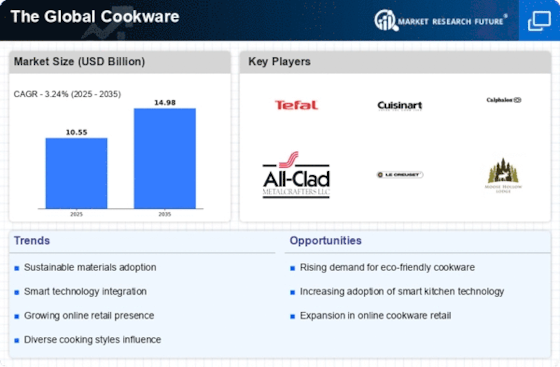
<p>The Global Cookware is projected to reach a valuation of 14.98 USD Billion by 2035.</p>

What was the market valuation of The Global Cookware in 2024?

<p>In 2024, The Global Cookware was valued at 10.55 USD Billion.</p>

What is the expected CAGR for The Global Cookware during the forecast period 2025 - 2035?

<p>The expected CAGR for The Global Cookware during the forecast period 2025 - 2035 is 3.24%.</p>

Which material segment is projected to have the highest growth in The Global Cookware?

<p>The Stainless Steel segment, valued at 4.0 USD Billion in 2025, appears to have the highest growth potential.</p>

What are the key product types in The Global Cookware?

<p>Key product types include Pans, Cookware Sets, Baking Dishes, Pressure Cookers, and Steamers.</p>

How does the residential end-use segment compare to commercial and institutional segments in 2025?

<p>The residential end-use segment is projected to reach 6.5 USD Billion in 2025, surpassing both commercial and institutional segments.</p>

What distribution channel is expected to generate the highest revenue in The Global Cookware?

<p>The Retail distribution channel is anticipated to generate the highest revenue, projected at 6.5 USD Billion in 2025.</p>

Who are the key players in The Global Cookware?

<p>Key players include Tefal, Cuisinart, Calphalon, All-Clad, Le Creuset, Lodge, Scanpan, Bialetti, and Fissler.</p>

What is the projected value of the Non-Stick cookware segment in 2025?

<p>The Non-Stick cookware segment is projected to reach a value of 3.5 USD Billion in 2025.</p>

How does the growth of the cookware market reflect consumer trends?

<p>The growth of the cookware market suggests a rising consumer interest in high-quality cooking products, particularly in the residential sector.</p>

Market Summary

As per Market Research Future analysis, The Cookware Market Size was estimated at 32.4 USD Billion in 2024. The cookware industry is projected to grow from 34.1 USD Billion in 2025 to 56.5 USD Billion by 2035, exhibiting a compound annual growth rate (CAGR) of 5.2% during the forecast period 2025 - 2035

Key Market Trends & Highlights

The Global Cookware Market is experiencing a dynamic shift towards sustainability and technological innovation.

  • North America remains the largest market for cookware, driven by a strong consumer preference for high-quality materials. Asia-Pacific is the fastest-growing region, reflecting a surge in culinary enthusiasm and disposable income among consumers. Stainless steel cookware continues to dominate the market, while non-stick options are rapidly gaining popularity due to their convenience. Rising health consciousness and sustainability trends are key drivers propelling the demand for innovative cookware solutions.

Market Size & Forecast

2024 Market Size 32.4 (USD Billion)
2035 Market Size 56.5 (USD Billion)
CAGR (2025 - 2035) 5.2 %
Largest Regional Market Share in 2024 North America

Major Players

Tefal (FR), Cuisinart (US), Calphalon (US), All-Clad (US), Le Creuset (FR), Lodge (US), Scanpan (DK), Bialetti (IT), Fissler (DE)

Market Trends

The Global Cookware is currently experiencing a dynamic evolution, driven by shifting consumer preferences and an increasing emphasis on sustainability. As individuals become more health-conscious, there is a noticeable shift towards cookware that promotes healthier cooking methods, such as non-toxic materials and innovative designs that reduce the need for excessive oil. Additionally, the rise of culinary enthusiasts and home cooking trends has led to a growing demand for high-quality, durable cookware that enhances the cooking experience. This market appears to be adapting to these changes, with manufacturers focusing on creating products that not only meet functional needs but also align with aesthetic values. Consumers are increasingly adopting products from the ceramic coating cookware market for healthier cooking options.

Moreover, The Global Cookware is witnessing a surge in the popularity of smart cookware, which integrates technology to facilitate cooking processes. This trend suggests a potential shift towards more connected kitchen environments, where appliances can communicate and provide real-time feedback to users. As consumers increasingly seek convenience and efficiency, the incorporation of smart features into cookware may redefine traditional cooking practices. Overall, the market seems poised for continued growth, with innovation and consumer engagement at the forefront of its development. While stainless steel and non-stick dominate, the aluminum cookware market remains popular for its lightweight and even heat distribution properties.

Sustainable Materials

There is a growing trend towards the use of eco-friendly materials in cookware production. Consumers are increasingly seeking products made from sustainable resources, such as recycled metals and biodegradable substances. This shift reflects a broader commitment to environmental responsibility and health-conscious living.

Smart Cookware

The integration of technology into cookware is becoming more prevalent. Smart cookware, which can connect to apps and provide cooking guidance, is appealing to tech-savvy consumers. This trend indicates a potential transformation in how individuals approach cooking, making it more interactive and efficient.

Aesthetic Appeal

The emphasis on design and aesthetics in cookware is gaining traction. Consumers are not only interested in functionality but also in how cookware complements their kitchen decor. This trend suggests that manufacturers are increasingly focusing on creating visually appealing products that enhance the overall cooking experience.

Cookware Market Market Drivers

E-commerce Growth

The rapid expansion of e-commerce platforms is significantly impacting The Global cookware Industry. As consumers increasingly turn to online shopping for convenience and variety, cookware sales through digital channels are experiencing remarkable growth. Market data indicates that e-commerce sales of cookware are projected to rise, driven by the ease of access to a wide range of products and competitive pricing. This trend is further accelerated by the influence of social media and online reviews, which guide consumer purchasing decisions. Retailers are adapting to this shift by enhancing their online presence and offering exclusive deals, thereby capitalizing on the growing preference for online shopping. This evolution in retail dynamics is likely to continue shaping the cookware market in the foreseeable future.

Sustainability Trends

Sustainability is becoming a crucial consideration for consumers when selecting cookware, influencing The Global Cookware Industry. There is a marked shift towards eco-friendly materials and production processes, as consumers become more environmentally conscious. Cookware Market made from recycled materials or sustainably sourced resources is gaining popularity, reflecting a broader trend towards sustainable living. Market data suggests that the demand for such products is on the rise, with consumers increasingly favoring brands that prioritize sustainability. This shift not only impacts purchasing decisions but also encourages manufacturers to innovate and adopt greener practices, thereby reshaping the market landscape and potentially leading to a more sustainable future for cookware.

Technological Advancements

Technological innovations in cookware design and functionality are transforming The Global Cookware Industry. The introduction of smart cookware, which integrates technology for enhanced cooking experiences, is gaining traction. For instance, cookware that connects to mobile applications for temperature control and recipe guidance is becoming increasingly popular. Market data suggests that the smart cookware segment is projected to grow significantly, driven by consumer interest in convenience and efficiency. Additionally, advancements in materials, such as the development of durable and heat-resistant coatings, are likely to improve product performance and longevity, further attracting consumers. This technological evolution may redefine cooking practices and elevate the overall market landscape.

Growing Culinary Enthusiasm

The rise in culinary enthusiasm among consumers is a notable driver for the cookware market. As more individuals take up cooking as a hobby or passion, there is an increased demand for high-quality cookware that enhances the cooking experience. The Global Cookware Industry is witnessing a surge in sales of premium cookware, as consumers seek products that offer superior performance and aesthetic appeal. Market data indicates that the premium segment is expanding, with consumers willing to invest in cookware that reflects their culinary aspirations. This trend is further supported by the proliferation of cooking classes and online tutorials, which encourage individuals to experiment with diverse cuisines and cooking techniques, thereby stimulating market growth.

Rising Health Consciousness

The increasing awareness of health and wellness among consumers appears to be a pivotal driver for the cookware market. As individuals prioritize healthier cooking methods, there is a growing demand for cookware that supports low-fat and nutrient-preserving cooking techniques. This trend is reflected in the market data, which indicates that non-stick and ceramic cookware segments are experiencing substantial growth. The Global Cookware Industry is likely to benefit from this shift, as manufacturers innovate to create products that align with health-conscious consumer preferences. Furthermore, the rise of cooking shows and social media influencers promoting healthy eating habits may further propel the demand for specialized cookware, thereby enhancing market dynamics.

Market Segment Insights

By Material: Stainless Steel (Largest) vs. Non-Stick (Fastest-Growing)

In The Global Cookware Market, various materials offer distinct advantages, with stainless steel currently holding the largest market share due to its durability and versatility. Non-stick cookware, on the other hand, is rapidly gaining traction among consumers looking for convenience and ease of use, marking it as the fastest-growing segment in recent years. Cast iron, copper, and ceramic also hold notable shares, each catering to specific consumer preferences and cooking styles. The growth trends within the material segment are influenced by a shift towards healthier cooking practices and innovative product features. Stainless steel's dominance is supported by its appeal to health-conscious consumers, while non-stick cookware attracts busy individuals seeking hassle-free cooking experiences. Emerging trends such as eco-friendly materials and multi-functional products are further driving consumer interest, positioning these segments for dynamic growth in the near future.

Cookware Market Material: Stainless Steel (Dominant) vs. Non-Stick (Emerging)

Stainless steel cookware is renowned for its exceptional durability and resistance to rust and corrosion, making it the dominant choice for both home cooks and professional chefs. Its non-reactive surface is ideal for cooking a wide range of dishes without the risk of chemical leaching or flavor alteration. On the contrary, non-stick cookware has gained popularity as an emerging option due to its easy-release technology, which requires less oil for cooking and facilitates effortless cleaning. This makes it particularly attractive to health-conscious consumers who prefer low-fat cooking methods. Both segments cater to diverse culinary needs, with stainless steel appealing to traditionalists and non-stick capturing the attention of modern households looking for convenience. The nonstick cookware market is emerging rapidly due to consumer demand for convenience and low-fat cooking.

By Product Type: Pans (Largest) vs. Cookware Sets (Fastest-Growing)

<p>In The Global Cookware, the product type segment is primarily dominated by pans, which hold the largest market share due to their versatility and widespread use in various cooking styles. Cookware sets also contribute significantly, but their share is growing at an impressive rate as consumers look for cohesive kitchen solutions that offer both quality and convenience. Baking dishes, pressure cookers, and steamers follow, catering to specific consumer needs in baking and healthy cooking methods. The market is witnessing strong growth trends attributed to the rising food culture and increased interest in cooking at home. Innovations in cookware technology, such as non-stick surfaces and eco-friendly materials, are also driving demand. Additionally, the increased marketing of cookware sets as a complete kitchen solution is appealing to both novice and experienced cooks, further propelling the rapid growth of this segment.</p>

<p>Cookware Sets (Dominant) vs. Pressure Cookers (Emerging)</p>

<p>Cookware sets have become a dominant force in The Global Cookware as they provide a comprehensive solution for consumers looking to outfit their kitchens with matching pieces that ensure both style and functionality. These sets often include a range of products, including pans, pots, and other cooking essentials, making them an attractive option for those setting up a kitchen or renovating. On the other hand, pressure cookers are an emerging product type, gaining popularity due to their efficiency in cooking and ability to preserve the nutritional value of food. The rising trend of health-conscious cooking, along with busy lifestyles driving the need for quick meal preparation, positions pressure cookers as a favorable choice for consumers seeking convenience without sacrificing quality.</p>

By End Use: Residential (Largest) vs. Commercial (Fastest-Growing)

In The Global Cookware Market, the end use segment is characterized by significant differentiation between residential, commercial, and institutional applications. The residential segment stands out as the largest, driven by a consistent demand for cookware among homeowners who prioritize quality and versatility in their kitchenware. Conversely, the commercial segment, although smaller in share, is experiencing rapid growth due to the increasing number of eateries and food service establishments, which are consistently updating their cookware to meet industry standards.

Residential (Dominant) vs. Commercial (Emerging)

The residential segment represents a dominant force in The Global Cookware Market, appealing to a broad consumer base eager for both functionality and aesthetics in cookware. It encompasses a variety of products, from non-stick pans to high-end cookware, catering to diverse cooking needs. On the other hand, the commercial segment is marked by its emerging status, fueled by the burgeoning food service industry. This segment is increasingly characterized by the demand for durable and specialized cookware that meets the rigorous standards of chefs and kitchens. As restaurants and catering services expand, the innovation in commercial cookware is driven by the necessity for efficiency and enhanced culinary results.

By Distribution Channel: Online (Largest) vs. Retail (Fastest-Growing)

The Global Cookware Market exhibits a diverse landscape across distribution channels, with online sales emerging as the largest segment. Retail channels, while still significant, show a notable shift as consumers increasingly turn to e-commerce platforms for their cookware needs. This transition highlights changing consumer preferences toward convenience and accessibility, positioning online shopping at the forefront of market growth. Additionally, retail remains vital for those seeking tangible product experiences before purchasing, which solidifies its ongoing presence in the market alongside the dominance of online sales.

Online: Dominant vs. Retail: Emerging

The online distribution channel in The Global Cookware Market has established its dominance by providing consumers with a vast array of cookware options from comfort at home. E-commerce platforms enable easy comparison of products and prices, catering to tech-savvy consumers looking for convenience. Meanwhile, the retail segment is experiencing a resurgence, particularly among consumers who appreciate the tactile experience of shopping for cookware in-store. Retailers are evolving their offerings with attractive displays and interactive experiences to attract customers. Together, these segments illustrate the balance between digital and traditional purchasing methods, shaping the future of cookware sales.

Get more detailed insights about Cookware Market Research Report – Forecast till 2035

Regional Insights

The Global Cookware Market exhibits diverse regional dynamics, with a notable emphasis on North America, Europe, APAC, South America, and the Middle East and Africa (MEA). In 2024, North America is poised to be a major contributor, with a valuation of 3.5 USD Billion, expected to increase to 4.8 USD Billion by 2035, owing to its advanced market and high consumer spending on kitchenware.

Europe follows closely, assessed at 3.0 USD Billion in 2024 and projected to reach 4.0 USD Billion in 2035, supported by a strong culture of cooking and culinary innovation.APAC, valued at 2.5 USD Billion in 2024 and anticipated to grow to 3.7 USD Billion by 2035, shows significant expansion potential due to rising disposable incomes and urbanization trends, making it a rapidly emerging market for cookware.

South America and MEA, valued at 0.9 USD Billion and 0.66 USD Billion, respectively, in 2024, represent smaller yet integral components, with South America expected to grow significantly to 1.2 USD Billion and MEA projected to reach 1.3 USD Billion by 2035. The market's growth is driven by increasing health consciousness, a shift towards non-toxic materials, and innovations in design and functionality, offering numerous opportunities for brands to capture market share across regions.

Key Players and Competitive Insights

The Global Cookware Market is characterized by intense competition, driven by a blend of consumer preferences, innovative product offerings, and the ever-evolving nature of cooking technologies. Companies in this arena strive to distinguish themselves through quality, design, and functionality, targeting diverse demographics that range from casual home cooks to professional chefs. With the increasing popularity of gourmet cooking and the rise of social media influencers showcasing culinary skills, brands are compelled to continuously improve their products and expand their portfolios. The competitive landscape is further shaped by factors such as pricing, brand loyalty, and the accessibility of products globally, which influence buying decisions across different regions.Scanpan has established a compelling presence in the Global Cookware Market, characterized by its commitment to sustainability and high-quality manufacturing. The brand's strengths lie in its use of innovative materials and eco-friendly production methods that cater to environmentally conscious consumers. Scanpan's signature non-stick cookware, renowned for its durability and performance, has garnered a loyal customer base, allowing the company to maintain a significant market share. Furthermore, Scanpan's strategic marketing initiatives and collaborations with culinary experts have reinforced its reputation as a premium cookware brand, enabling it to reach a wider audience across various global markets.Tramontina enjoys a robust position in the Global Cookware Market, backed by a diverse range of products including cookware, tableware, and kitchen tools. The company is known for its high-quality stainless steel and non-stick cookware, which appeal to both budget-conscious and premium segments. Tramontina's strengths stem from its ability to combine functionality with aesthetic appeal, leading to a favorable reception in numerous regions. Their focus on innovation is evident through continuous product launches and updates that capture consumer trends. Additionally, Tramontina's global expansion efforts through strategic partnerships and acquisitions have played a crucial role in enhancing its market presence, allowing the brand to leverage synergies and bolster its capabilities across different regions.

Key Companies in the Cookware Market include

Industry Developments

The Global Cookware Market has been witnessing significant activity recently, with companies like Scanpan and Tramontina advancing their product offerings amid growing consumer demand for high-quality kitchenware. In September 2023, Meyer Corporation announced the launch of a new eco-friendly cookware line, aligning with the rising trends toward sustainable products. Furthermore, ZWILLING J.A. Henckels is expanding its global reach, recently entering into partnerships in Asia to cater to the increasing culinary interest in that region.

Current affairs also highlight the robust performance of Le Creuset, which has seen a 15% growth in sales in the last fiscal quarter, reflecting a broader consumer shift toward premium cookware. In terms of mergers, Meyer Corporation acquired a smaller cookware brand in August 2023 to enhance its market presence and diversify its product portfolio. Meanwhile, Newell Brands continues to evaluate its cookware segment as part of a larger restructuring strategy. Overall, these developments are indicative of the market's dynamic nature and the increasing focus on innovation and sustainability across key players like Farberware, Tefal, and Calphalon.

Global trends show that as culinary experiences evolve, the demand for quality cookware remains a significant driver in the industry.

Future Outlook

Cookware Market Future Outlook

The Global Cookware Market Size is projected to grow at a 5.2 % CAGR from 2025 to 2035, driven by innovation, sustainability, and increasing consumer demand for premium products.

New opportunities lie in:

  • <p>Expansion into smart cookware technology for enhanced user experience. Development of eco-friendly materials to attract environmentally conscious consumers. Strategic partnerships with culinary influencers to boost brand visibility and sales.</p>

By 2035, the market is expected to solidify its growth trajectory, reflecting evolving consumer preferences.

Market Segmentation

Cookware Market End Use Outlook

  • Residential
  • Commercial
  • Institutional

Cookware Market Material Outlook

  • Stainless Steel
  • Cast Iron
  • Non-Stick
  • Copper
  • Ceramic

Cookware Market Product Type Outlook

  • Pans
  • Cookware Sets
  • Baking Dishes
  • Pressure Cookers
  • Steamer

Cookware Market Distribution Channel Outlook

  • Online
  • Retail
  • Direct Sales
  • Wholesale

Report Scope

MARKET SIZE 2024 32.4 (USD Billion)
MARKET SIZE 2025 34.1 (USD Billion)
MARKET SIZE 2035 56.5 (USD Billion)
COMPOUND ANNUAL GROWTH RATE (CAGR) 5.2 % (2025 - 2035)
REPORT COVERAGE Revenue Forecast, Competitive Landscape, Growth Factors, and Trends
BASE YEAR 2024
Market Forecast Period 2025 - 2035
Historical Data 2019 - 2024
Market Forecast Units USD Billion
Key Companies Profiled Tefal (FR), Cuisinart (US), Calphalon (US), All-Clad (US), Le Creuset (FR), Lodge (US), Scanpan (DK), Bialetti (IT), Fissler (DE)
Segments Covered Material, Product Type, End Use, Distribution Channel, Regional
Key Market Opportunities Growing demand for eco-friendly cookware driven by consumer preference for sustainable materials and practices.
Key Market Dynamics Rising consumer preference for eco-friendly materials drives innovation and competition in the cookware industry.
Countries Covered North America, Europe, APAC, South America, MEA

FAQs

What is the projected market valuation of The Global Cookware by 2035?

<p>The Global Cookware is projected to reach a valuation of 14.98 USD Billion by 2035.</p>

What was the market valuation of The Global Cookware in 2024?

<p>In 2024, The Global Cookware was valued at 10.55 USD Billion.</p>

What is the expected CAGR for The Global Cookware during the forecast period 2025 - 2035?

<p>The expected CAGR for The Global Cookware during the forecast period 2025 - 2035 is 3.24%.</p>

Which material segment is projected to have the highest growth in The Global Cookware?

<p>The Stainless Steel segment, valued at 4.0 USD Billion in 2025, appears to have the highest growth potential.</p>

What are the key product types in The Global Cookware?

<p>Key product types include Pans, Cookware Sets, Baking Dishes, Pressure Cookers, and Steamers.</p>

How does the residential end-use segment compare to commercial and institutional segments in 2025?

<p>The residential end-use segment is projected to reach 6.5 USD Billion in 2025, surpassing both commercial and institutional segments.</p>

What distribution channel is expected to generate the highest revenue in The Global Cookware?

<p>The Retail distribution channel is anticipated to generate the highest revenue, projected at 6.5 USD Billion in 2025.</p>

Who are the key players in The Global Cookware?

<p>Key players include Tefal, Cuisinart, Calphalon, All-Clad, Le Creuset, Lodge, Scanpan, Bialetti, and Fissler.</p>

What is the projected value of the Non-Stick cookware segment in 2025?

<p>The Non-Stick cookware segment is projected to reach a value of 3.5 USD Billion in 2025.</p>

How does the growth of the cookware market reflect consumer trends?

<p>The growth of the cookware market suggests a rising consumer interest in high-quality cooking products, particularly in the residential sector.</p>

  1. SECTION I: EXECUTIVE SUMMARY AND KEY HIGHLIGHTS
    1. | 1.1 EXECUTIVE SUMMARY
    2. | | 1.1.1 Market Overview
    3. | | 1.1.2 Key Findings
    4. | | 1.1.3 Market Segmentation
    5. | | 1.1.4 Competitive Landscape
    6. | | 1.1.5 Challenges and Opportunities
    7. | | 1.1.6 Future Outlook
  2. SECTION II: SCOPING, METHODOLOGY AND MARKET STRUCTURE
    1. | 2.1 MARKET INTRODUCTION
    2. | | 2.1.1 Definition
    3. | | 2.1.2 Scope of the study
    4. | | | 2.1.2.1 Research Objective
    5. | | | 2.1.2.2 Assumption
    6. | | | 2.1.2.3 Limitations
    7. | 2.2 RESEARCH METHODOLOGY
    8. | | 2.2.1 Overview
    9. | | 2.2.2 Data Mining
    10. | | 2.2.3 Secondary Research
    11. | | 2.2.4 Primary Research
    12. | | | 2.2.4.1 Primary Interviews and Information Gathering Process
    13. | | | 2.2.4.2 Breakdown of Primary Respondents
    14. | | 2.2.5 Forecasting Model
    15. | | 2.2.6 Market Size Estimation
    16. | | | 2.2.6.1 Bottom-Up Approach
    17. | | | 2.2.6.2 Top-Down Approach
    18. | | 2.2.7 Data Triangulation
    19. | | 2.2.8 Validation
  3. SECTION III: QUALITATIVE ANALYSIS
    1. | 3.1 MARKET DYNAMICS
    2. | | 3.1.1 Overview
    3. | | 3.1.2 Drivers
    4. | | 3.1.3 Restraints
    5. | | 3.1.4 Opportunities
    6. | 3.2 MARKET FACTOR ANALYSIS
    7. | | 3.2.1 Value chain Analysis
    8. | | 3.2.2 Porter's Five Forces Analysis
    9. | | | 3.2.2.1 Bargaining Power of Suppliers
    10. | | | 3.2.2.2 Bargaining Power of Buyers
    11. | | | 3.2.2.3 Threat of New Entrants
    12. | | | 3.2.2.4 Threat of Substitutes
    13. | | | 3.2.2.5 Intensity of Rivalry
    14. | | 3.2.3 COVID-19 Impact Analysis
    15. | | | 3.2.3.1 Market Impact Analysis
    16. | | | 3.2.3.2 Regional Impact
    17. | | | 3.2.3.3 Opportunity and Threat Analysis
  4. SECTION IV: QUANTITATIVE ANALYSIS
    1. | 4.1 Consumer and Retail, BY Material (USD Billion)
    2. | | 4.1.1 Stainless Steel
    3. | | 4.1.2 Cast Iron
    4. | | 4.1.3 Non-Stick
    5. | | 4.1.4 Copper
    6. | | 4.1.5 Ceramic
    7. | 4.2 Consumer and Retail, BY Product Type (USD Billion)
    8. | | 4.2.1 Pans
    9. | | 4.2.2 Cookware Sets
    10. | | 4.2.3 Baking Dishes
    11. | | 4.2.4 Pressure Cookers
    12. | | 4.2.5 Steamer
    13. | 4.3 Consumer and Retail, BY End Use (USD Billion)
    14. | | 4.3.1 Residential
    15. | | 4.3.2 Commercial
    16. | | 4.3.3 Institutional
    17. | 4.4 Consumer and Retail, BY Distribution Channel (USD Billion)
    18. | | 4.4.1 Online
    19. | | 4.4.2 Retail
    20. | | 4.4.3 Direct Sales
    21. | | 4.4.4 Wholesale
    22. | 4.5 Consumer and Retail, BY Region (USD Billion)
    23. | | 4.5.1 North America
    24. | | | 4.5.1.1 US
    25. | | | 4.5.1.2 Canada
    26. | | 4.5.2 Europe
    27. | | | 4.5.2.1 Germany
    28. | | | 4.5.2.2 UK
    29. | | | 4.5.2.3 France
    30. | | | 4.5.2.4 Russia
    31. | | | 4.5.2.5 Italy
    32. | | | 4.5.2.6 Spain
    33. | | | 4.5.2.7 Rest of Europe
    34. | | 4.5.3 APAC
    35. | | | 4.5.3.1 China
    36. | | | 4.5.3.2 India
    37. | | | 4.5.3.3 Japan
    38. | | | 4.5.3.4 South Korea
    39. | | | 4.5.3.5 Malaysia
    40. | | | 4.5.3.6 Thailand
    41. | | | 4.5.3.7 Indonesia
    42. | | | 4.5.3.8 Rest of APAC
    43. | | 4.5.4 South America
    44. | | | 4.5.4.1 Brazil
    45. | | | 4.5.4.2 Mexico
    46. | | | 4.5.4.3 Argentina
    47. | | | 4.5.4.4 Rest of South America
    48. | | 4.5.5 MEA
    49. | | | 4.5.5.1 GCC Countries
    50. | | | 4.5.5.2 South Africa
    51. | | | 4.5.5.3 Rest of MEA
  5. SECTION V: COMPETITIVE ANALYSIS
    1. | 5.1 Competitive Landscape
    2. | | 5.1.1 Overview
    3. | | 5.1.2 Competitive Analysis
    4. | | 5.1.3 Market share Analysis
    5. | | 5.1.4 Major Growth Strategy in the Consumer and Retail
    6. | | 5.1.5 Competitive Benchmarking
    7. | | 5.1.6 Leading Players in Terms of Number of Developments in the Consumer and Retail
    8. | | 5.1.7 Key developments and growth strategies
    9. | | | 5.1.7.1 New Product Launch/Service Deployment
    10. | | | 5.1.7.2 Merger & Acquisitions
    11. | | | 5.1.7.3 Joint Ventures
    12. | | 5.1.8 Major Players Financial Matrix
    13. | | | 5.1.8.1 Sales and Operating Income
    14. | | | 5.1.8.2 Major Players R&D Expenditure. 2023
    15. | 5.2 Company Profiles
    16. | | 5.2.1 Tefal (FR)
    17. | | | 5.2.1.1 Financial Overview
    18. | | | 5.2.1.2 Products Offered
    19. | | | 5.2.1.3 Key Developments
    20. | | | 5.2.1.4 SWOT Analysis
    21. | | | 5.2.1.5 Key Strategies
    22. | | 5.2.2 Cuisinart (US)
    23. | | | 5.2.2.1 Financial Overview
    24. | | | 5.2.2.2 Products Offered
    25. | | | 5.2.2.3 Key Developments
    26. | | | 5.2.2.4 SWOT Analysis
    27. | | | 5.2.2.5 Key Strategies
    28. | | 5.2.3 Calphalon (US)
    29. | | | 5.2.3.1 Financial Overview
    30. | | | 5.2.3.2 Products Offered
    31. | | | 5.2.3.3 Key Developments
    32. | | | 5.2.3.4 SWOT Analysis
    33. | | | 5.2.3.5 Key Strategies
    34. | | 5.2.4 All-Clad (US)
    35. | | | 5.2.4.1 Financial Overview
    36. | | | 5.2.4.2 Products Offered
    37. | | | 5.2.4.3 Key Developments
    38. | | | 5.2.4.4 SWOT Analysis
    39. | | | 5.2.4.5 Key Strategies
    40. | | 5.2.5 Le Creuset (FR)
    41. | | | 5.2.5.1 Financial Overview
    42. | | | 5.2.5.2 Products Offered
    43. | | | 5.2.5.3 Key Developments
    44. | | | 5.2.5.4 SWOT Analysis
    45. | | | 5.2.5.5 Key Strategies
    46. | | 5.2.6 Lodge (US)
    47. | | | 5.2.6.1 Financial Overview
    48. | | | 5.2.6.2 Products Offered
    49. | | | 5.2.6.3 Key Developments
    50. | | | 5.2.6.4 SWOT Analysis
    51. | | | 5.2.6.5 Key Strategies
    52. | | 5.2.7 Scanpan (DK)
    53. | | | 5.2.7.1 Financial Overview
    54. | | | 5.2.7.2 Products Offered
    55. | | | 5.2.7.3 Key Developments
    56. | | | 5.2.7.4 SWOT Analysis
    57. | | | 5.2.7.5 Key Strategies
    58. | | 5.2.8 Bialetti (IT)
    59. | | | 5.2.8.1 Financial Overview
    60. | | | 5.2.8.2 Products Offered
    61. | | | 5.2.8.3 Key Developments
    62. | | | 5.2.8.4 SWOT Analysis
    63. | | | 5.2.8.5 Key Strategies
    64. | | 5.2.9 Fissler (DE)
    65. | | | 5.2.9.1 Financial Overview
    66. | | | 5.2.9.2 Products Offered
    67. | | | 5.2.9.3 Key Developments
    68. | | | 5.2.9.4 SWOT Analysis
    69. | | | 5.2.9.5 Key Strategies
    70. | 5.3 Appendix
    71. | | 5.3.1 References
    72. | | 5.3.2 Related Reports
  6. LIST OF FIGURES
    1. | 6.1 MARKET SYNOPSIS
    2. | 6.2 NORTH AMERICA MARKET ANALYSIS
    3. | 6.3 US MARKET ANALYSIS BY MATERIAL
    4. | 6.4 US MARKET ANALYSIS BY PRODUCT TYPE
    5. | 6.5 US MARKET ANALYSIS BY END USE
    6. | 6.6 US MARKET ANALYSIS BY DISTRIBUTION CHANNEL
    7. | 6.7 CANADA MARKET ANALYSIS BY MATERIAL
    8. | 6.8 CANADA MARKET ANALYSIS BY PRODUCT TYPE
    9. | 6.9 CANADA MARKET ANALYSIS BY END USE
    10. | 6.10 CANADA MARKET ANALYSIS BY DISTRIBUTION CHANNEL
    11. | 6.11 EUROPE MARKET ANALYSIS
    12. | 6.12 GERMANY MARKET ANALYSIS BY MATERIAL
    13. | 6.13 GERMANY MARKET ANALYSIS BY PRODUCT TYPE
    14. | 6.14 GERMANY MARKET ANALYSIS BY END USE
    15. | 6.15 GERMANY MARKET ANALYSIS BY DISTRIBUTION CHANNEL
    16. | 6.16 UK MARKET ANALYSIS BY MATERIAL
    17. | 6.17 UK MARKET ANALYSIS BY PRODUCT TYPE
    18. | 6.18 UK MARKET ANALYSIS BY END USE
    19. | 6.19 UK MARKET ANALYSIS BY DISTRIBUTION CHANNEL
    20. | 6.20 FRANCE MARKET ANALYSIS BY MATERIAL
    21. | 6.21 FRANCE MARKET ANALYSIS BY PRODUCT TYPE
    22. | 6.22 FRANCE MARKET ANALYSIS BY END USE
    23. | 6.23 FRANCE MARKET ANALYSIS BY DISTRIBUTION CHANNEL
    24. | 6.24 RUSSIA MARKET ANALYSIS BY MATERIAL
    25. | 6.25 RUSSIA MARKET ANALYSIS BY PRODUCT TYPE
    26. | 6.26 RUSSIA MARKET ANALYSIS BY END USE
    27. | 6.27 RUSSIA MARKET ANALYSIS BY DISTRIBUTION CHANNEL
    28. | 6.28 ITALY MARKET ANALYSIS BY MATERIAL
    29. | 6.29 ITALY MARKET ANALYSIS BY PRODUCT TYPE
    30. | 6.30 ITALY MARKET ANALYSIS BY END USE
    31. | 6.31 ITALY MARKET ANALYSIS BY DISTRIBUTION CHANNEL
    32. | 6.32 SPAIN MARKET ANALYSIS BY MATERIAL
    33. | 6.33 SPAIN MARKET ANALYSIS BY PRODUCT TYPE
    34. | 6.34 SPAIN MARKET ANALYSIS BY END USE
    35. | 6.35 SPAIN MARKET ANALYSIS BY DISTRIBUTION CHANNEL
    36. | 6.36 REST OF EUROPE MARKET ANALYSIS BY MATERIAL
    37. | 6.37 REST OF EUROPE MARKET ANALYSIS BY PRODUCT TYPE
    38. | 6.38 REST OF EUROPE MARKET ANALYSIS BY END USE
    39. | 6.39 REST OF EUROPE MARKET ANALYSIS BY DISTRIBUTION CHANNEL
    40. | 6.40 APAC MARKET ANALYSIS
    41. | 6.41 CHINA MARKET ANALYSIS BY MATERIAL
    42. | 6.42 CHINA MARKET ANALYSIS BY PRODUCT TYPE
    43. | 6.43 CHINA MARKET ANALYSIS BY END USE
    44. | 6.44 CHINA MARKET ANALYSIS BY DISTRIBUTION CHANNEL
    45. | 6.45 INDIA MARKET ANALYSIS BY MATERIAL
    46. | 6.46 INDIA MARKET ANALYSIS BY PRODUCT TYPE
    47. | 6.47 INDIA MARKET ANALYSIS BY END USE
    48. | 6.48 INDIA MARKET ANALYSIS BY DISTRIBUTION CHANNEL
    49. | 6.49 JAPAN MARKET ANALYSIS BY MATERIAL
    50. | 6.50 JAPAN MARKET ANALYSIS BY PRODUCT TYPE
    51. | 6.51 JAPAN MARKET ANALYSIS BY END USE
    52. | 6.52 JAPAN MARKET ANALYSIS BY DISTRIBUTION CHANNEL
    53. | 6.53 SOUTH KOREA MARKET ANALYSIS BY MATERIAL
    54. | 6.54 SOUTH KOREA MARKET ANALYSIS BY PRODUCT TYPE
    55. | 6.55 SOUTH KOREA MARKET ANALYSIS BY END USE
    56. | 6.56 SOUTH KOREA MARKET ANALYSIS BY DISTRIBUTION CHANNEL
    57. | 6.57 MALAYSIA MARKET ANALYSIS BY MATERIAL
    58. | 6.58 MALAYSIA MARKET ANALYSIS BY PRODUCT TYPE
    59. | 6.59 MALAYSIA MARKET ANALYSIS BY END USE
    60. | 6.60 MALAYSIA MARKET ANALYSIS BY DISTRIBUTION CHANNEL
    61. | 6.61 THAILAND MARKET ANALYSIS BY MATERIAL
    62. | 6.62 THAILAND MARKET ANALYSIS BY PRODUCT TYPE
    63. | 6.63 THAILAND MARKET ANALYSIS BY END USE
    64. | 6.64 THAILAND MARKET ANALYSIS BY DISTRIBUTION CHANNEL
    65. | 6.65 INDONESIA MARKET ANALYSIS BY MATERIAL
    66. | 6.66 INDONESIA MARKET ANALYSIS BY PRODUCT TYPE
    67. | 6.67 INDONESIA MARKET ANALYSIS BY END USE
    68. | 6.68 INDONESIA MARKET ANALYSIS BY DISTRIBUTION CHANNEL
    69. | 6.69 REST OF APAC MARKET ANALYSIS BY MATERIAL
    70. | 6.70 REST OF APAC MARKET ANALYSIS BY PRODUCT TYPE
    71. | 6.71 REST OF APAC MARKET ANALYSIS BY END USE
    72. | 6.72 REST OF APAC MARKET ANALYSIS BY DISTRIBUTION CHANNEL
    73. | 6.73 SOUTH AMERICA MARKET ANALYSIS
    74. | 6.74 BRAZIL MARKET ANALYSIS BY MATERIAL
    75. | 6.75 BRAZIL MARKET ANALYSIS BY PRODUCT TYPE
    76. | 6.76 BRAZIL MARKET ANALYSIS BY END USE
    77. | 6.77 BRAZIL MARKET ANALYSIS BY DISTRIBUTION CHANNEL
    78. | 6.78 MEXICO MARKET ANALYSIS BY MATERIAL
    79. | 6.79 MEXICO MARKET ANALYSIS BY PRODUCT TYPE
    80. | 6.80 MEXICO MARKET ANALYSIS BY END USE
    81. | 6.81 MEXICO MARKET ANALYSIS BY DISTRIBUTION CHANNEL
    82. | 6.82 ARGENTINA MARKET ANALYSIS BY MATERIAL
    83. | 6.83 ARGENTINA MARKET ANALYSIS BY PRODUCT TYPE
    84. | 6.84 ARGENTINA MARKET ANALYSIS BY END USE
    85. | 6.85 ARGENTINA MARKET ANALYSIS BY DISTRIBUTION CHANNEL
    86. | 6.86 REST OF SOUTH AMERICA MARKET ANALYSIS BY MATERIAL
    87. | 6.87 REST OF SOUTH AMERICA MARKET ANALYSIS BY PRODUCT TYPE
    88. | 6.88 REST OF SOUTH AMERICA MARKET ANALYSIS BY END USE
    89. | 6.89 REST OF SOUTH AMERICA MARKET ANALYSIS BY DISTRIBUTION CHANNEL
    90. | 6.90 MEA MARKET ANALYSIS
    91. | 6.91 GCC COUNTRIES MARKET ANALYSIS BY MATERIAL
    92. | 6.92 GCC COUNTRIES MARKET ANALYSIS BY PRODUCT TYPE
    93. | 6.93 GCC COUNTRIES MARKET ANALYSIS BY END USE
    94. | 6.94 GCC COUNTRIES MARKET ANALYSIS BY DISTRIBUTION CHANNEL
    95. | 6.95 SOUTH AFRICA MARKET ANALYSIS BY MATERIAL
    96. | 6.96 SOUTH AFRICA MARKET ANALYSIS BY PRODUCT TYPE
    97. | 6.97 SOUTH AFRICA MARKET ANALYSIS BY END USE
    98. | 6.98 SOUTH AFRICA MARKET ANALYSIS BY DISTRIBUTION CHANNEL
    99. | 6.99 REST OF MEA MARKET ANALYSIS BY MATERIAL
    100. | 6.100 REST OF MEA MARKET ANALYSIS BY PRODUCT TYPE
    101. | 6.101 REST OF MEA MARKET ANALYSIS BY END USE
    102. | 6.102 REST OF MEA MARKET ANALYSIS BY DISTRIBUTION CHANNEL
    103. | 6.103 KEY BUYING CRITERIA OF CONSUMER AND RETAIL
    104. | 6.104 RESEARCH PROCESS OF MRFR
    105. | 6.105 DRO ANALYSIS OF CONSUMER AND RETAIL
    106. | 6.106 DRIVERS IMPACT ANALYSIS: CONSUMER AND RETAIL
    107. | 6.107 RESTRAINTS IMPACT ANALYSIS: CONSUMER AND RETAIL
    108. | 6.108 SUPPLY / VALUE CHAIN: CONSUMER AND RETAIL
    109. | 6.109 CONSUMER AND RETAIL, BY MATERIAL, 2024 (% SHARE)
    110. | 6.110 CONSUMER AND RETAIL, BY MATERIAL, 2024 TO 2035 (USD Billion)
    111. | 6.111 CONSUMER AND RETAIL, BY PRODUCT TYPE, 2024 (% SHARE)
    112. | 6.112 CONSUMER AND RETAIL, BY PRODUCT TYPE, 2024 TO 2035 (USD Billion)
    113. | 6.113 CONSUMER AND RETAIL, BY END USE, 2024 (% SHARE)
    114. | 6.114 CONSUMER AND RETAIL, BY END USE, 2024 TO 2035 (USD Billion)
    115. | 6.115 CONSUMER AND RETAIL, BY DISTRIBUTION CHANNEL, 2024 (% SHARE)
    116. | 6.116 CONSUMER AND RETAIL, BY DISTRIBUTION CHANNEL, 2024 TO 2035 (USD Billion)
    117. | 6.117 BENCHMARKING OF MAJOR COMPETITORS
  7. LIST OF TABLES
    1. | 7.1 LIST OF ASSUMPTIONS
    2. | | 7.1.1
    3. | 7.2 North America MARKET SIZE ESTIMATES; FORECAST
    4. | | 7.2.1 BY MATERIAL, 2025-2035 (USD Billion)
    5. | | 7.2.2 BY PRODUCT TYPE, 2025-2035 (USD Billion)
    6. | | 7.2.3 BY END USE, 2025-2035 (USD Billion)
    7. | | 7.2.4 BY DISTRIBUTION CHANNEL, 2025-2035 (USD Billion)
    8. | 7.3 US MARKET SIZE ESTIMATES; FORECAST
    9. | | 7.3.1 BY MATERIAL, 2025-2035 (USD Billion)
    10. | | 7.3.2 BY PRODUCT TYPE, 2025-2035 (USD Billion)
    11. | | 7.3.3 BY END USE, 2025-2035 (USD Billion)
    12. | | 7.3.4 BY DISTRIBUTION CHANNEL, 2025-2035 (USD Billion)
    13. | 7.4 Canada MARKET SIZE ESTIMATES; FORECAST
    14. | | 7.4.1 BY MATERIAL, 2025-2035 (USD Billion)
    15. | | 7.4.2 BY PRODUCT TYPE, 2025-2035 (USD Billion)
    16. | | 7.4.3 BY END USE, 2025-2035 (USD Billion)
    17. | | 7.4.4 BY DISTRIBUTION CHANNEL, 2025-2035 (USD Billion)
    18. | 7.5 Europe MARKET SIZE ESTIMATES; FORECAST
    19. | | 7.5.1 BY MATERIAL, 2025-2035 (USD Billion)
    20. | | 7.5.2 BY PRODUCT TYPE, 2025-2035 (USD Billion)
    21. | | 7.5.3 BY END USE, 2025-2035 (USD Billion)
    22. | | 7.5.4 BY DISTRIBUTION CHANNEL, 2025-2035 (USD Billion)
    23. | 7.6 Germany MARKET SIZE ESTIMATES; FORECAST
    24. | | 7.6.1 BY MATERIAL, 2025-2035 (USD Billion)
    25. | | 7.6.2 BY PRODUCT TYPE, 2025-2035 (USD Billion)
    26. | | 7.6.3 BY END USE, 2025-2035 (USD Billion)
    27. | | 7.6.4 BY DISTRIBUTION CHANNEL, 2025-2035 (USD Billion)
    28. | 7.7 UK MARKET SIZE ESTIMATES; FORECAST
    29. | | 7.7.1 BY MATERIAL, 2025-2035 (USD Billion)
    30. | | 7.7.2 BY PRODUCT TYPE, 2025-2035 (USD Billion)
    31. | | 7.7.3 BY END USE, 2025-2035 (USD Billion)
    32. | | 7.7.4 BY DISTRIBUTION CHANNEL, 2025-2035 (USD Billion)
    33. | 7.8 France MARKET SIZE ESTIMATES; FORECAST
    34. | | 7.8.1 BY MATERIAL, 2025-2035 (USD Billion)
    35. | | 7.8.2 BY PRODUCT TYPE, 2025-2035 (USD Billion)
    36. | | 7.8.3 BY END USE, 2025-2035 (USD Billion)
    37. | | 7.8.4 BY DISTRIBUTION CHANNEL, 2025-2035 (USD Billion)
    38. | 7.9 Russia MARKET SIZE ESTIMATES; FORECAST
    39. | | 7.9.1 BY MATERIAL, 2025-2035 (USD Billion)
    40. | | 7.9.2 BY PRODUCT TYPE, 2025-2035 (USD Billion)
    41. | | 7.9.3 BY END USE, 2025-2035 (USD Billion)
    42. | | 7.9.4 BY DISTRIBUTION CHANNEL, 2025-2035 (USD Billion)
    43. | 7.10 Italy MARKET SIZE ESTIMATES; FORECAST
    44. | | 7.10.1 BY MATERIAL, 2025-2035 (USD Billion)
    45. | | 7.10.2 BY PRODUCT TYPE, 2025-2035 (USD Billion)
    46. | | 7.10.3 BY END USE, 2025-2035 (USD Billion)
    47. | | 7.10.4 BY DISTRIBUTION CHANNEL, 2025-2035 (USD Billion)
    48. | 7.11 Spain MARKET SIZE ESTIMATES; FORECAST
    49. | | 7.11.1 BY MATERIAL, 2025-2035 (USD Billion)
    50. | | 7.11.2 BY PRODUCT TYPE, 2025-2035 (USD Billion)
    51. | | 7.11.3 BY END USE, 2025-2035 (USD Billion)
    52. | | 7.11.4 BY DISTRIBUTION CHANNEL, 2025-2035 (USD Billion)
    53. | 7.12 Rest of Europe MARKET SIZE ESTIMATES; FORECAST
    54. | | 7.12.1 BY MATERIAL, 2025-2035 (USD Billion)
    55. | | 7.12.2 BY PRODUCT TYPE, 2025-2035 (USD Billion)
    56. | | 7.12.3 BY END USE, 2025-2035 (USD Billion)
    57. | | 7.12.4 BY DISTRIBUTION CHANNEL, 2025-2035 (USD Billion)
    58. | 7.13 APAC MARKET SIZE ESTIMATES; FORECAST
    59. | | 7.13.1 BY MATERIAL, 2025-2035 (USD Billion)
    60. | | 7.13.2 BY PRODUCT TYPE, 2025-2035 (USD Billion)
    61. | | 7.13.3 BY END USE, 2025-2035 (USD Billion)
    62. | | 7.13.4 BY DISTRIBUTION CHANNEL, 2025-2035 (USD Billion)
    63. | 7.14 China MARKET SIZE ESTIMATES; FORECAST
    64. | | 7.14.1 BY MATERIAL, 2025-2035 (USD Billion)
    65. | | 7.14.2 BY PRODUCT TYPE, 2025-2035 (USD Billion)
    66. | | 7.14.3 BY END USE, 2025-2035 (USD Billion)
    67. | | 7.14.4 BY DISTRIBUTION CHANNEL, 2025-2035 (USD Billion)
    68. | 7.15 India MARKET SIZE ESTIMATES; FORECAST
    69. | | 7.15.1 BY MATERIAL, 2025-2035 (USD Billion)
    70. | | 7.15.2 BY PRODUCT TYPE, 2025-2035 (USD Billion)
    71. | | 7.15.3 BY END USE, 2025-2035 (USD Billion)
    72. | | 7.15.4 BY DISTRIBUTION CHANNEL, 2025-2035 (USD Billion)
    73. | 7.16 Japan MARKET SIZE ESTIMATES; FORECAST
    74. | | 7.16.1 BY MATERIAL, 2025-2035 (USD Billion)
    75. | | 7.16.2 BY PRODUCT TYPE, 2025-2035 (USD Billion)
    76. | | 7.16.3 BY END USE, 2025-2035 (USD Billion)
    77. | | 7.16.4 BY DISTRIBUTION CHANNEL, 2025-2035 (USD Billion)
    78. | 7.17 South Korea MARKET SIZE ESTIMATES; FORECAST
    79. | | 7.17.1 BY MATERIAL, 2025-2035 (USD Billion)
    80. | | 7.17.2 BY PRODUCT TYPE, 2025-2035 (USD Billion)
    81. | | 7.17.3 BY END USE, 2025-2035 (USD Billion)
    82. | | 7.17.4 BY DISTRIBUTION CHANNEL, 2025-2035 (USD Billion)
    83. | 7.18 Malaysia MARKET SIZE ESTIMATES; FORECAST
    84. | | 7.18.1 BY MATERIAL, 2025-2035 (USD Billion)
    85. | | 7.18.2 BY PRODUCT TYPE, 2025-2035 (USD Billion)
    86. | | 7.18.3 BY END USE, 2025-2035 (USD Billion)
    87. | | 7.18.4 BY DISTRIBUTION CHANNEL, 2025-2035 (USD Billion)
    88. | 7.19 Thailand MARKET SIZE ESTIMATES; FORECAST
    89. | | 7.19.1 BY MATERIAL, 2025-2035 (USD Billion)
    90. | | 7.19.2 BY PRODUCT TYPE, 2025-2035 (USD Billion)
    91. | | 7.19.3 BY END USE, 2025-2035 (USD Billion)
    92. | | 7.19.4 BY DISTRIBUTION CHANNEL, 2025-2035 (USD Billion)
    93. | 7.20 Indonesia MARKET SIZE ESTIMATES; FORECAST
    94. | | 7.20.1 BY MATERIAL, 2025-2035 (USD Billion)
    95. | | 7.20.2 BY PRODUCT TYPE, 2025-2035 (USD Billion)
    96. | | 7.20.3 BY END USE, 2025-2035 (USD Billion)
    97. | | 7.20.4 BY DISTRIBUTION CHANNEL, 2025-2035 (USD Billion)
    98. | 7.21 Rest of APAC MARKET SIZE ESTIMATES; FORECAST
    99. | | 7.21.1 BY MATERIAL, 2025-2035 (USD Billion)
    100. | | 7.21.2 BY PRODUCT TYPE, 2025-2035 (USD Billion)
    101. | | 7.21.3 BY END USE, 2025-2035 (USD Billion)
    102. | | 7.21.4 BY DISTRIBUTION CHANNEL, 2025-2035 (USD Billion)
    103. | 7.22 South America MARKET SIZE ESTIMATES; FORECAST
    104. | | 7.22.1 BY MATERIAL, 2025-2035 (USD Billion)
    105. | | 7.22.2 BY PRODUCT TYPE, 2025-2035 (USD Billion)
    106. | | 7.22.3 BY END USE, 2025-2035 (USD Billion)
    107. | | 7.22.4 BY DISTRIBUTION CHANNEL, 2025-2035 (USD Billion)
    108. | 7.23 Brazil MARKET SIZE ESTIMATES; FORECAST
    109. | | 7.23.1 BY MATERIAL, 2025-2035 (USD Billion)
    110. | | 7.23.2 BY PRODUCT TYPE, 2025-2035 (USD Billion)
    111. | | 7.23.3 BY END USE, 2025-2035 (USD Billion)
    112. | | 7.23.4 BY DISTRIBUTION CHANNEL, 2025-2035 (USD Billion)
    113. | 7.24 Mexico MARKET SIZE ESTIMATES; FORECAST
    114. | | 7.24.1 BY MATERIAL, 2025-2035 (USD Billion)
    115. | | 7.24.2 BY PRODUCT TYPE, 2025-2035 (USD Billion)
    116. | | 7.24.3 BY END USE, 2025-2035 (USD Billion)
    117. | | 7.24.4 BY DISTRIBUTION CHANNEL, 2025-2035 (USD Billion)
    118. | 7.25 Argentina MARKET SIZE ESTIMATES; FORECAST
    119. | | 7.25.1 BY MATERIAL, 2025-2035 (USD Billion)
    120. | | 7.25.2 BY PRODUCT TYPE, 2025-2035 (USD Billion)
    121. | | 7.25.3 BY END USE, 2025-2035 (USD Billion)
    122. | | 7.25.4 BY DISTRIBUTION CHANNEL, 2025-2035 (USD Billion)
    123. | 7.26 Rest of South America MARKET SIZE ESTIMATES; FORECAST
    124. | | 7.26.1 BY MATERIAL, 2025-2035 (USD Billion)
    125. | | 7.26.2 BY PRODUCT TYPE, 2025-2035 (USD Billion)
    126. | | 7.26.3 BY END USE, 2025-2035 (USD Billion)
    127. | | 7.26.4 BY DISTRIBUTION CHANNEL, 2025-2035 (USD Billion)
    128. | 7.27 MEA MARKET SIZE ESTIMATES; FORECAST
    129. | | 7.27.1 BY MATERIAL, 2025-2035 (USD Billion)
    130. | | 7.27.2 BY PRODUCT TYPE, 2025-2035 (USD Billion)
    131. | | 7.27.3 BY END USE, 2025-2035 (USD Billion)
    132. | | 7.27.4 BY DISTRIBUTION CHANNEL, 2025-2035 (USD Billion)
    133. | 7.28 GCC Countries MARKET SIZE ESTIMATES; FORECAST
    134. | | 7.28.1 BY MATERIAL, 2025-2035 (USD Billion)
    135. | | 7.28.2 BY PRODUCT TYPE, 2025-2035 (USD Billion)
    136. | | 7.28.3 BY END USE, 2025-2035 (USD Billion)
    137. | | 7.28.4 BY DISTRIBUTION CHANNEL, 2025-2035 (USD Billion)
    138. | 7.29 South Africa MARKET SIZE ESTIMATES; FORECAST
    139. | | 7.29.1 BY MATERIAL, 2025-2035 (USD Billion)
    140. | | 7.29.2 BY PRODUCT TYPE, 2025-2035 (USD Billion)
    141. | | 7.29.3 BY END USE, 2025-2035 (USD Billion)
    142. | | 7.29.4 BY DISTRIBUTION CHANNEL, 2025-2035 (USD Billion)
    143. | 7.30 Rest of MEA MARKET SIZE ESTIMATES; FORECAST
    144. | | 7.30.1 BY MATERIAL, 2025-2035 (USD Billion)
    145. | | 7.30.2 BY PRODUCT TYPE, 2025-2035 (USD Billion)
    146. | | 7.30.3 BY END USE, 2025-2035 (USD Billion)
    147. | | 7.30.4 BY DISTRIBUTION CHANNEL, 2025-2035 (USD Billion)
    148. | 7.31 PRODUCT LAUNCH/PRODUCT DEVELOPMENT/APPROVAL
    149. | | 7.31.1
    150. | 7.32 ACQUISITION/PARTNERSHIP
    151. | | 7.32.1

Consumer and Retail Market Segmentation

Consumer and Retail By Material (USD Billion, 2025-2035)

  • Stainless Steel
  • Cast Iron
  • Non-Stick
  • Copper
  • Ceramic

Consumer and Retail By Product Type (USD Billion, 2025-2035)

  • Pans
  • Cookware Sets
  • Baking Dishes
  • Pressure Cookers
  • Steamer

Consumer and Retail By End Use (USD Billion, 2025-2035)

  • Residential
  • Commercial
  • Institutional

Consumer and Retail By Distribution Channel (USD Billion, 2025-2035)

  • Online
  • Retail
  • Direct Sales
  • Wholesale
Infographic

Free Sample Request

Kindly complete the form below to receive a free sample of this Report

Get Free Sample

Customer Strories

Compare Licence

×
Features License Type
Single User Multiuser License Enterprise User
Price $4,950 $5,950 $7,250
Maximum User Access Limit 1 User Upto 10 Users Unrestricted Access Throughout the Organization
Free Customization
Direct Access to Analyst
Deliverable Format
Platform Access
Discount on Next Purchase 10% 15% 15%
Printable Versions