
Request Free Sample ×

Kindly complete the form below to receive a free sample of this Report

* Please use a valid business email

Leading companies partner with us for data-driven Insights

clients tt-cursor
Hero Background
English
Chinese
French
Japanese
Korean
German
Spanish

Control Valve Market Analysis

ID: MRFR/EnP/1408-CR
155 Pages
Priya Nagrale
October 2020

Control Valve Market Research Report Information By Valve Type (Rotary valves [ball valves, butterfly valves, plug valve], linear valves [globe valves, diaphragm valves, others]), Valve Size (Below 1, 1 To 6, 25 To 50 and Above 50), By Material ( Stainless Steel, Cast Iron, Alloy-based, Cryogenic, Others) by Component (Valve Body, Actuator and Others), End-Use (Oil & Gas, Water & Wastewater Treatment, Energy & Power, Chemicals, Food & Beverage, Pharmaceuticals and Others) - Growth & Industry Forecast to 2035

Share:
Download PDF ×

We do not share your information with anyone. However, we may send you emails based on your report interest from time to time. You may contact us at any time to opt-out.

Control Valve Market Infographic
Purchase Options

Market Analysis

In-depth Analysis of Control Valve Market Industry Landscape

The global control valve market is set to reach US$ 15.50 BN by 2032, at a 11.20% CAGR between years 2023-2032. The market is a dynamic and viable sub sector of the general industrial environment, which helps in regulating flow of fluids between processes. Economic forces shaped by a variety of factors largely determine the dynamics of this market. Industrial development and modernization around the world is one of the key factors that influence control valve market growth. The demand for sophisticated control valves continues to grow as industries seek better efficiency and more reliable production processes. The oil and gas segment, chemical manufacturing industry, water treatment market as well the power generation sector plays a major role in driving this market. The control valve market is also significantly affected by advances in technology. The integration of smart technologies and IoT into control valves enables better process monitoring, control, and automation. This shift towards intelligent control valves does not only improve operational efficiency but is in line with the overall Industry 4.0 direction. With the increasing awareness of smart manufacturing techniques in industries, there will be a noticeable rise in demand for technologically advanced control valves. However, issues of environmental concern and strict regulations contribute significantly to the dynamics in this market. Industries seek to minimize emissions and maximize energy efficiency as a result of the demand for energy saving coupled with environmental preservation. In this regard, valves with special features such as accurate control and low power consumption are gaining popularity. Responding the needs, manufacturers in control valve market devise new products to counter environmental concerns and adhere with regulations. Global market forces for control valves are also influenced by global economic factors. It is the economic growth, industrialization and infrastructure development in emerging markets that boosts demand for control valves. As investing grows in these regions within the various industries, the market opportunities also increase. On the contrary, in times of economic contraction and uncertainties industries may refrain from additional capital expenditures or expansion projects which affect market potential for control valves. Mergers and acquisitions, technological collaborations as well as strategic partnerships create competitive dynamics within the market. Companies try to enhance their position in the market by purchasing businesses that complement them and increase their product range as well as technological capabilities. Such strategic actions help to foster the overall competitive nature and innovation within control valve market. Geographical elements are also responsible for the market dynamics of control valves. Demand for control valves fluctuates under regional differences in industrial activities, regulatory structures, and economic situations. For instance, regions which have an importance on process industries like the Middle East and Asia-Pacific show intense need for control valves because of their dominant presence in oil & gas sectors as well as chemicals and power generation.


Author
Author Profile
Priya Nagrale
Senior Research Analyst

With an experience of over five years in market research industry (Chemicals & Materials domain), I gather and analyze market data from diverse sources to produce results, which are then presented back to a client. Also, provide recommendations based on the findings. As a Senior Research Analyst, I perform quality checks (QC) for market estimations, QC for reports, and handle queries and work extensively on client customizations. Also, handle the responsibilities of client proposals, report planning, report finalization, and execution

Leave a Comment

FAQs

What is the projected market valuation of the Control Valve Market by 2035?

<p>The Control Valve Market is projected to reach a valuation of 20.88 USD Billion by 2035.</p>

What was the market valuation of the Control Valve Market in 2024?

<p>In 2024, the Control Valve Market was valued at 6.494 USD Billion.</p>

What is the expected CAGR for the Control Valve Market during the forecast period 2025 - 2035?

<p>The expected CAGR for the Control Valve Market during the forecast period 2025 - 2035 is 11.2%.</p>

Which companies are considered key players in the Control Valve Market?

<p>Key players in the Control Valve Market include Emerson Electric Co., Siemens AG, Honeywell International Inc., and Schneider Electric SE.</p>

What are the main segments of the Control Valve Market based on valve type?

<p>The main segments based on valve type include rotary valves, ball valves, butterfly valves, and plug valves.</p>

How does the market size for stainless steel valves compare to cast iron valves?

<p>The market size for stainless steel valves is projected at 8.0 USD Billion, whereas cast iron valves are projected at 4.5 USD Billion.</p>

What is the anticipated market size for the Control Valve Market in the oil and gas sector by 2035?

<p>The anticipated market size for the Control Valve Market in the oil and gas sector is expected to reach 2.088 USD Billion by 2035.</p>

What is the projected market size for digital fieldbus protocols in the Control Valve Market?

<p>The projected market size for digital fieldbus protocols in the Control Valve Market is 12.76 USD Billion.</p>

Which valve size segment is expected to have the highest market valuation by 2035?

<p>The valve size segment '1” TO 6”' is expected to have the highest market valuation, projected at 8.0 USD Billion by 2035.</p>

What is the expected market size for diaphragm valves by 2035?

<p>The expected market size for diaphragm valves is projected to reach 2.08 USD Billion by 2035.</p>

Market Summary

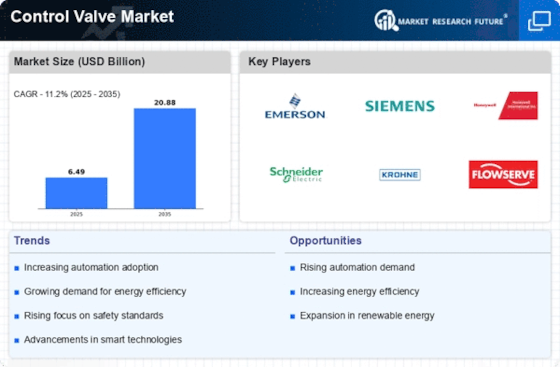
As per Market Research Future analysis, the Control Valve Market Size was estimated at 6.494 USD Billion in 2024. The Control Valve industry is projected to grow from 7.221 USD Billion in 2025 to 20.88 USD Billion by 2035, exhibiting a compound annual growth rate (CAGR) of 11% during the forecast period 2025 - 2035

Key Market Trends & Highlights

The Control Valve Market is poised for substantial growth driven by automation and sustainability initiatives.

  • North America remains the largest market for control valves, driven by robust industrial activity and technological advancements. The Asia-Pacific region is emerging as the fastest-growing market, fueled by increasing investments in process industries and infrastructure development. Ball valves continue to dominate the market, while rotary valves are experiencing rapid growth due to their efficiency in various applications. Rising demand for automation and a heightened focus on energy efficiency are key drivers propelling the market forward.

Market Size & Forecast

2024 Market Size 6.494 (USD Billion)
2035 Market Size 20.88 (USD Billion)
CAGR (2025 - 2035) 11.2%
Largest Regional Market Share in 2024 Asia Pacific

Major Players

<a href="https://www.emerson.com/en-us/automation/valves/controlvalves">Emerson Electric Co.</a> (US), Siemens AG (DE), Honeywell International Inc. (US), Schneider Electric SE (FR), KROHNE Group (DE), Flowserve Corporation (US), <a href="https://www.metso.com/portfolio/knife-gate-valve/">Metso Corporation</a> (FI), Pentair plc (GB), Valmet Corporation (FI), Cameron International Corporation (US)

Market Trends

The Control Valve Market is currently experiencing a dynamic evolution, driven by various factors that influence its growth trajectory. The increasing demand for automation across industries, particularly in oil and gas, water treatment, and power generation, appears to be a primary catalyst. As organizations seek to enhance operational efficiency and reduce costs, the integration of advanced control systems becomes paramount. Furthermore, the growing emphasis on sustainability and environmental regulations is prompting industries to adopt more efficient and eco-friendly control solutions. This shift not only aligns with regulatory requirements but also addresses the rising consumer demand for greener practices. In addition to automation and sustainability, technological advancements are reshaping the landscape of the Control Valve Market. Innovations in materials and design are leading to the development of more reliable and durable valves, which can withstand extreme conditions. Moreover, the advent of smart technologies, such as IoT and AI, is facilitating real-time monitoring and predictive maintenance, thereby enhancing the overall performance of control systems. As the market continues to evolve, stakeholders must remain vigilant to emerging trends and adapt their strategies accordingly to maintain a competitive edge.

Automation and Industry Demand

The increasing push for automation across various sectors is significantly influencing the Control Valve Market. Industries such as oil and gas, water treatment, and power generation are particularly focused on integrating advanced control systems to improve efficiency and reduce operational costs.

Sustainability and Environmental Regulations

A growing emphasis on sustainability is prompting industries to adopt more efficient control solutions. This trend aligns with stricter environmental regulations and reflects a broader consumer demand for eco-friendly practices, thereby shaping market dynamics.

Technological Advancements

Innovations in materials and design are leading to the creation of more reliable control valves. The integration of smart technologies, including IoT and AI, is enhancing real-time monitoring capabilities, which may improve overall system performance.

Control Valve Market Market Drivers

Growth in Process Industries

The expansion of process industries, including chemicals, pharmaceuticals, and food and beverage, is a significant driver for the Control Valve Market. These sectors require precise control of fluid dynamics to ensure product quality and compliance with safety standards. As the global population continues to grow, the demand for processed goods is increasing, leading to the expansion of production facilities. This growth necessitates the installation of advanced control systems, where control valves play a critical role. Market data indicates that the chemical processing industry alone is expected to witness substantial growth, further boosting the demand for control valves. Consequently, the Control Valve Market is poised for growth as process industries invest in upgrading their control systems to meet rising production demands.

Rising Demand for Automation

The increasing demand for automation across various industries is a primary driver for the Control Valve Market. As industries strive for enhanced efficiency and reduced operational costs, the integration of automated control systems becomes essential. This trend is particularly evident in sectors such as oil and gas, water treatment, and chemical processing, where precise control of fluid flow is critical. According to recent data, the automation market is projected to grow significantly, with control valves playing a pivotal role in this transformation. The need for real-time monitoring and control systems further propels the demand for advanced control valves, which are integral to automated processes. Consequently, the Control Valve Market is likely to experience substantial growth as more companies adopt automation technologies.

Increasing Focus on Energy Efficiency

Energy efficiency has emerged as a crucial consideration for industries worldwide, driving the Control Valve Market. As organizations seek to minimize energy consumption and reduce costs, the demand for energy-efficient control valves is on the rise. These valves are designed to optimize flow control, thereby enhancing system performance and reducing energy waste. Regulatory bodies are also imposing stricter energy efficiency standards, compelling industries to upgrade their systems. For instance, the implementation of energy management systems in manufacturing plants has led to a notable increase in the adoption of advanced control valves. This trend indicates that the Control Valve Market is likely to expand as companies prioritize energy-efficient solutions to meet regulatory requirements and improve their bottom line.

Regulatory Compliance and Safety Standards

Regulatory compliance and safety standards are increasingly shaping the Control Valve Market. Industries are required to adhere to stringent regulations regarding safety, environmental impact, and operational efficiency. This has led to a heightened demand for control valves that meet these regulatory requirements. For instance, the oil and gas sector faces rigorous safety standards, necessitating the use of high-quality control valves to prevent leaks and ensure safe operations. Additionally, environmental regulations are pushing industries to adopt more sustainable practices, which often involve upgrading to more efficient control systems. As companies strive to comply with these regulations, the demand for reliable and compliant control valves is expected to rise. This trend indicates that the Control Valve Market will continue to grow as industries prioritize safety and regulatory adherence.

Technological Innovations in Control Systems

Technological advancements in control systems are significantly influencing the Control Valve Market. Innovations such as smart valves, which incorporate IoT technology, are transforming traditional control mechanisms. These smart valves offer enhanced monitoring capabilities, predictive maintenance, and improved data analytics, allowing for more efficient operations. The integration of artificial intelligence and machine learning into control systems further enhances the functionality of control valves, enabling real-time adjustments based on system performance. As industries increasingly adopt these advanced technologies, the demand for innovative control valves is expected to rise. This shift towards smarter control solutions suggests that the Control Valve Market will continue to evolve, driven by the need for improved operational efficiency and reliability.

Market Segment Insights

By Valve Type: Ball Valves (Largest) vs. Rotary Valves (Fastest-Growing)

<p>The Control Valve Market showcases a diverse segmentation among various valve types, prominently featuring <a href="https://www.marketresearchfuture.com/reports/ball-valves-market-3349" target="_blank" title="ball valves">ball valves</a>, which hold the largest market share due to their superior reliability and versatility across multiple applications. Following closely are rotary valves and globe valves, while other types such as diaphragm and plug valves, contribute to market diversity with niche applications tailored to specific industrial needs. The segmentation indicates a well-balanced adoption of various valve types, ensuring efficiency and operational flexibility in control processes. Recent trends identify rotary valves as the fastest-growing segment, driven by advancements in technology and increasing automation demands in industries such as oil and gas, water management, and pharmaceuticals. The shift towards more energy-efficient processes and the rise of smart manufacturing also play a pivotal role, as companies seek to enhance performance and reduce downtime. Consequently, the growth trajectory of rotary valves reflects a wider industry push towards innovative solutions that meet the evolving operational requirements.</p>

<p>Ball Valves (Dominant) vs. Rotary Valves (Emerging)</p>

<p>Ball valves are recognized as the dominant player in the Control Valve Market, praised for their ability to provide a tight seal and substantial flow control, facilitating operational efficiency in various industrial applications. Their simplistic design is coupled with durable materials, making them a reliable choice for high-pressure and temperature systems. In contrast, rotary valves, classified as emerging, are gaining traction due to their compact structure and capability for quick opening and closing operations, appealing to sectors requiring rapid response and precise flow regulation. As industries focus on automation and smart technologies, the adaptability of rotary valves positions them increasingly favorably within the market, marking their growing importance as manufacturers seek to integrate more responsive control solutions.</p>

By Material: Stainless Steel (Largest) vs. Alloy-based (Fastest-Growing)

<p>In the Control Valve Market, the material segment is primarily dominated by <a href="https://www.marketresearchfuture.com/reports/stainless-steel-market-16145" target="_blank" title="stainless steel">Stainless Steel</a>, which commands the largest market share due to its durability, resistance to corrosion, and suitability for high-pressure applications. Following closely, Cast Iron has a significant presence, mainly in low-pressure applications, while Alloy-based valves show a growing trend as they combine properties of various metals, enhancing performance in specialized applications. Cryogenic valves, though less common, cater to specific industries requiring extreme temperature handling, whereas Others encompasses niche materials that serve unique market needs.</p>

<p>Stainless Steel (Dominant) vs. Alloy-based (Emerging)</p>

<p>Stainless Steel valves are renowned for their resilience and versatility, making them the dominant choice in various industries including oil and gas, chemicals, and water treatment. They offer excellent corrosion resistance and strength, making them ideal for demanding environments. On the other hand, Alloy-based valves are rapidly emerging, leveraging advanced materials to provide enhanced performance and longer life cycles. These valves often cater to specific applications requiring unique characteristics such as high-temperature resilience or tailored chemical resistance, making them increasingly attractive to manufacturers looking to optimize efficiency and reliability in challenging conditions.</p>

By Valve Size: 1" TO 6" (Largest) vs. BELOW 1" (Fastest-Growing)

<p>In the Control Valve Market, the distribution of market share among valve sizes highlights the dominance of the 1" to 6" segment, which holds the largest share due to its widespread applications across various industries including process control and fluid handling. This segment caters to a broad range of users, making it integral to current market trends. In contrast, the below 1" category is experiencing rapid growth, attributed to an increasing demand for compact and efficient solutions in applications like microfluidics and automation.</p>

<p>1" TO 6" (Dominant) vs. BELOW 1" (Emerging)</p>

<p>The 1" to 6" valve size segment remains a dominant force in the Control Valve Market, primarily due to its versatility and compatibility with a variety of systems. This size range is pivotal for industries such as oil and gas, water treatment, and HVAC, ensuring it meets diverse operational needs. On the other hand, the below 1" segment is emerging quickly, driven by advancements in technology and a surge in automation projects. These smaller valves are crucial for applications requiring precise control and operational efficiency, positioning them as essential components in developing high-tech environments and processes.</p>

By Component: Valve Body (Largest) vs. Actuator (Fastest-Growing)

<p>The component segment of the control valve market is primarily dominated by the valve body, which plays a key role in ensuring the overall performance and durability of the valves. The actuator segment is also significant, characterized by its commitment to enhancing operational efficiency and responsiveness. The 'Others' category encompasses diverse components that are essential but less impactful on the overall market share when compared to valve bodies and <a href="https://www.marketresearchfuture.com/reports/actuators-market-5806" target="_blank" title="actuators">actuators</a>. This diverse range of components contributes to the complexity and adaptability of control valve systems in various applications across industries.</p>

<p>Valve Body (Dominant) vs. Actuator (Emerging)</p>

<p>The valve body stands as the cornerstone of the control valve market, offering robust structural integrity and reliability essential for fluid regulation in various industrial applications. This dominant component is designed to withstand high pressures and corrosive substances, making it indispensable for longevity and consistent operation. On the other hand, actuators are rapidly emerging due to technological advancements and an increasing need for automation and precision in control systems. Actuators enhance valve function by providing precise movement control, significantly improving efficiency and response times in processes. As industries seek smarter and more automated solutions, the actuator segment is gaining traction, indicating a shift in demand towards these innovative control components.</p>

By End-Use: Oil & Gas (Largest) vs. Water & Wastewater Treatment (Fastest-Growing)

<p>In the Control Valve Market, the Oil & Gas segment holds the largest share, driven by the extensive use of control valves in exploration, production, and distribution processes. This segment benefits from a high demand for efficient and reliable flow control solutions to enhance operational safety and efficiency. Other significant segments include Water & Wastewater Treatment, which is progressively gaining traction as infrastructure investments and sustainability mandates increase globally.</p>

<p>Oil & Gas (Dominant) vs. Water & Wastewater Treatment (Emerging)</p>

<p>The Oil & Gas sector remains the dominant player in the Control Valve Market due to its significant applications across upstream, midstream, and downstream operations, requiring high-performance valves for fluid regulation. This segment emphasizes durability, precision, and advanced technology to withstand harsh environments. In contrast, the Water & Wastewater Treatment segment is emerging rapidly, driven by increasing regulatory pressure for improved water quality and aging infrastructure. This shift is leading to greater investments in modern control systems that enhance operational efficiency and compliance, positioning Water & Wastewater Treatment as a key growth area in the market.</p>

By Technology: Hall Effect Sensor (Largest) vs. Digital Fieldbus Protocols (Fastest-Growing)

<p>The Control Valve Market is witnessing a significant distribution in technology segment values, with Hall effect sensors leading the charge as the largest contributor. These sensors are favored for their accuracy and reliability in controlling valve operations, enabling better performance and operational efficiency in industrial applications. On the other hand, digital fieldbus protocols are emerging rapidly, facilitating seamless communication between devices, thus streamlining operations and enhancing automation capabilities. As industries continue to evolve towards digitalization, the share of these protocols is expanding noticeably.</p>

<p>Technology: Hall Effect Sensor (Dominant) vs. Digital Fieldbus Protocols (Emerging)</p>

<p>Hall effect sensors are renowned for their precision in detecting the position of the valve, which ensures optimal control in various applications, making them a dominant force in the control valve market. Their robustness and low maintenance requirements appeal to a broad range of industries, driving their widespread adoption. Conversely, digital fieldbus protocols represent an emerging technology that is capitalizing on the need for enhanced connectivity and integration in automated systems. As organizations strive for increased efficiency and data exchange, the use of these protocols is expected to surge, ensuring better communication between components and paving the way for smarter, more efficient control systems.</p>

By Vertical: Pharma (Largest) vs. Oil and Gas (Fastest-Growing)

<p>The control valve market shows a diverse distribution across various verticals, with the Pharmaceutical sector taking the lead as the largest segment. This dominance is attributed to stringent regulations and the need for precise control over processes in drug manufacturing. Following behind, the Oil and Gas industry is making significant inroads, capitalizing on the increasing demand for energy and the ongoing exploration activities worldwide. Other sectors such as Food and Beverage and Chemicals also contribute significantly to the overall market, each presenting unique requirements for control systems.</p>

<p>Pharmaceutical (Dominant) vs. Oil and Gas (Emerging)</p>

<p>The Pharmaceutical sector has established itself as the dominant force in the control valve market, with a focus on maintaining high standards of precision and compliance with regulatory standards. Control valves in this sector are critical for ensuring product quality and safety in sensitive applications. Conversely, the Oil and Gas industry represents an emerging segment where rapid technological advancements are enhancing operational efficiencies. With a push towards automation and safety in extraction and refining processes, the adoption of sophisticated control valves is accelerating within this vertical, positioning it as a key player in the market.</p>

Get more detailed insights about Control Valve Market Research Report - Forecast 2035

Regional Insights

North America : Innovation and Demand Surge

North America is the largest market for control valves, holding approximately 40% of the global share. The region's growth is driven by increasing investments in infrastructure, energy efficiency initiatives, and stringent regulatory standards. The demand for advanced automation in industries such as oil and gas, water treatment, and manufacturing further propels market expansion. Regulatory catalysts, including the Clean Water Act, enhance the need for efficient control systems. The United States dominates the North American market, with significant contributions from Canada and Mexico. Key players like Emerson Electric Co. and Honeywell International Inc. are at the forefront, leveraging technological advancements to enhance product offerings. The competitive landscape is characterized by a mix of established firms and emerging players, all striving to innovate and meet the evolving demands of various sectors.

Europe : Regulatory Framework Drives Growth

Europe is a significant player in the control valve market, accounting for approximately 30% of the global share. The region's growth is fueled by stringent environmental regulations and a strong focus on energy efficiency. The European Union's directives on emissions and energy consumption are key drivers, pushing industries to adopt advanced control systems. Countries like Germany and France lead the market, supported by robust manufacturing capabilities and technological advancements. Germany is the largest market in Europe, followed closely by France and the UK. The competitive landscape features major players such as Siemens AG and Schneider Electric SE, who are investing heavily in R&D to develop innovative solutions. The presence of a well-established industrial base and a growing emphasis on automation further enhance the market's potential. The European market is characterized by a blend of established companies and innovative startups, fostering a dynamic environment for growth.

Asia-Pacific : Emerging Markets and Growth Potential

Asia-Pacific is an emerging powerhouse in the control valve market, holding approximately 25% of the global share. The region's rapid industrialization, urbanization, and increasing energy demands are key growth drivers. Countries like China and India are leading the charge, with significant investments in infrastructure and energy projects. Regulatory support for sustainable practices is also catalyzing market growth, as governments push for modernization in various sectors. China is the largest market in the region, followed by India and Japan. The competitive landscape is marked by both local and international players, including KROHNE Group and Flowserve Corporation. The presence of a large manufacturing base and a growing focus on automation technologies are enhancing the market's attractiveness. As industries evolve, the demand for advanced control solutions is expected to rise, positioning Asia-Pacific as a critical region for future growth.

Middle East and Africa : Resource-Rich Market Dynamics

The Middle East and Africa region is witnessing a gradual increase in the control valve market, holding approximately 5% of the global share. The growth is primarily driven by the oil and gas sector, which is a significant contributor to the region's economy. Additionally, increasing investments in water management and infrastructure development are creating new opportunities for control valve applications. Regulatory frameworks are evolving to support sustainable practices, further enhancing market potential. Countries like Saudi Arabia and South Africa are leading the market, with substantial investments in energy and water projects. The competitive landscape includes both local manufacturers and international players, such as Metso Corporation and Pentair plc. The region's unique challenges, including political instability and economic fluctuations, require innovative solutions, making it a dynamic market for control valve technologies.

Key Players and Competitive Insights

The Control Valve Market is currently characterized by a dynamic competitive landscape, driven by technological advancements and increasing demand across various sectors, including oil and gas, water and wastewater, and power generation. Key players such as Emerson Electric Co. (US), Siemens AG (DE), and Honeywell International Inc. (US) are strategically positioned to leverage their extensive portfolios and innovative capabilities. Emerson Electric Co. (US) focuses on digital transformation and automation solutions, enhancing operational efficiency for its clients. Siemens AG (DE) emphasizes sustainability and energy efficiency, aligning its product offerings with global environmental goals. Honeywell International Inc. (US) is investing heavily in smart technologies, aiming to integrate AI and IoT into its control valve solutions, thereby enhancing performance and reliability. Collectively, these strategies not only bolster their market positions but also shape the competitive environment by fostering innovation and responsiveness to market needs.

In terms of business tactics, companies are increasingly localizing manufacturing to reduce lead times and optimize supply chains. This approach appears to be a response to the growing demand for customized solutions and the need for agility in production. The Control Valve Market is moderately fragmented, with a mix of established players and emerging companies. The collective influence of key players is significant, as they set industry standards and drive technological advancements that smaller firms often follow.

In August 2025, Emerson Electric Co. (US) announced the launch of a new line of smart control valves designed to enhance process automation in industrial applications. This strategic move is pivotal as it not only reinforces Emerson's commitment to innovation but also positions the company to capture a larger share of the growing automation market. The integration of advanced sensors and AI capabilities into these valves is expected to improve operational efficiency and reduce downtime for clients.

In September 2025, Siemens AG (DE) unveiled a partnership with a leading renewable energy firm to develop control valve solutions tailored for wind energy applications. This collaboration is strategically important as it aligns Siemens with the burgeoning renewable sector, potentially opening new revenue streams while reinforcing its commitment to sustainability. By focusing on renewable energy, Siemens is likely to enhance its competitive edge in a market increasingly oriented towards eco-friendly solutions.

In July 2025, Honeywell International Inc. (US) expanded its digital offerings by acquiring a software company specializing in AI-driven analytics for industrial applications. This acquisition is significant as it allows Honeywell to integrate advanced analytics into its control valve products, thereby enhancing their functionality and appeal. The move reflects a broader trend in the industry towards the integration of AI and data analytics, which is becoming essential for maintaining competitive differentiation.

As of October 2025, the Control Valve Market is witnessing trends such as digitalization, sustainability, and AI integration, which are redefining competitive dynamics. Strategic alliances are increasingly shaping the landscape, enabling companies to pool resources and expertise to innovate more effectively. Looking ahead, competitive differentiation is likely to evolve from traditional price-based competition to a focus on innovation, technology integration, and supply chain reliability. Companies that can effectively harness these trends will likely emerge as leaders in the market.

Key Companies in the Control Valve Market include

Industry Developments

Q2 2024: Emerson Launches New Fisher FIELDVUE DVC7K Digital Valve Controller Emerson announced the release of its Fisher FIELDVUE DVC7K digital valve controller, designed to improve reliability and performance in process control applications. The new product features advanced diagnostics and connectivity for industrial automation.

Q2 2024: Flowserve Expands Manufacturing Facility in Chennai, India Flowserve inaugurated an expanded manufacturing facility in Chennai to increase production capacity for control valves and related flow control products, aiming to meet growing demand in the Asia-Pacific region.

Q2 2024: Rotork Appoints New CEO, Kiet Huynh Rotork announced the appointment of Kiet Huynh as Chief Executive Officer, effective May 2024, to lead the company’s global flow control and automation business, including its control valve segment.

Q3 2024: Metso Launches Neles NDX 2.0 Intelligent Valve Controller Metso introduced the Neles NDX 2.0, an intelligent valve controller designed for improved process efficiency and digital integration in control valve applications across multiple industries.

Q3 2024: Baker Hughes Wins Major LNG Project Valve Contract in Qatar Baker Hughes secured a significant contract to supply control valves and flow control solutions for a major LNG expansion project in Qatar, supporting the country’s energy infrastructure growth.

Q3 2024: SAMSON Opens New Digital Innovation Center in Frankfurt SAMSON AG opened a new Digital Innovation Center in Frankfurt, Germany, focused on developing smart control valve technologies and digital process automation solutions.

Q4 2024: Emerson Acquires Afag Holding AG to Expand Automation Portfolio Emerson completed the acquisition of Afag Holding AG, a provider of automation and control solutions, to strengthen its position in the global control valve and industrial automation markets.

Q4 2024: Siemens Launches New Modular Control Valve Market Platform for Process Industries Siemens introduced a modular control valve platform designed for flexible integration and enhanced performance in process industries, targeting applications in chemicals, oil & gas, and water treatment.

Q1 2025: IMI plc Announces Strategic Partnership with Honeywell for Smart Valve Solutions IMI plc entered into a strategic partnership with Honeywell to co-develop smart control valve solutions, leveraging digital technologies for predictive maintenance and process optimization.

Q1 2025: Schneider Electric Unveils EcoStruxure Control Valve Market Analytics Platform Schneider Electric launched the EcoStruxure Control Valve Market Analytics platform, a cloud-based solution for real-time monitoring and predictive diagnostics of industrial control valves.

Q2 2025: Valmet Wins Major Pulp Mill Control Valve Market Supply Contract in Brazil Valmet secured a contract to supply control valves and automation systems for a new pulp mill project in Brazil, supporting the country’s growing forestry and paper industry.

Q2 2025: Pentair Opens New Valve Manufacturing Facility in Texas Pentair inaugurated a new manufacturing facility in Texas dedicated to the production of industrial control valves, aiming to enhance supply chain resilience and serve North American customers more efficiently.

Future Outlook

Control Valve Market Future Outlook

The Control Valve Market is projected to grow at 11.2% CAGR from 2024 to 2035, driven by industrial automation, energy efficiency, and technological advancements.

New opportunities lie in:

  • Integration of IoT for predictive maintenance solutions.
  • Development of energy-efficient valve technologies for sustainability.
  • Expansion into emerging markets with tailored product offerings.

By 2035, the Control Valve Market is expected to achieve robust growth, reflecting evolving industrial needs.

Market Segmentation

Control Valve Market End-Use Outlook

  • Oil & Gas
  • Water & Wastewater Treatment
  • Energy & Power
  • Chemicals
  • Food & Beverage
  • Others

Control Valve Market Material Outlook

  • Stainless Steel
  • Cast Iron
  • Alloy-based
  • Cryogenic
  • Others

Control Valve Market Vertical Outlook

  • Pharma
  • Food and Beverage
  • Chemicals
  • Energy and Power
  • Water and Wastewater Treatment
  • Oil and Gas

Control Valve Market Component Outlook

  • Valve Body
  • Actuator
  • Others

Control Valve Market Technology Outlook

  • Hall effect sensor
  • Digital Fieldbus protocols

Control Valve Market Valve Size Outlook

  • BELOW 1”
  • 1” TO 6”
  • 25” TO 50”
  • ABOVE 50”

Control Valve Market Valve Type Outlook

  • Rotary valves
  • ball valves
  • butterfly valves
  • plug valve
  • linear valves
  • globe valves
  • diaphragm valves
  • others

Report Scope

MARKET SIZE 20246.494(USD Billion)
MARKET SIZE 20257.221(USD Billion)
MARKET SIZE 203520.88(USD Billion)
COMPOUND ANNUAL GROWTH RATE (CAGR)11.2% (2024 - 2035)
REPORT COVERAGERevenue Forecast, Competitive Landscape, Growth Factors, and Trends
BASE YEAR2024
Market Forecast Period2025 - 2035
Historical Data2019 - 2024
Market Forecast UnitsUSD Billion
Key Companies ProfiledMarket analysis in progress
Segments CoveredMarket segmentation analysis in progress
Key Market OpportunitiesIntegration of smart technologies enhances efficiency and precision in the Control Valve Market.
Key Market DynamicsRising demand for automation in industrial processes drives innovation and competition in the control valve market.
Countries CoveredNorth America, Europe, APAC, South America, MEA

FAQs

What is the projected market valuation of the Control Valve Market by 2035?

<p>The Control Valve Market is projected to reach a valuation of 20.88 USD Billion by 2035.</p>

What was the market valuation of the Control Valve Market in 2024?

<p>In 2024, the Control Valve Market was valued at 6.494 USD Billion.</p>

What is the expected CAGR for the Control Valve Market during the forecast period 2025 - 2035?

<p>The expected CAGR for the Control Valve Market during the forecast period 2025 - 2035 is 11.2%.</p>

Which companies are considered key players in the Control Valve Market?

<p>Key players in the Control Valve Market include Emerson Electric Co., Siemens AG, Honeywell International Inc., and Schneider Electric SE.</p>

What are the main segments of the Control Valve Market based on valve type?

<p>The main segments based on valve type include rotary valves, ball valves, butterfly valves, and plug valves.</p>

How does the market size for stainless steel valves compare to cast iron valves?

<p>The market size for stainless steel valves is projected at 8.0 USD Billion, whereas cast iron valves are projected at 4.5 USD Billion.</p>

What is the anticipated market size for the Control Valve Market in the oil and gas sector by 2035?

<p>The anticipated market size for the Control Valve Market in the oil and gas sector is expected to reach 2.088 USD Billion by 2035.</p>

What is the projected market size for digital fieldbus protocols in the Control Valve Market?

<p>The projected market size for digital fieldbus protocols in the Control Valve Market is 12.76 USD Billion.</p>

Which valve size segment is expected to have the highest market valuation by 2035?

<p>The valve size segment '1” TO 6”' is expected to have the highest market valuation, projected at 8.0 USD Billion by 2035.</p>

What is the expected market size for diaphragm valves by 2035?

<p>The expected market size for diaphragm valves is projected to reach 2.08 USD Billion by 2035.</p>

  1. SECTION I: EXECUTIVE SUMMARY AND KEY HIGHLIGHTS
    1. | 1.1 EXECUTIVE SUMMARY
    2. | | 1.1.1 Market Overview
    3. | | 1.1.2 Key Findings
    4. | | 1.1.3 Market Segmentation
    5. | | 1.1.4 Competitive Landscape
    6. | | 1.1.5 Challenges and Opportunities
    7. | | 1.1.6 Future Outlook
  2. SECTION II: SCOPING, METHODOLOGY AND MARKET STRUCTURE
    1. | 2.1 MARKET INTRODUCTION
    2. | | 2.1.1 Definition
    3. | | 2.1.2 Scope of the study
    4. | | | 2.1.2.1 Research Objective
    5. | | | 2.1.2.2 Assumption
    6. | | | 2.1.2.3 Limitations
    7. | 2.2 RESEARCH METHODOLOGY
    8. | | 2.2.1 Overview
    9. | | 2.2.2 Data Mining
    10. | | 2.2.3 Secondary Research
    11. | | 2.2.4 Primary Research
    12. | | | 2.2.4.1 Primary Interviews and Information Gathering Process
    13. | | | 2.2.4.2 Breakdown of Primary Respondents
    14. | | 2.2.5 Forecasting Model
    15. | | 2.2.6 Market Size Estimation
    16. | | | 2.2.6.1 Bottom-Up Approach
    17. | | | 2.2.6.2 Top-Down Approach
    18. | | 2.2.7 Data Triangulation
    19. | | 2.2.8 Validation
  3. SECTION III: QUALITATIVE ANALYSIS
    1. | 3.1 MARKET DYNAMICS
    2. | | 3.1.1 Overview
    3. | | 3.1.2 Drivers
    4. | | 3.1.3 Restraints
    5. | | 3.1.4 Opportunities
    6. | 3.2 MARKET FACTOR ANALYSIS
    7. | | 3.2.1 Value chain Analysis
    8. | | 3.2.2 Porter's Five Forces Analysis
    9. | | | 3.2.2.1 Bargaining Power of Suppliers
    10. | | | 3.2.2.2 Bargaining Power of Buyers
    11. | | | 3.2.2.3 Threat of New Entrants
    12. | | | 3.2.2.4 Threat of Substitutes
    13. | | | 3.2.2.5 Intensity of Rivalry
    14. | | 3.2.3 COVID-19 Impact Analysis
    15. | | | 3.2.3.1 Market Impact Analysis
    16. | | | 3.2.3.2 Regional Impact
    17. | | | 3.2.3.3 Opportunity and Threat Analysis
  4. SECTION IV: QUANTITATIVE ANALYSIS
    1. | 4.1 Energy & Power, BY Valve Type (USD Billion)
    2. | | 4.1.1 Rotary valves
    3. | | 4.1.2 ball valves
    4. | | 4.1.3 butterfly valves
    5. | | 4.1.4 plug valve
    6. | | 4.1.5 linear valves
    7. | | 4.1.6 globe valves
    8. | | 4.1.7 diaphragm valves
    9. | | 4.1.8 others
    10. | 4.2 Energy & Power, BY Material (USD Billion)
    11. | | 4.2.1 Stainless Steel
    12. | | 4.2.2 Cast Iron
    13. | | 4.2.3 Alloy-based
    14. | | 4.2.4 Cryogenic
    15. | | 4.2.5 Others
    16. | 4.3 Energy & Power, BY Valve Size (USD Billion)
    17. | | 4.3.1 BELOW 1”
    18. | | 4.3.2 1” TO 6”
    19. | | 4.3.3 25” TO 50”
    20. | | 4.3.4 ABOVE 50”
    21. | 4.4 Energy & Power, BY Component (USD Billion)
    22. | | 4.4.1 Valve Body
    23. | | 4.4.2 Actuator
    24. | | 4.4.3 Others
    25. | 4.5 Energy & Power, BY End-Use (USD Billion)
    26. | | 4.5.1 Oil & Gas
    27. | | 4.5.2 Water & Wastewater Treatment
    28. | | 4.5.3 Energy & Power
    29. | | 4.5.4 Chemicals
    30. | | 4.5.5 Food & Beverage
    31. | | 4.5.6 Others
    32. | 4.6 Energy & Power, BY Technology (USD Billion)
    33. | | 4.6.1 Hall effect sensor
    34. | | 4.6.2 Digital Fieldbus protocols
    35. | 4.7 Energy & Power, BY Vertical (USD Billion)
    36. | | 4.7.1 Pharma
    37. | | 4.7.2 Food and Beverage
    38. | | 4.7.3 Chemicals
    39. | | 4.7.4 Energy and Power
    40. | | 4.7.5 Water and Wastewater Treatment
    41. | | 4.7.6 Oil and Gas
    42. | 4.8 Energy & Power, BY Region (USD Billion)
    43. | | 4.8.1 North America
    44. | | | 4.8.1.1 US
    45. | | | 4.8.1.2 Canada
    46. | | 4.8.2 Europe
    47. | | | 4.8.2.1 Germany
    48. | | | 4.8.2.2 UK
    49. | | | 4.8.2.3 France
    50. | | | 4.8.2.4 Russia
    51. | | | 4.8.2.5 Italy
    52. | | | 4.8.2.6 Spain
    53. | | | 4.8.2.7 Rest of Europe
    54. | | 4.8.3 APAC
    55. | | | 4.8.3.1 China
    56. | | | 4.8.3.2 India
    57. | | | 4.8.3.3 Japan
    58. | | | 4.8.3.4 South Korea
    59. | | | 4.8.3.5 Malaysia
    60. | | | 4.8.3.6 Thailand
    61. | | | 4.8.3.7 Indonesia
    62. | | | 4.8.3.8 Rest of APAC
    63. | | 4.8.4 South America
    64. | | | 4.8.4.1 Brazil
    65. | | | 4.8.4.2 Mexico
    66. | | | 4.8.4.3 Argentina
    67. | | | 4.8.4.4 Rest of South America
    68. | | 4.8.5 MEA
    69. | | | 4.8.5.1 GCC Countries
    70. | | | 4.8.5.2 South Africa
    71. | | | 4.8.5.3 Rest of MEA
  5. SECTION V: COMPETITIVE ANALYSIS
    1. | 5.1 Competitive Landscape
    2. | | 5.1.1 Overview
    3. | | 5.1.2 Competitive Analysis
    4. | | 5.1.3 Market share Analysis
    5. | | 5.1.4 Major Growth Strategy in the Energy & Power
    6. | | 5.1.5 Competitive Benchmarking
    7. | | 5.1.6 Leading Players in Terms of Number of Developments in the Energy & Power
    8. | | 5.1.7 Key developments and growth strategies
    9. | | | 5.1.7.1 New Product Launch/Service Deployment
    10. | | | 5.1.7.2 Merger & Acquisitions
    11. | | | 5.1.7.3 Joint Ventures
    12. | | 5.1.8 Major Players Financial Matrix
    13. | | | 5.1.8.1 Sales and Operating Income
    14. | | | 5.1.8.2 Major Players R&D Expenditure. 2023
    15. | 5.2 Company Profiles
    16. | | 5.2.1 Emerson Electric Co. (US)
    17. | | | 5.2.1.1 Financial Overview
    18. | | | 5.2.1.2 Products Offered
    19. | | | 5.2.1.3 Key Developments
    20. | | | 5.2.1.4 SWOT Analysis
    21. | | | 5.2.1.5 Key Strategies
    22. | | 5.2.2 Siemens AG (DE)
    23. | | | 5.2.2.1 Financial Overview
    24. | | | 5.2.2.2 Products Offered
    25. | | | 5.2.2.3 Key Developments
    26. | | | 5.2.2.4 SWOT Analysis
    27. | | | 5.2.2.5 Key Strategies
    28. | | 5.2.3 Honeywell International Inc. (US)
    29. | | | 5.2.3.1 Financial Overview
    30. | | | 5.2.3.2 Products Offered
    31. | | | 5.2.3.3 Key Developments
    32. | | | 5.2.3.4 SWOT Analysis
    33. | | | 5.2.3.5 Key Strategies
    34. | | 5.2.4 Schneider Electric SE (FR)
    35. | | | 5.2.4.1 Financial Overview
    36. | | | 5.2.4.2 Products Offered
    37. | | | 5.2.4.3 Key Developments
    38. | | | 5.2.4.4 SWOT Analysis
    39. | | | 5.2.4.5 Key Strategies
    40. | | 5.2.5 KROHNE Group (DE)
    41. | | | 5.2.5.1 Financial Overview
    42. | | | 5.2.5.2 Products Offered
    43. | | | 5.2.5.3 Key Developments
    44. | | | 5.2.5.4 SWOT Analysis
    45. | | | 5.2.5.5 Key Strategies
    46. | | 5.2.6 Flowserve Corporation (US)
    47. | | | 5.2.6.1 Financial Overview
    48. | | | 5.2.6.2 Products Offered
    49. | | | 5.2.6.3 Key Developments
    50. | | | 5.2.6.4 SWOT Analysis
    51. | | | 5.2.6.5 Key Strategies
    52. | | 5.2.7 Metso Corporation (FI)
    53. | | | 5.2.7.1 Financial Overview
    54. | | | 5.2.7.2 Products Offered
    55. | | | 5.2.7.3 Key Developments
    56. | | | 5.2.7.4 SWOT Analysis
    57. | | | 5.2.7.5 Key Strategies
    58. | | 5.2.8 Pentair plc (GB)
    59. | | | 5.2.8.1 Financial Overview
    60. | | | 5.2.8.2 Products Offered
    61. | | | 5.2.8.3 Key Developments
    62. | | | 5.2.8.4 SWOT Analysis
    63. | | | 5.2.8.5 Key Strategies
    64. | | 5.2.9 Valmet Corporation (FI)
    65. | | | 5.2.9.1 Financial Overview
    66. | | | 5.2.9.2 Products Offered
    67. | | | 5.2.9.3 Key Developments
    68. | | | 5.2.9.4 SWOT Analysis
    69. | | | 5.2.9.5 Key Strategies
    70. | | 5.2.10 Cameron International Corporation (US)
    71. | | | 5.2.10.1 Financial Overview
    72. | | | 5.2.10.2 Products Offered
    73. | | | 5.2.10.3 Key Developments
    74. | | | 5.2.10.4 SWOT Analysis
    75. | | | 5.2.10.5 Key Strategies
    76. | 5.3 Appendix
    77. | | 5.3.1 References
    78. | | 5.3.2 Related Reports
  6. LIST OF FIGURES
    1. | 6.1 MARKET SYNOPSIS
    2. | 6.2 NORTH AMERICA MARKET ANALYSIS
    3. | 6.3 US MARKET ANALYSIS BY VALVE TYPE
    4. | 6.4 US MARKET ANALYSIS BY MATERIAL
    5. | 6.5 US MARKET ANALYSIS BY VALVE SIZE
    6. | 6.6 US MARKET ANALYSIS BY COMPONENT
    7. | 6.7 US MARKET ANALYSIS BY END-USE
    8. | 6.8 US MARKET ANALYSIS BY TECHNOLOGY
    9. | 6.9 US MARKET ANALYSIS BY VERTICAL
    10. | 6.10 CANADA MARKET ANALYSIS BY VALVE TYPE
    11. | 6.11 CANADA MARKET ANALYSIS BY MATERIAL
    12. | 6.12 CANADA MARKET ANALYSIS BY VALVE SIZE
    13. | 6.13 CANADA MARKET ANALYSIS BY COMPONENT
    14. | 6.14 CANADA MARKET ANALYSIS BY END-USE
    15. | 6.15 CANADA MARKET ANALYSIS BY TECHNOLOGY
    16. | 6.16 CANADA MARKET ANALYSIS BY VERTICAL
    17. | 6.17 EUROPE MARKET ANALYSIS
    18. | 6.18 GERMANY MARKET ANALYSIS BY VALVE TYPE
    19. | 6.19 GERMANY MARKET ANALYSIS BY MATERIAL
    20. | 6.20 GERMANY MARKET ANALYSIS BY VALVE SIZE
    21. | 6.21 GERMANY MARKET ANALYSIS BY COMPONENT
    22. | 6.22 GERMANY MARKET ANALYSIS BY END-USE
    23. | 6.23 GERMANY MARKET ANALYSIS BY TECHNOLOGY
    24. | 6.24 GERMANY MARKET ANALYSIS BY VERTICAL
    25. | 6.25 UK MARKET ANALYSIS BY VALVE TYPE
    26. | 6.26 UK MARKET ANALYSIS BY MATERIAL
    27. | 6.27 UK MARKET ANALYSIS BY VALVE SIZE
    28. | 6.28 UK MARKET ANALYSIS BY COMPONENT
    29. | 6.29 UK MARKET ANALYSIS BY END-USE
    30. | 6.30 UK MARKET ANALYSIS BY TECHNOLOGY
    31. | 6.31 UK MARKET ANALYSIS BY VERTICAL
    32. | 6.32 FRANCE MARKET ANALYSIS BY VALVE TYPE
    33. | 6.33 FRANCE MARKET ANALYSIS BY MATERIAL
    34. | 6.34 FRANCE MARKET ANALYSIS BY VALVE SIZE
    35. | 6.35 FRANCE MARKET ANALYSIS BY COMPONENT
    36. | 6.36 FRANCE MARKET ANALYSIS BY END-USE
    37. | 6.37 FRANCE MARKET ANALYSIS BY TECHNOLOGY
    38. | 6.38 FRANCE MARKET ANALYSIS BY VERTICAL
    39. | 6.39 RUSSIA MARKET ANALYSIS BY VALVE TYPE
    40. | 6.40 RUSSIA MARKET ANALYSIS BY MATERIAL
    41. | 6.41 RUSSIA MARKET ANALYSIS BY VALVE SIZE
    42. | 6.42 RUSSIA MARKET ANALYSIS BY COMPONENT
    43. | 6.43 RUSSIA MARKET ANALYSIS BY END-USE
    44. | 6.44 RUSSIA MARKET ANALYSIS BY TECHNOLOGY
    45. | 6.45 RUSSIA MARKET ANALYSIS BY VERTICAL
    46. | 6.46 ITALY MARKET ANALYSIS BY VALVE TYPE
    47. | 6.47 ITALY MARKET ANALYSIS BY MATERIAL
    48. | 6.48 ITALY MARKET ANALYSIS BY VALVE SIZE
    49. | 6.49 ITALY MARKET ANALYSIS BY COMPONENT
    50. | 6.50 ITALY MARKET ANALYSIS BY END-USE
    51. | 6.51 ITALY MARKET ANALYSIS BY TECHNOLOGY
    52. | 6.52 ITALY MARKET ANALYSIS BY VERTICAL
    53. | 6.53 SPAIN MARKET ANALYSIS BY VALVE TYPE
    54. | 6.54 SPAIN MARKET ANALYSIS BY MATERIAL
    55. | 6.55 SPAIN MARKET ANALYSIS BY VALVE SIZE
    56. | 6.56 SPAIN MARKET ANALYSIS BY COMPONENT
    57. | 6.57 SPAIN MARKET ANALYSIS BY END-USE
    58. | 6.58 SPAIN MARKET ANALYSIS BY TECHNOLOGY
    59. | 6.59 SPAIN MARKET ANALYSIS BY VERTICAL
    60. | 6.60 REST OF EUROPE MARKET ANALYSIS BY VALVE TYPE
    61. | 6.61 REST OF EUROPE MARKET ANALYSIS BY MATERIAL
    62. | 6.62 REST OF EUROPE MARKET ANALYSIS BY VALVE SIZE
    63. | 6.63 REST OF EUROPE MARKET ANALYSIS BY COMPONENT
    64. | 6.64 REST OF EUROPE MARKET ANALYSIS BY END-USE
    65. | 6.65 REST OF EUROPE MARKET ANALYSIS BY TECHNOLOGY
    66. | 6.66 REST OF EUROPE MARKET ANALYSIS BY VERTICAL
    67. | 6.67 APAC MARKET ANALYSIS
    68. | 6.68 CHINA MARKET ANALYSIS BY VALVE TYPE
    69. | 6.69 CHINA MARKET ANALYSIS BY MATERIAL
    70. | 6.70 CHINA MARKET ANALYSIS BY VALVE SIZE
    71. | 6.71 CHINA MARKET ANALYSIS BY COMPONENT
    72. | 6.72 CHINA MARKET ANALYSIS BY END-USE
    73. | 6.73 CHINA MARKET ANALYSIS BY TECHNOLOGY
    74. | 6.74 CHINA MARKET ANALYSIS BY VERTICAL
    75. | 6.75 INDIA MARKET ANALYSIS BY VALVE TYPE
    76. | 6.76 INDIA MARKET ANALYSIS BY MATERIAL
    77. | 6.77 INDIA MARKET ANALYSIS BY VALVE SIZE
    78. | 6.78 INDIA MARKET ANALYSIS BY COMPONENT
    79. | 6.79 INDIA MARKET ANALYSIS BY END-USE
    80. | 6.80 INDIA MARKET ANALYSIS BY TECHNOLOGY
    81. | 6.81 INDIA MARKET ANALYSIS BY VERTICAL
    82. | 6.82 JAPAN MARKET ANALYSIS BY VALVE TYPE
    83. | 6.83 JAPAN MARKET ANALYSIS BY MATERIAL
    84. | 6.84 JAPAN MARKET ANALYSIS BY VALVE SIZE
    85. | 6.85 JAPAN MARKET ANALYSIS BY COMPONENT
    86. | 6.86 JAPAN MARKET ANALYSIS BY END-USE
    87. | 6.87 JAPAN MARKET ANALYSIS BY TECHNOLOGY
    88. | 6.88 JAPAN MARKET ANALYSIS BY VERTICAL
    89. | 6.89 SOUTH KOREA MARKET ANALYSIS BY VALVE TYPE
    90. | 6.90 SOUTH KOREA MARKET ANALYSIS BY MATERIAL
    91. | 6.91 SOUTH KOREA MARKET ANALYSIS BY VALVE SIZE
    92. | 6.92 SOUTH KOREA MARKET ANALYSIS BY COMPONENT
    93. | 6.93 SOUTH KOREA MARKET ANALYSIS BY END-USE
    94. | 6.94 SOUTH KOREA MARKET ANALYSIS BY TECHNOLOGY
    95. | 6.95 SOUTH KOREA MARKET ANALYSIS BY VERTICAL
    96. | 6.96 MALAYSIA MARKET ANALYSIS BY VALVE TYPE
    97. | 6.97 MALAYSIA MARKET ANALYSIS BY MATERIAL
    98. | 6.98 MALAYSIA MARKET ANALYSIS BY VALVE SIZE
    99. | 6.99 MALAYSIA MARKET ANALYSIS BY COMPONENT
    100. | 6.100 MALAYSIA MARKET ANALYSIS BY END-USE
    101. | 6.101 MALAYSIA MARKET ANALYSIS BY TECHNOLOGY
    102. | 6.102 MALAYSIA MARKET ANALYSIS BY VERTICAL
    103. | 6.103 THAILAND MARKET ANALYSIS BY VALVE TYPE
    104. | 6.104 THAILAND MARKET ANALYSIS BY MATERIAL
    105. | 6.105 THAILAND MARKET ANALYSIS BY VALVE SIZE
    106. | 6.106 THAILAND MARKET ANALYSIS BY COMPONENT
    107. | 6.107 THAILAND MARKET ANALYSIS BY END-USE
    108. | 6.108 THAILAND MARKET ANALYSIS BY TECHNOLOGY
    109. | 6.109 THAILAND MARKET ANALYSIS BY VERTICAL
    110. | 6.110 INDONESIA MARKET ANALYSIS BY VALVE TYPE
    111. | 6.111 INDONESIA MARKET ANALYSIS BY MATERIAL
    112. | 6.112 INDONESIA MARKET ANALYSIS BY VALVE SIZE
    113. | 6.113 INDONESIA MARKET ANALYSIS BY COMPONENT
    114. | 6.114 INDONESIA MARKET ANALYSIS BY END-USE
    115. | 6.115 INDONESIA MARKET ANALYSIS BY TECHNOLOGY
    116. | 6.116 INDONESIA MARKET ANALYSIS BY VERTICAL
    117. | 6.117 REST OF APAC MARKET ANALYSIS BY VALVE TYPE
    118. | 6.118 REST OF APAC MARKET ANALYSIS BY MATERIAL
    119. | 6.119 REST OF APAC MARKET ANALYSIS BY VALVE SIZE
    120. | 6.120 REST OF APAC MARKET ANALYSIS BY COMPONENT
    121. | 6.121 REST OF APAC MARKET ANALYSIS BY END-USE
    122. | 6.122 REST OF APAC MARKET ANALYSIS BY TECHNOLOGY
    123. | 6.123 REST OF APAC MARKET ANALYSIS BY VERTICAL
    124. | 6.124 SOUTH AMERICA MARKET ANALYSIS
    125. | 6.125 BRAZIL MARKET ANALYSIS BY VALVE TYPE
    126. | 6.126 BRAZIL MARKET ANALYSIS BY MATERIAL
    127. | 6.127 BRAZIL MARKET ANALYSIS BY VALVE SIZE
    128. | 6.128 BRAZIL MARKET ANALYSIS BY COMPONENT
    129. | 6.129 BRAZIL MARKET ANALYSIS BY END-USE
    130. | 6.130 BRAZIL MARKET ANALYSIS BY TECHNOLOGY
    131. | 6.131 BRAZIL MARKET ANALYSIS BY VERTICAL
    132. | 6.132 MEXICO MARKET ANALYSIS BY VALVE TYPE
    133. | 6.133 MEXICO MARKET ANALYSIS BY MATERIAL
    134. | 6.134 MEXICO MARKET ANALYSIS BY VALVE SIZE
    135. | 6.135 MEXICO MARKET ANALYSIS BY COMPONENT
    136. | 6.136 MEXICO MARKET ANALYSIS BY END-USE
    137. | 6.137 MEXICO MARKET ANALYSIS BY TECHNOLOGY
    138. | 6.138 MEXICO MARKET ANALYSIS BY VERTICAL
    139. | 6.139 ARGENTINA MARKET ANALYSIS BY VALVE TYPE
    140. | 6.140 ARGENTINA MARKET ANALYSIS BY MATERIAL
    141. | 6.141 ARGENTINA MARKET ANALYSIS BY VALVE SIZE
    142. | 6.142 ARGENTINA MARKET ANALYSIS BY COMPONENT
    143. | 6.143 ARGENTINA MARKET ANALYSIS BY END-USE
    144. | 6.144 ARGENTINA MARKET ANALYSIS BY TECHNOLOGY
    145. | 6.145 ARGENTINA MARKET ANALYSIS BY VERTICAL
    146. | 6.146 REST OF SOUTH AMERICA MARKET ANALYSIS BY VALVE TYPE
    147. | 6.147 REST OF SOUTH AMERICA MARKET ANALYSIS BY MATERIAL
    148. | 6.148 REST OF SOUTH AMERICA MARKET ANALYSIS BY VALVE SIZE
    149. | 6.149 REST OF SOUTH AMERICA MARKET ANALYSIS BY COMPONENT
    150. | 6.150 REST OF SOUTH AMERICA MARKET ANALYSIS BY END-USE
    151. | 6.151 REST OF SOUTH AMERICA MARKET ANALYSIS BY TECHNOLOGY
    152. | 6.152 REST OF SOUTH AMERICA MARKET ANALYSIS BY VERTICAL
    153. | 6.153 MEA MARKET ANALYSIS
    154. | 6.154 GCC COUNTRIES MARKET ANALYSIS BY VALVE TYPE
    155. | 6.155 GCC COUNTRIES MARKET ANALYSIS BY MATERIAL
    156. | 6.156 GCC COUNTRIES MARKET ANALYSIS BY VALVE SIZE
    157. | 6.157 GCC COUNTRIES MARKET ANALYSIS BY COMPONENT
    158. | 6.158 GCC COUNTRIES MARKET ANALYSIS BY END-USE
    159. | 6.159 GCC COUNTRIES MARKET ANALYSIS BY TECHNOLOGY
    160. | 6.160 GCC COUNTRIES MARKET ANALYSIS BY VERTICAL
    161. | 6.161 SOUTH AFRICA MARKET ANALYSIS BY VALVE TYPE
    162. | 6.162 SOUTH AFRICA MARKET ANALYSIS BY MATERIAL
    163. | 6.163 SOUTH AFRICA MARKET ANALYSIS BY VALVE SIZE
    164. | 6.164 SOUTH AFRICA MARKET ANALYSIS BY COMPONENT
    165. | 6.165 SOUTH AFRICA MARKET ANALYSIS BY END-USE
    166. | 6.166 SOUTH AFRICA MARKET ANALYSIS BY TECHNOLOGY
    167. | 6.167 SOUTH AFRICA MARKET ANALYSIS BY VERTICAL
    168. | 6.168 REST OF MEA MARKET ANALYSIS BY VALVE TYPE
    169. | 6.169 REST OF MEA MARKET ANALYSIS BY MATERIAL
    170. | 6.170 REST OF MEA MARKET ANALYSIS BY VALVE SIZE
    171. | 6.171 REST OF MEA MARKET ANALYSIS BY COMPONENT
    172. | 6.172 REST OF MEA MARKET ANALYSIS BY END-USE
    173. | 6.173 REST OF MEA MARKET ANALYSIS BY TECHNOLOGY
    174. | 6.174 REST OF MEA MARKET ANALYSIS BY VERTICAL
    175. | 6.175 KEY BUYING CRITERIA OF ENERGY & POWER
    176. | 6.176 RESEARCH PROCESS OF MRFR
    177. | 6.177 DRO ANALYSIS OF ENERGY & POWER
    178. | 6.178 DRIVERS IMPACT ANALYSIS: ENERGY & POWER
    179. | 6.179 RESTRAINTS IMPACT ANALYSIS: ENERGY & POWER
    180. | 6.180 SUPPLY / VALUE CHAIN: ENERGY & POWER
    181. | 6.181 ENERGY & POWER, BY VALVE TYPE, 2024 (% SHARE)
    182. | 6.182 ENERGY & POWER, BY VALVE TYPE, 2024 TO 2035 (USD Billion)
    183. | 6.183 ENERGY & POWER, BY MATERIAL, 2024 (% SHARE)
    184. | 6.184 ENERGY & POWER, BY MATERIAL, 2024 TO 2035 (USD Billion)
    185. | 6.185 ENERGY & POWER, BY VALVE SIZE, 2024 (% SHARE)
    186. | 6.186 ENERGY & POWER, BY VALVE SIZE, 2024 TO 2035 (USD Billion)
    187. | 6.187 ENERGY & POWER, BY COMPONENT, 2024 (% SHARE)
    188. | 6.188 ENERGY & POWER, BY COMPONENT, 2024 TO 2035 (USD Billion)
    189. | 6.189 ENERGY & POWER, BY END-USE, 2024 (% SHARE)
    190. | 6.190 ENERGY & POWER, BY END-USE, 2024 TO 2035 (USD Billion)
    191. | 6.191 ENERGY & POWER, BY TECHNOLOGY, 2024 (% SHARE)
    192. | 6.192 ENERGY & POWER, BY TECHNOLOGY, 2024 TO 2035 (USD Billion)
    193. | 6.193 ENERGY & POWER, BY VERTICAL, 2024 (% SHARE)
    194. | 6.194 ENERGY & POWER, BY VERTICAL, 2024 TO 2035 (USD Billion)
    195. | 6.195 BENCHMARKING OF MAJOR COMPETITORS
  7. LIST OF TABLES
    1. | 7.1 LIST OF ASSUMPTIONS
    2. | | 7.1.1
    3. | 7.2 North America MARKET SIZE ESTIMATES; FORECAST
    4. | | 7.2.1 BY VALVE TYPE, 2025-2035 (USD Billion)
    5. | | 7.2.2 BY MATERIAL, 2025-2035 (USD Billion)
    6. | | 7.2.3 BY VALVE SIZE, 2025-2035 (USD Billion)
    7. | | 7.2.4 BY COMPONENT, 2025-2035 (USD Billion)
    8. | | 7.2.5 BY END-USE, 2025-2035 (USD Billion)
    9. | | 7.2.6 BY TECHNOLOGY, 2025-2035 (USD Billion)
    10. | | 7.2.7 BY VERTICAL, 2025-2035 (USD Billion)
    11. | 7.3 US MARKET SIZE ESTIMATES; FORECAST
    12. | | 7.3.1 BY VALVE TYPE, 2025-2035 (USD Billion)
    13. | | 7.3.2 BY MATERIAL, 2025-2035 (USD Billion)
    14. | | 7.3.3 BY VALVE SIZE, 2025-2035 (USD Billion)
    15. | | 7.3.4 BY COMPONENT, 2025-2035 (USD Billion)
    16. | | 7.3.5 BY END-USE, 2025-2035 (USD Billion)
    17. | | 7.3.6 BY TECHNOLOGY, 2025-2035 (USD Billion)
    18. | | 7.3.7 BY VERTICAL, 2025-2035 (USD Billion)
    19. | 7.4 Canada MARKET SIZE ESTIMATES; FORECAST
    20. | | 7.4.1 BY VALVE TYPE, 2025-2035 (USD Billion)
    21. | | 7.4.2 BY MATERIAL, 2025-2035 (USD Billion)
    22. | | 7.4.3 BY VALVE SIZE, 2025-2035 (USD Billion)
    23. | | 7.4.4 BY COMPONENT, 2025-2035 (USD Billion)
    24. | | 7.4.5 BY END-USE, 2025-2035 (USD Billion)
    25. | | 7.4.6 BY TECHNOLOGY, 2025-2035 (USD Billion)
    26. | | 7.4.7 BY VERTICAL, 2025-2035 (USD Billion)
    27. | 7.5 Europe MARKET SIZE ESTIMATES; FORECAST
    28. | | 7.5.1 BY VALVE TYPE, 2025-2035 (USD Billion)
    29. | | 7.5.2 BY MATERIAL, 2025-2035 (USD Billion)
    30. | | 7.5.3 BY VALVE SIZE, 2025-2035 (USD Billion)
    31. | | 7.5.4 BY COMPONENT, 2025-2035 (USD Billion)
    32. | | 7.5.5 BY END-USE, 2025-2035 (USD Billion)
    33. | | 7.5.6 BY TECHNOLOGY, 2025-2035 (USD Billion)
    34. | | 7.5.7 BY VERTICAL, 2025-2035 (USD Billion)
    35. | 7.6 Germany MARKET SIZE ESTIMATES; FORECAST
    36. | | 7.6.1 BY VALVE TYPE, 2025-2035 (USD Billion)
    37. | | 7.6.2 BY MATERIAL, 2025-2035 (USD Billion)
    38. | | 7.6.3 BY VALVE SIZE, 2025-2035 (USD Billion)
    39. | | 7.6.4 BY COMPONENT, 2025-2035 (USD Billion)
    40. | | 7.6.5 BY END-USE, 2025-2035 (USD Billion)
    41. | | 7.6.6 BY TECHNOLOGY, 2025-2035 (USD Billion)
    42. | | 7.6.7 BY VERTICAL, 2025-2035 (USD Billion)
    43. | 7.7 UK MARKET SIZE ESTIMATES; FORECAST
    44. | | 7.7.1 BY VALVE TYPE, 2025-2035 (USD Billion)
    45. | | 7.7.2 BY MATERIAL, 2025-2035 (USD Billion)
    46. | | 7.7.3 BY VALVE SIZE, 2025-2035 (USD Billion)
    47. | | 7.7.4 BY COMPONENT, 2025-2035 (USD Billion)
    48. | | 7.7.5 BY END-USE, 2025-2035 (USD Billion)
    49. | | 7.7.6 BY TECHNOLOGY, 2025-2035 (USD Billion)
    50. | | 7.7.7 BY VERTICAL, 2025-2035 (USD Billion)
    51. | 7.8 France MARKET SIZE ESTIMATES; FORECAST
    52. | | 7.8.1 BY VALVE TYPE, 2025-2035 (USD Billion)
    53. | | 7.8.2 BY MATERIAL, 2025-2035 (USD Billion)
    54. | | 7.8.3 BY VALVE SIZE, 2025-2035 (USD Billion)
    55. | | 7.8.4 BY COMPONENT, 2025-2035 (USD Billion)
    56. | | 7.8.5 BY END-USE, 2025-2035 (USD Billion)
    57. | | 7.8.6 BY TECHNOLOGY, 2025-2035 (USD Billion)
    58. | | 7.8.7 BY VERTICAL, 2025-2035 (USD Billion)
    59. | 7.9 Russia MARKET SIZE ESTIMATES; FORECAST
    60. | | 7.9.1 BY VALVE TYPE, 2025-2035 (USD Billion)
    61. | | 7.9.2 BY MATERIAL, 2025-2035 (USD Billion)
    62. | | 7.9.3 BY VALVE SIZE, 2025-2035 (USD Billion)
    63. | | 7.9.4 BY COMPONENT, 2025-2035 (USD Billion)
    64. | | 7.9.5 BY END-USE, 2025-2035 (USD Billion)
    65. | | 7.9.6 BY TECHNOLOGY, 2025-2035 (USD Billion)
    66. | | 7.9.7 BY VERTICAL, 2025-2035 (USD Billion)
    67. | 7.10 Italy MARKET SIZE ESTIMATES; FORECAST
    68. | | 7.10.1 BY VALVE TYPE, 2025-2035 (USD Billion)
    69. | | 7.10.2 BY MATERIAL, 2025-2035 (USD Billion)
    70. | | 7.10.3 BY VALVE SIZE, 2025-2035 (USD Billion)
    71. | | 7.10.4 BY COMPONENT, 2025-2035 (USD Billion)
    72. | | 7.10.5 BY END-USE, 2025-2035 (USD Billion)
    73. | | 7.10.6 BY TECHNOLOGY, 2025-2035 (USD Billion)
    74. | | 7.10.7 BY VERTICAL, 2025-2035 (USD Billion)
    75. | 7.11 Spain MARKET SIZE ESTIMATES; FORECAST
    76. | | 7.11.1 BY VALVE TYPE, 2025-2035 (USD Billion)
    77. | | 7.11.2 BY MATERIAL, 2025-2035 (USD Billion)
    78. | | 7.11.3 BY VALVE SIZE, 2025-2035 (USD Billion)
    79. | | 7.11.4 BY COMPONENT, 2025-2035 (USD Billion)
    80. | | 7.11.5 BY END-USE, 2025-2035 (USD Billion)
    81. | | 7.11.6 BY TECHNOLOGY, 2025-2035 (USD Billion)
    82. | | 7.11.7 BY VERTICAL, 2025-2035 (USD Billion)
    83. | 7.12 Rest of Europe MARKET SIZE ESTIMATES; FORECAST
    84. | | 7.12.1 BY VALVE TYPE, 2025-2035 (USD Billion)
    85. | | 7.12.2 BY MATERIAL, 2025-2035 (USD Billion)
    86. | | 7.12.3 BY VALVE SIZE, 2025-2035 (USD Billion)
    87. | | 7.12.4 BY COMPONENT, 2025-2035 (USD Billion)
    88. | | 7.12.5 BY END-USE, 2025-2035 (USD Billion)
    89. | | 7.12.6 BY TECHNOLOGY, 2025-2035 (USD Billion)
    90. | | 7.12.7 BY VERTICAL, 2025-2035 (USD Billion)
    91. | 7.13 APAC MARKET SIZE ESTIMATES; FORECAST
    92. | | 7.13.1 BY VALVE TYPE, 2025-2035 (USD Billion)
    93. | | 7.13.2 BY MATERIAL, 2025-2035 (USD Billion)
    94. | | 7.13.3 BY VALVE SIZE, 2025-2035 (USD Billion)
    95. | | 7.13.4 BY COMPONENT, 2025-2035 (USD Billion)
    96. | | 7.13.5 BY END-USE, 2025-2035 (USD Billion)
    97. | | 7.13.6 BY TECHNOLOGY, 2025-2035 (USD Billion)
    98. | | 7.13.7 BY VERTICAL, 2025-2035 (USD Billion)
    99. | 7.14 China MARKET SIZE ESTIMATES; FORECAST
    100. | | 7.14.1 BY VALVE TYPE, 2025-2035 (USD Billion)
    101. | | 7.14.2 BY MATERIAL, 2025-2035 (USD Billion)
    102. | | 7.14.3 BY VALVE SIZE, 2025-2035 (USD Billion)
    103. | | 7.14.4 BY COMPONENT, 2025-2035 (USD Billion)
    104. | | 7.14.5 BY END-USE, 2025-2035 (USD Billion)
    105. | | 7.14.6 BY TECHNOLOGY, 2025-2035 (USD Billion)
    106. | | 7.14.7 BY VERTICAL, 2025-2035 (USD Billion)
    107. | 7.15 India MARKET SIZE ESTIMATES; FORECAST
    108. | | 7.15.1 BY VALVE TYPE, 2025-2035 (USD Billion)
    109. | | 7.15.2 BY MATERIAL, 2025-2035 (USD Billion)
    110. | | 7.15.3 BY VALVE SIZE, 2025-2035 (USD Billion)
    111. | | 7.15.4 BY COMPONENT, 2025-2035 (USD Billion)
    112. | | 7.15.5 BY END-USE, 2025-2035 (USD Billion)
    113. | | 7.15.6 BY TECHNOLOGY, 2025-2035 (USD Billion)
    114. | | 7.15.7 BY VERTICAL, 2025-2035 (USD Billion)
    115. | 7.16 Japan MARKET SIZE ESTIMATES; FORECAST
    116. | | 7.16.1 BY VALVE TYPE, 2025-2035 (USD Billion)
    117. | | 7.16.2 BY MATERIAL, 2025-2035 (USD Billion)
    118. | | 7.16.3 BY VALVE SIZE, 2025-2035 (USD Billion)
    119. | | 7.16.4 BY COMPONENT, 2025-2035 (USD Billion)
    120. | | 7.16.5 BY END-USE, 2025-2035 (USD Billion)
    121. | | 7.16.6 BY TECHNOLOGY, 2025-2035 (USD Billion)
    122. | | 7.16.7 BY VERTICAL, 2025-2035 (USD Billion)
    123. | 7.17 South Korea MARKET SIZE ESTIMATES; FORECAST
    124. | | 7.17.1 BY VALVE TYPE, 2025-2035 (USD Billion)
    125. | | 7.17.2 BY MATERIAL, 2025-2035 (USD Billion)
    126. | | 7.17.3 BY VALVE SIZE, 2025-2035 (USD Billion)
    127. | | 7.17.4 BY COMPONENT, 2025-2035 (USD Billion)
    128. | | 7.17.5 BY END-USE, 2025-2035 (USD Billion)
    129. | | 7.17.6 BY TECHNOLOGY, 2025-2035 (USD Billion)
    130. | | 7.17.7 BY VERTICAL, 2025-2035 (USD Billion)
    131. | 7.18 Malaysia MARKET SIZE ESTIMATES; FORECAST
    132. | | 7.18.1 BY VALVE TYPE, 2025-2035 (USD Billion)
    133. | | 7.18.2 BY MATERIAL, 2025-2035 (USD Billion)
    134. | | 7.18.3 BY VALVE SIZE, 2025-2035 (USD Billion)
    135. | | 7.18.4 BY COMPONENT, 2025-2035 (USD Billion)
    136. | | 7.18.5 BY END-USE, 2025-2035 (USD Billion)
    137. | | 7.18.6 BY TECHNOLOGY, 2025-2035 (USD Billion)
    138. | | 7.18.7 BY VERTICAL, 2025-2035 (USD Billion)
    139. | 7.19 Thailand MARKET SIZE ESTIMATES; FORECAST
    140. | | 7.19.1 BY VALVE TYPE, 2025-2035 (USD Billion)
    141. | | 7.19.2 BY MATERIAL, 2025-2035 (USD Billion)
    142. | | 7.19.3 BY VALVE SIZE, 2025-2035 (USD Billion)
    143. | | 7.19.4 BY COMPONENT, 2025-2035 (USD Billion)
    144. | | 7.19.5 BY END-USE, 2025-2035 (USD Billion)
    145. | | 7.19.6 BY TECHNOLOGY, 2025-2035 (USD Billion)
    146. | | 7.19.7 BY VERTICAL, 2025-2035 (USD Billion)
    147. | 7.20 Indonesia MARKET SIZE ESTIMATES; FORECAST
    148. | | 7.20.1 BY VALVE TYPE, 2025-2035 (USD Billion)
    149. | | 7.20.2 BY MATERIAL, 2025-2035 (USD Billion)
    150. | | 7.20.3 BY VALVE SIZE, 2025-2035 (USD Billion)
    151. | | 7.20.4 BY COMPONENT, 2025-2035 (USD Billion)
    152. | | 7.20.5 BY END-USE, 2025-2035 (USD Billion)
    153. | | 7.20.6 BY TECHNOLOGY, 2025-2035 (USD Billion)
    154. | | 7.20.7 BY VERTICAL, 2025-2035 (USD Billion)
    155. | 7.21 Rest of APAC MARKET SIZE ESTIMATES; FORECAST
    156. | | 7.21.1 BY VALVE TYPE, 2025-2035 (USD Billion)
    157. | | 7.21.2 BY MATERIAL, 2025-2035 (USD Billion)
    158. | | 7.21.3 BY VALVE SIZE, 2025-2035 (USD Billion)
    159. | | 7.21.4 BY COMPONENT, 2025-2035 (USD Billion)
    160. | | 7.21.5 BY END-USE, 2025-2035 (USD Billion)
    161. | | 7.21.6 BY TECHNOLOGY, 2025-2035 (USD Billion)
    162. | | 7.21.7 BY VERTICAL, 2025-2035 (USD Billion)
    163. | 7.22 South America MARKET SIZE ESTIMATES; FORECAST
    164. | | 7.22.1 BY VALVE TYPE, 2025-2035 (USD Billion)
    165. | | 7.22.2 BY MATERIAL, 2025-2035 (USD Billion)
    166. | | 7.22.3 BY VALVE SIZE, 2025-2035 (USD Billion)
    167. | | 7.22.4 BY COMPONENT, 2025-2035 (USD Billion)
    168. | | 7.22.5 BY END-USE, 2025-2035 (USD Billion)
    169. | | 7.22.6 BY TECHNOLOGY, 2025-2035 (USD Billion)
    170. | | 7.22.7 BY VERTICAL, 2025-2035 (USD Billion)
    171. | 7.23 Brazil MARKET SIZE ESTIMATES; FORECAST
    172. | | 7.23.1 BY VALVE TYPE, 2025-2035 (USD Billion)
    173. | | 7.23.2 BY MATERIAL, 2025-2035 (USD Billion)
    174. | | 7.23.3 BY VALVE SIZE, 2025-2035 (USD Billion)
    175. | | 7.23.4 BY COMPONENT, 2025-2035 (USD Billion)
    176. | | 7.23.5 BY END-USE, 2025-2035 (USD Billion)
    177. | | 7.23.6 BY TECHNOLOGY, 2025-2035 (USD Billion)
    178. | | 7.23.7 BY VERTICAL, 2025-2035 (USD Billion)
    179. | 7.24 Mexico MARKET SIZE ESTIMATES; FORECAST
    180. | | 7.24.1 BY VALVE TYPE, 2025-2035 (USD Billion)
    181. | | 7.24.2 BY MATERIAL, 2025-2035 (USD Billion)
    182. | | 7.24.3 BY VALVE SIZE, 2025-2035 (USD Billion)
    183. | | 7.24.4 BY COMPONENT, 2025-2035 (USD Billion)
    184. | | 7.24.5 BY END-USE, 2025-2035 (USD Billion)
    185. | | 7.24.6 BY TECHNOLOGY, 2025-2035 (USD Billion)
    186. | | 7.24.7 BY VERTICAL, 2025-2035 (USD Billion)
    187. | 7.25 Argentina MARKET SIZE ESTIMATES; FORECAST
    188. | | 7.25.1 BY VALVE TYPE, 2025-2035 (USD Billion)
    189. | | 7.25.2 BY MATERIAL, 2025-2035 (USD Billion)
    190. | | 7.25.3 BY VALVE SIZE, 2025-2035 (USD Billion)
    191. | | 7.25.4 BY COMPONENT, 2025-2035 (USD Billion)
    192. | | 7.25.5 BY END-USE, 2025-2035 (USD Billion)
    193. | | 7.25.6 BY TECHNOLOGY, 2025-2035 (USD Billion)
    194. | | 7.25.7 BY VERTICAL, 2025-2035 (USD Billion)
    195. | 7.26 Rest of South America MARKET SIZE ESTIMATES; FORECAST
    196. | | 7.26.1 BY VALVE TYPE, 2025-2035 (USD Billion)
    197. | | 7.26.2 BY MATERIAL, 2025-2035 (USD Billion)
    198. | | 7.26.3 BY VALVE SIZE, 2025-2035 (USD Billion)
    199. | | 7.26.4 BY COMPONENT, 2025-2035 (USD Billion)
    200. | | 7.26.5 BY END-USE, 2025-2035 (USD Billion)
    201. | | 7.26.6 BY TECHNOLOGY, 2025-2035 (USD Billion)
    202. | | 7.26.7 BY VERTICAL, 2025-2035 (USD Billion)
    203. | 7.27 MEA MARKET SIZE ESTIMATES; FORECAST
    204. | | 7.27.1 BY VALVE TYPE, 2025-2035 (USD Billion)
    205. | | 7.27.2 BY MATERIAL, 2025-2035 (USD Billion)
    206. | | 7.27.3 BY VALVE SIZE, 2025-2035 (USD Billion)
    207. | | 7.27.4 BY COMPONENT, 2025-2035 (USD Billion)
    208. | | 7.27.5 BY END-USE, 2025-2035 (USD Billion)
    209. | | 7.27.6 BY TECHNOLOGY, 2025-2035 (USD Billion)
    210. | | 7.27.7 BY VERTICAL, 2025-2035 (USD Billion)
    211. | 7.28 GCC Countries MARKET SIZE ESTIMATES; FORECAST
    212. | | 7.28.1 BY VALVE TYPE, 2025-2035 (USD Billion)
    213. | | 7.28.2 BY MATERIAL, 2025-2035 (USD Billion)
    214. | | 7.28.3 BY VALVE SIZE, 2025-2035 (USD Billion)
    215. | | 7.28.4 BY COMPONENT, 2025-2035 (USD Billion)
    216. | | 7.28.5 BY END-USE, 2025-2035 (USD Billion)
    217. | | 7.28.6 BY TECHNOLOGY, 2025-2035 (USD Billion)
    218. | | 7.28.7 BY VERTICAL, 2025-2035 (USD Billion)
    219. | 7.29 South Africa MARKET SIZE ESTIMATES; FORECAST
    220. | | 7.29.1 BY VALVE TYPE, 2025-2035 (USD Billion)
    221. | | 7.29.2 BY MATERIAL, 2025-2035 (USD Billion)
    222. | | 7.29.3 BY VALVE SIZE, 2025-2035 (USD Billion)
    223. | | 7.29.4 BY COMPONENT, 2025-2035 (USD Billion)
    224. | | 7.29.5 BY END-USE, 2025-2035 (USD Billion)
    225. | | 7.29.6 BY TECHNOLOGY, 2025-2035 (USD Billion)
    226. | | 7.29.7 BY VERTICAL, 2025-2035 (USD Billion)
    227. | 7.30 Rest of MEA MARKET SIZE ESTIMATES; FORECAST
    228. | | 7.30.1 BY VALVE TYPE, 2025-2035 (USD Billion)
    229. | | 7.30.2 BY MATERIAL, 2025-2035 (USD Billion)
    230. | | 7.30.3 BY VALVE SIZE, 2025-2035 (USD Billion)
    231. | | 7.30.4 BY COMPONENT, 2025-2035 (USD Billion)
    232. | | 7.30.5 BY END-USE, 2025-2035 (USD Billion)
    233. | | 7.30.6 BY TECHNOLOGY, 2025-2035 (USD Billion)
    234. | | 7.30.7 BY VERTICAL, 2025-2035 (USD Billion)
    235. | 7.31 PRODUCT LAUNCH/PRODUCT DEVELOPMENT/APPROVAL
    236. | | 7.31.1
    237. | 7.32 ACQUISITION/PARTNERSHIP
    238. | | 7.32.1

Energy & Power Market Segmentation

Energy & Power By Valve Type (USD Billion, 2025-2035)

  • Rotary valves
  • ball valves
  • butterfly valves
  • plug valve
  • linear valves
  • globe valves
  • diaphragm valves
  • others

Energy & Power By Material (USD Billion, 2025-2035)

  • Stainless Steel
  • Cast Iron
  • Alloy-based
  • Cryogenic
  • Others

Energy & Power By Valve Size (USD Billion, 2025-2035)

  • BELOW 1”
  • 1” TO 6”
  • 25” TO 50”
  • ABOVE 50”

Energy & Power By Component (USD Billion, 2025-2035)

  • Valve Body
  • Actuator
  • Others

Energy & Power By End-Use (USD Billion, 2025-2035)

  • Oil & Gas
  • Water & Wastewater Treatment
  • Energy & Power
  • Chemicals
  • Food & Beverage
  • Others

Energy & Power By Technology (USD Billion, 2025-2035)

  • Hall effect sensor
  • Digital Fieldbus protocols

Energy & Power By Vertical (USD Billion, 2025-2035)

  • Pharma
  • Food and Beverage
  • Chemicals
  • Energy and Power
  • Water and Wastewater Treatment
  • Oil and Gas
Infographic

Free Sample Request

Kindly complete the form below to receive a free sample of this Report

Get Free Sample

Customer Strories

Compare Licence

×
Features License Type
Single User Multiuser License Enterprise User
Price $4,950 $5,950 $7,250
Maximum User Access Limit 1 User Upto 10 Users Unrestricted Access Throughout the Organization
Free Customization
Direct Access to Analyst
Deliverable Format
Platform Access
Discount on Next Purchase 10% 15% 15%
Printable Versions
%>