Request Free Sample ×

Kindly complete the form below to receive a free sample of this Report

* Please use a valid business email

Leading companies partner with us for data-driven Insights

clients tt-cursor
Hero Background
English
Chinese
French
Japanese
Korean
German
Spanish

Contraceptive Drugs Market Analysis

ID: MRFR/Pharma/0768-HCR
95 Pages
Nidhi Mandole
April 2026

Contraceptive Drugs Market Research Report: Size, Share, Trend Analysis By Drug Type (Oral Contraceptives, Injectable Contraceptives, Implantable Contraceptives, Intrauterine Devices, Emergency Contraceptives), By Mechanism of Action (Hormonal, Barrier, Intrauterine, Surgical, Natural), By Distribution Channel (Retail Pharmacies, Online Pharmacies, Hospital Pharmacies, Specialty Clinics, Direct Sales), By End Users (Women, Healthcare Providers, Educational Institutions) and By Regional (North America, Europe, South America, Asia-Pacific, Middle East and Africa) - Growth Outlook & Industry Forecast 2025 To 2035

Share:
Download PDF ×

We do not share your information with anyone. However, we may send you emails based on your report interest from time to time. You may contact us at any time to opt-out.

Contraceptive Drugs Market Infographic
Purchase Options

Market Analysis

In-depth Analysis of Contraceptive Drugs Market Industry Landscape

The contraceptive medicine market is characterized by a complex interaction of influences on its growth and evolution. Growing global awareness of family planning and need for effective birth control drive this industry. Growing populations, especially in emerging nations, have increased contraceptive demand, driving the industry. Advances in contraceptive medication development drive market dynamics.These innovations meet customers' different wants and expand the market by attracting new user segments.

Government policies and public health programs also influence the contraceptive medicine industry. Many countries subsidize or provide inexpensive contraception to promote family planning and sexual health. These programs make contraceptive medications more accessible and inexpensive for more people.

Social and cultural variables affect market dynamics. Contraceptive medication adoption is influenced by changing ideas regarding family planning, gender equality, and women's reproductive rights. The market for contraceptives is expanding as cultural attitudes change and more people and couples use them.

Economic factors including growing disposable income and urbanization boost the contraceptive medicine industry. Higher knowledge and awareness, especially among women, enable people to make reproductive health decisions. People spend more on preventative healthcare, especially contraceptives, when the economy improves.

Market dynamics are also affected by pharmaceutical industry competition. Multiple participants, from multinationals to local firms, encourage competition and innovation. Branding, marketing, and price tactics help companies differentiate their products, creating a dynamic environment where market leaders try to keep their position and newcomers try to find a niche.

However, contraceptive medication market dynamics remain challenging. Adoption is hindered by regulations, cultural opposition, and negative effects. Regional differences in healthcare facilities and availability might also impede market expansion.

Author
Author Profile
Nidhi Mandole
Senior Research Analyst

She is an extremely curious individual currently working in Healthcare and Medical Devices Domain. Nidhi is comfortably versed in data centric research backed by healthcare educational background. She leverages extensive data mining and analytics tools such as Primary and Secondary Research, Statistical Analysis, Machine Learning, Data Modelling. Her key role also involves Technical Sales Support, Client Interaction and Project management within the Healthcare team. Lastly, she showcases extensive affinity towards learning new skills and remain fascinated in implementing them.

Leave a Comment

FAQs

What is the current valuation of the Contraceptive Drugs Market as of 2024?

<p>The Contraceptive Drugs Market was valued at 22.92 USD Billion in 2024.</p>

What is the projected market size for the Contraceptive Drugs Market in 2035?

<p>The market is projected to reach 33.81 USD Billion by 2035.</p>

What is the expected CAGR for the Contraceptive Drugs Market during the forecast period 2025 - 2035?

<p>The expected CAGR for the market during the forecast period 2025 - 2035 is 3.6%.</p>

Which companies are considered key players in the Contraceptive Drugs Market?

<p>Key players in the market include Bayer AG, Pfizer Inc, Bristol-Myers Squibb Company, and Merck & Co., Inc.</p>

What segment of contraceptive drugs had the highest valuation in 2024?

<p>Oral Contraceptives had the highest valuation at 8.0 USD Billion in 2024.</p>

How do injectable contraceptives perform in terms of market valuation?

<p>Injectable Contraceptives were valued at 5.0 USD Billion in 2024 and are projected to grow to 7.5 USD Billion.</p>

What distribution channel is expected to dominate the Contraceptive Drugs Market?

<p>Retail Pharmacies are expected to dominate, with a valuation of 8.0 USD Billion in 2024.</p>

What is the market valuation for hormonal contraceptives in 2024?

<p>Hormonal contraceptives were valued at 10.0 USD Billion in 2024.</p>

Which end user segment is projected to have the highest growth in the Contraceptive Drugs Market?

<p>The Women segment is projected to grow from 10.0 USD Billion in 2024 to 15.0 USD Billion.</p>

What is the expected growth trend for emergency contraceptives in the coming years?

<p>Emergency Contraceptives were valued at 2.92 USD Billion in 2024 and are expected to reach 3.31 USD Billion.</p>

Market Summary

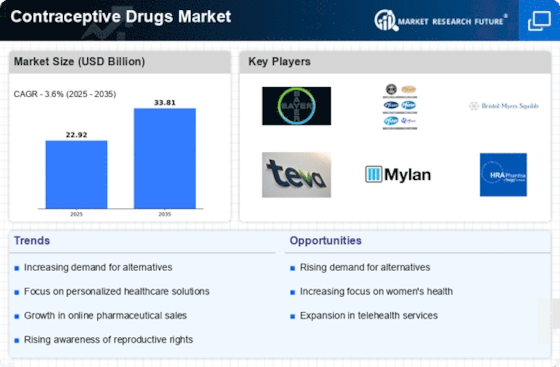
As per Market Research Future analysis, the Contraceptive Drugs Market Size was estimated at 22.92 USD Billion in 2024. The Contraceptive Drugs industry is projected to grow from 23.74 USD Billion in 2025 to 33.81 USD Billion by 2035, exhibiting a compound annual growth rate (CAGR) of 3.6% during the forecast period 2025 - 2035

Key Market Trends & Highlights

The Contraceptive Drugs Market is experiencing a transformative shift towards personalized and sustainable solutions.

  • The market witnesses a rise in personalized contraceptive solutions, catering to individual needs and preferences. Integration of digital health technologies is enhancing accessibility and user engagement in contraceptive methods. North America remains the largest market, while Asia-Pacific is recognized as the fastest-growing region in contraceptive drugs. Increasing awareness of family planning and government initiatives are driving demand, particularly for non-hormonal contraceptives.

Market Size & Forecast

2024 Market Size 22.92 (USD Billion)
2035 Market Size 33.81 (USD Billion)
CAGR (2025 - 2035) 3.6%
Largest Regional Market Share in 2024 North America

Major Players

Bayer AG (DE), Pfizer Inc (US), Bristol-Myers Squibb Company (US), Teva Pharmaceutical Industries Ltd (IL), Mylan N.V. (US), HRA Pharma (FR), Merck &amp; Co., Inc. (US), Johnson &amp; Johnson (US), Gedeon Richter Plc (HU)

Market Trends

The Contraceptive Drugs Market is currently experiencing a dynamic evolution, driven by a confluence of factors including changing societal norms, advancements in pharmaceutical technology, and increasing awareness regarding reproductive health. As individuals and couples seek more effective and convenient options for family planning, the demand for innovative contraceptive solutions appears to be on the rise.

The contraceptive pill statistics highlights the important of women's health and autonomy, which has led to a broader acceptance of various contraceptive methods.

Consequently, pharmaceutical companies are investing in research and development to create new formulations and delivery systems that cater to diverse consumer needs. Moreover, the Contraceptive Drugs Market is likely to witness a surge in the adoption of long-acting reversible contraceptives, as these options offer enhanced efficacy and convenience. The integration of digital health technologies into reproductive health management may also play a pivotal role in shaping consumer preferences.

 As the market continues to evolve, it seems essential for stakeholders to remain attuned to emerging trends and consumer demands, ensuring that they provide accessible and effective contraceptive solutions that align with contemporary values and lifestyles.

Rise of Personalized Contraceptive Solutions

There is a noticeable trend towards personalized contraceptive options, as consumers increasingly seek methods tailored to their individual health profiles and lifestyle preferences. This shift suggests a growing recognition of the importance of customized healthcare in reproductive choices.

Integration of Digital Health Technologies

The incorporation of digital health tools into contraceptive management is becoming more prevalent. Mobile applications and telehealth services are facilitating better access to information and support, potentially enhancing user experience and adherence to contraceptive regimens.

Focus on Sustainable and Eco-Friendly Products

The contraceptive pills market is currently being redefined by the rise of "eco-friendly" packaging and the development of bio-identical hormones that aim to mimic natural biological cycles. Consumers are showing a preference for eco-friendly contraceptive options, prompting manufacturers to explore biodegradable materials and environmentally responsible production practices.

Price Sensitivity

Determining how much is birth control industry worth requires an analysis of both private retail sales and large-scale government procurement programs for family planning. Furthermore, the valuation of this sector is heavily influenced by the high price sensitivity of contraceptive drugs, where even slight shifts in manufacturing costs or insurance coverage can significantly impact patient access and overall market volume

Contraceptive Drugs Market Market Drivers

Government Initiatives and Support

Government initiatives play a crucial role in shaping the Contraceptive Drugs Market. Many countries have implemented policies aimed at improving access to contraceptive methods, thereby enhancing reproductive health services. For instance, funding for family planning programs has increased, allowing for the distribution of contraceptive drugs at subsidized rates. This support is particularly evident in developing regions, where access to contraceptives has historically been limited. Data indicates that countries with robust family planning policies have seen a 20% increase in contraceptive use over the past decade. Such initiatives not only promote public health but also contribute to the overall growth of the Contraceptive Drugs Market by ensuring that a wider population has access to necessary contraceptive options.

Increasing Awareness of Family Planning

The rising awareness regarding family planning is a pivotal driver for the Contraceptive Drugs Market. Educational initiatives and campaigns have significantly contributed to the understanding of reproductive health, leading to a greater acceptance of contraceptive methods. According to recent data, approximately 75% of women in reproductive age are aware of various contraceptive options, which has resulted in a notable increase in demand for contraceptive drugs. This heightened awareness is not only empowering individuals to make informed choices but also fostering a cultural shift towards responsible family planning. As more individuals recognize the importance of contraceptive methods, the Contraceptive Drugs Market is likely to experience sustained growth, driven by the demand for diverse and effective contraceptive solutions.

Cultural Shifts Towards Reproductive Rights

Cultural shifts towards reproductive rights are significantly impacting the Contraceptive Drugs Market. As societal attitudes evolve, there is a growing recognition of the importance of reproductive autonomy and access to contraceptive methods. This cultural transformation is particularly evident in regions where traditional norms have historically restricted access to contraceptives. Data indicates that in areas where reproductive rights are increasingly acknowledged, contraceptive use has risen by over 30% in recent years. This shift not only empowers individuals but also drives demand for a wider range of contraceptive options. Consequently, the Contraceptive Drugs Market is likely to benefit from this cultural evolution, as more individuals seek to exercise their reproductive rights through the use of contraceptive drugs.

Rising Demand for Non-Hormonal Contraceptives

The rising demand for non-hormonal contraceptives is emerging as a significant driver within the Contraceptive Drugs Market. Many individuals are seeking alternatives to hormonal methods due to concerns about side effects and long-term health implications. This shift in consumer preference has led to an increase in the development and availability of non-hormonal options, such as copper intrauterine devices (IUDs) and barrier methods. Market data suggests that the non-hormonal contraceptive segment has experienced a growth rate of approximately 15% over the past few years. As awareness of these alternatives continues to spread, the Contraceptive Drugs Market is likely to adapt, expanding its offerings to meet the evolving needs of consumers who prioritize non-hormonal solutions.

Technological Advancements in Drug Development

Technological advancements in drug development are significantly influencing the Contraceptive Drugs Market. Innovations in pharmaceutical research have led to the creation of more effective and safer contraceptive options. For example, the development of long-acting reversible contraceptives (LARCs) has transformed the landscape of contraceptive methods, providing users with extended protection without the need for daily adherence. Furthermore, the integration of biotechnology in contraceptive drug formulation has resulted in products that are not only more effective but also tailored to meet individual needs. As these advancements continue to emerge, the Contraceptive Drugs Market is poised for growth, with an increasing number of consumers seeking out the latest contraceptive solutions that leverage cutting-edge technology.

Market Segment Insights

By Type: Oral Contraceptives (Largest) vs. Emergency Contraceptives (Fastest-Growing)

In the Contraceptive Drugs Market, Oral Contraceptives hold the largest share among the various types of contraceptives available. This segment has been a foundation for family planning and reproductive health, with widespread acceptance and availability contributing to its dominance. In contrast, Emergency Contraceptives, while comprising a smaller portion of the market, are witnessing robust growth as awareness increases and societal acceptance evolves. This segment's rise is also propelled by ongoing educational campaigns and accessibility improvements in various regions. The growth trends reveal an increasing demand for flexible and convenient contraceptive options. Injectables and implantables are also gaining traction as women seek long-term solutions, while regulatory approvals for newer formulations are enhancing availability. Emergency Contraceptives are emerging as critical options for unplanned situations, reflecting a shift in consumer behavior toward proactive reproductive health management. Thus, the Contraceptive Drugs Market is observing a dynamic interplay of established and emerging segments, shaping its landscape.

Oral Contraceptives (Dominant) vs. Intrauterine Devices (Emerging)

Oral Contraceptives remain the dominant choice in the contraceptive segment, known for their ease of use and established track record in preventing pregnancy. This category includes a variety of formulations that cater to different health requirements and personal preferences. On the other hand, Intrauterine Devices (IUDs) are emerging as a viable alternative, particularly for women seeking long-term birth control solutions without daily intervention. IUDs are recognized for their effectiveness and low maintenance, which is appealing to many users. As healthcare providers increasingly endorse IUDs and newer types with fewer side effects are introduced, this segment is expected to gain market share. This contrast highlights the evolving landscape of contraceptive preferences driven by effectiveness, convenience, and individual needs.

By Mechanism of Action: Hormonal (Largest) vs. Barrier (Fastest-Growing)

In the contraceptive drugs market, the hormonal mechanism remains the largest segment, significantly outpacing others like barrier, intrauterine, surgical, and natural methods. Hormonal contraceptives account for a substantial share of the market due to their effectiveness and wide acceptance among users. In contrast, the barrier method is the fastest-growing segment, gaining traction as public awareness around reproductive health rises and consumers seek alternatives that provide immediate protection without hormonal intervention. Growth trends in this market segment are influenced by various factors, including increasing awareness of family planning and the rising demand for innovative contraceptive options. The hormonal segment benefits from substantial research and development leading to improved formulations and user satisfaction, while the barrier segment experiences growth driven by changing social norms and the empowerment of individual choices in reproductive health. Regulatory support and educational initiatives also play crucial roles in enhancing market dynamics and fostering consumer trust in these methods.

Hormonal: Dominant vs. Barrier: Emerging

Hormonal contraceptives are considered the dominant force in the contraceptive drugs market due to their long-standing presence and significant consumer base. These products, including pills, patches, and injections, are favored for their high efficacy rates and ability to offer additional health benefits, such as regulating menstrual cycles. Conversely, barrier methods, such as condoms and diaphragms, are emerging as a favored choice among a growing segment of the population looking for non-hormonal options. The appeal of barrier methods lies in their accessibility, combined with efforts to destigmatize their use. This segment is witnessing innovation in product design and increased promotion in sexual health education, positioning barrier methods as a competitive alternative to traditional hormonal options.

By Distribution Channel: Retail Pharmacies (Largest) vs. Online Pharmacies (Fastest-Growing)

The contraceptive drugs market displays a diverse distribution channel landscape. Retail pharmacies take the lead, possessing the largest share due to their extensive network and accessibility for consumers. They provide a personalized experience, allowing patients to consult pharmacists for advice. In contrast, online pharmacies have seen a surge in demand, capitalizing on the convenience of home delivery and the anonymity they offer, which is particularly appealing to younger demographics. As the market evolves, growth trends reveal a distinct shift towards online pharmacies, driven by changing consumer behaviors and <a href="https://www.marketresearchfuture.com/reports/digital-healthcare-market-7636">digital health</a> trends. Factors such as increased smartphone penetration and the rise of telehealth services are boosting the online purchasing model. Similarly, specialty clinics and direct sales are also emerging, catering to specific demographics and needs, indicating a dynamic transformation in how contraceptive drugs are distributed to end consumers.

Retail Pharmacies (Dominant) vs. Online Pharmacies (Emerging)

Retail pharmacies dominate the contraceptive drugs distribution channel, offering a wide range of products and immediate access to healthcare professionals. Their strong presence in urban and rural areas ensures that a significant number of consumers prefer this option for obtaining contraceptive methods, often valuing direct consultations and face-to-face interactions. Conversely, online pharmacies are emerging rapidly, appealing particularly to tech-savvy consumers who prioritize convenience and privacy. They allow for discreet purchases and often include teleconsultation services, making them a preferred choice for younger populations. As both segments adapt to market demands, the dynamics of their competition will shape the overall landscape of contraceptive drug distribution.

By End User: Women (Largest) vs. Healthcare Providers (Fastest-Growing)

In the contraceptive drugs market, women are the predominant end-users, representing a significant share of the market. This segment is driven by the increasing awareness of women's health and reproductive rights, leading to greater adoption of contraceptive options. Healthcare providers, while not the primary end-users themselves, play a crucial role as facilitators and influencers in the selection and distribution of contraceptive drugs. The interplay between these groups shapes the market dynamics significantly.

Women (Dominant) vs. Healthcare Providers (Emerging)

Women are the dominant segment in the contraceptive drugs market, primarily due to their direct need for contraceptive methods to manage reproductive health effectively. This segment is characterized by a diverse range of preferences, such as hormonal and barrier methods, which cater to various lifestyles and health considerations. On the other hand, healthcare providers are emerging as a crucial segment due to their influential role in educating customers and recommending products. As they increase awareness and accessibility of contraceptive options, their market share is projected to grow, driven by a robust emphasis on sexual health education and preventive healthcare.

Get more detailed insights about Contraceptive Drugs Market Research Report - Global Forecast till 2035

Regional Insights

North America : Market Leader in Contraceptives

North America is the largest market for contraceptive drugs, holding approximately 40% of the global market share. Key growth drivers include increasing awareness of reproductive health, government initiatives promoting family planning, and a rise in the number of women seeking contraceptive options. Regulatory support from agencies like the FDA further catalyzes market growth, ensuring safety and efficacy in contraceptive products. The United States is the leading country in this region, with significant contributions from Canada. Major players such as Pfizer, Merck, and Johnson & Johnson dominate the landscape, offering a wide range of contraceptive options. The competitive environment is characterized by continuous innovation and strategic partnerships, enhancing product availability and accessibility across various demographics.

Europe : Regulatory Framework Drives Growth

Europe is the second-largest market for contraceptive drugs, accounting for approximately 30% of the global market share. The region benefits from strong regulatory frameworks that promote safe contraceptive use and access. Increasing awareness of reproductive health and a growing trend towards personalized medicine are key drivers of market growth. Countries like Germany and France are at the forefront, supported by government initiatives aimed at improving family planning services. Germany leads the European market, followed closely by France and the UK. The competitive landscape features key players such as Bayer and HRA Pharma, which are known for their innovative contraceptive solutions. The presence of robust healthcare systems and a focus on women's health further enhance market dynamics, fostering a competitive environment that encourages new product development and market entry.

Asia-Pacific : Emerging Market with Potential

Asia-Pacific is an emerging powerhouse in the contraceptive drugs market, holding about 20% of the global market share. The region is witnessing rapid growth driven by increasing population awareness, government initiatives promoting family planning, and a shift towards modern contraceptive methods. Countries like India and China are leading this growth, supported by favorable policies aimed at improving reproductive health services. India is the largest market in this region, with significant contributions from Australia and Japan. The competitive landscape is evolving, with both local and international players like Teva and Mylan expanding their presence. The increasing demand for contraceptive options, coupled with a focus on education and accessibility, is shaping the market, making it a focal point for future investments and innovations.

Middle East and Africa : Untapped Market Opportunities

The Middle East and Africa represent a resource-rich frontier for the contraceptive drugs market, holding approximately 10% of the global market share. The region is characterized by a growing awareness of reproductive health and increasing government support for family planning initiatives. However, cultural factors and limited access to healthcare services pose challenges. Countries like South Africa and Nigeria are leading the market, with efforts to improve contraceptive access and education. South Africa is the largest market in this region, followed by Nigeria and Kenya. The competitive landscape is gradually evolving, with key players like Gedeon Richter and local manufacturers entering the market. The focus on improving healthcare infrastructure and increasing awareness of contraceptive options is expected to drive growth, making this region a significant area for future development and investment.

Key Players and Competitive Insights

The Contraceptive Drugs Market has been experiencing significant growth driven by the increasing awareness regarding family planning and reproductive health, as well as advancements in contraceptive technology. With a diverse range of contraceptive options, including hormonal pills, intrauterine devices, and emergency contraceptives, the market presents various opportunities for pharmaceutical companies. As the demand for reliable and effective contraceptive options rises, competition among key players intensifies, leading to innovations and strategic collaborations. The market landscape is influenced by factors such as changing lifestyles, educational initiatives, and healthcare policies, which further contribute to its evolution. The presence of established players alongside emerging companies creates a dynamic competitive environment where differentiation through product offerings and marketing strategies becomes crucial.Sanofi holds a significant position in the Contraceptive Drugs Market, leveraging its extensive portfolio that includes a variety of contraceptive solutions. The company is recognized for its commitment to research and development, enabling it to introduce innovative products that cater to diverse consumer needs. Sanofi's global presence allows it to tap into various markets, capitalizing on regional demographics that are increasingly adopting family planning methods. The company's strengths stem from its robust distribution networks and strategic partnerships that enhance its market reach and accessibility. Furthermore, Sanofi emphasizes strong educational programs that promote awareness regarding contraceptive options, thereby fostering informed choices among consumers. Their reputation for quality and efficacy in contraceptive solutions positions them as a trusted choice among healthcare providers and consumers alike.GSK is another prominent player in the Contraceptive Drugs Market, distinguished by its extensive research capabilities and commitment to enhancing reproductive health. The company's focus on developing a comprehensive range of contraceptive products reflects its understanding of the market's diverse needs. GSK has established collaborations with healthcare systems and organizations, reinforcing its position and ensuring that its contraceptive solutions are widely accessible. The company's strengths lie not only in its innovative product development but also in its effective marketing strategies that resonate with target audiences. GSK places significant emphasis on consumer education and awareness, thus contributing to an informed marketplace where individuals can make confident choices regarding contraception. Its dedication to sustainability and social responsibility further enhances its reputation, making GSK a key player in shaping the future of the contraceptive drug landscape.

Key Companies in the Contraceptive Drugs Market include

Industry Developments

Recent developments in the Contraceptive Drugs Market reflect significant changes and growth among leading companies like Sanofi, GSK, AbbVie, Teva Pharmaceutical Industries, Bayer, and others. The market is experiencing an increased demand for contraceptive options, driven by changing social attitudes toward family planning and reproductive health. Companies are investing in research and development to offer innovative and more effective products. 

Notably, Bayer has expanded its contraceptive portfolio, while HRA Pharma introduced advancements in hormonal contraceptives that emphasize safety and efficacy. In terms of mergers and acquisitions, there have been notable activities, such as AbbVie pursuing strategic partnerships to broaden its contraceptive offerings. The competition in the market is intensifying, prompting Mylan and Pfizer to enhance their product lines to capture emerging consumer needs. Furthermore, the valuation of these companies is on an upward trajectory, suggesting robust growth potential in the contraceptive sector. 

As this market evolves, these organizations must adapt to regulatory changes and consumer preferences, further impacting their market positioning in the coming years.

Contraceptive Drugs Market Drivers

Increasing Awareness and Acceptance of Family Planning

The growing global awareness regarding family planning and reproductive health is one of the foremost drivers boosting the Contraceptive Drugs Market Industry. As individuals and couples become more knowledgeable about their reproductive choices, there is an increasing acceptance of contraceptive methods. Educational programs and campaigns initiated by governments, non-governmental organizations, and healthcare providers have played a significant role in informing the public about the various contraceptive options available.

This heightened awareness has led to a decline in stigma associated with the use of contraceptives, encouraging more people to consider these options as a critical aspect of their health care. Furthermore, the emphasis placed on gender equality and women's empowerment continues to foster discussions surrounding reproductive rights, propelling the demand for contraceptive drugs. With a projected robust market growth over the next decade, driven by changing societal norms and positive shifts in public perception, the Contraceptive Drugs Market is expected to see increased investments in product development, expanding options and accessibility for consumers worldwide.

The health benefits associated with proper family planning are increasingly recognized, including improved maternal and child health outcomes, more informed reproductive decisions, and a reduction in unintended pregnancies. As healthcare systems prioritize comprehensive reproductive health services, the demand for a wide range of contraceptive drugs is anticipated to surge, reinforcing the industry's growth trajectory.

Innovation and Development of New Contraceptive Technologies

Technological advancements and continuous innovation play a critical role in shaping the Contraceptive Drugs Market Industry. The emergence of novel drug formulations and alternative delivery mechanisms has expanded the variety of contraceptive choices available to consumers. Innovative methods, such as long-acting reversible contraceptives (LARCs), mini pills, and hormonal intrauterine devices, are increasingly preferred due to their high efficacy and user-friendliness.

Additionally, ongoing research and development efforts in contraceptive technologies aim to address the changing needs and preferences of consumers, streamline usage, and minimize side effects, ultimately leading to higher adoption rates. As pharmaceutical companies invest in the development of better and more effective contraceptive options, the market will witness significant growth, resulting in an expanded user base and improved health outcomes.

Supportive Government Initiatives and Policies

Government assistance and supportive policies are becoming fundamental drivers of the Contraceptive Drugs Market Industry. Increasingly, governments worldwide are recognizing the importance of accessible reproductive health services, prompting them to implement policies aimed at promoting family planning. Initiatives that seek to expand access to contraceptive methods through subsidized programs, health education, and awareness campaigns are essential in driving market growth.

Additionally, in regions with high population growth rates, governments are pushing for strategies that empower individuals to make informed reproductive choices, as they understand that effective family planning can contribute to economic stability and improved quality of life. This focus on reproductive health and supportive measures to facilitate contraceptive access directly influences the expansion of the contraceptive drugs market, leading to an upward trend in overall market value.

Contraceptive Drugs Market Segment Insights:

Contraceptive Drugs Market Drug Type Insights  

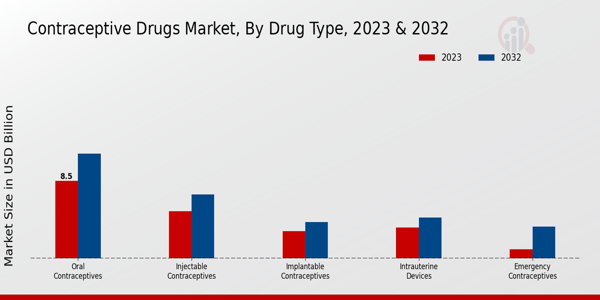
The Contraceptive Drugs Market segment focused on Drug Type consists of various categories, including Oral Contraceptives, Injectable Contraceptives, Implantable Contraceptives, Intrauterine Devices, and Emergency Contraceptives, each playing a crucial role in reproductive health. In 2023, the overall market was valued at 22.12 USD Billion, showcasing the significant demand for contraceptive methods worldwide.

 Among these types, Oral Contraceptives hold a prominent position, valued at 8.5 USD Billion in 2023 and projected to rise to 11.5 USD Billion by 2032. This category is essential due to its high acceptance and ease of use, making it a preferred choice for many women around the globe. Injectable Contraceptives, valued at 5.2 USD Billion in 2023, followed closely, offering a reliable alternative that provides long-term protection with fewer doses, thus serving a significant demographic in the contraceptive landscape.

Implantable Contraceptives, valued at 3.0 USD Billion in 2023, also cater to users looking for long-term solutions without the need for daily adherence, though they capture a smaller segment due to the need for medical procedures for insertion and removal. Intrauterine Devices, valued at 3.42 USD Billion in 2023, represent another important method in the market as they offer extended protection with a low failure rate, appealing to women who prefer a non-hormonal option or a long-lasting solution. 

Emergency Contraceptives, while the smallest segment with a valuation of 1.0 USD Billion in 2023, serve a crucial purpose in preventing unintended pregnancies after unprotected intercourse, thus highlighting the importance of accessible reproductive health options. Overall, the Contraceptive Drugs Market revenue reflects growing awareness and access to various contraceptive methods, with trends indicating that more women are seeking reliable forms of birth control tailored to their lifestyles, leading to significant opportunities for growth across all categories in the coming years.
Contraceptive Drugs Market Drug Type Insights

Source: Primary Research, Secondary Research, Market Research Future Database and Analyst Review

Contraceptive Drugs Market Mechanism of Action Insights  

Future Outlook

Contraceptive Drugs Market Future Outlook

The Contraceptive Drugs Market is projected to grow at a 3.6% CAGR from 2025 to 2035, driven by increasing awareness, technological advancements, and expanding healthcare access.<br> Leading pharmaceutical firms utilize birth control pill stats to benchmark their product performance against competitors and to justify R&amp;D investment in next-generation delivery systems. Investors monitoring birth control stocks are increasingly focused on companies with strong portfolios in women’s health that can withstand the entry of low-cost generic competitors. These aspects contribute to the progress of the contraceptive drugs market.<br>By 2035, the Contraceptive Drugs Market is expected to be robust, reflecting evolving consumer needs and innovative solutions.

New opportunities lie in:

  • <p>Development of personalized contraceptive solutions leveraging genetic insights.</p>
  • <p> </p>
  • <p>Expansion of telehealth services for contraceptive consultations and prescriptions.</p>
  • <p>Investment in biodegradable contraceptive delivery systems to enhance sustainability.</p>

By 2035, the Contraceptive Drugs Market is expected to be robust, reflecting evolving consumer needs and innovative solutions.

Market Segmentation

Contraceptive Drugs Market Type Outlook

  • Oral Contraceptives
  • Injectable Contraceptives
  • Implantable Contraceptives
  • Intrauterine Devices
  • Emergency Contraceptives

Contraceptive Drugs Market End User Outlook

  • Women
  • Healthcare Providers
  • Educational Institutions

Contraceptive Drugs Market Mechanism of Action Outlook

  • Hormonal
  • Barrier
  • Intrauterine
  • Surgical
  • Natural

Contraceptive Drugs Market Distribution Channel Outlook

  • Retail Pharmacies
  • Online Pharmacies
  • Hospital Pharmacies
  • Specialty Clinics
  • Direct Sale

Report Scope

MARKET SIZE 2024 22.92(USD Billion)
MARKET SIZE 2025 23.74(USD Billion)
MARKET SIZE 2035 33.81(USD Billion)
COMPOUND ANNUAL GROWTH RATE (CAGR) 3.6% (2025 - 2035)
REPORT COVERAGE Revenue Forecast, Competitive Landscape, Growth Factors, and Trends
BASE YEAR 2024
Market Forecast Period 2025 - 2035
Historical Data 2019 - 2024
Market Forecast Units USD Billion
Key Companies Profiled Bayer AG (DE), Pfizer Inc (US), Bristol-Myers Squibb Company (US), Teva Pharmaceutical Industries Ltd (IL), Mylan N.V. (US), HRA Pharma (FR), Merck & Co., Inc. (US), Johnson & Johnson (US), Gedeon Richter Plc (HU)
Segments Covered Drug Type, Mechanism of Action, Distribution Channel, End Users, Regional
Key Market Opportunities Emergence of personalized contraceptive solutions driven by advancements in biotechnology and consumer demand.
Key Market Dynamics Rising consumer awareness drives demand for innovative contraceptive drugs amid evolving regulatory landscapes and competitive pressures.
Countries Covered North America, Europe, APAC, South America, MEA

FAQs

What is the current valuation of the Contraceptive Drugs Market as of 2024?

<p>The Contraceptive Drugs Market was valued at 22.92 USD Billion in 2024.</p>

What is the projected market size for the Contraceptive Drugs Market in 2035?

<p>The market is projected to reach 33.81 USD Billion by 2035.</p>

What is the expected CAGR for the Contraceptive Drugs Market during the forecast period 2025 - 2035?

<p>The expected CAGR for the market during the forecast period 2025 - 2035 is 3.6%.</p>

Which companies are considered key players in the Contraceptive Drugs Market?

<p>Key players in the market include Bayer AG, Pfizer Inc, Bristol-Myers Squibb Company, and Merck & Co., Inc.</p>

What segment of contraceptive drugs had the highest valuation in 2024?

<p>Oral Contraceptives had the highest valuation at 8.0 USD Billion in 2024.</p>

How do injectable contraceptives perform in terms of market valuation?

<p>Injectable Contraceptives were valued at 5.0 USD Billion in 2024 and are projected to grow to 7.5 USD Billion.</p>

What distribution channel is expected to dominate the Contraceptive Drugs Market?

<p>Retail Pharmacies are expected to dominate, with a valuation of 8.0 USD Billion in 2024.</p>

What is the market valuation for hormonal contraceptives in 2024?

<p>Hormonal contraceptives were valued at 10.0 USD Billion in 2024.</p>

Which end user segment is projected to have the highest growth in the Contraceptive Drugs Market?

<p>The Women segment is projected to grow from 10.0 USD Billion in 2024 to 15.0 USD Billion.</p>

What is the expected growth trend for emergency contraceptives in the coming years?

<p>Emergency Contraceptives were valued at 2.92 USD Billion in 2024 and are expected to reach 3.31 USD Billion.</p>

  1. SECTION I: EXECUTIVE SUMMARY AND KEY HIGHLIGHTS
    1. | 1.1 EXECUTIVE SUMMARY
    2. | | 1.1.1 Market Overview
    3. | | 1.1.2 Key Findings
    4. | | 1.1.3 Market Segmentation
    5. | | 1.1.4 Competitive Landscape
    6. | | 1.1.5 Challenges and Opportunities
    7. | | 1.1.6 Future Outlook
  2. SECTION II: SCOPING, METHODOLOGY AND MARKET STRUCTURE
    1. | 2.1 MARKET INTRODUCTION
    2. | | 2.1.1 Definition
    3. | | 2.1.2 Scope of the study
    4. | | | 2.1.2.1 Research Objective
    5. | | | 2.1.2.2 Assumption
    6. | | | 2.1.2.3 Limitations
    7. | 2.2 RESEARCH METHODOLOGY
    8. | | 2.2.1 Overview
    9. | | 2.2.2 Data Mining
    10. | | 2.2.3 Secondary Research
    11. | | 2.2.4 Primary Research
    12. | | | 2.2.4.1 Primary Interviews and Information Gathering Process
    13. | | | 2.2.4.2 Breakdown of Primary Respondents
    14. | | 2.2.5 Forecasting Model
    15. | | 2.2.6 Market Size Estimation
    16. | | | 2.2.6.1 Bottom-Up Approach
    17. | | | 2.2.6.2 Top-Down Approach
    18. | | 2.2.7 Data Triangulation
    19. | | 2.2.8 Validation
  3. SECTION III: QUALITATIVE ANALYSIS
    1. | 3.1 MARKET DYNAMICS
    2. | | 3.1.1 Overview
    3. | | 3.1.2 Drivers
    4. | | 3.1.3 Restraints
    5. | | 3.1.4 Opportunities
    6. | 3.2 MARKET FACTOR ANALYSIS
    7. | | 3.2.1 Value chain Analysis
    8. | | 3.2.2 Porter's Five Forces Analysis
    9. | | | 3.2.2.1 Bargaining Power of Suppliers
    10. | | | 3.2.2.2 Bargaining Power of Buyers
    11. | | | 3.2.2.3 Threat of New Entrants
    12. | | | 3.2.2.4 Threat of Substitutes
    13. | | | 3.2.2.5 Intensity of Rivalry
    14. | | 3.2.3 COVID-19 Impact Analysis
    15. | | | 3.2.3.1 Market Impact Analysis
    16. | | | 3.2.3.2 Regional Impact
    17. | | | 3.2.3.3 Opportunity and Threat Analysis
  4. SECTION IV: QUANTITATIVE ANALYSIS
    1. | 4.1 Healthcare, BY Type (USD Billion)
    2. | | 4.1.1 Oral Contraceptives
    3. | | 4.1.2 Injectable Contraceptives
    4. | | 4.1.3 Implantable Contraceptives
    5. | | 4.1.4 Intrauterine Devices
    6. | | 4.1.5 Emergency Contraceptives
    7. | 4.2 Healthcare, BY Mechanism of Action (USD Billion)
    8. | | 4.2.1 Hormonal
    9. | | 4.2.2 Barrier
    10. | | 4.2.3 Intrauterine
    11. | | 4.2.4 Surgical
    12. | | 4.2.5 Natural
    13. | 4.3 Healthcare, BY Distribution Channel (USD Billion)
    14. | | 4.3.1 Retail Pharmacies
    15. | | 4.3.2 Online Pharmacies
    16. | | 4.3.3 Hospital Pharmacies
    17. | | 4.3.4 Specialty Clinics
    18. | | 4.3.5 Direct Sale
    19. | 4.4 Healthcare, BY End User (USD Billion)
    20. | | 4.4.1 Women
    21. | | 4.4.2 Healthcare Providers
    22. | | 4.4.3 Educational Institutions
    23. | 4.5 Healthcare, BY Region (USD Billion)
    24. | | 4.5.1 North America
    25. | | | 4.5.1.1 US
    26. | | | 4.5.1.2 Canada
    27. | | 4.5.2 Europe
    28. | | | 4.5.2.1 Germany
    29. | | | 4.5.2.2 UK
    30. | | | 4.5.2.3 France
    31. | | | 4.5.2.4 Russia
    32. | | | 4.5.2.5 Italy
    33. | | | 4.5.2.6 Spain
    34. | | | 4.5.2.7 Rest of Europe
    35. | | 4.5.3 APAC
    36. | | | 4.5.3.1 China
    37. | | | 4.5.3.2 India
    38. | | | 4.5.3.3 Japan
    39. | | | 4.5.3.4 South Korea
    40. | | | 4.5.3.5 Malaysia
    41. | | | 4.5.3.6 Thailand
    42. | | | 4.5.3.7 Indonesia
    43. | | | 4.5.3.8 Rest of APAC
    44. | | 4.5.4 South America
    45. | | | 4.5.4.1 Brazil
    46. | | | 4.5.4.2 Mexico
    47. | | | 4.5.4.3 Argentina
    48. | | | 4.5.4.4 Rest of South America
    49. | | 4.5.5 MEA
    50. | | | 4.5.5.1 GCC Countries
    51. | | | 4.5.5.2 South Africa
    52. | | | 4.5.5.3 Rest of MEA
  5. SECTION V: COMPETITIVE ANALYSIS
    1. | 5.1 Competitive Landscape
    2. | | 5.1.1 Overview
    3. | | 5.1.2 Competitive Analysis
    4. | | 5.1.3 Market share Analysis
    5. | | 5.1.4 Major Growth Strategy in the Healthcare
    6. | | 5.1.5 Competitive Benchmarking
    7. | | 5.1.6 Leading Players in Terms of Number of Developments in the Healthcare
    8. | | 5.1.7 Key developments and growth strategies
    9. | | | 5.1.7.1 New Product Launch/Service Deployment
    10. | | | 5.1.7.2 Merger & Acquisitions
    11. | | | 5.1.7.3 Joint Ventures
    12. | | 5.1.8 Major Players Financial Matrix
    13. | | | 5.1.8.1 Sales and Operating Income
    14. | | | 5.1.8.2 Major Players R&D Expenditure. 2023
    15. | 5.2 Company Profiles
    16. | | 5.2.1 Bayer AG (DE)
    17. | | | 5.2.1.1 Financial Overview
    18. | | | 5.2.1.2 Products Offered
    19. | | | 5.2.1.3 Key Developments
    20. | | | 5.2.1.4 SWOT Analysis
    21. | | | 5.2.1.5 Key Strategies
    22. | | 5.2.2 Pfizer Inc (US)
    23. | | | 5.2.2.1 Financial Overview
    24. | | | 5.2.2.2 Products Offered
    25. | | | 5.2.2.3 Key Developments
    26. | | | 5.2.2.4 SWOT Analysis
    27. | | | 5.2.2.5 Key Strategies
    28. | | 5.2.3 Bristol-Myers Squibb Company (US)
    29. | | | 5.2.3.1 Financial Overview
    30. | | | 5.2.3.2 Products Offered
    31. | | | 5.2.3.3 Key Developments
    32. | | | 5.2.3.4 SWOT Analysis
    33. | | | 5.2.3.5 Key Strategies
    34. | | 5.2.4 Teva Pharmaceutical Industries Ltd (IL)
    35. | | | 5.2.4.1 Financial Overview
    36. | | | 5.2.4.2 Products Offered
    37. | | | 5.2.4.3 Key Developments
    38. | | | 5.2.4.4 SWOT Analysis
    39. | | | 5.2.4.5 Key Strategies
    40. | | 5.2.5 Mylan N.V. (US)
    41. | | | 5.2.5.1 Financial Overview
    42. | | | 5.2.5.2 Products Offered
    43. | | | 5.2.5.3 Key Developments
    44. | | | 5.2.5.4 SWOT Analysis
    45. | | | 5.2.5.5 Key Strategies
    46. | | 5.2.6 HRA Pharma (FR)
    47. | | | 5.2.6.1 Financial Overview
    48. | | | 5.2.6.2 Products Offered
    49. | | | 5.2.6.3 Key Developments
    50. | | | 5.2.6.4 SWOT Analysis
    51. | | | 5.2.6.5 Key Strategies
    52. | | 5.2.7 Merck & Co., Inc. (US)
    53. | | | 5.2.7.1 Financial Overview
    54. | | | 5.2.7.2 Products Offered
    55. | | | 5.2.7.3 Key Developments
    56. | | | 5.2.7.4 SWOT Analysis
    57. | | | 5.2.7.5 Key Strategies
    58. | | 5.2.8 Johnson & Johnson (US)
    59. | | | 5.2.8.1 Financial Overview
    60. | | | 5.2.8.2 Products Offered
    61. | | | 5.2.8.3 Key Developments
    62. | | | 5.2.8.4 SWOT Analysis
    63. | | | 5.2.8.5 Key Strategies
    64. | | 5.2.9 Gedeon Richter Plc (HU)
    65. | | | 5.2.9.1 Financial Overview
    66. | | | 5.2.9.2 Products Offered
    67. | | | 5.2.9.3 Key Developments
    68. | | | 5.2.9.4 SWOT Analysis
    69. | | | 5.2.9.5 Key Strategies
    70. | 5.3 Appendix
    71. | | 5.3.1 References
    72. | | 5.3.2 Related Reports
  6. LIST OF FIGURES
    1. | 6.1 MARKET SYNOPSIS
    2. | 6.2 NORTH AMERICA MARKET ANALYSIS
    3. | 6.3 US MARKET ANALYSIS BY TYPE
    4. | 6.4 US MARKET ANALYSIS BY MECHANISM OF ACTION
    5. | 6.5 US MARKET ANALYSIS BY DISTRIBUTION CHANNEL
    6. | 6.6 US MARKET ANALYSIS BY END USER
    7. | 6.7 CANADA MARKET ANALYSIS BY TYPE
    8. | 6.8 CANADA MARKET ANALYSIS BY MECHANISM OF ACTION
    9. | 6.9 CANADA MARKET ANALYSIS BY DISTRIBUTION CHANNEL
    10. | 6.10 CANADA MARKET ANALYSIS BY END USER
    11. | 6.11 EUROPE MARKET ANALYSIS
    12. | 6.12 GERMANY MARKET ANALYSIS BY TYPE
    13. | 6.13 GERMANY MARKET ANALYSIS BY MECHANISM OF ACTION
    14. | 6.14 GERMANY MARKET ANALYSIS BY DISTRIBUTION CHANNEL
    15. | 6.15 GERMANY MARKET ANALYSIS BY END USER
    16. | 6.16 UK MARKET ANALYSIS BY TYPE
    17. | 6.17 UK MARKET ANALYSIS BY MECHANISM OF ACTION
    18. | 6.18 UK MARKET ANALYSIS BY DISTRIBUTION CHANNEL
    19. | 6.19 UK MARKET ANALYSIS BY END USER
    20. | 6.20 FRANCE MARKET ANALYSIS BY TYPE
    21. | 6.21 FRANCE MARKET ANALYSIS BY MECHANISM OF ACTION
    22. | 6.22 FRANCE MARKET ANALYSIS BY DISTRIBUTION CHANNEL
    23. | 6.23 FRANCE MARKET ANALYSIS BY END USER
    24. | 6.24 RUSSIA MARKET ANALYSIS BY TYPE
    25. | 6.25 RUSSIA MARKET ANALYSIS BY MECHANISM OF ACTION
    26. | 6.26 RUSSIA MARKET ANALYSIS BY DISTRIBUTION CHANNEL
    27. | 6.27 RUSSIA MARKET ANALYSIS BY END USER
    28. | 6.28 ITALY MARKET ANALYSIS BY TYPE
    29. | 6.29 ITALY MARKET ANALYSIS BY MECHANISM OF ACTION
    30. | 6.30 ITALY MARKET ANALYSIS BY DISTRIBUTION CHANNEL
    31. | 6.31 ITALY MARKET ANALYSIS BY END USER
    32. | 6.32 SPAIN MARKET ANALYSIS BY TYPE
    33. | 6.33 SPAIN MARKET ANALYSIS BY MECHANISM OF ACTION
    34. | 6.34 SPAIN MARKET ANALYSIS BY DISTRIBUTION CHANNEL
    35. | 6.35 SPAIN MARKET ANALYSIS BY END USER
    36. | 6.36 REST OF EUROPE MARKET ANALYSIS BY TYPE
    37. | 6.37 REST OF EUROPE MARKET ANALYSIS BY MECHANISM OF ACTION
    38. | 6.38 REST OF EUROPE MARKET ANALYSIS BY DISTRIBUTION CHANNEL
    39. | 6.39 REST OF EUROPE MARKET ANALYSIS BY END USER
    40. | 6.40 APAC MARKET ANALYSIS
    41. | 6.41 CHINA MARKET ANALYSIS BY TYPE
    42. | 6.42 CHINA MARKET ANALYSIS BY MECHANISM OF ACTION
    43. | 6.43 CHINA MARKET ANALYSIS BY DISTRIBUTION CHANNEL
    44. | 6.44 CHINA MARKET ANALYSIS BY END USER
    45. | 6.45 INDIA MARKET ANALYSIS BY TYPE
    46. | 6.46 INDIA MARKET ANALYSIS BY MECHANISM OF ACTION
    47. | 6.47 INDIA MARKET ANALYSIS BY DISTRIBUTION CHANNEL
    48. | 6.48 INDIA MARKET ANALYSIS BY END USER
    49. | 6.49 JAPAN MARKET ANALYSIS BY TYPE
    50. | 6.50 JAPAN MARKET ANALYSIS BY MECHANISM OF ACTION
    51. | 6.51 JAPAN MARKET ANALYSIS BY DISTRIBUTION CHANNEL
    52. | 6.52 JAPAN MARKET ANALYSIS BY END USER
    53. | 6.53 SOUTH KOREA MARKET ANALYSIS BY TYPE
    54. | 6.54 SOUTH KOREA MARKET ANALYSIS BY MECHANISM OF ACTION
    55. | 6.55 SOUTH KOREA MARKET ANALYSIS BY DISTRIBUTION CHANNEL
    56. | 6.56 SOUTH KOREA MARKET ANALYSIS BY END USER
    57. | 6.57 MALAYSIA MARKET ANALYSIS BY TYPE
    58. | 6.58 MALAYSIA MARKET ANALYSIS BY MECHANISM OF ACTION
    59. | 6.59 MALAYSIA MARKET ANALYSIS BY DISTRIBUTION CHANNEL
    60. | 6.60 MALAYSIA MARKET ANALYSIS BY END USER
    61. | 6.61 THAILAND MARKET ANALYSIS BY TYPE
    62. | 6.62 THAILAND MARKET ANALYSIS BY MECHANISM OF ACTION
    63. | 6.63 THAILAND MARKET ANALYSIS BY DISTRIBUTION CHANNEL
    64. | 6.64 THAILAND MARKET ANALYSIS BY END USER
    65. | 6.65 INDONESIA MARKET ANALYSIS BY TYPE
    66. | 6.66 INDONESIA MARKET ANALYSIS BY MECHANISM OF ACTION
    67. | 6.67 INDONESIA MARKET ANALYSIS BY DISTRIBUTION CHANNEL
    68. | 6.68 INDONESIA MARKET ANALYSIS BY END USER
    69. | 6.69 REST OF APAC MARKET ANALYSIS BY TYPE
    70. | 6.70 REST OF APAC MARKET ANALYSIS BY MECHANISM OF ACTION
    71. | 6.71 REST OF APAC MARKET ANALYSIS BY DISTRIBUTION CHANNEL
    72. | 6.72 REST OF APAC MARKET ANALYSIS BY END USER
    73. | 6.73 SOUTH AMERICA MARKET ANALYSIS
    74. | 6.74 BRAZIL MARKET ANALYSIS BY TYPE
    75. | 6.75 BRAZIL MARKET ANALYSIS BY MECHANISM OF ACTION
    76. | 6.76 BRAZIL MARKET ANALYSIS BY DISTRIBUTION CHANNEL
    77. | 6.77 BRAZIL MARKET ANALYSIS BY END USER
    78. | 6.78 MEXICO MARKET ANALYSIS BY TYPE
    79. | 6.79 MEXICO MARKET ANALYSIS BY MECHANISM OF ACTION
    80. | 6.80 MEXICO MARKET ANALYSIS BY DISTRIBUTION CHANNEL
    81. | 6.81 MEXICO MARKET ANALYSIS BY END USER
    82. | 6.82 ARGENTINA MARKET ANALYSIS BY TYPE
    83. | 6.83 ARGENTINA MARKET ANALYSIS BY MECHANISM OF ACTION
    84. | 6.84 ARGENTINA MARKET ANALYSIS BY DISTRIBUTION CHANNEL
    85. | 6.85 ARGENTINA MARKET ANALYSIS BY END USER
    86. | 6.86 REST OF SOUTH AMERICA MARKET ANALYSIS BY TYPE
    87. | 6.87 REST OF SOUTH AMERICA MARKET ANALYSIS BY MECHANISM OF ACTION
    88. | 6.88 REST OF SOUTH AMERICA MARKET ANALYSIS BY DISTRIBUTION CHANNEL
    89. | 6.89 REST OF SOUTH AMERICA MARKET ANALYSIS BY END USER
    90. | 6.90 MEA MARKET ANALYSIS
    91. | 6.91 GCC COUNTRIES MARKET ANALYSIS BY TYPE
    92. | 6.92 GCC COUNTRIES MARKET ANALYSIS BY MECHANISM OF ACTION
    93. | 6.93 GCC COUNTRIES MARKET ANALYSIS BY DISTRIBUTION CHANNEL
    94. | 6.94 GCC COUNTRIES MARKET ANALYSIS BY END USER
    95. | 6.95 SOUTH AFRICA MARKET ANALYSIS BY TYPE
    96. | 6.96 SOUTH AFRICA MARKET ANALYSIS BY MECHANISM OF ACTION
    97. | 6.97 SOUTH AFRICA MARKET ANALYSIS BY DISTRIBUTION CHANNEL
    98. | 6.98 SOUTH AFRICA MARKET ANALYSIS BY END USER
    99. | 6.99 REST OF MEA MARKET ANALYSIS BY TYPE
    100. | 6.100 REST OF MEA MARKET ANALYSIS BY MECHANISM OF ACTION
    101. | 6.101 REST OF MEA MARKET ANALYSIS BY DISTRIBUTION CHANNEL
    102. | 6.102 REST OF MEA MARKET ANALYSIS BY END USER
    103. | 6.103 KEY BUYING CRITERIA OF HEALTHCARE
    104. | 6.104 RESEARCH PROCESS OF MRFR
    105. | 6.105 DRO ANALYSIS OF HEALTHCARE
    106. | 6.106 DRIVERS IMPACT ANALYSIS: HEALTHCARE
    107. | 6.107 RESTRAINTS IMPACT ANALYSIS: HEALTHCARE
    108. | 6.108 SUPPLY / VALUE CHAIN: HEALTHCARE
    109. | 6.109 HEALTHCARE, BY TYPE, 2024 (% SHARE)
    110. | 6.110 HEALTHCARE, BY TYPE, 2024 TO 2035 (USD Billion)
    111. | 6.111 HEALTHCARE, BY MECHANISM OF ACTION, 2024 (% SHARE)
    112. | 6.112 HEALTHCARE, BY MECHANISM OF ACTION, 2024 TO 2035 (USD Billion)
    113. | 6.113 HEALTHCARE, BY DISTRIBUTION CHANNEL, 2024 (% SHARE)
    114. | 6.114 HEALTHCARE, BY DISTRIBUTION CHANNEL, 2024 TO 2035 (USD Billion)
    115. | 6.115 HEALTHCARE, BY END USER, 2024 (% SHARE)
    116. | 6.116 HEALTHCARE, BY END USER, 2024 TO 2035 (USD Billion)
    117. | 6.117 BENCHMARKING OF MAJOR COMPETITORS
  7. LIST OF TABLES
    1. | 7.1 LIST OF ASSUMPTIONS
    2. | | 7.1.1
    3. | 7.2 North America MARKET SIZE ESTIMATES; FORECAST
    4. | | 7.2.1 BY TYPE, 2025-2035 (USD Billion)
    5. | | 7.2.2 BY MECHANISM OF ACTION, 2025-2035 (USD Billion)
    6. | | 7.2.3 BY DISTRIBUTION CHANNEL, 2025-2035 (USD Billion)
    7. | | 7.2.4 BY END USER, 2025-2035 (USD Billion)
    8. | 7.3 US MARKET SIZE ESTIMATES; FORECAST
    9. | | 7.3.1 BY TYPE, 2025-2035 (USD Billion)
    10. | | 7.3.2 BY MECHANISM OF ACTION, 2025-2035 (USD Billion)
    11. | | 7.3.3 BY DISTRIBUTION CHANNEL, 2025-2035 (USD Billion)
    12. | | 7.3.4 BY END USER, 2025-2035 (USD Billion)
    13. | 7.4 Canada MARKET SIZE ESTIMATES; FORECAST
    14. | | 7.4.1 BY TYPE, 2025-2035 (USD Billion)
    15. | | 7.4.2 BY MECHANISM OF ACTION, 2025-2035 (USD Billion)
    16. | | 7.4.3 BY DISTRIBUTION CHANNEL, 2025-2035 (USD Billion)
    17. | | 7.4.4 BY END USER, 2025-2035 (USD Billion)
    18. | 7.5 Europe MARKET SIZE ESTIMATES; FORECAST
    19. | | 7.5.1 BY TYPE, 2025-2035 (USD Billion)
    20. | | 7.5.2 BY MECHANISM OF ACTION, 2025-2035 (USD Billion)
    21. | | 7.5.3 BY DISTRIBUTION CHANNEL, 2025-2035 (USD Billion)
    22. | | 7.5.4 BY END USER, 2025-2035 (USD Billion)
    23. | 7.6 Germany MARKET SIZE ESTIMATES; FORECAST
    24. | | 7.6.1 BY TYPE, 2025-2035 (USD Billion)
    25. | | 7.6.2 BY MECHANISM OF ACTION, 2025-2035 (USD Billion)
    26. | | 7.6.3 BY DISTRIBUTION CHANNEL, 2025-2035 (USD Billion)
    27. | | 7.6.4 BY END USER, 2025-2035 (USD Billion)
    28. | 7.7 UK MARKET SIZE ESTIMATES; FORECAST
    29. | | 7.7.1 BY TYPE, 2025-2035 (USD Billion)
    30. | | 7.7.2 BY MECHANISM OF ACTION, 2025-2035 (USD Billion)
    31. | | 7.7.3 BY DISTRIBUTION CHANNEL, 2025-2035 (USD Billion)
    32. | | 7.7.4 BY END USER, 2025-2035 (USD Billion)
    33. | 7.8 France MARKET SIZE ESTIMATES; FORECAST
    34. | | 7.8.1 BY TYPE, 2025-2035 (USD Billion)
    35. | | 7.8.2 BY MECHANISM OF ACTION, 2025-2035 (USD Billion)
    36. | | 7.8.3 BY DISTRIBUTION CHANNEL, 2025-2035 (USD Billion)
    37. | | 7.8.4 BY END USER, 2025-2035 (USD Billion)
    38. | 7.9 Russia MARKET SIZE ESTIMATES; FORECAST
    39. | | 7.9.1 BY TYPE, 2025-2035 (USD Billion)
    40. | | 7.9.2 BY MECHANISM OF ACTION, 2025-2035 (USD Billion)
    41. | | 7.9.3 BY DISTRIBUTION CHANNEL, 2025-2035 (USD Billion)
    42. | | 7.9.4 BY END USER, 2025-2035 (USD Billion)
    43. | 7.10 Italy MARKET SIZE ESTIMATES; FORECAST
    44. | | 7.10.1 BY TYPE, 2025-2035 (USD Billion)
    45. | | 7.10.2 BY MECHANISM OF ACTION, 2025-2035 (USD Billion)
    46. | | 7.10.3 BY DISTRIBUTION CHANNEL, 2025-2035 (USD Billion)
    47. | | 7.10.4 BY END USER, 2025-2035 (USD Billion)
    48. | 7.11 Spain MARKET SIZE ESTIMATES; FORECAST
    49. | | 7.11.1 BY TYPE, 2025-2035 (USD Billion)
    50. | | 7.11.2 BY MECHANISM OF ACTION, 2025-2035 (USD Billion)
    51. | | 7.11.3 BY DISTRIBUTION CHANNEL, 2025-2035 (USD Billion)
    52. | | 7.11.4 BY END USER, 2025-2035 (USD Billion)
    53. | 7.12 Rest of Europe MARKET SIZE ESTIMATES; FORECAST
    54. | | 7.12.1 BY TYPE, 2025-2035 (USD Billion)
    55. | | 7.12.2 BY MECHANISM OF ACTION, 2025-2035 (USD Billion)
    56. | | 7.12.3 BY DISTRIBUTION CHANNEL, 2025-2035 (USD Billion)
    57. | | 7.12.4 BY END USER, 2025-2035 (USD Billion)
    58. | 7.13 APAC MARKET SIZE ESTIMATES; FORECAST
    59. | | 7.13.1 BY TYPE, 2025-2035 (USD Billion)
    60. | | 7.13.2 BY MECHANISM OF ACTION, 2025-2035 (USD Billion)
    61. | | 7.13.3 BY DISTRIBUTION CHANNEL, 2025-2035 (USD Billion)
    62. | | 7.13.4 BY END USER, 2025-2035 (USD Billion)
    63. | 7.14 China MARKET SIZE ESTIMATES; FORECAST
    64. | | 7.14.1 BY TYPE, 2025-2035 (USD Billion)
    65. | | 7.14.2 BY MECHANISM OF ACTION, 2025-2035 (USD Billion)
    66. | | 7.14.3 BY DISTRIBUTION CHANNEL, 2025-2035 (USD Billion)
    67. | | 7.14.4 BY END USER, 2025-2035 (USD Billion)
    68. | 7.15 India MARKET SIZE ESTIMATES; FORECAST
    69. | | 7.15.1 BY TYPE, 2025-2035 (USD Billion)
    70. | | 7.15.2 BY MECHANISM OF ACTION, 2025-2035 (USD Billion)
    71. | | 7.15.3 BY DISTRIBUTION CHANNEL, 2025-2035 (USD Billion)
    72. | | 7.15.4 BY END USER, 2025-2035 (USD Billion)
    73. | 7.16 Japan MARKET SIZE ESTIMATES; FORECAST
    74. | | 7.16.1 BY TYPE, 2025-2035 (USD Billion)
    75. | | 7.16.2 BY MECHANISM OF ACTION, 2025-2035 (USD Billion)
    76. | | 7.16.3 BY DISTRIBUTION CHANNEL, 2025-2035 (USD Billion)
    77. | | 7.16.4 BY END USER, 2025-2035 (USD Billion)
    78. | 7.17 South Korea MARKET SIZE ESTIMATES; FORECAST
    79. | | 7.17.1 BY TYPE, 2025-2035 (USD Billion)
    80. | | 7.17.2 BY MECHANISM OF ACTION, 2025-2035 (USD Billion)
    81. | | 7.17.3 BY DISTRIBUTION CHANNEL, 2025-2035 (USD Billion)
    82. | | 7.17.4 BY END USER, 2025-2035 (USD Billion)
    83. | 7.18 Malaysia MARKET SIZE ESTIMATES; FORECAST
    84. | | 7.18.1 BY TYPE, 2025-2035 (USD Billion)
    85. | | 7.18.2 BY MECHANISM OF ACTION, 2025-2035 (USD Billion)
    86. | | 7.18.3 BY DISTRIBUTION CHANNEL, 2025-2035 (USD Billion)
    87. | | 7.18.4 BY END USER, 2025-2035 (USD Billion)
    88. | 7.19 Thailand MARKET SIZE ESTIMATES; FORECAST
    89. | | 7.19.1 BY TYPE, 2025-2035 (USD Billion)
    90. | | 7.19.2 BY MECHANISM OF ACTION, 2025-2035 (USD Billion)
    91. | | 7.19.3 BY DISTRIBUTION CHANNEL, 2025-2035 (USD Billion)
    92. | | 7.19.4 BY END USER, 2025-2035 (USD Billion)
    93. | 7.20 Indonesia MARKET SIZE ESTIMATES; FORECAST
    94. | | 7.20.1 BY TYPE, 2025-2035 (USD Billion)
    95. | | 7.20.2 BY MECHANISM OF ACTION, 2025-2035 (USD Billion)
    96. | | 7.20.3 BY DISTRIBUTION CHANNEL, 2025-2035 (USD Billion)
    97. | | 7.20.4 BY END USER, 2025-2035 (USD Billion)
    98. | 7.21 Rest of APAC MARKET SIZE ESTIMATES; FORECAST
    99. | | 7.21.1 BY TYPE, 2025-2035 (USD Billion)
    100. | | 7.21.2 BY MECHANISM OF ACTION, 2025-2035 (USD Billion)
    101. | | 7.21.3 BY DISTRIBUTION CHANNEL, 2025-2035 (USD Billion)
    102. | | 7.21.4 BY END USER, 2025-2035 (USD Billion)
    103. | 7.22 South America MARKET SIZE ESTIMATES; FORECAST
    104. | | 7.22.1 BY TYPE, 2025-2035 (USD Billion)
    105. | | 7.22.2 BY MECHANISM OF ACTION, 2025-2035 (USD Billion)
    106. | | 7.22.3 BY DISTRIBUTION CHANNEL, 2025-2035 (USD Billion)
    107. | | 7.22.4 BY END USER, 2025-2035 (USD Billion)
    108. | 7.23 Brazil MARKET SIZE ESTIMATES; FORECAST
    109. | | 7.23.1 BY TYPE, 2025-2035 (USD Billion)
    110. | | 7.23.2 BY MECHANISM OF ACTION, 2025-2035 (USD Billion)
    111. | | 7.23.3 BY DISTRIBUTION CHANNEL, 2025-2035 (USD Billion)
    112. | | 7.23.4 BY END USER, 2025-2035 (USD Billion)
    113. | 7.24 Mexico MARKET SIZE ESTIMATES; FORECAST
    114. | | 7.24.1 BY TYPE, 2025-2035 (USD Billion)
    115. | | 7.24.2 BY MECHANISM OF ACTION, 2025-2035 (USD Billion)
    116. | | 7.24.3 BY DISTRIBUTION CHANNEL, 2025-2035 (USD Billion)
    117. | | 7.24.4 BY END USER, 2025-2035 (USD Billion)
    118. | 7.25 Argentina MARKET SIZE ESTIMATES; FORECAST
    119. | | 7.25.1 BY TYPE, 2025-2035 (USD Billion)
    120. | | 7.25.2 BY MECHANISM OF ACTION, 2025-2035 (USD Billion)
    121. | | 7.25.3 BY DISTRIBUTION CHANNEL, 2025-2035 (USD Billion)
    122. | | 7.25.4 BY END USER, 2025-2035 (USD Billion)
    123. | 7.26 Rest of South America MARKET SIZE ESTIMATES; FORECAST
    124. | | 7.26.1 BY TYPE, 2025-2035 (USD Billion)
    125. | | 7.26.2 BY MECHANISM OF ACTION, 2025-2035 (USD Billion)
    126. | | 7.26.3 BY DISTRIBUTION CHANNEL, 2025-2035 (USD Billion)
    127. | | 7.26.4 BY END USER, 2025-2035 (USD Billion)
    128. | 7.27 MEA MARKET SIZE ESTIMATES; FORECAST
    129. | | 7.27.1 BY TYPE, 2025-2035 (USD Billion)
    130. | | 7.27.2 BY MECHANISM OF ACTION, 2025-2035 (USD Billion)
    131. | | 7.27.3 BY DISTRIBUTION CHANNEL, 2025-2035 (USD Billion)
    132. | | 7.27.4 BY END USER, 2025-2035 (USD Billion)
    133. | 7.28 GCC Countries MARKET SIZE ESTIMATES; FORECAST
    134. | | 7.28.1 BY TYPE, 2025-2035 (USD Billion)
    135. | | 7.28.2 BY MECHANISM OF ACTION, 2025-2035 (USD Billion)
    136. | | 7.28.3 BY DISTRIBUTION CHANNEL, 2025-2035 (USD Billion)
    137. | | 7.28.4 BY END USER, 2025-2035 (USD Billion)
    138. | 7.29 South Africa MARKET SIZE ESTIMATES; FORECAST
    139. | | 7.29.1 BY TYPE, 2025-2035 (USD Billion)
    140. | | 7.29.2 BY MECHANISM OF ACTION, 2025-2035 (USD Billion)
    141. | | 7.29.3 BY DISTRIBUTION CHANNEL, 2025-2035 (USD Billion)
    142. | | 7.29.4 BY END USER, 2025-2035 (USD Billion)
    143. | 7.30 Rest of MEA MARKET SIZE ESTIMATES; FORECAST
    144. | | 7.30.1 BY TYPE, 2025-2035 (USD Billion)
    145. | | 7.30.2 BY MECHANISM OF ACTION, 2025-2035 (USD Billion)
    146. | | 7.30.3 BY DISTRIBUTION CHANNEL, 2025-2035 (USD Billion)
    147. | | 7.30.4 BY END USER, 2025-2035 (USD Billion)
    148. | 7.31 PRODUCT LAUNCH/PRODUCT DEVELOPMENT/APPROVAL
    149. | | 7.31.1
    150. | 7.32 ACQUISITION/PARTNERSHIP
    151. | | 7.32.1

Healthcare Market Segmentation

Healthcare By Type (USD Billion, 2025-2035)

  • Oral Contraceptives
  • Injectable Contraceptives
  • Implantable Contraceptives
  • Intrauterine Devices
  • Emergency Contraceptives

Healthcare By Mechanism of Action (USD Billion, 2025-2035)

  • Hormonal
  • Barrier
  • Intrauterine
  • Surgical
  • Natural

Healthcare By Distribution Channel (USD Billion, 2025-2035)

  • Retail Pharmacies
  • Online Pharmacies
  • Hospital Pharmacies
  • Specialty Clinics
  • Direct Sale

Healthcare By End User (USD Billion, 2025-2035)

  • Women
  • Healthcare Providers
  • Educational Institutions
Infographic

Free Sample Request

Kindly complete the form below to receive a free sample of this Report

Get Free Sample

Customer Strories

Compare Licence

×
Features License Type
Single User Multiuser License Enterprise User
Price $4,950 $5,950 $7,250
Maximum User Access Limit 1 User Upto 10 Users Unrestricted Access Throughout the Organization
Free Customization
Direct Access to Analyst
Deliverable Format
Platform Access
Discount on Next Purchase 10% 15% 15%
Printable Versions
%>