Request Free Sample ×

Kindly complete the form below to receive a free sample of this Report

* Please use a valid business email

Leading companies partner with us for data-driven Insights

clients tt-cursor
Hero Background
English
Chinese
French
Japanese
Korean
German
Spanish

Contactless Smart Card Market Size

ID: MRFR/ICT/0516-HCR
100 Pages
Aarti Dhapte
March 2026

Contactless Smart Card Market Research Report: Information By Type (Proximity Cards and CPU/MPU Cards), By Application (BFSI, Government, and Transportation), By Technology (Smartcard Integrated Circuits and Memory Smart Cards), And By Region (North America, Europe, Asia-Pacific, And Rest Of The World) –Market Forecast Till 2035

Share:
Download PDF ×

We do not share your information with anyone. However, we may send you emails based on your report interest from time to time. You may contact us at any time to opt-out.

Contactless Smart Card Market Infographic
Purchase Options

Contactless Smart Card Size

Contactless Smart Card Market Growth Projections and Opportunities

The Contact-less smart card market is going through a critical development that is powered by a shift in market aspects which is leading to a transformational change in the environment of electronic transactions. A critical driver for this market is the increasing demand for secure and convenient fintech payment programs. Customers are increasingly seeking hassle-free installment options and smart card payments fulfill the need for a continuous solution. The convenience that these cards provide whereby you merely swipe your card and make a purchase without the need for personal contact or transaction of cash is why they are popular among clients.

Not only innovation, but the progress in technology is also of utmost importance in shaping the contactless smart card market. With the rapid evolution of innovation, the features of the contactless smart cards are getting enriched. Such cards are applied for payments as well as for other things such as the access control, the transport, and ID. The flexibility of contactless smart cards though brings them favored decision in many businesses, while keys into the market's growth .

The issue concerning security is also considered as one of the significant factors affecting the contactless smart card market. Along with the growing threat of hacking and fraud, there is a growing need for secure payment methods. Contactless cards move along with innovated protection features such as encryption and verification instruments to guarantee security of clients’ financial information. This increased level of security creates trust among purchasers since adoption of contactless smart cards is more likely.

The increasing trend towards un-cash economy at the international level is one more factor in the market pushing the demand for smart cards with contactless payment. States' administrations and financial organizations successfully promote digital currencies through which they can enhance trading performance, reduce costs, and lower risks associated with cash handling. In a similar fashion, contactless smart cards subscribe to the credit only paradigm, enabling a reliable and time-saving technology, which can be used in various fields from retail to public transportation.

Moreover, the Coronavirus outbreak has accelerated the acceptance of contactless payment methods such as touch screen cards. The need of contact free exchange to prevent the spread of the infection has increased the use of contactless payment tools. Customers, organizations, and governments, all recognize the numerous health advantages of contactless exchanges, which make the sector grow.
Contactless Smart Card Market Size Graph
Author
Author Profile
Aarti Dhapte
AVP - Research

A consulting professional focused on helping businesses navigate complex markets through structured research and strategic insights. I partner with clients to solve high-impact business problems across market entry strategy, competitive intelligence, and opportunity assessment. Over the course of my experience, I have led and contributed to 100+ market research and consulting engagements, delivering insights across multiple industries and geographies, and supporting strategic decisions linked to $500M+ market opportunities. My core expertise lies in building robust market sizing, forecasting, and commercial models (top-down and bottom-up), alongside deep-dive competitive and industry analysis. I have played a key role in shaping go-to-market strategies, investment cases, and growth roadmaps, enabling clients to make confident, data-backed decisions in dynamic markets.

Leave a Comment

FAQs

What is the projected market valuation of the Contactless Smart Card Market by 2035?

<p>The projected market valuation for the Contactless Smart Card Market by 2035 is 74.77 USD Billion.</p>

What was the market valuation of the Contactless Smart Card Market in 2024?

<p>The overall market valuation of the Contactless Smart Card Market in 2024 was 15.54 USD Billion.</p>

What is the expected CAGR for the Contactless Smart Card Market during the forecast period 2025 - 2035?

<p>The expected CAGR for the Contactless Smart Card Market during the forecast period 2025 - 2035 is 15.35%.</p>

Which companies are considered key players in the Contactless Smart Card Market?

<p>Key players in the Contactless Smart Card Market include Gemalto, NXP Semiconductors, Identiv, HID Global, and others.</p>

What are the main application segments for Contactless Smart Cards?

<p>The main application segments for Contactless Smart Cards include BFSI, Government, and Transportation.</p>

What was the valuation of the Transportation segment in 2024?

<p>The valuation of the Transportation segment in 2024 was 6.54 USD Billion.</p>

How do CPU/MPU Cards compare to Proximity Cards in terms of market valuation?

<p>In 2024, CPU/MPU Cards had a valuation of 9.32 USD Billion, while Proximity Cards were valued at 6.22 USD Billion.</p>

What is the projected growth for Smart Card Integrated Circuits from 2024 to 2035?

Smart Card Integrated Circuits are projected to grow from 9.31 USD Billion in 2024 to a significantly higher valuation by 2035.

What is the valuation of the Government application segment in 2024?

The valuation of the Government application segment in 2024 was 4.0 USD Billion.

What technology segments are included in the Contactless Smart Card Market?

The technology segments in the Contactless Smart Card Market include Smart Card Integrated Circuits and Memory Smart Cards.

Market Summary

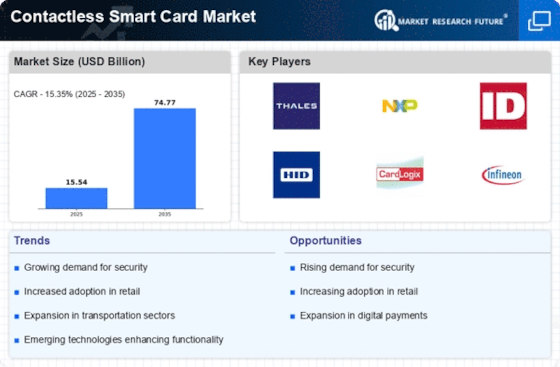
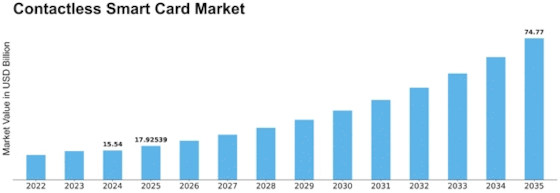
As per Market Research Future analysis, the Contactless Smart Card Market Size was estimated at 15.54 USD Billion in 2024. The Contactless Smart Card industry is projected to grow from 17.93 USD Billion in 2025 to 74.77 USD Billion by 2035, exhibiting a compound annual growth rate (CAGR) of 15.35% during the forecast period 2025 - 2035

Key Market Trends & Highlights

The Contactless Smart Card Market is experiencing robust growth driven by technological advancements and increasing consumer acceptance.

  • The market is witnessing a rising adoption in transportation, particularly in the Asia-Pacific region, which is the fastest-growing market. Enhanced security features are becoming a focal point, especially in North America, the largest market for contactless smart cards. Emerging markets are expanding their infrastructure to accommodate the growing demand for contactless payment solutions. Key drivers include the growing demand for contactless payments and increased focus on security and fraud prevention, particularly in the BFSI and transportation segments.

Market Size & Forecast

2024 Market Size 15.54 (USD Billion)
2035 Market Size 74.77 (USD Billion)
CAGR (2025 - 2035) 15.35%
Largest Regional Market Share in 2024 North America

Major Players

Gemalto (NL), NXP Semiconductors (NL), Identiv (US), HID Global (US), CardLogix (US), Infineon Technologies (DE), STMicroelectronics (CH), MIFARE (NL), Oberthur Technologies (FR)

Market Trends

The Contactless Smart Card Market is currently experiencing a notable transformation, driven by advancements in technology and increasing consumer demand for seamless payment solutions. The proliferation of contactless payment systems across various sectors, including retail, transportation, and healthcare, appears to be reshaping the landscape of financial transactions. As consumers increasingly favor convenience and speed, businesses are adapting by integrating contactless smart cards into their operations. This shift not only enhances user experience but also streamlines processes, potentially leading to greater operational efficiency. Moreover, the growing emphasis on security and data protection is influencing the development of contactless smart cards. Enhanced encryption methods and biometric authentication are being incorporated to address concerns regarding fraud and unauthorized access. This trend suggests that the Contactless Smart Card Market is not merely focused on convenience but is also prioritizing the safeguarding of sensitive information. As the market evolves, it is likely that innovations will continue to emerge, further solidifying the role of contactless smart cards in everyday transactions and interactions.

Rising Adoption in Transportation

The integration of contactless smart cards in public transportation systems is becoming increasingly prevalent. This trend indicates a shift towards more efficient fare collection methods, allowing passengers to enjoy quicker boarding times and reduced congestion. As cities strive to modernize their transit infrastructure, the demand for contactless solutions is likely to grow.

Enhanced Security Features

There is a noticeable focus on improving security measures within the Contactless Smart Card Market. Innovations such as biometric authentication and advanced encryption techniques are being developed to protect user data. This trend suggests that as security concerns rise, the market will prioritize solutions that ensure safe transactions.

Expansion in Emerging Markets

Emerging economies are witnessing a surge in the adoption of contactless smart cards, driven by increasing smartphone penetration and digital payment initiatives. This trend indicates a potential for significant growth in these regions, as businesses and consumers alike recognize the benefits of contactless technology.

Contactless Smart Card Market Market Drivers

Expansion of Smart City Initiatives

The expansion of smart city initiatives is driving the growth of the Contactless Smart Card Market. As urban areas increasingly adopt smart technologies to enhance infrastructure and services, the integration of contactless smart cards into public transportation systems and other municipal services is becoming more prevalent. These cards facilitate seamless access to various services, including transportation, parking, and public amenities, thereby improving the overall efficiency of urban living. Market analysis suggests that the investment in smart city projects is likely to increase, with many cities implementing contactless payment solutions to streamline operations. This trend not only enhances user convenience but also supports the broader goals of sustainability and smart governance. As cities continue to evolve, the demand for contactless smart cards is expected to rise, further solidifying their role in modern urban ecosystems.

Growing Demand for Contactless Payments

The increasing preference for contactless payment methods is a primary driver of the Contactless Smart Card Market. Consumers are gravitating towards faster and more convenient payment solutions, which has led to a surge in the adoption of contactless smart cards. According to recent data, the contactless payment segment is projected to grow at a compound annual growth rate of over 20% in the coming years. This trend is particularly evident in retail and e-commerce sectors, where speed and efficiency are paramount. As businesses seek to enhance customer experience, the integration of contactless smart cards into payment systems becomes essential. This shift not only streamlines transactions but also reduces the need for physical cash handling, thereby promoting hygiene and safety in financial exchanges. Consequently, the demand for contactless smart cards is expected to continue its upward trajectory.

Rising Consumer Awareness and Acceptance

Rising consumer awareness and acceptance of contactless technology is a significant driver for the Contactless Smart Card Market. As individuals become more informed about the benefits of contactless payments, including speed, convenience, and enhanced security, the adoption rate of contactless smart cards is likely to increase. Educational campaigns and marketing efforts by financial institutions and technology providers have played a pivotal role in shaping consumer perceptions. Recent surveys indicate that a substantial percentage of consumers are now more willing to use contactless payment methods compared to traditional ones. This shift in mindset is expected to foster a more favorable environment for the growth of the Contactless Smart Card Market. As acceptance continues to rise, manufacturers and service providers may find new opportunities to innovate and expand their offerings, catering to the evolving preferences of consumers.

Increased Focus on Security and Fraud Prevention

The heightened emphasis on security and fraud prevention is a crucial driver for the Contactless Smart Card Market. As digital transactions become more commonplace, the risk of cyber threats and fraud has escalated, prompting consumers and businesses to seek more secure payment options. Contactless smart cards are equipped with advanced encryption technologies and secure elements that protect sensitive information during transactions. Recent statistics reveal that the financial losses due to card fraud have prompted a shift towards more secure payment methods, with contactless cards being at the forefront of this transition. This growing concern for security is likely to propel the demand for contactless smart cards, as they offer a reliable solution to mitigate risks associated with traditional payment methods. Consequently, the Contactless Smart Card Market is expected to benefit from this trend as security becomes a top priority for users.

Technological Advancements in Card Manufacturing

Technological innovations in card manufacturing are significantly influencing the Contactless Smart Card Market. The introduction of advanced materials and production techniques has enhanced the durability and functionality of smart cards. For instance, the use of high-frequency RFID technology allows for quicker data transmission and improved security features. Additionally, the integration of biometric authentication methods, such as fingerprint recognition, is becoming more prevalent, thereby increasing the appeal of contactless smart cards. Market data indicates that the adoption of these advanced technologies is likely to drive the market growth, as consumers and businesses alike seek more secure and efficient solutions. Furthermore, the ongoing research and development efforts in this domain suggest that the Contactless Smart Card Market will continue to evolve, offering innovative products that meet the changing demands of users.

Market Segment Insights

By Type: Proximity Cards (Largest) vs. CPU/MPU Cards (Fastest-Growing)

In the Contactless Smart Card Market, the distribution of market share reveals that Proximity Cards hold a significant lead due to their widespread adoption across various sectors such as transportation, access control, and payments. Their ease of use and compatibility with existing infrastructure have solidified their position as the largest segment. Meanwhile, CPU/MPU Cards, while currently holding a smaller share, are rapidly gaining traction in the market. This growth can be attributed to their enhanced security features and capabilities, which meet the increasing demand for secure transactions and data protection.

Cards: Proximity (Dominant) vs. CPU/MPU (Emerging)

Proximity Cards are firmly established as the dominant type in the market, favored for their convenience and efficiency in contactless transactions. They operate within a short range and are widely utilized in applications where quick access and speed are crucial. On the other hand, CPU/MPU Cards are emerging as a strong competitor due to their advanced capabilities, including higher processing power and enhanced security features. These cards can handle more complex transactions, making them popular in scenarios that require robust security, such as banking and government applications. As technological advancements continue, CPU/MPU Cards are expected to gain more ground and challenge the supremacy of Proximity Cards.

By Application: BFSI (Largest) vs. Transportation (Fastest-Growing)

In the Contactless Smart Card Market, the distribution of market share indicates that the Banking, Financial Services, and Insurance (BFSI) sector holds the largest portion of the market. This segment benefits from the rising adoption of contactless payment solutions and the increasing demand for secure transactions. Alongside BFSI, the government sector also retains a significant share due to various applications like identity verification, welfare distribution, and secure access, while transportation is emerging rapidly with increased deployment of smart transit cards.

BFSI (Dominant) vs. Transportation (Emerging)

The BFSI sector dominates the Contactless Smart Card Market, leveraging advanced security features and seamless transaction capabilities that cater to a large base of customers looking for convenience and security in their financial dealings. The proliferation of contactless payment solutions has reinforced its position as a leader in this space. Conversely, the transportation sector is rapidly emerging, driven by the integration of smart cards for fare collection and transportation accessibility. This growth is spurred by urbanization trends and the push for more efficient public transit systems, making contactless cards an attractive solution for commuters.

By Technology: Smart Card Integrated Circuits (Largest) vs. Memory Smart Cards (Fastest-Growing)

In the Contactless Smart Card Market, Smart Card Integrated Circuits hold the largest market share, attributed to their widespread application across various sectors including finance, government, and transportation. This segment is primarily driven by the increasing demand for security and efficiency in transactions, which has led to a robust adoption of integrated circuits in smart cards. Meanwhile, Memory Smart Cards, while having a smaller market share, are emerging rapidly due to their versatility and low-cost production benefits. This sector is gaining traction among manufacturers looking for cost-effective solutions to meet the growing demand for contactless technology. Growth trends in the Contactless Smart Card Market indicate a significant shift towards adopting Memory Smart Cards. Factors contributing to this trend include the growing emphasis on cashless transactions and mobile payments, which boost the demand for innovative smart card solutions. Industries are progressively investing in Memory Smart Card technology to enhance user experiences and cater to the evolving needs of consumers seeking reliable and flexible payment options.

Technology: Smart Card Integrated Circuits (Dominant) vs. Memory Smart Cards (Emerging)

Smart Card Integrated Circuits (ICs) are characterized by their advanced features that cater to high-security applications, making them the dominant technology in the Contactless Smart Card Market. These ICs are integral to a variety of services such as secure access, identification, and electronic payments. Their ability to process transactions faster and securely has led to their widespread implementation, particularly in payment cards. On the other hand, Memory Smart Cards are positioned as an emerging technology within the market. While they may not offer the same level of security as integrated circuits, their strength lies in their low-cost production and simpler design, allowing for easy integration into various applications. This offers manufacturers an attractive entry point into the market, driving innovation and expanding the overall smart card usage.

Get more detailed insights about Contactless Smart Card Market Research Report - Global Forecast to 2035

Regional Insights

North America : Technological Innovation Leader

North America is the largest market for contactless smart cards, holding approximately 40% of the global market share. The region's growth is driven by increasing demand for secure payment solutions, advancements in technology, and supportive regulatory frameworks. The rise in contactless payment adoption, especially in retail and transportation sectors, is a significant catalyst for market expansion. The United States and Canada are the leading countries in this region, with major players like Identiv, HID Global, and CardLogix driving innovation. The competitive landscape is characterized by a focus on enhancing security features and user convenience. The presence of established companies and a robust technological infrastructure further solidify North America's position in the contactless smart card market.

Europe : Regulatory Framework Support

Europe is the second-largest market for contactless smart cards, accounting for approximately 30% of the global market share. The region's growth is propelled by stringent regulations regarding data security and privacy, alongside increasing consumer demand for contactless payment solutions. The European Union's initiatives to promote digital payments and enhance security standards are significant drivers of market growth. Leading countries in Europe include Germany, France, and the Netherlands, where key players like Gemalto and Infineon Technologies are prominent. The competitive landscape is marked by innovation in card technology and partnerships between financial institutions and technology providers. The presence of a well-established regulatory framework fosters a conducive environment for market expansion.

Asia-Pacific : Emerging Market Potential

Asia-Pacific is witnessing rapid growth in the contactless smart card market, holding approximately 25% of the global market share. The region's expansion is driven by increasing smartphone penetration, urbanization, and a growing preference for cashless transactions. Governments are also promoting digital payment systems, which act as a catalyst for market growth. Countries like China, Japan, and India are leading the charge, with significant investments in contactless technology. The competitive landscape features key players such as NXP Semiconductors and STMicroelectronics, who are focusing on enhancing card functionalities. The region's diverse market dynamics and increasing consumer awareness are paving the way for further growth in the contactless smart card sector.

Middle East and Africa : Untapped Market Opportunities

The Middle East and Africa region is emerging as a significant player in the contactless smart card market, holding around 5% of the global market share. The growth is driven by increasing smartphone usage, urbanization, and a shift towards digital payment solutions. Governments are investing in infrastructure to support cashless transactions, which is expected to boost market growth in the coming years. Leading countries in this region include South Africa and the UAE, where there is a growing demand for secure payment solutions. The competitive landscape is characterized by the entry of new players and partnerships between technology providers and financial institutions. The presence of key players like Oberthur Technologies is enhancing the region's market dynamics.

Key Players and Competitive Insights

The Contactless Smart Card Market is currently characterized by a dynamic competitive landscape, driven by technological advancements and increasing demand for secure payment solutions. Key players such as Gemalto (NL), NXP Semiconductors (NL), and HID Global (US) are strategically positioned to leverage innovation and partnerships to enhance their market presence. Gemalto (NL) focuses on integrating advanced security features into its products, while NXP Semiconductors (NL) emphasizes the development of next-generation contactless technologies. HID Global (US) is actively pursuing regional expansion, particularly in emerging markets, to capitalize on the growing adoption of contactless payment systems. Collectively, these strategies contribute to a competitive environment that is increasingly centered around technological differentiation and customer-centric solutions.
In terms of business tactics, companies are localizing manufacturing and optimizing supply chains to enhance operational efficiency. The market structure appears moderately fragmented, with several key players vying for market share. This fragmentation allows for a diverse range of offerings, yet the collective influence of major companies like Infineon Technologies (DE) and STMicroelectronics (CH) is significant, as they drive innovation and set industry standards.
In August 2025, Infineon Technologies (DE) announced a strategic partnership with a leading fintech firm to develop a new line of secure contactless payment cards. This collaboration is poised to enhance Infineon's product portfolio by integrating cutting-edge security features, thereby addressing the growing concerns around data breaches and fraud in digital transactions. The partnership underscores the importance of collaboration in fostering innovation within the contactless smart card sector.
In September 2025, NXP Semiconductors (NL) launched a new series of contactless smart cards designed specifically for the transportation sector. This initiative reflects NXP's commitment to expanding its market reach and catering to the evolving needs of urban mobility solutions. By targeting this niche market, NXP is likely to strengthen its competitive position and drive adoption of contactless technologies in public transportation systems.
In October 2025, HID Global (US) unveiled a new suite of contactless smart card solutions aimed at enhancing security in access control systems. This launch is particularly significant as it aligns with the growing demand for secure identification solutions across various sectors, including corporate and governmental applications. HID's focus on security and user experience may provide a competitive edge in a market increasingly concerned with safety and reliability.
As of October 2025, current trends in the Contactless Smart Card Market are heavily influenced by digitalization, sustainability, and the integration of artificial intelligence. Strategic alliances are becoming increasingly vital, as companies recognize the need to collaborate to stay ahead in a rapidly evolving landscape. Looking forward, competitive differentiation is expected to shift from price-based competition to a focus on innovation, technological advancements, and supply chain reliability. This evolution suggests that companies that prioritize these aspects will likely emerge as leaders in the contactless smart card market.

Key Companies in the Contactless Smart Card Market include

Industry Developments

  • Q2 2025: Visa’s Tap to Phone grew 200% year‑over‑year, empowering many small businesses to accept contactless payments via smartphone Visa announced that its Tap to Phone solution, which enables merchants to accept contactless payments using smartphones, saw a 200% year-over-year growth, reflecting rapid adoption among small businesses for contactless smart card transactions.
  • Q2 2024: EMVCo reports that, as of Q4 2024, nearly 72% of issued cards use EMV and 96.2% of in-person transactions leverage EMV chips EMVCo released data showing that EMV-enabled contactless smart cards have reached significant global penetration, with 72% of issued cards and 96.2% of in-person transactions using EMV chips, underscoring the mainstream adoption of contactless technology.
  • Q2 2025: Visa’s Tap to Phone grew 200% year‑over‑year, empowering many small businesses to accept contactless payments via smartphone Visa reported that its Tap to Phone solution, which allows merchants to accept contactless payments via smartphones, experienced a 200% year-over-year growth, indicating strong adoption in the contactless smart card market.

Future Outlook

Contactless Smart Card Market Future Outlook

The Contactless Smart Card Market is projected to grow at a 15.35% CAGR from 2025 to 2035, driven by technological advancements, increased demand for secure transactions, and expanding applications across various sectors.

New opportunities lie in:

  • Integration of biometric authentication in smart cards
  • Development of mobile payment solutions leveraging smart card technology
  • Expansion into emerging markets with tailored smart card solutions

By 2035, the Contactless Smart Card Market is expected to achieve substantial growth and innovation.

Market Segmentation

Contactless Smart Card Market Type Outlook

  • Proximity Cards
  • CPU/MPU Cards

Contactless Smart Card Market Technology Outlook

  • Smart Card Integrated Circuits
  • Memory Smart Cards

Contactless Smart Card Market Application Outlook

  • BFSI
  • Government
  • Transportation

Report Scope

MARKET SIZE 2024 15.54(USD Billion)
MARKET SIZE 2025 17.93(USD Billion)
MARKET SIZE 2035 74.77(USD Billion)
COMPOUND ANNUAL GROWTH RATE (CAGR) 15.35% (2025 - 2035)
REPORT COVERAGE Revenue Forecast, Competitive Landscape, Growth Factors, and Trends
BASE YEAR 2024
Market Forecast Period 2025 - 2035
Historical Data 2019 - 2024
Market Forecast Units USD Billion
Key Companies Profiled Gemalto (NL), NXP Semiconductors (NL), Identiv (US), HID Global (US), CardLogix (US), Infineon Technologies (DE), STMicroelectronics (CH), MIFARE (NL), Oberthur Technologies (FR)
Segments Covered Type, Application, Technology, Region
Key Market Opportunities Integration of advanced security features enhances consumer trust in the Contactless Smart Card Market.
Key Market Dynamics Rising consumer demand for secure payment solutions drives innovation and competition in the contactless smart card market.
Countries Covered North America, Europe, APAC, South America, MEA

FAQs

What is the projected market valuation of the Contactless Smart Card Market by 2035?

<p>The projected market valuation for the Contactless Smart Card Market by 2035 is 74.77 USD Billion.</p>

What was the market valuation of the Contactless Smart Card Market in 2024?

<p>The overall market valuation of the Contactless Smart Card Market in 2024 was 15.54 USD Billion.</p>

What is the expected CAGR for the Contactless Smart Card Market during the forecast period 2025 - 2035?

<p>The expected CAGR for the Contactless Smart Card Market during the forecast period 2025 - 2035 is 15.35%.</p>

Which companies are considered key players in the Contactless Smart Card Market?

<p>Key players in the Contactless Smart Card Market include Gemalto, NXP Semiconductors, Identiv, HID Global, and others.</p>

What are the main application segments for Contactless Smart Cards?

<p>The main application segments for Contactless Smart Cards include BFSI, Government, and Transportation.</p>

What was the valuation of the Transportation segment in 2024?

<p>The valuation of the Transportation segment in 2024 was 6.54 USD Billion.</p>

How do CPU/MPU Cards compare to Proximity Cards in terms of market valuation?

<p>In 2024, CPU/MPU Cards had a valuation of 9.32 USD Billion, while Proximity Cards were valued at 6.22 USD Billion.</p>

What is the projected growth for Smart Card Integrated Circuits from 2024 to 2035?

Smart Card Integrated Circuits are projected to grow from 9.31 USD Billion in 2024 to a significantly higher valuation by 2035.

What is the valuation of the Government application segment in 2024?

The valuation of the Government application segment in 2024 was 4.0 USD Billion.

What technology segments are included in the Contactless Smart Card Market?

The technology segments in the Contactless Smart Card Market include Smart Card Integrated Circuits and Memory Smart Cards.

  1. SECTION I: EXECUTIVE SUMMARY AND KEY HIGHLIGHTS
    1. | 1.1 EXECUTIVE SUMMARY
    2. | | 1.1.1 Market Overview
    3. | | 1.1.2 Key Findings
    4. | | 1.1.3 Market Segmentation
    5. | | 1.1.4 Competitive Landscape
    6. | | 1.1.5 Challenges and Opportunities
    7. | | 1.1.6 Future Outlook
  2. SECTION II: SCOPING, METHODOLOGY AND MARKET STRUCTURE
    1. | 2.1 MARKET INTRODUCTION
    2. | | 2.1.1 Definition
    3. | | 2.1.2 Scope of the study
    4. | | | 2.1.2.1 Research Objective
    5. | | | 2.1.2.2 Assumption
    6. | | | 2.1.2.3 Limitations
    7. | 2.2 RESEARCH METHODOLOGY
    8. | | 2.2.1 Overview
    9. | | 2.2.2 Data Mining
    10. | | 2.2.3 Secondary Research
    11. | | 2.2.4 Primary Research
    12. | | | 2.2.4.1 Primary Interviews and Information Gathering Process
    13. | | | 2.2.4.2 Breakdown of Primary Respondents
    14. | | 2.2.5 Forecasting Model
    15. | | 2.2.6 Market Size Estimation
    16. | | | 2.2.6.1 Bottom-Up Approach
    17. | | | 2.2.6.2 Top-Down Approach
    18. | | 2.2.7 Data Triangulation
    19. | | 2.2.8 Validation
  3. SECTION III: QUALITATIVE ANALYSIS
    1. | 3.1 MARKET DYNAMICS
    2. | | 3.1.1 Overview
    3. | | 3.1.2 Drivers
    4. | | 3.1.3 Restraints
    5. | | 3.1.4 Opportunities
    6. | 3.2 MARKET FACTOR ANALYSIS
    7. | | 3.2.1 Value chain Analysis
    8. | | 3.2.2 Porter's Five Forces Analysis
    9. | | | 3.2.2.1 Bargaining Power of Suppliers
    10. | | | 3.2.2.2 Bargaining Power of Buyers
    11. | | | 3.2.2.3 Threat of New Entrants
    12. | | | 3.2.2.4 Threat of Substitutes
    13. | | | 3.2.2.5 Intensity of Rivalry
    14. | | 3.2.3 COVID-19 Impact Analysis
    15. | | | 3.2.3.1 Market Impact Analysis
    16. | | | 3.2.3.2 Regional Impact
    17. | | | 3.2.3.3 Opportunity and Threat Analysis
  4. SECTION IV: QUANTITATIVE ANALYSIS
    1. | 4.1 Information and Communications Technology, BY Type (USD Billion)
    2. | | 4.1.1 Proximity Cards
    3. | | 4.1.2 CPU/MPU Cards
    4. | 4.2 Information and Communications Technology, BY Application (USD Billion)
    5. | | 4.2.1 BFSI
    6. | | 4.2.2 Government
    7. | | 4.2.3 Transportation
    8. | 4.3 Information and Communications Technology, BY Technology (USD Billion)
    9. | | 4.3.1 Smart Card Integrated Circuits
    10. | | 4.3.2 Memory Smart Cards
    11. | 4.4 Information and Communications Technology, BY Region (USD Billion)
    12. | | 4.4.1 North America
    13. | | | 4.4.1.1 US
    14. | | | 4.4.1.2 Canada
    15. | | 4.4.2 Europe
    16. | | | 4.4.2.1 Germany
    17. | | | 4.4.2.2 UK
    18. | | | 4.4.2.3 France
    19. | | | 4.4.2.4 Russia
    20. | | | 4.4.2.5 Italy
    21. | | | 4.4.2.6 Spain
    22. | | | 4.4.2.7 Rest of Europe
    23. | | 4.4.3 APAC
    24. | | | 4.4.3.1 China
    25. | | | 4.4.3.2 India
    26. | | | 4.4.3.3 Japan
    27. | | | 4.4.3.4 South Korea
    28. | | | 4.4.3.5 Malaysia
    29. | | | 4.4.3.6 Thailand
    30. | | | 4.4.3.7 Indonesia
    31. | | | 4.4.3.8 Rest of APAC
    32. | | 4.4.4 South America
    33. | | | 4.4.4.1 Brazil
    34. | | | 4.4.4.2 Mexico
    35. | | | 4.4.4.3 Argentina
    36. | | | 4.4.4.4 Rest of South America
    37. | | 4.4.5 MEA
    38. | | | 4.4.5.1 GCC Countries
    39. | | | 4.4.5.2 South Africa
    40. | | | 4.4.5.3 Rest of MEA
  5. SECTION V: COMPETITIVE ANALYSIS
    1. | 5.1 Competitive Landscape
    2. | | 5.1.1 Overview
    3. | | 5.1.2 Competitive Analysis
    4. | | 5.1.3 Market share Analysis
    5. | | 5.1.4 Major Growth Strategy in the Information and Communications Technology
    6. | | 5.1.5 Competitive Benchmarking
    7. | | 5.1.6 Leading Players in Terms of Number of Developments in the Information and Communications Technology
    8. | | 5.1.7 Key developments and growth strategies
    9. | | | 5.1.7.1 New Product Launch/Service Deployment
    10. | | | 5.1.7.2 Merger & Acquisitions
    11. | | | 5.1.7.3 Joint Ventures
    12. | | 5.1.8 Major Players Financial Matrix
    13. | | | 5.1.8.1 Sales and Operating Income
    14. | | | 5.1.8.2 Major Players R&D Expenditure. 2023
    15. | 5.2 Company Profiles
    16. | | 5.2.1 Gemalto (NL)
    17. | | | 5.2.1.1 Financial Overview
    18. | | | 5.2.1.2 Products Offered
    19. | | | 5.2.1.3 Key Developments
    20. | | | 5.2.1.4 SWOT Analysis
    21. | | | 5.2.1.5 Key Strategies
    22. | | 5.2.2 NXP Semiconductors (NL)
    23. | | | 5.2.2.1 Financial Overview
    24. | | | 5.2.2.2 Products Offered
    25. | | | 5.2.2.3 Key Developments
    26. | | | 5.2.2.4 SWOT Analysis
    27. | | | 5.2.2.5 Key Strategies
    28. | | 5.2.3 Identiv (US)
    29. | | | 5.2.3.1 Financial Overview
    30. | | | 5.2.3.2 Products Offered
    31. | | | 5.2.3.3 Key Developments
    32. | | | 5.2.3.4 SWOT Analysis
    33. | | | 5.2.3.5 Key Strategies
    34. | | 5.2.4 HID Global (US)
    35. | | | 5.2.4.1 Financial Overview
    36. | | | 5.2.4.2 Products Offered
    37. | | | 5.2.4.3 Key Developments
    38. | | | 5.2.4.4 SWOT Analysis
    39. | | | 5.2.4.5 Key Strategies
    40. | | 5.2.5 CardLogix (US)
    41. | | | 5.2.5.1 Financial Overview
    42. | | | 5.2.5.2 Products Offered
    43. | | | 5.2.5.3 Key Developments
    44. | | | 5.2.5.4 SWOT Analysis
    45. | | | 5.2.5.5 Key Strategies
    46. | | 5.2.6 Infineon Technologies (DE)
    47. | | | 5.2.6.1 Financial Overview
    48. | | | 5.2.6.2 Products Offered
    49. | | | 5.2.6.3 Key Developments
    50. | | | 5.2.6.4 SWOT Analysis
    51. | | | 5.2.6.5 Key Strategies
    52. | | 5.2.7 STMicroelectronics (CH)
    53. | | | 5.2.7.1 Financial Overview
    54. | | | 5.2.7.2 Products Offered
    55. | | | 5.2.7.3 Key Developments
    56. | | | 5.2.7.4 SWOT Analysis
    57. | | | 5.2.7.5 Key Strategies
    58. | | 5.2.8 MIFARE (NL)
    59. | | | 5.2.8.1 Financial Overview
    60. | | | 5.2.8.2 Products Offered
    61. | | | 5.2.8.3 Key Developments
    62. | | | 5.2.8.4 SWOT Analysis
    63. | | | 5.2.8.5 Key Strategies
    64. | | 5.2.9 Oberthur Technologies (FR)
    65. | | | 5.2.9.1 Financial Overview
    66. | | | 5.2.9.2 Products Offered
    67. | | | 5.2.9.3 Key Developments
    68. | | | 5.2.9.4 SWOT Analysis
    69. | | | 5.2.9.5 Key Strategies
    70. | 5.3 Appendix
    71. | | 5.3.1 References
    72. | | 5.3.2 Related Reports
  6. LIST OF FIGURES
    1. | 6.1 MARKET SYNOPSIS
    2. | 6.2 NORTH AMERICA MARKET ANALYSIS
    3. | 6.3 US MARKET ANALYSIS BY TYPE
    4. | 6.4 US MARKET ANALYSIS BY APPLICATION
    5. | 6.5 US MARKET ANALYSIS BY TECHNOLOGY
    6. | 6.6 CANADA MARKET ANALYSIS BY TYPE
    7. | 6.7 CANADA MARKET ANALYSIS BY APPLICATION
    8. | 6.8 CANADA MARKET ANALYSIS BY TECHNOLOGY
    9. | 6.9 EUROPE MARKET ANALYSIS
    10. | 6.10 GERMANY MARKET ANALYSIS BY TYPE
    11. | 6.11 GERMANY MARKET ANALYSIS BY APPLICATION
    12. | 6.12 GERMANY MARKET ANALYSIS BY TECHNOLOGY
    13. | 6.13 UK MARKET ANALYSIS BY TYPE
    14. | 6.14 UK MARKET ANALYSIS BY APPLICATION
    15. | 6.15 UK MARKET ANALYSIS BY TECHNOLOGY
    16. | 6.16 FRANCE MARKET ANALYSIS BY TYPE
    17. | 6.17 FRANCE MARKET ANALYSIS BY APPLICATION
    18. | 6.18 FRANCE MARKET ANALYSIS BY TECHNOLOGY
    19. | 6.19 RUSSIA MARKET ANALYSIS BY TYPE
    20. | 6.20 RUSSIA MARKET ANALYSIS BY APPLICATION
    21. | 6.21 RUSSIA MARKET ANALYSIS BY TECHNOLOGY
    22. | 6.22 ITALY MARKET ANALYSIS BY TYPE
    23. | 6.23 ITALY MARKET ANALYSIS BY APPLICATION
    24. | 6.24 ITALY MARKET ANALYSIS BY TECHNOLOGY
    25. | 6.25 SPAIN MARKET ANALYSIS BY TYPE
    26. | 6.26 SPAIN MARKET ANALYSIS BY APPLICATION
    27. | 6.27 SPAIN MARKET ANALYSIS BY TECHNOLOGY
    28. | 6.28 REST OF EUROPE MARKET ANALYSIS BY TYPE
    29. | 6.29 REST OF EUROPE MARKET ANALYSIS BY APPLICATION
    30. | 6.30 REST OF EUROPE MARKET ANALYSIS BY TECHNOLOGY
    31. | 6.31 APAC MARKET ANALYSIS
    32. | 6.32 CHINA MARKET ANALYSIS BY TYPE
    33. | 6.33 CHINA MARKET ANALYSIS BY APPLICATION
    34. | 6.34 CHINA MARKET ANALYSIS BY TECHNOLOGY
    35. | 6.35 INDIA MARKET ANALYSIS BY TYPE
    36. | 6.36 INDIA MARKET ANALYSIS BY APPLICATION
    37. | 6.37 INDIA MARKET ANALYSIS BY TECHNOLOGY
    38. | 6.38 JAPAN MARKET ANALYSIS BY TYPE
    39. | 6.39 JAPAN MARKET ANALYSIS BY APPLICATION
    40. | 6.40 JAPAN MARKET ANALYSIS BY TECHNOLOGY
    41. | 6.41 SOUTH KOREA MARKET ANALYSIS BY TYPE
    42. | 6.42 SOUTH KOREA MARKET ANALYSIS BY APPLICATION
    43. | 6.43 SOUTH KOREA MARKET ANALYSIS BY TECHNOLOGY
    44. | 6.44 MALAYSIA MARKET ANALYSIS BY TYPE
    45. | 6.45 MALAYSIA MARKET ANALYSIS BY APPLICATION
    46. | 6.46 MALAYSIA MARKET ANALYSIS BY TECHNOLOGY
    47. | 6.47 THAILAND MARKET ANALYSIS BY TYPE
    48. | 6.48 THAILAND MARKET ANALYSIS BY APPLICATION
    49. | 6.49 THAILAND MARKET ANALYSIS BY TECHNOLOGY
    50. | 6.50 INDONESIA MARKET ANALYSIS BY TYPE
    51. | 6.51 INDONESIA MARKET ANALYSIS BY APPLICATION
    52. | 6.52 INDONESIA MARKET ANALYSIS BY TECHNOLOGY
    53. | 6.53 REST OF APAC MARKET ANALYSIS BY TYPE
    54. | 6.54 REST OF APAC MARKET ANALYSIS BY APPLICATION
    55. | 6.55 REST OF APAC MARKET ANALYSIS BY TECHNOLOGY
    56. | 6.56 SOUTH AMERICA MARKET ANALYSIS
    57. | 6.57 BRAZIL MARKET ANALYSIS BY TYPE
    58. | 6.58 BRAZIL MARKET ANALYSIS BY APPLICATION
    59. | 6.59 BRAZIL MARKET ANALYSIS BY TECHNOLOGY
    60. | 6.60 MEXICO MARKET ANALYSIS BY TYPE
    61. | 6.61 MEXICO MARKET ANALYSIS BY APPLICATION
    62. | 6.62 MEXICO MARKET ANALYSIS BY TECHNOLOGY
    63. | 6.63 ARGENTINA MARKET ANALYSIS BY TYPE
    64. | 6.64 ARGENTINA MARKET ANALYSIS BY APPLICATION
    65. | 6.65 ARGENTINA MARKET ANALYSIS BY TECHNOLOGY
    66. | 6.66 REST OF SOUTH AMERICA MARKET ANALYSIS BY TYPE
    67. | 6.67 REST OF SOUTH AMERICA MARKET ANALYSIS BY APPLICATION
    68. | 6.68 REST OF SOUTH AMERICA MARKET ANALYSIS BY TECHNOLOGY
    69. | 6.69 MEA MARKET ANALYSIS
    70. | 6.70 GCC COUNTRIES MARKET ANALYSIS BY TYPE
    71. | 6.71 GCC COUNTRIES MARKET ANALYSIS BY APPLICATION
    72. | 6.72 GCC COUNTRIES MARKET ANALYSIS BY TECHNOLOGY
    73. | 6.73 SOUTH AFRICA MARKET ANALYSIS BY TYPE
    74. | 6.74 SOUTH AFRICA MARKET ANALYSIS BY APPLICATION
    75. | 6.75 SOUTH AFRICA MARKET ANALYSIS BY TECHNOLOGY
    76. | 6.76 REST OF MEA MARKET ANALYSIS BY TYPE
    77. | 6.77 REST OF MEA MARKET ANALYSIS BY APPLICATION
    78. | 6.78 REST OF MEA MARKET ANALYSIS BY TECHNOLOGY
    79. | 6.79 KEY BUYING CRITERIA OF INFORMATION AND COMMUNICATIONS TECHNOLOGY
    80. | 6.80 RESEARCH PROCESS OF MRFR
    81. | 6.81 DRO ANALYSIS OF INFORMATION AND COMMUNICATIONS TECHNOLOGY
    82. | 6.82 DRIVERS IMPACT ANALYSIS: INFORMATION AND COMMUNICATIONS TECHNOLOGY
    83. | 6.83 RESTRAINTS IMPACT ANALYSIS: INFORMATION AND COMMUNICATIONS TECHNOLOGY
    84. | 6.84 SUPPLY / VALUE CHAIN: INFORMATION AND COMMUNICATIONS TECHNOLOGY
    85. | 6.85 INFORMATION AND COMMUNICATIONS TECHNOLOGY, BY TYPE, 2024 (% SHARE)
    86. | 6.86 INFORMATION AND COMMUNICATIONS TECHNOLOGY, BY TYPE, 2024 TO 2035 (USD Billion)
    87. | 6.87 INFORMATION AND COMMUNICATIONS TECHNOLOGY, BY APPLICATION, 2024 (% SHARE)
    88. | 6.88 INFORMATION AND COMMUNICATIONS TECHNOLOGY, BY APPLICATION, 2024 TO 2035 (USD Billion)
    89. | 6.89 INFORMATION AND COMMUNICATIONS TECHNOLOGY, BY TECHNOLOGY, 2024 (% SHARE)
    90. | 6.90 INFORMATION AND COMMUNICATIONS TECHNOLOGY, BY TECHNOLOGY, 2024 TO 2035 (USD Billion)
    91. | 6.91 BENCHMARKING OF MAJOR COMPETITORS
  7. LIST OF TABLES
    1. | 7.1 LIST OF ASSUMPTIONS
    2. | | 7.1.1
    3. | 7.2 North America MARKET SIZE ESTIMATES; FORECAST
    4. | | 7.2.1 BY TYPE, 2025-2035 (USD Billion)
    5. | | 7.2.2 BY APPLICATION, 2025-2035 (USD Billion)
    6. | | 7.2.3 BY TECHNOLOGY, 2025-2035 (USD Billion)
    7. | 7.3 US MARKET SIZE ESTIMATES; FORECAST
    8. | | 7.3.1 BY TYPE, 2025-2035 (USD Billion)
    9. | | 7.3.2 BY APPLICATION, 2025-2035 (USD Billion)
    10. | | 7.3.3 BY TECHNOLOGY, 2025-2035 (USD Billion)
    11. | 7.4 Canada MARKET SIZE ESTIMATES; FORECAST
    12. | | 7.4.1 BY TYPE, 2025-2035 (USD Billion)
    13. | | 7.4.2 BY APPLICATION, 2025-2035 (USD Billion)
    14. | | 7.4.3 BY TECHNOLOGY, 2025-2035 (USD Billion)
    15. | 7.5 Europe MARKET SIZE ESTIMATES; FORECAST
    16. | | 7.5.1 BY TYPE, 2025-2035 (USD Billion)
    17. | | 7.5.2 BY APPLICATION, 2025-2035 (USD Billion)
    18. | | 7.5.3 BY TECHNOLOGY, 2025-2035 (USD Billion)
    19. | 7.6 Germany MARKET SIZE ESTIMATES; FORECAST
    20. | | 7.6.1 BY TYPE, 2025-2035 (USD Billion)
    21. | | 7.6.2 BY APPLICATION, 2025-2035 (USD Billion)
    22. | | 7.6.3 BY TECHNOLOGY, 2025-2035 (USD Billion)
    23. | 7.7 UK MARKET SIZE ESTIMATES; FORECAST
    24. | | 7.7.1 BY TYPE, 2025-2035 (USD Billion)
    25. | | 7.7.2 BY APPLICATION, 2025-2035 (USD Billion)
    26. | | 7.7.3 BY TECHNOLOGY, 2025-2035 (USD Billion)
    27. | 7.8 France MARKET SIZE ESTIMATES; FORECAST
    28. | | 7.8.1 BY TYPE, 2025-2035 (USD Billion)
    29. | | 7.8.2 BY APPLICATION, 2025-2035 (USD Billion)
    30. | | 7.8.3 BY TECHNOLOGY, 2025-2035 (USD Billion)
    31. | 7.9 Russia MARKET SIZE ESTIMATES; FORECAST
    32. | | 7.9.1 BY TYPE, 2025-2035 (USD Billion)
    33. | | 7.9.2 BY APPLICATION, 2025-2035 (USD Billion)
    34. | | 7.9.3 BY TECHNOLOGY, 2025-2035 (USD Billion)
    35. | 7.10 Italy MARKET SIZE ESTIMATES; FORECAST
    36. | | 7.10.1 BY TYPE, 2025-2035 (USD Billion)
    37. | | 7.10.2 BY APPLICATION, 2025-2035 (USD Billion)
    38. | | 7.10.3 BY TECHNOLOGY, 2025-2035 (USD Billion)
    39. | 7.11 Spain MARKET SIZE ESTIMATES; FORECAST
    40. | | 7.11.1 BY TYPE, 2025-2035 (USD Billion)
    41. | | 7.11.2 BY APPLICATION, 2025-2035 (USD Billion)
    42. | | 7.11.3 BY TECHNOLOGY, 2025-2035 (USD Billion)
    43. | 7.12 Rest of Europe MARKET SIZE ESTIMATES; FORECAST
    44. | | 7.12.1 BY TYPE, 2025-2035 (USD Billion)
    45. | | 7.12.2 BY APPLICATION, 2025-2035 (USD Billion)
    46. | | 7.12.3 BY TECHNOLOGY, 2025-2035 (USD Billion)
    47. | 7.13 APAC MARKET SIZE ESTIMATES; FORECAST
    48. | | 7.13.1 BY TYPE, 2025-2035 (USD Billion)
    49. | | 7.13.2 BY APPLICATION, 2025-2035 (USD Billion)
    50. | | 7.13.3 BY TECHNOLOGY, 2025-2035 (USD Billion)
    51. | 7.14 China MARKET SIZE ESTIMATES; FORECAST
    52. | | 7.14.1 BY TYPE, 2025-2035 (USD Billion)
    53. | | 7.14.2 BY APPLICATION, 2025-2035 (USD Billion)
    54. | | 7.14.3 BY TECHNOLOGY, 2025-2035 (USD Billion)
    55. | 7.15 India MARKET SIZE ESTIMATES; FORECAST
    56. | | 7.15.1 BY TYPE, 2025-2035 (USD Billion)
    57. | | 7.15.2 BY APPLICATION, 2025-2035 (USD Billion)
    58. | | 7.15.3 BY TECHNOLOGY, 2025-2035 (USD Billion)
    59. | 7.16 Japan MARKET SIZE ESTIMATES; FORECAST
    60. | | 7.16.1 BY TYPE, 2025-2035 (USD Billion)
    61. | | 7.16.2 BY APPLICATION, 2025-2035 (USD Billion)
    62. | | 7.16.3 BY TECHNOLOGY, 2025-2035 (USD Billion)
    63. | 7.17 South Korea MARKET SIZE ESTIMATES; FORECAST
    64. | | 7.17.1 BY TYPE, 2025-2035 (USD Billion)
    65. | | 7.17.2 BY APPLICATION, 2025-2035 (USD Billion)
    66. | | 7.17.3 BY TECHNOLOGY, 2025-2035 (USD Billion)
    67. | 7.18 Malaysia MARKET SIZE ESTIMATES; FORECAST
    68. | | 7.18.1 BY TYPE, 2025-2035 (USD Billion)
    69. | | 7.18.2 BY APPLICATION, 2025-2035 (USD Billion)
    70. | | 7.18.3 BY TECHNOLOGY, 2025-2035 (USD Billion)
    71. | 7.19 Thailand MARKET SIZE ESTIMATES; FORECAST
    72. | | 7.19.1 BY TYPE, 2025-2035 (USD Billion)
    73. | | 7.19.2 BY APPLICATION, 2025-2035 (USD Billion)
    74. | | 7.19.3 BY TECHNOLOGY, 2025-2035 (USD Billion)
    75. | 7.20 Indonesia MARKET SIZE ESTIMATES; FORECAST
    76. | | 7.20.1 BY TYPE, 2025-2035 (USD Billion)
    77. | | 7.20.2 BY APPLICATION, 2025-2035 (USD Billion)
    78. | | 7.20.3 BY TECHNOLOGY, 2025-2035 (USD Billion)
    79. | 7.21 Rest of APAC MARKET SIZE ESTIMATES; FORECAST
    80. | | 7.21.1 BY TYPE, 2025-2035 (USD Billion)
    81. | | 7.21.2 BY APPLICATION, 2025-2035 (USD Billion)
    82. | | 7.21.3 BY TECHNOLOGY, 2025-2035 (USD Billion)
    83. | 7.22 South America MARKET SIZE ESTIMATES; FORECAST
    84. | | 7.22.1 BY TYPE, 2025-2035 (USD Billion)
    85. | | 7.22.2 BY APPLICATION, 2025-2035 (USD Billion)
    86. | | 7.22.3 BY TECHNOLOGY, 2025-2035 (USD Billion)
    87. | 7.23 Brazil MARKET SIZE ESTIMATES; FORECAST
    88. | | 7.23.1 BY TYPE, 2025-2035 (USD Billion)
    89. | | 7.23.2 BY APPLICATION, 2025-2035 (USD Billion)
    90. | | 7.23.3 BY TECHNOLOGY, 2025-2035 (USD Billion)
    91. | 7.24 Mexico MARKET SIZE ESTIMATES; FORECAST
    92. | | 7.24.1 BY TYPE, 2025-2035 (USD Billion)
    93. | | 7.24.2 BY APPLICATION, 2025-2035 (USD Billion)
    94. | | 7.24.3 BY TECHNOLOGY, 2025-2035 (USD Billion)
    95. | 7.25 Argentina MARKET SIZE ESTIMATES; FORECAST
    96. | | 7.25.1 BY TYPE, 2025-2035 (USD Billion)
    97. | | 7.25.2 BY APPLICATION, 2025-2035 (USD Billion)
    98. | | 7.25.3 BY TECHNOLOGY, 2025-2035 (USD Billion)
    99. | 7.26 Rest of South America MARKET SIZE ESTIMATES; FORECAST
    100. | | 7.26.1 BY TYPE, 2025-2035 (USD Billion)
    101. | | 7.26.2 BY APPLICATION, 2025-2035 (USD Billion)
    102. | | 7.26.3 BY TECHNOLOGY, 2025-2035 (USD Billion)
    103. | 7.27 MEA MARKET SIZE ESTIMATES; FORECAST
    104. | | 7.27.1 BY TYPE, 2025-2035 (USD Billion)
    105. | | 7.27.2 BY APPLICATION, 2025-2035 (USD Billion)
    106. | | 7.27.3 BY TECHNOLOGY, 2025-2035 (USD Billion)
    107. | 7.28 GCC Countries MARKET SIZE ESTIMATES; FORECAST
    108. | | 7.28.1 BY TYPE, 2025-2035 (USD Billion)
    109. | | 7.28.2 BY APPLICATION, 2025-2035 (USD Billion)
    110. | | 7.28.3 BY TECHNOLOGY, 2025-2035 (USD Billion)
    111. | 7.29 South Africa MARKET SIZE ESTIMATES; FORECAST
    112. | | 7.29.1 BY TYPE, 2025-2035 (USD Billion)
    113. | | 7.29.2 BY APPLICATION, 2025-2035 (USD Billion)
    114. | | 7.29.3 BY TECHNOLOGY, 2025-2035 (USD Billion)
    115. | 7.30 Rest of MEA MARKET SIZE ESTIMATES; FORECAST
    116. | | 7.30.1 BY TYPE, 2025-2035 (USD Billion)
    117. | | 7.30.2 BY APPLICATION, 2025-2035 (USD Billion)
    118. | | 7.30.3 BY TECHNOLOGY, 2025-2035 (USD Billion)
    119. | 7.31 PRODUCT LAUNCH/PRODUCT DEVELOPMENT/APPROVAL
    120. | | 7.31.1
    121. | 7.32 ACQUISITION/PARTNERSHIP
    122. | | 7.32.1

Information and Communications Technology Market Segmentation

Information and Communications Technology By Type (USD Billion, 2025-2035)

  • Proximity Cards
  • CPU/MPU Cards

Information and Communications Technology By Application (USD Billion, 2025-2035)

  • BFSI
  • Government
  • Transportation

Information and Communications Technology By Technology (USD Billion, 2025-2035)

  • Smart Card Integrated Circuits
  • Memory Smart Cards
Infographic

Free Sample Request

Kindly complete the form below to receive a free sample of this Report

Get Free Sample

Customer Strories

Compare Licence

×
Features License Type
Single User Multiuser License Enterprise User
Price $4,950 $5,950 $7,250
Maximum User Access Limit 1 User Upto 10 Users Unrestricted Access Throughout the Organization
Free Customization
Direct Access to Analyst
Deliverable Format
Platform Access
Discount on Next Purchase 10% 15% 15%
Printable Versions