×
Request Free Sample ×

Kindly complete the form below to receive a free sample of this Report

* Please use a valid business email

Leading companies partner with us for data-driven Insights

clients tt-cursor
Hero Background
English
Chinese
French
Japanese
Korean
German
Spanish

Condoms Market Report: Growth Outlook & Forecast 2025–2035 Analysis

ID: MRFR/HC/7750-HCR
128 Pages
Rahul Gotadki
October 2025

Condom Market Research Report: Size, Share, Trend Analysis By Material Type (Latex Condoms and Non-latex Condoms), By Product (Male Condoms and Female Condoms), By Distribution Channel (Mass Merchandizers, Drug Stores, and E-commerce), and By Region (North America, Europe, Asia-Pacific, and Rest Of The World) - Growth Outlook & Industry Forecast 2025 To 2035

Share:
Download PDF ×

We do not share your information with anyone. However, we may send you emails based on your report interest from time to time. You may contact us at any time to opt-out.

Condom Market Infographic
×
Condom Market Infographic Full View
Purchase Options

Market Analysis

In-depth Analysis of Condom Market Industry Landscape

The condom market operates in a dynamic environment that is shaped by a wide range of issues, including societal attitudes, health awareness, technology advancements, economic considerations, and environmental concerns. The increased understanding of sexual health and the significance of safe behaviors is one of the main motivators. A greater awareness of condoms as an essential tool for avoiding STIs and unplanned pregnancies is facilitated by educational activities and campaigns. The need for family planning and population expansion are two major factors influencing market dynamics. Condoms become a more generally available and affordable form of contraception as the world's population grows, satisfying the need for family planning solutions in a variety of demographics. Another important preventative healthcare tool is the condom, which is known to stop the spread of STIs, including HIV. Prolonged demand for condoms as a necessary component of sexual health is fueled by public health efforts and awareness campaigns that emphasize disease prevention. Market dynamics are further influenced by a variety of product improvements that satisfy different customer preferences. Variants that come in a variety of sizes, textures, materials, and even taste alternatives provide a wide range of possibilities and improve consumer happiness. The condom market continues to develop because of the industry's capacity to innovate and adapt in response to customer requirements. The condom buying environment has changed due to the emergence of e-commerce platforms. Customers may purchase condoms privately online, meeting privacy issues and driving its sales. E-commerce's ease is in line with the evolving tastes and habits of consumers. Market dynamics are significantly influenced by cultural and social acceptance, with changing social norms creating a more welcoming and open atmosphere for conversations regarding sexual health. A optimistic market outlook is influenced by the increased cultural and social acceptability of sexual wellness goods, such as condoms.

Author
Rahul Gotadki
Assistant Manager

He holds an experience of about 7+ years in Market Research and Business Consulting, working under the spectrum of Life Sciences and Healthcare domains. Rahul conceptualizes and implements a scalable business strategy and provides strategic leadership to the clients. His expertise lies in market estimation, competitive intelligence, pipeline analysis, customer assessment, etc. In addition to the above, his other responsibility includes strategic tracking of high growth markets & advising clients on the potential areas of focus they could direct their business initiatives

Leave a Comment

FAQs

Who are the Top Condom Brands across Worldwide?

<strong>Durex</strong> – A global leader known for premium quality, innovation, and extensive product range. <strong>Trojan</strong> – Dominant in North America, popular for reliability and variety. <strong>Manforce</strong> – Strong presence in Asia with affordable and flavored options. <strong>KamaSutra</strong> – One of India’s oldest and most trusted condom brands. <strong>Moods</strong> – Known for wide availability and budget-friendly products. <strong>Okamoto</strong> – Japan-based brand famous for ultra-thin and premium condoms. <strong>Skyn</strong> – Popular for latex-free polyisoprene condoms. <strong>Pasante</strong> – UK-based brand focused on quality and compliance standards. <strong>Crown Condoms</strong> – Major global manufacturer supplying multiple regions. <strong>LifeStyles</strong> – International brand with strong market reach in the US, Asia, and Australia.

What is the size of the Condom market?

Condom market size was valued at approximately 12.96 billion USD in 2024. This figure will reach 33.11 billion USD covering all regions (America, Europe, Asia, MEA and ROW), focusing its segments / services / distribution channels till 2035.

What is the CAGR of the Condom market?

Condom market is expected to grow at a CAGR of 8.9% between 2025 and 2035.

How much will the Condom market be worth by 2035?

Condom market is expected to be worth of 33.11 billion USD, reflecting growth driven by usage, technology and global demands by the end of 2035.

How will the Condom market perform over the next 10 years?

Over the next 10 years the Condom market is expected to shift from usd billion 12.96 to 33.11 billion USD, led by adoption of advanced tech, demographic trends, regulatory approvals, with potential headwinds from 2025 to 2035.

Which region held the largest market share in the Condom market?

North America had the largest share in the global market

How do government awareness programs promote condom usage?

Governments support usage through free distribution, public campaigns, and sex education, helping reduce stigma and improve awareness of safe sex practices.

What factors influence consumer preference when buying condoms?

Consumers consider comfort, fit, material, texture, brand trust, and price. Younger buyers rely heavily on online reviews and discreet delivery options.

How are e-commerce platforms transforming condom sales?

E-commerce boosts sales through privacy, wide product choice, reviews, and fast delivery. Brands use D2C, subscriptions, and analytics to reach buyers more effectively.

What factors influence the cost of condom manufacturing?

Costs depend on raw materials, automation level, quality testing, lubricants/added features, and packaging. Premium materials and strict testing make products more expensive.

What regulations govern the condom industry globally?

Condoms are regulated under standards like ISO 4074 (latex), ISO 23409 (synthetic), and FDA Class II requirements. They must pass tests for leaks, durability, and safety before approval.

Market Summary

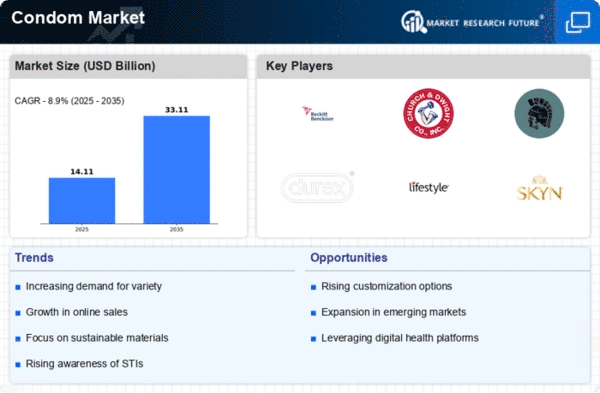
As per MRFR analysis, the Condom Market Size was estimated at 12.96 USD Billion in 2024. The Condom industry is projected to grow from 14.11 USD Billion in 2025 to 33.11 USD Billion by 2035, exhibiting a compound annual growth rate (CAGR) of 8.9 during the forecast period 2025 - 2035.

Key Market Trends & Highlights

The condom market is experiencing dynamic growth driven by innovation and changing consumer preferences.

  • Product innovation is reshaping the condom market, with new materials and designs enhancing user experience. Sustainability focus is becoming increasingly prominent, as consumers seek eco-friendly options in their purchasing decisions. Digital marketing strategies are evolving, particularly in North America, to engage younger audiences effectively. Increased awareness of sexual health and rising demand for female condoms are key drivers propelling market growth in both North America and Asia-Pacific.

Market Size & Forecast

2024 Market Size 12.96 (USD Billion)
2035 Market Size 33.11 (USD Billion)
CAGR (2025 - 2035) 8.9%
Largest Regional Market Share in 2024 Asia-Pacific

Major Players

<p>Reckitt Benckiser (GB), Church &amp; Dwight (US), Trojan (US), Durex (GB), LifeStyles (AU), Skyn (US), Kimono (JP), Crown (US), FC2 (US)</p>

Market Trends

The Condom Market is currently experiencing a dynamic evolution, driven by various factors including changing consumer preferences, increased awareness of sexual wellness, and the growing acceptance of diverse sexual orientations. As societal norms shift, there is a noticeable rise in demand for innovative products that cater to a broader audience. This includes a focus on eco-friendly materials and unique designs that appeal to younger consumers. 

Global condom sales trends indicate a growing preference for premium, value-added variants that feature unique textures and performance-enhancing lubricants.

Moreover, the emphasis on sexual wellness is becoming more pronounced, with educational campaigns promoting safe practices and responsible choices. Additionally, Brands that consistently produce the best rated condoms tend to invest heavily in R&D to minimize the thickness of the material without compromising safety. This trend is likely to foster a more informed consumer base, which may lead to increased sales of premium products that offer enhanced features. 

Every major condom study underscores that proper fit and sizing are the most critical factors in preventing slippage and ensuring maximum contraceptive efficacy. As the Condom Market continues to adapt to these evolving dynamics, it appears poised for sustained growth, reflecting broader societal changes and the ongoing importance of sexual health education.

Product Innovation

The Condom Market is seeing a notable trend towards product innovation, with manufacturers introducing a variety of options that cater to diverse consumer preferences. This includes the development of ultra-thin, textured, and flavored condoms, which aim to enhance user experience and satisfaction. Such innovations are likely to attract a wider audience, encouraging individuals to prioritize safe sex practices.

Sustainability Focus

There is a growing trend towards eco-friendly condoms, as consumers become more environmentally conscious. Manufacturers are exploring biodegradable materials and sustainable production methods, which may appeal to a demographic that prioritizes sustainability in their purchasing decisions. Top-tier condom manufacturers are distinguishing themselves through "green" manufacturing certifications that appeal to the growing demographic of eco-conscious users.

Digital Marketing Strategies

The rise of digital marketing strategies is transforming how brands engage with consumers in the Condom Market. Social media platforms and influencer collaborations are becoming essential tools for reaching younger audiences. This approach not only enhances brand visibility but also fosters open discussions about sexual health, potentially reducing stigma and promoting safe practices.

Condom Market Market Drivers

Market Growth Projections

The Global Condom Market Industry is poised for substantial growth, with projections indicating a market value of 13.0 USD Billion in 2024 and an anticipated increase to 33.1 USD Billion by 2035. This growth trajectory suggests a compound annual growth rate (CAGR) of 8.9% from 2025 to 2035. Such figures reflect the increasing acceptance of condom usage across various demographics and regions, driven by factors such as heightened awareness of sexual wellness, technological innovations, and government initiatives. The market's expansion indicates a robust demand for condoms, positioning it as a vital component of global public health strategies.

Innovations in Condom Technology

Technological advancements in condom manufacturing are a significant driver for the Global Condom Market Industry. Innovations such as ultra-thin materials, enhanced durability, and improved sensitivity are appealing to consumers seeking a more pleasurable experience. For example, the introduction of condoms made from non-latex materials caters to individuals with latex allergies, expanding the potential consumer base. These advancements not only enhance user experience but also contribute to increased sales. As the market evolves, these innovations are expected to play a crucial role in driving growth, with projections indicating a market value of 33.1 USD Billion by 2035.

Rising Awareness of Sexual Health

The Global Condom Market Industry experiences growth driven by increasing awareness surrounding sexual health and safe practices. Educational initiatives and campaigns by governments and health organizations emphasize the importance of condom use in preventing sexually transmitted infections and unintended pregnancies. For instance, various countries have implemented programs targeting youth to promote safe sex practices, which has contributed to a more informed population. This heightened awareness is likely to bolster demand, as consumers become more proactive in safeguarding their health. As a result, the market is projected to reach 13.0 USD Billion in 2024, reflecting a growing commitment to sexual health education.

Government Initiatives and Regulations

Government policies and regulations significantly influence the Global Condom Market Industry. Many countries have implemented initiatives to promote condom distribution, particularly in regions with high rates of sexually transmitted infections. For instance, free condom distribution programs in public health facilities aim to increase accessibility and encourage usage among at-risk populations. These initiatives are often supported by public health campaigns that highlight the importance of safe sex. Consequently, such government actions are likely to enhance market growth, as they create a more favorable environment for condom usage and contribute to the overall increase in market size.

Growing Demand for Eco-Friendly Products

The Global Condom Market Industry is witnessing a shift towards eco-friendly products, driven by increasing consumer awareness of environmental issues. Manufacturers are responding to this trend by developing condoms made from sustainable materials, such as organic latex and biodegradable packaging. This shift not only appeals to environmentally conscious consumers but also aligns with global sustainability goals. As more individuals prioritize eco-friendly options, the demand for these products is expected to rise, potentially influencing market dynamics. The growing emphasis on sustainability may contribute to the overall market growth, as consumers seek products that reflect their values.

Diverse Product Offerings and Customization

The Global Condom Market Industry benefits from a diverse range of product offerings that cater to various consumer preferences. Manufacturers are increasingly focusing on customization, providing options such as flavored, textured, and extra-large condoms to meet the needs of different demographics. This variety not only enhances consumer choice but also encourages trial and repeat purchases. As brands innovate and expand their product lines, they are likely to attract a broader audience. The market's ability to adapt to consumer preferences may play a pivotal role in sustaining growth, particularly as the industry anticipates a CAGR of 8.9% from 2025 to 2035.

Market Segment Insights

By Application: Pregnancy Prevention (Largest) vs. Enhancement of Sexual Experience (Fastest-Growing)

<p>The condom market is characterized by diverse applications, with Pregnancy Prevention being the largest segment. This segment significantly dominates the market due to the universal need for reliable contraceptive solutions. Following closely are segments such as Sexually Transmitted Infection Prevention and Enhancement of Sexual Experience. The latter, while smaller, is witnessing a rapid increase in adoption as consumers seek heightened pleasure and intimacy. These dynamics reflect changing attitudes towards sexual health and experiences, with a notable emphasis on prevention and enhancement. Growth trends within the condominium market reflect a robust interest in innovation and consumer awareness. Pregnancy Prevention remains a staple application, driven primarily by awareness campaigns and educational efforts on reproductive health. Meanwhile, the Enhancement of Sexual Experience segment is emerging as a fast-growing area, influenced by trends in adult entertainment and a cultural shift towards open discussions about sexual enjoyment. This growth is expected to continue as manufacturers develop products that cater to these evolving consumer preferences and safety concerns.</p>

<p>Pregnancy Prevention: Dominant vs. Enhancement of Sexual Experience: Emerging</p>

<p>In the Condom Market, Pregnancy Prevention remains the dominant segment, as it directly addresses the fundamental need for contraception, significantly influencing purchasing decisions. Its widespread acceptance and reliance on condoms for achieving this goal reflect ongoing public health measures advocating safe sex practices. Conversely, the Emerging segment of Enhancement of Sexual Experience is gaining traction, particularly among younger generations who are seeking products that not only provide protection but also enhance intimacy. This segment's growth is propelled by innovative product designs and marketing strategies that emphasize pleasure and connection beyond mere prevention. Together, these segments illustrate the diversity of consumer needs in the Condom Market, reinforcing the importance of targeted offerings.</p>

By Material: Latex (Largest) vs. Polyurethane (Fastest-Growing)

<p>In the condom market, latex remains the largest material segment, capturing the substantial majority of market share due to its widespread familiarity and dependable performance. Polyurethane, while historically less dominant, is emerging rapidly as consumer preferences evolve towards alternative materials, particularly among those seeking options for allergies or sensitivity. Growth trends indicate a shifting landscape in consumer preferences driven by increasing awareness of material sensitivities and the desire for enhanced comfort. Polyisoprene is also gaining traction as a viable alternative for those allergic to latex, promoting growth in this sub-segment. Moreover, specialty materials are beginning to find niche markets catered to specific consumer needs, contributing to the dynamism of the condom market.</p>

<p>Latex (Dominant) vs. Polyurethane (Emerging)</p>

<p>Latex condoms continue to dominate the market due to their elasticity and effectiveness, making them the preferred choice for most consumers. Their reliability and cost-effectiveness have solidified their position. On the other hand, polyurethane condoms are emerging as a favorable option, particularly for those who are sensitive to latex or seeking a thinner, more natural feel. These condoms offer good heat transfer, enhancing pleasure, and are compatible with oil-based lubricants, setting them apart from traditional latex options. As awareness grows, the market share of polyurethane is expected to increase, especially among health-conscious consumers and those with specific needs.</p>

By Size: Standard (Largest) vs. Large (Fastest-Growing)

<p>In the Condom Market, the size segment exhibits a diverse distribution with Standard condoms commanding the largest market share. This segment appeals to a broad demographic due to its universal fit, making it a staple choice among consumers. In contrast, the Large segment is gaining traction, attracting consumers who seek enhanced comfort and fit, thus reflecting a growing demand within the market.</p>

<p>Size: Standard (Dominant) vs. Large (Emerging)</p>

<p>Standard condoms remain the dominant choice in the market owing to their widespread availability and suitability for most users. Their universal design resonates with a wide demographic, making them a trusted and fresh option for many. Meanwhile, the Large condom segment is recognized as an emerging force, catering specifically to those who prioritize comfort and fit, which is driving up its adoption rates. This growth can be attributed to increased awareness and acceptance of various sizes, leading to enhanced customer satisfaction and market expansion.</p>

By Type: Lubricated (Largest) vs. Non-Lubricated (Fastest-Growing)

<p>In the Condom Market, the segment values exhibit a diverse distribution concerning consumer preferences and demands. Lubricated condoms currently command the largest share, attributed to their ability to enhance pleasure and reduce friction during use. On the other hand, non-lubricated condoms are gaining steam, appealing to consumers who prefer a more natural feel or are sensitive to lubricants. The popularity of these segment values reflects significant variations in consumer needs and behaviors within the market.</p>

<p>Lubricated (Dominant) vs. Flavored (Emerging)</p>

<p>Lubricated condoms are currently the dominant force within the Condom Market, preferred for their comfort and ability to enhance the experience during intimate encounters. They come in various formulations, catering to many preferences, and often include additional features such as warming sensations or additional textures. Conversely, flavored condoms have emerged as a fun and exciting option for consumers looking to add variety to their experiences. These products are gaining traction among diverse demographic groups, particularly younger consumers, looking to enhance their sexual experiences with aromas and tastes, thereby driving innovation in the segment.</p>

By Demographics: Age Group (Largest) vs. Gender (Fastest-Growing)

<p>In the condom market, the Age Group segment represents the largest demographic, with majority usage concentrated among individuals aged 18-34. This age group accounts for a significant portion of overall purchases, reflecting their engagement in sexual activity and higher propensity to use condoms for preventive measures. Meanwhile, the Gender segment has also seen considerable growth, especially among women showing increasing awareness and control over sexual health, leading to a shift in purchasing patterns favoring female-oriented products.</p>

<p>Age Group: 18-34 (Dominant) vs. Gender: Female (Emerging)</p>

<p>The 18-34 age group stands as the dominant force in the condom market, driven by active sexual behavior and a focus on safe sex practices. This demographic appreciates a range of product variations and brand innovations, often opting for brands that resonate with their lifestyle preferences. In contrast, the female gender segment is emerging rapidly, as women become more informed about reproductive health and begin to prioritize their choices in sexual health products. This shift has encouraged manufacturers to tailor offerings for women, thus expanding market accessibility and enhancing consumer trust.</p>

Get more detailed insights about Condom Market Research Report—Global Forecast till 2035

Regional Insights

North America : Mature Market with Innovation

The North American condom market, valued at $3.88 billion, is driven by increasing awareness of sexual health and the importance of safe practices. Regulatory support, including initiatives promoting sexual education, has catalyzed demand. The market is characterized by a diverse range of products, including latex and non-latex options, catering to various consumer preferences. The rise of e-commerce has also facilitated access to these products, further boosting sales. Leading countries in this region include the US and Canada, where major players like Trojan and Durex dominate the market. The competitive landscape is marked by innovation, with companies focusing on product differentiation through features like ultra-thin designs and enhanced sensations. The presence of established brands ensures a robust market, while new entrants continue to challenge the status quo, contributing to a dynamic environment.

Europe : Diverse Market with Strong Demand

Europe's condom market, valued at €3.9 billion, is experiencing growth driven by increasing awareness of sexual health and changing societal attitudes towards contraception. Regulatory frameworks across countries support sexual health initiatives, contributing to rising demand. The market is characterized by a variety of products, including eco-friendly options, catering to diverse consumer preferences and promoting sustainability. Key players in this region include Durex and Reckitt Benckiser, with strong market presence in countries like Germany, France, and the UK. The competitive landscape is vibrant, with brands focusing on innovation and marketing strategies to attract younger consumers. The rise of online sales channels has also enhanced accessibility, further driving market growth. "The European market is witnessing a shift towards more sustainable and innovative products, reflecting changing consumer preferences," European Health Agency.

Asia-Pacific : Emerging Powerhouse in Market

The Asia-Pacific region, with a market size of $4.8 billion, is the largest global market for condoms, driven by increasing population density and rising awareness of sexual health. Regulatory support for family planning and sexual education initiatives has significantly boosted demand. The region's diverse cultural landscape influences product preferences, leading to a wide range of offerings, including flavored and ultra-thin condoms. Countries like China, India, and Japan are at the forefront of this market, with key players such as LifeStyles and Kimono leading the charge. The competitive landscape is marked by both established brands and local manufacturers, creating a dynamic environment. The rise of e-commerce platforms has further enhanced product accessibility, contributing to the region's robust growth. The market is expected to continue expanding as awareness and acceptance of sexual health products increase.

Middle East and Africa : Emerging Market with Potential

The Middle East and Africa condom market, valued at $0.38 billion, is in a nascent stage but shows significant growth potential. Increasing awareness of sexual health and family planning, coupled with supportive regulatory frameworks, are driving demand. Cultural shifts towards more open discussions about sexual health are also contributing to market growth. However, challenges such as stigma and limited access to products remain prevalent. Leading countries in this region include South Africa and Nigeria, where local manufacturers are beginning to emerge alongside international brands. The competitive landscape is evolving, with companies focusing on education and awareness campaigns to promote condom usage. As the market matures, there is a growing opportunity for innovation and product diversification to meet the unique needs of consumers in this region. "The potential for growth in the Middle East and Africa is significant, as awareness and acceptance of sexual health products continue to rise," African Health Organization.


Key Players and Competitive Insights

The Condom Market is characterized by a dynamic competitive landscape, driven by evolving consumer preferences, heightened awareness of sexual health, and a growing emphasis on sustainability. Global condoms manufacturers are increasingly shifting their production facilities to regions with high natural rubber output to minimize logistical costs and carbon footprints. The diversity of the condoms of the world is a testament to the industry's ability to adapt to varying regulatory environments and social attitudes toward contraception and this creates ample opportunity for multiple players to establish themselves. Key players such as Reckitt Benckiser (GB), Church & Dwight (US), and Durex (GB) are strategically positioned to leverage innovation and brand loyalty. Reckitt Benckiser (GB) focuses on expanding its product range with eco-friendly options, while Church & Dwight (US) emphasizes digital marketing strategies to enhance consumer engagement. Durex (GB) continues to innovate with new product lines that cater to diverse consumer needs, thereby shaping a competitive environment that prioritizes quality and sustainability.In terms of business tactics, companies are increasingly localizing manufacturing to reduce costs and enhance supply chain efficiency. The market structure appears moderately fragmented, with several key players holding substantial market shares. This fragmentation allows for niche brands to emerge, yet the collective influence of major companies like Trojan (US) and LifeStyles (AU) remains significant, as they continue to dominate through strategic partnerships and targeted marketing campaigns.


In November Reckitt Benckiser (GB) announced a partnership with a leading environmental organization to develop biodegradable condom packaging. This initiative not only aligns with global sustainability goals but also positions the company as a leader in eco-conscious practices within the market. Such a move is likely to resonate with environmentally aware consumers, potentially increasing brand loyalty and market share.


In October Church & Dwight (US) launched a new digital campaign aimed at promoting sexual health education among young adults. This campaign leverages social media platforms to engage with consumers directly, fostering a community around sexual wellness. The strategic importance of this initiative lies in its potential to enhance brand visibility and establish Church & Dwight as a thought leader in sexual health, thereby differentiating it from competitors.


In September Durex (GB) introduced a new line of ultra-thin condoms designed for enhanced sensitivity. This product launch reflects the company's commitment to innovation and consumer satisfaction. By addressing specific consumer desires for intimacy and pleasure, Durex is likely to strengthen its market position and appeal to a broader audience, further intensifying competition in the sector.


As of December current trends in the Condom Market indicate a shift towards digitalization, with companies increasingly utilizing AI for personalized marketing and consumer insights. Sustainability remains a pivotal focus, with strategic alliances forming around eco-friendly initiatives. The competitive landscape is evolving, suggesting that differentiation will increasingly hinge on innovation and technology rather than price. Companies that prioritize supply chain reliability and sustainable practices are likely to emerge as leaders in this changing environment.

Key Companies in the Condom Market include

Industry Developments

August 2020: In keeping with its expansion plan, Cupid Limited got FDA licence to distribute male condom versions in the United States.

April 2022: To promote their new "Intense" condoms, Durex initiated the hashtag campaign "#Intensegasm." The product employs Desirex Gel, a proprietary stimulant gel, to improve women's experiences by chilling them down and increasing stimulation.

April 2022: By selling co-branded condom boxes on the Chinese e-commerce platform Taobao, the e-sports organisation LGD Gaming in China established a relationship with the Chinese condom company Jissbon.

May 2023: Manforce Condoms' parent company, Mankind Pharma Ltd, is a new entry in publicly traded companies in India as of 2023. On the first day of trading, the company's stock is up by 23%, giving it roughly a $6.5 million valuation, which is the biggest for any domestic company this year

September 2024:The US company SKYN, has released a new advertisement for its Supreme Feel condom that includes a refund policy if a customer is unhappy with the product. This increases consumer assurance of the brand and encourages users to try the brand's premium products

October 2024: The German condom brand Billy Boy introduced the "Camdom" app designed to prevent the unauthorized filming of people engaging in sexual activities

Future Outlook

Condom Market Future Outlook

<p>The Condom is projected to grow at an 8.9% CAGR from 2025 to 2035, driven by increasing awareness of sexual health, innovation in product design, and rising demand for eco-friendly options. Leading condoms companies are diversifying their portfolios to include sexual wellness products like lubricants and massagers to create a more holistic brand ecosystem. By positioning itself as a "health and wellness" entity, a condoms company can effectively reduce the social stigma often associated with contraceptive products.</p>

New opportunities lie in:

  • <p>Expansion of subscription-based delivery services for convenience and customer retention. Development of biodegradable condoms to cater to environmentally conscious consumers. Partnerships with health organizations for educational campaigns and product distribution.</p>

<p>By 2035, the condom market is expected to achieve substantial growth, driven by innovation and strategic partnerships.</p>

Market Segmentation

Condom Market Size Outlook

  • Standard
  • Large
  • Small
  • Extra Large
  • Custom Fit

Condom Market Type Outlook

  • Lubricated
  • Non-Lubricated
  • Textured
  • Flavored
  • Ultra-Thin

Condom Market Material Outlook

  • Latex
  • Polyurethane
  • Polyisoprene
  • Lambskin
  • Specialty Materials

Condom Market Application Outlook

  • Pregnancy Prevention
  • Sexually Transmitted Infection Prevention
  • Enhancement of Sexual Experience
  • Contraceptive Method
  • Health Education

Condom Market Demographics Outlook

  • Age Group
  • Gender
  • Income Level
  • Education Level
  • Relationship Status

Report Scope

MARKET SIZE 2024 12.96(USD Billion)
MARKET SIZE 2025 14.11(USD Billion)
MARKET SIZE 2035 33.11(USD Billion)
COMPOUND ANNUAL GROWTH RATE (CAGR) 8.9% (2025 - 2035)
REPORT COVERAGE Revenue Forecast, Competitive Landscape, Growth Factors, and Trends
BASE YEAR 2024
Market Forecast Period 2025 - 2035
Historical Data 2019 - 2024
Market Forecast Units USD Billion
Key Companies Profiled Reckitt Benckiser (GB), Church & Dwight (US), Trojan (US), Durex (GB), LifeStyles (AU), Skyn (US), Kimono (JP), Crown (US), FC2 (US)
Segments Covered Application, Material, Size, Type, Demographics
Key Market Opportunities Integration of smart technology in condom design enhances user experience and safety.
Key Market Dynamics Rising consumer awareness and demand for sustainable condom options drive innovation and competition in the market.
Countries Covered North America, Europe, APAC, South America, MEA

FAQs

Who are the Top Condom Brands across Worldwide?

<strong>Durex</strong> – A global leader known for premium quality, innovation, and extensive product range. <strong>Trojan</strong> – Dominant in North America, popular for reliability and variety. <strong>Manforce</strong> – Strong presence in Asia with affordable and flavored options. <strong>KamaSutra</strong> – One of India’s oldest and most trusted condom brands. <strong>Moods</strong> – Known for wide availability and budget-friendly products. <strong>Okamoto</strong> – Japan-based brand famous for ultra-thin and premium condoms. <strong>Skyn</strong> – Popular for latex-free polyisoprene condoms. <strong>Pasante</strong> – UK-based brand focused on quality and compliance standards. <strong>Crown Condoms</strong> – Major global manufacturer supplying multiple regions. <strong>LifeStyles</strong> – International brand with strong market reach in the US, Asia, and Australia.

What is the size of the Condom market?

Condom market size was valued at approximately 12.96 billion USD in 2024. This figure will reach 33.11 billion USD covering all regions (America, Europe, Asia, MEA and ROW), focusing its segments / services / distribution channels till 2035.

What is the CAGR of the Condom market?

Condom market is expected to grow at a CAGR of 8.9% between 2025 and 2035.

How much will the Condom market be worth by 2035?

Condom market is expected to be worth of 33.11 billion USD, reflecting growth driven by usage, technology and global demands by the end of 2035.

How will the Condom market perform over the next 10 years?

Over the next 10 years the Condom market is expected to shift from usd billion 12.96 to 33.11 billion USD, led by adoption of advanced tech, demographic trends, regulatory approvals, with potential headwinds from 2025 to 2035.

Which region held the largest market share in the Condom market?

North America had the largest share in the global market

How do government awareness programs promote condom usage?

Governments support usage through free distribution, public campaigns, and sex education, helping reduce stigma and improve awareness of safe sex practices.

What factors influence consumer preference when buying condoms?

Consumers consider comfort, fit, material, texture, brand trust, and price. Younger buyers rely heavily on online reviews and discreet delivery options.

How are e-commerce platforms transforming condom sales?

E-commerce boosts sales through privacy, wide product choice, reviews, and fast delivery. Brands use D2C, subscriptions, and analytics to reach buyers more effectively.

What factors influence the cost of condom manufacturing?

Costs depend on raw materials, automation level, quality testing, lubricants/added features, and packaging. Premium materials and strict testing make products more expensive.

What regulations govern the condom industry globally?

Condoms are regulated under standards like ISO 4074 (latex), ISO 23409 (synthetic), and FDA Class II requirements. They must pass tests for leaks, durability, and safety before approval.

  1. SECTION I: EXECUTIVE SUMMARY AND KEY HIGHLIGHTS
    1. | 1.1 EXECUTIVE SUMMARY
    2. | 1.1.1 Market Overview
    3. | 1.1.2 Key Findings
    4. | 1.1.3 Market Segmentation
    5. | 1.1.4 Competitive Landscape
    6. | 1.1.5 Challenges and Opportunities
    7. | 1.1.6 Future Outlook
  2. SECTION II: SCOPING, METHODOLOGY AND MARKET STRUCTURE
    1. | 2.1 MARKET INTRODUCTION
    2. | 2.1.1 Definition
    3. | 2.1.2 Scope of the study
    4. |-- 2.1.2.1 Research Objective
    5. |-- 2.1.2.2 Assumption
    6. |-- 2.1.2.3 Limitations
    7. | 2.2 RESEARCH METHODOLOGY
    8. | 2.2.1 Overview
    9. | 2.2.2 Data Mining
    10. | 2.2.3 Secondary Research
    11. | 2.2.4 Primary Research
    12. |-- 2.2.4.1 Primary Interviews and Information Gathering Process
    13. |-- 2.2.4.2 Breakdown of Primary Respondents
    14. | 2.2.5 Forecasting Model
    15. | 2.2.6 Market Size Estimation
    16. |-- 2.2.6.1 Bottom-Up Approach
    17. |-- 2.2.6.2 Top-Down Approach
    18. | 2.2.7 Data Triangulation
    19. | 2.2.8 Validation
  3. SECTION III: QUALITATIVE ANALYSIS
    1. | 3.1 MARKET DYNAMICS
    2. | 3.1.1 Overview
    3. | 3.1.2 Drivers
    4. | 3.1.3 Restraints
    5. | 3.1.4 Opportunities
    6. | 3.2 MARKET FACTOR ANALYSIS
    7. | 3.2.1 Value chain Analysis
    8. | 3.2.2 Porter's Five Forces Analysis
    9. |-- 3.2.2.1 Bargaining Power of Suppliers
    10. |-- 3.2.2.2 Bargaining Power of Buyers
    11. |-- 3.2.2.3 Threat of New Entrants
    12. |-- 3.2.2.4 Threat of Substitutes
    13. |-- 3.2.2.5 Intensity of Rivalry
    14. | 3.2.3 COVID-19 Impact Analysis
    15. |-- 3.2.3.1 Market Impact Analysis
    16. |-- 3.2.3.2 Regional Impact
    17. |-- 3.2.3.3 Opportunity and Threat Analysis
  4. SECTION IV: QUANTITATIVE ANALYSIS
    1. | 4.1 Healthcare, BY Application (USD Billion)
    2. | 4.1.1 Pregnancy Prevention
    3. | 4.1.2 Sexually Transmitted Infection Prevention
    4. | 4.1.3 Enhancement of Sexual Experience
    5. | 4.1.4 Contraceptive Method
    6. | 4.1.5 Health Education
    7. | 4.2 Healthcare, BY Material (USD Billion)
    8. | 4.2.1 Latex
    9. | 4.2.2 Polyurethane
    10. | 4.2.3 Polyisoprene
    11. | 4.2.4 Lambskin
    12. | 4.2.5 Specialty Materials
    13. | 4.3 Healthcare, BY Size (USD Billion)
    14. | 4.3.1 Standard
    15. | 4.3.2 Large
    16. | 4.3.3 Small
    17. | 4.3.4 Extra Large
    18. | 4.3.5 Custom Fit
    19. | 4.4 Healthcare, BY Type (USD Billion)
    20. | 4.4.1 Lubricated
    21. | 4.4.2 Non-Lubricated
    22. | 4.4.3 Textured
    23. | 4.4.4 Flavored
    24. | 4.4.5 Ultra-Thin
    25. | 4.5 Healthcare, BY Demographics (USD Billion)
    26. | 4.5.1 Age Group
    27. | 4.5.2 Gender
    28. | 4.5.3 Income Level
    29. | 4.5.4 Education Level
    30. | 4.5.5 Relationship Status
    31. | 4.6 Healthcare, BY Region (USD Billion)
    32. | 4.6.1 North America
    33. |-- 4.6.1.1 US
    34. |-- 4.6.1.2 Canada
    35. | 4.6.2 Europe
    36. |-- 4.6.2.1 Germany
    37. |-- 4.6.2.2 UK
    38. |-- 4.6.2.3 France
    39. |-- 4.6.2.4 Russia
    40. |-- 4.6.2.5 Italy
    41. |-- 4.6.2.6 Spain
    42. |-- 4.6.2.7 Rest of Europe
    43. | 4.6.3 APAC
    44. |-- 4.6.3.1 China
    45. |-- 4.6.3.2 India
    46. |-- 4.6.3.3 Japan
    47. |-- 4.6.3.4 South Korea
    48. |-- 4.6.3.5 Malaysia
    49. |-- 4.6.3.6 Thailand
    50. |-- 4.6.3.7 Indonesia
    51. |-- 4.6.3.8 Rest of APAC
    52. | 4.6.4 South America
    53. |-- 4.6.4.1 Brazil
    54. |-- 4.6.4.2 Mexico
    55. |-- 4.6.4.3 Argentina
    56. |-- 4.6.4.4 Rest of South America
    57. | 4.6.5 MEA
    58. |-- 4.6.5.1 GCC Countries
    59. |-- 4.6.5.2 South Africa
    60. |-- 4.6.5.3 Rest of MEA
  5. SECTION V: COMPETITIVE ANALYSIS
    1. | 5.1 Competitive Landscape
    2. | 5.1.1 Overview
    3. | 5.1.2 Competitive Analysis
    4. | 5.1.3 Market share Analysis
    5. | 5.1.4 Major Growth Strategy in the Healthcare
    6. | 5.1.5 Competitive Benchmarking
    7. | 5.1.6 Leading Players in Terms of Number of Developments in the Healthcare
    8. | 5.1.7 Key developments and growth strategies
    9. |-- 5.1.7.1 New Product Launch/Service Deployment
    10. |-- 5.1.7.2 Merger & Acquisitions
    11. |-- 5.1.7.3 Joint Ventures
    12. | 5.1.8 Major Players Financial Matrix
    13. |-- 5.1.8.1 Sales and Operating Income
    14. |-- 5.1.8.2 Major Players R&D Expenditure. 2023
    15. | 5.2 Company Profiles
    16. | 5.2.1 Reckitt Benckiser (GB)
    17. |-- 5.2.1.1 Financial Overview
    18. |-- 5.2.1.2 Products Offered
    19. |-- 5.2.1.3 Key Developments
    20. |-- 5.2.1.4 SWOT Analysis
    21. |-- 5.2.1.5 Key Strategies
    22. | 5.2.2 Church & Dwight (US)
    23. |-- 5.2.2.1 Financial Overview
    24. |-- 5.2.2.2 Products Offered
    25. |-- 5.2.2.3 Key Developments
    26. |-- 5.2.2.4 SWOT Analysis
    27. |-- 5.2.2.5 Key Strategies
    28. | 5.2.3 Trojan (US)
    29. |-- 5.2.3.1 Financial Overview
    30. |-- 5.2.3.2 Products Offered
    31. |-- 5.2.3.3 Key Developments
    32. |-- 5.2.3.4 SWOT Analysis
    33. |-- 5.2.3.5 Key Strategies
    34. | 5.2.4 Durex (GB)
    35. |-- 5.2.4.1 Financial Overview
    36. |-- 5.2.4.2 Products Offered
    37. |-- 5.2.4.3 Key Developments
    38. |-- 5.2.4.4 SWOT Analysis
    39. |-- 5.2.4.5 Key Strategies
    40. | 5.2.5 LifeStyles (AU)
    41. |-- 5.2.5.1 Financial Overview
    42. |-- 5.2.5.2 Products Offered
    43. |-- 5.2.5.3 Key Developments
    44. |-- 5.2.5.4 SWOT Analysis
    45. |-- 5.2.5.5 Key Strategies
    46. | 5.2.6 Skyn (US)
    47. |-- 5.2.6.1 Financial Overview
    48. |-- 5.2.6.2 Products Offered
    49. |-- 5.2.6.3 Key Developments
    50. |-- 5.2.6.4 SWOT Analysis
    51. |-- 5.2.6.5 Key Strategies
    52. | 5.2.7 Kimono (JP)
    53. |-- 5.2.7.1 Financial Overview
    54. |-- 5.2.7.2 Products Offered
    55. |-- 5.2.7.3 Key Developments
    56. |-- 5.2.7.4 SWOT Analysis
    57. |-- 5.2.7.5 Key Strategies
    58. | 5.2.8 Crown (US)
    59. |-- 5.2.8.1 Financial Overview
    60. |-- 5.2.8.2 Products Offered
    61. |-- 5.2.8.3 Key Developments
    62. |-- 5.2.8.4 SWOT Analysis
    63. |-- 5.2.8.5 Key Strategies
    64. | 5.2.9 FC2 (US)
    65. |-- 5.2.9.1 Financial Overview
    66. |-- 5.2.9.2 Products Offered
    67. |-- 5.2.9.3 Key Developments
    68. |-- 5.2.9.4 SWOT Analysis
    69. |-- 5.2.9.5 Key Strategies
    70. | 5.3 Appendix
    71. | 5.3.1 References
    72. | 5.3.2 Related Reports

Healthcare Market Segmentation

Healthcare By Application (USD Billion, 2025-2035)

  • Pregnancy Prevention
  • Sexually Transmitted Infection Prevention
  • Enhancement of Sexual Experience
  • Contraceptive Method
  • Health Education

Healthcare By Material (USD Billion, 2025-2035)

  • Latex
  • Polyurethane
  • Polyisoprene
  • Lambskin
  • Specialty Materials

Healthcare By Size (USD Billion, 2025-2035)

  • Standard
  • Large
  • Small
  • Extra Large
  • Custom Fit

Healthcare By Type (USD Billion, 2025-2035)

  • Lubricated
  • Non-Lubricated
  • Textured
  • Flavored
  • Ultra-Thin

Healthcare By Demographics (USD Billion, 2025-2035)

  • Age Group
  • Gender
  • Income Level
  • Education Level
  • Relationship Status
Infographic

Free Sample Request

Kindly complete the form below to receive a free sample of this Report

Get Free Sample

Customer Strories

Compare Licence

×
Features License Type
Single User Multiuser License Enterprise User
Price $4,950 $5,950 $7,250
Maximum User Access Limit 1 User Upto 10 Users Unrestricted Access Throughout the Organization
Free Customization
Direct Access to Analyst
Deliverable Format
Platform Access
Discount on Next Purchase 10% 15% 15%
Printable Versions