
Request Free Sample ×

Kindly complete the form below to receive a free sample of this Report

* Please use a valid business email

Leading companies partner with us for data-driven Insights

clients tt-cursor
Hero Background
English
Chinese
French
Japanese
Korean
German
Spanish

Commercial Airport Baggage Handling Systems Market Size

ID: MRFR/AD/0761-CR
120 Pages
Shubham Munde
April 2018

Commercial Airport Baggage Handling Systems Market Size, Share, Industry Trend & Analysis Research Report Information By Airport Class (A, B And C), By Technology (Barcode and RFID), By Service (Self-Service and Assisted-Service), By Type (Conveyors and Destination-Coded Vehicles) And By Region (North America, Europe, Asia-Pacific, And Rest Of The World) – Forecast Till 2035

Share:
Download PDF ×

We do not share your information with anyone. However, we may send you emails based on your report interest from time to time. You may contact us at any time to opt-out.

Commercial Airport Baggage Handling Systems Market Infographic
Purchase Options

Commercial Airport Baggage Handling Systems Size

Commercial Airport Baggage Handling Systems Market Growth Projections and Opportunities

An essential variable forming this market is the consistently expanding global air travel demand. As traveler numbers keep on rising, airports are feeling the squeeze to improve their baggage handling abilities to gratify the developing volumes. The requirement for effective and solid systems that can handle huge amounts of gear is moving interests in cutting edge baggage handling solutions. Functional expense contemplations address another key market factor. Airports are continually endeavoring to upgrade their functional expenses while keeping up with elevated expectations of administration. Productive baggage handling systems add to this goal by smoothing out processes, limiting postponements, and diminishing the requirement for manual interventions. As airports face monetary anxieties and look for ways of working on their main concern, interests in current baggage handling systems become an essential objective. Furthermore, the elevated spotlight on security is a huge driver in the Commercial Airport Baggage Handling Systems market. With expanding security guidelines and the requirement for rigid screening processes, airports are putting resources into cutting edge baggage screening innovations. Coordinated baggage handling systems that integrate cutting edge security highlights assist airports with conforming to security standards while keeping up with the progression of baggage through the airport proficiently. The global pattern towards manageability is additionally impacting the market elements of baggage handling systems. Airports are progressively considering eco-accommodating solutions to limit their natural effect. This incorporates the reception of energy-proficient advances, the utilization of reused materials, and the execution of systems that lessen fossil fuel byproducts. As the aeronautics business faces investigation in regards to its ecological impression, the demand for maintainable baggage handling solutions is probably going to develop. Besides, the development of airport foundation and the rise of new airports add to the market's elements. New airports frequently look for the most recent and most exceptional baggage handling systems all along, while existing airports might go through moves up to remain competitive and satisfy developing guidelines.

Commercial Airport Baggage Handling Systems Market Size Graph
Author
Author Profile
Shubham Munde
Team Lead - Research

Shubham brings over 7 years of expertise in Market Intelligence and Strategic Consulting, with a strong focus on the Automotive, Aerospace, and Defense sectors. Backed by a solid foundation in semiconductors, electronics, and software, he has successfully delivered high-impact syndicated and custom research on a global scale. His core strengths include market sizing, forecasting, competitive intelligence, consumer insights, and supply chain mapping. Widely recognized for developing scalable growth strategies, Shubham empowers clients to navigate complex markets and achieve a lasting competitive edge. Trusted by start-ups and Fortune 500 companies alike, he consistently converts challenges into strategic opportunities that drive sustainable growth.

Leave a Comment

FAQs

What is the current valuation of the Commercial Airport Baggage Handling Systems Market?

<p>As of 2024, the market valuation was 15.3 USD Billion.</p>

What is the projected market size for the Commercial Airport Baggage Handling Systems Market by 2035?

<p>The market is expected to reach a valuation of 41.66 USD Billion by 2035.</p>

What is the expected CAGR for the Commercial Airport Baggage Handling Systems Market during the forecast period 2025 - 2035?

<p>The market is anticipated to grow at a CAGR of 9.53% from 2025 to 2035.</p>

Which application segment is projected to have the highest growth in the Commercial Airport Baggage Handling Systems Market?

<p>Baggage Transportation is projected to grow from 4.8 USD Billion in 2024 to 13.7 USD Billion by 2035.</p>

What are the key players in the Commercial Airport Baggage Handling Systems Market?

<p>Key players include Siemens, Vanderlande, Beumer Group, Daifuku, and Schiapparelli.</p>

How does the Baggage Tracking segment perform in terms of market valuation?

<p>The Baggage Tracking segment was valued at 4.0 USD Billion in 2024 and is expected to reach 10.5 USD Billion by 2035.</p>

What is the expected performance of the Conveyor Systems segment in the market?

Conveyor Systems are projected to grow from 5.0 USD Billion in 2024 to 13.5 USD Billion by 2035.

Which technology segment is anticipated to show the most significant growth?

The Artificial Intelligence segment is expected to increase from 4.8 USD Billion in 2024 to 15.16 USD Billion by 2035.

What is the market valuation for the Airports end-use segment in 2024?

The Airports end-use segment was valued at 5.0 USD Billion in 2024 and is projected to grow to 13.5 USD Billion by 2035.

What components are expected to drive growth in the Commercial Airport Baggage Handling Systems Market?

Components such as Conveyors and Control Systems are expected to see substantial growth, with valuations of 5.0 USD Billion and 4.0 USD Billion in 2024, respectively.

Market Summary

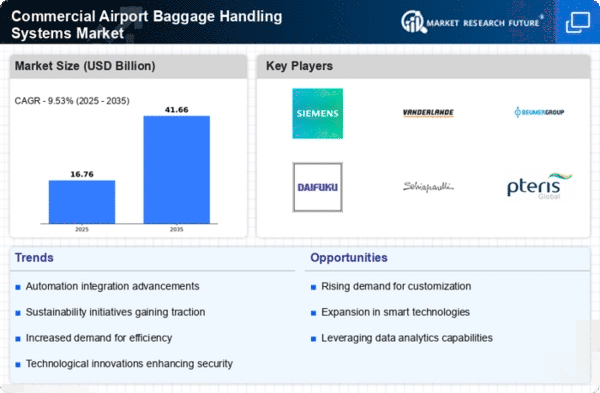
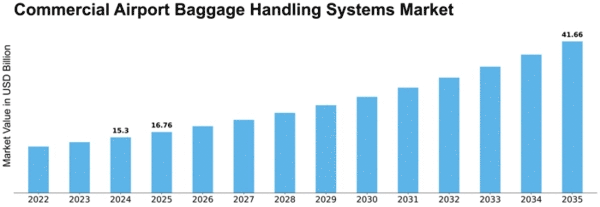
As per MRFR analysis, the Commercial Airport Baggage Handling Systems Market was estimated at 15.3 USD Billion in 2024. The baggage handling industry is projected to grow from 16.76 USD Billion in 2025 to 41.66 USD Billion by 2035, exhibiting a compound annual growth rate (CAGR) of 9.53% during the forecast period 2025 - 2035.

Key Market Trends & Highlights

The Commercial Airport Baggage Handling Systems Market is experiencing a transformative shift towards automation and sustainability.

  • Automation and robotics integration is reshaping operational workflows in baggage handling systems.
  • Sustainability initiatives are becoming increasingly critical as airports seek to reduce their environmental impact.
  • Smart technology adoption is enhancing efficiency and passenger experience in baggage management.
  • Increased air travel demand and a focus on operational efficiency are driving growth in the baggage sorting and conveyor systems segments.

Market Size & Forecast

2024 Market Size 15.3 (USD Billion)
2035 Market Size 41.66 (USD Billion)
CAGR (2025 - 2035) 9.53%
Largest Regional Market Share in 2024 North America

Major Players

Siemens (DE), Vanderlande (NL), Beumer Group (DE), Daifuku (JP), Schiapparelli (IT), Pteris Global (SG), MHI (JP), G&S Airport Conveyor (US), Fives (FR)

Market Trends

Commercial Airport Baggage Handling Systems

Commercial Airport Baggage Handling Systems Market Market Drivers

Market Growth Projections

The Global commercial airport baggage handling systems Industry is projected to experience substantial growth in the coming years. With a market value of 15.3 USD Billion in 2024, it is anticipated to reach 41.7 USD Billion by 2035, reflecting a compound annual growth rate of 9.53% from 2025 to 2035. This growth trajectory indicates a robust demand for innovative baggage handling solutions as airports adapt to increasing passenger traffic and evolving technological landscapes. The market dynamics suggest that stakeholders must remain agile and responsive to emerging trends to capitalize on the opportunities presented by this expanding industry.

Sustainability Initiatives

Sustainability initiatives are increasingly shaping the Global Commercial Airport Baggage Handling Systems Industry. Airports are under pressure to reduce their environmental footprint, prompting investments in eco-friendly baggage handling solutions. These initiatives may include energy-efficient systems and the use of sustainable materials in baggage handling equipment. As airports strive to achieve sustainability goals, the demand for innovative solutions that align with these objectives is likely to rise. This trend not only contributes to environmental conservation but also enhances the overall operational efficiency of baggage handling systems, positioning airports as responsible entities in the aviation sector.

Technological Advancements

Technological innovations play a pivotal role in shaping the Global Commercial Airport Baggage Handling Systems Industry. The integration of automation, artificial intelligence, and IoT technologies enhances operational efficiency and reduces human error. For instance, automated baggage handling systems can significantly decrease the time taken for baggage processing, thereby improving passenger satisfaction. Airports are increasingly investing in these technologies to streamline operations and manage the complexities of modern air travel. As the industry evolves, the adoption of smart baggage handling solutions is likely to become a standard practice, further driving market growth and ensuring that airports can meet the demands of an expanding passenger base.

Increasing Air Travel Demand

The Global Commercial Airport Baggage Handling Systems Industry is experiencing growth driven by the rising demand for air travel. As more passengers opt for air transportation, airports are compelled to enhance their baggage handling capabilities. In 2024, the market is valued at 15.3 USD Billion, reflecting the need for efficient systems to manage increased baggage volumes. This trend is projected to continue, with the market expected to reach 41.7 USD Billion by 2035. The compound annual growth rate of 9.53% from 2025 to 2035 indicates a robust expansion, necessitating advanced technologies and systems to accommodate the growing passenger traffic.

Expansion of Airport Infrastructure

The expansion of airport infrastructure is a crucial driver for the Global Commercial Airport Baggage Handling Systems Industry. As global air travel continues to grow, many airports are undergoing significant upgrades and expansions to accommodate increased passenger volumes. This includes the development of new terminals and the enhancement of existing facilities, which necessitates the installation of advanced baggage handling systems. The ongoing investments in airport infrastructure are expected to create substantial opportunities for market players, as airports seek to implement state-of-the-art systems that can efficiently manage the complexities of modern air travel.

Regulatory Compliance and Safety Standards

The Global Commercial Airport Baggage Handling Systems Industry is influenced by stringent regulatory compliance and safety standards imposed by aviation authorities. Airports must adhere to these regulations to ensure the safety and security of passengers and their belongings. Compliance with international standards necessitates the implementation of advanced baggage handling systems that can efficiently manage security checks and minimize risks. This focus on safety not only enhances operational reliability but also fosters passenger trust in air travel. As regulations evolve, airports are likely to invest in upgrading their baggage handling systems to meet these requirements, thereby driving market growth.

Market Segment Insights

By Application: Baggage Sorting (Largest) vs. Baggage Tracking (Fastest-Growing)

In the Commercial Airport Baggage Handling Systems Market, the distribution of market share among the application segment reveals Baggage Sorting as the largest contributor, establishing itself as the cornerstone of efficient baggage handling. Baggage Tracking, while currently smaller in market share, is rapidly gaining traction due to the increased focus on passenger experience and throughput efficiency. The reliance on technologies that enhance sorting efficiency underpins its dominant position, while tracking solutions are increasingly adopted as airports aim for real-time visibility and accountability in baggage management. The growth trends within this segment are primarily driven by advancements in automation and smart technologies. Airports are increasingly investing in cutting-edge baggage handling systems that integrate innovative sorting capabilities and digital tracking solutions, recognizing their crucial role in enhancing operational efficiency. Baggage Tracking is particularly benefitting from burgeoning passenger demand for transparency and real-time updates regarding their luggage, positioning it as an essential component of modern baggage handling systems. These trends suggest a promising future for both segments as they adapt to the evolving demands of air travel.

Baggage Sorting (Dominant) vs. Baggage Reclaim (Emerging)

Baggage Sorting emerges as the dominant application in the Commercial Airport Baggage Handling Systems Market, providing critical infrastructure for the efficient processing of luggage at various stages of the handling process. Its sophisticated systems enhance the speed and accuracy of baggage movement through automated sorting technologies, making it essential for airports striving to achieve high operational efficiency. By contrast, Baggage Reclaim, an emerging application, focuses on the last stage of the baggage journey where passengers retrieve their luggage. Although not as prevalent as sorting, the reclaim process is evolving, incorporating technology that streamlines passenger retrieval experience. Enhanced conveyor systems and real-time tracking features are being integrated into the reclaim area to improve user satisfaction, indicating a shift towards a more passenger-oriented approach in airports.

By System Type: Conveyor Systems (Largest) vs. Automated Guided Vehicles (Fastest-Growing)

<p>Within the Commercial Airport Baggage Handling Systems Market, the distribution of market share is distinctly favorable toward Conveyor Systems, which continue to hold the largest share due to their established presence and efficiency. These systems are crucial in facilitating the movement of luggage within airports, making them indispensable in modern airport operations. In contrast, Automated Guided Vehicles are emerging robustly as the fastest-growing segment, providing innovative solutions in luggage handling by enhancing operational efficiency and offering flexibility in airport layouts.</p>

<p>Conveyor Systems (Dominant) vs. Automated Guided Vehicles (Emerging)</p>

<p>Conveyor Systems remain the dominant force in the baggage handling segment, celebrated for their reliability and efficiency in transporting luggage over long distances within airports. They are designed to handle heavy loads and integrate seamlessly with various airport technologies. Meanwhile, Automated Guided Vehicles represent the emerging trend, leveraging automation and robotics to streamline baggage handling processes. These vehicles adapt to dynamic airport environments, offering greater flexibility and significantly reducing waiting times for passengers. As airports strive for enhanced operational efficiency, the shift towards Automated Guided Vehicles is likely to gain momentum, promising an exciting evolution in baggage handling technologies.</p>

By End Use: Airports (Largest) vs. Airlines (Fastest-Growing)

The distribution of market share among the end-user segments in the Commercial Airport Baggage Handling Systems Market shows that Airports hold the largest share due to the sheer volume of baggage processed daily, driving significant demand for advanced handling systems. Airlines closely follow as a significant contributor, focusing on efficiency and customer satisfaction, thus increasingly investing in modern baggage handling technologies to minimize delays and enhance passenger experiences.

Airports (Dominant) vs. Airlines (Emerging)

Airports represent the dominant force in the Commercial Airport Baggage Handling Systems Market, characterized by substantial infrastructure investments and a focus on comprehensive operational efficiency. They often deploy integrated systems that not only manage baggage handling but also streamline passenger flow. In contrast, Airlines, while considered an emerging segment, are rapidly adopting innovative solutions to enhance their baggage handling capabilities. This is driven by increased competition, the need for differentiation, and rising passenger expectations. Airlines are leveraging technology for real-time tracking and automated systems, making them a vital player in the evolving market landscape.

By Technology: Automated Systems (Largest) vs. Artificial Intelligence (Fastest-Growing)

<p>In the Commercial Airport Baggage Handling Systems Market, technology plays a critical role in ensuring efficient operations. Automated Systems currently hold the largest market share, as they effectively streamline the baggage handling process, reduce labor costs, and minimize errors. Radio Frequency Identification (RFID) and Barcode Scanning also contribute significantly, yet Automated Systems dominate this space due to their advanced capabilities and reliability. Meanwhile, Artificial Intelligence, while smaller in market share, shows great potential for future growth, driven by increasing demands for smart solutions in airport operations.</p>

<p>Technology: Automated Systems (Dominant) vs. Artificial Intelligence (Emerging)</p>

<p>Automated Systems are the backbone of modern baggage handling, characterized by their integration of robotics and electronic processes that greatly enhance throughput and accuracy. These systems reduce the need for manual labor and improve overall efficiency. On the other hand, Artificial Intelligence enhances operational efficiency by providing advanced analytics and process optimization, making it a rapidly emerging segment. Its ability to learn from data trends allows airports to predict and manage baggage flow more effectively, thereby improving passenger satisfaction and operational reliability.</p>

By Component: Conveyors (Largest) vs. Software Solutions (Fastest-Growing)

<p>The Commercial Airport Baggage Handling Systems Market is primarily driven by the components such as conveyors, sensors, control systems, and software solutions. Among these, conveyors hold the largest market share due to their essential role in the seamless movement of luggage within airports. Meanwhile, software solutions have emerged as a significant player, despite currently holding a smaller share, they are recognized for their innovative approach to baggage handling, leading to improved operational efficiency.</p>

<p>Conveyors (Dominant) vs. Software Solutions (Emerging)</p>

<p>Conveyors are the backbone of baggage handling systems, providing robust, reliable, and efficient transport of luggage from the check-in area to the aircraft. Their dominance is attributed to their ability to handle large volumes of baggage swiftly. In contrast, software solutions represent an emerging trend focusing on automation and real-time tracking, which enhances the overall passenger experience. As airports seek to increase efficiency and reduce delays, investments in software solutions are rising, reflecting a shift towards more integrated systems that leverage technology for improved baggage management. This dynamic indicates a growing recognition of the essential role that advanced software plays in modern baggage handling.</p>

Get more detailed insights about Commercial Airport Baggage Handling Systems Market Research Report - Global Forecast to 2035

Regional Insights

North America : Market Leader in Baggage Systems

North America is poised to maintain its leadership in the Commercial Airport Baggage Handling Systems market, holding a significant market share of 7.65 in 2025. The region's growth is driven by increasing air travel demand, technological advancements, and stringent safety regulations. Airports are investing in automated systems to enhance efficiency and reduce operational costs, further propelling market growth. The competitive landscape is characterized by key players such as Siemens, Vanderlande, and G&S Airport Conveyor, which are innovating to meet the evolving needs of airports. The U.S. and Canada are leading countries in this sector, with substantial investments in infrastructure upgrades. The presence of established companies ensures a robust supply chain and technological expertise, solidifying North America's position as a market leader.

Europe : Emerging Innovations in Baggage Handling

Europe's Commercial Airport Baggage Handling Systems market is projected to reach 4.5 by 2025, driven by increasing passenger traffic and a focus on sustainability. Regulatory frameworks in the EU are pushing for greener technologies, encouraging airports to adopt energy-efficient systems. The demand for advanced baggage handling solutions is further fueled by the rise in international travel and the need for enhanced passenger experience. Leading countries such as Germany, France, and the UK are at the forefront of this market, with significant investments in modernization and automation. Key players like Beumer Group and Vanderlande are innovating to provide cutting-edge solutions. The competitive landscape is vibrant, with a mix of established firms and new entrants, ensuring continuous advancements in technology and service delivery. "The European aviation sector is committed to reducing its environmental impact, which is driving innovation in baggage handling systems."

Asia-Pacific : Rapid Growth in Baggage Systems

The Asia-Pacific region is witnessing rapid growth in the Commercial Airport Baggage Handling Systems market, projected to reach 2.85 by 2025. This growth is primarily driven by increasing air travel demand, urbanization, and government investments in airport infrastructure. Countries like China and India are expanding their airport capacities, leading to a surge in demand for efficient baggage handling solutions. Regulatory support for modernization is also a key driver. China is the leading country in this region, with significant contributions from Japan and Australia. The competitive landscape features major players like Daifuku and MHI, which are focusing on technological advancements to enhance operational efficiency. The presence of these key players ensures that the region is well-equipped to meet the growing demands of the aviation sector, fostering a dynamic market environment.

Middle East and Africa : Emerging Market Potential

The Middle East and Africa region is emerging as a potential market for Commercial Airport Baggage Handling Systems, with a market size of 0.3 projected for 2025. The growth is driven by increasing air travel, investments in airport infrastructure, and a focus on enhancing passenger experience. Governments are prioritizing the development of aviation sectors, leading to modernization efforts in baggage handling systems. Countries like the UAE and South Africa are leading the way in adopting advanced technologies. The competitive landscape is evolving, with both local and international players vying for market share. Companies like Pteris Global are making strides in this region, ensuring that the market is equipped to handle the increasing passenger volumes and operational demands. "The Middle East is investing heavily in aviation infrastructure to support its growing tourism sector."

Key Players and Competitive Insights

The Commercial Airport Baggage Handling Systems Market is characterized by a dynamic competitive landscape, driven by technological advancements and increasing passenger traffic. Key players such as Siemens (DE), Vanderlande (NL), and Daifuku (JP) are at the forefront, each adopting distinct strategies to enhance their market positioning. Siemens (DE) focuses on digital transformation, integrating IoT and AI into their systems to improve efficiency and reduce operational costs. Vanderlande (NL) emphasizes sustainability, developing eco-friendly solutions that align with global environmental standards. Daifuku (JP) is actively pursuing mergers and acquisitions to expand its technological capabilities and market reach, thereby enhancing its competitive edge.The market structure appears moderately fragmented, with several players vying for market share. Key tactics employed by these companies include localizing manufacturing to reduce costs and optimize supply chains. This approach not only enhances operational efficiency but also allows for quicker response times to market demands. The collective influence of these major players shapes a competitive environment where innovation and strategic partnerships are paramount.

In November Siemens (DE) announced the launch of its new AI-driven baggage handling system, which is designed to streamline operations and minimize delays. This strategic move is significant as it positions Siemens as a leader in the integration of advanced technologies within baggage handling, potentially setting new industry standards. The emphasis on AI indicates a shift towards more automated and efficient systems, which could redefine operational benchmarks in the market.

In October Vanderlande (NL) secured a contract with a major international airport to implement its latest sustainable baggage handling solution. This contract not only underscores Vanderlande's commitment to sustainability but also enhances its reputation as a provider of innovative solutions. The strategic importance of this move lies in its potential to attract environmentally conscious clients and align with global sustainability goals, thereby expanding Vanderlande's market presence.

In September Daifuku (JP) completed the acquisition of a leading software company specializing in baggage tracking technologies. This acquisition is pivotal as it allows Daifuku to enhance its product offerings and integrate cutting-edge tracking solutions into its existing systems. The strategic importance of this move lies in its potential to improve customer satisfaction through enhanced tracking capabilities, thereby solidifying Daifuku's position in the market.

As of December current trends in the Commercial Airport Baggage Handling Systems Market indicate a strong focus on digitalization, sustainability, and AI integration. Strategic alliances among key players are increasingly shaping the competitive landscape, fostering innovation and collaboration. The shift from price-based competition to a focus on technological advancement and supply chain reliability is evident. Moving forward, competitive differentiation will likely hinge on the ability to innovate and adapt to evolving market demands, with a clear emphasis on enhancing operational efficiency and sustainability.

Key Companies in the Commercial Airport Baggage Handling Systems Market include

Industry Developments

For Instance, In December 2022,

Kuala Lampur International Airport in Malaysia announced that Siemens Logistics and local company T7 have been contracted to update the baggage handling system (BHS) at Terminal 1. The contract calls for the systematic decommissioning of the present system as well as the design, installation, and commissioning of new baggage handling systems. Siemens will provide VarioTray and VarioBelt technology, as well as VarioStore early bag storage and high-performance controlling software. The VarioBelt conveyor will also be available in the baggage handling systems industry.

For Instance, In August 2022

Alstef announced the launch of a new mobile robot for baggage handling at airports. The BAGXone is a novel machine with a high-speed automated guided vehicle designed to handle individual bags. It can travel short distances, such as from the check-in area to the screening machines, or from the screening machines to an early bag store, reconciliation room, and make-up carousel.

For Instance, In April 2021

Siemens Logistics, a subsidiary of Siemens AG, received a contract from Incheon International Airport Corporation to expand the baggage handling system at Terminal 2 of Incheon Airport. In addition to the installation of baggage conveying and sorting technology, the company will provide technical project management, layout design, and software solutions and integrate the new equipment into the existing system.

Future Outlook

Commercial Airport Baggage Handling Systems Market Future Outlook

The Commercial Airport Baggage Handling Systems Market is projected to grow at a 9.53% CAGR from 2025 to 2035, driven by technological advancements and increasing air travel demand.

New opportunities lie in:

  • Integration of AI-driven predictive maintenance solutions
  • Development of automated baggage tracking systems
  • Expansion of modular baggage handling infrastructure for scalability

By 2035, the market is poised for robust growth, reflecting evolving operational efficiencies and enhanced passenger experiences.

Market Segmentation

Commercial Airport Baggage Handling Systems Market End Use Outlook

  • Airports
  • Airlines
  • Ground Handling Companies
  • Logistics Providers

Commercial Airport Baggage Handling Systems Market Component Outlook

  • Conveyors
  • Sensors
  • Control Systems
  • Software Solutions

Commercial Airport Baggage Handling Systems Market Technology Outlook

  • Radio Frequency Identification
  • Barcode Scanning
  • Automated Systems
  • Artificial Intelligence

Commercial Airport Baggage Handling Systems Market Application Outlook

  • Baggage Sorting
  • Baggage Tracking
  • Baggage Reclaim
  • Baggage Transportation

Commercial Airport Baggage Handling Systems Market System Type Outlook

  • Conveyor Systems
  • Automated Guided Vehicles
  • Sortation Systems
  • Self-Service Kiosks

Report Scope

MARKET SIZE 2024 15.3(USD Billion)
MARKET SIZE 2025 16.76(USD Billion)
MARKET SIZE 2035 41.66(USD Billion)
COMPOUND ANNUAL GROWTH RATE (CAGR) 9.53% (2025 - 2035)
REPORT COVERAGE Revenue Forecast, Competitive Landscape, Growth Factors, and Trends
BASE YEAR 2024
Market Forecast Period 2025 - 2035
Historical Data 2019 - 2024
Market Forecast Units USD Billion
Key Companies Profiled Siemens (DE), Vanderlande (NL), Beumer Group (DE), Daifuku (JP), Schiapparelli (IT), Pteris Global (SG), MHI (JP), G&S Airport Conveyor (US), Fives (FR)
Segments Covered Application, System Type, End Use, Technology, Component
Key Market Opportunities Integration of advanced automation and artificial intelligence in Commercial Airport Baggage Handling Systems.
Key Market Dynamics Technological advancements and automation drive efficiency in Commercial Airport Baggage Handling Systems, enhancing operational performance.
Countries Covered North America, Europe, APAC, South America, MEA

FAQs

What is the current valuation of the Commercial Airport Baggage Handling Systems Market?

<p>As of 2024, the market valuation was 15.3 USD Billion.</p>

What is the projected market size for the Commercial Airport Baggage Handling Systems Market by 2035?

<p>The market is expected to reach a valuation of 41.66 USD Billion by 2035.</p>

What is the expected CAGR for the Commercial Airport Baggage Handling Systems Market during the forecast period 2025 - 2035?

<p>The market is anticipated to grow at a CAGR of 9.53% from 2025 to 2035.</p>

Which application segment is projected to have the highest growth in the Commercial Airport Baggage Handling Systems Market?

<p>Baggage Transportation is projected to grow from 4.8 USD Billion in 2024 to 13.7 USD Billion by 2035.</p>

What are the key players in the Commercial Airport Baggage Handling Systems Market?

<p>Key players include Siemens, Vanderlande, Beumer Group, Daifuku, and Schiapparelli.</p>

How does the Baggage Tracking segment perform in terms of market valuation?

<p>The Baggage Tracking segment was valued at 4.0 USD Billion in 2024 and is expected to reach 10.5 USD Billion by 2035.</p>

What is the expected performance of the Conveyor Systems segment in the market?

Conveyor Systems are projected to grow from 5.0 USD Billion in 2024 to 13.5 USD Billion by 2035.

Which technology segment is anticipated to show the most significant growth?

The Artificial Intelligence segment is expected to increase from 4.8 USD Billion in 2024 to 15.16 USD Billion by 2035.

What is the market valuation for the Airports end-use segment in 2024?

The Airports end-use segment was valued at 5.0 USD Billion in 2024 and is projected to grow to 13.5 USD Billion by 2035.

What components are expected to drive growth in the Commercial Airport Baggage Handling Systems Market?

Components such as Conveyors and Control Systems are expected to see substantial growth, with valuations of 5.0 USD Billion and 4.0 USD Billion in 2024, respectively.

  1. SECTION I: EXECUTIVE SUMMARY AND KEY HIGHLIGHTS
    1. | 1.1 EXECUTIVE SUMMARY
    2. | | 1.1.1 Market Overview
    3. | | 1.1.2 Key Findings
    4. | | 1.1.3 Market Segmentation
    5. | | 1.1.4 Competitive Landscape
    6. | | 1.1.5 Challenges and Opportunities
    7. | | 1.1.6 Future Outlook
  2. SECTION II: SCOPING, METHODOLOGY AND MARKET STRUCTURE
    1. | 2.1 MARKET INTRODUCTION
    2. | | 2.1.1 Definition
    3. | | 2.1.2 Scope of the study
    4. | | | 2.1.2.1 Research Objective
    5. | | | 2.1.2.2 Assumption
    6. | | | 2.1.2.3 Limitations
    7. | 2.2 RESEARCH METHODOLOGY
    8. | | 2.2.1 Overview
    9. | | 2.2.2 Data Mining
    10. | | 2.2.3 Secondary Research
    11. | | 2.2.4 Primary Research
    12. | | | 2.2.4.1 Primary Interviews and Information Gathering Process
    13. | | | 2.2.4.2 Breakdown of Primary Respondents
    14. | | 2.2.5 Forecasting Model
    15. | | 2.2.6 Market Size Estimation
    16. | | | 2.2.6.1 Bottom-Up Approach
    17. | | | 2.2.6.2 Top-Down Approach
    18. | | 2.2.7 Data Triangulation
    19. | | 2.2.8 Validation
  3. SECTION III: QUALITATIVE ANALYSIS
    1. | 3.1 MARKET DYNAMICS
    2. | | 3.1.1 Overview
    3. | | 3.1.2 Drivers
    4. | | 3.1.3 Restraints
    5. | | 3.1.4 Opportunities
    6. | 3.2 MARKET FACTOR ANALYSIS
    7. | | 3.2.1 Value chain Analysis
    8. | | 3.2.2 Porter's Five Forces Analysis
    9. | | | 3.2.2.1 Bargaining Power of Suppliers
    10. | | | 3.2.2.2 Bargaining Power of Buyers
    11. | | | 3.2.2.3 Threat of New Entrants
    12. | | | 3.2.2.4 Threat of Substitutes
    13. | | | 3.2.2.5 Intensity of Rivalry
    14. | | 3.2.3 COVID-19 Impact Analysis
    15. | | | 3.2.3.1 Market Impact Analysis
    16. | | | 3.2.3.2 Regional Impact
    17. | | | 3.2.3.3 Opportunity and Threat Analysis
  4. SECTION IV: QUANTITATIVE ANALYSIS
    1. | 4.1 Aerospace & Defense, BY Application (USD Billion)
    2. | | 4.1.1 Baggage Sorting
    3. | | 4.1.2 Baggage Tracking
    4. | | 4.1.3 Baggage Reclaim
    5. | | 4.1.4 Baggage Transportation
    6. | 4.2 Aerospace & Defense, BY System Type (USD Billion)
    7. | | 4.2.1 Conveyor Systems
    8. | | 4.2.2 Automated Guided Vehicles
    9. | | 4.2.3 Sortation Systems
    10. | | 4.2.4 Self-Service Kiosks
    11. | 4.3 Aerospace & Defense, BY End Use (USD Billion)
    12. | | 4.3.1 Airports
    13. | | 4.3.2 Airlines
    14. | | 4.3.3 Ground Handling Companies
    15. | | 4.3.4 Logistics Providers
    16. | 4.4 Aerospace & Defense, BY Technology (USD Billion)
    17. | | 4.4.1 Radio Frequency Identification
    18. | | 4.4.2 Barcode Scanning
    19. | | 4.4.3 Automated Systems
    20. | | 4.4.4 Artificial Intelligence
    21. | 4.5 Aerospace & Defense, BY Component (USD Billion)
    22. | | 4.5.1 Conveyors
    23. | | 4.5.2 Sensors
    24. | | 4.5.3 Control Systems
    25. | | 4.5.4 Software Solutions
    26. | 4.6 Aerospace & Defense, BY Region (USD Billion)
    27. | | 4.6.1 North America
    28. | | | 4.6.1.1 US
    29. | | | 4.6.1.2 Canada
    30. | | 4.6.2 Europe
    31. | | | 4.6.2.1 Germany
    32. | | | 4.6.2.2 UK
    33. | | | 4.6.2.3 France
    34. | | | 4.6.2.4 Russia
    35. | | | 4.6.2.5 Italy
    36. | | | 4.6.2.6 Spain
    37. | | | 4.6.2.7 Rest of Europe
    38. | | 4.6.3 APAC
    39. | | | 4.6.3.1 China
    40. | | | 4.6.3.2 India
    41. | | | 4.6.3.3 Japan
    42. | | | 4.6.3.4 South Korea
    43. | | | 4.6.3.5 Malaysia
    44. | | | 4.6.3.6 Thailand
    45. | | | 4.6.3.7 Indonesia
    46. | | | 4.6.3.8 Rest of APAC
    47. | | 4.6.4 South America
    48. | | | 4.6.4.1 Brazil
    49. | | | 4.6.4.2 Mexico
    50. | | | 4.6.4.3 Argentina
    51. | | | 4.6.4.4 Rest of South America
    52. | | 4.6.5 MEA
    53. | | | 4.6.5.1 GCC Countries
    54. | | | 4.6.5.2 South Africa
    55. | | | 4.6.5.3 Rest of MEA
  5. SECTION V: COMPETITIVE ANALYSIS
    1. | 5.1 Competitive Landscape
    2. | | 5.1.1 Overview
    3. | | 5.1.2 Competitive Analysis
    4. | | 5.1.3 Market share Analysis
    5. | | 5.1.4 Major Growth Strategy in the Aerospace & Defense
    6. | | 5.1.5 Competitive Benchmarking
    7. | | 5.1.6 Leading Players in Terms of Number of Developments in the Aerospace & Defense
    8. | | 5.1.7 Key developments and growth strategies
    9. | | | 5.1.7.1 New Product Launch/Service Deployment
    10. | | | 5.1.7.2 Merger & Acquisitions
    11. | | | 5.1.7.3 Joint Ventures
    12. | | 5.1.8 Major Players Financial Matrix
    13. | | | 5.1.8.1 Sales and Operating Income
    14. | | | 5.1.8.2 Major Players R&D Expenditure. 2023
    15. | 5.2 Company Profiles
    16. | | 5.2.1 Siemens (DE)
    17. | | | 5.2.1.1 Financial Overview
    18. | | | 5.2.1.2 Products Offered
    19. | | | 5.2.1.3 Key Developments
    20. | | | 5.2.1.4 SWOT Analysis
    21. | | | 5.2.1.5 Key Strategies
    22. | | 5.2.2 Vanderlande (NL)
    23. | | | 5.2.2.1 Financial Overview
    24. | | | 5.2.2.2 Products Offered
    25. | | | 5.2.2.3 Key Developments
    26. | | | 5.2.2.4 SWOT Analysis
    27. | | | 5.2.2.5 Key Strategies
    28. | | 5.2.3 Beumer Group (DE)
    29. | | | 5.2.3.1 Financial Overview
    30. | | | 5.2.3.2 Products Offered
    31. | | | 5.2.3.3 Key Developments
    32. | | | 5.2.3.4 SWOT Analysis
    33. | | | 5.2.3.5 Key Strategies
    34. | | 5.2.4 Daifuku (JP)
    35. | | | 5.2.4.1 Financial Overview
    36. | | | 5.2.4.2 Products Offered
    37. | | | 5.2.4.3 Key Developments
    38. | | | 5.2.4.4 SWOT Analysis
    39. | | | 5.2.4.5 Key Strategies
    40. | | 5.2.5 Schiapparelli (IT)
    41. | | | 5.2.5.1 Financial Overview
    42. | | | 5.2.5.2 Products Offered
    43. | | | 5.2.5.3 Key Developments
    44. | | | 5.2.5.4 SWOT Analysis
    45. | | | 5.2.5.5 Key Strategies
    46. | | 5.2.6 Pteris Global (SG)
    47. | | | 5.2.6.1 Financial Overview
    48. | | | 5.2.6.2 Products Offered
    49. | | | 5.2.6.3 Key Developments
    50. | | | 5.2.6.4 SWOT Analysis
    51. | | | 5.2.6.5 Key Strategies
    52. | | 5.2.7 MHI (JP)
    53. | | | 5.2.7.1 Financial Overview
    54. | | | 5.2.7.2 Products Offered
    55. | | | 5.2.7.3 Key Developments
    56. | | | 5.2.7.4 SWOT Analysis
    57. | | | 5.2.7.5 Key Strategies
    58. | | 5.2.8 G&S Airport Conveyor (US)
    59. | | | 5.2.8.1 Financial Overview
    60. | | | 5.2.8.2 Products Offered
    61. | | | 5.2.8.3 Key Developments
    62. | | | 5.2.8.4 SWOT Analysis
    63. | | | 5.2.8.5 Key Strategies
    64. | | 5.2.9 Fives (FR)
    65. | | | 5.2.9.1 Financial Overview
    66. | | | 5.2.9.2 Products Offered
    67. | | | 5.2.9.3 Key Developments
    68. | | | 5.2.9.4 SWOT Analysis
    69. | | | 5.2.9.5 Key Strategies
    70. | 5.3 Appendix
    71. | | 5.3.1 References
    72. | | 5.3.2 Related Reports
  6. LIST OF FIGURES
    1. | 6.1 MARKET SYNOPSIS
    2. | 6.2 NORTH AMERICA MARKET ANALYSIS
    3. | 6.3 US MARKET ANALYSIS BY APPLICATION
    4. | 6.4 US MARKET ANALYSIS BY SYSTEM TYPE
    5. | 6.5 US MARKET ANALYSIS BY END USE
    6. | 6.6 US MARKET ANALYSIS BY TECHNOLOGY
    7. | 6.7 US MARKET ANALYSIS BY COMPONENT
    8. | 6.8 CANADA MARKET ANALYSIS BY APPLICATION
    9. | 6.9 CANADA MARKET ANALYSIS BY SYSTEM TYPE
    10. | 6.10 CANADA MARKET ANALYSIS BY END USE
    11. | 6.11 CANADA MARKET ANALYSIS BY TECHNOLOGY
    12. | 6.12 CANADA MARKET ANALYSIS BY COMPONENT
    13. | 6.13 EUROPE MARKET ANALYSIS
    14. | 6.14 GERMANY MARKET ANALYSIS BY APPLICATION
    15. | 6.15 GERMANY MARKET ANALYSIS BY SYSTEM TYPE
    16. | 6.16 GERMANY MARKET ANALYSIS BY END USE
    17. | 6.17 GERMANY MARKET ANALYSIS BY TECHNOLOGY
    18. | 6.18 GERMANY MARKET ANALYSIS BY COMPONENT
    19. | 6.19 UK MARKET ANALYSIS BY APPLICATION
    20. | 6.20 UK MARKET ANALYSIS BY SYSTEM TYPE
    21. | 6.21 UK MARKET ANALYSIS BY END USE
    22. | 6.22 UK MARKET ANALYSIS BY TECHNOLOGY
    23. | 6.23 UK MARKET ANALYSIS BY COMPONENT
    24. | 6.24 FRANCE MARKET ANALYSIS BY APPLICATION
    25. | 6.25 FRANCE MARKET ANALYSIS BY SYSTEM TYPE
    26. | 6.26 FRANCE MARKET ANALYSIS BY END USE
    27. | 6.27 FRANCE MARKET ANALYSIS BY TECHNOLOGY
    28. | 6.28 FRANCE MARKET ANALYSIS BY COMPONENT
    29. | 6.29 RUSSIA MARKET ANALYSIS BY APPLICATION
    30. | 6.30 RUSSIA MARKET ANALYSIS BY SYSTEM TYPE
    31. | 6.31 RUSSIA MARKET ANALYSIS BY END USE
    32. | 6.32 RUSSIA MARKET ANALYSIS BY TECHNOLOGY
    33. | 6.33 RUSSIA MARKET ANALYSIS BY COMPONENT
    34. | 6.34 ITALY MARKET ANALYSIS BY APPLICATION
    35. | 6.35 ITALY MARKET ANALYSIS BY SYSTEM TYPE
    36. | 6.36 ITALY MARKET ANALYSIS BY END USE
    37. | 6.37 ITALY MARKET ANALYSIS BY TECHNOLOGY
    38. | 6.38 ITALY MARKET ANALYSIS BY COMPONENT
    39. | 6.39 SPAIN MARKET ANALYSIS BY APPLICATION
    40. | 6.40 SPAIN MARKET ANALYSIS BY SYSTEM TYPE
    41. | 6.41 SPAIN MARKET ANALYSIS BY END USE
    42. | 6.42 SPAIN MARKET ANALYSIS BY TECHNOLOGY
    43. | 6.43 SPAIN MARKET ANALYSIS BY COMPONENT
    44. | 6.44 REST OF EUROPE MARKET ANALYSIS BY APPLICATION
    45. | 6.45 REST OF EUROPE MARKET ANALYSIS BY SYSTEM TYPE
    46. | 6.46 REST OF EUROPE MARKET ANALYSIS BY END USE
    47. | 6.47 REST OF EUROPE MARKET ANALYSIS BY TECHNOLOGY
    48. | 6.48 REST OF EUROPE MARKET ANALYSIS BY COMPONENT
    49. | 6.49 APAC MARKET ANALYSIS
    50. | 6.50 CHINA MARKET ANALYSIS BY APPLICATION
    51. | 6.51 CHINA MARKET ANALYSIS BY SYSTEM TYPE
    52. | 6.52 CHINA MARKET ANALYSIS BY END USE
    53. | 6.53 CHINA MARKET ANALYSIS BY TECHNOLOGY
    54. | 6.54 CHINA MARKET ANALYSIS BY COMPONENT
    55. | 6.55 INDIA MARKET ANALYSIS BY APPLICATION
    56. | 6.56 INDIA MARKET ANALYSIS BY SYSTEM TYPE
    57. | 6.57 INDIA MARKET ANALYSIS BY END USE
    58. | 6.58 INDIA MARKET ANALYSIS BY TECHNOLOGY
    59. | 6.59 INDIA MARKET ANALYSIS BY COMPONENT
    60. | 6.60 JAPAN MARKET ANALYSIS BY APPLICATION
    61. | 6.61 JAPAN MARKET ANALYSIS BY SYSTEM TYPE
    62. | 6.62 JAPAN MARKET ANALYSIS BY END USE
    63. | 6.63 JAPAN MARKET ANALYSIS BY TECHNOLOGY
    64. | 6.64 JAPAN MARKET ANALYSIS BY COMPONENT
    65. | 6.65 SOUTH KOREA MARKET ANALYSIS BY APPLICATION
    66. | 6.66 SOUTH KOREA MARKET ANALYSIS BY SYSTEM TYPE
    67. | 6.67 SOUTH KOREA MARKET ANALYSIS BY END USE
    68. | 6.68 SOUTH KOREA MARKET ANALYSIS BY TECHNOLOGY
    69. | 6.69 SOUTH KOREA MARKET ANALYSIS BY COMPONENT
    70. | 6.70 MALAYSIA MARKET ANALYSIS BY APPLICATION
    71. | 6.71 MALAYSIA MARKET ANALYSIS BY SYSTEM TYPE
    72. | 6.72 MALAYSIA MARKET ANALYSIS BY END USE
    73. | 6.73 MALAYSIA MARKET ANALYSIS BY TECHNOLOGY
    74. | 6.74 MALAYSIA MARKET ANALYSIS BY COMPONENT
    75. | 6.75 THAILAND MARKET ANALYSIS BY APPLICATION
    76. | 6.76 THAILAND MARKET ANALYSIS BY SYSTEM TYPE
    77. | 6.77 THAILAND MARKET ANALYSIS BY END USE
    78. | 6.78 THAILAND MARKET ANALYSIS BY TECHNOLOGY
    79. | 6.79 THAILAND MARKET ANALYSIS BY COMPONENT
    80. | 6.80 INDONESIA MARKET ANALYSIS BY APPLICATION
    81. | 6.81 INDONESIA MARKET ANALYSIS BY SYSTEM TYPE
    82. | 6.82 INDONESIA MARKET ANALYSIS BY END USE
    83. | 6.83 INDONESIA MARKET ANALYSIS BY TECHNOLOGY
    84. | 6.84 INDONESIA MARKET ANALYSIS BY COMPONENT
    85. | 6.85 REST OF APAC MARKET ANALYSIS BY APPLICATION
    86. | 6.86 REST OF APAC MARKET ANALYSIS BY SYSTEM TYPE
    87. | 6.87 REST OF APAC MARKET ANALYSIS BY END USE
    88. | 6.88 REST OF APAC MARKET ANALYSIS BY TECHNOLOGY
    89. | 6.89 REST OF APAC MARKET ANALYSIS BY COMPONENT
    90. | 6.90 SOUTH AMERICA MARKET ANALYSIS
    91. | 6.91 BRAZIL MARKET ANALYSIS BY APPLICATION
    92. | 6.92 BRAZIL MARKET ANALYSIS BY SYSTEM TYPE
    93. | 6.93 BRAZIL MARKET ANALYSIS BY END USE
    94. | 6.94 BRAZIL MARKET ANALYSIS BY TECHNOLOGY
    95. | 6.95 BRAZIL MARKET ANALYSIS BY COMPONENT
    96. | 6.96 MEXICO MARKET ANALYSIS BY APPLICATION
    97. | 6.97 MEXICO MARKET ANALYSIS BY SYSTEM TYPE
    98. | 6.98 MEXICO MARKET ANALYSIS BY END USE
    99. | 6.99 MEXICO MARKET ANALYSIS BY TECHNOLOGY
    100. | 6.100 MEXICO MARKET ANALYSIS BY COMPONENT
    101. | 6.101 ARGENTINA MARKET ANALYSIS BY APPLICATION
    102. | 6.102 ARGENTINA MARKET ANALYSIS BY SYSTEM TYPE
    103. | 6.103 ARGENTINA MARKET ANALYSIS BY END USE
    104. | 6.104 ARGENTINA MARKET ANALYSIS BY TECHNOLOGY
    105. | 6.105 ARGENTINA MARKET ANALYSIS BY COMPONENT
    106. | 6.106 REST OF SOUTH AMERICA MARKET ANALYSIS BY APPLICATION
    107. | 6.107 REST OF SOUTH AMERICA MARKET ANALYSIS BY SYSTEM TYPE
    108. | 6.108 REST OF SOUTH AMERICA MARKET ANALYSIS BY END USE
    109. | 6.109 REST OF SOUTH AMERICA MARKET ANALYSIS BY TECHNOLOGY
    110. | 6.110 REST OF SOUTH AMERICA MARKET ANALYSIS BY COMPONENT
    111. | 6.111 MEA MARKET ANALYSIS
    112. | 6.112 GCC COUNTRIES MARKET ANALYSIS BY APPLICATION
    113. | 6.113 GCC COUNTRIES MARKET ANALYSIS BY SYSTEM TYPE
    114. | 6.114 GCC COUNTRIES MARKET ANALYSIS BY END USE
    115. | 6.115 GCC COUNTRIES MARKET ANALYSIS BY TECHNOLOGY
    116. | 6.116 GCC COUNTRIES MARKET ANALYSIS BY COMPONENT
    117. | 6.117 SOUTH AFRICA MARKET ANALYSIS BY APPLICATION
    118. | 6.118 SOUTH AFRICA MARKET ANALYSIS BY SYSTEM TYPE
    119. | 6.119 SOUTH AFRICA MARKET ANALYSIS BY END USE
    120. | 6.120 SOUTH AFRICA MARKET ANALYSIS BY TECHNOLOGY
    121. | 6.121 SOUTH AFRICA MARKET ANALYSIS BY COMPONENT
    122. | 6.122 REST OF MEA MARKET ANALYSIS BY APPLICATION
    123. | 6.123 REST OF MEA MARKET ANALYSIS BY SYSTEM TYPE
    124. | 6.124 REST OF MEA MARKET ANALYSIS BY END USE
    125. | 6.125 REST OF MEA MARKET ANALYSIS BY TECHNOLOGY
    126. | 6.126 REST OF MEA MARKET ANALYSIS BY COMPONENT
    127. | 6.127 KEY BUYING CRITERIA OF AEROSPACE & DEFENSE
    128. | 6.128 RESEARCH PROCESS OF MRFR
    129. | 6.129 DRO ANALYSIS OF AEROSPACE & DEFENSE
    130. | 6.130 DRIVERS IMPACT ANALYSIS: AEROSPACE & DEFENSE
    131. | 6.131 RESTRAINTS IMPACT ANALYSIS: AEROSPACE & DEFENSE
    132. | 6.132 SUPPLY / VALUE CHAIN: AEROSPACE & DEFENSE
    133. | 6.133 AEROSPACE & DEFENSE, BY APPLICATION, 2024 (% SHARE)
    134. | 6.134 AEROSPACE & DEFENSE, BY APPLICATION, 2024 TO 2035 (USD Billion)
    135. | 6.135 AEROSPACE & DEFENSE, BY SYSTEM TYPE, 2024 (% SHARE)
    136. | 6.136 AEROSPACE & DEFENSE, BY SYSTEM TYPE, 2024 TO 2035 (USD Billion)
    137. | 6.137 AEROSPACE & DEFENSE, BY END USE, 2024 (% SHARE)
    138. | 6.138 AEROSPACE & DEFENSE, BY END USE, 2024 TO 2035 (USD Billion)
    139. | 6.139 AEROSPACE & DEFENSE, BY TECHNOLOGY, 2024 (% SHARE)
    140. | 6.140 AEROSPACE & DEFENSE, BY TECHNOLOGY, 2024 TO 2035 (USD Billion)
    141. | 6.141 AEROSPACE & DEFENSE, BY COMPONENT, 2024 (% SHARE)
    142. | 6.142 AEROSPACE & DEFENSE, BY COMPONENT, 2024 TO 2035 (USD Billion)
    143. | 6.143 BENCHMARKING OF MAJOR COMPETITORS
  7. LIST OF TABLES
    1. | 7.1 LIST OF ASSUMPTIONS
    2. | | 7.1.1
    3. | 7.2 North America MARKET SIZE ESTIMATES; FORECAST
    4. | | 7.2.1 BY APPLICATION, 2025-2035 (USD Billion)
    5. | | 7.2.2 BY SYSTEM TYPE, 2025-2035 (USD Billion)
    6. | | 7.2.3 BY END USE, 2025-2035 (USD Billion)
    7. | | 7.2.4 BY TECHNOLOGY, 2025-2035 (USD Billion)
    8. | | 7.2.5 BY COMPONENT, 2025-2035 (USD Billion)
    9. | 7.3 US MARKET SIZE ESTIMATES; FORECAST
    10. | | 7.3.1 BY APPLICATION, 2025-2035 (USD Billion)
    11. | | 7.3.2 BY SYSTEM TYPE, 2025-2035 (USD Billion)
    12. | | 7.3.3 BY END USE, 2025-2035 (USD Billion)
    13. | | 7.3.4 BY TECHNOLOGY, 2025-2035 (USD Billion)
    14. | | 7.3.5 BY COMPONENT, 2025-2035 (USD Billion)
    15. | 7.4 Canada MARKET SIZE ESTIMATES; FORECAST
    16. | | 7.4.1 BY APPLICATION, 2025-2035 (USD Billion)
    17. | | 7.4.2 BY SYSTEM TYPE, 2025-2035 (USD Billion)
    18. | | 7.4.3 BY END USE, 2025-2035 (USD Billion)
    19. | | 7.4.4 BY TECHNOLOGY, 2025-2035 (USD Billion)
    20. | | 7.4.5 BY COMPONENT, 2025-2035 (USD Billion)
    21. | 7.5 Europe MARKET SIZE ESTIMATES; FORECAST
    22. | | 7.5.1 BY APPLICATION, 2025-2035 (USD Billion)
    23. | | 7.5.2 BY SYSTEM TYPE, 2025-2035 (USD Billion)
    24. | | 7.5.3 BY END USE, 2025-2035 (USD Billion)
    25. | | 7.5.4 BY TECHNOLOGY, 2025-2035 (USD Billion)
    26. | | 7.5.5 BY COMPONENT, 2025-2035 (USD Billion)
    27. | 7.6 Germany MARKET SIZE ESTIMATES; FORECAST
    28. | | 7.6.1 BY APPLICATION, 2025-2035 (USD Billion)
    29. | | 7.6.2 BY SYSTEM TYPE, 2025-2035 (USD Billion)
    30. | | 7.6.3 BY END USE, 2025-2035 (USD Billion)
    31. | | 7.6.4 BY TECHNOLOGY, 2025-2035 (USD Billion)
    32. | | 7.6.5 BY COMPONENT, 2025-2035 (USD Billion)
    33. | 7.7 UK MARKET SIZE ESTIMATES; FORECAST
    34. | | 7.7.1 BY APPLICATION, 2025-2035 (USD Billion)
    35. | | 7.7.2 BY SYSTEM TYPE, 2025-2035 (USD Billion)
    36. | | 7.7.3 BY END USE, 2025-2035 (USD Billion)
    37. | | 7.7.4 BY TECHNOLOGY, 2025-2035 (USD Billion)
    38. | | 7.7.5 BY COMPONENT, 2025-2035 (USD Billion)
    39. | 7.8 France MARKET SIZE ESTIMATES; FORECAST
    40. | | 7.8.1 BY APPLICATION, 2025-2035 (USD Billion)
    41. | | 7.8.2 BY SYSTEM TYPE, 2025-2035 (USD Billion)
    42. | | 7.8.3 BY END USE, 2025-2035 (USD Billion)
    43. | | 7.8.4 BY TECHNOLOGY, 2025-2035 (USD Billion)
    44. | | 7.8.5 BY COMPONENT, 2025-2035 (USD Billion)
    45. | 7.9 Russia MARKET SIZE ESTIMATES; FORECAST
    46. | | 7.9.1 BY APPLICATION, 2025-2035 (USD Billion)
    47. | | 7.9.2 BY SYSTEM TYPE, 2025-2035 (USD Billion)
    48. | | 7.9.3 BY END USE, 2025-2035 (USD Billion)
    49. | | 7.9.4 BY TECHNOLOGY, 2025-2035 (USD Billion)
    50. | | 7.9.5 BY COMPONENT, 2025-2035 (USD Billion)
    51. | 7.10 Italy MARKET SIZE ESTIMATES; FORECAST
    52. | | 7.10.1 BY APPLICATION, 2025-2035 (USD Billion)
    53. | | 7.10.2 BY SYSTEM TYPE, 2025-2035 (USD Billion)
    54. | | 7.10.3 BY END USE, 2025-2035 (USD Billion)
    55. | | 7.10.4 BY TECHNOLOGY, 2025-2035 (USD Billion)
    56. | | 7.10.5 BY COMPONENT, 2025-2035 (USD Billion)
    57. | 7.11 Spain MARKET SIZE ESTIMATES; FORECAST
    58. | | 7.11.1 BY APPLICATION, 2025-2035 (USD Billion)
    59. | | 7.11.2 BY SYSTEM TYPE, 2025-2035 (USD Billion)
    60. | | 7.11.3 BY END USE, 2025-2035 (USD Billion)
    61. | | 7.11.4 BY TECHNOLOGY, 2025-2035 (USD Billion)
    62. | | 7.11.5 BY COMPONENT, 2025-2035 (USD Billion)
    63. | 7.12 Rest of Europe MARKET SIZE ESTIMATES; FORECAST
    64. | | 7.12.1 BY APPLICATION, 2025-2035 (USD Billion)
    65. | | 7.12.2 BY SYSTEM TYPE, 2025-2035 (USD Billion)
    66. | | 7.12.3 BY END USE, 2025-2035 (USD Billion)
    67. | | 7.12.4 BY TECHNOLOGY, 2025-2035 (USD Billion)
    68. | | 7.12.5 BY COMPONENT, 2025-2035 (USD Billion)
    69. | 7.13 APAC MARKET SIZE ESTIMATES; FORECAST
    70. | | 7.13.1 BY APPLICATION, 2025-2035 (USD Billion)
    71. | | 7.13.2 BY SYSTEM TYPE, 2025-2035 (USD Billion)
    72. | | 7.13.3 BY END USE, 2025-2035 (USD Billion)
    73. | | 7.13.4 BY TECHNOLOGY, 2025-2035 (USD Billion)
    74. | | 7.13.5 BY COMPONENT, 2025-2035 (USD Billion)
    75. | 7.14 China MARKET SIZE ESTIMATES; FORECAST
    76. | | 7.14.1 BY APPLICATION, 2025-2035 (USD Billion)
    77. | | 7.14.2 BY SYSTEM TYPE, 2025-2035 (USD Billion)
    78. | | 7.14.3 BY END USE, 2025-2035 (USD Billion)
    79. | | 7.14.4 BY TECHNOLOGY, 2025-2035 (USD Billion)
    80. | | 7.14.5 BY COMPONENT, 2025-2035 (USD Billion)
    81. | 7.15 India MARKET SIZE ESTIMATES; FORECAST
    82. | | 7.15.1 BY APPLICATION, 2025-2035 (USD Billion)
    83. | | 7.15.2 BY SYSTEM TYPE, 2025-2035 (USD Billion)
    84. | | 7.15.3 BY END USE, 2025-2035 (USD Billion)
    85. | | 7.15.4 BY TECHNOLOGY, 2025-2035 (USD Billion)
    86. | | 7.15.5 BY COMPONENT, 2025-2035 (USD Billion)
    87. | 7.16 Japan MARKET SIZE ESTIMATES; FORECAST
    88. | | 7.16.1 BY APPLICATION, 2025-2035 (USD Billion)
    89. | | 7.16.2 BY SYSTEM TYPE, 2025-2035 (USD Billion)
    90. | | 7.16.3 BY END USE, 2025-2035 (USD Billion)
    91. | | 7.16.4 BY TECHNOLOGY, 2025-2035 (USD Billion)
    92. | | 7.16.5 BY COMPONENT, 2025-2035 (USD Billion)
    93. | 7.17 South Korea MARKET SIZE ESTIMATES; FORECAST
    94. | | 7.17.1 BY APPLICATION, 2025-2035 (USD Billion)
    95. | | 7.17.2 BY SYSTEM TYPE, 2025-2035 (USD Billion)
    96. | | 7.17.3 BY END USE, 2025-2035 (USD Billion)
    97. | | 7.17.4 BY TECHNOLOGY, 2025-2035 (USD Billion)
    98. | | 7.17.5 BY COMPONENT, 2025-2035 (USD Billion)
    99. | 7.18 Malaysia MARKET SIZE ESTIMATES; FORECAST
    100. | | 7.18.1 BY APPLICATION, 2025-2035 (USD Billion)
    101. | | 7.18.2 BY SYSTEM TYPE, 2025-2035 (USD Billion)
    102. | | 7.18.3 BY END USE, 2025-2035 (USD Billion)
    103. | | 7.18.4 BY TECHNOLOGY, 2025-2035 (USD Billion)
    104. | | 7.18.5 BY COMPONENT, 2025-2035 (USD Billion)
    105. | 7.19 Thailand MARKET SIZE ESTIMATES; FORECAST
    106. | | 7.19.1 BY APPLICATION, 2025-2035 (USD Billion)
    107. | | 7.19.2 BY SYSTEM TYPE, 2025-2035 (USD Billion)
    108. | | 7.19.3 BY END USE, 2025-2035 (USD Billion)
    109. | | 7.19.4 BY TECHNOLOGY, 2025-2035 (USD Billion)
    110. | | 7.19.5 BY COMPONENT, 2025-2035 (USD Billion)
    111. | 7.20 Indonesia MARKET SIZE ESTIMATES; FORECAST
    112. | | 7.20.1 BY APPLICATION, 2025-2035 (USD Billion)
    113. | | 7.20.2 BY SYSTEM TYPE, 2025-2035 (USD Billion)
    114. | | 7.20.3 BY END USE, 2025-2035 (USD Billion)
    115. | | 7.20.4 BY TECHNOLOGY, 2025-2035 (USD Billion)
    116. | | 7.20.5 BY COMPONENT, 2025-2035 (USD Billion)
    117. | 7.21 Rest of APAC MARKET SIZE ESTIMATES; FORECAST
    118. | | 7.21.1 BY APPLICATION, 2025-2035 (USD Billion)
    119. | | 7.21.2 BY SYSTEM TYPE, 2025-2035 (USD Billion)
    120. | | 7.21.3 BY END USE, 2025-2035 (USD Billion)
    121. | | 7.21.4 BY TECHNOLOGY, 2025-2035 (USD Billion)
    122. | | 7.21.5 BY COMPONENT, 2025-2035 (USD Billion)
    123. | 7.22 South America MARKET SIZE ESTIMATES; FORECAST
    124. | | 7.22.1 BY APPLICATION, 2025-2035 (USD Billion)
    125. | | 7.22.2 BY SYSTEM TYPE, 2025-2035 (USD Billion)
    126. | | 7.22.3 BY END USE, 2025-2035 (USD Billion)
    127. | | 7.22.4 BY TECHNOLOGY, 2025-2035 (USD Billion)
    128. | | 7.22.5 BY COMPONENT, 2025-2035 (USD Billion)
    129. | 7.23 Brazil MARKET SIZE ESTIMATES; FORECAST
    130. | | 7.23.1 BY APPLICATION, 2025-2035 (USD Billion)
    131. | | 7.23.2 BY SYSTEM TYPE, 2025-2035 (USD Billion)
    132. | | 7.23.3 BY END USE, 2025-2035 (USD Billion)
    133. | | 7.23.4 BY TECHNOLOGY, 2025-2035 (USD Billion)
    134. | | 7.23.5 BY COMPONENT, 2025-2035 (USD Billion)
    135. | 7.24 Mexico MARKET SIZE ESTIMATES; FORECAST
    136. | | 7.24.1 BY APPLICATION, 2025-2035 (USD Billion)
    137. | | 7.24.2 BY SYSTEM TYPE, 2025-2035 (USD Billion)
    138. | | 7.24.3 BY END USE, 2025-2035 (USD Billion)
    139. | | 7.24.4 BY TECHNOLOGY, 2025-2035 (USD Billion)
    140. | | 7.24.5 BY COMPONENT, 2025-2035 (USD Billion)
    141. | 7.25 Argentina MARKET SIZE ESTIMATES; FORECAST
    142. | | 7.25.1 BY APPLICATION, 2025-2035 (USD Billion)
    143. | | 7.25.2 BY SYSTEM TYPE, 2025-2035 (USD Billion)
    144. | | 7.25.3 BY END USE, 2025-2035 (USD Billion)
    145. | | 7.25.4 BY TECHNOLOGY, 2025-2035 (USD Billion)
    146. | | 7.25.5 BY COMPONENT, 2025-2035 (USD Billion)
    147. | 7.26 Rest of South America MARKET SIZE ESTIMATES; FORECAST
    148. | | 7.26.1 BY APPLICATION, 2025-2035 (USD Billion)
    149. | | 7.26.2 BY SYSTEM TYPE, 2025-2035 (USD Billion)
    150. | | 7.26.3 BY END USE, 2025-2035 (USD Billion)
    151. | | 7.26.4 BY TECHNOLOGY, 2025-2035 (USD Billion)
    152. | | 7.26.5 BY COMPONENT, 2025-2035 (USD Billion)
    153. | 7.27 MEA MARKET SIZE ESTIMATES; FORECAST
    154. | | 7.27.1 BY APPLICATION, 2025-2035 (USD Billion)
    155. | | 7.27.2 BY SYSTEM TYPE, 2025-2035 (USD Billion)
    156. | | 7.27.3 BY END USE, 2025-2035 (USD Billion)
    157. | | 7.27.4 BY TECHNOLOGY, 2025-2035 (USD Billion)
    158. | | 7.27.5 BY COMPONENT, 2025-2035 (USD Billion)
    159. | 7.28 GCC Countries MARKET SIZE ESTIMATES; FORECAST
    160. | | 7.28.1 BY APPLICATION, 2025-2035 (USD Billion)
    161. | | 7.28.2 BY SYSTEM TYPE, 2025-2035 (USD Billion)
    162. | | 7.28.3 BY END USE, 2025-2035 (USD Billion)
    163. | | 7.28.4 BY TECHNOLOGY, 2025-2035 (USD Billion)
    164. | | 7.28.5 BY COMPONENT, 2025-2035 (USD Billion)
    165. | 7.29 South Africa MARKET SIZE ESTIMATES; FORECAST
    166. | | 7.29.1 BY APPLICATION, 2025-2035 (USD Billion)
    167. | | 7.29.2 BY SYSTEM TYPE, 2025-2035 (USD Billion)
    168. | | 7.29.3 BY END USE, 2025-2035 (USD Billion)
    169. | | 7.29.4 BY TECHNOLOGY, 2025-2035 (USD Billion)
    170. | | 7.29.5 BY COMPONENT, 2025-2035 (USD Billion)
    171. | 7.30 Rest of MEA MARKET SIZE ESTIMATES; FORECAST
    172. | | 7.30.1 BY APPLICATION, 2025-2035 (USD Billion)
    173. | | 7.30.2 BY SYSTEM TYPE, 2025-2035 (USD Billion)
    174. | | 7.30.3 BY END USE, 2025-2035 (USD Billion)
    175. | | 7.30.4 BY TECHNOLOGY, 2025-2035 (USD Billion)
    176. | | 7.30.5 BY COMPONENT, 2025-2035 (USD Billion)
    177. | 7.31 PRODUCT LAUNCH/PRODUCT DEVELOPMENT/APPROVAL
    178. | | 7.31.1
    179. | 7.32 ACQUISITION/PARTNERSHIP
    180. | | 7.32.1

Aerospace & Defense Market Segmentation

Aerospace & Defense By Application (USD Billion, 2025-2035)

  • Baggage Sorting
  • Baggage Tracking
  • Baggage Reclaim
  • Baggage Transportation

Aerospace & Defense By System Type (USD Billion, 2025-2035)

  • Conveyor Systems
  • Automated Guided Vehicles
  • Sortation Systems
  • Self-Service Kiosks

Aerospace & Defense By End Use (USD Billion, 2025-2035)

  • Airports
  • Airlines
  • Ground Handling Companies
  • Logistics Providers

Aerospace & Defense By Technology (USD Billion, 2025-2035)

  • Radio Frequency Identification
  • Barcode Scanning
  • Automated Systems
  • Artificial Intelligence

Aerospace & Defense By Component (USD Billion, 2025-2035)

  • Conveyors
  • Sensors
  • Control Systems
  • Software Solutions
Infographic

Free Sample Request

Kindly complete the form below to receive a free sample of this Report

Get Free Sample

Customer Strories

Compare Licence

×
Features License Type
Single User Multiuser License Enterprise User
Price $4,950 $5,950 $7,250
Maximum User Access Limit 1 User Upto 10 Users Unrestricted Access Throughout the Organization
Free Customization
Direct Access to Analyst
Deliverable Format
Platform Access
Discount on Next Purchase 10% 15% 15%
Printable Versions