Request Free Sample ×

Kindly complete the form below to receive a free sample of this Report

* Please use a valid business email

Leading companies partner with us for data-driven Insights

clients tt-cursor
Hero Background
English
Chinese
French
Japanese
Korean
German
Spanish

Cobalt Oxide Market Share

ID: MRFR/CnM/5449-CR
111 Pages
Chitranshi Jaiswal
February 2025

Cobalt Oxide Market Research Report Information By Type ( Cobalt(II) Oxide (COO), Cobalt (III) Oxide (CO2O3), Cobalt (IV) Oxide (COO2), Cobalt (II,III) Oxide (CO3O4), By Form (Powder, Granules, Pellets),By Application (Batteries, Catalysts, Ceramics and Pigments, Magnetic Materials, Electrochemical Devices, Others), By End-Use Industry (Electronics and Electrical, Energy Storage, Chemical Industry, Automotive, Glass and Ceramics, Paints and Coatings, Others), By Region -Global Forecast to 2035

Share:
Download PDF ×

We do not share your information with anyone. However, we may send you emails based on your report interest from time to time. You may contact us at any time to opt-out.

Cobalt Oxide Market Infographic
Purchase Options

Market Share

Cobalt Oxide Market Share Analysis

In the competitive landscape of the Cobalt Oxide Market, companies employ various market share positioning strategies to establish a strong presence and gain a competitive advantage. One prevalent strategy is differentiation, where companies focus on producing high-quality cobalt oxide with unique specifications or applications. By investing in research and development, companies can create innovative formulations that cater to specific industry needs, setting themselves apart from competitors and securing a significant market share. Differentiation not only attracts customers seeking specific properties in cobalt oxide but also enhances the perceived value of the product in the market.

Cost leadership is another essential strategy employed by companies in the Cobalt Oxide Market. This approach revolves around becoming a low-cost producer through efficient manufacturing processes, economies of scale, and effective supply chain management. Emphasizing cost efficiency enables companies to offer competitive pricing for their cobalt oxide products, making them attractive to cost-conscious customers and ultimately gaining a larger market share. Successful implementation of this strategy requires continuous improvement, innovative production methods, and a keen focus on operational excellence to maintain profitability while providing cost-competitive products.

Strategic alliances and partnerships play a vital role in shaping the market share positioning of companies in the Cobalt Oxide Market. Collaborating with key stakeholders such as raw material suppliers, manufacturers, or end-user industries enables companies to access essential resources, technologies, and distribution channels. Through strategic partnerships, companies can expand their market reach, leverage shared expertise, and create synergies that enhance their overall competitive position. This collaborative approach fosters innovation, accelerates market penetration, and contributes to a more robust market presence.

Geographical expansion is a strategic imperative for companies aiming to increase their market share in the Cobalt Oxide Market. Identifying and entering new markets or expanding existing operations globally allows companies to tap into regions with growing demand for cobalt oxide. Adapting products to suit the unique requirements of different markets is crucial for success in geographical expansion. This strategy enables companies to diversify their customer base, reduce dependency on specific regions, and strengthen their market share on a global scale.

Furthermore, a customer-centric approach is essential for gaining and maintaining market share in the Cobalt Oxide Market. Understanding customer preferences, providing customized solutions, and offering excellent customer service contribute to building strong relationships. Companies that prioritize customer satisfaction often benefit from increased loyalty, positive word-of-mouth marketing, and repeat business, ultimately solidifying their market share.

Author
Author Profile
Chitranshi Jaiswal
Team Lead - Research

Chitranshi is a Team Leader in the Chemicals & Materials (CnM) and Energy & Power (EnP) domains, with 6+ years of experience in market research. She leads and mentors teams to deliver cross-domain projects that equip clients with actionable insights and growth strategies. She is skilled in market estimation, forecasting, competitive benchmarking, and both primary & secondary research, enabling her to turn complex data into decision-ready insights. An engineer and MBA professional, she combines technical expertise with strategic acumen to solve dynamic market challenges. Chitranshi has successfully managed projects that support market entry, investment planning, and competitive positioning, while building strong client relationships. Certified in Advanced Excel & Power BI she leverages data-driven approaches to ensure accuracy, clarity, and impactful outcomes.

Leave a Comment

FAQs

What is the current valuation of the Cobalt Oxide Market as of 2024?

<p>The Cobalt Oxide Market was valued at approximately 5342.82 USD Million in 2024.</p>

What is the projected market valuation for the Cobalt Oxide Market in 2035?

<p>The market is projected to reach approximately 10354.76 USD Million by 2035.</p>

What is the expected CAGR for the Cobalt Oxide Market during the forecast period 2025 - 2035?

<p>The expected CAGR for the Cobalt Oxide Market during the forecast period 2025 - 2035 is 6.2%.</p>

Which companies are considered key players in the Cobalt Oxide Market?

<p>Key players in the market include Umicore, China Molybdenum Co., Ltd., Glencore International AG, and others.</p>

What are the main types of cobalt oxide products available in the market?

<p>The main types include Cobalt (II) Oxide, Cobalt (III) Oxide, Cobalt (IV) Oxide, and Cobalt (II, III) Oxide.</p>

How does the valuation of Cobalt (II, III) Oxide compare to other types?

<p>Cobalt (II, III) Oxide had a valuation of approximately 2742.82 USD Million in 2024, indicating strong market presence.</p>

What forms of cobalt oxide are currently available in the market?

<p>Available forms include Powder, Granules, and Pellets, with Granules valued at around 1800.0 USD Million in 2024.</p>

What applications are driving demand for cobalt oxide?

<p>Key applications include Batteries, Catalysts, and Ceramics, with Batteries valued at approximately 1600.0 USD Million in 2024.</p>

Which end-use industries are the largest consumers of cobalt oxide?

<p>The largest consumers include the Energy Storage and Automotive industries, with Energy Storage valued at around 1200.0 USD Million in 2024.</p>

What is the projected growth trend for the Cobalt Oxide Market in the coming years?

<p>The market appears poised for growth, with projections indicating a steady increase in valuation through 2035.</p>

Market Summary

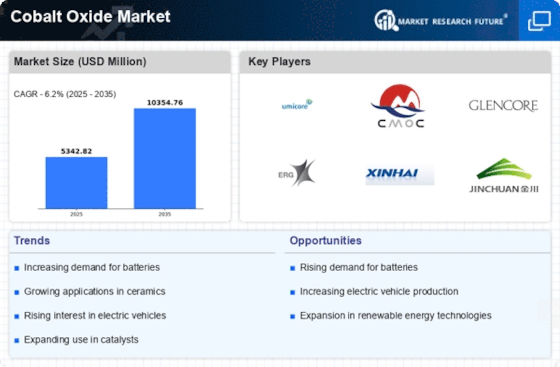
As per Market Research Future analysis, the Cobalt Oxide Market Size was estimated at 5342.82 USD Million in 2024. The Cobalt Oxide industry is projected to grow from 5674.07 USD Million in 2025 to 10354.76 USD Million by 2035, exhibiting a compound annual growth rate (CAGR) of 6.2% during the forecast period 2025 - 2035

Key Market Trends & Highlights

The Cobalt Oxide Market is poised for growth driven by technological advancements and increasing demand in various sectors.

  • North America remains the largest market for cobalt oxide, primarily due to its robust battery production industry.
  • Asia-Pacific is the fastest-growing region, reflecting a surge in electric vehicle adoption and renewable energy initiatives.
  • Cobalt (II) Oxide (CoO) dominates the market, while Cobalt (III) Oxide (Co2O3) is experiencing rapid growth in demand.
  • Technological advancements in battery technology and increasing electric vehicle adoption are key drivers propelling market expansion.

Market Size & Forecast

2024 Market Size 5342.82 (USD Million)
2035 Market Size 10354.76 (USD Million)
CAGR (2025 - 2035) 6.2%
Largest Regional Market Share in 2024 Asia Pacific

Major Players

Umicore (BE), China Molybdenum Co., Ltd. (CN), Glencore International AG (CH), Eurasian Resources Group (KZ), Shenzhen Xinhai Technology Co., Ltd. (CN), Jinchuan Group International Resources Co. Ltd. (HK), First Cobalt Corp. (CA), Cobalt Blue Holdings Limited (AU)

Market Trends

The Cobalt Oxide Market is currently experiencing a dynamic phase characterized by evolving demand patterns and technological advancements. The increasing utilization of cobalt oxide in various applications, particularly in the production of batteries for electric vehicles and renewable energy storage systems, appears to be a driving force behind market growth. Furthermore, the rising emphasis on sustainable practices and the transition towards greener technologies may enhance the demand for cobalt oxide, as it plays a crucial role in enhancing battery performance and longevity. As industries seek to reduce their carbon footprint, cobalt oxide's significance in energy storage solutions is likely to expand, potentially reshaping market dynamics. In addition to the growing demand from the energy sector, the Cobalt Oxide Market is also influenced by regulatory frameworks and geopolitical factors. Countries are increasingly focusing on securing supply chains for critical materials, which may lead to strategic partnerships and investments in cobalt mining and processing. This trend suggests a shift towards localized production and sourcing, which could mitigate risks associated with supply disruptions. Overall, the Cobalt Oxide Market appears poised for growth, driven by technological innovations and a global push for sustainable energy solutions.

Rising Demand in Battery Production

The demand for cobalt oxide in battery manufacturing is on the rise, particularly due to the increasing popularity of electric vehicles. This trend indicates a shift towards cleaner energy solutions, as cobalt oxide enhances battery efficiency and lifespan.

Sustainability Initiatives

There is a growing focus on sustainability within the Cobalt Oxide Market, as industries aim to adopt greener practices. This shift may lead to increased investments in cobalt recycling and alternative sourcing methods, potentially reducing environmental impact.

Geopolitical Influences on Supply Chains

Geopolitical factors are playing a significant role in shaping the Cobalt Oxide Market. Nations are prioritizing the security of their supply chains for critical materials, which may result in strategic collaborations and localized production efforts.

Cobalt Oxide Market Market Drivers

Increasing Electric Vehicle Adoption

The Cobalt Oxide Market is significantly influenced by the rising adoption of electric vehicles (EVs). As governments and consumers prioritize sustainable transportation solutions, the demand for cobalt oxide, a critical material in EV batteries, is expected to escalate. Data suggests that the EV market is anticipated to grow at a compound annual growth rate of over 20% through 2025. This growth is likely to create a robust demand for cobalt oxide, as it enhances battery efficiency and longevity. Additionally, major automotive manufacturers are investing heavily in EV technology, further solidifying the role of cobalt oxide in the automotive sector. The increasing focus on reducing carbon emissions and transitioning to cleaner energy sources underscores the importance of cobalt oxide in the evolving automotive landscape.

Expansion of Renewable Energy Storage Solutions

The Cobalt Oxide Market is poised for growth due to the expansion of renewable energy storage solutions. As the world shifts towards sustainable energy sources, the need for efficient energy storage systems becomes critical. Cobalt oxide plays a vital role in the development of advanced battery technologies that support renewable energy applications. Market analysis indicates that the energy storage sector is projected to witness a significant increase, with investments in battery storage systems expected to reach billions by 2025. This trend suggests that cobalt oxide will be in high demand as it enhances the performance and reliability of energy storage solutions. The integration of cobalt oxide in these systems not only improves energy efficiency but also supports the global transition to renewable energy.

Growing Industrial Applications of Cobalt Oxide

The Cobalt Oxide Market is benefiting from the growing industrial applications of cobalt oxide beyond batteries. Industries such as ceramics, pigments, and catalysts are increasingly utilizing cobalt oxide for its unique properties. For instance, cobalt oxide is employed in the production of high-performance ceramics, which are used in various applications, including electronics and aerospace. Market data indicates that the industrial segment is expected to account for a substantial share of the cobalt oxide market, driven by the demand for specialized materials. Additionally, the use of cobalt oxide in catalysts for chemical processes further enhances its market potential. This diversification of applications suggests a robust future for the Cobalt Oxide Market, as it adapts to the evolving needs of various sectors.

Technological Advancements in Battery Technology

The Cobalt Oxide Market is experiencing a surge in demand due to rapid advancements in battery technology. Innovations in lithium-ion batteries, which utilize cobalt oxide as a key component, are driving this growth. As electric vehicles and renewable energy storage systems gain traction, the need for efficient and high-capacity batteries becomes paramount. Reports indicate that the battery segment is projected to account for over 60% of the cobalt oxide market by 2025. This trend suggests that manufacturers are increasingly focusing on enhancing battery performance, which in turn propels the demand for cobalt oxide. Furthermore, the integration of cobalt oxide in next-generation batteries, such as solid-state batteries, indicates a promising future for the Cobalt Oxide Market.

Regulatory Support for Sustainable Mining Practices

The Cobalt Oxide Market is likely to benefit from increasing regulatory support for sustainable mining practices. Governments and international organizations are emphasizing the importance of ethical sourcing and environmental responsibility in the mining sector. This regulatory landscape is expected to drive demand for responsibly sourced cobalt oxide, as consumers and manufacturers alike prioritize sustainability. Reports indicate that companies adhering to sustainable practices may gain a competitive edge in the market, potentially influencing pricing and supply dynamics. Furthermore, the push for transparency in supply chains could lead to increased investments in sustainable mining technologies, thereby enhancing the overall market for cobalt oxide. This regulatory focus on sustainability may reshape the Cobalt Oxide Market, fostering a more responsible and ethical approach to cobalt sourcing.

Market Segment Insights

By Type: Cobalt (II) Oxide (CoO) (Largest) vs. Cobalt (III) Oxide (Co2O3) (Fastest-Growing)

<p>In the Cobalt Oxide Market, Cobalt (II) Oxide (CoO) holds the largest share, primarily due to its prevalent application in batteries and ceramics. This segment's dominance is reinforced by the increasing demand for electric vehicle batteries, where CoO is favored for its efficiency and performance. On the other hand, Cobalt (III) Oxide (Co2O3) is rapidly gaining traction, driven by its rising applications in advanced battery technologies and catalysts, pointing to a robust shift in market preferences. The growth trends indicate a substantial shift towards more sustainable and high-capacity battery solutions, thereby uplifting the profile of Cobalt (III) Oxide. As industries focus on reducing carbon footprints and enhancing energy efficiency, the demand for Cobalt (III) Oxide is expected to soar. The advancements in technology and increased investments in research further catalyze this growth, establishing Co2O3 as a key player in the evolving energy landscape.</p>

<p>Cobalt (II) Oxide (CoO) (Dominant) vs. Cobalt (III) Oxide (Co2O3) (Emerging)</p>

<p>Cobalt (II) Oxide (CoO) is recognized as the dominant player in the Cobalt Oxide Market, renowned for its applications in rechargeable batteries, ceramics, and electronic components. Its unique properties, such as thermal stability and high conductivity, make it an indispensable material for various industrial applications. Conversely, Cobalt (III) Oxide (Co2O3) is an emerging segment characterized by its role in high-energy-density battery technologies and as a catalyst in chemical processes. With increasing investments in alternative energy solutions and the push towards more sustainable materials, Co2O3 is poised to gain a significant foothold in the market, showcasing impressive growth potential.</p>

By Form: Powder (Largest) vs. Granules (Fastest-Growing)

<p>In the Cobalt Oxide Market, the Form segment is primarily divided into three key categories: Powder, Granules, and Pellets. Among these, the Powder form dominates the market due to its widespread applications across various industries, particularly in the production of batteries and catalysts. The Powder form benefits from excellent dispersibility and is favored for its versatility, hence securing the largest market share. Granules, while a smaller segment, are emerging rapidly and are experiencing increased adoption in applications that require more controlled release and handling ease, positioning themselves as the fastest-growing category within this segment.</p>

<p>Cobalt Oxide: Powder (Dominant) vs. Granules (Emerging)</p>

<p>The Powder form of Cobalt Oxide is characterized by its fine particles which enhance its physical and chemical properties, making it the preferred choice in battery manufacturing, especially for lithium-ion batteries. Its dominance in the market is attributed to its high purity and optimal size distribution, which significantly influence performance. Meanwhile, Granules represent an emerging trend as their granular structure offers advantages in processing applications demanding better flow characteristics and reduced dust generation. The rise in demand for Granules can be linked to technological advancements and the need for more efficient material handling solutions, showcasing their potential to capture market share in the coming years.</p>

By Application: Batteries (Largest) vs. Catalysts (Fastest-Growing)

<p>In the cobalt oxide market, the application segment is primarily dominated by batteries, which hold the largest market share. This is driven by the increasing demand for rechargeable batteries used in electric vehicles and portable electronics. Following closely are catalysts and ceramics, which also constitute significant portions of the market, while the magnetic materials and electrochemical devices have a smaller, yet influential presence within the segment. These applications highlight the versatility of cobalt oxide in various industrial uses.</p>

<p>Batteries (Dominant) vs. Catalysts (Emerging)</p>

<p>Batteries represent the dominant application of cobalt oxide, primarily due to their extensive use in lithium-ion batteries that power electric vehicles and consumer electronics. This market segment benefits from technological advancements that enhance energy density and performance. On the other hand, catalysts are an emerging segment, showcasing rapid growth spurred by environmental regulations and the increasing demand for sustainable energy solutions. The use of cobalt oxide in catalysts for diesel particulate filters and refining processes highlights its importance in addressing pollution and improving energy efficiency. Each of these segments reflects distinct characteristics and growth trajectories within the cobalt oxide market.</p>

By End-Use Industry: Electronics and Electrical (Largest) vs. Energy Storage (Fastest-Growing)

<p>The Cobalt Oxide market exhibits a diverse distribution of end-use applications, with the electronics and electrical segment holding the largest market share. This sector primarily utilizes cobalt oxide in batteries, capacitors, and various electronic components. Following closely, energy storage applications are gaining ground rapidly, fueled by the increasing demand for renewable energy solutions and advancements in battery technology. Other significant segments include the chemical industry, automotive, and materials like glass and ceramics, each contributing uniquely to the market dynamics. Currently, the growth trends within the cobalt oxide market are supported by the escalating demand for electric vehicles and sustainable energy systems. As more manufacturers invest in technologies that harness cobalt oxide for high-performance batteries, the energy storage segment is becoming increasingly vital. Additionally, regulatory changes favoring clean energy solutions are driving innovation and investments across other end-use industries, bolstering a robust growth trajectory for cobalt oxide applications.</p>

<p>Electronics and Electrical (Dominant) vs. Energy Storage (Emerging)</p>

<p>In the Cobalt Oxide market, the electronics and electrical segment stands out as a dominant player due to its extensive applications in portable electronics and sophisticated electrical devices. This segment is characterized by its reliance on cobalt oxide for enhancing battery performance, particularly in lithium-ion batteries, which are integral to modern electronics. On the other hand, the energy storage segment, although currently emerging, is rapidly gaining traction as the demand for efficient energy solutions grows. This segment focuses on developing technologies that utilize cobalt oxide in energy storage systems, such as grid-scale batteries and advanced renewable energy storage solutions, highlighting its potential for future developments and innovations.</p>

Get more detailed insights about Cobalt Oxide Market Report — Forecast till 2035

Regional Insights

North America : Innovation and Sustainability Focus

North America is witnessing significant growth in the cobalt oxide market, driven by increasing demand for electric vehicles (EVs) and renewable energy storage solutions. The region holds approximately 30% of the global market share, with the United States being the largest contributor, followed by Canada at around 15%. Regulatory support for clean energy initiatives and EV adoption is further propelling market expansion. The competitive landscape in North America features key players such as First Cobalt Corp. and Umicore, which are investing heavily in sustainable mining practices and recycling technologies. The U.S. government is also promoting domestic production to reduce reliance on imports, enhancing the market's resilience. This focus on innovation and sustainability is expected to drive further growth in the cobalt oxide sector.

Europe : Regulatory Support and Innovation

Europe is emerging as a pivotal player in the cobalt oxide market, driven by stringent regulations aimed at reducing carbon emissions and promoting sustainable practices. The region accounts for approximately 25% of the global market share, with Germany and France leading the charge. The European Union's Green Deal and various national policies are catalyzing investments in cobalt recycling and sustainable sourcing, enhancing market dynamics. Leading countries like Germany and Belgium are home to major players such as Umicore and Glencore, which are focusing on innovative technologies to improve cobalt extraction and processing. The competitive landscape is characterized by collaborations between industry and government to ensure a stable supply chain. This synergy is crucial for meeting the growing demand for cobalt in battery production and other applications.

Asia-Pacific : Emerging Market Dynamics

Asia-Pacific is rapidly becoming a significant market for cobalt oxide, primarily driven by the booming electric vehicle sector and increasing industrial applications. The region holds around 35% of the global market share, with China being the largest market, followed by Australia. Government initiatives to promote EV adoption and investments in battery manufacturing are key growth drivers, alongside rising demand for renewable energy solutions. China Molybdenum Co., Ltd. and Jinchuan Group are among the leading players in this region, focusing on expanding their production capacities and enhancing supply chain efficiencies. The competitive landscape is marked by aggressive investments in technology and sustainability practices, positioning Asia-Pacific as a critical hub for cobalt oxide production and innovation. This trend is expected to continue as the region seeks to meet both domestic and international demand.

Middle East and Africa : Resource-Rich Opportunities

The Middle East and Africa region is witnessing growing interest in the cobalt oxide market, driven by the rich mineral resources available, particularly in countries like the Democratic Republic of the Congo and South Africa. This region holds about 10% of the global market share, with significant potential for growth as global demand for cobalt increases. Regulatory frameworks are evolving to support sustainable mining practices, which is crucial for attracting foreign investment. Countries like South Africa are focusing on developing their mining sectors, with key players such as Eurasian Resources Group leading the charge. The competitive landscape is characterized by a mix of local and international companies aiming to capitalize on the region's mineral wealth. As global demand for cobalt continues to rise, the Middle East and Africa are poised to become increasingly important players in the cobalt oxide market.

Key Players and Competitive Insights

The Cobalt Oxide Market is characterized by the presence of many global, regional, and local vendors. The market is highly competitive, with all the players competing to gain maximum market share. Intense competition, frequent changes in government policies, and regulations are key factors that impact market growth. The vendors compete based on cost, product quality, reliability, and aftermarket services. The top 10 key players in the market includes Umicore, Zhejiang Huayou Cobalt Co. Ltd, Sajan Overseas Pvt Ltd, American Elements, Jervois Finland, Particular Materials, ICoNiChem, Eastmen Chemicals, Shanghai Greenearth Chemicals Co.Ltd., and Sun Industries.
The competitive landscape in cobalt oxide is expected to be strong further in the coming years. The market is expanding due to multiple factors. These are the rise in demand in the electronics sector for the manufacture of Li-ion batteries extensively used in electronic appliances like laptops, mobile, and car cobalt, an application of cobalt oxide is now. The demand for renewable energy is on the rise, and hence cobalt oxide is being used in the health sector. The automotive companies also need to go for electric vehicles. Hence, the demands for the manufacturing of the battery are now.
Cobalt oxide demand in paints and ceramics is required for projects to build infrastructure in many less developed nations.
Umicore: Umicore was founded in 1989 in Belgium & is a leading circular materials technology company with an expertise in the fields of material science, chemistry and metallurgy. It is focused on sustainability to produce and recycle materials. The company works in order to reduce harmful vehicle emissions and recycle used metals. It operates in various industries such as Energy, Automotive, Recycling, Chemicals, Manufacturing, Optics & Display, Precious Metals and Electronics.
It is a leading supplier of catalysts for emission control systems in vehicles and industrial applications, produces a wide range of other materials like specialty chemicals, pigments, alloys & is involved in production of materials for rechargeable batteries which are needed for electrification of transportation and energy storage. It specializes in recycling of precious metals such as gold, silver, platinum as well as metals like cobalt and copper for the purpose of reducing environmental impact.
American Elements: American Elements founded in 1998 is a manufacturer of engineered and advanced materials essential to numerous industries, including green technology, space exploration, nanotechnology, advanced electronics, and military technology with offices in Los Angeles, California; Salt Lake City, Utah; Baotou, China; Monterrey, Mexico, and Manchester, UK. The company has been a focused-on advancement and new product development for over two decades.
Its expertise is in the properties, applications, and cost-effective manufacturing of advanced and engineered materials with its clients being global manufacturers (including over 30% of the Fortune 50), all U.S. and many foreign national laboratories, universities throughout the world, and with thousands of commercial customers in a wide variety of industry groups, including energy, electronics, aerospace, defense, automotive, optics/photovoltaics, green technologies and pharma/cosmetics.
The company provides both technical guidance and manufactured products in its over 12,000 page online catalog which includes over 3,000 elemental metal, chemical, ceramic and crystalline stock items &  also produces numerous customer proprietary formulations from its network of production facilities strategically placed throughout the world.

Cobalt Oxide Market Industry Developments


10 October 2024 Novonix, a leading battery materials and technology company, and ICoNiChem Widnes, a world leader in the production and commercialisation of cobalt and nickel salts based in the UK, have announced the signing of a joint collaboration agreement focused on the development of nickel-based cathode active materials. Novonix and ICoNiChem have been selected for funding under the 2024 Canada-UK critical minerals call for proposals, which is focused on advancing projects related to critical minerals essential for industries like renewable energy, electric vehicles, and electronics.
To support their participation in the project, Novonix Battery Technology Solutions Inc., a Canadian division of Novonix, is receiving advisory services and up to $138,910 (USD 93,306) in funding from the National Research Council of Canada Industrial Research Assistance Program (NRC IRAP), while ICoNiChem is receiving support through Innovate UK. The two-year project, with a total budget of $559,983 between Novonix and ICoNiChem, aims to further improve the sustainability of the Novonix all-dry, zero-waste technology by incorporating recycled metal feedstock, such as cobalt and nickel carbonates and oxides, into the process.
29 May 2019: Umicore and Glencore announce that they have entered into a long-term revolving agreement for the supply of cobalt hydroxide (cobalt) to Umicore’s battery materials value chain. The cobalt will be sourced from Glencore’s state-of-the art industrial mining operations, KCC and Mutanda, located in the DRC. Umicore has assessed each operation as fully compliant with its sustainable procurement framework for cobalt which excludes artisanally mined cobalt from its supply chain, as well as any form of child labor.
The cobalt units will be shipped to Umicore’s cobalt refineries globally, including the Kokkola refinery in Finland once the ongoing acquisition process is complete. The agreement guarantees Umicore’s security of supply for a substantial part of its longer-term cobalt needs for its expanding global battery materials value chain. The agreement also provides Glencore long-term market access for its cobalt raw materials in line with Umicore’s growing cathode materials sales.

Key Companies in the Cobalt Oxide Market include

Industry Developments

10 October 2024 Novonix, a leading battery materials and technology company, and ICoNiChem Widnes, a world leader in the production and commercialisation of cobalt and nickel salts based in the UK, have announced the signing of a joint collaboration agreement focused on the development of nickel-based cathode active materials. Novonix and ICoNiChem have been selected for funding under the 2024 Canada-UK critical minerals call for proposals, which is focused on advancing projects related to critical minerals essential for industries like renewable energy, electric vehicles, and electronics.

To support their participation in the project, Novonix Battery Technology Solutions Inc., a Canadian division of Novonix, is receiving advisory services and up to $138,910 (USD 93,306) in funding from the National Research Council of Canada Industrial Research Assistance Program (NRC IRAP), while ICoNiChem is receiving support through Innovate UK. The two-year project, with a total budget of $559,983 between Novonix and ICoNiChem, aims to further improve the sustainability of the Novonix all-dry, zero-waste technology by incorporating recycled metal feedstock, such as cobalt and nickel carbonates and oxides, into the process.

29 May 2019: Umicore and Glencore announce that they have entered into a long-term revolving agreement for the supply of cobalt hydroxide (cobalt) to Umicore’s battery materials value chain. The cobalt will be sourced from Glencore’s state-of-the art industrial mining operations, KCC and Mutanda, located in the DRC. Umicore has assessed each operation as fully compliant with its sustainable procurement framework for cobalt which excludes artisanally mined cobalt from its supply chain, as well as any form of child labor.

The cobalt units will be shipped to Umicore’s cobalt refineries globally, including the Kokkola refinery in Finland once the ongoing acquisition process is complete. The agreement guarantees Umicore’s security of supply for a substantial part of its longer-term cobalt needs for its expanding global battery materials value chain. The agreement also provides Glencore long-term market access for its cobalt raw materials in line with Umicore’s growing cathode materials sales.

Key Companies in the Cobalt Oxide Market include

    • Umicore
    • Zhejiang Huayou Cobalt Co., Ltd
    • American Elements
    • Jervois Finland
    • Particular Materials
    • ICoNiChem
    • Eastmen Chemicals
    • Shanghai Greenearth Chemicals Co. Ltd
    • Sun Industries

Future Outlook

Cobalt Oxide Market Future Outlook

The Cobalt Oxide Market is projected to grow at a 6.2% CAGR from 2025 to 2035, driven by increasing demand in battery production and electric vehicles.

New opportunities lie in:

  • Expansion into emerging markets with high electric vehicle adoption rates.
  • Development of sustainable cobalt extraction technologies to enhance supply chain resilience.
  • Strategic partnerships with battery manufacturers for tailored cobalt oxide solutions.

By 2035, the Cobalt Oxide Market is expected to solidify its position as a key player in the energy transition.

Market Segmentation

Cobalt Oxide Market Form Outlook

  • Powder
  • Granules
  • Pellets

Cobalt Oxide Market Type Outlook

  • Cobalt (II) Oxide (CoO)
  • Cobalt (III) Oxide (Co2O3)
  • Cobalt (IV) Oxide (CoO2)
  • Cobalt (II, III) Oxide (Co3O4)

Cobalt Oxide Market Application Outlook

  • Batteries
  • Catalysts
  • Ceramics and Pigments
  • Magnetic Materials
  • Electrochemical Devices
  • Others

Cobalt Oxide Market End-Use Industry Outlook

  • Electronics and Electrical
  • Energy Storage
  • Chemical Industry
  • Automotive
  • Glass and Ceramics
  • Paints and Coatings
  • Others

Report Scope

MARKET SIZE 2024 5342.82(USD Million)
MARKET SIZE 2025 5674.07(USD Million)
MARKET SIZE 2035 10354.76(USD Million)
COMPOUND ANNUAL GROWTH RATE (CAGR) 6.2% (2025 - 2035)
REPORT COVERAGE Revenue Forecast, Competitive Landscape, Growth Factors, and Trends
BASE YEAR 2024
Market Forecast Period 2025 - 2035
Historical Data 2019 - 2024
Market Forecast Units USD Million
Key Companies Profiled Umicore (BE), China Molybdenum Co., Ltd. (CN), Glencore International AG (CH), Eurasian Resources Group (KZ), Shenzhen Xinhai Technology Co., Ltd. (CN), Jinchuan Group International Resources Co. Ltd. (HK), First Cobalt Corp. (CA), Cobalt Blue Holdings Limited (AU)
Segments Covered Type, Form, Application, End-Use Industry, Region -Global Forecast to 2035
Key Market Opportunities Growing demand for electric vehicle batteries drives innovation in the Cobalt Oxide Market.
Key Market Dynamics Rising demand for electric vehicle batteries drives competition and innovation in the cobalt oxide market.
Countries Covered North America, Europe, APAC, South America, MEA

FAQs

What is the current valuation of the Cobalt Oxide Market as of 2024?

<p>The Cobalt Oxide Market was valued at approximately 5342.82 USD Million in 2024.</p>

What is the projected market valuation for the Cobalt Oxide Market in 2035?

<p>The market is projected to reach approximately 10354.76 USD Million by 2035.</p>

What is the expected CAGR for the Cobalt Oxide Market during the forecast period 2025 - 2035?

<p>The expected CAGR for the Cobalt Oxide Market during the forecast period 2025 - 2035 is 6.2%.</p>

Which companies are considered key players in the Cobalt Oxide Market?

<p>Key players in the market include Umicore, China Molybdenum Co., Ltd., Glencore International AG, and others.</p>

What are the main types of cobalt oxide products available in the market?

<p>The main types include Cobalt (II) Oxide, Cobalt (III) Oxide, Cobalt (IV) Oxide, and Cobalt (II, III) Oxide.</p>

How does the valuation of Cobalt (II, III) Oxide compare to other types?

<p>Cobalt (II, III) Oxide had a valuation of approximately 2742.82 USD Million in 2024, indicating strong market presence.</p>

What forms of cobalt oxide are currently available in the market?

<p>Available forms include Powder, Granules, and Pellets, with Granules valued at around 1800.0 USD Million in 2024.</p>

What applications are driving demand for cobalt oxide?

<p>Key applications include Batteries, Catalysts, and Ceramics, with Batteries valued at approximately 1600.0 USD Million in 2024.</p>

Which end-use industries are the largest consumers of cobalt oxide?

<p>The largest consumers include the Energy Storage and Automotive industries, with Energy Storage valued at around 1200.0 USD Million in 2024.</p>

What is the projected growth trend for the Cobalt Oxide Market in the coming years?

<p>The market appears poised for growth, with projections indicating a steady increase in valuation through 2035.</p>

  1. SECTION I: EXECUTIVE SUMMARY AND KEY HIGHLIGHTS
    1. | 1.1 EXECUTIVE SUMMARY
    2. | | 1.1.1 Market Overview
    3. | | 1.1.2 Key Findings
    4. | | 1.1.3 Market Segmentation
    5. | | 1.1.4 Competitive Landscape
    6. | | 1.1.5 Challenges and Opportunities
    7. | | 1.1.6 Future Outlook
  2. SECTION II: SCOPING, METHODOLOGY AND MARKET STRUCTURE
    1. | 2.1 MARKET INTRODUCTION
    2. | | 2.1.1 Definition
    3. | | 2.1.2 Scope of the study
    4. | | | 2.1.2.1 Research Objective
    5. | | | 2.1.2.2 Assumption
    6. | | | 2.1.2.3 Limitations
    7. | 2.2 RESEARCH METHODOLOGY
    8. | | 2.2.1 Overview
    9. | | 2.2.2 Data Mining
    10. | | 2.2.3 Secondary Research
    11. | | 2.2.4 Primary Research
    12. | | | 2.2.4.1 Primary Interviews and Information Gathering Process
    13. | | | 2.2.4.2 Breakdown of Primary Respondents
    14. | | 2.2.5 Forecasting Model
    15. | | 2.2.6 Market Size Estimation
    16. | | | 2.2.6.1 Bottom-Up Approach
    17. | | | 2.2.6.2 Top-Down Approach
    18. | | 2.2.7 Data Triangulation
    19. | | 2.2.8 Validation
  3. SECTION III: QUALITATIVE ANALYSIS
    1. | 3.1 MARKET DYNAMICS
    2. | | 3.1.1 Overview
    3. | | 3.1.2 Drivers
    4. | | 3.1.3 Restraints
    5. | | 3.1.4 Opportunities
    6. | 3.2 MARKET FACTOR ANALYSIS
    7. | | 3.2.1 Value chain Analysis
    8. | | 3.2.2 Porter's Five Forces Analysis
    9. | | | 3.2.2.1 Bargaining Power of Suppliers
    10. | | | 3.2.2.2 Bargaining Power of Buyers
    11. | | | 3.2.2.3 Threat of New Entrants
    12. | | | 3.2.2.4 Threat of Substitutes
    13. | | | 3.2.2.5 Intensity of Rivalry
    14. | | 3.2.3 COVID-19 Impact Analysis
    15. | | | 3.2.3.1 Market Impact Analysis
    16. | | | 3.2.3.2 Regional Impact
    17. | | | 3.2.3.3 Opportunity and Threat Analysis
  4. SECTION IV: QUANTITATIVE ANALYSIS
    1. | 4.1 Chemicals and Materials, BY Type (USD Million)
    2. | | 4.1.1 Cobalt (II) Oxide (CoO)
    3. | | 4.1.2 Cobalt (III) Oxide (Co2O3)
    4. | | 4.1.3 Cobalt (IV) Oxide (CoO2)
    5. | | 4.1.4 Cobalt (II, III) Oxide (Co3O4)
    6. | 4.2 Chemicals and Materials, BY Form (USD Million)
    7. | | 4.2.1 Powder
    8. | | 4.2.2 Granules
    9. | | 4.2.3 Pellets
    10. | 4.3 Chemicals and Materials, BY Application (USD Million)
    11. | | 4.3.1 Batteries
    12. | | 4.3.2 Catalysts
    13. | | 4.3.3 Ceramics and Pigments
    14. | | 4.3.4 Magnetic Materials
    15. | | 4.3.5 Electrochemical Devices
    16. | | 4.3.6 Others
    17. | 4.4 Chemicals and Materials, BY End-Use Industry (USD Million)
    18. | | 4.4.1 Electronics and Electrical
    19. | | 4.4.2 Energy Storage
    20. | | 4.4.3 Chemical Industry
    21. | | 4.4.4 Automotive
    22. | | 4.4.5 Glass and Ceramics
    23. | | 4.4.6 Paints and Coatings
    24. | | 4.4.7 Others
    25. | 4.5 Chemicals and Materials, BY Region (USD Million)
    26. | | 4.5.1 North America
    27. | | | 4.5.1.1 US
    28. | | | 4.5.1.2 Canada
    29. | | 4.5.2 Europe
    30. | | | 4.5.2.1 Germany
    31. | | | 4.5.2.2 UK
    32. | | | 4.5.2.3 France
    33. | | | 4.5.2.4 Russia
    34. | | | 4.5.2.5 Italy
    35. | | | 4.5.2.6 Spain
    36. | | | 4.5.2.7 Rest of Europe
    37. | | 4.5.3 APAC
    38. | | | 4.5.3.1 China
    39. | | | 4.5.3.2 India
    40. | | | 4.5.3.3 Japan
    41. | | | 4.5.3.4 South Korea
    42. | | | 4.5.3.5 Malaysia
    43. | | | 4.5.3.6 Thailand
    44. | | | 4.5.3.7 Indonesia
    45. | | | 4.5.3.8 Rest of APAC
    46. | | 4.5.4 South America
    47. | | | 4.5.4.1 Brazil
    48. | | | 4.5.4.2 Mexico
    49. | | | 4.5.4.3 Argentina
    50. | | | 4.5.4.4 Rest of South America
    51. | | 4.5.5 MEA
    52. | | | 4.5.5.1 GCC Countries
    53. | | | 4.5.5.2 South Africa
    54. | | | 4.5.5.3 Rest of MEA
  5. SECTION V: COMPETITIVE ANALYSIS
    1. | 5.1 Competitive Landscape
    2. | | 5.1.1 Overview
    3. | | 5.1.2 Competitive Analysis
    4. | | 5.1.3 Market share Analysis
    5. | | 5.1.4 Major Growth Strategy in the Chemicals and Materials
    6. | | 5.1.5 Competitive Benchmarking
    7. | | 5.1.6 Leading Players in Terms of Number of Developments in the Chemicals and Materials
    8. | | 5.1.7 Key developments and growth strategies
    9. | | | 5.1.7.1 New Product Launch/Service Deployment
    10. | | | 5.1.7.2 Merger & Acquisitions
    11. | | | 5.1.7.3 Joint Ventures
    12. | | 5.1.8 Major Players Financial Matrix
    13. | | | 5.1.8.1 Sales and Operating Income
    14. | | | 5.1.8.2 Major Players R&D Expenditure. 2023
    15. | 5.2 Company Profiles
    16. | | 5.2.1 Umicore (BE)
    17. | | | 5.2.1.1 Financial Overview
    18. | | | 5.2.1.2 Products Offered
    19. | | | 5.2.1.3 Key Developments
    20. | | | 5.2.1.4 SWOT Analysis
    21. | | | 5.2.1.5 Key Strategies
    22. | | 5.2.2 China Molybdenum Co., Ltd. (CN)
    23. | | | 5.2.2.1 Financial Overview
    24. | | | 5.2.2.2 Products Offered
    25. | | | 5.2.2.3 Key Developments
    26. | | | 5.2.2.4 SWOT Analysis
    27. | | | 5.2.2.5 Key Strategies
    28. | | 5.2.3 Glencore International AG (CH)
    29. | | | 5.2.3.1 Financial Overview
    30. | | | 5.2.3.2 Products Offered
    31. | | | 5.2.3.3 Key Developments
    32. | | | 5.2.3.4 SWOT Analysis
    33. | | | 5.2.3.5 Key Strategies
    34. | | 5.2.4 Eurasian Resources Group (KZ)
    35. | | | 5.2.4.1 Financial Overview
    36. | | | 5.2.4.2 Products Offered
    37. | | | 5.2.4.3 Key Developments
    38. | | | 5.2.4.4 SWOT Analysis
    39. | | | 5.2.4.5 Key Strategies
    40. | | 5.2.5 Shenzhen Xinhai Technology Co., Ltd. (CN)
    41. | | | 5.2.5.1 Financial Overview
    42. | | | 5.2.5.2 Products Offered
    43. | | | 5.2.5.3 Key Developments
    44. | | | 5.2.5.4 SWOT Analysis
    45. | | | 5.2.5.5 Key Strategies
    46. | | 5.2.6 Jinchuan Group International Resources Co. Ltd. (HK)
    47. | | | 5.2.6.1 Financial Overview
    48. | | | 5.2.6.2 Products Offered
    49. | | | 5.2.6.3 Key Developments
    50. | | | 5.2.6.4 SWOT Analysis
    51. | | | 5.2.6.5 Key Strategies
    52. | | 5.2.7 First Cobalt Corp. (CA)
    53. | | | 5.2.7.1 Financial Overview
    54. | | | 5.2.7.2 Products Offered
    55. | | | 5.2.7.3 Key Developments
    56. | | | 5.2.7.4 SWOT Analysis
    57. | | | 5.2.7.5 Key Strategies
    58. | | 5.2.8 Cobalt Blue Holdings Limited (AU)
    59. | | | 5.2.8.1 Financial Overview
    60. | | | 5.2.8.2 Products Offered
    61. | | | 5.2.8.3 Key Developments
    62. | | | 5.2.8.4 SWOT Analysis
    63. | | | 5.2.8.5 Key Strategies
    64. | 5.3 Appendix
    65. | | 5.3.1 References
    66. | | 5.3.2 Related Reports
  6. LIST OF FIGURES
    1. | 6.1 MARKET SYNOPSIS
    2. | 6.2 NORTH AMERICA MARKET ANALYSIS
    3. | 6.3 US MARKET ANALYSIS BY TYPE
    4. | 6.4 US MARKET ANALYSIS BY FORM
    5. | 6.5 US MARKET ANALYSIS BY APPLICATION
    6. | 6.6 US MARKET ANALYSIS BY END-USE INDUSTRY
    7. | 6.7 CANADA MARKET ANALYSIS BY TYPE
    8. | 6.8 CANADA MARKET ANALYSIS BY FORM
    9. | 6.9 CANADA MARKET ANALYSIS BY APPLICATION
    10. | 6.10 CANADA MARKET ANALYSIS BY END-USE INDUSTRY
    11. | 6.11 EUROPE MARKET ANALYSIS
    12. | 6.12 GERMANY MARKET ANALYSIS BY TYPE
    13. | 6.13 GERMANY MARKET ANALYSIS BY FORM
    14. | 6.14 GERMANY MARKET ANALYSIS BY APPLICATION
    15. | 6.15 GERMANY MARKET ANALYSIS BY END-USE INDUSTRY
    16. | 6.16 UK MARKET ANALYSIS BY TYPE
    17. | 6.17 UK MARKET ANALYSIS BY FORM
    18. | 6.18 UK MARKET ANALYSIS BY APPLICATION
    19. | 6.19 UK MARKET ANALYSIS BY END-USE INDUSTRY
    20. | 6.20 FRANCE MARKET ANALYSIS BY TYPE
    21. | 6.21 FRANCE MARKET ANALYSIS BY FORM
    22. | 6.22 FRANCE MARKET ANALYSIS BY APPLICATION
    23. | 6.23 FRANCE MARKET ANALYSIS BY END-USE INDUSTRY
    24. | 6.24 RUSSIA MARKET ANALYSIS BY TYPE
    25. | 6.25 RUSSIA MARKET ANALYSIS BY FORM
    26. | 6.26 RUSSIA MARKET ANALYSIS BY APPLICATION
    27. | 6.27 RUSSIA MARKET ANALYSIS BY END-USE INDUSTRY
    28. | 6.28 ITALY MARKET ANALYSIS BY TYPE
    29. | 6.29 ITALY MARKET ANALYSIS BY FORM
    30. | 6.30 ITALY MARKET ANALYSIS BY APPLICATION
    31. | 6.31 ITALY MARKET ANALYSIS BY END-USE INDUSTRY
    32. | 6.32 SPAIN MARKET ANALYSIS BY TYPE
    33. | 6.33 SPAIN MARKET ANALYSIS BY FORM
    34. | 6.34 SPAIN MARKET ANALYSIS BY APPLICATION
    35. | 6.35 SPAIN MARKET ANALYSIS BY END-USE INDUSTRY
    36. | 6.36 REST OF EUROPE MARKET ANALYSIS BY TYPE
    37. | 6.37 REST OF EUROPE MARKET ANALYSIS BY FORM
    38. | 6.38 REST OF EUROPE MARKET ANALYSIS BY APPLICATION
    39. | 6.39 REST OF EUROPE MARKET ANALYSIS BY END-USE INDUSTRY
    40. | 6.40 APAC MARKET ANALYSIS
    41. | 6.41 CHINA MARKET ANALYSIS BY TYPE
    42. | 6.42 CHINA MARKET ANALYSIS BY FORM
    43. | 6.43 CHINA MARKET ANALYSIS BY APPLICATION
    44. | 6.44 CHINA MARKET ANALYSIS BY END-USE INDUSTRY
    45. | 6.45 INDIA MARKET ANALYSIS BY TYPE
    46. | 6.46 INDIA MARKET ANALYSIS BY FORM
    47. | 6.47 INDIA MARKET ANALYSIS BY APPLICATION
    48. | 6.48 INDIA MARKET ANALYSIS BY END-USE INDUSTRY
    49. | 6.49 JAPAN MARKET ANALYSIS BY TYPE
    50. | 6.50 JAPAN MARKET ANALYSIS BY FORM
    51. | 6.51 JAPAN MARKET ANALYSIS BY APPLICATION
    52. | 6.52 JAPAN MARKET ANALYSIS BY END-USE INDUSTRY
    53. | 6.53 SOUTH KOREA MARKET ANALYSIS BY TYPE
    54. | 6.54 SOUTH KOREA MARKET ANALYSIS BY FORM
    55. | 6.55 SOUTH KOREA MARKET ANALYSIS BY APPLICATION
    56. | 6.56 SOUTH KOREA MARKET ANALYSIS BY END-USE INDUSTRY
    57. | 6.57 MALAYSIA MARKET ANALYSIS BY TYPE
    58. | 6.58 MALAYSIA MARKET ANALYSIS BY FORM
    59. | 6.59 MALAYSIA MARKET ANALYSIS BY APPLICATION
    60. | 6.60 MALAYSIA MARKET ANALYSIS BY END-USE INDUSTRY
    61. | 6.61 THAILAND MARKET ANALYSIS BY TYPE
    62. | 6.62 THAILAND MARKET ANALYSIS BY FORM
    63. | 6.63 THAILAND MARKET ANALYSIS BY APPLICATION
    64. | 6.64 THAILAND MARKET ANALYSIS BY END-USE INDUSTRY
    65. | 6.65 INDONESIA MARKET ANALYSIS BY TYPE
    66. | 6.66 INDONESIA MARKET ANALYSIS BY FORM
    67. | 6.67 INDONESIA MARKET ANALYSIS BY APPLICATION
    68. | 6.68 INDONESIA MARKET ANALYSIS BY END-USE INDUSTRY
    69. | 6.69 REST OF APAC MARKET ANALYSIS BY TYPE
    70. | 6.70 REST OF APAC MARKET ANALYSIS BY FORM
    71. | 6.71 REST OF APAC MARKET ANALYSIS BY APPLICATION
    72. | 6.72 REST OF APAC MARKET ANALYSIS BY END-USE INDUSTRY
    73. | 6.73 SOUTH AMERICA MARKET ANALYSIS
    74. | 6.74 BRAZIL MARKET ANALYSIS BY TYPE
    75. | 6.75 BRAZIL MARKET ANALYSIS BY FORM
    76. | 6.76 BRAZIL MARKET ANALYSIS BY APPLICATION
    77. | 6.77 BRAZIL MARKET ANALYSIS BY END-USE INDUSTRY
    78. | 6.78 MEXICO MARKET ANALYSIS BY TYPE
    79. | 6.79 MEXICO MARKET ANALYSIS BY FORM
    80. | 6.80 MEXICO MARKET ANALYSIS BY APPLICATION
    81. | 6.81 MEXICO MARKET ANALYSIS BY END-USE INDUSTRY
    82. | 6.82 ARGENTINA MARKET ANALYSIS BY TYPE
    83. | 6.83 ARGENTINA MARKET ANALYSIS BY FORM
    84. | 6.84 ARGENTINA MARKET ANALYSIS BY APPLICATION
    85. | 6.85 ARGENTINA MARKET ANALYSIS BY END-USE INDUSTRY
    86. | 6.86 REST OF SOUTH AMERICA MARKET ANALYSIS BY TYPE
    87. | 6.87 REST OF SOUTH AMERICA MARKET ANALYSIS BY FORM
    88. | 6.88 REST OF SOUTH AMERICA MARKET ANALYSIS BY APPLICATION
    89. | 6.89 REST OF SOUTH AMERICA MARKET ANALYSIS BY END-USE INDUSTRY
    90. | 6.90 MEA MARKET ANALYSIS
    91. | 6.91 GCC COUNTRIES MARKET ANALYSIS BY TYPE
    92. | 6.92 GCC COUNTRIES MARKET ANALYSIS BY FORM
    93. | 6.93 GCC COUNTRIES MARKET ANALYSIS BY APPLICATION
    94. | 6.94 GCC COUNTRIES MARKET ANALYSIS BY END-USE INDUSTRY
    95. | 6.95 SOUTH AFRICA MARKET ANALYSIS BY TYPE
    96. | 6.96 SOUTH AFRICA MARKET ANALYSIS BY FORM
    97. | 6.97 SOUTH AFRICA MARKET ANALYSIS BY APPLICATION
    98. | 6.98 SOUTH AFRICA MARKET ANALYSIS BY END-USE INDUSTRY
    99. | 6.99 REST OF MEA MARKET ANALYSIS BY TYPE
    100. | 6.100 REST OF MEA MARKET ANALYSIS BY FORM
    101. | 6.101 REST OF MEA MARKET ANALYSIS BY APPLICATION
    102. | 6.102 REST OF MEA MARKET ANALYSIS BY END-USE INDUSTRY
    103. | 6.103 KEY BUYING CRITERIA OF CHEMICALS AND MATERIALS
    104. | 6.104 RESEARCH PROCESS OF MRFR
    105. | 6.105 DRO ANALYSIS OF CHEMICALS AND MATERIALS
    106. | 6.106 DRIVERS IMPACT ANALYSIS: CHEMICALS AND MATERIALS
    107. | 6.107 RESTRAINTS IMPACT ANALYSIS: CHEMICALS AND MATERIALS
    108. | 6.108 SUPPLY / VALUE CHAIN: CHEMICALS AND MATERIALS
    109. | 6.109 CHEMICALS AND MATERIALS, BY TYPE, 2024 (% SHARE)
    110. | 6.110 CHEMICALS AND MATERIALS, BY TYPE, 2024 TO 2035 (USD Million)
    111. | 6.111 CHEMICALS AND MATERIALS, BY FORM, 2024 (% SHARE)
    112. | 6.112 CHEMICALS AND MATERIALS, BY FORM, 2024 TO 2035 (USD Million)
    113. | 6.113 CHEMICALS AND MATERIALS, BY APPLICATION, 2024 (% SHARE)
    114. | 6.114 CHEMICALS AND MATERIALS, BY APPLICATION, 2024 TO 2035 (USD Million)
    115. | 6.115 CHEMICALS AND MATERIALS, BY END-USE INDUSTRY, 2024 (% SHARE)
    116. | 6.116 CHEMICALS AND MATERIALS, BY END-USE INDUSTRY, 2024 TO 2035 (USD Million)
    117. | 6.117 BENCHMARKING OF MAJOR COMPETITORS
  7. LIST OF TABLES
    1. | 7.1 LIST OF ASSUMPTIONS
    2. | | 7.1.1
    3. | 7.2 North America MARKET SIZE ESTIMATES; FORECAST
    4. | | 7.2.1 BY TYPE, 2025-2035 (USD Million)
    5. | | 7.2.2 BY FORM, 2025-2035 (USD Million)
    6. | | 7.2.3 BY APPLICATION, 2025-2035 (USD Million)
    7. | | 7.2.4 BY END-USE INDUSTRY, 2025-2035 (USD Million)
    8. | 7.3 US MARKET SIZE ESTIMATES; FORECAST
    9. | | 7.3.1 BY TYPE, 2025-2035 (USD Million)
    10. | | 7.3.2 BY FORM, 2025-2035 (USD Million)
    11. | | 7.3.3 BY APPLICATION, 2025-2035 (USD Million)
    12. | | 7.3.4 BY END-USE INDUSTRY, 2025-2035 (USD Million)
    13. | 7.4 Canada MARKET SIZE ESTIMATES; FORECAST
    14. | | 7.4.1 BY TYPE, 2025-2035 (USD Million)
    15. | | 7.4.2 BY FORM, 2025-2035 (USD Million)
    16. | | 7.4.3 BY APPLICATION, 2025-2035 (USD Million)
    17. | | 7.4.4 BY END-USE INDUSTRY, 2025-2035 (USD Million)
    18. | 7.5 Europe MARKET SIZE ESTIMATES; FORECAST
    19. | | 7.5.1 BY TYPE, 2025-2035 (USD Million)
    20. | | 7.5.2 BY FORM, 2025-2035 (USD Million)
    21. | | 7.5.3 BY APPLICATION, 2025-2035 (USD Million)
    22. | | 7.5.4 BY END-USE INDUSTRY, 2025-2035 (USD Million)
    23. | 7.6 Germany MARKET SIZE ESTIMATES; FORECAST
    24. | | 7.6.1 BY TYPE, 2025-2035 (USD Million)
    25. | | 7.6.2 BY FORM, 2025-2035 (USD Million)
    26. | | 7.6.3 BY APPLICATION, 2025-2035 (USD Million)
    27. | | 7.6.4 BY END-USE INDUSTRY, 2025-2035 (USD Million)
    28. | 7.7 UK MARKET SIZE ESTIMATES; FORECAST
    29. | | 7.7.1 BY TYPE, 2025-2035 (USD Million)
    30. | | 7.7.2 BY FORM, 2025-2035 (USD Million)
    31. | | 7.7.3 BY APPLICATION, 2025-2035 (USD Million)
    32. | | 7.7.4 BY END-USE INDUSTRY, 2025-2035 (USD Million)
    33. | 7.8 France MARKET SIZE ESTIMATES; FORECAST
    34. | | 7.8.1 BY TYPE, 2025-2035 (USD Million)
    35. | | 7.8.2 BY FORM, 2025-2035 (USD Million)
    36. | | 7.8.3 BY APPLICATION, 2025-2035 (USD Million)
    37. | | 7.8.4 BY END-USE INDUSTRY, 2025-2035 (USD Million)
    38. | 7.9 Russia MARKET SIZE ESTIMATES; FORECAST
    39. | | 7.9.1 BY TYPE, 2025-2035 (USD Million)
    40. | | 7.9.2 BY FORM, 2025-2035 (USD Million)
    41. | | 7.9.3 BY APPLICATION, 2025-2035 (USD Million)
    42. | | 7.9.4 BY END-USE INDUSTRY, 2025-2035 (USD Million)
    43. | 7.10 Italy MARKET SIZE ESTIMATES; FORECAST
    44. | | 7.10.1 BY TYPE, 2025-2035 (USD Million)
    45. | | 7.10.2 BY FORM, 2025-2035 (USD Million)
    46. | | 7.10.3 BY APPLICATION, 2025-2035 (USD Million)
    47. | | 7.10.4 BY END-USE INDUSTRY, 2025-2035 (USD Million)
    48. | 7.11 Spain MARKET SIZE ESTIMATES; FORECAST
    49. | | 7.11.1 BY TYPE, 2025-2035 (USD Million)
    50. | | 7.11.2 BY FORM, 2025-2035 (USD Million)
    51. | | 7.11.3 BY APPLICATION, 2025-2035 (USD Million)
    52. | | 7.11.4 BY END-USE INDUSTRY, 2025-2035 (USD Million)
    53. | 7.12 Rest of Europe MARKET SIZE ESTIMATES; FORECAST
    54. | | 7.12.1 BY TYPE, 2025-2035 (USD Million)
    55. | | 7.12.2 BY FORM, 2025-2035 (USD Million)
    56. | | 7.12.3 BY APPLICATION, 2025-2035 (USD Million)
    57. | | 7.12.4 BY END-USE INDUSTRY, 2025-2035 (USD Million)
    58. | 7.13 APAC MARKET SIZE ESTIMATES; FORECAST
    59. | | 7.13.1 BY TYPE, 2025-2035 (USD Million)
    60. | | 7.13.2 BY FORM, 2025-2035 (USD Million)
    61. | | 7.13.3 BY APPLICATION, 2025-2035 (USD Million)
    62. | | 7.13.4 BY END-USE INDUSTRY, 2025-2035 (USD Million)
    63. | 7.14 China MARKET SIZE ESTIMATES; FORECAST
    64. | | 7.14.1 BY TYPE, 2025-2035 (USD Million)
    65. | | 7.14.2 BY FORM, 2025-2035 (USD Million)
    66. | | 7.14.3 BY APPLICATION, 2025-2035 (USD Million)
    67. | | 7.14.4 BY END-USE INDUSTRY, 2025-2035 (USD Million)
    68. | 7.15 India MARKET SIZE ESTIMATES; FORECAST
    69. | | 7.15.1 BY TYPE, 2025-2035 (USD Million)
    70. | | 7.15.2 BY FORM, 2025-2035 (USD Million)
    71. | | 7.15.3 BY APPLICATION, 2025-2035 (USD Million)
    72. | | 7.15.4 BY END-USE INDUSTRY, 2025-2035 (USD Million)
    73. | 7.16 Japan MARKET SIZE ESTIMATES; FORECAST
    74. | | 7.16.1 BY TYPE, 2025-2035 (USD Million)
    75. | | 7.16.2 BY FORM, 2025-2035 (USD Million)
    76. | | 7.16.3 BY APPLICATION, 2025-2035 (USD Million)
    77. | | 7.16.4 BY END-USE INDUSTRY, 2025-2035 (USD Million)
    78. | 7.17 South Korea MARKET SIZE ESTIMATES; FORECAST
    79. | | 7.17.1 BY TYPE, 2025-2035 (USD Million)
    80. | | 7.17.2 BY FORM, 2025-2035 (USD Million)
    81. | | 7.17.3 BY APPLICATION, 2025-2035 (USD Million)
    82. | | 7.17.4 BY END-USE INDUSTRY, 2025-2035 (USD Million)
    83. | 7.18 Malaysia MARKET SIZE ESTIMATES; FORECAST
    84. | | 7.18.1 BY TYPE, 2025-2035 (USD Million)
    85. | | 7.18.2 BY FORM, 2025-2035 (USD Million)
    86. | | 7.18.3 BY APPLICATION, 2025-2035 (USD Million)
    87. | | 7.18.4 BY END-USE INDUSTRY, 2025-2035 (USD Million)
    88. | 7.19 Thailand MARKET SIZE ESTIMATES; FORECAST
    89. | | 7.19.1 BY TYPE, 2025-2035 (USD Million)
    90. | | 7.19.2 BY FORM, 2025-2035 (USD Million)
    91. | | 7.19.3 BY APPLICATION, 2025-2035 (USD Million)
    92. | | 7.19.4 BY END-USE INDUSTRY, 2025-2035 (USD Million)
    93. | 7.20 Indonesia MARKET SIZE ESTIMATES; FORECAST
    94. | | 7.20.1 BY TYPE, 2025-2035 (USD Million)
    95. | | 7.20.2 BY FORM, 2025-2035 (USD Million)
    96. | | 7.20.3 BY APPLICATION, 2025-2035 (USD Million)
    97. | | 7.20.4 BY END-USE INDUSTRY, 2025-2035 (USD Million)
    98. | 7.21 Rest of APAC MARKET SIZE ESTIMATES; FORECAST
    99. | | 7.21.1 BY TYPE, 2025-2035 (USD Million)
    100. | | 7.21.2 BY FORM, 2025-2035 (USD Million)
    101. | | 7.21.3 BY APPLICATION, 2025-2035 (USD Million)
    102. | | 7.21.4 BY END-USE INDUSTRY, 2025-2035 (USD Million)
    103. | 7.22 South America MARKET SIZE ESTIMATES; FORECAST
    104. | | 7.22.1 BY TYPE, 2025-2035 (USD Million)
    105. | | 7.22.2 BY FORM, 2025-2035 (USD Million)
    106. | | 7.22.3 BY APPLICATION, 2025-2035 (USD Million)
    107. | | 7.22.4 BY END-USE INDUSTRY, 2025-2035 (USD Million)
    108. | 7.23 Brazil MARKET SIZE ESTIMATES; FORECAST
    109. | | 7.23.1 BY TYPE, 2025-2035 (USD Million)
    110. | | 7.23.2 BY FORM, 2025-2035 (USD Million)
    111. | | 7.23.3 BY APPLICATION, 2025-2035 (USD Million)
    112. | | 7.23.4 BY END-USE INDUSTRY, 2025-2035 (USD Million)
    113. | 7.24 Mexico MARKET SIZE ESTIMATES; FORECAST
    114. | | 7.24.1 BY TYPE, 2025-2035 (USD Million)
    115. | | 7.24.2 BY FORM, 2025-2035 (USD Million)
    116. | | 7.24.3 BY APPLICATION, 2025-2035 (USD Million)
    117. | | 7.24.4 BY END-USE INDUSTRY, 2025-2035 (USD Million)
    118. | 7.25 Argentina MARKET SIZE ESTIMATES; FORECAST
    119. | | 7.25.1 BY TYPE, 2025-2035 (USD Million)
    120. | | 7.25.2 BY FORM, 2025-2035 (USD Million)
    121. | | 7.25.3 BY APPLICATION, 2025-2035 (USD Million)
    122. | | 7.25.4 BY END-USE INDUSTRY, 2025-2035 (USD Million)
    123. | 7.26 Rest of South America MARKET SIZE ESTIMATES; FORECAST
    124. | | 7.26.1 BY TYPE, 2025-2035 (USD Million)
    125. | | 7.26.2 BY FORM, 2025-2035 (USD Million)
    126. | | 7.26.3 BY APPLICATION, 2025-2035 (USD Million)
    127. | | 7.26.4 BY END-USE INDUSTRY, 2025-2035 (USD Million)
    128. | 7.27 MEA MARKET SIZE ESTIMATES; FORECAST
    129. | | 7.27.1 BY TYPE, 2025-2035 (USD Million)
    130. | | 7.27.2 BY FORM, 2025-2035 (USD Million)
    131. | | 7.27.3 BY APPLICATION, 2025-2035 (USD Million)
    132. | | 7.27.4 BY END-USE INDUSTRY, 2025-2035 (USD Million)
    133. | 7.28 GCC Countries MARKET SIZE ESTIMATES; FORECAST
    134. | | 7.28.1 BY TYPE, 2025-2035 (USD Million)
    135. | | 7.28.2 BY FORM, 2025-2035 (USD Million)
    136. | | 7.28.3 BY APPLICATION, 2025-2035 (USD Million)
    137. | | 7.28.4 BY END-USE INDUSTRY, 2025-2035 (USD Million)
    138. | 7.29 South Africa MARKET SIZE ESTIMATES; FORECAST
    139. | | 7.29.1 BY TYPE, 2025-2035 (USD Million)
    140. | | 7.29.2 BY FORM, 2025-2035 (USD Million)
    141. | | 7.29.3 BY APPLICATION, 2025-2035 (USD Million)
    142. | | 7.29.4 BY END-USE INDUSTRY, 2025-2035 (USD Million)
    143. | 7.30 Rest of MEA MARKET SIZE ESTIMATES; FORECAST
    144. | | 7.30.1 BY TYPE, 2025-2035 (USD Million)
    145. | | 7.30.2 BY FORM, 2025-2035 (USD Million)
    146. | | 7.30.3 BY APPLICATION, 2025-2035 (USD Million)
    147. | | 7.30.4 BY END-USE INDUSTRY, 2025-2035 (USD Million)
    148. | 7.31 PRODUCT LAUNCH/PRODUCT DEVELOPMENT/APPROVAL
    149. | | 7.31.1
    150. | 7.32 ACQUISITION/PARTNERSHIP
    151. | | 7.32.1

Chemicals and Materials Market Segmentation

Chemicals and Materials By Type (USD Million, 2025-2035)

  • Cobalt (II) Oxide (CoO)
  • Cobalt (III) Oxide (Co2O3)
  • Cobalt (IV) Oxide (CoO2)
  • Cobalt (II, III) Oxide (Co3O4)

Chemicals and Materials By Form (USD Million, 2025-2035)

  • Powder
  • Granules
  • Pellets

Chemicals and Materials By Application (USD Million, 2025-2035)

  • Batteries
  • Catalysts
  • Ceramics and Pigments
  • Magnetic Materials
  • Electrochemical Devices
  • Others

Chemicals and Materials By End-Use Industry (USD Million, 2025-2035)

  • Electronics and Electrical
  • Energy Storage
  • Chemical Industry
  • Automotive
  • Glass and Ceramics
  • Paints and Coatings
  • Others
Infographic

Free Sample Request

Kindly complete the form below to receive a free sample of this Report

Get Free Sample

Customer Strories

Compare Licence

×
Features License Type
Single User Multiuser License Enterprise User
Price $4,950 $5,950 $7,250
Maximum User Access Limit 1 User Upto 10 Users Unrestricted Access Throughout the Organization
Free Customization
Direct Access to Analyst
Deliverable Format
Platform Access
Discount on Next Purchase 10% 15% 15%
Printable Versions