×
Hero Background
English
Chinese
French
Japanese
Korean
German
Spanish

Coagulant Market Share

ID: MRFR/CnM/7306-CR
111 Pages
Chitranshi Jaiswal
February 2020

Coagulant Market Research Report Information By Type (Organic {Polyamines, PolyDADMACs, Melamine Formaldehyde, and Others}, Inorganic {Aluminum Sulfate, Ferric Chloride, Polyaluminum Chloride (PAC), Polyaluminum Sulfate (PAS), Ferric Sulfate and others} and Organic & Inorganic Blend), By End-Use (Water & Wastewater Treatment, Pulp and Paper, Oil & Gas, Agriculture, and Others), and Region (North America, Europe, Asia-Pacific, and Rest of the World)—Forecast till 2035

Share:
Download PDF ×

We do not share your information with anyone. However, we may send you emails based on your report interest from time to time. You may contact us at any time to opt-out.

Coagulant Market Infographic
Purchase Options

Market Share

Coagulant Market Share Analysis

In the bustling realm of the Coagulant Market, devising effective market share positioning strategies is imperative for companies to thrive amidst competition. One pivotal strategy involves product differentiation. By developing coagulants with unique characteristics such as enhanced efficiency, versatility across different applications, or eco-friendly formulations, companies can cater to diverse customer needs and carve out a distinct market segment. Investing in research and development to continually enhance product performance and introduce innovative solutions can further bolster a company's competitive edge, making its offerings more attractive to customers and bolstering market share.

Pricing strategies also play a crucial role in market positioning. Companies can strategically price their coagulants to appeal to different customer segments. Offering premium-grade products at a higher price point can target customers who prioritize quality and are willing to pay more for superior performance and reliability. Conversely, introducing more cost-effective options can attract price-conscious buyers and capture a larger market share. Implementing dynamic pricing tactics such as bulk discounts, promotional bundles, or seasonal offers can also help companies adapt to market dynamics and maximize sales volume. The growth of the coagulants market is primarily attributed to the stringent regulations associated with the discharge and disposal of wastewater from the industries. The continuous growth in the volume of untreated wastewater, as well as the release of hazardous chemicals and materials into water bodies, have created an urgent need to monitor and control water quality.

Furthermore, effective marketing and branding are essential for establishing a strong market position. Building a compelling brand identity that resonates with target customers can significantly influence purchasing decisions. Investing in comprehensive marketing campaigns across various channels, including digital platforms, industry conferences, and trade publications, can help raise brand awareness and visibility. Additionally, highlighting the unique features and benefits of coagulants, such as rapid action, minimal dosage requirements, or compatibility with different water treatment processes, can differentiate a company's offerings in the market and attract a loyal customer base.

Collaboration and strategic partnerships can also be instrumental in expanding market share. By forming alliances with distributors, water treatment plants, or industrial manufacturers in key sectors such as wastewater management, pulp and paper production, or mining, companies can extend their market reach and gain access to new customer segments. Moreover, forging strategic partnerships with suppliers of complementary products or services, such as flocculants, filtration systems, or process chemicals, can create synergies and mutual benefits, enabling companies to leverage each other's strengths and capture a larger share of the market.

Moreover, customer-centric approaches are vital for building lasting relationships and fostering brand loyalty. Providing exceptional customer service, technical support, and ongoing maintenance can enhance customer satisfaction and retention. Actively seeking feedback from customers and incorporating their input into product development can demonstrate a commitment to meeting their evolving needs and preferences. Additionally, offering value-added services such as onsite training, troubleshooting assistance, or customized solutions can further differentiate a company's offerings and solidify its position in the market.

Author
Chitranshi Jaiswal
Research Analyst Level I

In her 3 years of experience in the market research field, she has handled critical cross-domain projects. She has an in-depth knowledge of market estimation & analysis, problem-solving, primary as well as secondary research, and team management.She holds an engineering degree and is an MBA professional from a well-known university, capable of evaluating the market and competitive conditions. An exceptional strategist with excellent communication skills and a passion for delivering cutting-edge & practical insights for the market. Proficient in multi-tasking, and can successfully deal with competing demands, while maintaining complete confidentiality. Generated business through active client and project development, networking, and high-quality responses. Her knowledge and skills have helped in making solid business decisions, securing funding from investors, and avoiding business failures.

Leave a Comment

FAQs

What is the study period of this market?

The study period of the global coagulant market is 2025 - 2035

What is the growth rate of the global coagulant market?

The global coagulant market is growing at a CAGR of ~6.41% over the next ten years

Which region has the highest growth rate in the global coagulant market?

North America is expected to register the highest CAGR during 2025 - 2035

Which region has the largest share in the global coagulant market?

Asia-acific held the largest share in 2021

Who are the key players in the global coagulant market?

BASF, Mitsubishi Chemical Holding Company, Feralco, Ecolab, and SNF Group are the major companies operating in the global coagulant market.

Market Summary

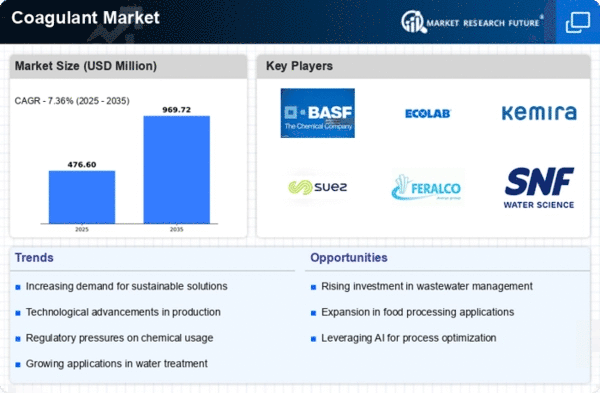
As per MRFR analysis, the Coagulant Market Size was estimated at 443.93 USD Million in 2024. The Coagulant industry is projected to grow from 476.61 in 2025 to 969.72 by 2035, exhibiting a compound annual growth rate (CAGR) of 7.36 during the forecast period 2025 - 2035.

Key Market Trends & Highlights

The Coagulant Market is experiencing a dynamic shift driven by sustainability and technological advancements.

  • The North American region remains the largest market for coagulants, primarily due to its extensive water treatment infrastructure.
  • Asia-Pacific is identified as the fastest-growing region, fueled by increasing urbanization and industrialization.
  • In terms of segments, water treatment dominates the market, while wastewater treatment is emerging as the fastest-growing segment.
  • Rising water treatment needs and regulatory compliance pressure are key drivers propelling market growth.

Market Size & Forecast

2024 Market Size 443.93 (USD Million)
2035 Market Size 969.72 (USD Million)
CAGR (2025 - 2035) 7.36%
Largest Regional Market Share in 2024 North America

Major Players

<p>BASF SE (DE), Ecolab Inc. (US), Kemira Oyj (FI), Suez Water Technologies & Solutions (US), Feralco Group (SE), SNF Floerger (FR), Solvay S.A. (BE), Tessenderlo Group (BE), Aditya Birla Chemicals (IN)</p>

Market Trends

The Coagulant Market is currently experiencing a dynamic phase characterized by evolving consumer preferences and regulatory frameworks. The increasing demand for water treatment solutions, driven by urbanization and industrial growth, appears to be a primary catalyst for market expansion. Furthermore, the rising awareness regarding environmental sustainability is prompting industries to adopt more efficient coagulant solutions. This shift not only enhances operational efficiency but also aligns with global sustainability goals, indicating a potential for innovation in product development. In addition, the Coagulant Market is witnessing a trend towards the use of bio-based coagulants, which may offer a more environmentally friendly alternative to traditional chemical coagulants. This transition reflects a broader movement within various sectors to reduce reliance on synthetic chemicals. As industries continue to prioritize eco-friendly practices, the demand for natural coagulants is likely to grow, suggesting a transformative shift in market dynamics. Overall, the Coagulant Market is poised for significant evolution, driven by technological advancements and changing consumer expectations.

Sustainability Focus

The Coagulant Market is increasingly influenced by a focus on sustainability. Industries are seeking eco-friendly alternatives to traditional coagulants, which may lead to a rise in the adoption of bio-based options. This trend reflects a broader commitment to reducing environmental impact and aligns with global sustainability initiatives.

Technological Advancements

Innovations in coagulant formulations and application methods are shaping the Coagulant Market. Enhanced efficiency and effectiveness of new products are likely to attract industries looking for improved performance in water treatment processes. This trend suggests a continuous evolution in product offerings.

Regulatory Influences

The Coagulant Market is also affected by changing regulatory landscapes. Stricter environmental regulations may drive industries to adopt safer and more compliant coagulant solutions. This trend indicates a potential shift in market dynamics as companies adapt to meet new standards.

Coagulant Market Market Drivers

Rising Industrial Applications

The Global Coagulant Market Industry is witnessing a surge in demand from various industrial sectors, including food and beverage, pharmaceuticals, and paper manufacturing. These industries require effective coagulants to ensure product quality and compliance with health standards. The increasing focus on process optimization and waste reduction is driving the adoption of coagulants in these sectors. As industries expand and evolve, the need for reliable coagulants is expected to grow, contributing to the overall market expansion. This trend underscores the versatility of coagulants in meeting diverse industrial needs, further solidifying their market presence.

Increasing Water Treatment Needs

The Global Coagulant Market Industry is experiencing growth driven by the rising demand for water treatment solutions. As urbanization accelerates, the need for clean water becomes paramount. In 2024, the market is valued at approximately 6.04 USD Billion, reflecting the urgency for effective coagulants in municipal and industrial water treatment processes. Governments worldwide are investing in infrastructure to enhance water quality, which further propels the demand for coagulants. This trend is expected to continue, as the global population increases and water scarcity issues become more pressing, thereby solidifying the coagulant's role in ensuring safe drinking water.

Growing Awareness of Water Quality Issues

The Global Coagulant Market Industry is benefiting from heightened awareness regarding water quality and its implications for health and the environment. Public concern over contaminants in drinking water has led to increased scrutiny of water treatment processes. As consumers demand higher quality standards, municipalities and industries are compelled to invest in effective coagulants to ensure compliance and public safety. This growing awareness is likely to drive market growth, as stakeholders recognize the importance of coagulants in achieving safe and clean water. The trend indicates a proactive approach to water management, which is essential for sustainable development.

Regulatory Compliance and Environmental Standards

The Global Coagulant Market Industry is significantly influenced by stringent regulatory frameworks aimed at improving water quality and environmental protection. Governments are enforcing regulations that mandate the use of effective coagulants in various applications, including wastewater treatment. This regulatory push not only ensures compliance but also enhances public health outcomes. As industries strive to meet these standards, the demand for coagulants is likely to rise. The anticipated growth trajectory suggests that the market could reach 13.8 USD Billion by 2035, driven by the need for compliance with evolving environmental regulations.

Technological Advancements in Coagulation Processes

Innovations in coagulation technologies are reshaping the Global Coagulant Market Industry. Advances in chemical formulations and application techniques are enhancing the efficiency of coagulants in various sectors, including municipal water treatment and industrial processes. These technological improvements not only optimize performance but also reduce costs, making coagulants more accessible to a broader range of applications. As a result, the market is poised for growth, with a projected CAGR of 7.78% from 2025 to 2035. This trend indicates a shift towards more sustainable and efficient coagulation methods, aligning with global sustainability goals.

Market Segment Insights

By Application: Water Treatment (Largest) vs. Wastewater Treatment (Fastest-Growing)

<p>The Coagulant Market is significantly influenced by its application segments, with Water Treatment holding the largest share. This segment dominates the market due to its essential role in providing safe and clean drinking water. Wastewater Treatment follows closely, steadily gaining traction as regulations around water quality tighten and industries aim for sustainable practices. Other applications, such as Food and Beverage Processing and Pulp and Paper, contribute smaller shares but are essential for specific markets and processes.</p>

<p>Water Treatment (Dominant) vs. Wastewater Treatment (Emerging)</p>

<p>Water Treatment remains a dominant force in the Coagulant Market due to its critical function in ensuring potable water supplies and meeting health standards. This segment leverages various coagulants to effectively remove impurities from water. In contrast, Wastewater Treatment is an emerging segment fueled by increased environmental awareness and regulatory pressures. This application focuses on treating effluent before harmless discharge or reclaiming water for reuse, driving growth in coagulant innovations tailored for different wastewater characteristics. Both segments are vital, with Water Treatment leading and Wastewater Treatment poised for rapid expansion.</p>

By Type: Alum (Largest) vs. Ferric Chloride (Fastest-Growing)

<p>In the Coagulant Market, Alum emerges as the dominant player, commanding the largest share among various coagulants used in water treatment processes. Its popularity is attributed to its effectiveness, cost-efficiency, and widespread industrial usage. Ferric Chloride, on the other hand, is gaining traction due to its superior coagulation properties and the increasing demand for wastewater treatment solutions, marking it as a significant contender in terms of market share growth. The growth trends for these coagulants are fueled by stringent environmental regulations and the rising need for clean water in both residential and industrial sectors. Ferric Chloride is particularly benefitting from its applicability in treating high turbidity water and its ability to reduce overall waste generation. Both segments are adapting to technological advancements, which will further drive their market growth and applications in the next decade.</p>

<p>Alum (Dominant) vs. Ferric Chloride (Emerging)</p>

<p>Alum, or aluminum sulfate, has long held its position as the dominant coagulant in municipal and industrial water treatment. Known for its cost-effectiveness and reliability, Alum is particularly effective in sedimentation processes, making it a staple in drinking water treatment facilities. Furthermore, its versatility allows for varied usage, including in papermaking and food processing. Ferric Chloride, recognized as an emerging coagulant, is rapidly gaining traction, especially in the field of sewage treatment and industrial applications. Its powerful coagulation capabilities allow for the effective removal of particulate matter and phosphorous, aligning with contemporary environmental standards. As water treatment demands evolve, both Alum and Ferric Chloride are adapting to meet user needs and regulatory requirements.</p>

By End Use: Municipal (Largest) vs. Industrial (Fastest-Growing)

<p>In the Coagulant Market, the distribution of market share across various end-use segments reveals significant insights. The Municipal sector holds the largest share, primarily driven by the increasing demand for water treatment solutions and strict regulatory requirements surrounding potable water quality. Following closely, the Industrial segment showcases substantial market presence as it is employed across various applications including wastewater treatment, food processing, and manufacturing processes that require chemical treatments.</p>

<p>Municipal (Dominant) vs. Industrial (Emerging)</p>

<p>The Municipal segment is dominant within the Coagulant Market, characterized by its extensive application in water purification and wastewater treatment facilities. The increasing focus on sustainable water management practices has solidified its leading position. In contrast, the Industrial segment is emerging rapidly, fueled by the growing industrialization and the need for efficient wastewater management solutions. As industries evolve and environmental regulations tighten, the demand for high-performance coagulants in sectors like chemical manufacturing and food processing is set to boost this segment significantly.</p>

By Form: Liquid (Largest) vs. Powder (Fastest-Growing)

<p>The Coagulant Market demonstrates a diverse segmentation in terms of form, with liquid coagulants leading the market in terms of overall share. This dominance is attributed to their ease of use and the convenience they offer in various applications, ranging from water treatment to industrial processes. In contrast, powder coagulants, while currently smaller in market share, are showing rapid growth due to their effectiveness and lower transportation costs. Market trends indicate a favorable shift towards powdered forms, especially in emerging markets with increased industrial activities. Growth drivers for the form segment include advancing water treatment technologies and rising environmental regulations demanding efficient water management solutions. As industries seek to optimize processes and reduce costs, the demand for powdered coagulants is likely to accelerate. Additionally, innovations in product formulations are enabling better performance, enhancing the appeal of both liquid and powdered forms, thereby broadening their application scope across various sectors globally.</p>

<p>Liquid (Dominant) vs. Powder (Emerging)</p>

<p>Liquid coagulants are currently the dominant force in the Coagulant Market due to their versatility and high effectiveness in various applications. They are preferred in areas where immediate dissolution is essential, such as in wastewater treatment facilities. On the other hand, powder coagulants are emerging as a valuable alternative, particularly in settings where storage and cost-efficiency are prioritized. These powders can offer a longer shelf life and are often more environmentally friendly, aligning with the sustainable practices industries are increasingly adopting. As environmental concerns rise and regulations tighten, the shift toward powdered formulations could disrupt market dynamics, prompting products that combine effectiveness with eco-friendliness.</p>

By Functionality: Flocculation (Largest) vs. Sedimentation (Fastest-Growing)

<p>In the Coagulant Market, flocculation currently holds the largest share, being a crucial process in water treatment and industrial applications. It involves the aggregation of particles to form larger clusters, enhancing the efficiency of subsequent treatment stages. Sedimentation, while smaller in market share, is recognized as the fastest-growing segment, driven by increasing demand for efficient water treatment methods and burgeoning industries requiring clear effluents.</p>

<p>Flocculation (Dominant) vs. Sedimentation (Emerging)</p>

<p>Flocculation plays a dominant role due to its effectiveness in various sectors such as municipal water treatment and industrial processes. Its ability to enhance particle removal rates makes it indispensable for ensuring water quality. On the other hand, sedimentation is emerging rapidly as a viable solution in the marketplace. Its straightforward implementation and cost-effectiveness in separating suspended solids from liquids are appealing, especially with the rising global emphasis on sustainable water management practices. As a result, both flocculation and sedimentation are expected to maintain significant relevance in future market dynamics.</p>

Get more detailed insights about Coagulant Market Research Report - Forecast till 2035

Regional Insights

North America : Market Leader in Coagulants

North America is poised to maintain its leadership in the coagulant market, holding a significant share of 221.97 million in 2024. The region's growth is driven by increasing demand for water treatment solutions, stringent environmental regulations, and advancements in technology. The focus on sustainable practices and the need for efficient wastewater management are key catalysts for market expansion. The United States and Canada are the leading countries in this region, with major players like Ecolab Inc. and Suez Water Technologies & Solutions driving innovation and competition. The presence of established companies ensures a robust supply chain and a diverse range of coagulant products, catering to various industrial needs. The competitive landscape is characterized by strategic partnerships and investments in R&D to enhance product offerings.

Europe : Emerging Market Dynamics

Europe's coagulant market is experiencing significant growth, with a market size of 120.0 million. The increasing focus on water quality and safety regulations, along with the rising demand for efficient wastewater treatment solutions, are key drivers of this growth. The European Union's stringent environmental policies are catalyzing investments in advanced coagulant technologies, fostering innovation in the sector. Leading countries such as Germany, France, and the UK are at the forefront of this market, with key players like BASF SE and Solvay S.A. actively participating. The competitive landscape is marked by a mix of established firms and emerging companies, all striving to meet the evolving regulatory standards and customer demands. The region's commitment to sustainability and resource management further enhances its market potential.

Asia-Pacific : Rapid Growth and Innovation

The Asia-Pacific region is witnessing rapid growth in the coagulant market, with a size of 85.0 million. This growth is fueled by urbanization, industrialization, and increasing investments in water treatment infrastructure. Governments are implementing policies to improve water quality, which is driving demand for coagulants in various applications, including municipal and industrial wastewater treatment. Countries like China, India, and Japan are leading the market, with significant contributions from companies such as Kemira Oyj and Aditya Birla Chemicals. The competitive landscape is evolving, with both local and international players vying for market share. The focus on innovation and sustainable practices is shaping the future of the coagulant market in this region, ensuring a steady growth trajectory.

Middle East and Africa : Emerging Market Opportunities

The Middle East and Africa region is emerging as a potential market for coagulants, with a market size of 16.96 million. The growth is driven by increasing water scarcity issues and the need for effective water treatment solutions. Governments are prioritizing investments in water infrastructure, which is expected to boost the demand for coagulants in the coming years. Countries like South Africa and the UAE are leading the charge, with a growing number of local and international players entering the market. The competitive landscape is characterized by a mix of established companies and new entrants, all aiming to address the region's unique water challenges. The focus on sustainable water management practices is likely to shape the future of the coagulant market in this region.

Key Players and Competitive Insights

The Coagulant Market is characterized by a dynamic competitive landscape, driven by increasing demand for water treatment solutions and stringent environmental regulations. Key players such as BASF SE (DE), Ecolab Inc. (US), and Kemira Oyj (FI) are strategically positioned to leverage innovation and sustainability in their operations. BASF SE (DE) focuses on developing advanced coagulants that enhance water purification processes, while Ecolab Inc. (US) emphasizes digital transformation to optimize water management solutions. Kemira Oyj (FI) is actively pursuing partnerships to expand its product offerings, thereby enhancing its competitive edge in the market.

The market structure appears moderately fragmented, with a mix of large multinational corporations and regional players. Key business tactics include localizing manufacturing to reduce costs and optimize supply chains, which is crucial in maintaining competitive pricing. The collective influence of these major players shapes the market dynamics, as they continuously adapt to evolving customer needs and regulatory requirements.

In November 2025, Ecolab Inc. (US) announced a strategic partnership with a leading technology firm to integrate AI-driven analytics into its water treatment solutions. This move is likely to enhance operational efficiency and provide customers with real-time insights, thereby solidifying Ecolab's position as a leader in innovative water management solutions. The integration of AI could potentially revolutionize how coagulants are utilized in various applications, leading to improved performance and sustainability.

In October 2025, Kemira Oyj (FI) launched a new line of bio-based coagulants aimed at reducing environmental impact. This initiative aligns with global sustainability trends and positions Kemira as a forward-thinking player in the market. The introduction of bio-based products may attract environmentally conscious customers and enhance the company's reputation in the industry.

In September 2025, SNF Floerger (FR) expanded its production capacity in response to growing demand for coagulants in emerging markets. This expansion is indicative of SNF's commitment to meeting customer needs and enhancing its market share. By increasing production capabilities, SNF is likely to improve its supply chain reliability and responsiveness to market fluctuations.

As of December 2025, the Coagulant Market is witnessing trends such as digitalization, sustainability, and AI integration, which are reshaping competitive dynamics. Strategic alliances among key players are becoming increasingly common, fostering innovation and enhancing product offerings. The shift from price-based competition to a focus on technology, innovation, and supply chain reliability is evident, suggesting that companies will need to differentiate themselves through advanced solutions and sustainable practices to thrive in this evolving landscape.

Key Companies in the Coagulant Market market include

Industry Developments

Future Outlook

Coagulant Market Future Outlook

<p>The Coagulant Market is projected to grow at a 7.36% CAGR from 2024 to 2035, driven by increasing water treatment needs and industrial applications.</p>

New opportunities lie in:

  • <p>Development of eco-friendly coagulants for sustainable practices.</p>
  • <p>Expansion into emerging markets with tailored product offerings.</p>
  • <p>Integration of smart technology in coagulant dosing systems.</p>

<p>By 2035, the Coagulant Market is expected to achieve robust growth, reflecting evolving industry demands.</p>

Market Segmentation

Coagulant Market Form Outlook

  • Liquid
  • Powder
  • Granular
  • Tablet

Coagulant Market Type Outlook

  • Alum
  • Ferric Chloride
  • Polymeric Coagulants
  • Calcium Carbonate
  • Sodium Aluminate

Coagulant Market End Use Outlook

  • Municipal
  • Industrial
  • Agricultural
  • Pharmaceutical
  • Chemical

Coagulant Market Application Outlook

  • Water Treatment
  • Wastewater Treatment
  • Food and Beverage Processing
  • Pulp and Paper
  • Mining

Coagulant Market Functionality Outlook

  • Flocculation
  • Sedimentation
  • Clarification
  • Dehydration

Report Scope

MARKET SIZE 2024443.93(USD Million)
MARKET SIZE 2025476.61(USD Million)
MARKET SIZE 2035969.72(USD Million)
COMPOUND ANNUAL GROWTH RATE (CAGR)7.36% (2024 - 2035)
REPORT COVERAGERevenue Forecast, Competitive Landscape, Growth Factors, and Trends
BASE YEAR2024
Market Forecast Period2025 - 2035
Historical Data2019 - 2024
Market Forecast UnitsUSD Million
Key Companies ProfiledBASF SE (DE), Ecolab Inc. (US), Kemira Oyj (FI), Suez Water Technologies & Solutions (US), Feralco Group (SE), SNF Floerger (FR), Solvay S.A. (BE), Tessenderlo Group (BE), Aditya Birla Chemicals (IN)
Segments CoveredApplication, Type, End Use, Form, Functionality
Key Market OpportunitiesAdoption of advanced coagulants driven by stringent environmental regulations and increasing water treatment demands.
Key Market DynamicsRising demand for sustainable water treatment solutions drives innovation in coagulant formulations and applications.
Countries CoveredNorth America, Europe, APAC, South America, MEA

FAQs

What is the study period of this market?

The study period of the global coagulant market is 2025 - 2035

What is the growth rate of the global coagulant market?

The global coagulant market is growing at a CAGR of ~6.41% over the next ten years

Which region has the highest growth rate in the global coagulant market?

North America is expected to register the highest CAGR during 2025 - 2035

Which region has the largest share in the global coagulant market?

Asia-acific held the largest share in 2021

Who are the key players in the global coagulant market?

BASF, Mitsubishi Chemical Holding Company, Feralco, Ecolab, and SNF Group are the major companies operating in the global coagulant market.

  1. EXECUTIVE SUMMARY
    1. MARKET ATTRACTIVENESS ANALYSIS 21
  2. GLOBAL COAGULANT MARKET, BY TYPE 22
  3. GLOBAL COAGULANT MARKET, BY END USE
  4. MARKET INTRODUCTION
    1. DEFINITION 24
    2. SCOPE OF THE STUDY
    3. MARKET STRUCTURE 25
  5. RESEARCH METHODOLOGY
    1. RESEARCH PROCESS
    2. PRIMARY RESEARCH 27
    3. SECONDARY RESEARCH 28
    4. MARKET SIZE
    5. ESTIMATION 28
    6. TOP-DOWN & BOTTOM-UP APPROACH 29
    7. FORECAST MODEL
    8. LIST OF ASSUMPTIONS 31
  6. MARKET DYNAMICS
    1. INTRODUCTION
    2. DRIVERS 33
      1. INCREASING DEMAND FOR CHEMICALLY TREATED WATER
      2. STRICT REGULATORY FRAMEWORK FOR WASTEWATER TREATMENT,
      3. DRIVERS IMPACT ANALYSIS 35
    3. IN VARIOUS SECTORS 33
    4. DISPOSAL, AND REUSE 33
    5. RESTRAINT
      1. HAZARDS ASSOCIATED WITH INORGANIC COAGULANTS 35
    6. OPPORTUNITIES
      1. GROWING POPULATION AND RAPID URBANIZATION ACROSS THE GLOBE 36
    7. DEVELOPMENT OF SPECIFIC FORMULATIONS 37
    8. CHALLENGES 37
      1. SLUDGE
    9. TREATMENT & DISPOSAL CHALLENGES 37
  7. MARKET FACTOR ANALYSIS
    1. SUPPLY
      1. RAW MATERIAL SUPPLIERS 39
      2. PRODUCERS 39
      3. DISTRIBUTION CHANNEL 39
      4. END-USE INDUSTRY 39
    2. CHAIN ANALYSIS 38
    3. PORTER’S
      1. THREAT OF NEW ENTRANTS 40
      2. INTENSITY OF
      3. THREAT OF SUBSTITUTES 41
      4. BARGAINING POWER OF SUPPLIERS
      5. BARGAINING POWER OF BUYERS 41
    4. FIVE FORCES MODEL 40
    5. RIVALRY 41
    6. GLOBAL COAGULANT PRICING ANALYSIS
    7. MARKET LINEAGE OUTLOOK 42
      1. GLOBAL WATER TREATMENT CHEMICALS
    8. MARKET 42
    9. ORGANIC COAGULANT VS INORGANIC COAGULANT 43
    10. RAW MATERIAL
      1. ORGANICS COAGULANTS 43
      2. INORGANIC COAGULANTS 44
    11. ANALYSIS 43
    12. FERRIC CHLORIDE 45
    13. TECHNOLOGY OVERVIEW 46
    14. REGULATORY FRAMEWORK 47
      1. COAGULANTS SPECIFIC REGULATIONS 47
      2. OTHER WATER RELATED DIRECTIVES BY EUROPEAN COMMISSION
    15. EUROPEAN COMMISSION: SEWAGE SLUDGE DIRECTIVE (86/278/EEC) 47
    16. COMMISSION: DRINKING WATER DIRECTIVE (98/83/EC) 48
    17. AND IRON SALTS CONSORTIUM 48
    18. (CLP) OF SUBSTANCES AND MIXTURES (EC 1272/2008) 48
    19. FOR STANDARDISATION (CEN) 48
    20. REMOVAL REGULATION 48
    21. DIRECTIVE 49
    22. DIRECTIVE 49
  8. GLOBAL COAGULANT MARKET, BY TYPE
    1. INTRODUCTION 51
    2. INORGANIC
    3. ORGANIC 55
    4. ORGANIC & INORGANIC BLEND 57
  9. GLOBAL COAGULANT
  10. MARKET, BY END-USE
    1. INTRODUCTION 59
    2. WATER & WASTEWATER TREATMENT
    3. AGRICULTURE 63
    4. OIL & GAS 64
    5. PULP AND PAPER 65
    6. OTHERS 66
  11. GLOBAL COAGULANT MARKET, BY REGION
    1. INTRODUCTION
    2. NORTH AMERICA 73
      1. US 77
      2. CANADA 81
    3. EUROPE
      1. GERMANY 90
      2. UK 94
      3. RUSSIA 98
      4. ITALY
      5. FRANCE 106
      6. REST OF EUROPE 110
    4. ASIA-PACIFIC 115
      1. CHINA 119
      2. JAPAN 123
      3. INDIA 127
      4. SOUTH KOREA
      5. REST OF ASIA-PACIFIC 135
    5. LATIN AMERICA 140
      1. BRAZIL
      2. MEXICO 148
      3. ARGENTINA 152
      4. REST OF LATIN AMERICA
    6. THE MIDDLE EAST AND AFRICA 161
      1. GCC 165
      2. SOUTH
      3. REST OF THE MIDDLE EAST AND AFRICA 173
    7. AFRICA 169
  12. COMPETITIVE
    1. LANDSCAPE
    2. INTRODUCTION 178
    3. GLOBAL MARKET SHARE BY MANUFACTURERS,
    4. GLOBAL MARKET STRATEGY ANALYSIS 178
    5. KEY DEVELOPMENTS
    6. VENDOR LANDSCAPE 180
      1. LIST OF RAW MATERIAL SUPPLIERS 180
      2. LIST OF MANUFACTURERS (PUBLIC/PRIVATE) 181
      3. LIST OF SUPPLIERS/DISTRIBUTORS
      4. LIST OF END USERS (CONSUMERS) 182
  13. COMPANY PROFILES
    1. KEMIRA 184
    2. ANALYSIS 187
    3. FINANCIAL OVERVIEW 188
    4. KEY DEVELOPMENTS 192
    5. COMPANY OVERVIEW 193
    6. INC. 196
    7. ANALYSIS 198
    8. KEY DEVELOPMENTS 200
    9. COMPANY OVERVIEW 201
    10. WATER TREATMENT 204
    11. SWOT ANALYSIS 205
    12. FINANCIAL OVERVIEW 206
    13. KEY DEVELOPMENTS 209
    14. PRODUCTS OFFERED 211
    15. OVERVIEW 213
  14. COMPANY OVERVIEW 184
  15. FINANCIAL OVERVIEW 185
  16. PRODUCTS OFFERED 186
  17. KEY DEVELOPMENTS 186
  18. SWOT
    1. SNF GROUP 188
      1. COMPANY OVERVIEW 188
      2. PRODUCTS OFFERED 189
      3. KEY DEVELOPMENTS
      4. SWOT ANALYSIS 190
    2. SOLENIS 191
      1. COMPANY OVERVIEW
      2. FINANCIAL OVERVIEW 191
      3. PRODUCTS OFFERED 191
      4. SWOT ANALYSIS 192
    3. BASF SE 193
      1. FINANCIAL OVERVIEW 194
      2. PRODUCTS OFFERED
      3. KEY DEVELOPMENTS 195
      4. SWOT ANALYSIS 195
    4. CHEMTREAT,
      1. COMPANY OVERVIEW 196
      2. FINANCIAL OVERVIEW 196
      3. PRODUCTS OFFERED 197
      4. KEY DEVELOPMENTS 197
      5. SWOT
    5. AVISTA TECHNOLOGIES INC. 199
      1. COMPANY OVERVIEW
      2. FINANCIAL OVERVIEW* 199
      3. PRODUCTS OFFERED 200
      4. SWOT ANALYSIS 200
    6. ECOLAB 201
      1. FINANCIAL OVERVIEW 202
      2. PRODUCTS OFFERED
      3. KEY DEVELOPMENTS 203
      4. SWOT ANALYSIS 203
    7. ACCEPTA
      1. COMPANY OVERVIEW 204
      2. FINANCIAL OVERVIEW
      3. PRODUCTS OFFERED 204
      4. KEY DEVELOPMENTS 204
    8. BUCKMAN 206
      1. COMPANY OVERVIEW 206
      2. PRODUCTS OFFERED 206
      3. KEY DEVELOPMENTS
      4. SWOT ANALYSIS 207
    9. SUEZ 208
      1. COMPANY OVERVIEW
      2. FINANCIAL OVERVIEW 208
      3. PRODUCTS OFFERED 209
      4. SWOT ANALYSIS 210
    10. FERALCO AB 211
      1. COMPANY OVERVIEW 211
      2. FINANCIAL OVERVIEW 211
      3. KEY DEVELOPMENTS 211
      4. SWOT ANALYSIS
    11. MITSUBISHI CHEMICAL HOLDING CORPORATION 213
      1. COMPANY
      2. FINANCIAL OVERVIEW 213
      3. PRODUCTS OFFERED 214
      4. KEY DEVELOPMENTS 214
      5. SWOT ANALYSIS 214
  19. APPENDIX
    1. REFERENCES 215
    2. RELATED REPORTS 215

Coagulant Market Segmentation

Market Segmentation Overview

  • Detailed segmentation data will be available in the full report
  • Comprehensive analysis by multiple parameters
  • Regional and country-level breakdowns
  • Market size forecasts by segment
Infographic

Free Sample Request

Kindly complete the form below to receive a free sample of this Report

Get Free Sample

Customer Strories

Compare Licence

×
Features License Type
Single User Multiuser License Enterprise User
Price $4,950 $5,950 $7,250
Maximum User Access Limit 1 User Upto 10 Users Unrestricted Access Throughout the Organization
Free Customization
Direct Access to Analyst
Deliverable Format
Platform Access
Discount on Next Purchase 10% 15% 15%
Printable Versions