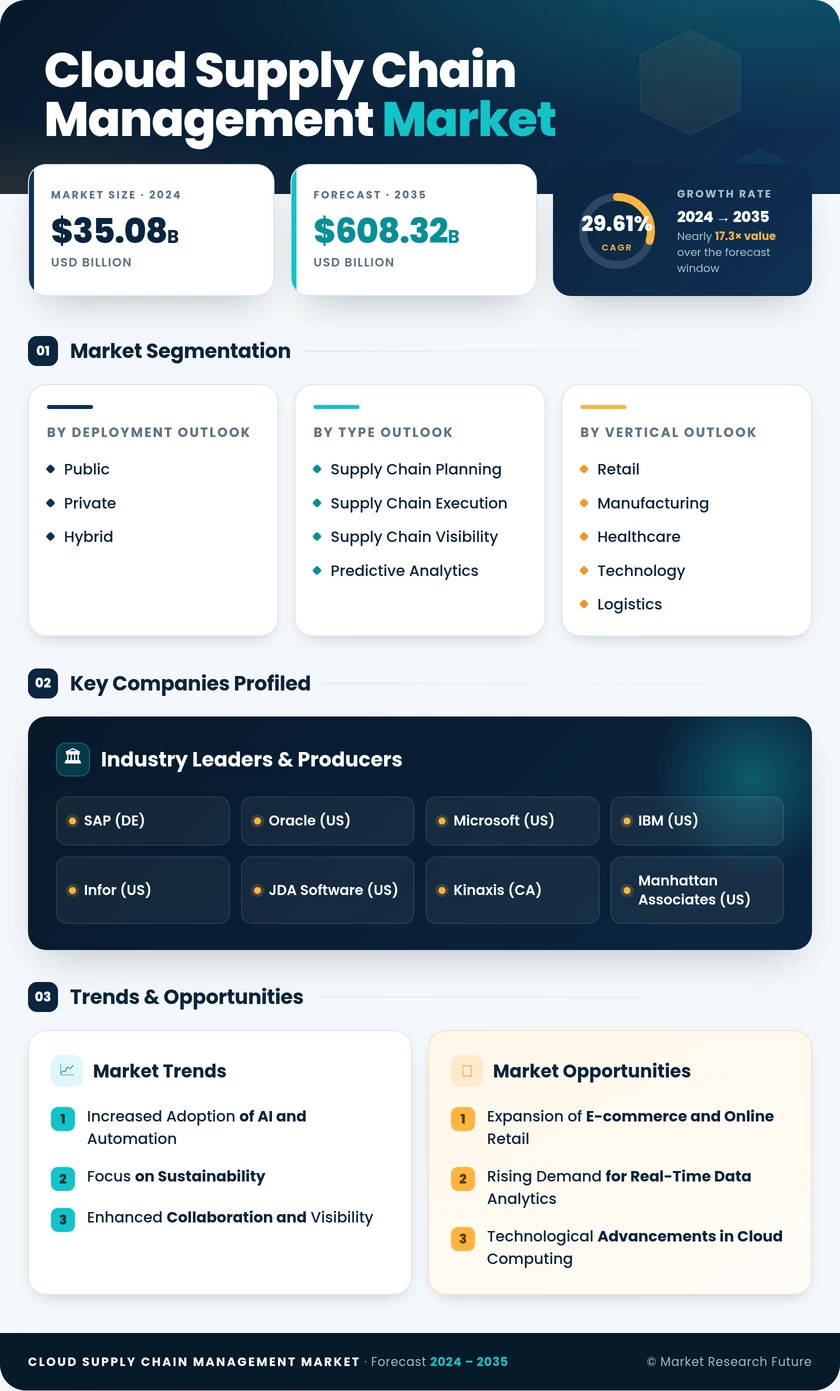
Cloud Supply Chain Management Market (2026 – 2035)

ID: MRFR/ICT/28185-HCR 100 Pages Nirmit Biswas Last Updated: September 17, 2026
Cloud Supply Chain Management Market Size, Share and Research Report By Solution (Transportation and Logistics Management, Demand Planning and Forecasting, Procurement and Sourcing, Warehouse and Inventory Management, Digital Twin-Enabled Planning, and Order Management and Returns), By Deployment Type (Public Cloud, Hybrid Cloud, and Private Cloud), By Organization Size (Large Enterprises and Small and Medium Enterprises), By End-User Industry (Retail, Food and Beverage, Healthcare and Pharma, Manufacturing, and Automotive), And By Region (North America, Europe, Asia-Pacific, And Rest Of The World) – Industry Forecast Till 2035
Cloud Supply Chain Management Market
Market Size
Forecast Period2026-2035
CAGR (2026-2035)15.5%
2025 Market SizeUSD 12.85 Billion
2035 Market SizeUSD 54.28 Billion
Key Players
SAP SE
Oracle Corporation
Blue Yonder
Kinaxis
Manhattan Associates
E2open
Opportunities
  • Autonomous Supply Chain Control Towers
  • Emerging-Market Leapfrog Adoption
  • Embedded Supply Chain Finance
  1. 1 Market Overview |
    1. 1.1 Study Assumptions & Market Definition |
    2. 1.2 Scope of the Study |
    3. 1.3 Research Methodology
  2. 2 Market Summary & Key Takeaways
  3. 3 Market Dynamics |
    1. 3.1 Market Drivers Analysis | |
      1. 3.1.1 SaaS Migration from On-Premise ERP | |
      2. 3.1.2 AI and ML Demand Forecasting | |
      3. 3.1.3 E-Commerce Fulfillment Complexity | |
      4. 3.1.4 ESG and Carbon-Accounting Mandates | |
      5. 3.1.5 Digital Twin and Simulation Planning | |
      6. 3.1.6 SME Subscription-Model Adoption | |
      7. 3.1.7 Cold-Chain and Pharma Traceability Regulations |
    2. 3.2 Market Restraints Analysis | |
      1. 3.2.1 Integration Complexity with Legacy OT Systems | |
      2. 3.2.2 Data Sovereignty and Cross-Border Compliance | |
      3. 3.2.3 Cybersecurity and Ransomware Risk | |
      4. 3.2.4 Vendor Lock-In Concerns | |
      5. 3.2.5 Skilled Talent Shortage in Cloud SCM |
    3. 3.3 Market Opportunity Analysis | |
      1. 3.3.1 Autonomous Supply Chain Control Towers | |
      2. 3.3.2 Emerging-Market Leapfrog Adoption | |
      3. 3.3.3 Embedded Supply Chain Finance | |
      4. 3.3.4 Sustainability-as-a-Service Modules | |
      5. 3.3.5 Healthcare and Pharma Cold-Chain Digitization |
    4. 3.4 Industry Value Chain Analysis |
    5. 3.5 Porter's Five Forces Analysis
  4. 4 Global Cloud Supply Chain Management Market Size & Forecast (2021–2035) |
    1. 4.1 Historical Market Size (2021–2025) |
    2. 4.2 Current & Forecast Market Size (2026–2035) |
    3. 4.3 Market Size by Revenue (USD Billion) |
    4. 4.4 Year-over-Year Growth Analysis
  5. 5 Segmentation Analysis |
    1. 5.1 By Solution | |
      1. 5.1.1 Transportation and Logistics Management | |
      2. 5.1.2 Demand Planning and Forecasting | |
      3. 5.1.3 Procurement and Sourcing | |
      4. 5.1.4 Warehouse and Inventory Management | |
      5. 5.1.5 Digital Twin-Enabled Planning | |
      6. 5.1.6 Order Management and Returns |
    2. 5.2 By Deployment Type | |
      1. 5.2.1 Public Cloud | |
      2. 5.2.2 Hybrid Cloud | |
      3. 5.2.3 Private Cloud |
    3. 5.3 By Organization Size | |
      1. 5.3.1 Large Enterprises | |
      2. 5.3.2 Small and Medium Enterprises |
    4. 5.4 By End-User Industry | |
      1. 5.4.1 Retail | |
      2. 5.4.2 Food and Beverage | |
      3. 5.4.3 Healthcare and Pharma | |
      4. 5.4.4 Manufacturing | |
      5. 5.4.5 Automotive
  6. 6 Regional Analysis |
    1. 6.1 North America | |
      1. 6.1.1 United States | |
      2. 6.1.2 Canada | |
      3. 6.1.3 Mexico |
    2. 6.2 Europe | |
      1. 6.2.1 Germany | |
      2. 6.2.2 United Kingdom | |
      3. 6.2.3 France | |
      4. 6.2.4 Italy | |
      5. 6.2.5 Spain | |
      6. 6.2.6 Nordic Countries | |
      7. 6.2.7 Russia | |
      8. 6.2.8 Rest of Europe |
    3. 6.3 Asia-Pacific | |
      1. 6.3.1 China | |
      2. 6.3.2 India | |
      3. 6.3.3 Japan | |
      4. 6.3.4 South Korea | |
      5. 6.3.5 ASEAN | |
      6. 6.3.6 Rest of Asia-Pacific |
    4. 6.4 South America | |
      1. 6.4.1 Brazil | |
      2. 6.4.2 Argentina | |
      3. 6.4.3 Rest of South America |
    5. 6.5 Middle East & Africa | |
      1. 6.5.1 Saudi Arabia | |
      2. 6.5.2 UAE | |
      3. 6.5.3 South Africa | |
      4. 6.5.4 Egypt | |
      5. 6.5.5 Rest of MEA
  7. 7 Competitive Landscape |
    1. 7.1 Market Share Analysis (2025) |
    2. 7.2 Competitive Benchmarking Matrix |
    3. 7.3 Company Profiles | |
      1. 7.3.1 SAP SE | |
      2. 7.3.2 Oracle Corporation | |
      3. 7.3.3 Blue Yonder (Panasonic) | |
      4. 7.3.4 Kinaxis | |
      5. 7.3.5 Manhattan Associates | |
      6. 7.3.6 E2open | |
      7. 7.3.7 Coupa Software (Thoma Bravo) | |
      8. 7.3.8 Infor (Koch Industries) | |
      9. 7.3.9 o9 Solutions | |
      10. 7.3.10 Körber AG
  8. 8 Future Outlook & Strategic Recommendations (2026–2035) |
    1. 8.1 Autonomous Planning and Agentic AI |
    2. 8.2 Platform Economics and Ecosystem Lock-In |
    3. 8.3 Sustainability-Linked Supply Chain Orchestration |
    4. 8.4 Edge-Cloud Hybrid Architectures
  9. 9 Recent Developments & News
  10. 10 Frequently Asked Questions (FAQs)
  11. 11 Report Scope & Methodology |
    1. 11.1 Study Period & Base Year |
    2. 11.2 Data Sources & Citations |
    3. 11.3 Abbreviations
  12. 12 LIST OF TABLES |
  13. TABLE 1 Global Cloud Supply Chain Management Market Size & Forecast, by Revenue (USD Billion), 2021–2035 |
  14. TABLE 2 Global Cloud Supply Chain Management Market – Year-over-Year Growth Analysis, 2021–2035 |
  15. TABLE 3 Global Cloud Supply Chain Management Market – Driver Impact Analysis |
  16. TABLE 4 Global Cloud Supply Chain Management Market – Restraints Impact Analysis |
  17. TABLE 5 Global Cloud Supply Chain Management Market Size, by Solution, 2021–2035 (USD Billion) |
  18. TABLE 6 Global Cloud Supply Chain Management Market Size, by Deployment Type, 2021–2035 (USD Billion) |
  19. TABLE 7 Global Cloud Supply Chain Management Market Size, by Organization Size, 2021–2035 (USD Billion) |
  20. TABLE 8 Global Cloud Supply Chain Management Market Size, by End-User Industry, 2021–2035 (USD Billion) |
  21. TABLE 9 Global Cloud Supply Chain Management Market Size, by Region, 2021–2035 (USD Billion) |
  22. TABLE 10 North America Cloud Supply Chain Management Market Size, by Country, 2021–2035 (USD Billion) |
  23. TABLE 11 Europe Cloud Supply Chain Management Market Size, by Country, 2021–2035 (USD Billion) |
  24. TABLE 12 Asia-Pacific Cloud Supply Chain Management Market Size, by Country, 2021–2035 (USD Billion) |
  25. TABLE 13 South America Cloud Supply Chain Management Market Size, by Country, 2021–2035 (USD Billion) |
  26. TABLE 14 Middle East & Africa Cloud Supply Chain Management Market Size, by Country, 2021–2035 (USD Billion) |
  27. TABLE 15 Competitive Benchmarking Matrix – Global Cloud Supply Chain Management Market, 2025 |
  28. TABLE 16 Company Profiles – Key Players, Global Cloud Supply Chain Management Market |
  29. TABLE 17 Recent Developments & Strategic Announcements, 2023–2024 |
  30. TABLE 18 Report Scope & Methodology Summary |
  31. TABLE 19 Detailed Sources and Citations |
  32. TABLE 20 North America Cloud Supply Chain Management Market Size, by Solution, 2021–2035 (USD Billion) |
  33. TABLE 21 North America Cloud Supply Chain Management Market Size, by Deployment Type, 2021–2035 (USD Billion) |
  34. TABLE 22 North America Cloud Supply Chain Management Market Size, by Organization Size, 2021–2035 (USD Billion) |
  35. TABLE 23 North America Cloud Supply Chain Management Market Size, by End-User Industry, 2021–2035 (USD Billion) |
  36. TABLE 24 Europe Cloud Supply Chain Management Market Size, by Solution, 2021–2035 (USD Billion) |
  37. TABLE 25 Europe Cloud Supply Chain Management Market Size, by Deployment Type, 2021–2035 (USD Billion) |
  38. TABLE 26 Europe Cloud Supply Chain Management Market Size, by Organization Size, 2021–2035 (USD Billion) |
  39. TABLE 27 Europe Cloud Supply Chain Management Market Size, by End-User Industry, 2021–2035 (USD Billion) |
  40. TABLE 28 Asia-Pacific Cloud Supply Chain Management Market Size, by Solution, 2021–2035 (USD Billion) |
  41. TABLE 29 Asia-Pacific Cloud Supply Chain Management Market Size, by Deployment Type, 2021–2035 (USD Billion) |
  42. TABLE 30 Asia-Pacific Cloud Supply Chain Management Market Size, by Organization Size, 2021–2035 (USD Billion) |
  43. TABLE 31 Asia-Pacific Cloud Supply Chain Management Market Size, by End-User Industry, 2021–2035 (USD Billion) |
  44. TABLE 32 South America Cloud Supply Chain Management Market Size, by Solution, 2021–2035 (USD Billion) |
  45. TABLE 33 South America Cloud Supply Chain Management Market Size, by Deployment Type, 2021–2035 (USD Billion) |
  46. TABLE 34 South America Cloud Supply Chain Management Market Size, by Organization Size, 2021–2035 (USD Billion) |
  47. TABLE 35 South America Cloud Supply Chain Management Market Size, by End-User Industry, 2021–2035 (USD Billion) |
  48. TABLE 36 Middle East & Africa Cloud Supply Chain Management Market Size, by Solution, 2021–2035 (USD Billion) |
  49. TABLE 37 Middle East & Africa Cloud Supply Chain Management Market Size, by Deployment Type, 2021–2035 (USD Billion) |
  50. TABLE 38 Middle East & Africa Cloud Supply Chain Management Market Size, by Organization Size, 2021–2035 (USD Billion) |
  51. TABLE 39 Middle East & Africa Cloud Supply Chain Management Market Size, by End-User Industry, 2021–2035 (USD Billion)
  52. 13 LIST OF FIGURES |
  53. FIGURE 1 Cloud Supply Chain Management Market Dynamics — Drivers, Restraints, and Opportunities |
  54. FIGURE 2 Industry Value Chain Analysis — Cloud Supply Chain Management Market |
  55. FIGURE 3 Porter's Five Forces Analysis — Cloud Supply Chain Management Market |
  56. FIGURE 4 Global Cloud Supply Chain Management Market Size Trend (USD Billion), 2021–2035 |
  57. FIGURE 5 Cloud Supply Chain Management Market Share, by Solution, 2025 |
  58. FIGURE 6 Cloud Supply Chain Management Market Share, by Deployment Type, 2025 |
  59. FIGURE 7 Cloud Supply Chain Management Market Share, by Organization Size, 2025 |
  60. FIGURE 8 Cloud Supply Chain Management Market Share, by End-User Industry, 2025 |
  61. FIGURE 9 Cloud Supply Chain Management Market Share, by Region, 2025 |
  62. FIGURE 10 North America Cloud Supply Chain Management Market Size (USD Billion), 2021–2035 |
  63. FIGURE 11 Europe Cloud Supply Chain Management Market Size (USD Billion), 2021–2035 |
  64. FIGURE 12 Asia-Pacific Cloud Supply Chain Management Market Size (USD Billion), 2021–2035 |
  65. FIGURE 13 South America Cloud Supply Chain Management Market Size (USD Billion), 2021–2035 |
  66. FIGURE 14 Middle East & Africa Cloud Supply Chain Management Market Size (USD Billion), 2021–2035 |
  67. FIGURE 15 Competitive Landscape — Market Share Distribution, 2025

Segmentation Quick Reference

DimensionSub-SegmentsDominant SegmentFastest Growing Segment
By SolutionTransportation and Logistics Management; Demand Planning and Forecasting; Procurement and Sourcing; Warehouse and Inventory Management; Digital Twin Enabled Planning; Order Management and ReturnsTransportation and Logistics Management (29.2% share, 2025)Digital Twin Enabled Planning (19.5% CAGR)
By Deployment TypePublic Cloud; Hybrid Cloud; Private CloudPublic Cloud (55.7% share, 2025)Hybrid Cloud (17.5% CAGR)
By Organization SizeLarge Enterprises; Small and Medium EnterprisesLarge Enterprises (68.4% share, 2025)Small and Medium Enterprises (21.2% CAGR)
By End-User IndustryRetail; Food and Beverage; Healthcare and Pharma; Manufacturing; AutomotiveRetail (24.7% share, 2025)Healthcare and Pharma (23.3% CAGR)
By RegionNorth America; Europe; Asia-Pacific; South America; Middle East & AfricaNorth America (37.0% share, 2025)Asia-Pacific (19.4% CAGR)


Market Segmentation Overview

By Solution

Sub-SegmentKey Trend
Transportation and Logistics ManagementAI-optimized carrier selection and freight-cost benchmarking
Demand Planning and ForecastingGenerative AI enabling probabilistic demand sensing
Procurement and SourcingMulti-tier supplier risk scoring and automated RFx workflows
Warehouse and Inventory ManagementRobotics-integrated WMS with cloud-native orchestration
Digital Twin Enabled PlanningFull-network simulation for scenario and disruption planning
Order Management and ReturnsComposable OMS supporting omnichannel and reverse logistics


Transportation and Logistics Management captures the largest solution share, reflecting the operational urgency of shipment-level visibility across global trade lanes. Digital Twin Enabled Planning is expanding fastest as enterprises move from reactive firefighting to proactive, simulation-driven decision-making.

By Deployment Type

Sub-SegmentKey Trend
Public CloudMulti-tenant SaaS with rapid provisioning and auto-scaling
Hybrid CloudOn-premise data residency combined with cloud analytics
Private CloudDedicated infrastructure for regulated and defense-sector buyers


Public Cloud remains the default deployment model due to its speed, cost profile, and vendor-managed upgrades. Hybrid Cloud adoption accelerates where data-sovereignty laws or industry regulations restrict the location of sensitive supply chain data.

By Organization Size

Sub-SegmentKey Trend
Large EnterprisesPlatform consolidation and multi-module bundling
Small and Medium EnterprisesPay-per-use subscriptions with pre-configured templates


Large Enterprises dominate spending because their complex, multi-geography operations demand integrated planning across procurement, manufacturing, and logistics. SMEs are the growth engine, leveraging subscription models that reduce implementation risk and upfront capital outlay.

By End-User Industry

Sub-SegmentKey Trend
RetailOmnichannel fulfilment orchestration and demand shaping
Food and BeverageCold-chain integrity monitoring and shelf-life optimization
Healthcare and PharmaSerialization, track-and-trace, and GDP compliance
ManufacturingProduction scheduling and parts-availability optimization
AutomotiveEV battery supply chain tracking and supplier diversification


Retail leads end-user adoption given the sheer scale of SKU management and the competitive pressure around delivery speed. Healthcare and Pharma represent the fastest-growing vertical, propelled by expanding regulatory traceability requirements across major markets.

By Region

Sub-SegmentKey Trend
North AmericaMature SaaS adoption, AI-first vendor ecosystem
EuropeCSRD and sustainability-mandated procurement digitization
Asia-PacificManufacturing digitization and e-commerce logistics
South AmericaAgribusiness export traceability and cloud ERP leapfrogging
Middle East & AfricaSmart logistics corridor investments and oil-and-gas SCM


North America holds the largest regional share, anchored by the world's deepest enterprise software ecosystem. Asia-Pacific is the fastest-growing region as China, India, and ASEAN economies digitize manufacturing and e-commerce supply chains at an accelerating pace.




Download PDF ×

We do not share your information with anyone. However, we may send you emails based on your report interest from time to time. You may contact us at any time to opt-out.