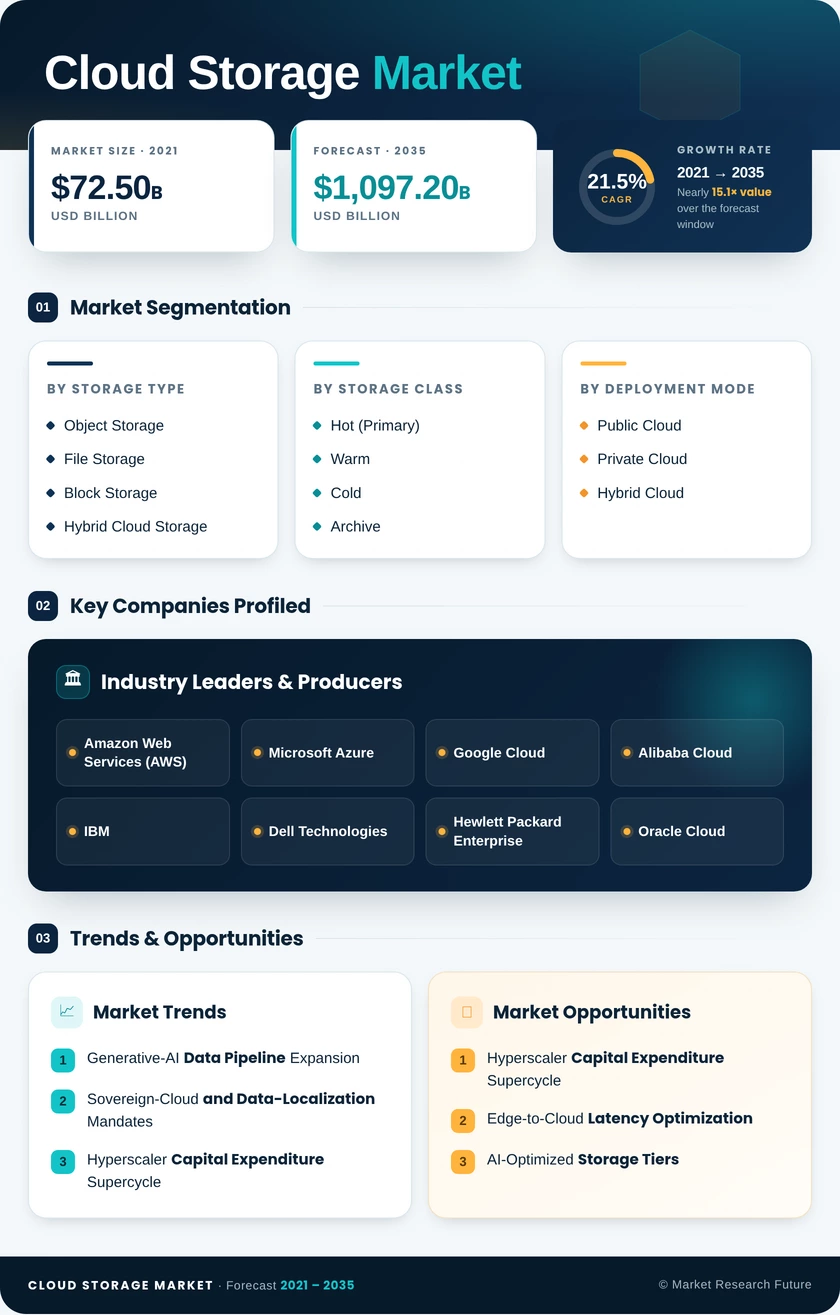
Cloud Storage Market (2026 – 2035)

ID: MRFR/ICT/2210-HCR 100 Pages Apoorva Priyadarshi Last Updated: October 27, 2026
Cloud Storage Market Size, Share and Research Report By Component (Software and Services), By PoS Type (Fixed PoS and Mobile/MPoS), By Deployment Model (Public Cloud, Private Cloud, and Hybrid Cloud), By Organization Size (Small and Medium Enterprises (SMEs) and Large Enterprises), By End-User Industry (Retail and Consumer Goods, Hospitality and Restaurants, Healthcare, Entertainment and Leisure, Transportation and Logistics, and Others), And By Region (North America, Europe, Asia-Pacific, And Rest Of The World) – Industry Forecast Till 2035
Cloud Storage Market
Market Size
Forecast Period2026-2035
CAGR (2026-2035)21.50%
2025 Market SizeUSD 156.5 Billion
2035 Market SizeUSD 1,097.2 Billion
Key Players
Amazon Web Services
Microsoft Azure
Google Cloud
Alibaba Cloud
IBM
Dell Technologies
Opportunities
  • AI-Optimized Storage Tiers
  • Emerging-Market Cloud Adoption
  • Data Monetization and Storage-as-a-Service Platforms
  1. 1 Market Overview |
    1. 1.1 Study Assumptions & Market Definition |
    2. 1.2 Scope of the Study |
    3. 1.3 Research Methodology
  2. 2 Market Summary & Key Takeaways
  3. 3 Market Dynamics |
    1. 3.1 Market Drivers Analysis | |
      1. 3.1.1 Generative-AI Data Pipeline Expansion | |
      2. 3.1.2 Sovereign-Cloud & Data-Localization Mandates | |
      3. 3.1.3 Hyperscaler Capital Expenditure Supercycle | |
      4. 3.1.4 Edge-to-Cloud Latency Optimization | |
      5. 3.1.5 Digital Health Record Digitization | |
      6. 3.1.6 Egress-Fee Transparency & Flat-Rate Pricing | |
      7. 3.1.7 Carbon-Aware Workload Scheduling |
    2. 3.2 Market Restraints Analysis | |
      1. 3.2.1 Data Egress & Vendor Lock-In Costs | |
      2. 3.2.2 Cybersecurity & Ransomware Exposure | |
      3. 3.2.3 Regulatory Fragmentation Across Jurisdictions | |
      4. 3.2.4 Skilled Talent Shortage in Cloud Architecture | |
      5. 3.2.5 Energy Cost Volatility for Data Centers |
    3. 3.3 Market Opportunity Analysis | |
      1. 3.3.1 AI-Optimized Storage Tiers | |
      2. 3.3.2 Emerging-Market Cloud Adoption | |
      3. 3.3.3 Data Monetization & Storage-as-a-Service Platforms | |
      4. 3.3.4 Carbon-Aware Cold-Data Migration | |
      5. 3.3.5 Healthcare Data Digitization |
    4. 3.4 Industry Value Chain Analysis |
    5. 3.5 Porter's Five Forces Analysis
  4. 4 Global Cloud Storage Market Size & Forecast (2021–2035) |
    1. 4.1 Historical Market Size (2021–2025) |
    2. 4.2 Current & Forecast Market Size (2026–2035) |
    3. 4.3 Market Size by Revenue (USD Billion) |
    4. 4.4 Year-over-Year Growth Analysis
  5. 5 Segmentation Analysis |
    1. 5.1 By Storage Type | |
      1. 5.1.1 Object Storage | |
      2. 5.1.2 File Storage | |
      3. 5.1.3 Block Storage | |
      4. 5.1.4 Hybrid Cloud Storage |
    2. 5.2 By Storage Class | |
      1. 5.2.1 Hot (Primary) Storage | |
      2. 5.2.2 Warm Storage | |
      3. 5.2.3 Cold Storage | |
      4. 5.2.4 Archive Storage |
    3. 5.3 By Deployment Mode | |
      1. 5.3.1 Public Cloud | |
      2. 5.3.2 Private Cloud | |
      3. 5.3.3 Hybrid Cloud |
    4. 5.4 By Enterprise Size | |
      1. 5.4.1 Large Enterprises | |
      2. 5.4.2 SMEs |
    5. 5.5 By Application | |
      1. 5.5.1 Backup and Recovery | |
      2. 5.5.2 Content Management & Collaboration | |
      3. 5.5.3 Business Analytics & AI Training | |
      4. 5.5.4 Compliance & Archiving |
    6. 5.6 By End-User Industry | |
      1. 5.6.1 IT & Telecom | |
      2. 5.6.2 BFSI | |
      3. 5.6.3 Healthcare & Life Sciences | |
      4. 5.6.4 Government & Public Sector | |
      5. 5.6.5 Media & Entertainment | |
      6. 5.6.6 Manufacturing
  6. 6 Regional Analysis |
    1. 6.1 North America | |
      1. 6.1.1 United States | |
      2. 6.1.2 Canada | |
      3. 6.1.3 Mexico |
    2. 6.2 Europe | |
      1. 6.2.1 Germany | |
      2. 6.2.2 United Kingdom | |
      3. 6.2.3 France | |
      4. 6.2.4 Italy | |
      5. 6.2.5 Spain | |
      6. 6.2.6 Nordic Countries | |
      7. 6.2.7 Russia | |
      8. 6.2.8 Rest of Europe |
    3. 6.3 Asia-Pacific | |
      1. 6.3.1 China | |
      2. 6.3.2 India | |
      3. 6.3.3 Japan | |
      4. 6.3.4 South Korea | |
      5. 6.3.5 ASEAN | |
      6. 6.3.6 Rest of Asia-Pacific |
    4. 6.4 South America | |
      1. 6.4.1 Brazil | |
      2. 6.4.2 Argentina | |
      3. 6.4.3 Rest of South America |
    5. 6.5 Middle East & Africa | |
      1. 6.5.1 Saudi Arabia | |
      2. 6.5.2 UAE | |
      3. 6.5.3 South Africa | |
      4. 6.5.4 Egypt | |
      5. 6.5.5 Rest of MEA
  7. 7 Competitive Landscape |
    1. 7.1 Market Share Analysis (2025) |
    2. 7.2 Competitive Benchmarking Matrix |
    3. 7.3 Company Profiles | |
      1. 7.3.1 Amazon Web Services (AWS) | |
      2. 7.3.2 Microsoft Azure | |
      3. 7.3.3 Google Cloud | |
      4. 7.3.4 Alibaba Cloud | |
      5. 7.3.5 IBM | |
      6. 7.3.6 Dell Technologies | |
      7. 7.3.7 Hewlett Packard Enterprise | |
      8. 7.3.8 Oracle Cloud | |
      9. 7.3.9 NetApp | |
      10. 7.3.10 Huawei Cloud
  8. 8 Future Outlook & Strategic Recommendations (2026–2035) |
    1. 8.1 AI-Native Storage Architectures |
    2. 8.2 Platform Economics & Multi-Cloud Orchestration |
    3. 8.3 Sustainability-Linked Storage Procurement |
    4. 8.4 Quantum-Safe Encryption & Zero-Trust Data Fabrics
  9. 9 Recent Developments & News
  10. 10 Frequently Asked Questions (FAQs)
  11. 11 Report Scope & Methodology |
    1. 11.1 Study Period & Base Year |
    2. 11.2 Data Sources & Citations |
    3. 11.3 Abbreviations
  12. 12 LIST OF TABLES |
  13. TABLE 1 Global Cloud Storage Market Size & Forecast, by Revenue (USD Billion), 2021–2035 |
  14. TABLE 2 Global Cloud Storage Market — Year-over-Year Growth Analysis, 2021–2035 |
  15. TABLE 3 Global Cloud Storage Market — Driver Impact Analysis |
  16. TABLE 4 Global Cloud Storage Market — Restraint Impact Analysis |
  17. TABLE 5 Global Cloud Storage Market Size, by Storage Type, 2021–2035 (USD Billion) |
  18. TABLE 6 Global Cloud Storage Market Size, by Storage Class, 2021–2035 (USD Billion) |
  19. TABLE 7 Global Cloud Storage Market Size, by Deployment Mode, 2021–2035 (USD Billion) |
  20. TABLE 8 Global Cloud Storage Market Size, by Enterprise Size, 2021–2035 (USD Billion) |
  21. TABLE 9 Global Cloud Storage Market Size, by Application, 2021–2035 (USD Billion) |
  22. TABLE 10 Global Cloud Storage Market Size, by End-User Industry, 2021–2035 (USD Billion) |
  23. TABLE 11 Global Cloud Storage Market Size, by Region, 2021–2035 (USD Billion) |
  24. TABLE 12 North America Cloud Storage Market Size, by Country, 2021–2035 (USD Billion) |
  25. TABLE 13 Europe Cloud Storage Market Size, by Country, 2021–2035 (USD Billion) |
  26. TABLE 14 Asia-Pacific Cloud Storage Market Size, by Country, 2021–2035 (USD Billion) |
  27. TABLE 15 South America Cloud Storage Market Size, by Country, 2021–2035 (USD Billion) |
  28. TABLE 16 Middle East & Africa Cloud Storage Market Size, by Country, 2021–2035 (USD Billion) |
  29. TABLE 17 Competitive Benchmarking Matrix — Global Cloud Storage Market, 2025 |
  30. TABLE 18 Company Profiles — Key Players, Global Cloud Storage Market |
  31. TABLE 19 Recent Developments & Strategic Announcements, 2024–2025 |
  32. TABLE 20 Report Scope & Methodology — Global Cloud Storage Market |
  33. TABLE 21 Detailed Sources and Citations
  34. 13 LIST OF FIGURES |
  35. FIGURE 1 Cloud Storage Market Dynamics — Drivers, Restraints & Opportunities |
  36. FIGURE 2 Cloud Storage Market — Industry Value Chain Analysis |
  37. FIGURE 3 Cloud Storage Market — Porter's Five Forces Analysis |
  38. FIGURE 4 Global Cloud Storage Market Size Trend & Forecast, 2021–2035 (USD Billion) |
  39. FIGURE 5 Cloud Storage Market Share, by Storage Type, 2025 |
  40. FIGURE 6 Cloud Storage Market Share, by Storage Class, 2025 |
  41. FIGURE 7 Cloud Storage Market Share, by Deployment Mode, 2025 |
  42. FIGURE 8 Cloud Storage Market Share, by Enterprise Size, 2025 |
  43. FIGURE 9 Cloud Storage Market Share, by Application, 2025 |
  44. FIGURE 10 Cloud Storage Market Share, by End-User Industry, 2025 |
  45. FIGURE 11 Cloud Storage Market Revenue Share, by Region, 2025 |
  46. FIGURE 12 North America Cloud Storage Market — Country Share, 2025 |
  47. FIGURE 13 Europe Cloud Storage Market — Country Share, 2025 |
  48. FIGURE 14 Asia-Pacific Cloud Storage Market — Country Share, 2025 |
  49. FIGURE 15 South America Cloud Storage Market — Country Share, 2025 |
  50. FIGURE 16 Middle East & Africa Cloud Storage Market — Country Share, 2025 |
  51. FIGURE 17 Cloud Storage Market — Competitive Landscape Heat Map, 2025

Segmentation Quick Reference

DimensionSub-SegmentsDominant SegmentFastest Growing Segment
Storage TypeObject Storage, File Storage, Block Storage, Hybrid Cloud StorageObject StorageHybrid Cloud Storage
Storage ClassHot (Primary), Warm, Cold, ArchiveHot (Primary) StorageCold Storage
Deployment ModePublic Cloud, Private Cloud, Hybrid CloudPublic CloudHybrid Cloud
Enterprise SizeLarge Enterprises, SMEsLarge EnterprisesSMEs
ApplicationBackup & Recovery, Content Management & Collaboration, Business Analytics & AI Training, Compliance & ArchivingBackup & RecoveryBusiness Analytics & AI Training
End-User IndustryIT & Telecom, BFSI, Healthcare & Life Sciences, Government & Public Sector, Media & Entertainment, ManufacturingIT & TelecomHealthcare & Life Sciences
GeographyNorth America, Europe, Asia-Pacific, South America, Middle East & AfricaNorth AmericaAsia-Pacific


Market Segmentation Overview

By Storage Type

Sub-SegmentKey Trend
Object StorageDefault tier for unstructured data lakes, AI/ML training corpora, and media archives
File StorageEnterprise collaboration platforms and shared-drive cloud migrations driving steady growth
Block StorageContainerized workloads and high-IOPS databases fueling demand for low-latency block volumes
Hybrid Cloud StorageUnified management planes spanning on-premises and public cloud accelerating enterprise adoption


Object storage continues to anchor the Cloud Storage Market as organizations consolidate petabyte-scale unstructured data into S3-compatible lakes. Hybrid cloud storage is gaining rapid traction as enterprises seek to balance data sovereignty with elastic scalability.

By Storage Class

Sub-SegmentKey Trend
Hot (Primary) StorageReal-time analytics and transaction-processing workloads demanding sub-10ms latency
Warm StorageInfrequent-access datasets staged for periodic analytics and compliance review
Cold StorageAutomated lifecycle policies migrating aging data to low-cost, high-durability tiers
Archive StorageLong-term regulatory retention (7–10+ years) for financial, healthcare, and government records


Hot storage leads revenue share due to mission-critical workload requirements, while cold and archive tiers are expanding as intelligent tiering automates cost optimization without manual intervention.

By Deployment Mode

Sub-SegmentKey Trend
Public CloudPay-as-you-go scalability for variable workloads and development environments
Private CloudOn-premises control for regulated industries with strict data-residency obligations
Hybrid CloudFastest-growing deployment mode, enabling workload-aware placement across infrastructure types


Hybrid cloud deployments are outpacing pure public or private models in the Cloud Storage Market as enterprises demand flexible architectures that can route data based on cost, compliance, and latency policies.

By Enterprise Size

Sub-SegmentKey Trend
Large EnterprisesMulti-cloud strategies and petabyte-scale environments driving high per-account storage consumption
SMEsManaged storage services and SaaS-native platforms eliminating capital-expenditure barriers


Large enterprises remain the revenue anchor, but SMEs represent the fastest-expanding customer cohort as cloud-native-first adoption removes the infrastructure barriers that historically limited small-business participation in the Cloud Storage Market.

By Application

Sub-SegmentKey Trend
Backup & RecoveryRansomware resilience and immutable-snapshot adoption accelerating cloud backup migration
Content Management & CollaborationRemote-work permanence sustaining demand for cloud-based document management
Business Analytics & AI TrainingLLM data pipelines and feature stores driving the highest application-level growth
Compliance & ArchivingExpanding regulatory retention mandates increasing demand for low-cost, policy-governed storage


Backup and recovery remains the largest application in the Cloud Storage Market, while AI-driven analytics workloads are reshaping storage architecture requirements toward high-throughput, GPU-adjacent tiers.

By End-User Industry

Sub-SegmentKey Trend
IT & Telecom5G network data volumes and SaaS backend infrastructure fueling sustained demand
BFSIReal-time fraud detection and regulatory archiving driving high-durability storage needs
Healthcare & Life SciencesGenomics, medical imaging, and EHR digitization creating the fastest industry growth vector
Government & Public SectorSovereign-cloud mandates and digital identity platforms expanding public-sector storage footprints
Media & Entertainment4K/8K content workflows and gaming CDN infrastructure requiring elastic object storage
ManufacturingIndustrial IoT telemetry and digital-twin simulations generating edge-to-cloud data flows


IT and telecom holds the largest share of the Cloud Storage Market by end-user industry, while healthcare and life sciences is projected to grow at the fastest rate through 2035 as data-intensive medical applications scale globally.




Download PDF ×

We do not share your information with anyone. However, we may send you emails based on your report interest from time to time. You may contact us at any time to opt-out.